


The latest report from asset management company VanEck pointed out that recent Bitcoin mining activities have significantly cooled down, and if we refer to historical experience, it is likely to herald the return of a bullish trend for Bitcoin.
VanEck's research report published on Monday mentioned that, looking back at market patterns since 2014, when the total network hash rate shrinks, there is a 65% chance that the investment return in the following 90 days will be positive; conversely, when the hash rate continues to grow, the probability of positive returns is only 54%.
VanEck analysts indicated that empirical data shows that 'a decline in hash rate may actually be a bullish signal for long-term holders' and described it as a contrarian indicator, often accompanied by 'miner capitulation'—when the price of coins falls, costs rise, and the profit margin is compressed, financially weaker miners are forced to shut down and exit, or even sell Bitcoin to survive.
Historically, this type of 'cleansing' often marks the formation of a market bottom, typically followed by a strong rebound.
VanEck notes that the current market situation perfectly aligns with the aforementioned trend. As of December 15, Bitcoin's total network hash rate has decreased by about 4% in one month, marking the largest single-month decline since April 2024. The report further notes that the longer the hash rate compression lasts, the more intense the future rebound is likely to be.
Amidst weak coin prices, the profitability of the mining industry is being ruthlessly squeezed. VanEck's data shows that for the currently mid-range mainstream miner Antminer S19 XP, the "breakeven electricity price" has dropped significantly from $0.12 per kilowatt-hour at the end of 2024 to about $0.077 in mid-December.
"Breakeven electricity price" refers to the highest electricity cost miners can bear without incurring losses. A rapid decline indicates shrinking mining profits, and only miners with lower electricity costs and better capital structures can remain in the market.
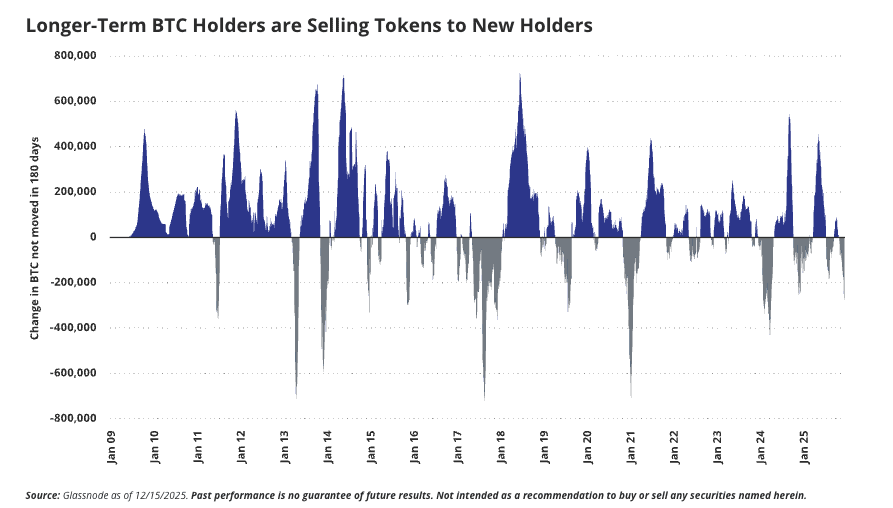
As mining pressures increase, VanEck points out that long-term institutional buyers are gradually stepping in, especially 'coin-hoarding companies' which have accelerated their buying on dips over the past month.
According to the report, from mid-November to mid-December, cryptocurrency reserve companies collectively purchased about 42,000 Bitcoins, reflecting a monthly increase of about 4%, raising the total holdings to approximately 1.09 million Bitcoins.
This is also the largest single-month institutional accumulation since mid-July to mid-August 2025 (when over 128,000 Bitcoins were added in a single month).
Looking ahead, VanEck believes that cryptocurrency reserve companies will gradually reduce the issuance of common stock (which dilutes equity) and instead raise funds through preferred stock as the main source of capital for purchasing Bitcoin.
"Is the 'miner capitulation' a signal for a price rise? VanEck: The sharp drop in Bitcoin's hash rate signals a bullish market is brewing." This article was first published on (Blockcast).
