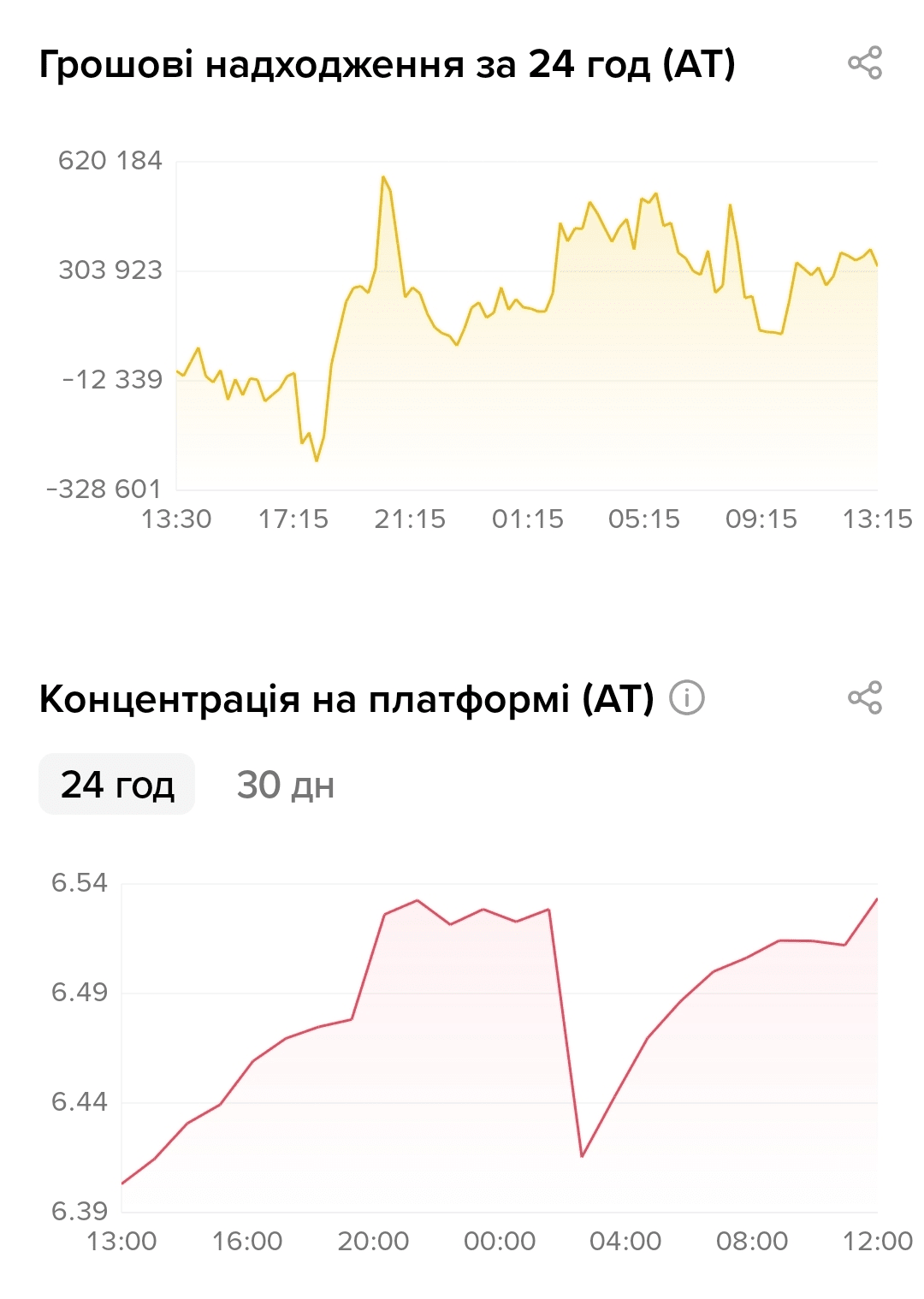
The day before yesterday I was sitting in the kitchen, brewing coffee, and suddenly I thought about a strange thing. We live in a world where there is no longer a single truth. Not in the sense of postmodernism or philosophy — in the literal technical sense. Everyone has their own internet, their own news, their own reality. And now blockchains have been added, where each chain has its own version of what is happening. And oracles like @APRO Oracle have to somehow glue all this together. But how?
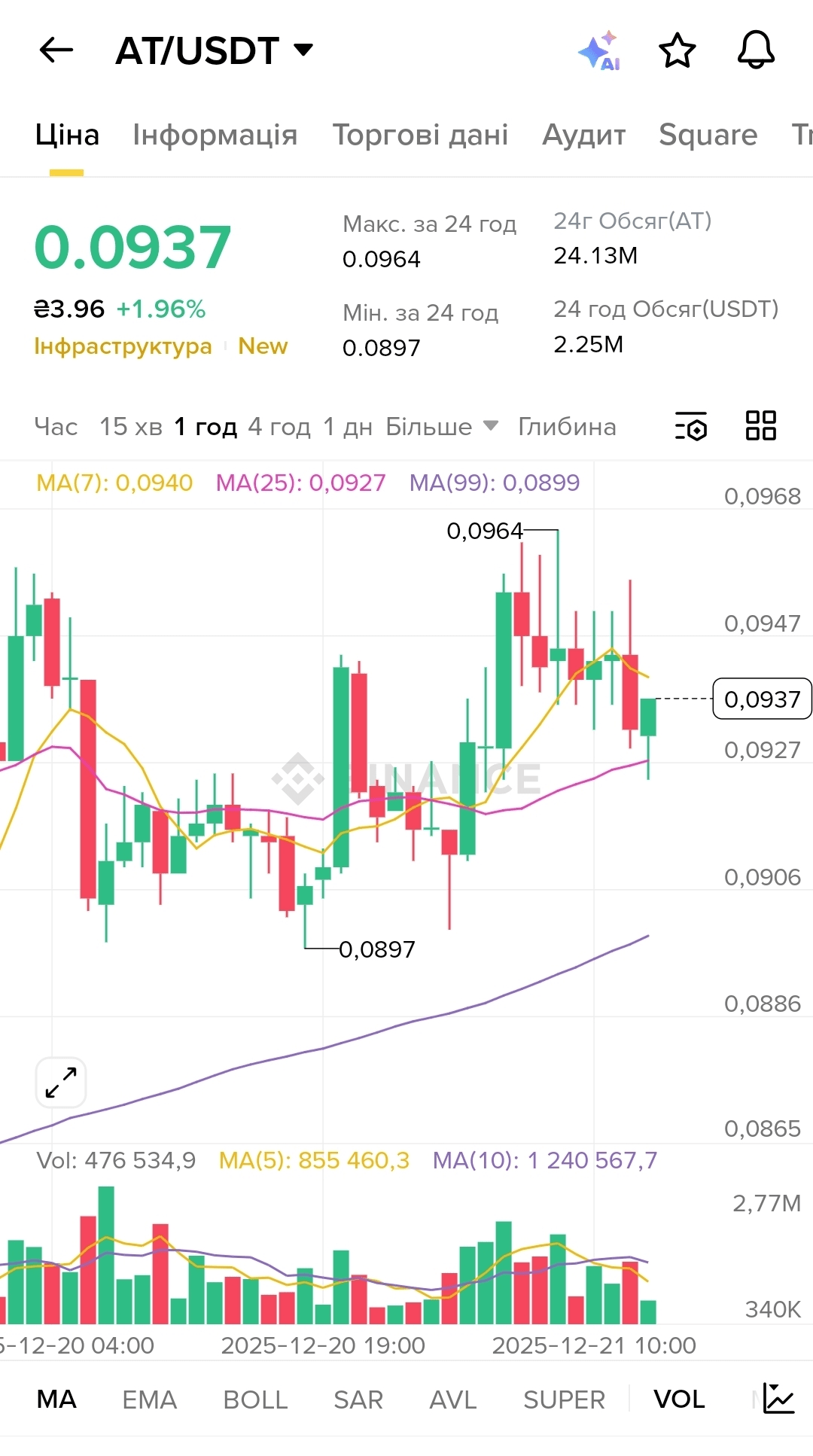
I am currently looking at $AT — the price is 0.0937, plus almost two percent, and I think: behind these numbers lies a huge invisible work of filtering, aggregating, interpreting reality. Every price, every event, every fact passes through dozens of points where someone or something decides — is this true or not? Is it relevant or not? Is it worth recording in an immutable blockchain or better to ignore?
Let's take a simple example with the price of Bitcoin. It seems that nothing could be simpler? Bitcoin costs a certain amount of dollars, all exchanges see this, the oracle takes this data and transmits it to the blockchain. But in reality, everything is wildly complicated. On Binance the price is one, on Coinbase another, on Kraken a third. The difference can be in hundreds of dollars. Which price is "correct"?
One can average. But which exchanges to consider? Top-10? Top-50? And what to do with small exchanges, where manipulation can occur — someone deliberately makes a massive deal to move the price, and if the oracle includes this exchange in its calculations, it will pass on distorted data. We need to filter out the outliers somehow. But how to determine what is an outlier and what is a legitimate price change?
#APRO works with forty blockchains and transmits all kinds of data — not just prices, but also sports results, weather, political events. And for each type of data, the problem stands in its own way. Sports results? Who determines the official result — the referees on the field, VAR, the federation? What to do if the result is later challenged and changed?
Weather? Sounds objective, but in reality, different weather stations can show different temperatures in the same city. Cloudy or sunny — this is generally subjective. Who decides which weather source is the "most correct"? And if this data is used for crop insurance — there are millions at stake.
Political events are a nightmare. "The president fulfilled the promise to lower taxes" — who determines this? Western media will say one thing, propaganda channels another, independent analysts a third. If @APRO-Oracle has to transmit this event for the prediction market, which source should it choose? And will this not be a political statement in itself?
Here we face a fundamental problem — in today's world, there are no neutral sources of information. Every media outlet, every platform, every algorithm has biases. Sometimes conscious, more often unconscious. And the oracle that selects these sources automatically inherits these biases.
I look at the trading volume — 2.25 million per day — and wonder how many people understand that their investments depend on someone else's decisions about which sources to trust? That behind every price update $AT there is an invisible hierarchy of trust built by the oracle developers?
There is also the problem of language and culture. Most data on the internet is in English. If @APRO-Oracle uses AI to verify news about events in Ukraine, and this AI is mainly trained on English texts from Western media — is the context lost? Is the picture distorted?
I remember how during the full-scale invasion, Western media often misnamed Ukrainian cities, confused facts, and did not understand the context. If the oracle relied solely on them, it would convey a distorted reality. But if it relied only on Ukrainian sources — it would be accused of bias. Where is the balance?
I am also concerned about the problem of "truth over time". Many things that seem true now turn out to be lies after months or years. Scientific studies are disproven. Witnesses change their testimonies. New facts emerge. But the blockchain is immutable. If the oracle recorded something as truth, it will forever remain in the chain, even if it later turns out that it was false.
One could say — well, the oracle just records the consensus at the moment of recording. But this means we are creating an immutable history that may be objectively wrong. And future generations, looking at the blockchain as the "source of truth", will see a distorted picture of the past.
Honestly, I don’t know how to solve this. Maybe oracles need a "history correction" mechanism — some way to mark that the data recorded earlier turned out to be inaccurate. But this undermines the entire concept of blockchain immutability. It opens the door to revisionism, to rewriting history.
Or perhaps we need a "multidimensional truth" system — where the oracle records not one version of the event, but several, from different sources, and smart contracts themselves decide which to trust. But this complicates everything to the point of impossibility. And who then bears responsibility if the contract chooses the wrong version?
I look at the maximum for the day — 0.0964 — and the minimum — 0.0897 — and think about the volatility not only of the price but also of the very concept of truth. In the digital world, truth has become as volatile as the price of a token. It fluctuates depending on who you ask, when you ask, and which algorithms you use.
@APRO-Oracle essentially acts as an epistemological arbiter — deciding what to consider knowledge and what to consider noise. But who gave it this right? The developers? The community? The algorithms? And can anyone be trusted with this role in a world where everyone has their own agenda?
Perhaps the solution lies not in finding the "most correct" source, but in the transparency of the selection process. If users could see which sources the oracle uses, how it weighs them, what criteria it applies — they could at least consciously assess the risk. Instead of the illusion of objectivity, there should be an honest acknowledgment of subjectivity.
But even transparency does not fully solve the problem. Because most people do not have the time or expertise to analyze the methodologies of oracles. They just want it to work. They want to trust that the data is correct. And this trust is a huge responsibility for a platform like $AT.
Another thing is the problem of "financialization of truth". When data from the oracle affects billions of dollars in smart contracts, there are huge incentives to manipulate sources. Bribing journalists, creating fake news sites, attacking legitimate sources. Truth becomes a commodity, and like any commodity, it is subject to market distortions.
I think about this and realize — we are creating an infrastructure for the future, not fully understanding the consequences. Oracles like #APRO will become a critical part of the digital economy. They will depend on finances, governance, possibly even political processes. And if the foundation is built on imperfect, biased, manipulated data sources — the whole system will inherit these problems.
I am not afraid of technical vulnerabilities — they can be fixed. I am afraid of the epistemological crisis we might create. A world where "truth" is defined by algorithms and economic incentives, rather than a shared search for understanding. Where everyone lives in their version of reality, supported by "objective data" from their favorite oracle.
Maybe I am dramatizing. Perhaps the industry will find ways to cope with this. Maybe new technologies will emerge — some zero-knowledge proofs of truth, or decentralized networks of verifiers, where no one has enough power to impose their version of truth. Perhaps AI will become smart enough to recognize biases and correct them.
Or maybe we need to accept that absolute objectivity does not exist. That any oracle is just one of the possible interpretations of reality. And instead of searching for a single truth, we should build systems that can work with multiple truths without falling into chaos.
I sit and look at this chart, see green candles, red candles, numbers, lines — and I understand that behind all this lies a much deeper problem. The problem of how we collectively define what is real. And whether we are ready to trust this definition to machines, algorithms, decentralized systems.
Honestly — I don’t know. But I do know that we need to talk about it. While there is still time to think, discuss, and find solutions. Because when oracles become fully embedded in all our infrastructure, changing anything will be almost impossible. And then we will be stuck with the version of "truth" that was encoded at early stages. With all its biases, limitations, and errors.