

#apro
apro
5.5M views
98,401 Discussing
Hot
Latest

·
--
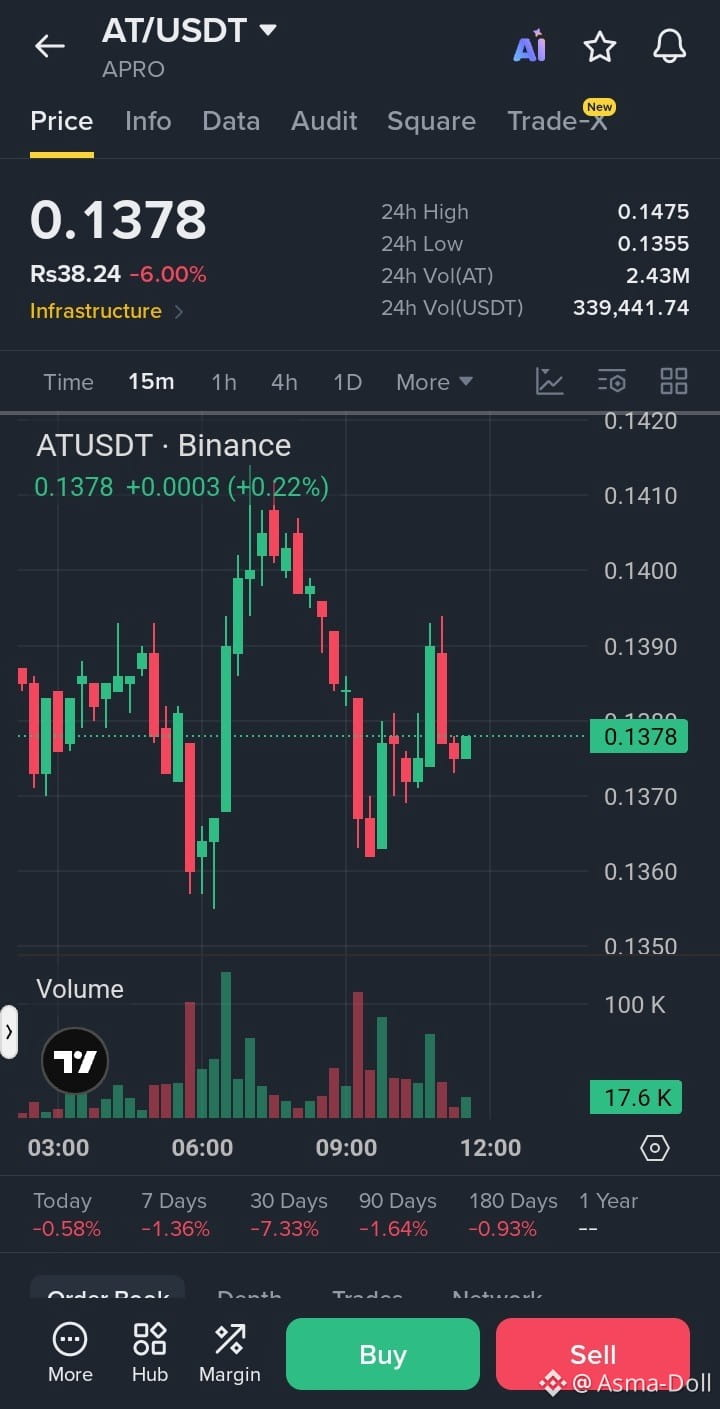
$AT /USDT (APRO) — SHORT 📉
Entry: 0.1375 – 0.1390
Stop Loss: 0.1430
TP1: 0.1355
TP2: 0.1320
TP3: 0.1280
Trade here $AT
{future}(ATUSDT)
Analysis:
Price is down ~6% and trading close to the 24h low 0.1355.
Weak recovery around 0.138 suggests sellers remain active.
Break below 0.1355 can trigger further downside.
Confirmation: 15m candle close below 0.1355 with rising volume.
If price reclaims 0.1430, invalidate the short setup.
#APRO #ATUSDT #Short #Binance #CryptoTrading
$AT /USDT (APRO) — SHORT 📉
Entry: 0.1375 – 0.1390
Stop Loss: 0.1430
TP1: 0.1355
TP2: 0.1320
TP3: 0.1280
Trade here $AT
Analysis:
Price is down ~6% and trading close to the 24h low 0.1355.
Weak recovery around 0.138 suggests sellers remain active.
Break below 0.1355 can trigger further downside.
Confirmation: 15m candle close below 0.1355 with rising volume.
If price reclaims 0.1430, invalidate the short setup.
#APRO #ATUSDT #Short #Binance #CryptoTrading
Entry: 0.1375 – 0.1390
Stop Loss: 0.1430
TP1: 0.1355
TP2: 0.1320
TP3: 0.1280
Trade here $AT
Analysis:
Price is down ~6% and trading close to the 24h low 0.1355.
Weak recovery around 0.138 suggests sellers remain active.
Break below 0.1355 can trigger further downside.
Confirmation: 15m candle close below 0.1355 with rising volume.
If price reclaims 0.1430, invalidate the short setup.
#APRO #ATUSDT #Short #Binance #CryptoTrading
164

·
--
Bullish
🔥 **AT/USDT (APRO) BULLISH CONSOLIDATION BREAKOUT SIGNAL** 🚀
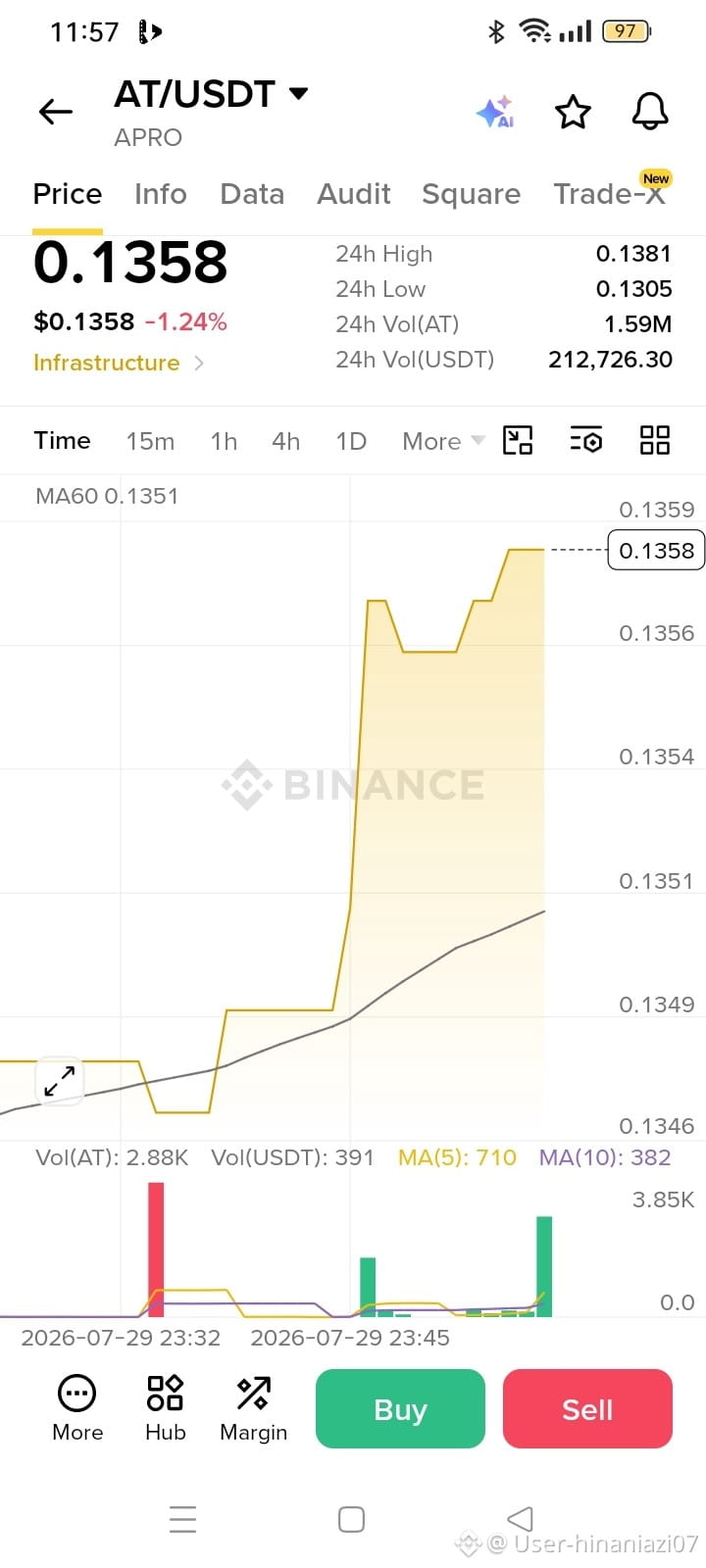
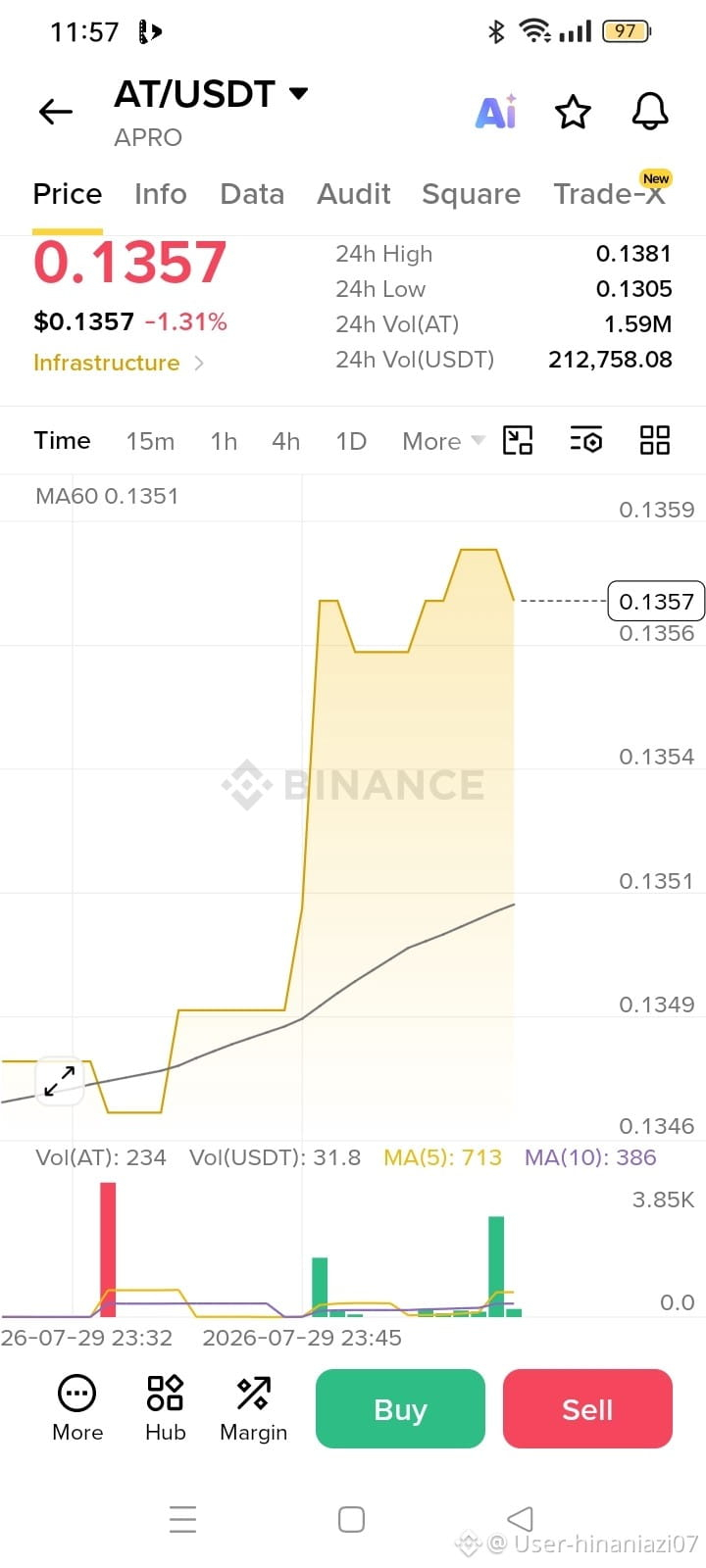
The single correct signal for **AT/USDT** based on price structure and high liquidity consolidation is **BULLISH** 🐂🟢. **APRO (AT)** is holding a strong bullish trend structure above key support levels ($0.1305), printing a steady **+1.79%** gain with robust 24-hour liquidity over **1.13M+ USDT**. As an infrastructure/AI oracle project, it is building heavy momentum for a push toward new local highs! 📈
$AT
{future}(ATUSDT)
💥 **Signal Type:** **STRONG BULLISH** 🐂🟢
📍 **Current Price:** $0.13650000
📊 **24h High:** $0.13670000
📉 **24h Low:** $0.13050000
💰 **24h Volume (USDT):** $1,138,171.48
⚡ **24h Volume (AT):** 8.45M+ AT
🏷️ **Category:** Infrastructure / Oracle Network
---
### 📊 Technical Setup & Key Drivers
1. **Steady Higher Lows:** Price defended the critical demand zone at **$0.1305** and is pushing right against daily resistance at **$0.1367**.
2. **Impending Breakout:** The current market price ($0.1365) is trading near the 24h peak ($0.1367). A clean 1-hour/4-hour candle close above **$0.1367** will trigger immediate buying momentum toward higher expansion levels.
3. **Solid Volume Support:** 8.45 Million+ AT tokens traded shows consistent institutional accumulation without sell pressure spikes.
---
### 🎯 Trade Parameters
* **Best Entry Zone:** $0.13400000 – $0.13650000
* **Target 1 (TP1):** $0.13670000 *(Breakout Level / Local High)* 🎯
* **Target 2 (TP2):** $0.14200000 🎯
* **Target 3 (TP3):** $0.15000000 🚀
* **Stop Loss (SL):** $0.12950000 *(Below 24h Low Support)* 🛑
---
### 💡 Strategy & Risk Management
Maintain a moderate leverage setup (3x to 5x for futures) and keep risk management strict. Set your Stop Loss firmly at **$0.12950000**. Once price clears Target 1 ($0.1367), trail your Stop Loss into profit to secure risk-free gains! 📈✨
---
#ATENCIÓN #APRO #cryptosignals
🔥 **AT/USDT (APRO) BULLISH CONSOLIDATION BREAKOUT SIGNAL** 🚀
The single correct signal for **AT/USDT** based on price structure and high liquidity consolidation is **BULLISH** 🐂🟢. **APRO (AT)** is holding a strong bullish trend structure above key support levels ($0.1305), printing a steady **+1.79%** gain with robust 24-hour liquidity over **1.13M+ USDT**. As an infrastructure/AI oracle project, it is building heavy momentum for a push toward new local highs! 📈
$AT
💥 **Signal Type:** **STRONG BULLISH** 🐂🟢
📍 **Current Price:** $0.13650000
📊 **24h High:** $0.13670000
📉 **24h Low:** $0.13050000
💰 **24h Volume (USDT):** $1,138,171.48
⚡ **24h Volume (AT):** 8.45M+ AT
🏷️ **Category:** Infrastructure / Oracle Network
---
### 📊 Technical Setup & Key Drivers
1. **Steady Higher Lows:** Price defended the critical demand zone at **$0.1305** and is pushing right against daily resistance at **$0.1367**.
2. **Impending Breakout:** The current market price ($0.1365) is trading near the 24h peak ($0.1367). A clean 1-hour/4-hour candle close above **$0.1367** will trigger immediate buying momentum toward higher expansion levels.
3. **Solid Volume Support:** 8.45 Million+ AT tokens traded shows consistent institutional accumulation without sell pressure spikes.
---
### 🎯 Trade Parameters
* **Best Entry Zone:** $0.13400000 – $0.13650000
* **Target 1 (TP1):** $0.13670000 *(Breakout Level / Local High)* 🎯
* **Target 2 (TP2):** $0.14200000 🎯
* **Target 3 (TP3):** $0.15000000 🚀
* **Stop Loss (SL):** $0.12950000 *(Below 24h Low Support)* 🛑
---
### 💡 Strategy & Risk Management
Maintain a moderate leverage setup (3x to 5x for futures) and keep risk management strict. Set your Stop Loss firmly at **$0.12950000**. Once price clears Target 1 ($0.1367), trail your Stop Loss into profit to secure risk-free gains! 📈✨
---
#ATENCIÓN #APRO #cryptosignals
The single correct signal for **AT/USDT** based on price structure and high liquidity consolidation is **BULLISH** 🐂🟢. **APRO (AT)** is holding a strong bullish trend structure above key support levels ($0.1305), printing a steady **+1.79%** gain with robust 24-hour liquidity over **1.13M+ USDT**. As an infrastructure/AI oracle project, it is building heavy momentum for a push toward new local highs! 📈
$AT
💥 **Signal Type:** **STRONG BULLISH** 🐂🟢
📍 **Current Price:** $0.13650000
📊 **24h High:** $0.13670000
📉 **24h Low:** $0.13050000
💰 **24h Volume (USDT):** $1,138,171.48
⚡ **24h Volume (AT):** 8.45M+ AT
🏷️ **Category:** Infrastructure / Oracle Network
---
### 📊 Technical Setup & Key Drivers
1. **Steady Higher Lows:** Price defended the critical demand zone at **$0.1305** and is pushing right against daily resistance at **$0.1367**.
2. **Impending Breakout:** The current market price ($0.1365) is trading near the 24h peak ($0.1367). A clean 1-hour/4-hour candle close above **$0.1367** will trigger immediate buying momentum toward higher expansion levels.
3. **Solid Volume Support:** 8.45 Million+ AT tokens traded shows consistent institutional accumulation without sell pressure spikes.
---
### 🎯 Trade Parameters
* **Best Entry Zone:** $0.13400000 – $0.13650000
* **Target 1 (TP1):** $0.13670000 *(Breakout Level / Local High)* 🎯
* **Target 2 (TP2):** $0.14200000 🎯
* **Target 3 (TP3):** $0.15000000 🚀
* **Stop Loss (SL):** $0.12950000 *(Below 24h Low Support)* 🛑
---
### 💡 Strategy & Risk Management
Maintain a moderate leverage setup (3x to 5x for futures) and keep risk management strict. Set your Stop Loss firmly at **$0.12950000**. Once price clears Target 1 ($0.1367), trail your Stop Loss into profit to secure risk-free gains! 📈✨
---
#ATENCIÓN #APRO #cryptosignals
1
117

·
--
I've been digging into APRO and it's one of those projects that doesn't get much attention compared to the big AI or meme narratives.
A few things that caught my eye:
🔸️ Low visibility compared to many projects with similar ambitions.
🔸️ Focus on infrastructure rather than hype. Not the kind of thing that trends every day, but sometimes that's where opportunities appear.
🔸️ Market still seems undecided. Some traders see potential, others don't care yet. That's usually more interesting to me than assets everyone already agrees on.
Now, let's be real:
⚠️ APRO isn't guaranteed to moon.
⚠️ It could underperform.
⚠️ Crypto is full of projects that looked promising and went nowhere.
But that's exactly why I'm watching it. The risk/reward profile feels more interesting than chasing tokens that already pumped 500%.
What I usually do with coins like this:
✔️ Read the docs.
✔️Check tokenomics.
✔️Watch volume and liquidity.
✔️ Open a small position first and let the market prove me right (or wrong).
Not financial advice, of course. Just sharing a project that's currently on my watchlist and its has kinda strong protection against this downtrend we all see
Have you looked into APRO yet? Bullish, bearish, or staying away?
$AT #APRO
{spot}(ATUSDT)
I've been digging into APRO and it's one of those projects that doesn't get much attention compared to the big AI or meme narratives.
A few things that caught my eye:
🔸️ Low visibility compared to many projects with similar ambitions.
🔸️ Focus on infrastructure rather than hype. Not the kind of thing that trends every day, but sometimes that's where opportunities appear.
🔸️ Market still seems undecided. Some traders see potential, others don't care yet. That's usually more interesting to me than assets everyone already agrees on.
Now, let's be real:
⚠️ APRO isn't guaranteed to moon.
⚠️ It could underperform.
⚠️ Crypto is full of projects that looked promising and went nowhere.
But that's exactly why I'm watching it. The risk/reward profile feels more interesting than chasing tokens that already pumped 500%.
What I usually do with coins like this:
✔️ Read the docs.
✔️Check tokenomics.
✔️Watch volume and liquidity.
✔️ Open a small position first and let the market prove me right (or wrong).
Not financial advice, of course. Just sharing a project that's currently on my watchlist and its has kinda strong protection against this downtrend we all see
Have you looked into APRO yet? Bullish, bearish, or staying away?
$AT #APRO
A few things that caught my eye:
🔸️ Low visibility compared to many projects with similar ambitions.
🔸️ Focus on infrastructure rather than hype. Not the kind of thing that trends every day, but sometimes that's where opportunities appear.
🔸️ Market still seems undecided. Some traders see potential, others don't care yet. That's usually more interesting to me than assets everyone already agrees on.
Now, let's be real:
⚠️ APRO isn't guaranteed to moon.
⚠️ It could underperform.
⚠️ Crypto is full of projects that looked promising and went nowhere.
But that's exactly why I'm watching it. The risk/reward profile feels more interesting than chasing tokens that already pumped 500%.
What I usually do with coins like this:
✔️ Read the docs.
✔️Check tokenomics.
✔️Watch volume and liquidity.
✔️ Open a small position first and let the market prove me right (or wrong).
Not financial advice, of course. Just sharing a project that's currently on my watchlist and its has kinda strong protection against this downtrend we all see
Have you looked into APRO yet? Bullish, bearish, or staying away?
$AT #APRO
175

#APRO
🔍 $AT Price Outlook: Real Focus on Profit or Macroeconomic Pressure?
Short-Term Volatility or Foundation for Future Growth? We analyze the key factors that will determine the $AT price movement in the near future.
1️⃣ 🚀 Adoption and Integrations: The Foundation is Growing
Reality: The protocol is already running on over 40 blockchains. An important marker is the launch of a key integration with Arbitrum and a steady weekly increase in AI oracle calls.
Price Impact: DeFi, RWA and prediction markets are creating real demand for the network. If the economic model effectively links this activity to the token (via staking or fees), we will see strong structural demand. However, the fight for market share with giants like Chainlink still leaves this factor moderately speculative.
2️⃣ 📊 Exchange Liquidity: A Double-edged Sword
Pros: The airdrop and listing on Binance, as well as the appearance on Bitrue and Tapbit, provided the token with strong visibility and initial capital inflows.
Cons: The recent removal of the AT/BNB trading pair on Binance may slightly reduce accessibility for some of the audience and provoke local volatility. Risks for short-term traders are increasing.
3️⃣ 📉 Market sentiment: Altcoins under pressure
Macro picture: The crypto market is currently in the “Fear” zone, with Bitcoin dominance remaining high (over 58%).
What this means: Oracles are high-beta assets. As long as capital is focused on BTC and the AltSeason index is stagnating at 46, APRO will find it difficult to go against the tide. The price will remain dependent on the overall risk appetite of investors.
⚠️ Summary for holders
APRO's medium-term success directly depends on the project's ability to convert cool technical integrations (such as with Arbitrum) into real utility and demand for the token. While the macroeconomic background is stormy, the investor's main weapon is patience and monitoring the ecosystem.
{future}(ATUSDT)
#APRO
🔍 $AT Price Outlook: Real Focus on Profit or Macroeconomic Pressure?
Short-Term Volatility or Foundation for Future Growth? We analyze the key factors that will determine the $AT price movement in the near future.
1️⃣ 🚀 Adoption and Integrations: The Foundation is Growing
Reality: The protocol is already running on over 40 blockchains. An important marker is the launch of a key integration with Arbitrum and a steady weekly increase in AI oracle calls.
Price Impact: DeFi, RWA and prediction markets are creating real demand for the network. If the economic model effectively links this activity to the token (via staking or fees), we will see strong structural demand. However, the fight for market share with giants like Chainlink still leaves this factor moderately speculative.
2️⃣ 📊 Exchange Liquidity: A Double-edged Sword
Pros: The airdrop and listing on Binance, as well as the appearance on Bitrue and Tapbit, provided the token with strong visibility and initial capital inflows.
Cons: The recent removal of the AT/BNB trading pair on Binance may slightly reduce accessibility for some of the audience and provoke local volatility. Risks for short-term traders are increasing.
3️⃣ 📉 Market sentiment: Altcoins under pressure
Macro picture: The crypto market is currently in the “Fear” zone, with Bitcoin dominance remaining high (over 58%).
What this means: Oracles are high-beta assets. As long as capital is focused on BTC and the AltSeason index is stagnating at 46, APRO will find it difficult to go against the tide. The price will remain dependent on the overall risk appetite of investors.
⚠️ Summary for holders
APRO's medium-term success directly depends on the project's ability to convert cool technical integrations (such as with Arbitrum) into real utility and demand for the token. While the macroeconomic background is stormy, the investor's main weapon is patience and monitoring the ecosystem.
🔍 $AT Price Outlook: Real Focus on Profit or Macroeconomic Pressure?
Short-Term Volatility or Foundation for Future Growth? We analyze the key factors that will determine the $AT price movement in the near future.
1️⃣ 🚀 Adoption and Integrations: The Foundation is Growing
Reality: The protocol is already running on over 40 blockchains. An important marker is the launch of a key integration with Arbitrum and a steady weekly increase in AI oracle calls.
Price Impact: DeFi, RWA and prediction markets are creating real demand for the network. If the economic model effectively links this activity to the token (via staking or fees), we will see strong structural demand. However, the fight for market share with giants like Chainlink still leaves this factor moderately speculative.
2️⃣ 📊 Exchange Liquidity: A Double-edged Sword
Pros: The airdrop and listing on Binance, as well as the appearance on Bitrue and Tapbit, provided the token with strong visibility and initial capital inflows.
Cons: The recent removal of the AT/BNB trading pair on Binance may slightly reduce accessibility for some of the audience and provoke local volatility. Risks for short-term traders are increasing.
3️⃣ 📉 Market sentiment: Altcoins under pressure
Macro picture: The crypto market is currently in the “Fear” zone, with Bitcoin dominance remaining high (over 58%).
What this means: Oracles are high-beta assets. As long as capital is focused on BTC and the AltSeason index is stagnating at 46, APRO will find it difficult to go against the tide. The price will remain dependent on the overall risk appetite of investors.
⚠️ Summary for holders
APRO's medium-term success directly depends on the project's ability to convert cool technical integrations (such as with Arbitrum) into real utility and demand for the token. While the macroeconomic background is stormy, the investor's main weapon is patience and monitoring the ecosystem.

1
135

🚀 Just explored the APRO documentation and it's clear the team is focused on building a developer-friendly ecosystem.
Well-structured docs, a straightforward onboarding experience, and the resources developers need to start building with confidence. Great documentation is one of the strongest indicators of a project's long-term potential.
If you're building in Web3, it's worth checking out and following the project's progress.
#APRO #Web3 #blockchain #DeFi: #Developers #Crypto #BuildInPublic
🚀 Just explored the APRO documentation and it's clear the team is focused on building a developer-friendly ecosystem.
Well-structured docs, a straightforward onboarding experience, and the resources developers need to start building with confidence. Great documentation is one of the strongest indicators of a project's long-term potential.
If you're building in Web3, it's worth checking out and following the project's progress.
#APRO #Web3 #blockchain #DeFi: #Developers #Crypto #BuildInPublic
Well-structured docs, a straightforward onboarding experience, and the resources developers need to start building with confidence. Great documentation is one of the strongest indicators of a project's long-term potential.
If you're building in Web3, it's worth checking out and following the project's progress.
#APRO #Web3 #blockchain #DeFi: #Developers #Crypto #BuildInPublic
96

·
--
🚨 URGENT: WILL AT/USDT BREAK OUT OR BREAK DOWN? UNDERSTAND THE MOVE RIGHT NOW! 🚨
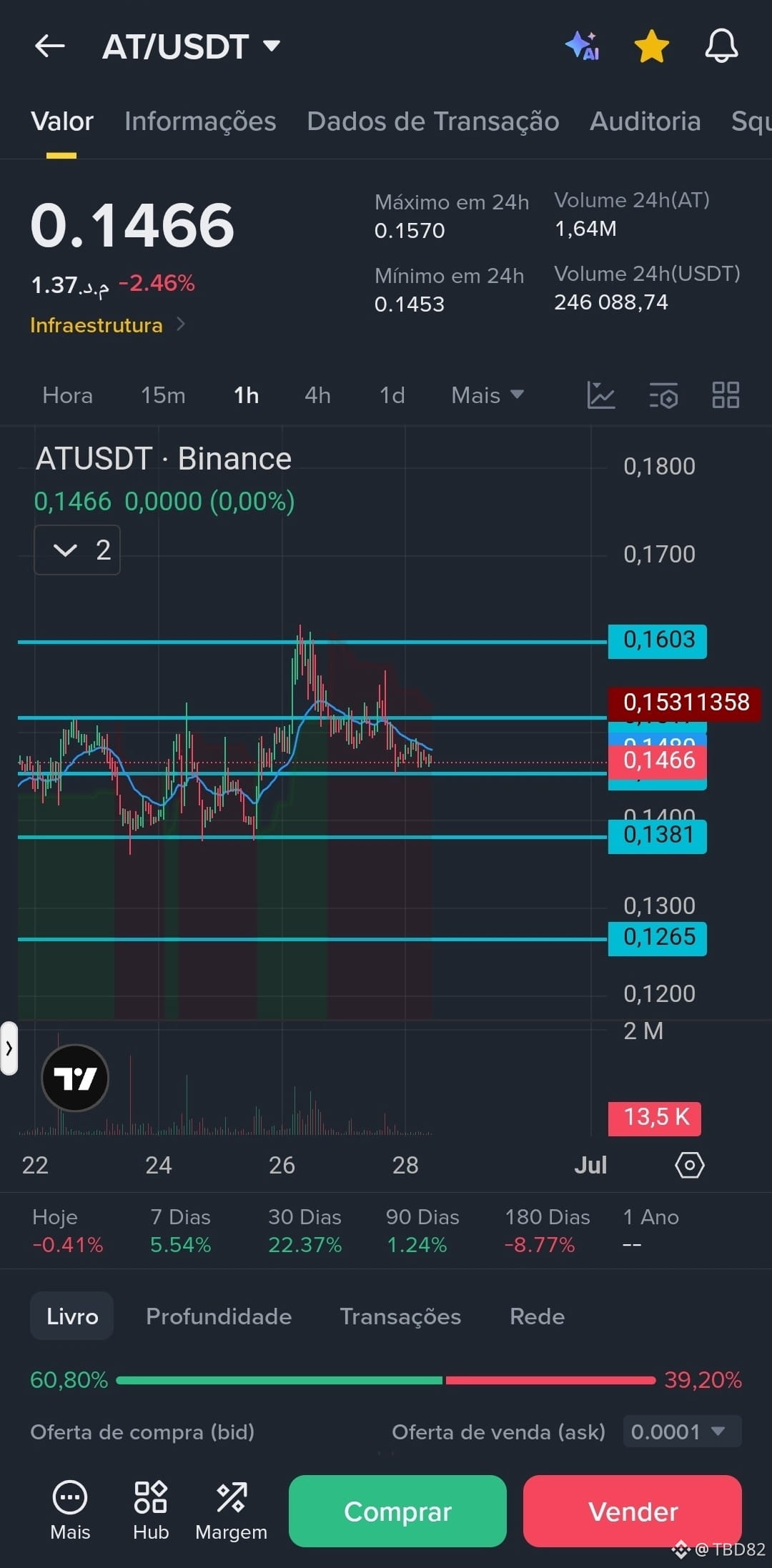
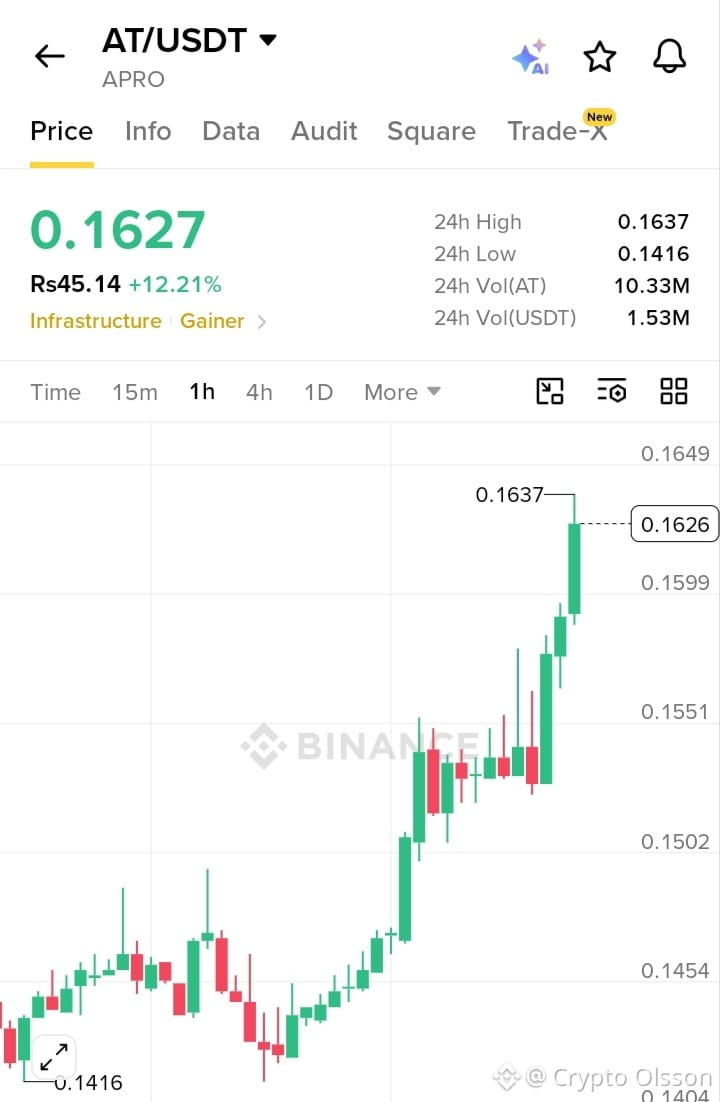
The AT token (APRO) is consolidating at $0.1466 (-2.46%), but the clock is ticking! ⏳ If you’re already positioned or thinking about entering, pay close attention to these crucial technical factors in the coming hours:
📈 THE BULLISH SIDE (UP):
Strategic integrations with BNB Chain and ListaDAO have drastically increased the usefulness of oracles for RWAs and DeFi. The community is anticipating a breakout! Strong support in the $0.1381 to $0.1400 region has been holding the price firmly.
📉 THE BEARISH RISK (DOWN):
Short-term momentum has slowed down. The MACD on the 1H chart shows negative histograms and the price has pulled back slightly. Also, daily liquidity is reduced (Volume: 1.64M), meaning any whale could move the market suddenly. If support at $0.1381 is lost, the next target is $0.1265. But if the RSI signals oversold and volume comes in, we’ll quickly go after resistance at $0.1603!
🎯 PROFITABLE STRATEGY: Don’t trade in the dark! Wait for volume confirmation before opening your position.
👉 Want to make big profits with exclusive analyses before everyone else? Click FOLLOW my profile now so you don’t miss the next market signals and explosive updates! 🚀
#BinanceSquare #CryptoAnalise #APRO #trading #Altcoins $BTC $SPCXB $AT
{spot}(ATUSDT)
🚨 URGENT: WILL AT/USDT BREAK OUT OR BREAK DOWN? UNDERSTAND THE MOVE RIGHT NOW! 🚨
The AT token (APRO) is consolidating at $0.1466 (-2.46%), but the clock is ticking! ⏳ If you’re already positioned or thinking about entering, pay close attention to these crucial technical factors in the coming hours:
📈 THE BULLISH SIDE (UP):
Strategic integrations with BNB Chain and ListaDAO have drastically increased the usefulness of oracles for RWAs and DeFi. The community is anticipating a breakout! Strong support in the $0.1381 to $0.1400 region has been holding the price firmly.
📉 THE BEARISH RISK (DOWN):
Short-term momentum has slowed down. The MACD on the 1H chart shows negative histograms and the price has pulled back slightly. Also, daily liquidity is reduced (Volume: 1.64M), meaning any whale could move the market suddenly. If support at $0.1381 is lost, the next target is $0.1265. But if the RSI signals oversold and volume comes in, we’ll quickly go after resistance at $0.1603!
🎯 PROFITABLE STRATEGY: Don’t trade in the dark! Wait for volume confirmation before opening your position.
👉 Want to make big profits with exclusive analyses before everyone else? Click FOLLOW my profile now so you don’t miss the next market signals and explosive updates! 🚀
#BinanceSquare #CryptoAnalise #APRO #trading #Altcoins $BTC $SPCXB $AT
The AT token (APRO) is consolidating at $0.1466 (-2.46%), but the clock is ticking! ⏳ If you’re already positioned or thinking about entering, pay close attention to these crucial technical factors in the coming hours:
📈 THE BULLISH SIDE (UP):
Strategic integrations with BNB Chain and ListaDAO have drastically increased the usefulness of oracles for RWAs and DeFi. The community is anticipating a breakout! Strong support in the $0.1381 to $0.1400 region has been holding the price firmly.
📉 THE BEARISH RISK (DOWN):
Short-term momentum has slowed down. The MACD on the 1H chart shows negative histograms and the price has pulled back slightly. Also, daily liquidity is reduced (Volume: 1.64M), meaning any whale could move the market suddenly. If support at $0.1381 is lost, the next target is $0.1265. But if the RSI signals oversold and volume comes in, we’ll quickly go after resistance at $0.1603!
🎯 PROFITABLE STRATEGY: Don’t trade in the dark! Wait for volume confirmation before opening your position.
👉 Want to make big profits with exclusive analyses before everyone else? Click FOLLOW my profile now so you don’t miss the next market signals and explosive updates! 🚀
#BinanceSquare #CryptoAnalise #APRO #trading #Altcoins $BTC $SPCXB $AT
210



·
--
$APRO POWERS LISTA DAO'S BSTORKS INTEGRATION — ECOSYSTEM EXPANDING 🚀
APRO is now providing price feed services for six new bStock trading pairs on Lista DAO through the MORE program. This adds MSFTB, METAB, LITEB, PLTRB, QQQB, and SKHYB to the existing coverage.
The multi-oracle structure eliminates single-point-of-failure risk while stabilizing pricing across tokenized equities. With bStocks growing rapidly on BNB Chain, APRO's role as the primary oracle provider gives it structural demand that isn't priced in yet.
Does this move strengthen $APRO 's position as the go-to oracle for BNB Chain synthetic assets?
Not financial advice. Always manage your risk.
#APRO #LISTA #Oracle #bStocks #BNBChain
🔥
$APRO POWERS LISTA DAO'S BSTORKS INTEGRATION — ECOSYSTEM EXPANDING 🚀
APRO is now providing price feed services for six new bStock trading pairs on Lista DAO through the MORE program. This adds MSFTB, METAB, LITEB, PLTRB, QQQB, and SKHYB to the existing coverage.
The multi-oracle structure eliminates single-point-of-failure risk while stabilizing pricing across tokenized equities. With bStocks growing rapidly on BNB Chain, APRO's role as the primary oracle provider gives it structural demand that isn't priced in yet.
Does this move strengthen $APRO 's position as the go-to oracle for BNB Chain synthetic assets?
Not financial advice. Always manage your risk.
#APRO #LISTA #Oracle #bStocks #BNBChain
🔥
APRO is now providing price feed services for six new bStock trading pairs on Lista DAO through the MORE program. This adds MSFTB, METAB, LITEB, PLTRB, QQQB, and SKHYB to the existing coverage.
The multi-oracle structure eliminates single-point-of-failure risk while stabilizing pricing across tokenized equities. With bStocks growing rapidly on BNB Chain, APRO's role as the primary oracle provider gives it structural demand that isn't priced in yet.
Does this move strengthen $APRO 's position as the go-to oracle for BNB Chain synthetic assets?
Not financial advice. Always manage your risk.
#APRO #LISTA #Oracle #bStocks #BNBChain
🔥
100

$APRO JUST LANDED A MAJOR ORACLE DEAL THAT FEW ARE TALKING ABOUT 🚀
APRO's MORE program just added Lista DAO, bringing price feeds for six new Binance bStocks pairs — MSFTB, METAB, LITEB, PLTRB, QQQB, SKHYB — alongside existing assets like NVDAB and TSLAB. This isn't a tiny update; it's APRO positioning as the go-to oracle for tokenized stocks on BNB Chain. With bStocks volume growing, the demand for reliable price data is non-negotiable.
The team says they now offer the most comprehensive coverage in the bStocks space. That's a narrative that tends to attract volume when the market catches on. Are you watching the $APRO chart for a volume spike?
Not financial advice. Always manage your risk.
#APRO #Oracle #BNBChain #DeFi #bStocks
🔥
$APRO JUST LANDED A MAJOR ORACLE DEAL THAT FEW ARE TALKING ABOUT 🚀
APRO's MORE program just added Lista DAO, bringing price feeds for six new Binance bStocks pairs — MSFTB, METAB, LITEB, PLTRB, QQQB, SKHYB — alongside existing assets like NVDAB and TSLAB. This isn't a tiny update; it's APRO positioning as the go-to oracle for tokenized stocks on BNB Chain. With bStocks volume growing, the demand for reliable price data is non-negotiable.
The team says they now offer the most comprehensive coverage in the bStocks space. That's a narrative that tends to attract volume when the market catches on. Are you watching the $APRO chart for a volume spike?
Not financial advice. Always manage your risk.
#APRO #Oracle #BNBChain #DeFi #bStocks
🔥
APRO's MORE program just added Lista DAO, bringing price feeds for six new Binance bStocks pairs — MSFTB, METAB, LITEB, PLTRB, QQQB, SKHYB — alongside existing assets like NVDAB and TSLAB. This isn't a tiny update; it's APRO positioning as the go-to oracle for tokenized stocks on BNB Chain. With bStocks volume growing, the demand for reliable price data is non-negotiable.
The team says they now offer the most comprehensive coverage in the bStocks space. That's a narrative that tends to attract volume when the market catches on. Are you watching the $APRO chart for a volume spike?
Not financial advice. Always manage your risk.
#APRO #Oracle #BNBChain #DeFi #bStocks
🔥
83


·
--
#USPARITYCryptoTaxBill
Digital Asset Protection, Accountability, Regulation, Innovation, Taxation & Yields (PARITY) Act
BACKGROUND
This bill was officially introduced on May 19, 2026, by a bipartisan group from the House Ways and Means Committee — Rep. Steven Horsford (D-Nev.), Suzan DelBene (D-Wash.), Max Miller (R-Ohio), and Mike Carey (R-Ohio).
This didn't just pop up out of nowhere — the PARITY Act first dropped as a discussion draft back in December 2025, then got re-released in March 2026 for further review.
$AT @APRO-Oracle #APRO
{spot}(ATUSDT)
#USPARITYCryptoTaxBill
Digital Asset Protection, Accountability, Regulation, Innovation, Taxation & Yields (PARITY) Act
BACKGROUND
This bill was officially introduced on May 19, 2026, by a bipartisan group from the House Ways and Means Committee — Rep. Steven Horsford (D-Nev.), Suzan DelBene (D-Wash.), Max Miller (R-Ohio), and Mike Carey (R-Ohio).
This didn't just pop up out of nowhere — the PARITY Act first dropped as a discussion draft back in December 2025, then got re-released in March 2026 for further review.
$AT @APRO Oracle #APRO
Digital Asset Protection, Accountability, Regulation, Innovation, Taxation & Yields (PARITY) Act
BACKGROUND
This bill was officially introduced on May 19, 2026, by a bipartisan group from the House Ways and Means Committee — Rep. Steven Horsford (D-Nev.), Suzan DelBene (D-Wash.), Max Miller (R-Ohio), and Mike Carey (R-Ohio).
This didn't just pop up out of nowhere — the PARITY Act first dropped as a discussion draft back in December 2025, then got re-released in March 2026 for further review.
$AT @APRO Oracle #APRO
1
1
313

·
--
Bullish
In the name of Allah, the Most Gracious, the Most Merciful
Peace be upon you, and Allah’s mercy and blessings
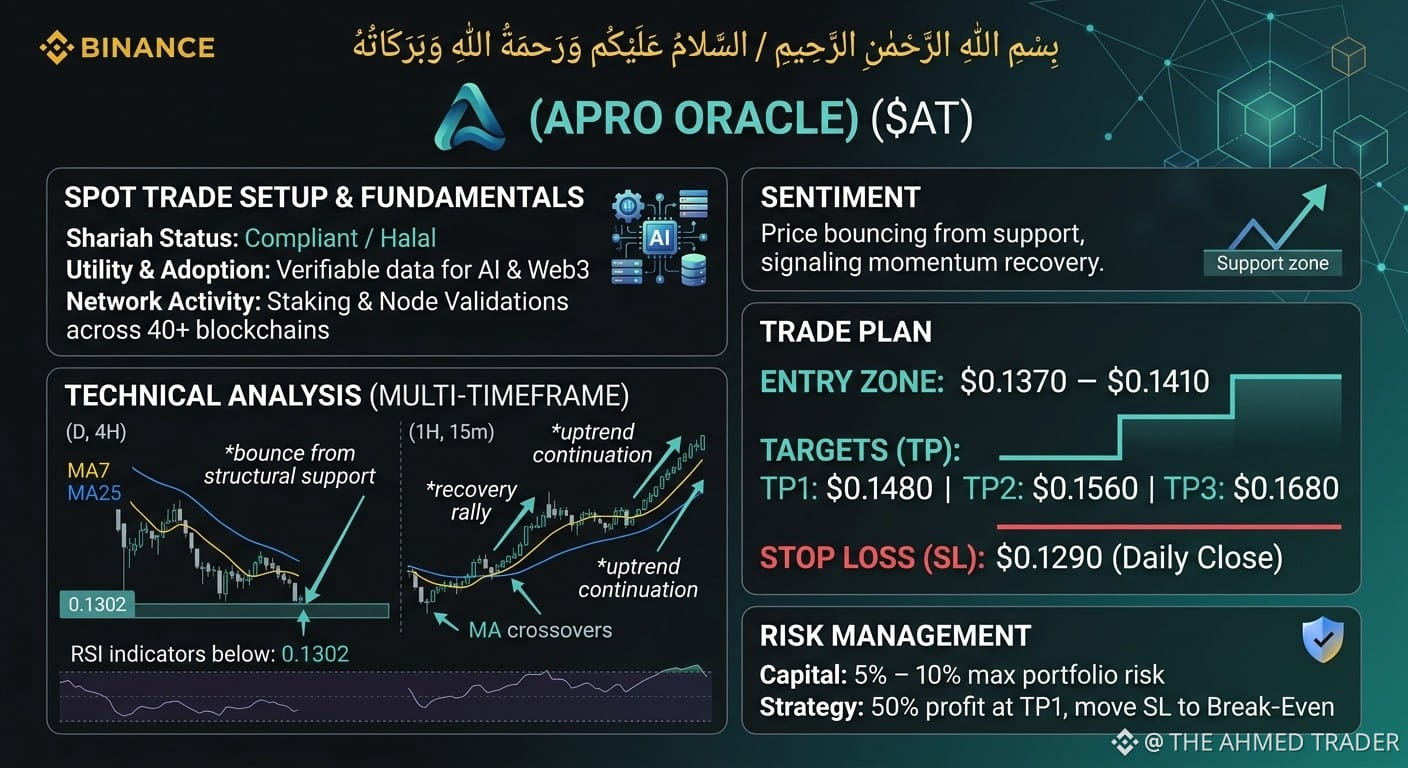
📊 $AT APRO ORACLE) SPOT TRADE SETUP
Shariah Status: Compliant / Halal (AI-Driven Decentralized Oracle Protocol for Bitcoin & Web3 Data Feeds)
Utility & Adoption: Provides verifiable price feeds and off-chain data to AI agents, BTCFi, and multi-chain smart contracts.
Network & Activity: Staking and node validations ensure real-time data delivery across 40+ blockchains.
Sentiment: Price bouncing from the strong $0.1302–$0.1355 support zone, signaling momentum recovery.
📈 MULTI-TIMEFRAME TECHNICALS
1D Frame: $0.1404 | Base consolidation above the structural low ($0.0948); holding below MA7 ($0.1475) & MA25 ($0.1432); RSI 47.81.
4H Frame: $0.1404 | Rebounding off the swing bottom ($0.1302); MA7 ($0.1394) crossing near MA25 ($0.1461); RSI 43.84.
1H Frame: $0.1404 | Recovery rally from the $0.1345 low; MA7 ($0.1392) crossing above MA25 ($0.1398); RSI 46.35.
15m Frame: $0.1404 | Micro uptrend continuation from the $0.1355 bottom; MA7 ($0.1403) riding above MA25 ($0.1391); RSI 55.25.
🎯 SPOT TRADE SETUP
📍 Entry Zone: $0.1370 – $0.1410
🎯 TP1: $0.1480 | TP2: $0.1560 | TP3: $0.1680
⛔ Stop Loss (SL): $0.1290 (Daily Close)
💡 RISK MANAGEMENT
Capital: Maximum 5% – 10% portfolio risk.
Strategy: Take 50% profit at TP1 and move SL to Break-Even for a risk-free trade.
{spot}(ATUSDT)
#AT #APRO #CryptoAnalysis #TradingSetup #BinanceSquare
In the name of Allah, the Most Gracious, the Most Merciful
Peace be upon you, and Allah’s mercy and blessings
📊 $AT APRO ORACLE) SPOT TRADE SETUP
Shariah Status: Compliant / Halal (AI-Driven Decentralized Oracle Protocol for Bitcoin & Web3 Data Feeds)
Utility & Adoption: Provides verifiable price feeds and off-chain data to AI agents, BTCFi, and multi-chain smart contracts.
Network & Activity: Staking and node validations ensure real-time data delivery across 40+ blockchains.
Sentiment: Price bouncing from the strong $0.1302–$0.1355 support zone, signaling momentum recovery.
📈 MULTI-TIMEFRAME TECHNICALS
1D Frame: $0.1404 | Base consolidation above the structural low ($0.0948); holding below MA7 ($0.1475) & MA25 ($0.1432); RSI 47.81.
4H Frame: $0.1404 | Rebounding off the swing bottom ($0.1302); MA7 ($0.1394) crossing near MA25 ($0.1461); RSI 43.84.
1H Frame: $0.1404 | Recovery rally from the $0.1345 low; MA7 ($0.1392) crossing above MA25 ($0.1398); RSI 46.35.
15m Frame: $0.1404 | Micro uptrend continuation from the $0.1355 bottom; MA7 ($0.1403) riding above MA25 ($0.1391); RSI 55.25.
🎯 SPOT TRADE SETUP
📍 Entry Zone: $0.1370 – $0.1410
🎯 TP1: $0.1480 | TP2: $0.1560 | TP3: $0.1680
⛔ Stop Loss (SL): $0.1290 (Daily Close)
💡 RISK MANAGEMENT
Capital: Maximum 5% – 10% portfolio risk.
Strategy: Take 50% profit at TP1 and move SL to Break-Even for a risk-free trade.
#AT #APRO #CryptoAnalysis #TradingSetup #BinanceSquare
Peace be upon you, and Allah’s mercy and blessings
📊 $AT APRO ORACLE) SPOT TRADE SETUP
Shariah Status: Compliant / Halal (AI-Driven Decentralized Oracle Protocol for Bitcoin & Web3 Data Feeds)
Utility & Adoption: Provides verifiable price feeds and off-chain data to AI agents, BTCFi, and multi-chain smart contracts.
Network & Activity: Staking and node validations ensure real-time data delivery across 40+ blockchains.
Sentiment: Price bouncing from the strong $0.1302–$0.1355 support zone, signaling momentum recovery.
📈 MULTI-TIMEFRAME TECHNICALS
1D Frame: $0.1404 | Base consolidation above the structural low ($0.0948); holding below MA7 ($0.1475) & MA25 ($0.1432); RSI 47.81.
4H Frame: $0.1404 | Rebounding off the swing bottom ($0.1302); MA7 ($0.1394) crossing near MA25 ($0.1461); RSI 43.84.
1H Frame: $0.1404 | Recovery rally from the $0.1345 low; MA7 ($0.1392) crossing above MA25 ($0.1398); RSI 46.35.
15m Frame: $0.1404 | Micro uptrend continuation from the $0.1355 bottom; MA7 ($0.1403) riding above MA25 ($0.1391); RSI 55.25.
🎯 SPOT TRADE SETUP
📍 Entry Zone: $0.1370 – $0.1410
🎯 TP1: $0.1480 | TP2: $0.1560 | TP3: $0.1680
⛔ Stop Loss (SL): $0.1290 (Daily Close)
💡 RISK MANAGEMENT
Capital: Maximum 5% – 10% portfolio risk.
Strategy: Take 50% profit at TP1 and move SL to Break-Even for a risk-free trade.
#AT #APRO #CryptoAnalysis #TradingSetup #BinanceSquare
86

·
--
Bearish
🔴 $AT — SHORT SIGNAL
📊 Conviction: 91.7%
⚖️ R:R: Up to 1:2.18
🎯 Entry: $0.1430–$0.1440
🛑 SL: $0.1520 (+5.9%)
🎯 TP1: $0.1345 (-6.3%)
🎯 TP2: $0.1300 (-9.4%)
🎯 TP3: $0.1250 (-12.9%)
🔥 Key Signals:
• Top Trader Ratio: 6.80 → 6.31 ↓
• Support $0.1400 under pressure
• OI ~57.8M, contracting from peak
• Funding +0.0050%
• Basis near zero/negative
• Repeated taker-sell spikes
• Retail accounts heavily short-biased
⚡ Confirmation: 15m/1H close below $0.1400 with strong sell volume.
❌ Invalidation: Sustained reclaim above $0.1520.
⚠️ Retail shorts are already crowded, so a relief squeeze is possible. Manage risk carefully.
#AT #APRO #Crypto #Futures #Trading
{future}(ATUSDT)
🔴 $AT — SHORT SIGNAL
📊 Conviction: 91.7%
⚖️ R:R: Up to 1:2.18
🎯 Entry: $0.1430–$0.1440
🛑 SL: $0.1520 (+5.9%)
🎯 TP1: $0.1345 (-6.3%)
🎯 TP2: $0.1300 (-9.4%)
🎯 TP3: $0.1250 (-12.9%)
🔥 Key Signals:
• Top Trader Ratio: 6.80 → 6.31 ↓
• Support $0.1400 under pressure
• OI ~57.8M, contracting from peak
• Funding +0.0050%
• Basis near zero/negative
• Repeated taker-sell spikes
• Retail accounts heavily short-biased
⚡ Confirmation: 15m/1H close below $0.1400 with strong sell volume.
❌ Invalidation: Sustained reclaim above $0.1520.
⚠️ Retail shorts are already crowded, so a relief squeeze is possible. Manage risk carefully.
#AT #APRO #Crypto #Futures #Trading
📊 Conviction: 91.7%
⚖️ R:R: Up to 1:2.18
🎯 Entry: $0.1430–$0.1440
🛑 SL: $0.1520 (+5.9%)
🎯 TP1: $0.1345 (-6.3%)
🎯 TP2: $0.1300 (-9.4%)
🎯 TP3: $0.1250 (-12.9%)
🔥 Key Signals:
• Top Trader Ratio: 6.80 → 6.31 ↓
• Support $0.1400 under pressure
• OI ~57.8M, contracting from peak
• Funding +0.0050%
• Basis near zero/negative
• Repeated taker-sell spikes
• Retail accounts heavily short-biased
⚡ Confirmation: 15m/1H close below $0.1400 with strong sell volume.
❌ Invalidation: Sustained reclaim above $0.1520.
⚠️ Retail shorts are already crowded, so a relief squeeze is possible. Manage risk carefully.
#AT #APRO #Crypto #Futures #Trading

69
·
--
Bullish
السلام عليكم ورحمة الله وبركاته
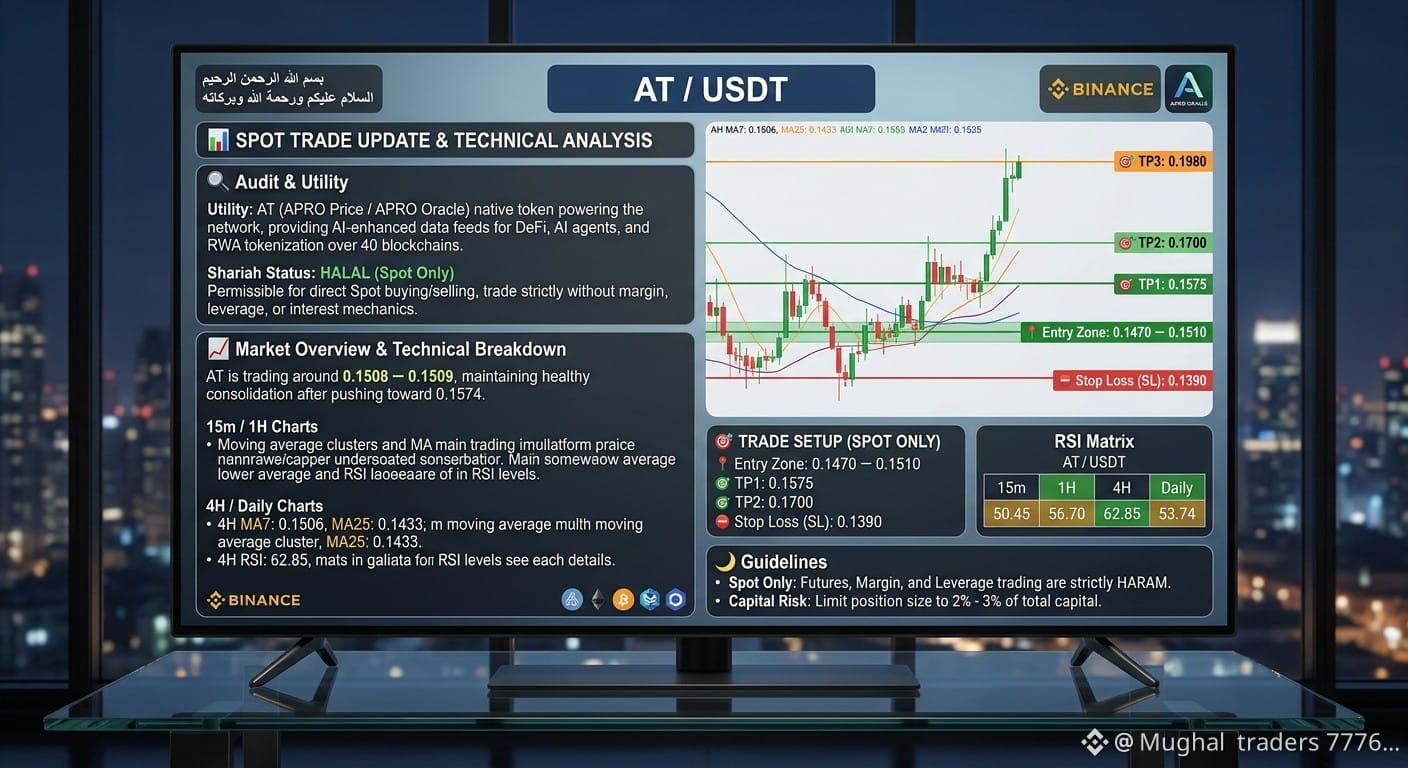
📊 SPOT TRADE UPDATE & TECHNICAL ANALYSIS: $AT / USDT
🔍 Audit & Utility
Utility: $AT is the native utility, staking, and governance token powering the APRO Oracle network. It provides AI-enhanced, decentralized real-world data feeds across over 40 blockchains for DeFi, AI agents, and Real-World Asset (RWA) tokenization.
Shariah Status: HALAL (Spot Only) (Permissible for direct Spot buying and selling as a decentralized AI oracle data-feed infrastructure asset; trade strictly on Spot without margin, leverage, or interest mechanics).
📈 Market Overview & Technical Breakdown
AT is trading around 0.1508 – 0.1509, maintaining a healthy consolidation pattern after pushing up toward its recent high near 0.1574.
15m / 1H Charts: On lower timeframes, AT is consolidating near key moving average clusters following a brief spike to 0.1574. On 15m, price action is hovering around short-term moving averages (15m MA7: 0.1511, MA25: 0.1509, MA99: 0.1506; 1H MA7: 0.1509, MA25: 0.1506, MA99: 0.1429). 15m RSI is neutral at 50.45, while 1H RSI sits at 56.70.
4H / Daily Charts: Higher timeframes show strong macro recovery and upward continuation from its bottom support floor of 0.1302 (4H low) and 0.0948 (Daily swing low). Price is trading comfortably above long-term moving averages (4H MA7: 0.1506, MA25: 0.1433, MA99: 0.1406; Daily MA7: 0.1412, MA25: 0.1452, MA99: 0.1416). 4H RSI stands at 62.85 and Daily RSI holds a solid 53.74.
RSI Matrix: 15m: 50.45 | 1H: 56.70 | 4H: 62.85 | Daily: 53.74.
🎯 TRADE SETUP (SPOT ONLY)
Asset: AT / USDT | Type: Spot (Halal Setup) | Status: Bullish Consolidation / MA Support Reclaim
📍 Entry Zone: 0.1470 – 0.1510
🎯 TP1: 0.1575
🎯 TP2: 0.1700
🎯 TP3: 0.1980
⛔ Stop Loss (SL): 0.1390
🌙 Guidelines
Spot Only: Futures, Margin, and Leverage trading are strictly HARAM.
Capital Risk: Limit position size to 2% - 3% of total capital.
{spot}(ATUSDT)
#AT #APRO #CryptoAnalysis #SpotTrading #HalalCrypto
السلام عليكم ورحمة الله وبركاته
📊 SPOT TRADE UPDATE & TECHNICAL ANALYSIS: $AT / USDT
🔍 Audit & Utility
Utility: $AT is the native utility, staking, and governance token powering the APRO Oracle network. It provides AI-enhanced, decentralized real-world data feeds across over 40 blockchains for DeFi, AI agents, and Real-World Asset (RWA) tokenization.
Shariah Status: HALAL (Spot Only) (Permissible for direct Spot buying and selling as a decentralized AI oracle data-feed infrastructure asset; trade strictly on Spot without margin, leverage, or interest mechanics).
📈 Market Overview & Technical Breakdown
AT is trading around 0.1508 – 0.1509, maintaining a healthy consolidation pattern after pushing up toward its recent high near 0.1574.
15m / 1H Charts: On lower timeframes, AT is consolidating near key moving average clusters following a brief spike to 0.1574. On 15m, price action is hovering around short-term moving averages (15m MA7: 0.1511, MA25: 0.1509, MA99: 0.1506; 1H MA7: 0.1509, MA25: 0.1506, MA99: 0.1429). 15m RSI is neutral at 50.45, while 1H RSI sits at 56.70.
4H / Daily Charts: Higher timeframes show strong macro recovery and upward continuation from its bottom support floor of 0.1302 (4H low) and 0.0948 (Daily swing low). Price is trading comfortably above long-term moving averages (4H MA7: 0.1506, MA25: 0.1433, MA99: 0.1406; Daily MA7: 0.1412, MA25: 0.1452, MA99: 0.1416). 4H RSI stands at 62.85 and Daily RSI holds a solid 53.74.
RSI Matrix: 15m: 50.45 | 1H: 56.70 | 4H: 62.85 | Daily: 53.74.
🎯 TRADE SETUP (SPOT ONLY)
Asset: AT / USDT | Type: Spot (Halal Setup) | Status: Bullish Consolidation / MA Support Reclaim
📍 Entry Zone: 0.1470 – 0.1510
🎯 TP1: 0.1575
🎯 TP2: 0.1700
🎯 TP3: 0.1980
⛔ Stop Loss (SL): 0.1390
🌙 Guidelines
Spot Only: Futures, Margin, and Leverage trading are strictly HARAM.
Capital Risk: Limit position size to 2% - 3% of total capital.
#AT #APRO #CryptoAnalysis #SpotTrading #HalalCrypto
📊 SPOT TRADE UPDATE & TECHNICAL ANALYSIS: $AT / USDT
🔍 Audit & Utility
Utility: $AT is the native utility, staking, and governance token powering the APRO Oracle network. It provides AI-enhanced, decentralized real-world data feeds across over 40 blockchains for DeFi, AI agents, and Real-World Asset (RWA) tokenization.
Shariah Status: HALAL (Spot Only) (Permissible for direct Spot buying and selling as a decentralized AI oracle data-feed infrastructure asset; trade strictly on Spot without margin, leverage, or interest mechanics).
📈 Market Overview & Technical Breakdown
AT is trading around 0.1508 – 0.1509, maintaining a healthy consolidation pattern after pushing up toward its recent high near 0.1574.
15m / 1H Charts: On lower timeframes, AT is consolidating near key moving average clusters following a brief spike to 0.1574. On 15m, price action is hovering around short-term moving averages (15m MA7: 0.1511, MA25: 0.1509, MA99: 0.1506; 1H MA7: 0.1509, MA25: 0.1506, MA99: 0.1429). 15m RSI is neutral at 50.45, while 1H RSI sits at 56.70.
4H / Daily Charts: Higher timeframes show strong macro recovery and upward continuation from its bottom support floor of 0.1302 (4H low) and 0.0948 (Daily swing low). Price is trading comfortably above long-term moving averages (4H MA7: 0.1506, MA25: 0.1433, MA99: 0.1406; Daily MA7: 0.1412, MA25: 0.1452, MA99: 0.1416). 4H RSI stands at 62.85 and Daily RSI holds a solid 53.74.
RSI Matrix: 15m: 50.45 | 1H: 56.70 | 4H: 62.85 | Daily: 53.74.
🎯 TRADE SETUP (SPOT ONLY)
Asset: AT / USDT | Type: Spot (Halal Setup) | Status: Bullish Consolidation / MA Support Reclaim
📍 Entry Zone: 0.1470 – 0.1510
🎯 TP1: 0.1575
🎯 TP2: 0.1700
🎯 TP3: 0.1980
⛔ Stop Loss (SL): 0.1390
🌙 Guidelines
Spot Only: Futures, Margin, and Leverage trading are strictly HARAM.
Capital Risk: Limit position size to 2% - 3% of total capital.
#AT #APRO #CryptoAnalysis #SpotTrading #HalalCrypto
43

·
--
Bullish
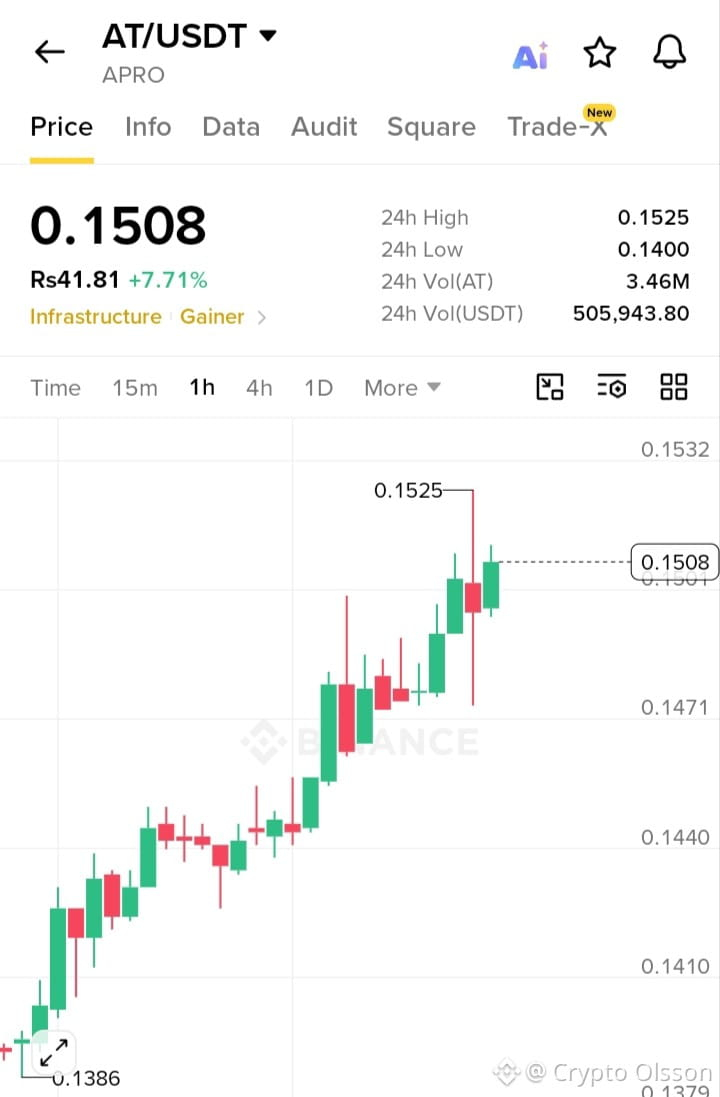
🔥 $AT /USDT — LONG SETUP
Entry Point (EP): $0.1470 – $0.1500
TP1: $0.1525
TP2: $0.1532
TP3: $0.1580
🛑 SL: $0.1410
Bullish idea: Hold above $0.1470 and reclaim $0.1525 with volume → potential continuation higher.
⚠️ Don't chase the pump. Wait for a proper entry/retest and manage risk.
#AT #ATUSDT #APRO #LongSetup
$AT
{future}(ATUSDT)
🔥 $AT /USDT — LONG SETUP
Entry Point (EP): $0.1470 – $0.1500
TP1: $0.1525
TP2: $0.1532
TP3: $0.1580
🛑 SL: $0.1410
Bullish idea: Hold above $0.1470 and reclaim $0.1525 with volume → potential continuation higher.
⚠️ Don't chase the pump. Wait for a proper entry/retest and manage risk.
#AT #ATUSDT #APRO #LongSetup
$AT
Entry Point (EP): $0.1470 – $0.1500
TP1: $0.1525
TP2: $0.1532
TP3: $0.1580
🛑 SL: $0.1410
Bullish idea: Hold above $0.1470 and reclaim $0.1525 with volume → potential continuation higher.
⚠️ Don't chase the pump. Wait for a proper entry/retest and manage risk.
#AT #ATUSDT #APRO #LongSetup
$AT
1
100



Post Draft: Why $AT is the Future of Decentralized Intelligence
The era of "static data" is over. 🌐 As Web3 evolves, the need for intelligent, real-time data becomes the backbone of every successful protocol. This is where @APRO-Oracle is changing the game!
Unlike traditional oracles, APRO introduces a hybrid AI-driven architecture specifically optimized for the Bitcoin ecosystem and beyond. Whether it’s high-frequency DeFi trading, RWA tokenization, or AI agents, APRO delivers 4000 TPS with sub-240ms latency. ⚡️
Why I’m watching $AT closely:
AI-Enhanced Validation: It doesn't just pass data; it uses ML to detect anomalies and prevent manipulation.
Multi-Chain Dominance: Supporting 40+ networks including #BNBChain , Solana, and Bitcoin.
True Utility: The $At token powers the entire ecosystem—from validator rewards to governance and security staking.
The bridge between real-world data and on-chain logic is getting a major upgrade. Keep an eye on the leaderboards—this is just the beginning for the ecosystem! 🚀
#APRO #CryptoAirdrop #oracles
Tips for "Mindshare" & Climbing the Leaderboard:
Engagement: After posting, reply to at least 3-5 comments. The Binance Square algorithm rewards "active" creators who foster conversation.
Visuals: Always attach a high-quality graphic or a screenshot of the $AT price chart/ecosystem map to increase the click-through rate.
Timing: Post during peak trading hours (usually 12:00 PM – 4:00 PM UTC) to catch the most eyes.
Post Draft: Why $AT is the Future of Decentralized Intelligence
The era of "static data" is over. 🌐 As Web3 evolves, the need for intelligent, real-time data becomes the backbone of every successful protocol. This is where @APRO Oracle is changing the game!
Unlike traditional oracles, APRO introduces a hybrid AI-driven architecture specifically optimized for the Bitcoin ecosystem and beyond. Whether it’s high-frequency DeFi trading, RWA tokenization, or AI agents, APRO delivers 4000 TPS with sub-240ms latency. ⚡️
Why I’m watching $AT closely:
AI-Enhanced Validation: It doesn't just pass data; it uses ML to detect anomalies and prevent manipulation.
Multi-Chain Dominance: Supporting 40+ networks including #BNBChain , Solana, and Bitcoin.
True Utility: The $At token powers the entire ecosystem—from validator rewards to governance and security staking.
The bridge between real-world data and on-chain logic is getting a major upgrade. Keep an eye on the leaderboards—this is just the beginning for the ecosystem! 🚀
#APRO #CryptoAirdrop #oracles
Tips for "Mindshare" & Climbing the Leaderboard:
Engagement: After posting, reply to at least 3-5 comments. The Binance Square algorithm rewards "active" creators who foster conversation.
Visuals: Always attach a high-quality graphic or a screenshot of the $AT price chart/ecosystem map to increase the click-through rate.
Timing: Post during peak trading hours (usually 12:00 PM – 4:00 PM UTC) to catch the most eyes.
The era of "static data" is over. 🌐 As Web3 evolves, the need for intelligent, real-time data becomes the backbone of every successful protocol. This is where @APRO Oracle is changing the game!
Unlike traditional oracles, APRO introduces a hybrid AI-driven architecture specifically optimized for the Bitcoin ecosystem and beyond. Whether it’s high-frequency DeFi trading, RWA tokenization, or AI agents, APRO delivers 4000 TPS with sub-240ms latency. ⚡️
Why I’m watching $AT closely:
AI-Enhanced Validation: It doesn't just pass data; it uses ML to detect anomalies and prevent manipulation.
Multi-Chain Dominance: Supporting 40+ networks including #BNBChain , Solana, and Bitcoin.
True Utility: The $At token powers the entire ecosystem—from validator rewards to governance and security staking.
The bridge between real-world data and on-chain logic is getting a major upgrade. Keep an eye on the leaderboards—this is just the beginning for the ecosystem! 🚀
#APRO #CryptoAirdrop #oracles
Tips for "Mindshare" & Climbing the Leaderboard:
Engagement: After posting, reply to at least 3-5 comments. The Binance Square algorithm rewards "active" creators who foster conversation.
Visuals: Always attach a high-quality graphic or a screenshot of the $AT price chart/ecosystem map to increase the click-through rate.
Timing: Post during peak trading hours (usually 12:00 PM – 4:00 PM UTC) to catch the most eyes.
2
65


·
--
Beyond Price Feeds: APRO Oracle as the Backbone of On-Chain Intelligence
In the early days of decentralized finance, the oracle problem was viewed almost exclusively through the lens of price feeds. We needed to know the cost of ETH in dollars to trigger a liquidation or execute a swap, and as long as the number was "close enough" and didn't crash the system, the infrastructure was deemed a success. But as we move through late 2025, the market has realized that price is just one small dimension of the truth. Today’s sophisticated smart contracts—those managing billions in tokenized real-world assets or directing autonomous AI agents—require something much deeper than a simple numerical ticker. They require on-chain intelligence. This shift in demand has brought APRO Oracle into the spotlight, not as a mere data provider, but as a specialized infrastructure layer designed to validate the very reality upon which decentralized logic is built.
The core challenge of the current cycle isn't just getting data onto a blockchain; it’s ensuring that the data hasn't been subtly manipulated or misinterpreted before it arrives. Traditional oracles often suffer from a "garbage in, garbage out" vulnerability, where a single compromised source can poison an entire protocol. APRO addresses this by implementing a dual-layer architecture that separates the heavy lifting of data ingestion from the critical task of consensus. The first layer utilizes a multi-modal AI pipeline capable of processing unstructured data—think legal contracts, land registry PDFs, or even satellite imagery—and converting them into a machine-readable format. The second layer then subjects this information to a rigorous, decentralized audit where independent nodes must agree on the validity of the data before it is ever committed on-chain.
This move toward AI-enhanced verification has become particularly trending as the industry pivots toward Real-World Assets (RWAs) and Prediction Markets. By December 2025, we’ve seen the protocol successfully handle over 97,000 AI-powered checks in a single month, a metric that reflects the growing complexity of the tasks being offloaded to the network. For a trader, this translates to a massive reduction in "oracle risk." In high-stakes environments like the BNB Chain’s prediction ecosystems, where outcomes must be settled in less than a second, the difference between a standard price feed and APRO’s low-latency delivery is the difference between a fair market and an exploitable one. The protocol’s hybrid "Push" and "Pull" models allow developers to choose between continuous updates for high-frequency trading or on-demand requests for gas-sensitive applications, effectively solving the cost-efficiency dilemma that plagued older oracle models.
From a human perspective, there is something inherently more trustworthy about a system that admits "the truth is messy" and builds redundancy to account for it. As someone who has watched various oracle-related exploits wipe out portfolios in minutes, I find the introduction of Secure Multi-Party Computation (SMPC) and Trusted Execution Environments (TEEs) within the APRO stack to be a significant step forward. These technologies ensure that even the node operators themselves cannot see or tamper with the raw data they are processing. This creates an environment of "blind trust," where security is derived from mathematical proofs rather than the reputation of a centralized provider. It is an institutional-grade approach to a problem that was once solved with simple, and often fragile, multisigs.
The progress made by the team in late 2025 has also focused heavily on the Bitcoin ecosystem and cross-chain interoperability. By integrating with over 40 blockchains, including high-speed networks like Sei and various UTXO-based chains, APRO is positioning itself as a universal nervous system for Web3. This is crucial because, as liquidity becomes more fragmented across Layer 2s and app-chains, we need a single, consistent source of truth that remains valid regardless of which network you are trading on. The recent launch of the ATTP protocol—an agent-to-agent communication layer—further expands this vision, providing the encrypted "language" through which AI agents can exchange verified facts without human intervention.
For investors, the utility of the native token, AT, is tied directly to this infrastructure’s reliability. Because node operators must stake these tokens to participate, they are economically incentivized to remain honest; any attempt to feed "bad data" results in immediate slashing of their collateral. In a year where we have seen several high-profile attempts to manipulate thin-liquidity price feeds on decentralized exchanges, this economic security layer acts as a necessary deterrent. It transforms the oracle from a passive service into an active participant in the security of the broader ecosystem.
As we look toward 2026, the evolution of APRO suggests a broader trend in the crypto markets: the transition from "data as a commodity" to "intelligence as infrastructure." We are no longer satisfied with knowing the price of an asset; we want to know the provenance of the collateral, the legal standing of the issuer, and the real-time health of the underlying liquidity pool. By providing the tools to verify these complex realities on-chain, APRO is essentially building the backbone for a more mature, transparent, and resilient financial system.
This transition reminds us that the true power of blockchain technology isn't just in its ability to move value, but in its ability to anchor truth. If the first era of crypto was about creating trustless money, this era is about creating trustless information. As oracles move beyond simple price feeds and become the curators of global intelligence, the protocols that prioritize accuracy and verification over speed and hype will likely become the silent giants of the next decade. In the end, a smart contract is only as intelligent as the data it consumes, and as our digital world grows more complex, the quality of that data becomes the ultimate arbiter of success.
#APRO
@APRO-Oracle $AT
{spot}(ATUSDT)
$
Beyond Price Feeds: APRO Oracle as the Backbone of On-Chain Intelligence
In the early days of decentralized finance, the oracle problem was viewed almost exclusively through the lens of price feeds. We needed to know the cost of ETH in dollars to trigger a liquidation or execute a swap, and as long as the number was "close enough" and didn't crash the system, the infrastructure was deemed a success. But as we move through late 2025, the market has realized that price is just one small dimension of the truth. Today’s sophisticated smart contracts—those managing billions in tokenized real-world assets or directing autonomous AI agents—require something much deeper than a simple numerical ticker. They require on-chain intelligence. This shift in demand has brought APRO Oracle into the spotlight, not as a mere data provider, but as a specialized infrastructure layer designed to validate the very reality upon which decentralized logic is built.
The core challenge of the current cycle isn't just getting data onto a blockchain; it’s ensuring that the data hasn't been subtly manipulated or misinterpreted before it arrives. Traditional oracles often suffer from a "garbage in, garbage out" vulnerability, where a single compromised source can poison an entire protocol. APRO addresses this by implementing a dual-layer architecture that separates the heavy lifting of data ingestion from the critical task of consensus. The first layer utilizes a multi-modal AI pipeline capable of processing unstructured data—think legal contracts, land registry PDFs, or even satellite imagery—and converting them into a machine-readable format. The second layer then subjects this information to a rigorous, decentralized audit where independent nodes must agree on the validity of the data before it is ever committed on-chain.
This move toward AI-enhanced verification has become particularly trending as the industry pivots toward Real-World Assets (RWAs) and Prediction Markets. By December 2025, we’ve seen the protocol successfully handle over 97,000 AI-powered checks in a single month, a metric that reflects the growing complexity of the tasks being offloaded to the network. For a trader, this translates to a massive reduction in "oracle risk." In high-stakes environments like the BNB Chain’s prediction ecosystems, where outcomes must be settled in less than a second, the difference between a standard price feed and APRO’s low-latency delivery is the difference between a fair market and an exploitable one. The protocol’s hybrid "Push" and "Pull" models allow developers to choose between continuous updates for high-frequency trading or on-demand requests for gas-sensitive applications, effectively solving the cost-efficiency dilemma that plagued older oracle models.
From a human perspective, there is something inherently more trustworthy about a system that admits "the truth is messy" and builds redundancy to account for it. As someone who has watched various oracle-related exploits wipe out portfolios in minutes, I find the introduction of Secure Multi-Party Computation (SMPC) and Trusted Execution Environments (TEEs) within the APRO stack to be a significant step forward. These technologies ensure that even the node operators themselves cannot see or tamper with the raw data they are processing. This creates an environment of "blind trust," where security is derived from mathematical proofs rather than the reputation of a centralized provider. It is an institutional-grade approach to a problem that was once solved with simple, and often fragile, multisigs.
The progress made by the team in late 2025 has also focused heavily on the Bitcoin ecosystem and cross-chain interoperability. By integrating with over 40 blockchains, including high-speed networks like Sei and various UTXO-based chains, APRO is positioning itself as a universal nervous system for Web3. This is crucial because, as liquidity becomes more fragmented across Layer 2s and app-chains, we need a single, consistent source of truth that remains valid regardless of which network you are trading on. The recent launch of the ATTP protocol—an agent-to-agent communication layer—further expands this vision, providing the encrypted "language" through which AI agents can exchange verified facts without human intervention.
For investors, the utility of the native token, AT, is tied directly to this infrastructure’s reliability. Because node operators must stake these tokens to participate, they are economically incentivized to remain honest; any attempt to feed "bad data" results in immediate slashing of their collateral. In a year where we have seen several high-profile attempts to manipulate thin-liquidity price feeds on decentralized exchanges, this economic security layer acts as a necessary deterrent. It transforms the oracle from a passive service into an active participant in the security of the broader ecosystem.
As we look toward 2026, the evolution of APRO suggests a broader trend in the crypto markets: the transition from "data as a commodity" to "intelligence as infrastructure." We are no longer satisfied with knowing the price of an asset; we want to know the provenance of the collateral, the legal standing of the issuer, and the real-time health of the underlying liquidity pool. By providing the tools to verify these complex realities on-chain, APRO is essentially building the backbone for a more mature, transparent, and resilient financial system.
This transition reminds us that the true power of blockchain technology isn't just in its ability to move value, but in its ability to anchor truth. If the first era of crypto was about creating trustless money, this era is about creating trustless information. As oracles move beyond simple price feeds and become the curators of global intelligence, the protocols that prioritize accuracy and verification over speed and hype will likely become the silent giants of the next decade. In the end, a smart contract is only as intelligent as the data it consumes, and as our digital world grows more complex, the quality of that data becomes the ultimate arbiter of success.
#APRO
@APRO Oracle $AT
$
The core challenge of the current cycle isn't just getting data onto a blockchain; it’s ensuring that the data hasn't been subtly manipulated or misinterpreted before it arrives. Traditional oracles often suffer from a "garbage in, garbage out" vulnerability, where a single compromised source can poison an entire protocol. APRO addresses this by implementing a dual-layer architecture that separates the heavy lifting of data ingestion from the critical task of consensus. The first layer utilizes a multi-modal AI pipeline capable of processing unstructured data—think legal contracts, land registry PDFs, or even satellite imagery—and converting them into a machine-readable format. The second layer then subjects this information to a rigorous, decentralized audit where independent nodes must agree on the validity of the data before it is ever committed on-chain.
This move toward AI-enhanced verification has become particularly trending as the industry pivots toward Real-World Assets (RWAs) and Prediction Markets. By December 2025, we’ve seen the protocol successfully handle over 97,000 AI-powered checks in a single month, a metric that reflects the growing complexity of the tasks being offloaded to the network. For a trader, this translates to a massive reduction in "oracle risk." In high-stakes environments like the BNB Chain’s prediction ecosystems, where outcomes must be settled in less than a second, the difference between a standard price feed and APRO’s low-latency delivery is the difference between a fair market and an exploitable one. The protocol’s hybrid "Push" and "Pull" models allow developers to choose between continuous updates for high-frequency trading or on-demand requests for gas-sensitive applications, effectively solving the cost-efficiency dilemma that plagued older oracle models.
From a human perspective, there is something inherently more trustworthy about a system that admits "the truth is messy" and builds redundancy to account for it. As someone who has watched various oracle-related exploits wipe out portfolios in minutes, I find the introduction of Secure Multi-Party Computation (SMPC) and Trusted Execution Environments (TEEs) within the APRO stack to be a significant step forward. These technologies ensure that even the node operators themselves cannot see or tamper with the raw data they are processing. This creates an environment of "blind trust," where security is derived from mathematical proofs rather than the reputation of a centralized provider. It is an institutional-grade approach to a problem that was once solved with simple, and often fragile, multisigs.
The progress made by the team in late 2025 has also focused heavily on the Bitcoin ecosystem and cross-chain interoperability. By integrating with over 40 blockchains, including high-speed networks like Sei and various UTXO-based chains, APRO is positioning itself as a universal nervous system for Web3. This is crucial because, as liquidity becomes more fragmented across Layer 2s and app-chains, we need a single, consistent source of truth that remains valid regardless of which network you are trading on. The recent launch of the ATTP protocol—an agent-to-agent communication layer—further expands this vision, providing the encrypted "language" through which AI agents can exchange verified facts without human intervention.
For investors, the utility of the native token, AT, is tied directly to this infrastructure’s reliability. Because node operators must stake these tokens to participate, they are economically incentivized to remain honest; any attempt to feed "bad data" results in immediate slashing of their collateral. In a year where we have seen several high-profile attempts to manipulate thin-liquidity price feeds on decentralized exchanges, this economic security layer acts as a necessary deterrent. It transforms the oracle from a passive service into an active participant in the security of the broader ecosystem.
As we look toward 2026, the evolution of APRO suggests a broader trend in the crypto markets: the transition from "data as a commodity" to "intelligence as infrastructure." We are no longer satisfied with knowing the price of an asset; we want to know the provenance of the collateral, the legal standing of the issuer, and the real-time health of the underlying liquidity pool. By providing the tools to verify these complex realities on-chain, APRO is essentially building the backbone for a more mature, transparent, and resilient financial system.
This transition reminds us that the true power of blockchain technology isn't just in its ability to move value, but in its ability to anchor truth. If the first era of crypto was about creating trustless money, this era is about creating trustless information. As oracles move beyond simple price feeds and become the curators of global intelligence, the protocols that prioritize accuracy and verification over speed and hype will likely become the silent giants of the next decade. In the end, a smart contract is only as intelligent as the data it consumes, and as our digital world grows more complex, the quality of that data becomes the ultimate arbiter of success.
#APRO
@APRO Oracle $AT
$
1
147
Log in to explore more content
Join global crypto users on Binance Square
⚡️ Get latest and useful information about crypto.
💬 Trusted by the world’s largest crypto exchange.
👍 Discover real insights from verified creators.
Email / Phone number
Trending Topics
1
#BitcoinSpotETFsNetInflow$191M
5 views
6 Discussing
2
#CFTCUpdatesGuidanceOnTokenizedAssets
2,684 views
167 Discussing
3
#BitgetSays$352MAffectedInHack
375 views
11 Discussing
4
#BinanceWillListHyperliquid(HYPE)
168,583 views
2,764 Discussing
5
#BrazilOrdersReportingOf$10KSelfCustodyTransfers
499 views
14 Discussing
6
#FedProposesRulesForBankIssuedStablecoins
4,831 views
186 Discussing
7
#OndoFinanceSoughtSaleAfterFoundersDeath
3,410 views
133 Discussing
8
#FedOctoberRateHikeOddsRiseTo69.7%
61,803 views
1,169 Discussing
9
#BitcoinFallsBelow$83,000
4,628 views
20 Discussing
10
#BitcoinFallsToAround$84,600ThisWeek
0 views
0 Discussing