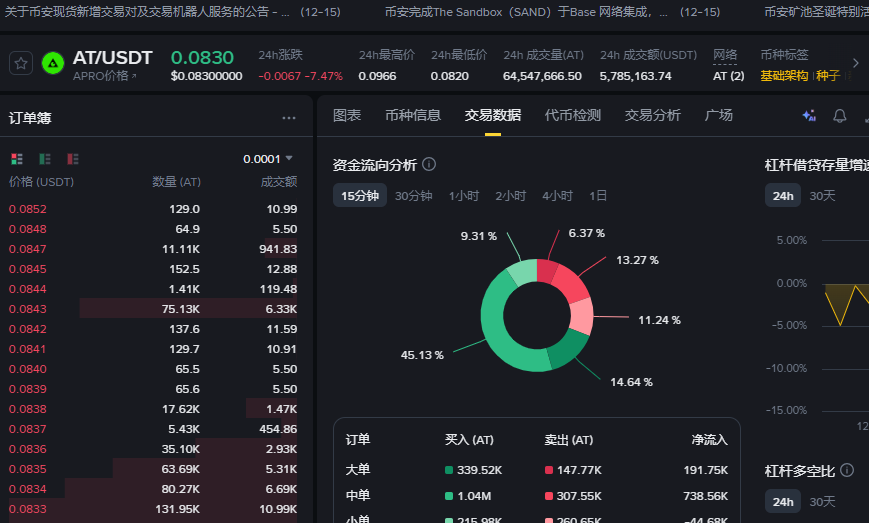
You may not have noticed that just one day after Binance launched $AT, the oracle project @APRO-Oracle did something big: it officially entered the RWA battlefield on Arbitrum, integrating over $300 million in real-world assets on-chain all at once.
This is not a small matter. On its first “customer” list, there are two real giants: BlackRock's BUIDL fund and Franklin Templeton's BENJI fund, along with a host of strong players like OpenEden and Spiko.
Why do all these top traditional institutions choose the same oracle to “feed data”? The answer is simple: bringing RWA on-chain, the hardest part is not the technology, but trust.
One, the pain points of RWA: how to put data on-chain?
RWA (Real World Assets on-chain) sounds beautiful, moving government bonds and fund net values to the blockchain for transparent circulation. But the reality is harsh: the prices and net value data of these assets are locked in PDF reports, spreadsheets, or even the backend of custodial banks.
Traditional oracles only capture simple prices from exchanges and are completely helpless in the face of these diverse 'unstructured data'.
@APRO-Oracle's approach is very straightforward: hard chewing with an AI data ingestion layer.
Using OCR technology to 'read' PDF reports and scanned documents
Using NLP to understand text content and extract key figures
Ultimately converting chaotic data into a standardized format that smart contracts can understand
Two, the key move: real-time proof of reserves
For RWA, what do investors fear the most? They fear that the on-chain tokens are mere air, with no real assets behind them.
@APRO-Oracle provides real-time PoR (Proof of Reserves), which is a reassurance.
It can dynamically track the account balances of custodial banks, verify asset flows across chains, and if the reserves and token issuance amounts do not match, the system will immediately raise an alarm.
This is no longer a quarterly or annual audit, but 24/7 on-chain transparent monitoring.
Three, why Arbitrum?
Traditional financial institutions exploring blockchain primarily consider: security, compliance, and developer friendliness.
As the most mature Ethereum L2, Arbitrum is fully EVM compatible and has a rich ecosystem, making it the natural first choice for a 'test field'. @APRO-Oracle provides a complete set of data services here:
Push mode: automatically updates on a schedule, such as updating fund net values precisely at 9 AM every day.
Pull mode: real-time requests as needed, obtaining the latest fair price in milliseconds when users redeem.
Four, the real ambition: to be the 'data utility' for the RWA ecosystem.
Just look at the scenarios it serves, and you will understand the landscape:
Providing daily net value feeds for Franklin Templeton's money market fund.
Providing accurate yield data for OpenEden's daily compound government bonds.
In the future, it will also support on-chain RWA collateralized lending (monitoring collateral ratios, triggering liquidations) and even RWA derivatives (requiring complex data such as property valuations, rental income, etc.).
@APRO-Oracle is not just simply connecting a few quotes; it is building the most fundamental and reliable data infrastructure for the trillion-dollar RWA market.
Written at the end
When asset management giants like BlackRock, with assets of $10 trillion, seriously 'bet' on on-chain funds and choose @APRO-Oracle as their key data pipeline, the signal is already very clear: RWA is not a concept; it is a reality that is happening.
In this wave of reconstructing global asset forms, whoever controls the gateway to credible data holds the valve to the future.
$AT This step on Arbitrum is significant and stable.