
#securitecrypto
securitecrypto
17,555 views
44 Discussing
Hot
Latest

·
--
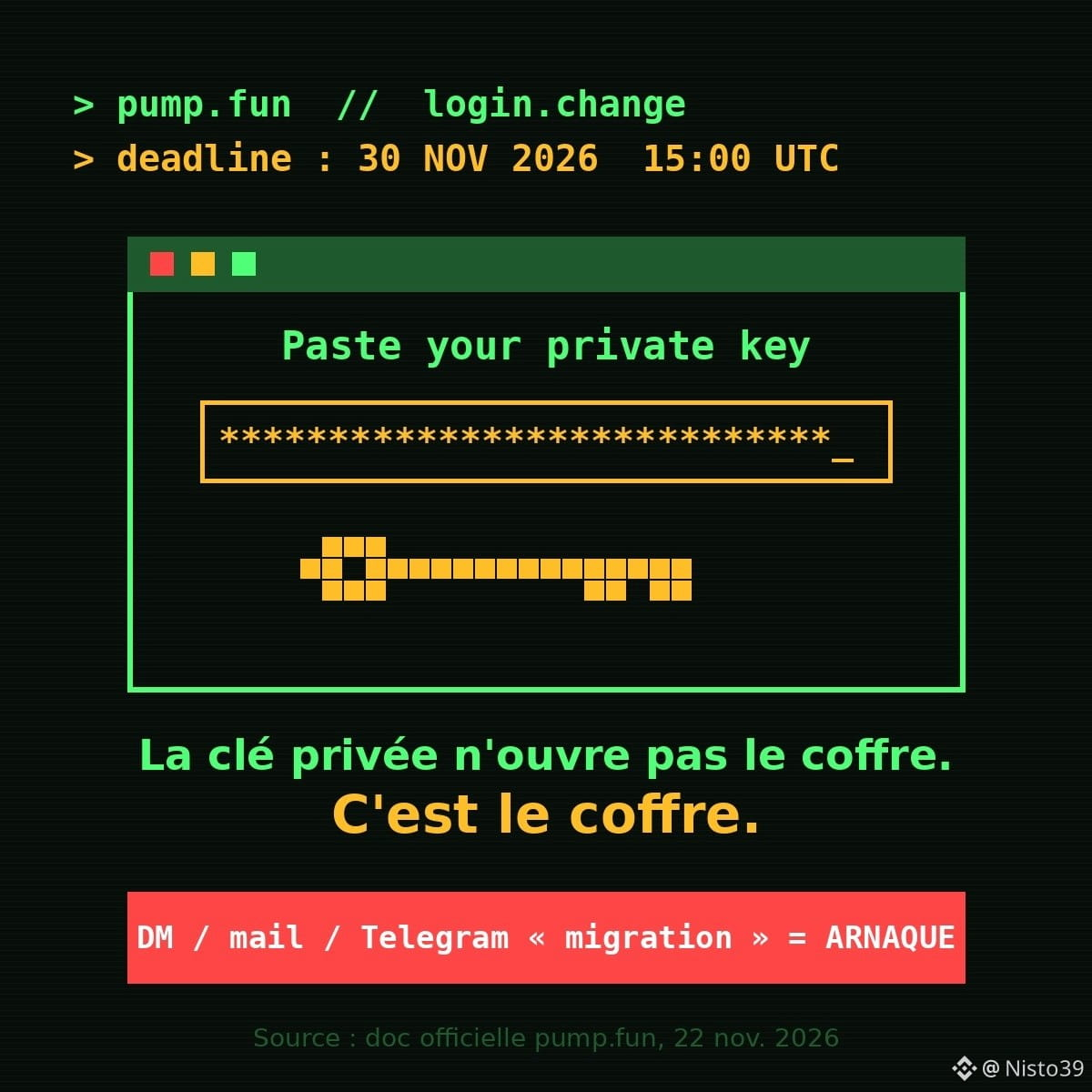
Pump.fun is going to ask you for your private key. Not a fake message: it’s in their own docs.
On November 30 at 15:00 UTC, the web version of Pump.fun (the site behind $PUMP) will stop supporting login via Phantom, Solflare, or Ledger. Instead, you’ll use email, Google, Apple, or GitHub, just like in the app.
To keep your current account (username, followers, history), the “recommended” way is to open “Link email & socials” and paste in your $SOL wallet’s private key. Pump.fun says it’s encrypted in your browser, then kept end-to-end encrypted by Privy, its login provider.
The private key, in a nutshell: it’s not the password to the vault; it’s the vault. Whoever has it can empty it.
Mark Karpelès (former head of Mt. Gox) replied publicly: entering your key on a website isn’t safe, and Pump.fun’s own terms of service warn against it.
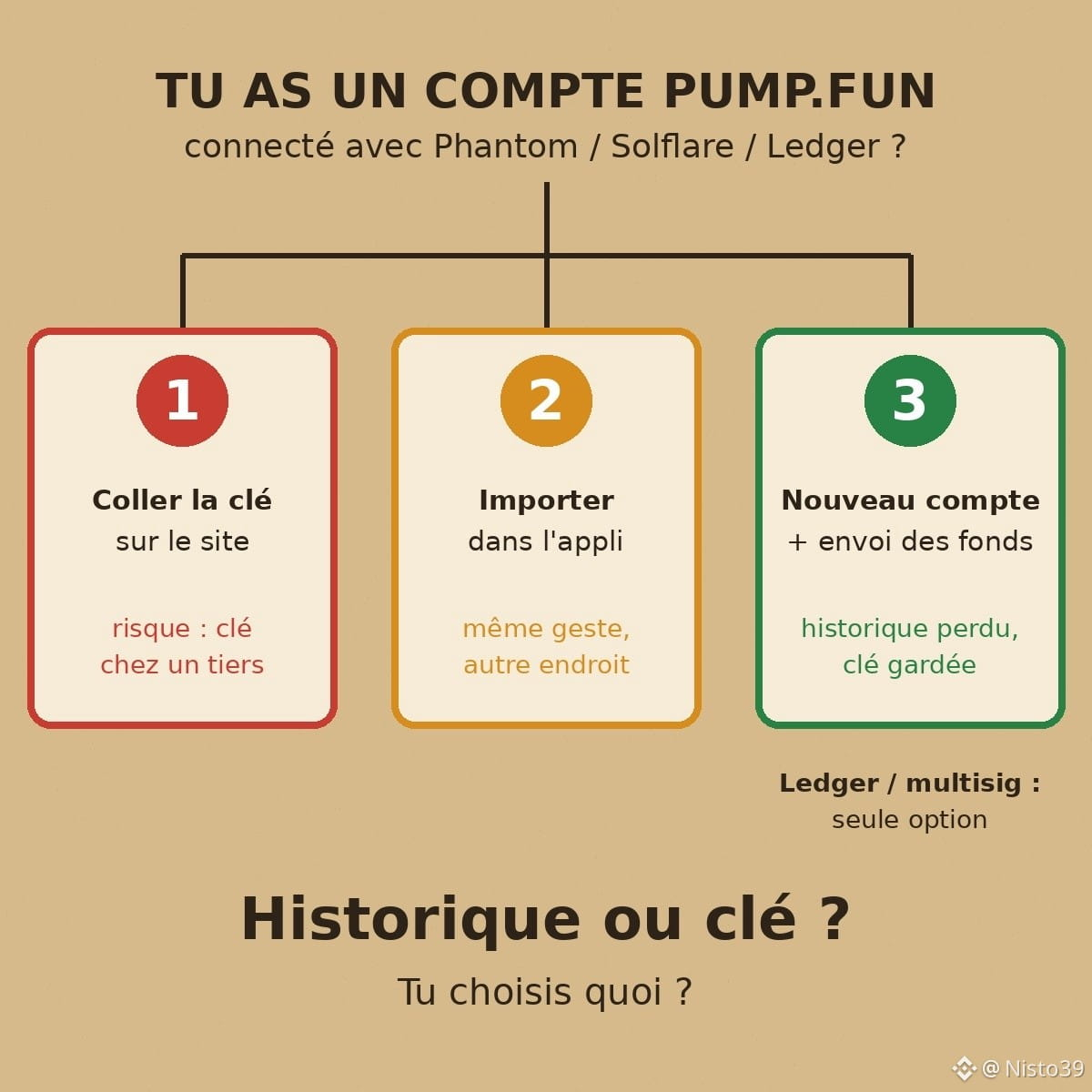
The three options on offer, and my take:
1. Paste the key into the site. The simplest option. But your wallet now also depends on a third party’s security.
2. Import it into the app. Same action, different place.
3. Create a new account and send your funds there. You lose your history, but your old key stays yours alone. The only option for a Ledger or multisig.
I’d choose option 3 without hesitation. You can rebuild a history; you can’t unexpose a key.
The real trap this week will come from elsewhere: fake “urgent migration, paste your key here” messages in DMs, by email, on Telegram. Pump.fun says so itself: your key should only be requested in that window, never anywhere else. Share this with anyone trading memecoins.
You: keep your history or keep your key? And what’s the most you’d leave in a wallet whose key has been imported elsewhere?
#PumpFun #Solana #SecuriteCrypto #Scam
Pump.fun is going to ask you for your private key. Not a fake message: it’s in their own docs.
On November 30 at 15:00 UTC, the web version of Pump.fun (the site behind $PUMP ) will stop supporting login via Phantom, Solflare, or Ledger. Instead, you’ll use email, Google, Apple, or GitHub, just like in the app.
To keep your current account (username, followers, history), the “recommended” way is to open “Link email & socials” and paste in your $SOL wallet’s private key. Pump.fun says it’s encrypted in your browser, then kept end-to-end encrypted by Privy, its login provider.
The private key, in a nutshell: it’s not the password to the vault; it’s the vault. Whoever has it can empty it.
Mark Karpelès (former head of Mt. Gox) replied publicly: entering your key on a website isn’t safe, and Pump.fun’s own terms of service warn against it.
The three options on offer, and my take:
1. Paste the key into the site. The simplest option. But your wallet now also depends on a third party’s security.
2. Import it into the app. Same action, different place.
3. Create a new account and send your funds there. You lose your history, but your old key stays yours alone. The only option for a Ledger or multisig.
I’d choose option 3 without hesitation. You can rebuild a history; you can’t unexpose a key.
The real trap this week will come from elsewhere: fake “urgent migration, paste your key here” messages in DMs, by email, on Telegram. Pump.fun says so itself: your key should only be requested in that window, never anywhere else. Share this with anyone trading memecoins.
You: keep your history or keep your key? And what’s the most you’d leave in a wallet whose key has been imported elsewhere?
#PumpFun #Solana #SecuriteCrypto #Scam
164
·
--
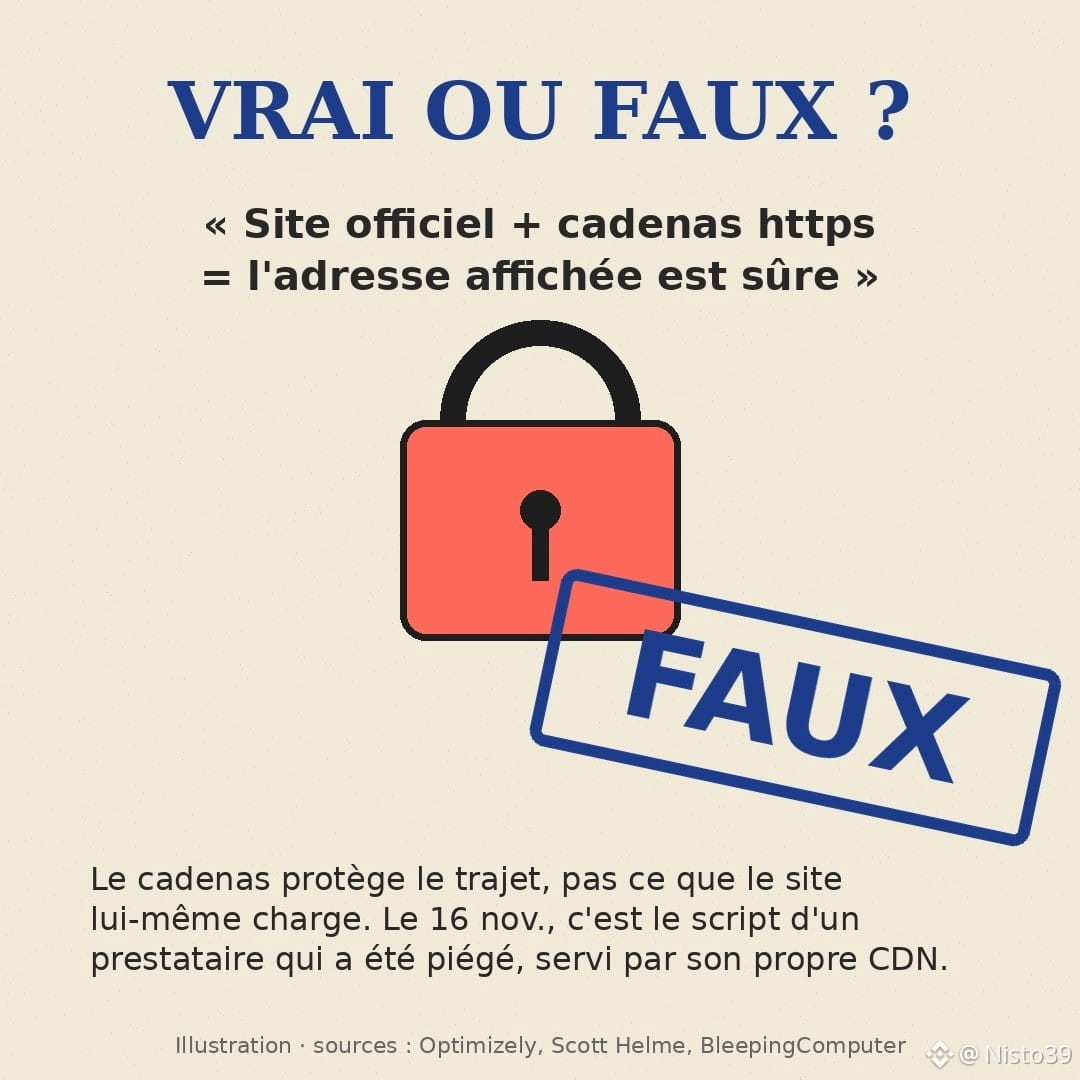
True or false: on an official website, with the https padlock, the crypto address you copy is guaranteed to be the right one.
False. And November 16 proved it on a large scale.
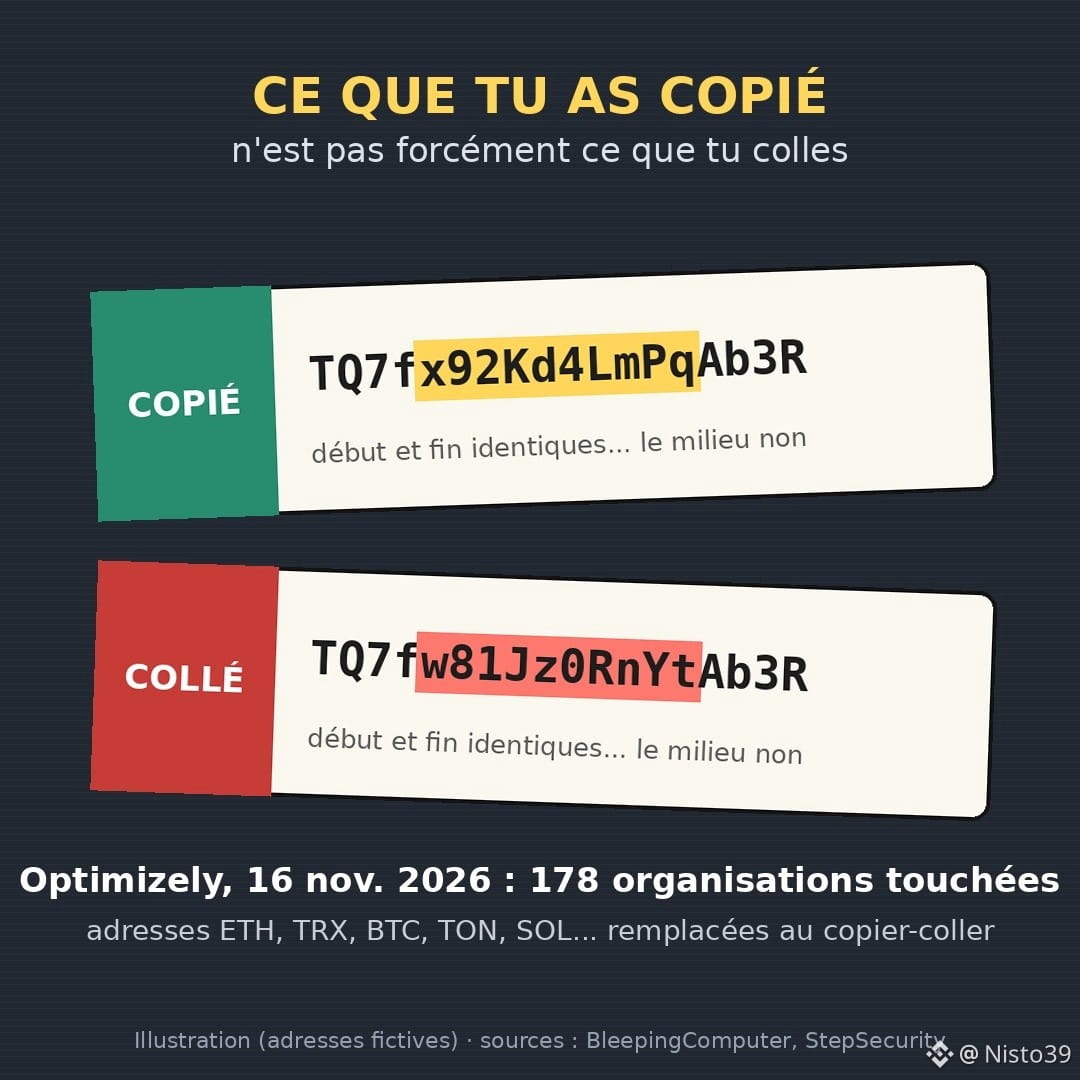
That day, an attacker exploited a vulnerability at Optimizely, a tool major brands use to test their pages. They slipped code into the projects of 178 organizations (identified by researcher Scott Helme). Among them: Ledger, CNN, BBC, Zoom, Salesforce, HSBC Insurance.
The script was served by Optimizely’s own CDN, with its certificate. To your browser, everything looked normal.
What it did: monitor the page, detect wallet addresses (ETH, TRX, BTC, TON, SOL, LTC, DOGE...) and replace them with the attacker’s. Valid addresses that pass format checks. It also stole bank card details.
Known tally so far: about $7,000 received in their wallets by November 16, according to Helme; some were already active beforehand. Optimizely says it fixed the vulnerability; everything was clean that same evening.
$7,000 isn’t much. In my view, the lesson is worth a lot more. The padlock protects the connection between you and the website, not what the website loads itself. Your only real defense is the confirmation screen in your wallet or on the exchange.
Three ten-second habits:
- compare the beginning, the end AND a few characters in the middle (clipboard hijackers often copy the beginning and end);
- save frequently used addresses in an address book / whitelist;
- for a large amount, send a small test transaction first.
This applies to $TRX or USDT on Tron just as much as to $ETH.
Do you check your address character by character, or do you trust copy and paste?
#securitecrypto #arnaque #wallet #Optimizely #cybersecurity
True or false: on an official website, with the https padlock, the crypto address you copy is guaranteed to be the right one.
False. And November 16 proved it on a large scale.
That day, an attacker exploited a vulnerability at Optimizely, a tool major brands use to test their pages. They slipped code into the projects of 178 organizations (identified by researcher Scott Helme). Among them: Ledger, CNN, BBC, Zoom, Salesforce, HSBC Insurance.
The script was served by Optimizely’s own CDN, with its certificate. To your browser, everything looked normal.
What it did: monitor the page, detect wallet addresses (ETH, TRX, BTC, TON, SOL, LTC, DOGE...) and replace them with the attacker’s. Valid addresses that pass format checks. It also stole bank card details.
Known tally so far: about $7,000 received in their wallets by November 16, according to Helme; some were already active beforehand. Optimizely says it fixed the vulnerability; everything was clean that same evening.
$7,000 isn’t much. In my view, the lesson is worth a lot more. The padlock protects the connection between you and the website, not what the website loads itself. Your only real defense is the confirmation screen in your wallet or on the exchange.
Three ten-second habits:
- compare the beginning, the end AND a few characters in the middle (clipboard hijackers often copy the beginning and end);
- save frequently used addresses in an address book / whitelist;
- for a large amount, send a small test transaction first.
This applies to $TRX or USDT on Tron just as much as to $ETH .
Do you check your address character by character, or do you trust copy and paste?
#securitecrypto #arnaque #wallet #Optimizely #cybersecurity
1
78

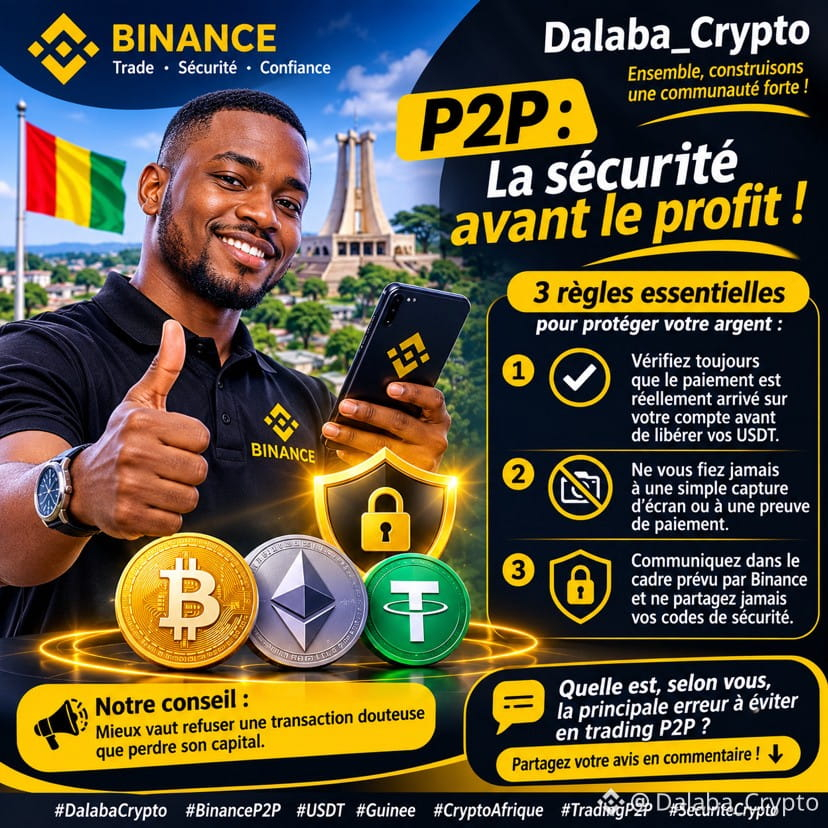
🔐 P2P: SECURITY BEFORE PROFIT!
Hello to the entire Dalaba_Crypto community! 🌍
P2P trading lets you buy and sell USDT directly with other users. But every good transaction starts with caution.
3 essential rules to protect your money:
1️⃣ Always check that the payment has actually arrived in your account before releasing your USDT.
2️⃣ Never rely solely on a screenshot or proof of payment sent by the buyer.
3️⃣ Communicate and make your transactions within Binance. Never share your security codes.
📊 Market update: the BTC and ETH quotes consulted vary across sources. Therefore, the current prices and the USDT/GNF exchange rate cannot be confirmed with sufficient reliability in this bulletin.
💡 Our philosophy: it’s better to reject a suspicious transaction than to lose your capital.
Question for the community: in your opinion, what’s the main mistake to avoid when starting out in P2P trading in Guinea?
👇 Share your experience in the comments!
#DalabaCrypto #CryptoSelloffTriggersMultipleWhaleLiquidations BinanceP2P #USDT #Guinee #CryptoAfrique #TradingP2P #CryptoSecurity
77

Article
The most common crypto scams and how to avoid themThe most common crypto scams and how to avoid them
The speed and irreversibility of crypto transactions attract fraudsters, who are now using AI to trick users.
Here’s what you need to know to spot the most common traps and protect your Binance wallet.
1. Classic scams
- Fake giveaways and airdrops: Impersonator accounts promise to double your crypto if you send them funds. Binance will never ask you for money to win a prize.
The most common crypto scams and how to avoid them
The most common crypto scams and how to avoid them
The speed and irreversibility of crypto transactions attract fraudsters, who are now using AI to trick users.
Here’s what you need to know to spot the most common traps and protect your Binance wallet.
1. Classic scams
- Fake giveaways and airdrops: Impersonator accounts promise to double your crypto if you send them funds. Binance will never ask you for money to win a prize.
1
301
·
--
Article
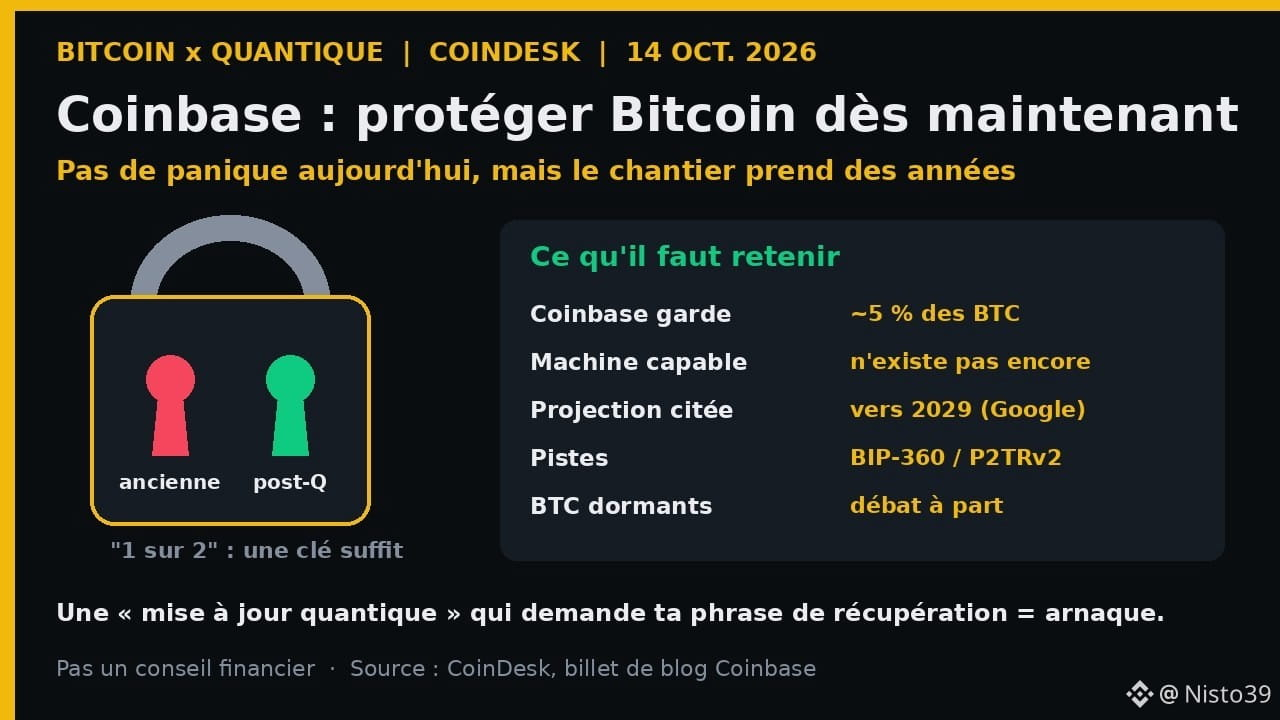
Bitcoin and quantum computers: why Coinbase wants to start protecting it now (and what it means for you)Coinbase holds about 5% of all the bitcoins in the world for its customers. On October 14, the platform made one simple point: we need to start protecting Bitcoin against future quantum computers **now**. No need to panic about your wallet today — but here’s what’s at stake, in simple terms, and what it means for you.
📋 The facts (CoinDesk, Omkar Godbole, Oct. 14, 2026, based on a Coinbase blog post)
• Coinbase believes Bitcoin needs to prepare now for a quantum computer that could one day derive a private key from a public key — and therefore drain vulnerable wallets.
Bitcoin and quantum computers: why Coinbase wants to start protecting it now (and what it means for you)
Coinbase holds about 5% of all the bitcoins in the world for its customers. On October 14, the platform made one simple point: we need to start protecting Bitcoin against future quantum computers **now**. No need to panic about your wallet today — but here’s what’s at stake, in simple terms, and what it means for you.
📋 The facts (CoinDesk, Omkar Godbole, Oct. 14, 2026, based on a Coinbase blog post)
• Coinbase believes Bitcoin needs to prepare now for a quantum computer that could one day derive a private key from a public key — and therefore drain vulnerable wallets.
📋 The facts (CoinDesk, Omkar Godbole, Oct. 14, 2026, based on a Coinbase blog post)
• Coinbase believes Bitcoin needs to prepare now for a quantum computer that could one day derive a private key from a public key — and therefore drain vulnerable wallets.
59
·
--
Article
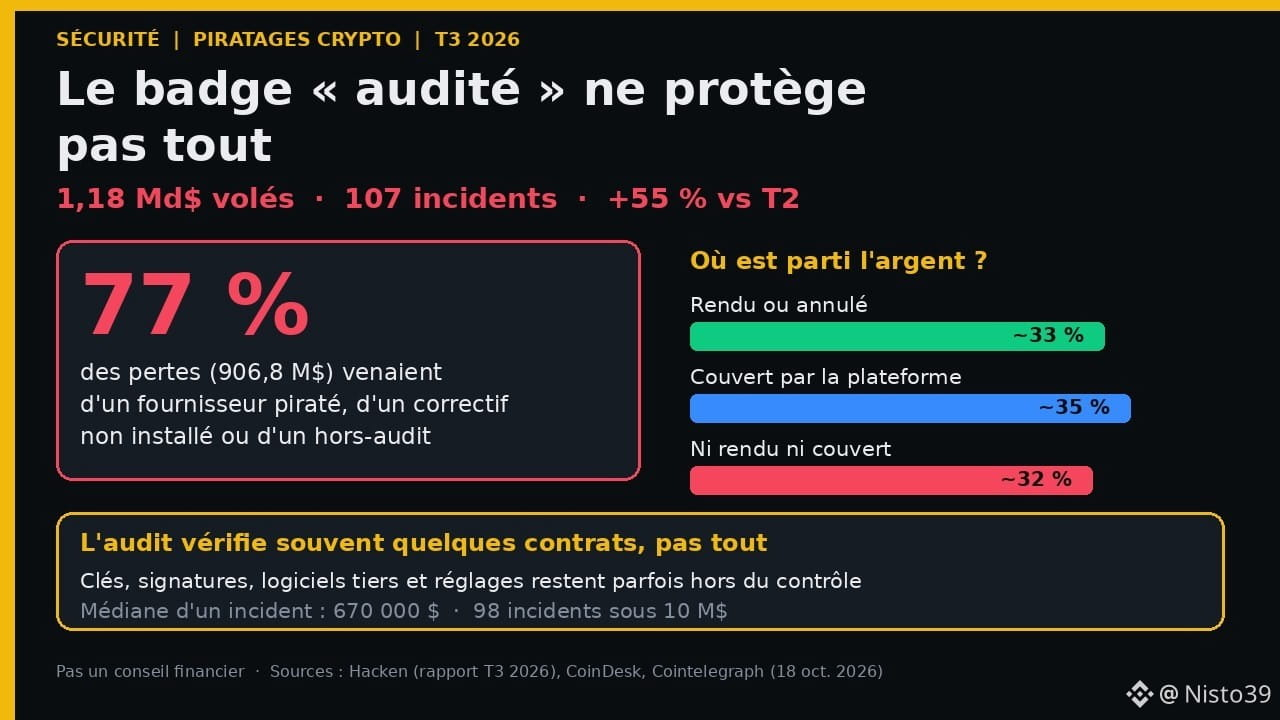
$1.18 billion stolen in 3 months: why the “audited” badge doesn’t protect you“Audited project”: many of us read this badge as a guarantee. The new report from security firm Hacken (Q3 2026, covered by CoinDesk and Cointelegraph on October 18) shows why that’s a mistake. Between July and September, $1.18 billion was stolen in 107 incidents, 55% more than in the previous quarter. And in 77% of cases, the money didn’t leave through the party that had been audited.
📋 Key figures (Hacken, July–September 2026)
$1.18 billion stolen in 3 months: why the “audited” badge doesn’t protect you
“Audited project”: many of us read this badge as a guarantee. The new report from security firm Hacken (Q3 2026, covered by CoinDesk and Cointelegraph on October 18) shows why that’s a mistake. Between July and September, $1.18 billion was stolen in 107 incidents, 55% more than in the previous quarter. And in 77% of cases, the money didn’t leave through the party that had been audited.
📋 Key figures (Hacken, July–September 2026)
📋 Key figures (Hacken, July–September 2026)
124
·
--
Article
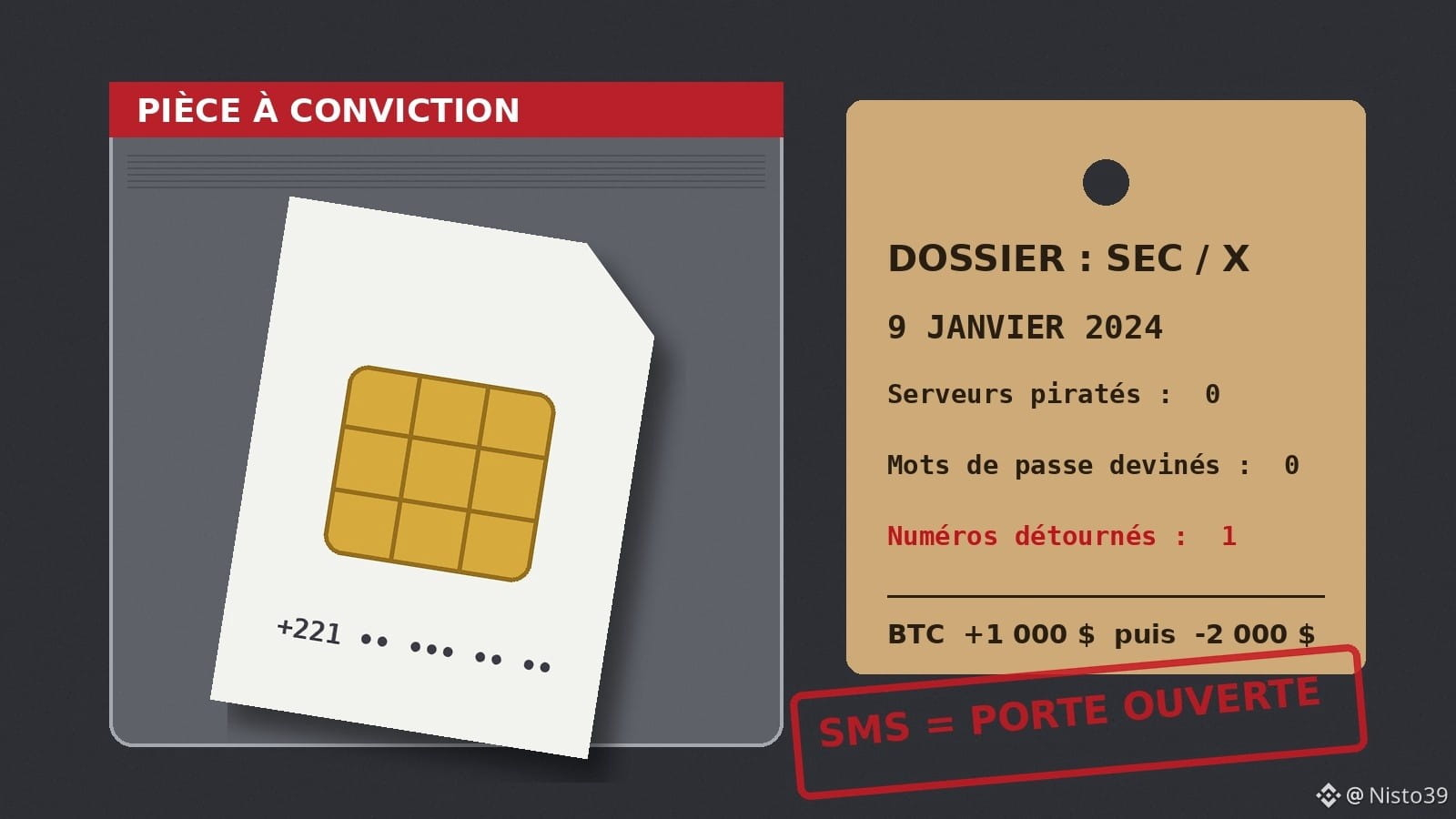
They didn’t hack the SEC. They just got its phone numberOn January 9, 2024, the SEC’s official X account announces that bitcoin ETFs are approved. $BTC jumps by more than $1,000 in a few minutes. Then the SEC denies it: fake message, account hacked. Bitcoin then loses more than $2,000 (U.S. Department of Justice).
The most interesting thing is what wasn’t hacked. No SEC server. No guessed password. No flaw at X. Let’s rewind.
Step -1: the message
The accomplices post in the SEC chair’s name. So they have the account. But how?
They didn’t hack the SEC. They just got its phone number
On January 9, 2024, the SEC’s official X account announces that bitcoin ETFs are approved. $BTC jumps by more than $1,000 in a few minutes. Then the SEC denies it: fake message, account hacked. Bitcoin then loses more than $2,000 (U.S. Department of Justice).
The most interesting thing is what wasn’t hacked. No SEC server. No guessed password. No flaw at X. Let’s rewind.
Step -1: the message
The accomplices post in the SEC chair’s name. So they have the account. But how?
The most interesting thing is what wasn’t hacked. No SEC server. No guessed password. No flaw at X. Let’s rewind.
Step -1: the message
The accomplices post in the SEC chair’s name. So they have the account. But how?
291
·
--
The hacker from $ACE a pocketed about $2M. Traders who came after him drained $3.7M. So who really broke the bridge?
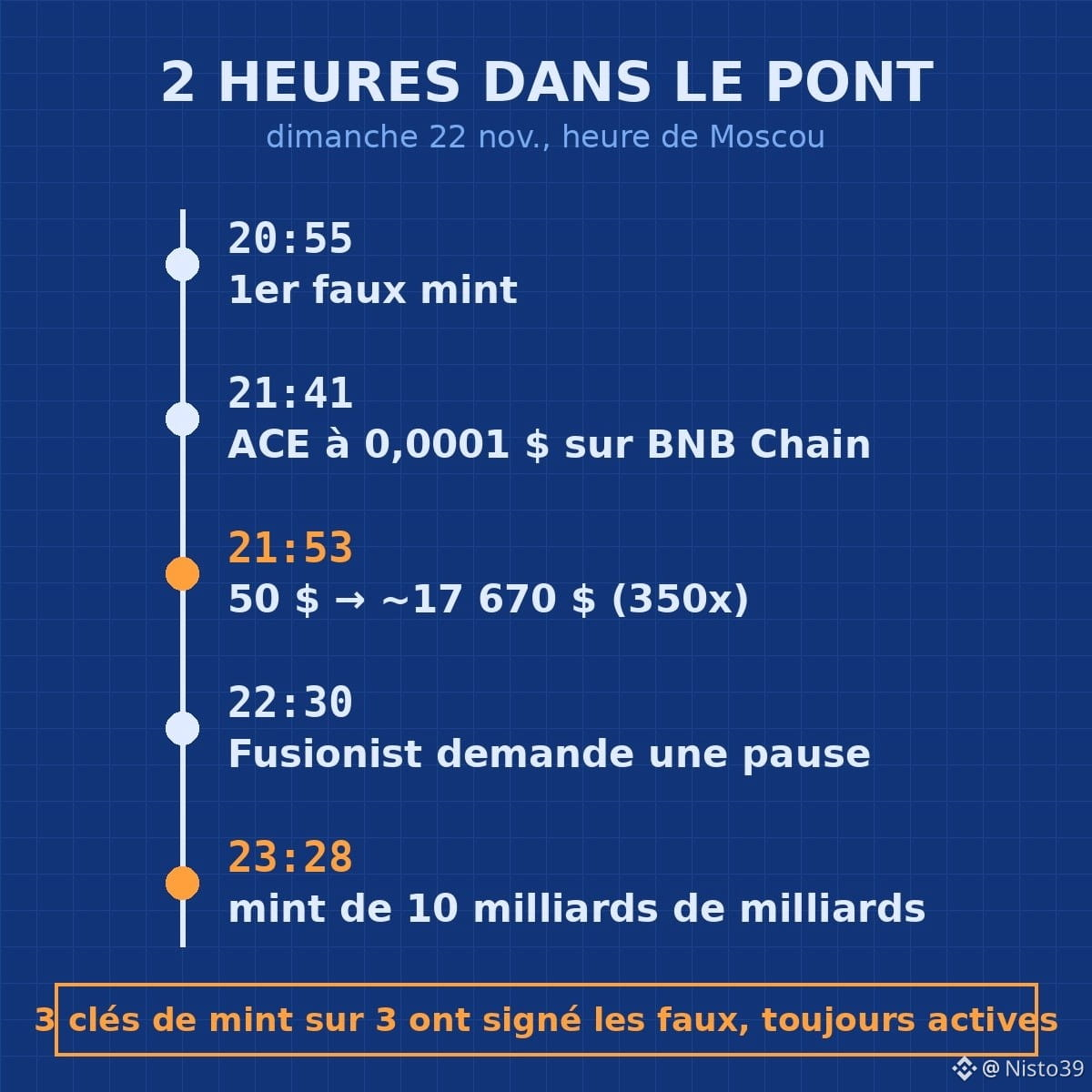
Sunday evening’s timeline (Moscow time):
20:55 — first mint of fake ACE on BNB Chain, via the Fusionist bridge, belonging to the game studio behind the token. A bridge is like a teller: you lock up real ACE on one side, it gives you a copy on the other, and vice versa.
21:41 — on BNB Chain (the $BNB network), ACE sells for $0.0001. On exchanges, it’s around $0.04.
21:53 — a wallet that started with $50 comes out with ~ $17,670. It bought the broken copy, sent it back through the bridge, received real ACE, and sold it. 350x in twelve minutes.
22:30 — Fusionist asks for everything to be paused.
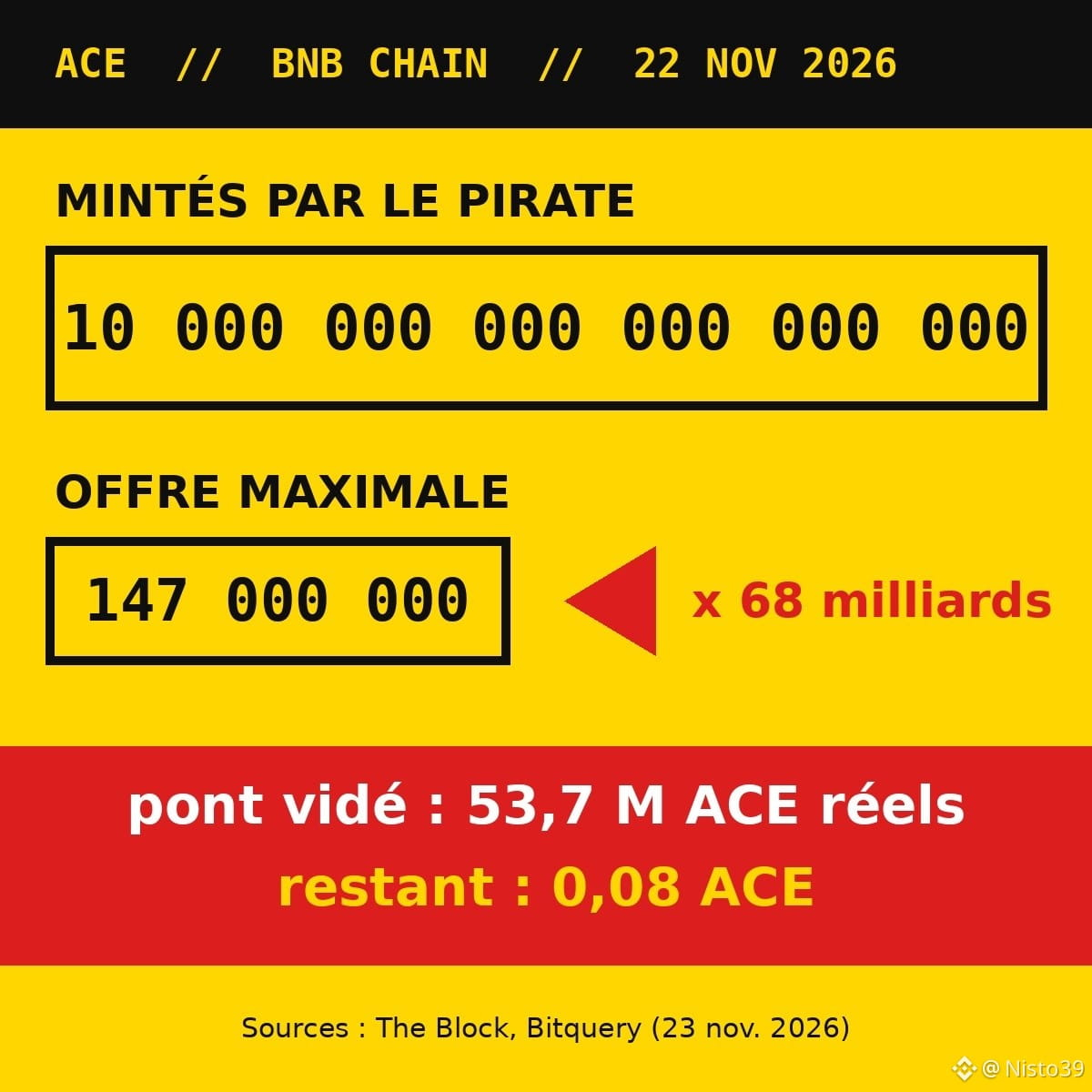
23:28 — final mint: 10 000 000 000 000 000 000 tokens. Ten billion billion. ACE’s maximum supply is 147 million.
According to The Block, the bridge held 53.7 million real ACE, and only 0.08 remained. Bitquery spotted 1,150.9 ETH sent to Tornado Cash, while the three keys that signed the fake mints (the same ones since 2023) were still in place this morning.
My take: the hack was a stolen key. The real flaw was a bridge that kept paying out for two hours without anyone shutting it down. And the damage doesn’t stop there: Gate canceled ACE sales from that window, leaving some sellers with a negative balance.
On Binance this morning, ACE is at $0.0755 (-11% in 24 hours, with a low of $0.0567).
The $50 wallet: clever opportunist or looter? And would you hold a token whose bridge relies on three keys?
#ACE #Fusionist #BNBChain #Hack #SecuriteCrypto
286
·
--
Article
Proof of reserves: one true statement, one half true, one falseFour years. FTX declared bankruptcy on November 11, 2022, and since then, we’ve all learned a new term: proof of reserves. Platforms display it, we nod, and almost no one clicks the “verify” button.
I wanted to sort through what we hear about this. Three statements come up all the time. One is true, one is half true, and one is false.
“I can verify for myself that my balance is included.” → TRUE
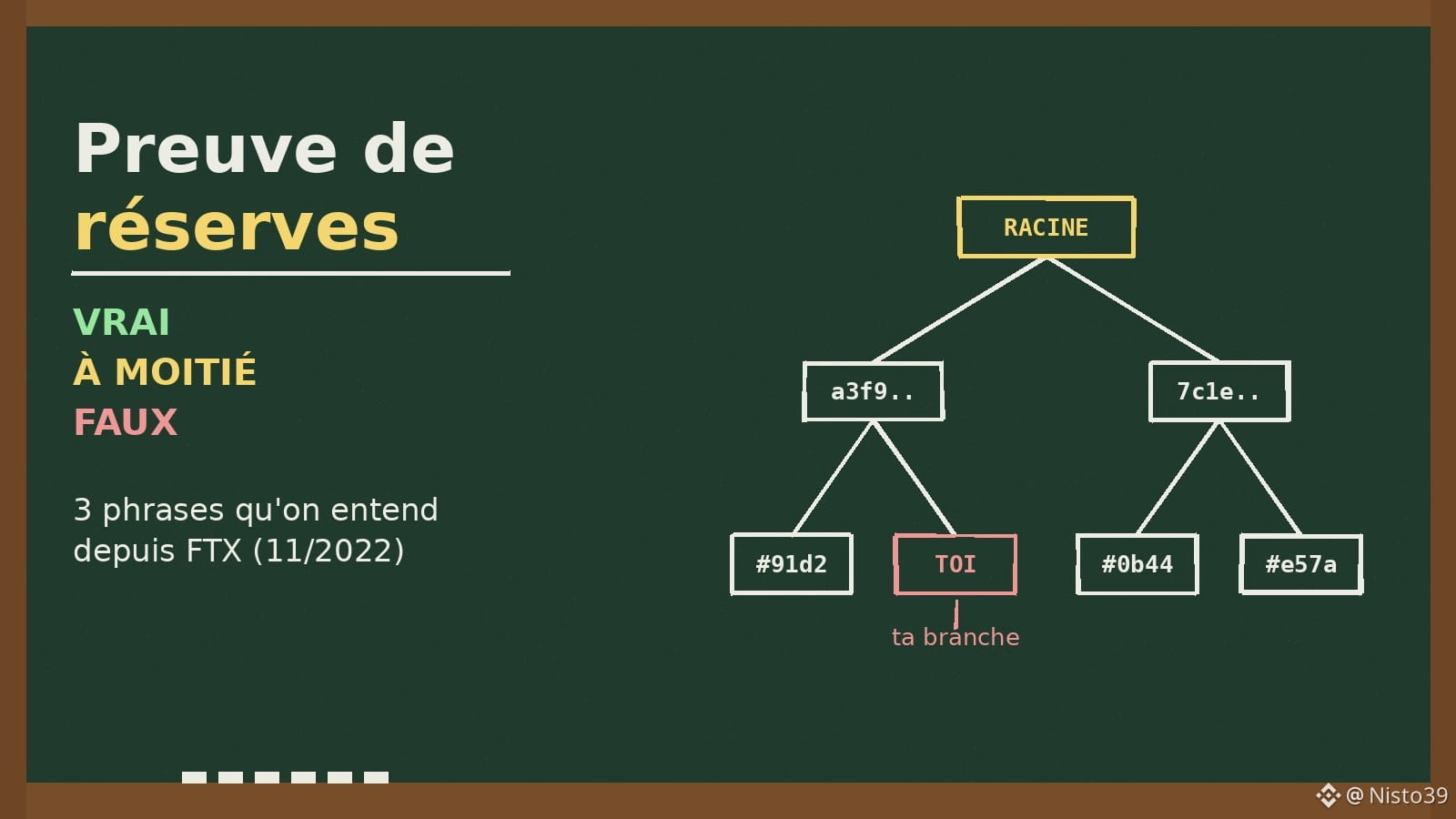
This is the most underrated part. The system is based on a Merkle tree: each account becomes a digital fingerprint (a hash, like a barcode that’s impossible to reverse). The fingerprints are grouped in pairs, then in pairs again, until there’s just one fingerprint at the top: the root. If someone removes or modifies your account, the root changes. You only need to see your own branch, not everyone else’s balances.
Proof of reserves: one true statement, one half true, one false
Four years. FTX declared bankruptcy on November 11, 2022, and since then, we’ve all learned a new term: proof of reserves. Platforms display it, we nod, and almost no one clicks the “verify” button.
I wanted to sort through what we hear about this. Three statements come up all the time. One is true, one is half true, and one is false.
“I can verify for myself that my balance is included.” → TRUE
This is the most underrated part. The system is based on a Merkle tree: each account becomes a digital fingerprint (a hash, like a barcode that’s impossible to reverse). The fingerprints are grouped in pairs, then in pairs again, until there’s just one fingerprint at the top: the root. If someone removes or modifies your account, the root changes. You only need to see your own branch, not everyone else’s balances.
136
·
--
Article
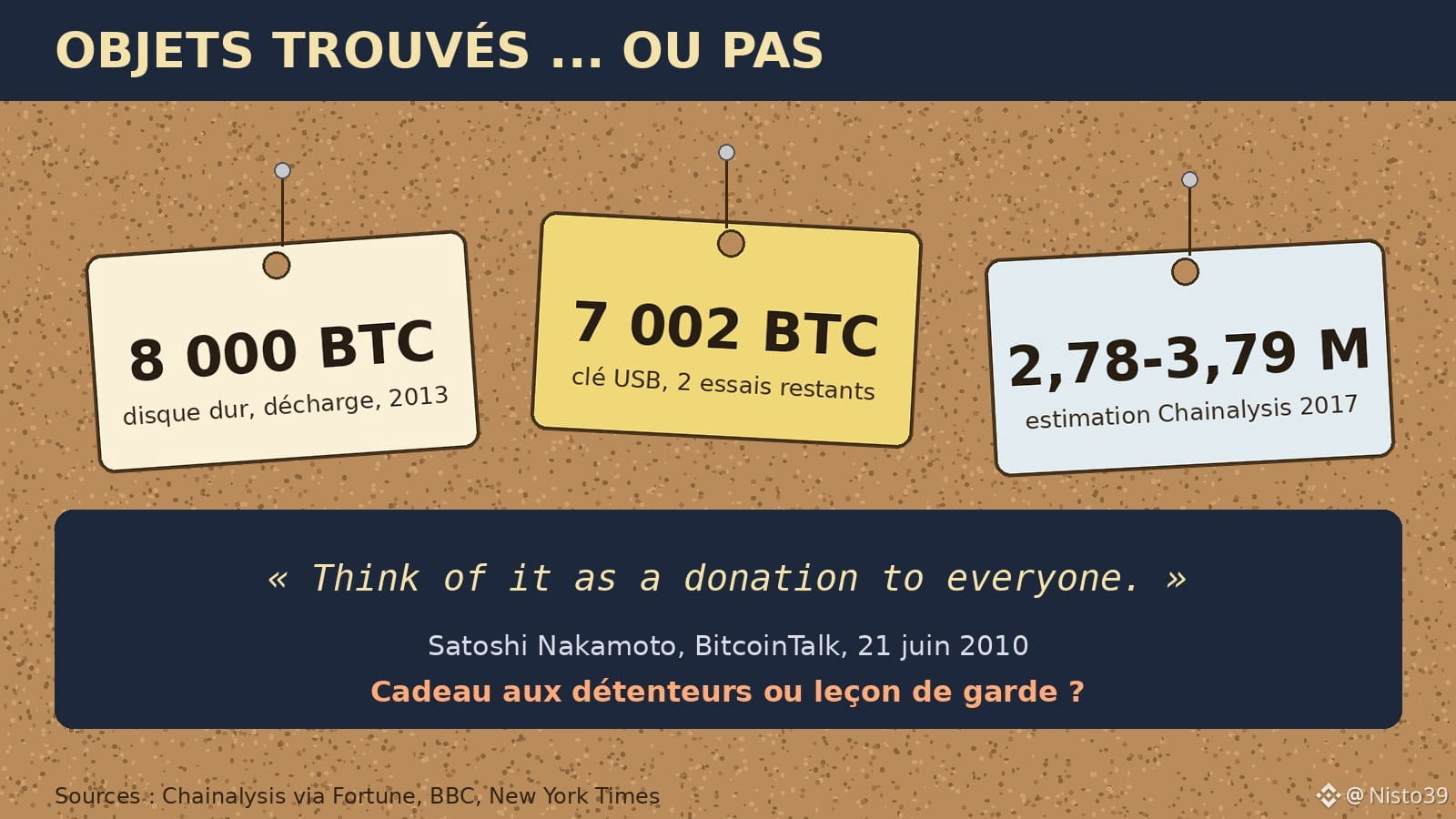
“A donation to everyone”: Satoshi and lost bitcoins—I only half agree“Lost coins only make everyone else’s coins worth slightly more. Think of it as a donation to everyone.”
Satoshi Nakamoto wrote this on the BitcoinTalk forum on June 21, 2010. In other words: lost coins just make everyone else’s coins worth a little more; think of it as a donation to everyone.
Sixteen years later, the phrase is cited everywhere as if it were self-evident. I think it’s only half true. Here’s why.
How many bitcoins are lost forever?
No one knows exactly, and you should be wary of anyone who gives a figure down to the nearest bitcoin. The most widely cited estimate comes from Chainalysis, in 2017: between 2.78 and 3.79 million BTC were probably lost, or 17 to 23% of what existed at the time. The method: look at how long each coin has been inactive, and conduct statistical surveys of the oldest ones. It’s an estimate, not an inventory.
“A donation to everyone”: Satoshi and lost bitcoins—I only half agree
“Lost coins only make everyone else’s coins worth slightly more. Think of it as a donation to everyone.”
Satoshi Nakamoto wrote this on the BitcoinTalk forum on June 21, 2010. In other words: lost coins just make everyone else’s coins worth a little more; think of it as a donation to everyone.
Sixteen years later, the phrase is cited everywhere as if it were self-evident. I think it’s only half true. Here’s why.
How many bitcoins are lost forever?
No one knows exactly, and you should be wary of anyone who gives a figure down to the nearest bitcoin. The most widely cited estimate comes from Chainalysis, in 2017: between 2.78 and 3.79 million BTC were probably lost, or 17 to 23% of what existed at the time. The method: look at how long each coin has been inactive, and conduct statistical surveys of the oldest ones. It’s an estimate, not an inventory.
327
·
--
Article
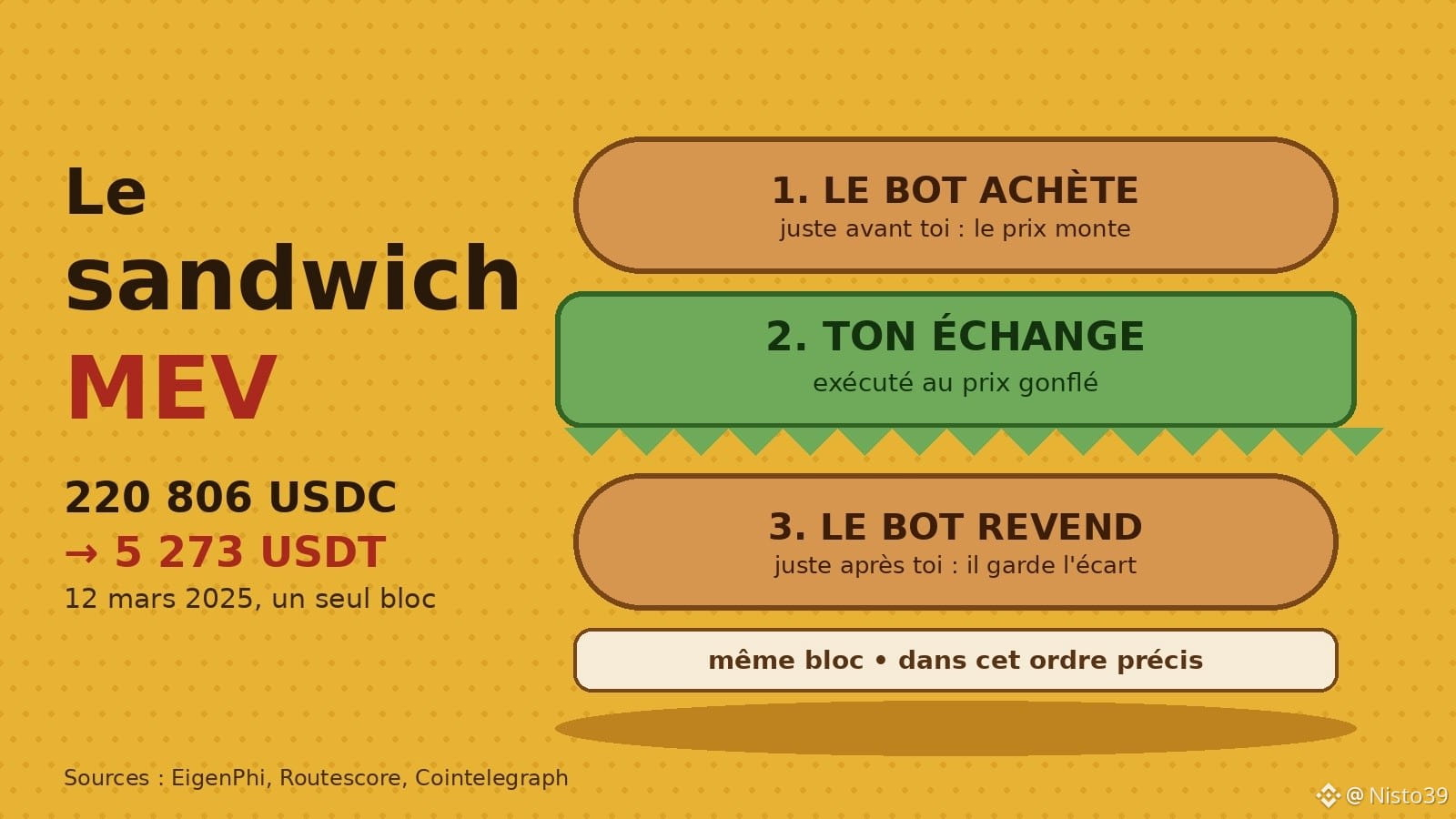
The sandwich: how 220,806 USDC became 5,273 USDT in a single blockOn March 12, 2025, at around 9:04 a.m. (UTC), someone sent 220,806 USDC to a Uniswap pool to get USDT. An exchange between two digital dollars. The kind of transaction where you'd expect to lose a few cents in fees.
They received 5,273 USDT. About 2.4% of what they put in. More than $215,000 evaporated in a single Ethereum block.
No hack. No contract vulnerability. Just a recipe bots know by heart: the sandwich.
The recipe, in three slices
Basic ingredient: the mempool. It's the public waiting room where transactions sit before entering a block. Anyone can read it. Bots can too, in a matter of milliseconds.
The sandwich: how 220,806 USDC became 5,273 USDT in a single block
On March 12, 2025, at around 9:04 a.m. (UTC), someone sent 220,806 USDC to a Uniswap pool to get USDT. An exchange between two digital dollars. The kind of transaction where you'd expect to lose a few cents in fees.
They received 5,273 USDT. About 2.4% of what they put in. More than $215,000 evaporated in a single Ethereum block.
No hack. No contract vulnerability. Just a recipe bots know by heart: the sandwich.
The recipe, in three slices
Basic ingredient: the mempool. It's the public waiting room where transactions sit before entering a block. Anyone can read it. Bots can too, in a matter of milliseconds.
1
533
·
--
Article
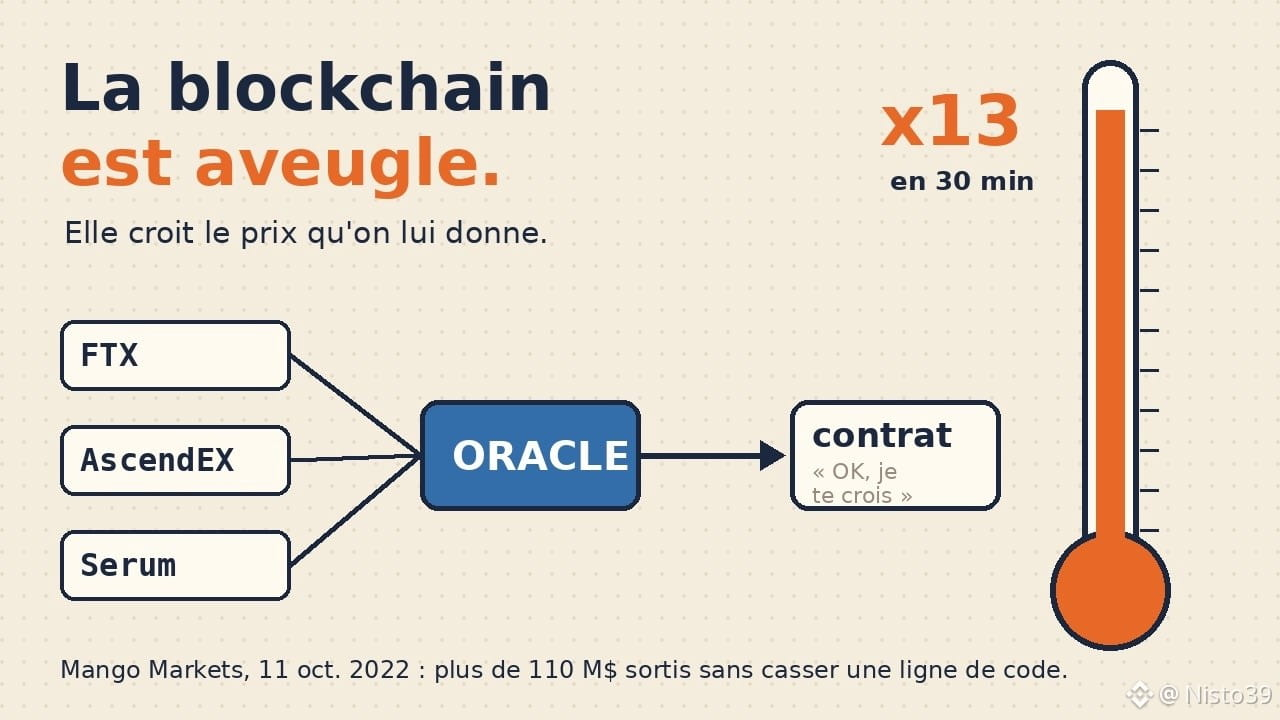
The blockchain is blind: the overlooked link that cost Mango Markets $110 millionA blockchain has no way of knowing what anything is worth.
It may be surprising, but it’s true. A smart contract (a program that runs on its own on the chain) can read what’s written on its own blockchain: balances, transactions, signatures. The price of $SOL on the markets, the euro exchange rate, the result of a match? It has no idea. Someone has to come and tell it.
This “someone” is called an oracle. It’s a service that fetches information from outside and writes it to the chain so contracts can use it. All of DeFi that lends, borrows, or liquidates positions depends on it. If the oracle says a token is worth 10 dollars, the contract believes it. It has no other option.
The blockchain is blind: the overlooked link that cost Mango Markets $110 million
A blockchain has no way of knowing what anything is worth.
It may be surprising, but it’s true. A smart contract (a program that runs on its own on the chain) can read what’s written on its own blockchain: balances, transactions, signatures. The price of $SOL on the markets, the euro exchange rate, the result of a match? It has no idea. Someone has to come and tell it.
This “someone” is called an oracle. It’s a service that fetches information from outside and writes it to the chain so contracts can use it. All of DeFi that lends, borrows, or liquidates positions depends on it. If the oracle says a token is worth 10 dollars, the contract believes it. It has no other option.
117
·
--
Article
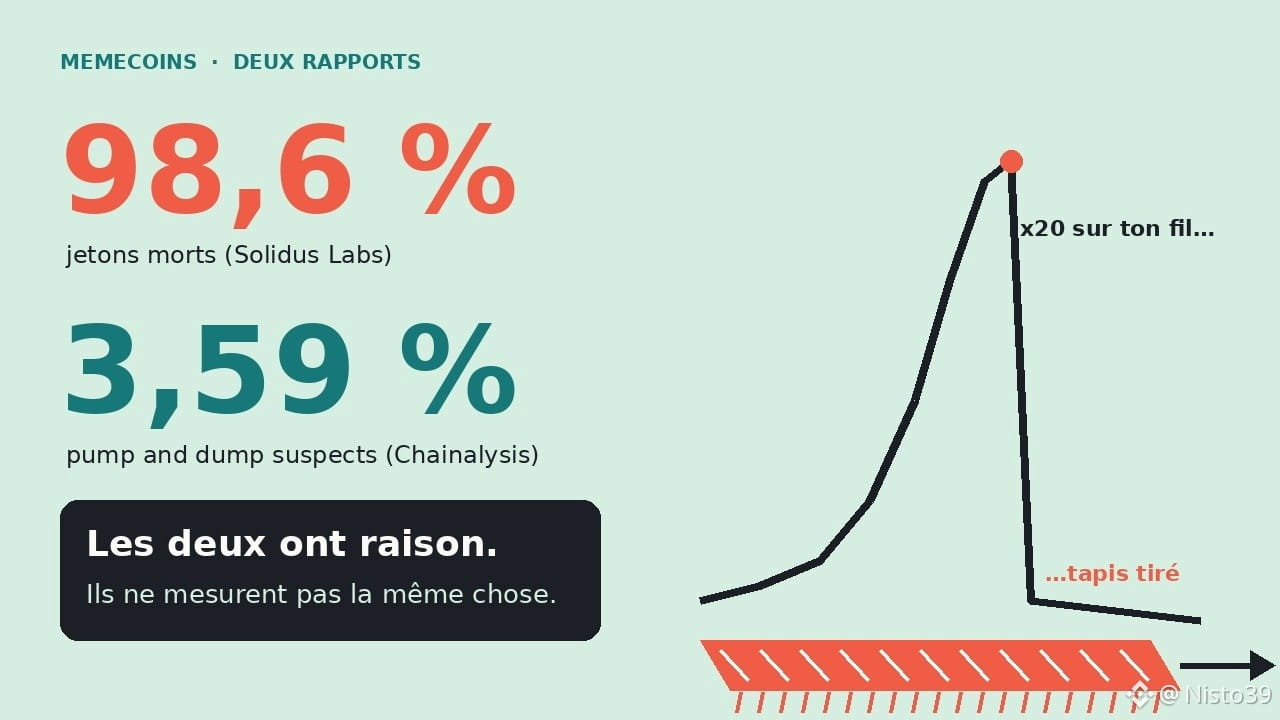
98.6% or 3.59%? Both figures on memecoins are rightTwo serious reports, two figures on memecoin scams. The first says 98.6%. The second says 3.59%. And the funniest part is, neither one is lying.
The 98.6% figure comes from Solidus Labs, a market surveillance firm. In May 2025, it examined more than 7 million tokens created on Pump.fun, Solana’s memecoin machine, between January 2024 and March 2025. The result: only 97,000 still had more than $1,000 in liquidity. Everything else had collapsed.
98.6% or 3.59%? Both figures on memecoins are right
Two serious reports, two figures on memecoin scams. The first says 98.6%. The second says 3.59%. And the funniest part is, neither one is lying.
The 98.6% figure comes from Solidus Labs, a market surveillance firm. In May 2025, it examined more than 7 million tokens created on Pump.fun, Solana’s memecoin machine, between January 2024 and March 2025. The result: only 97,000 still had more than $1,000 in liquidity. Everything else had collapsed.
The 98.6% figure comes from Solidus Labs, a market surveillance firm. In May 2025, it examined more than 7 million tokens created on Pump.fun, Solana’s memecoin machine, between January 2024 and March 2025. The result: only 97,000 still had more than $1,000 in liquidity. Everything else had collapsed.
185
·
--
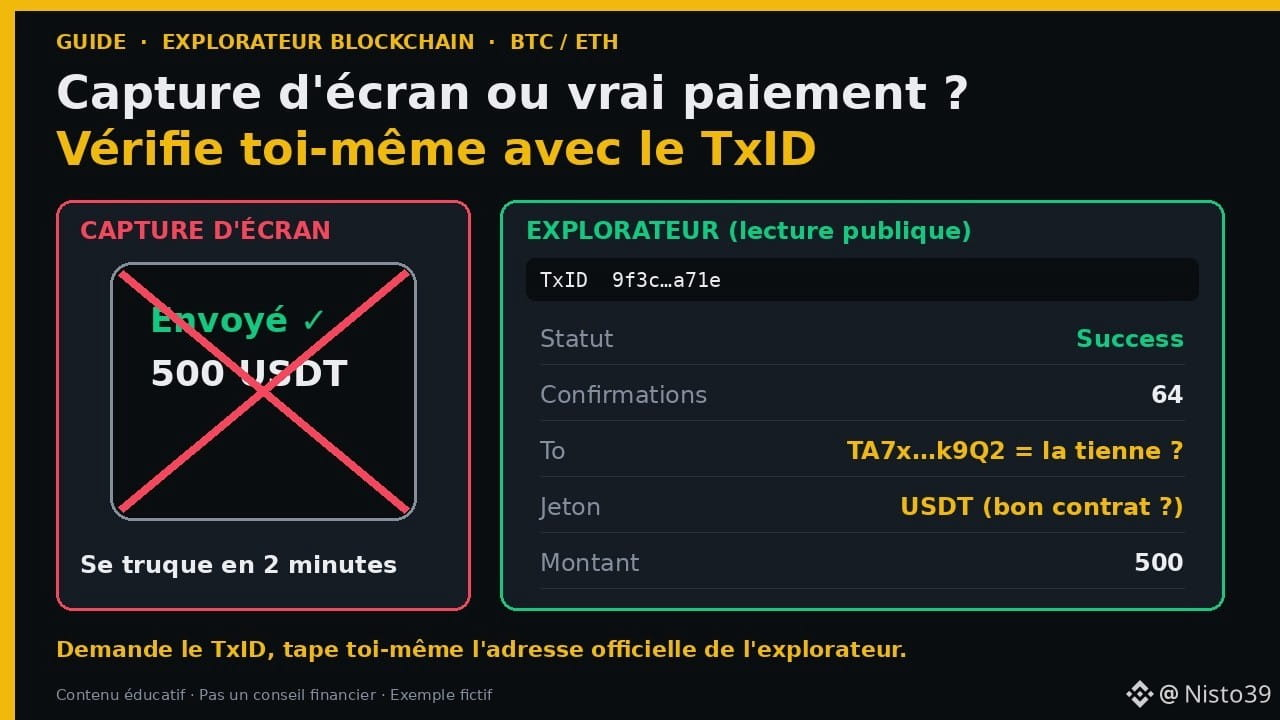
Article
Screenshot or real payment? Learn how to verify a crypto transaction yourselfKoffi sells motorcycle parts in Lomé. A customer tells him: “I sent you the USDT, look, here’s the screenshot.” But nothing has arrived in Koffi’s account. Who’s telling the truth? The answer isn’t in the screenshot or the customer’s word: it’s on the blockchain, and anyone can read it for free using a “block explorer.” Here’s how, step by step.
🔎 What is a blockchain explorer?
• A blockchain is a large public ledger. A block explorer is simply a website that displays this ledger in an easy-to-read format, like a bank statement open to everyone.
Screenshot or real payment? Learn how to verify a crypto transaction yourself
Koffi sells motorcycle parts in Lomé. A customer tells him: “I sent you the USDT, look, here’s the screenshot.” But nothing has arrived in Koffi’s account. Who’s telling the truth? The answer isn’t in the screenshot or the customer’s word: it’s on the blockchain, and anyone can read it for free using a “block explorer.” Here’s how, step by step.
🔎 What is a blockchain explorer?
• A blockchain is a large public ledger. A block explorer is simply a website that displays this ledger in an easy-to-read format, like a bank statement open to everyone.
🔎 What is a blockchain explorer?
• A blockchain is a large public ledger. A block explorer is simply a website that displays this ledger in an easy-to-read format, like a bank statement open to everyone.
2
353
·
--
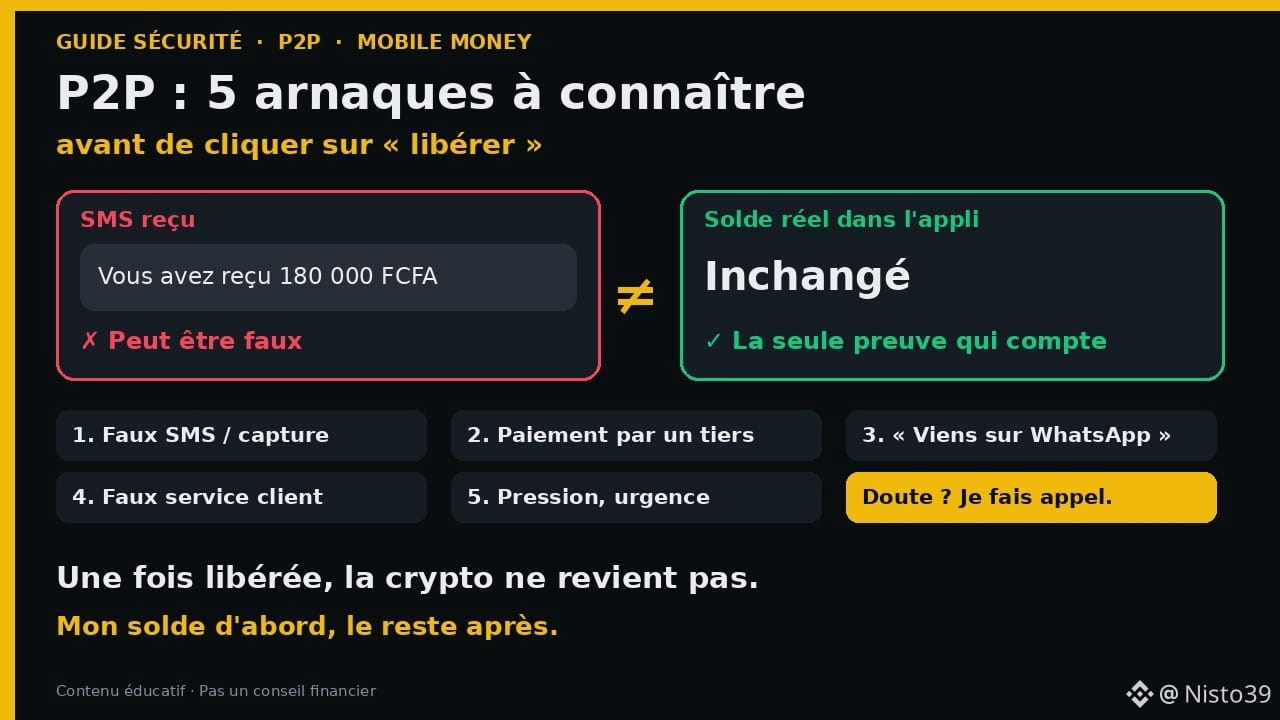
Article
P2P and Mobile Money: 5 scams to know about before clicking “release”Kodjo sells phones at the Grand Market of Lomé. One evening, he sells 300 USDT via P2P. A few minutes later, a text message arrives: “You’ve received 180,000 FCFA.” The buyer insists: “It’s paid, release it quickly, I’m in a hurry!”
Kodjo opens his Mobile Money app… and the balance hasn’t changed. The text message was fake.
P2P (peer-to-peer) is a valuable entry point in Africa: you buy or sell crypto directly with another person, who pays via Mobile Money or bank transfer. But it’s also where scammers are most active. Here are the 5 most common traps and how to avoid them.
P2P and Mobile Money: 5 scams to know about before clicking “release”
Kodjo sells phones at the Grand Market of Lomé. One evening, he sells 300 USDT via P2P. A few minutes later, a text message arrives: “You’ve received 180,000 FCFA.” The buyer insists: “It’s paid, release it quickly, I’m in a hurry!”
Kodjo opens his Mobile Money app… and the balance hasn’t changed. The text message was fake.
P2P (peer-to-peer) is a valuable entry point in Africa: you buy or sell crypto directly with another person, who pays via Mobile Money or bank transfer. But it’s also where scammers are most active. Here are the 5 most common traps and how to avoid them.
8
31
15.9k
·
--
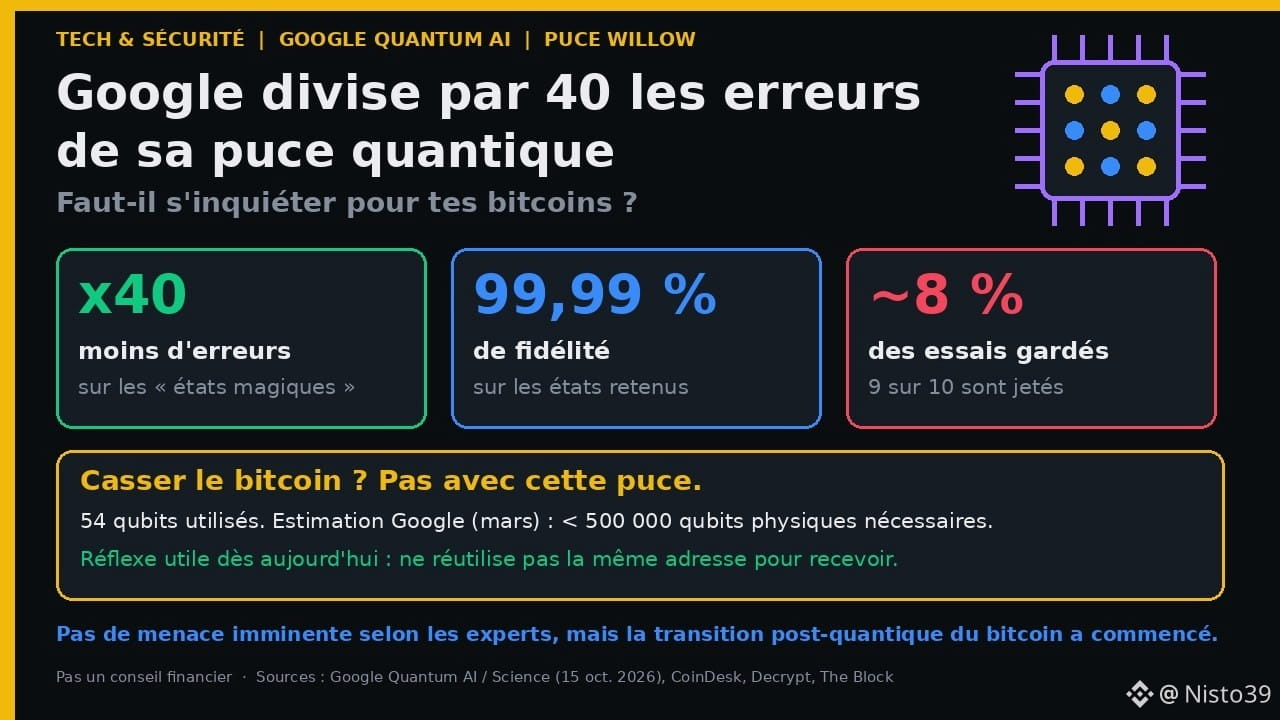
Article
Google reduces errors in its quantum chip by 40 times: should you worry about your bitcoins?On October 15, Google announced a breakthrough in its quantum computers. Some people on social media concluded that bitcoin would soon be “broken.” The reality is more nuanced, and it affects you even if you only have a few thousand CFA francs in crypto. Here’s what really happened, explained simply.
📋 The facts (Google, Oct. 15, 2026; article published in the journal Science)
• The Google Quantum AI team tested a technique on its Willow chip called “magic state cultivation.”
Google reduces errors in its quantum chip by 40 times: should you worry about your bitcoins?
On October 15, Google announced a breakthrough in its quantum computers. Some people on social media concluded that bitcoin would soon be “broken.” The reality is more nuanced, and it affects you even if you only have a few thousand CFA francs in crypto. Here’s what really happened, explained simply.
📋 The facts (Google, Oct. 15, 2026; article published in the journal Science)
• The Google Quantum AI team tested a technique on its Willow chip called “magic state cultivation.”
📋 The facts (Google, Oct. 15, 2026; article published in the journal Science)
• The Google Quantum AI team tested a technique on its Willow chip called “magic state cultivation.”
38

·
--
Bitget confirms that a hack exposed 352 million dollars this Thursday, and yet the market barely flinched: BTC holds at 84 516 $ (+1,08 % over 24h) and ETH at 2 693 $ (+0,94 %). Honestly, this calm seems suspicious, as if the fear of hacks had become mere background noise. After FTX, we were promised transparency and proof of reserves—yet another nine-figure failure. Would you keep your funds on a platform the very day it announces a hack? #Bitget #CryptoSecurity
Bitget confirms that a hack exposed 352 million dollars this Thursday, and yet the market barely flinched: BTC holds at 84 516 $ (+1,08 % over 24h) and ETH at 2 693 $ (+0,94 %). Honestly, this calm seems suspicious, as if the fear of hacks had become mere background noise. After FTX, we were promised transparency and proof of reserves—yet another nine-figure failure. Would you keep your funds on a platform the very day it announces a hack? #Bitget #CryptoSecurity
1
135
·
--
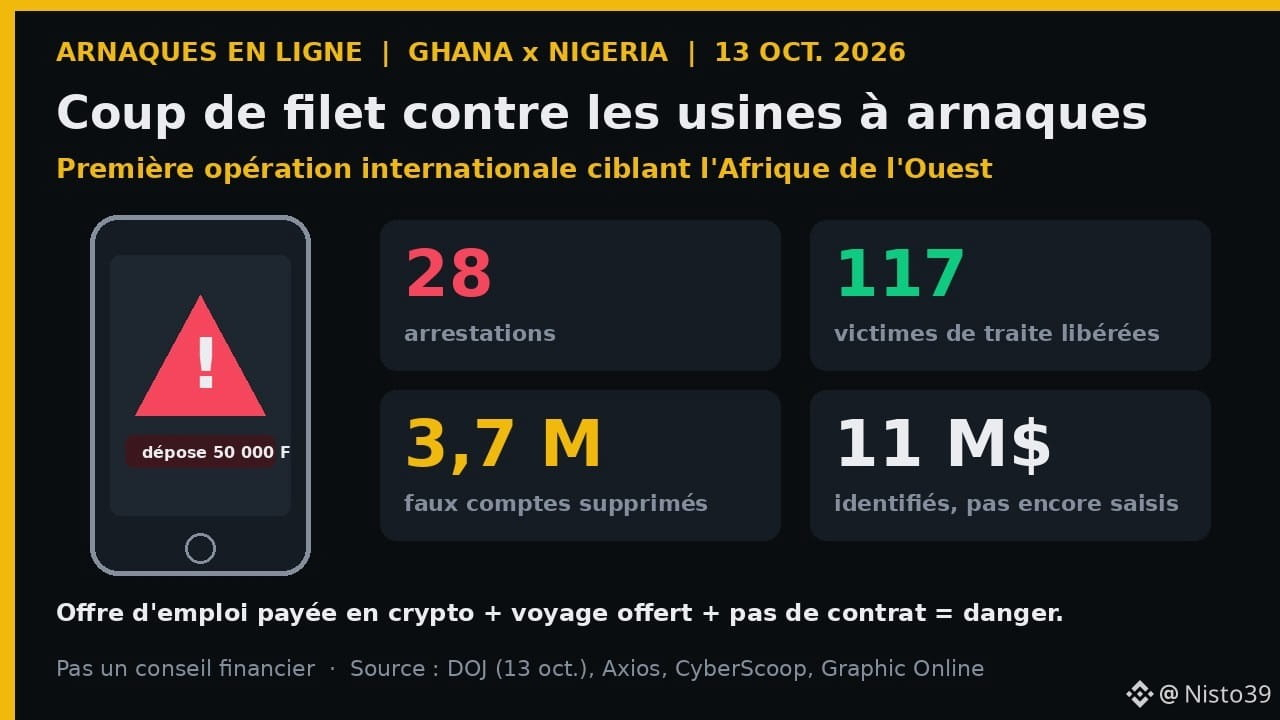
Article
Ghana-Nigeria: 28 arrests, 117 victims freed. How crypto scam factories operate28 arrests in Ghana and Nigeria, 117 people freed from a house where they were forced to scam strangers online, and more than 3.7 million fake accounts removed. That’s the outcome of “Joint Disruption Week,” the first major international operation targeting online scam networks in West Africa, announced on October 13, 2026. Here’s what happened, how these networks operate, and what it means for you.
📋 The facts (U.S. Department of Justice press release, Oct. 13, 2026; Axios, CyberScoop, Graphic Online)
Ghana-Nigeria: 28 arrests, 117 victims freed. How crypto scam factories operate
28 arrests in Ghana and Nigeria, 117 people freed from a house where they were forced to scam strangers online, and more than 3.7 million fake accounts removed. That’s the outcome of “Joint Disruption Week,” the first major international operation targeting online scam networks in West Africa, announced on October 13, 2026. Here’s what happened, how these networks operate, and what it means for you.
📋 The facts (U.S. Department of Justice press release, Oct. 13, 2026; Axios, CyberScoop, Graphic Online)
📋 The facts (U.S. Department of Justice press release, Oct. 13, 2026; Axios, CyberScoop, Graphic Online)
57
·
--
Bitget is hacked for $351.6 million, and CZ has already announced that Binance and the BNB Chain ecosystem will do everything they can to help, while Richard Teng confirms that intelligence-sharing is underway following the detection of the theft. The affected assets include ETH, XRP, BNB, AVAX, and stablecoins, with the XRP Ledger leading the losses by chain. Bitget highlights its protection fund of more than $464 million, but a major exchange that has been compromised remains a major exchange that has been compromised. The market, meanwhile, shows an almost unsettling calm: BTC at 83 884 $ (-0.55 %) and ETH at 2 684 $ (-0.16 %). Do you think this hack will become the final argument for imposing real-time proof of reserves on all exchanges? #Bitget #SecuriteCrypto
Bitget is hacked for $351.6 million, and CZ has already announced that Binance and the BNB Chain ecosystem will do everything they can to help, while Richard Teng confirms that intelligence-sharing is underway following the detection of the theft. The affected assets include ETH, XRP, BNB, AVAX, and stablecoins, with the XRP Ledger leading the losses by chain. Bitget highlights its protection fund of more than $464 million, but a major exchange that has been compromised remains a major exchange that has been compromised. The market, meanwhile, shows an almost unsettling calm: BTC at 83 884 $ (-0.55 %) and ETH at 2 684 $ (-0.16 %). Do you think this hack will become the final argument for imposing real-time proof of reserves on all exchanges? #Bitget #SecuriteCrypto
135

·
--
🚨 If someone promises to DOUBLES your money in 7 days, that’s not crypto. It’s a scam. Period.
Real crypto guarantees no profit. Those who promise you a fixed return just want your Flooz.
Here are the 4 traps we see every day in Lomé 👇
1️⃣ « Send 50,000 F to this T-Money, my agent will buy for you »
→ NEVER. No serious person manages your money for you. You buy yourself, on your own wallet.
2️⃣ The WhatsApp/Telegram group full of “withdrawal screenshots”
→ These proofs are faked in 2 minutes. A screenshot isn’t proof.
3️⃣ « There are more than 2 spots left—today or never »
→ Urgency is the scammer’s #1 weapon. A real project will still be there tomorrow.
4️⃣ They ask you for your secret phrase (12/24-word seed phrase)
→ It’s the key to your safe. Nobody—NONE of any platform—asks for it. If you give it away = you lose everything.
The NBBC rule: buy/sell yourself, on a reputable platform, and keep your seed phrase to yourself alone.
👉 Have you already been offered a crypto scam in Togo? What exactly was the pitch? Tell us in the comments 👇 — it could help someone else avoid the trap.
This is not financial advice.
#crypto #togodcrypt #SecuriteCrypto #bitcoin
1
408
Log in to explore more content
Join global crypto users on Binance Square
⚡️ Get latest and useful information about crypto.
💬 Trusted by the world’s largest crypto exchange.
👍 Discover real insights from verified creators.
Email / Phone number
Trending Topics
1
#CorePCEBeatLiftsFedHikeOdds
26,755 views
472 Discussing
2
#BitcoinAndStocksSlipAgainAmidTrump’sTariffPlans
113,660 views
1,410 Discussing
3
#JensenHuangSaysNvidiaDoesn’tNeedASuccessionPlan
59,745 views
832 Discussing
4
#NasdaqFuturesSlideMoreThan3%
5,563 views
145 Discussing
5
#USOctoberPCEPriceIndexAt0.3%MoM
5,562 views
134 Discussing
6
#BitcoinETFsPostRecord$4.94BNovemberOutflows
497 views
19 Discussing
7
#TetherInvestsInArgentinasLemon
3,718 views
65 Discussing
8
#AnthropicBreaksBelowIPOPriceAmidAISlump
180,931 views
1,529 Discussing
9
#SouthKoreaProposesCryptoExchangeStaffUseOwnPlatform
958 views
25 Discussing
10
#UkraineParliamentPassesVirtualAssetLegalizationBill
7,148 views
26 Discussing