

#chainlinklaunchesccip2withenterpriseverification
chainlinklaunchesccip2withenterpriseverification
Hot
Latest

·
--
Chainlink has officially launched CCIP 2, introducing enterprise-grade verification capabilities. This significant upgrade to the Cross-Chain Interoperability Protocol is poised to enhance security and trust for institutional adoption of blockchain technology.
The integration of enterprise verification marks a crucial step towards bridging the gap between traditional finance and decentralized networks. By providing robust mechanisms for validating transactions and data across different blockchains, CCIP 2 aims to unlock new possibilities for financial institutions looking to leverage the power of web3. This development could significantly boost the utility and adoption of cross-chain solutions, making it easier and safer for enterprises to interact with the digital asset ecosystem.
This advancement underscores Chainlink's commitment to building the infrastructure necessary for a more interconnected and secure blockchain future.
#ChainlinkLaunchesCCIP2WithEnterpriseVerification $LINK
Chainlink has officially launched CCIP 2, introducing enterprise-grade verification capabilities. This significant upgrade to the Cross-Chain Interoperability Protocol is poised to enhance security and trust for institutional adoption of blockchain technology.
The integration of enterprise verification marks a crucial step towards bridging the gap between traditional finance and decentralized networks. By providing robust mechanisms for validating transactions and data across different blockchains, CCIP 2 aims to unlock new possibilities for financial institutions looking to leverage the power of web3. This development could significantly boost the utility and adoption of cross-chain solutions, making it easier and safer for enterprises to interact with the digital asset ecosystem.
This advancement underscores Chainlink's commitment to building the infrastructure necessary for a more interconnected and secure blockchain future.
#ChainlinkLaunchesCCIP2WithEnterpriseVerification $LINK
The integration of enterprise verification marks a crucial step towards bridging the gap between traditional finance and decentralized networks. By providing robust mechanisms for validating transactions and data across different blockchains, CCIP 2 aims to unlock new possibilities for financial institutions looking to leverage the power of web3. This development could significantly boost the utility and adoption of cross-chain solutions, making it easier and safer for enterprises to interact with the digital asset ecosystem.
This advancement underscores Chainlink's commitment to building the infrastructure necessary for a more interconnected and secure blockchain future.
#ChainlinkLaunchesCCIP2WithEnterpriseVerification $LINK
59

·
--
Chainlink Takes CCIP to the Enterprise Level 🚀
Chainlink has launched CCIP 2.0, adding a new verification layer that lets institutions run their own Cross-Chain Verifiers or use independent third-party validators. The upgrade is designed to give firms more control over security when moving tokenized assets across blockchains.
CCIP 2.0 also adds built-in compliance tools for KYC, AML and sanctions screening, plus configurable transaction-finality speeds. The launch includes partners such as AWS, ANZ, Fidelity International, Google Cloud and Deutsche Börse’s Crypto Finance. 🔐
Chainlink says CCIP has already handled more than $84 billion in cross-chain token value. The new version is clearly aimed at making blockchain infrastructure easier for traditional financial institutions to use.
{future}(LINKUSDT)
#ChainlinkLaunchesCCIP2WithEnterpriseVerification
Chainlink Takes CCIP to the Enterprise Level 🚀
Chainlink has launched CCIP 2.0, adding a new verification layer that lets institutions run their own Cross-Chain Verifiers or use independent third-party validators. The upgrade is designed to give firms more control over security when moving tokenized assets across blockchains.
CCIP 2.0 also adds built-in compliance tools for KYC, AML and sanctions screening, plus configurable transaction-finality speeds. The launch includes partners such as AWS, ANZ, Fidelity International, Google Cloud and Deutsche Börse’s Crypto Finance. 🔐
Chainlink says CCIP has already handled more than $84 billion in cross-chain token value. The new version is clearly aimed at making blockchain infrastructure easier for traditional financial institutions to use.
#ChainlinkLaunchesCCIP2WithEnterpriseVerification
Chainlink has launched CCIP 2.0, adding a new verification layer that lets institutions run their own Cross-Chain Verifiers or use independent third-party validators. The upgrade is designed to give firms more control over security when moving tokenized assets across blockchains.
CCIP 2.0 also adds built-in compliance tools for KYC, AML and sanctions screening, plus configurable transaction-finality speeds. The launch includes partners such as AWS, ANZ, Fidelity International, Google Cloud and Deutsche Börse’s Crypto Finance. 🔐
Chainlink says CCIP has already handled more than $84 billion in cross-chain token value. The new version is clearly aimed at making blockchain infrastructure easier for traditional financial institutions to use.
#ChainlinkLaunchesCCIP2WithEnterpriseVerification
59

·
--
🏦 Chainlink just changed what a cross-chain transaction can prove...
#chainlinklaunchesccip2withenterpriseverification
CCIP 2.0 is now live — but the interesting upgrade isn't simply moving assets between blockchains.
It's who gets to approve the move.
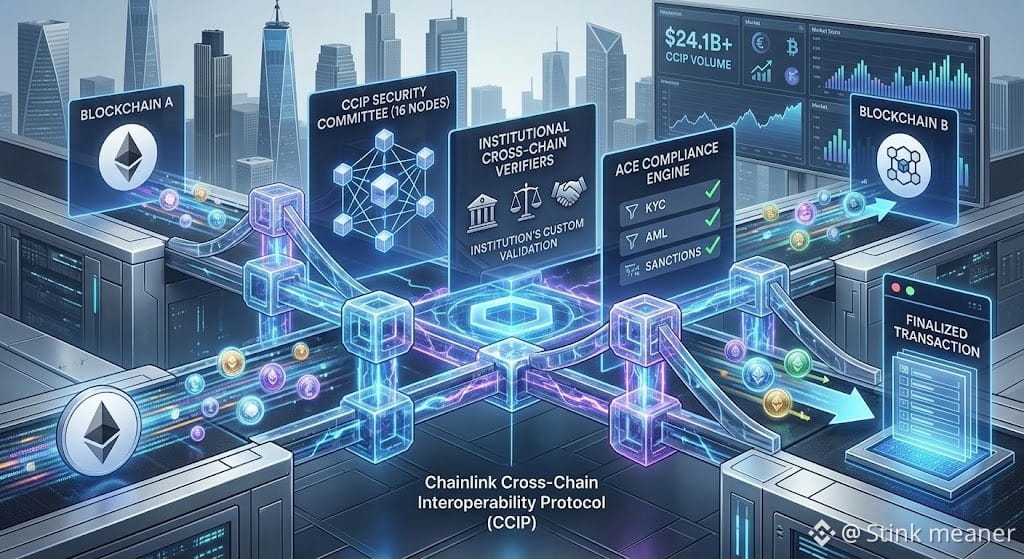
CCIP's default security layer uses a 16-node committee. Now institutions and asset issuers can add their own Cross-Chain Verifiers — or trusted third-party verifiers — so a transaction requires the required attestations before execution.
They can even impose rules like:
“Anything above $1M needs another approval.”
Then Chainlink adds programmable compliance through ACE: KYC, AML, sanctions screening, allowlists, transaction limits and exposure controls can follow an asset across chains.
That's a subtle but important shift:
OLD MODEL: move the asset.
NEW MODEL: move the asset only when its rules are satisfied.
And verification itself is becoming a marketplace, with specialist providers able to operate CCVs and charge their own fees.
That matters because tokenized securities are already reaching production workflows. DTCC has processed real trades using tokenized assets and is preparing its broader tokenization service.
CCIP has already processed $24.1B+ in cumulative transfer volume, according to Chainlink's latest metrics.
The bigger question for $LINK isn't whether institutions are using Chainlink.
It's whether that usage eventually becomes meaningful token economics.
DYOR. CCIP adoption does not automatically create open-market demand for LINK; fee mechanisms and institutional usage will determine the economic impact.
$LINK
{future}(LINKUSDT)
#ChainlinkLaunchesCCIP2WithEnterpriseVerification #Binance #CryptoNews #CCIP
🏦 Chainlink just changed what a cross-chain transaction can prove...
#chainlinklaunchesccip2withenterpriseverification
CCIP 2.0 is now live — but the interesting upgrade isn't simply moving assets between blockchains.
It's who gets to approve the move.
CCIP's default security layer uses a 16-node committee. Now institutions and asset issuers can add their own Cross-Chain Verifiers — or trusted third-party verifiers — so a transaction requires the required attestations before execution.
They can even impose rules like:
“Anything above $1M needs another approval.”
Then Chainlink adds programmable compliance through ACE: KYC, AML, sanctions screening, allowlists, transaction limits and exposure controls can follow an asset across chains.
That's a subtle but important shift:
OLD MODEL: move the asset.
NEW MODEL: move the asset only when its rules are satisfied.
And verification itself is becoming a marketplace, with specialist providers able to operate CCVs and charge their own fees.
That matters because tokenized securities are already reaching production workflows. DTCC has processed real trades using tokenized assets and is preparing its broader tokenization service.
CCIP has already processed $24.1B+ in cumulative transfer volume, according to Chainlink's latest metrics.
The bigger question for $LINK isn't whether institutions are using Chainlink.
It's whether that usage eventually becomes meaningful token economics.
DYOR. CCIP adoption does not automatically create open-market demand for LINK; fee mechanisms and institutional usage will determine the economic impact.
$LINK
#ChainlinkLaunchesCCIP2WithEnterpriseVerification #Binance #CryptoNews #CCIP
#chainlinklaunchesccip2withenterpriseverification
CCIP 2.0 is now live — but the interesting upgrade isn't simply moving assets between blockchains.
It's who gets to approve the move.
CCIP's default security layer uses a 16-node committee. Now institutions and asset issuers can add their own Cross-Chain Verifiers — or trusted third-party verifiers — so a transaction requires the required attestations before execution.
They can even impose rules like:
“Anything above $1M needs another approval.”
Then Chainlink adds programmable compliance through ACE: KYC, AML, sanctions screening, allowlists, transaction limits and exposure controls can follow an asset across chains.
That's a subtle but important shift:
OLD MODEL: move the asset.
NEW MODEL: move the asset only when its rules are satisfied.
And verification itself is becoming a marketplace, with specialist providers able to operate CCVs and charge their own fees.
That matters because tokenized securities are already reaching production workflows. DTCC has processed real trades using tokenized assets and is preparing its broader tokenization service.
CCIP has already processed $24.1B+ in cumulative transfer volume, according to Chainlink's latest metrics.
The bigger question for $LINK isn't whether institutions are using Chainlink.
It's whether that usage eventually becomes meaningful token economics.
DYOR. CCIP adoption does not automatically create open-market demand for LINK; fee mechanisms and institutional usage will determine the economic impact.
$LINK
#ChainlinkLaunchesCCIP2WithEnterpriseVerification #Binance #CryptoNews #CCIP
18

·
--
Chainlink Launches CCIP 2.0 with Enterprise Verification! 🔗
Big news today Sep 28 — Chainlink launched CCIP 2.0, a major upgrade to its cross-chain protocol.
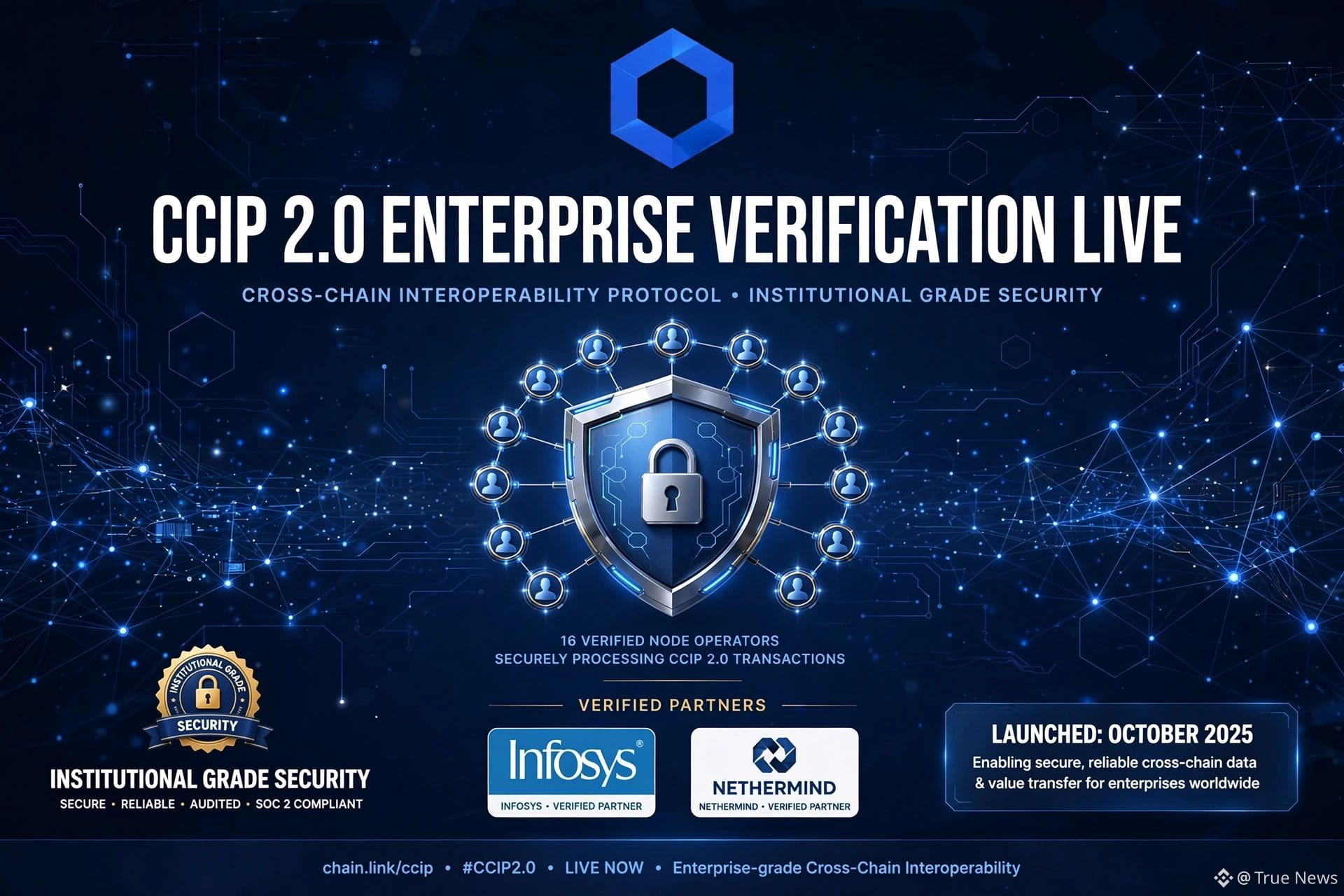
New version lets enterprises add their own security verification checks on top of Chainlink's default network of 16 independent node operators.
Businesses can run their own validators or hire external providers like Infosys or Nethermind.
This comes after $292M Kelp DAO hack that used single verifier. CCIP 2.0 is secure-by-default, institutional-grade.
I am BULLISH on $LINK
{future}(LINKUSDT)
. Cross-chain future is here. Not financial advice.#chainlinklaunchesccip2withenterpriseverification
Chainlink Launches CCIP 2.0 with Enterprise Verification! 🔗
Big news today Sep 28 — Chainlink launched CCIP 2.0, a major upgrade to its cross-chain protocol.
New version lets enterprises add their own security verification checks on top of Chainlink's default network of 16 independent node operators.
Businesses can run their own validators or hire external providers like Infosys or Nethermind.
This comes after $292M Kelp DAO hack that used single verifier. CCIP 2.0 is secure-by-default, institutional-grade.
I am BULLISH on $LINK
. Cross-chain future is here. Not financial advice.#chainlinklaunchesccip2withenterpriseverification
Big news today Sep 28 — Chainlink launched CCIP 2.0, a major upgrade to its cross-chain protocol.
New version lets enterprises add their own security verification checks on top of Chainlink's default network of 16 independent node operators.
Businesses can run their own validators or hire external providers like Infosys or Nethermind.
This comes after $292M Kelp DAO hack that used single verifier. CCIP 2.0 is secure-by-default, institutional-grade.
I am BULLISH on $LINK
. Cross-chain future is here. Not financial advice.#chainlinklaunchesccip2withenterpriseverification
1
10

·
--
Bullish
#chainlinklaunchesccip2withenterpriseverification
🚨 CHAINLINK JUST LEVELLED UP CROSS-CHAIN INFRASTRUCTURE! 🔗🔥
#ChainlinkLaunchesCCIP2WithEnterpriseVerification — and this could be a major step for institutional blockchain adoption. 👀
Chainlink’s CCIP 2.0 brings stronger enterprise-focused verification and infrastructure for moving data and assets across different blockchains.
🔗 Cross-chain connectivity
🏦 Built with enterprise use cases in mind
🛡️ Stronger verification infrastructure
🌐 More bridges between traditional finance and blockchain
Why does this matter for $LINK?
The more institutions use blockchain across multiple networks, the greater the need for reliable cross-chain infrastructure.
If adoption accelerates, LINK could become one of the tokens traders watch closely. 🚀
Is Chainlink preparing for the next wave of institutional blockchain adoption? 👀
#Chainlink #LINK #crypto
#chainlinklaunchesccip2withenterpriseverification
🚨 CHAINLINK JUST LEVELLED UP CROSS-CHAIN INFRASTRUCTURE! 🔗🔥
#ChainlinkLaunchesCCIP2WithEnterpriseVerification — and this could be a major step for institutional blockchain adoption. 👀
Chainlink’s CCIP 2.0 brings stronger enterprise-focused verification and infrastructure for moving data and assets across different blockchains.
🔗 Cross-chain connectivity
🏦 Built with enterprise use cases in mind
🛡️ Stronger verification infrastructure
🌐 More bridges between traditional finance and blockchain
Why does this matter for $LINK?
The more institutions use blockchain across multiple networks, the greater the need for reliable cross-chain infrastructure.
If adoption accelerates, LINK could become one of the tokens traders watch closely. 🚀
Is Chainlink preparing for the next wave of institutional blockchain adoption? 👀
#Chainlink #LINK #crypto
🚨 CHAINLINK JUST LEVELLED UP CROSS-CHAIN INFRASTRUCTURE! 🔗🔥
#ChainlinkLaunchesCCIP2WithEnterpriseVerification — and this could be a major step for institutional blockchain adoption. 👀
Chainlink’s CCIP 2.0 brings stronger enterprise-focused verification and infrastructure for moving data and assets across different blockchains.
🔗 Cross-chain connectivity
🏦 Built with enterprise use cases in mind
🛡️ Stronger verification infrastructure
🌐 More bridges between traditional finance and blockchain
Why does this matter for $LINK?
The more institutions use blockchain across multiple networks, the greater the need for reliable cross-chain infrastructure.
If adoption accelerates, LINK could become one of the tokens traders watch closely. 🚀
Is Chainlink preparing for the next wave of institutional blockchain adoption? 👀
#Chainlink #LINK #crypto
46

·
--
$LINK just got another interesting update.
Chainlink has launched CCIP 2.0, bringing enterprise-grade verification directly into its cross-chain infrastructure.
For anyone unfamiliar, CCIP is Chainlink’s system for moving tokens and data between different blockchains without relying on traditional bridges.
The big update is Cross-Chain Verifiers (CCVs).
Institutions can now add their own independent verification layer on top of Chainlink’s existing 16-node network. They can run it themselves or use providers like Infosys and Nethermind.
So before a transfer goes through, both verification layers have to approve it.
CCIP 2.0 also adds compliance tools for things like KYC, AML, sanctions screening and custom rules, while giving institutions different speed and security options depending on the transaction.
The bigger picture is pretty simple:
Chainlink is making it easier for institutions to move tokenized assets across different chains while keeping more control over security and compliance.
With names like ANZ, Fidelity International, SBI Digital Markets, AWS and Google Cloud involved at launch, this is definitely one I’m keeping an eye on.
#ChainlinkLaunchesCCIP2WithEnterpriseVerification
$LINK just got another interesting update.
Chainlink has launched CCIP 2.0, bringing enterprise-grade verification directly into its cross-chain infrastructure.
For anyone unfamiliar, CCIP is Chainlink’s system for moving tokens and data between different blockchains without relying on traditional bridges.
The big update is Cross-Chain Verifiers (CCVs).
Institutions can now add their own independent verification layer on top of Chainlink’s existing 16-node network. They can run it themselves or use providers like Infosys and Nethermind.
So before a transfer goes through, both verification layers have to approve it.
CCIP 2.0 also adds compliance tools for things like KYC, AML, sanctions screening and custom rules, while giving institutions different speed and security options depending on the transaction.
The bigger picture is pretty simple:
Chainlink is making it easier for institutions to move tokenized assets across different chains while keeping more control over security and compliance.
With names like ANZ, Fidelity International, SBI Digital Markets, AWS and Google Cloud involved at launch, this is definitely one I’m keeping an eye on.
#ChainlinkLaunchesCCIP2WithEnterpriseVerification
Chainlink has launched CCIP 2.0, bringing enterprise-grade verification directly into its cross-chain infrastructure.
For anyone unfamiliar, CCIP is Chainlink’s system for moving tokens and data between different blockchains without relying on traditional bridges.
The big update is Cross-Chain Verifiers (CCVs).
Institutions can now add their own independent verification layer on top of Chainlink’s existing 16-node network. They can run it themselves or use providers like Infosys and Nethermind.
So before a transfer goes through, both verification layers have to approve it.
CCIP 2.0 also adds compliance tools for things like KYC, AML, sanctions screening and custom rules, while giving institutions different speed and security options depending on the transaction.
The bigger picture is pretty simple:
Chainlink is making it easier for institutions to move tokenized assets across different chains while keeping more control over security and compliance.
With names like ANZ, Fidelity International, SBI Digital Markets, AWS and Google Cloud involved at launch, this is definitely one I’m keeping an eye on.
#ChainlinkLaunchesCCIP2WithEnterpriseVerification
1
39

·
--
Article
Chainlink CCIP 2.0: Is Cross-Chain Infrastructure Entering the Institutional Era?The blockchain industry has been trying to solve one major problem for years:
How can value and data move from one blockchain to another in a way that is secure, customizable, and suitable for institutional use?
Chainlink’s new CCIP 2.0 is taking another step toward solving that problem.
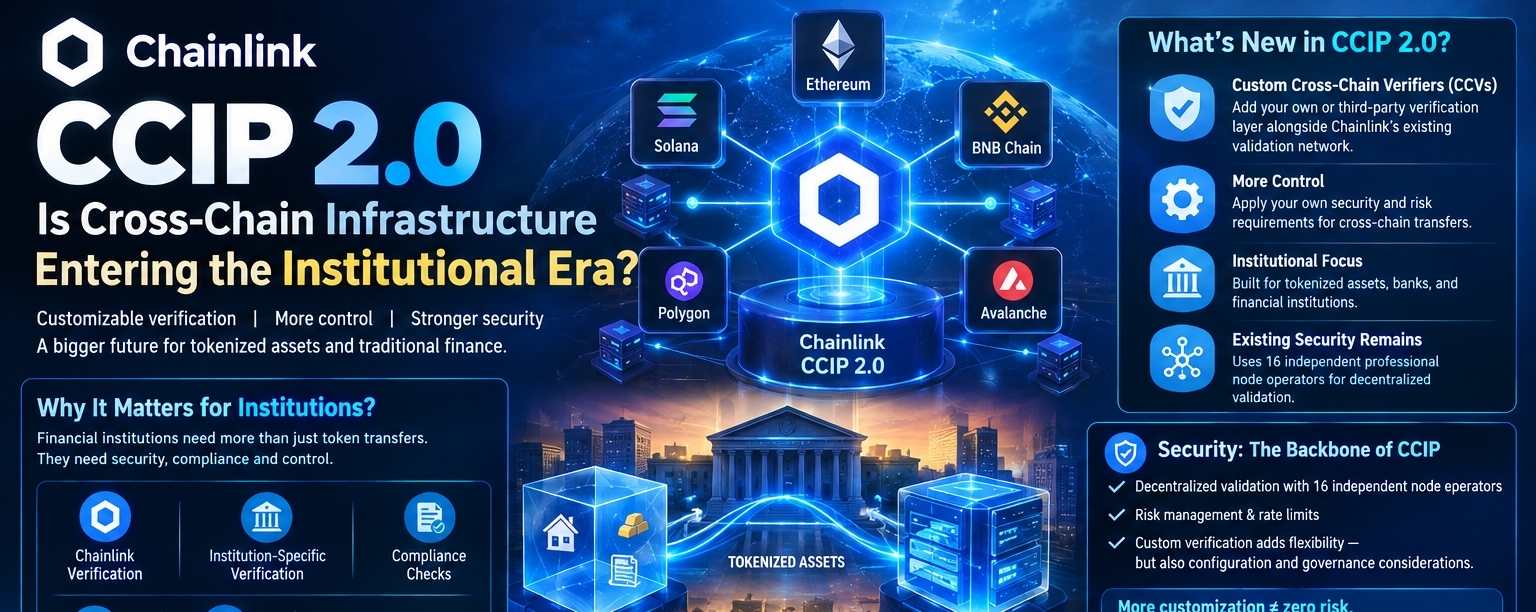
One of the most important developments is support for custom Cross-Chain Verifiers, or CCVs. This allows organizations to add their own verification layer—or use a third-party verification layer—alongside Chainlink’s existing security infrastructure.
This is more than just a technical upgrade.
The bigger story is that cross-chain infrastructure is evolving beyond simple token transfers toward institutional security, compliance, risk management, and customizable verification.
And that is where a potentially important investment narrative for $LINK begins.
🔗 What Exactly Changes With CCIP 2.0?
The basic objective of earlier cross-chain infrastructure was relatively simple:
Chain A → Bridge → Chain B
But institutional investors and financial institutions have much more complex requirements.
They want to know:
Who is verifying the transaction?
What conditions must be satisfied before a transfer is approved?
Can specific verification policies be applied to different assets?
How can compliance requirements be integrated?
Can suspicious activity trigger a transfer halt?
How can risk controls be applied across multiple blockchains?
CCIP 2.0’s customizable verification architecture addresses this area.
Organizations can potentially add additional verification layers according to their own requirements while continuing to use Chainlink’s existing decentralized infrastructure.
In other words:
From “one security model for everyone” toward “security + customizable institutional policies.”
🏦 Why Could This Matter for Institutional Adoption?
A retail user may simply want to send tokens from one blockchain to another.
But imagine a financial institution transferring $500 million worth of tokenized assets between blockchains.
It may require:
**Chainlink verification
Institution-specific verification
Compliance checks
Transfer limits
Emergency controls**
A layered security model could become increasingly important as institutional participation in blockchain infrastructure grows.
Chainlink says CCIP uses decentralized validation, with its network secured by independent professional node operators. Chainlink has also described additional risk-management mechanisms such as rate limits as part of its CCIP security architecture.
CCIP 2.0 therefore represents an interesting evolution:
Base security → Additional verification → Institution-specific policies
However, adding custom verification does not mean eliminating risk.
The quality, independence, operational security, and governance of those additional verification layers will also matter.
So while customization can increase flexibility, it can also introduce additional configuration and operational considerations.
🛡️ Security Could Be the Most Important Part of CCIP
Cross-chain infrastructure has historically been one of the most closely watched security areas in crypto.
A bridge connects different blockchain ecosystems while potentially handling significant amounts of value. A vulnerability can therefore have serious consequences.
Chainlink has designed CCIP around decentralized validation rather than relying on a single verifier. Its materials describe independent professional node operators participating in the validation process.
CCIP also includes mechanisms such as rate limits and other risk-management controls designed to help reduce potential exposure from abnormal activity.
The customizable verifier model in CCIP 2.0 adds another layer to this architecture:
Decentralized base security → Custom verification → Institution-specific risk controls
That could be particularly relevant for institutions operating under strict internal security and compliance frameworks.
But investors should also remember:
More customization does not automatically mean zero risk.
The additional verification infrastructure itself must be evaluated.
🌐 From Cross-Chain to Cross-Finance
This may be the most interesting part of the long-term CCIP narrative.
The blockchain industry is no longer simply about Ethereum versus Solana versus other networks.
A much bigger question is emerging:
How will different blockchains, financial institutions, and tokenized asset ecosystems communicate with one another?
Chainlink has been expanding CCIP’s role in tokenized assets and capital-market infrastructure.
This matters because tokenization does not end when an asset is issued on a blockchain.
The ecosystem may eventually require:
Issuance → Custody → Compliance → Transfer → Settlement → Cross-chain liquidity
Interoperability can become an important layer connecting these stages.
💰 What Could This Mean for LINK?
This is where investors need to separate the technology from the token.
CCIP adoption and LINK price are not the same thing.
A protocol can gain adoption without the token immediately reflecting that growth.
However, several structural themes are worth watching around LINK.
1️⃣ From Oracle Network to Infrastructure Layer
Chainlink originally became known primarily as an oracle network.
But its ecosystem has expanded:
Oracle → Data → Automation → Cross-chain messaging → Tokenized assets → Institutional infrastructure
CCIP is an important part of that expansion.
If blockchain and traditional finance become increasingly interconnected, cross-chain infrastructure could become strategically more important.
2️⃣ Institutional Use Cases
Institutional infrastructure has a different adoption profile from retail speculation.
Banks, asset managers, stablecoin issuers, and financial platforms typically require long-term integrations, security standards, governance, and compliance frameworks.
If an infrastructure provider becomes part of those systems, its adoption could have a different character from short-term retail usage.
The key question is whether institutions will actually deploy CCIP at meaningful scale.
3️⃣ The Tokenized RWA Narrative
Real-world assets, or RWAs, remain an important theme in blockchain.
Treasuries, funds, private credit, stablecoins, and other financial assets can potentially be tokenized.
As these assets move across different blockchain ecosystems, reliable interoperability infrastructure could become increasingly important.
Chainlink has positioned CCIP as infrastructure for tokenized assets and capital markets.
That creates a potentially significant long-term narrative for the Chainlink ecosystem.
📈 What Should Investors Watch in the LINK Market?
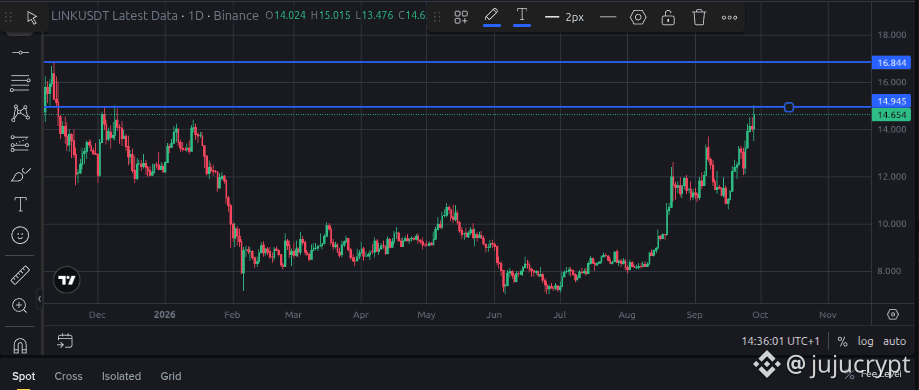
At the time of writing, LINK is trading around the $14–$15 area, with recent market data placing its market capitalization around $11 billion and circulating supply around 750 million LINK.
That means LINK is no longer a small-cap speculative asset.
It already has a large market valuation.
Therefore, a major long-term price expansion would likely require more than a single announcement.
The market may need to see:
Real adoption + increasing network utility + sustained liquidity + broader institutional demand
📊 Technical Perspective: What Should Traders Watch?
For $LINK, simply hearing “CCIP 2.0 has launched” is not enough to justify chasing the market.
Price structure still matters.
Recent market commentary has highlighted the $16 area and approximately $17.70 as important resistance zones.
From a trading perspective, several scenarios are worth monitoring.
🟢 Bullish Confirmation
If LINK can:
Reclaim the $16 zone
→ Break through the $17.70 area
→ Maintain supportive volume and market participation
then the market structure could become stronger.
That would provide more technical confirmation than simply relying on the CCIP 2.0 narrative.
🟡 Consolidation Scenario
If LINK remains within a range around the current market structure, the market may simply be waiting for stronger catalysts.
In that environment, monitoring support, resistance, volume, and liquidity may be more useful than chasing short-term breakouts.
🔴 Risk Scenario
If major support levels break while BTC and the broader altcoin market weaken, LINK could experience additional downside pressure.
A strong fundamental narrative does not prevent short-term price volatility.
Because:
Good technology ≠ guaranteed short-term price appreciation.
🧠 The Biggest Question: Will CCIP 2.0 Actually Increase LINK Demand?
This is where investors need to remain realistic.
CCIP 2.0 may be technologically significant, but the more important question for investors is:
How much economic value will actual CCIP usage create for the LINK ecosystem?
That is the long-term question.
Protocol adoption does not automatically translate into token value.
Therefore, investors should look beyond announcements and partnerships.
Important metrics to monitor include:
CCIP transaction growth
Number of blockchain integrations
Institutional deployments
Tokenized asset adoption
Stablecoin integrations
CCIP fees and economic activity
Actual LINK utility
Sustained network usage
Token supply and circulating supply dynamics
Overall crypto liquidity
These metrics can help determine whether the narrative is becoming a real adoption story.
⚠️ What Are the Major Risks?
No investment thesis is risk-free.
CCIP 2.0 also comes with several factors worth monitoring.
1. Institutional adoption could be slow
Financial institutions typically move carefully when integrating new infrastructure.
Even strong technology does not guarantee immediate mass adoption.
2. Competition will remain
Cross-chain interoperability is becoming an increasingly important market.
Chainlink is not the only project working toward interoperability and institutional blockchain infrastructure.
3. Custom verification introduces complexity
Additional verification can improve flexibility and potentially strengthen institutional controls, but it also introduces additional considerations around configuration, governance, and third-party dependencies.
4. LINK remains market-driven
Even if CCIP adoption grows, LINK can still experience significant short-term corrections.
BTC dominance, liquidity, interest rates, risk appetite, and the broader altcoin cycle can all influence LINK’s price.
🔥 What I Find Most Interesting About CCIP 2.0
The most important part of CCIP 2.0 may not simply be that it is “another cross-chain upgrade.”
It could represent a broader transition:
Blockchain interoperability → Institutional interoperability
The question is no longer simply:
“How do I move a token from one chain to another?”
The future question could be:
“Which asset, on which blockchain, under which verification policy, with which compliance requirements, should be transferred across chains?”
That is where Chainlink’s customizable verification architecture could become an important infrastructure component.
Chainlink’s current documentation describes verifier functionality and multi-chain tooling for CCIP 2.0, while the broader CCIP ecosystem continues to expand its blockchain integrations.
💎 Bottom Line for $LINK Investors
If you view $LINK only as an “oracle token,” it is easy to underestimate the significance of CCIP.
But if Chainlink is viewed as:
Oracle + Interoperability + Tokenized Assets + Institutional Infrastructure
then the long-term narrative becomes much broader.
However, an investment thesis and an investment outcome are not the same thing.
The long-term success of CCIP will depend not only on how good the technology is, but also on how many institutions actually use it, how much value moves through the infrastructure, how much economic activity is generated, and how much of that activity ultimately translates into value for the LINK ecosystem.
That is why I would not focus only on the headline.
I would watch:
Adoption + on-chain activity + price structure + market liquidity
If LINK establishes a strong breakout while CCIP adoption and institutional use cases continue to expand, the market could develop a new valuation narrative around the asset.
On the other hand, if adoption grows more slowly than expected or the broader crypto market weakens, LINK can still face substantial volatility even if the underlying technology continues to develop.
So the real question around LINK is no longer simply:
“How good is Chainlink?”
The bigger question is:
“If the blockchain economy and traditional finance evolve into a multi-chain ecosystem, how much of that interoperability infrastructure can Chainlink capture?”
The answer to that question could become one of the most important drivers of the LINK narrative going forward.
DYOR. NFA. Don’t chase a pump.
Even when the fundamentals look promising, position sizing, disciplined entries, and risk management remain essential.
{spot}(LINKUSDT)
#ChainlinkLaunchesCCIP2WithEnterpriseVerification #LINK #LINK🔥🔥🔥 #Binance #ChinaMayLetAlibabaByteDanceBuyNvidiaChips
Chainlink CCIP 2.0: Is Cross-Chain Infrastructure Entering the Institutional Era?
The blockchain industry has been trying to solve one major problem for years:
How can value and data move from one blockchain to another in a way that is secure, customizable, and suitable for institutional use?
Chainlink’s new CCIP 2.0 is taking another step toward solving that problem.
One of the most important developments is support for custom Cross-Chain Verifiers, or CCVs. This allows organizations to add their own verification layer—or use a third-party verification layer—alongside Chainlink’s existing security infrastructure.
This is more than just a technical upgrade.
The bigger story is that cross-chain infrastructure is evolving beyond simple token transfers toward institutional security, compliance, risk management, and customizable verification.
And that is where a potentially important investment narrative for $LINK begins.
🔗 What Exactly Changes With CCIP 2.0?
The basic objective of earlier cross-chain infrastructure was relatively simple:
Chain A → Bridge → Chain B
But institutional investors and financial institutions have much more complex requirements.
They want to know:
Who is verifying the transaction?
What conditions must be satisfied before a transfer is approved?
Can specific verification policies be applied to different assets?
How can compliance requirements be integrated?
Can suspicious activity trigger a transfer halt?
How can risk controls be applied across multiple blockchains?
CCIP 2.0’s customizable verification architecture addresses this area.
Organizations can potentially add additional verification layers according to their own requirements while continuing to use Chainlink’s existing decentralized infrastructure.
In other words:
From “one security model for everyone” toward “security + customizable institutional policies.”
🏦 Why Could This Matter for Institutional Adoption?
A retail user may simply want to send tokens from one blockchain to another.
But imagine a financial institution transferring $500 million worth of tokenized assets between blockchains.
It may require:
**Chainlink verification
Institution-specific verification
Compliance checks
Transfer limits
Emergency controls**
A layered security model could become increasingly important as institutional participation in blockchain infrastructure grows.
Chainlink says CCIP uses decentralized validation, with its network secured by independent professional node operators. Chainlink has also described additional risk-management mechanisms such as rate limits as part of its CCIP security architecture.
CCIP 2.0 therefore represents an interesting evolution:
Base security → Additional verification → Institution-specific policies
However, adding custom verification does not mean eliminating risk.
The quality, independence, operational security, and governance of those additional verification layers will also matter.
So while customization can increase flexibility, it can also introduce additional configuration and operational considerations.
🛡️ Security Could Be the Most Important Part of CCIP
Cross-chain infrastructure has historically been one of the most closely watched security areas in crypto.
A bridge connects different blockchain ecosystems while potentially handling significant amounts of value. A vulnerability can therefore have serious consequences.
Chainlink has designed CCIP around decentralized validation rather than relying on a single verifier. Its materials describe independent professional node operators participating in the validation process.
CCIP also includes mechanisms such as rate limits and other risk-management controls designed to help reduce potential exposure from abnormal activity.
The customizable verifier model in CCIP 2.0 adds another layer to this architecture:
Decentralized base security → Custom verification → Institution-specific risk controls
That could be particularly relevant for institutions operating under strict internal security and compliance frameworks.
But investors should also remember:
More customization does not automatically mean zero risk.
The additional verification infrastructure itself must be evaluated.
🌐 From Cross-Chain to Cross-Finance
This may be the most interesting part of the long-term CCIP narrative.
The blockchain industry is no longer simply about Ethereum versus Solana versus other networks.
A much bigger question is emerging:
How will different blockchains, financial institutions, and tokenized asset ecosystems communicate with one another?
Chainlink has been expanding CCIP’s role in tokenized assets and capital-market infrastructure.
This matters because tokenization does not end when an asset is issued on a blockchain.
The ecosystem may eventually require:
Issuance → Custody → Compliance → Transfer → Settlement → Cross-chain liquidity
Interoperability can become an important layer connecting these stages.
💰 What Could This Mean for LINK?
This is where investors need to separate the technology from the token.
CCIP adoption and LINK price are not the same thing.
A protocol can gain adoption without the token immediately reflecting that growth.
However, several structural themes are worth watching around LINK.
1️⃣ From Oracle Network to Infrastructure Layer
Chainlink originally became known primarily as an oracle network.
But its ecosystem has expanded:
Oracle → Data → Automation → Cross-chain messaging → Tokenized assets → Institutional infrastructure
CCIP is an important part of that expansion.
If blockchain and traditional finance become increasingly interconnected, cross-chain infrastructure could become strategically more important.
2️⃣ Institutional Use Cases
Institutional infrastructure has a different adoption profile from retail speculation.
Banks, asset managers, stablecoin issuers, and financial platforms typically require long-term integrations, security standards, governance, and compliance frameworks.
If an infrastructure provider becomes part of those systems, its adoption could have a different character from short-term retail usage.
The key question is whether institutions will actually deploy CCIP at meaningful scale.
3️⃣ The Tokenized RWA Narrative
Real-world assets, or RWAs, remain an important theme in blockchain.
Treasuries, funds, private credit, stablecoins, and other financial assets can potentially be tokenized.
As these assets move across different blockchain ecosystems, reliable interoperability infrastructure could become increasingly important.
Chainlink has positioned CCIP as infrastructure for tokenized assets and capital markets.
That creates a potentially significant long-term narrative for the Chainlink ecosystem.
📈 What Should Investors Watch in the LINK Market?
At the time of writing, LINK is trading around the $14–$15 area, with recent market data placing its market capitalization around $11 billion and circulating supply around 750 million LINK.
That means LINK is no longer a small-cap speculative asset.
It already has a large market valuation.
Therefore, a major long-term price expansion would likely require more than a single announcement.
The market may need to see:
Real adoption + increasing network utility + sustained liquidity + broader institutional demand
📊 Technical Perspective: What Should Traders Watch?
For $LINK , simply hearing “CCIP 2.0 has launched” is not enough to justify chasing the market.
Price structure still matters.
Recent market commentary has highlighted the $16 area and approximately $17.70 as important resistance zones.
From a trading perspective, several scenarios are worth monitoring.
🟢 Bullish Confirmation
If LINK can:
Reclaim the $16 zone
→ Break through the $17.70 area
→ Maintain supportive volume and market participation
then the market structure could become stronger.
That would provide more technical confirmation than simply relying on the CCIP 2.0 narrative.
🟡 Consolidation Scenario
If LINK remains within a range around the current market structure, the market may simply be waiting for stronger catalysts.
In that environment, monitoring support, resistance, volume, and liquidity may be more useful than chasing short-term breakouts.
🔴 Risk Scenario
If major support levels break while BTC and the broader altcoin market weaken, LINK could experience additional downside pressure.
A strong fundamental narrative does not prevent short-term price volatility.
Because:
Good technology ≠ guaranteed short-term price appreciation.
🧠 The Biggest Question: Will CCIP 2.0 Actually Increase LINK Demand?
This is where investors need to remain realistic.
CCIP 2.0 may be technologically significant, but the more important question for investors is:
How much economic value will actual CCIP usage create for the LINK ecosystem?
That is the long-term question.
Protocol adoption does not automatically translate into token value.
Therefore, investors should look beyond announcements and partnerships.
Important metrics to monitor include:
CCIP transaction growth
Number of blockchain integrations
Institutional deployments
Tokenized asset adoption
Stablecoin integrations
CCIP fees and economic activity
Actual LINK utility
Sustained network usage
Token supply and circulating supply dynamics
Overall crypto liquidity
These metrics can help determine whether the narrative is becoming a real adoption story.
⚠️ What Are the Major Risks?
No investment thesis is risk-free.
CCIP 2.0 also comes with several factors worth monitoring.
1. Institutional adoption could be slow
Financial institutions typically move carefully when integrating new infrastructure.
Even strong technology does not guarantee immediate mass adoption.
2. Competition will remain
Cross-chain interoperability is becoming an increasingly important market.
Chainlink is not the only project working toward interoperability and institutional blockchain infrastructure.
3. Custom verification introduces complexity
Additional verification can improve flexibility and potentially strengthen institutional controls, but it also introduces additional considerations around configuration, governance, and third-party dependencies.
4. LINK remains market-driven
Even if CCIP adoption grows, LINK can still experience significant short-term corrections.
BTC dominance, liquidity, interest rates, risk appetite, and the broader altcoin cycle can all influence LINK’s price.
🔥 What I Find Most Interesting About CCIP 2.0
The most important part of CCIP 2.0 may not simply be that it is “another cross-chain upgrade.”
It could represent a broader transition:
Blockchain interoperability → Institutional interoperability
The question is no longer simply:
“How do I move a token from one chain to another?”
The future question could be:
“Which asset, on which blockchain, under which verification policy, with which compliance requirements, should be transferred across chains?”
That is where Chainlink’s customizable verification architecture could become an important infrastructure component.
Chainlink’s current documentation describes verifier functionality and multi-chain tooling for CCIP 2.0, while the broader CCIP ecosystem continues to expand its blockchain integrations.
💎 Bottom Line for $LINK Investors
If you view $LINK only as an “oracle token,” it is easy to underestimate the significance of CCIP.
But if Chainlink is viewed as:
Oracle + Interoperability + Tokenized Assets + Institutional Infrastructure
then the long-term narrative becomes much broader.
However, an investment thesis and an investment outcome are not the same thing.
The long-term success of CCIP will depend not only on how good the technology is, but also on how many institutions actually use it, how much value moves through the infrastructure, how much economic activity is generated, and how much of that activity ultimately translates into value for the LINK ecosystem.
That is why I would not focus only on the headline.
I would watch:
Adoption + on-chain activity + price structure + market liquidity
If LINK establishes a strong breakout while CCIP adoption and institutional use cases continue to expand, the market could develop a new valuation narrative around the asset.
On the other hand, if adoption grows more slowly than expected or the broader crypto market weakens, LINK can still face substantial volatility even if the underlying technology continues to develop.
So the real question around LINK is no longer simply:
“How good is Chainlink?”
The bigger question is:
“If the blockchain economy and traditional finance evolve into a multi-chain ecosystem, how much of that interoperability infrastructure can Chainlink capture?”
The answer to that question could become one of the most important drivers of the LINK narrative going forward.
DYOR. NFA. Don’t chase a pump.
Even when the fundamentals look promising, position sizing, disciplined entries, and risk management remain essential.
#ChainlinkLaunchesCCIP2WithEnterpriseVerification #LINK #LINK🔥🔥🔥 #Binance #ChinaMayLetAlibabaByteDanceBuyNvidiaChips
How can value and data move from one blockchain to another in a way that is secure, customizable, and suitable for institutional use?
Chainlink’s new CCIP 2.0 is taking another step toward solving that problem.
One of the most important developments is support for custom Cross-Chain Verifiers, or CCVs. This allows organizations to add their own verification layer—or use a third-party verification layer—alongside Chainlink’s existing security infrastructure.
This is more than just a technical upgrade.
The bigger story is that cross-chain infrastructure is evolving beyond simple token transfers toward institutional security, compliance, risk management, and customizable verification.
And that is where a potentially important investment narrative for $LINK begins.
🔗 What Exactly Changes With CCIP 2.0?
The basic objective of earlier cross-chain infrastructure was relatively simple:
Chain A → Bridge → Chain B
But institutional investors and financial institutions have much more complex requirements.
They want to know:
Who is verifying the transaction?
What conditions must be satisfied before a transfer is approved?
Can specific verification policies be applied to different assets?
How can compliance requirements be integrated?
Can suspicious activity trigger a transfer halt?
How can risk controls be applied across multiple blockchains?
CCIP 2.0’s customizable verification architecture addresses this area.
Organizations can potentially add additional verification layers according to their own requirements while continuing to use Chainlink’s existing decentralized infrastructure.
In other words:
From “one security model for everyone” toward “security + customizable institutional policies.”
🏦 Why Could This Matter for Institutional Adoption?
A retail user may simply want to send tokens from one blockchain to another.
But imagine a financial institution transferring $500 million worth of tokenized assets between blockchains.
It may require:
**Chainlink verification
Institution-specific verification
Compliance checks
Transfer limits
Emergency controls**
A layered security model could become increasingly important as institutional participation in blockchain infrastructure grows.
Chainlink says CCIP uses decentralized validation, with its network secured by independent professional node operators. Chainlink has also described additional risk-management mechanisms such as rate limits as part of its CCIP security architecture.
CCIP 2.0 therefore represents an interesting evolution:
Base security → Additional verification → Institution-specific policies
However, adding custom verification does not mean eliminating risk.
The quality, independence, operational security, and governance of those additional verification layers will also matter.
So while customization can increase flexibility, it can also introduce additional configuration and operational considerations.
🛡️ Security Could Be the Most Important Part of CCIP
Cross-chain infrastructure has historically been one of the most closely watched security areas in crypto.
A bridge connects different blockchain ecosystems while potentially handling significant amounts of value. A vulnerability can therefore have serious consequences.
Chainlink has designed CCIP around decentralized validation rather than relying on a single verifier. Its materials describe independent professional node operators participating in the validation process.
CCIP also includes mechanisms such as rate limits and other risk-management controls designed to help reduce potential exposure from abnormal activity.
The customizable verifier model in CCIP 2.0 adds another layer to this architecture:
Decentralized base security → Custom verification → Institution-specific risk controls
That could be particularly relevant for institutions operating under strict internal security and compliance frameworks.
But investors should also remember:
More customization does not automatically mean zero risk.
The additional verification infrastructure itself must be evaluated.
🌐 From Cross-Chain to Cross-Finance
This may be the most interesting part of the long-term CCIP narrative.
The blockchain industry is no longer simply about Ethereum versus Solana versus other networks.
A much bigger question is emerging:
How will different blockchains, financial institutions, and tokenized asset ecosystems communicate with one another?
Chainlink has been expanding CCIP’s role in tokenized assets and capital-market infrastructure.
This matters because tokenization does not end when an asset is issued on a blockchain.
The ecosystem may eventually require:
Issuance → Custody → Compliance → Transfer → Settlement → Cross-chain liquidity
Interoperability can become an important layer connecting these stages.
💰 What Could This Mean for LINK?
This is where investors need to separate the technology from the token.
CCIP adoption and LINK price are not the same thing.
A protocol can gain adoption without the token immediately reflecting that growth.
However, several structural themes are worth watching around LINK.
1️⃣ From Oracle Network to Infrastructure Layer
Chainlink originally became known primarily as an oracle network.
But its ecosystem has expanded:
Oracle → Data → Automation → Cross-chain messaging → Tokenized assets → Institutional infrastructure
CCIP is an important part of that expansion.
If blockchain and traditional finance become increasingly interconnected, cross-chain infrastructure could become strategically more important.
2️⃣ Institutional Use Cases
Institutional infrastructure has a different adoption profile from retail speculation.
Banks, asset managers, stablecoin issuers, and financial platforms typically require long-term integrations, security standards, governance, and compliance frameworks.
If an infrastructure provider becomes part of those systems, its adoption could have a different character from short-term retail usage.
The key question is whether institutions will actually deploy CCIP at meaningful scale.
3️⃣ The Tokenized RWA Narrative
Real-world assets, or RWAs, remain an important theme in blockchain.
Treasuries, funds, private credit, stablecoins, and other financial assets can potentially be tokenized.
As these assets move across different blockchain ecosystems, reliable interoperability infrastructure could become increasingly important.
Chainlink has positioned CCIP as infrastructure for tokenized assets and capital markets.
That creates a potentially significant long-term narrative for the Chainlink ecosystem.
📈 What Should Investors Watch in the LINK Market?
At the time of writing, LINK is trading around the $14–$15 area, with recent market data placing its market capitalization around $11 billion and circulating supply around 750 million LINK.
That means LINK is no longer a small-cap speculative asset.
It already has a large market valuation.
Therefore, a major long-term price expansion would likely require more than a single announcement.
The market may need to see:
Real adoption + increasing network utility + sustained liquidity + broader institutional demand
📊 Technical Perspective: What Should Traders Watch?
For $LINK , simply hearing “CCIP 2.0 has launched” is not enough to justify chasing the market.
Price structure still matters.
Recent market commentary has highlighted the $16 area and approximately $17.70 as important resistance zones.
From a trading perspective, several scenarios are worth monitoring.
🟢 Bullish Confirmation
If LINK can:
Reclaim the $16 zone
→ Break through the $17.70 area
→ Maintain supportive volume and market participation
then the market structure could become stronger.
That would provide more technical confirmation than simply relying on the CCIP 2.0 narrative.
🟡 Consolidation Scenario
If LINK remains within a range around the current market structure, the market may simply be waiting for stronger catalysts.
In that environment, monitoring support, resistance, volume, and liquidity may be more useful than chasing short-term breakouts.
🔴 Risk Scenario
If major support levels break while BTC and the broader altcoin market weaken, LINK could experience additional downside pressure.
A strong fundamental narrative does not prevent short-term price volatility.
Because:
Good technology ≠ guaranteed short-term price appreciation.
🧠 The Biggest Question: Will CCIP 2.0 Actually Increase LINK Demand?
This is where investors need to remain realistic.
CCIP 2.0 may be technologically significant, but the more important question for investors is:
How much economic value will actual CCIP usage create for the LINK ecosystem?
That is the long-term question.
Protocol adoption does not automatically translate into token value.
Therefore, investors should look beyond announcements and partnerships.
Important metrics to monitor include:
CCIP transaction growth
Number of blockchain integrations
Institutional deployments
Tokenized asset adoption
Stablecoin integrations
CCIP fees and economic activity
Actual LINK utility
Sustained network usage
Token supply and circulating supply dynamics
Overall crypto liquidity
These metrics can help determine whether the narrative is becoming a real adoption story.
⚠️ What Are the Major Risks?
No investment thesis is risk-free.
CCIP 2.0 also comes with several factors worth monitoring.
1. Institutional adoption could be slow
Financial institutions typically move carefully when integrating new infrastructure.
Even strong technology does not guarantee immediate mass adoption.
2. Competition will remain
Cross-chain interoperability is becoming an increasingly important market.
Chainlink is not the only project working toward interoperability and institutional blockchain infrastructure.
3. Custom verification introduces complexity
Additional verification can improve flexibility and potentially strengthen institutional controls, but it also introduces additional considerations around configuration, governance, and third-party dependencies.
4. LINK remains market-driven
Even if CCIP adoption grows, LINK can still experience significant short-term corrections.
BTC dominance, liquidity, interest rates, risk appetite, and the broader altcoin cycle can all influence LINK’s price.
🔥 What I Find Most Interesting About CCIP 2.0
The most important part of CCIP 2.0 may not simply be that it is “another cross-chain upgrade.”
It could represent a broader transition:
Blockchain interoperability → Institutional interoperability
The question is no longer simply:
“How do I move a token from one chain to another?”
The future question could be:
“Which asset, on which blockchain, under which verification policy, with which compliance requirements, should be transferred across chains?”
That is where Chainlink’s customizable verification architecture could become an important infrastructure component.
Chainlink’s current documentation describes verifier functionality and multi-chain tooling for CCIP 2.0, while the broader CCIP ecosystem continues to expand its blockchain integrations.
💎 Bottom Line for $LINK Investors
If you view $LINK only as an “oracle token,” it is easy to underestimate the significance of CCIP.
But if Chainlink is viewed as:
Oracle + Interoperability + Tokenized Assets + Institutional Infrastructure
then the long-term narrative becomes much broader.
However, an investment thesis and an investment outcome are not the same thing.
The long-term success of CCIP will depend not only on how good the technology is, but also on how many institutions actually use it, how much value moves through the infrastructure, how much economic activity is generated, and how much of that activity ultimately translates into value for the LINK ecosystem.
That is why I would not focus only on the headline.
I would watch:
Adoption + on-chain activity + price structure + market liquidity
If LINK establishes a strong breakout while CCIP adoption and institutional use cases continue to expand, the market could develop a new valuation narrative around the asset.
On the other hand, if adoption grows more slowly than expected or the broader crypto market weakens, LINK can still face substantial volatility even if the underlying technology continues to develop.
So the real question around LINK is no longer simply:
“How good is Chainlink?”
The bigger question is:
“If the blockchain economy and traditional finance evolve into a multi-chain ecosystem, how much of that interoperability infrastructure can Chainlink capture?”
The answer to that question could become one of the most important drivers of the LINK narrative going forward.
DYOR. NFA. Don’t chase a pump.
Even when the fundamentals look promising, position sizing, disciplined entries, and risk management remain essential.
#ChainlinkLaunchesCCIP2WithEnterpriseVerification #LINK #LINK🔥🔥🔥 #Binance #ChinaMayLetAlibabaByteDanceBuyNvidiaChips
1
34

·
--
Bullish
#ChainlinkLaunchesCCIP2WithEnterpriseVerification
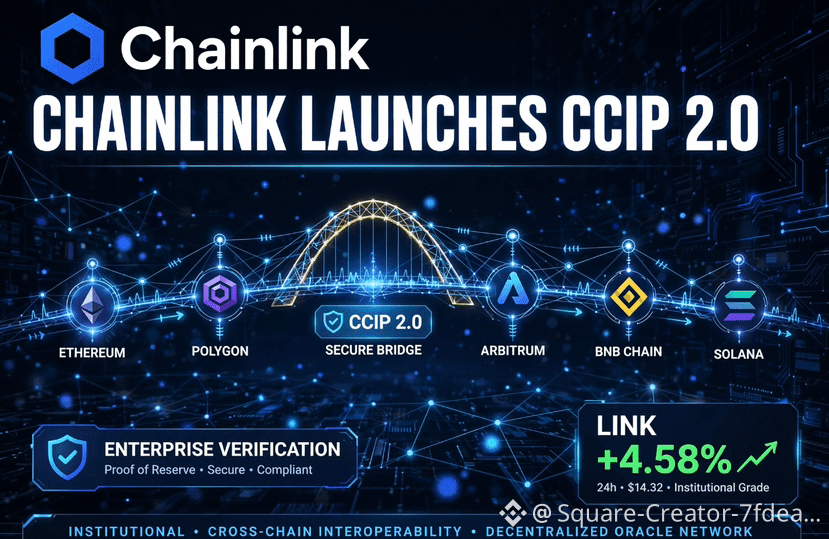
🚀 #ChainlinkLaunchesCCIP2WithEnterpriseVerification - GAME CHANGER FOR LINK!
Chainlink has officially launched CCIP 2.0! 🎉
What is new?
✅ Enterprise-grade verification - Banks can run own validators
✅ Cross-Chain Verifiers (CCVs) on AWS & Google Cloud
✅ Built-in KYC, AML, compliance for every tx
✅ Custom finality speed - instant or ultra-secure
✅ $84 BILLION already processed via CCIP
Why it matters?
After $292M Kelp DAO hack (LayerZero single validator), CCIP 2.0 lets institutions add EXTRA security layers on top of Chainlink's 16 node operators. Providers like Infosys & Nethermind now available!
Big names already migrating: Aave, Maple, and Kelp moving rsETH to Chainlink!
LINK is +4.58% today - institutional adoption incoming!
Is LINK about to lead the RWA & cross-chain narrative?
#ChainlinkLaunchesCCIP2WithEnterpriseVerification #LINK #Chainlink #CCIP #CryptoNews #BinanceSquare #RWA
#ChainlinkLaunchesCCIP2WithEnterpriseVerification
🚀 #ChainlinkLaunchesCCIP2WithEnterpriseVerification - GAME CHANGER FOR LINK!
Chainlink has officially launched CCIP 2.0! 🎉
What is new?
✅ Enterprise-grade verification - Banks can run own validators
✅ Cross-Chain Verifiers (CCVs) on AWS & Google Cloud
✅ Built-in KYC, AML, compliance for every tx
✅ Custom finality speed - instant or ultra-secure
✅ $84 BILLION already processed via CCIP
Why it matters?
After $292M Kelp DAO hack (LayerZero single validator), CCIP 2.0 lets institutions add EXTRA security layers on top of Chainlink's 16 node operators. Providers like Infosys & Nethermind now available!
Big names already migrating: Aave, Maple, and Kelp moving rsETH to Chainlink!
LINK is +4.58% today - institutional adoption incoming!
Is LINK about to lead the RWA & cross-chain narrative?
#ChainlinkLaunchesCCIP2WithEnterpriseVerification #LINK #Chainlink #CCIP #CryptoNews #BinanceSquare #RWA
🚀 #ChainlinkLaunchesCCIP2WithEnterpriseVerification - GAME CHANGER FOR LINK!
Chainlink has officially launched CCIP 2.0! 🎉
What is new?
✅ Enterprise-grade verification - Banks can run own validators
✅ Cross-Chain Verifiers (CCVs) on AWS & Google Cloud
✅ Built-in KYC, AML, compliance for every tx
✅ Custom finality speed - instant or ultra-secure
✅ $84 BILLION already processed via CCIP
Why it matters?
After $292M Kelp DAO hack (LayerZero single validator), CCIP 2.0 lets institutions add EXTRA security layers on top of Chainlink's 16 node operators. Providers like Infosys & Nethermind now available!
Big names already migrating: Aave, Maple, and Kelp moving rsETH to Chainlink!
LINK is +4.58% today - institutional adoption incoming!
Is LINK about to lead the RWA & cross-chain narrative?
#ChainlinkLaunchesCCIP2WithEnterpriseVerification #LINK #Chainlink #CCIP #CryptoNews #BinanceSquare #RWA
1
16

·
--
Bullish
#ChainlinkLaunchesCCIP2WithEnterpriseVerification
has launched CCIP 2.0, focused on making cross-chain transfers more customizable for institutions. A key addition is support for custom Cross-Chain Verifiers (CCVs), allowing organizations to add their own or third-party verification layer alongside Chainlink’s existing validation network.
🔗 What CCIP 2.0 changes
Extra verification: Enterprises can add independent validators on top of CCIP’s standard security model.
More control: Different organizations can apply their own security and risk requirements to cross-chain transfers.
Institutional focus: This fits tokenized assets and financial institutions that need additional verification and compliance controls.
Existing security remains: Chainlink says its CCIP infrastructure uses 16 independent professional node operators for decentralized validation.
The broader significance is that cross-chain infrastructure is moving beyond simply transferring tokens toward customizable verification, compliance, and institutional controls. Chainlink has also been expanding CCIP's use in tokenized assets and regulated financial applications.
Discussion: CCIP 2.0 could make it easier for enterprises to connect multiple blockchains while retaining control over their own verification requirements. The key question will be how widely institutions actually adopt these custom verification layers and how they affect security, cost, and transfer speed.
#ChainlinkLaunchesCCIP2WithEnterpriseVerification
has launched CCIP 2.0, focused on making cross-chain transfers more customizable for institutions. A key addition is support for custom Cross-Chain Verifiers (CCVs), allowing organizations to add their own or third-party verification layer alongside Chainlink’s existing validation network.
🔗 What CCIP 2.0 changes
Extra verification: Enterprises can add independent validators on top of CCIP’s standard security model.
More control: Different organizations can apply their own security and risk requirements to cross-chain transfers.
Institutional focus: This fits tokenized assets and financial institutions that need additional verification and compliance controls.
Existing security remains: Chainlink says its CCIP infrastructure uses 16 independent professional node operators for decentralized validation.
The broader significance is that cross-chain infrastructure is moving beyond simply transferring tokens toward customizable verification, compliance, and institutional controls. Chainlink has also been expanding CCIP's use in tokenized assets and regulated financial applications.
Discussion: CCIP 2.0 could make it easier for enterprises to connect multiple blockchains while retaining control over their own verification requirements. The key question will be how widely institutions actually adopt these custom verification layers and how they affect security, cost, and transfer speed.
has launched CCIP 2.0, focused on making cross-chain transfers more customizable for institutions. A key addition is support for custom Cross-Chain Verifiers (CCVs), allowing organizations to add their own or third-party verification layer alongside Chainlink’s existing validation network.
🔗 What CCIP 2.0 changes
Extra verification: Enterprises can add independent validators on top of CCIP’s standard security model.
More control: Different organizations can apply their own security and risk requirements to cross-chain transfers.
Institutional focus: This fits tokenized assets and financial institutions that need additional verification and compliance controls.
Existing security remains: Chainlink says its CCIP infrastructure uses 16 independent professional node operators for decentralized validation.
The broader significance is that cross-chain infrastructure is moving beyond simply transferring tokens toward customizable verification, compliance, and institutional controls. Chainlink has also been expanding CCIP's use in tokenized assets and regulated financial applications.
Discussion: CCIP 2.0 could make it easier for enterprises to connect multiple blockchains while retaining control over their own verification requirements. The key question will be how widely institutions actually adopt these custom verification layers and how they affect security, cost, and transfer speed.
1
74

Verified
#chainlinklaunchesccip2withenterpriseverification CHAINLINK NÂNG CẤP CCIP 2
Chainlink has just launched CCIP 2, upgrading the cross-chain system with security as the main focus.
A noteworthy point is that enterprises can now add their own validators or hire a third party such as Infosys or Nethermind to verify transactions.
Previously, Kelp DAO was hacked for about $292 million in rsETH; after this incident, Kelp moved rsETH to Chainlink.
But there’s one point Mây wants everyone to pay attention to:
If no new validators are added, CCIP 2 users currently rely on only one verification network, instead of two layers as before.
So the cross-chain story isn’t only about speed or transaction fees.
Security is what needs to be watched long term.
Mây will see whether major organizations will deploy additional validators. 👀
Follow Mây for more crypto news every day.
DYOR and always manage your capital.
#chainlinklaunchesccip2withenterpriseverification CHAINLINK NÂNG CẤP CCIP 2
Chainlink has just launched CCIP 2, upgrading the cross-chain system with security as the main focus.
A noteworthy point is that enterprises can now add their own validators or hire a third party such as Infosys or Nethermind to verify transactions.
Previously, Kelp DAO was hacked for about $292 million in rsETH; after this incident, Kelp moved rsETH to Chainlink.
But there’s one point Mây wants everyone to pay attention to:
If no new validators are added, CCIP 2 users currently rely on only one verification network, instead of two layers as before.
So the cross-chain story isn’t only about speed or transaction fees.
Security is what needs to be watched long term.
Mây will see whether major organizations will deploy additional validators. 👀
Follow Mây for more crypto news every day.
DYOR and always manage your capital.
Chainlink has just launched CCIP 2, upgrading the cross-chain system with security as the main focus.
A noteworthy point is that enterprises can now add their own validators or hire a third party such as Infosys or Nethermind to verify transactions.
Previously, Kelp DAO was hacked for about $292 million in rsETH; after this incident, Kelp moved rsETH to Chainlink.
But there’s one point Mây wants everyone to pay attention to:
If no new validators are added, CCIP 2 users currently rely on only one verification network, instead of two layers as before.
So the cross-chain story isn’t only about speed or transaction fees.
Security is what needs to be watched long term.
Mây will see whether major organizations will deploy additional validators. 👀
Follow Mây for more crypto news every day.
DYOR and always manage your capital.
2
1.1k

·
--
Chainlink recently released the CCIP 2.0 protocol, introducing an enterprise-grade verification mechanism. This version supports 8 enterprise verification nodes, a 50% increase over CCIP 1.0, aiming to improve the security and reliability of cross-chain data transmission. The CCIP 2.0 pilot projects cover 12 industries, including financial services and supply chain management. This upgrade significantly strengthens the protocol’s compliance and interoperability, paving the way for large enterprises to adopt Web3 technology.#CCIP2 $LINK
#LINK #ChainlinkLaunchesCCIP2WithEnterpriseVerification
Chainlink recently released the CCIP 2.0 protocol, introducing an enterprise-grade verification mechanism. This version supports 8 enterprise verification nodes, a 50% increase over CCIP 1.0, aiming to improve the security and reliability of cross-chain data transmission. The CCIP 2.0 pilot projects cover 12 industries, including financial services and supply chain management. This upgrade significantly strengthens the protocol’s compliance and interoperability, paving the way for large enterprises to adopt Web3 technology.#CCIP2 $LINK
#LINK #ChainlinkLaunchesCCIP2WithEnterpriseVerification
#LINK #ChainlinkLaunchesCCIP2WithEnterpriseVerification
23

·
--
Bearish
#ChainlinkLaunchesCCIP2WithEnterpriseVerification
Chainlink presents CCIP 2.0, opening the gates so that global capital can flow through the blockchain.
It is now available for all institutions and digital asset issuers. This update introduces new key features that establish CCIP as the only interoperability standard designed to meet the security, regulatory compliance, and speed requirements of the world’s largest financial institutions.
The next chapter of blockchain technology is integrating the entire global financial system into the blockchain to transform how the world issues, transfers, and manages value. And with MiCA legislation in the EU, the GENIUS Act in the US, and collaboration between the SEC and the CFTC in the US, the regulatory framework for digital and tokenized assets has never been clearer.
Asset issuers and tokenization platforms are now competing to bring equities, ETFs, funds, commodities, and currencies onto the blockchain, while institutions are accelerating their transition from experimental pilot projects to revenue-generating products and services.
Today, financial activity on the blockchain is higher than ever, but institutional assets and workflows remain highly fragmented across public and private blockchains. Secure cross-chain connectivity is now essential for institutions seeking to maximize distribution and get the most out of their assets across different markets.
$LINK
{spot}(LINKUSDT)
$NVDAB
{spot}(NVDABUSDT)
$AAPLB
{spot}(AAPLBUSDT)
#ChainlinkLaunchesCCIP2WithEnterpriseVerification
Chainlink presents CCIP 2.0, opening the gates so that global capital can flow through the blockchain.
It is now available for all institutions and digital asset issuers. This update introduces new key features that establish CCIP as the only interoperability standard designed to meet the security, regulatory compliance, and speed requirements of the world’s largest financial institutions.
The next chapter of blockchain technology is integrating the entire global financial system into the blockchain to transform how the world issues, transfers, and manages value. And with MiCA legislation in the EU, the GENIUS Act in the US, and collaboration between the SEC and the CFTC in the US, the regulatory framework for digital and tokenized assets has never been clearer.
Asset issuers and tokenization platforms are now competing to bring equities, ETFs, funds, commodities, and currencies onto the blockchain, while institutions are accelerating their transition from experimental pilot projects to revenue-generating products and services.
Today, financial activity on the blockchain is higher than ever, but institutional assets and workflows remain highly fragmented across public and private blockchains. Secure cross-chain connectivity is now essential for institutions seeking to maximize distribution and get the most out of their assets across different markets.
$LINK
$NVDAB
$AAPLB
Chainlink presents CCIP 2.0, opening the gates so that global capital can flow through the blockchain.
It is now available for all institutions and digital asset issuers. This update introduces new key features that establish CCIP as the only interoperability standard designed to meet the security, regulatory compliance, and speed requirements of the world’s largest financial institutions.
The next chapter of blockchain technology is integrating the entire global financial system into the blockchain to transform how the world issues, transfers, and manages value. And with MiCA legislation in the EU, the GENIUS Act in the US, and collaboration between the SEC and the CFTC in the US, the regulatory framework for digital and tokenized assets has never been clearer.
Asset issuers and tokenization platforms are now competing to bring equities, ETFs, funds, commodities, and currencies onto the blockchain, while institutions are accelerating their transition from experimental pilot projects to revenue-generating products and services.
Today, financial activity on the blockchain is higher than ever, but institutional assets and workflows remain highly fragmented across public and private blockchains. Secure cross-chain connectivity is now essential for institutions seeking to maximize distribution and get the most out of their assets across different markets.
$LINK
$NVDAB
$AAPLB
1
1
20

·
--
Bearish
$POL SHORT 🔴
Margin Mode : Isolated💎
Signal Type : Scalp Trade 🔥
1) 0.11970- 100%
Take Profit Targets:
1)🟥 0.11790
2)🟥 0.11605
3)🟥 0.11380
4)🟥 0.11059
5)🟥 0.10755
🟩 SL : 0.12588 - 100%
📊 LEV : 20X#ChainlinkLaunchesCCIP2WithEnterpriseVerification
$POL SHORT 🔴
Margin Mode : Isolated💎
Signal Type : Scalp Trade 🔥
1) 0.11970- 100%
Take Profit Targets:
1)🟥 0.11790
2)🟥 0.11605
3)🟥 0.11380
4)🟥 0.11059
5)🟥 0.10755
🟩 SL : 0.12588 - 100%
📊 LEV : 20X#ChainlinkLaunchesCCIP2WithEnterpriseVerification
Margin Mode : Isolated💎
Signal Type : Scalp Trade 🔥
1) 0.11970- 100%
Take Profit Targets:
1)🟥 0.11790
2)🟥 0.11605
3)🟥 0.11380
4)🟥 0.11059
5)🟥 0.10755
🟩 SL : 0.12588 - 100%
📊 LEV : 20X#ChainlinkLaunchesCCIP2WithEnterpriseVerification
22
·
--
Bearish
📊 $ALGO USDT — 1D UPDATE
#ALGO is approaching a strong resistance zone around $0.1334–$0.1400 🔴
📉 A rejection from this area could open a short opportunity, with a downside target around $0.1052.
🎯 Expected Move: ~21% Downside
⚠️ Wait for confirmation & manage risk properly.
{future}(ALGOUSDT)
#ChainlinkLaunchesCCIP2WithEnterpriseVerification #QNTFallsOver40%FromMorningHigh #KospiFalls2.7%SamsungSKHynixDropOver5% #BitgetDetailsSecurityIncidentTimeline
📊 $ALGO USDT — 1D UPDATE
#ALGO is approaching a strong resistance zone around $0.1334–$0.1400 🔴
📉 A rejection from this area could open a short opportunity, with a downside target around $0.1052.
🎯 Expected Move: ~21% Downside
⚠️ Wait for confirmation & manage risk properly.
#ChainlinkLaunchesCCIP2WithEnterpriseVerification #QNTFallsOver40%FromMorningHigh #KospiFalls2.7%SamsungSKHynixDropOver5% #BitgetDetailsSecurityIncidentTimeline
#ALGO is approaching a strong resistance zone around $0.1334–$0.1400 🔴
📉 A rejection from this area could open a short opportunity, with a downside target around $0.1052.
🎯 Expected Move: ~21% Downside
⚠️ Wait for confirmation & manage risk properly.
#ChainlinkLaunchesCCIP2WithEnterpriseVerification #QNTFallsOver40%FromMorningHigh #KospiFalls2.7%SamsungSKHynixDropOver5% #BitgetDetailsSecurityIncidentTimeline
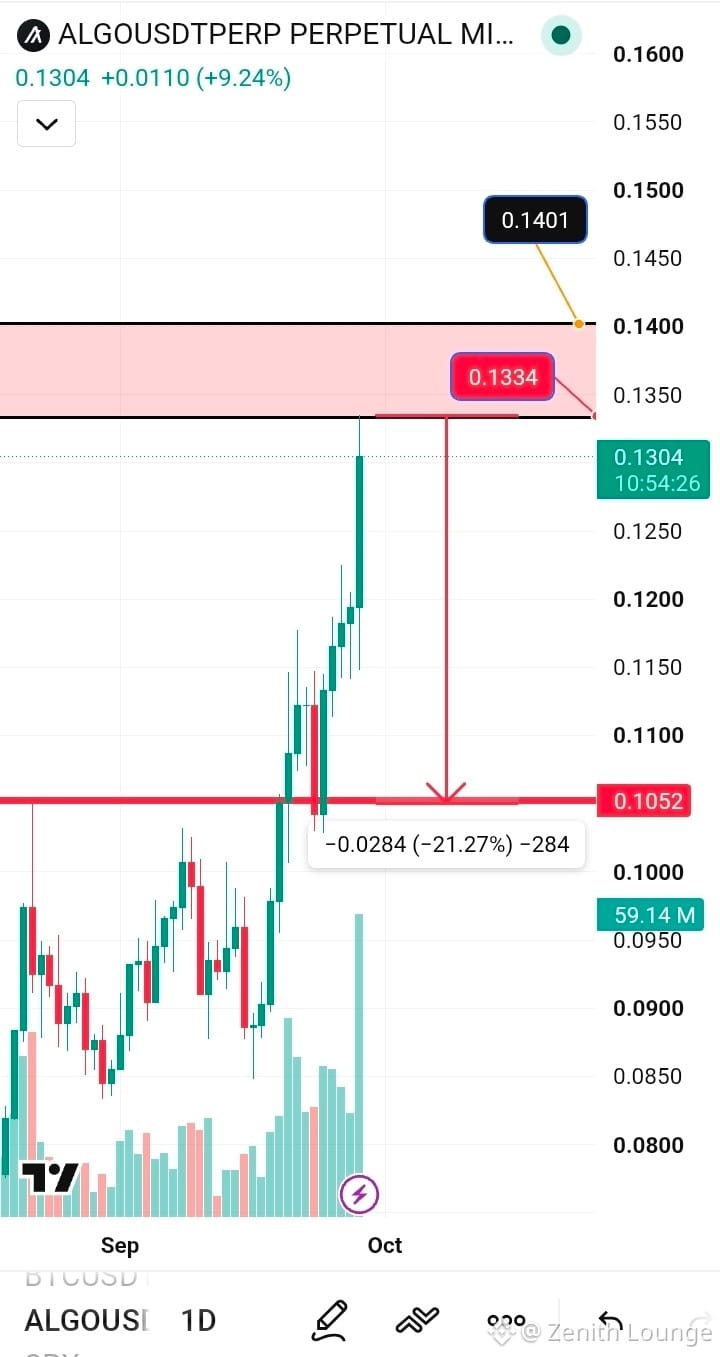
1
79

Current price: around $9.1. ETC has pulled back roughly 4–5% today, after recently trading near $9.6.
📊 Technical outlook
Resistance: $9.50–$9.60
Major resistance: $9.90–$10.20
Support: $9.00
Next support: $8.70–$8.75
Stronger support: $8.40–$8.50
ETC recently rallied strongly, including a reported 13.5% surge on September 25, but the latest move shows profit-taking and broader altcoin weakness.
🔹 Bullish scenario
If ETC holds $9.00 and reclaims $9.50–$9.60, momentum could target $9.90 → $10.20.
🔻 Bearish scenario
A decisive break below $9.00 could expose $8.70, followed by $8.40–$8.50.
Short-term bias: ⚠️ Neutral-to-bearish below $9.60
Key level: $9.00 support / $9.60 resistance
#ETC #ChainlinkLaunchesCCIP2WithEnterpriseVerification #QNTFallsOver40%FromMorningHigh #KospiFalls2.7%SamsungSKHynixDropOver5% #BitgetDetailsSecurityIncidentTimeline
$ETC
{future}(ETCUSDT)
Current price: around $9.1. ETC has pulled back roughly 4–5% today, after recently trading near $9.6.
📊 Technical outlook
Resistance: $9.50–$9.60
Major resistance: $9.90–$10.20
Support: $9.00
Next support: $8.70–$8.75
Stronger support: $8.40–$8.50
ETC recently rallied strongly, including a reported 13.5% surge on September 25, but the latest move shows profit-taking and broader altcoin weakness.
🔹 Bullish scenario
If ETC holds $9.00 and reclaims $9.50–$9.60, momentum could target $9.90 → $10.20.
🔻 Bearish scenario
A decisive break below $9.00 could expose $8.70, followed by $8.40–$8.50.
Short-term bias: ⚠️ Neutral-to-bearish below $9.60
Key level: $9.00 support / $9.60 resistance
#ETC #ChainlinkLaunchesCCIP2WithEnterpriseVerification #QNTFallsOver40%FromMorningHigh #KospiFalls2.7%SamsungSKHynixDropOver5% #BitgetDetailsSecurityIncidentTimeline
$ETC
📊 Technical outlook
Resistance: $9.50–$9.60
Major resistance: $9.90–$10.20
Support: $9.00
Next support: $8.70–$8.75
Stronger support: $8.40–$8.50
ETC recently rallied strongly, including a reported 13.5% surge on September 25, but the latest move shows profit-taking and broader altcoin weakness.
🔹 Bullish scenario
If ETC holds $9.00 and reclaims $9.50–$9.60, momentum could target $9.90 → $10.20.
🔻 Bearish scenario
A decisive break below $9.00 could expose $8.70, followed by $8.40–$8.50.
Short-term bias: ⚠️ Neutral-to-bearish below $9.60
Key level: $9.00 support / $9.60 resistance
#ETC #ChainlinkLaunchesCCIP2WithEnterpriseVerification #QNTFallsOver40%FromMorningHigh #KospiFalls2.7%SamsungSKHynixDropOver5% #BitgetDetailsSecurityIncidentTimeline
$ETC
1
24

·
--
$ETH Pullback Setup 🎯
$ETH is holding around $2,691 after a relatively small pullback. Waiting for a stronger entry rather than chasing.
Trade Plan:
• Entry: $2,600–2,650
• TP1: $2,800
• TP2: $2,950
• TP3: $3,100
• SL: $2,500
Looking for confirmation around the entry zone before taking the trade.
$BTC
{spot}(ETHUSDT)
{spot}(BTCUSDT)
#BTCFallsBelow$83000 #QNTFallsOver40%FromMorningHigh #ChainlinkLaunchesCCIP2WithEnterpriseVerification
$ETH Pullback Setup 🎯
$ETH is holding around $2,691 after a relatively small pullback. Waiting for a stronger entry rather than chasing.
Trade Plan:
• Entry: $2,600–2,650
• TP1: $2,800
• TP2: $2,950
• TP3: $3,100
• SL: $2,500
Looking for confirmation around the entry zone before taking the trade.
$BTC
#BTCFallsBelow$83000 #QNTFallsOver40%FromMorningHigh #ChainlinkLaunchesCCIP2WithEnterpriseVerification
$ETH is holding around $2,691 after a relatively small pullback. Waiting for a stronger entry rather than chasing.
Trade Plan:
• Entry: $2,600–2,650
• TP1: $2,800
• TP2: $2,950
• TP3: $3,100
• SL: $2,500
Looking for confirmation around the entry zone before taking the trade.
$BTC
#BTCFallsBelow$83000 #QNTFallsOver40%FromMorningHigh #ChainlinkLaunchesCCIP2WithEnterpriseVerification
6

🔥 BTW (Bitway) Momentum Update
BTW is showing strong bullish momentum on the 1D chart, trading around $1.344 (+16.68%). Price recently tested $1.36 and is holding above the $1.21 area.
📌 Resistance: $1.36–$1.42
📌 Support: $1.21 / $0.93
⚠️ High volatility — watch for confirmation before chasing the move.
#BTW #Bitway #Crypto #BinanceSquare #Altcoins
$BTW #
{alpha}(560x444045b0ee1ee319a660a5e3d604ca0ffa35acaa)
#QNTFallsOver40%FromMorningHigh #ChainlinkLaunchesCCIP2WithEnterpriseVerification
🔥 BTW (Bitway) Momentum Update
BTW is showing strong bullish momentum on the 1D chart, trading around $1.344 (+16.68%). Price recently tested $1.36 and is holding above the $1.21 area.
📌 Resistance: $1.36–$1.42
📌 Support: $1.21 / $0.93
⚠️ High volatility — watch for confirmation before chasing the move.
#BTW #Bitway #Crypto #BinanceSquare #Altcoins
$BTW #
#QNTFallsOver40%FromMorningHigh #ChainlinkLaunchesCCIP2WithEnterpriseVerification
BTW is showing strong bullish momentum on the 1D chart, trading around $1.344 (+16.68%). Price recently tested $1.36 and is holding above the $1.21 area.
📌 Resistance: $1.36–$1.42
📌 Support: $1.21 / $0.93
⚠️ High volatility — watch for confirmation before chasing the move.
#BTW #Bitway #Crypto #BinanceSquare #Altcoins
$BTW #
#QNTFallsOver40%FromMorningHigh #ChainlinkLaunchesCCIP2WithEnterpriseVerification
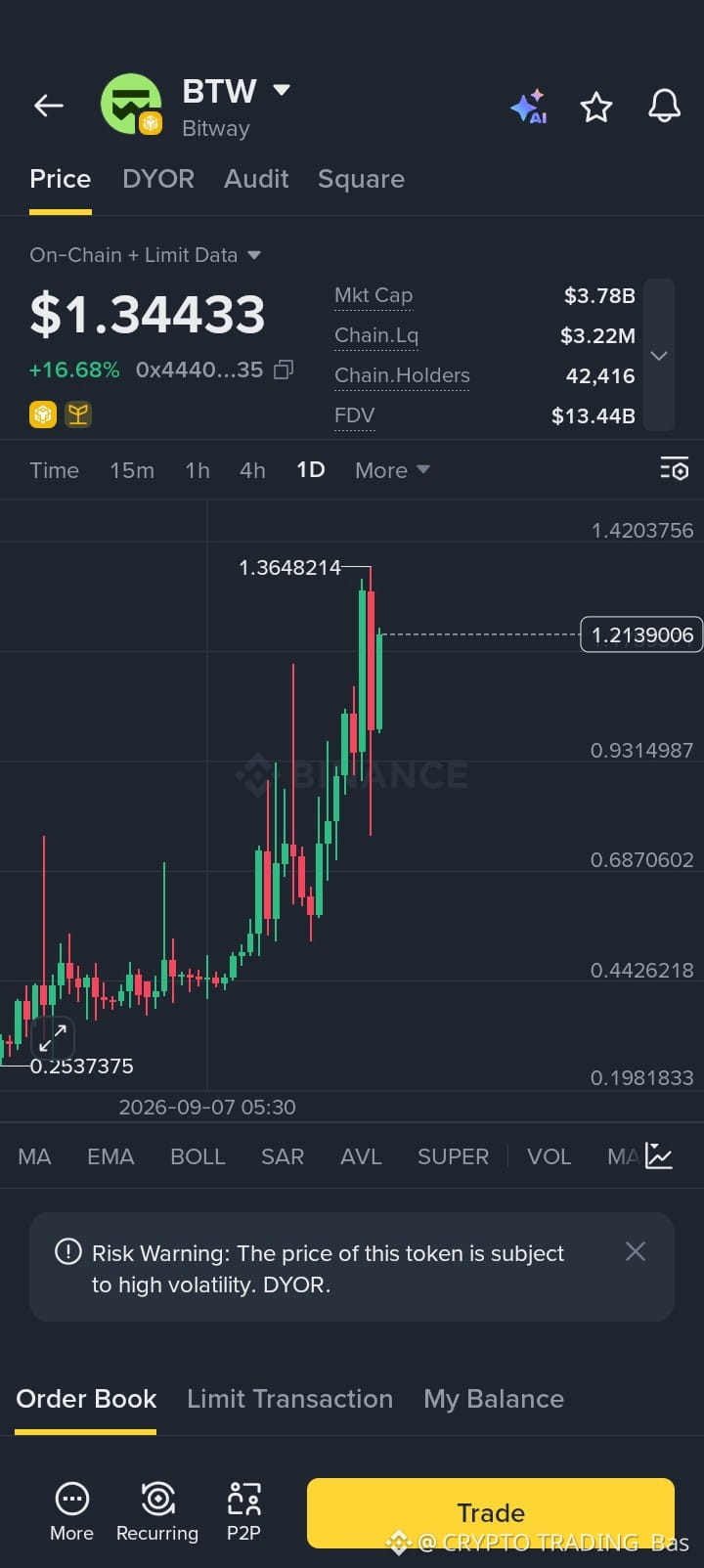
48

·
--
If I reach 1K followers by tomorrow, I’ll reveal something special for you.
#ChainlinkLaunchesCCIP2WithEnterpriseVerification #QNTFallsOver40%FromMorningHigh #KospiFalls2.7%SamsungSKHynixDropOver5%
$BTC $HBAR $SOL
If I reach 1K followers by tomorrow, I’ll reveal something special for you.
#ChainlinkLaunchesCCIP2WithEnterpriseVerification #QNTFallsOver40%FromMorningHigh #KospiFalls2.7%SamsungSKHynixDropOver5%
$BTC $HBAR $SOL
#ChainlinkLaunchesCCIP2WithEnterpriseVerification #QNTFallsOver40%FromMorningHigh #KospiFalls2.7%SamsungSKHynixDropOver5%
$BTC $HBAR $SOL
15

September 28 Crypto Market Watch
Another day, another chance to stay disciplined in the market. 🔥
Don’t chase pumps. Don’t revenge trade. Wait for clean setups, manage your risk, and let the market come to you.
🎯 My focus today:
• Strong BTC/ETH momentum
• High-volume altcoin setups
• Clear support & resistance levels
• Tight risk management
• Taking profit when the setup delivers
💰 The goal isn’t to win every trade — it’s to protect capital and consistently capture good opportunities.
#ChainlinkLaunchesCCIP2WithEnterpriseVerification #GoldFallsTo$4144 #QNTFallsOver40%FromMorningHigh #FedProposesPaymentStablecoinRules $BTC
{future}(BTCUSDT)
September 28 Crypto Market Watch
Another day, another chance to stay disciplined in the market. 🔥
Don’t chase pumps. Don’t revenge trade. Wait for clean setups, manage your risk, and let the market come to you.
🎯 My focus today:
• Strong BTC/ETH momentum
• High-volume altcoin setups
• Clear support & resistance levels
• Tight risk management
• Taking profit when the setup delivers
💰 The goal isn’t to win every trade — it’s to protect capital and consistently capture good opportunities.
#ChainlinkLaunchesCCIP2WithEnterpriseVerification #GoldFallsTo$4144 #QNTFallsOver40%FromMorningHigh #FedProposesPaymentStablecoinRules $BTC
Another day, another chance to stay disciplined in the market. 🔥
Don’t chase pumps. Don’t revenge trade. Wait for clean setups, manage your risk, and let the market come to you.
🎯 My focus today:
• Strong BTC/ETH momentum
• High-volume altcoin setups
• Clear support & resistance levels
• Tight risk management
• Taking profit when the setup delivers
💰 The goal isn’t to win every trade — it’s to protect capital and consistently capture good opportunities.
#ChainlinkLaunchesCCIP2WithEnterpriseVerification #GoldFallsTo$4144 #QNTFallsOver40%FromMorningHigh #FedProposesPaymentStablecoinRules $BTC
1
20

·
--
{spot}(SOLUSDT)
#$SOL Short Analysis
Trend: Short-term recovery/bullish momentum.
Support: $120, then $118.
Resistance: $125, then $130.
Bullish scenario: A strong break above $125 could open the way toward $130–$135.
Bearish scenario: Losing $120 could bring a pullback toward $118–$112.
Key level: Watch $125 for confirmation.
#ChainlinkLaunchesCCIP2WithEnterpriseVerification #QNTFallsOver40%FromMorningHigh #KospiFalls2.7%SamsungSKHynixDropOver5% #FedProposesPaymentStablecoinRules
#$SOL Short Analysis
Trend: Short-term recovery/bullish momentum.
Support: $120, then $118.
Resistance: $125, then $130.
Bullish scenario: A strong break above $125 could open the way toward $130–$135.
Bearish scenario: Losing $120 could bring a pullback toward $118–$112.
Key level: Watch $125 for confirmation.
#ChainlinkLaunchesCCIP2WithEnterpriseVerification #QNTFallsOver40%FromMorningHigh #KospiFalls2.7%SamsungSKHynixDropOver5% #FedProposesPaymentStablecoinRules
Trend: Short-term recovery/bullish momentum.
Support: $120, then $118.
Resistance: $125, then $130.
Bullish scenario: A strong break above $125 could open the way toward $130–$135.
Bearish scenario: Losing $120 could bring a pullback toward $118–$112.
Key level: Watch $125 for confirmation.
#ChainlinkLaunchesCCIP2WithEnterpriseVerification #QNTFallsOver40%FromMorningHigh #KospiFalls2.7%SamsungSKHynixDropOver5% #FedProposesPaymentStablecoinRules
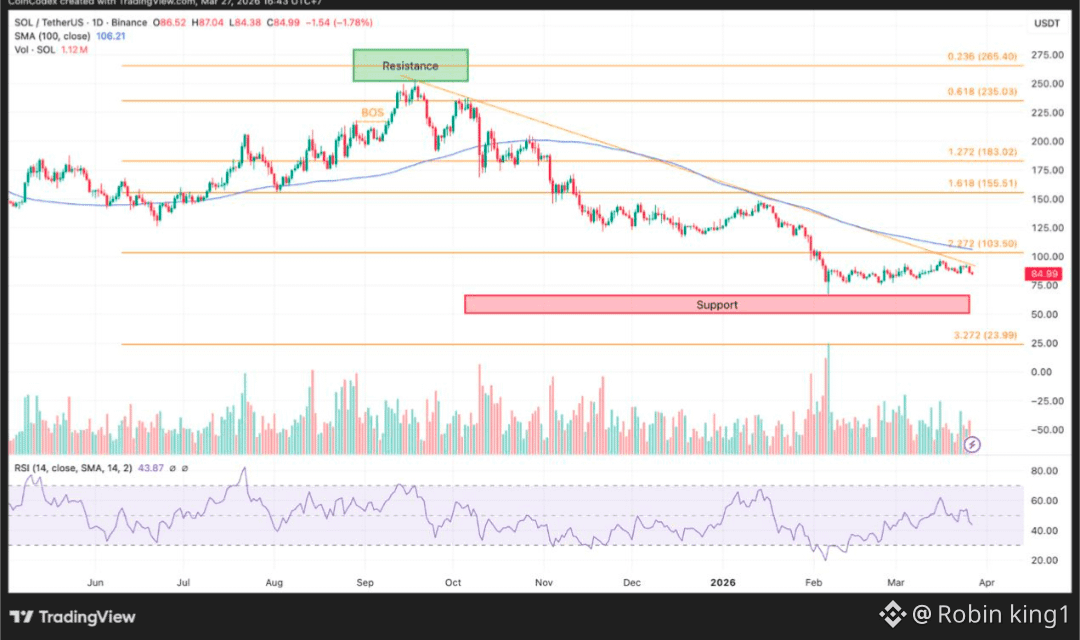
2
Log in to explore more content
Join global crypto users on Binance Square
⚡️ Get latest and useful information about crypto.
💬 Trusted by the world’s largest crypto exchange.
👍 Discover real insights from verified creators.
Email / Phone number
Trending Topics
1
#ChainlinkLaunchesCCIP2WithEnterpriseVerification
341 views
104 Discussing
2
#GoldFallsTo$4144
2,003 views
67 Discussing
3
#QNTFallsOver40%FromMorningHigh
18,396 views
566 Discussing
4
#KospiFalls2.7%SamsungSKHynixDropOver5%
3,117 views
237 Discussing
5
#BitgetCEOConfirms$388MStolenInHack
1,211 views
28 Discussing
6
#BTCFallsBelow$83000
13,216 views
114 Discussing
7
#BitgetDetailsSecurityIncidentTimeline
12,092 views
390 Discussing
8
#BitcoinSpotETFs$2.39BWeeklyNetInflow
5,340 views
27 Discussing
9
#FedProposesPaymentStablecoinRules
41,042 views
752 Discussing
10
#ChinaMayLetAlibabaByteDanceBuyNvidiaChips
43,109 views
759 Discussing