
#cftc
cftc
2M views
5,162 Discussing
Hot
Latest

The US CFTC staff has issued guidance on how Bitcoin, Ethereum, and payment stablecoins may count toward certain exchange financial resource requirements.
This is another development in the relationship between crypto assets and traditional financial infrastructure.
$BTC $ETH #CFTC #CryptoRegulation
{spot}(BTCUSDT)
{spot}(ETHUSDT)
The US CFTC staff has issued guidance on how Bitcoin, Ethereum, and payment stablecoins may count toward certain exchange financial resource requirements.
This is another development in the relationship between crypto assets and traditional financial infrastructure.
$BTC $ETH #CFTC #CryptoRegulation
This is another development in the relationship between crypto assets and traditional financial infrastructure.
$BTC $ETH #CFTC #CryptoRegulation
105

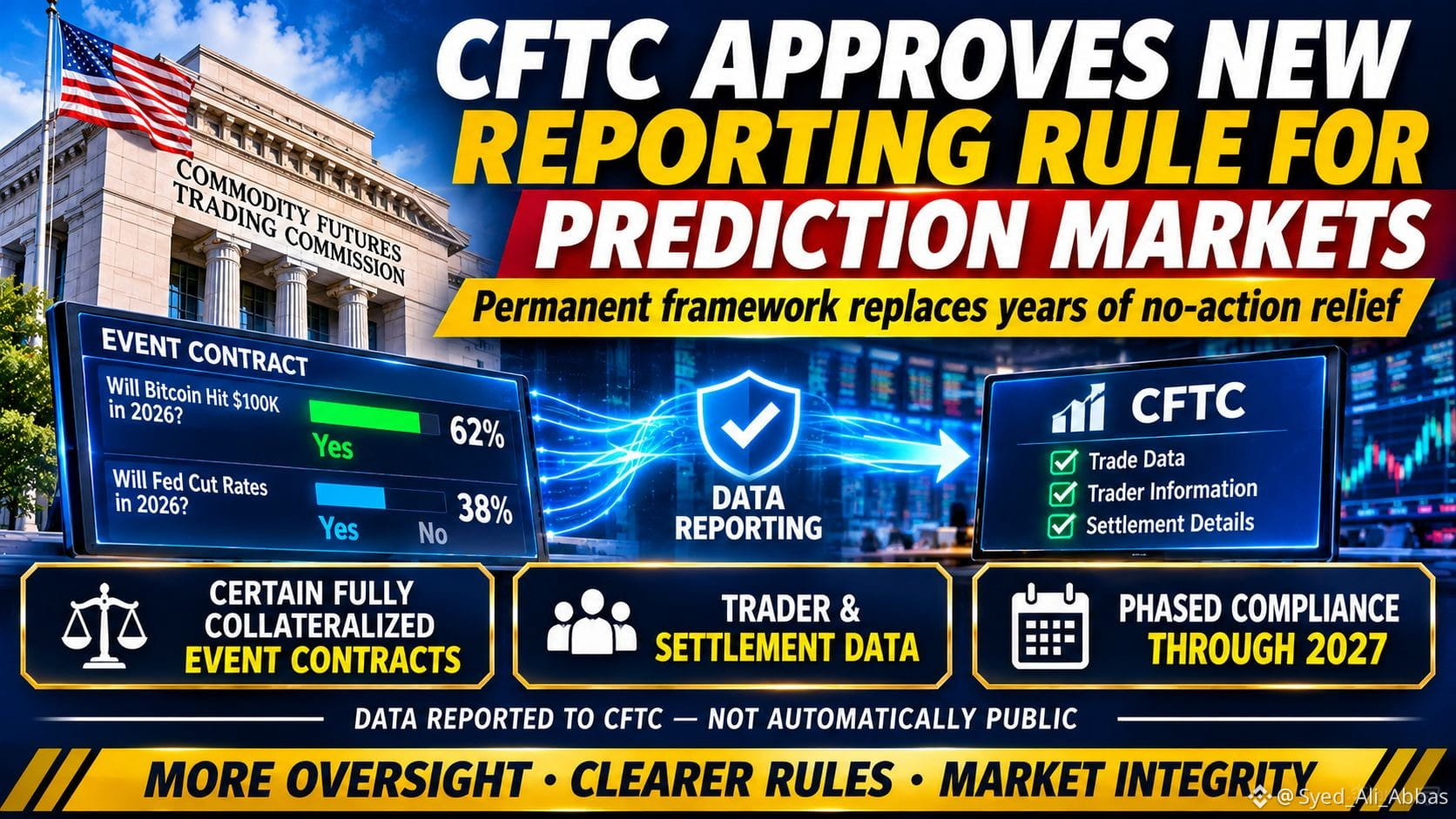
CFTC APPROVES NEW REPORTING RULE FOR PREDICTION MARKETS — MORE TRANSPARENCY, STRONGER OVERSIGHT!
The US Commodity Futures Trading Commission (CFTC) has approved a major regulatory change that could reshape how certain prediction-market contracts are monitored.
The move is designed to establish clearer reporting obligations and improve regulatory oversight as prediction markets continue expanding.
WHAT EXACTLY HAS THE CFTC APPROVED?
The final rule amends Parts 15, 16 and 17 of CFTC regulations and introduces a new Section 16.03 called Covered Event Contracts.
Under the new framework, affected reporting markets, futures commission merchants, clearing members and foreign brokers will report certain event-contract information under Parts 15–18.
This replaces the previous patchwork of reporting arrangements under selected provisions of Parts 38, 39, 43 and 45.
$ETH #CFTC #CryptoNews
{spot}(ETHUSDT)
#cftcapprovestradereportingruleforpredictionmarkets
CFTC APPROVES NEW REPORTING RULE FOR PREDICTION MARKETS — MORE TRANSPARENCY, STRONGER OVERSIGHT!
The US Commodity Futures Trading Commission (CFTC) has approved a major regulatory change that could reshape how certain prediction-market contracts are monitored.
The move is designed to establish clearer reporting obligations and improve regulatory oversight as prediction markets continue expanding.
WHAT EXACTLY HAS THE CFTC APPROVED?
The final rule amends Parts 15, 16 and 17 of CFTC regulations and introduces a new Section 16.03 called Covered Event Contracts.
Under the new framework, affected reporting markets, futures commission merchants, clearing members and foreign brokers will report certain event-contract information under Parts 15–18.
This replaces the previous patchwork of reporting arrangements under selected provisions of Parts 38, 39, 43 and 45.
$ETH #CFTC #CryptoNews
#cftcapprovestradereportingruleforpredictionmarkets
117

·
--
🚨 BREAKING: CFTC FINALIZES NEW PREDICTION MARKET RULES — A 9-YEAR REPORTING SHIFT! 👀
Event contracts listed on US-regulated exchanges (DCMs) have expanded rapidly, and new CFTC data shows just how much they've grown.
📊 The numbers tell the story:
• 2006–2020: Around 5 event contracts listed per year on average.
• 2021: 131 contracts.
• 2025: Approximately 1,600 contracts!
That's more than 12 times as many contracts as in 2021!
Now, the US CFTC has finalized new reporting rules for certain fully collateralized event contracts, aiming to improve transparency and regulatory oversight.
⏳ Some requirements begin after 60 days, while trader-identification requirements have a 12-month timeline after publication.
Will stronger regulation help prediction markets grow further, or slow them down! 📈
$UMA - $OPG - $DODO
{future}(UMAUSDT)
{future}(OPGUSDT)
{spot}(DODOUSDT)
#PredictionMarkets #CFTC #CryptoNews #CFTCApprovesTradeReportingRuleForPredictionMarkets
"Will new CFTC rules strengthen prediction markets"!?⚡
🚨 BREAKING: CFTC FINALIZES NEW PREDICTION MARKET RULES — A 9-YEAR REPORTING SHIFT! 👀
Event contracts listed on US-regulated exchanges (DCMs) have expanded rapidly, and new CFTC data shows just how much they've grown.
📊 The numbers tell the story:
• 2006–2020: Around 5 event contracts listed per year on average.
• 2021: 131 contracts.
• 2025: Approximately 1,600 contracts!
That's more than 12 times as many contracts as in 2021!
Now, the US CFTC has finalized new reporting rules for certain fully collateralized event contracts, aiming to improve transparency and regulatory oversight.
⏳ Some requirements begin after 60 days, while trader-identification requirements have a 12-month timeline after publication.
Will stronger regulation help prediction markets grow further, or slow them down! 📈
$UMA - $OPG - $DODO
#PredictionMarkets #CFTC #CryptoNews #CFTCApprovesTradeReportingRuleForPredictionMarkets
"Will new CFTC rules strengthen prediction markets"!?⚡
🟢 YES — More transparency! 👀
🔴 NO — More restrictions! 🎯
1 hr(s) left
4
2.1k

·
--
#CFTCApprovesTradeReportingRuleForPredictionMarkets
📜 No-Action Letters Since 2017 End: Prediction Markets Get Rules
On Nov 23 the CFTC moved fully collateralized event contracts to futures-style reporting.
📊 Large-trader reporting at 125,000 contracts, from July 26, 2027
⚠️ Exchanges must collect trader name, address, job and employer
🏦 Trade price, size and time published free for at least a year
📅 Core rules start 60 days after Federal Register publication
The catch: clearer rules come with less anonymity.
Event-contract volume higher or lower a year after this starts? 👇
#CFTCApprovesTradeReportingRuleForPredictionMarkets #PredictionMarkets #CFTC

1
4


·
--
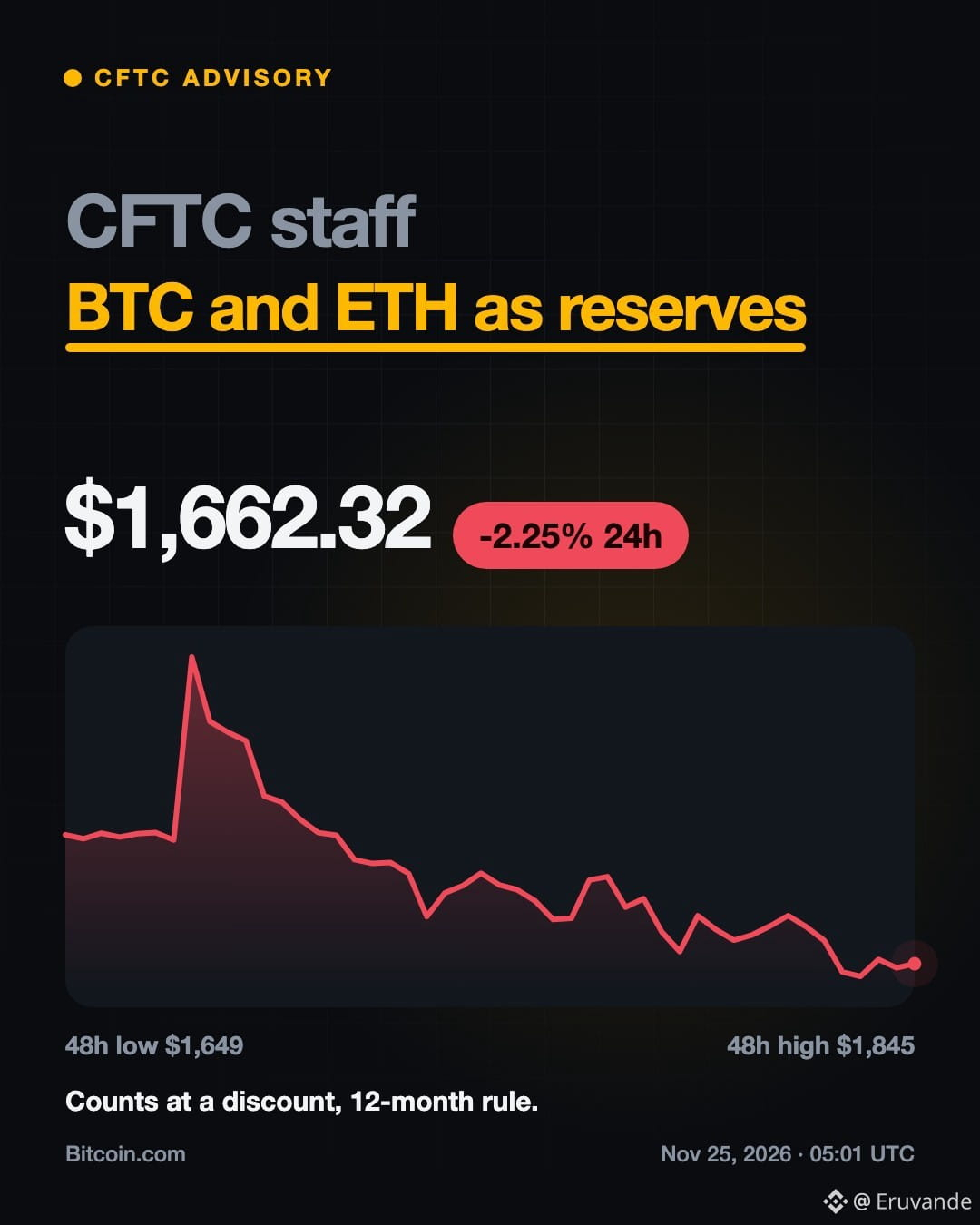
CFTC staff just said US exchanges and clearinghouses can count $BTC, $ETH and payment stablecoins toward their 12-month operating reserve requirement, per Bitcoin.com. CryptoSlate notes the catch: qualifying crypto counts at a discount, so a venue needs more than a dollar-for-dollar buffer. Do exchange reserves in crypto make the system sturdier?
#CFTC #Ethereum
CFTC staff just said US exchanges and clearinghouses can count $BTC , $ETH and payment stablecoins toward their 12-month operating reserve requirement, per Bitcoin.com. CryptoSlate notes the catch: qualifying crypto counts at a discount, so a venue needs more than a dollar-for-dollar buffer. Do exchange reserves in crypto make the system sturdier?
#CFTC #Ethereum
#CFTC #Ethereum
133

·
--
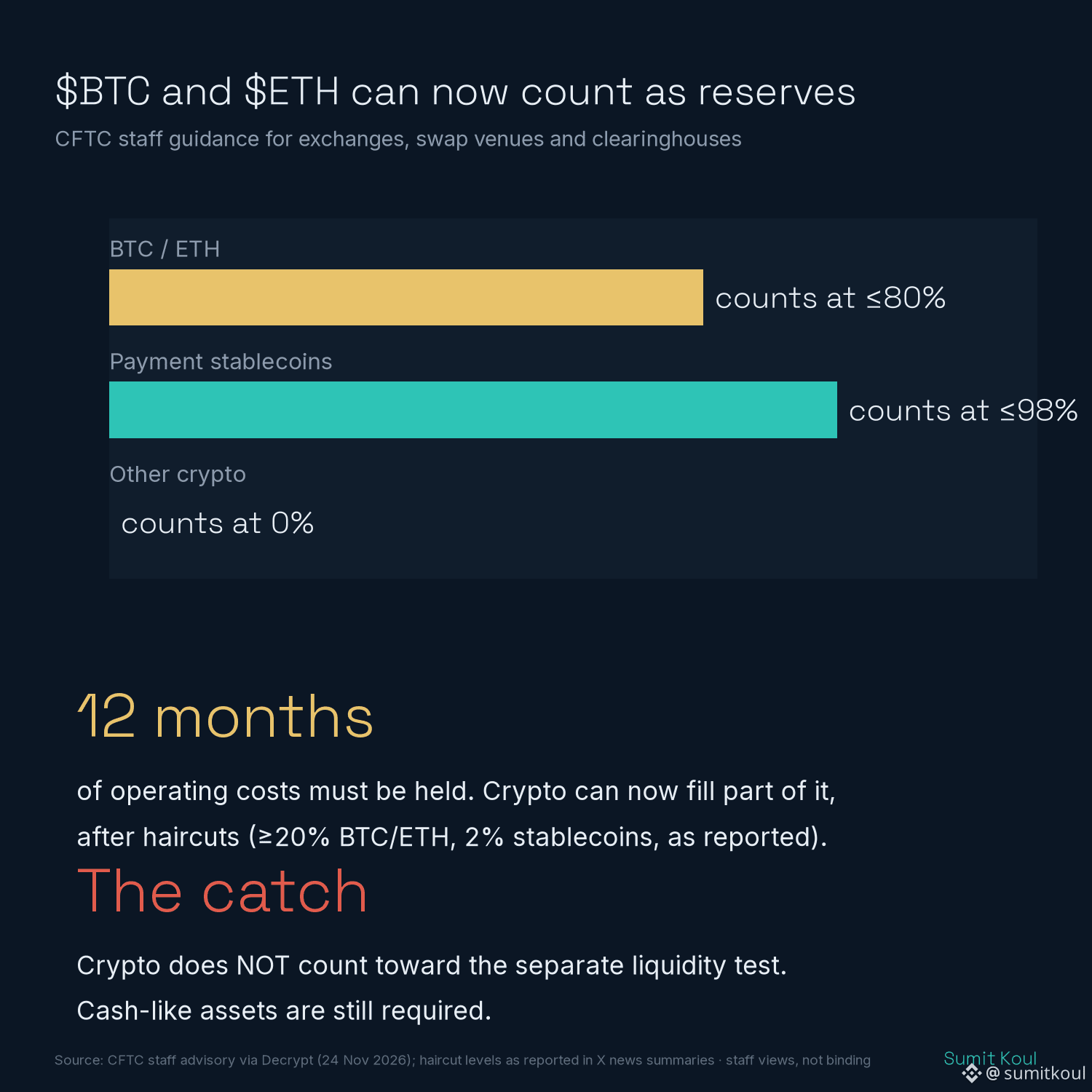
US exchanges and clearinghouses can now hold $BTC and $ETH as part of their reserves. But there's a catch. 🏛️
New CFTC staff guidance:
• Platforms must hold 12 months of operating costs
• BTC, ETH and payment stablecoins can now count toward it
• With haircuts (reported: at least 20% for BTC/ETH, 2% for stablecoins)
• Other crypto doesn't count
The catch: crypto does NOT count toward the separate liquidity test. They still need cash-like assets.
It's staff guidance only. Not binding.
Big step or just paperwork? Tell me in the comments.
Follow me for crypto policy explained in one image.
#CFTC #Bitcoin #Regulation
1

·
--
Prediction markets just got their first permanent rulebook in the US — and it matters for crypto.
The CFTC approved a final rule on Monday replacing 17 temporary no-action letters dating back to 2017 with one reporting framework. Event contracts now report like futures. Only fully collateralized contracts are covered.
The scale explains the timing: exchanges certified about 1,600 event contracts in 2025, against about five a year across 2006–2020. At least 12 companies had exchange applications under review as of September.
The trade is not free. A position becomes reportable at 125,000 contracts or $125,000 in notional value, and exchanges must collect each trader's name, address, occupation and employer. Most provisions take effect 60 days after the rule hits the Federal Register.
Unsettled: the CFTC vs state gambling regulators fight over who controls these markets, and which events can be listed at all.
My read: plumbing, not a catalyst — no price pops from a reporting rule. But a permanent framework pulls more US venues into a market crypto already lives in. Polymarket runs on USDC. Growing up means paperwork.
Bitcoin is still pinned under $60K at $59,442, up slightly from the last post. Tonight's PCE print at 7:30 PM Dhaka decides whether our $58,386 range-call line holds or breaks.
If this saved you money, the tip button is there.
Do regulated prediction markets pull money in, or push traders back to crypto-native venues? Follow for the PCE print tonight.
Not financial advice. Do your own research.
$BTC $BNB
#CFTC #PredictionMarkets #Crypto
16

·
--
Bullish
#cftcapprovestradereportingruleforpredictionmarkets
CFTC Approves Trade Reporting Rule for Prediction Markets
A major regulatory development is emerging for prediction markets as the CFTC approves a new trade reporting rule.
The decision could bring greater transparency to a rapidly growing sector where users trade contracts tied to real-world events, economic outcomes, and political developments.
What Happened?
Regulatory Clarity: The CFTC is moving toward clearer reporting standards for prediction-market activity.
Market Transparency: Trade reporting could help regulators monitor transactions and market behavior.
Industry Impact: Prediction-market platforms may need to strengthen their compliance and reporting systems.
Why It Matters for Crypto
Prediction markets are attracting growing interest from crypto and traditional finance companies. Clearer reporting requirements could support institutional participation while increasing compliance obligations for platforms.
The rule is designed to strengthen oversight and improve market integrity as prediction markets expand. <Cite refs={["turn266300news13","turn266300search7"]}/>
Prediction markets are growing fast — and regulators are now setting clearer rules for the next stage.
#CFTC #PredictionMarkets #CryptoRegulation

544


Article
CFTC Approves Permanent Trade Reporting Rule for Prediction MarketsOn November 23, 2026, the U.S. Commodity Futures Trading Commission (CFTC) approved a final rule establishing permanent trade reporting requirements for prediction markets, replacing a patchwork of 17 temporary no-action relief letters. The rule applies to fully collateralized event contracts traded on CFTC-registered exchanges and aligns their reporting framework with traditional futures and options. Large-trader reporting kicks in at $125,000 in notional value, and venues will also need to collect added trader details—including names, addresses, occupations, and employers—to strengthen oversight and trace unusual market activity.
For the crypto and trading community on Binance Square, the move brings clearer rules as event contracts surge alongside crypto and macro trading. Permanent standards give prediction platforms and institutional players a firmer regulatory footing, while tighter reporting and identity checks raise compliance bars across venues. Traders on Binance Square can watch how clearer rules shape liquidity, market transparency, and cross-market sentiment across crypto and event markets.
$PEPE
{spot}(BONKUSDT)
{spot}(PEPEUSDT)
#BinanceSquare #CryptoNews #CFTC #PredictionMarkets
#cftcapprovestradereportingruleforpredictionmarkets
CFTC Approves Permanent Trade Reporting Rule for Prediction Markets
On November 23, 2026, the U.S. Commodity Futures Trading Commission (CFTC) approved a final rule establishing permanent trade reporting requirements for prediction markets, replacing a patchwork of 17 temporary no-action relief letters. The rule applies to fully collateralized event contracts traded on CFTC-registered exchanges and aligns their reporting framework with traditional futures and options. Large-trader reporting kicks in at $125,000 in notional value, and venues will also need to collect added trader details—including names, addresses, occupations, and employers—to strengthen oversight and trace unusual market activity.
For the crypto and trading community on Binance Square, the move brings clearer rules as event contracts surge alongside crypto and macro trading. Permanent standards give prediction platforms and institutional players a firmer regulatory footing, while tighter reporting and identity checks raise compliance bars across venues. Traders on Binance Square can watch how clearer rules shape liquidity, market transparency, and cross-market sentiment across crypto and event markets.
$PEPE
#BinanceSquare #CryptoNews #CFTC #PredictionMarkets
#cftcapprovestradereportingruleforpredictionmarkets
1
118

📊 The CFTC approved permanent rules for certain event contracts while more firms currently seek entry into the US prediction markets.
#CFTC #PredictionMarkets #CryptoNews
$BTC
📊 The CFTC approved permanent rules for certain event contracts while more firms currently seek entry into the US prediction markets.
#CFTC #PredictionMarkets #CryptoNews
$BTC
#CFTC #PredictionMarkets #CryptoNews
$BTC

9

Quietly big news from the CFTC while everyone was staring at the $60K line.
US derivatives exchanges and clearinghouses can now count $BTC, $ETH and payment stablecoins toward the reserves they have to hold to cover a year of operating costs. Staff letter 26-31, issued Monday.
The catch: a 20% haircut on BTC and ETH, 2% on stablecoins. So $100 of Bitcoin counts as $80 in the reserve pile. And crypto still can't cover the separate 3-6 month liquidity cushion, that still has to be cash or highly liquid securities. At most about half the 12-month reserve can be crypto.
It's staff guidance, not a formal rule, and CFTC Chair Selig welcomed it as more clarity for crypto in US derivatives markets. Saylor already flagged it on X.
Meanwhile spot is still stuck under $60K. BTC around $59,600, down about 2.4% in 24h, ETH near $1,675, and tonight's PCE print at 7pm IST is the next big test. Regulation keeps moving crypto into the plumbing of traditional markets, even while the price can't catch a break.
#Bitcoin #Crypto #CFTC
Not financial advice. DYOR.
Quietly big news from the CFTC while everyone was staring at the $60K line.
US derivatives exchanges and clearinghouses can now count $BTC , $ETH and payment stablecoins toward the reserves they have to hold to cover a year of operating costs. Staff letter 26-31, issued Monday.
The catch: a 20% haircut on BTC and ETH, 2% on stablecoins. So $100 of Bitcoin counts as $80 in the reserve pile. And crypto still can't cover the separate 3-6 month liquidity cushion, that still has to be cash or highly liquid securities. At most about half the 12-month reserve can be crypto.
It's staff guidance, not a formal rule, and CFTC Chair Selig welcomed it as more clarity for crypto in US derivatives markets. Saylor already flagged it on X.
Meanwhile spot is still stuck under $60K. BTC around $59,600, down about 2.4% in 24h, ETH near $1,675, and tonight's PCE print at 7pm IST is the next big test. Regulation keeps moving crypto into the plumbing of traditional markets, even while the price can't catch a break.
#Bitcoin #Crypto #CFTC
Not financial advice. DYOR.


·
--
🏛️ CFTC lets US derivatives venues count bitcoin and ether toward reserves
CFTC staff issued an advisory saying swap execution facilities, futures exchanges and clearinghouses may use bitcoin, ether and payment stablecoins to help cover their required 12 months of operating costs.
Haircuts apply: at least 20% for BTC and ETH and 2% for payment stablecoins. Crypto still can't count toward the separate liquidity requirement, and the advisory reflects staff views only, not a new rule.
⭐ Formal recognition of BTC and ETH as reserve assets for US derivatives infrastructure marks another step in bringing crypto into mainstream market plumbing.
#CFTC #Bitcoin #Ethereum #Stablecoins #CryptoRegulation

1
185

A quiet but meaningful regulatory step for crypto this week: the US Commodity Futures Trading Commission issued staff guidance letting regulated derivatives exchanges count Bitcoin, Ether and payment stablecoins toward the reserves they must hold to cover 12 months of operating costs.
In plain terms, $BTC and $ETH can now sit on the balance sheet of a regulated US exchange as reserve assets — the same kind of treatment traditionally reserved for cash and high-quality instruments. It is guidance, not a new law, but it normalizes crypto inside the plumbing of regulated markets.
The market, however, barely noticed. Bitcoin still slipped under $60,000 and November ETF outflows hit a record $4.71 billion. That gap is the lesson: regulatory plumbing moves slowly, while flows move prices today.
There is a second signal worth noting. BlackRock launched its first tokenized money market fund in Hong Kong, another step in bringing traditional finance products onto blockchain rails.
My take: do not expect a price reaction from guidance like this. Its value is structural — each step that treats crypto as ordinary financial collateral lowers the barrier for the next institution. The price will follow flows; the infrastructure is being built regardless.
#CFTC #Regulation #Bitcoin #Ethereum
106

·
--
🇺🇸 Bitcoin can count toward certain derivatives reserves. The haircut is the number I want.
CFTC staff guidance says qualifying derivatives venues can count certain crypto assets toward financial resource requirements, subject to conditions.
Start with $BTC and $ETH . If a venue holds a volatile asset as part of its reserve, how much of that asset’s market value can it actually count? A haircut reduces the amount credited toward the requirement. The answer matters most on a volatile day.
For the crypto lending side, $LISTA was up 28.83% in 24h on Binance. Its chart is a separate way to follow interest in collateral markets.
#CFTC #Bitcoin #Collateral

1
304

$ETH and $BTC just got a quiet nod from US regulators that I think most people scrolled past.
CFTC staff put out an advisory on Nov 23 saying regulated derivatives exchanges, swap facilities and clearinghouses can count bitcoin, ether and payment stablecoins toward their 12-month operating-cost reserves. There's a haircut, at least 20% on BTC and ETH per the staff letter as reported by TFTC, and crypto still doesn't count toward the separate liquidity requirement. It's staff guidance only, not a rule.
Not a price catalyst on its own, especially with the market this heavy. But it's one more step where $ETH and $BTC get treated as balance-sheet assets instead of something to keep off the books.
Do you think this kind of slow plumbing change matters more long term than this month's ETF outflows?
NFA, just my read.
Sources: CFTC press release 9331-26, TFTC
#CFTC #Regulation #ETH #BTC #CryptoNews
29


Article
U.S. sets out new guidance on crypto as part of firms’ reservesThe U.S. is continuing to explore how cryptocurrencies can be integrated within the financial sector.
Staff at the U.S. Commodity Futures Trading Commission (CFTC) released guidance on 24th November 2026 stating that some crypto can form part of a firm’s reserve base.
However, this is in addition to and not interchangeable with firms’ liquidity needs.
WHAT DOES THIS ALL MEAN?
1. Digital assets can form part of a firm’s reserves
Appropriate digital assets can be held as part of a regulated firm’s or clearing house’s reserve base.
2. Liquidity is still a different requirement
Firms are not able to use the same digital assets to meet their liquidity needs.
3. Regulation is becoming more defined
The guidance has helped further to delineate the difference between a firm’s reserves and liquidity needs within the crypto space.
4. Not all cryptos will be accepted
Specifically, the guidance does not state which digital assets can be included.
WHY IS THIS IMPORTANT?
Within the financial sector, firms are continually concerned with the safe-keeping, reserves and liquidity of their assets.
This guidance may therefore further assist firms to recognise how appropriate digital assets can align with current regulation.
Furthermore, it demonstrates that alongside the debate about whether or not digital assets should be allowed, regulators are also becoming more involved in analysing the finer points of integrating crypto within financial services.
WHAT SHOULD INVESTORS BE LOOKING FOR?
People will be keen to ascertain:
What digital assets may be accepted?
Whether further regulatory guidance will be issued.
Whether this will further promote institutional involvement in crypto.
And how trading firms will modify their reserve strategies.
In your view, will more precise reserve guidelines spur greater institutional investment in crypto within the U.S.?
Please leave a comment below. And don’t forget to follow us for further news on crypto regulation, institutional investment and worldwide markets.
Please note that this is general information and does not constitute financial advice. It is always essential that you carry out your own research.
#CFTC #CryptoRegulation #bitcoin #InstitutionalAdoption #BinanceSquare
U.S. sets out new guidance on crypto as part of firms’ reserves
The U.S. is continuing to explore how cryptocurrencies can be integrated within the financial sector.
Staff at the U.S. Commodity Futures Trading Commission (CFTC) released guidance on 24th November 2026 stating that some crypto can form part of a firm’s reserve base.
However, this is in addition to and not interchangeable with firms’ liquidity needs.
WHAT DOES THIS ALL MEAN?
1. Digital assets can form part of a firm’s reserves
Appropriate digital assets can be held as part of a regulated firm’s or clearing house’s reserve base.
2. Liquidity is still a different requirement
Firms are not able to use the same digital assets to meet their liquidity needs.
3. Regulation is becoming more defined
The guidance has helped further to delineate the difference between a firm’s reserves and liquidity needs within the crypto space.
4. Not all cryptos will be accepted
Specifically, the guidance does not state which digital assets can be included.
WHY IS THIS IMPORTANT?
Within the financial sector, firms are continually concerned with the safe-keeping, reserves and liquidity of their assets.
This guidance may therefore further assist firms to recognise how appropriate digital assets can align with current regulation.
Furthermore, it demonstrates that alongside the debate about whether or not digital assets should be allowed, regulators are also becoming more involved in analysing the finer points of integrating crypto within financial services.
WHAT SHOULD INVESTORS BE LOOKING FOR?
People will be keen to ascertain:
What digital assets may be accepted?
Whether further regulatory guidance will be issued.
Whether this will further promote institutional involvement in crypto.
And how trading firms will modify their reserve strategies.
In your view, will more precise reserve guidelines spur greater institutional investment in crypto within the U.S.?
Please leave a comment below. And don’t forget to follow us for further news on crypto regulation, institutional investment and worldwide markets.
Please note that this is general information and does not constitute financial advice. It is always essential that you carry out your own research.
#CFTC #CryptoRegulation #bitcoin #InstitutionalAdoption #BinanceSquare
122

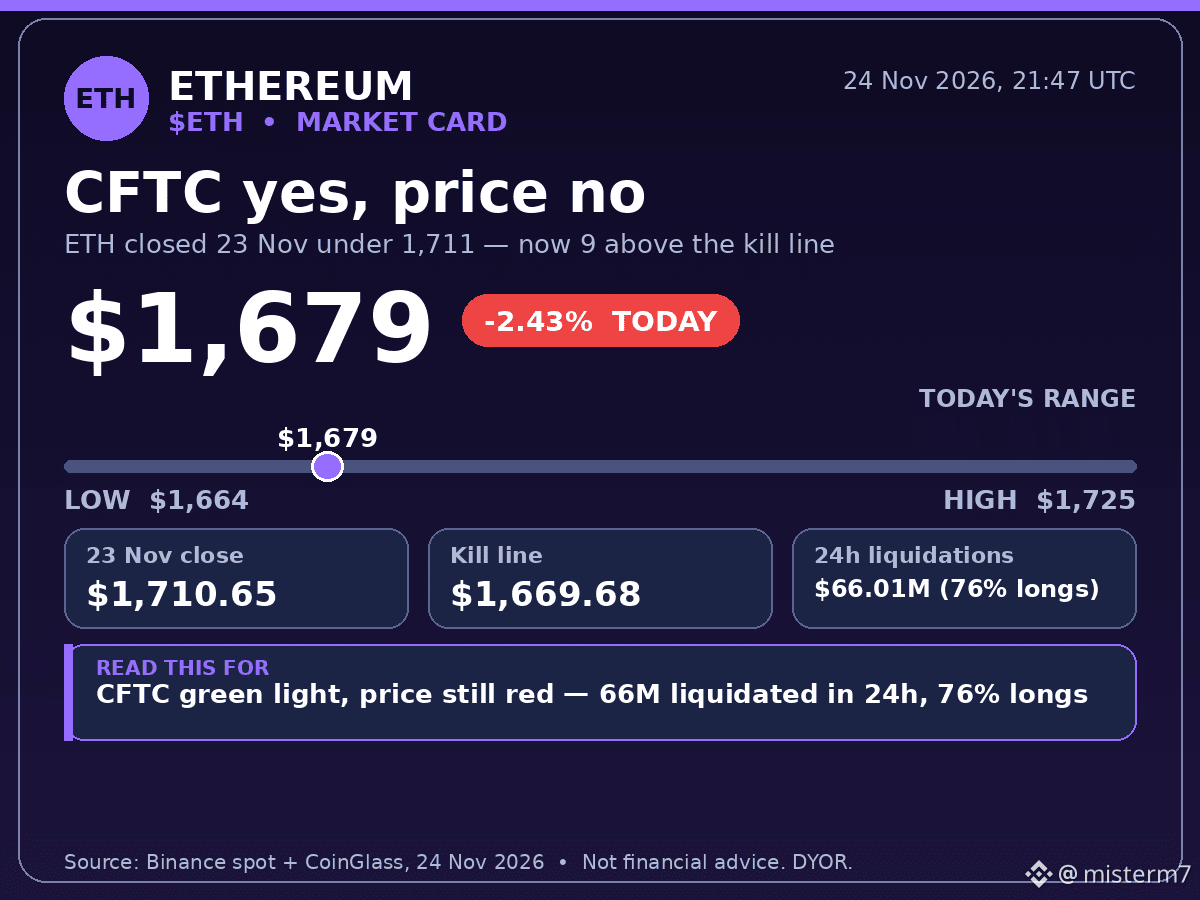

·
--
The CFTC just let US exchanges count Bitcoin as reserves. That is a quiet green light for crypto. 📰
CFTC staff guidance now lets regulated US derivatives exchanges count Bitcoin, Ether and payment stablecoins toward the reserves that cover 12 months of costs, reported by Crypto.news in the 24 November morning edition. 📊 CoinGecko data checked at 02:00 PKT puts Bitcoin near 59,488 dollars on the last 30 minute close, with total market cap at 2.08 trillion dollars and Bitcoin dominance at 57.82 percent. My reading is that regulators are slowly treating Bitcoin as a real reserve asset, and that matters more over months than over one session, because it opens the door for exchanges to hold crypto instead of only cash.
Does this CFTC move bring more institutions into Bitcoin next year, or does the market ignore it? 🤔
Follow for more trades.
#Crypto #Bitcoin #FuturesTrading #TradingSignals #CFTC


·
--
📜 CFTC Sets Permanent Rules for Prediction Markets — No More "Band-Aid" Relief
📌 What happened
The US Commodity Futures Trading Commission approved a final rule on Monday, Nov 23, putting reporting for fully collateralised event contracts — the products prediction markets list — under permanent regulations. Exchanges will now report these contracts like traditional futures and options trades, and no longer need individual no-action relief from the CFTC.
📊 Key numbers
• 1,600 event contracts certified for listing in 2025, vs an average of just 5 new listings per year from 2006–2020
• At least 12 firms have applications pending to launch exchanges offering these contracts
• Exchanges get 12 months to start collecting each trader's name, address, job and employer
• Core reporting phases in over 60 days to July 2027
• Senate passed the DEATH BETS Act on Nov 19, banning war, terrorism and death contracts
🔍 Why it matters
Prediction markets grew up alongside crypto — Polymarket and Kalshi trade heavily on BTC and ETH outcomes — and the CFTC is now writing their rulebook instead of policing them case by case. Chairman Michael Selig called the old no-action letters "band-aids for unworkable regulations." Permanent rules lower the barrier for the 12+ firms waiting to enter the US, which means more venues, more liquidity and more crypto-linked contracts. The trade-off is surveillance: exchanges must now know who traders are and where they work, to catch insiders who could influence an outcome.
👀 What to watch
• Which of the 12 pending applicants launches first
• The separate CFTC rule on which events can be offered, now under White House review
• The CFTC's lawsuits against 12 states over sports contracts
• Whether BTC/ETH prediction volume moves to newly licensed US venues
Not financial advice. Source: CFTC / Unchained Crypto / TradingView, Nov 24.
$BTC $ETH #PredictionMarkets #CFTC #Crypto
27
Log in to explore more content
Join global crypto users on Binance Square
⚡️ Get latest and useful information about crypto.
💬 Trusted by the world’s largest crypto exchange.
👍 Discover real insights from verified creators.
Email / Phone number
Trending Topics
1
#CanMarketsReboundAfterThanksgiving?
196,382 views
1,975 Discussing
2
#CouldSpaceX’sOrbitalDataCentersBoostAIChipDemand?
96,442 views
1,189 Discussing
3
#SouthKoreaProposesMandatoryDigitalAssetTransactionDisclosure
5,094 views
110 Discussing
4
#EvolveAtBinanceBlockchainWeek
843,480 views
10,511 Discussing
5
#KoreaFSCSeeksPowerToSuspendCryptoListings
22,097 views
328 Discussing
6
#SouthKoreaPlansToRequireTetherCircleLocalReserves
20,304 views
234 Discussing
7
#UKFCAReportedlyPlansDeFiAuthorizationRules
15,548 views
138 Discussing
8
#ZcashDevelopersUrgeZECMoveToIronwood
33,175 views
167 Discussing
9
#TetherGoldFaces$2.55BUnrealizedLoss
3,425 views
16 Discussing
10
#CorePCEBeatLiftsFedHikeOdds
307,326 views
1,840 Discussing