
W A R D A N
4k Posts

W A R D A N
Report
Block User
331 Following
20.1K+ Followers
11.0K+ Liked
Posts
All
Quotes
Videos
Live
·
--
The first thing that caught my attention on $ZEC was not the recent strength. It was where that strength is happening.
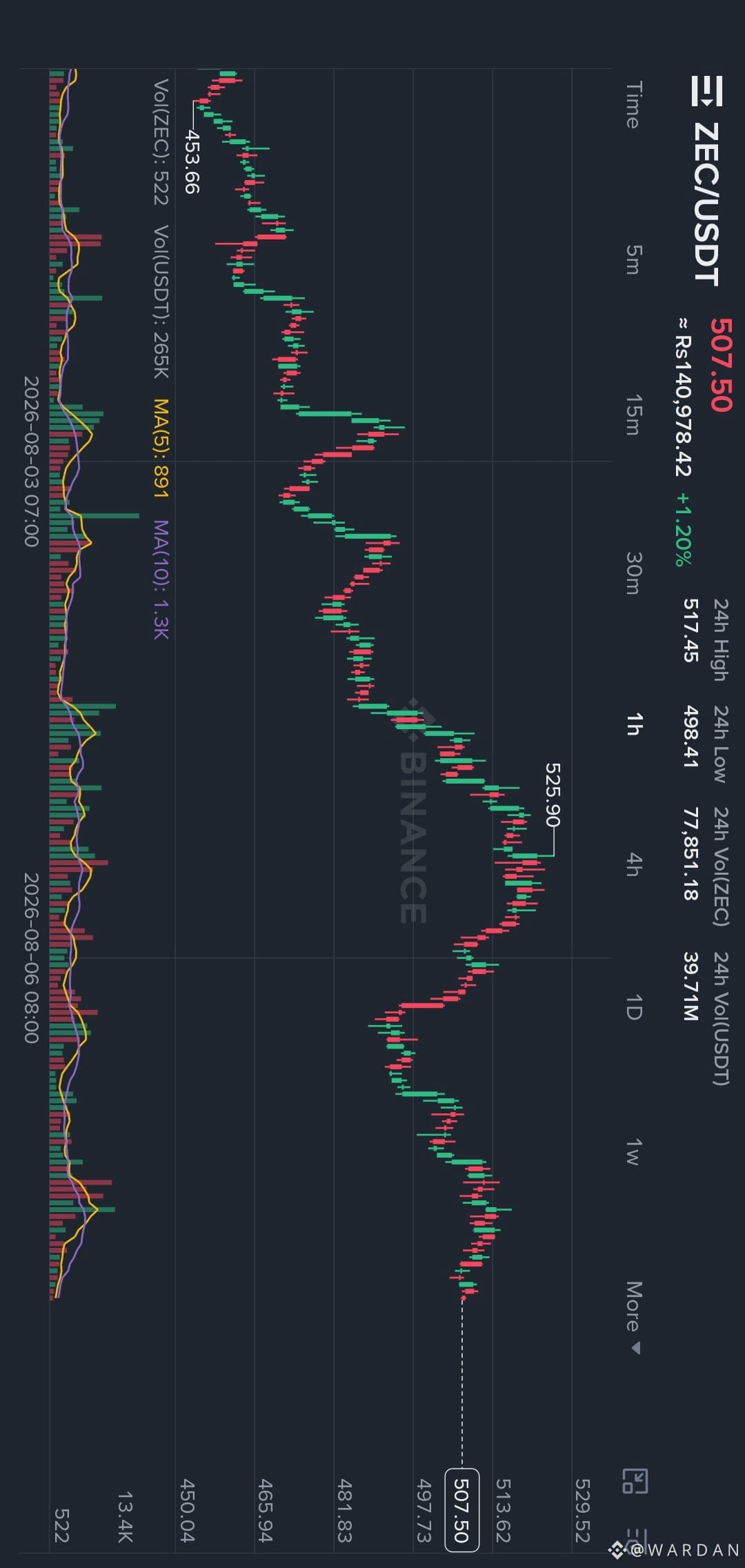
ZEC has been outperforming BTC over the broader 7-day window, while Open Interest has also been rising. On paper, that looks like fresh participation. But price is still sitting below an important resistance area around $525.70, and current volume is not expanding enough for me to treat the move as a confirmed breakout.
That changes the trade completely.
Buying simply because ZEC looks stronger than BTC would mean entering before the market has proved it can actually accept higher prices. Rising OI underneath resistance can support a breakout, but it can also create trapped positioning if buyers fail to push through.
The cleaner setup for me is patience.
If ZEC can get real acceptance above $525.70, then return to that area and hold it as support, the breakout becomes much more interesting. A strong 15M/1H reaction from the retest would give better confirmation than chasing the first green candle.
On the other side, losing the ~$498 area would weaken the bullish structure and tell me the market is not ready.
So my current view is bullish only conditionally. The edge is not “ZEC will pump.” The edge is knowing exactly what price must prove before taking the risk.
Would you trust the first breakout above $525.70, or wait for the level to survive a retest before treating it as real acceptance?
$ZEC $BTC #cryptotrading #zec
{spot}(ZECUSDT)
The first thing that caught my attention on $ZEC was not the recent strength. It was where that strength is happening.
ZEC has been outperforming BTC over the broader 7-day window, while Open Interest has also been rising. On paper, that looks like fresh participation. But price is still sitting below an important resistance area around $525.70, and current volume is not expanding enough for me to treat the move as a confirmed breakout.
That changes the trade completely.
Buying simply because ZEC looks stronger than BTC would mean entering before the market has proved it can actually accept higher prices. Rising OI underneath resistance can support a breakout, but it can also create trapped positioning if buyers fail to push through.
The cleaner setup for me is patience.
If ZEC can get real acceptance above $525.70, then return to that area and hold it as support, the breakout becomes much more interesting. A strong 15M/1H reaction from the retest would give better confirmation than chasing the first green candle.
On the other side, losing the ~$498 area would weaken the bullish structure and tell me the market is not ready.
So my current view is bullish only conditionally. The edge is not “ZEC will pump.” The edge is knowing exactly what price must prove before taking the risk.
Would you trust the first breakout above $525.70, or wait for the level to survive a retest before treating it as real acceptance?
$ZEC $BTC #cryptotrading #zec
ZEC has been outperforming BTC over the broader 7-day window, while Open Interest has also been rising. On paper, that looks like fresh participation. But price is still sitting below an important resistance area around $525.70, and current volume is not expanding enough for me to treat the move as a confirmed breakout.
That changes the trade completely.
Buying simply because ZEC looks stronger than BTC would mean entering before the market has proved it can actually accept higher prices. Rising OI underneath resistance can support a breakout, but it can also create trapped positioning if buyers fail to push through.
The cleaner setup for me is patience.
If ZEC can get real acceptance above $525.70, then return to that area and hold it as support, the breakout becomes much more interesting. A strong 15M/1H reaction from the retest would give better confirmation than chasing the first green candle.
On the other side, losing the ~$498 area would weaken the bullish structure and tell me the market is not ready.
So my current view is bullish only conditionally. The edge is not “ZEC will pump.” The edge is knowing exactly what price must prove before taking the risk.
Would you trust the first breakout above $525.70, or wait for the level to survive a retest before treating it as real acceptance?
$ZEC $BTC #cryptotrading #zec
161
·
--
The Ledger partnership made Babylon’s Trustless Bitcoin Vaults (TBV) look ready for a wider hardware-wallet audience. But the live testnet instructions tell a more precise story.
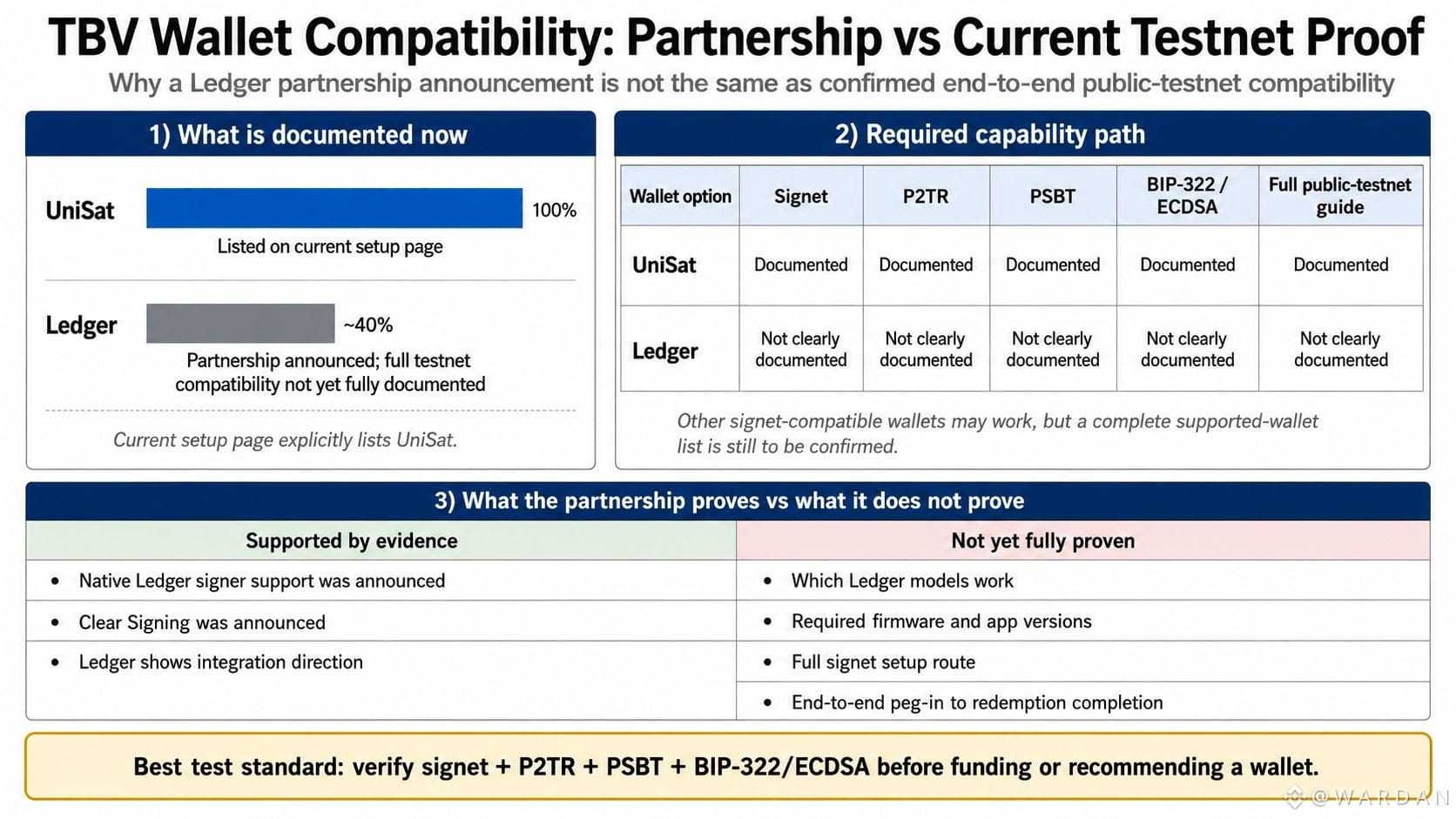
Right now, the setup page lists UniSat and requires a wallet to do four specific things: connect to Bitcoin signet, generate a Taproot P2TR address, sign PSBTs, and authenticate through BIP-322 or ECDSA message signing.
That is the detail I would not skip.
A wallet can hold Bitcoin securely and still fail the TBV flow later. It may receive signet BTC, yet stop at portal authentication, PSBT approval, peg-in, or activation. So an announced partnership proves direction, but not necessarily complete current compatibility.
I would not conclude that Ledger cannot work with @babylonlabs_io The documentation may simply be behind the product, and other signet-compatible wallets may already function. But the available evidence does not yet prove which Ledger models, firmware versions, signing methods, or connection paths complete the full public-testnet lifecycle.
This matters because compatibility can fail after the easy step. Receiving test BTC proves only that the address works. It does not prove the wallet can authenticate, sign the required transaction set, or finish the lifecycle. For testers, that gap can later turn a promising partnership into a confusing support problem.
For the $BABY testnet, the useful standard is not the partnership logo. It is successful completion of the required capability path.
Before funding or recommending any wallet, verify that the exact setup supports signet, P2TR, PSBT signing, and BIP-322 or ECDSA message signing. Then check whether it can actually complete peg-in, activation, borrowing, repayment, and redemption.
That is the difference between announcing access and proving that access works end to end. #baby
The Ledger partnership made Babylon’s Trustless Bitcoin Vaults (TBV) look ready for a wider hardware-wallet audience. But the live testnet instructions tell a more precise story.
Right now, the setup page lists UniSat and requires a wallet to do four specific things: connect to Bitcoin signet, generate a Taproot P2TR address, sign PSBTs, and authenticate through BIP-322 or ECDSA message signing.
That is the detail I would not skip.
A wallet can hold Bitcoin securely and still fail the TBV flow later. It may receive signet BTC, yet stop at portal authentication, PSBT approval, peg-in, or activation. So an announced partnership proves direction, but not necessarily complete current compatibility.
I would not conclude that Ledger cannot work with @BabylonLabs_io The documentation may simply be behind the product, and other signet-compatible wallets may already function. But the available evidence does not yet prove which Ledger models, firmware versions, signing methods, or connection paths complete the full public-testnet lifecycle.
This matters because compatibility can fail after the easy step. Receiving test BTC proves only that the address works. It does not prove the wallet can authenticate, sign the required transaction set, or finish the lifecycle. For testers, that gap can later turn a promising partnership into a confusing support problem.
For the $BABY testnet, the useful standard is not the partnership logo. It is successful completion of the required capability path.
Before funding or recommending any wallet, verify that the exact setup supports signet, P2TR, PSBT signing, and BIP-322 or ECDSA message signing. Then check whether it can actually complete peg-in, activation, borrowing, repayment, and redemption.
That is the difference between announcing access and proving that access works end to end. #baby
Right now, the setup page lists UniSat and requires a wallet to do four specific things: connect to Bitcoin signet, generate a Taproot P2TR address, sign PSBTs, and authenticate through BIP-322 or ECDSA message signing.
That is the detail I would not skip.
A wallet can hold Bitcoin securely and still fail the TBV flow later. It may receive signet BTC, yet stop at portal authentication, PSBT approval, peg-in, or activation. So an announced partnership proves direction, but not necessarily complete current compatibility.
I would not conclude that Ledger cannot work with @BabylonLabs_io The documentation may simply be behind the product, and other signet-compatible wallets may already function. But the available evidence does not yet prove which Ledger models, firmware versions, signing methods, or connection paths complete the full public-testnet lifecycle.
This matters because compatibility can fail after the easy step. Receiving test BTC proves only that the address works. It does not prove the wallet can authenticate, sign the required transaction set, or finish the lifecycle. For testers, that gap can later turn a promising partnership into a confusing support problem.
For the $BABY testnet, the useful standard is not the partnership logo. It is successful completion of the required capability path.
Before funding or recommending any wallet, verify that the exact setup supports signet, P2TR, PSBT signing, and BIP-322 or ECDSA message signing. Then check whether it can actually complete peg-in, activation, borrowing, repayment, and redemption.
That is the difference between announcing access and proving that access works end to end. #baby
1
137
·
--
What I noticed is that a Pending status in Babylon’s Trustless Bitcoin Vaults (TBV) does not automatically point to a Vault Provider failure.
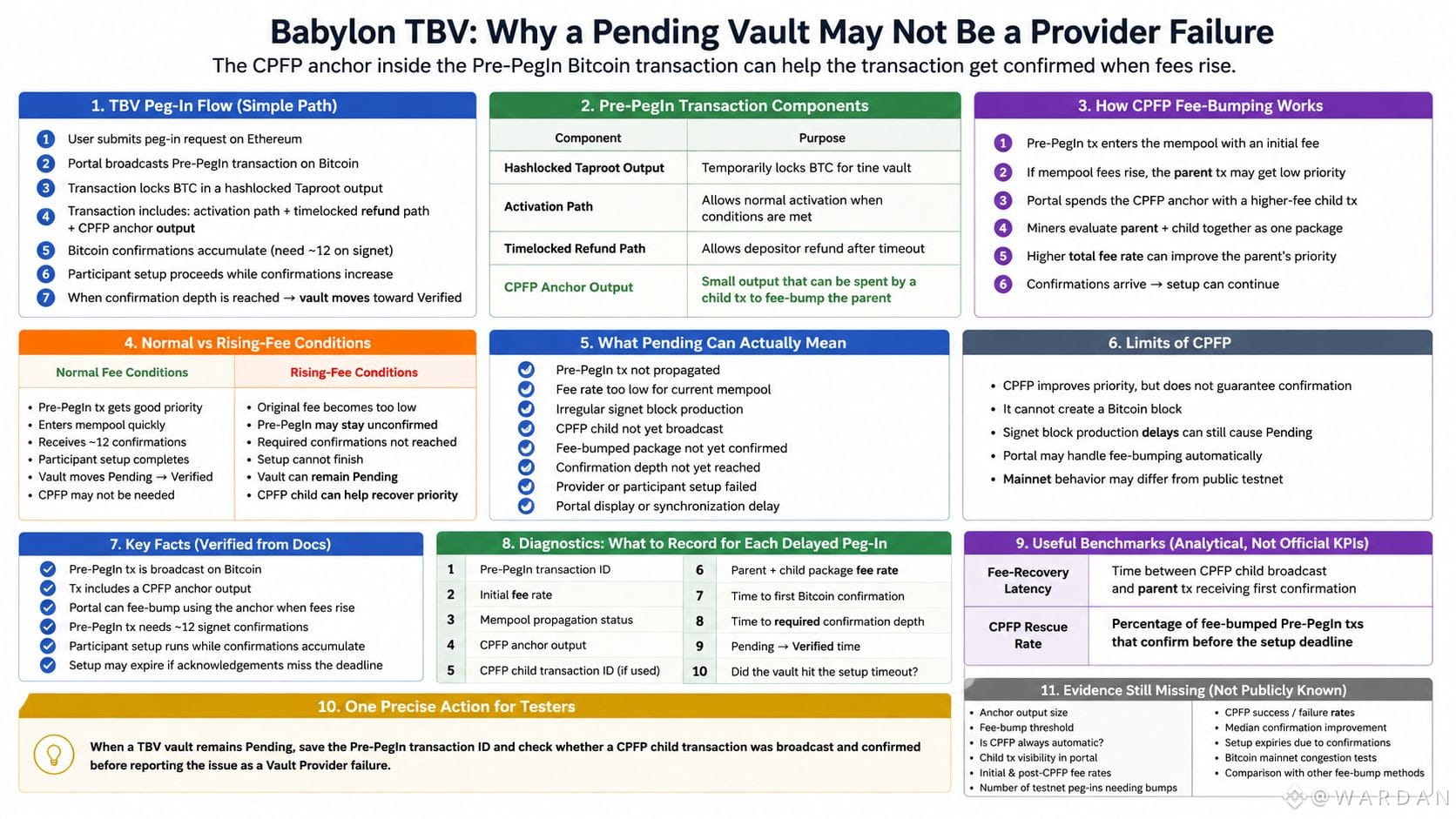
The peg-in begins with a Pre-PegIn Bitcoin transaction that must reach about 12 signet confirmations before setup can move forward. Inside that transaction is a small Child Pays for Parent, or CPFP, anchor. If the parent fee becomes too low as mempool fees rise, a higher-fee child can spend the anchor, letting miners judge both transactions as one package and potentially improve the parent’s confirmation priority.
That detail changes the diagnosis. The Ethereum request may be valid and the protocol participants may be ready, while the Bitcoin funding transaction is still waiting for enough priority. Pending can therefore hide a transaction-fee problem, an irregular signet block delay, or a real setup issue. The visible state alone cannot tell us which one happened.
CPFP is not a guarantee. It cannot create a new block, and the portal’s exact fee-bump policy is not publicly clear. Still, it gives testers a concrete Bitcoin-side check before blaming the provider.
For @babylonlabs_io $BABY testnet, save the Pre-PegIn transaction ID whenever a vault stays Pending. Check whether a CPFP child was broadcast and whether the parent package confirmed before reporting “my provider failed.” That single detail can turn vague feedback into a useful diagnosis of where the peg-in actually stopped and which system layer needs attention first. #baby
What I noticed is that a Pending status in Babylon’s Trustless Bitcoin Vaults (TBV) does not automatically point to a Vault Provider failure.
The peg-in begins with a Pre-PegIn Bitcoin transaction that must reach about 12 signet confirmations before setup can move forward. Inside that transaction is a small Child Pays for Parent, or CPFP, anchor. If the parent fee becomes too low as mempool fees rise, a higher-fee child can spend the anchor, letting miners judge both transactions as one package and potentially improve the parent’s confirmation priority.
That detail changes the diagnosis. The Ethereum request may be valid and the protocol participants may be ready, while the Bitcoin funding transaction is still waiting for enough priority. Pending can therefore hide a transaction-fee problem, an irregular signet block delay, or a real setup issue. The visible state alone cannot tell us which one happened.
CPFP is not a guarantee. It cannot create a new block, and the portal’s exact fee-bump policy is not publicly clear. Still, it gives testers a concrete Bitcoin-side check before blaming the provider.
For @BabylonLabs_io $BABY testnet, save the Pre-PegIn transaction ID whenever a vault stays Pending. Check whether a CPFP child was broadcast and whether the parent package confirmed before reporting “my provider failed.” That single detail can turn vague feedback into a useful diagnosis of where the peg-in actually stopped and which system layer needs attention first. #baby
The peg-in begins with a Pre-PegIn Bitcoin transaction that must reach about 12 signet confirmations before setup can move forward. Inside that transaction is a small Child Pays for Parent, or CPFP, anchor. If the parent fee becomes too low as mempool fees rise, a higher-fee child can spend the anchor, letting miners judge both transactions as one package and potentially improve the parent’s confirmation priority.
That detail changes the diagnosis. The Ethereum request may be valid and the protocol participants may be ready, while the Bitcoin funding transaction is still waiting for enough priority. Pending can therefore hide a transaction-fee problem, an irregular signet block delay, or a real setup issue. The visible state alone cannot tell us which one happened.
CPFP is not a guarantee. It cannot create a new block, and the portal’s exact fee-bump policy is not publicly clear. Still, it gives testers a concrete Bitcoin-side check before blaming the provider.
For @BabylonLabs_io $BABY testnet, save the Pre-PegIn transaction ID whenever a vault stays Pending. Check whether a CPFP child was broadcast and whether the parent package confirmed before reporting “my provider failed.” That single detail can turn vague feedback into a useful diagnosis of where the peg-in actually stopped and which system layer needs attention first. #baby
2
154
·
--
The detail that changed how I read Babylon’s Trustless Bitcoin Vaults (TBV) is that “native BTC collateral” sounds like one Bitcoin price should explain the whole loan. In practice, that is not quite how liquidation works.
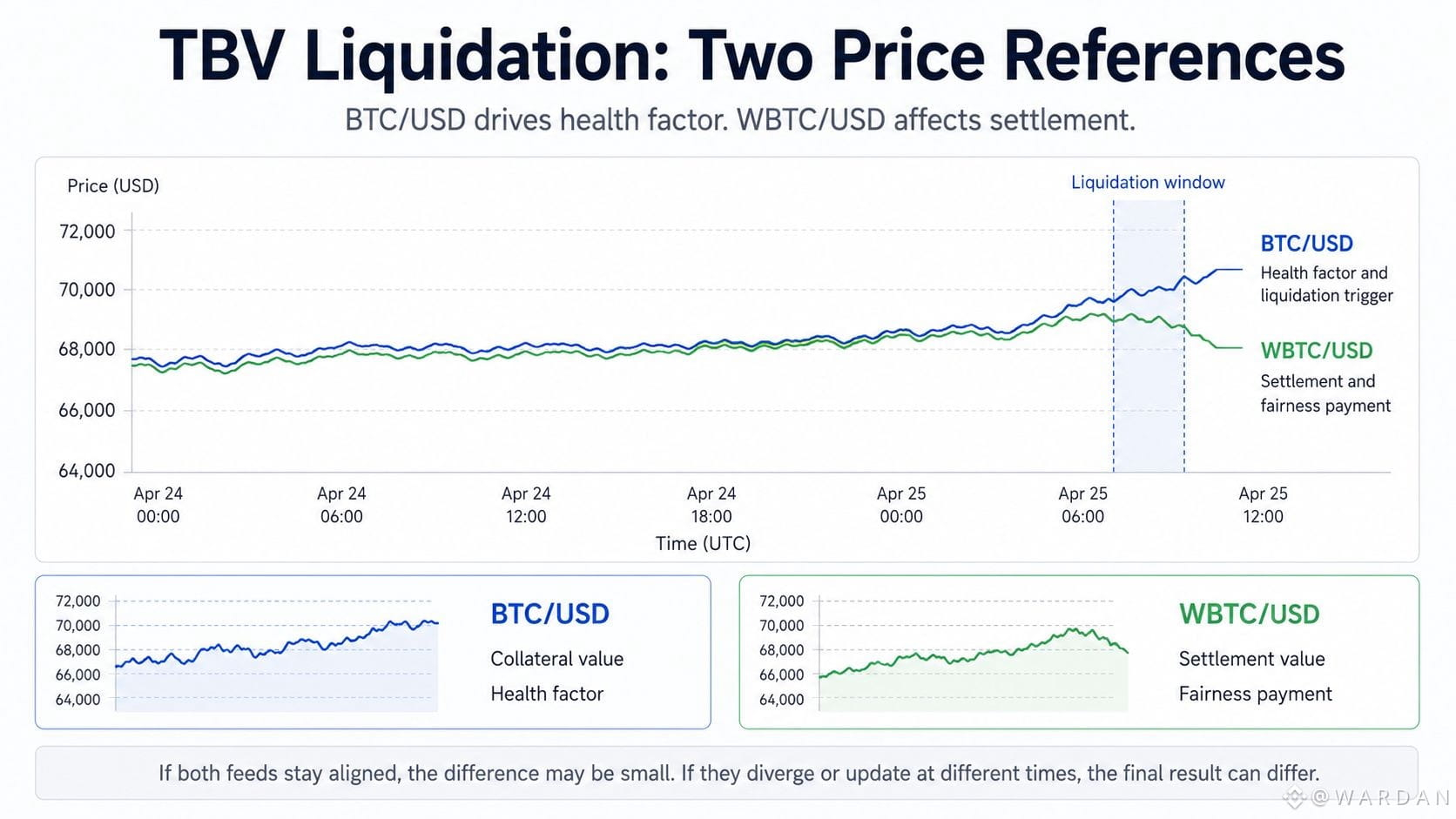
BTC/USD is used to value the native BTC collateral, calculate the health factor, and decide when a position can be liquidated. But the Ethereum-side settlement uses WBTC, so WBTC/USD also enters the settlement and fairness-payment calculation.
That creates an important split: one feed helps trigger liquidation, while another helps price what happens after the trigger.
When BTC/USD and WBTC/USD stay fresh and closely aligned, the difference may be too small to matter. But if the feeds update at different times or WBTC/USD moves away from BTC/USD, the position can be judged unhealthy using one reference while settlement is calculated using another.
This does not mean @babylonlabs_io uses wrapped BTC as the depositor’s collateral. The BTC still remains native inside the vault. It means native custody and settlement pricing are separate layers, and BTC price alone may not explain the full liquidation result. That distinction matters most during stress, when timing gaps can become economically visible to borrowers.
For the $BABY testnet, the most useful check is simple: record both BTC/USD and WBTC/USD values, together with their update times, when reviewing a liquidation. A useful analytical benchmark is the BTC–WBTC oracle basis, not as an official Babylon KPI, but as a way to see whether the two feeds are telling the same economic story. #baby
The detail that changed how I read Babylon’s Trustless Bitcoin Vaults (TBV) is that “native BTC collateral” sounds like one Bitcoin price should explain the whole loan. In practice, that is not quite how liquidation works.
BTC/USD is used to value the native BTC collateral, calculate the health factor, and decide when a position can be liquidated. But the Ethereum-side settlement uses WBTC, so WBTC/USD also enters the settlement and fairness-payment calculation.
That creates an important split: one feed helps trigger liquidation, while another helps price what happens after the trigger.
When BTC/USD and WBTC/USD stay fresh and closely aligned, the difference may be too small to matter. But if the feeds update at different times or WBTC/USD moves away from BTC/USD, the position can be judged unhealthy using one reference while settlement is calculated using another.
This does not mean @BabylonLabs_io uses wrapped BTC as the depositor’s collateral. The BTC still remains native inside the vault. It means native custody and settlement pricing are separate layers, and BTC price alone may not explain the full liquidation result. That distinction matters most during stress, when timing gaps can become economically visible to borrowers.
For the $BABY testnet, the most useful check is simple: record both BTC/USD and WBTC/USD values, together with their update times, when reviewing a liquidation. A useful analytical benchmark is the BTC–WBTC oracle basis, not as an official Babylon KPI, but as a way to see whether the two feeds are telling the same economic story. #baby
BTC/USD is used to value the native BTC collateral, calculate the health factor, and decide when a position can be liquidated. But the Ethereum-side settlement uses WBTC, so WBTC/USD also enters the settlement and fairness-payment calculation.
That creates an important split: one feed helps trigger liquidation, while another helps price what happens after the trigger.
When BTC/USD and WBTC/USD stay fresh and closely aligned, the difference may be too small to matter. But if the feeds update at different times or WBTC/USD moves away from BTC/USD, the position can be judged unhealthy using one reference while settlement is calculated using another.
This does not mean @BabylonLabs_io uses wrapped BTC as the depositor’s collateral. The BTC still remains native inside the vault. It means native custody and settlement pricing are separate layers, and BTC price alone may not explain the full liquidation result. That distinction matters most during stress, when timing gaps can become economically visible to borrowers.
For the $BABY testnet, the most useful check is simple: record both BTC/USD and WBTC/USD values, together with their update times, when reviewing a liquidation. A useful analytical benchmark is the BTC–WBTC oracle basis, not as an official Babylon KPI, but as a way to see whether the two feeds are telling the same economic story. #baby
3
1
148
·
--
What caught my attention on Babylon’s Trustless Bitcoin Vaults (TBV) testnet was that four Vault Provider pages showed the same 1% commission, but success rates ranged from 14.2% to 49.2%. At first, that looked like a ranking. The mechanism made me read it differently. Because these are changing testnet figures, I would use them to guide questions, not settle a verdict about mainnet reliability.
A vault has to move from Pending to Verified. During this stage, the Vault Provider and operators must complete setup and acknowledgements within 24 hours. After that, the depositor must reveal the activation secret on Ethereum before roughly 48 hours so the vault can become Active.
Miss either gate and the final label may be the same: Expired.
That is the detail I would not ignore. One headline success rate can mix two events. One may reflect setup or coordination problems before Verified. Another may reflect a user who received a ready vault but never completed activation. So the percentage may contain a provider signal, but it does not show who caused each expiry.
For @babylonlabs_io $BABY testnet, I see a better check in a stage-based funnel: how many requests reach Verified, and how many Verified vaults reach Active. These would be proposed metrics, not official Babylon KPIs.
When testing TBV, record the provider, highest state reached, whether activation was attempted, and final result. “My vault stayed Pending” or “It reached Verified but I did not activate it” gives better feedback than “my provider failed.” #baby
What caught my attention on Babylon’s Trustless Bitcoin Vaults (TBV) testnet was that four Vault Provider pages showed the same 1% commission, but success rates ranged from 14.2% to 49.2%. At first, that looked like a ranking. The mechanism made me read it differently. Because these are changing testnet figures, I would use them to guide questions, not settle a verdict about mainnet reliability.
A vault has to move from Pending to Verified. During this stage, the Vault Provider and operators must complete setup and acknowledgements within 24 hours. After that, the depositor must reveal the activation secret on Ethereum before roughly 48 hours so the vault can become Active.
Miss either gate and the final label may be the same: Expired.
That is the detail I would not ignore. One headline success rate can mix two events. One may reflect setup or coordination problems before Verified. Another may reflect a user who received a ready vault but never completed activation. So the percentage may contain a provider signal, but it does not show who caused each expiry.
For @BabylonLabs_io $BABY testnet, I see a better check in a stage-based funnel: how many requests reach Verified, and how many Verified vaults reach Active. These would be proposed metrics, not official Babylon KPIs.
When testing TBV, record the provider, highest state reached, whether activation was attempted, and final result. “My vault stayed Pending” or “It reached Verified but I did not activate it” gives better feedback than “my provider failed.” #baby
A vault has to move from Pending to Verified. During this stage, the Vault Provider and operators must complete setup and acknowledgements within 24 hours. After that, the depositor must reveal the activation secret on Ethereum before roughly 48 hours so the vault can become Active.
Miss either gate and the final label may be the same: Expired.
That is the detail I would not ignore. One headline success rate can mix two events. One may reflect setup or coordination problems before Verified. Another may reflect a user who received a ready vault but never completed activation. So the percentage may contain a provider signal, but it does not show who caused each expiry.
For @BabylonLabs_io $BABY testnet, I see a better check in a stage-based funnel: how many requests reach Verified, and how many Verified vaults reach Active. These would be proposed metrics, not official Babylon KPIs.
When testing TBV, record the provider, highest state reached, whether activation was attempted, and final result. “My vault stayed Pending” or “It reached Verified but I did not activate it” gives better feedback than “my provider failed.” #baby
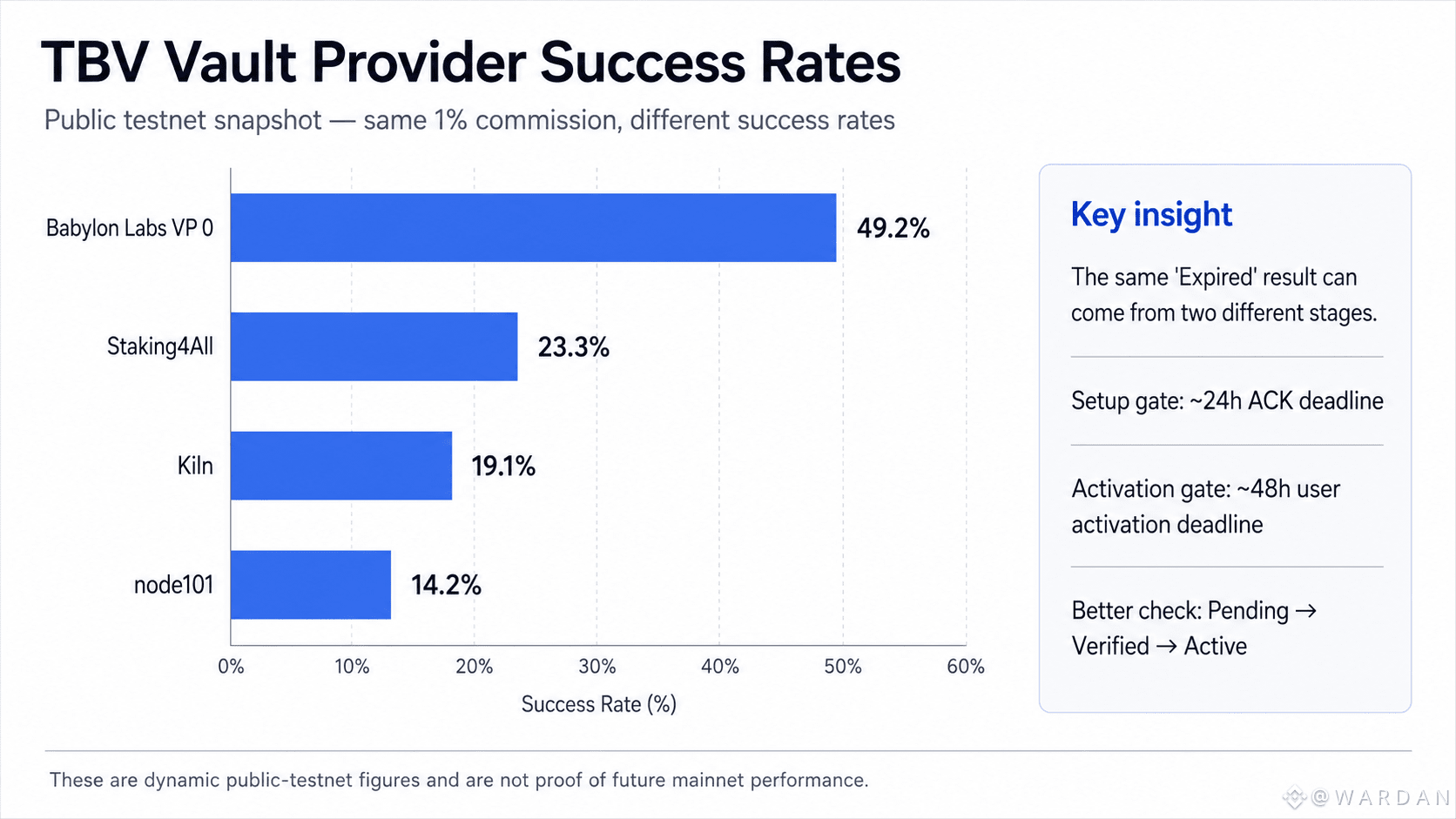
1
115
·
--
The detail that changes how I read Babylon’s testnet is the word “permissionless.”
With Trustless Bitcoin Vaults (TBV), anyone can trigger the LLP liquidation route when a native BTC-backed Aave v4 position becomes unhealthy. But that open trigger is only the first step. The liquidator receives WBTC at once, while the seized Bitcoin vault moves into escrow. A registered AVK then has to acquire that vault and complete the slower Bitcoin-side redemption path.
That distinction matters because “permissionless liquidation” does not mean every stage is open to the same actors. The Ethereum call is open, but final native BTC settlement still depends on registered roles, available vault data, and working proof and challenge paths.
I do not see this as a flaw by itself. The split may be exactly how TBV gives Aave fast settlement without forcing the user to wrap or move their BTC away from Bitcoin. But it changes what should be tested.
A useful testnet question is not only whether liquidation can be called. It is whether enough independent AVKs can take over escrowed vaults, clear them quickly, and complete redemption without delays piling up.
For @babylonlabs_io , the stronger proof of a healthy system will be a full permissions map and clean end-to-end settlement data: who can trigger, who funds WBTC, who acquires the vault, and how long native BTC takes to clear.
That is the level where $BABY and #baby readers can judge whether the design stays open in practice, not only in the first transaction.
The detail that changes how I read Babylon’s testnet is the word “permissionless.”
With Trustless Bitcoin Vaults (TBV), anyone can trigger the LLP liquidation route when a native BTC-backed Aave v4 position becomes unhealthy. But that open trigger is only the first step. The liquidator receives WBTC at once, while the seized Bitcoin vault moves into escrow. A registered AVK then has to acquire that vault and complete the slower Bitcoin-side redemption path.
That distinction matters because “permissionless liquidation” does not mean every stage is open to the same actors. The Ethereum call is open, but final native BTC settlement still depends on registered roles, available vault data, and working proof and challenge paths.
I do not see this as a flaw by itself. The split may be exactly how TBV gives Aave fast settlement without forcing the user to wrap or move their BTC away from Bitcoin. But it changes what should be tested.
A useful testnet question is not only whether liquidation can be called. It is whether enough independent AVKs can take over escrowed vaults, clear them quickly, and complete redemption without delays piling up.
For @BabylonLabs_io , the stronger proof of a healthy system will be a full permissions map and clean end-to-end settlement data: who can trigger, who funds WBTC, who acquires the vault, and how long native BTC takes to clear.
That is the level where $BABY and #baby readers can judge whether the design stays open in practice, not only in the first transaction.
With Trustless Bitcoin Vaults (TBV), anyone can trigger the LLP liquidation route when a native BTC-backed Aave v4 position becomes unhealthy. But that open trigger is only the first step. The liquidator receives WBTC at once, while the seized Bitcoin vault moves into escrow. A registered AVK then has to acquire that vault and complete the slower Bitcoin-side redemption path.
That distinction matters because “permissionless liquidation” does not mean every stage is open to the same actors. The Ethereum call is open, but final native BTC settlement still depends on registered roles, available vault data, and working proof and challenge paths.
I do not see this as a flaw by itself. The split may be exactly how TBV gives Aave fast settlement without forcing the user to wrap or move their BTC away from Bitcoin. But it changes what should be tested.
A useful testnet question is not only whether liquidation can be called. It is whether enough independent AVKs can take over escrowed vaults, clear them quickly, and complete redemption without delays piling up.
For @BabylonLabs_io , the stronger proof of a healthy system will be a full permissions map and clean end-to-end settlement data: who can trigger, who funds WBTC, who acquires the vault, and how long native BTC takes to clear.
That is the level where $BABY and #baby readers can judge whether the design stays open in practice, not only in the first transaction.
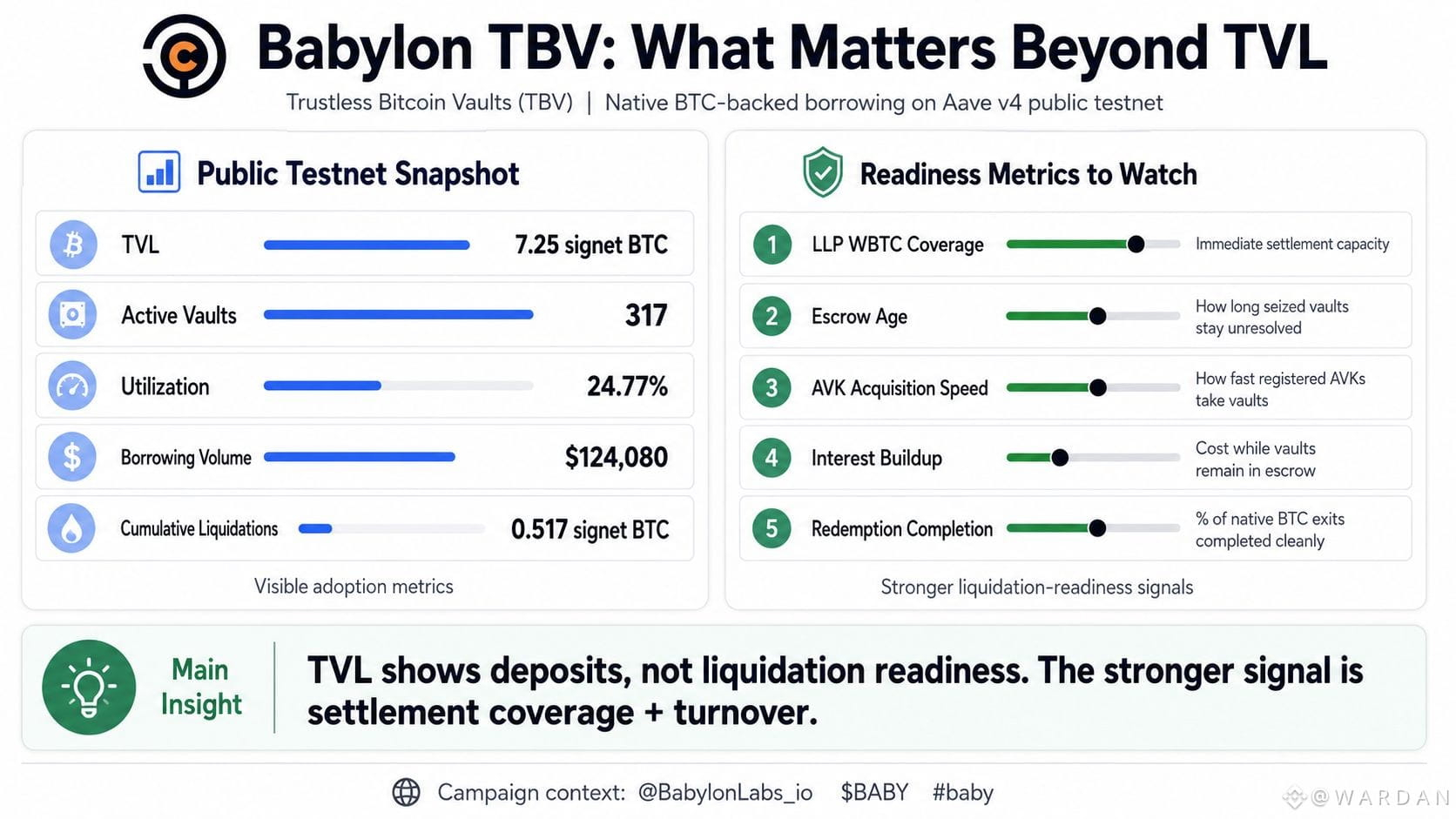
1
133
·
--
The dashboard number that first caught my attention was TVL, but the TBV flow made me question what that number can really prove.
For Babylon’s Trustless Bitcoin Vaults (TBV), a deposit only shows that BTC reached a collateral state. It does not show that the full borrowing system worked from start to finish. A vault still has to be activated, used to borrow through Aave v4, repaid, moved through redemption, and finally return native BTC after the challenge process.
That is why I see utilization and completed loan cycles as the stronger test. TVL can rise even when many vaults never open a loan, stop before repayment, or remain stuck before final redemption. The public explorer already separates TVL from utilization, which is an important clue: locked collateral and useful credit are not the same result. It also gives testers a clearer way to separate early interest from real end-to-end performance under current public testnet conditions.
The better testnet question is not only, “How much BTC entered?” It is, “How much of that BTC produced a completed borrow, repay, and redeem cycle?”
For users, this changes what useful feedback should look like. A strong test report should note whether the vault activated, whether borrowing worked, how repayment behaved, how long redemption took, and whether native BTC returned without unclear steps or failed states.
TVL still matters because it shows participation. But it cannot prove that the full credit path is reliable. For @babylonlabs_io , the stronger signal will be how many vaults complete the entire journey, not how many simply enter it.
That is the metric I would watch when judging whether native Bitcoin-backed borrowing is becoming practically useful. $BABY #baby
The dashboard number that first caught my attention was TVL, but the TBV flow made me question what that number can really prove.
For Babylon’s Trustless Bitcoin Vaults (TBV), a deposit only shows that BTC reached a collateral state. It does not show that the full borrowing system worked from start to finish. A vault still has to be activated, used to borrow through Aave v4, repaid, moved through redemption, and finally return native BTC after the challenge process.
That is why I see utilization and completed loan cycles as the stronger test. TVL can rise even when many vaults never open a loan, stop before repayment, or remain stuck before final redemption. The public explorer already separates TVL from utilization, which is an important clue: locked collateral and useful credit are not the same result. It also gives testers a clearer way to separate early interest from real end-to-end performance under current public testnet conditions.
The better testnet question is not only, “How much BTC entered?” It is, “How much of that BTC produced a completed borrow, repay, and redeem cycle?”
For users, this changes what useful feedback should look like. A strong test report should note whether the vault activated, whether borrowing worked, how repayment behaved, how long redemption took, and whether native BTC returned without unclear steps or failed states.
TVL still matters because it shows participation. But it cannot prove that the full credit path is reliable. For @BabylonLabs_io , the stronger signal will be how many vaults complete the entire journey, not how many simply enter it.
That is the metric I would watch when judging whether native Bitcoin-backed borrowing is becoming practically useful. $BABY #baby
For Babylon’s Trustless Bitcoin Vaults (TBV), a deposit only shows that BTC reached a collateral state. It does not show that the full borrowing system worked from start to finish. A vault still has to be activated, used to borrow through Aave v4, repaid, moved through redemption, and finally return native BTC after the challenge process.
That is why I see utilization and completed loan cycles as the stronger test. TVL can rise even when many vaults never open a loan, stop before repayment, or remain stuck before final redemption. The public explorer already separates TVL from utilization, which is an important clue: locked collateral and useful credit are not the same result. It also gives testers a clearer way to separate early interest from real end-to-end performance under current public testnet conditions.
The better testnet question is not only, “How much BTC entered?” It is, “How much of that BTC produced a completed borrow, repay, and redeem cycle?”
For users, this changes what useful feedback should look like. A strong test report should note whether the vault activated, whether borrowing worked, how repayment behaved, how long redemption took, and whether native BTC returned without unclear steps or failed states.
TVL still matters because it shows participation. But it cannot prove that the full credit path is reliable. For @BabylonLabs_io , the stronger signal will be how many vaults complete the entire journey, not how many simply enter it.
That is the metric I would watch when judging whether native Bitcoin-backed borrowing is becoming practically useful. $BABY #baby
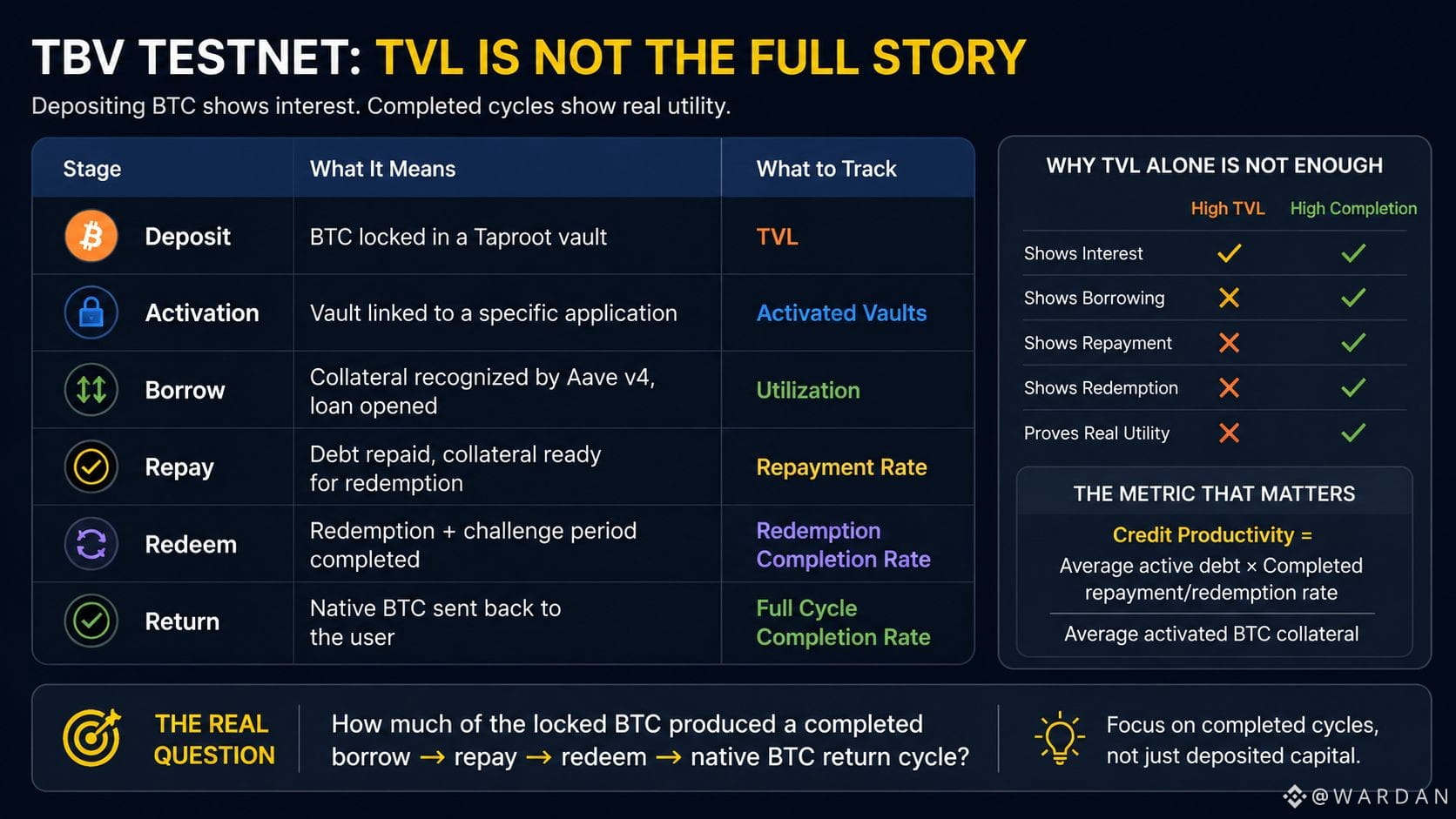
1
1
124
·
--
What changes my view of Babylon’s Trustless Bitcoin Vaults (TBV) is that self-custody does not end with holding the Bitcoin key.
In the current design, the strongest fallback also depends on recovery files created when the vault is set up. If a Vault Provider does not start the withdrawal, the depositor may need the WOTS file and local claimer artifacts to use the already-approved Bitcoin claim path.
That detail matters because the vault cannot simply create a new payout route later. The valid Bitcoin spending paths are committed in advance. So the user’s control is not only about owning the key. It is also about keeping the files that make the fallback path usable.
The Bitcoin key protects signing authority, while these artifacts preserve the data needed to continue the pre-built recovery process. They solve different parts of the same problem.
I do not read this as proof that TBV is not self-custodial. I read it as a more complete version of self-custody: key control plus recovery readiness.
For a testnet user, the useful check is simple. Do not only confirm that the vault was created and borrowing worked. Also confirm that the WOTS file and claimer artifacts were downloaded, backed up safely, and can be restored when needed.
That is the detail I would not ignore in @babylonlabs_io current $BABY testnet. The real recovery question is not only “Who holds the key?” It is also “Can the owner use the fallback path when the normal provider is offline?” #baby
What changes my view of Babylon’s Trustless Bitcoin Vaults (TBV) is that self-custody does not end with holding the Bitcoin key.
In the current design, the strongest fallback also depends on recovery files created when the vault is set up. If a Vault Provider does not start the withdrawal, the depositor may need the WOTS file and local claimer artifacts to use the already-approved Bitcoin claim path.
That detail matters because the vault cannot simply create a new payout route later. The valid Bitcoin spending paths are committed in advance. So the user’s control is not only about owning the key. It is also about keeping the files that make the fallback path usable.
The Bitcoin key protects signing authority, while these artifacts preserve the data needed to continue the pre-built recovery process. They solve different parts of the same problem.
I do not read this as proof that TBV is not self-custodial. I read it as a more complete version of self-custody: key control plus recovery readiness.
For a testnet user, the useful check is simple. Do not only confirm that the vault was created and borrowing worked. Also confirm that the WOTS file and claimer artifacts were downloaded, backed up safely, and can be restored when needed.
That is the detail I would not ignore in @BabylonLabs_io current $BABY testnet. The real recovery question is not only “Who holds the key?” It is also “Can the owner use the fallback path when the normal provider is offline?” #baby
In the current design, the strongest fallback also depends on recovery files created when the vault is set up. If a Vault Provider does not start the withdrawal, the depositor may need the WOTS file and local claimer artifacts to use the already-approved Bitcoin claim path.
That detail matters because the vault cannot simply create a new payout route later. The valid Bitcoin spending paths are committed in advance. So the user’s control is not only about owning the key. It is also about keeping the files that make the fallback path usable.
The Bitcoin key protects signing authority, while these artifacts preserve the data needed to continue the pre-built recovery process. They solve different parts of the same problem.
I do not read this as proof that TBV is not self-custodial. I read it as a more complete version of self-custody: key control plus recovery readiness.
For a testnet user, the useful check is simple. Do not only confirm that the vault was created and borrowing worked. Also confirm that the WOTS file and claimer artifacts were downloaded, backed up safely, and can be restored when needed.
That is the detail I would not ignore in @BabylonLabs_io current $BABY testnet. The real recovery question is not only “Who holds the key?” It is also “Can the owner use the fallback path when the normal provider is offline?” #baby
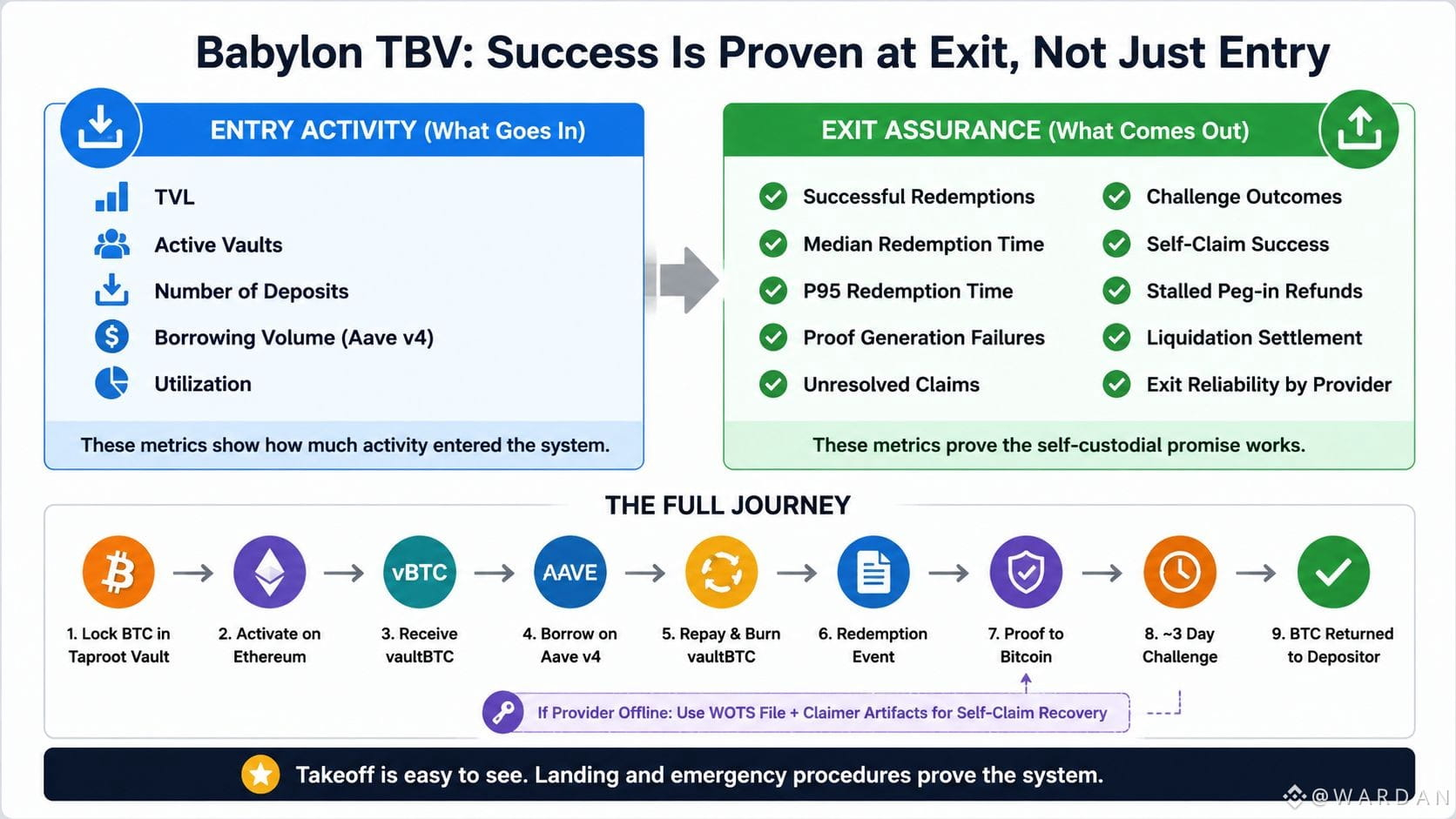
1
133
·
--
When I trace Babylon’s slashing flow from proof to Bitcoin settlement, one thing keeps standing out: cryptographic evidence is not the same as economic enforcement.
The real risk is not whether equivocation can be proven. It is whether that proof becomes a confirmed Bitcoin transaction quickly enough to preserve deterrence.
In Babylon’s design, Extractable One-Time Signatures (EOTS) can expose a finality provider that signs conflicting blocks. But the BTC Staking Monitor still has to detect the offense, extract the usable key material, trigger the slashing path, and wait for Bitcoin inclusion.
I think this is where many people overestimate what “trustless” means. Self-custodial BTC staking removes the need to bridge or wrap Bitcoin, but it does not remove operational liveness. Watchdogs still need to stay online, index the right events, act correctly, and compete for block inclusion during congestion.
So I would not judge Babylon’s security only by whether equivocation evidence exists. I would watch the full evidence-to-enforcement latency under stress.
Two measurements matter most: the median number of Bitcoin blocks from detected equivocation to confirmed slash, and the number of provable cases still unslashed after 12 blocks. If confirmation stays within two blocks and no valid case remains unresolved, the enforcement path is doing its job. If delays persist, the deterrence claim weakens even when the cryptography works.
My implication for @babylonlabs_io and $BABY is simple: trustless-vault security should be measured by how fast proof becomes punishment. #BABY
When I trace Babylon’s slashing flow from proof to Bitcoin settlement, one thing keeps standing out: cryptographic evidence is not the same as economic enforcement.
The real risk is not whether equivocation can be proven. It is whether that proof becomes a confirmed Bitcoin transaction quickly enough to preserve deterrence.
In Babylon’s design, Extractable One-Time Signatures (EOTS) can expose a finality provider that signs conflicting blocks. But the BTC Staking Monitor still has to detect the offense, extract the usable key material, trigger the slashing path, and wait for Bitcoin inclusion.
I think this is where many people overestimate what “trustless” means. Self-custodial BTC staking removes the need to bridge or wrap Bitcoin, but it does not remove operational liveness. Watchdogs still need to stay online, index the right events, act correctly, and compete for block inclusion during congestion.
So I would not judge Babylon’s security only by whether equivocation evidence exists. I would watch the full evidence-to-enforcement latency under stress.
Two measurements matter most: the median number of Bitcoin blocks from detected equivocation to confirmed slash, and the number of provable cases still unslashed after 12 blocks. If confirmation stays within two blocks and no valid case remains unresolved, the enforcement path is doing its job. If delays persist, the deterrence claim weakens even when the cryptography works.
My implication for @BabylonLabs_io and $BABY is simple: trustless-vault security should be measured by how fast proof becomes punishment. #BABY
The real risk is not whether equivocation can be proven. It is whether that proof becomes a confirmed Bitcoin transaction quickly enough to preserve deterrence.
In Babylon’s design, Extractable One-Time Signatures (EOTS) can expose a finality provider that signs conflicting blocks. But the BTC Staking Monitor still has to detect the offense, extract the usable key material, trigger the slashing path, and wait for Bitcoin inclusion.
I think this is where many people overestimate what “trustless” means. Self-custodial BTC staking removes the need to bridge or wrap Bitcoin, but it does not remove operational liveness. Watchdogs still need to stay online, index the right events, act correctly, and compete for block inclusion during congestion.
So I would not judge Babylon’s security only by whether equivocation evidence exists. I would watch the full evidence-to-enforcement latency under stress.
Two measurements matter most: the median number of Bitcoin blocks from detected equivocation to confirmed slash, and the number of provable cases still unslashed after 12 blocks. If confirmation stays within two blocks and no valid case remains unresolved, the enforcement path is doing its job. If delays persist, the deterrence claim weakens even when the cryptography works.
My implication for @BabylonLabs_io and $BABY is simple: trustless-vault security should be measured by how fast proof becomes punishment. #BABY
Median slash latency
67%
Number of detected offenses
0%
Total BTC staked
33%
Finality provider count
0%
3 votes • Voting closed
2
1
156
·
--
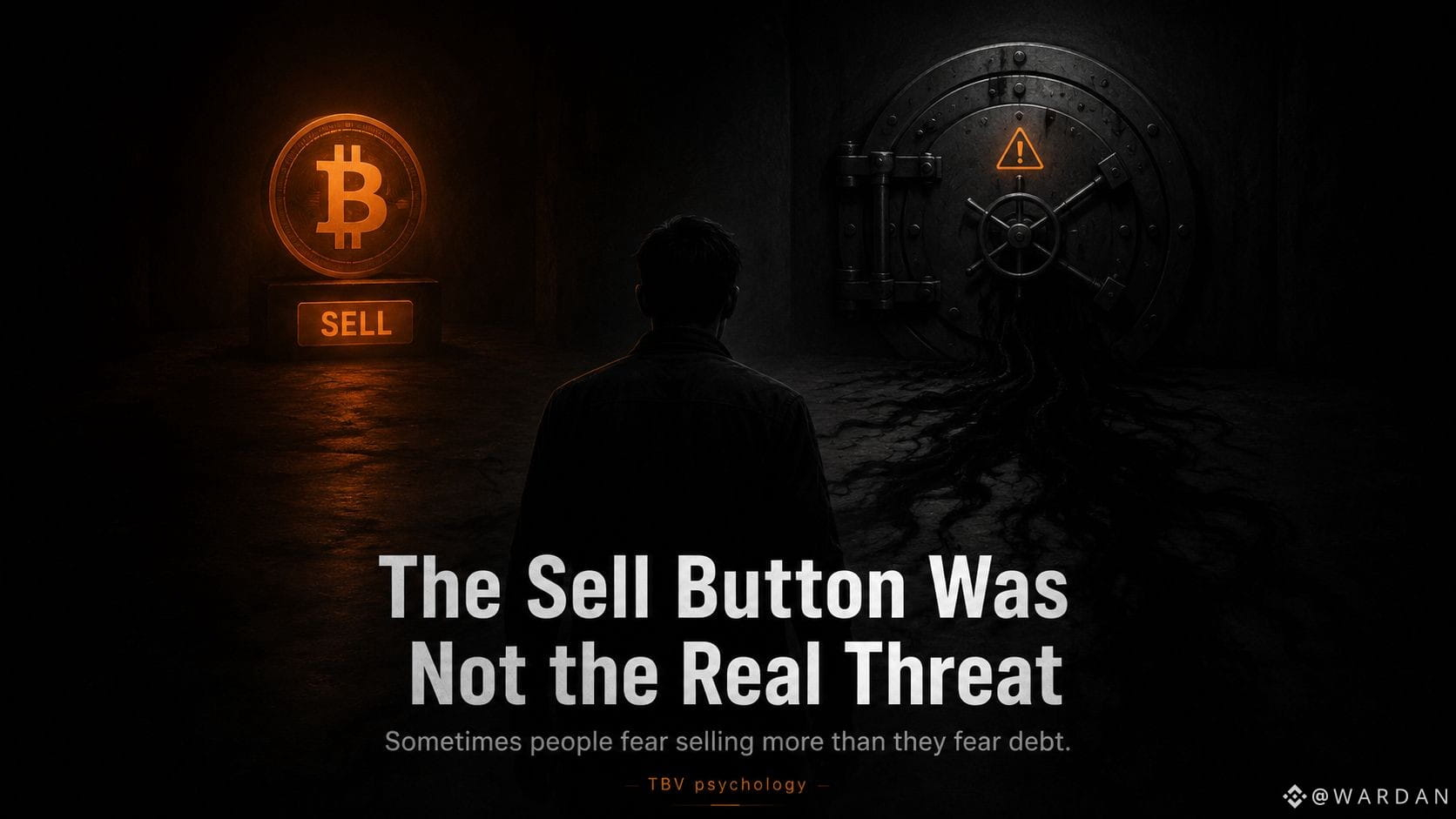
The Sell Button Was Not the Real Threat
I remember watching a Bitcoin holder stare at the sell button as if it were a trapdoor. His hand moved toward the screen, then stopped. The room was quiet, but his mind was loud. He did not need all his Bitcoin. He only needed some cash. Still, selling felt like cutting away a piece of his future. So he chose the option that looked less painful: keep the BTC, place it inside a vault, and borrow against it.
At first, the move felt smart. His Bitcoin was still there. The price could rise. He had cash in hand. Nothing seemed lost. That is where the psychology became darker.
Humans often fear a visible loss more than a hidden risk. Selling creates an instant wound. The balance falls, the coin leaves, and the decision becomes real. Debt feels softer because it arrives dressed as access, choice, and time. But the danger has not vanished. It has only changed shape.
A system such as TBV can let native BTC support a borrowing position without first becoming a wrapped token. That can reduce some old limits. Yet it does not remove market risk. Interest can grow. Bitcoin can fall. A weak position can move closer to liquidation while the holder keeps telling himself, “I still own my Bitcoin.”
This is the twist: sometimes people do not borrow because debt is safer. They borrow because selling hurts more.
The real lesson for learners is not “never borrow.” It is to ask a harder question before opening any position: am I using debt as a tool, or am I using it to escape a decision I am too afraid to make?
The vault may protect the Bitcoin from being sold today. It may not protect the holder from losing it tomorrow.
🤯
@babylonlabs_io $BABY #baby
{spot}(BABYUSDT)
The Sell Button Was Not the Real Threat
I remember watching a Bitcoin holder stare at the sell button as if it were a trapdoor. His hand moved toward the screen, then stopped. The room was quiet, but his mind was loud. He did not need all his Bitcoin. He only needed some cash. Still, selling felt like cutting away a piece of his future. So he chose the option that looked less painful: keep the BTC, place it inside a vault, and borrow against it.
At first, the move felt smart. His Bitcoin was still there. The price could rise. He had cash in hand. Nothing seemed lost. That is where the psychology became darker.
Humans often fear a visible loss more than a hidden risk. Selling creates an instant wound. The balance falls, the coin leaves, and the decision becomes real. Debt feels softer because it arrives dressed as access, choice, and time. But the danger has not vanished. It has only changed shape.
A system such as TBV can let native BTC support a borrowing position without first becoming a wrapped token. That can reduce some old limits. Yet it does not remove market risk. Interest can grow. Bitcoin can fall. A weak position can move closer to liquidation while the holder keeps telling himself, “I still own my Bitcoin.”
This is the twist: sometimes people do not borrow because debt is safer. They borrow because selling hurts more.
The real lesson for learners is not “never borrow.” It is to ask a harder question before opening any position: am I using debt as a tool, or am I using it to escape a decision I am too afraid to make?
The vault may protect the Bitcoin from being sold today. It may not protect the holder from losing it tomorrow.
🤯
@BabylonLabs_io $BABY #baby
I remember watching a Bitcoin holder stare at the sell button as if it were a trapdoor. His hand moved toward the screen, then stopped. The room was quiet, but his mind was loud. He did not need all his Bitcoin. He only needed some cash. Still, selling felt like cutting away a piece of his future. So he chose the option that looked less painful: keep the BTC, place it inside a vault, and borrow against it.
At first, the move felt smart. His Bitcoin was still there. The price could rise. He had cash in hand. Nothing seemed lost. That is where the psychology became darker.
Humans often fear a visible loss more than a hidden risk. Selling creates an instant wound. The balance falls, the coin leaves, and the decision becomes real. Debt feels softer because it arrives dressed as access, choice, and time. But the danger has not vanished. It has only changed shape.
A system such as TBV can let native BTC support a borrowing position without first becoming a wrapped token. That can reduce some old limits. Yet it does not remove market risk. Interest can grow. Bitcoin can fall. A weak position can move closer to liquidation while the holder keeps telling himself, “I still own my Bitcoin.”
This is the twist: sometimes people do not borrow because debt is safer. They borrow because selling hurts more.
The real lesson for learners is not “never borrow.” It is to ask a harder question before opening any position: am I using debt as a tool, or am I using it to escape a decision I am too afraid to make?
The vault may protect the Bitcoin from being sold today. It may not protect the holder from losing it tomorrow.
🤯
@BabylonLabs_io $BABY #baby
112
·
--
Article
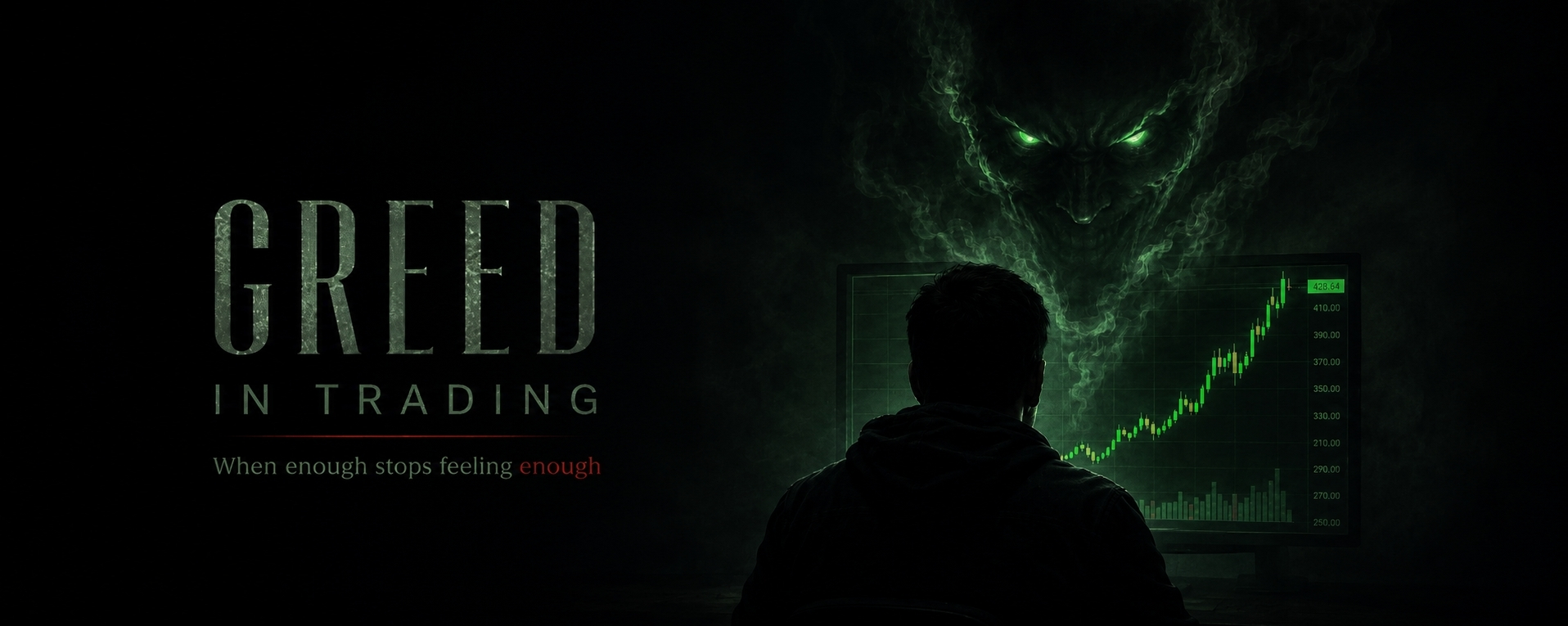
The Market Never Took My MoneyThe profit was still glowing green on my screen when I felt something strange in the room. Nothing had crashed, no warning had appeared, and the chart was still moving in my direction, yet the silence around me felt heavy. My target had already been reached. According to the plan written in my notebook, the trade was finished, but my hand stopped before pressing the close button. The number on the screen was no longer just profit. It had started to look like the beginning of something much bigger.
I told myself I would wait for only one more candle. It sounded reasonable because the trend looked strong, volume was rising, and the market appeared ready to continue. A few moments later, the price moved higher, and that small reward changed the way I was thinking. My original target suddenly looked weak. I moved it further away and began calculating how much I could make if the move continued for another hour. Without noticing it, I had stopped managing a trade and started imagining a future that did not yet exist.
Then the price pulled back.
At first, I felt no fear. Pullbacks were normal, and I had seen many trades recover before. When the profit became smaller, however, an uncomfortable thought entered my mind. I had seen a larger number on the screen, and now it felt as if that money had been taken away from me. In reality, I had never closed the trade, so the larger profit had never truly belonged to me, but my mind had already claimed it. I was still in profit, yet emotionally I felt that I was losing.
The price continued moving down, and my behaviour became stranger. I moved my stop lower because I did not want a temporary fall to remove me from the trade. When the chart showed another weak candle, I searched for reasons to remain confident. I changed the timeframe, drew new support lines, and found indicators that agreed with what I wanted to believe. I was no longer reading the market. I was asking the chart to protect my ego.
This is how human greed often appears in trading. It does not enter the mind shouting that it wants unlimited wealth. It speaks calmly and uses the language of opportunity. After a winning trade, it says that your skill has improved. After a loss, it tells you that one larger position can recover everything. When another trader posts a large profit online, greed convinces you that your own steady progress is too slow. It can look like confidence, patience, courage, or even discipline, while quietly destroying every limit you created before entering the trade.
The real difference between ambition and greed is not the amount of profit a trader wants. Ambition still respects a stopping point. Greed keeps moving that point whenever it gets close. It makes a trader continue after the daily target has been reached, increase leverage after a few lucky wins, hold a profitable position until it becomes a loss, and risk more money simply because accepting less feels like failure.
Eventually, the position closed with almost nothing left. I sat in front of the screen feeling as though the market had played a cruel game with me. I blamed the reversal, the sudden selling pressure, and the traders who had entered earlier. Then I opened the trade history and noticed something that made the room feel cold again.
My original take-profit had been reached almost forty minutes earlier. My original stop-loss had never been touched. Had I followed the plan, the trade would have ended exactly as expected.
The market had not trapped me. It had not stolen my profit or changed the rules. Every dangerous decision had been made by my own hand. I had removed the safe exit, moved the protective stop, and turned a completed trade into a struggle.
That was the twist I did not want to accept: the frightening thing watching me from the screen was never the market. It was my own greed, waiting patiently for me to give it control.
#greed #gareedindex #FearGreed
The Market Never Took My Money
The profit was still glowing green on my screen when I felt something strange in the room. Nothing had crashed, no warning had appeared, and the chart was still moving in my direction, yet the silence around me felt heavy. My target had already been reached. According to the plan written in my notebook, the trade was finished, but my hand stopped before pressing the close button. The number on the screen was no longer just profit. It had started to look like the beginning of something much bigger.
I told myself I would wait for only one more candle. It sounded reasonable because the trend looked strong, volume was rising, and the market appeared ready to continue. A few moments later, the price moved higher, and that small reward changed the way I was thinking. My original target suddenly looked weak. I moved it further away and began calculating how much I could make if the move continued for another hour. Without noticing it, I had stopped managing a trade and started imagining a future that did not yet exist.
Then the price pulled back.
At first, I felt no fear. Pullbacks were normal, and I had seen many trades recover before. When the profit became smaller, however, an uncomfortable thought entered my mind. I had seen a larger number on the screen, and now it felt as if that money had been taken away from me. In reality, I had never closed the trade, so the larger profit had never truly belonged to me, but my mind had already claimed it. I was still in profit, yet emotionally I felt that I was losing.
The price continued moving down, and my behaviour became stranger. I moved my stop lower because I did not want a temporary fall to remove me from the trade. When the chart showed another weak candle, I searched for reasons to remain confident. I changed the timeframe, drew new support lines, and found indicators that agreed with what I wanted to believe. I was no longer reading the market. I was asking the chart to protect my ego.
This is how human greed often appears in trading. It does not enter the mind shouting that it wants unlimited wealth. It speaks calmly and uses the language of opportunity. After a winning trade, it says that your skill has improved. After a loss, it tells you that one larger position can recover everything. When another trader posts a large profit online, greed convinces you that your own steady progress is too slow. It can look like confidence, patience, courage, or even discipline, while quietly destroying every limit you created before entering the trade.
The real difference between ambition and greed is not the amount of profit a trader wants. Ambition still respects a stopping point. Greed keeps moving that point whenever it gets close. It makes a trader continue after the daily target has been reached, increase leverage after a few lucky wins, hold a profitable position until it becomes a loss, and risk more money simply because accepting less feels like failure.
Eventually, the position closed with almost nothing left. I sat in front of the screen feeling as though the market had played a cruel game with me. I blamed the reversal, the sudden selling pressure, and the traders who had entered earlier. Then I opened the trade history and noticed something that made the room feel cold again.
My original take-profit had been reached almost forty minutes earlier. My original stop-loss had never been touched. Had I followed the plan, the trade would have ended exactly as expected.
The market had not trapped me. It had not stolen my profit or changed the rules. Every dangerous decision had been made by my own hand. I had removed the safe exit, moved the protective stop, and turned a completed trade into a struggle.
That was the twist I did not want to accept: the frightening thing watching me from the screen was never the market. It was my own greed, waiting patiently for me to give it control.
#greed #gareedindex #FearGreed
I told myself I would wait for only one more candle. It sounded reasonable because the trend looked strong, volume was rising, and the market appeared ready to continue. A few moments later, the price moved higher, and that small reward changed the way I was thinking. My original target suddenly looked weak. I moved it further away and began calculating how much I could make if the move continued for another hour. Without noticing it, I had stopped managing a trade and started imagining a future that did not yet exist.
Then the price pulled back.
At first, I felt no fear. Pullbacks were normal, and I had seen many trades recover before. When the profit became smaller, however, an uncomfortable thought entered my mind. I had seen a larger number on the screen, and now it felt as if that money had been taken away from me. In reality, I had never closed the trade, so the larger profit had never truly belonged to me, but my mind had already claimed it. I was still in profit, yet emotionally I felt that I was losing.
The price continued moving down, and my behaviour became stranger. I moved my stop lower because I did not want a temporary fall to remove me from the trade. When the chart showed another weak candle, I searched for reasons to remain confident. I changed the timeframe, drew new support lines, and found indicators that agreed with what I wanted to believe. I was no longer reading the market. I was asking the chart to protect my ego.
This is how human greed often appears in trading. It does not enter the mind shouting that it wants unlimited wealth. It speaks calmly and uses the language of opportunity. After a winning trade, it says that your skill has improved. After a loss, it tells you that one larger position can recover everything. When another trader posts a large profit online, greed convinces you that your own steady progress is too slow. It can look like confidence, patience, courage, or even discipline, while quietly destroying every limit you created before entering the trade.
The real difference between ambition and greed is not the amount of profit a trader wants. Ambition still respects a stopping point. Greed keeps moving that point whenever it gets close. It makes a trader continue after the daily target has been reached, increase leverage after a few lucky wins, hold a profitable position until it becomes a loss, and risk more money simply because accepting less feels like failure.
Eventually, the position closed with almost nothing left. I sat in front of the screen feeling as though the market had played a cruel game with me. I blamed the reversal, the sudden selling pressure, and the traders who had entered earlier. Then I opened the trade history and noticed something that made the room feel cold again.
My original take-profit had been reached almost forty minutes earlier. My original stop-loss had never been touched. Had I followed the plan, the trade would have ended exactly as expected.
The market had not trapped me. It had not stolen my profit or changed the rules. Every dangerous decision had been made by my own hand. I had removed the safe exit, moved the protective stop, and turned a completed trade into a struggle.
That was the twist I did not want to accept: the frightening thing watching me from the screen was never the market. It was my own greed, waiting patiently for me to give it control.
#greed #gareedindex #FearGreed
118
·
--
I was scrolling through Babylon’s public testnet page on my phone when one small question stopped me: if borrowing against Bitcoin already exists, what is actually new here? I went back through the flow, opened the testnet links, looked at the steps, and the answer became clearer. The real idea is not the loan itself. The real idea is keeping Bitcoin native while using it as collateral.
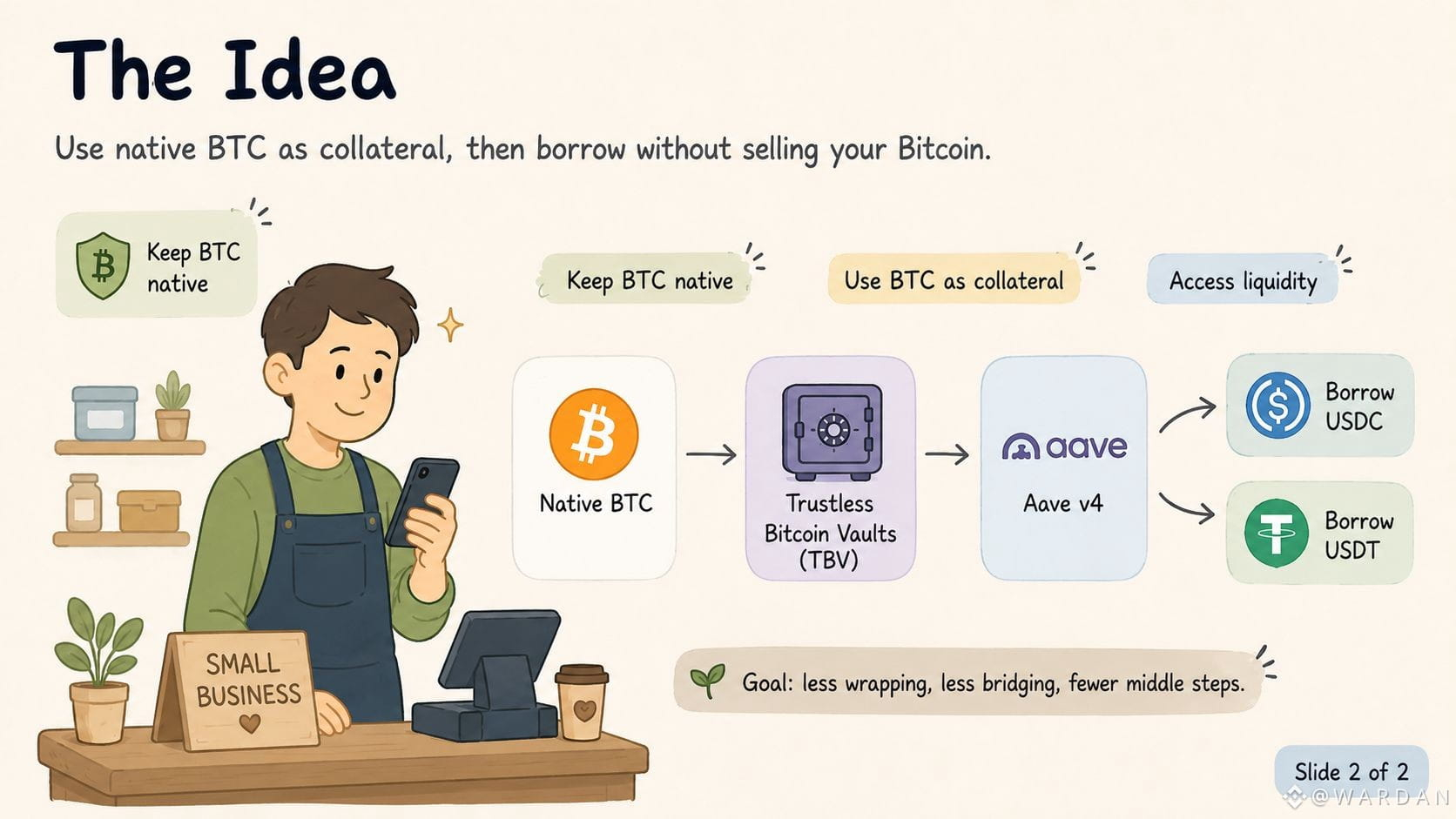
A small business owner is closing his shop when a supplier sends a message asking for payment by the next morning. Most of his savings are in Bitcoin. He does not want to sell because he plans to hold it for years, but he still needs short-term money. He opens his wallet, checks the BTC balance, and starts searching for a solution. Very quickly, he finds wrapped Bitcoin, bridges, custodians, and different networks. What looked like a simple loan now has several extra steps and several new things to trust.
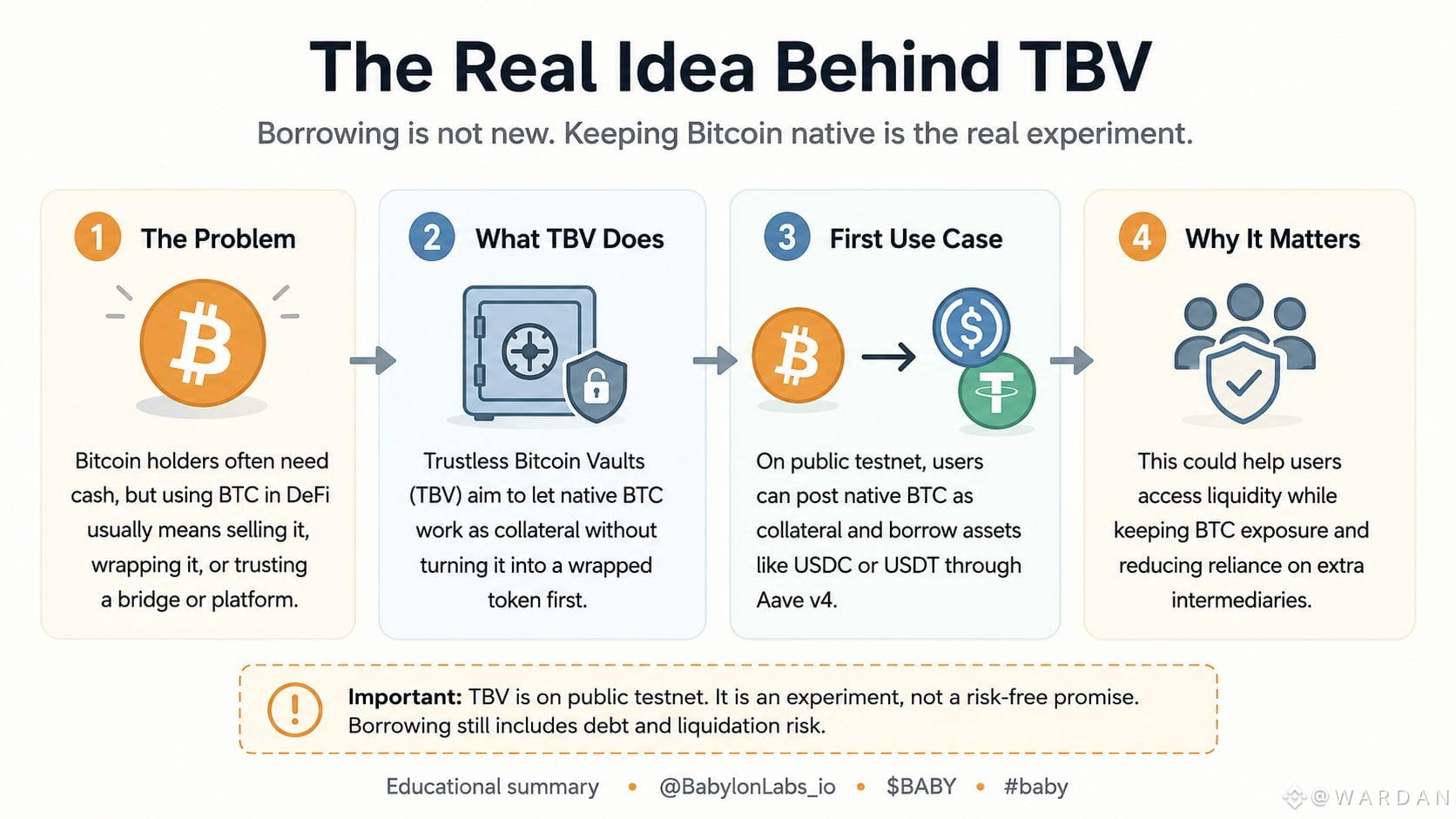
This is the problem Trustless Bitcoin Vaults (TBV) are trying to solve. TBV is designed to let native BTC work as collateral without first turning it into a wrapped token or giving control to a centralized lender.
The first use case connects native Bitcoin-backed borrowing with Aave v4. A user can place native BTC as collateral and borrow supported assets such as USDC or USDT on Ethereum. The important part is not just receiving stablecoins. That already happens in many lending markets. The interesting part is trying to reach that liquidity while the collateral remains native Bitcoin.
The public testnet is where this idea becomes more than a clean sentence. A user has to open the app, claim test tokens, follow the borrowing steps, check the transaction in the explorer, and notice where the process feels clear or confusing.
TBV is still on testnet, so it should not be treated as finished or risk-free. Borrowing still brings debt, interest, and liquidation risk. But the question behind it is strong: can a Bitcoin holder access liquidity without selling BTC, wrapping it, o control to a central company?
That is the part I find most worth watching.
@babylonlabs_io $BABY #baby
I was scrolling through Babylon’s public testnet page on my phone when one small question stopped me: if borrowing against Bitcoin already exists, what is actually new here? I went back through the flow, opened the testnet links, looked at the steps, and the answer became clearer. The real idea is not the loan itself. The real idea is keeping Bitcoin native while using it as collateral.
A small business owner is closing his shop when a supplier sends a message asking for payment by the next morning. Most of his savings are in Bitcoin. He does not want to sell because he plans to hold it for years, but he still needs short-term money. He opens his wallet, checks the BTC balance, and starts searching for a solution. Very quickly, he finds wrapped Bitcoin, bridges, custodians, and different networks. What looked like a simple loan now has several extra steps and several new things to trust.
This is the problem Trustless Bitcoin Vaults (TBV) are trying to solve. TBV is designed to let native BTC work as collateral without first turning it into a wrapped token or giving control to a centralized lender.
The first use case connects native Bitcoin-backed borrowing with Aave v4. A user can place native BTC as collateral and borrow supported assets such as USDC or USDT on Ethereum. The important part is not just receiving stablecoins. That already happens in many lending markets. The interesting part is trying to reach that liquidity while the collateral remains native Bitcoin.
The public testnet is where this idea becomes more than a clean sentence. A user has to open the app, claim test tokens, follow the borrowing steps, check the transaction in the explorer, and notice where the process feels clear or confusing.
TBV is still on testnet, so it should not be treated as finished or risk-free. Borrowing still brings debt, interest, and liquidation risk. But the question behind it is strong: can a Bitcoin holder access liquidity without selling BTC, wrapping it, o control to a central company?
That is the part I find most worth watching.
@BabylonLabs_io $BABY #baby
A small business owner is closing his shop when a supplier sends a message asking for payment by the next morning. Most of his savings are in Bitcoin. He does not want to sell because he plans to hold it for years, but he still needs short-term money. He opens his wallet, checks the BTC balance, and starts searching for a solution. Very quickly, he finds wrapped Bitcoin, bridges, custodians, and different networks. What looked like a simple loan now has several extra steps and several new things to trust.
This is the problem Trustless Bitcoin Vaults (TBV) are trying to solve. TBV is designed to let native BTC work as collateral without first turning it into a wrapped token or giving control to a centralized lender.
The first use case connects native Bitcoin-backed borrowing with Aave v4. A user can place native BTC as collateral and borrow supported assets such as USDC or USDT on Ethereum. The important part is not just receiving stablecoins. That already happens in many lending markets. The interesting part is trying to reach that liquidity while the collateral remains native Bitcoin.
The public testnet is where this idea becomes more than a clean sentence. A user has to open the app, claim test tokens, follow the borrowing steps, check the transaction in the explorer, and notice where the process feels clear or confusing.
TBV is still on testnet, so it should not be treated as finished or risk-free. Borrowing still brings debt, interest, and liquidation risk. But the question behind it is strong: can a Bitcoin holder access liquidity without selling BTC, wrapping it, o control to a central company?
That is the part I find most worth watching.
@BabylonLabs_io $BABY #baby
1
149
·
--
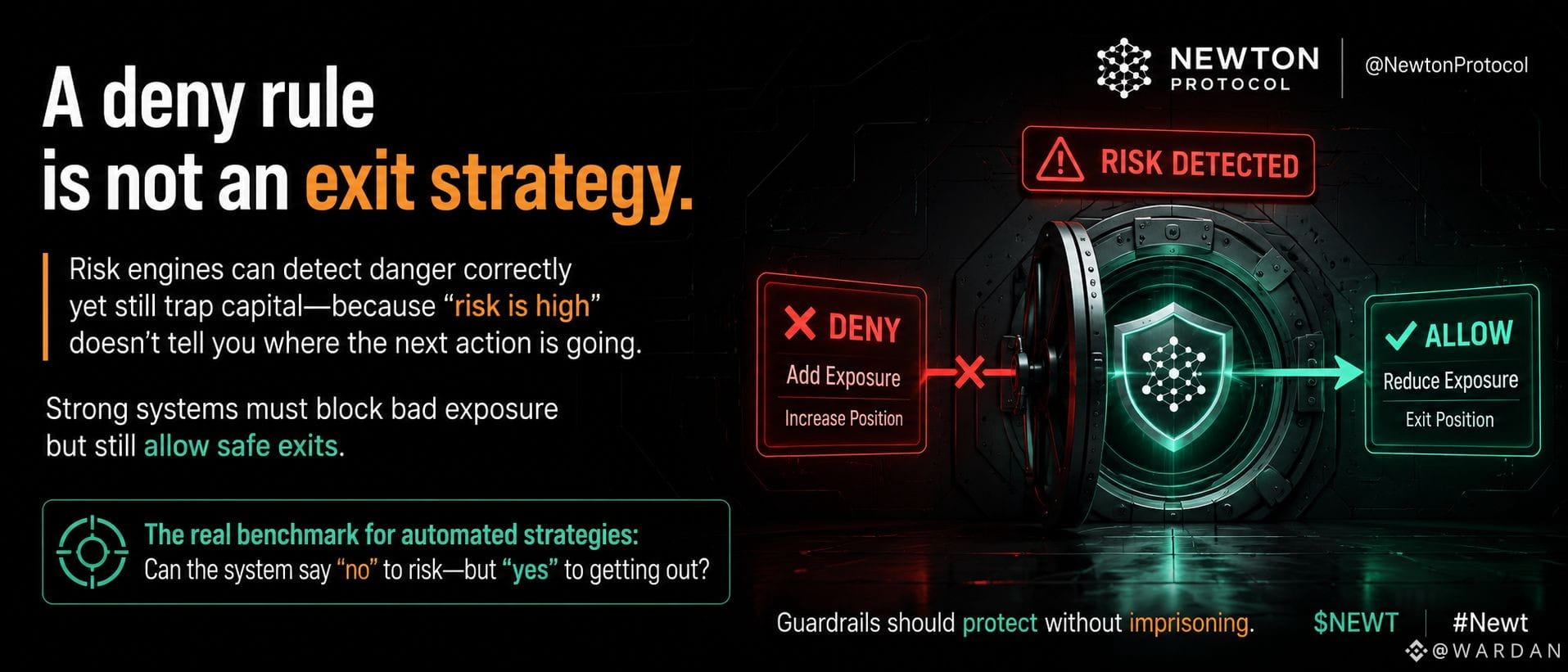
A risk engine can fail even when it detects danger correctly.
That is the uncomfortable test for @NewtonProtocol l and $NEWT
Imagine a vault hits a depeg or drawdown threshold. The policy sees the risk and starts denying transactions. Fine. But the real question is whether it can distinguish between an action that adds exposure and one that reduces it.
Because “risk is high” is only a description of the current state. It does not tell you where the next transaction is taking the vault.
A blunt deny rule can block both directions.
That creates a strange failure mode: the system recognizes danger, enforces the rule exactly as written, and still traps capital inside the condition it was designed to protect against.
This is why action direction matters more than raw risk detection for automated strategies.
The policy layer has to evaluate not only what is wrong now, but whether the proposed intent makes the position safer or worse. Adding exposure during a depeg and exiting that exposure should not receive the same answer simply because both transactions occur under the same risk flag.
A deny rule is not an exit strategy.
For Newton, the harder benchmark is not how reliably policies can say “no.” It is whether they can say: no, you cannot add this risk—but yes, you can leave it.
That distinction may decide whether programmable guardrails become real institutional risk controls or just very efficient locks.
#Newt
A risk engine can fail even when it detects danger correctly.
That is the uncomfortable test for @NewtonProtocol l and $NEWT
Imagine a vault hits a depeg or drawdown threshold. The policy sees the risk and starts denying transactions. Fine. But the real question is whether it can distinguish between an action that adds exposure and one that reduces it.
Because “risk is high” is only a description of the current state. It does not tell you where the next transaction is taking the vault.
A blunt deny rule can block both directions.
That creates a strange failure mode: the system recognizes danger, enforces the rule exactly as written, and still traps capital inside the condition it was designed to protect against.
This is why action direction matters more than raw risk detection for automated strategies.
The policy layer has to evaluate not only what is wrong now, but whether the proposed intent makes the position safer or worse. Adding exposure during a depeg and exiting that exposure should not receive the same answer simply because both transactions occur under the same risk flag.
A deny rule is not an exit strategy.
For Newton, the harder benchmark is not how reliably policies can say “no.” It is whether they can say: no, you cannot add this risk—but yes, you can leave it.
That distinction may decide whether programmable guardrails become real institutional risk controls or just very efficient locks.
#Newt
That is the uncomfortable test for @NewtonProtocol l and $NEWT
Imagine a vault hits a depeg or drawdown threshold. The policy sees the risk and starts denying transactions. Fine. But the real question is whether it can distinguish between an action that adds exposure and one that reduces it.
Because “risk is high” is only a description of the current state. It does not tell you where the next transaction is taking the vault.
A blunt deny rule can block both directions.
That creates a strange failure mode: the system recognizes danger, enforces the rule exactly as written, and still traps capital inside the condition it was designed to protect against.
This is why action direction matters more than raw risk detection for automated strategies.
The policy layer has to evaluate not only what is wrong now, but whether the proposed intent makes the position safer or worse. Adding exposure during a depeg and exiting that exposure should not receive the same answer simply because both transactions occur under the same risk flag.
A deny rule is not an exit strategy.
For Newton, the harder benchmark is not how reliably policies can say “no.” It is whether they can say: no, you cannot add this risk—but yes, you can leave it.
That distinction may decide whether programmable guardrails become real institutional risk controls or just very efficient locks.
#Newt
2
1
108
·
--
Article
Newton's Policy Packs May Become More Important Than the Apps Using ThemThe part of Newton that made me pause was not a failure. It was convenience. Policy Packs are useful because a builder does not need to recreate the same authorization logic every time. A working policy component can be reused, combined with other components, and fitted into a new application. From a developer's point of view, that is exactly what good infrastructure should do.
But convenience changes behavior.
When developers find a component that already works, many of them will choose it. They save time, reduce their own engineering work, and avoid rebuilding controls that already exist. A popular pack can slowly become the normal choice without anyone formally deciding that it should become a standard.
That possibility interests me more than the number of Policy Packs Newton can create.
Suppose four vault teams need a similar withdrawal rule. The first team writes its own policy. The second does the same. The third makes a different version. The fourth uses another approach. This is messy and inefficient, but the mistakes are separated. A bad assumption inside one policy usually stays close to the application that created it.
Now change the setup.
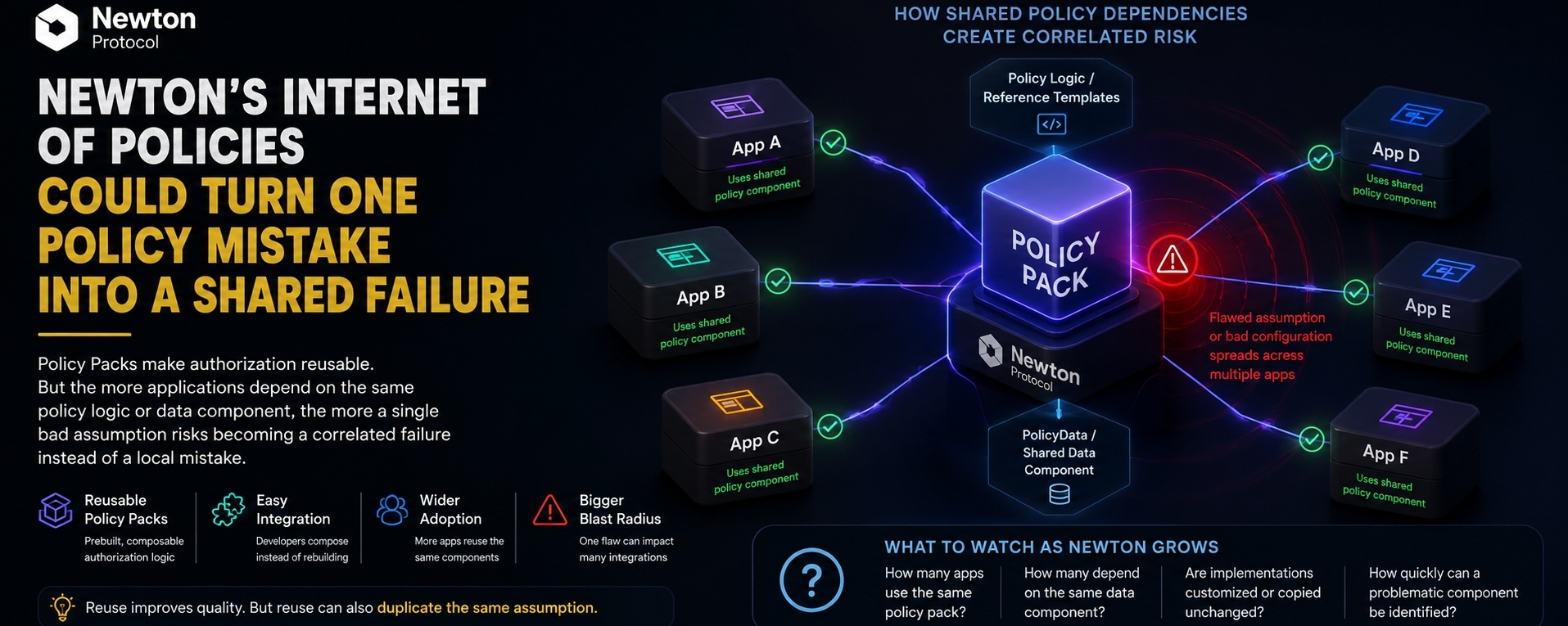
All four teams use the same reusable policy component because it has a good reputation and is easy to integrate. The component works well for months. More builders begin to trust it. New applications copy the same reference logic. A shared PolicyData dependency also becomes common because everybody already knows how to work with it.
At that point, the policy is no longer just a tool.
It has become part of the ecosystem's dependency structure.
That is the risk I think deserves more attention around Newton's Internet of Policies direction. Reusable authorization can improve the quality of many applications at the same time, but heavy reuse can also connect those applications through the same policy assumption.
The important word is assumption.
A policy does not need to contain broken code to create a problem. The logic may run exactly as designed. The evaluation may be correct. The authorization result may match the written rule. The weakness can sit one step earlier, inside the judgment that produced the rule.
Maybe a threshold was designed for one type of vault and later reused somewhere with different behavior. Maybe a reference configuration becomes popular and teams copy it without testing the same edge conditions. Maybe several policies lean on the same supporting data component because replacing it feels unnecessary.
Nothing has to look obviously broken.
That is what makes concentration difficult to notice.
A popular component often looks safer because many teams use it. More usage creates familiarity. Familiarity creates confidence. Confidence makes builders less interested in questioning the original assumptions.
I think Newton's growth could make this problem more important, not less.
If Policy Packs remain diverse and builders change them heavily for their own use cases, the failure domain stays smaller. One application can still make a bad decision, but the error is less likely to move across the ecosystem in the same shape.
The pressure changes if a few packs become dominant.
Then I would stop looking only at the number of policies available. I would want to see how usage is distributed. Are twenty applications using twenty different policy designs, or are seventeen of them leaning on the same three components? Are developers actually adapting reference logic, or are they copying it with minor parameter changes? How many applications depend on the same PolicyData address?
Those numbers could tell us more about risk than a simple policy count.
A library with one hundred Policy Packs sounds diverse. It may not be diverse in practice if most real activity sits behind five of them.
This is also why I do not see the issue as a general argument against reuse. Rebuilding authorization logic from zero for every application would create its own problems. Small teams would repeat old mistakes, audits would be fragmented, and proven components would be ignored for the sake of artificial independence.
Newton should benefit when good policy logic is reused.
The harder question begins after one component becomes successful.
At what point does popularity become concentration?
I think that line matters because the cost of one mistake changes with adoption. A flawed rule used by one application is a local issue. The same flawed assumption reused across many integrations can produce related approvals or denials in several places before teams even realize they share the same dependency.
The original bug does not become smarter.
Its reach becomes larger.
For Newton, I would pay close attention to dependency visibility as the policy ecosystem develops. Builders should be able to understand not only what a Policy Pack does, but where else it is being used and what other components depend on the same logic or data source.
That would make a popular policy easier to evaluate as infrastructure rather than only as code.
My concern becomes much weaker if real adoption stays spread across many policy designs, teams test and customize packs independently, and common components do not create linked authorization failures. That outcome would show that reuse is improving quality without quietly concentrating too much risk.
But if a small number of Policy Packs become default choices across a large part of Newton's ecosystem, I would treat their popularity as a security signal, not only an adoption signal.
The Internet of Policies sounds strongest when useful rules can travel.
Its harder responsibility may be showing how far the same rule has already travelled.
@NewtonProtocol $NEWT #Newt
{spot}(NEWTUSDT)
Newton's Policy Packs May Become More Important Than the Apps Using Them
The part of Newton that made me pause was not a failure. It was convenience. Policy Packs are useful because a builder does not need to recreate the same authorization logic every time. A working policy component can be reused, combined with other components, and fitted into a new application. From a developer's point of view, that is exactly what good infrastructure should do.
But convenience changes behavior.
When developers find a component that already works, many of them will choose it. They save time, reduce their own engineering work, and avoid rebuilding controls that already exist. A popular pack can slowly become the normal choice without anyone formally deciding that it should become a standard.
That possibility interests me more than the number of Policy Packs Newton can create.
Suppose four vault teams need a similar withdrawal rule. The first team writes its own policy. The second does the same. The third makes a different version. The fourth uses another approach. This is messy and inefficient, but the mistakes are separated. A bad assumption inside one policy usually stays close to the application that created it.
Now change the setup.
All four teams use the same reusable policy component because it has a good reputation and is easy to integrate. The component works well for months. More builders begin to trust it. New applications copy the same reference logic. A shared PolicyData dependency also becomes common because everybody already knows how to work with it.
At that point, the policy is no longer just a tool.
It has become part of the ecosystem's dependency structure.
That is the risk I think deserves more attention around Newton's Internet of Policies direction. Reusable authorization can improve the quality of many applications at the same time, but heavy reuse can also connect those applications through the same policy assumption.
The important word is assumption.
A policy does not need to contain broken code to create a problem. The logic may run exactly as designed. The evaluation may be correct. The authorization result may match the written rule. The weakness can sit one step earlier, inside the judgment that produced the rule.
Maybe a threshold was designed for one type of vault and later reused somewhere with different behavior. Maybe a reference configuration becomes popular and teams copy it without testing the same edge conditions. Maybe several policies lean on the same supporting data component because replacing it feels unnecessary.
Nothing has to look obviously broken.
That is what makes concentration difficult to notice.
A popular component often looks safer because many teams use it. More usage creates familiarity. Familiarity creates confidence. Confidence makes builders less interested in questioning the original assumptions.
I think Newton's growth could make this problem more important, not less.
If Policy Packs remain diverse and builders change them heavily for their own use cases, the failure domain stays smaller. One application can still make a bad decision, but the error is less likely to move across the ecosystem in the same shape.
The pressure changes if a few packs become dominant.
Then I would stop looking only at the number of policies available. I would want to see how usage is distributed. Are twenty applications using twenty different policy designs, or are seventeen of them leaning on the same three components? Are developers actually adapting reference logic, or are they copying it with minor parameter changes? How many applications depend on the same PolicyData address?
Those numbers could tell us more about risk than a simple policy count.
A library with one hundred Policy Packs sounds diverse. It may not be diverse in practice if most real activity sits behind five of them.
This is also why I do not see the issue as a general argument against reuse. Rebuilding authorization logic from zero for every application would create its own problems. Small teams would repeat old mistakes, audits would be fragmented, and proven components would be ignored for the sake of artificial independence.
Newton should benefit when good policy logic is reused.
The harder question begins after one component becomes successful.
At what point does popularity become concentration?
I think that line matters because the cost of one mistake changes with adoption. A flawed rule used by one application is a local issue. The same flawed assumption reused across many integrations can produce related approvals or denials in several places before teams even realize they share the same dependency.
The original bug does not become smarter.
Its reach becomes larger.
For Newton, I would pay close attention to dependency visibility as the policy ecosystem develops. Builders should be able to understand not only what a Policy Pack does, but where else it is being used and what other components depend on the same logic or data source.
That would make a popular policy easier to evaluate as infrastructure rather than only as code.
My concern becomes much weaker if real adoption stays spread across many policy designs, teams test and customize packs independently, and common components do not create linked authorization failures. That outcome would show that reuse is improving quality without quietly concentrating too much risk.
But if a small number of Policy Packs become default choices across a large part of Newton's ecosystem, I would treat their popularity as a security signal, not only an adoption signal.
The Internet of Policies sounds strongest when useful rules can travel.
Its harder responsibility may be showing how far the same rule has already travelled.
@NewtonProtocol $NEWT #Newt
But convenience changes behavior.
When developers find a component that already works, many of them will choose it. They save time, reduce their own engineering work, and avoid rebuilding controls that already exist. A popular pack can slowly become the normal choice without anyone formally deciding that it should become a standard.
That possibility interests me more than the number of Policy Packs Newton can create.
Suppose four vault teams need a similar withdrawal rule. The first team writes its own policy. The second does the same. The third makes a different version. The fourth uses another approach. This is messy and inefficient, but the mistakes are separated. A bad assumption inside one policy usually stays close to the application that created it.
Now change the setup.
All four teams use the same reusable policy component because it has a good reputation and is easy to integrate. The component works well for months. More builders begin to trust it. New applications copy the same reference logic. A shared PolicyData dependency also becomes common because everybody already knows how to work with it.
At that point, the policy is no longer just a tool.
It has become part of the ecosystem's dependency structure.
That is the risk I think deserves more attention around Newton's Internet of Policies direction. Reusable authorization can improve the quality of many applications at the same time, but heavy reuse can also connect those applications through the same policy assumption.
The important word is assumption.
A policy does not need to contain broken code to create a problem. The logic may run exactly as designed. The evaluation may be correct. The authorization result may match the written rule. The weakness can sit one step earlier, inside the judgment that produced the rule.
Maybe a threshold was designed for one type of vault and later reused somewhere with different behavior. Maybe a reference configuration becomes popular and teams copy it without testing the same edge conditions. Maybe several policies lean on the same supporting data component because replacing it feels unnecessary.
Nothing has to look obviously broken.
That is what makes concentration difficult to notice.
A popular component often looks safer because many teams use it. More usage creates familiarity. Familiarity creates confidence. Confidence makes builders less interested in questioning the original assumptions.
I think Newton's growth could make this problem more important, not less.
If Policy Packs remain diverse and builders change them heavily for their own use cases, the failure domain stays smaller. One application can still make a bad decision, but the error is less likely to move across the ecosystem in the same shape.
The pressure changes if a few packs become dominant.
Then I would stop looking only at the number of policies available. I would want to see how usage is distributed. Are twenty applications using twenty different policy designs, or are seventeen of them leaning on the same three components? Are developers actually adapting reference logic, or are they copying it with minor parameter changes? How many applications depend on the same PolicyData address?
Those numbers could tell us more about risk than a simple policy count.
A library with one hundred Policy Packs sounds diverse. It may not be diverse in practice if most real activity sits behind five of them.
This is also why I do not see the issue as a general argument against reuse. Rebuilding authorization logic from zero for every application would create its own problems. Small teams would repeat old mistakes, audits would be fragmented, and proven components would be ignored for the sake of artificial independence.
Newton should benefit when good policy logic is reused.
The harder question begins after one component becomes successful.
At what point does popularity become concentration?
I think that line matters because the cost of one mistake changes with adoption. A flawed rule used by one application is a local issue. The same flawed assumption reused across many integrations can produce related approvals or denials in several places before teams even realize they share the same dependency.
The original bug does not become smarter.
Its reach becomes larger.
For Newton, I would pay close attention to dependency visibility as the policy ecosystem develops. Builders should be able to understand not only what a Policy Pack does, but where else it is being used and what other components depend on the same logic or data source.
That would make a popular policy easier to evaluate as infrastructure rather than only as code.
My concern becomes much weaker if real adoption stays spread across many policy designs, teams test and customize packs independently, and common components do not create linked authorization failures. That outcome would show that reuse is improving quality without quietly concentrating too much risk.
But if a small number of Policy Packs become default choices across a large part of Newton's ecosystem, I would treat their popularity as a security signal, not only an adoption signal.
The Internet of Policies sounds strongest when useful rules can travel.
Its harder responsibility may be showing how far the same rule has already travelled.
@NewtonProtocol $NEWT #Newt
4
1
200
·
--
Tomorrow morning, while reviewing Newton’s consensus flow, I wrote three slightly different price readings beside each other. At first, I treated the gap as normal market noise. But once Newton converted those readings into one median value, the policy’s “exact” threshold started looking less simple.
Newton operators may retrieve different numeric values. The Gateway calculates a median, checks whether the readings remain inside the configured tolerance, and then gives the policy one shared value to evaluate. This helps stop one delayed or abnormal reading from controlling the decision.
That design is useful, but the tolerance becomes important when a vault rule sits close to a narrow price, risk, leverage, or depeg boundary. In that situation, the result depends not only on the threshold written into the policy, but also on how much disagreement Newton allows before creating the median.
This does not prove that Newton’s documented 10% default is used by every live policy or that current authorizations are inaccurate. The tolerance is configurable, and values outside it can fail consensus instead of being accepted.
I would not judge a Newton policy only by asking which oracle supplies the data. I would also want to know how far operator readings differed, which tolerance was selected, and how close the final median came to the policy limit. Median consensus becomes useful only when the allowed disagreement matches the sensitivity of the money being protected.
@NewtonProtocol $NEWT #Newt
Tomorrow morning, while reviewing Newton’s consensus flow, I wrote three slightly different price readings beside each other. At first, I treated the gap as normal market noise. But once Newton converted those readings into one median value, the policy’s “exact” threshold started looking less simple.
Newton operators may retrieve different numeric values. The Gateway calculates a median, checks whether the readings remain inside the configured tolerance, and then gives the policy one shared value to evaluate. This helps stop one delayed or abnormal reading from controlling the decision.
That design is useful, but the tolerance becomes important when a vault rule sits close to a narrow price, risk, leverage, or depeg boundary. In that situation, the result depends not only on the threshold written into the policy, but also on how much disagreement Newton allows before creating the median.
This does not prove that Newton’s documented 10% default is used by every live policy or that current authorizations are inaccurate. The tolerance is configurable, and values outside it can fail consensus instead of being accepted.
I would not judge a Newton policy only by asking which oracle supplies the data. I would also want to know how far operator readings differed, which tolerance was selected, and how close the final median came to the policy limit. Median consensus becomes useful only when the allowed disagreement matches the sensitivity of the money being protected.
@NewtonProtocol $NEWT #Newt
Newton operators may retrieve different numeric values. The Gateway calculates a median, checks whether the readings remain inside the configured tolerance, and then gives the policy one shared value to evaluate. This helps stop one delayed or abnormal reading from controlling the decision.
That design is useful, but the tolerance becomes important when a vault rule sits close to a narrow price, risk, leverage, or depeg boundary. In that situation, the result depends not only on the threshold written into the policy, but also on how much disagreement Newton allows before creating the median.
This does not prove that Newton’s documented 10% default is used by every live policy or that current authorizations are inaccurate. The tolerance is configurable, and values outside it can fail consensus instead of being accepted.
I would not judge a Newton policy only by asking which oracle supplies the data. I would also want to know how far operator readings differed, which tolerance was selected, and how close the final median came to the policy limit. Median consensus becomes useful only when the allowed disagreement matches the sensitivity of the money being protected.
@NewtonProtocol $NEWT #Newt
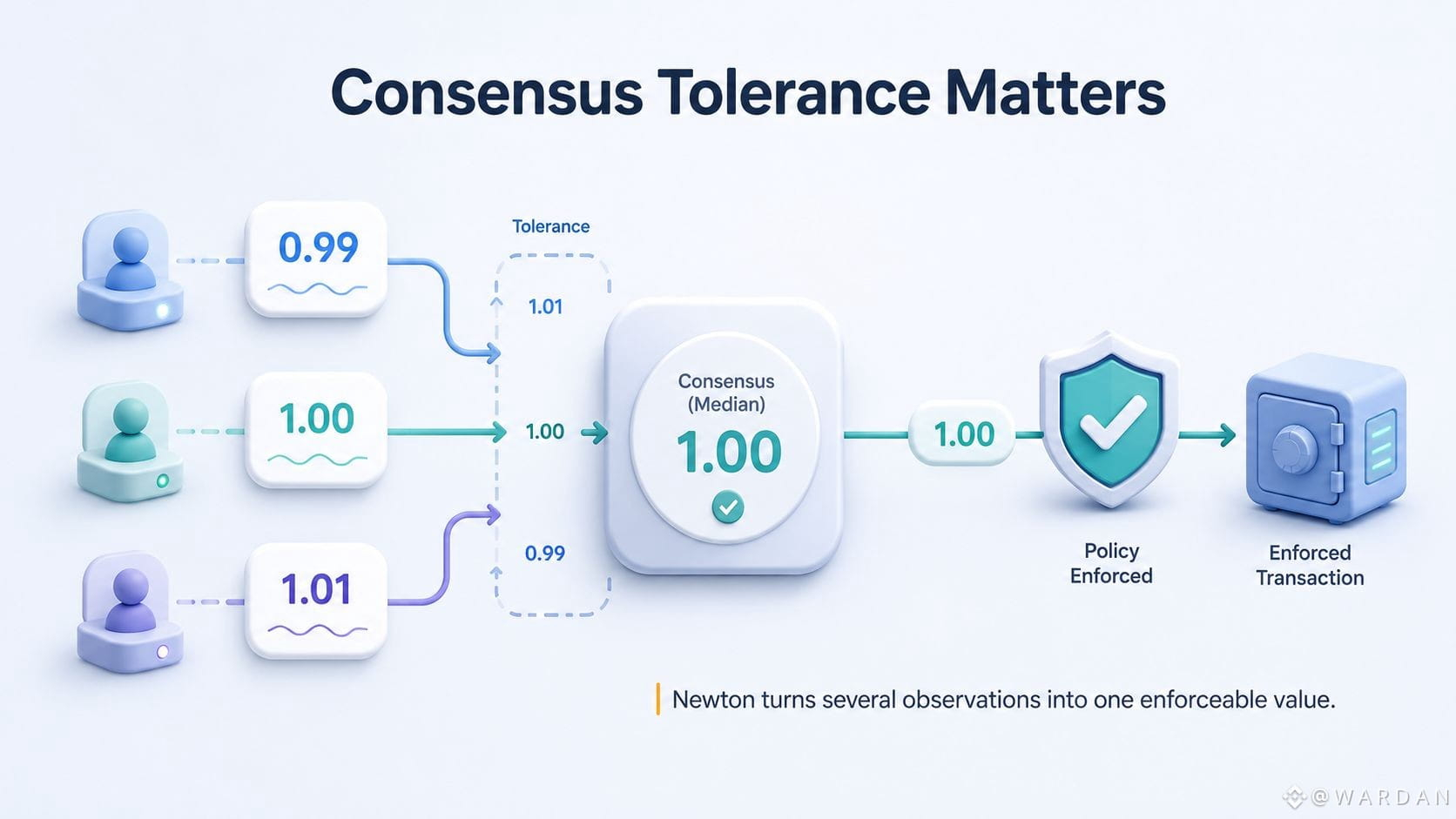
4
1
98
·
--
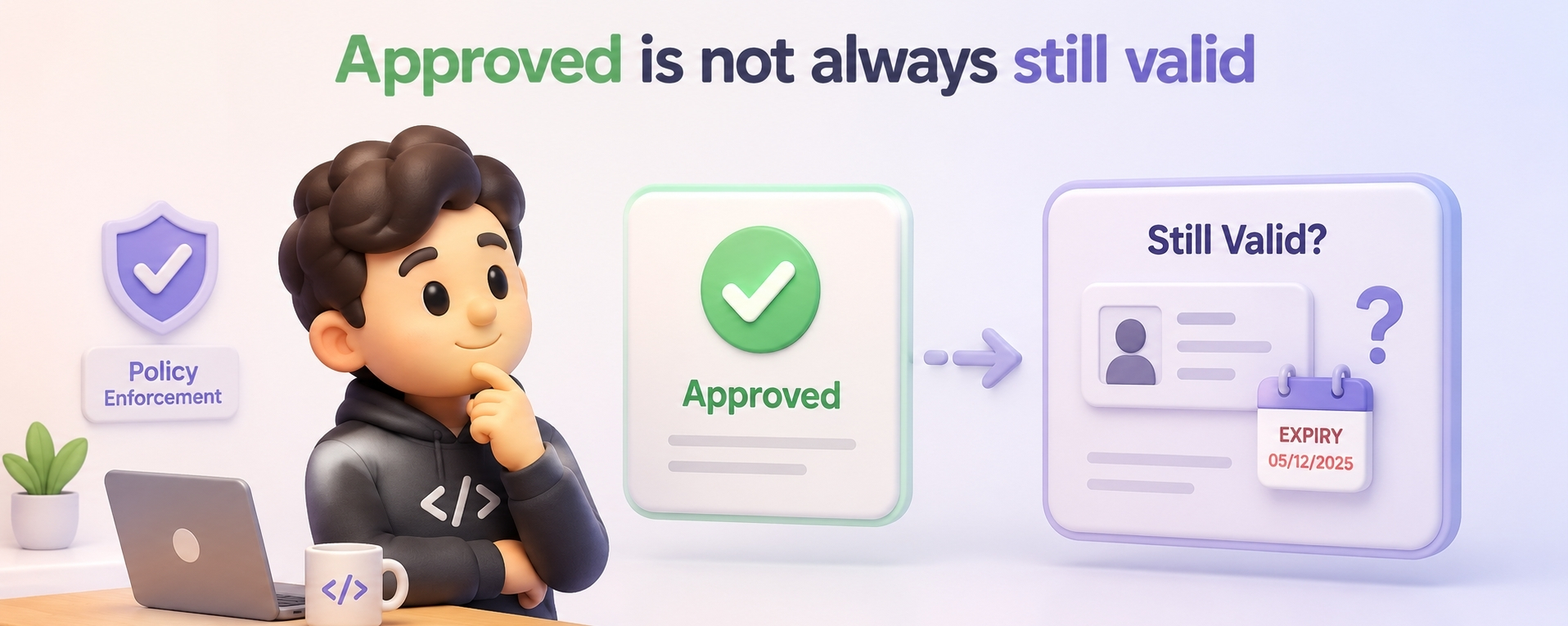
Article
Newton’s KYC Can Prove You Were Approved Without Proving Your ID Is Still ValidI was copying three Newton identity checks into my notes when their difference finally became clear. One checked whether a user had been approved. Another checked whether the document had expired. A third could require the document to remain valid for a minimum period.
At first, I had treated these as different ways of asking the same question. They are not.
Newton exposes check_approved(), not_expired() and valid_for() as separate tools for the policy developer. The developer decides which conditions must pass before a user can perform a protected action.
That distinction looks small inside technical documentation, but it changes what “KYC verified” can mean inside a real application.
Imagine a user completed KYC several months ago. Their status was approved at the time, but the identity document connected to that approval has since expired. A policy checking only the approval result may be asking whether the person passed verification before. A policy also checking expiration is asking whether the evidence remains valid now.
Those are different security standards.
I can see why Newton gives developers this flexibility. Different applications face different requirements. One service may only need proof that a basic identity review was completed. A regulated financial product may need a current document with several months of validity remaining. Hard-coding one rule for every application would make the identity system less useful.
The flexibility, however, places more responsibility on the person writing the policy.
A user may see two platforms describing themselves as Newton KYC-protected and assume both apply the same identity standard. In practice, one policy could check approval, expiration and remaining validity, while another checks only whether approval was recorded.
The cryptographic enforcement could work perfectly in both cases. The difference would sit inside the rule being enforced.
There is also a fair counterargument. An external KYC provider may automatically change a user’s status when a document expires. In that setup, checking approval alone might already reject an outdated identity. Newton’s public material does not establish that every provider and implementation behaves this way, so it would be wrong to assume either outcome universally.
That uncertainty is exactly why the policy details matter.
Newton’s identity system can make a chosen condition enforceable, reusable and easier to verify. But it cannot decide on behalf of every application what “currently valid identity” should include. That judgment remains with the policy author and the process responsible for refreshing the underlying identity data.
This changed how I would judge identity adoption around Newton. I would not stop at asking how many applications use its credentials or how many users have completed KYC.
I would look at how many production policies combine approval with not_expired() or valid_for(), and how frequently identity status is refreshed.
A reusable identity is valuable because it avoids asking the user to start from zero every time. But reuse becomes trustworthy only when the system remembers that an approval can remain recorded long after the evidence behind it has changed.
@NewtonProtocol $NEWT #Newt
{spot}(NEWTUSDT)
Newton’s KYC Can Prove You Were Approved Without Proving Your ID Is Still Valid
I was copying three Newton identity checks into my notes when their difference finally became clear. One checked whether a user had been approved. Another checked whether the document had expired. A third could require the document to remain valid for a minimum period.
At first, I had treated these as different ways of asking the same question. They are not.
Newton exposes check_approved(), not_expired() and valid_for() as separate tools for the policy developer. The developer decides which conditions must pass before a user can perform a protected action.
That distinction looks small inside technical documentation, but it changes what “KYC verified” can mean inside a real application.
Imagine a user completed KYC several months ago. Their status was approved at the time, but the identity document connected to that approval has since expired. A policy checking only the approval result may be asking whether the person passed verification before. A policy also checking expiration is asking whether the evidence remains valid now.
Those are different security standards.
I can see why Newton gives developers this flexibility. Different applications face different requirements. One service may only need proof that a basic identity review was completed. A regulated financial product may need a current document with several months of validity remaining. Hard-coding one rule for every application would make the identity system less useful.
The flexibility, however, places more responsibility on the person writing the policy.
A user may see two platforms describing themselves as Newton KYC-protected and assume both apply the same identity standard. In practice, one policy could check approval, expiration and remaining validity, while another checks only whether approval was recorded.
The cryptographic enforcement could work perfectly in both cases. The difference would sit inside the rule being enforced.
There is also a fair counterargument. An external KYC provider may automatically change a user’s status when a document expires. In that setup, checking approval alone might already reject an outdated identity. Newton’s public material does not establish that every provider and implementation behaves this way, so it would be wrong to assume either outcome universally.
That uncertainty is exactly why the policy details matter.
Newton’s identity system can make a chosen condition enforceable, reusable and easier to verify. But it cannot decide on behalf of every application what “currently valid identity” should include. That judgment remains with the policy author and the process responsible for refreshing the underlying identity data.
This changed how I would judge identity adoption around Newton. I would not stop at asking how many applications use its credentials or how many users have completed KYC.
I would look at how many production policies combine approval with not_expired() or valid_for(), and how frequently identity status is refreshed.
A reusable identity is valuable because it avoids asking the user to start from zero every time. But reuse becomes trustworthy only when the system remembers that an approval can remain recorded long after the evidence behind it has changed.
@NewtonProtocol $NEWT #Newt
At first, I had treated these as different ways of asking the same question. They are not.
Newton exposes check_approved(), not_expired() and valid_for() as separate tools for the policy developer. The developer decides which conditions must pass before a user can perform a protected action.
That distinction looks small inside technical documentation, but it changes what “KYC verified” can mean inside a real application.
Imagine a user completed KYC several months ago. Their status was approved at the time, but the identity document connected to that approval has since expired. A policy checking only the approval result may be asking whether the person passed verification before. A policy also checking expiration is asking whether the evidence remains valid now.
Those are different security standards.
I can see why Newton gives developers this flexibility. Different applications face different requirements. One service may only need proof that a basic identity review was completed. A regulated financial product may need a current document with several months of validity remaining. Hard-coding one rule for every application would make the identity system less useful.
The flexibility, however, places more responsibility on the person writing the policy.
A user may see two platforms describing themselves as Newton KYC-protected and assume both apply the same identity standard. In practice, one policy could check approval, expiration and remaining validity, while another checks only whether approval was recorded.
The cryptographic enforcement could work perfectly in both cases. The difference would sit inside the rule being enforced.
There is also a fair counterargument. An external KYC provider may automatically change a user’s status when a document expires. In that setup, checking approval alone might already reject an outdated identity. Newton’s public material does not establish that every provider and implementation behaves this way, so it would be wrong to assume either outcome universally.
That uncertainty is exactly why the policy details matter.
Newton’s identity system can make a chosen condition enforceable, reusable and easier to verify. But it cannot decide on behalf of every application what “currently valid identity” should include. That judgment remains with the policy author and the process responsible for refreshing the underlying identity data.
This changed how I would judge identity adoption around Newton. I would not stop at asking how many applications use its credentials or how many users have completed KYC.
I would look at how many production policies combine approval with not_expired() or valid_for(), and how frequently identity status is refreshed.
A reusable identity is valuable because it avoids asking the user to start from zero every time. But reuse becomes trustworthy only when the system remembers that an approval can remain recorded long after the evidence behind it has changed.
@NewtonProtocol $NEWT #Newt
7
4
143
·
--
A Newton Integration Does Not Mean the Whole Application Is Protected
I was going through Newton’s smart-contract integration flow when one small detail changed how I understood the security claim.
Newton does not automatically protect an entire application just because the project has integrated it.
The developer has to place Newton’s attestation check inside each sensitive function. That check must happen before funds move or the main action executes. It also has to confirm that the approval belongs to the exact function being called.
This sounds like a technical detail, but the practical meaning is simple.
Imagine an application protects its main withdrawal function with Newton, but another function can move the same funds through a different route. Newton’s operators could evaluate the policy correctly every time, yet that second route might still sit outside the protection.
I can also see why Newton gives developers this flexibility. Every application works differently. Forcing authorization checks onto every small function could increase cost and make integration unnecessarily complicated.
But that flexibility makes the phrase “integrated with Newton” less useful on its own.
It could mean one action is protected. It could mean most important actions are protected. Or it could mean every route that can create the same financial result is protected. Those are completely different levels of security.
That is why I would not judge Newton’s adoption only by the number of announced integrations.
I would look for something more practical: a clear function-level audit showing exactly which actions require Newton validation and whether another code path can reach the same result without it.
Newton can verify whether an action follows the policy.
The developer still decides which actions are forced to face that verification.
@NewtonProtocol $NEWT #Newt
A Newton Integration Does Not Mean the Whole Application Is Protected
I was going through Newton’s smart-contract integration flow when one small detail changed how I understood the security claim.
Newton does not automatically protect an entire application just because the project has integrated it.
The developer has to place Newton’s attestation check inside each sensitive function. That check must happen before funds move or the main action executes. It also has to confirm that the approval belongs to the exact function being called.
This sounds like a technical detail, but the practical meaning is simple.
Imagine an application protects its main withdrawal function with Newton, but another function can move the same funds through a different route. Newton’s operators could evaluate the policy correctly every time, yet that second route might still sit outside the protection.
I can also see why Newton gives developers this flexibility. Every application works differently. Forcing authorization checks onto every small function could increase cost and make integration unnecessarily complicated.
But that flexibility makes the phrase “integrated with Newton” less useful on its own.
It could mean one action is protected. It could mean most important actions are protected. Or it could mean every route that can create the same financial result is protected. Those are completely different levels of security.
That is why I would not judge Newton’s adoption only by the number of announced integrations.
I would look for something more practical: a clear function-level audit showing exactly which actions require Newton validation and whether another code path can reach the same result without it.
Newton can verify whether an action follows the policy.
The developer still decides which actions are forced to face that verification.
@NewtonProtocol $NEWT #Newt
I was going through Newton’s smart-contract integration flow when one small detail changed how I understood the security claim.
Newton does not automatically protect an entire application just because the project has integrated it.
The developer has to place Newton’s attestation check inside each sensitive function. That check must happen before funds move or the main action executes. It also has to confirm that the approval belongs to the exact function being called.
This sounds like a technical detail, but the practical meaning is simple.
Imagine an application protects its main withdrawal function with Newton, but another function can move the same funds through a different route. Newton’s operators could evaluate the policy correctly every time, yet that second route might still sit outside the protection.
I can also see why Newton gives developers this flexibility. Every application works differently. Forcing authorization checks onto every small function could increase cost and make integration unnecessarily complicated.
But that flexibility makes the phrase “integrated with Newton” less useful on its own.
It could mean one action is protected. It could mean most important actions are protected. Or it could mean every route that can create the same financial result is protected. Those are completely different levels of security.
That is why I would not judge Newton’s adoption only by the number of announced integrations.
I would look for something more practical: a clear function-level audit showing exactly which actions require Newton validation and whether another code path can reach the same result without it.
Newton can verify whether an action follows the policy.
The developer still decides which actions are forced to face that verification.
@NewtonProtocol $NEWT #Newt
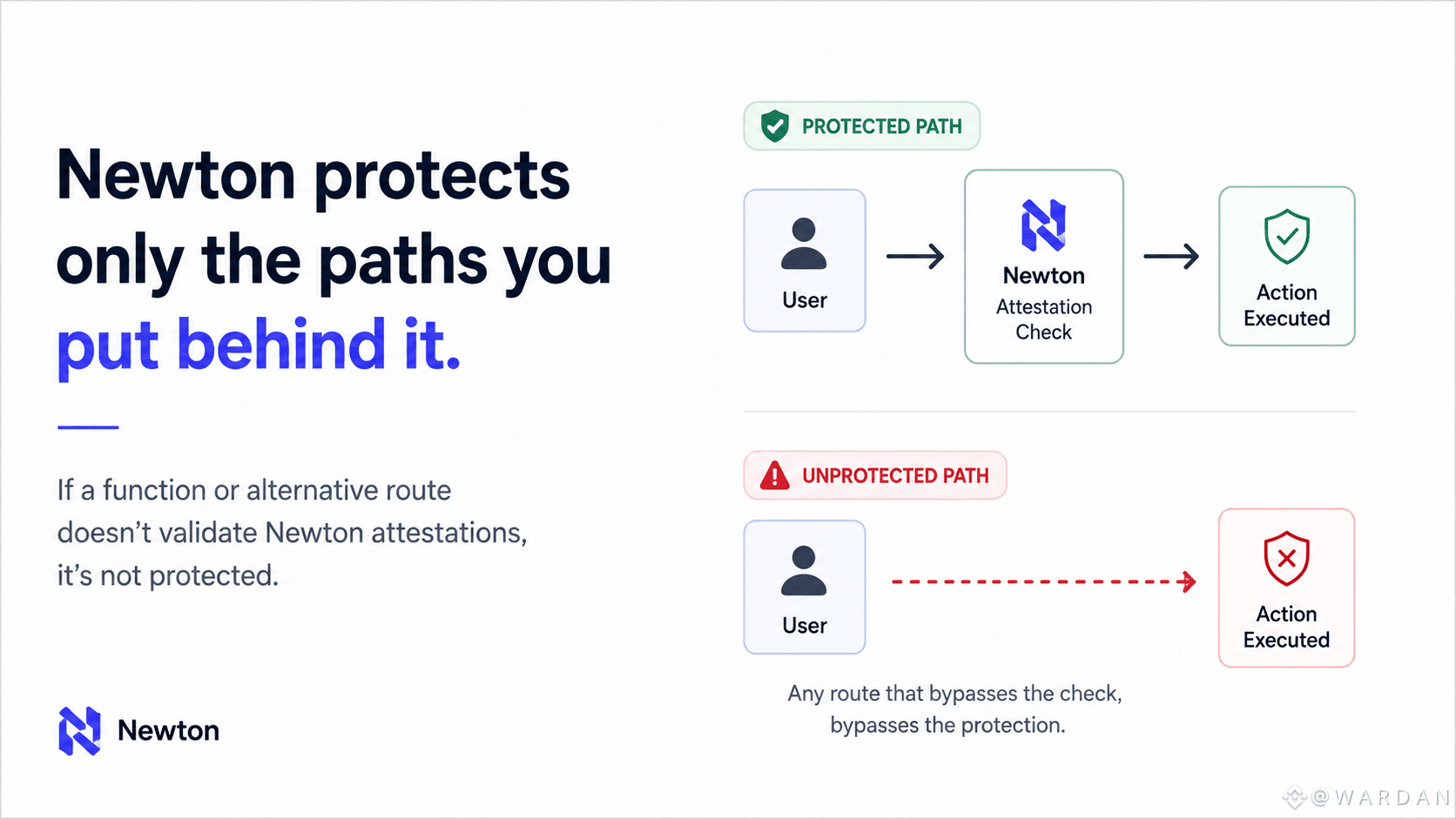
4
4
195
·
--
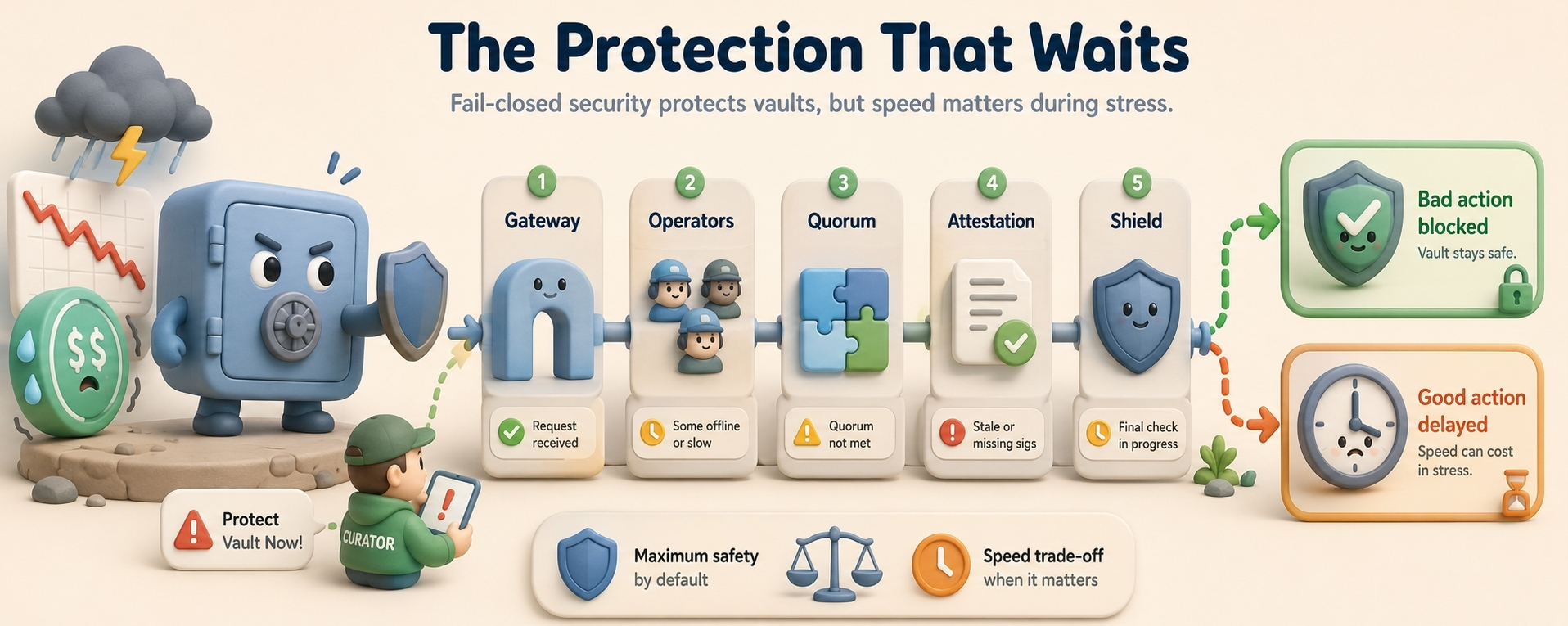
Article
The Protection That Waits: Why Newton's Real Security Test Happens When Vaults Need Speed MostThis afternoon I had two browser tabs open side by side. On the left was Newton Protocol's marketing page, promising to stop vault managers from breaking predefined rules. On the right was the VaultKit technical documentation I had been meaning to review. The marketing spoke of enforceable protection and automated safety. The documentation spoke of something else entirely. I stopped scrolling when I reached the phrase "fail-closed." VaultKit, I read, does not forward a vault action when operator quorum is unreachable, when attestations expire, or when Shield validation fails. The system stops transactions not only when policy is violated, but when the authorization machinery itself cannot complete.
I went back to the marketing tab, then returned to the documentation. The disconnect became harder to ignore. The promise was that Newton would protect depositors from curator misconduct. The mechanism was that every legitimate action must pass through Gateway coordination, operator evaluation, signature aggregation, attestation creation, and onchain verification before execution proceeds. I had initially assumed that protection meant stopping bad transactions while allowing good ones to flow. The documentation suggested a more complicated reality. A transaction could halt not because policy concluded it was harmful, but because external data was stale, operators were temporarily unreachable, or an attestation expired during network congestion.
To understand why this matters, consider what happens when a curator prepares an urgent defensive rebalancing during a stablecoin depeg. The curator converts the action into an intent. The Gateway coordinates offchain evaluation. Newton operators assess the intent against policy parameters and required external information. The aggregator collects signatures until quorum is reached. Only then is an attestation created, bound to the exact caller, vault, chain, calldata, and expiration. The Shield verifies this attestation. If any step stalls, the vault action does not proceed. The curator watches while the market continues moving against the position.
The genuine benefit of this design is real and must be weighed fairly. Fail-closed execution prevents curators from quietly bypassing policy when restrictions become inconvenient. It protects depositors against unauthorized market exposure, excessive concentration, weak-liquidity allocations, sanctioned counterparties, and manipulated fee changes. Without such enforcement, a curator could ignore limits after depositors have committed capital, making supposedly binding rules optional. Newton is attempting to replace a curator's promise with an enforceable process, and the intention is structurally sound.
But here is the two-sided tension that the marketing materials do not resolve. A vault may need urgent action during a liquidity collapse, a lending-market exploit, rapid collateral deterioration, or oracle instability. During such conditions, failure to complete authorization may prevent legitimate protective action. The system that stops unauthorized concentration can also stop authorized de-risking if the operator quorum cannot form in time, if the external oracle times out, or if the attestation expires while waiting for final signatures. The real tension is between preventing unsafe action and preserving necessary action. Neither side can be ignored.
Newton's strongest defense is that any serious authorization system should fail closed. An instant override would create an easy bypass: manufacture an evaluation failure, claim emergency conditions, and execute outside the policy. This is why Newton's escape path is public and time-delayed rather than immediate. The counterargument is strong and must be treated fairly. The correct criticism is not that Newton should fail open. The correct question is whether Newton can design fail-closed protection with enough redundancy, speed, and transparent emergency governance to remain useful during real stress.
Newton announced its mainnet beta on June 23, 2026, describing the protocol as live on Ethereum and Base with enforceable policies for DeFi vault workflows. The architecture is documented and currently active. But its resilience at meaningful scale remains unmeasured. Public evidence does not yet establish real authorization-success rates, median and worst-case evaluation latency, operator-quorum failure frequency, or how the system behaves during volatile market periods. The unanswered question is whether the protection layer can process urgent legitimate actions reliably when multiple dependencies are under pressure.
Newton changes the location of vault risk. Without VaultKit, risk may sit mainly with a curator's manager key, human discretion, and weakly enforced mandates. With mandatory authorization, some of that risk moves into policy correctness, external-data availability, Gateway operation, operator participation, quorum formation, attestation expiration, and Shield verification. Newton may reduce one category of trust without eliminating operational dependence. The deeper test is not whether the protocol contains safeguards. It is whether the entire authorization path remains dependable when conditions are worst.
I closed the documentation tab and returned to the marketing page. The promise of protection remained visible, but its meaning had shifted. Newton's fail-closed design becomes a meaningful security improvement only if its operator availability, data resilience, authorization latency, and emergency-governance system are strong enough that the protection layer does not prevent legitimate loss-reduction actions during periods of market stress. The system's ability to reject bad actions proves only one side of the security model. Its ability to authorize the right action reliably, quickly, and under adverse conditions will determine whether Newton reduces total vault risk or merely replaces discretionary-manager risk with authorization-infrastructure risk.
For now, I would watch authorization completion rates, median and tail evaluation latency, operator-quorum success rates, attestation-expiration frequency, and incident publication during market stress. Security is not only the ability to say no. In a live financial system, security also includes the ability to produce the correct yes before the opportunity to protect capital disappears.
$NEWT #NewtonProtocol #DeFi @NewtonProtocol #VaultSecurity #Newt #RiskManagement #CryptoAnalysis #BinanceSquare
The Protection That Waits: Why Newton's Real Security Test Happens When Vaults Need Speed Most
This afternoon I had two browser tabs open side by side. On the left was Newton Protocol's marketing page, promising to stop vault managers from breaking predefined rules. On the right was the VaultKit technical documentation I had been meaning to review. The marketing spoke of enforceable protection and automated safety. The documentation spoke of something else entirely. I stopped scrolling when I reached the phrase "fail-closed." VaultKit, I read, does not forward a vault action when operator quorum is unreachable, when attestations expire, or when Shield validation fails. The system stops transactions not only when policy is violated, but when the authorization machinery itself cannot complete.
I went back to the marketing tab, then returned to the documentation. The disconnect became harder to ignore. The promise was that Newton would protect depositors from curator misconduct. The mechanism was that every legitimate action must pass through Gateway coordination, operator evaluation, signature aggregation, attestation creation, and onchain verification before execution proceeds. I had initially assumed that protection meant stopping bad transactions while allowing good ones to flow. The documentation suggested a more complicated reality. A transaction could halt not because policy concluded it was harmful, but because external data was stale, operators were temporarily unreachable, or an attestation expired during network congestion.
To understand why this matters, consider what happens when a curator prepares an urgent defensive rebalancing during a stablecoin depeg. The curator converts the action into an intent. The Gateway coordinates offchain evaluation. Newton operators assess the intent against policy parameters and required external information. The aggregator collects signatures until quorum is reached. Only then is an attestation created, bound to the exact caller, vault, chain, calldata, and expiration. The Shield verifies this attestation. If any step stalls, the vault action does not proceed. The curator watches while the market continues moving against the position.
The genuine benefit of this design is real and must be weighed fairly. Fail-closed execution prevents curators from quietly bypassing policy when restrictions become inconvenient. It protects depositors against unauthorized market exposure, excessive concentration, weak-liquidity allocations, sanctioned counterparties, and manipulated fee changes. Without such enforcement, a curator could ignore limits after depositors have committed capital, making supposedly binding rules optional. Newton is attempting to replace a curator's promise with an enforceable process, and the intention is structurally sound.
But here is the two-sided tension that the marketing materials do not resolve. A vault may need urgent action during a liquidity collapse, a lending-market exploit, rapid collateral deterioration, or oracle instability. During such conditions, failure to complete authorization may prevent legitimate protective action. The system that stops unauthorized concentration can also stop authorized de-risking if the operator quorum cannot form in time, if the external oracle times out, or if the attestation expires while waiting for final signatures. The real tension is between preventing unsafe action and preserving necessary action. Neither side can be ignored.
Newton's strongest defense is that any serious authorization system should fail closed. An instant override would create an easy bypass: manufacture an evaluation failure, claim emergency conditions, and execute outside the policy. This is why Newton's escape path is public and time-delayed rather than immediate. The counterargument is strong and must be treated fairly. The correct criticism is not that Newton should fail open. The correct question is whether Newton can design fail-closed protection with enough redundancy, speed, and transparent emergency governance to remain useful during real stress.
Newton announced its mainnet beta on June 23, 2026, describing the protocol as live on Ethereum and Base with enforceable policies for DeFi vault workflows. The architecture is documented and currently active. But its resilience at meaningful scale remains unmeasured. Public evidence does not yet establish real authorization-success rates, median and worst-case evaluation latency, operator-quorum failure frequency, or how the system behaves during volatile market periods. The unanswered question is whether the protection layer can process urgent legitimate actions reliably when multiple dependencies are under pressure.
Newton changes the location of vault risk. Without VaultKit, risk may sit mainly with a curator's manager key, human discretion, and weakly enforced mandates. With mandatory authorization, some of that risk moves into policy correctness, external-data availability, Gateway operation, operator participation, quorum formation, attestation expiration, and Shield verification. Newton may reduce one category of trust without eliminating operational dependence. The deeper test is not whether the protocol contains safeguards. It is whether the entire authorization path remains dependable when conditions are worst.
I closed the documentation tab and returned to the marketing page. The promise of protection remained visible, but its meaning had shifted. Newton's fail-closed design becomes a meaningful security improvement only if its operator availability, data resilience, authorization latency, and emergency-governance system are strong enough that the protection layer does not prevent legitimate loss-reduction actions during periods of market stress. The system's ability to reject bad actions proves only one side of the security model. Its ability to authorize the right action reliably, quickly, and under adverse conditions will determine whether Newton reduces total vault risk or merely replaces discretionary-manager risk with authorization-infrastructure risk.
For now, I would watch authorization completion rates, median and tail evaluation latency, operator-quorum success rates, attestation-expiration frequency, and incident publication during market stress. Security is not only the ability to say no. In a live financial system, security also includes the ability to produce the correct yes before the opportunity to protect capital disappears.
$NEWT #NewtonProtocol #DeFi @NewtonProtocol #VaultSecurity #Newt #RiskManagement #CryptoAnalysis #BinanceSquare
I went back to the marketing tab, then returned to the documentation. The disconnect became harder to ignore. The promise was that Newton would protect depositors from curator misconduct. The mechanism was that every legitimate action must pass through Gateway coordination, operator evaluation, signature aggregation, attestation creation, and onchain verification before execution proceeds. I had initially assumed that protection meant stopping bad transactions while allowing good ones to flow. The documentation suggested a more complicated reality. A transaction could halt not because policy concluded it was harmful, but because external data was stale, operators were temporarily unreachable, or an attestation expired during network congestion.
To understand why this matters, consider what happens when a curator prepares an urgent defensive rebalancing during a stablecoin depeg. The curator converts the action into an intent. The Gateway coordinates offchain evaluation. Newton operators assess the intent against policy parameters and required external information. The aggregator collects signatures until quorum is reached. Only then is an attestation created, bound to the exact caller, vault, chain, calldata, and expiration. The Shield verifies this attestation. If any step stalls, the vault action does not proceed. The curator watches while the market continues moving against the position.
The genuine benefit of this design is real and must be weighed fairly. Fail-closed execution prevents curators from quietly bypassing policy when restrictions become inconvenient. It protects depositors against unauthorized market exposure, excessive concentration, weak-liquidity allocations, sanctioned counterparties, and manipulated fee changes. Without such enforcement, a curator could ignore limits after depositors have committed capital, making supposedly binding rules optional. Newton is attempting to replace a curator's promise with an enforceable process, and the intention is structurally sound.
But here is the two-sided tension that the marketing materials do not resolve. A vault may need urgent action during a liquidity collapse, a lending-market exploit, rapid collateral deterioration, or oracle instability. During such conditions, failure to complete authorization may prevent legitimate protective action. The system that stops unauthorized concentration can also stop authorized de-risking if the operator quorum cannot form in time, if the external oracle times out, or if the attestation expires while waiting for final signatures. The real tension is between preventing unsafe action and preserving necessary action. Neither side can be ignored.
Newton's strongest defense is that any serious authorization system should fail closed. An instant override would create an easy bypass: manufacture an evaluation failure, claim emergency conditions, and execute outside the policy. This is why Newton's escape path is public and time-delayed rather than immediate. The counterargument is strong and must be treated fairly. The correct criticism is not that Newton should fail open. The correct question is whether Newton can design fail-closed protection with enough redundancy, speed, and transparent emergency governance to remain useful during real stress.
Newton announced its mainnet beta on June 23, 2026, describing the protocol as live on Ethereum and Base with enforceable policies for DeFi vault workflows. The architecture is documented and currently active. But its resilience at meaningful scale remains unmeasured. Public evidence does not yet establish real authorization-success rates, median and worst-case evaluation latency, operator-quorum failure frequency, or how the system behaves during volatile market periods. The unanswered question is whether the protection layer can process urgent legitimate actions reliably when multiple dependencies are under pressure.
Newton changes the location of vault risk. Without VaultKit, risk may sit mainly with a curator's manager key, human discretion, and weakly enforced mandates. With mandatory authorization, some of that risk moves into policy correctness, external-data availability, Gateway operation, operator participation, quorum formation, attestation expiration, and Shield verification. Newton may reduce one category of trust without eliminating operational dependence. The deeper test is not whether the protocol contains safeguards. It is whether the entire authorization path remains dependable when conditions are worst.
I closed the documentation tab and returned to the marketing page. The promise of protection remained visible, but its meaning had shifted. Newton's fail-closed design becomes a meaningful security improvement only if its operator availability, data resilience, authorization latency, and emergency-governance system are strong enough that the protection layer does not prevent legitimate loss-reduction actions during periods of market stress. The system's ability to reject bad actions proves only one side of the security model. Its ability to authorize the right action reliably, quickly, and under adverse conditions will determine whether Newton reduces total vault risk or merely replaces discretionary-manager risk with authorization-infrastructure risk.
For now, I would watch authorization completion rates, median and tail evaluation latency, operator-quorum success rates, attestation-expiration frequency, and incident publication during market stress. Security is not only the ability to say no. In a live financial system, security also includes the ability to produce the correct yes before the opportunity to protect capital disappears.
$NEWT #NewtonProtocol #DeFi @NewtonProtocol #VaultSecurity #Newt #RiskManagement #CryptoAnalysis #BinanceSquare
4
3
197
·
--
I’ve noticed that most AI automation projects are judged by how quickly they can execute. But speed becomes less impressive when users cannot verify what the automated system actually did.
That is where Newton Protocol’s secure rollup idea becomes meaningful. The deeper value is not simply allowing AI-driven strategies or automated trading. It is creating an execution layer where automated actions can operate under clearer security and verification conditions.
This matters because automation increases both convenience and distance. The more decisions a system makes for us, the harder it becomes to notice where something went wrong, whether instructions were followed correctly, or who should be trusted when results differ from expectations.
Newton’s developer marketplace could expand the number of AI tools available, but more tools alone will not create adoption. Users will still need confidence that those tools execute reliably, interact safely, and produce outcomes they can examine rather than blindly accept.
The real adoption test for Newton Protocol is not how many automated strategies can be built on it. It is whether users eventually feel safer delegating meaningful actions to those strategies.
AI can make decisions faster. Trust determines whether people will allow it to keep making them.
@NewtonProtocol $NEWT #Newt
{spot}(NEWTUSDT)
I’ve noticed that most AI automation projects are judged by how quickly they can execute. But speed becomes less impressive when users cannot verify what the automated system actually did.
That is where Newton Protocol’s secure rollup idea becomes meaningful. The deeper value is not simply allowing AI-driven strategies or automated trading. It is creating an execution layer where automated actions can operate under clearer security and verification conditions.
This matters because automation increases both convenience and distance. The more decisions a system makes for us, the harder it becomes to notice where something went wrong, whether instructions were followed correctly, or who should be trusted when results differ from expectations.
Newton’s developer marketplace could expand the number of AI tools available, but more tools alone will not create adoption. Users will still need confidence that those tools execute reliably, interact safely, and produce outcomes they can examine rather than blindly accept.
The real adoption test for Newton Protocol is not how many automated strategies can be built on it. It is whether users eventually feel safer delegating meaningful actions to those strategies.
AI can make decisions faster. Trust determines whether people will allow it to keep making them.
@NewtonProtocol $NEWT #Newt
That is where Newton Protocol’s secure rollup idea becomes meaningful. The deeper value is not simply allowing AI-driven strategies or automated trading. It is creating an execution layer where automated actions can operate under clearer security and verification conditions.
This matters because automation increases both convenience and distance. The more decisions a system makes for us, the harder it becomes to notice where something went wrong, whether instructions were followed correctly, or who should be trusted when results differ from expectations.
Newton’s developer marketplace could expand the number of AI tools available, but more tools alone will not create adoption. Users will still need confidence that those tools execute reliably, interact safely, and produce outcomes they can examine rather than blindly accept.
The real adoption test for Newton Protocol is not how many automated strategies can be built on it. It is whether users eventually feel safer delegating meaningful actions to those strategies.
AI can make decisions faster. Trust determines whether people will allow it to keep making them.
@NewtonProtocol $NEWT #Newt
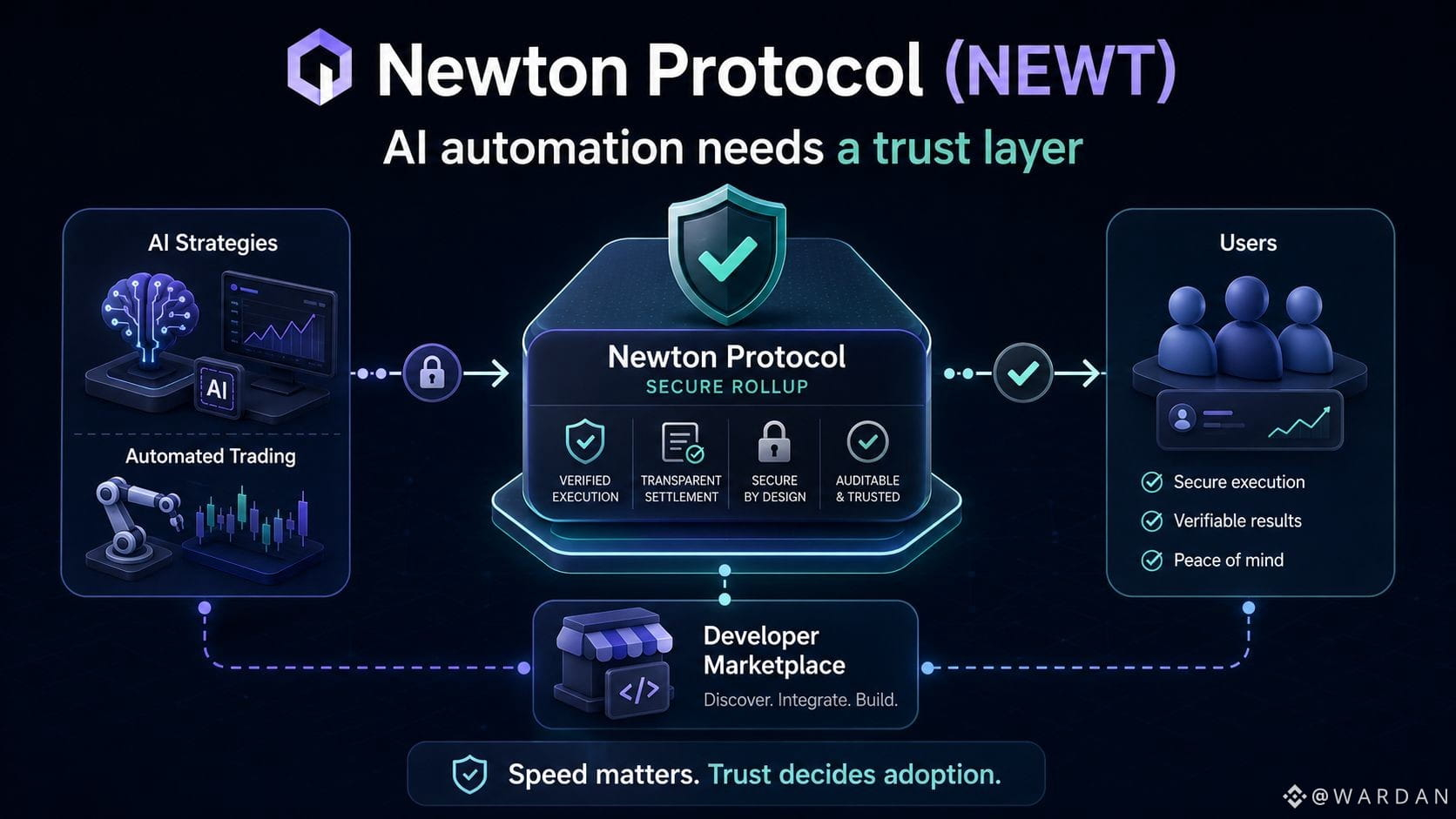
1
1
160
·
--
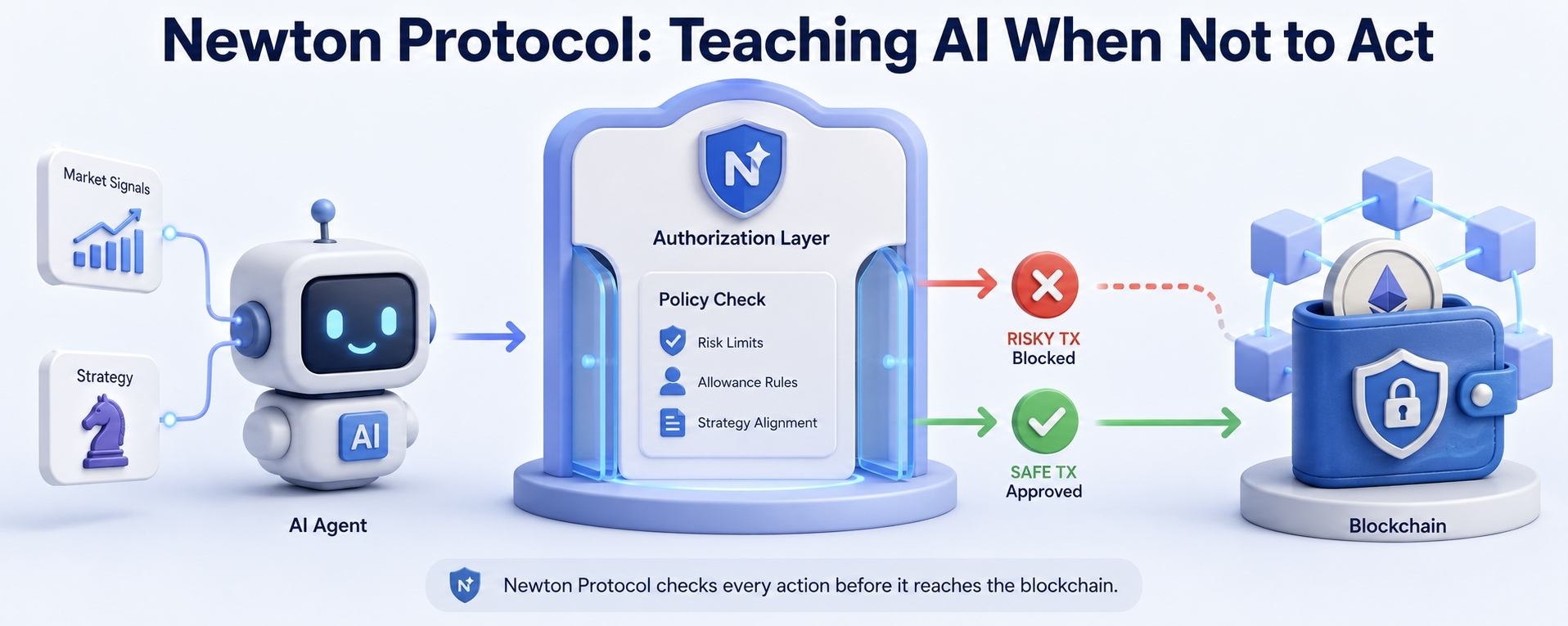
Article
Newton Protocol’s Hardest Job Is Teaching AI When Not to ActThe more I study AI-driven crypto projects, the less impressed I become by the promise that an agent can trade faster, scan more data or manage a wallet without sleep. We already know software can automate decisions. What I keep coming back to is a more uncomfortable question: what happens when the agent makes the wrong decision with real money?
That question changed how I started looking at Newton Protocol.
At first, Newton appears to fit the familiar AI narrative. It supports autonomous strategies, automated transactions and a marketplace where developers can build and distribute agents. But I do not think the agent itself is the most important part of the system. The part that interests me is what stands between the agent’s intention and the final transaction.
In my experience, automation usually looks safe while everything is working normally. The real test comes when data is misleading, market conditions change suddenly, a smart contract behaves unexpectedly or the agent misunderstands what the user actually wanted. A human trader can hesitate, review the situation or simply close the screen. An autonomous agent may continue acting because execution is exactly what it was designed to do.
This is where Newton’s authorization layer becomes meaningful.
A user or developer can define the boundaries before the agent begins operating. The agent may only interact with approved protocols. It may have a maximum transaction size. It may be blocked from using certain contract functions or moving funds outside a specific set of addresses. When the agent proposes an action, the system checks that action against the predefined policy before allowing it to reach the blockchain.
I see this as the difference between giving someone a wallet and giving them a company expense card. A wallet with broad permission can potentially do anything. An expense card may still be useful, but it operates inside clear limits. The intelligence decides what action might be useful. The authorization layer decides whether that action is acceptable.
That distinction sounds simple, yet I think it touches one of the biggest unsolved problems in autonomous finance. Blockchains are good at confirming that a transaction carries a valid signature. They are not naturally good at understanding whether the person behind that signature truly intended the outcome, whether an AI exceeded its role or whether the transaction violated a wider set of conditions.
Newton is trying to place programmable judgment inside that gap.
The potential use is broader than automated trading. The same structure could control how an AI agent spends stablecoins, manage permissions inside a DeFi vault, enforce eligibility conditions for tokenized assets or prevent an automated treasury system from taking excessive exposure to one protocol. Developers could build agents that are useful without asking users to surrender unlimited control
But I also see a difficult trade-off here.
The stronger the restrictions become, the safer the agent may be, but the less flexible it becomes. A policy that is too loose may fail when protection is needed most. A policy that is too strict may block valid transactions during fast-moving market conditions. Someone still has to define those rules, update them and decide which data sources deserve trust.
This means Newton cannot solve the entire problem simply by adding another security layer. Poorly designed policies can still create poor outcomes. External data can be delayed or manipulated. Independent operators can disagree. Additional verification can also introduce cost, complexity and slower execution.
From a developer’s perspective, this matters a lot. A system can be technically impressive and still struggle if integration feels heavier than the risk it removes. Most users will never care how policy evaluations, signatures or operator coordination work beneath the surface. They will care whether the agent protects their funds without constantly rejecting the actions they expected it to perform.
That is the adoption test I would watch.
I would not judge Newton mainly by how many agents are created or how often the project is mentioned alongside AI. Those numbers can grow before real trust exists. I would pay more attention to whether users repeatedly allow these agents to operate with meaningful capital, whether developers build applications that depend on Newton’s permissions and whether the system continues working when conditions become unpredictable.
The NEWT token deserves the same practical test.
The token has been positioned around fees, staking, governance and participation in the protocol’s security economy. But a token does not gain lasting value simply because the protocol has an important idea. The connection between actual authorization activity and real demand for NEWT still needs to become visible. I would want to see the token becoming necessary inside the system rather than remaining attached to it mainly through narrative.
For me, Newton’s long-term opportunity is not about producing an AI agent that never makes mistakes. I do not believe such an agent exists. Its opportunity is to make those mistakes smaller, contain them before execution and give users a way to automate without handing over unlimited authority.
That may not sound as exciting as an AI that promises to trade better than humans. But after watching how quickly one wrong transaction can erase months of careful decisions, I think the ability to stop an agent may eventually matter more than the ability to make it act.
In autonomous finance, intelligence creates the decision. Trust begins with the power to refuse it.
@NewtonProtocol $NEWT #Newt
{spot}(NEWTUSDT)
Newton Protocol’s Hardest Job Is Teaching AI When Not to Act
The more I study AI-driven crypto projects, the less impressed I become by the promise that an agent can trade faster, scan more data or manage a wallet without sleep. We already know software can automate decisions. What I keep coming back to is a more uncomfortable question: what happens when the agent makes the wrong decision with real money?
That question changed how I started looking at Newton Protocol.
At first, Newton appears to fit the familiar AI narrative. It supports autonomous strategies, automated transactions and a marketplace where developers can build and distribute agents. But I do not think the agent itself is the most important part of the system. The part that interests me is what stands between the agent’s intention and the final transaction.
In my experience, automation usually looks safe while everything is working normally. The real test comes when data is misleading, market conditions change suddenly, a smart contract behaves unexpectedly or the agent misunderstands what the user actually wanted. A human trader can hesitate, review the situation or simply close the screen. An autonomous agent may continue acting because execution is exactly what it was designed to do.
This is where Newton’s authorization layer becomes meaningful.
A user or developer can define the boundaries before the agent begins operating. The agent may only interact with approved protocols. It may have a maximum transaction size. It may be blocked from using certain contract functions or moving funds outside a specific set of addresses. When the agent proposes an action, the system checks that action against the predefined policy before allowing it to reach the blockchain.
I see this as the difference between giving someone a wallet and giving them a company expense card. A wallet with broad permission can potentially do anything. An expense card may still be useful, but it operates inside clear limits. The intelligence decides what action might be useful. The authorization layer decides whether that action is acceptable.
That distinction sounds simple, yet I think it touches one of the biggest unsolved problems in autonomous finance. Blockchains are good at confirming that a transaction carries a valid signature. They are not naturally good at understanding whether the person behind that signature truly intended the outcome, whether an AI exceeded its role or whether the transaction violated a wider set of conditions.
Newton is trying to place programmable judgment inside that gap.
The potential use is broader than automated trading. The same structure could control how an AI agent spends stablecoins, manage permissions inside a DeFi vault, enforce eligibility conditions for tokenized assets or prevent an automated treasury system from taking excessive exposure to one protocol. Developers could build agents that are useful without asking users to surrender unlimited control
But I also see a difficult trade-off here.
The stronger the restrictions become, the safer the agent may be, but the less flexible it becomes. A policy that is too loose may fail when protection is needed most. A policy that is too strict may block valid transactions during fast-moving market conditions. Someone still has to define those rules, update them and decide which data sources deserve trust.
This means Newton cannot solve the entire problem simply by adding another security layer. Poorly designed policies can still create poor outcomes. External data can be delayed or manipulated. Independent operators can disagree. Additional verification can also introduce cost, complexity and slower execution.
From a developer’s perspective, this matters a lot. A system can be technically impressive and still struggle if integration feels heavier than the risk it removes. Most users will never care how policy evaluations, signatures or operator coordination work beneath the surface. They will care whether the agent protects their funds without constantly rejecting the actions they expected it to perform.
That is the adoption test I would watch.
I would not judge Newton mainly by how many agents are created or how often the project is mentioned alongside AI. Those numbers can grow before real trust exists. I would pay more attention to whether users repeatedly allow these agents to operate with meaningful capital, whether developers build applications that depend on Newton’s permissions and whether the system continues working when conditions become unpredictable.
The NEWT token deserves the same practical test.
The token has been positioned around fees, staking, governance and participation in the protocol’s security economy. But a token does not gain lasting value simply because the protocol has an important idea. The connection between actual authorization activity and real demand for NEWT still needs to become visible. I would want to see the token becoming necessary inside the system rather than remaining attached to it mainly through narrative.
For me, Newton’s long-term opportunity is not about producing an AI agent that never makes mistakes. I do not believe such an agent exists. Its opportunity is to make those mistakes smaller, contain them before execution and give users a way to automate without handing over unlimited authority.
That may not sound as exciting as an AI that promises to trade better than humans. But after watching how quickly one wrong transaction can erase months of careful decisions, I think the ability to stop an agent may eventually matter more than the ability to make it act.
In autonomous finance, intelligence creates the decision. Trust begins with the power to refuse it.
@NewtonProtocol $NEWT #Newt
That question changed how I started looking at Newton Protocol.
At first, Newton appears to fit the familiar AI narrative. It supports autonomous strategies, automated transactions and a marketplace where developers can build and distribute agents. But I do not think the agent itself is the most important part of the system. The part that interests me is what stands between the agent’s intention and the final transaction.
In my experience, automation usually looks safe while everything is working normally. The real test comes when data is misleading, market conditions change suddenly, a smart contract behaves unexpectedly or the agent misunderstands what the user actually wanted. A human trader can hesitate, review the situation or simply close the screen. An autonomous agent may continue acting because execution is exactly what it was designed to do.
This is where Newton’s authorization layer becomes meaningful.
A user or developer can define the boundaries before the agent begins operating. The agent may only interact with approved protocols. It may have a maximum transaction size. It may be blocked from using certain contract functions or moving funds outside a specific set of addresses. When the agent proposes an action, the system checks that action against the predefined policy before allowing it to reach the blockchain.
I see this as the difference between giving someone a wallet and giving them a company expense card. A wallet with broad permission can potentially do anything. An expense card may still be useful, but it operates inside clear limits. The intelligence decides what action might be useful. The authorization layer decides whether that action is acceptable.
That distinction sounds simple, yet I think it touches one of the biggest unsolved problems in autonomous finance. Blockchains are good at confirming that a transaction carries a valid signature. They are not naturally good at understanding whether the person behind that signature truly intended the outcome, whether an AI exceeded its role or whether the transaction violated a wider set of conditions.
Newton is trying to place programmable judgment inside that gap.
The potential use is broader than automated trading. The same structure could control how an AI agent spends stablecoins, manage permissions inside a DeFi vault, enforce eligibility conditions for tokenized assets or prevent an automated treasury system from taking excessive exposure to one protocol. Developers could build agents that are useful without asking users to surrender unlimited control
But I also see a difficult trade-off here.
The stronger the restrictions become, the safer the agent may be, but the less flexible it becomes. A policy that is too loose may fail when protection is needed most. A policy that is too strict may block valid transactions during fast-moving market conditions. Someone still has to define those rules, update them and decide which data sources deserve trust.
This means Newton cannot solve the entire problem simply by adding another security layer. Poorly designed policies can still create poor outcomes. External data can be delayed or manipulated. Independent operators can disagree. Additional verification can also introduce cost, complexity and slower execution.
From a developer’s perspective, this matters a lot. A system can be technically impressive and still struggle if integration feels heavier than the risk it removes. Most users will never care how policy evaluations, signatures or operator coordination work beneath the surface. They will care whether the agent protects their funds without constantly rejecting the actions they expected it to perform.
That is the adoption test I would watch.
I would not judge Newton mainly by how many agents are created or how often the project is mentioned alongside AI. Those numbers can grow before real trust exists. I would pay more attention to whether users repeatedly allow these agents to operate with meaningful capital, whether developers build applications that depend on Newton’s permissions and whether the system continues working when conditions become unpredictable.
The NEWT token deserves the same practical test.
The token has been positioned around fees, staking, governance and participation in the protocol’s security economy. But a token does not gain lasting value simply because the protocol has an important idea. The connection between actual authorization activity and real demand for NEWT still needs to become visible. I would want to see the token becoming necessary inside the system rather than remaining attached to it mainly through narrative.
For me, Newton’s long-term opportunity is not about producing an AI agent that never makes mistakes. I do not believe such an agent exists. Its opportunity is to make those mistakes smaller, contain them before execution and give users a way to automate without handing over unlimited authority.
That may not sound as exciting as an AI that promises to trade better than humans. But after watching how quickly one wrong transaction can erase months of careful decisions, I think the ability to stop an agent may eventually matter more than the ability to make it act.
In autonomous finance, intelligence creates the decision. Trust begins with the power to refuse it.
@NewtonProtocol $NEWT #Newt
3
2
150
Log in to explore more content
Join global crypto users on Binance Square
⚡️ Get latest and useful information about crypto.
💬 Trusted by the world’s largest crypto exchange.
👍 Discover real insights from verified creators.
Email / Phone number
Trending Topics
CPIWatch
86.1M views
498,785 Discussing
Share & Win Traffic Reward in our Trending Hashtag Campaign
✨Topic: Will CPI Trigger Rate Hike?
👉How to Join:
Publish a short post or article with hashtag #CPIWatch
Create content based on the below two angles:
- Nonfarm payrolls beat expectations and CPI is around the corner, do you think the Fed will hike or hold the rate?
- Bullish or bearish? Share your take and showcase your stocks or gold trade/holdings with our trade sharing widget.
🚀Campaign Period:
- 2026-09-11 3:00 - 2026-09-12 9:00 UTC
🎁Reward:
- Qualified posts that comply with the above guidelines and contain more than 100 words will be reviewed and may receive a random traffic boost of 500 to 3,000 views. You will receive a notification from your feed secretary if your post is selected.
- Get a chance to have your article featured on Binance Square Official
Need ideas for your post? Visit the topic page #CPIWatch or the Square Guide on How to Post for Better Reach.
Binance Square Official
·167 Likes
·248.7k views
TrumpDeclinesSaudiRequestToStrikeHouthis
1,920 views
109 Discussing
CryptoSectorsFallSecondDay
7,128 views
349 Discussing