Binance Square

CoachOfficial

Exploring the Future of Crypto | Deep Dives | Market Stories | DYOR 📈 | X: @CoachOfficials 🔷
Trade eröffnen
Regelmäßiger Trader
4.4 Jahre
6.3K+ Following
12.1K+ Follower
4.3K+ Like gegeben
39 Geteilt
Beiträge
Portfolio
·
--
Übersetzung ansehen
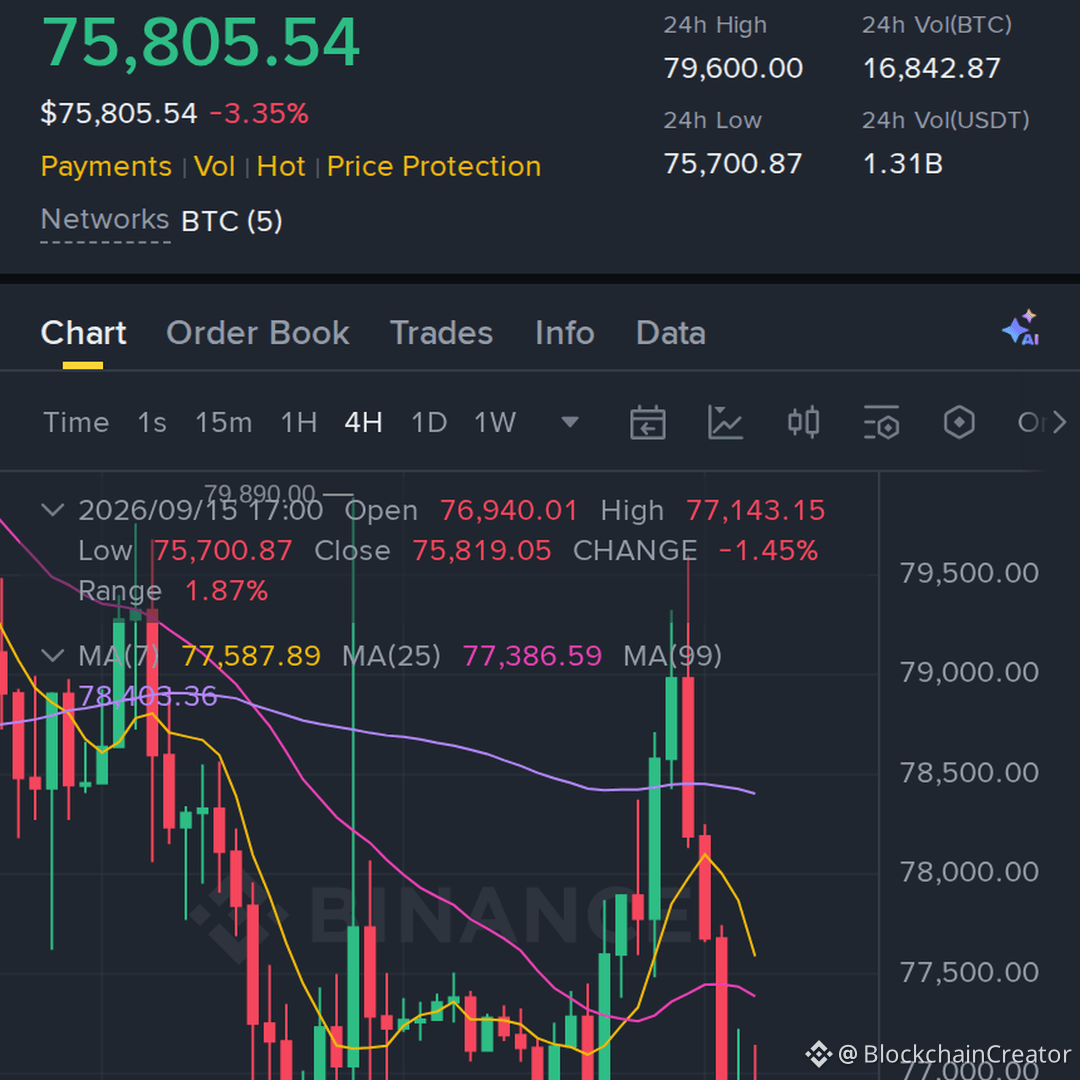
🚨 JUST IN: Bitcoin $BTC has slipped below $68,000 — a key level that often acts like a liquidity magnet (stops + leverage get tested fast). Why it matters $68K → psychological + structure level: losing it can trigger liquidations and momentum selling. If BTC can’t reclaim it quickly, the move often shifts from “dip” to trend continuation. What I’m watching next Reclaim vs. breakdown: does BTC snap back above $68K and hold (bear trap), or reject and grind lower? Funding + OI: a clean flush usually shows OI dropping with funding cooling; if OI rises while price falls, shorts may be crowding. Spot/ETF tone: are dips getting bought (absorption) or are outflows/spot selling dominating? Alt reaction: if majors hold while alts cascade, it’s rotation; if everything dumps, it’s risk-off. Key nearby zones (watch areas, not predictions): $67K, then mid-$66Ks, then $65K. Not financial advice. #AltcoinSeasonTalkTwoYearLow #SolvProtocolHacked #BTC
🚨 JUST IN: Bitcoin $BTC has slipped below $68,000 — a key level that often acts like a liquidity magnet (stops + leverage get tested fast).

Why it matters

$68K → psychological + structure level: losing it can trigger liquidations and momentum selling.

If BTC can’t reclaim it quickly, the move often shifts from “dip” to trend continuation.

What I’m watching next

Reclaim vs. breakdown: does BTC snap back above $68K and hold (bear trap), or reject and grind lower?

Funding + OI: a clean flush usually shows OI dropping with funding cooling; if OI rises while price falls, shorts may be crowding.

Spot/ETF tone: are dips getting bought (absorption) or are outflows/spot selling dominating?

Alt reaction: if majors hold while alts cascade, it’s rotation; if everything dumps, it’s risk-off.

Key nearby zones (watch areas, not predictions): $67K, then mid-$66Ks, then $65K.

Not financial advice.

#AltcoinSeasonTalkTwoYearLow #SolvProtocolHacked #BTC
Übersetzung ansehen
🚨 JUST IN: Solana $SOL has dropped below $85, a key psychological level that tends to flip from support → resistance once lost. Why it matters: Sub-$85 often triggers forced de-risking (stops, liquidations, and momentum sellers). It also pressures high-beta alts broadly when SOL is a market “risk barometer.” What I’m watching next Reclaim vs. breakdown: Does SOL quickly reclaim $85 on strong volume (bear trap) or does it reject and roll lower (trend continuation)? Funding + OI: If funding flips deeply negative while OI drops, that can signal a flush (short-term bottoming behavior). If OI rises while price falls, that’s usually late shorts piling in. BTC correlation: If $BTC is stable while SOL weakens, it’s likely alt-specific rotation. If BTC is also dumping, it’s just macro risk-off. Trade tape read: sub-$85 is usually where bounces get violent either way—expect wider spreads and sharper wicks. Not financial advice. #AltcoinSeasonTalkTwoYearLow #SolvProtocolHacked #SOL
🚨 JUST IN: Solana $SOL has dropped below $85, a key psychological level that tends to flip from support → resistance once lost.

Why it matters:

Sub-$85 often triggers forced de-risking (stops, liquidations, and momentum sellers).

It also pressures high-beta alts broadly when SOL is a market “risk barometer.”

What I’m watching next

Reclaim vs. breakdown: Does SOL quickly reclaim $85 on strong volume (bear trap) or does it reject and roll lower (trend continuation)?

Funding + OI: If funding flips deeply negative while OI drops, that can signal a flush (short-term bottoming behavior). If OI rises while price falls, that’s usually late shorts piling in.

BTC correlation: If $BTC is stable while SOL weakens, it’s likely alt-specific rotation. If BTC is also dumping, it’s just macro risk-off.

Trade tape read: sub-$85 is usually where bounces get violent either way—expect wider spreads and sharper wicks.

Not financial advice.

#AltcoinSeasonTalkTwoYearLow #SolvProtocolHacked #SOL
Übersetzung ansehen
I used to hear something like “a public network for robots” and assume it was mostly theory. You can usually tell when a concept is trying to outrun the messy parts of reality. But the more I’ve watched automation spread, the more the same small problem keeps showing up. Not “can the robot do the task?” It’s “who asked it to, and who’s responsible when it affects someone else?” That’s where things get interesting. Autonomy doesn’t land in one place. It leaks across boundaries. An agent adjusts a schedule. A robot changes a route. A supplier system accepts the update because it looks valid on its side. And then a regulator, an insurer, or a customer asks a blunt question: who approved this chain of decisions? The question changes from “did the system behave correctly?” to “can you prove the authority behind it?” And most teams aren’t set up for that. They have logs, tickets, emails. They have “we always do it this way.” None of that travels well between organizations. So with @FabricFND Protocol, I end up thinking less about capability and more about record-keeping that doesn’t depend on one party’s goodwill. A shared way to anchor delegation, computation, and constraints so disputes don’t turn into weeks of screenshots and phone calls. It becomes obvious after a while that coordination costs more than execution. And once robots are involved, coordination is the real surface area. You can feel that pressure building, even before anything breaks. #ROBO $ROBO
I used to hear something like “a public network for robots” and assume it was mostly theory. You can usually tell when a concept is trying to outrun the messy parts of reality. But the more I’ve watched automation spread, the more the same small problem keeps showing up. Not “can the robot do the task?” It’s “who asked it to, and who’s responsible when it affects someone else?”

That’s where things get interesting. Autonomy doesn’t land in one place. It leaks across boundaries. An agent adjusts a schedule. A robot changes a route. A supplier system accepts the update because it looks valid on its side. And then a regulator, an insurer, or a customer asks a blunt question: who approved this chain of decisions? The question changes from “did the system behave correctly?” to “can you prove the authority behind it?” And most teams aren’t set up for that. They have logs, tickets, emails. They have “we always do it this way.” None of that travels well between organizations.

So with @Fabric Foundation Protocol, I end up thinking less about capability and more about record-keeping that doesn’t depend on one party’s goodwill. A shared way to anchor delegation, computation, and constraints so disputes don’t turn into weeks of screenshots and phone calls. It becomes obvious after a while that coordination costs more than execution. And once robots are involved, coordination is the real surface area. You can feel that pressure building, even before anything breaks.

#ROBO $ROBO
Übersetzung ansehen
Spot Bitcoin ETF flows are finally showing early stabilization after weeks of sustained outflows.The key shift is in the 14-day netflow trend, which has started to turn higher—a sign that the worst of the distribution may be easing. That matters because persistent outflows act like a constant sell program in the background. When that pressure fades, spot price tends to breathe, and we’re seeing that dynamic as BTC pushes back above 70K. This doesn’t mean “institutions are back” in size yet. Demand still looks tentative, and a lot of the bid can be tactical (rebalancing, dip-buying, short-covering). But the slope change in the netflow trend is important: it suggests the market is transitioning from forced selling → absorption, which is usually the first step toward a healthier uptrend. What would confirm re-accumulation: Multiple days of consistent net inflows (not just one-off spikes)BTC holding key levels on daily/weekly closesFunding staying contained as price rises (less leveraged chasing)Improving breadth (ETH and high-quality alts participating) Bottom line: ETF flows aren’t screaming “new bull leg” yet, but they’re no longer flashing heavy distribution. If inflows follow through while BTC holds above 70K, the tape starts to look more like early re-accumulation than a dead-cat bounce. $BTC $ETH #USJobsData #AltcoinSeasonTalkTwoYearLow

Spot Bitcoin ETF flows are finally showing early stabilization after weeks of sustained outflows.

The key shift is in the 14-day netflow trend, which has started to turn higher—a sign that the worst of the distribution may be easing. That matters because persistent outflows act like a constant sell program in the background. When that pressure fades, spot price tends to breathe, and we’re seeing that dynamic as BTC pushes back above 70K.
This doesn’t mean “institutions are back” in size yet. Demand still looks tentative, and a lot of the bid can be tactical (rebalancing, dip-buying, short-covering). But the slope change in the netflow trend is important: it suggests the market is transitioning from forced selling → absorption, which is usually the first step toward a healthier uptrend.
What would confirm re-accumulation:
Multiple days of consistent net inflows (not just one-off spikes)BTC holding key levels on daily/weekly closesFunding staying contained as price rises (less leveraged chasing)Improving breadth (ETH and high-quality alts participating)
Bottom line: ETF flows aren’t screaming “new bull leg” yet, but they’re no longer flashing heavy distribution. If inflows follow through while BTC holds above 70K, the tape starts to look more like early re-accumulation than a dead-cat bounce.

$BTC $ETH #USJobsData #AltcoinSeasonTalkTwoYearLow
Übersetzung ansehen
Sometimes I think the most difficult part of robotics isn’t motion or perception. It’s continuity.Not the “keep the #ROBO running all day” kind of continuity. More like the “keep the story straight” kind. The kind that matters once a robot leaves the lab and starts getting handled by different people, in different places, across months and years. Updates roll out. Policies change. Training data grows. Hardware gets replaced. The same system slowly becomes something else, even if everyone keeps calling it by the same name. That’s the mindset I fall into when I look at @FabricFND Protocol. It’s described as a global open network supported by a non-profit, the Fabric Foundation. It aims to enable the construction, governance, and collaborative evolution of general-purpose robots, using verifiable computing and agent-native infrastructure. The protocol coordinates data, computation, and regulation through a public ledger, and it combines modular infrastructure to support safer human-machine collaboration. Those are a lot of words, but when you sit with them, they point to a pretty grounded problem: robots don’t exist in isolation anymore. They’re becoming part of ecosystems. And ecosystems need shared memory. A robot is never just a robot You can usually tell when someone has worked close to complex systems because they stop talking only about features and start talking about provenance. About where things came from, how they were produced, and what changed along the way. A “general-purpose robot” isn’t just a body with arms and wheels. It’s also a stack of models, datasets, control policies, safety constraints, and permissions. It’s a supply chain of components and decisions. And that supply chain doesn’t stay stable. Even in a single organization, people swap parts and tweak configurations all the time. But once you broaden it—multiple teams, contractors, partners, operators, auditors—things get messy fast. Not because people are malicious. Mostly because nobody has the full picture. Everyone sees their slice. Everyone assumes the rest is handled. It becomes obvious after a while that the biggest risk isn’t always a dramatic failure. It’s quiet drift. The robot is “mostly the same,” except it’s not. A new dataset is used. A model is retrained. A safety rule is updated. A module is replaced. And those changes don’t always get recorded in a way that’s easy to verify later. That’s where the idea of a protocol starts to matter. The protocol as shared coordination Fabric Protocol is framed as a way to coordinate data, computation, and regulation through a public ledger. “Public ledger” can sound like finance, but I think the useful way to think about it is simpler: a shared record that isn’t controlled by a single party. A place to anchor the facts that would otherwise get lost in private logs and internal tickets. Not the raw data itself, usually. Not every sensor stream or training sample. That would be impractical. But metadata. Commitments. Proofs. References. The kinds of things that let you say, later, “this model came from this training run, using this dataset, under these constraints, approved by these parties.” That’s where things get interesting, because a ledger changes what “trust” looks like. In a typical setup, trust is social. You trust the team that says they ran tests. You trust the vendor who shipped the module. You trust the operator who followed procedure. Sometimes that trust is deserved. Sometimes it’s just the only option. A public ledger shifts the center of gravity a little. It doesn’t eliminate trust, but it gives people something firmer than a promise. It gives them a way to check. And checking matters in robotics because the consequences are physical. If a software service behaves oddly, it’s annoying. If a robot behaves oddly in a shared space, it can be dangerous. Even small errors can become big problems when they’re repeated in the real world. Verifiable computing as receipts Fabric Protocol mentions verifiable computing, which I keep translating into a word that feels more human: receipts. Not receipts for everything. More like receipts for the moments that matter. Proof that a computation happened the way it claims to have happened. Proof that a safety check ran. Proof that a policy was applied. Proof that a model is the one it says it is. This is subtle, but it’s also the kind of subtlety that saves time and reduces conflict later. Because without receipts, every disagreement becomes a debate about memory. Did we run the right evaluation? Did we deploy the approved model? Did the safety constraints actually activate? Did we train on the dataset we said we trained on? In many teams, you end up answering these questions with a mix of log files, screenshots, and people’s recollections. It becomes obvious after a while that this doesn’t scale. Especially once the ecosystem grows and the people involved don’t all know each other personally. Verifiable computing is one way to make claims testable across organizational boundaries. Instead of asking someone to trust your internal process, you give them a proof that the key steps were followed. It’s not about exposing everything. It’s about making the crucial parts verifiable. And that fits nicely with the ledger idea, because proofs need somewhere to live. Somewhere stable. Somewhere others can refer to later. Agent-native infrastructure and the shift in who the system is “for” Then there’s this phrase: agent-native infrastructure. I think what it’s getting at is that robots are increasingly acting like agents, not just machines with remote control. They request resources. They make choices. They coordinate with other systems. They might need access to data. They might need compute. They might need to prove they’re allowed to do something before they can do it. Most infrastructure today is built for humans. Humans manage keys. Humans request permissions. Humans review logs. Humans click “approve.” That works, up to a point. But once you have systems operating in real time, across distributed environments, human-only control becomes both slow and brittle. Agent-native infrastructure suggests that identity, permissions, and verification are designed so agents can use them directly. That doesn’t mean agents get free rein. If anything, it could mean the opposite: tighter, clearer constraints. It’s just that the constraints are expressed in a way that can be enforced automatically, consistently, and without relying on someone remembering to follow a manual checklist. That’s where things get interesting again. Because a lot of safety work fails not at the level of policy, but at the level of execution. People intend to do the right thing. They even write the right rules. But the rules don’t travel well across systems and teams. They get interpreted differently. They get skipped when deadlines hit. They get lost when a new integrator comes in. Making the rules agent-native means the rules can be part of the operating environment. They’re not just written down. They’re applied. Regulation as part of the technical fabric The description also says the protocol coordinates regulation through the ledger. That can be easy to misread. I don’t think this means Fabric Protocol is trying to replace regulators or define laws. It seems more like it’s trying to make regulatory constraints enforceable and auditable inside the system. Regulation, in practice, often becomes a set of requirements about process and accountability. Who can deploy what? What testing is required? What data practices are allowed? What records must be kept? What happens after an incident? Those requirements get hard when systems are distributed and evolving. And robots are both. So the question changes from “do we have rules?” to “can we prove the rules were followed, and can we trace responsibility when they weren’t?” A ledger helps with that. Verifiable computing helps with that. And governance becomes something ongoing instead of a one-time signoff. It becomes obvious after a while that compliance isn’t really about saying “yes, we’re compliant.” It’s about being able to show your work. Modularity and the reality of mixed systems Fabric Protocol also talks about modular infrastructure. That part feels almost inevitable. Robotics is too diverse for a single stack. Different environments demand different sensors. Different tasks demand different bodies. Different budgets, suppliers, and local constraints push teams toward different choices. So you end up with a world of modules. Hardware modules. Software modules. Control modules. Perception modules. Safety modules. And the more modular things get, the more you need a way to stitch them together without losing accountability. Because modularity without traceability is just a pile of interchangeable parts. It can be powerful, but it can also be risky. If you don’t know what a module assumes, or what data it was trained on, or how it behaves at the edges, plugging it in becomes guesswork. A protocol that provides shared records and proofs for modules is basically trying to make modularity safer. Not safe in an absolute sense. Just safer than “trust me, it works.” Collaboration without a single owner The non-profit angle matters again here. When a system is owned by a company, collaboration often has a hidden shape: you can collaborate as long as you stay inside their boundaries. Their cloud. Their standards. Their approval pipeline. That can be efficient, but it’s not the same thing as open collaboration. Fabric Protocol, being described as a global open network supported by a foundation, suggests it wants to sit underneath those boundaries. It wants to allow different builders and operators to coordinate without being forced into one owner’s stack. That’s hard, of course. Open systems can fragment. Governance can become political. Standards can take forever. People can game incentives. None of that disappears just because a foundation exists. But you can usually tell when someone is trying to solve a real coordination problem because they build for the messy case. The case where multiple parties need to cooperate but don’t fully trust each other. The case where responsibility matters. The case where systems evolve faster than documentation. A quieter kind of goal All of this is framed toward “safe human-machine collaboration.” I don’t read that as a bold promise. More like a direction the system is trying to support. Safety, in this framing, comes from legibility. From being able to trace what changed, verify what ran, and enforce rules consistently even when the system is distributed. That’s a quieter goal than “build the future of robotics.” It’s closer to: “make it easier to understand and manage what we’re already building, as it grows.” And maybe that’s the most honest way to talk about it. Fabric Protocol seems like an attempt to give $ROBO ecosystems a shared backbone. A way to coordinate data, computation, and rules without relying on one team’s private infrastructure. A way to keep the story coherent as robots are built, governed, and changed by many hands. No strong conclusions come out of that, at least not for me. It’s more like you notice the pattern—how often things break because nobody can trace the thread—and you start paying attention to anything that tries to preserve that thread. And once you start looking at robotics as a long chain of changes rather than a single build, you can’t really stop seeing it that way, even when you close the page…

Sometimes I think the most difficult part of robotics isn’t motion or perception. It’s continuity.

Not the “keep the #ROBO running all day” kind of continuity. More like the “keep the story straight” kind. The kind that matters once a robot leaves the lab and starts getting handled by different people, in different places, across months and years. Updates roll out. Policies change. Training data grows. Hardware gets replaced. The same system slowly becomes something else, even if everyone keeps calling it by the same name.
That’s the mindset I fall into when I look at @Fabric Foundation Protocol.
It’s described as a global open network supported by a non-profit, the Fabric Foundation. It aims to enable the construction, governance, and collaborative evolution of general-purpose robots, using verifiable computing and agent-native infrastructure. The protocol coordinates data, computation, and regulation through a public ledger, and it combines modular infrastructure to support safer human-machine collaboration.
Those are a lot of words, but when you sit with them, they point to a pretty grounded problem: robots don’t exist in isolation anymore. They’re becoming part of ecosystems. And ecosystems need shared memory.
A robot is never just a robot
You can usually tell when someone has worked close to complex systems because they stop talking only about features and start talking about provenance. About where things came from, how they were produced, and what changed along the way.
A “general-purpose robot” isn’t just a body with arms and wheels. It’s also a stack of models, datasets, control policies, safety constraints, and permissions. It’s a supply chain of components and decisions. And that supply chain doesn’t stay stable.
Even in a single organization, people swap parts and tweak configurations all the time. But once you broaden it—multiple teams, contractors, partners, operators, auditors—things get messy fast. Not because people are malicious. Mostly because nobody has the full picture. Everyone sees their slice. Everyone assumes the rest is handled.
It becomes obvious after a while that the biggest risk isn’t always a dramatic failure. It’s quiet drift. The robot is “mostly the same,” except it’s not. A new dataset is used. A model is retrained. A safety rule is updated. A module is replaced. And those changes don’t always get recorded in a way that’s easy to verify later.
That’s where the idea of a protocol starts to matter.
The protocol as shared coordination
Fabric Protocol is framed as a way to coordinate data, computation, and regulation through a public ledger.
“Public ledger” can sound like finance, but I think the useful way to think about it is simpler: a shared record that isn’t controlled by a single party. A place to anchor the facts that would otherwise get lost in private logs and internal tickets.
Not the raw data itself, usually. Not every sensor stream or training sample. That would be impractical. But metadata. Commitments. Proofs. References. The kinds of things that let you say, later, “this model came from this training run, using this dataset, under these constraints, approved by these parties.”
That’s where things get interesting, because a ledger changes what “trust” looks like. In a typical setup, trust is social. You trust the team that says they ran tests. You trust the vendor who shipped the module. You trust the operator who followed procedure. Sometimes that trust is deserved. Sometimes it’s just the only option.
A public ledger shifts the center of gravity a little. It doesn’t eliminate trust, but it gives people something firmer than a promise. It gives them a way to check.
And checking matters in robotics because the consequences are physical. If a software service behaves oddly, it’s annoying. If a robot behaves oddly in a shared space, it can be dangerous. Even small errors can become big problems when they’re repeated in the real world.
Verifiable computing as receipts
Fabric Protocol mentions verifiable computing, which I keep translating into a word that feels more human: receipts.
Not receipts for everything. More like receipts for the moments that matter. Proof that a computation happened the way it claims to have happened. Proof that a safety check ran. Proof that a policy was applied. Proof that a model is the one it says it is.
This is subtle, but it’s also the kind of subtlety that saves time and reduces conflict later. Because without receipts, every disagreement becomes a debate about memory.
Did we run the right evaluation? Did we deploy the approved model? Did the safety constraints actually activate? Did we train on the dataset we said we trained on? In many teams, you end up answering these questions with a mix of log files, screenshots, and people’s recollections.
It becomes obvious after a while that this doesn’t scale. Especially once the ecosystem grows and the people involved don’t all know each other personally.
Verifiable computing is one way to make claims testable across organizational boundaries. Instead of asking someone to trust your internal process, you give them a proof that the key steps were followed. It’s not about exposing everything. It’s about making the crucial parts verifiable.
And that fits nicely with the ledger idea, because proofs need somewhere to live. Somewhere stable. Somewhere others can refer to later.
Agent-native infrastructure and the shift in who the system is “for”
Then there’s this phrase: agent-native infrastructure.
I think what it’s getting at is that robots are increasingly acting like agents, not just machines with remote control. They request resources. They make choices. They coordinate with other systems. They might need access to data. They might need compute. They might need to prove they’re allowed to do something before they can do it.
Most infrastructure today is built for humans. Humans manage keys. Humans request permissions. Humans review logs. Humans click “approve.” That works, up to a point. But once you have systems operating in real time, across distributed environments, human-only control becomes both slow and brittle.
Agent-native infrastructure suggests that identity, permissions, and verification are designed so agents can use them directly.
That doesn’t mean agents get free rein. If anything, it could mean the opposite: tighter, clearer constraints. It’s just that the constraints are expressed in a way that can be enforced automatically, consistently, and without relying on someone remembering to follow a manual checklist.
That’s where things get interesting again. Because a lot of safety work fails not at the level of policy, but at the level of execution. People intend to do the right thing. They even write the right rules. But the rules don’t travel well across systems and teams. They get interpreted differently. They get skipped when deadlines hit. They get lost when a new integrator comes in.
Making the rules agent-native means the rules can be part of the operating environment. They’re not just written down. They’re applied.
Regulation as part of the technical fabric
The description also says the protocol coordinates regulation through the ledger.
That can be easy to misread. I don’t think this means Fabric Protocol is trying to replace regulators or define laws. It seems more like it’s trying to make regulatory constraints enforceable and auditable inside the system.
Regulation, in practice, often becomes a set of requirements about process and accountability. Who can deploy what? What testing is required? What data practices are allowed? What records must be kept? What happens after an incident?
Those requirements get hard when systems are distributed and evolving. And robots are both. So the question changes from “do we have rules?” to “can we prove the rules were followed, and can we trace responsibility when they weren’t?”
A ledger helps with that. Verifiable computing helps with that. And governance becomes something ongoing instead of a one-time signoff.
It becomes obvious after a while that compliance isn’t really about saying “yes, we’re compliant.” It’s about being able to show your work.
Modularity and the reality of mixed systems
Fabric Protocol also talks about modular infrastructure.
That part feels almost inevitable. Robotics is too diverse for a single stack. Different environments demand different sensors. Different tasks demand different bodies. Different budgets, suppliers, and local constraints push teams toward different choices.
So you end up with a world of modules. Hardware modules. Software modules. Control modules. Perception modules. Safety modules. And the more modular things get, the more you need a way to stitch them together without losing accountability.
Because modularity without traceability is just a pile of interchangeable parts. It can be powerful, but it can also be risky. If you don’t know what a module assumes, or what data it was trained on, or how it behaves at the edges, plugging it in becomes guesswork.
A protocol that provides shared records and proofs for modules is basically trying to make modularity safer. Not safe in an absolute sense. Just safer than “trust me, it works.”
Collaboration without a single owner
The non-profit angle matters again here.
When a system is owned by a company, collaboration often has a hidden shape: you can collaborate as long as you stay inside their boundaries. Their cloud. Their standards. Their approval pipeline. That can be efficient, but it’s not the same thing as open collaboration.
Fabric Protocol, being described as a global open network supported by a foundation, suggests it wants to sit underneath those boundaries. It wants to allow different builders and operators to coordinate without being forced into one owner’s stack.
That’s hard, of course. Open systems can fragment. Governance can become political. Standards can take forever. People can game incentives. None of that disappears just because a foundation exists.
But you can usually tell when someone is trying to solve a real coordination problem because they build for the messy case. The case where multiple parties need to cooperate but don’t fully trust each other. The case where responsibility matters. The case where systems evolve faster than documentation.
A quieter kind of goal
All of this is framed toward “safe human-machine collaboration.”
I don’t read that as a bold promise. More like a direction the system is trying to support. Safety, in this framing, comes from legibility. From being able to trace what changed, verify what ran, and enforce rules consistently even when the system is distributed.
That’s a quieter goal than “build the future of robotics.” It’s closer to: “make it easier to understand and manage what we’re already building, as it grows.”
And maybe that’s the most honest way to talk about it.
Fabric Protocol seems like an attempt to give $ROBO ecosystems a shared backbone. A way to coordinate data, computation, and rules without relying on one team’s private infrastructure. A way to keep the story coherent as robots are built, governed, and changed by many hands.
No strong conclusions come out of that, at least not for me. It’s more like you notice the pattern—how often things break because nobody can trace the thread—and you start paying attention to anything that tries to preserve that thread.
And once you start looking at robotics as a long chain of changes rather than a single build, you can’t really stop seeing it that way, even when you close the page…
Übersetzung ansehen
I first heard the phrase “verification layer for AI” and sort of tuned out.Not in an angry way. More like that familiar feeling you get when something sounds like it’s trying to solve a messy human problem with a clean technical wrapper. I’ve seen that pattern too many times. It usually ends with a dashboard nobody trusts and a process nobody follows. But then I watched a very normal situation unfold. A team used an AI model to draft a short internal note about a policy. It sounded fine. Clean sentences. Confident tone. Everyone moved on. A week later, someone in legal asked where a particular claim came from. Not because they were being difficult. Because the claim had consequences. And suddenly nobody could answer. The model had said it. The team had repeated it. The paper trail was basically vibes. It becomes obvious after a while that this is the actual issue with “reliability.” It’s not only that AI can be wrong. Everything can be wrong. The issue is that AI outputs often arrive in the most dangerous form possible: a finished-looking answer without a built-in way to show your work. And once AI starts showing up inside real workflows, that matters more than people expect. The problem isn’t accuracy. It’s what happens next. In low-stakes use, you can shrug off mistakes. A wrong restaurant recommendation is annoying. A weird summary of an article is whatever. You can correct it. You can laugh and move on. In high-stakes use, you don’t get that luxury. People like to say “hallucinations” and “bias” like they’re separate categories, but in practice they blur into the same operational headache: the output looks legitimate enough to be acted on. The model doesn’t only guess. It guesses confidently. That’s the part that changes behavior. You can usually tell when a system is becoming “real” when the questions people ask shift. Early on, it’s: “Can it do the task?” Later, it’s: “What do we do when it’s wrong?” And then, more sharply: “Who is responsible when it’s wrong?” That’s where things get interesting, because those questions don’t have model-sized answers. They have workflow-sized answers. Legal answers. Budget answers. Human behavior answers. If an AI system helps approve a loan, or flags a transaction, or summarizes a medical chart, the correctness of the output is only the beginning. What matters is whether the output can be defended later. To an auditor. To a regulator. To a customer. To a judge. Or just to an internal risk team that’s trying to not lose their job. So the question changes from “is this answer plausible?” to “is this answer settle-able?” That sounds like a strange word, but it’s the right one. In the real world, truth is often something you settle. You settle disputes. You settle accounts. You settle claims. You settle on a version of events that can be acted on and defended. The systems we rely on—finance, compliance, insurance, procurement—are full of settlement logic. They don’t run on vibes. They run on records. AI, by default, doesn’t give you records. It gives you language. Why the usual fixes feel awkward in practice When teams notice this problem, they reach for the standard remedies. And you can’t blame them. They’re trying to make something unpredictable behave in predictable environments. The first remedy is “human in the loop.” It’s the comfort blanket of AI deployment. Put a person there and you’ve solved accountability, right? Except… not really. What often happens is the AI output becomes the default, and the human becomes a checkbox. The human has a pile of things to review, limited time, and unclear standards. They’re not actually verifying truth. They’re verifying that the output looks reasonable. And “reasonable” is a weak filter when the model is optimized to sound reasonable. It becomes obvious after a while that human review can turn into a liability sponge. The system fails, and the reviewer gets blamed for not catching it, even though the organization made it impossible to catch consistently. That’s not a stable design. It’s just risk being pushed down the org chart. The second remedy is “better models.” Fine-tuning, domain training, custom prompts, retrieval. All useful, sometimes. But this turns into maintenance. The domain changes. Policies change. Data shifts. Edge cases show up. And the organization still needs an answer to the same question: if this decision is challenged, what do we point to? The third remedy is centralized “trust.” A vendor says they can validate outputs. Or provide a scoring layer. Or certify the model. Again, sometimes helpful. But it introduces a different problem: you’re concentrating trust in one party’s incentives and uptime. That’s fine until something goes wrong and everyone looks around for who is accountable. And in regulated settings, “we trusted a vendor” is not a satisfying explanation. It might be true, but it’s not a defense. So you end up with a weird situation where people want AI because it reduces cost and time, but they don’t have a strong structure for absorbing the risk. The fixes either slow things down too much, or they create new points of failure, or they feel like theater. Why “verification” keeps coming back This is why the idea of verification keeps resurfacing, even among skeptical people. Not because it sounds cool, but because it aligns with how high-stakes systems already work. Verification is basically the opposite of persuasion. Persuasion is “this sounds right.” Verification is “show me what this is based on, and show me that someone checked it.” Institutions are built around verification. They can be slow and annoying, but it’s not random. It exists because of human behavior. People make mistakes. People cut corners. People lie sometimes. Incentives drift. And systems need to survive that. AI doesn’t remove those behaviors. In some ways it amplifies them, because it makes it easier to generate plausible content at scale. So if you want AI to operate in critical contexts, you eventually run into the need for something like a verification layer. Not as a moral statement. As an operational requirement. And that seems to be where @mira_network Network is aiming. Thinking about Mira as infrastructure, not as a “thing” I’m trying to avoid starting with features, because features are easy to describe and hard to evaluate. What matters is the shape of the gap it’s trying to fill. If you take Mira’s framing seriously, it’s saying: AI outputs need to become something closer to verified information, not just generated text. That’s a subtle but important shift. It means treating output as a set of claims, not a monolith. That fits how disputes work. When something is challenged, it’s rarely the whole document. It’s specific assertions. “This policy says X.” “The user did Y.” “The contract allows Z.” In real workflows, those assertions need support. They need provenance. They need a record of checks. Breaking outputs into verifiable claims is, in a way, an attempt to reshape AI output into the same units that institutions already know how to handle. That’s where things get interesting, because it moves reliability from “trust the model” to “trust the process.” And trust in process is something regulators, auditors, and risk teams understand. They might still dislike it, but at least it’s in their vocabulary. Why decentralization might matter here (and why it might not) The decentralized part is where people either get excited or roll their eyes. I lean toward the eye-roll most days, mostly because decentralization is often used as a substitute for governance instead of a tool for it. But I can also see a practical reason it might matter in this specific case: independence. If the same entity generates the output and verifies it, you don’t really have verification. You have internal QA. That can be good, but it’s not the same thing as an independent check. And when incentives are misaligned—say, when there’s pressure to approve transactions faster—internal checks get weakened. A network of independent verifiers, if it’s actually independent, creates a different dynamic. It’s not perfect. It can be gamed. But it’s harder to quietly tilt the process if the checkers aren’t all under one roof. You can usually tell when independence matters by looking at where trust breaks today. In many industries, trust breaks at vendor boundaries, or between departments, or between a company and its regulator. These are places where “just trust our internal system” isn’t enough. A shared, tamper-resistant record of what was checked, by whom (or by what), and what the agreement looked like is at least the kind of thing that could travel across those boundaries. That’s the role blockchains are often trying to play: not “make things true,” but “make it hard to rewrite what happened.” Still, the decentralization angle comes with real questions. Who runs the verifiers? How are incentives designed? What prevents collusion? What is the cost structure? How is governance handled when disputes arise about the verification process itself? These aren’t philosophical questions. They’re operational. And they decide whether something like this becomes useful infrastructure or just another layer nobody wants to pay for. “Cryptographic verification” and what it actually buys you It’s tempting to hear “cryptographically verified” and assume it means “correct.” It doesn’t. It usually means something closer to “provable record.” You can prove that a certain claim was checked. You can prove that a set of verifiers agreed, or disagreed. You can prove that the record wasn’t changed after the fact. That’s valuable in the ways mature systems tend to care about. Because in disputes, people fight about process as much as substance. If you can show that you followed a consistent verification process, you’re in a stronger position than if you can only say “we trusted the model.” It doesn’t guarantee you win. But it changes the terrain. It also changes internal behavior. If people know there will be a durable record of what was claimed and how it was verified, they behave differently. Teams become less casual about pushing questionable outputs into production. Or at least, that’s the hope. The economics are the real test The part that quietly determines everything is cost. Verification is not free. It takes compute, time, and coordination. And organizations will only adopt it if the cost of verification is lower than the cost of failure. That sounds obvious, but it’s the core constraint. In some workflows, failure is cheap. A user corrects the AI. No big deal. In those cases, verification is unnecessary overhead. In other workflows, failure is expensive. A wrong denial triggers appeals and legal risk. A wrong compliance decision triggers audits. A wrong financial action triggers chargebacks, disputes, reputational damage. Those are the zones where verification could be worth paying for. And that’s where Mira’s approach, at least conceptually, has a place: converting reliability from a vague aspiration into a priced, measurable part of a workflow. The question changes from “can we trust the model?” to “how much do we pay for a higher-confidence claim, and what do we get in return?” That’s a question institutions are used to answering, even if they don’t like it. Who might actually use something like this If I try to picture early users, I don’t think it’s casual consumers or hobbyists. It’s teams that already live with disputes and audits. Insurance claims operations. Lending and underwriting. Healthcare billing and coding. Sanctions screening. Procurement and contract review. Corporate reporting where errors create downstream chaos. Not because these teams love new technology. Usually they don’t. But because they already spend money on trust. They pay for auditors, compliance tools, legal review, controls, and manual processes. They’re used to the idea that “trust” is an operational expense. If #Mira can slot into that world, it could be useful. If it can’t, it will probably stay in the world of demos. The failure modes are pretty easy to imagine If verification is too slow, teams won’t wait. They’ll bypass it. If it’s too expensive, it won’t scale beyond niche cases. If the verification process becomes symbolic—verifying easy claims while missing the meaningful ones—people will stop caring. It will become another checkbox. If the verifier network can be gamed or captured, the credibility collapses quickly. And in finance and compliance settings, credibility doesn’t recover easily. And if the system can’t produce artifacts that fit into real audit and legal processes—clear logs, clear standards, clear accountability—then it might be technically elegant and still operationally irrelevant. That’s the harsh part about infrastructure. It doesn’t get points for being clever. It gets points for being boring and dependable. Sitting with the idea without forcing a conclusion I don’t have a strong conclusion here, partly because I don’t think strong conclusions are warranted yet. But I do think the motivation is real. AI is moving from “help me write” to “help me decide.” And decision systems, even small ones, need ways to create defensible records. They need verification, not as a virtue, but as a way to survive real-world pressure. $MIRA framing—turning outputs into verifiable claims and relying on independent checks—seems aimed at that pressure. Whether it works will depend on details that rarely make it into summaries: how claims are defined, what evidence is acceptable, how incentives behave over time, and whether the cost stays below the cost of failure. You can usually tell later, in hindsight, whether something like this was necessary infrastructure or just an extra layer. For now it sits in that in-between space, where the problem is clearly real, and the shape of a solution is starting to form, but the world still has to decide if it fits. And that decision tends to happen slowly, one workflow at a time.

I first heard the phrase “verification layer for AI” and sort of tuned out.

Not in an angry way. More like that familiar feeling you get when something sounds like it’s trying to solve a messy human problem with a clean technical wrapper. I’ve seen that pattern too many times. It usually ends with a dashboard nobody trusts and a process nobody follows.
But then I watched a very normal situation unfold. A team used an AI model to draft a short internal note about a policy. It sounded fine. Clean sentences. Confident tone. Everyone moved on. A week later, someone in legal asked where a particular claim came from. Not because they were being difficult. Because the claim had consequences. And suddenly nobody could answer. The model had said it. The team had repeated it. The paper trail was basically vibes.
It becomes obvious after a while that this is the actual issue with “reliability.” It’s not only that AI can be wrong. Everything can be wrong. The issue is that AI outputs often arrive in the most dangerous form possible: a finished-looking answer without a built-in way to show your work.
And once AI starts showing up inside real workflows, that matters more than people expect.
The problem isn’t accuracy. It’s what happens next.
In low-stakes use, you can shrug off mistakes. A wrong restaurant recommendation is annoying. A weird summary of an article is whatever. You can correct it. You can laugh and move on.
In high-stakes use, you don’t get that luxury.
People like to say “hallucinations” and “bias” like they’re separate categories, but in practice they blur into the same operational headache: the output looks legitimate enough to be acted on. The model doesn’t only guess. It guesses confidently. That’s the part that changes behavior.
You can usually tell when a system is becoming “real” when the questions people ask shift. Early on, it’s: “Can it do the task?” Later, it’s: “What do we do when it’s wrong?” And then, more sharply: “Who is responsible when it’s wrong?”
That’s where things get interesting, because those questions don’t have model-sized answers. They have workflow-sized answers. Legal answers. Budget answers. Human behavior answers.
If an AI system helps approve a loan, or flags a transaction, or summarizes a medical chart, the correctness of the output is only the beginning. What matters is whether the output can be defended later. To an auditor. To a regulator. To a customer. To a judge. Or just to an internal risk team that’s trying to not lose their job.
So the question changes from “is this answer plausible?” to “is this answer settle-able?”
That sounds like a strange word, but it’s the right one. In the real world, truth is often something you settle. You settle disputes. You settle accounts. You settle claims. You settle on a version of events that can be acted on and defended. The systems we rely on—finance, compliance, insurance, procurement—are full of settlement logic. They don’t run on vibes. They run on records.
AI, by default, doesn’t give you records. It gives you language.
Why the usual fixes feel awkward in practice
When teams notice this problem, they reach for the standard remedies. And you can’t blame them. They’re trying to make something unpredictable behave in predictable environments.
The first remedy is “human in the loop.” It’s the comfort blanket of AI deployment. Put a person there and you’ve solved accountability, right?
Except… not really.
What often happens is the AI output becomes the default, and the human becomes a checkbox. The human has a pile of things to review, limited time, and unclear standards. They’re not actually verifying truth. They’re verifying that the output looks reasonable. And “reasonable” is a weak filter when the model is optimized to sound reasonable.
It becomes obvious after a while that human review can turn into a liability sponge. The system fails, and the reviewer gets blamed for not catching it, even though the organization made it impossible to catch consistently. That’s not a stable design. It’s just risk being pushed down the org chart.
The second remedy is “better models.” Fine-tuning, domain training, custom prompts, retrieval. All useful, sometimes. But this turns into maintenance. The domain changes. Policies change. Data shifts. Edge cases show up. And the organization still needs an answer to the same question: if this decision is challenged, what do we point to?
The third remedy is centralized “trust.” A vendor says they can validate outputs. Or provide a scoring layer. Or certify the model. Again, sometimes helpful. But it introduces a different problem: you’re concentrating trust in one party’s incentives and uptime. That’s fine until something goes wrong and everyone looks around for who is accountable.
And in regulated settings, “we trusted a vendor” is not a satisfying explanation. It might be true, but it’s not a defense.
So you end up with a weird situation where people want AI because it reduces cost and time, but they don’t have a strong structure for absorbing the risk. The fixes either slow things down too much, or they create new points of failure, or they feel like theater.
Why “verification” keeps coming back
This is why the idea of verification keeps resurfacing, even among skeptical people. Not because it sounds cool, but because it aligns with how high-stakes systems already work.
Verification is basically the opposite of persuasion. Persuasion is “this sounds right.” Verification is “show me what this is based on, and show me that someone checked it.”
Institutions are built around verification. They can be slow and annoying, but it’s not random. It exists because of human behavior. People make mistakes. People cut corners. People lie sometimes. Incentives drift. And systems need to survive that.
AI doesn’t remove those behaviors. In some ways it amplifies them, because it makes it easier to generate plausible content at scale.
So if you want AI to operate in critical contexts, you eventually run into the need for something like a verification layer. Not as a moral statement. As an operational requirement.
And that seems to be where @Mira - Trust Layer of AI Network is aiming.
Thinking about Mira as infrastructure, not as a “thing”
I’m trying to avoid starting with features, because features are easy to describe and hard to evaluate. What matters is the shape of the gap it’s trying to fill.
If you take Mira’s framing seriously, it’s saying: AI outputs need to become something closer to verified information, not just generated text. That’s a subtle but important shift. It means treating output as a set of claims, not a monolith.
That fits how disputes work. When something is challenged, it’s rarely the whole document. It’s specific assertions. “This policy says X.” “The user did Y.” “The contract allows Z.” In real workflows, those assertions need support. They need provenance. They need a record of checks.
Breaking outputs into verifiable claims is, in a way, an attempt to reshape AI output into the same units that institutions already know how to handle.
That’s where things get interesting, because it moves reliability from “trust the model” to “trust the process.” And trust in process is something regulators, auditors, and risk teams understand. They might still dislike it, but at least it’s in their vocabulary.
Why decentralization might matter here (and why it might not)
The decentralized part is where people either get excited or roll their eyes. I lean toward the eye-roll most days, mostly because decentralization is often used as a substitute for governance instead of a tool for it.
But I can also see a practical reason it might matter in this specific case: independence.
If the same entity generates the output and verifies it, you don’t really have verification. You have internal QA. That can be good, but it’s not the same thing as an independent check. And when incentives are misaligned—say, when there’s pressure to approve transactions faster—internal checks get weakened.
A network of independent verifiers, if it’s actually independent, creates a different dynamic. It’s not perfect. It can be gamed. But it’s harder to quietly tilt the process if the checkers aren’t all under one roof.
You can usually tell when independence matters by looking at where trust breaks today. In many industries, trust breaks at vendor boundaries, or between departments, or between a company and its regulator. These are places where “just trust our internal system” isn’t enough.
A shared, tamper-resistant record of what was checked, by whom (or by what), and what the agreement looked like is at least the kind of thing that could travel across those boundaries.
That’s the role blockchains are often trying to play: not “make things true,” but “make it hard to rewrite what happened.”
Still, the decentralization angle comes with real questions. Who runs the verifiers? How are incentives designed? What prevents collusion? What is the cost structure? How is governance handled when disputes arise about the verification process itself?
These aren’t philosophical questions. They’re operational. And they decide whether something like this becomes useful infrastructure or just another layer nobody wants to pay for.
“Cryptographic verification” and what it actually buys you
It’s tempting to hear “cryptographically verified” and assume it means “correct.” It doesn’t. It usually means something closer to “provable record.”
You can prove that a certain claim was checked. You can prove that a set of verifiers agreed, or disagreed. You can prove that the record wasn’t changed after the fact. That’s valuable in the ways mature systems tend to care about.
Because in disputes, people fight about process as much as substance.
If you can show that you followed a consistent verification process, you’re in a stronger position than if you can only say “we trusted the model.” It doesn’t guarantee you win. But it changes the terrain.
It also changes internal behavior. If people know there will be a durable record of what was claimed and how it was verified, they behave differently. Teams become less casual about pushing questionable outputs into production. Or at least, that’s the hope.
The economics are the real test
The part that quietly determines everything is cost.
Verification is not free. It takes compute, time, and coordination. And organizations will only adopt it if the cost of verification is lower than the cost of failure.
That sounds obvious, but it’s the core constraint.
In some workflows, failure is cheap. A user corrects the AI. No big deal. In those cases, verification is unnecessary overhead.
In other workflows, failure is expensive. A wrong denial triggers appeals and legal risk. A wrong compliance decision triggers audits. A wrong financial action triggers chargebacks, disputes, reputational damage.
Those are the zones where verification could be worth paying for.
And that’s where Mira’s approach, at least conceptually, has a place: converting reliability from a vague aspiration into a priced, measurable part of a workflow.
The question changes from “can we trust the model?” to “how much do we pay for a higher-confidence claim, and what do we get in return?”
That’s a question institutions are used to answering, even if they don’t like it.
Who might actually use something like this
If I try to picture early users, I don’t think it’s casual consumers or hobbyists. It’s teams that already live with disputes and audits.
Insurance claims operations. Lending and underwriting. Healthcare billing and coding. Sanctions screening. Procurement and contract review. Corporate reporting where errors create downstream chaos.
Not because these teams love new technology. Usually they don’t. But because they already spend money on trust. They pay for auditors, compliance tools, legal review, controls, and manual processes. They’re used to the idea that “trust” is an operational expense.
If #Mira can slot into that world, it could be useful. If it can’t, it will probably stay in the world of demos.
The failure modes are pretty easy to imagine
If verification is too slow, teams won’t wait. They’ll bypass it. If it’s too expensive, it won’t scale beyond niche cases.
If the verification process becomes symbolic—verifying easy claims while missing the meaningful ones—people will stop caring. It will become another checkbox.
If the verifier network can be gamed or captured, the credibility collapses quickly. And in finance and compliance settings, credibility doesn’t recover easily.
And if the system can’t produce artifacts that fit into real audit and legal processes—clear logs, clear standards, clear accountability—then it might be technically elegant and still operationally irrelevant.
That’s the harsh part about infrastructure. It doesn’t get points for being clever. It gets points for being boring and dependable.
Sitting with the idea without forcing a conclusion
I don’t have a strong conclusion here, partly because I don’t think strong conclusions are warranted yet. But I do think the motivation is real.
AI is moving from “help me write” to “help me decide.” And decision systems, even small ones, need ways to create defensible records. They need verification, not as a virtue, but as a way to survive real-world pressure.
$MIRA framing—turning outputs into verifiable claims and relying on independent checks—seems aimed at that pressure. Whether it works will depend on details that rarely make it into summaries: how claims are defined, what evidence is acceptable, how incentives behave over time, and whether the cost stays below the cost of failure.
You can usually tell later, in hindsight, whether something like this was necessary infrastructure or just an extra layer. For now it sits in that in-between space, where the problem is clearly real, and the shape of a solution is starting to form, but the world still has to decide if it fits.
And that decision tends to happen slowly, one workflow at a time.
Übersetzung ansehen
@mira_network — I remember hearing “verification layer for AI” and dismissing it as unnecessary ceremony. Like, if the model is good, why bolt on extra machinery? Then I watched a very normal failure: a model produced a clean, confident summary of a contract clause that wasn’t actually there. The team didn’t catch it because the output looked plausible, and the workflow rewarded speed. The argument later wasn’t about model quality. It was about responsibility: who approved this, what was checked, and what record exists when a counterparty disputes it? That’s the gap #Mira seems to be aiming at. The core issue isn’t that AI is imperfect. It’s that AI output is the wrong “shape” for the systems we operate. Law, compliance, and finance don’t run on vibes. They run on traceability, contestability, and process. If you can’t break an answer into claims, show what supports each claim, and prove it was reviewed under a defined standard, you don’t have a reliable output—you have a liability wrapped in fluent text. Most current fixes feel incomplete because they don’t change incentives. Human review becomes rubber-stamping. Fine-tuning turns into constant maintenance. Centralized validators just move trust to another institution, and that trust gets expensive the moment something goes wrong. So a verification layer as infrastructure makes a certain cautious sense: not “make AI truthful,” but make AI outputs settle-able—something auditors, regulators, and businesses can accept without pretending certainty. Who uses it? Teams automating high-stakes workflows where disputes are costly. It works if verification is cheaper than failure and fast enough to keep operations moving. It fails if it becomes slow, captured, or purely symbolic. $MIRA
@Mira - Trust Layer of AI — I remember hearing “verification layer for AI” and dismissing it as unnecessary ceremony. Like, if the model is good, why bolt on extra machinery? Then I watched a very normal failure: a model produced a clean, confident summary of a contract clause that wasn’t actually there. The team didn’t catch it because the output looked plausible, and the workflow rewarded speed. The argument later wasn’t about model quality. It was about responsibility: who approved this, what was checked, and what record exists when a counterparty disputes it?

That’s the gap #Mira seems to be aiming at. The core issue isn’t that AI is imperfect. It’s that AI output is the wrong “shape” for the systems we operate. Law, compliance, and finance don’t run on vibes. They run on traceability, contestability, and process. If you can’t break an answer into claims, show what supports each claim, and prove it was reviewed under a defined standard, you don’t have a reliable output—you have a liability wrapped in fluent text.

Most current fixes feel incomplete because they don’t change incentives. Human review becomes rubber-stamping. Fine-tuning turns into constant maintenance. Centralized validators just move trust to another institution, and that trust gets expensive the moment something goes wrong.

So a verification layer as infrastructure makes a certain cautious sense: not “make AI truthful,” but make AI outputs settle-able—something auditors, regulators, and businesses can accept without pretending certainty.

Who uses it? Teams automating high-stakes workflows where disputes are costly. It works if verification is cheaper than failure and fast enough to keep operations moving. It fails if it becomes slow, captured, or purely symbolic.

$MIRA
Übersetzung ansehen
Market Sentiment Bitcoin’s Fear & Greed Index is at 22/100 — “Extreme Fear.” That tells you the rally hasn’t flipped psychology yet: positioning is still defensive, traders are cautious, and confidence is fragile. Historically, sub-25 readings tend to show up when markets are either: near local exhaustion (selling pressure starts to dry up), or stuck in a grind-down where fear lingers longer than people expect. How I’d use this: Good environment for sharp relief rallies (because shorts pile in + sellers get tapped out) Not a green light for a new bull trend by itself — you still want confirmation (structure, flows, breadth). Key tells from here Can $BTC hold key levels on daily/weekly closes? Do funding + OI stay calm (no overheated leverage)? Does participation broaden beyond BTC/ETH into alts? Extreme Fear = opportunity potential… but only if price/flow confirms. #BTC #IranSuccession #MarketRebound #AIBinance
Market Sentiment Bitcoin’s Fear & Greed Index is at 22/100 — “Extreme Fear.”

That tells you the rally hasn’t flipped psychology yet: positioning is still defensive, traders are cautious, and confidence is fragile.

Historically, sub-25 readings tend to show up when markets are either:
near local exhaustion (selling pressure starts to dry up), or
stuck in a grind-down where fear lingers longer than people expect.

How I’d use this:
Good environment for sharp relief rallies (because shorts pile in + sellers get tapped out)

Not a green light for a new bull trend by itself — you still want confirmation (structure, flows, breadth).

Key tells from here

Can $BTC hold key levels on daily/weekly closes?
Do funding + OI stay calm (no overheated leverage)?
Does participation broaden beyond BTC/ETH into alts?

Extreme Fear = opportunity potential… but only if price/flow confirms.

#BTC #IranSuccession #MarketRebound #AIBinance
Übersetzung ansehen
I keep coming back to this simple mismatch with AI: it talks like it’s finished, even when it isn’t.It speaks in complete sentences, with clean confidence, and it rarely pauses to say, “I’m not sure.” And you can usually tell that’s the root of the trouble. The system isn’t only making mistakes. It’s making mistakes that look like decisions. So when I read about @mira_network Network, what stands out isn’t the blockchain part first. It’s the attitude underneath it. It treats AI output as something that needs a second step. Like the first step is “generate,” and the second step is “prove it holds up.” Not prove it in a philosophical way, but in a practical, testable way. Because right now, most AI systems leave you with a very human burden: you have to evaluate the answer with your own judgment, your own knowledge, your own time. That’s fine if you’re just asking for ideas or summaries. But it starts to fall apart when the output is meant to run something. And that’s what people mean by “autonomous operation,” really. It’s not the AI being smart. It’s the AI being allowed to act without someone hovering. And modern AI doesn’t earn that permission easily. Hallucinations are one issue. Bias is another. But even beyond those labels, there’s this general softness in the output. The model can sound right without being grounded. It can mix truth and guesswork in the same paragraph. It can give you a clean explanation that has one hidden error that changes the entire meaning. Mira’s approach, from what you shared, is to take that softness and harden it into smaller pieces. Not by forcing the model to be more careful, but by forcing the system around the model to be more careful. The key move is breaking down complex responses into verifiable claims. That sounds like a technical detail, but it’s actually a change in how you treat information. A normal AI answer is like a smooth surface. You can’t easily grab it. But a list of claims is more like a set of handles. You can test each one. You can say, “this part is supported,” “this part is unclear,” “this part doesn’t match anything.” It becomes obvious after a while that most of the damage comes from the parts you can test but don’t. Dates. Names. Numbers. Attributions. Small factual anchors that the model sometimes invents or distorts. If you can isolate those anchors and put them through verification, you reduce the space where confident nonsense can hide. Then #Mira distributes those claims across a network of independent AI models. I think the best way to picture it isn’t “a smarter AI checks a weaker AI.” It’s more like multiple imperfect checkers looking for overlap. The question changes from “is this model trustworthy?” to “can this claim survive scrutiny from different angles?” That matters because AI errors aren’t random. They have patterns. A model might have a consistent tendency to fill in missing details. Or to overfit to common narratives. Or to prefer the most likely-sounding answer over the most accurate one. If you rely on one model, you inherit that pattern. If you bring in multiple independent models, you at least introduce tension. Disagreement becomes useful. It’s like hearing two people describe the same event and noticing where their stories don’t line up—that’s often where the truth is hiding. But in a normal setup, even if you have multiple models, you still have a trust bottleneck: who decides which model wins? Who keeps the record? Who enforces the rules? And that’s where the blockchain consensus layer shows up. I don’t think the point is that “blockchain = truth.” That’s not how it works. The point is that blockchain gives you a shared ledger of what the network decided, and a mechanism for reaching that decision without one party controlling it. In plain terms, it makes the verification process harder to quietly manipulate. It makes outcomes more traceable. It creates a kind of public memory of what was checked and how it was resolved. That’s where “cryptographically verified information” starts to mean something. Not that the claim becomes magically correct, but that the verification result has a trail behind it. You can track that a claim was evaluated, that it passed some threshold, that the network reached consensus on it. And you don’t have to take a single organization’s word for it. Then there are the economic incentives, which are easy to roll your eyes at, but they’re part of the design logic. Mira leans on the idea that verification shouldn’t be optional or charity. People (or entities) participating in validation have something at stake. They can be rewarded for doing it properly and penalized for doing it badly. So the network isn’t built on “trust us.” It’s built on “it’s costly to cheat.” That’s the “trustless consensus” piece, and it’s a funny phrase because it sounds colder than it is. It doesn’t mean nobody trusts anyone. It means the system doesn’t require you to choose a single trusted center. You trust the mechanism more than the personalities. Still, it’s not hard to see the messy edges. Some claims are hard to verify. Some are subjective. Some are true but misleading. And bias can slip through even when individual facts check out. You can have a perfectly verified set of claims that still paints a distorted picture, just by what it chooses to include. But even with those limits, the angle that stays with me is this: $MIRA is treating reliability as an infrastructure problem, not a model problem. It’s saying the path to safer AI isn’t only “make the brain bigger.” It’s “wrap the brain in a process that challenges it.” And that feels like a quieter, more realistic ambition. Not to make AI flawless. Just to make it harder for an answer to pass as “usable” without being pressed on the parts that can be pressed. Like adding a pause after generation, where the system asks, in its own way, “what are you claiming here, exactly?” and then keeps going from there.

I keep coming back to this simple mismatch with AI: it talks like it’s finished, even when it isn’t.

It speaks in complete sentences, with clean confidence, and it rarely pauses to say, “I’m not sure.” And you can usually tell that’s the root of the trouble. The system isn’t only making mistakes. It’s making mistakes that look like decisions.

So when I read about @Mira - Trust Layer of AI Network, what stands out isn’t the blockchain part first. It’s the attitude underneath it. It treats AI output as something that needs a second step. Like the first step is “generate,” and the second step is “prove it holds up.” Not prove it in a philosophical way, but in a practical, testable way.

Because right now, most AI systems leave you with a very human burden: you have to evaluate the answer with your own judgment, your own knowledge, your own time. That’s fine if you’re just asking for ideas or summaries. But it starts to fall apart when the output is meant to run something. And that’s what people mean by “autonomous operation,” really. It’s not the AI being smart. It’s the AI being allowed to act without someone hovering.

And modern AI doesn’t earn that permission easily. Hallucinations are one issue. Bias is another. But even beyond those labels, there’s this general softness in the output. The model can sound right without being grounded. It can mix truth and guesswork in the same paragraph. It can give you a clean explanation that has one hidden error that changes the entire meaning.

Mira’s approach, from what you shared, is to take that softness and harden it into smaller pieces. Not by forcing the model to be more careful, but by forcing the system around the model to be more careful.

The key move is breaking down complex responses into verifiable claims. That sounds like a technical detail, but it’s actually a change in how you treat information. A normal AI answer is like a smooth surface. You can’t easily grab it. But a list of claims is more like a set of handles. You can test each one. You can say, “this part is supported,” “this part is unclear,” “this part doesn’t match anything.”

It becomes obvious after a while that most of the damage comes from the parts you can test but don’t. Dates. Names. Numbers. Attributions. Small factual anchors that the model sometimes invents or distorts. If you can isolate those anchors and put them through verification, you reduce the space where confident nonsense can hide.

Then #Mira distributes those claims across a network of independent AI models. I think the best way to picture it isn’t “a smarter AI checks a weaker AI.” It’s more like multiple imperfect checkers looking for overlap. The question changes from “is this model trustworthy?” to “can this claim survive scrutiny from different angles?”

That matters because AI errors aren’t random. They have patterns. A model might have a consistent tendency to fill in missing details. Or to overfit to common narratives. Or to prefer the most likely-sounding answer over the most accurate one. If you rely on one model, you inherit that pattern. If you bring in multiple independent models, you at least introduce tension. Disagreement becomes useful. It’s like hearing two people describe the same event and noticing where their stories don’t line up—that’s often where the truth is hiding.

But in a normal setup, even if you have multiple models, you still have a trust bottleneck: who decides which model wins? Who keeps the record? Who enforces the rules? And that’s where the blockchain consensus layer shows up.

I don’t think the point is that “blockchain = truth.” That’s not how it works. The point is that blockchain gives you a shared ledger of what the network decided, and a mechanism for reaching that decision without one party controlling it. In plain terms, it makes the verification process harder to quietly manipulate. It makes outcomes more traceable. It creates a kind of public memory of what was checked and how it was resolved.

That’s where “cryptographically verified information” starts to mean something. Not that the claim becomes magically correct, but that the verification result has a trail behind it. You can track that a claim was evaluated, that it passed some threshold, that the network reached consensus on it. And you don’t have to take a single organization’s word for it.

Then there are the economic incentives, which are easy to roll your eyes at, but they’re part of the design logic. Mira leans on the idea that verification shouldn’t be optional or charity. People (or entities) participating in validation have something at stake. They can be rewarded for doing it properly and penalized for doing it badly. So the network isn’t built on “trust us.” It’s built on “it’s costly to cheat.”

That’s the “trustless consensus” piece, and it’s a funny phrase because it sounds colder than it is. It doesn’t mean nobody trusts anyone. It means the system doesn’t require you to choose a single trusted center. You trust the mechanism more than the personalities.

Still, it’s not hard to see the messy edges. Some claims are hard to verify. Some are subjective. Some are true but misleading. And bias can slip through even when individual facts check out. You can have a perfectly verified set of claims that still paints a distorted picture, just by what it chooses to include.

But even with those limits, the angle that stays with me is this: $MIRA is treating reliability as an infrastructure problem, not a model problem. It’s saying the path to safer AI isn’t only “make the brain bigger.” It’s “wrap the brain in a process that challenges it.”

And that feels like a quieter, more realistic ambition. Not to make AI flawless. Just to make it harder for an answer to pass as “usable” without being pressed on the parts that can be pressed. Like adding a pause after generation, where the system asks, in its own way, “what are you claiming here, exactly?” and then keeps going from there.
Übersetzung ansehen
A big 2025 trend: public-company #Bitcoin treasuries scaled fast. By the end of 2024, only 22 public companies held 1,000+ $BTC on their balance sheets (with the earliest accumulation dating back to Q4 2017). By the end of 2025, that figure more than doubled to 49. Why this matters: this isn’t just “a few tech bros buying BTC” anymore — it’s a corporate finance shift. Companies are increasingly treating Bitcoin as a strategic reserve asset (inflation hedge / alternative treasury strategy) and as a way to differentiate in capital markets. In many cases, the equity becomes a BTC proxy trade, attracting investors who want exposure without holding spot. What the doubling signals: Normalization: boards and auditors are getting more comfortable with BTC accounting and custody. Playbook effect: once a handful prove the model works (access to capital, investor demand), others copy it. Reflexivity: more corporate demand can tighten float, which can support price, which encourages more adoption. Watch next: whether this broadens beyond “BTC-native” names into traditional industries, and whether firms pair BTC holdings with clear risk policies (hedging, leverage limits, and disclosure). #IranSuccession #MarketRebound #AIBinance
A big 2025 trend: public-company #Bitcoin treasuries scaled fast.

By the end of 2024, only 22 public companies held 1,000+ $BTC on their balance sheets (with the earliest accumulation dating back to Q4 2017). By the end of 2025, that figure more than doubled to 49.

Why this matters: this isn’t just “a few tech bros buying BTC” anymore — it’s a corporate finance shift. Companies are increasingly treating Bitcoin as a strategic reserve asset (inflation hedge / alternative treasury strategy) and as a way to differentiate in capital markets. In many cases, the equity becomes a BTC proxy trade, attracting investors who want exposure without holding spot.

What the doubling signals:

Normalization: boards and auditors are getting more comfortable with BTC accounting and custody.

Playbook effect: once a handful prove the model works (access to capital, investor demand), others copy it.

Reflexivity: more corporate demand can tighten float, which can support price, which encourages more adoption.

Watch next: whether this broadens beyond “BTC-native” names into traditional industries, and whether firms pair BTC holdings with clear risk policies (hedging, leverage limits, and disclosure).

#IranSuccession #MarketRebound #AIBinance
Übersetzung ansehen
I keep thinking about how, with robots, the hardest part often shows up after the first.“working demo.” Not because the demo was fake. Just because that’s when the real world starts pushing back. Someone asks to deploy it in a different building. Someone swaps a sensor because the original one is out of stock. A team in another time zone retrains a model on slightly different data. A regulator wants a clear explanation of what the system is allowed to do. And suddenly you’re not dealing with one robot anymore. You’re dealing with a chain of decisions that stretches across people, tools, and time. That’s the angle I find most useful for @FabricFND Protocol: it’s less about making robots smarter, and more about keeping the system understandable as it spreads. Fabric Protocol is described as a global open network supported by the non-profit Fabric Foundation. That detail feels like the quiet starting point. You can usually tell when something is meant to be shared infrastructure because it doesn’t assume a single owner will be trusted forever. Instead, it tries to set up rules and records that still make sense even when a lot of different groups are involved. A foundation isn’t a magic solution, but it does suggest the goal is to keep the network open and collectively maintained. And the network itself is meant to support construction, governance, and collaborative evolution of general-purpose robots. Those three pieces fit together more tightly than they sound. “Construction” is the obvious part. Build the robot. Integrate the parts. Write the software. But “governance” and “evolution” are basically what happens the moment the robot leaves the lab. Robots don’t stay still. They change through updates, repairs, retraining, and reconfiguration. Even if the hardware stays the same, the behavior drifts because the inputs change. The environment changes. The people operating it change. It becomes obvious after a while that the question isn’t “can we build a capable robot?” The question changes from this to that: “can we keep a clear record of what this robot is, and why it behaves the way it does, after ten rounds of changes?” Fabric Protocol tries to answer that by coordinating data, computation, and regulation through a public ledger. A ledger can sound like a finance thing, but in this context it feels more like a shared notebook that nobody owns. A place where certain facts can be pinned down. Not every detail, not every log line, but the key bits that tend to get lost. What data was used. What computation happened. What version of a policy was active. Who approved what. When it changed. That’s where things get interesting, because most failures in complex systems aren’t “one huge mistake.” They’re often a sequence of small mismatches. The model was updated, but the safety constraint wasn’t. The training set included something unexpected. A permission changed. A robot started operating in a new environment, but nobody updated the allowed behaviors. Each step seems reasonable in isolation. But together they create a gap, and that gap is where accidents and confusion live. So the ledger is less about control and more about continuity. It gives you a way to say, “this is the thread,” and keep following it. Verifiable computing is another piece of that continuity. I tend to think of it like receipts, or proofs that something happened the way it’s claimed. You don’t have to rely on someone saying “we ran the checks.” You can point to evidence that the checks ran, and that the computation followed the expected path. It’s not the same as total transparency. It’s more selective than that. But selective can be enough if it focuses on the parts that matter for trust. You can usually tell when a system is going to be hard to govern because it’s built on unverifiable claims. Everything becomes an argument. What ran? Which version? Did the constraint actually apply? Verifiable computing tries to move some of those arguments out of the human “he said, she said” space and into something more concrete. Then there’s “agent-native infrastructure,” which sounds technical but points at a practical problem: robots aren’t just passive machines that humans babysit. They increasingly act like agents. They request resources. They take actions. They coordinate with other systems. They might need access to certain data, but only under certain rules. They might need compute, but only if they can prove they’re running an approved configuration. If the infrastructure is built only for humans, you end up with manual processes. People approving things in dashboards. People copying files around. People making judgment calls under pressure. That can work for a while, but it doesn’t scale well, and it tends to break in the exact moments you wish it wouldn’t. Agent-native infrastructure suggests that identity, permissions, and proofs are things agents can handle directly as part of operation. Not because you want robots to “self-govern,” but because the system needs consistent rules even when humans aren’t watching every second. The regulation part is the one I keep circling back to, mostly because it’s easy to misunderstand. When Fabric Protocol says it coordinates regulation via the ledger, I don’t picture it replacing regulators or writing laws. I picture it making rules enforceable and checkable inside the system. Like: this robot in this setting must run this safety policy. Or: this capability can’t be enabled without a certain review. Or: data from this environment can’t be used for training without consent. The point isn’t to debate the rules on-chain. It’s to make sure that whatever rules exist don’t dissolve once the system gets complicated. And modular infrastructure is what makes all of this plausible. Robotics isn’t going to converge on one hardware body or one software stack. It’s too varied. So the protocol seems to accept that reality: lots of modules, lots of builders, lots of variation. The trick is getting those modules to cooperate without losing traceability. If I had to sum up this angle, I’d put it like this: Fabric Protocol is trying to make robot ecosystems less forgetful. Less dependent on private logs, informal trust, and scattered documentation. More able to carry forward the “why” behind changes, not just the “what.” It doesn’t mean things won’t get messy. They will. But it might change the kind of mess you end up with. And in a space like robotics, where the consequences are physical and shared, changing the kind of mess can matter more than it sounds at first… #ROBO $ROBO

I keep thinking about how, with robots, the hardest part often shows up after the first.

“working demo.”

Not because the demo was fake. Just because that’s when the real world starts pushing back. Someone asks to deploy it in a different building. Someone swaps a sensor because the original one is out of stock. A team in another time zone retrains a model on slightly different data. A regulator wants a clear explanation of what the system is allowed to do. And suddenly you’re not dealing with one robot anymore. You’re dealing with a chain of decisions that stretches across people, tools, and time.

That’s the angle I find most useful for @Fabric Foundation Protocol: it’s less about making robots smarter, and more about keeping the system understandable as it spreads.

Fabric Protocol is described as a global open network supported by the non-profit Fabric Foundation. That detail feels like the quiet starting point. You can usually tell when something is meant to be shared infrastructure because it doesn’t assume a single owner will be trusted forever. Instead, it tries to set up rules and records that still make sense even when a lot of different groups are involved. A foundation isn’t a magic solution, but it does suggest the goal is to keep the network open and collectively maintained.

And the network itself is meant to support construction, governance, and collaborative evolution of general-purpose robots.

Those three pieces fit together more tightly than they sound. “Construction” is the obvious part. Build the robot. Integrate the parts. Write the software. But “governance” and “evolution” are basically what happens the moment the robot leaves the lab. Robots don’t stay still. They change through updates, repairs, retraining, and reconfiguration. Even if the hardware stays the same, the behavior drifts because the inputs change. The environment changes. The people operating it change.

It becomes obvious after a while that the question isn’t “can we build a capable robot?” The question changes from this to that: “can we keep a clear record of what this robot is, and why it behaves the way it does, after ten rounds of changes?”

Fabric Protocol tries to answer that by coordinating data, computation, and regulation through a public ledger.

A ledger can sound like a finance thing, but in this context it feels more like a shared notebook that nobody owns. A place where certain facts can be pinned down. Not every detail, not every log line, but the key bits that tend to get lost. What data was used. What computation happened. What version of a policy was active. Who approved what. When it changed.

That’s where things get interesting, because most failures in complex systems aren’t “one huge mistake.” They’re often a sequence of small mismatches. The model was updated, but the safety constraint wasn’t. The training set included something unexpected. A permission changed. A robot started operating in a new environment, but nobody updated the allowed behaviors. Each step seems reasonable in isolation. But together they create a gap, and that gap is where accidents and confusion live.

So the ledger is less about control and more about continuity. It gives you a way to say, “this is the thread,” and keep following it.

Verifiable computing is another piece of that continuity. I tend to think of it like receipts, or proofs that something happened the way it’s claimed. You don’t have to rely on someone saying “we ran the checks.” You can point to evidence that the checks ran, and that the computation followed the expected path.

It’s not the same as total transparency. It’s more selective than that. But selective can be enough if it focuses on the parts that matter for trust. You can usually tell when a system is going to be hard to govern because it’s built on unverifiable claims. Everything becomes an argument. What ran? Which version? Did the constraint actually apply? Verifiable computing tries to move some of those arguments out of the human “he said, she said” space and into something more concrete.

Then there’s “agent-native infrastructure,” which sounds technical but points at a practical problem: robots aren’t just passive machines that humans babysit. They increasingly act like agents. They request resources. They take actions. They coordinate with other systems. They might need access to certain data, but only under certain rules. They might need compute, but only if they can prove they’re running an approved configuration.

If the infrastructure is built only for humans, you end up with manual processes. People approving things in dashboards. People copying files around. People making judgment calls under pressure. That can work for a while, but it doesn’t scale well, and it tends to break in the exact moments you wish it wouldn’t.

Agent-native infrastructure suggests that identity, permissions, and proofs are things agents can handle directly as part of operation. Not because you want robots to “self-govern,” but because the system needs consistent rules even when humans aren’t watching every second.

The regulation part is the one I keep circling back to, mostly because it’s easy to misunderstand.

When Fabric Protocol says it coordinates regulation via the ledger, I don’t picture it replacing regulators or writing laws. I picture it making rules enforceable and checkable inside the system. Like: this robot in this setting must run this safety policy. Or: this capability can’t be enabled without a certain review. Or: data from this environment can’t be used for training without consent. The point isn’t to debate the rules on-chain. It’s to make sure that whatever rules exist don’t dissolve once the system gets complicated.

And modular infrastructure is what makes all of this plausible. Robotics isn’t going to converge on one hardware body or one software stack. It’s too varied. So the protocol seems to accept that reality: lots of modules, lots of builders, lots of variation. The trick is getting those modules to cooperate without losing traceability.

If I had to sum up this angle, I’d put it like this: Fabric Protocol is trying to make robot ecosystems less forgetful.

Less dependent on private logs, informal trust, and scattered documentation. More able to carry forward the “why” behind changes, not just the “what.” It doesn’t mean things won’t get messy. They will. But it might change the kind of mess you end up with.

And in a space like robotics, where the consequences are physical and shared, changing the kind of mess can matter more than it sounds at first…

#ROBO $ROBO
🏦Citi vertieft sich in die Bitcoin-Infrastruktur. Die Citigroup gibt bekannt, dass sie plant, noch in diesem Jahr eine institutionelle Bitcoin-Depot-Infrastruktur einzuführen, die BTC in dieselben Depot-, Berichts- und Steuerabläufe integriert, die sie bereits für traditionelle Vermögenswerte verwendet – sodass die Kunden #Bitcoin innerhalb vertrauter „Master-Depot“-Rahmen arbeiten können, anstatt separate Krypto-Schienen zu betreiben. Warum es wichtig ist: so wird Bitcoin für große Investoren „bankfähig“ – standardisierte Berichte, Kontrollen und betriebliche Prozesse, die die Investitionskommissionen bereits verstehen. Es intensiviert auch den Wettbewerb um die institutionelle Depot-Schicht zu einem Zeitpunkt, an dem das Wachstum von Krypto-ETFs das Depot zu einem zentralen Bestandteil der Marktinfrastruktur gemacht hat, und große Börsen wie Coinbase immer noch einen großen Anteil an den Beziehungen zur ETF-Aufbewahrung dominieren. Was als Nächstes zu beobachten ist Zeitplan-Klarheit: folgt auf diese „Infrastruktur“-Phase eine vollständige Kunden-Einführung im Jahr 2026? Umfang: $BTC nur zunächst oder später auf ETH/andere Vermögenswerte ausgeweitet? Sicherheiten + Cross-Margining: ob Citi es ermöglicht, Bitcoin nahtloser zusammen mit traditionellen Portfolios zu verwenden (ein großer institutioneller Fortschritt). $ETH #IranSuccession #MarketRebound
🏦Citi vertieft sich in die Bitcoin-Infrastruktur.

Die Citigroup gibt bekannt, dass sie plant, noch in diesem Jahr eine institutionelle Bitcoin-Depot-Infrastruktur einzuführen, die BTC in dieselben Depot-, Berichts- und Steuerabläufe integriert, die sie bereits für traditionelle Vermögenswerte verwendet – sodass die Kunden #Bitcoin innerhalb vertrauter „Master-Depot“-Rahmen arbeiten können, anstatt separate Krypto-Schienen zu betreiben.

Warum es wichtig ist: so wird Bitcoin für große Investoren „bankfähig“ – standardisierte Berichte, Kontrollen und betriebliche Prozesse, die die Investitionskommissionen bereits verstehen. Es intensiviert auch den Wettbewerb um die institutionelle Depot-Schicht zu einem Zeitpunkt, an dem das Wachstum von Krypto-ETFs das Depot zu einem zentralen Bestandteil der Marktinfrastruktur gemacht hat, und große Börsen wie Coinbase immer noch einen großen Anteil an den Beziehungen zur ETF-Aufbewahrung dominieren.

Was als Nächstes zu beobachten ist

Zeitplan-Klarheit: folgt auf diese „Infrastruktur“-Phase eine vollständige Kunden-Einführung im Jahr 2026?

Umfang: $BTC nur zunächst oder später auf ETH/andere Vermögenswerte ausgeweitet?

Sicherheiten + Cross-Margining: ob Citi es ermöglicht, Bitcoin nahtloser zusammen mit traditionellen Portfolios zu verwenden (ein großer institutioneller Fortschritt).

$ETH #IranSuccession #MarketRebound
Übersetzung ansehen
I used to think AI reliability was mostly a model problem—get better training data, run more evals, patch the rough edges. Then I watched a team deploy an “AI assistant” into a process that touched payments. Nobody asked whether the answers were true. They asked whether the answers were documented. That’s when it clicked: the bottleneck isn’t intelligence, it’s settlement. In real organizations, decisions need a paper trail. Not because people love bureaucracy, but because it’s how costs are controlled. If something breaks, you need to know what was asserted, what evidence supported it, who signed off, and what standard was used. AI outputs don’t come with that. They come as polished text that hides uncertainty, and that’s exactly the wrong shape for law, audits, and compliance. Most current solutions feel like coping mechanisms. Humans “review” until review becomes a checkbox. Vendors promise safety until you ask who is accountable. Internal guardrails help until an edge case hits, and then you’re back to arguing about intent and process. So a verification layer starts to look practical: infrastructure that turns model output into something closer to a claim ledger—traceable, contestable, and priced. That fits how institutions actually behave under risk. Who uses @mira_network ? Teams automating regulated workflows where disputes are expensive. It works if it reduces real liability at a tolerable cost. It fails if it adds friction without changing accountability. #Mira $MIRA
I used to think AI reliability was mostly a model problem—get better training data, run more evals, patch the rough edges. Then I watched a team deploy an “AI assistant” into a process that touched payments. Nobody asked whether the answers were true. They asked whether the answers were documented. That’s when it clicked: the bottleneck isn’t intelligence, it’s settlement.

In real organizations, decisions need a paper trail. Not because people love bureaucracy, but because it’s how costs are controlled. If something breaks, you need to know what was asserted, what evidence supported it, who signed off, and what standard was used. AI outputs don’t come with that. They come as polished text that hides uncertainty, and that’s exactly the wrong shape for law, audits, and compliance.

Most current solutions feel like coping mechanisms. Humans “review” until review becomes a checkbox. Vendors promise safety until you ask who is accountable. Internal guardrails help until an edge case hits, and then you’re back to arguing about intent and process.

So a verification layer starts to look practical: infrastructure that turns model output into something closer to a claim ledger—traceable, contestable, and priced. That fits how institutions actually behave under risk.

Who uses @Mira - Trust Layer of AI ? Teams automating regulated workflows where disputes are expensive. It works if it reduces real liability at a tolerable cost. It fails if it adds friction without changing accountability.

#Mira $MIRA
Übersetzung ansehen
🚨 JUST IN: The FBI says it has arrested John Daghita in connection with an alleged ~$40M theft of U.S. government-held crypto assets. According to a statement from FBI Director Kash Patel, Daghita was taken into custody in Saint Martin in a joint operation with France’s Gendarmerie. The case centers on a U.S. government contractor accused of stealing cryptocurrency linked to U.S. Marshals-related holdings. Why it matters: this is another sign that crypto theft—especially involving public funds—is getting full cross-border enforcement, with investigators leaning on international partners to track suspects and assets. Next steps to watch: extradition process, formal charges/court filings, and whether authorities announce any asset recovery tied to the stolen funds. $BTC $XRP $USDC #IranSuccession #MarketRebound
🚨 JUST IN: The FBI says it has arrested John Daghita in connection with an alleged ~$40M theft of U.S. government-held crypto assets.

According to a statement from FBI Director Kash Patel, Daghita was taken into custody in Saint Martin in a joint operation with France’s Gendarmerie. The case centers on a U.S. government contractor accused of stealing cryptocurrency linked to U.S. Marshals-related holdings.

Why it matters: this is another sign that crypto theft—especially involving public funds—is getting full cross-border enforcement, with investigators leaning on international partners to track suspects and assets.

Next steps to watch: extradition process, formal charges/court filings, and whether authorities announce any asset recovery tied to the stolen funds.

$BTC $XRP $USDC #IranSuccession #MarketRebound
Übersetzung ansehen
I used to think “who approved what” was a solved problem. Just keep logs, right? Then I watched a partner dispute unfold where everyone had logs—and none of them mattered. A customer-facing agent offered refunds, a billing system netted them out, a vendor portal accepted the changes, and a robot in the returns center acted on the updated instructions. When the customer complained, each org pointed to its own audit trail. The uncomfortable truth: an audit trail isn’t a contract, and it’s definitely not shared reality. This problem exists because autonomous decisions don’t respect org charts. They propagate across interfaces where policy becomes ambiguous: who is allowed to delegate, what counts as consent, when does an automated action become a regulated action, and which jurisdiction governs the chain? Once you introduce agents that negotiate, schedule, reorder, dispatch, and remediate, you’re basically running a distributed company without the distributed governance. Most “fixes” are either performative (dashboards that look reassuring but don’t prove authority) or heavy-handed (central platforms that demand trust at the exact moment trust is lowest). And humans behave predictably: they approve in bulk, rubber-stamp alerts, and only get careful after something breaks. If @FabricFND Protocol works, it’s because it makes disputes cheaper: clearer delegation, clearer approval, less retroactive storytelling. It fails if nobody accepts it as neutral ground—or if teams treat it as paperwork until the next incident. #ROBO $ROBO
I used to think “who approved what” was a solved problem. Just keep logs, right? Then I watched a partner dispute unfold where everyone had logs—and none of them mattered. A customer-facing agent offered refunds, a billing system netted them out, a vendor portal accepted the changes, and a robot in the returns center acted on the updated instructions. When the customer complained, each org pointed to its own audit trail. The uncomfortable truth: an audit trail isn’t a contract, and it’s definitely not shared reality.

This problem exists because autonomous decisions don’t respect org charts. They propagate across interfaces where policy becomes ambiguous: who is allowed to delegate, what counts as consent, when does an automated action become a regulated action, and which jurisdiction governs the chain? Once you introduce agents that negotiate, schedule, reorder, dispatch, and remediate, you’re basically running a distributed company without the distributed governance.

Most “fixes” are either performative (dashboards that look reassuring but don’t prove authority) or heavy-handed (central platforms that demand trust at the exact moment trust is lowest). And humans behave predictably: they approve in bulk, rubber-stamp alerts, and only get careful after something breaks.

If @Fabric Foundation Protocol works, it’s because it makes disputes cheaper: clearer delegation, clearer approval, less retroactive storytelling. It fails if nobody accepts it as neutral ground—or if teams treat it as paperwork until the next incident.

#ROBO $ROBO
Übersetzung ansehen
That kind of taker-buy spike is basically “market-order demand” hitting the tape — buyers crossing the spread to get filled now, not placing passive bids. Why it matters If price pops with a taker-buy surge, it usually signals real urgency (often institutions/US desks) rather than slow accumulation. Spikes right at the U.S. open often line up with ETF/TradFi liquidity turning on (and/or macro headlines), so they can kick off a new intraday trend. How to read it (quick) Bullish continuation: price holds above the breakout level after the spike + follow-through volume stays elevated. Blow-off / trap risk: huge spike, quick wick, then volume fades → often means liquidity sweep and a pullback. What to watch next Does $BTC hold the post-open range low? Are funding + OI rising (chasing) or flat (spot-led)? Any second wave of taker buying into NY afternoon? If you want, I can turn this into a clean 1–2 sentence tweet caption in your style (more aggressive vs more neutral). #BTC #AIBinance #NewGlobalUS15%TariffComingThisWeek
That kind of taker-buy spike is basically “market-order demand” hitting the tape — buyers crossing the spread to get filled now, not placing passive bids.

Why it matters

If price pops with a taker-buy surge, it usually signals real urgency (often institutions/US desks) rather than slow accumulation.

Spikes right at the U.S. open often line up with ETF/TradFi liquidity turning on (and/or macro headlines), so they can kick off a new intraday trend.

How to read it (quick)

Bullish continuation: price holds above the breakout level after the spike + follow-through volume stays elevated.

Blow-off / trap risk: huge spike, quick wick, then volume fades → often means liquidity sweep and a pullback.

What to watch next

Does $BTC hold the post-open range low?

Are funding + OI rising (chasing) or flat (spot-led)?

Any second wave of taker buying into NY afternoon?

If you want, I can turn this into a clean 1–2 sentence tweet caption in your style (more aggressive vs more neutral).

#BTC #AIBinance #NewGlobalUS15%TariffComingThisWeek
🚨 BREAKING: Die USA bereiten sich darauf vor, den vorübergehenden "globalen" Importzoll auf 15% (von 10%) in dieser Woche zu erhöhen, so Schatzmeister Scott Bessent - mit dem Schritt, der unter einem 150-tägigen Genehmigungsfenster operiert. Der Kontext ist wichtig: Nachdem ein Urteil des US-Obersten Gerichts den früheren Zollrahmen der Verwaltung aufgehoben hat, wandte sich das Weiße Haus an Abschnitt 122 des Handelsgesetzes von 1974, das breite Zölle (bis zu 15%) für einen begrenzten Zeitraum erlaubt, während längere, nachhaltigere Zollmaßnahmen unter anderen Befugnissen verfolgt werden. Europa könnte verschont bleiben. Bloomberg berichtet, dass die EU eine Ausnahme von der Erhöhung auf 15% erwartet, und zwar mit dem Hinweis auf Zusicherungen, dass die USA einen universellen Zollsatz von 10% auf die Exporte des Blocks beibehalten werden (laut Personen, die mit der Angelegenheit vertraut sind). Warum Märkte sich kümmern: Eine breite Zollsteigerung ist ein sofortiger Schock für Kosten und Lieferketten, was die Inflationserwartungen anheben, bestimmten importlastigen Sektoren Druck ausüben und neue Unsicherheit in risikobehaftete Anlagen einbringen kann. Gleichzeitig würde die EU-Ausnahme (wenn bestätigt) signalisieren, dass sich die Zollpolitik von „allgemein“ zu verhandelten Routen verschiebt, wo Ausnahmen zu einem wichtigen handelbaren Schlagzeile werden. Nächste Beobachtung: die formelle Bekanntgabe der Umsetzung, Ausnahmedetails (Umfang + Dauer) und alle nachfolgenden Ermittlungen, die Zölle über das 150-tägige Fenster hinaus ausdehnen. $BTC $SOL $BNB #AIBinance #NewGlobalUS15%TariffComingThisWeek #USIranWarEscalation
🚨 BREAKING: Die USA bereiten sich darauf vor, den vorübergehenden "globalen" Importzoll auf 15% (von 10%) in dieser Woche zu erhöhen, so Schatzmeister Scott Bessent - mit dem Schritt, der unter einem 150-tägigen Genehmigungsfenster operiert. Der Kontext ist wichtig: Nachdem ein Urteil des US-Obersten Gerichts den früheren Zollrahmen der Verwaltung aufgehoben hat, wandte sich das Weiße Haus an Abschnitt 122 des Handelsgesetzes von 1974, das breite Zölle (bis zu 15%) für einen begrenzten Zeitraum erlaubt, während längere, nachhaltigere Zollmaßnahmen unter anderen Befugnissen verfolgt werden.

Europa könnte verschont bleiben. Bloomberg berichtet, dass die EU eine Ausnahme von der Erhöhung auf 15% erwartet, und zwar mit dem Hinweis auf Zusicherungen, dass die USA einen universellen Zollsatz von 10% auf die Exporte des Blocks beibehalten werden (laut Personen, die mit der Angelegenheit vertraut sind). Warum Märkte sich kümmern: Eine breite Zollsteigerung ist ein sofortiger Schock für Kosten und Lieferketten, was die Inflationserwartungen anheben, bestimmten importlastigen Sektoren Druck ausüben und neue Unsicherheit in risikobehaftete Anlagen einbringen kann. Gleichzeitig würde die EU-Ausnahme (wenn bestätigt) signalisieren, dass sich die Zollpolitik von „allgemein“ zu verhandelten Routen verschiebt, wo Ausnahmen zu einem wichtigen handelbaren Schlagzeile werden.

Nächste Beobachtung: die formelle Bekanntgabe der Umsetzung, Ausnahmedetails (Umfang + Dauer) und alle nachfolgenden Ermittlungen, die Zölle über das 150-tägige Fenster hinaus ausdehnen.

$BTC $SOL $BNB #AIBinance #NewGlobalUS15%TariffComingThisWeek #USIranWarEscalation
🇩🇪 GROß: Das Weiße Haus hat formell die Nominierung von Kevin Warsh für den U.S. Senat zur nächsten Vorsitzenden der Federal Reserve eingereicht, was den Bestätigungsprozess einleitet. Warsh (ein ehemaliger Fed-Gouverneur während der Krise 2008) würde in der Warteschlange stehen, um Jerome Powell zu ersetzen, wenn Powells Amtszeit am 15. Mai endet, obwohl die Nominierungsunterlagen Berichten zufolge Warshs Vorsitzzeitraum ab dem 1. Februar datieren. Warum die Märkte interessiert sind: Warsh wird allgemein als aufgeschlossener gegenüber Zinssenkungen als Powell angesehen, weshalb sein Name von Zins-Händlern und Risikomärkten genau beobachtet wird. Warum die Krypto-Twitter-Community interessiert ist: Warsh hat in jüngsten öffentlichen Diskussionen bemerkenswert konstruktive Kommentare zu Bitcoin abgegeben – genug, dass viele im Bereich ihn als "Bitcoin-freundlich" kennzeichnen, auch wenn das nicht automatisch in eine pro-Krypto-Politik der Fed übersetzt wird. Das Hindernis: Die Nominierung benötigt noch eine Anhörung und Abstimmung im Senatsausschuss für Banken, und mindestens ein GOP-Senator hat gedroht, Fed-Nominierungen zu blockieren, die mit dem laufenden Streit um Powell verbunden sind. Fazit: Das ist jetzt real, prozedural Washington – Schlagzeilen, Anhörungen und Zeitpläne. $BTC #USIranWarEscalation #AIBinance #BTC
🇩🇪 GROß: Das Weiße Haus hat formell die Nominierung von Kevin Warsh für den U.S. Senat zur nächsten Vorsitzenden der Federal Reserve eingereicht, was den Bestätigungsprozess einleitet.

Warsh (ein ehemaliger Fed-Gouverneur während der Krise 2008) würde in der Warteschlange stehen, um Jerome Powell zu ersetzen, wenn Powells Amtszeit am 15. Mai endet, obwohl die Nominierungsunterlagen Berichten zufolge Warshs Vorsitzzeitraum ab dem 1. Februar datieren.

Warum die Märkte interessiert sind: Warsh wird allgemein als aufgeschlossener gegenüber Zinssenkungen als Powell angesehen, weshalb sein Name von Zins-Händlern und Risikomärkten genau beobachtet wird.

Warum die Krypto-Twitter-Community interessiert ist: Warsh hat in jüngsten öffentlichen Diskussionen bemerkenswert konstruktive Kommentare zu Bitcoin abgegeben – genug, dass viele im Bereich ihn als "Bitcoin-freundlich" kennzeichnen, auch wenn das nicht automatisch in eine pro-Krypto-Politik der Fed übersetzt wird.

Das Hindernis: Die Nominierung benötigt noch eine Anhörung und Abstimmung im Senatsausschuss für Banken, und mindestens ein GOP-Senator hat gedroht, Fed-Nominierungen zu blockieren, die mit dem laufenden Streit um Powell verbunden sind.

Fazit: Das ist jetzt real, prozedural Washington – Schlagzeilen, Anhörungen und Zeitpläne.

$BTC #USIranWarEscalation #AIBinance #BTC
Übersetzung ansehen
When people talk about AI “reliability,” it can sound like a vague complaint.Like, yeah, models make mistakes. Everyone knows that. But it becomes a different kind of problem once you actually try to use these systems in a way that matters. You can usually tell when it shifts. At first, it’s just funny errors. A made-up fact here, a confident wrong answer there. Then you start leaning on the model more. You let it draft something important, or summarize something you didn’t have time to read, or make a recommendation that feeds into another system. And suddenly the mistakes aren’t cute anymore. They’re just… messy. And hard to catch. Because the output looks clean even when the logic underneath it isn’t. That’s the gap @mira_network Network seems to be aiming at. Not “make AI smarter.” More like: how do you make AI outputs something you can actually depend on, without having to trust the model’s tone or the company behind it? It becomes obvious after a while that raw AI output isn’t built for trust. It’s built for fluency. The model’s job is to produce something that fits the shape of language, and it does that really well. But language is flexible. It lets you slide past uncertainty. It lets you sound sure when you’re not. So even if the model is trying its best, the format itself is slippery. #Mira tries to change the format. The way it does that is by treating an AI response less like one big answer and more like a set of smaller statements. Claims. Things that can be checked. That sounds simple, but it’s a real shift. Because the question changes from “is this whole response good?” to “is this specific piece true?” And once you’re in that second mode, you’re not arguing with vibes anymore. You have something concrete to test. So imagine a model gives a long explanation. Hidden inside it are a bunch of claims—some factual, some implied, some half-assumed. Mira’s approach is to break that down into parts that can stand on their own. Then those parts get sent out for verification. That’s where things get interesting. Because Mira doesn’t rely on a single checker. It distributes those claims across a network of independent AI models. Instead of one model judging itself, or one central system acting as the authority, you have multiple models looking at the same material from different angles. And that matters for a basic reason: models have blind spots. They fail in different ways. One might hallucinate citations. Another might be overly literal. Another might do great on logic but stumble on context. If you want reliability, you don’t necessarily want one voice shouting louder. You want a setup where disagreements surface naturally, and where there’s a way to resolve them. Mira leans on blockchain consensus for that resolution. People hear “blockchain” and often jump straight to hype, but the underlying idea is pretty grounded. A blockchain is basically a way to get a network to agree on an outcome without one party being in charge. No central editor. No single gatekeeper. Just a shared record of what the network decided, and a process for reaching that decision. So in Mira’s case, the verification results aren’t just stored somewhere private. They’re agreed on through consensus and recorded in a way that’s hard to quietly rewrite. That’s what they mean by transforming AI outputs into cryptographically verified information. Not that the answer becomes magically “true,” but that there’s a traceable process behind it. You can point to how the claim was handled. Who checked it. What the network concluded. And to make the process hold together, $MIRA uses economic incentives. This part is easy to misunderstand, but it’s not that complicated. In open networks, you can’t just ask participants to behave. You have to design it so that good behavior is rewarded and bad behavior costs something. So if a verifier consistently pushes false validations, they lose out. If they align with what the network recognizes as correct verification, they gain. It’s a way of shaping the system’s behavior without needing a central enforcer. The “trustless” part is basically that you don’t need to trust anyone personally. You don’t need to believe a specific model, or a specific operator, or even a specific organization. You trust the structure. Or at least, you trust that the structure makes cheating harder than cooperating. Bias fits into this picture too, though it’s a little less clean than hallucination. Bias isn’t always a wrong fact you can check off as true or false. Sometimes it’s framing. Sometimes it’s what gets emphasized or ignored. But even there, breaking output into claims helps. It makes the scaffolding visible. And once you can see the scaffolding, you can start noticing where things tilt. None of this feels like a final answer to AI reliability. It feels more like a way to stop pretending that fluent text is the same as dependable information. Mira is basically saying: if AI is going to operate in critical environments, it needs an extra layer. A layer that turns “a model said so” into “a network checked this.” And once you sit with that idea, it keeps expanding. You start wondering which parts of AI output really need verification, and which parts can stay soft. You start thinking about how much autonomy is too much, and what kind of systems can carry that weight. The thought doesn’t really end. It just kind of keeps moving forward from there.

When people talk about AI “reliability,” it can sound like a vague complaint.

Like, yeah, models make mistakes. Everyone knows that. But it becomes a different kind of problem once you actually try to use these systems in a way that matters.

You can usually tell when it shifts. At first, it’s just funny errors. A made-up fact here, a confident wrong answer there. Then you start leaning on the model more. You let it draft something important, or summarize something you didn’t have time to read, or make a recommendation that feeds into another system. And suddenly the mistakes aren’t cute anymore. They’re just… messy. And hard to catch. Because the output looks clean even when the logic underneath it isn’t.

That’s the gap @Mira - Trust Layer of AI Network seems to be aiming at.

Not “make AI smarter.” More like: how do you make AI outputs something you can actually depend on, without having to trust the model’s tone or the company behind it?

It becomes obvious after a while that raw AI output isn’t built for trust. It’s built for fluency. The model’s job is to produce something that fits the shape of language, and it does that really well. But language is flexible. It lets you slide past uncertainty. It lets you sound sure when you’re not. So even if the model is trying its best, the format itself is slippery.

#Mira tries to change the format.

The way it does that is by treating an AI response less like one big answer and more like a set of smaller statements. Claims. Things that can be checked. That sounds simple, but it’s a real shift. Because the question changes from “is this whole response good?” to “is this specific piece true?” And once you’re in that second mode, you’re not arguing with vibes anymore. You have something concrete to test.

So imagine a model gives a long explanation. Hidden inside it are a bunch of claims—some factual, some implied, some half-assumed. Mira’s approach is to break that down into parts that can stand on their own. Then those parts get sent out for verification.

That’s where things get interesting. Because Mira doesn’t rely on a single checker. It distributes those claims across a network of independent AI models. Instead of one model judging itself, or one central system acting as the authority, you have multiple models looking at the same material from different angles.

And that matters for a basic reason: models have blind spots. They fail in different ways. One might hallucinate citations. Another might be overly literal. Another might do great on logic but stumble on context. If you want reliability, you don’t necessarily want one voice shouting louder. You want a setup where disagreements surface naturally, and where there’s a way to resolve them.

Mira leans on blockchain consensus for that resolution.

People hear “blockchain” and often jump straight to hype, but the underlying idea is pretty grounded. A blockchain is basically a way to get a network to agree on an outcome without one party being in charge. No central editor. No single gatekeeper. Just a shared record of what the network decided, and a process for reaching that decision.

So in Mira’s case, the verification results aren’t just stored somewhere private. They’re agreed on through consensus and recorded in a way that’s hard to quietly rewrite. That’s what they mean by transforming AI outputs into cryptographically verified information. Not that the answer becomes magically “true,” but that there’s a traceable process behind it. You can point to how the claim was handled. Who checked it. What the network concluded.

And to make the process hold together, $MIRA uses economic incentives.

This part is easy to misunderstand, but it’s not that complicated. In open networks, you can’t just ask participants to behave. You have to design it so that good behavior is rewarded and bad behavior costs something. So if a verifier consistently pushes false validations, they lose out. If they align with what the network recognizes as correct verification, they gain. It’s a way of shaping the system’s behavior without needing a central enforcer.

The “trustless” part is basically that you don’t need to trust anyone personally. You don’t need to believe a specific model, or a specific operator, or even a specific organization. You trust the structure. Or at least, you trust that the structure makes cheating harder than cooperating.

Bias fits into this picture too, though it’s a little less clean than hallucination. Bias isn’t always a wrong fact you can check off as true or false. Sometimes it’s framing. Sometimes it’s what gets emphasized or ignored. But even there, breaking output into claims helps. It makes the scaffolding visible. And once you can see the scaffolding, you can start noticing where things tilt.

None of this feels like a final answer to AI reliability. It feels more like a way to stop pretending that fluent text is the same as dependable information. Mira is basically saying: if AI is going to operate in critical environments, it needs an extra layer. A layer that turns “a model said so” into “a network checked this.”

And once you sit with that idea, it keeps expanding. You start wondering which parts of AI output really need verification, and which parts can stay soft. You start thinking about how much autonomy is too much, and what kind of systems can carry that weight. The thought doesn’t really end. It just kind of keeps moving forward from there.
Melde dich an, um weitere Inhalte zu entdecken
Bleib immer am Ball mit den neuesten Nachrichten aus der Kryptowelt
⚡️ Beteilige dich an aktuellen Diskussionen rund um Kryptothemen
💬 Interagiere mit deinen bevorzugten Content-Erstellern
👍 Entdecke für dich interessante Inhalte
E-Mail-Adresse/Telefonnummer
Sitemap
Cookie-Präferenzen
Nutzungsbedingungen der Plattform