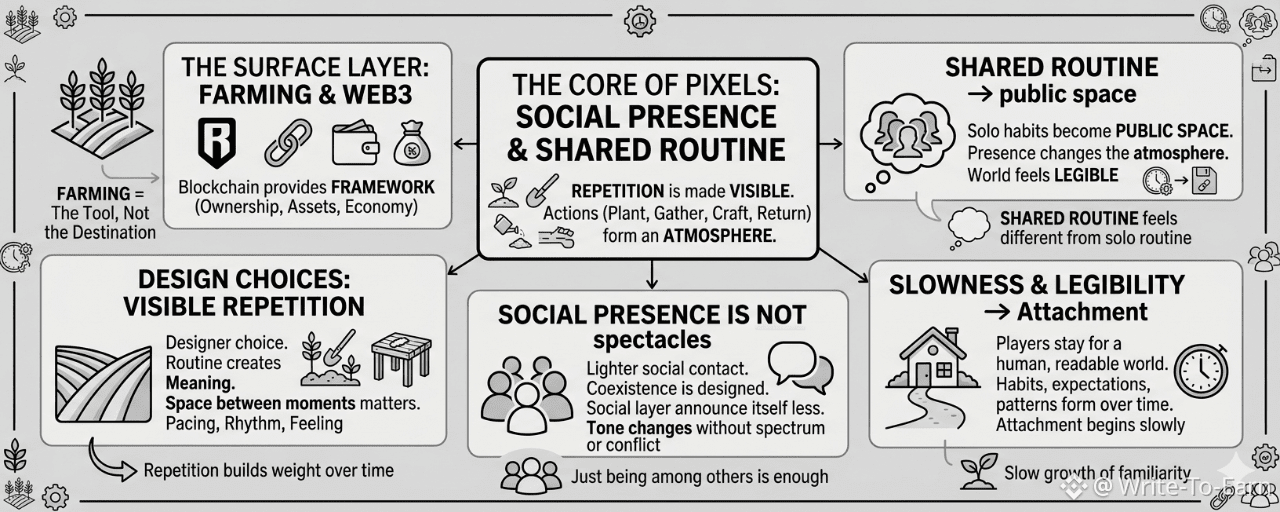
That sounds strange to say about a game built so heavily around farming, but after a while, that part starts to feel like the surface layer. Important, yes. Constant, definitely. But still just the surface. The deeper thing going on in Pixels is how it turns simple, repeated actions into a kind of social presence.
That is the part that stays with you.
In most games, repetition is something designers try to hide. They dress it up with louder rewards, faster progression, bigger effects. They do not want you to notice that you are doing the same few things again and again. Pixels almost does the opposite. It lets repetition stay visible. You plant, gather, move, craft, return. Then you do it again. And again. The game does not seem embarrassed by that. It builds around it.
That choice changes everything.
Because once repetition is no longer hidden, the question becomes: what makes repeated actions worth doing? In Pixels, the answer is not just progress. It is not only resources or in-game value or some long chain of upgrades. It is also the feeling that these actions are taking place in a world that other people are passing through at the same time. The routine is shared, even when it is quiet.
And shared routine feels different from solo routine.
You can feel that difference pretty quickly. In a single-player farming game, your habits belong only to you. They are sealed inside your save file. In Pixels, those habits become part of a public space. Even if nobody stops to talk, even if you are mostly focused on your own tasks, other players still change the atmosphere. Their presence gives shape to the world. A path feels more real when others are crossing it. A gathering area feels more alive when it carries signs of repeated use. A small task feels less empty when it happens inside a visible crowd.
That is where Pixels starts to separate itself a bit.
Not because it reinvents the farming genre. It does not. And honestly, it does not need to. A lot of what it uses is already familiar. Crops, quests, crafting, resource collection, skill building, wandering through zones, slowly improving your place in the world. None of that is unusual on paper. But games are not really made of paper descriptions. They are made of pacing, rhythm, and feeling. Two games can list the same features and land very differently.
Pixels lands in a softer way.
It is not trying to overwhelm you with scale. It is not trying to turn every moment into an event. It seems more interested in giving you enough to do, then letting the repetition create meaning on its own. That is a risky approach, because if the world does not hold together, the whole thing starts to feel thin. But if it does hold together, then something subtler happens. You stop asking what the next big moment is supposed to be. You start paying attention to the space between moments.
That shift matters more than people usually say.
A lot of web3 games got stuck because they were built around urgency. Earn this. Buy that. Move quickly. Extract value before attention fades. You could feel that pressure in the design. It made everything feel temporary, even when the games talked about long-term community or world-building. The world was there, technically, but it was hard to believe in it because everything pointed outside the world toward some reward loop.
Pixels seems to work best when it lowers that pressure.
Not completely. The web3 structure is still there. Ronin is still the network underneath it. Ownership, assets, economy, all of that remains part of the game’s identity. You cannot really talk about Pixels honestly without acknowledging that layer. But what is interesting is how the game seems to place that layer slightly behind the daily experience rather than in front of it.
That is an important distinction.
Because once the economic side becomes the first thing a player feels, the world starts to flatten. Every crop becomes a number. Every item becomes a trade. Every routine becomes labor. The game may still function, but it stops breathing a little. It becomes obvious after a while when that happens. People are no longer inhabiting a place. They are processing it.
Pixels seems aware of that danger.
So instead of treating blockchain as the emotional center, it leans on slower things. Familiar tasks. A readable world. A casual visual style. Player movement that feels loose rather than rigid. Social contact that does not always need to become conversation. It gives the impression that the game wants to be inhabited first and interpreted second.
That might be the smartest thing about it.
Because most players do not stay in a game because of its structure alone. Structure helps, of course. Systems matter. But people stay because a world starts to feel legible in a human way. They know where to go. They recognize patterns. They develop habits. They build small expectations. They begin to sense how long something takes, where certain things happen, what kinds of interactions the world allows. None of this sounds dramatic, but that is usually how attachment begins.
Slowly. Almost by accident.
Pixels understands that slowness better than a lot of games in its space. It does not seem obsessed with proving itself every second. It lets players repeat actions until those actions become familiar enough to carry some weight. That does not mean the game is deep in every possible sense. It means it trusts routine to do some of the emotional work.
And routine is underrated.
People often talk about games as if they need to be intense to matter. But plenty of games last because they become part of someone’s day in a modest way. Not the center of the day. Just part of its shape. You log in, do a few tasks, wander a bit, notice who is around, work toward something without needing it to feel monumental. There is a kind of honesty in that. Pixels feels closer to that mode than to the louder, more performative kind of online game.
That also changes how the social side works.
In many online spaces, social interaction is treated as a feature that needs to be constantly activated. Team up, speak, coordinate, compete, react. Pixels seems more comfortable with lighter contact. Just being among others can be enough sometimes. Seeing people move through the same environment already creates a feeling. The social layer does not always need to announce itself. It can just sit there, changing the tone of everything else.
That is a subtle design choice, but not a small one.
It means the game does not depend entirely on spectacle or conflict to make player presence meaningful. It can let people coexist. And coexistence is harder to design than it sounds. It requires a world with enough softness that players are not forced into extremes all the time. Pixels seems to make room for that kind of softness.
So in that sense, the game is less about farming than about familiarity. Farming just happens to be the tool it uses.
The crops matter because they slow time down. The exploration matters because it prevents that slowness from turning stale. The crafting matters because it gives a shape to what you collect. The social space matters because it keeps the routine from feeling sealed off. Ronin and the web3 layer matter because they frame ownership and persistence. But none of those pieces fully explain the experience on their own. It is the way they settle together that makes the game feel distinct.
Not revolutionary. Not beyond comparison. Just distinct in its own quiet way.
And maybe that is the right scale to think about Pixels. Not as some giant statement about the future of games, and not as a simple farming loop with blockchain attached. More like an experiment in what happens when a digital world stops trying to impress you immediately and instead asks whether you can live with its rhythm for a while.
That is a different kind of test.
And the answer probably depends less on whether someone is interested in web3, and more on whether they care about games that build attachment through repetition instead of force. Pixels seems to sit in that space. Calmly. A little awkwardly at times, maybe. But still there, letting the same small actions gather meaning over time. Then letting that meaning stay unfinished for a while.
@Pixels #pixel $PIXEL

Artikel
What makes Pixels interesting is not really the farming.
Haftungsausschluss: Die hier bereitgestellten Informationen enthalten Meinungen Dritter und/oder gesponserte Inhalte und stellen keine Finanzberatung dar. Siehe AGB.