On the surface, it looks simple. Farming. Exploring. Crafting. A social open world with that soft, casual rhythm that makes people stay longer than they planned. It runs on Ronin, so people naturally place it in the web3 bucket. But after a while, that framing starts to feel too narrow. Because what really matters is not just that @Pixels is onchain. It is how the team learned, in public and under pressure, what actually keeps a game economy alive.
That’s where Stacked starts to make sense.
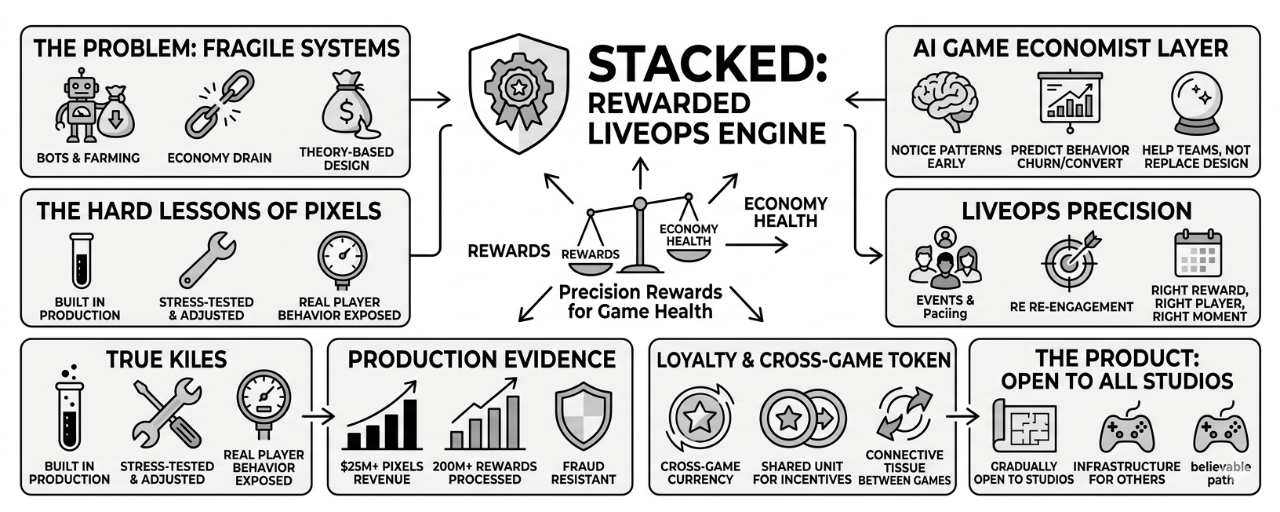
The simple version is this: Stacked is a rewarded LiveOps engine built by the Pixels team. It helps game studios give the right reward to the right player at the right moment, then see whether that actually changed anything. Did it help retention? Did it improve revenue? Did it lift LTV over time? That is the real question. Not “did players like the reward,” but “did the game become healthier because of it.”
You can usually tell when a rewards system was designed from theory instead of experience. It looks fine on paper. Players earn something, come back for a bit, and numbers move just enough for everyone to feel optimistic. Then the usual problems show up. Bots arrive. Farming behavior takes over. Rewards leak out faster than value comes in. The system starts feeding itself instead of the game. And eventually the whole thing feels thin. Familiar. Replaceable.
Pixels seems to have lived through enough of that to stop treating rewards as a surface-level feature.
That is probably the most important part here. Stacked does not read like another generic rewards layer bolted onto a game because rewards are trendy or because a token exists and needs a use case. It feels more like infrastructure that came out of hard lessons. The team went through the messier part first. They saw what broke. They saw what attracted the wrong behavior. They saw how easily a reward loop can start draining the economy it was supposed to support. And instead of walking away from that problem, they built around it.
So now the pitch becomes much clearer: Stacked is a rewarded LiveOps engine for games, with an AI game economist sitting on top.
That phrase can sound abstract for a second, but the idea underneath it is pretty grounded. LiveOps already means the ongoing tuning of a game while people are playing it. Events, offers, incentives, re-engagement, pacing, reward timing. The part Stacked adds is precision. Not every player should get the same thing. Not every moment is equal. A reward that helps one player stay engaged might be wasted on another, or worse, teach the wrong habit. So instead of blasting incentives across the whole player base, the system looks for where a reward might actually matter.
Then there is the AI economist layer, which is where things get more interesting.
Not because “AI” makes it more impressive by default. Usually that word just makes people more cautious. Fair enough. But here the useful part seems to be that the system can look across player behavior and point toward experiments worth trying. That is a different use of AI than the usual consumer-facing gimmick. It is less about replacing design judgment and more about helping teams notice patterns early. Who is at risk of dropping off. Who is likely to convert. Which kind of reward changes behavior, and which just gets claimed and forgotten. Over time, the question changes from “can we give rewards?” to “can we use rewards without distorting the game?”
And apparently there is actual production evidence behind that.
Stacked-powered systems have contributed to more than $25 million in Pixels revenue. That number matters mostly because it shifts the conversation. It stops being a product story and becomes an operating story. This is not an idea waiting for its first real test. It has already been used inside the Pixels ecosystem. Pixels itself. Pixel Dungeons. Chubkins. More than 200 million rewards processed. At that scale, you are not really talking about a prototype anymore. You are looking at something that has already been exposed to real player behavior, real edge cases, real abuse attempts, and the slow pressure of everyday game operations.
And that fraud-resistant part matters more than people sometimes admit.
A lot of web3 gaming systems sound exciting until incentives touch reality. Once there is real money, or even meaningful in-game value, behavior changes quickly. Players optimize. Farmers appear. Bots test every seam. So any rewards engine that wants to last has to assume adversarial behavior from the start. Not as an exception, but as the normal environment. It becomes obvious after a while that the hardest part is not distributing rewards. The hard part is making rewards useful without making them exploitable.
That also connects to how $PIXEL fits into this.
The token is not being framed here as a single-game asset floating around in search of purpose. It sits inside the rewards system as a cross-game currency and loyalty layer. That is a more practical role. It gives the ecosystem a shared unit for incentives across titles instead of tying all meaning back to one game loop. If more external studios come in, that becomes even more relevant. The token starts functioning less like a bet on one product and more like connective tissue between games.
That seems to be the direction now. Built in production first. Used internally. Stress-tested. Then gradually opened to outside studios.
Which, honestly, is a much more believable path than launching with a huge promise and figuring out the mechanics later.
So if someone asks what this really is, the clean answer is probably not “a web3 rewards platform” or “an AI monetization tool,” even though those labels will get used. It is closer to this: the Pixels team took a problem they had already suffered through, built a system to manage it properly, and now that system is becoming a product other studios can use too.
And with Pixels itself, that context matters. Because the game is not just the setting around the token. It is the place where the logic got tested, adjusted, and made real. Everything else sort of follows from that.
#pixel

Artikel
Pixels is an easy game to misunderstand at first.
Haftungsausschluss: Die hier bereitgestellten Informationen enthalten Meinungen Dritter und/oder gesponserte Inhalte und stellen keine Finanzberatung dar. Siehe AGB.