A lot of people hear “web3 game” and their mind goes straight to tokens, wallets, speculation, all that noise that usually sits around blockchain projects. That reaction makes sense. It has happened enough times that people expect the game part to come second. With Pixels, though, that assumption starts to feel a little off once you spend time with it.
Because the first thing you notice is not really the blockchain side. It is the pace.
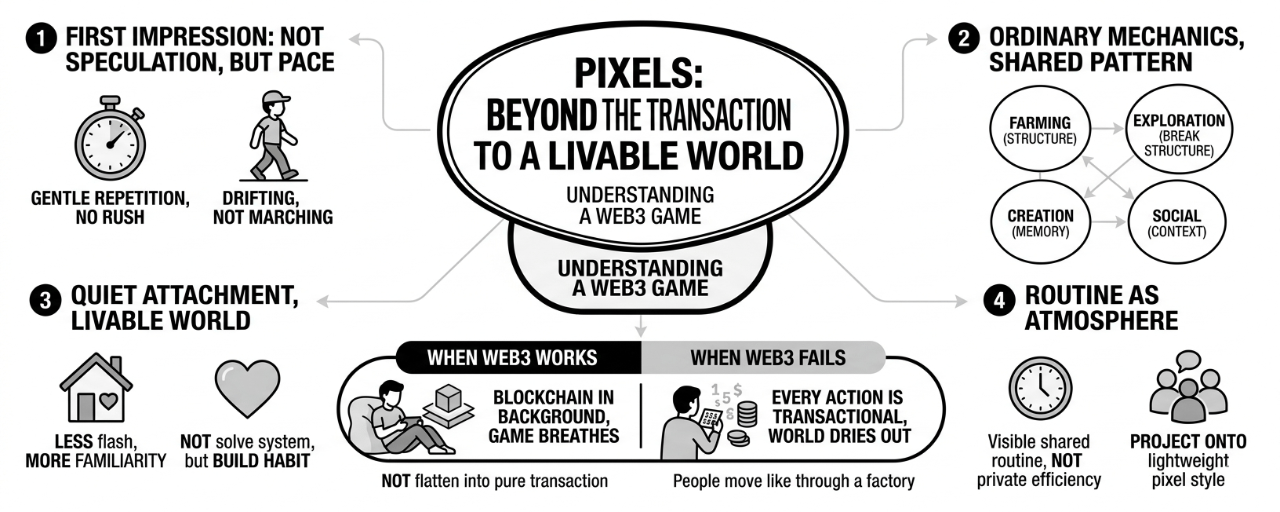
Everything in Pixels moves with a kind of gentle repetition. You plant. You harvest. You walk somewhere else. You gather materials. You craft a few things. Maybe you talk to someone. Maybe you follow a quest for a while, then drift off and do something smaller instead. The game does not rush you into seeing itself as a system to solve. It feels more like a place that wants you to settle into it.
And I think that changes how the whole thing lands.
Most games built around progress are pretty direct about it. They want you to chase a level, a rank, a stronger weapon, a bigger win. Pixels does have progress, obviously. It has skills, resources, routines, upgrades, and all the familiar structures that keep a game moving. But it presents them in a softer way. You are not constantly being pushed toward some dramatic peak. You are more often circling through small actions that slowly start to connect.
That sounds minor, but it changes the mood.
You can usually tell when a game wants to impress you immediately. Pixels does something quieter. It lets the world explain itself through repetition. After a while, the farming is not just farming. It becomes the thing that anchors everything else. Exploration matters because you need materials and new areas. Crafting matters because all that collecting needs a purpose. Social spaces matter because shared worlds feel different once other people are moving through the same routines as you.
So the game starts to feel less like a set of features and more like a pattern.
That is probably the angle that makes the most sense to me. Pixels is not really about any single mechanic. It is about how ordinary mechanics support each other. Farming gives the day structure. Exploration breaks the structure open. Creation gives it memory. Social interaction gives it context. None of these parts are new on their own. The interesting part is how calmly they sit next to each other.
And that calm matters more than people sometimes admit.
There is a tendency, especially around blockchain games, to talk about scale, innovation, disruption, all those big words that usually hide the fact that a game either feels good to return to or it does not. Pixels seems more aware of that than a lot of projects in the same space. It does not try to win you over with complexity first. It leans on familiarity. Crops, land, gathering, quests, wandering around, meeting people. Things that already make sense.
That choice tells you something.
It suggests the game knows the real problem is not getting people to understand a system. The real problem is getting them to care about being there. That is harder. A lot harder, actually. People can learn rules in five minutes. What takes longer is building that quiet sense of attachment, where you log in not because something flashy is happening, but because the world has started to feel slightly lived in.
That is where Pixels becomes easier to understand.
The Ronin Network and the web3 framework are important, sure. They shape ownership, economy, identity, and how certain assets work across the game. But if you lead with that, you miss the texture of the thing. It is like describing a small town only by talking about its road system. Technically that matters. It helps everything function. But it is not the reason the place feels the way it feels.
In Pixels, the real texture comes from repetition shared with other people.
You plant things that take time. You return to places more than once. You start recognizing routines. You start recognizing other players too, or at least the feeling that other players are nearby, doing their own version of the same things. That changes the emotional shape of a farming game. In a single-player setup, routine can become private and a little sealed off. In a shared world, routine becomes visible. It becomes atmosphere.
That is a small shift, but it carries a lot.
Because once routine becomes atmosphere, the game stops being just about efficiency. The question changes from “How fast can I optimize this?” to “What kind of place does this become when people keep showing up?” That is a more interesting question, honestly. And it is one that social games live or die by.
Pixels seems to lean into that without making a huge speech about it. It lets the open world do some of the work. It lets movement matter. It lets people drift rather than march. The pixel-art style helps too. Not because retro visuals automatically make a game cozy, but because they reduce friction. They keep things readable. They leave a little room for imagination. The world feels light enough that players can project themselves into it without being overwhelmed.
You see that a lot in games people stick with for longer than expected.
Not because they are the biggest or deepest games in a strict mechanical sense, but because they leave space for habit. And habit is underrated. People talk about immersion like it has to come from giant cinematic moments. Sometimes it comes from doing the same small task over and over until it starts to feel natural. Walk here. Water that. Gather this. Check what changed. Talk to someone on the way. Leave. Come back later.
Pixels is built on that kind of rhythm.
Of course, the web3 part still matters. You cannot just pretend it is incidental. It shapes how people think about land, items, rewards, and value. It also brings a certain tension into the game, because anything tied to ownership and tokens risks pulling attention away from the world itself. That tension never fully disappears. It is just there in the background. You can feel it.
But maybe the more honest way to put it is this: Pixels works best when the blockchain layer stays in the background long enough for the game layer to breathe.
That is the balance it seems to be chasing. Not removing the economic side, not denying the structure underneath, but making sure those things do not flatten the experience into pure transaction. Because once every action feels transactional, the world starts to dry out. Players stop noticing the place and only notice the output. It becomes obvious after a while when that happens. People move through the game like they are passing through a factory.
Pixels seems to resist that, at least in spirit, by making the world feel slow enough to inhabit.
And that slowness is probably the part that stays with me. Not in some romantic way. Just as a design choice that reveals what the game is really trying to do. It is trying to make blockchain feel less like an interruption and more like part of the furniture. Something present, but not constantly demanding attention. Whether that fully works will depend on the player, and probably on the state of the economy around the game too. Still, the intention shows.
So when people describe Pixels as a social casual web3 game about farming, exploration, and creation, that is accurate, but only in the plainest sense. The fuller picture is quieter. It is a game about shared routine. About how simple tasks start to mean more when they happen in a world that continues around you. About how familiarity can sometimes do more than novelty. And about how a game in this space maybe does better when it stops trying so hard to announce what it is.
Then it just lets people wander a bit and figure it out in their own time.
That seems closer to what Pixels actually feels like, or at least part of it. The rest is still unfolding a little.
@Pixels #pixel $PIXEL

Artikel
Pixels is easy to misread at first.
Haftungsausschluss: Die hier bereitgestellten Informationen enthalten Meinungen Dritter und/oder gesponserte Inhalte und stellen keine Finanzberatung dar. Siehe AGB.