I believe my old friends who often watch me know that I have been continuously following Aethir @AethirCloud for over a year!
Last year, I also acquired their nodes. To be honest, I didn't expect to make a huge profit at that time; I just felt that this project was solid and not playing tricks. As a result, unexpectedly, amid many projects losing money, it became one of the few projects that made me money, which is a pleasant surprise.
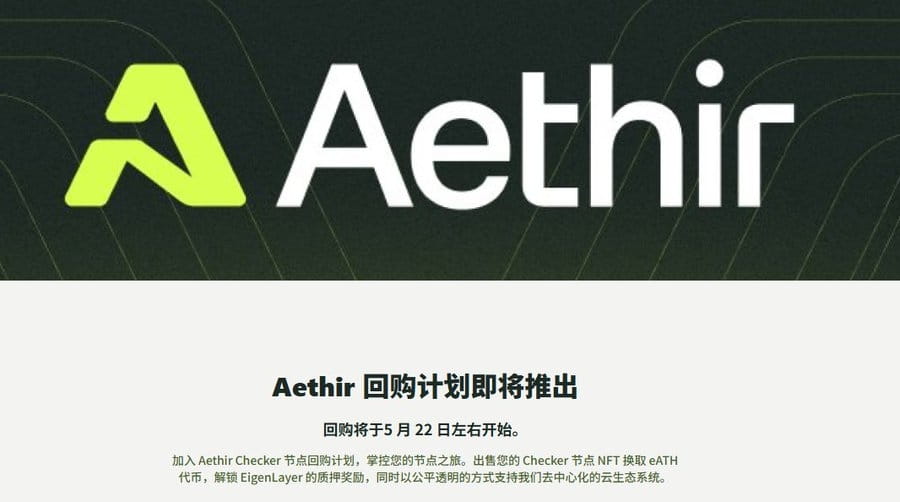
Recently, the project team has made a big move: The buyback plan for Checker Node NFTs has officially launched. Given their recent series of operations, I feel this matter is worth discussing thoroughly, as it may be a key entry point for us to understand the long-term value of Aethir @AethirMandarin.
I. Core points of the buyback plan: It provides node users with a clear way to exit or upgrade, which I will explain in three points:
1. What is node buyback?
In simple terms, as long as you have a Checker Node NFT (regardless of whether it is T1 to T6), you can now sell it directly to Aethir's official team in exchange for eATH tokens (which are the certificate of ATH staked in EigenLayer). This is different from selling on an exchange; the project team is actively opening channels to buy your NFT, initially offering 200 million ATH as a funding pool, and may increase the amount later depending on the situation.
2. Key details overview
Timeline: The buyback plan officially starts on May 22, 2025; you can directly log on to the official website https://checkerbb.aethir.com to operate.
How to collect payments: After selling the NFT, you receive eATH tokens, which are equivalent to staking ATH into EigenLayer as a 'certificate'. However, eATH needs to be locked for 1 year, during which you can simultaneously earn staking rewards from both ATH and EIGEN, which means 'the money is still working, and you can earn double rewards.'
Transaction fee: A 10% fee is charged for each transaction, mainly to maintain platform operations and incentivize the ecosystem; it's not just a cost.
Impact of exit: Once you sell the NFT to the official party, you no longer hold the node, and future earnings are lost. However, historical rewards that were not claimed before selling can still be claimed normally through the official website, so you don't have to worry about 'not getting the money.'
3. Why settle with eATH?
In simple terms, eATH is not just a 'payment certificate'; it's more like a 'pass' to enter the EigenLayer ecosystem. By binding to EigenLayer's staking reward mechanism, even if you exit the node, you can still participate in other incentive activities during the lock-up period of one year, meaning 'the person has exited the node, but the revenue chain has not been broken,' allowing you to earn passive income while developing alongside the ecosystem, achieving two goals at once.
II. The purpose behind the buyback: Shifting focus from quantity growth to quality enhancement
Many people wonder: Why is the project team buying back at this time? This is actually a necessary path for ecological upgrading:
1. Activate liquidity: Provide a decent exit channel for early participants to avoid a low-price sell-off impacting the market, especially suitable for users who no longer wish to operate nodes for various reasons.
2. Optimize network structure: Recover idle nodes, focus resources on active computing power, and improve GPU utilization (which has currently reached over 70%, with over 428,000 GPUs deployed), solidifying infrastructure competitiveness.
3. Strengthen ecological collaboration: Deepen cooperation with EigenLayer through eATH, leveraging its staking network to expand the application scenarios of ATH, while paving the way for the future AVS model (accelerated cloud host access).
III. Aethir's 'report card': Proving with actions that it's not just talk
The confidence in the buyback comes from the project's continuous delivery capability, with key progress over the past year including:
Infrastructure and ecology:
Launched a $100 million ecological fund to support Web3 AI, NodeFi, and other fields; expanded the Solana chain to engage more developers and users; collaborated with Plume to initiate a $10 million RWAI fund, laying out the financialization of AI computing power.
Industry collaboration:
Jointly launched the AVS model with EigenLayer to lower the operational threshold for nodes;
Initiated the Web3 AI Alliance AI Unbundle, aggregating partners like MetaStreet and ADBC to accelerate AI + game development in the Middle East and North Africa.
Market performance:
ATH price rose from $0.03 at the beginning of the month to $0.048, highlighting the attractiveness of value projects during the market recovery period.
IV. Who is suited to participate in the buyback? How to choose?
Short-term arbitrageurs: If the cost of holding a node is lower than the buyback price, this can lock in profits, especially suitable for NFT holders with insufficient liquidity;
Flexible allocators: Sell some nodes to exchange for eATH, laying out potential airdrop opportunities in the EigenLayer ecosystem while retaining some nodes to enjoy long-term computing power dividends;
Long-term believers: Can continue to hold nodes to enjoy triple staking rewards (which are still ongoing) and the appreciation space brought by the future explosion in AI computing power demand.
V. Advice for investors: Pragmatic projects are more worthy of 'slow heat attention'
The Web3 market is becoming increasingly pragmatic; projects that only make grand claims are struggling, while those that truly deliver can go far. Aethir's current buyback of nodes is not an endpoint but a signal of ecological maturity — from their deployment of over 428,000 GPUs to collaboration with reliable partners like EigenLayer, it shows a 'no boasting, just solid work' style. Here are three solid pieces of advice for investors focusing on cloud computing + AI + blockchain:
If you want to keep up with progress, first join the official group: Although sometimes the link may act up (like this Telegram group https://t.me/AethirCN), official news is usually synchronized first in the group, so you can know the buyback progress and new features as soon as possible.
Focus on these numbers: How much staking income can be earned during the eATH lock-up period, whether the GPU utilization continues to improve (it's already over 70%), and whether there are new ecological collaboration cases launched; these are the hard indicators that determine project value.
Think clearly about how long you can hold on: If you need money urgently, exiting through the buyback is quite decent; if you are optimistic about the long-term ecosystem, keeping the node might allow you to catch the dividends of the AVS model launch later. Don't follow the crowd; act according to your own financial pace.
Lastly, I want to say that with such great market uncertainty, Aethir's willingness to buy back nodes with real money and solidly build the ecosystem is already more reliable than many projects. Whether you plan to sell nodes for eATH or continue to hold for appreciation, the underlying logic of 'computing power infrastructure + token economy' is worth pondering — after all, in this restless circle, projects that are willing to take their time to solidify their work are more likely to withstand the test of time.