
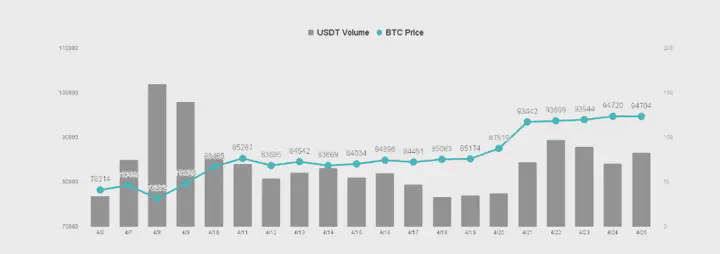
The change in market conditions last week was highly indicative for Bitcoin and the cryptocurrency market. Market funds finally view Bitcoin as 'digital gold' and are gradually decoupling from the performance of U.S. stocks. Price fluctuations quickly overlapped with gold, pushing Bitcoin's price directly up to $94,000, with a weekly increase of 12%. Although U.S. stocks rebounded, the trends clearly showed a significant gap with cryptocurrencies.

Central banks around the world may gradually reduce their reliance on U.S. Treasury bonds due to uncertainties in U.S. tariffs, fiscal policy, and economy, turning to alternative assets including gold and Bitcoin, which has also driven up the prices of gold and Bitcoin.
The market is changing the way it assesses Bitcoin's value, shifting from following the fluctuations of U.S. tech stocks to gradually redefining it as a safe-haven choice outside of the U.S. dollar, positioning it closer to value storage tools like gold. After experiencing a period of correction, the cryptocurrency market has regained vitality, sparking speculation about a trend reversal.
However, it cannot be concluded that a full recovery has taken place yet.
Investor confidence in the U.S. seems to be recovering. Since April 21, Bitcoin has begun to show signs of a trend reversal. Large investors are becoming active buyers again, especially the accumulation of whales on Binance often signals a market rebound. Subsequently, similar behavior has been observed among U.S. investors on Coinbase. Notably, the Coinbase premium, which represents the sentiment of U.S. retail investors, continues to be positive, indicating stable demand in the U.S. market, and this wave of recovery has already shown structural changes.
Due to the ongoing uncertainty of U.S. tariff policies, along with the freezing of $300 billion in Russian central bank assets due to the invasion of Ukraine, this incident has caused medium-sized countries to reconsider their reserve policies. Rather than using foreign exchange to purchase U.S. Treasury bonds, it may be better to invest in Bitcoin or gold as value storage tools. This is also true for other emerging countries, leading to an increasing demand for assets that are unrelated to traditional markets. Bitcoin, like gold, is seen as a safe-haven asset, and global investors are seeking assets that can perform differently in times of crisis.
The correlation between Bitcoin and U.S. stocks is gradually decreasing, indicating that it is developing into a global value storage asset. Bitcoin is gradually acquiring safe-haven functions similar to gold, attracting institutional investors.
With Trump's posture softening, the rise of Bitcoin may pause.
Regarding the U.S.-China tariff war, the U.S. is certainly at a disadvantage, as they rely heavily on low to medium-cost imports. Last week, Trump continually signaled that both sides are communicating. First, Trump indicated that he might lower tariffs on specific goods, then rumors about potentially lowering tariffs on China were leaked through the White House and media. If the opponent does not respond or refuses, it can be dismissed as rumors as a way to step down without undermining their own negotiation leverage.
But the current U.S.-China tariff tensions continue to be in the spotlight, with Wall Street hoping for signs of easing relations. Reports on Friday indicated that China quietly canceled some tariffs on U.S. semiconductors to alleviate pressure on its technology sector.
If trade negotiations make progress, there may be exemptions for tariffs on U.S. ethane and liquefied petroleum gas (LPG).
Despite China publicly displaying a tough stance, Trump's attitude was relatively mild last week. Trump stated that the U.S. has always been in contact with China, indicating that the U.S. unilaterally desires to negotiate with China and is showing goodwill and weakness.
The anticipated trade war may end faster than expected, which is not beneficial for Bitcoin's current positioning as digital gold, hindering its sustained rise. Considering Trump's attitude and a series of weakening actions, as well as the general estimate from the three major U.S. suppliers that current retail shelf inventories can support about 2 months of sales, costs will rise significantly due to tariffs afterwards. It is clear that Trump must reach a negotiation agreement with various countries within a limited time frame.
This is also why Trump suddenly announced that within 2 to 3 weeks, he would re-implement reciprocal tariffs on countries that have not reached an agreement, rather than the previously promised 90-day exemption period. The U.S. side is under time pressure; if tariffs drag on too long, U.S. costs will rise significantly due to tariffs, driving U.S. prices to soar and public grievances will certainly spike.
Assuming so, it is almost impossible for Trump to win next year's midterm elections, so the U.S. side's time is running out, and the challenges are quite high. It is certain that concessions will be made to major economies like China and the EU. Therefore, it is believed that the current rise in Bitcoin is a good profit-taking point. After the trade war ends, confidence in the U.S. dollar will gradually recover, and at that time, Bitcoin's positioning as digital gold may actually hinder its rise.
