
#vanguardopensdigitalassetsheadsearch
vanguardopensdigitalassetsheadsearch
12,344 views
140 Discussing
Hot
Latest

#VanguardOpensDigitalAssetsHeadSearch
Change of heart, or just keeping up with the times? 🔄
Vanguard is reportedly looking for a **Head of Digital Assets**.
For anyone who follows the crypto and digital asset space, this is a massive headline. Vanguard has famously been one of the most conservative major asset managers when it comes to cryptocurrency, previously blocking its users from buying spot Bitcoin ETFs on its platform.
But this move signals a major shift.
Why this matters:
*Pragmatism over Dogma:** Even the most traditional financial giants realize they can't ignore the infrastructure of digital assets forever.
* **Beyond just "Crypto":** A "Digital Assets" role usually signals an interest in tokenization, blockchain technology, and modernizing financial plumbing—not just trading coins.
* **Client Demand:** It’s a clear sign that institutional and retail pressure is moving the needle.
It’s a reminder that in finance, adaptation isn't optional—it's inevitable. It will be fascinating to see who lands this role and how they shape Vanguard’s strategy moving forward.
What do you think? Is this a total pivot for Vanguard, or just a cautious toe in the water?
#DigitalAssets #Finance ##Web3 #AssetManagementUpdate
Change of heart, or just keeping up with the times? 🔄
Vanguard is reportedly looking for a **Head of Digital Assets**.
For anyone who follows the crypto and digital asset space, this is a massive headline. Vanguard has famously been one of the most conservative major asset managers when it comes to cryptocurrency, previously blocking its users from buying spot Bitcoin ETFs on its platform.
But this move signals a major shift.
Why this matters:
*Pragmatism over Dogma:** Even the most traditional financial giants realize they can't ignore the infrastructure of digital assets forever.
* **Beyond just "Crypto":** A "Digital Assets" role usually signals an interest in tokenization, blockchain technology, and modernizing financial plumbing—not just trading coins.
* **Client Demand:** It’s a clear sign that institutional and retail pressure is moving the needle.
It’s a reminder that in finance, adaptation isn't optional—it's inevitable. It will be fascinating to see who lands this role and how they shape Vanguard’s strategy moving forward.
What do you think? Is this a total pivot for Vanguard, or just a cautious toe in the water?
#DigitalAssets #Finance ##Web3 #AssetManagementUpdate

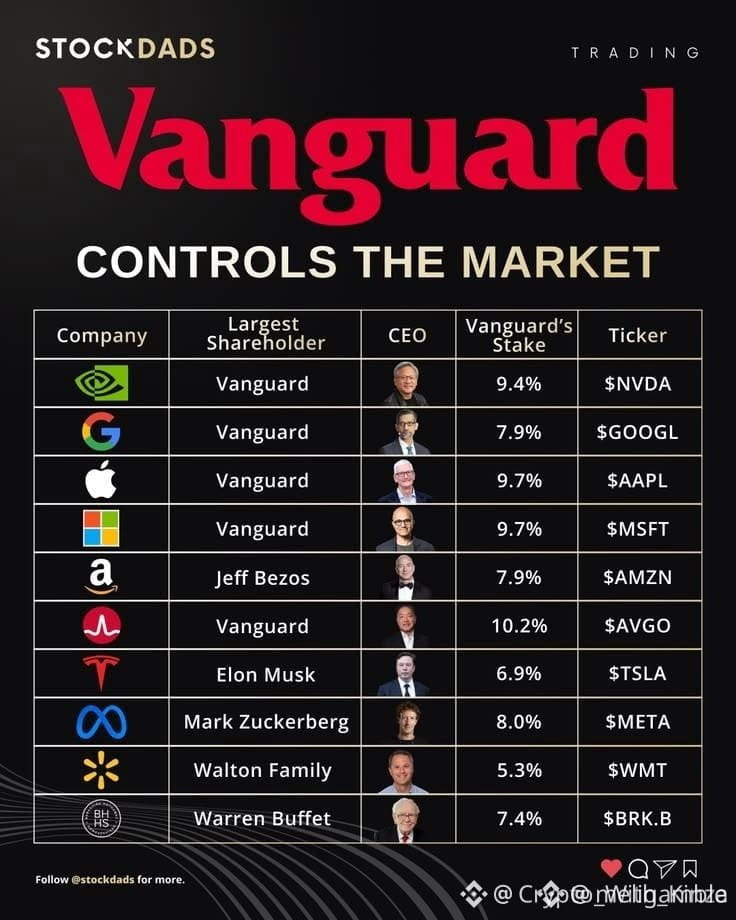

#VanguardOpensDigitalAssetsHeadSearch
The financial world continues to evolve, and recent reports that Vanguard is searching for a Head of Digital Assets have sparked discussions across the crypto community. While the company has traditionally taken a cautious approach to cryptocurrencies, this move may signal a growing interest in understanding and expanding its digital asset strategy.
Digital assets are becoming an increasingly important part of the global financial landscape. From Bitcoin and Ethereum to tokenized real-world assets, many institutions are exploring how blockchain technology can improve efficiency, transparency, and access to financial services.
If a major investment firm like Vanguard strengthens its digital asset team, it could reflect the broader trend of traditional finance paying closer attention to blockchain innovation. However, a leadership search does not necessarily mean immediate new products or a major shift in company policy. Investors should wait for official announcements before drawing conclusions.
For crypto enthusiasts, institutional interest is worth watching because it may contribute to broader adoption over time. At the same time, it's important to make investment decisions based on research and long-term goals rather than headlines alone.
As the digital asset industry continues to mature, collaboration between traditional finance and blockchain technology could shape the next phase of financial innovation.
💬 Question for readers: Do you think traditional financial institutions will play a bigger role in the future of cryptocurrency? Why or why not?
Hashtags: #VanguardOpensDigitalAssetsHeadSearch #BinanceSquare #Crypto #Bitcoin #Blockchain #DigitalAssets #Web3
The financial world continues to evolve, and recent reports that Vanguard is searching for a Head of Digital Assets have sparked discussions across the crypto community. While the company has traditionally taken a cautious approach to cryptocurrencies, this move may signal a growing interest in understanding and expanding its digital asset strategy.
Digital assets are becoming an increasingly important part of the global financial landscape. From Bitcoin and Ethereum to tokenized real-world assets, many institutions are exploring how blockchain technology can improve efficiency, transparency, and access to financial services.
If a major investment firm like Vanguard strengthens its digital asset team, it could reflect the broader trend of traditional finance paying closer attention to blockchain innovation. However, a leadership search does not necessarily mean immediate new products or a major shift in company policy. Investors should wait for official announcements before drawing conclusions.
For crypto enthusiasts, institutional interest is worth watching because it may contribute to broader adoption over time. At the same time, it's important to make investment decisions based on research and long-term goals rather than headlines alone.
As the digital asset industry continues to mature, collaboration between traditional finance and blockchain technology could shape the next phase of financial innovation.
💬 Question for readers: Do you think traditional financial institutions will play a bigger role in the future of cryptocurrency? Why or why not?
Hashtags: #VanguardOpensDigitalAssetsHeadSearch #BinanceSquare #Crypto #Bitcoin #Blockchain #DigitalAssets #Web3

#VanguardOpensDigitalAssetsHeadSearch Big move from Vanguard.
Vanguard is searching for a Head of Digital Assets, signaling that even traditional finance giants are paying closer attention to blockchain and crypto. Institutional adoption continues to build behind the scenes.
Smart money is preparing. Are you? 👀
#Crypto #Bitcoin #DigitalAssets
Vanguard is searching for a Head of Digital Assets, signaling that even traditional finance giants are paying closer attention to blockchain and crypto. Institutional adoption continues to build behind the scenes.
Smart money is preparing. Are you? 👀
#Crypto #Bitcoin #DigitalAssets
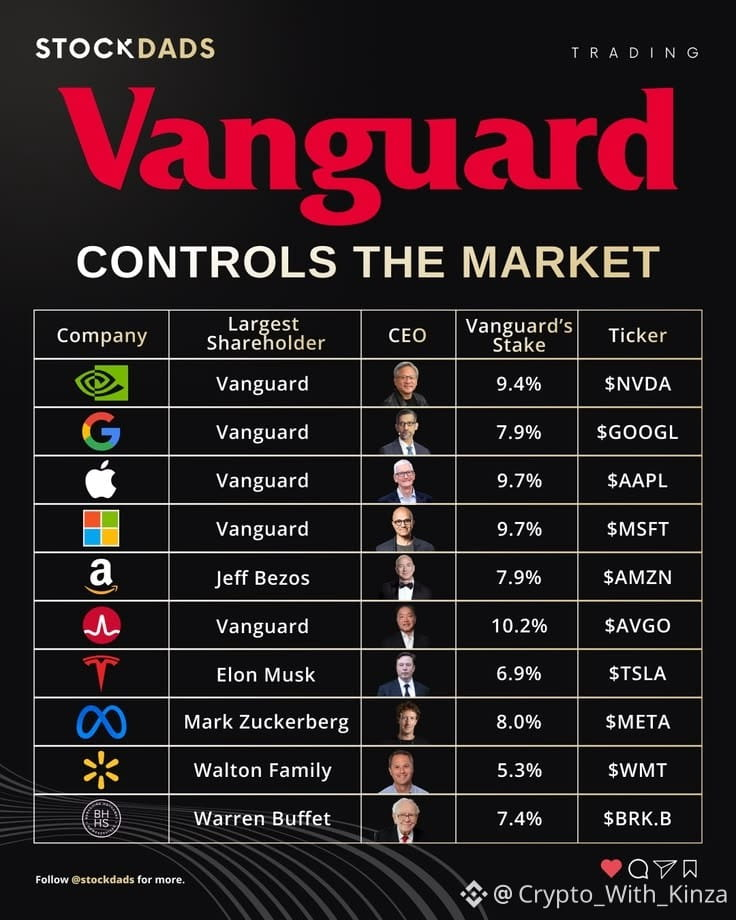

#VanguardOpensDigitalAssetsHeadSearch Vanguard has just opened job openings for the Head of Digital Assets position, marking a significant strategic shift from one of the world’s largest asset managers, who was previously known to be highly skeptical of crypto. This move expands the company’s focus to more systematically and deeply examine the blockchain ecosystem.


#vanguardopensdigitalassetsheadsearch
The Last Institutional Holdout Just Capitulated. 🏛️➡️⛓️
Vanguard—the $8+ trillion traditional finance giant that famously banned clients from buying Spot Bitcoin ETFs—is officially entering the arena.
They have just launched a global search for their first-ever Head of Digital Assets.
If you needed a sign that the wall between TradFi and Web3 has permanently crumbled, this is it. Here is the professional breakdown of what is happening behind the scenes and why it matters for your portfolio.
🎯 The Strategic Blueprint
This is not a public relations stunt. The new executive will sit within Vanguard Personal Wealth with a mandate to build a multi-year infrastructure roadmap. The core focus areas include:
RWA Tokenization: Migrating real-world assets onto the blockchain.Stablecoins & Custody: Integrating digital wallets into traditional brokerages.On-Chain Settlement: Utilizing blockchain for instant backend financial clearing.
🔄 The "BlackRock Effect"
The shift is driven directly by new CEO Salim Ramji—the former BlackRock executive who masterminded their ETF dominance. Under his leadership, Vanguard has already quietly reversed its ban, allowing clients to trade third-party crypto ETFs. Hiring a Digital Assets chief is the logical next step toward deep ecosystem integration.
💡 The Big Takeaway for Investors
Vanguard claims they still won't issue their own proprietary crypto tokens. Don't let that distract you.
The real story here is infrastructure. When a conservative giant with trillions in assets starts hiring for blockchain settlement and tokenization, Web3 ceases to be an "alternative asset class." It becomes the new operating system for global finance.
The institutional dominoes have fallen. Capital always finds a way. 🌊
What is your move? Are you heavily exposed to RWA tokens ahead of this institutional wave? Let's discuss in the comments. 👇
#Vanguard #Web3 #Tokenization #RWA
The Last Institutional Holdout Just Capitulated. 🏛️➡️⛓️
Vanguard—the $8+ trillion traditional finance giant that famously banned clients from buying Spot Bitcoin ETFs—is officially entering the arena.
They have just launched a global search for their first-ever Head of Digital Assets.
If you needed a sign that the wall between TradFi and Web3 has permanently crumbled, this is it. Here is the professional breakdown of what is happening behind the scenes and why it matters for your portfolio.
🎯 The Strategic Blueprint
This is not a public relations stunt. The new executive will sit within Vanguard Personal Wealth with a mandate to build a multi-year infrastructure roadmap. The core focus areas include:
RWA Tokenization: Migrating real-world assets onto the blockchain.Stablecoins & Custody: Integrating digital wallets into traditional brokerages.On-Chain Settlement: Utilizing blockchain for instant backend financial clearing.
🔄 The "BlackRock Effect"
The shift is driven directly by new CEO Salim Ramji—the former BlackRock executive who masterminded their ETF dominance. Under his leadership, Vanguard has already quietly reversed its ban, allowing clients to trade third-party crypto ETFs. Hiring a Digital Assets chief is the logical next step toward deep ecosystem integration.
💡 The Big Takeaway for Investors
Vanguard claims they still won't issue their own proprietary crypto tokens. Don't let that distract you.
The real story here is infrastructure. When a conservative giant with trillions in assets starts hiring for blockchain settlement and tokenization, Web3 ceases to be an "alternative asset class." It becomes the new operating system for global finance.
The institutional dominoes have fallen. Capital always finds a way. 🌊
What is your move? Are you heavily exposed to RWA tokens ahead of this institutional wave? Let's discuss in the comments. 👇
#Vanguard #Web3 #Tokenization #RWA

#VanguardOpensDigitalAssetsHeadSearch
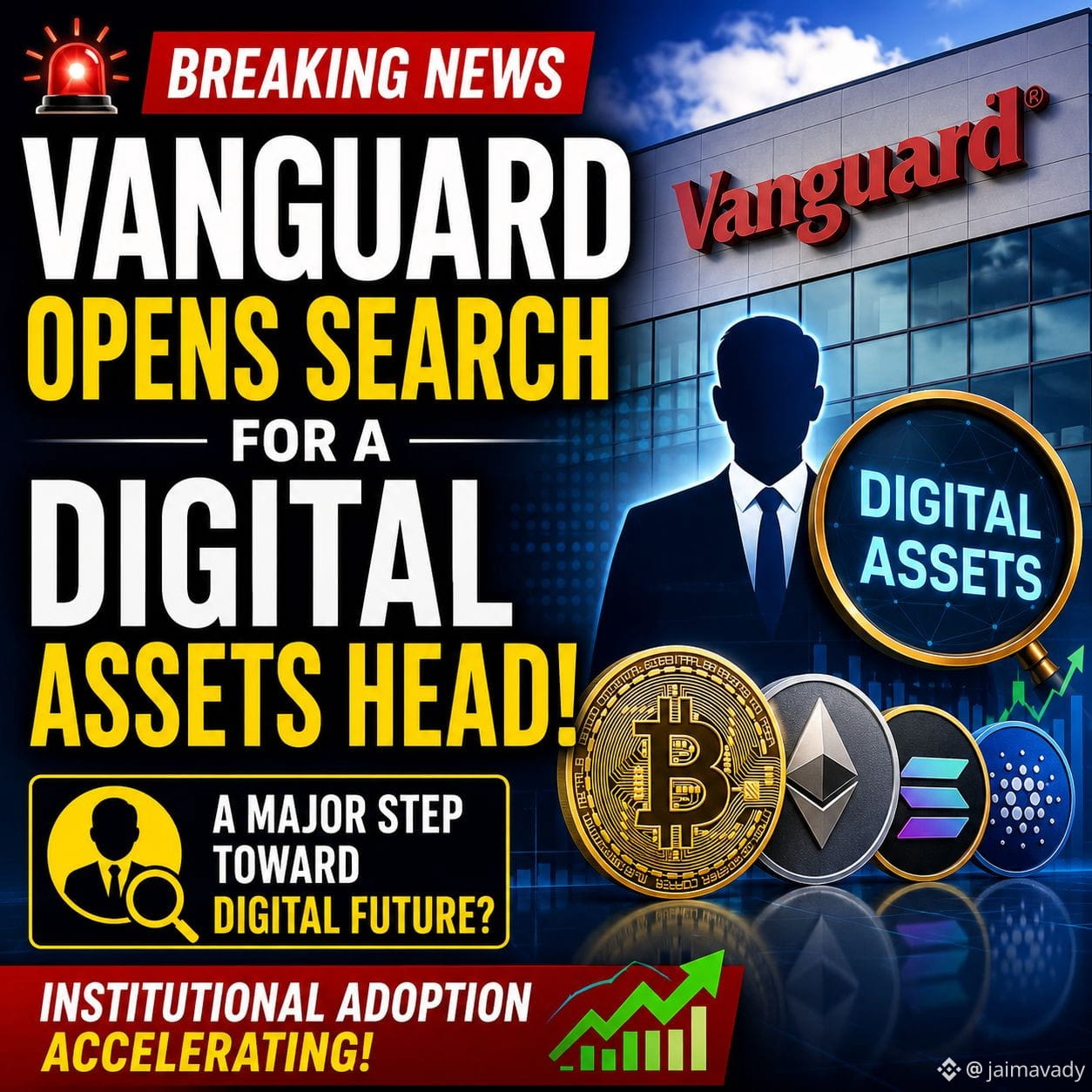
🚨 Vanguard Opens Search for a Digital Assets Head – A Major Shift?
Investment giant Vanguard has reportedly begun searching for a Head of Digital Assets, signaling growing interest in blockchain technology and the evolving digital asset ecosystem.
💡 Why It Matters
🔹 Could mark a strategic move toward digital asset initiatives.
🔹 Highlights increasing institutional attention on blockchain and tokenized finance.
🔹 May strengthen confidence in the long-term growth of the crypto industry.
📊 Market Impact While this doesn't necessarily mean Vanguard will offer direct crypto products, institutional investment in digital asset expertise is a positive sign for the sector's future.
⚠️ Keep an eye on official announcements before making investment decisions. Institutional adoption remains one of the biggest long-term catalysts for the crypto market.
#bitcoin.” #CryptoNewss #blockchains #InstitutionalAdoption $BTC $ADBE $SD
🚨 Vanguard Opens Search for a Digital Assets Head – A Major Shift?
Investment giant Vanguard has reportedly begun searching for a Head of Digital Assets, signaling growing interest in blockchain technology and the evolving digital asset ecosystem.
💡 Why It Matters
🔹 Could mark a strategic move toward digital asset initiatives.
🔹 Highlights increasing institutional attention on blockchain and tokenized finance.
🔹 May strengthen confidence in the long-term growth of the crypto industry.
📊 Market Impact While this doesn't necessarily mean Vanguard will offer direct crypto products, institutional investment in digital asset expertise is a positive sign for the sector's future.
⚠️ Keep an eye on official announcements before making investment decisions. Institutional adoption remains one of the biggest long-term catalysts for the crypto market.
#bitcoin.” #CryptoNewss #blockchains #InstitutionalAdoption $BTC $ADBE $SD

Verified
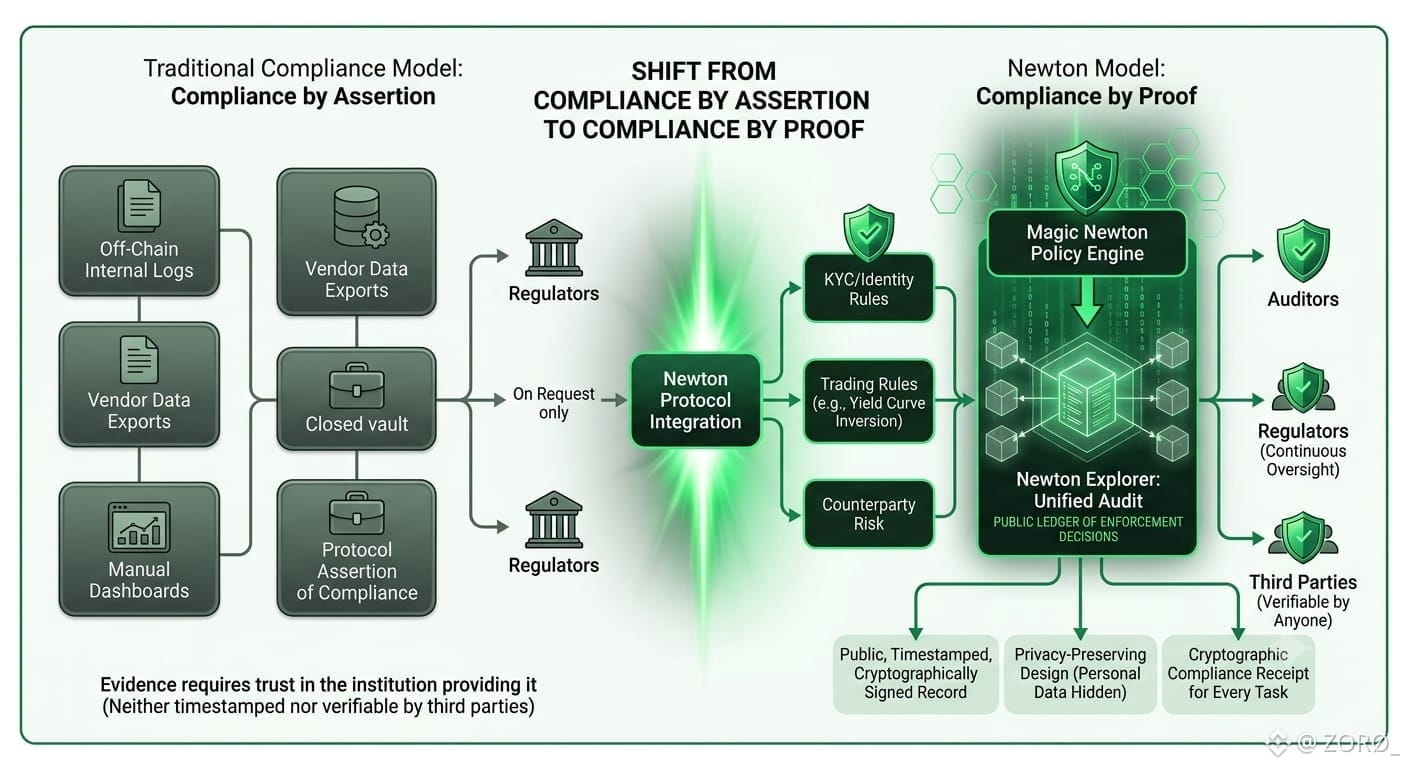
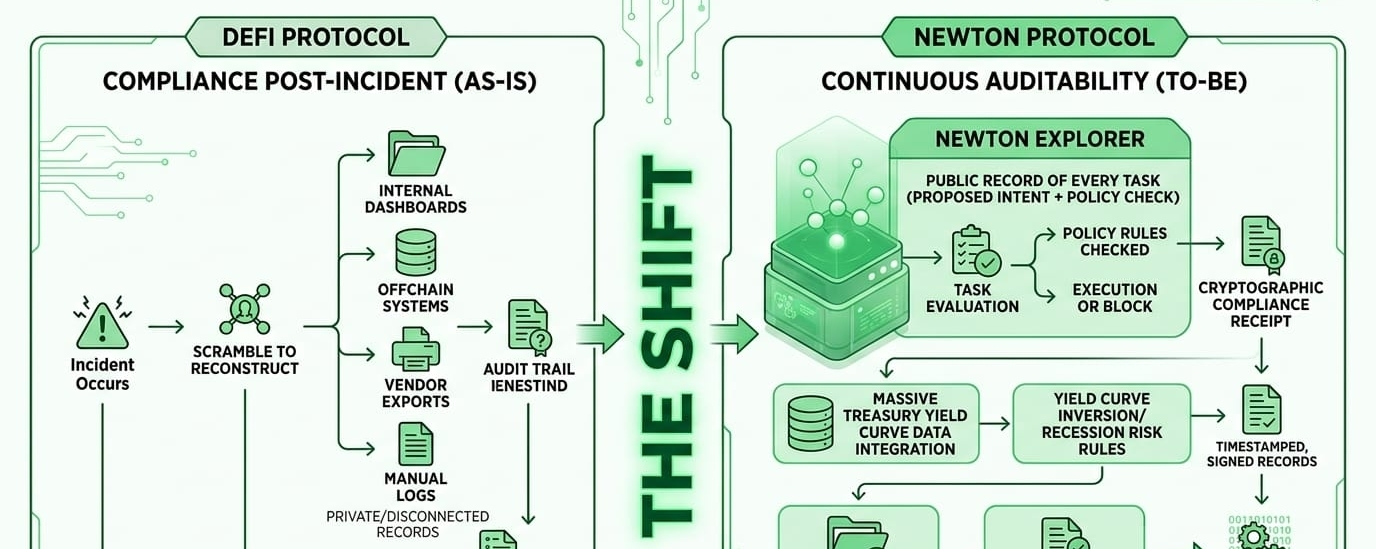
I noticed something while going through Newton's deployment history — the protocol was already live inside Polymarket before mainnet beta opened. A step-up withdrawal policy processed over $3 billion on US election night 2024, with zero downtime and sub-second responses. That's not a test environment.
What seems interesting is what that actually reveals. Sub-second enforcement under billions in real transaction volume is meaningfully different from a staged test. I sometimes wonder how many people in the institutional DeFi conversation have actually paused on that specific data point.
The question that comes to mind is whether Polymarket-scale success translates to institutional-grade complexity. Verifying step-up withdrawals is simpler than enforcing a multi-condition vault policy covering jurisdiction, counterparty risk, and concentration limits simultaneously. It makes me think the performance proof exists — but the complexity proof is still being built.
Looking from the outside, the Polymarket deployment is meaningful evidence that Newton holds under genuine pressure. Whether it holds under the full weight of institutional policy requirements is the part still remaining to be demonstrated — anyway, time will tell💥
@NewtonProtocol #newt $NEWT
$EVAA $CLO
#USLaunchesNewStrikesAgainstIran #OilJumpsNearly6% #VanguardOpensDigitalAssetsHeadSearch #SpaceXJoinsNasdaq100
What seems interesting is what that actually reveals. Sub-second enforcement under billions in real transaction volume is meaningfully different from a staged test. I sometimes wonder how many people in the institutional DeFi conversation have actually paused on that specific data point.
The question that comes to mind is whether Polymarket-scale success translates to institutional-grade complexity. Verifying step-up withdrawals is simpler than enforcing a multi-condition vault policy covering jurisdiction, counterparty risk, and concentration limits simultaneously. It makes me think the performance proof exists — but the complexity proof is still being built.
Looking from the outside, the Polymarket deployment is meaningful evidence that Newton holds under genuine pressure. Whether it holds under the full weight of institutional policy requirements is the part still remaining to be demonstrated — anyway, time will tell💥
@NewtonProtocol #newt $NEWT
$EVAA $CLO
#USLaunchesNewStrikesAgainstIran #OilJumpsNearly6% #VanguardOpensDigitalAssetsHeadSearch #SpaceXJoinsNasdaq100

$SPELL
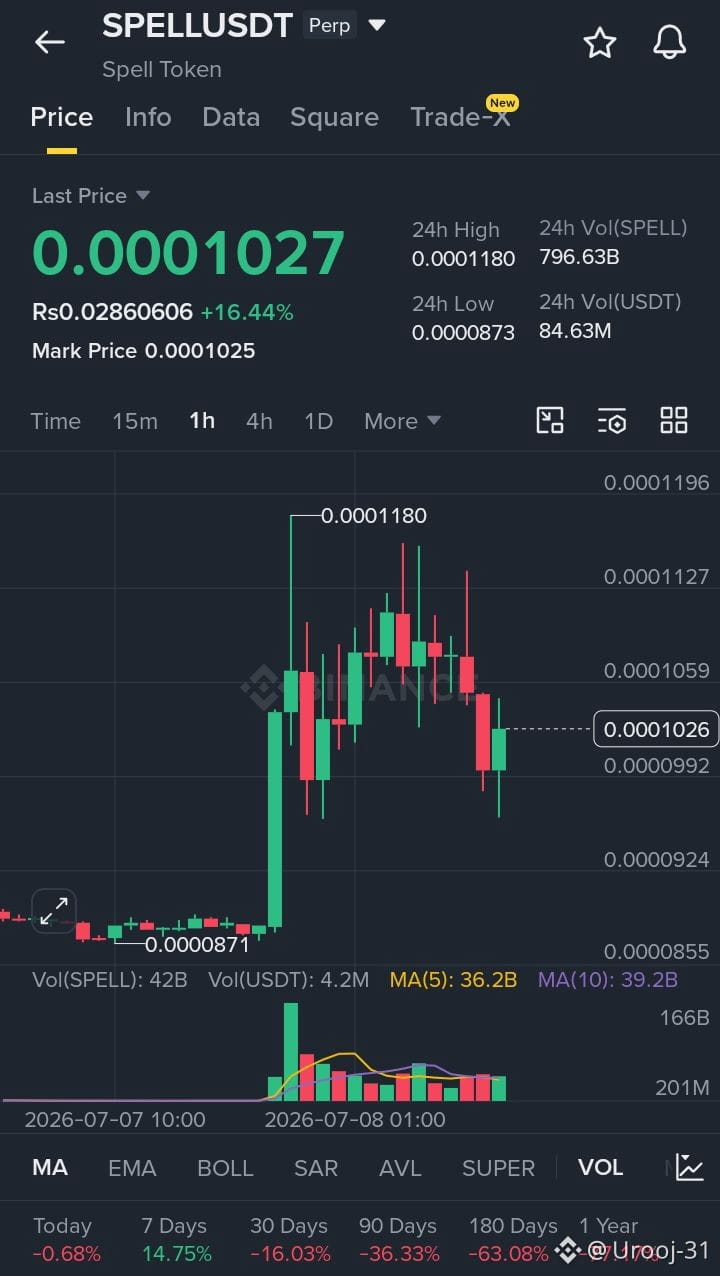
LONG SETUP CONFIRMED – BREAKOUT RETEST IN PLAY
Price reclaimed key support at 0.0001026 after sweeping 24H low at 0.0000873. Bullish divergence on RSI with volume acceleration (42B SPELL). MA(5) crossing above MA(10) – momentum shifting.
EP: 0.0001027
TP1: 0.0001100
TP2: 0.0001180
SL: 0.0000975 (below volume node)
Risk 1:3+. Conviction high. Watch 0.0001059 flip to support for add-on.
$SPELL
#SpaceXJoinsNasdaq100
#VanguardOpensDigitalAssetsHeadSearch
LONG SETUP CONFIRMED – BREAKOUT RETEST IN PLAY
Price reclaimed key support at 0.0001026 after sweeping 24H low at 0.0000873. Bullish divergence on RSI with volume acceleration (42B SPELL). MA(5) crossing above MA(10) – momentum shifting.
EP: 0.0001027
TP1: 0.0001100
TP2: 0.0001180
SL: 0.0000975 (below volume node)
Risk 1:3+. Conviction high. Watch 0.0001059 flip to support for add-on.
$SPELL
#SpaceXJoinsNasdaq100
#VanguardOpensDigitalAssetsHeadSearch

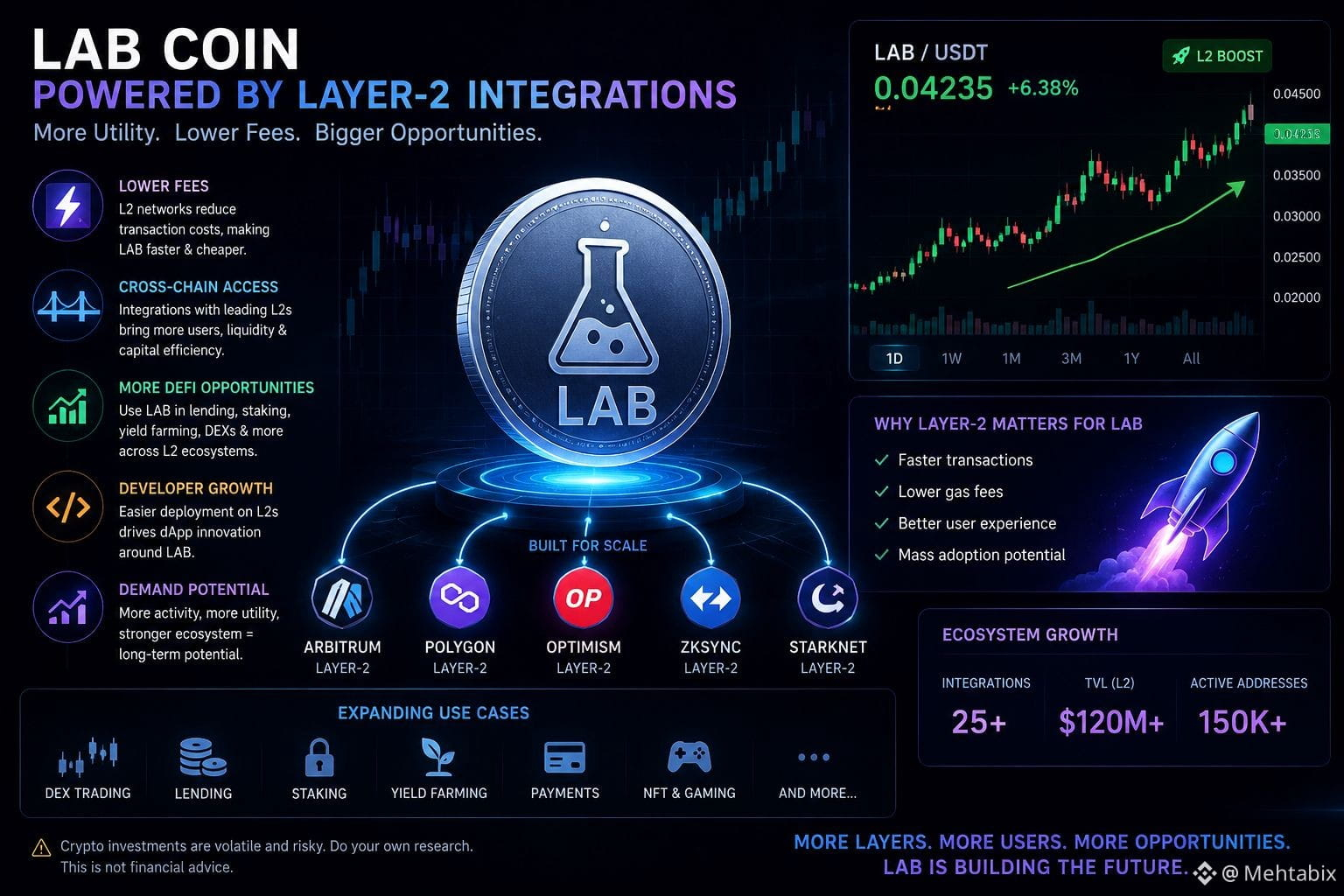
Recent Layer-2 ecosystem integrations could expand opportunities for $LAB coin in several important ways, assuming adoption continues:
⚡ Lower transaction costs: Layer-2 networks reduce fees, making LAB more practical for frequent trading, DeFi, and everyday on-chain activity.
🌉 Cross-chain accessibility: Integrations with major Layer-2 ecosystems can expose LAB to a wider user base, increasing liquidity and improving capital efficiency.
🏦 More DeFi opportunities: Compatibility with Layer-2 protocols can allow LAB to participate in lending, staking, yield farming, and decentralized exchanges, increasing utility.
👨💻 Developer growth: Easier deployment on Layer-2 networks may encourage developers to build new dApps and services around the LAB ecosystem.
📈 Potential demand growth: If Layer-2 adoption continues and $LAB secures meaningful integrations, increased network activity could support long-term token demand. However, actual value will still depend on sustained user adoption, ecosystem development, and execution—not integrations alone.
#VanguardOpensDigitalAssetsHeadSearch #SpaceXJoinsNasdaq100 BitcoinFailsToHold$64.4K
⚡ Lower transaction costs: Layer-2 networks reduce fees, making LAB more practical for frequent trading, DeFi, and everyday on-chain activity.
🌉 Cross-chain accessibility: Integrations with major Layer-2 ecosystems can expose LAB to a wider user base, increasing liquidity and improving capital efficiency.
🏦 More DeFi opportunities: Compatibility with Layer-2 protocols can allow LAB to participate in lending, staking, yield farming, and decentralized exchanges, increasing utility.
👨💻 Developer growth: Easier deployment on Layer-2 networks may encourage developers to build new dApps and services around the LAB ecosystem.
📈 Potential demand growth: If Layer-2 adoption continues and $LAB secures meaningful integrations, increased network activity could support long-term token demand. However, actual value will still depend on sustained user adoption, ecosystem development, and execution—not integrations alone.
#VanguardOpensDigitalAssetsHeadSearch #SpaceXJoinsNasdaq100 BitcoinFailsToHold$64.4K

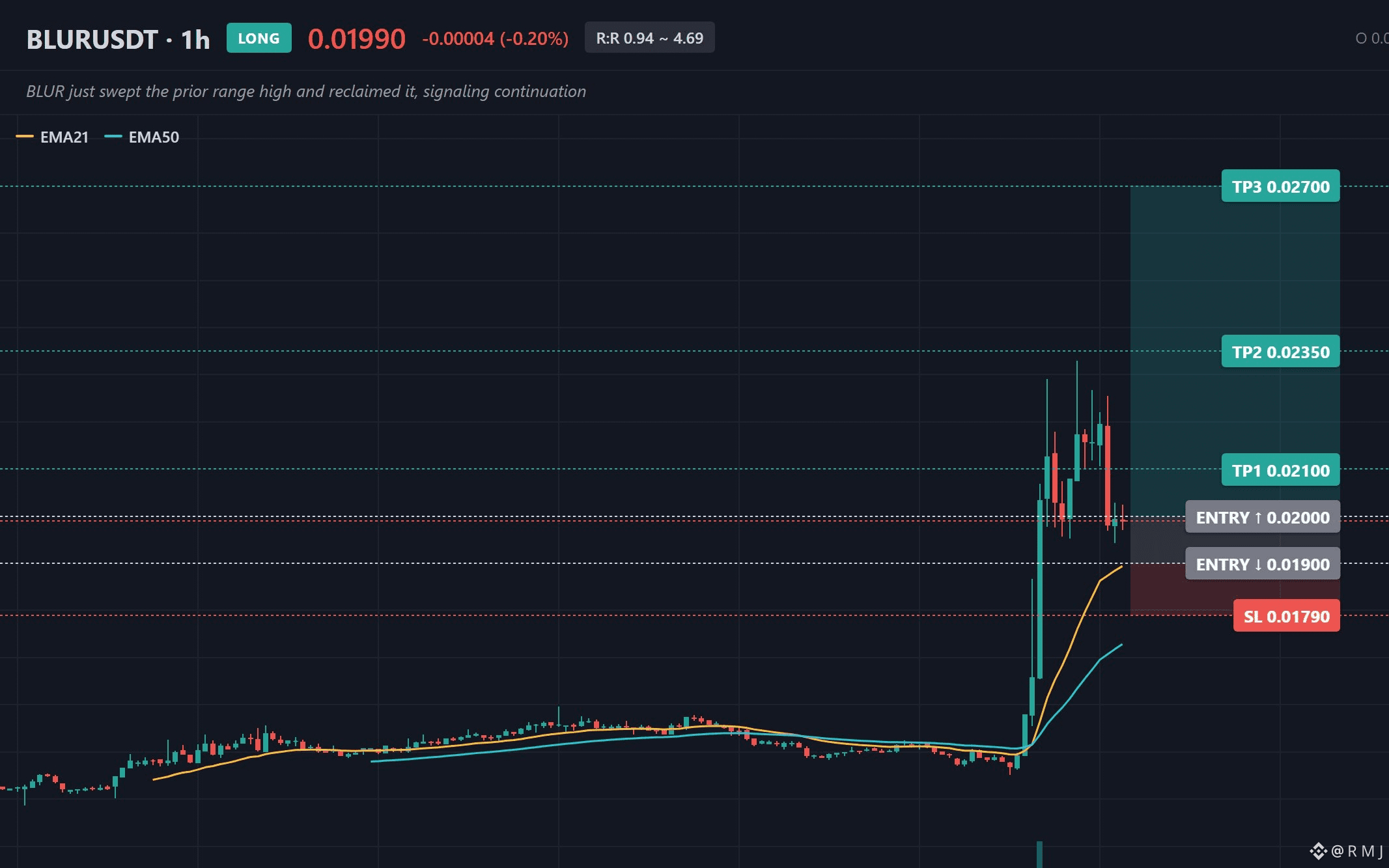
$BLUR has reclaimed the previous range high after a successful liquidity sweep, signaling potential continuation of the current bullish structure.
The 1H chart shows a clean reclaim after defending the $0.01939 support area. Extremely negative funding suggests heavy short positioning, creating the possibility of a short squeeze if buyers maintain control. Rising open interest and strong taker buying indicate increasing market participation.
Trade Setup
- Entry: $0.0190–$0.0200
- Take Profit 1: $0.02100
- Take Profit 2: $0.02350
- Take Profit 3: $0.02700
- Stop Loss: $0.01790
A break below $0.01790 would invalidate the bullish setup. Until then, the focus remains on continuation with disciplined risk management.
$BLUR
#RMJ_trades
#SpaceXJoinsNasdaq100
#SKHynixUSListingOversubscribed
#VanguardOpensDigitalAssetsHeadSearch
#USLaunchesNewStrikesAgainstIran
The 1H chart shows a clean reclaim after defending the $0.01939 support area. Extremely negative funding suggests heavy short positioning, creating the possibility of a short squeeze if buyers maintain control. Rising open interest and strong taker buying indicate increasing market participation.
Trade Setup
- Entry: $0.0190–$0.0200
- Take Profit 1: $0.02100
- Take Profit 2: $0.02350
- Take Profit 3: $0.02700
- Stop Loss: $0.01790
A break below $0.01790 would invalidate the bullish setup. Until then, the focus remains on continuation with disciplined risk management.
$BLUR
#RMJ_trades
#SpaceXJoinsNasdaq100
#SKHynixUSListingOversubscribed
#VanguardOpensDigitalAssetsHeadSearch
#USLaunchesNewStrikesAgainstIran

$LAB Fear = Opportunity?
After a major correction, selling pressure looks exhausted.
Fear is high
Risk/Reward is improving
Watching for long opportunities & accumulation
Smart money watches when others panic
#USLaunchesNewStrikesAgainstIran #VanguardOpensDigitalAssetsHeadSearch #SKHynixUSListingOversubscribed #SKHynixToBeginNasdaqTradingJuly10 #SpaceXJoinsNasdaq100
After a major correction, selling pressure looks exhausted.
Fear is high
Risk/Reward is improving
Watching for long opportunities & accumulation
Smart money watches when others panic
#USLaunchesNewStrikesAgainstIran #VanguardOpensDigitalAssetsHeadSearch #SKHynixUSListingOversubscribed #SKHynixToBeginNasdaqTradingJuly10 #SpaceXJoinsNasdaq100
Partly True
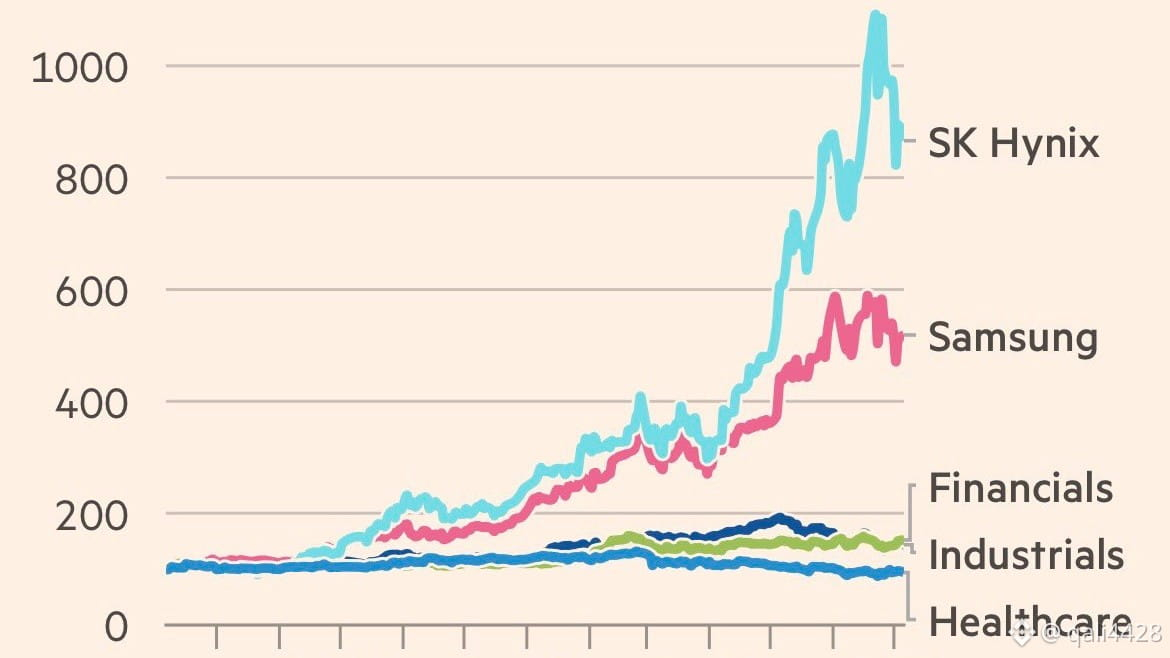
$100 BILLION EXITS KOREAN STOCKS AS FOREIGN INVESTORS FLEE
Foreign investors have withdrawn more than $100 BILLION from South Korean equities since the start of 2026.
The KOSPI has fallen nearly 20% from its June peak, despite continued strength in AI heavyweights like Samsung and SK Hynix
#USLaunchesNewStrikesAgainstIran
#VanguardOpensDigitalAssetsHeadSearch
#SpaceXJoinsNasdaq100
$BTC
Foreign investors have withdrawn more than $100 BILLION from South Korean equities since the start of 2026.
The KOSPI has fallen nearly 20% from its June peak, despite continued strength in AI heavyweights like Samsung and SK Hynix
#USLaunchesNewStrikesAgainstIran
#VanguardOpensDigitalAssetsHeadSearch
#SpaceXJoinsNasdaq100
$BTC


$MSFTB
$GOOGLB
$METAB
#USLaunchesNewStrikesAgainstIran SpotGoldFallsBelow$4100#VanguardOpensDigitalAssetsHeadSearch #SpaceXJoinsNasdaq100 #
$GOOGLB
$METAB
#USLaunchesNewStrikesAgainstIran SpotGoldFallsBelow$4100#VanguardOpensDigitalAssetsHeadSearch #SpaceXJoinsNasdaq100 #


🚀 $SEI
📈 $SEI is holding key support as buying momentum continues to strengthen.
🔥 A breakout above the next resistance with strong volume could trigger a fresh bullish rally.
⚠️ Stay patient and wait for confirmation before chasing green candles in this volatile market.
💎 $SEI remains one of the strongest Layer-1 projects to keep on your watchlist#USLaunchesNewStrikesAgainstIran #VanguardOpensDigitalAssetsHeadSearch #SKHynixUSListingOversubscribed #SpaceXJoinsNasdaq100 #SKHynixToBeginNasdaqTradingJuly10
📈 $SEI is holding key support as buying momentum continues to strengthen.
🔥 A breakout above the next resistance with strong volume could trigger a fresh bullish rally.
⚠️ Stay patient and wait for confirmation before chasing green candles in this volatile market.
💎 $SEI remains one of the strongest Layer-1 projects to keep on your watchlist#USLaunchesNewStrikesAgainstIran #VanguardOpensDigitalAssetsHeadSearch #SKHynixUSListingOversubscribed #SpaceXJoinsNasdaq100 #SKHynixToBeginNasdaqTradingJuly10
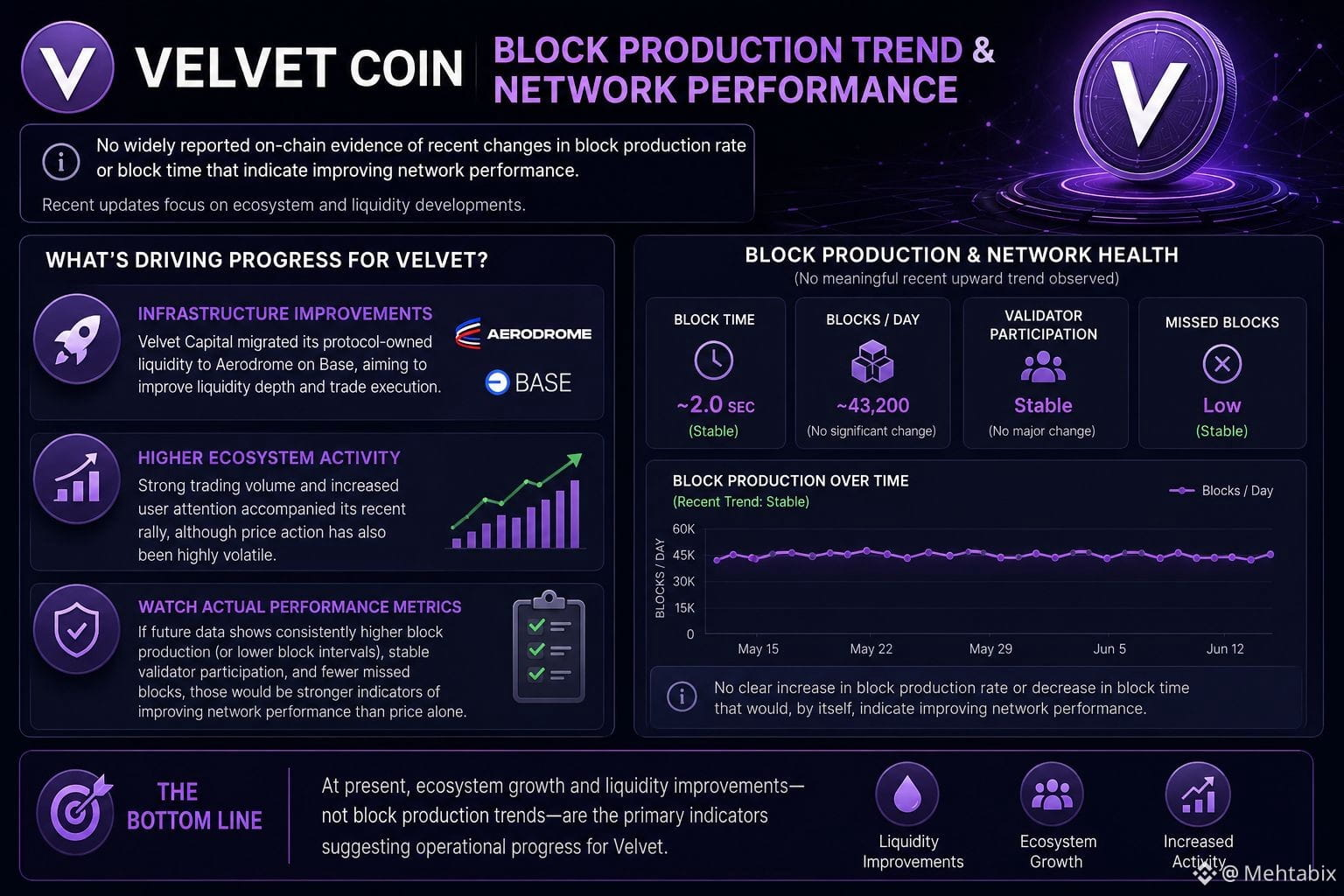
There is no widely reported on-chain evidence that $VELVET has recently experienced a meaningful change in block production rate or block time that would, by itself, indicate improving network performance. Public updates have instead focused on ecosystem and liquidity developments rather than core blockchain production metrics.
If you're evaluating Velvet's network health, these signals are currently more relevant:
🚀 Infrastructure improvements: Velvet Capital migrated its protocol-owned liquidity to Aerodrome on Base, aiming to improve liquidity depth and trade execution.
📈 Higher ecosystem activity: Strong trading volume and increased user attention accompanied its recent rally, although price action has also been highly volatile.
⚠️ Watch actual performance metrics: If future data shows consistently higher block production (or lower block intervals), stable validator participation, and fewer missed blocks, those would be stronger indicators of improving network performance than price alone.
At present, ecosystem growth and liquidity improvements—not block production trends—are the primary indicators suggesting operational progress for $VELVET
#VanguardOpensDigitalAssetsHeadSearch #SpaceXJoinsNasdaq100 #OilJumpsNearly6%
If you're evaluating Velvet's network health, these signals are currently more relevant:
🚀 Infrastructure improvements: Velvet Capital migrated its protocol-owned liquidity to Aerodrome on Base, aiming to improve liquidity depth and trade execution.
📈 Higher ecosystem activity: Strong trading volume and increased user attention accompanied its recent rally, although price action has also been highly volatile.
⚠️ Watch actual performance metrics: If future data shows consistently higher block production (or lower block intervals), stable validator participation, and fewer missed blocks, those would be stronger indicators of improving network performance than price alone.
At present, ecosystem growth and liquidity improvements—not block production trends—are the primary indicators suggesting operational progress for $VELVET
#VanguardOpensDigitalAssetsHeadSearch #SpaceXJoinsNasdaq100 #OilJumpsNearly6%

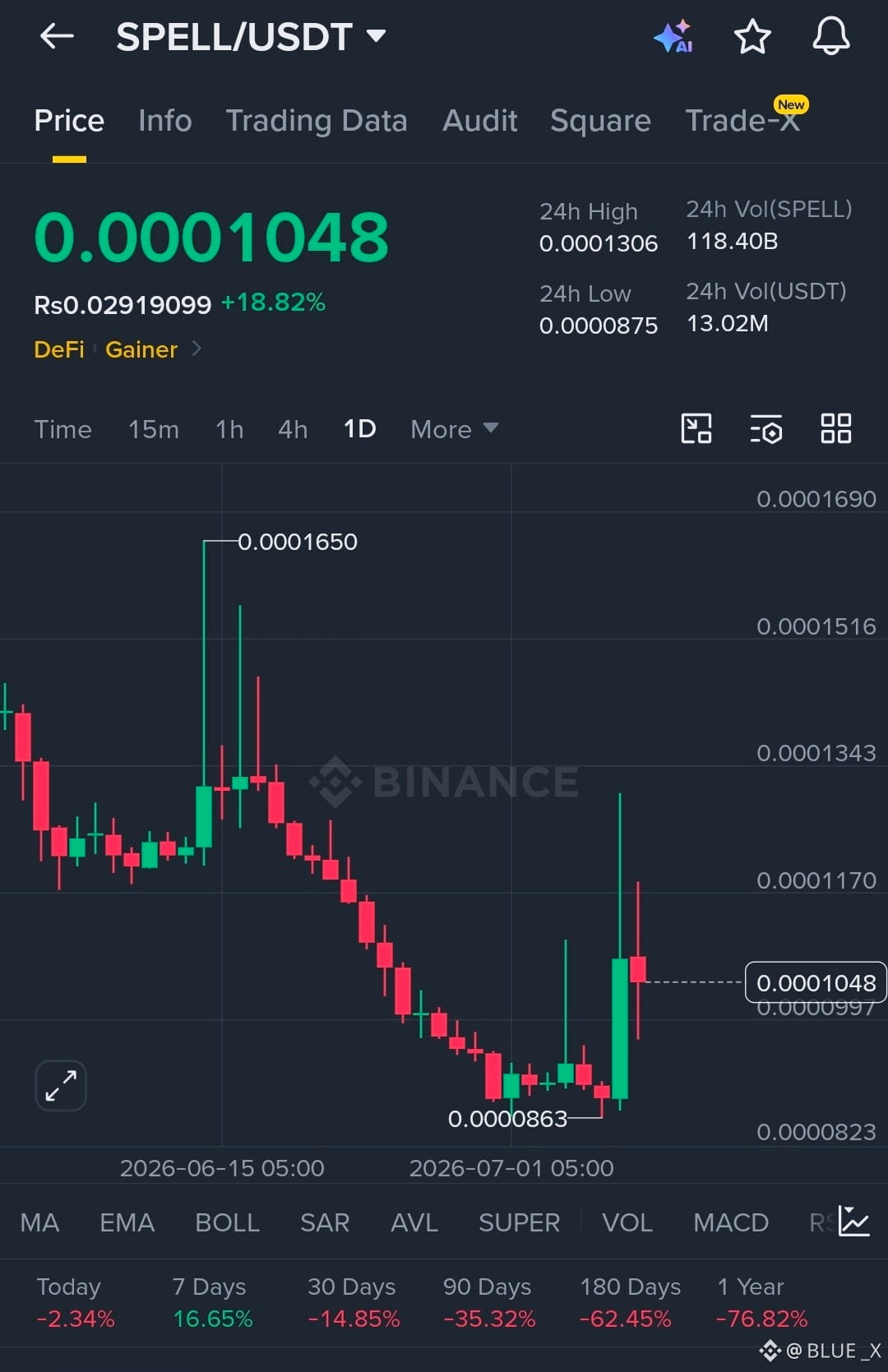
🚨 I'm taking a LONG on $SPELL L here.
Everyone's expecting more downside... that's exactly why I'm paying attention. 👀
The setup offers a solid risk-to-reward if buyers reclaim momentum.
Manage your stop, stay patient, and don't let fear make the decision.
Sometimes the best trades come when the crowd is looking the other way. 🔥
#SpaceXJoinsNasdaq100 #OilJumpsNearly6% #USLaunchesNewStrikesAgainstIran #VanguardOpensDigitalAssetsHeadSearch #SKHynixUSListingOversubscribed
Everyone's expecting more downside... that's exactly why I'm paying attention. 👀
The setup offers a solid risk-to-reward if buyers reclaim momentum.
Manage your stop, stay patient, and don't let fear make the decision.
Sometimes the best trades come when the crowd is looking the other way. 🔥
#SpaceXJoinsNasdaq100 #OilJumpsNearly6% #USLaunchesNewStrikesAgainstIran #VanguardOpensDigitalAssetsHeadSearch #SKHynixUSListingOversubscribed
Log in to explore more content