
#usar
usar
25,530 views
301 Discussing
Hot
Latest

The current $USAR quote is 17.74, with a 24-hour gain of 1.314%. The funding rate has dropped to zero, and open interest is 115391.49. The funding rate at zero is a rare state where long and short forces are temporarily balanced. A slight price increase with a flat funding rate suggests the upward momentum is not coming from long-side premium payments, and the market is not showing a clear one-sided bet.
This is a single-signal judgment, and the core variable is the funding rate. A funding rate of zero means that holders of long and short positions are not paying each other. This structure is rare in trending markets and usually appears near the end of consolidation or just before a directional choice. The price has risen a little, but longs have not become aggressive enough to pay a positive rate to maintain positions, and shorts have not been forced to pay to close. The market is waiting.
What I can infer is that behind the 1.314% rise, there is no added cost from leveraged longs. This weakens the sustainability signal of the rally, because healthy uptrends are often accompanied by longs paying positive funding, which indicates strong demand. Right now it looks more like shorts have temporarily backed off, or spot buying is pushing the price up, but there is no follow-through confirmation from the derivatives market. Open interest has not changed significantly, which also supports this view: no new capital has come in.
The bearish counterargument is strong: what if this is not balance at all, but the calm before the storm? Zero funding plus a modest rise may mean large players are quietly accumulating spot while hedging in derivatives to lock in price and avoid paying funding. Once they are ready, funding could flip positive and rise sharply, triggering a fast breakout to the upside. The condition under which my judgment fails is simple: if over the next 24 hours the price keeps rising and breaks above the 18.00 round number while the funding rate jumps above 0.01%, that would indicate real long premium has emerged, my balance assessment would be wrong, and the market has chosen to move higher.
The second-order impact is that if the price stalls or even pulls back from the current level, longs that entered around 17.74 will start to get anxious. Because there is no positive funding to subsidize their holdings, their only source of profit is continued price appreciation. Once the price turns, these positions will likely stop out first and become fuel for the decline.
As for action, this is not a good level to chase long positions. Zero funding means there is no interest income from being long; it is purely a directional bet.
Trading tag: #TradFi #链上美股 #USAR
Where do you think this analysis is most likely to be wrong?
This is a single-signal judgment, and the core variable is the funding rate. A funding rate of zero means that holders of long and short positions are not paying each other. This structure is rare in trending markets and usually appears near the end of consolidation or just before a directional choice. The price has risen a little, but longs have not become aggressive enough to pay a positive rate to maintain positions, and shorts have not been forced to pay to close. The market is waiting.
What I can infer is that behind the 1.314% rise, there is no added cost from leveraged longs. This weakens the sustainability signal of the rally, because healthy uptrends are often accompanied by longs paying positive funding, which indicates strong demand. Right now it looks more like shorts have temporarily backed off, or spot buying is pushing the price up, but there is no follow-through confirmation from the derivatives market. Open interest has not changed significantly, which also supports this view: no new capital has come in.
The bearish counterargument is strong: what if this is not balance at all, but the calm before the storm? Zero funding plus a modest rise may mean large players are quietly accumulating spot while hedging in derivatives to lock in price and avoid paying funding. Once they are ready, funding could flip positive and rise sharply, triggering a fast breakout to the upside. The condition under which my judgment fails is simple: if over the next 24 hours the price keeps rising and breaks above the 18.00 round number while the funding rate jumps above 0.01%, that would indicate real long premium has emerged, my balance assessment would be wrong, and the market has chosen to move higher.
The second-order impact is that if the price stalls or even pulls back from the current level, longs that entered around 17.74 will start to get anxious. Because there is no positive funding to subsidize their holdings, their only source of profit is continued price appreciation. Once the price turns, these positions will likely stop out first and become fuel for the decline.
As for action, this is not a good level to chase long positions. Zero funding means there is no interest income from being long; it is purely a directional bet.
Trading tag: #TradFi #链上美股 #USAR
Where do you think this analysis is most likely to be wrong?
$USAR is trading near the current price level of 17.74000, with a mild gain of 1.314% over the past 24 hours. But the more important signal lies in the derivatives structure: its perpetual contract funding rate is 0. For an asset that is up more than 1% in a day, longs and shorts are in absolute balance in terms of financing cost. This is a single-signal judgment, and it suggests that current participants’ leverage cost is extremely low, while market sentiment has not shown obvious FOMO or panic despite the price increase.
A zero funding rate usually appears during periods of strong disagreement or heavy wait-and-see sentiment in the market. For a TradFi Perp contract like $USAR , this may mean: first, existing holders are not rushing to add long leverage into the rally, perhaps because they believe a 1.3% gain is not worth paying positive funding to expand exposure; second, shorts are also not being forced into a position where they must pay to keep holding, because they judge the current price level does not pose a material threat. Combined with an open interest of 115,391.49, this is a neutral-to-calm position structure. Price is rising, but leveraged capital is not moving with the news, and the two are diverging. This typically points to a lack of sustained buying support, and looks more like a mild spot-driven push than a broad bullish shift in derivatives market sentiment.
The strongest counterexample is this: if $USAR ’s open interest quickly breaks above the current level over the next few hours, and the funding rate turns positive at the same time, then the current calm assessment will immediately fail. That would indicate sidelined capital has entered the market and started paying a cost to stay long, and price may enter an acceleration phase. Conversely, if price fails to hold the current area and funding turns negative, it would indicate that short pressure is beginning to take over, and downside correction pressure will increase.
Going forward, holders should closely monitor changes in the funding rate. Once funding moves away from the zero line, whether upward or downward, it means the current balance has been broken and the market will choose a short-term direction. For observers, the current zero-fee environment means holding costs for opening positions are very low, but direction is unclear. The safest move is to wait until a new, clearer relationship signal forms among $USAR ’s price, funding rate, and open interest before making a decision.
In short, the market is waiting for a catalyst.
Trading tag: #TradFi #链上美股 #USAR
Where do you think this whole judgment is most likely to be wrong?
A zero funding rate usually appears during periods of strong disagreement or heavy wait-and-see sentiment in the market. For a TradFi Perp contract like $USAR , this may mean: first, existing holders are not rushing to add long leverage into the rally, perhaps because they believe a 1.3% gain is not worth paying positive funding to expand exposure; second, shorts are also not being forced into a position where they must pay to keep holding, because they judge the current price level does not pose a material threat. Combined with an open interest of 115,391.49, this is a neutral-to-calm position structure. Price is rising, but leveraged capital is not moving with the news, and the two are diverging. This typically points to a lack of sustained buying support, and looks more like a mild spot-driven push than a broad bullish shift in derivatives market sentiment.
The strongest counterexample is this: if $USAR ’s open interest quickly breaks above the current level over the next few hours, and the funding rate turns positive at the same time, then the current calm assessment will immediately fail. That would indicate sidelined capital has entered the market and started paying a cost to stay long, and price may enter an acceleration phase. Conversely, if price fails to hold the current area and funding turns negative, it would indicate that short pressure is beginning to take over, and downside correction pressure will increase.
Going forward, holders should closely monitor changes in the funding rate. Once funding moves away from the zero line, whether upward or downward, it means the current balance has been broken and the market will choose a short-term direction. For observers, the current zero-fee environment means holding costs for opening positions are very low, but direction is unclear. The safest move is to wait until a new, clearer relationship signal forms among $USAR ’s price, funding rate, and open interest before making a decision.
In short, the market is waiting for a catalyst.
Trading tag: #TradFi #链上美股 #USAR
Where do you think this whole judgment is most likely to be wrong?
The perpetual contract funding rate for $USAR is pinned at the zero line, while it has risen 1.314% over the past 24 hours. That combination is a bit interesting.
A zero funding rate means neither longs nor shorts are currently paying the other side; the market is in a delicate state of balance. Price is rising, but the upward push is not coming from longs aggressively adding leverage, because shorts have also not been squeezed hard enough to pay funding to maintain positions. This is a low-consensus, low-friction rally: liquidity costs are almost zero, but there is also a lack of strong one-sided momentum.
Taken together with the open interest of 115391.49, this is another signal. Rising price combined with little change in open interest suggests that funds in the market are not opening a large number of new positions; it looks more like a slow rotation of existing positions or a mild rise driven by passive closing. On a macro level, if we view this as a microcosm, it reflects a certain risk appetite: capital is willing to look for opportunities in an environment with no obvious risk premium (zero funding), but a strong bullish consensus has not yet formed. This usually appears during a policy vacuum or a wait-and-see phase before data releases, when the market is waiting for a clearer catalyst.
The strongest counterargument would be if the next phase sees funding rates quickly turn negative, meaning shorts begin paying longs. Then this low-friction balance would be broken. That would indicate short-side pressure is building, and the market may shift to downward pressure. At that point, this mild upward structure would fail and need to be reassessed.
From this microstructure perspective, the current position of $USAR is more of an observation point than a strong initiation point. Zero funding lowers holding costs, but it also means there is no squeeze-driven move to push prices rapidly out of the current range.
**Scenarios and actions**:
- **Steady scenario**: Continue oscillating near zero funding, with price consolidating around 17.74. You can keep watching and wait for a significant change in open interest or a directional funding shift before making a call.
- **Aggressive scenario**: If open interest rises significantly along with price, while funding remains zero or slightly positive, it can be seen as new buying entering the market, but position size should be tightly controlled.
- **Avoidance scenario**: If price pulls back and funding turns negative, it suggests shorts are starting to gain a cost advantage; avoid or consider hedging.
**Invalidation condition**: If the funding rate turns clearly negative within 24 hours, the above equilibrium assessment becomes invalid.
Based on this data alone, the market isn't giving you money, but it's not rushing to charge you either.
Trading tag: #TradFi #链上美股 #USAR
Where do you think this judgment is most likely wrong?
A zero funding rate means neither longs nor shorts are currently paying the other side; the market is in a delicate state of balance. Price is rising, but the upward push is not coming from longs aggressively adding leverage, because shorts have also not been squeezed hard enough to pay funding to maintain positions. This is a low-consensus, low-friction rally: liquidity costs are almost zero, but there is also a lack of strong one-sided momentum.
Taken together with the open interest of 115391.49, this is another signal. Rising price combined with little change in open interest suggests that funds in the market are not opening a large number of new positions; it looks more like a slow rotation of existing positions or a mild rise driven by passive closing. On a macro level, if we view this as a microcosm, it reflects a certain risk appetite: capital is willing to look for opportunities in an environment with no obvious risk premium (zero funding), but a strong bullish consensus has not yet formed. This usually appears during a policy vacuum or a wait-and-see phase before data releases, when the market is waiting for a clearer catalyst.
The strongest counterargument would be if the next phase sees funding rates quickly turn negative, meaning shorts begin paying longs. Then this low-friction balance would be broken. That would indicate short-side pressure is building, and the market may shift to downward pressure. At that point, this mild upward structure would fail and need to be reassessed.
From this microstructure perspective, the current position of $USAR is more of an observation point than a strong initiation point. Zero funding lowers holding costs, but it also means there is no squeeze-driven move to push prices rapidly out of the current range.
**Scenarios and actions**:
- **Steady scenario**: Continue oscillating near zero funding, with price consolidating around 17.74. You can keep watching and wait for a significant change in open interest or a directional funding shift before making a call.
- **Aggressive scenario**: If open interest rises significantly along with price, while funding remains zero or slightly positive, it can be seen as new buying entering the market, but position size should be tightly controlled.
- **Avoidance scenario**: If price pulls back and funding turns negative, it suggests shorts are starting to gain a cost advantage; avoid or consider hedging.
**Invalidation condition**: If the funding rate turns clearly negative within 24 hours, the above equilibrium assessment becomes invalid.
Based on this data alone, the market isn't giving you money, but it's not rushing to charge you either.
Trading tag: #TradFi #链上美股 #USAR
Where do you think this judgment is most likely wrong?
$USAR The current price is 17.74, and over the past 24 hours it has moved only 1.314%. That level of volatility would be calm for any risk asset. What is truly interesting is that its funding rate is 0, completely neutral: longs are not paying, and shorts are not paying either. At the same time, open interest remains at 115391 contracts, with no obvious expansion or contraction.
This combination points to a wait-and-see state. A funding rate of zero means there is currently no one-sided speculative enthusiasm or panic in the derivatives market. Both longs and shorts have reached a delicate balance at the current price level, with the same holding cost, and neither side has an advantage in financing costs. Open interest has not dropped sharply, suggesting these balanced positions are not rushing to exit, but are waiting. Combined with only a modest price rise, market participants seem to be holding their breath for an external variable to break the stalemate. For US equity derivative contracts that track the macroeconomy, that variable is often not a company’s earnings report, but the next macro data point that can affect overall risk appetite, such as an unexpected jobs or inflation reading.
The strongest counterargument is this: if there were suddenly strong stock-specific positive or negative news targeting the underlying itself, this macro-level calm could be broken instantly. At the moment, I do not see any specific catalyst from the news flow. The invalidation condition is clear: if $USAR ’s price shows a far larger one-way move than 1.314% in the next 24 hours (for example, a rise or fall of more than 5%), and this is accompanied by the funding rate quickly moving away from zero, then the current judgment of a wait-and-see equilibrium would no longer hold, and the market will have chosen a direction.
So for now, the move is to wait. Wait for a clear macro data release, or wait for price and funding structure to give a directional signal first. In a stage where funding is absolutely neutral and open interest is stable, any rash directional bet is like guessing a coin toss. I would add $USAR to a watchlist until its price volatility or funding rate shows abnormal expansion.
Three-scenario summary: aggressive traders can take a small position for a breakout and wait for a macro catalyst to ignite the move; conservative traders should stay on the sidelines and wait for price or funding rate to provide a clear directional signal; avoidant traders can ignore the current dull volatility altogether and wait for a clearer opportunity.
Trading tag: #TradFi #链上美股 #USAR
Where do you think this whole assessment is most likely wrong?
This combination points to a wait-and-see state. A funding rate of zero means there is currently no one-sided speculative enthusiasm or panic in the derivatives market. Both longs and shorts have reached a delicate balance at the current price level, with the same holding cost, and neither side has an advantage in financing costs. Open interest has not dropped sharply, suggesting these balanced positions are not rushing to exit, but are waiting. Combined with only a modest price rise, market participants seem to be holding their breath for an external variable to break the stalemate. For US equity derivative contracts that track the macroeconomy, that variable is often not a company’s earnings report, but the next macro data point that can affect overall risk appetite, such as an unexpected jobs or inflation reading.
The strongest counterargument is this: if there were suddenly strong stock-specific positive or negative news targeting the underlying itself, this macro-level calm could be broken instantly. At the moment, I do not see any specific catalyst from the news flow. The invalidation condition is clear: if $USAR ’s price shows a far larger one-way move than 1.314% in the next 24 hours (for example, a rise or fall of more than 5%), and this is accompanied by the funding rate quickly moving away from zero, then the current judgment of a wait-and-see equilibrium would no longer hold, and the market will have chosen a direction.
So for now, the move is to wait. Wait for a clear macro data release, or wait for price and funding structure to give a directional signal first. In a stage where funding is absolutely neutral and open interest is stable, any rash directional bet is like guessing a coin toss. I would add $USAR to a watchlist until its price volatility or funding rate shows abnormal expansion.
Three-scenario summary: aggressive traders can take a small position for a breakout and wait for a macro catalyst to ignite the move; conservative traders should stay on the sidelines and wait for price or funding rate to provide a clear directional signal; avoidant traders can ignore the current dull volatility altogether and wait for a clearer opportunity.
Trading tag: #TradFi #链上美股 #USAR
Where do you think this whole assessment is most likely wrong?

$USAR has only risen 1.545% in the past 24 hours, with the price holding steady at 17.75. The key point is that open interest is just over 110,000, and the funding rate is zero. It’s hard not to notice this kind of structure on a Binance futures board.
My view is that market pricing of geopolitical risk in this asset has become close to ineffective. The evidence chain is simple: first, the price has barely moved, and a 1.545% gain is basically noise in the current environment; second, the funding rate is zero, which means neither longs nor shorts have a clear edge, and neither side is continuously paying the other. Both signals point to the same conclusion: everyone is waiting, and no one is making a big bet.
The strongest counterargument is that this calm itself is a signal. Is the market thinking the conflict will either not escalate enough to affect U.S. equity futures, or that any escalation has already been priced in? I lean toward the former. The second-order effect is that, if a black swan shock does arrive, this low-volatility, zero-funding structure would be the easiest to break instantly, and liquidity could be pulled out of these quiet names.
The invalidation conditions are clear: if the $USAR price falls below 17.5, the lower end of this recent consolidation range, or if a major geopolitical event suddenly hits U.S.-related assets directly, then my above judgment would no longer hold. At this level, my move is to stay on the sidelines: no chasing longs, no shorting either.
Trading tag: #TradFi #链上美股 #USAR
Where do you think this line of reasoning is most likely to be wrong?
My view is that market pricing of geopolitical risk in this asset has become close to ineffective. The evidence chain is simple: first, the price has barely moved, and a 1.545% gain is basically noise in the current environment; second, the funding rate is zero, which means neither longs nor shorts have a clear edge, and neither side is continuously paying the other. Both signals point to the same conclusion: everyone is waiting, and no one is making a big bet.
The strongest counterargument is that this calm itself is a signal. Is the market thinking the conflict will either not escalate enough to affect U.S. equity futures, or that any escalation has already been priced in? I lean toward the former. The second-order effect is that, if a black swan shock does arrive, this low-volatility, zero-funding structure would be the easiest to break instantly, and liquidity could be pulled out of these quiet names.
The invalidation conditions are clear: if the $USAR price falls below 17.5, the lower end of this recent consolidation range, or if a major geopolitical event suddenly hits U.S.-related assets directly, then my above judgment would no longer hold. At this level, my move is to stay on the sidelines: no chasing longs, no shorting either.
Trading tag: #TradFi #链上美股 #USAR
Where do you think this line of reasoning is most likely to be wrong?
$USAR is an on-chain U.S. military concept stock, up 1.545% over the past 24 hours. The increase is not large, but the funding rate is zero, open interest is just over 110,000, and trading volume is under 500,000.
This move is most likely related to the recent uptick in geopolitical tensions. Market sentiment has a short-term preference for defense stocks. But with funding at zero, it shows that long and short forces are temporarily balanced, with neither side aggressively taking a strong bet. OI and trading volume are also at moderate levels, with no sign of heavy funds rushing in.
This means the current price is being driven by sentiment, lacking sustained leverage-driven buying. If geopolitical events do not escalate further, or if the funding rate stays near zero for a long time, this wave of enthusiasm will be hard to sustain. The strongest counterargument is that once expectations of conflict ease, these concept stocks could pull back quickly, because there is no funding-cost burden on positions, making retreat quite decisive.
The second-order effect is that if the narrative of military tension continues, funds may chase names with more extreme funding and more obvious OI growth, and $USAR may instead be left behind.
My judgment is based on a single-signal inference, driven by price rising while other indicators remain flat. The invalidation condition is simple: if the price falls back below 17.5, or if funding suddenly turns negative, then my wait-and-see logic would be wrong.
This is not a good position to chase right now.
Trading tag: #TradFi #链上美股 #USAR
Where do you think this line of reasoning is most likely to be wrong?
This move is most likely related to the recent uptick in geopolitical tensions. Market sentiment has a short-term preference for defense stocks. But with funding at zero, it shows that long and short forces are temporarily balanced, with neither side aggressively taking a strong bet. OI and trading volume are also at moderate levels, with no sign of heavy funds rushing in.
This means the current price is being driven by sentiment, lacking sustained leverage-driven buying. If geopolitical events do not escalate further, or if the funding rate stays near zero for a long time, this wave of enthusiasm will be hard to sustain. The strongest counterargument is that once expectations of conflict ease, these concept stocks could pull back quickly, because there is no funding-cost burden on positions, making retreat quite decisive.
The second-order effect is that if the narrative of military tension continues, funds may chase names with more extreme funding and more obvious OI growth, and $USAR may instead be left behind.
My judgment is based on a single-signal inference, driven by price rising while other indicators remain flat. The invalidation condition is simple: if the price falls back below 17.5, or if funding suddenly turns negative, then my wait-and-see logic would be wrong.
This is not a good position to chase right now.
Trading tag: #TradFi #链上美股 #USAR
Where do you think this line of reasoning is most likely to be wrong?
$USAR is up slightly by 1.545% today to 17.75. The funding rate has barely moved, staying at 0, while open interest has quietly increased to 112,000 contracts. The picture is very clear: price is moving a little, funding cost is zero, but money is flowing in. The black-swan nature of political and military events is now outweighing the short-term volatility of on-chain and U.S. stock-linked contracts.
Longs currently do not have to pay a single cent in funding fees, and open interest is still rising. Clearly, these people are not here for short-term volatility. They are waiting for some catalyst. Interpreted from a political and military angle, this is a kind of hedging position build-up, or simply an event-driven directional bet. Based on a single signal: the current structure is a classic low-funding-rate plus slow position-building waiting pattern.
The strongest counterpoint is here: if there is a sudden major military escalation or policy crackdown, these slowly built long positions will be the first to get hammered. Their entry costs are concentrated in the current area, and once panic selling starts, there will be no support underneath, leading to a chain reaction of liquidations.
The second-order impact is very direct: this batch of position holders will become the fuel for the next move. Either the event turns bullish and forces shorts to cover, pushing prices up, or the event turns bearish and they are forced to cut positions, triggering more forced selling. Liquidity will be extracted from them.
Trading tag: #TradFi #链上美股 #USAR
Where do you think this judgment is most likely wrong?
Longs currently do not have to pay a single cent in funding fees, and open interest is still rising. Clearly, these people are not here for short-term volatility. They are waiting for some catalyst. Interpreted from a political and military angle, this is a kind of hedging position build-up, or simply an event-driven directional bet. Based on a single signal: the current structure is a classic low-funding-rate plus slow position-building waiting pattern.
The strongest counterpoint is here: if there is a sudden major military escalation or policy crackdown, these slowly built long positions will be the first to get hammered. Their entry costs are concentrated in the current area, and once panic selling starts, there will be no support underneath, leading to a chain reaction of liquidations.
The second-order impact is very direct: this batch of position holders will become the fuel for the next move. Either the event turns bullish and forces shorts to cover, pushing prices up, or the event turns bearish and they are forced to cut positions, triggering more forced selling. Liquidity will be extracted from them.
Trading tag: #TradFi #链上美股 #USAR
Where do you think this judgment is most likely wrong?
$USAR 24-hourly rose 1.545% to 17.75, funding rate is stuck at 0, and open interest is 112,000 contracts. Political and military events are heating up, but the contract pool is as quiet as a dead pond.
Core judgment: geopolitical risk has not been transmitted into the long-short game for $USAR ; this uptick is purely retail self-entertainment.
Evidence chain: the small price rise and zero funding mean neither bulls nor bears are willing to bet heavily, and OI did not increase with volume. The last time there was this combination of rising price, flat funding, and stable OI, the result was five days of sideways movement. Judging by a single signal, without resonance this is just a fake rally.
Counterpoint: if a real black swan conflict were to break out, defense stocks might get a short-term surge from hot money, but $USAR ’s position structure does not show any safe-haven funds positioning. The market is clearly betting on peace.
Second-order impact: retail buyers chasing higher have cost basis around 17.7; if price breaks down, their panic selling will hit the market. Institutions are waiting on the sidelines, and thin liquidity makes it easy to create false moves.
Invalidation conditions: price breaks above 18.5 on volume, or falls below 17 with OI surging by 20%; then this judgment is void.
Action: do nothing. Wait until it breaks above 18.5 and funding turns positive before trying a light long, stop loss at 17.8; if it falls below 17 and OI rises, try a short, stop loss at 17.5. Right now it’s just dead time.
Trade tag: #TradFi #链上美股 #USAR
Where do you think this analysis is most likely to be wrong?
Core judgment: geopolitical risk has not been transmitted into the long-short game for $USAR ; this uptick is purely retail self-entertainment.
Evidence chain: the small price rise and zero funding mean neither bulls nor bears are willing to bet heavily, and OI did not increase with volume. The last time there was this combination of rising price, flat funding, and stable OI, the result was five days of sideways movement. Judging by a single signal, without resonance this is just a fake rally.
Counterpoint: if a real black swan conflict were to break out, defense stocks might get a short-term surge from hot money, but $USAR ’s position structure does not show any safe-haven funds positioning. The market is clearly betting on peace.
Second-order impact: retail buyers chasing higher have cost basis around 17.7; if price breaks down, their panic selling will hit the market. Institutions are waiting on the sidelines, and thin liquidity makes it easy to create false moves.
Invalidation conditions: price breaks above 18.5 on volume, or falls below 17 with OI surging by 20%; then this judgment is void.
Action: do nothing. Wait until it breaks above 18.5 and funding turns positive before trying a light long, stop loss at 17.8; if it falls below 17 and OI rises, try a short, stop loss at 17.5. Right now it’s just dead time.
Trade tag: #TradFi #链上美股 #USAR
Where do you think this analysis is most likely to be wrong?

After a quick look, $USAR is up 2.188% over the past 24 hours, and the price is now stuck at 17.75. This kind of gain, paired with a funding rate of 0, is interesting. It suggests the current move is entirely driven by spot, while longs and shorts in the futures market still haven’t clearly separated. Open interest stands at 111,000 contracts, which isn’t especially high. Combined with the zero funding rate, there isn’t the kind of crowded-trade liquidation risk you’d normally see in the short term.
My view is that this kind of spot-driven, zero-funding rally usually depends on external news or continued capital inflows to keep going. Without the pressure from an opposing side in the funding rate, price elasticity is actually limited.
Trading tags: #BinanceFutures #TradFi #USDⓈM #USAR #USARUSDT $USAR
My view is that this kind of spot-driven, zero-funding rally usually depends on external news or continued capital inflows to keep going. Without the pressure from an opposing side in the funding rate, price elasticity is actually limited.
Trading tags: #BinanceFutures #TradFi #USDⓈM #USAR #USARUSDT $USAR
$USAR fell 4% over the past 24 hours, the funding rate is 0, and open interest is about 110,000 contracts. This round of decline is directly tied to U.S. stock market sentiment. Trump’s tariff policy has repeatedly pressured risk appetite, and traditional capital is following the decline in pricing on on-chain U.S. stock contracts.
My view is that this combination of a drop and zero funding creates a risk-asymmetric test position for bulls. The price has fallen, but shorts have not received any significant funding compensation, which suggests the selling pressure is more sentiment-driven than based on actual position buildup. If U.S. stocks develop rebound expectations because of a certain Trump tweet or statement, $USAR ’s elasticity will likely be much stronger than that of the underlying stock.
Trading tag: #TradFi #链上美股 #USAR
Where do you think this thesis is most likely wrong?
My view is that this combination of a drop and zero funding creates a risk-asymmetric test position for bulls. The price has fallen, but shorts have not received any significant funding compensation, which suggests the selling pressure is more sentiment-driven than based on actual position buildup. If U.S. stocks develop rebound expectations because of a certain Trump tweet or statement, $USAR ’s elasticity will likely be much stronger than that of the underlying stock.
Trading tag: #TradFi #链上美股 #USAR
Where do you think this thesis is most likely wrong?
$USAR fell 4% yesterday, but open interest of 109,000 contracts barely moved. Trump's tweets have an instant impact on on-chain U.S. stock contracts. Instruments like $USAR depend heavily on sentiment premium, and the fact that open interest did not decrease suggests the gamblers are still waiting for the next tweet.
My view is that as long as Trump keeps up an active election-style narrative, the volatility logic for $USAR remains valid. The price is now at 17.5 and cannot break lower; bears are not dumping it. What the market is ignoring is that the pricing power of such instruments lies in the instantaneous sentiment of social media, not in fundamentals.
Trading tag: #TradFi #链上美股 #USAR
Where do you think this line of reasoning is most likely to be wrong?
My view is that as long as Trump keeps up an active election-style narrative, the volatility logic for $USAR remains valid. The price is now at 17.5 and cannot break lower; bears are not dumping it. What the market is ignoring is that the pricing power of such instruments lies in the instantaneous sentiment of social media, not in fundamentals.
Trading tag: #TradFi #链上美股 #USAR
Where do you think this line of reasoning is most likely to be wrong?
$USAR fell 4% in 24 hours, but the funding rate stayed at 0 and open interest of 109,700 also didn’t surge. That’s suspicious. Price is dropping, yet the funding rate hasn’t tilted toward shorts, which suggests the selling pressure may be coming from spot or arbitrage traders, while both long and short futures positions are waiting on the sidelines. This kind of calm is often more dangerous than a dump, because liquidity can get sucked out in the next second. If Trump really does something that shocks U.S. stocks, this kind of structure would be the first thing to get unwound as a hedge. Not touching it now. Wait until it breaks below 17.3 or holds above 17.8 before acting; the direction depends on which side the market chooses.
Trading tag: #TradFi #链上美股 #USAR
Where do you think this line of reasoning is most likely to be wrong?
Trading tag: #TradFi #链上美股 #USAR
Where do you think this line of reasoning is most likely to be wrong?
$USAR fell 4% back to 17.5, and the funding rate went to zero. The linkage between Trump remarks and moves in U.S. stocks has already faded; the market has turned this trade into a vague slogan. A funding rate of 0 means longs and shorts are not disagreeing, and at this price both sides are too lazy to act, waiting only for Trump’s next specific policy point to be named.
Counter-consensus point: the so-called Trump concept stocks should have already stopped working, yet $USAR is still being supported by this narrative. Once midterm election polling shifts, this kind of related name with no fundamentals will fall the hardest. Next, watch open interest; don’t touch it before it breaks 110,000 contracts.
Action: wait.
Trading tag: #TradFi #链上美股 #USAR
Where do you think this line of reasoning is most likely to be wrong?
Counter-consensus point: the so-called Trump concept stocks should have already stopped working, yet $USAR is still being supported by this narrative. Once midterm election polling shifts, this kind of related name with no fundamentals will fall the hardest. Next, watch open interest; don’t touch it before it breaks 110,000 contracts.
Action: wait.
Trading tag: #TradFi #链上美股 #USAR
Where do you think this line of reasoning is most likely to be wrong?
USAR fell 4% in the past 24 hours to 17.5, while open interest (OI) is still 109,000. The price is drifting lower, but positions have not unwound, meaning shorts are actively building.
The core of the Trump trade is betting on the return of traditional U.S. industries, and USAR is directly tied to the real economy. The current funding rate is 0, which means long and short carrying costs are not diverging, but a price drop plus rising OI indicates shorts are betting that the “Trump rally” will fall short of expectations. Based on a single signal, shorts are adding.
The strongest counterexample would be a sudden rally in U.S. stocks due to some policy expectation, which would force shorts to cover quickly.
Trading tag: #TradFi #链上美股 #USAR
Where do you think this line of reasoning is most likely to be wrong?
The core of the Trump trade is betting on the return of traditional U.S. industries, and USAR is directly tied to the real economy. The current funding rate is 0, which means long and short carrying costs are not diverging, but a price drop plus rising OI indicates shorts are betting that the “Trump rally” will fall short of expectations. Based on a single signal, shorts are adding.
The strongest counterexample would be a sudden rally in U.S. stocks due to some policy expectation, which would force shorts to cover quickly.
Trading tag: #TradFi #链上美股 #USAR
Where do you think this line of reasoning is most likely to be wrong?

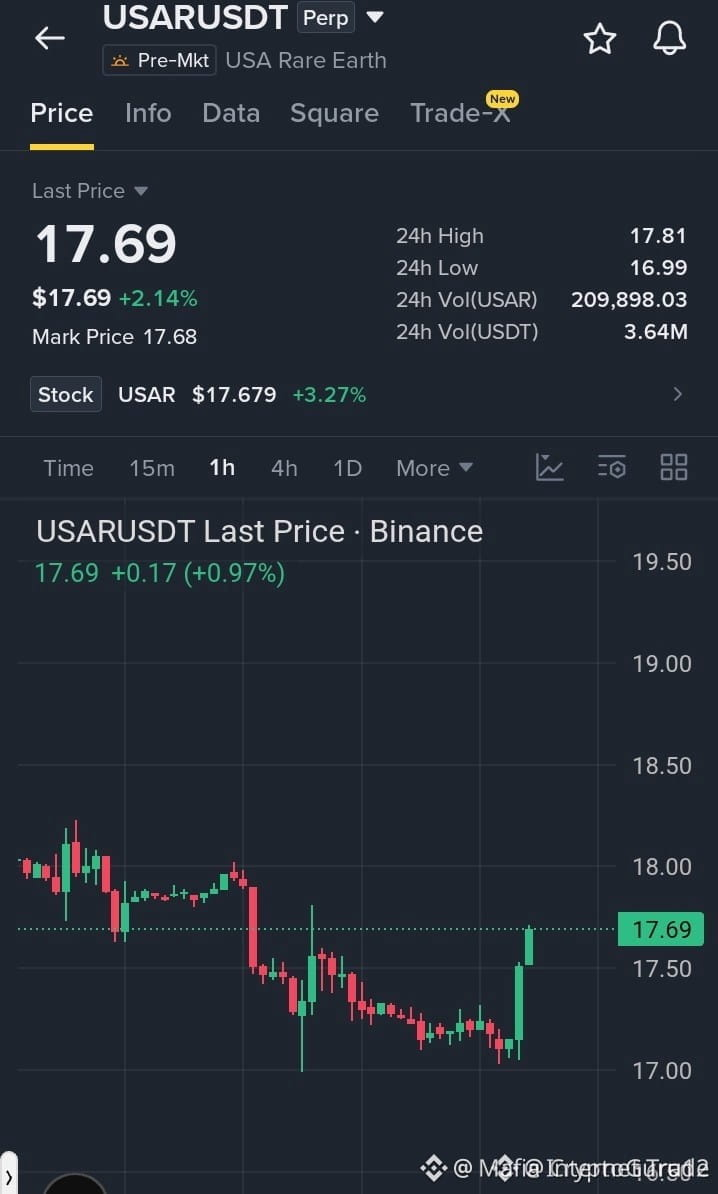
💥 $USAR RECLAIMS $17.50 AS BUYERS ABSORB SELLER PRESSURE FOR A BREAKOUT RUN! 🚀
Entry: 17.60 - 17.75 ⚡
Target: 17.85 - 18.15 🚀
Stop Loss: 17.35 ⚠️
Aggressive bids swept the $17.00 demand block and sparked a swift trend reversal. 🌊 Strong hourly volume just flipped $17.50 back into support, setting the stage to challenge the key resistance ceiling at $17.80.
📊 Market structure remains firmly bullish as long as price defends the $17.50 pivot zone. 💡 With momentum accelerating, managing risk tightly ensures we capture this expansion phase with clean execution. 💬 Are you bidding this momentum flip or waiting for a clean breakout confirmation above $17.80? 👇
⚠️ Not financial advice. Always manage your risk. 🛡️
🏷️ #USAR #LongSetup #Breakout #Crypto
🔥 💎
Entry: 17.60 - 17.75 ⚡
Target: 17.85 - 18.15 🚀
Stop Loss: 17.35 ⚠️
Aggressive bids swept the $17.00 demand block and sparked a swift trend reversal. 🌊 Strong hourly volume just flipped $17.50 back into support, setting the stage to challenge the key resistance ceiling at $17.80.
📊 Market structure remains firmly bullish as long as price defends the $17.50 pivot zone. 💡 With momentum accelerating, managing risk tightly ensures we capture this expansion phase with clean execution. 💬 Are you bidding this momentum flip or waiting for a clean breakout confirmation above $17.80? 👇
⚠️ Not financial advice. Always manage your risk. 🛡️
🏷️ #USAR #LongSetup #Breakout #Crypto
🔥 💎

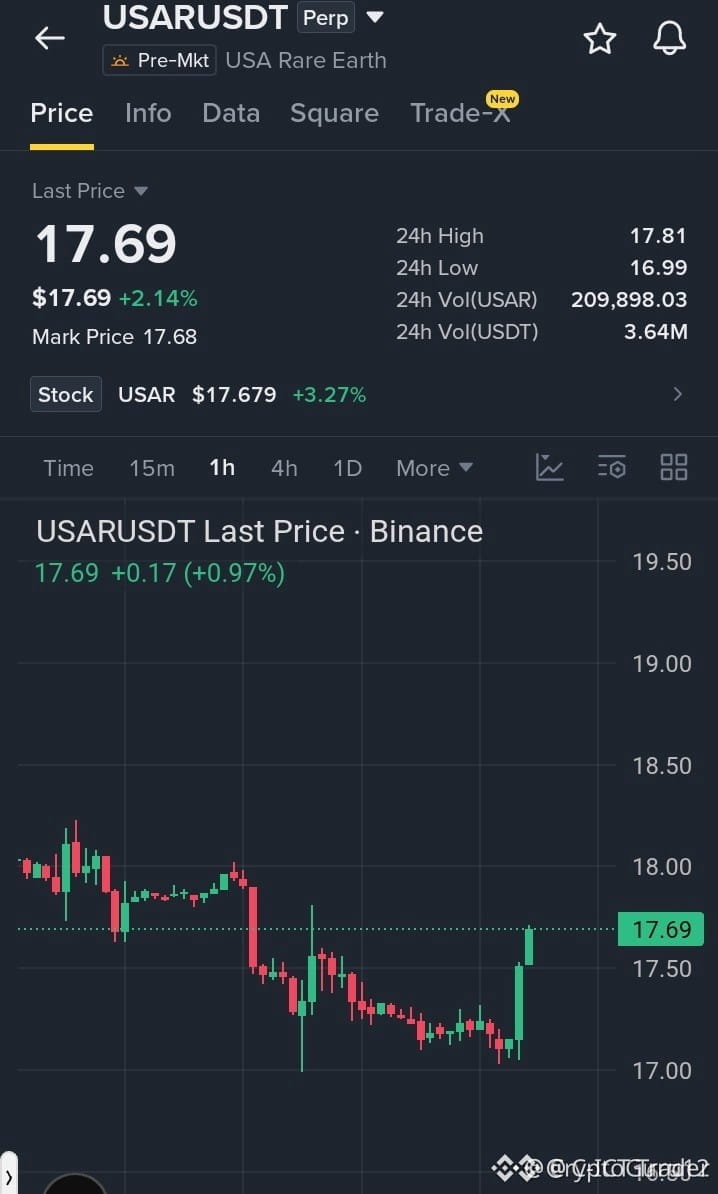
🦈 $USAR RECLAIMS KEY LEVEL AS SMART MONEY PUSHES THROUGH RESISTANCE! ⚡
Entry: 17.60 - 17.75 ⚡
Target: 18.15 🚀
Stop Loss: 17.35 ⚠️
Institutional buyers heavily defended the 17.00 - 17.20 demand zone, engineering a sharp structural reversal and reclaiming 17.50 with aggressive 1H order flow. 🔍
Price is now probing the 17.70 - 17.80 resistance block. 📊 Sustained acceptance above 17.50 keeps the bullish market structure intact for a run toward liquidity overhead. 📈
💭 Are you bidding this range reclaim, or waiting for a confirmed breakout above resistance? 👇
⚠️ Not financial advice. Always manage your risk. 🛡️
🏷️ #USAR #LongSetup #MarketStructure #Crypto #BTR
🎯 🦈
Entry: 17.60 - 17.75 ⚡
Target: 18.15 🚀
Stop Loss: 17.35 ⚠️
Institutional buyers heavily defended the 17.00 - 17.20 demand zone, engineering a sharp structural reversal and reclaiming 17.50 with aggressive 1H order flow. 🔍
Price is now probing the 17.70 - 17.80 resistance block. 📊 Sustained acceptance above 17.50 keeps the bullish market structure intact for a run toward liquidity overhead. 📈
💭 Are you bidding this range reclaim, or waiting for a confirmed breakout above resistance? 👇
⚠️ Not financial advice. Always manage your risk. 🛡️
🏷️ #USAR #LongSetup #MarketStructure #Crypto #BTR
🎯 🦈


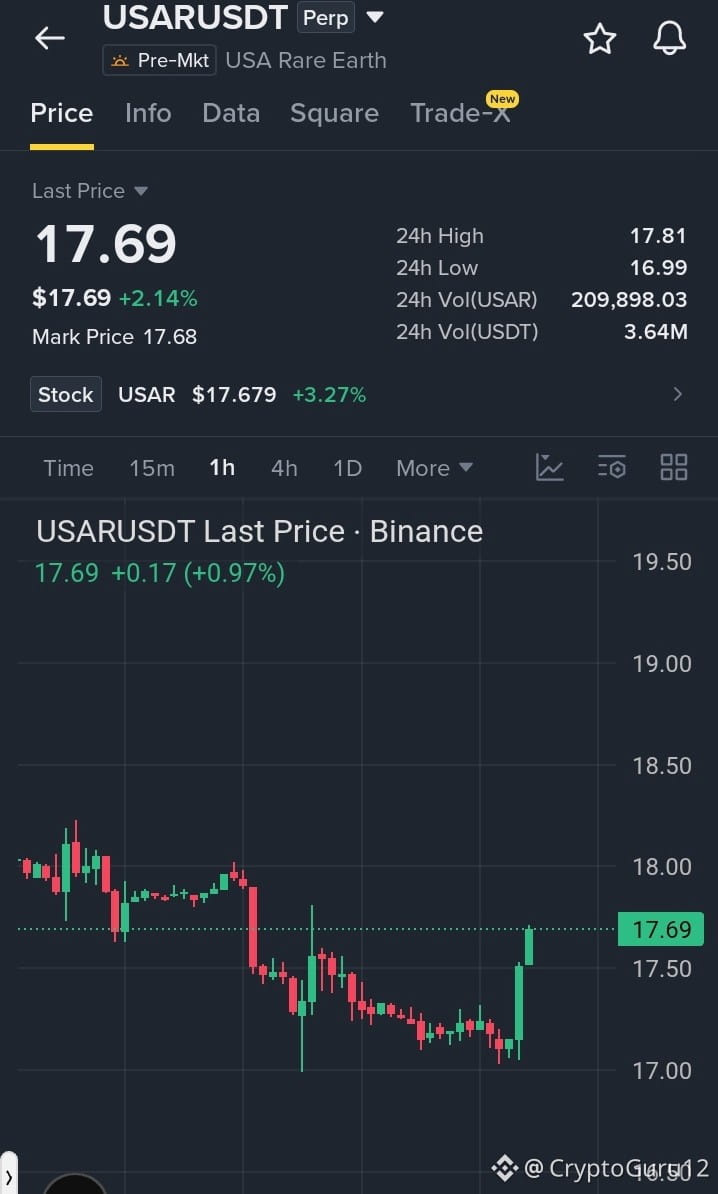
$USAR Reclaims $17.50 With Strong Momentum
#usar has reversed sharply from the $17.00–$17.20 support zone, breaking back above $17.50 with strong 1H buying pressure. Price is now testing the $17.70–$17.80 resistance area; a clean hold above this zone could trigger another leg higher.
LONG SETUP
Entry: $17.60 – $17.75
TP1: $17.85
TP2: $18.00
TP3: $18.15
SL: $17.35
The bullish structure stays intact while $17.50 holds as support. Manage leverage and risk carefully.
Buy and Trade
$BTR
$TUT
#usar has reversed sharply from the $17.00–$17.20 support zone, breaking back above $17.50 with strong 1H buying pressure. Price is now testing the $17.70–$17.80 resistance area; a clean hold above this zone could trigger another leg higher.
LONG SETUP
Entry: $17.60 – $17.75
TP1: $17.85
TP2: $18.00
TP3: $18.15
SL: $17.35
The bullish structure stays intact while $17.50 holds as support. Manage leverage and risk carefully.
Buy and Trade
$BTR
$TUT
$USAR 24 hours, the price rose 4.257%, and it is quoted at 17.88. Open interest remains fixed at 113387.92 contracts, and the funding rate is zero. This underlying belongs to the U.S. stock perpetual contract category; political and policy developments directly tug at its nerves.
Core view: Ambiguous signals from the political front are creating a short-term volatility premium for $USAR , but the funding rate’s absolute neutrality exposes a lack of market consensus—there is no one-way leveraged bet.
The evidence chain is based on two dimensions. The price is up 4.257%, yet open interest has almost not changed. This usually means the rally is not driven by new leveraged long positions, but rather by spot buy orders or short covering. The funding rate staying at 0 indicates that neither side needs to pay the other—an equilibrium state. This is a transitional judgment from a single signal to a bullish signal: stable open interest together with neutral funding points to a weak foundation for this leg of the rise; there is no top structure built up from funding accrual, nor a bottom basis that would trigger a squeeze.
The strongest counterargument is right here: if a sudden positive policy materializes for the political-policy-linked sector of $USAR —for example, regulatory loosening in a specific industry or fiscal subsidies—then the current positioning balance would be broken quickly. The funding rate could turn positive instantly, driving a pulse-like surge in price. The market may be underestimating the suddenness of policy implementation.
Second-order impact: if $USAR continues to strengthen as a result, the first players forced into action are those institutions that hold short hedges in its linked sector. They would need to close their short contracts, thereby paying funding to the longs, or directly buy the underlying to cut losses. The cost is borne by the shorts, and liquidity would be withdrawn from other political-sensitive assets with lower volatility, concentrating toward $USAR .
Conditions for the thesis to fail are clear: if the price of $USAR falls back below 17.00, and at the same time open interest drops below 100000 contracts, then the current assessment that policy expectations are lifting volatility is invalid. This would indicate that political expectations have faded, and capital has chosen to retreat.
Action plans provide three scenarios. Aggressive: when the price retraces to 17.50 and open interest does not show any signs of shrinking, lightly try going long; set the stop-loss at 17.00. Steady: stay on the sidelines and wait for the funding rate to show a clear direction (greater than 0.0001 or less than -0.0001) before considering follow-through. Avoid: don’t chase at the current price; if open interest starts to expand abnormally while the price stalls, consider reducing position.
Trading tag: #TradFi #链上美股 #USAR
Where do you think this set of judgments is most likely to be wrong?
Core view: Ambiguous signals from the political front are creating a short-term volatility premium for $USAR , but the funding rate’s absolute neutrality exposes a lack of market consensus—there is no one-way leveraged bet.
The evidence chain is based on two dimensions. The price is up 4.257%, yet open interest has almost not changed. This usually means the rally is not driven by new leveraged long positions, but rather by spot buy orders or short covering. The funding rate staying at 0 indicates that neither side needs to pay the other—an equilibrium state. This is a transitional judgment from a single signal to a bullish signal: stable open interest together with neutral funding points to a weak foundation for this leg of the rise; there is no top structure built up from funding accrual, nor a bottom basis that would trigger a squeeze.
The strongest counterargument is right here: if a sudden positive policy materializes for the political-policy-linked sector of $USAR —for example, regulatory loosening in a specific industry or fiscal subsidies—then the current positioning balance would be broken quickly. The funding rate could turn positive instantly, driving a pulse-like surge in price. The market may be underestimating the suddenness of policy implementation.
Second-order impact: if $USAR continues to strengthen as a result, the first players forced into action are those institutions that hold short hedges in its linked sector. They would need to close their short contracts, thereby paying funding to the longs, or directly buy the underlying to cut losses. The cost is borne by the shorts, and liquidity would be withdrawn from other political-sensitive assets with lower volatility, concentrating toward $USAR .
Conditions for the thesis to fail are clear: if the price of $USAR falls back below 17.00, and at the same time open interest drops below 100000 contracts, then the current assessment that policy expectations are lifting volatility is invalid. This would indicate that political expectations have faded, and capital has chosen to retreat.
Action plans provide three scenarios. Aggressive: when the price retraces to 17.50 and open interest does not show any signs of shrinking, lightly try going long; set the stop-loss at 17.00. Steady: stay on the sidelines and wait for the funding rate to show a clear direction (greater than 0.0001 or less than -0.0001) before considering follow-through. Avoid: don’t chase at the current price; if open interest starts to expand abnormally while the price stalls, consider reducing position.
Trading tag: #TradFi #链上美股 #USAR
Where do you think this set of judgments is most likely to be wrong?
$USAR rose 4.25% over the past 24 hours, with the price reaching $17.88. In the absence of a specific catalyst on-chain, the macro backdrop to this move is more worth watching than the price action itself.
Political uncertainty in the U.S. election year is the key variable driving capital flows. Markets are pricing potential policy shifts that could result from the election outcome—especially in trade and regulatory areas. In this environment, funds tend to look for assets that are believed to benefit from certain policy scenarios, or at least ones that won’t be directly hit. Part of $USAR ’s rally can be read as a reflection of this blend of risk-avoidance and speculation.
From the structure: its funding rate is 0, open interest is about 113,400 contracts, and 24-hour trading volume is roughly $4.13 million. A zero funding rate suggests that, around this price level, long and short forces have reached short-term equilibrium with no obvious one-way crowding. But combined with the price rise, this looks like a relatively mild upward structure—there hasn’t been excessive accumulation of positive funding costs from longs chasing aggressively. The open interest isn’t small either, indicating a meaningful portion of capital is holding positions and waiting for direction, rather than being short-term, in-and-out speculation.
The counterargument is also straightforward: if, over the next month, the policy platform of the leading candidates shows a clear turn—especially releasing clearer friendly signals to the crypto industry—then this uncertainty-based premium could quickly fade. At that point, support for tokens like $USAR would no longer be as solid.
The second-order effect is that once this politically driven sector rotation starts, liquidity tends to spread along the chain of assets that are expected to benefit from policy changes. Some assets tied to specific backgrounds or concepts may be repriced. But it also means the entire narrative depends heavily on the election schedule and shifts in public sentiment, so volatility is likely to stay elevated.
My view is built on the single signal that political uncertainty continues to intensify. If, over the next two weeks, major polls or market prediction platforms show an overwhelming advantage for a particular candidate—leading to a drop in uncertainty—then this logic would break.
Action-wise, the current price and structure are suitable for monitoring. Aggressive scenario: if clear political developments emerge indicating a favorable move toward easing regulation for specific industries, and $USAR ’s open interest expands while the funding rate turns positive, I would consider cautiously adding exposure, provided the price can hold above the current range. Conservative scenario: before political signals become clear, I would observe with current positioning and not chase.
Trading tag: #TradFi #链上美股 #USAR
Where do you think this view is most likely to be wrong?
Political uncertainty in the U.S. election year is the key variable driving capital flows. Markets are pricing potential policy shifts that could result from the election outcome—especially in trade and regulatory areas. In this environment, funds tend to look for assets that are believed to benefit from certain policy scenarios, or at least ones that won’t be directly hit. Part of $USAR ’s rally can be read as a reflection of this blend of risk-avoidance and speculation.
From the structure: its funding rate is 0, open interest is about 113,400 contracts, and 24-hour trading volume is roughly $4.13 million. A zero funding rate suggests that, around this price level, long and short forces have reached short-term equilibrium with no obvious one-way crowding. But combined with the price rise, this looks like a relatively mild upward structure—there hasn’t been excessive accumulation of positive funding costs from longs chasing aggressively. The open interest isn’t small either, indicating a meaningful portion of capital is holding positions and waiting for direction, rather than being short-term, in-and-out speculation.
The counterargument is also straightforward: if, over the next month, the policy platform of the leading candidates shows a clear turn—especially releasing clearer friendly signals to the crypto industry—then this uncertainty-based premium could quickly fade. At that point, support for tokens like $USAR would no longer be as solid.
The second-order effect is that once this politically driven sector rotation starts, liquidity tends to spread along the chain of assets that are expected to benefit from policy changes. Some assets tied to specific backgrounds or concepts may be repriced. But it also means the entire narrative depends heavily on the election schedule and shifts in public sentiment, so volatility is likely to stay elevated.
My view is built on the single signal that political uncertainty continues to intensify. If, over the next two weeks, major polls or market prediction platforms show an overwhelming advantage for a particular candidate—leading to a drop in uncertainty—then this logic would break.
Action-wise, the current price and structure are suitable for monitoring. Aggressive scenario: if clear political developments emerge indicating a favorable move toward easing regulation for specific industries, and $USAR ’s open interest expands while the funding rate turns positive, I would consider cautiously adding exposure, provided the price can hold above the current range. Conservative scenario: before political signals become clear, I would observe with current positioning and not chase.
Trading tag: #TradFi #链上美股 #USAR
Where do you think this view is most likely to be wrong?
$USAR funding rate is 0, with a 24-hour increase of 3.3%. The direct implication of this dataset is that positions holders do not need to pay any funding fees, and the long/short leverage costs are perfectly symmetrical.
A funding rate of zero usually appears at nodes where long and short forces are temporarily balanced. It is not a signal that longs are strong or shorts are strong; rather, both sides are in a wait-and-see or testing mode. Given the 24-hour gain of 3.3%, the price is rising steadily but without a corresponding increase in the incentive for longs to pay funding. This suggests the momentum for chasing higher prices is not strong. Trading volume of 4.34 million is not low, but an open interest of 112,000 points to only moderate opening enthusiasm. The market is not paying a premium for the rise (positive funding rate), nor is it paying a premium for the fall (negative funding rate). Traders show a lack of consensus on direction.
The strongest counter-evidence is: a funding rate that stays at 0 could simply be calm before the storm. Once key price levels are broken, the funding rate will quickly shift and amplify volatility. The second-order effect is that arbitrage capital will watch for this kind of balance, and any deviation in either direction could be magnified in the short term by that capital.
Under this structure, the cost-effectiveness of chasing longs or chasing shorts is not great. I will continue to observe and wait for the funding rate to show sustained positive or negative values, which is what would confirm that the market has established a clear directional preference.
Trading tag: #TradFi #链上美股 #USAR
Where do you think this assessment is most likely to be wrong?
A funding rate of zero usually appears at nodes where long and short forces are temporarily balanced. It is not a signal that longs are strong or shorts are strong; rather, both sides are in a wait-and-see or testing mode. Given the 24-hour gain of 3.3%, the price is rising steadily but without a corresponding increase in the incentive for longs to pay funding. This suggests the momentum for chasing higher prices is not strong. Trading volume of 4.34 million is not low, but an open interest of 112,000 points to only moderate opening enthusiasm. The market is not paying a premium for the rise (positive funding rate), nor is it paying a premium for the fall (negative funding rate). Traders show a lack of consensus on direction.
The strongest counter-evidence is: a funding rate that stays at 0 could simply be calm before the storm. Once key price levels are broken, the funding rate will quickly shift and amplify volatility. The second-order effect is that arbitrage capital will watch for this kind of balance, and any deviation in either direction could be magnified in the short term by that capital.
Under this structure, the cost-effectiveness of chasing longs or chasing shorts is not great. I will continue to observe and wait for the funding rate to show sustained positive or negative values, which is what would confirm that the market has established a clear directional preference.
Trading tag: #TradFi #链上美股 #USAR
Where do you think this assessment is most likely to be wrong?
Log in to explore more content