
#uniiotx
uniiotx
4,233 views
4 Discussing
Hot
Latest

·
--
Bearish
【Speculation | Bedrock 2.0 Transformation Plan, Will the Opportunity to Unwind uniIOTX Arise?】
The most criticized aspects of the last bull run's LST and LRT were probably the inability to exit after staking. Whether it was due to the target chain lacking trading liquidity or holding too little to meet the unstaking conditions.
For those who got liquidity trapped in uniIOTX, waiting for Bedrock @Bedrock to phase out the uniIOTX product line might be the only chance to recover assets, and that day should be coming soon.
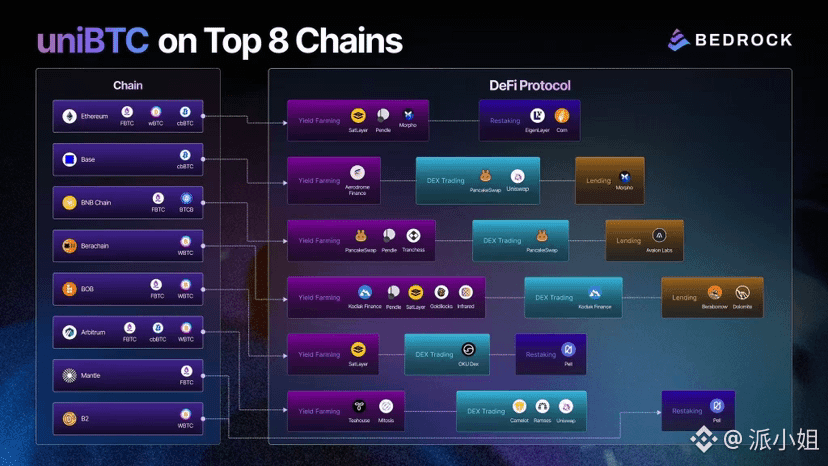
Yesterday, it was mentioned that Bedrock has stopped supporting the bridging functionality for uniBTC across 12 blockchains, and the official team will assist in transferring assets to Ethereum. A similar opportunity may also arise with uniIOTX.
-
Since its launch in 2024, uniIOTX has consistently maintained a staking volume above 400m $IOTX , but the reason might not be the allure of over 5% APY, rather it’s due to the lack of exit opportunities that passively traps holders.
According to the rules for unstaking uniIOTX, the minimum unstaking amount must reach 1m IOTX, currently valued at about $3,300.
Looking at the total staking volume, uniIOTX's reserves are approximately 420m IOTX, with 14,019 holding addresses, and an average holding amount of only about 30,000 IOTX, far below the threshold for unstaking applications.
Worse yet, the IoTeX chain has essentially become a dead chain, with the largest liquidity on-chain being Bedrock uniIOTX, meaning that even if users want to swap for other assets, the liquidity on the chain cannot meet the demand.
So, most uniIOTX holders can only passively wait for the Bedrock team to announce the discontinuation of that product line and provide users with an exit liquidity opportunity.
-
Summary
In contrast, even though uniETH did not appear in the Bedrock 2.0 plans, I believe ETH Staking is a more manageable product line, currently still accounting for about 1/3 of Bedrock's TVL, likely to be maintained for some time.
On the other hand, the uniIOTX product line is highly likely to be terminated in the near future. Interestingly, if uniIOTX officially enters its final chapter, it would also signal the end of the IoTeX blockchain.
-
● The above content does not constitute investment advice (NFA); users should operate based on their own risk tolerance, DYOR and participate in the investment market cautiously.
● Attached image sourced from Bedrock
#Bedrock #BR $BR #uniIOTX #uniBTC
{future}(BRUSDT)
{spot}(IOTXUSDT)
【Speculation | Bedrock 2.0 Transformation Plan, Will the Opportunity to Unwind uniIOTX Arise?】
The most criticized aspects of the last bull run's LST and LRT were probably the inability to exit after staking. Whether it was due to the target chain lacking trading liquidity or holding too little to meet the unstaking conditions.
For those who got liquidity trapped in uniIOTX, waiting for Bedrock @Bedrock to phase out the uniIOTX product line might be the only chance to recover assets, and that day should be coming soon.
Yesterday, it was mentioned that Bedrock has stopped supporting the bridging functionality for uniBTC across 12 blockchains, and the official team will assist in transferring assets to Ethereum. A similar opportunity may also arise with uniIOTX.
-
Since its launch in 2024, uniIOTX has consistently maintained a staking volume above 400m $IOTX , but the reason might not be the allure of over 5% APY, rather it’s due to the lack of exit opportunities that passively traps holders.
According to the rules for unstaking uniIOTX, the minimum unstaking amount must reach 1m IOTX, currently valued at about $3,300.
Looking at the total staking volume, uniIOTX's reserves are approximately 420m IOTX, with 14,019 holding addresses, and an average holding amount of only about 30,000 IOTX, far below the threshold for unstaking applications.
Worse yet, the IoTeX chain has essentially become a dead chain, with the largest liquidity on-chain being Bedrock uniIOTX, meaning that even if users want to swap for other assets, the liquidity on the chain cannot meet the demand.
So, most uniIOTX holders can only passively wait for the Bedrock team to announce the discontinuation of that product line and provide users with an exit liquidity opportunity.
-
Summary
In contrast, even though uniETH did not appear in the Bedrock 2.0 plans, I believe ETH Staking is a more manageable product line, currently still accounting for about 1/3 of Bedrock's TVL, likely to be maintained for some time.
On the other hand, the uniIOTX product line is highly likely to be terminated in the near future. Interestingly, if uniIOTX officially enters its final chapter, it would also signal the end of the IoTeX blockchain.
-
● The above content does not constitute investment advice (NFA); users should operate based on their own risk tolerance, DYOR and participate in the investment market cautiously.
● Attached image sourced from Bedrock
#Bedrock #BR $BR #uniIOTX #uniBTC
The most criticized aspects of the last bull run's LST and LRT were probably the inability to exit after staking. Whether it was due to the target chain lacking trading liquidity or holding too little to meet the unstaking conditions.
For those who got liquidity trapped in uniIOTX, waiting for Bedrock @Bedrock to phase out the uniIOTX product line might be the only chance to recover assets, and that day should be coming soon.
Yesterday, it was mentioned that Bedrock has stopped supporting the bridging functionality for uniBTC across 12 blockchains, and the official team will assist in transferring assets to Ethereum. A similar opportunity may also arise with uniIOTX.
-
Since its launch in 2024, uniIOTX has consistently maintained a staking volume above 400m $IOTX , but the reason might not be the allure of over 5% APY, rather it’s due to the lack of exit opportunities that passively traps holders.
According to the rules for unstaking uniIOTX, the minimum unstaking amount must reach 1m IOTX, currently valued at about $3,300.
Looking at the total staking volume, uniIOTX's reserves are approximately 420m IOTX, with 14,019 holding addresses, and an average holding amount of only about 30,000 IOTX, far below the threshold for unstaking applications.
Worse yet, the IoTeX chain has essentially become a dead chain, with the largest liquidity on-chain being Bedrock uniIOTX, meaning that even if users want to swap for other assets, the liquidity on the chain cannot meet the demand.
So, most uniIOTX holders can only passively wait for the Bedrock team to announce the discontinuation of that product line and provide users with an exit liquidity opportunity.
-
Summary
In contrast, even though uniETH did not appear in the Bedrock 2.0 plans, I believe ETH Staking is a more manageable product line, currently still accounting for about 1/3 of Bedrock's TVL, likely to be maintained for some time.
On the other hand, the uniIOTX product line is highly likely to be terminated in the near future. Interestingly, if uniIOTX officially enters its final chapter, it would also signal the end of the IoTeX blockchain.
-
● The above content does not constitute investment advice (NFA); users should operate based on their own risk tolerance, DYOR and participate in the investment market cautiously.
● Attached image sourced from Bedrock
#Bedrock #BR $BR #uniIOTX #uniBTC
1
339

·
--
Don't treat $BR as just another ordinary airdrop, Bedrock is truly different.
To be honest, I almost missed out on $BR. After diving into its operational logic, my perspective completely changed.
Most airdrop projects out there follow the same tired routine:
Official announcement hype → Users rush in to claim → Large sell-off → Project falls into silence.
Taking a quick look at the charts: BR/USDT perpetual current price 0.09877, change -0.12%.
What really made me stop and dig deeper into Bedrock wasn't the short-term airdrop gains, but the genuine users who remained steadfast even after the incentives faded.
I clearly observed the essential difference between it and typical meme coin projects:
When Bedrock first kicked off liquidity mining and invite events, it was just like any other airdrop project.
Lots of wallets rushing to claim airdrops, users flooding to claim, and capital pouring in for quick profits—just a short-term arbitrage scene.
But after the hype faded, the real turning point emerged.
The pure arbitrage miners left the scene, market liquidity briefly pulled back, yet a group of low-key, genuine core users stayed behind.
They didn’t stick around for the token rewards,
but because they recognized Bedrock's solid infrastructure—#uniBTC , #uniETH , #uniIOTX .
This liquidity re-staking system is a truly grounded, valuable core ecosystem.
This is also my core standard for filtering quality foundational projects:
I don’t look at the initial surge in TVL or the fake trading volumes at launch.
I only pay attention to who remains committed and is genuinely using the platform after the incentives vanish and the hype fades.
For me, $BR has never been just another ordinary airdrop token,
it's the best proof of the protocol's strength. @Bedrock
Let me ask everyone:
Did you claim the #Bedrock airdrop? Have you cashed out already, or are you like me, continuously holding and nurturing the ecosystem?
Let’s chat in the comments below 👇
{future}(BRUSDT)
Don't treat $BR as just another ordinary airdrop, Bedrock is truly different.
To be honest, I almost missed out on $BR . After diving into its operational logic, my perspective completely changed.
Most airdrop projects out there follow the same tired routine:
Official announcement hype → Users rush in to claim → Large sell-off → Project falls into silence.
Taking a quick look at the charts: BR/USDT perpetual current price 0.09877, change -0.12%.
What really made me stop and dig deeper into Bedrock wasn't the short-term airdrop gains, but the genuine users who remained steadfast even after the incentives faded.
I clearly observed the essential difference between it and typical meme coin projects:
When Bedrock first kicked off liquidity mining and invite events, it was just like any other airdrop project.
Lots of wallets rushing to claim airdrops, users flooding to claim, and capital pouring in for quick profits—just a short-term arbitrage scene.
But after the hype faded, the real turning point emerged.
The pure arbitrage miners left the scene, market liquidity briefly pulled back, yet a group of low-key, genuine core users stayed behind.
They didn’t stick around for the token rewards,
but because they recognized Bedrock's solid infrastructure—#uniBTC , #uniETH , #uniIOTX .
This liquidity re-staking system is a truly grounded, valuable core ecosystem.
This is also my core standard for filtering quality foundational projects:
I don’t look at the initial surge in TVL or the fake trading volumes at launch.
I only pay attention to who remains committed and is genuinely using the platform after the incentives vanish and the hype fades.
For me, $BR has never been just another ordinary airdrop token,
it's the best proof of the protocol's strength. @Bedrock
Let me ask everyone:
Did you claim the #Bedrock airdrop? Have you cashed out already, or are you like me, continuously holding and nurturing the ecosystem?
Let’s chat in the comments below 👇
To be honest, I almost missed out on $BR . After diving into its operational logic, my perspective completely changed.
Most airdrop projects out there follow the same tired routine:
Official announcement hype → Users rush in to claim → Large sell-off → Project falls into silence.
Taking a quick look at the charts: BR/USDT perpetual current price 0.09877, change -0.12%.
What really made me stop and dig deeper into Bedrock wasn't the short-term airdrop gains, but the genuine users who remained steadfast even after the incentives faded.
I clearly observed the essential difference between it and typical meme coin projects:
When Bedrock first kicked off liquidity mining and invite events, it was just like any other airdrop project.
Lots of wallets rushing to claim airdrops, users flooding to claim, and capital pouring in for quick profits—just a short-term arbitrage scene.
But after the hype faded, the real turning point emerged.
The pure arbitrage miners left the scene, market liquidity briefly pulled back, yet a group of low-key, genuine core users stayed behind.
They didn’t stick around for the token rewards,
but because they recognized Bedrock's solid infrastructure—#uniBTC , #uniETH , #uniIOTX .
This liquidity re-staking system is a truly grounded, valuable core ecosystem.
This is also my core standard for filtering quality foundational projects:
I don’t look at the initial surge in TVL or the fake trading volumes at launch.
I only pay attention to who remains committed and is genuinely using the platform after the incentives vanish and the hype fades.
For me, $BR has never been just another ordinary airdrop token,
it's the best proof of the protocol's strength. @Bedrock
Let me ask everyone:
Did you claim the #Bedrock airdrop? Have you cashed out already, or are you like me, continuously holding and nurturing the ecosystem?
Let’s chat in the comments below 👇
312

·
--
I was looking into $BR yesterday and honestly expected to just check the staking side and move on. Ended up spending way more time on it because the Bitcoin side caught my attention.
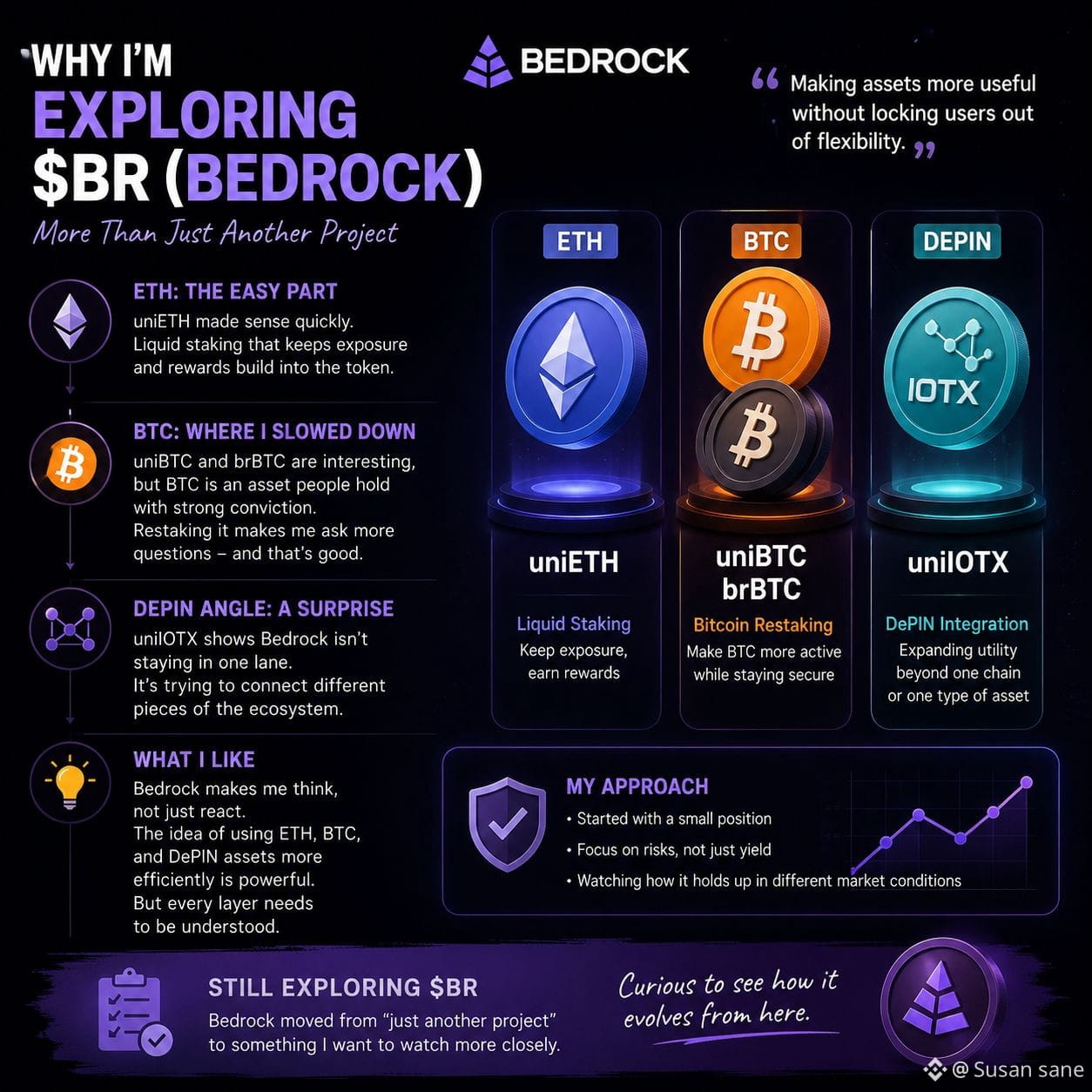
ETH liquid staking felt straightforward, but #uniBTC and #brBTC made me slow down. I’ve always seen BTC as the asset people don’t want to mess with, so turning it into something more active raises different questions.
I tested a small position first instead of going heavy. My main thought wasn’t “how much yield can I get?” but “what’s happening behind the scenes when conditions get rough?”
That’s the part I find interesting about Bedrock 2.0. The challenge isn’t just creating yield, it’s keeping users comfortable while moving assets that are usually held passively.
The DePIN angle through #uniIOTX was also unexpected. It makes me think Bedrock is trying to connect different use cases, not just chase one narrative.
Still researching $BR , but it’s definitely on my watchlist now.
#bedrocks @Bedrock
I was looking into $BR yesterday and honestly expected to just check the staking side and move on. Ended up spending way more time on it because the Bitcoin side caught my attention.
ETH liquid staking felt straightforward, but #uniBTC and #brBTC made me slow down. I’ve always seen BTC as the asset people don’t want to mess with, so turning it into something more active raises different questions.
I tested a small position first instead of going heavy. My main thought wasn’t “how much yield can I get?” but “what’s happening behind the scenes when conditions get rough?”
That’s the part I find interesting about Bedrock 2.0. The challenge isn’t just creating yield, it’s keeping users comfortable while moving assets that are usually held passively.
The DePIN angle through #uniIOTX was also unexpected. It makes me think Bedrock is trying to connect different use cases, not just chase one narrative.
Still researching $BR , but it’s definitely on my watchlist now.
#bedrocks @Bedrock
ETH liquid staking felt straightforward, but #uniBTC and #brBTC made me slow down. I’ve always seen BTC as the asset people don’t want to mess with, so turning it into something more active raises different questions.
I tested a small position first instead of going heavy. My main thought wasn’t “how much yield can I get?” but “what’s happening behind the scenes when conditions get rough?”
That’s the part I find interesting about Bedrock 2.0. The challenge isn’t just creating yield, it’s keeping users comfortable while moving assets that are usually held passively.
The DePIN angle through #uniIOTX was also unexpected. It makes me think Bedrock is trying to connect different use cases, not just chase one narrative.
Still researching $BR , but it’s definitely on my watchlist now.
#bedrocks @Bedrock
67
30
9.2k
Log in to explore more content
Join global crypto users on Binance Square
⚡️ Get latest and useful information about crypto.
💬 Trusted by the world’s largest crypto exchange.
👍 Discover real insights from verified creators.
Email / Phone number
Trending Topics
1
#FedRateWatch
681,368 views
3,212 Discussing
2
#EthereumFallsBelow$2400
959 views
35 Discussing
3
#USSenateBlocksClarityAct
3,878 views
151 Discussing
4
#BitcoinSlidesTo$76000
29,415 views
139 Discussing
5
#BitcoinReboundsTo$79K
64,690 views
415 Discussing
6
#StrategyMarketCapPassesFord
49,983 views
786 Discussing
7
#ClarityActOddsHalveOnPolymarket
81,961 views
686 Discussing
8
#US30YTreasuryYieldTops5.40%
42,841 views
443 Discussing
9
#BessentEndorsesFinalClarityActDraft
64,845 views
822 Discussing
10
#ZamaOpens16ConfidentialMorphoVaults
22,712 views
396 Discussing