
#termmaxx
termmaxx
473 views
12 Discussing
Hot
Latest

#termmax @TermMax I believe #termmaxx is one of the most promising projects on Binance right now, and I’m very optimistic about its future. Binance has always introduced strong and innovative projects, and I feel #TermMax🌐🚀 has the potential to become another important project in the ecosystem.
I’m especially hopeful that TermMax could offer strong rewards through the Binance Booster program. Among the projects available there, I believe TermMax has a great opportunity to stand out and deliver meaningful rewards to its supporters.
What makes me more confident is the overall strength and potential of the TermMax project. It looks like a project with a clear direction and strong possibilities for future growth. I don’t think TermMax will disappoint its community if the team continues building, improving the ecosystem, and delivering real value.
For me, #TermMax🌐🚀 is not only about short-term hype. I’m looking at its longer-term potential as well. If the project continues to develop successfully, holding $TERM for the future could potentially bring interesting opportunities.
Of course, every crypto investment carries risk, so everyone should always do their own research before making any decision. But based on what I’ve seen so far, I’m genuinely excited about TermMax and its future.
That’s why I think everyone interested in the Binance Booster program should take a closer look at TermMax and consider joining the campaign. I’m optimistic that this project can grow into something much bigger over time.
TermMax has strong potential, an exciting vision, and a community that can help drive its growth. I’m staying positive and looking forward to seeing what comes next.
#TermMax
I’m especially hopeful that TermMax could offer strong rewards through the Binance Booster program. Among the projects available there, I believe TermMax has a great opportunity to stand out and deliver meaningful rewards to its supporters.
What makes me more confident is the overall strength and potential of the TermMax project. It looks like a project with a clear direction and strong possibilities for future growth. I don’t think TermMax will disappoint its community if the team continues building, improving the ecosystem, and delivering real value.
For me, #TermMax🌐🚀 is not only about short-term hype. I’m looking at its longer-term potential as well. If the project continues to develop successfully, holding $TERM for the future could potentially bring interesting opportunities.
Of course, every crypto investment carries risk, so everyone should always do their own research before making any decision. But based on what I’ve seen so far, I’m genuinely excited about TermMax and its future.
That’s why I think everyone interested in the Binance Booster program should take a closer look at TermMax and consider joining the campaign. I’m optimistic that this project can grow into something much bigger over time.
TermMax has strong potential, an exciting vision, and a community that can help drive its growth. I’m staying positive and looking forward to seeing what comes next.
#TermMax
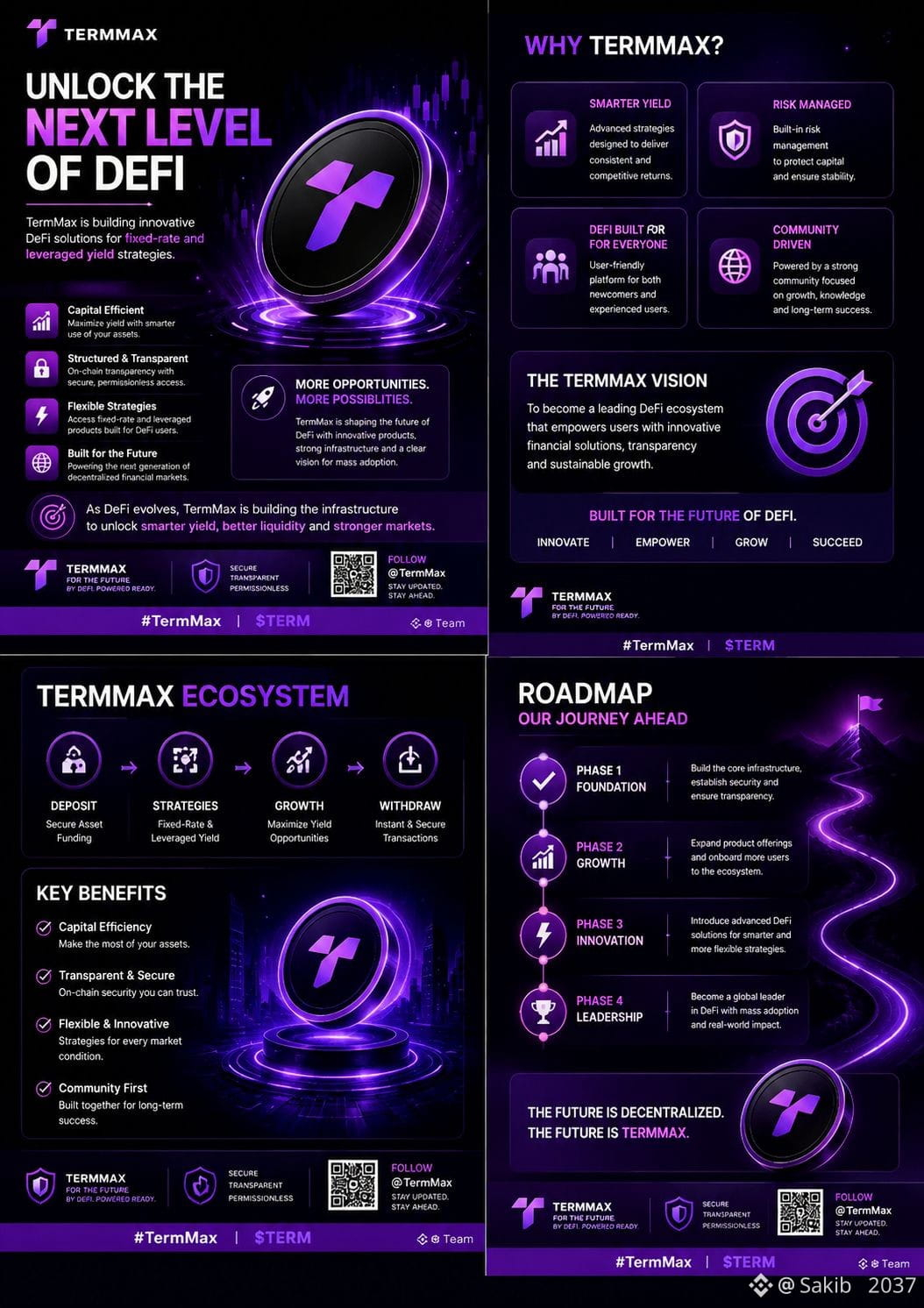

#termmax @TermMax Here's the shorter version (still 100+ characters, since that's the minimum required):
---
Exploring TermMax's fixed-rate lending model — a real upgrade over volatile APYs for DeFi users who want predictable yield and borrowing costs. Curious to see how @TermMax grows adoption with this structured approach. #TermMax
---
A few reminders:
- I can't post this myself — you'll need to copy it and publish directly on Binance Square.
- The **first published version** must already include the @TermMax x tag and #termmaxx hashtag — editing them in later means 0 points.
- I don't have verified, up-to-date info on TermMax's actual metrics or recent features — want me to search for the latest news so the post has something specific and less generic? #BinanceSquare
---
Exploring TermMax's fixed-rate lending model — a real upgrade over volatile APYs for DeFi users who want predictable yield and borrowing costs. Curious to see how @TermMax grows adoption with this structured approach. #TermMax
---
A few reminders:
- I can't post this myself — you'll need to copy it and publish directly on Binance Square.
- The **first published version** must already include the @TermMax x tag and #termmaxx hashtag — editing them in later means 0 points.
- I don't have verified, up-to-date info on TermMax's actual metrics or recent features — want me to search for the latest news so the post has something specific and less generic? #BinanceSquare

ma123456789:
good

Verified
I’ve been burned enough by DeFi “risk management” that I’m suspicious whenever the fix is just another liquidation bot.
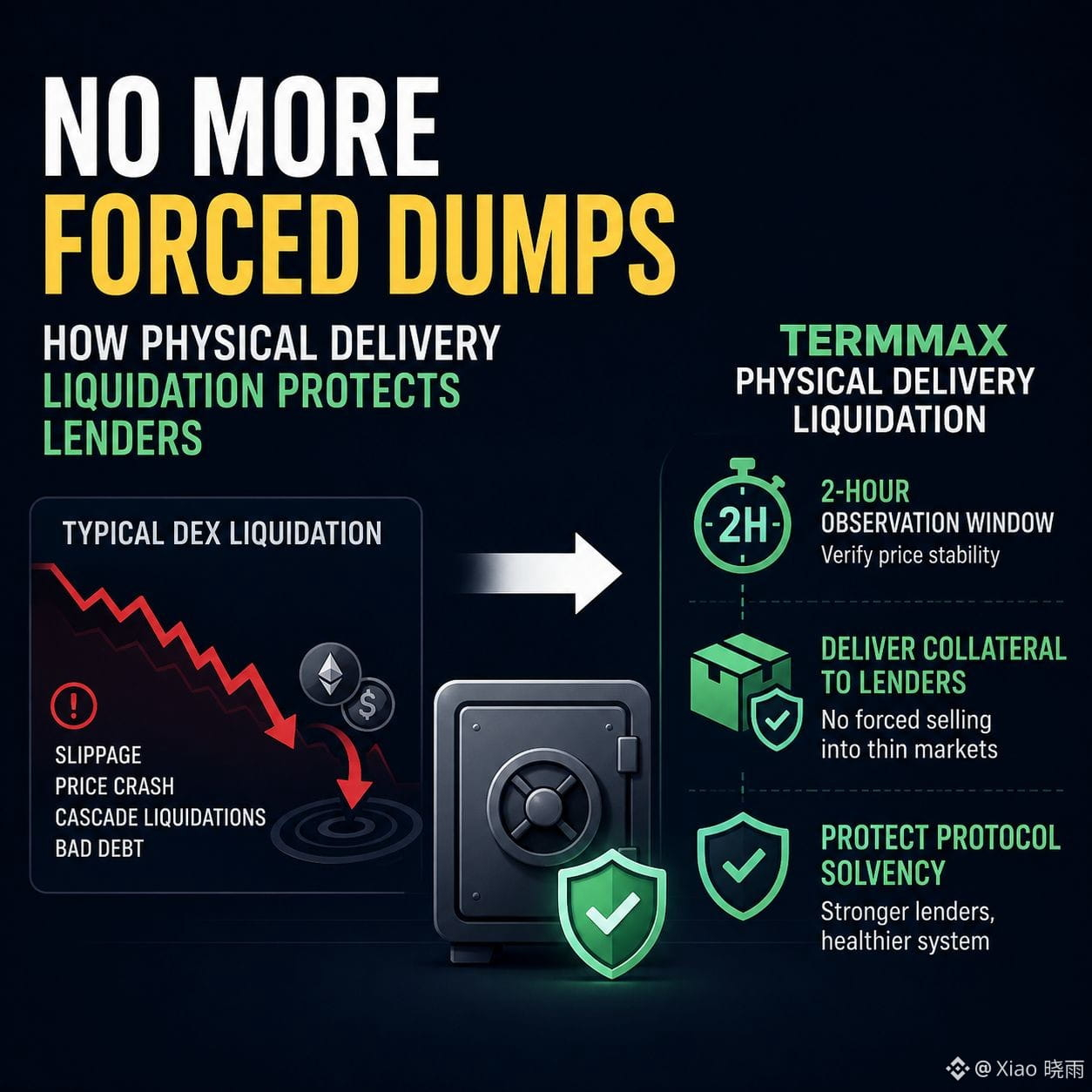
The ugly part is obvious: when markets get violent, automated DEX liquidations can dump collateral into thin liquidity, eat slippage, push price lower, trigger more liquidations, and turn a bad position into protocol-wide bad debt.
@TermMax takes a less sexy route.
Instead of immediately forcing a market sale, its liquidation flow uses a 2-hour observation window to check whether the asset price has actually stabilized. And if liquidation goes through, the underlying collateral can be delivered directly to lenders rather than nuked into an already wrecked order book.
That plumbing matters.
The goal isn’t to make liquidation disappear. It’s to stop the liquidation mechanism itself from becoming the thing that breaks solvency.
My contrarian take: DeFi keeps chasing volume, leverage and flashy yield while ignoring the boring machinery that keeps lenders alive when everything goes sideways.
Degen UX gets attention.
Boring liquidation design keeps protocols alive.
#TermMax @TermMax #termmaxx
$NEIRO
$BOME
$ENA
The ugly part is obvious: when markets get violent, automated DEX liquidations can dump collateral into thin liquidity, eat slippage, push price lower, trigger more liquidations, and turn a bad position into protocol-wide bad debt.
@TermMax takes a less sexy route.
Instead of immediately forcing a market sale, its liquidation flow uses a 2-hour observation window to check whether the asset price has actually stabilized. And if liquidation goes through, the underlying collateral can be delivered directly to lenders rather than nuked into an already wrecked order book.
That plumbing matters.
The goal isn’t to make liquidation disappear. It’s to stop the liquidation mechanism itself from becoming the thing that breaks solvency.
My contrarian take: DeFi keeps chasing volume, leverage and flashy yield while ignoring the boring machinery that keeps lenders alive when everything goes sideways.
Degen UX gets attention.
Boring liquidation design keeps protocols alive.
#TermMax @TermMax #termmaxx
$NEIRO
$BOME
$ENA

Michael John1:
TermMax’s liquidation design is interesting—less panic selling, more focus on market stability.

EASY DeFi OPPORTUNITY YOU SHOULDN'T MISS!
If you're looking for simple tasks with actual potential, definitely check out the @TermMax TermMax Web3 Booster event. They've lined up a massive 1,700,000 $TMX prize pool with 80,000 random slots open until August 24, 2026. It takes just a few minutes, so pretty much everyone should jump on this!
⚡ WHAT MAKES THIS PROJECT ACTUALLY USEFUL?
Let’s be real—fluctuating APYs in DeFi can be exhausting. You deposit your funds expecting solid yields, only to watch the rates drop a few days later.
Really solid utility behind this one. Excited to see where @TermMax goes from here! 💸 #termmaxx
If you're looking for simple tasks with actual potential, definitely check out the @TermMax TermMax Web3 Booster event. They've lined up a massive 1,700,000 $TMX prize pool with 80,000 random slots open until August 24, 2026. It takes just a few minutes, so pretty much everyone should jump on this!
⚡ WHAT MAKES THIS PROJECT ACTUALLY USEFUL?
Let’s be real—fluctuating APYs in DeFi can be exhausting. You deposit your funds expecting solid yields, only to watch the rates drop a few days later.
Really solid utility behind this one. Excited to see where @TermMax goes from here! 💸 #termmaxx

Today I want to put @TermMax into a more realistic scenario to look at it this way: if you already have funds on-chain, the real challenge isn’t “whether there’s a place to put them,” but how to choose among returns, risks, and liquidity.
Sometimes you’re willing to accept volatility to bet on a direction;
Sometimes you just want to lock in borrowing costs;
And sometimes you don’t want to trade at all—you just hope your assets aren’t sitting idle.
What makes TermMax special is that it doesn’t force these different needs into a single, one-size-fits-all玩法.
Fixed-rate lending is better suited for people who need to plan their funding costs;
Calls / Puts provide clear tools to express both bullish and bearish views;
And on the yield side, it offers another participation method for holders who don’t want to trade frequently.
I think this is more meaningful than simply debating “which feature has the highest returns.”
A truly mature DeFi shouldn’t require users to maintain the same risk preference forever. Market conditions change, and personal funding needs change too. If a protocol can let users switch strategies at different stages without leaving the entire ecosystem, that kind of stickiness is what’s really worth paying attention to.
So now I’m looking at #termmaxx . The focus isn’t just how many features it provides, but whether these features can work together to form a genuinely switchable, sustainable logic for capital management.
Sometimes you’re willing to accept volatility to bet on a direction;
Sometimes you just want to lock in borrowing costs;
And sometimes you don’t want to trade at all—you just hope your assets aren’t sitting idle.
What makes TermMax special is that it doesn’t force these different needs into a single, one-size-fits-all玩法.
Fixed-rate lending is better suited for people who need to plan their funding costs;
Calls / Puts provide clear tools to express both bullish and bearish views;
And on the yield side, it offers another participation method for holders who don’t want to trade frequently.
I think this is more meaningful than simply debating “which feature has the highest returns.”
A truly mature DeFi shouldn’t require users to maintain the same risk preference forever. Market conditions change, and personal funding needs change too. If a protocol can let users switch strategies at different stages without leaving the entire ecosystem, that kind of stickiness is what’s really worth paying attention to.
So now I’m looking at #termmaxx . The focus isn’t just how many features it provides, but whether these features can work together to form a genuinely switchable, sustainable logic for capital management.


#termmax @TermMax
How does TermMax separate base yield from temporary rewards?
Transparency may become one of the most important competitive advantages in the next generation of DeFi. TermMax is interesting because its approach focuses on making yield structures easier to understand. Instead of treating every reward as the same, separating base yield from temporary incentives gives users more information about the real source of returns. That distinction can matter when evaluating sustainability and risk. I think this is where
DeFi needs to mature: not simply offering attractive opportunities, but providing enough clarity for users to understand what they are participating in.
TermMax is taking an approach that could become increasingly relevant as the industr develop.
#termmaxx @TermMax
How does TermMax separate base yield from temporary rewards?
Transparency may become one of the most important competitive advantages in the next generation of DeFi. TermMax is interesting because its approach focuses on making yield structures easier to understand. Instead of treating every reward as the same, separating base yield from temporary incentives gives users more information about the real source of returns. That distinction can matter when evaluating sustainability and risk. I think this is where
DeFi needs to mature: not simply offering attractive opportunities, but providing enough clarity for users to understand what they are participating in.
TermMax is taking an approach that could become increasingly relevant as the industr develop.
#termmaxx @TermMax

kanwal Zaheer Bhatti:
TermMax is interesting because its approach focuses on making yield structures easier to understand. Instead of treating every reward as the same, separating base yield from temporary incentives gives users more information about the real source of return

#termmax @TermMax
@TermMax where ideas turn into results.
We don’t just talk about growth, we build it. From smart strategies to clean execution TermMax is built for people who want more: more clarity, more momentum, more wins.
Whether you’re starting out or scaling up, we’re here to simplify the complex and make the next step obvious.
This isn’t about hype. It’s about progress you can actually feel.
Join us. Learn. Build. Repeat.
Because the future belongs to those who show up and do the work.
Let’s max it out. #termmaxx #BuildBetter
@TermMax where ideas turn into results.
We don’t just talk about growth, we build it. From smart strategies to clean execution TermMax is built for people who want more: more clarity, more momentum, more wins.
Whether you’re starting out or scaling up, we’re here to simplify the complex and make the next step obvious.
This isn’t about hype. It’s about progress you can actually feel.
Join us. Learn. Build. Repeat.
Because the future belongs to those who show up and do the work.
Let’s max it out. #termmaxx #BuildBetter

#termmax In the bullish-bearish transition cycle of cryptocurrencies, some excellent infrastructure projects always emerge. @TermMax is one of them. It aims to break down barriers in traditional finance through a unique mechanism. I believe the future trend will be more transparent and efficient, and TermMax perfectly aligns with this理念. Not only is the interface user-friendly, but the interaction experience is also smooth. Looking forward to bigger breakthroughs in the coming quarters and becoming a benchmark for the industry! #termmaxx
Log in to explore more content