One thing I've noticed in crypto is that we can spend a lot of time researching a project and still overlook some of the most important details about its token.
We read about the technology, partnerships, integrations, community growth and roadmaps. And honestly, all of those things matter. But I think there's another question that deserves just as much attention:
If the project succeeds, what actually makes its token valuable?
The more I look at token economics, the more I realise that a promising project and a promising token are two different things.
A project can build a useful product, attract users and develop a strong ecosystem. But that success doesn't automatically translate into value for its token.
That's why I think it's worth looking beyond the project narrative and examining the token itself.
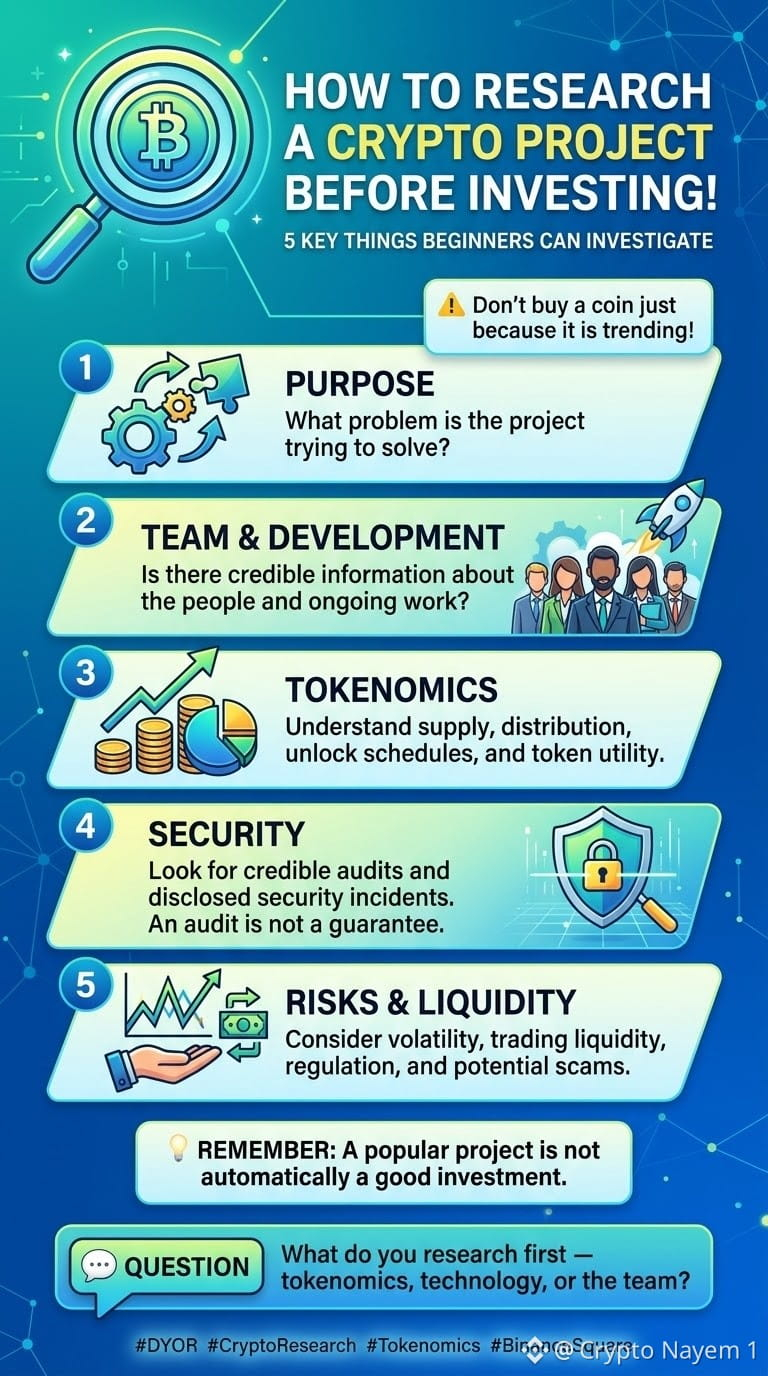
Here are five areas I believe deserve attention before forming an opinion about any token.
1. Token Utility: What does it actually do?
Start with the most basic question: What is the token used for?
Does it provide access to a platform or network? Is it required to pay transaction fees? Does it have a role in staking, governance or another part of the ecosystem?
These are useful questions because a token should have a clearly explained purpose. Sometimes a project has an impressive product, but its token plays only a limited role in how that product operates.
That doesn't automatically make the token a bad investment, but it does mean the distinction deserves attention.
I wouldn't assume that a project's success makes its token valuable simply because both share the same name.
Understand the actual use-case first.
2. Token Unlocks: What supply is coming next?
Token supply is another area I think deserves more attention. A token may have a relatively small circulating supply today, while a significant portion is scheduled to enter circulation over the coming months or years. This is where vesting schedules and token unlocks become important.
Look at:
- The current circulating supply.
- The total and maximum supply, where applicable.
- Upcoming unlock dates.
- The allocation to the team, investors, ecosystem and community.
One important distinction: An unlock doesn't automatically mean a sell-off.
Some recipients may sell their tokens, while others may hold them, use them within the ecosystem or distribute them according to the project's plans.
Still, understanding the schedule gives a clearer picture of potential future supply and possible selling pressure.
Ignoring it means evaluating a token using only part of the supply picture.
3. Market Cap vs. FDV: Look beyond the unit price
A low token price can look attractive, but the unit price alone tells us very little about whether a token is undervalued.
Consider two tokens:
One trades at $0.10, while another trades at $100.
That doesn't tell us which one has more room to grow.
The number of tokens in circulation matters when calculating market capitalisation:
Market Capitalisation = Token Price × Circulating Supply
Fully diluted valuation, or FDV, provides another perspective by estimating the valuation using a broader supply figure, often the maximum supply.
It's worth checking exactly which supply figure a data platform uses, because the methodology can vary.
The main point is simple: don't judge a token by how cheap or expensive one unit appears.
Look at the supply, market capitalisation and FDV together.
4. Liquidity: Can the market handle real size?
This is something I think can easily get overlooked when people focus only on market capitalisation.
A token might have a large reported market cap and considerable trading volume, but that doesn't necessarily mean there is enough liquidity to handle larger trades smoothly.
Two details worth examining are order-book depth and bid-ask spreads.
Order-book depth helps show how much buying and selling interest is available around the current price. The bid-ask spread shows the difference between the highest buying price and the lowest selling price.
When liquidity is thin, even a relatively modest order can have a noticeable effect on the execution price.
So, beyond asking how much a token is worth on paper, I think it's sensible to ask another question:
How easily can it actually be bought or sold?
5. Value Capture: Who actually benefits from growth?
This is probably the question I find most interesting.
Imagine a project attracts more users, processes more transactions and generates greater activity across its ecosystem.
That's positive for the project.
But what does it mean for the token?
Does increased activity translate into documented mechanisms such as fee-sharing, token buybacks, burns or staking rewards?
And more importantly, how do those mechanisms actually work?
It's worth examining where the money comes from, who receives the benefit and whether the mechanism is sustainable.
For example, staking rewards may be funded through newly issued tokens rather than revenue generated by the project. Similarly, a token burn reduces supply, but that alone doesn't guarantee an increase in token value.
The details matter more than the terminology.
A project can have a successful product without necessarily creating a direct economic benefit for token holders.
Utility and value capture are related, but they are not the same thing.
Understanding that distinction can make token research considerably more meaningful.
The Bigger Picture
The more I look at crypto projects, the more I believe good research isn't about finding the most exciting story.
It's about understanding what you're actually evaluating.
The technology can be impressive. The community can be strong. The roadmap can look promising.
But token utility, future supply, valuation, liquidity and value capture each deserve their own examination.
A good project can attract your attention. Understanding its token should determine whether you've done enough research.
That's an approach I'd rather take than getting carried away by a narrative or a price target.
What is the one thing you always check before investing in a token? I'd genuinely like to know what other people consider essential.
#CryptoResearch #Tokenomics #cryptoeducation #BinanceSquare #Web3 $BTC $ETH $BNB Educational content only. Not financial advice.