
#zcashdevelopersconfirmnovemberdatefornu7upgrade
zcashdevelopersconfirmnovemberdatefornu7upgrade
213,387 views
1,706 Discussing
Hot
Latest

·
--
The broader market is dragging its feet just below $80K, while privacy coins have already jumped the gun—in plain English, risk-taking money isn’t waiting for the Fed to show its hand; it’s already parked in ZEC.
$BTC is still hovering around $79,700, with no relief after three straight weeks of losses. $ZEC, meanwhile, gained about 7% in a week, reaching the $1,234 mark. Grayscale’s ZEC product pulled in $41.1 million over the week, its biggest weekly inflow since mid-September, after three straight weeks of outflows. That money is betting on the NU7 upgrade around November 5, which is expected to cut block confirmation times to 25 seconds. Santiment’s weekly report was even more interesting: the two biggest gainers that week were both privacy coins—ZEC and XMR—while BTC and ETH actually fell.
But don’t get carried away: ZEC is still down more than 15% this month, and remains 27% below its late-September high of $1,697. ETF inflows don’t mean the price will follow immediately. Some are calling it a privacy-coin comeback; others say it’s just a one-week rotation, and the price could drop once the good news is priced in.
I’m in the wait-for-confirmation camp: if the daily chart holds above $1,234, then watch $1,411. If it can’t hold, don’t chase it; a drop back to $1,091 would invalidate that thesis. Just my personal opinion, not financial advice.
#ZcashDevelopersConfirmNovemberDateForNU7Upgrade #Zcash #Bitcoin #FOMC
Will ZEC break above $1,234 and head for $1,411, or will it revisit $1,091 first? Pick a side in the comments.
The broader market is dragging its feet just below $80K, while privacy coins have already jumped the gun—in plain English, risk-taking money isn’t waiting for the Fed to show its hand; it’s already parked in ZEC.
$BTC is still hovering around $79,700, with no relief after three straight weeks of losses. $ZEC , meanwhile, gained about 7% in a week, reaching the $1,234 mark. Grayscale’s ZEC product pulled in $41.1 million over the week, its biggest weekly inflow since mid-September, after three straight weeks of outflows. That money is betting on the NU7 upgrade around November 5, which is expected to cut block confirmation times to 25 seconds. Santiment’s weekly report was even more interesting: the two biggest gainers that week were both privacy coins—ZEC and XMR—while BTC and ETH actually fell.
But don’t get carried away: ZEC is still down more than 15% this month, and remains 27% below its late-September high of $1,697. ETF inflows don’t mean the price will follow immediately. Some are calling it a privacy-coin comeback; others say it’s just a one-week rotation, and the price could drop once the good news is priced in.
I’m in the wait-for-confirmation camp: if the daily chart holds above $1,234, then watch $1,411. If it can’t hold, don’t chase it; a drop back to $1,091 would invalidate that thesis. Just my personal opinion, not financial advice.
#ZcashDevelopersConfirmNovemberDateForNU7Upgrade #Zcash #Bitcoin #FOMC
Will ZEC break above $1,234 and head for $1,411, or will it revisit $1,091 first? Pick a side in the comments.

1
430

·
--
ZEC | NU7 mainnet height set | Check wallet and node readiness first—don’t bet on the calendar
My stance is cautiously bullish, but I wouldn’t chase prices as talk of the upgrade heats up. The community is discussing #ZcashDevelopersConfirmNovemberDateForNU7Upgrade, and ZEC has also been trending over the past six hours. The attention is real, but it doesn’t mean the upgrade has already happened—nor should “date confirmed” in the hashtag be taken as a guarantee that activation will happen on a particular day or at a particular hour.
The first-hand facts are these: on October 22, the Zcash Foundation released the stable version Zebra 7.0.0, which explicitly supports NU7 on mainnet. Activation is set for block height 3,543,405; the official description of the calendar timing is only “around November 5.” The formal release notes on GitHub specify the same height and require mainnet nodes to update before then; otherwise, old nodes may follow a different chain. The upgrade reduces the target block interval from 75 seconds to 25 seconds, while adjusting the block reward to keep daily ZEC issuance unchanged. Sixty percent of transaction fees go into a reserve for future reissuance; they are not permanently burned. The 21 million coin cap remains unchanged. Interpreting “three times faster” as “daily new supply will also be nearly three times higher” is a misreading.
I’m more concerned about a less attention-grabbing detail that matters directly to holders: the official guidance says v4 transactions will become invalid after NU7 activates, while v5 and v6 will remain valid. The legacy Sprout pool can only use v4, so funds still in the Sprout pool at that point will not be spendable. This does not mean that all ZEC wallets or exchange balances will disappear; it’s a reminder for people still using the legacy pool to check their wallet type and the official migration guidance. Exchanges, wallets, and mining pools also need to check node versions, interface compatibility, deposit and withdrawal risk controls, and upgrade windows one by one. So far, I haven’t seen an official announcement that would justify claiming any platform will suspend deposits or withdrawals.
The market reaction should be assessed separately. At the time of writing, ZEC/USD on Kraken was around $1,249, with a daily open of $1,219.05, an intraday low of $1,185.52, and a high of $1,257.35. The price rise and search interest are moving in the same direction, but I can’t prove that NU7 is responsible for the entire gain. The area around $1,257 is immediate resistance, not a confirmed breakout; around $1,219 is a daily-open reference, and around $1,185 is the day’s low. If the news is hot but trading can’t hold above $1,257, the bullish narrative lacks price confirmation. If a new official risk warning emerges about node readiness, the fundamental outlook will also need to be reassessed.
If I were trading this myself, I wouldn’t chase a long position or use high leverage right now. I’d consider spot only, with a maximum of 1.5% of my total capital allocated to a trial position: first wait for the price to move above $1,257 and then hold that level on a retest, before entering in two tranches. The first target is $1,280; I’d take half off there and let the rest run toward $1,300, moving up my protective stop. If the price falls back below $1,219 after entry, I’d stop out and close the position. If it fails to break above $1,257, the plan isn’t triggered and I’d stay out. If an official source or major service provider reports compatibility issues as the activation height approaches, I’d exit first, whether the position is in profit or loss, and wait for the network status to become clear. Discipline matters more than guessing the upgrade date correctly.
Sources: Zcash Foundation’s October 22 announcement of Zebra 7.0.0; the ZcashFoundation/zebra GitHub v7.0.0 release notes. Price source: live Kraken ZEC/USD market data. #ZcashDevelopersConfirmNovemberDateForNU7Upgrade #ZEC
This is a personal market observation only and does not constitute investment advice.
39

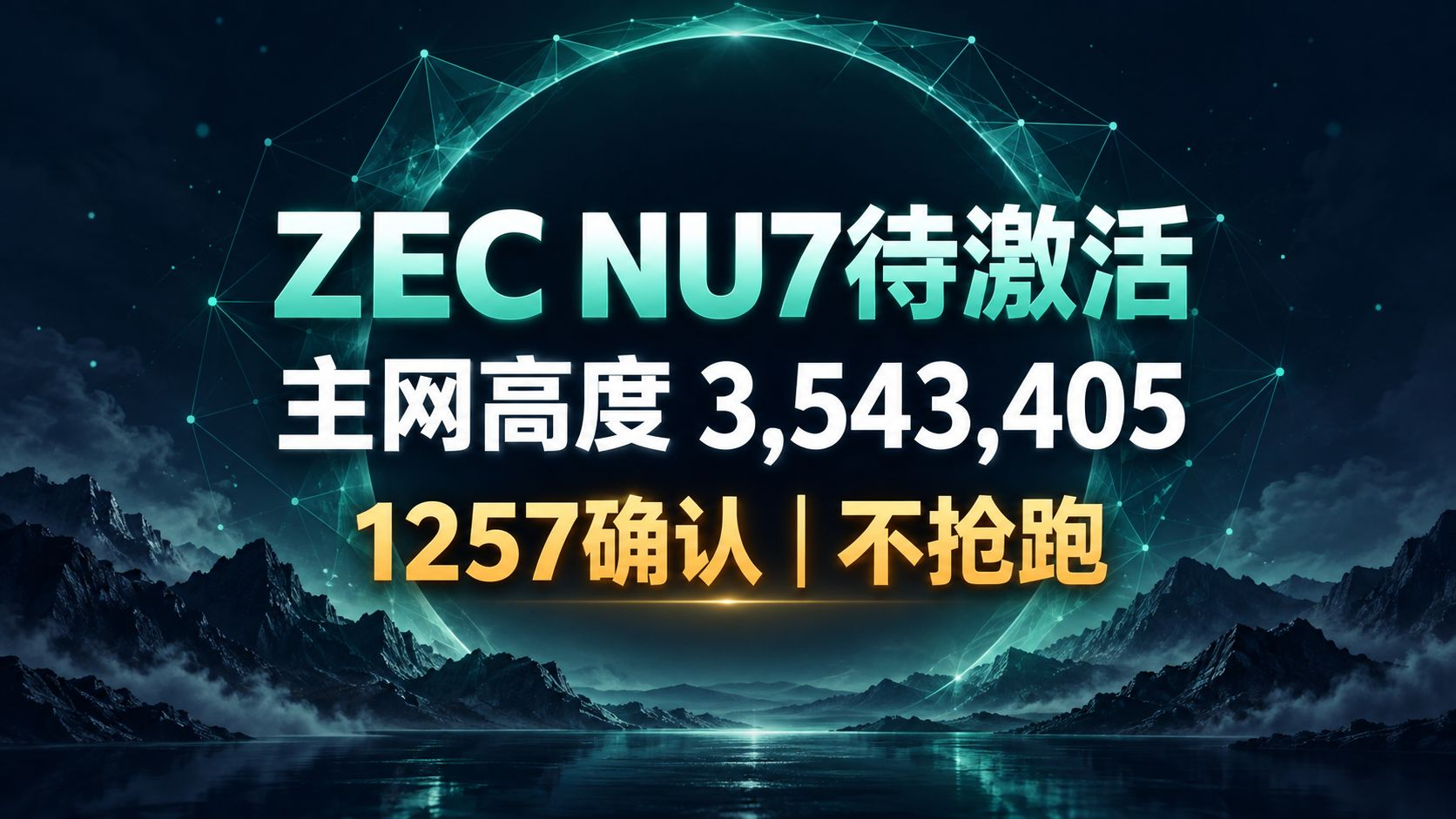
🚨 **ZCASH NU7: 3X FASTER BLOCKS — A MAJOR NETWORK MILESTONE? ⚡**
🔥 **#ZcashDevelopersConfirmNovemberDateForNU7Upgrade **
📅 **Target: November 5, 2026**
Zcash ($ZEC ) is preparing for a significant network upgrade, and here’s what has the crypto community watching 👀
⚡ **75s → 25s:** Target block times could fall by two-thirds, enabling faster transaction confirmations.
🔧 **Protocol changes:** NU7 also includes changes affecting legacy Sprout transactions and the network’s fee mechanism.
👀 **What matters next?** Successful implementation, network stability, and real-world adoption.
📈 A major upgrade can strengthen a project’s utility — but **it does NOT guarantee a price rally.**
💬 **Your take:** Will NU7 be a long-term win for Zcash, or is the market already pricing it in?
👇 Comment **“BULLISH ⚡”** or **“WAIT & SEE 👀”**
#Zcash #CryptoNews #Blockchain #BinanceSquare
{spot}(ZECUSDT)
🚨 **ZCASH NU7: 3X FASTER BLOCKS — A MAJOR NETWORK MILESTONE? ⚡**
🔥 **#ZcashDevelopersConfirmNovemberDateForNU7Upgrade **
📅 **Target: November 5, 2026**
Zcash ($ZEC ) is preparing for a significant network upgrade, and here’s what has the crypto community watching 👀
⚡ **75s → 25s:** Target block times could fall by two-thirds, enabling faster transaction confirmations.
🔧 **Protocol changes:** NU7 also includes changes affecting legacy Sprout transactions and the network’s fee mechanism.
👀 **What matters next?** Successful implementation, network stability, and real-world adoption.
📈 A major upgrade can strengthen a project’s utility — but **it does NOT guarantee a price rally.**
💬 **Your take:** Will NU7 be a long-term win for Zcash, or is the market already pricing it in?
👇 Comment **“BULLISH ⚡”** or **“WAIT & SEE 👀”**
#Zcash #CryptoNews #Blockchain #BinanceSquare
275

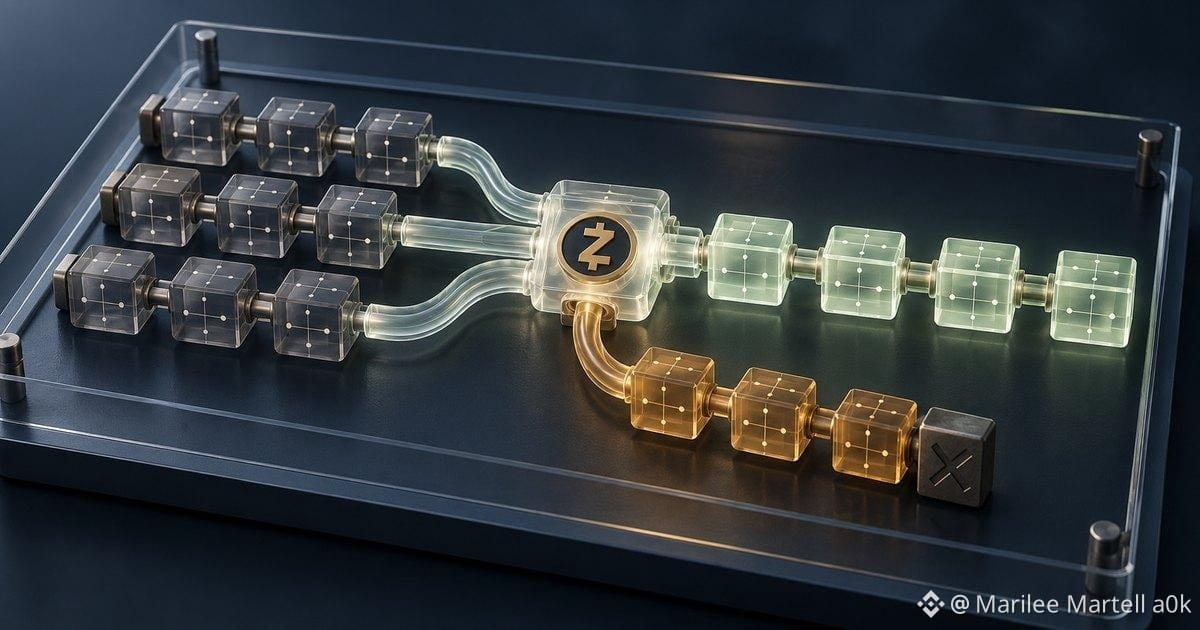
$ZEC: NU7 UPGRADE TARGETS NOVEMBER 5 — 3× FASTER BLOCKS COULD BE A BIG STEP FOR ZCASH!Zcash is approaching an important network milestone, but there’s more to this upgrade than faster transactions. Here’s what $ZEC holders and crypto traders should watch. 👇
🔥 WHAT’S CHANGING WITH NU7?
⏱️ 1. Block intervals: 75s → 25s
NU7 is designed to reduce the time between blocks by around 66.7%. For services waiting for three confirmations, the expected wait could fall from nearly four minutes to about 75 seconds.
🔐 2. A major change to the Sprout pool
The legacy Sprout privacy system is set to be disabled. Any funds remaining there at activation are expected to become unspendable. Anyone potentially affected should check official Zcash guidance and wallet support before the upgrade.
💰 3. Fee allocation and mining rewards
Around 60% of block transaction fees are expected to be set aside and returned to miners beginning around February 2031. The existing mining-reward halving schedule is intended to remain unchanged.
🛠️ 4. Network readiness matters
The target activation is block 3,543,405, expected around November 5, 2026. However, the selected height still needs to be integrated into the final deployment specification and node software. Infrastructure providers and node operators should monitor official release updates.
📊 WHY SHOULD $ZEC TRADERS CARE?
A major upgrade can attract attention, but the market reaction depends on more than the announcement itself.
🟢 Bullish possibility: Successful implementation, stronger demand, and improving market structure could support positive sentiment.
🔴 Risk scenario: Delays, technical issues, or a “buy the rumor, sell the news” reaction could pressure price even if the upgrade proceeds.
⚠️ Faster block production does not automatically mean every transaction is instantly final, and it does not guarantee a price rally.
🎯 MY TAKE
NU7 could be an important step in improving Zcash’s transaction experience. The key things to monitor are the final activation confirmation, successful network implementation, and whether market demand supports the bullish narrative.
What matters more for $ZEC in your view: the technical upgrade or actual demand for privacy-focused crypto? Share your reasoning below. 👇
$BNB $BTC $ETH
#ZcashDevelopersConfirmNovemberDateForNU7Upgrade #NU7 #ZEC #crypto #Nadeemgujjar143
{spot}(ZECUSDT)
{spot}(ETHUSDT)
{spot}(BTCUSDT)
$ZEC: NU7 UPGRADE TARGETS NOVEMBER 5 — 3× FASTER BLOCKS COULD BE A BIG STEP FOR ZCASH!
Zcash is approaching an important network milestone, but there’s more to this upgrade than faster transactions. Here’s what $ZEC holders and crypto traders should watch. 👇
🔥 WHAT’S CHANGING WITH NU7?
⏱️ 1. Block intervals: 75s → 25s
NU7 is designed to reduce the time between blocks by around 66.7%. For services waiting for three confirmations, the expected wait could fall from nearly four minutes to about 75 seconds.
🔐 2. A major change to the Sprout pool
The legacy Sprout privacy system is set to be disabled. Any funds remaining there at activation are expected to become unspendable. Anyone potentially affected should check official Zcash guidance and wallet support before the upgrade.
💰 3. Fee allocation and mining rewards
Around 60% of block transaction fees are expected to be set aside and returned to miners beginning around February 2031. The existing mining-reward halving schedule is intended to remain unchanged.
🛠️ 4. Network readiness matters
The target activation is block 3,543,405, expected around November 5, 2026. However, the selected height still needs to be integrated into the final deployment specification and node software. Infrastructure providers and node operators should monitor official release updates.
📊 WHY SHOULD $ZEC TRADERS CARE?
A major upgrade can attract attention, but the market reaction depends on more than the announcement itself.
🟢 Bullish possibility: Successful implementation, stronger demand, and improving market structure could support positive sentiment.
🔴 Risk scenario: Delays, technical issues, or a “buy the rumor, sell the news” reaction could pressure price even if the upgrade proceeds.
⚠️ Faster block production does not automatically mean every transaction is instantly final, and it does not guarantee a price rally.
🎯 MY TAKE
NU7 could be an important step in improving Zcash’s transaction experience. The key things to monitor are the final activation confirmation, successful network implementation, and whether market demand supports the bullish narrative.
What matters more for $ZEC in your view: the technical upgrade or actual demand for privacy-focused crypto? Share your reasoning below. 👇
$BNB $BTC $ETH
#ZcashDevelopersConfirmNovemberDateForNU7Upgrade #NU7 #ZEC #crypto #Nadeemgujjar143
192

·
--
🚨 THE UPGRADE EQUATION: ZCASH NU7 IS COMING IN NOVEMBER 🚨
#ZcashDevelopersConfirmNovemberDateForNU7Upgrade
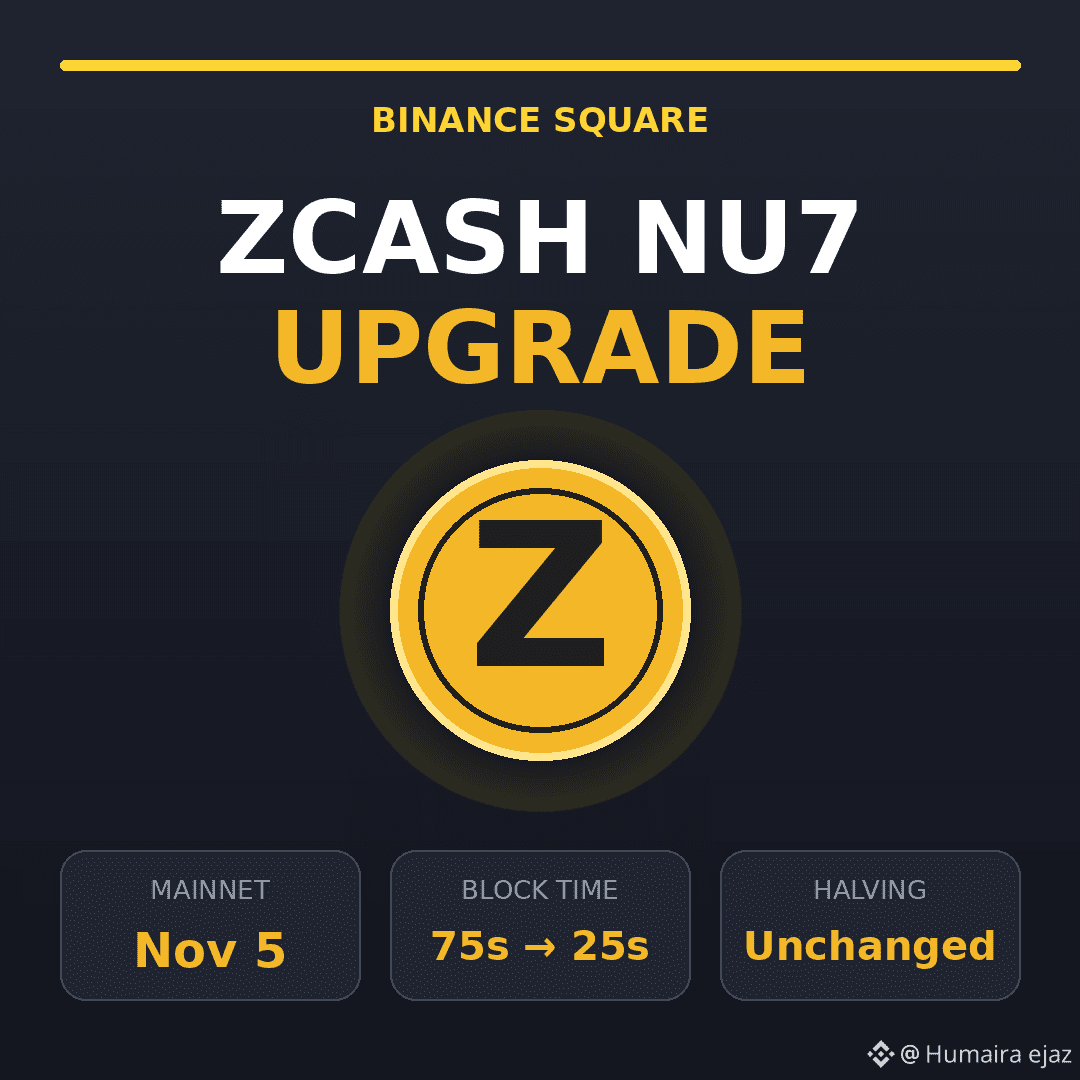
Zcash is set to launch its NU7 network upgrade on November 5, 2026. 🔥 (kucoin)
$ZEC is slightly in the red today, but the upgrade news keeps traders watching. 👀
📰 What Changes
NU7 cuts block time from 75 seconds to 25 seconds, so transactions confirm faster. (fxstreet)
The halving schedule stays the same, and old version 4 transactions are disabled. (fxstreet)
Regular ZEC holders and wallet users do not need to take any action. (kucoin)
🔮 Outlook
Faster blocks can make ZEC better for payments, and upgrades often bring more attention before launch.
But the date depends on testing going well, so watch for official updates.
Will you hold $ZEC into the upgrade? Comment below! 👇
1
241

·
--
#ZcashDevelopersConfirmNovemberDateForNU7Upgrade
🚨 ZCASH NU7: THE REAL DEADLINES AREN’T ABOUT SPEED
Zcash NU7 is getting attention for faster blocks, but the bigger story is the protocol transition and what holders and node operators need to watch.
🔹 Block time: 75s → 25s
🔹 Activation target: Block height 3,543,405
🔹 November 5: Estimated date, not a guaranteed deadline
🔹 Block reward: 1.5625 → 0.52083333 ZEC per block
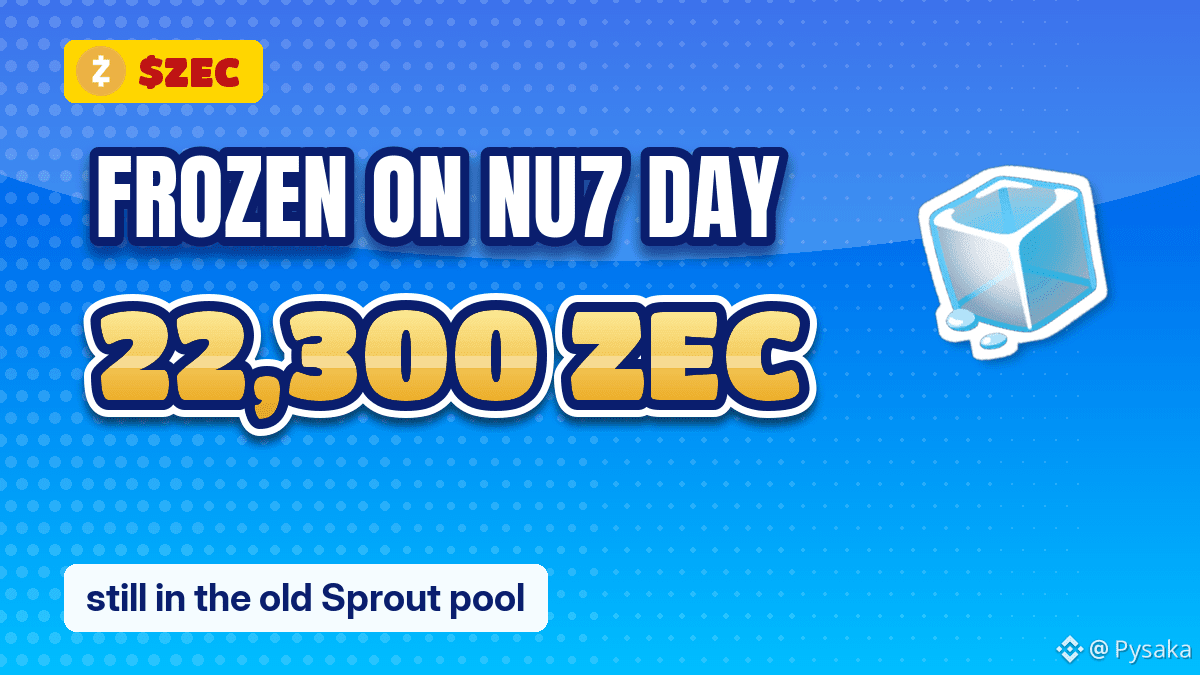
🔹 Sprout pool: ~22,300 ZEC could become unspendable at activation
🔹 Transaction compatibility: Version 4 transactions become invalid
🔹 Node risk: Outdated nodes may continue following a pre-NU7 chain
⚠️ The biggest concern? Network compatibility. An old node continuing on a pre-NU7 chain could leave users relying on outdated chain data.
Zebra 7.0.0’s stated eight-week support window makes the upgrade timeline worth monitoring closely.
📊 $ZECUSDT PERP — TRADING PLAN
🟢 Bullish setup: Price breaks above the recent resistance and holds it on a retest, with rising volume.
🔴 Bearish setup: Price loses recent support and fails to reclaim it.
🟡 No-trade zone: Price remains range-bound without volume confirmation.
🎯 Execution: Wait for a confirmed breakout or breakdown. Place a stop-loss beyond the invalidation level and set targets using the next support/resistance zones. No guaranteed direction.
My take: NU7 is more than a speed upgrade. The key risks are transaction compatibility, node readiness, and the transition itself. Watch official upgrade announcements alongside price action.
#Zcash #ZEC #CryptoTrading #BinanceSquare #Altcoins #NU7
1
252

·
--
Bullish
Zcash's NU7 headline is the speed. that's the boring part
the tag says November. what's locked is a block height, 3,543,405, merged into the spec on October 21. November 5 is an estimate
blocks go from 75 seconds to 25, but $ZEC
{future}(ZECUSDT)
per day stays the same: the reward per block drops from 1.5625 ZEC to 0.52083333
the real deadlines are quieter:
🔸 about 22,300 ZEC in the old Sprout pool becomes unspendable at activation
🔸 every version 4 transaction becomes invalid, not only Sprout ones
🔸 an old node won't stop, it keeps following a pre-NU7 chain
that last one bothers me most. Zebra 7.0.0 is supported for 8 weeks, and a service that skips it gets no error, only the wrong chain
after block 3,543,405 I'll check who got stranded on the old chain, follow and you'll see it first
#ZcashDevelopersConfirmNovemberDateForNU7Upgrade #zcash
Zcash's NU7 headline is the speed. that's the boring part
the tag says November. what's locked is a block height, 3,543,405, merged into the spec on October 21. November 5 is an estimate
blocks go from 75 seconds to 25, but $ZEC
per day stays the same: the reward per block drops from 1.5625 ZEC to 0.52083333
the real deadlines are quieter:
🔸 about 22,300 ZEC in the old Sprout pool becomes unspendable at activation
🔸 every version 4 transaction becomes invalid, not only Sprout ones
🔸 an old node won't stop, it keeps following a pre-NU7 chain
that last one bothers me most. Zebra 7.0.0 is supported for 8 weeks, and a service that skips it gets no error, only the wrong chain
after block 3,543,405 I'll check who got stranded on the old chain, follow and you'll see it first
#ZcashDevelopersConfirmNovemberDateForNU7Upgrade #zcash
1
224

·
--
Bullish
Verified
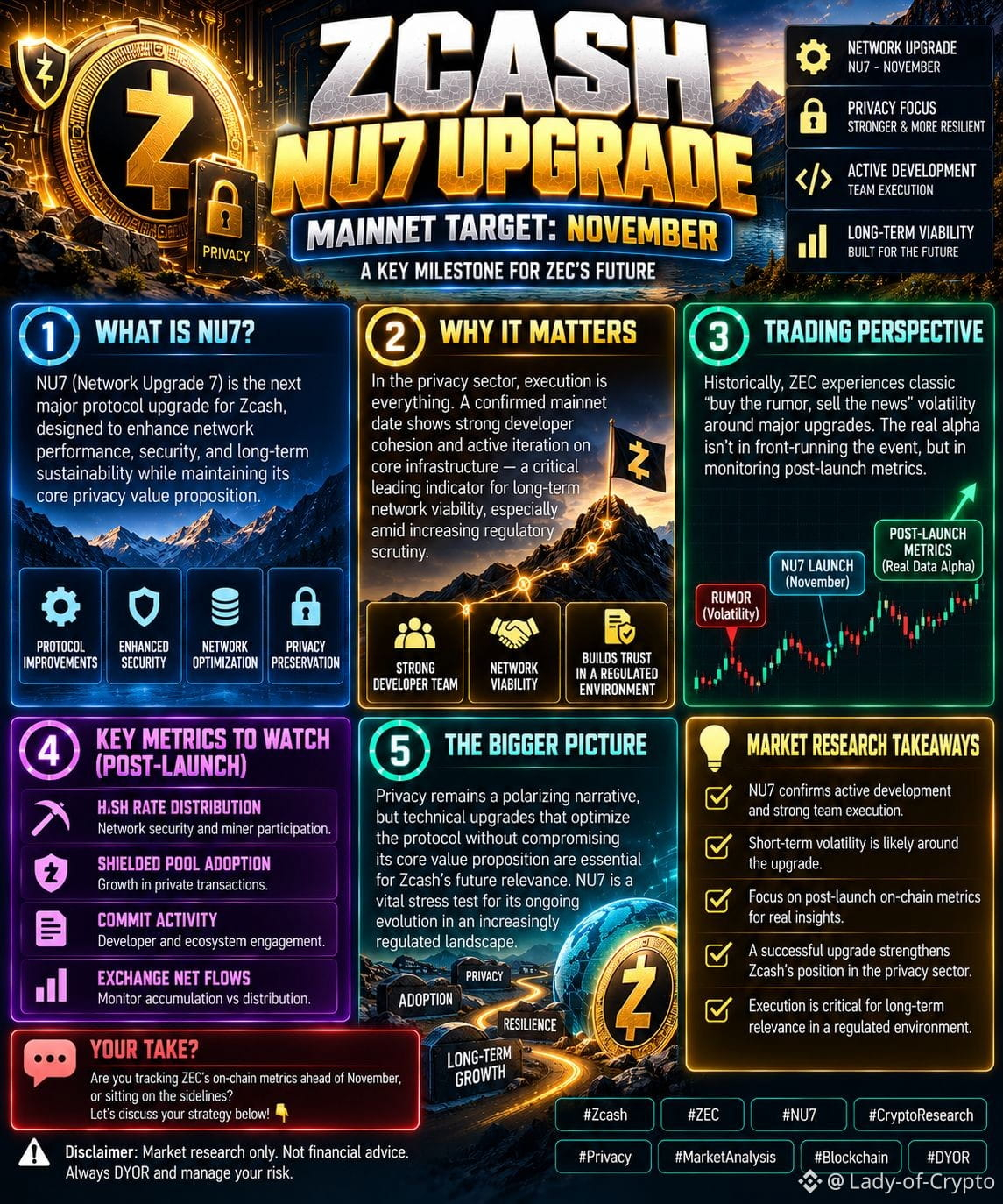
#zcashdevelopersconfirmnovemberdatefornu7upgrade Zcash developers have officially locked in a November target for the NU7 network upgrade. As a market researcher, I look past the daily noise to evaluate what this signals for the asset's fundamental trajectory.
In the privacy sector, execution is everything. Regulatory scrutiny means these protocols cannot afford technical stumbles. A confirmed mainnet date for NU7 demonstrates strong developer cohesion. It proves the team is actively iterating on core infrastructure, a critical leading indicator for long-term network viability.
From a trading perspective, how should we approach a major protocol upgrade? Historically, legacy assets like ZEC experience classic "buy the rumor, sell the news" volatility. The real alpha isn't in front-running the event; it’s in monitoring post-launch metrics. I’ll be watching hash rate distribution, shielded pool adoption, and commit activity post-fork.
Privacy remains a polarizing narrative, but technical upgrades that optimize the protocol without compromising its core value proposition are essential for future relevance. NU7 is a vital stress test for Zcash’s ongoing evolution.
Are you tracking ZEC’s on-chain metrics ahead of November, or sitting on the sidelines? Let’s discuss below.
Market research only. Not financial advice. Always DYOR and manage your risk.
$ARK $PROM $SOXSB
{spot}(SOXSBUSDT)
{future}(PROMUSDT)
{future}(ARKUSDT)
#zcashdevelopersconfirmnovemberdatefornu7upgrade Zcash developers have officially locked in a November target for the NU7 network upgrade. As a market researcher, I look past the daily noise to evaluate what this signals for the asset's fundamental trajectory.
In the privacy sector, execution is everything. Regulatory scrutiny means these protocols cannot afford technical stumbles. A confirmed mainnet date for NU7 demonstrates strong developer cohesion. It proves the team is actively iterating on core infrastructure, a critical leading indicator for long-term network viability.
From a trading perspective, how should we approach a major protocol upgrade? Historically, legacy assets like ZEC experience classic "buy the rumor, sell the news" volatility. The real alpha isn't in front-running the event; it’s in monitoring post-launch metrics. I’ll be watching hash rate distribution, shielded pool adoption, and commit activity post-fork.
Privacy remains a polarizing narrative, but technical upgrades that optimize the protocol without compromising its core value proposition are essential for future relevance. NU7 is a vital stress test for Zcash’s ongoing evolution.
Are you tracking ZEC’s on-chain metrics ahead of November, or sitting on the sidelines? Let’s discuss below.
Market research only. Not financial advice. Always DYOR and manage your risk.
$ARK $PROM $SOXSB
1
2.1k

·
--
Bullish
Verified
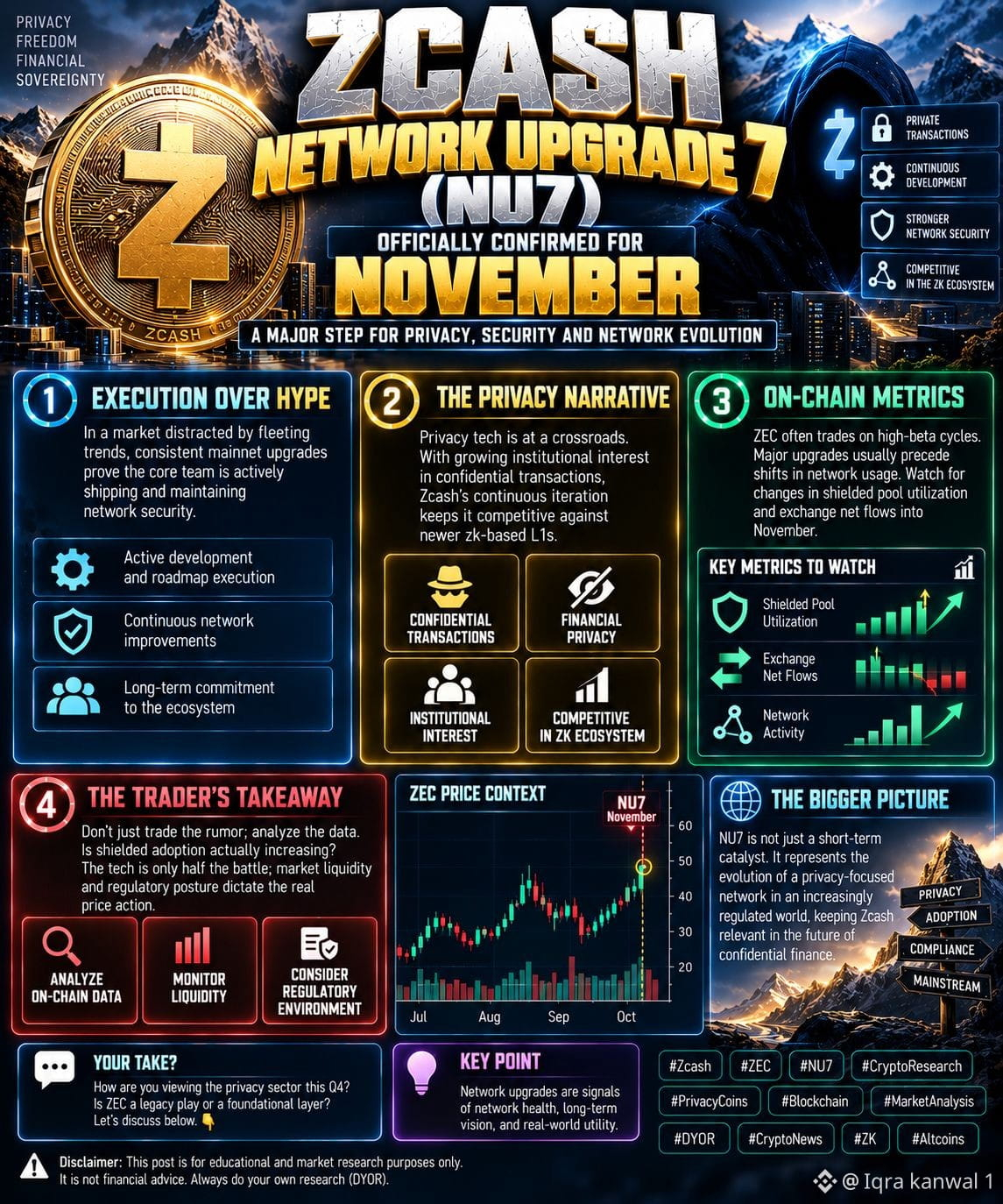
#zcashdevelopersconfirmnovemberdatefornu7upgrade Network upgrades are often short-term noise, but fundamentally, they tell a crucial story about a project's evolution. Zcash developers have officially confirmed the activation date for Network Upgrade 7 (NU7) this November.
As a market researcher, I look at upgrades not just as price catalysts, but as signals of network health and roadmap execution. Here is my analytical take on what NU7 means for ZEC:
1️⃣ **Execution Over Hype:** In a market distracted by fleeting trends, consistent mainnet upgrades prove the core team is actively shipping and maintaining network security.
2️⃣ **The Privacy Narrative:** Privacy tech is at a crossroads. With growing institutional interest in confidential transactions, Zcash’s continuous iteration keeps it competitive against newer zk-based L1s.
3️⃣ **On-Chain Metrics:** ZEC often trades on high-beta cycles. Major upgrades usually precede shifts in network usage. Watch for changes in shielded pool utilization and exchange net flows into November.
**The Trader’s Takeaway:**
Don't just trade the rumor; analyze the data. Is shielded adoption actually increasing? The tech is only half the battle; market liquidity and regulatory posture dictate the real price action.
How are you viewing the privacy sector this Q4? Is ZEC a legacy play or a foundational layer? Let’s discuss below. 👇
Market research only, not financial advice. Always DYOR.
$AVA $SOXSB $BOTB
{spot}(BOTBUSDT)
{spot}(SOXSBUSDT)
{future}(AVAUSDT)
#zcashdevelopersconfirmnovemberdatefornu7upgrade Network upgrades are often short-term noise, but fundamentally, they tell a crucial story about a project's evolution. Zcash developers have officially confirmed the activation date for Network Upgrade 7 (NU7) this November.
As a market researcher, I look at upgrades not just as price catalysts, but as signals of network health and roadmap execution. Here is my analytical take on what NU7 means for ZEC:
1️⃣ **Execution Over Hype:** In a market distracted by fleeting trends, consistent mainnet upgrades prove the core team is actively shipping and maintaining network security.
2️⃣ **The Privacy Narrative:** Privacy tech is at a crossroads. With growing institutional interest in confidential transactions, Zcash’s continuous iteration keeps it competitive against newer zk-based L1s.
3️⃣ **On-Chain Metrics:** ZEC often trades on high-beta cycles. Major upgrades usually precede shifts in network usage. Watch for changes in shielded pool utilization and exchange net flows into November.
**The Trader’s Takeaway:**
Don't just trade the rumor; analyze the data. Is shielded adoption actually increasing? The tech is only half the battle; market liquidity and regulatory posture dictate the real price action.
How are you viewing the privacy sector this Q4? Is ZEC a legacy play or a foundational layer? Let’s discuss below. 👇
Market research only, not financial advice. Always DYOR.
$AVA $SOXSB $BOTB
844

Verified
#zcashdevelopersconfirmnovemberdatefornu7upgrade
🚨 THE SPEED EQUATION: ZCASH NU7 MEETS 1D CHART 🚨
A massive upgrade date is locked while price battles major resistance! Let’s break down the setup using pure math 🧮👇
(Block 3,543,405) + (Nov 5 Target) = 3x Faster Zcash ⚡
Here is the exact formula driving the network:
The Upgrade Variable:
(75s Block Time) ➔ (25s Block Time) = Ultra-Fast Finality 🚀
(Legacy Sprout Pool) = Freezing remaining ZEC permanently 🥶
The 1D Chart Equation:
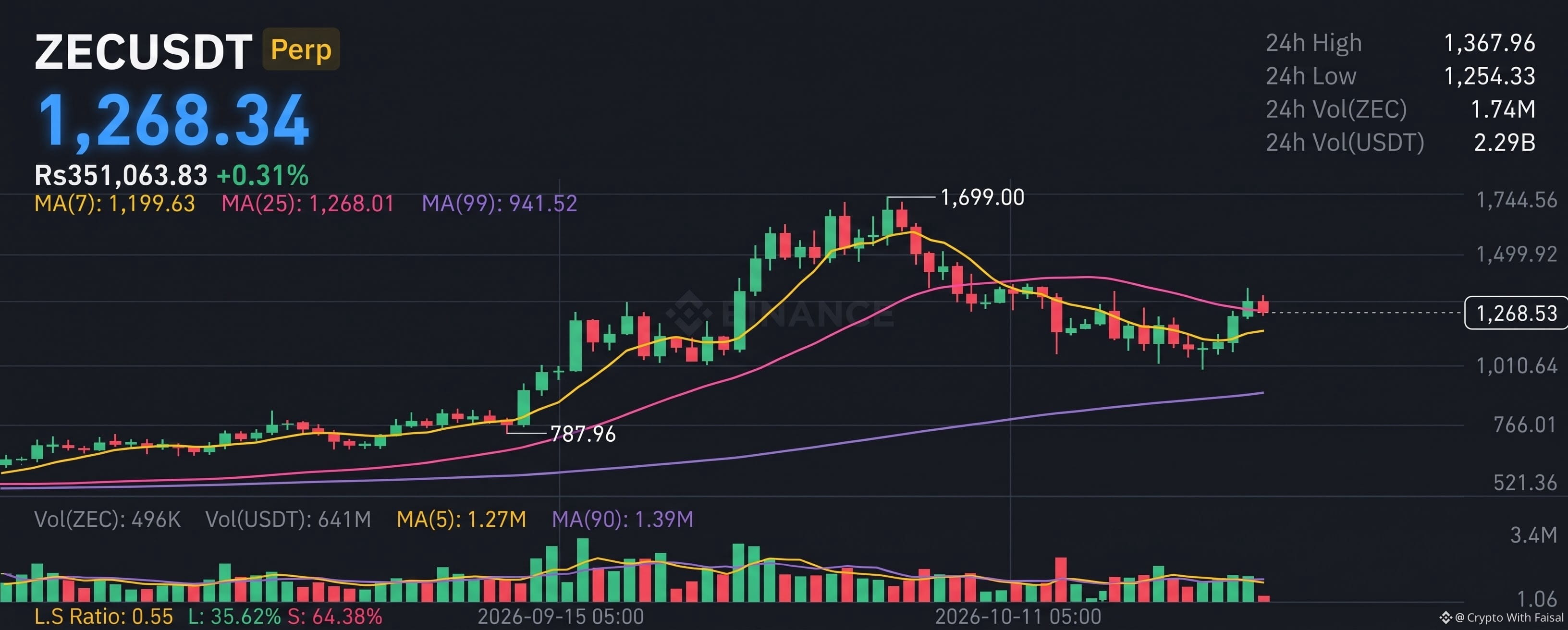
(Price: $1,268) ≈ 1D MA(25) Resistance ($1,268.01) ⚔️
The Breakdown:
Zcash developers officially confirmed Network Upgrade 7 (NU7) for roughly November 5, 2026. This slashes block times by 66% to just 25 seconds, modernizing throughput while permanently sunsetting legacy Sprout pool spending.
On the daily chart, $ZEC is testing the exact inflection point. After bouncing off sub-$1,050 lows, price has reclaimed the 1D MA(7) ($1,199.63) and is pushing directly against the MA(25) at $1,268. With the Long/Short ratio sitting heavily bearish at 0.55 (64.4% shorts), a confirmed daily close above $1,270 could trigger an aggressive short squeeze back toward the $1,400–$1,699 liquidity zone.
Is NU7 the catalyst to ignite a massive privacy squeeze? Drop your targets below! 👇💬
{future}(ZECUSDT)
#zec #zcash #CryptoNews
#zcashdevelopersconfirmnovemberdatefornu7upgrade
🚨 THE SPEED EQUATION: ZCASH NU7 MEETS 1D CHART 🚨
A massive upgrade date is locked while price battles major resistance! Let’s break down the setup using pure math 🧮👇
(Block 3,543,405) + (Nov 5 Target) = 3x Faster Zcash ⚡
Here is the exact formula driving the network:
The Upgrade Variable:
(75s Block Time) ➔ (25s Block Time) = Ultra-Fast Finality 🚀
(Legacy Sprout Pool) = Freezing remaining ZEC permanently 🥶
The 1D Chart Equation:
(Price: $1,268) ≈ 1D MA(25) Resistance ($1,268.01) ⚔️
The Breakdown:
Zcash developers officially confirmed Network Upgrade 7 (NU7) for roughly November 5, 2026. This slashes block times by 66% to just 25 seconds, modernizing throughput while permanently sunsetting legacy Sprout pool spending.
On the daily chart, $ZEC is testing the exact inflection point. After bouncing off sub-$1,050 lows, price has reclaimed the 1D MA(7) ($1,199.63) and is pushing directly against the MA(25) at $1,268. With the Long/Short ratio sitting heavily bearish at 0.55 (64.4% shorts), a confirmed daily close above $1,270 could trigger an aggressive short squeeze back toward the $1,400–$1,699 liquidity zone.
Is NU7 the catalyst to ignite a massive privacy squeeze? Drop your targets below! 👇💬
#zec #zcash #CryptoNews
1
3k

·
--
Bullish
Verified
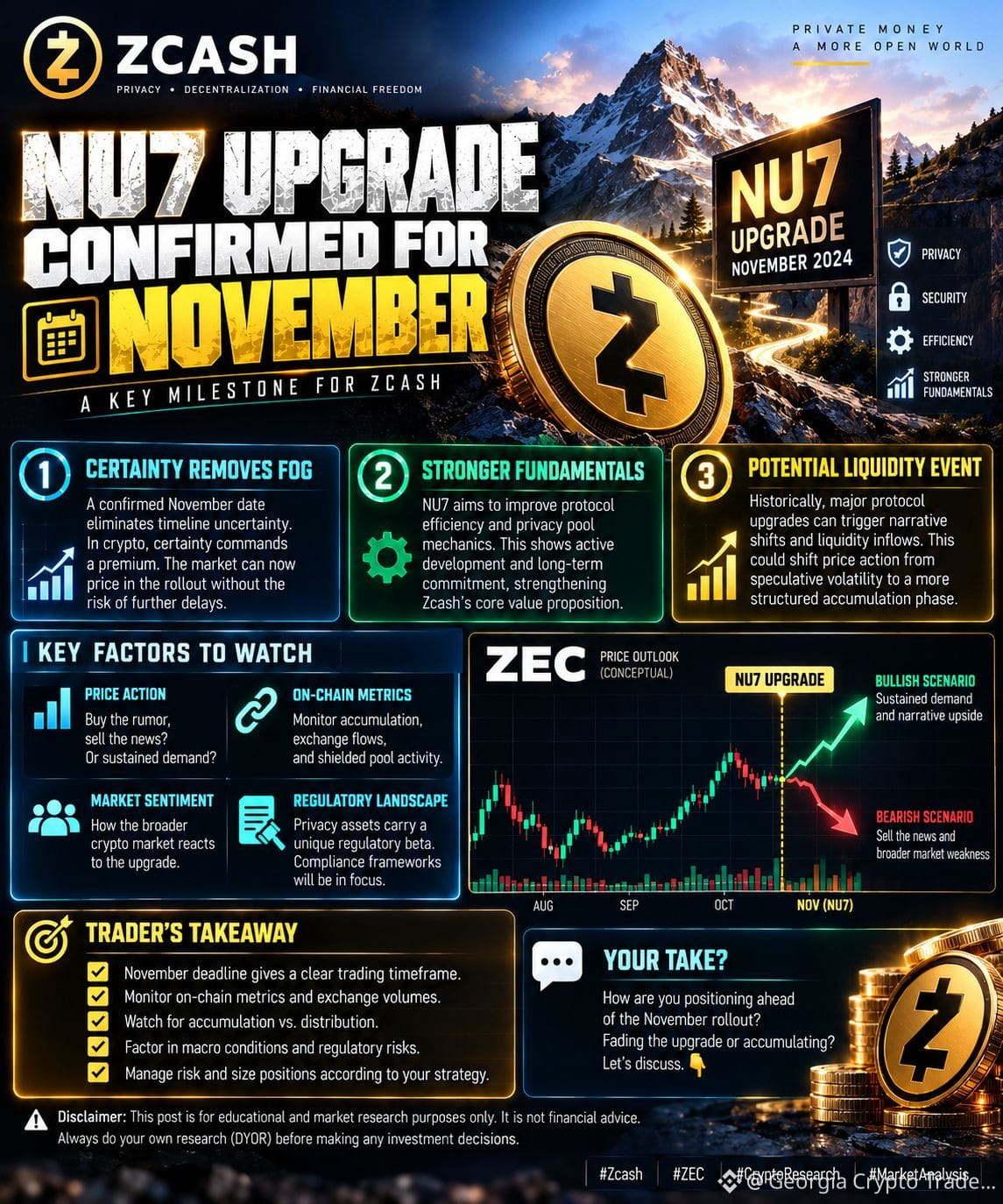
#zcashdevelopersconfirmnovemberdatefornu7upgrade Zcash devs just locked in the November date for the NU7 upgrade. As a market researcher, I view protocol upgrades not just as technical milestones, but as key catalysts for narrative shifts and liquidity events.
Confirming a hard date immediately removes timeline uncertainty. In crypto, certainty commands a premium. For $ZEC, the market can now price in the rollout without the fog of roadmap delays. Historically, this shifts price action from speculative volatility to more structured accumulation phases.
However, a professional approach requires looking at the whole board. While NU7 strengthens protocol fundamentals, we must factor in the macro environment. Privacy assets carry a unique regulatory beta. The market will watch closely to see how the broader ecosystem reacts to the deployment, especially regarding compliance frameworks.
From a trading perspective, this November deadline gives us a clear temporal boundary. The key now is monitoring on-chain metrics and exchange volumes. Are we looking at a classic "buy the rumor, sell the news" setup, or is there structural demand to sustain a post-upgrade trend?
How are you positioning ahead of the November rollout? Fading the upgrade or accumulating? Let’s discuss. 👇
Always remember to manage your risk and size positions according to your personal strategy.
#Zcash #ZEC #CryptoResearch #MarketAnalysis
$DGB $PROM $AVA
{future}(AVAUSDT)
{future}(PROMUSDT)
{spot}(DGBUSDT)
#zcashdevelopersconfirmnovemberdatefornu7upgrade Zcash devs just locked in the November date for the NU7 upgrade. As a market researcher, I view protocol upgrades not just as technical milestones, but as key catalysts for narrative shifts and liquidity events.
Confirming a hard date immediately removes timeline uncertainty. In crypto, certainty commands a premium. For $ZEC, the market can now price in the rollout without the fog of roadmap delays. Historically, this shifts price action from speculative volatility to more structured accumulation phases.
However, a professional approach requires looking at the whole board. While NU7 strengthens protocol fundamentals, we must factor in the macro environment. Privacy assets carry a unique regulatory beta. The market will watch closely to see how the broader ecosystem reacts to the deployment, especially regarding compliance frameworks.
From a trading perspective, this November deadline gives us a clear temporal boundary. The key now is monitoring on-chain metrics and exchange volumes. Are we looking at a classic "buy the rumor, sell the news" setup, or is there structural demand to sustain a post-upgrade trend?
How are you positioning ahead of the November rollout? Fading the upgrade or accumulating? Let’s discuss. 👇
Always remember to manage your risk and size positions according to your personal strategy.
#Zcash #ZEC #CryptoResearch #MarketAnalysis
$DGB $PROM $AVA
2.4k

·
--
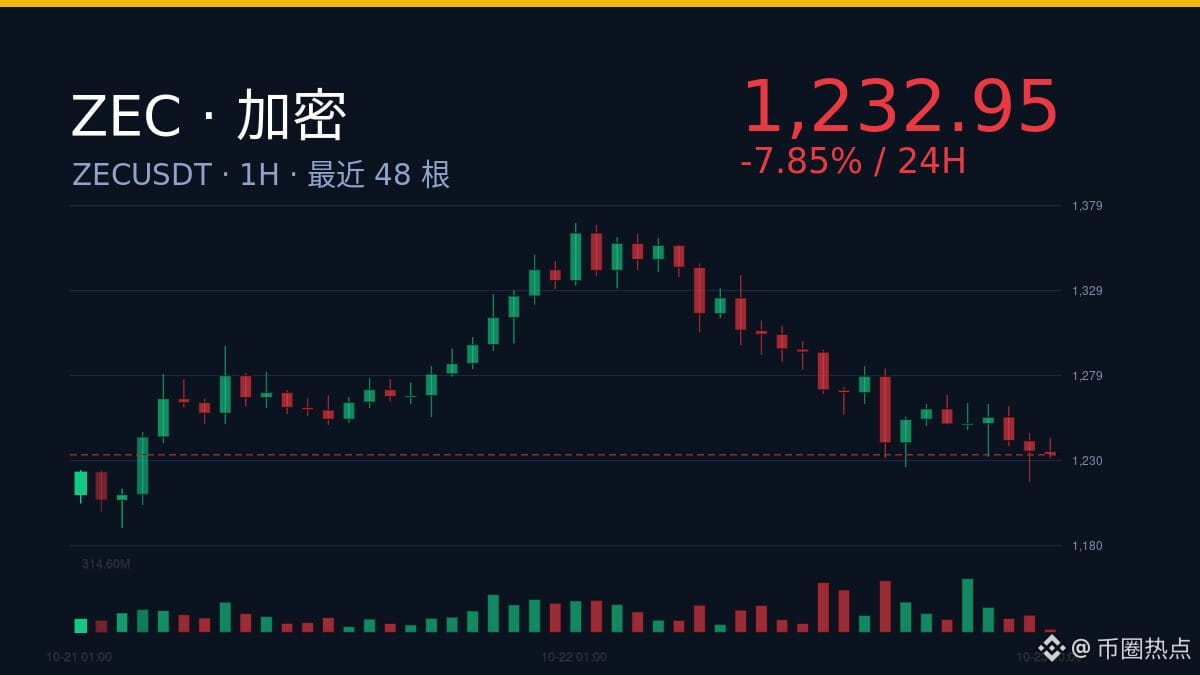
1,368 to 1,217: ZEC pulled back 11% in 24 hours, now at 1,233, down 7.9% on the day—the privacy coin rally has hit its first real brake.
Over the past few weeks, ZEC has been one of the strongest-performing assets. After such a big run-up, a pullback was only natural; today’s $315 million in trading volume shows this is a high-volume correction, not a slow bleed with no buyers.
My take: this looks more like a concentrated round of profit-taking and leveraged long liquidations than a collapse of the narrative. The NU7 upgrade is still scheduled for November 5. Before upgrades, some funds usually position themselves early, while others get out early.
I’m not making a call—just a reminder: with a 12% intraday range, both chasing the rally and buying the dip can get you burned. If you want exposure to NU7, wait for a pullback to stabilize, and don’t use leverage to bet on the date.
#ZcashDevelopersConfirmNovemberDateForNU7Upgrade $ZEC
53

📅 November Could Be an Important Month for Zcash
Zcash's NU7 upgrade timeline is drawing attention to the project's ongoing protocol development.
The key questions are what changes the upgrade introduces, how testing progresses, and whether the network is ready for activation.
Follow verified announcements rather than relying on speculation.
#zcash $ZEC $ETH
#zcashdevelopersconfirmnovemberdatefornu7upgrade
114
🔍 What to Watch Before Zcash NU7
A confirmed upgrade date gives the community a timeline to follow, but preparation remains essential.
Node operators, developers, and ecosystem participants will be watching implementation details and compatibility requirements ahead of the NU7 activation.
Technical progress deserves attention beyond short-term price movements.
#zec $ZEC $BTC
#zcashdevelopersconfirmnovemberdatefornu7upgrade
30
🛠️ Zcash NU7 Upgrade Gets a November Date
The confirmation of a November date for Zcash's NU7 upgrade puts network development back in focus.
Protocol upgrades can bring important technical changes, but the details matter most. Watch the official development updates for information about the upgrade's scope, activation schedule, and readiness.
#Zcash $ZEC
#zcashdevelopersconfirmnovemberdatefornu7upgrade
14
📊 ZEC Watch: Development Meets Market Sentiment
News about the November NU7 upgrade date may put $ZEC on more traders' watchlists.
However, a development milestone does not guarantee a price rally. Market liquidity, broader crypto conditions, and the actual upgrade details also matter.
Research first, manage risk, and avoid chasing headlines.
#zcash $ZEC $BTC
#zcashdevelopersconfirmnovemberdatefornu7upgrade
64
⚙️ Network Upgrades Are More Than a Date
An upgrade milestone is only one part of blockchain development.
Testing, implementation quality, node readiness, and clear communication all matter when a protocol change approaches.
With Zcash NU7 scheduled for November, the technical details and official progress reports deserve close attention.
$ZEC $LINK
#zcashdevelopersconfirmnovemberdatefornu7upgrade
98

·
--
Bullish
Verified
#zcashdevelopersconfirmnovemberdatefornu7upgrade
Zcash Developers Confirm November Target for NU7 Upgrade ⚡🛡️
Zcash (ZEC) is moving closer to a major network upgrade, with NU7 targeting activation around November 5, 2026.
The biggest change? Block times are expected to drop from 75 seconds to just 25 seconds — a potential improvement for transaction confirmation speed.
Here’s what matters:
3× Faster Blocks: Shorter intervals could reduce waiting times for transaction confirmations.
Network Changes: NU7 includes updates to transaction rules and a new mechanism for handling network fees.
Infrastructure Readiness: Nodes, indexers, and block explorers may need updates before activation.
One important detail: the target activation block has been selected, but final integration into the deployment specification and node software is still required. The date is a target, not a guarantee.
For ZEC holders, the real question is whether faster block production and the network changes improve usability over time.
A technical upgrade can strengthen a project, but price action still depends on market conditions and investor expectations.
#Zcash #zec #CryptoNews #Blockchain #CryptoUpgrade
1
2
106

·
--
Bullish
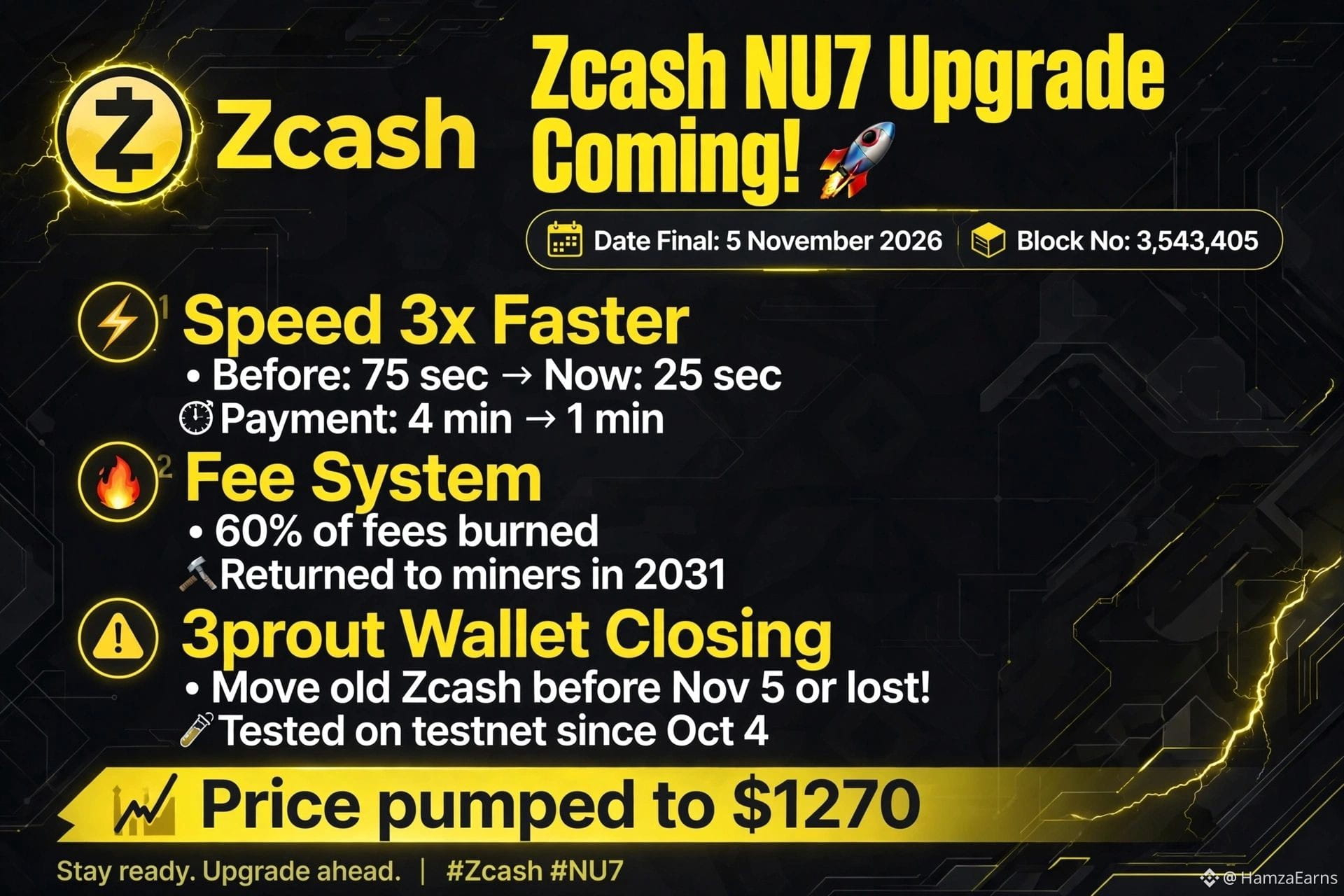
🛡️ *$Zcash's new update NU7 is coming!*
📅 *Final Date: 5 November 2026* 🗓️
📍 Block No: 3,543,405
⚡ *What's new?*
1️⃣ *3x Faster Speed* 🏃♂️💨
Before: 1 block = 75 seconds ⏳
Now: 1 block = 25 seconds ⚡
Means payment that took 4 min before will now take only 1 min! 💸$ZEC
2️⃣ *New Fee System* 🔥
60% of every block's fees will be burned, then returned to miners from 2031
3️⃣ *Old Sprout Wallet Closing* 🚨
If you have old Zcash from 2016 in Sprout, move it before 5 November, or it will be lost forever! ❌
🧪 *Tested Already*
Running on testnet since 4 October, all good ✅
$ZEC 📈 *Price Also Pumped* - Went up to $1,270 on this news 🚀
{spot}(ZECUSDT)
#ZcashDevelopersConfirmNovemberDateForNU7Upgrade
#NU7 #ZECUSDT
🛡️ *$Zcash's new update NU7 is coming!*
📅 *Final Date: 5 November 2026* 🗓️
📍 Block No: 3,543,405
⚡ *What's new?*
1️⃣ *3x Faster Speed* 🏃♂️💨
Before: 1 block = 75 seconds ⏳
Now: 1 block = 25 seconds ⚡
Means payment that took 4 min before will now take only 1 min! 💸$ZEC
2️⃣ *New Fee System* 🔥
60% of every block's fees will be burned, then returned to miners from 2031
3️⃣ *Old Sprout Wallet Closing* 🚨
If you have old Zcash from 2016 in Sprout, move it before 5 November, or it will be lost forever! ❌
🧪 *Tested Already*
Running on testnet since 4 October, all good ✅
$ZEC 📈 *Price Also Pumped* - Went up to $1,270 on this news 🚀
#ZcashDevelopersConfirmNovemberDateForNU7Upgrade
#NU7 #ZECUSDT
69


·
--
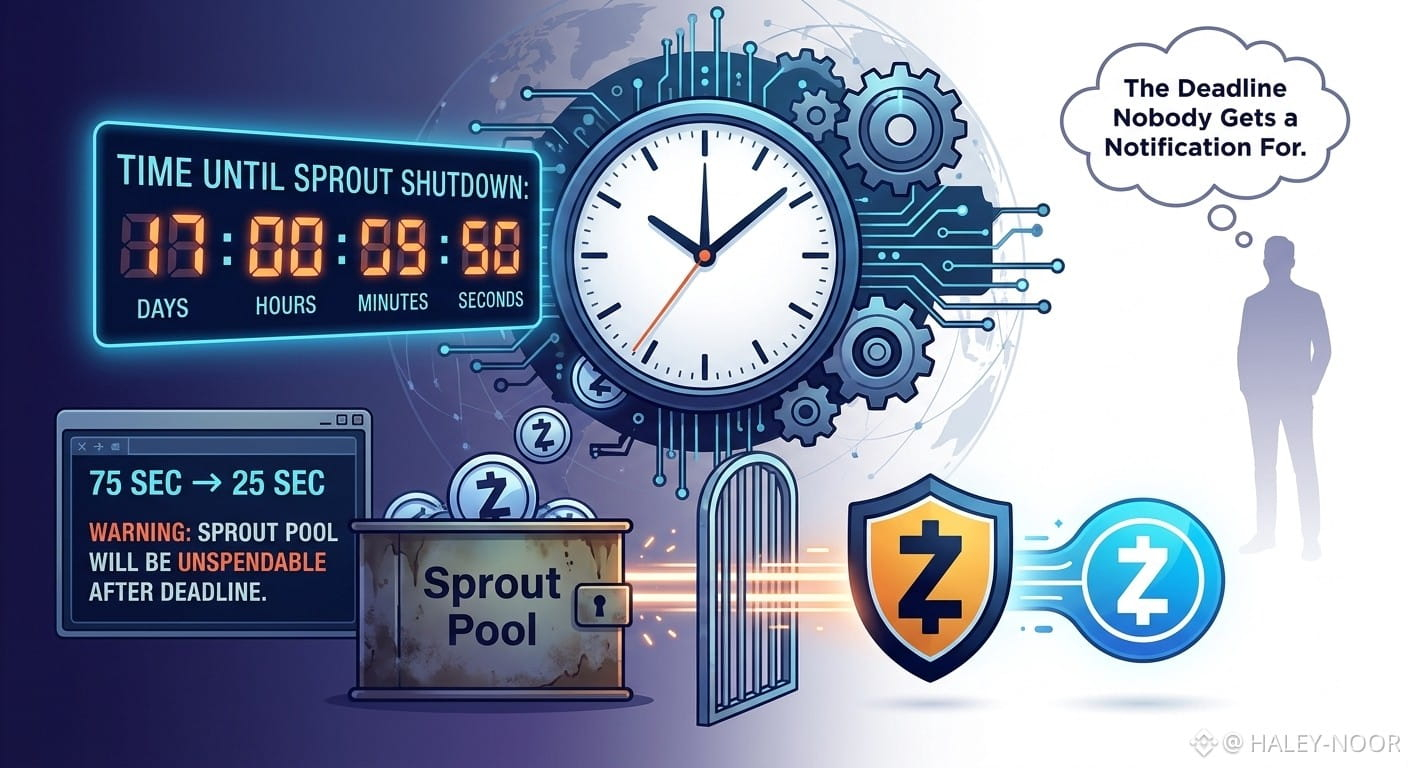
The Deadline Nobody Gets a Notification For
Picture someone who moved coins into Zcash's original Sprout pool years ago and hasn't opened that wallet since. This is a hypothetical, but it's who this upgrade is really written for.
Most NU7 coverage is about speed. Blocks drop from 75 seconds to 25, so three confirmations take about 75 seconds instead of nearly four minutes, per CoinDesk. The part with consequences is quieter: Sprout shuts down entirely, and coins still there when NU7 activates become unspendable.
I read that as a deliberate trade, shrinking old code and attack surface instead of keeping every legacy path alive forever. That's defensible. It also means the cost lands on the people least likely to follow upgrade news.
The date is also softer than the headlines suggest. Developers agreed on block 3,543,405, around November 5. But as of Wednesday morning UTC, the deployment spec still listed the height as undecided, and node software has to ship it too. One report notes developers haven't said whether unresolved Zebra-related issues could move the date. A coinholder vote of 2.4 million ZEC, 66% of the eligible pool, shaped the design, so the process is open. Agreement among people still isn't code running in nodes.
I couldn't find how much ZEC is still in Sprout, or how wallets will warn holders.
My reading: a faster chain is a nice feature. A chain that deletes old rules should also be loud about it, and I'm not sure Zcash has been loud enough yet.
$IRYS $BILL $ALT #EarningsSeason
#ZcashDevelopersConfirmNovemberDateForNU7Upgrade
317
Log in to explore more content
Join global crypto users on Binance Square
⚡️ Get latest and useful information about crypto.
💬 Trusted by the world’s largest crypto exchange.
👍 Discover real insights from verified creators.
Email / Phone number
Trending Topics
1
#BinanceReopensWithdrawalsForMoreAssets
1,930 views
169 Discussing
2
#AppleReportsMixedResults
2,844 views
174 Discussing
3
#BinanceWithdrawalScamWarning
79,698 views
990 Discussing
4
#USMidtermElections
666,055 views
3,559 Discussing
5
#USOctoberNFP-AreRateCutsStillPossible
82,170 views
744 Discussing
6
#Verify1to1BinanceReserves
72,183 views
551 Discussing
7
#BinanceRestores28FiatWithdrawals
211,065 views
1,227 Discussing
8
#BitMineAdds8573ETHTotalHoldingsReach6.06M
245 views
15 Discussing
9
#HKSFCEyesTokenizedGoldETFPilot
254 views
22 Discussing
10
#SouthKoreaRulingPartyToRecommendDelayingVirtualAssetTax
0 views
0 Discussing