

#vitalikbuterin
vitalikbuterin
3.2M views
2,407 Discussing
Hot
Latest

·
--
Bearish
Vitalik says Hegota, next year's fork, is likely Ethereum's last "normal" one
everyone will screenshot that. the part that hits builders on $ETH
{spot}(ETHUSDT)
is the bill after it
same computation, very different price
shove it into one serial transaction and it costs much more
split it into pieces that can run in parallel and it costs much less
so a contract that runs like one long to-do list gets expensive
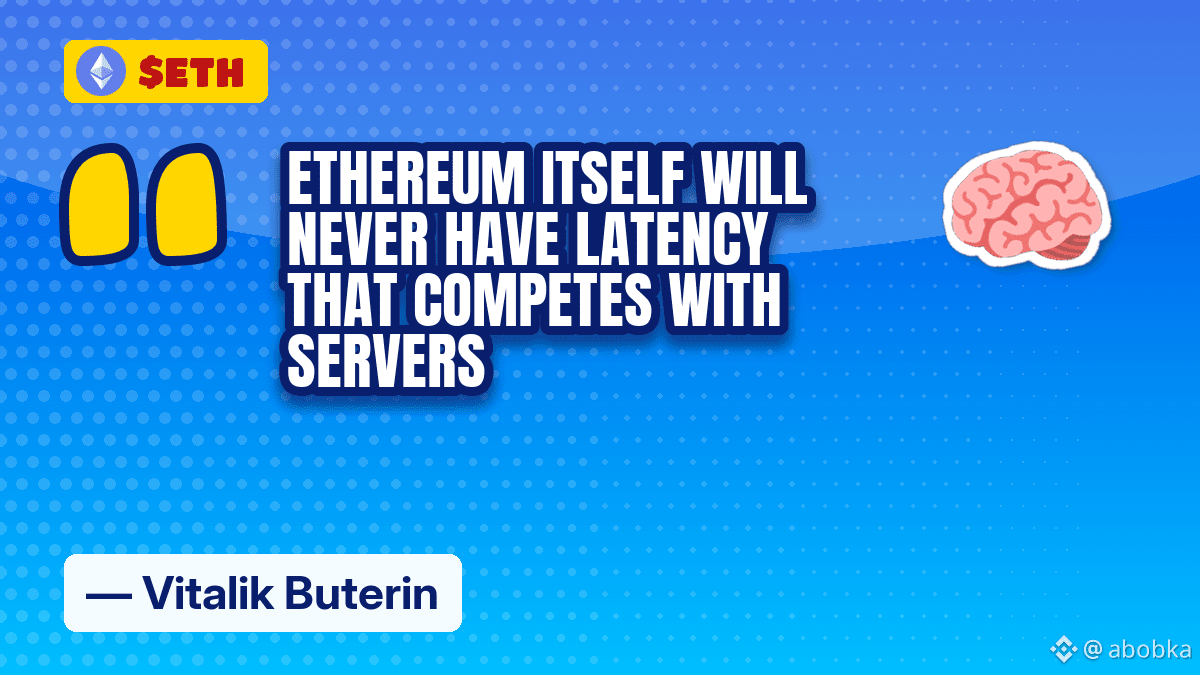
and speed, in his words: "Ethereum itself will never have latency that competes with servers"
whatever feels fast will sit around the chain
I don't hold ETH, so I'm just here for the architecture drama)
Glamsterdam, the fork before Hegota, is set for the fourth quarter of 2026 and hasn't even shipped
the day it does I'll break down what it changes right here, follow and you'll catch it
#VitalikButerin #HEGOTA #ETH
Vitalik says Hegota, next year's fork, is likely Ethereum's last "normal" one
everyone will screenshot that. the part that hits builders on $ETH
is the bill after it
same computation, very different price
shove it into one serial transaction and it costs much more
split it into pieces that can run in parallel and it costs much less
so a contract that runs like one long to-do list gets expensive
and speed, in his words: "Ethereum itself will never have latency that competes with servers"
whatever feels fast will sit around the chain
I don't hold ETH, so I'm just here for the architecture drama)
Glamsterdam, the fork before Hegota, is set for the fourth quarter of 2026 and hasn't even shipped
the day it does I'll break down what it changes right here, follow and you'll catch it
#VitalikButerin #HEGOTA #ETH
everyone will screenshot that. the part that hits builders on $ETH
is the bill after it
same computation, very different price
shove it into one serial transaction and it costs much more
split it into pieces that can run in parallel and it costs much less
so a contract that runs like one long to-do list gets expensive
and speed, in his words: "Ethereum itself will never have latency that competes with servers"
whatever feels fast will sit around the chain
I don't hold ETH, so I'm just here for the architecture drama)
Glamsterdam, the fork before Hegota, is set for the fourth quarter of 2026 and hasn't even shipped
the day it does I'll break down what it changes right here, follow and you'll catch it
#VitalikButerin #HEGOTA #ETH
2
119


·
--
Verified
🚀 Ethereum prepares for 2030 Buterin has proposed moving some of Ethereum's computations off-chain by 2030.
🔐 This could increase network throughput and enhance user privacy. Ethereum aims to catch up with faster competitors without sacrificing decentralization or security.
#ETFEthereum #VitalikButerin
$ETH
{spot}(ETHUSDT)
🚀 Ethereum prepares for 2030 Buterin has proposed moving some of Ethereum's computations off-chain by 2030.
🔐 This could increase network throughput and enhance user privacy. Ethereum aims to catch up with faster competitors without sacrificing decentralization or security.
#ETFEthereum #VitalikButerin
$ETH
🔐 This could increase network throughput and enhance user privacy. Ethereum aims to catch up with faster competitors without sacrificing decentralization or security.
#ETFEthereum #VitalikButerin
$ETH
10
866

Vitalik Buterin’s latest insights suggest the upcoming Hegotá upgrade might be the final traditional hard fork for Ethereum. With PeerDAS rolling out, the network is fundamentally evolving past a standard blockchain into a much more scalable, powerful modular ecosystem. This shift marks a major maturation milestone for ETH, changing how we view network upgrades and long-term scaling forever. Are you ready for the new era of Ethereum? $ETH #Ethereum #VitalikButerin #Layer2
Vitalik Buterin’s latest insights suggest the upcoming Hegotá upgrade might be the final traditional hard fork for Ethereum. With PeerDAS rolling out, the network is fundamentally evolving past a standard blockchain into a much more scalable, powerful modular ecosystem. This shift marks a major maturation milestone for ETH, changing how we view network upgrades and long-term scaling forever. Are you ready for the new era of Ethereum? $ETH #Ethereum #VitalikButerin #Layer2
3

·
--
💬 Vitalik Buterin wants Ethereum to become a true “global cryptographic computer,” capable of combining security, privacy, and computation at very large scale.
And the change could accelerate very quickly, because, according to him, Hegota, planned for 2027, could be the last fork still easily recognizable by someone who has known Ethereum in 2015. Then would come, among other things, recursive STARKs, automated formal verification, and an architecture resistant to quantum computers.
Ethereum would therefore no longer just aim to be a better blockchain, but to become a new form of global computing infrastructure.
#ETH #VitalikButerin
💬 Vitalik Buterin wants Ethereum to become a true “global cryptographic computer,” capable of combining security, privacy, and computation at very large scale.
And the change could accelerate very quickly, because, according to him, Hegota, planned for 2027, could be the last fork still easily recognizable by someone who has known Ethereum in 2015. Then would come, among other things, recursive STARKs, automated formal verification, and an architecture resistant to quantum computers.
Ethereum would therefore no longer just aim to be a better blockchain, but to become a new form of global computing infrastructure.
#ETH #VitalikButerin
And the change could accelerate very quickly, because, according to him, Hegota, planned for 2027, could be the last fork still easily recognizable by someone who has known Ethereum in 2015. Then would come, among other things, recursive STARKs, automated formal verification, and an architecture resistant to quantum computers.
Ethereum would therefore no longer just aim to be a better blockchain, but to become a new form of global computing infrastructure.
#ETH #VitalikButerin
1
406
Vitalik’s vision for Ethereum by 2030 proves the network is evolving far beyond a simple settlement layer. By expanding into modular scaling, enhanced privacy, and tighter account abstraction, ETH is positioning itself as a comprehensive global compute platform. This shift changes the long-term investment thesis entirely, moving value capture from basic gas fees to robust utility across decentralized applications worldwide. The next era of crypto infrastructure is arriving fast. $ETH #Ethereum #VitalikButerin #Crypto2030
Vitalik’s vision for Ethereum by 2030 proves the network is evolving far beyond a simple settlement layer. By expanding into modular scaling, enhanced privacy, and tighter account abstraction, ETH is positioning itself as a comprehensive global compute platform. This shift changes the long-term investment thesis entirely, moving value capture from basic gas fees to robust utility across decentralized applications worldwide. The next era of crypto infrastructure is arriving fast. $ETH #Ethereum #VitalikButerin #Crypto2030
17
Vitalik just dropped a massive 2030 vision for Ethereum, aiming to transform it from a basic ledger into a hyper-efficient global compute engine. The core shift focuses on scaling execution without forcing every single node to recheck identical calculations. If this roadmap succeeds, bottlenecks vanish and L2s reach hyper-speed. It is a bold blueprint that proves ETH is playing the long game while others chase short-term hype. The future of decentralized infrastructure is evolving right before our eyes. $ETH #Ethereum #VitalikButerin #Crypto2030
Vitalik just dropped a massive 2030 vision for Ethereum, aiming to transform it from a basic ledger into a hyper-efficient global compute engine. The core shift focuses on scaling execution without forcing every single node to recheck identical calculations. If this roadmap succeeds, bottlenecks vanish and L2s reach hyper-speed. It is a bold blueprint that proves ETH is playing the long game while others chase short-term hype. The future of decentralized infrastructure is evolving right before our eyes. $ETH #Ethereum #VitalikButerin #Crypto2030
24

·
--
🚨AI vs. Crypto: Why Artificial Intelligence Threatens Privacy on Ethereum? 🤖🔒
The rapid advancement of Artificial Intelligence doesn’t only affect the stock market (#TechStocks), but is also changing the rules of the game in the crypto world.
Vitalik Buterin has raised an important warning: advanced AI tools can now cross public data to identify the real identity of pseudo-anonymous wallets on Ethereum ($ETH).
Ethereum’s Diagnosis and Solution: 💡
The AI Threat: Predictive data analysis by Artificial Intelligence can correlate timestamps, values, and transaction addresses, destroying the traditional privacy of open blockchains.
The Technological Response (ZK-Proofs): To protect against AI tracking, Ethereum is speeding up the implementation of Zero-Knowledge Proofs (ZK-SNARKs) and the principles of "CROPS". The goal is to allow the network to verify the validity of a transaction without exposing who sent it or the values involved.
The Future of Investments: The infrastructure that can combine high scalability with immutable privacy against AI agents will be the big winner of this cycle.
The battle between AI surveillance and blockchain privacy has just begun.
Do you think ZK solutions will be enough to stop the advance of AI-based tracking?
Follow my profile for more analyses at the intersection of Artificial Intelligence, Cryptography, and the Financial Market! 🚀
#AIStocksWhatNext #Ethereum #ETH #VitalikButerin #BinanceSquare
$ETH
{spot}(ETHUSDT)
🚨AI vs. Crypto: Why Artificial Intelligence Threatens Privacy on Ethereum? 🤖🔒
The rapid advancement of Artificial Intelligence doesn’t only affect the stock market (#TechStocks), but is also changing the rules of the game in the crypto world.
Vitalik Buterin has raised an important warning: advanced AI tools can now cross public data to identify the real identity of pseudo-anonymous wallets on Ethereum ($ETH ).
Ethereum’s Diagnosis and Solution: 💡
The AI Threat: Predictive data analysis by Artificial Intelligence can correlate timestamps, values, and transaction addresses, destroying the traditional privacy of open blockchains.
The Technological Response (ZK-Proofs): To protect against AI tracking, Ethereum is speeding up the implementation of Zero-Knowledge Proofs (ZK-SNARKs) and the principles of "CROPS". The goal is to allow the network to verify the validity of a transaction without exposing who sent it or the values involved.
The Future of Investments: The infrastructure that can combine high scalability with immutable privacy against AI agents will be the big winner of this cycle.
The battle between AI surveillance and blockchain privacy has just begun.
Do you think ZK solutions will be enough to stop the advance of AI-based tracking?
Follow my profile for more analyses at the intersection of Artificial Intelligence, Cryptography, and the Financial Market! 🚀
#AIStocksWhatNext #Ethereum #ETH #VitalikButerin #BinanceSquare
$ETH
The rapid advancement of Artificial Intelligence doesn’t only affect the stock market (#TechStocks), but is also changing the rules of the game in the crypto world.
Vitalik Buterin has raised an important warning: advanced AI tools can now cross public data to identify the real identity of pseudo-anonymous wallets on Ethereum ($ETH ).
Ethereum’s Diagnosis and Solution: 💡
The AI Threat: Predictive data analysis by Artificial Intelligence can correlate timestamps, values, and transaction addresses, destroying the traditional privacy of open blockchains.
The Technological Response (ZK-Proofs): To protect against AI tracking, Ethereum is speeding up the implementation of Zero-Knowledge Proofs (ZK-SNARKs) and the principles of "CROPS". The goal is to allow the network to verify the validity of a transaction without exposing who sent it or the values involved.
The Future of Investments: The infrastructure that can combine high scalability with immutable privacy against AI agents will be the big winner of this cycle.
The battle between AI surveillance and blockchain privacy has just begun.
Do you think ZK solutions will be enough to stop the advance of AI-based tracking?
Follow my profile for more analyses at the intersection of Artificial Intelligence, Cryptography, and the Financial Market! 🚀
#AIStocksWhatNext #Ethereum #ETH #VitalikButerin #BinanceSquare
$ETH
301
·
--
Bullish
🔸 $795,687
That's the total TVL of a prediction market Vitalik Buterin just welcomed to Ethereum L1 #VitalikButerin
He called it focused on decentralization, and "ethical and not corposlop"
Trueo is migrating from Base to $ETH
{future}(ETHUSDT)
mainnet
Base markets stay live either way
Fourteenth place among onchain prediction markets, per DefiLlama
One quote from Buterin and suddenly everyone's talking about a protocol smaller than a whale's lunch money #Buterin
🔸 $795,687
That's the total TVL of a prediction market Vitalik Buterin just welcomed to Ethereum L1 #VitalikButerin
He called it focused on decentralization, and "ethical and not corposlop"
Trueo is migrating from Base to $ETH
mainnet
Base markets stay live either way
Fourteenth place among onchain prediction markets, per DefiLlama
One quote from Buterin and suddenly everyone's talking about a protocol smaller than a whale's lunch money #Buterin
That's the total TVL of a prediction market Vitalik Buterin just welcomed to Ethereum L1 #VitalikButerin
He called it focused on decentralization, and "ethical and not corposlop"
Trueo is migrating from Base to $ETH
mainnet
Base markets stay live either way
Fourteenth place among onchain prediction markets, per DefiLlama
One quote from Buterin and suddenly everyone's talking about a protocol smaller than a whale's lunch money #Buterin
8
52

Vitalik stays bullish on security
Vitalik Buterin is pushing back against the idea that AI powered hacking will make cybersecurity impossible, providing a more optimistic outlook on the tech battle.
#VitalikButerin #AISecurity
Vitalik stays bullish on security
Vitalik Buterin is pushing back against the idea that AI powered hacking will make cybersecurity impossible, providing a more optimistic outlook on the tech battle.
#VitalikButerin #AISecurity
Vitalik Buterin is pushing back against the idea that AI powered hacking will make cybersecurity impossible, providing a more optimistic outlook on the tech battle.
#VitalikButerin #AISecurity
8

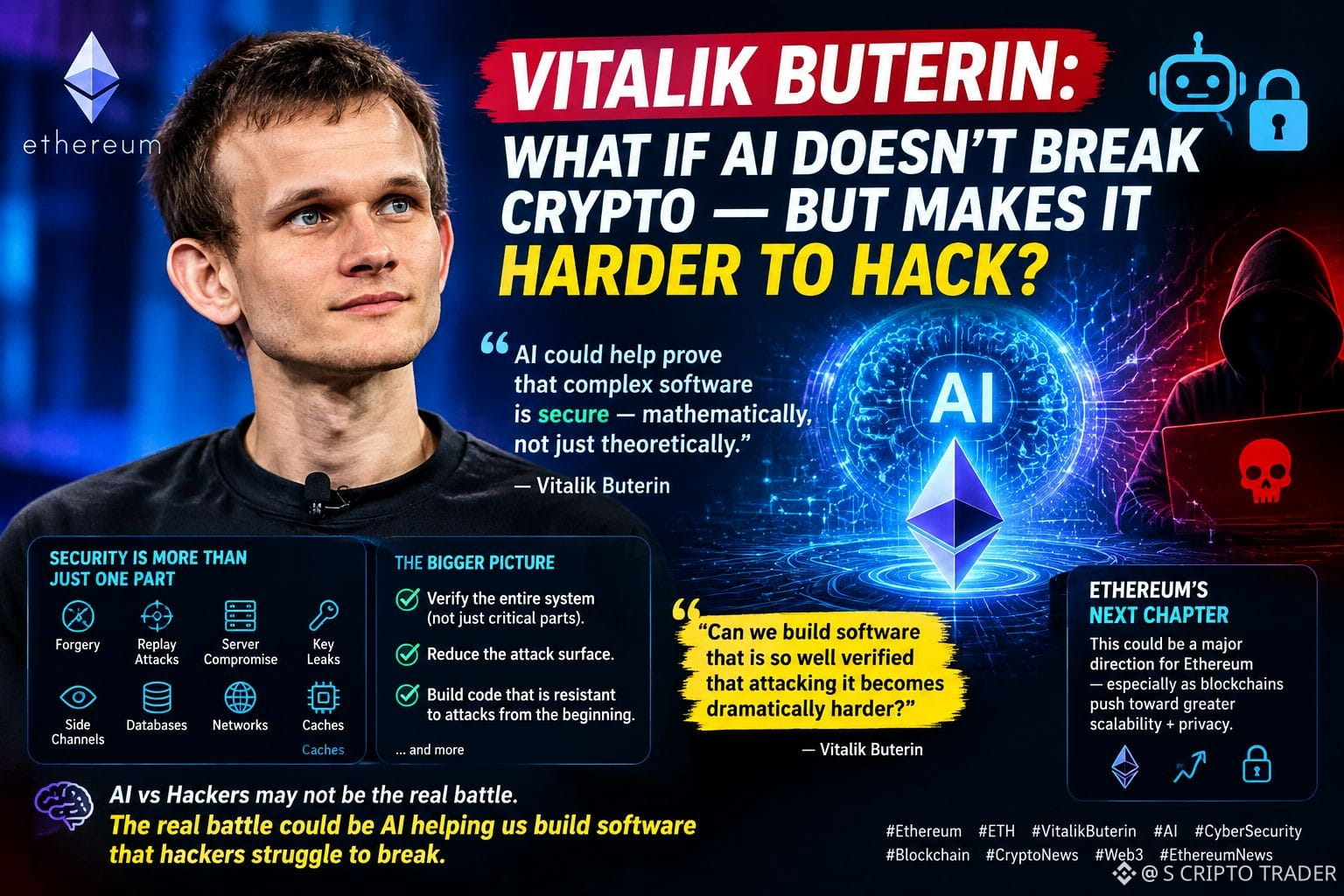
🚨 VITALIK BUTERIN: WHAT IF AI DOESN’T BREAK CRYPTO — BUT MAKES IT HARDER TO HACK? 🤖🔐
$ETH $SOL $SPY
For years, one fear has followed the rise of AI: What happens when machines become better at finding vulnerabilities than humans?
Ethereum co-founder Vitalik Buterin offered a different perspective.
🧠 His argument is simple but powerful:
AI could eventually help prove that complex software is secure — mathematically, not just theoretically.
Buterin pointed to advances in AI-driven mathematics and argued that, if machines can tackle extremely complex mathematical proofs, they could potentially verify the security of sophisticated programs as well.
🔎 But there’s a catch:
Security isn’t just about one smart contract or one critical function.
It can involve forgery, replay attacks, server compromises, key leaks, side channels, databases, networks, caches and much more.
That means the future of secure blockchain development may require something much bigger:
⚡ Verify the entire system.
⚡ Reduce the attack surface.
⚡ Build code that is resistant to attacks from the beginning.
And this is where the story gets interesting.
Instead of simply asking “Can defenders find the hacker first?”, Buterin’s vision asks a deeper question:
«“Can we build software that is so well verified that attacking it becomes dramatically harder?”»
According to Buterin, this could become a major direction for Ethereum over the coming years — especially as blockchains push toward greater scalability + privacy.
{spot}(ETHUSDT)
{spot}(SYRUPUSDT)
{future}(SPYUSDT)
🔮 AI vs Hackers may not be the real battle.
The real battle could be AI helping us build software that hackers struggle to break.
#Ethereum #ETH #VitalikButerin #AI
🚨 VITALIK BUTERIN: WHAT IF AI DOESN’T BREAK CRYPTO — BUT MAKES IT HARDER TO HACK? 🤖🔐
$ETH $SOL $SPY
For years, one fear has followed the rise of AI: What happens when machines become better at finding vulnerabilities than humans?
Ethereum co-founder Vitalik Buterin offered a different perspective.
🧠 His argument is simple but powerful:
AI could eventually help prove that complex software is secure — mathematically, not just theoretically.
Buterin pointed to advances in AI-driven mathematics and argued that, if machines can tackle extremely complex mathematical proofs, they could potentially verify the security of sophisticated programs as well.
🔎 But there’s a catch:
Security isn’t just about one smart contract or one critical function.
It can involve forgery, replay attacks, server compromises, key leaks, side channels, databases, networks, caches and much more.
That means the future of secure blockchain development may require something much bigger:
⚡ Verify the entire system.
⚡ Reduce the attack surface.
⚡ Build code that is resistant to attacks from the beginning.
And this is where the story gets interesting.
Instead of simply asking “Can defenders find the hacker first?”, Buterin’s vision asks a deeper question:
«“Can we build software that is so well verified that attacking it becomes dramatically harder?”»
According to Buterin, this could become a major direction for Ethereum over the coming years — especially as blockchains push toward greater scalability + privacy.
🔮 AI vs Hackers may not be the real battle.
The real battle could be AI helping us build software that hackers struggle to break.
#Ethereum #ETH #VitalikButerin #AI
$ETH $SOL $SPY
For years, one fear has followed the rise of AI: What happens when machines become better at finding vulnerabilities than humans?
Ethereum co-founder Vitalik Buterin offered a different perspective.
🧠 His argument is simple but powerful:
AI could eventually help prove that complex software is secure — mathematically, not just theoretically.
Buterin pointed to advances in AI-driven mathematics and argued that, if machines can tackle extremely complex mathematical proofs, they could potentially verify the security of sophisticated programs as well.
🔎 But there’s a catch:
Security isn’t just about one smart contract or one critical function.
It can involve forgery, replay attacks, server compromises, key leaks, side channels, databases, networks, caches and much more.
That means the future of secure blockchain development may require something much bigger:
⚡ Verify the entire system.
⚡ Reduce the attack surface.
⚡ Build code that is resistant to attacks from the beginning.
And this is where the story gets interesting.
Instead of simply asking “Can defenders find the hacker first?”, Buterin’s vision asks a deeper question:
«“Can we build software that is so well verified that attacking it becomes dramatically harder?”»
According to Buterin, this could become a major direction for Ethereum over the coming years — especially as blockchains push toward greater scalability + privacy.
🔮 AI vs Hackers may not be the real battle.
The real battle could be AI helping us build software that hackers struggle to break.
#Ethereum #ETH #VitalikButerin #AI

38

·
--
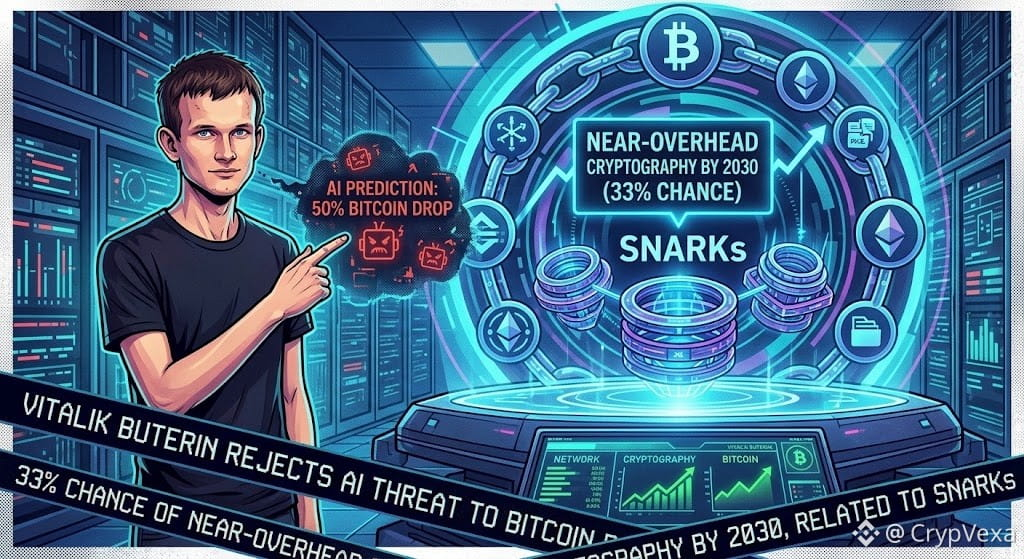
🧠 Vitalik Buterin Pushes Back on AI Threat to Bitcoin! ₿
Ethereum co-founder Vitalik Buterin rejected the idea that AI could trigger a 50% Bitcoin price crash, saying he remains bullish on the long-term outlook for cryptography.
🔐 He also estimates a 33% chance of “near-overhead cryptography” by 2030, with implications for technologies such as SNARKs.
👀 Why it matters: AI is advancing rapidly, but Vitalik argues that cryptography is also evolving, potentially strengthening blockchain security rather than simply threatening it.
#Bitcoin #Ethereum #VitalikButerin #Crypto
🧠 Vitalik Buterin Pushes Back on AI Threat to Bitcoin! ₿
Ethereum co-founder Vitalik Buterin rejected the idea that AI could trigger a 50% Bitcoin price crash, saying he remains bullish on the long-term outlook for cryptography.
🔐 He also estimates a 33% chance of “near-overhead cryptography” by 2030, with implications for technologies such as SNARKs.
👀 Why it matters: AI is advancing rapidly, but Vitalik argues that cryptography is also evolving, potentially strengthening blockchain security rather than simply threatening it.
#Bitcoin #Ethereum #VitalikButerin #Crypto
Ethereum co-founder Vitalik Buterin rejected the idea that AI could trigger a 50% Bitcoin price crash, saying he remains bullish on the long-term outlook for cryptography.
🔐 He also estimates a 33% chance of “near-overhead cryptography” by 2030, with implications for technologies such as SNARKs.
👀 Why it matters: AI is advancing rapidly, but Vitalik argues that cryptography is also evolving, potentially strengthening blockchain security rather than simply threatening it.
#Bitcoin #Ethereum #VitalikButerin #Crypto
41
·
--
Bullish
you can't un-send a donation. Buterin is $500 million into proving it
2021: he gets airdropped $SHIB he never asked for
that's what being the $ETH founder gets you, strangers put things in your wallet
he splits it roughly in half, one part to India's covid relief through CryptoRelief, the other to the Future of Life Institute
▪ what he thought FLI could realistically sell into: $10 million to $25 million at most
▪ what FLI actually cashed out: roughly $500 million
▪ what an FLI spokesperson later told Politico the gift came to: $665.8 million
a donation sized like a grant turned into a war chest, purely because a memecoin had more liquidity than the donor thought
and there's no undo button
no vesting, no clawback
no "spend it on bio and nuclear too, like we discussed"
the transfer cleared in 2021, the terms became whatever the recipient decided afterwards
FLI is now one of four funders behind the newsroom fellowships Semafor wrote up in December 2025, and nobody had to ask him first
on March 13, 2026 he said it himself. the institute had turned to culture and politics as its main lever, and pools of money that big in politics end up authoritarian and fragile. he also said he was heartened by their pro-human AI declaration, so it isn't a clean break either
David Sacks is now using that donation as an attack line on him
anyone who's ever sent an airdrop to a charity wallet signed the same terms, just with smaller numbers
ever send a token somewhere and then watch it run? proud or robbed)
#buterin #VitalikButerin
you can't un-send a donation. Buterin is $500 million into proving it
2021: he gets airdropped $SHIB he never asked for
that's what being the $ETH founder gets you, strangers put things in your wallet
he splits it roughly in half, one part to India's covid relief through CryptoRelief, the other to the Future of Life Institute
▪ what he thought FLI could realistically sell into: $10 million to $25 million at most
▪ what FLI actually cashed out: roughly $500 million
▪ what an FLI spokesperson later told Politico the gift came to: $665.8 million
a donation sized like a grant turned into a war chest, purely because a memecoin had more liquidity than the donor thought
and there's no undo button
no vesting, no clawback
no "spend it on bio and nuclear too, like we discussed"
the transfer cleared in 2021, the terms became whatever the recipient decided afterwards
FLI is now one of four funders behind the newsroom fellowships Semafor wrote up in December 2025, and nobody had to ask him first
on March 13, 2026 he said it himself. the institute had turned to culture and politics as its main lever, and pools of money that big in politics end up authoritarian and fragile. he also said he was heartened by their pro-human AI declaration, so it isn't a clean break either
David Sacks is now using that donation as an attack line on him
anyone who's ever sent an airdrop to a charity wallet signed the same terms, just with smaller numbers
ever send a token somewhere and then watch it run? proud or robbed)
#buterin #VitalikButerin
2021: he gets airdropped $SHIB he never asked for
that's what being the $ETH founder gets you, strangers put things in your wallet
he splits it roughly in half, one part to India's covid relief through CryptoRelief, the other to the Future of Life Institute
▪ what he thought FLI could realistically sell into: $10 million to $25 million at most
▪ what FLI actually cashed out: roughly $500 million
▪ what an FLI spokesperson later told Politico the gift came to: $665.8 million
a donation sized like a grant turned into a war chest, purely because a memecoin had more liquidity than the donor thought
and there's no undo button
no vesting, no clawback
no "spend it on bio and nuclear too, like we discussed"
the transfer cleared in 2021, the terms became whatever the recipient decided afterwards
FLI is now one of four funders behind the newsroom fellowships Semafor wrote up in December 2025, and nobody had to ask him first
on March 13, 2026 he said it himself. the institute had turned to culture and politics as its main lever, and pools of money that big in politics end up authoritarian and fragile. he also said he was heartened by their pro-human AI declaration, so it isn't a clean break either
David Sacks is now using that donation as an attack line on him
anyone who's ever sent an airdrop to a charity wallet signed the same terms, just with smaller numbers
ever send a token somewhere and then watch it run? proud or robbed)
#buterin #VitalikButerin

13
137

·
--
Could AI crash #Bitcoin in 2 years? 📉
While some raise alarms, Vitalik Buterin is betting big against this doom-and-gloom forecast. With roughly 90% of his net worth in crypto, the Ethereum co-founder has ultimate "skin in the game" opposing an AI-driven market crash.
It’s a massive vote of confidence in blockchain's resilience. Do you think AI poses a threat to BTC, or will it actually fuel the next bull run? 👇
#Bitcoin #VitalikButerin #CryptoNews
Could AI crash #Bitcoin in 2 years? 📉
While some raise alarms, Vitalik Buterin is betting big against this doom-and-gloom forecast. With roughly 90% of his net worth in crypto, the Ethereum co-founder has ultimate "skin in the game" opposing an AI-driven market crash.
It’s a massive vote of confidence in blockchain's resilience. Do you think AI poses a threat to BTC, or will it actually fuel the next bull run? 👇
#Bitcoin #VitalikButerin #CryptoNews
While some raise alarms, Vitalik Buterin is betting big against this doom-and-gloom forecast. With roughly 90% of his net worth in crypto, the Ethereum co-founder has ultimate "skin in the game" opposing an AI-driven market crash.
It’s a massive vote of confidence in blockchain's resilience. Do you think AI poses a threat to BTC, or will it actually fuel the next bull run? 👇
#Bitcoin #VitalikButerin #CryptoNews
29
·
--
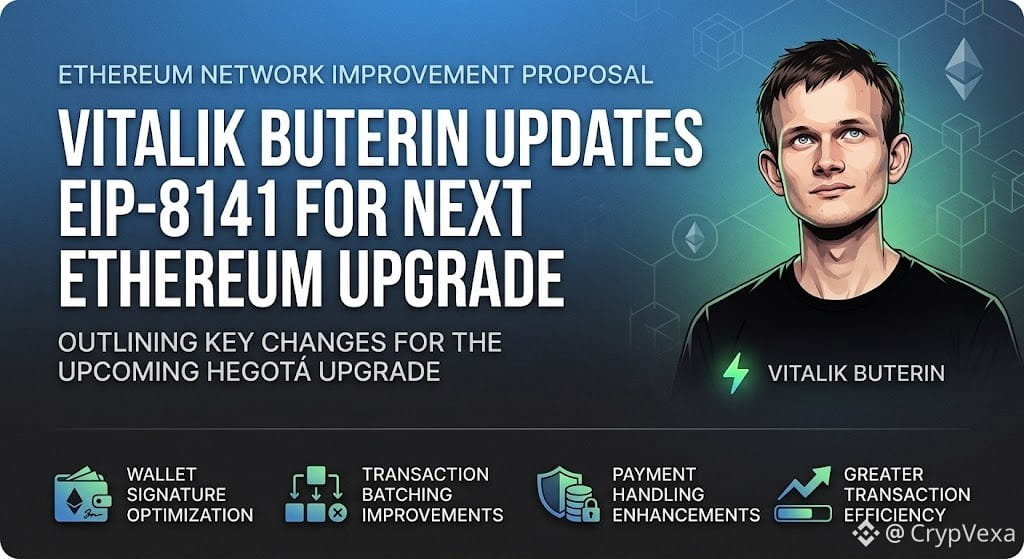
⚡ Vitalik Updates Ethereum Proposal EIP-8141!
Vitalik Buterin has released an updated EIP-8141 for Ethereum’s upcoming Hegotá upgrade. 🚀
The proposal could improve how wallets sign, batch transactions, and process payments, potentially making transaction formats more efficient. 🔥
👀 Ethereum’s next upgrade could bring major changes to how users transact.
#Ethereum #ETH #VitalikButerin #Crypto
⚡ Vitalik Updates Ethereum Proposal EIP-8141!
Vitalik Buterin has released an updated EIP-8141 for Ethereum’s upcoming Hegotá upgrade. 🚀
The proposal could improve how wallets sign, batch transactions, and process payments, potentially making transaction formats more efficient. 🔥
👀 Ethereum’s next upgrade could bring major changes to how users transact.
#Ethereum #ETH #VitalikButerin #Crypto
Vitalik Buterin has released an updated EIP-8141 for Ethereum’s upcoming Hegotá upgrade. 🚀
The proposal could improve how wallets sign, batch transactions, and process payments, potentially making transaction formats more efficient. 🔥
👀 Ethereum’s next upgrade could bring major changes to how users transact.
#Ethereum #ETH #VitalikButerin #Crypto
65
Vitalik Buterin dismissed fears that AI security threats could trigger a massive Bitcoin crash, citing the resilience of cryptography and the potential for future network upgrades.
#VitalikButerin #BitcoinSecurity
Vitalik Buterin dismissed fears that AI security threats could trigger a massive Bitcoin crash, citing the resilience of cryptography and the potential for future network upgrades.
#VitalikButerin #BitcoinSecurity
#VitalikButerin #BitcoinSecurity
64

·
--

Article
Ethereum co-founder Vitalik Buterin expressed willingness to risk 90% of his capitalEthereum co-founder Vitalik Buterin expressed willingness to risk 90% of his capital, taking a stand against the prediction of a major decline in Bitcoin’s value due to the development of artificial intelligence. In this way, he responded to a statement by well-known venture investor Liron Shapira, who predicted the collapse of the first cryptocurrency in the next two years.
Ethereum co-founder Vitalik Buterin expressed willingness to risk 90% of his capital
Ethereum co-founder Vitalik Buterin expressed willingness to risk 90% of his capital, taking a stand against the prediction of a major decline in Bitcoin’s value due to the development of artificial intelligence. In this way, he responded to a statement by well-known venture investor Liron Shapira, who predicted the collapse of the first cryptocurrency in the next two years.
1
113

Verified
🚨 BREAKING: Vitalik Buterin says there is a 60% chance that SNARKs, $FHE and $IO could eventually run with an overhead of less than 10x, with the first ones (probably SNARKs) arriving by the end of the decade.
$RAY 👀👀👀👀👀👀👀👀
{spot}(RAYUSDT)
{spot}(IOUSDT)
{future}(FHEUSDT)
#CryptoNewss #VitalikButerin #RussiaUkraine72-hourCeasefire #USStrikesIranTankersTehranRestrictsHormuz #bullish
🚨 BREAKING: Vitalik Buterin says there is a 60% chance that SNARKs, $FHE and $IO could eventually run with an overhead of less than 10x, with the first ones (probably SNARKs) arriving by the end of the decade.
$RAY 👀👀👀👀👀👀👀👀
#CryptoNewss #VitalikButerin #RussiaUkraine72-hourCeasefire #USStrikesIranTankersTehranRestrictsHormuz #bullish
$RAY 👀👀👀👀👀👀👀👀
#CryptoNewss #VitalikButerin #RussiaUkraine72-hourCeasefire #USStrikesIranTankersTehranRestrictsHormuz #bullish

2k
Vitalik Buterin is proposing a new generation of Ethereum transaction formats designed to separate execution from verification, potentially unlocking significant scaling improvements for the network.
#EthereumScaling #VitalikButerin
Vitalik Buterin is proposing a new generation of Ethereum transaction formats designed to separate execution from verification, potentially unlocking significant scaling improvements for the network.
#EthereumScaling #VitalikButerin
#EthereumScaling #VitalikButerin
57

·
--
Bullish
Partly True
🔥 Vitalik just called it out! Is 90% of Ethereum activity about to get "lower Gas"?
Yesterday on X, Vitalik revealed that EIP-8141 aims to split transactions into "actions" and "dependencies" for separate optimization. According to him, more than 90% of Ethereum activity doesn't need dynamic flexibility at all, and any part that can be statically analyzed will get lower Gas.
On-chain data also supports this direction — in Q2, Ethereum L1 processed 203.9 million transactions, up 68% year over year, while average fees fell from $1.08 to $0.31. The Glamsterdam upgrade is set to launch in September, with a target of 10,000 TPS. EIP-8141 is scheduled for the 2027 Hegotá fork.
Both the technicals and fundamentals are sending signals.
In addition, recently on-chain funds have been quietly positioning in a new Musk-themed dog coin. It’s pure CTO mode, community takeover, and the contract permissions have been renounced. The top 10 holders account for only 7.68%, so the holdings are extremely dispersed. Small money betting, the logic of turning a bicycle into a motorcycle.
{web3_wallet_create}(10xcf91b70017eabde82c9671e30e5502d312ea6eb2)
Looking at the bigger picture, the Ethereum upgrade narrative is in play, while a small allocation to community meme plays for excess returns — a two-pronged setup.
Personal analysis, not investment advice, for reference only. Play with small money and don’t get carried away.
#以太坊 #EIP8141 #VitalikButerin #meme币暴涨 #币安广场征文活动
🔥 Vitalik just called it out! Is 90% of Ethereum activity about to get "lower Gas"?
Yesterday on X, Vitalik revealed that EIP-8141 aims to split transactions into "actions" and "dependencies" for separate optimization. According to him, more than 90% of Ethereum activity doesn't need dynamic flexibility at all, and any part that can be statically analyzed will get lower Gas.
On-chain data also supports this direction — in Q2, Ethereum L1 processed 203.9 million transactions, up 68% year over year, while average fees fell from $1.08 to $0.31. The Glamsterdam upgrade is set to launch in September, with a target of 10,000 TPS. EIP-8141 is scheduled for the 2027 Hegotá fork.
Both the technicals and fundamentals are sending signals.
In addition, recently on-chain funds have been quietly positioning in a new Musk-themed dog coin. It’s pure CTO mode, community takeover, and the contract permissions have been renounced. The top 10 holders account for only 7.68%, so the holdings are extremely dispersed. Small money betting, the logic of turning a bicycle into a motorcycle.
Looking at the bigger picture, the Ethereum upgrade narrative is in play, while a small allocation to community meme plays for excess returns — a two-pronged setup.
Personal analysis, not investment advice, for reference only. Play with small money and don’t get carried away.
#以太坊 #EIP8141 #VitalikButerin #meme币暴涨 #币安广场征文活动
Yesterday on X, Vitalik revealed that EIP-8141 aims to split transactions into "actions" and "dependencies" for separate optimization. According to him, more than 90% of Ethereum activity doesn't need dynamic flexibility at all, and any part that can be statically analyzed will get lower Gas.
On-chain data also supports this direction — in Q2, Ethereum L1 processed 203.9 million transactions, up 68% year over year, while average fees fell from $1.08 to $0.31. The Glamsterdam upgrade is set to launch in September, with a target of 10,000 TPS. EIP-8141 is scheduled for the 2027 Hegotá fork.
Both the technicals and fundamentals are sending signals.
In addition, recently on-chain funds have been quietly positioning in a new Musk-themed dog coin. It’s pure CTO mode, community takeover, and the contract permissions have been renounced. The top 10 holders account for only 7.68%, so the holdings are extremely dispersed. Small money betting, the logic of turning a bicycle into a motorcycle.
Looking at the bigger picture, the Ethereum upgrade narrative is in play, while a small allocation to community meme plays for excess returns — a two-pronged setup.
Personal analysis, not investment advice, for reference only. Play with small money and don’t get carried away.
#以太坊 #EIP8141 #VitalikButerin #meme币暴涨 #币安广场征文活动


14
692

·
--
Article
Vitalik Explains Ethereum Foundation New Leaner Vision Focused on Security and Privacy in 2026Vitalik Buterin Explains Ethereum Foundation’s New Direction: Why Ethereum Is Choosing Conviction Over Size
The future direction of the Ethereum Foundation is becoming clearer — and according to Vitalik Buterin, it is not about becoming bigger, faster, or more corporate.
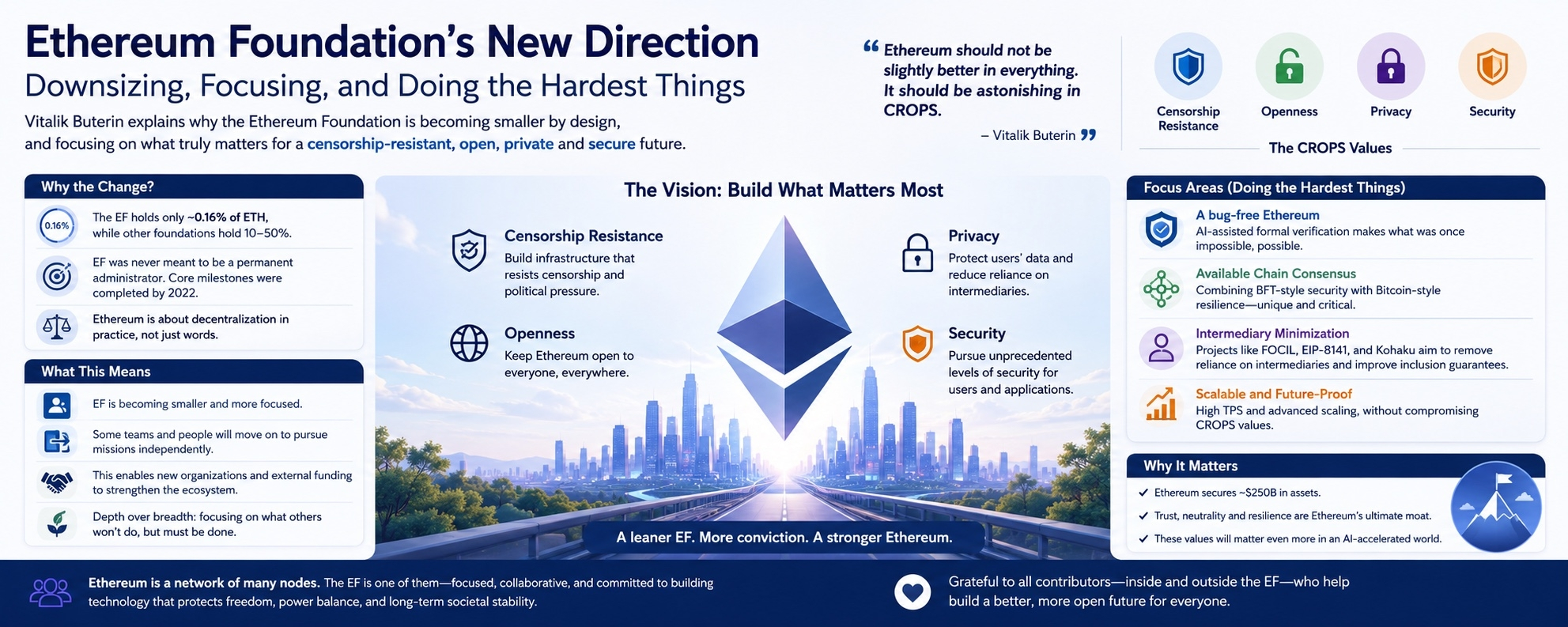
Instead, Ethereum is moving toward a leaner, more focused structure centered on what Vitalik calls the “CROPS” values:
▪︎ Censorship Resistance
▪︎ Openness
▪︎ Privacy
▪︎ Security
In a detailed reflection on the Foundation’s transition, Vitalik explained why Ethereum is intentionally avoiding the path taken by many competing blockchains and technology companies. His message was direct: Ethereum should not aim to be “slightly better” than everyone else. It should aim to become fundamentally different.
Ethereum Foundation Is Shrinking — By Design
One of the most important revelations from Vitalik’s comments is that the Ethereum Foundation is intentionally becoming smaller.
Unlike many blockchain ecosystems where foundations control massive portions of token supply, the Ethereum Foundation reportedly holds only around 0.16% of total ETH supply. In contrast, many competing blockchain foundations hold anywhere from 10% to 50% of their native assets.
That difference matters.
Vitalik emphasized that Ethereum was never designed to have a permanent centralized administrator. The Foundation originally existed to complete core milestones such as:
▪︎ Frontier
▪︎ Homestead
▪︎ Metropolis
▪︎ Serenity
Most of those foundational goals were completed years ago. Now, the organization is shifting from being a broad operator into a focused mission-driven institution.
This also explains why the Foundation is reducing its involvement in certain areas, allowing developers and researchers to build independently with outside funding rather than remaining permanently tied to EF.
According to Vitalik, this is not weakness — it is decentralization in practice.
Ethereum Does Not Want To Become “Just Another Fast Chain”
One of the strongest themes in Vitalik’s message was his rejection of the industry obsession with speed alone.
Today, many blockchains compete primarily on:
▪︎ Higher TPS
▪︎ Lower latency
▪︎ Faster finality
▪︎ Cheaper fees
Vitalik argues this path leads to mediocrity if decentralization and resilience are sacrificed along the way.
Instead of chasing “1 million TPS marketing,” Ethereum wants to dominate in trust, neutrality, and security.
This is where the CROPS philosophy becomes central.
Ethereum’s long-term vision is not simply scaling transaction throughput. It is building infrastructure that can survive political pressure, censorship attempts, surveillance, and systemic attacks while remaining open to everyone.
That is a much harder engineering challenge.
The Rise of “Unreasonable Ethereum”
Vitalik used an interesting comparison involving Google to explain his philosophy.
He described how many tech companies started with idealistic goals but gradually drifted toward profit maximization, surveillance systems, and government alignment.
His argument is that society benefits when at least some organizations resist those trends.
Ethereum wants to become one of those “unreasonable” systems — a network willing to prioritize principles even when doing so is slower, harder, or less profitable in the short term.
This philosophy also reflects Ethereum’s long-standing commitment to neutrality and open access.
AI Could Transform Ethereum Security
Perhaps the most fascinating technical point from Vitalik’s discussion involved AI-assisted formal verification.
He stated that creating a nearly bug-free Ethereum once sounded impossible, but advances in AI are rapidly changing that assumption.
Formal verification uses mathematical proofs to validate software correctness. Historically, this process has been expensive and difficult to scale.
Now, AI tools are making it significantly more practical.
If successful, Ethereum could become the first major blockchain ecosystem to dramatically reduce smart contract vulnerabilities and protocol-level bugs through large-scale verification systems.
This would be a major leap forward for blockchain security.
Ethereum’s Biggest Competitive Advantage May Be Trust
Vitalik also highlighted Ethereum’s unique consensus design.
According to him, Ethereum combines two important security properties:
▪︎ Byzantine Fault Tolerance-style security
▪︎ Bitcoin-style resilience against large attackers
Very few networks attempt to combine both.
Rather than relying heavily on social coordination or emergency hard forks, Ethereum’s roadmap increasingly focuses on making the protocol itself more resilient under extreme conditions.
This matters because Ethereum secures hundreds of billions of dollars in assets and infrastructure.
In Vitalik’s view, trust minimization will become more important — not less — as AI systems, digital surveillance, and geopolitical tensions continue accelerating globally.
Privacy Is Becoming A Core Ethereum Priority
Another major area of focus is privacy infrastructure.
Vitalik criticized the current blockchain user experience where wallets and applications often depend heavily on intermediaries and third-party infrastructure providers.
Projects and upgrades such as:
▪︎ FOCIL
▪︎ EIP-8141
▪︎ Smart contract wallets
▪︎ Privacy protocols like Railgun
are designed to reduce dependency on centralized intermediaries while improving transaction privacy and inclusion guarantees.
The broader goal is to ensure users can interact with Ethereum without exposing excessive personal information or relying on centralized gateways.
Why Some Talent Is Leaving Ethereum Foundation
One controversial part of the transition is the departure of respected developers and contributors from EF.
Vitalik addressed this directly.
He explained that allowing talented individuals to leave the Foundation can actually strengthen the ecosystem because it enables independent organizations and external funding sources to emerge.
In other words, decentralization means Ethereum innovation should not depend entirely on one institution.
This shift may initially appear chaotic, but it aligns closely with Ethereum’s original philosophy of distributed coordination.
Ethereum’s Future: Smaller Organization, Bigger Conviction
Vitalik’s overall message is not about retreat.
It is about specialization.
The Ethereum Foundation wants to focus on the hardest problems that few others are willing to prioritize:
▪︎ Censorship resistance
▪︎ Privacy preservation
▪︎ Secure scaling
▪︎ Neutral infrastructure
▪︎ Intermediary minimization
▪︎ Long-term protocol resilience
Rather than competing solely on transaction speed, Ethereum wants to become the blockchain ecosystem most trusted to survive over decades.
That strategy may not produce the fastest short-term growth narrative.
But if Ethereum succeeds, it could create something far more valuable: a decentralized financial and digital infrastructure durable enough for the AI era.
#Ethereum #ETH #VitalikButerin #Blockchain #ArifAlpha
Vitalik Explains Ethereum Foundation New Leaner Vision Focused on Security and Privacy in 2026
Vitalik Buterin Explains Ethereum Foundation’s New Direction: Why Ethereum Is Choosing Conviction Over Size
The future direction of the Ethereum Foundation is becoming clearer — and according to Vitalik Buterin, it is not about becoming bigger, faster, or more corporate.
Instead, Ethereum is moving toward a leaner, more focused structure centered on what Vitalik calls the “CROPS” values:
▪︎ Censorship Resistance
▪︎ Openness
▪︎ Privacy
▪︎ Security
In a detailed reflection on the Foundation’s transition, Vitalik explained why Ethereum is intentionally avoiding the path taken by many competing blockchains and technology companies. His message was direct: Ethereum should not aim to be “slightly better” than everyone else. It should aim to become fundamentally different.
Ethereum Foundation Is Shrinking — By Design
One of the most important revelations from Vitalik’s comments is that the Ethereum Foundation is intentionally becoming smaller.
Unlike many blockchain ecosystems where foundations control massive portions of token supply, the Ethereum Foundation reportedly holds only around 0.16% of total ETH supply. In contrast, many competing blockchain foundations hold anywhere from 10% to 50% of their native assets.
That difference matters.
Vitalik emphasized that Ethereum was never designed to have a permanent centralized administrator. The Foundation originally existed to complete core milestones such as:
▪︎ Frontier
▪︎ Homestead
▪︎ Metropolis
▪︎ Serenity
Most of those foundational goals were completed years ago. Now, the organization is shifting from being a broad operator into a focused mission-driven institution.
This also explains why the Foundation is reducing its involvement in certain areas, allowing developers and researchers to build independently with outside funding rather than remaining permanently tied to EF.
According to Vitalik, this is not weakness — it is decentralization in practice.
Ethereum Does Not Want To Become “Just Another Fast Chain”
One of the strongest themes in Vitalik’s message was his rejection of the industry obsession with speed alone.
Today, many blockchains compete primarily on:
▪︎ Higher TPS
▪︎ Lower latency
▪︎ Faster finality
▪︎ Cheaper fees
Vitalik argues this path leads to mediocrity if decentralization and resilience are sacrificed along the way.
Instead of chasing “1 million TPS marketing,” Ethereum wants to dominate in trust, neutrality, and security.
This is where the CROPS philosophy becomes central.
Ethereum’s long-term vision is not simply scaling transaction throughput. It is building infrastructure that can survive political pressure, censorship attempts, surveillance, and systemic attacks while remaining open to everyone.
That is a much harder engineering challenge.
The Rise of “Unreasonable Ethereum”
Vitalik used an interesting comparison involving Google to explain his philosophy.
He described how many tech companies started with idealistic goals but gradually drifted toward profit maximization, surveillance systems, and government alignment.
His argument is that society benefits when at least some organizations resist those trends.
Ethereum wants to become one of those “unreasonable” systems — a network willing to prioritize principles even when doing so is slower, harder, or less profitable in the short term.
This philosophy also reflects Ethereum’s long-standing commitment to neutrality and open access.
AI Could Transform Ethereum Security
Perhaps the most fascinating technical point from Vitalik’s discussion involved AI-assisted formal verification.
He stated that creating a nearly bug-free Ethereum once sounded impossible, but advances in AI are rapidly changing that assumption.
Formal verification uses mathematical proofs to validate software correctness. Historically, this process has been expensive and difficult to scale.
Now, AI tools are making it significantly more practical.
If successful, Ethereum could become the first major blockchain ecosystem to dramatically reduce smart contract vulnerabilities and protocol-level bugs through large-scale verification systems.
This would be a major leap forward for blockchain security.
Ethereum’s Biggest Competitive Advantage May Be Trust
Vitalik also highlighted Ethereum’s unique consensus design.
According to him, Ethereum combines two important security properties:
▪︎ Byzantine Fault Tolerance-style security
▪︎ Bitcoin-style resilience against large attackers
Very few networks attempt to combine both.
Rather than relying heavily on social coordination or emergency hard forks, Ethereum’s roadmap increasingly focuses on making the protocol itself more resilient under extreme conditions.
This matters because Ethereum secures hundreds of billions of dollars in assets and infrastructure.
In Vitalik’s view, trust minimization will become more important — not less — as AI systems, digital surveillance, and geopolitical tensions continue accelerating globally.
Privacy Is Becoming A Core Ethereum Priority
Another major area of focus is privacy infrastructure.
Vitalik criticized the current blockchain user experience where wallets and applications often depend heavily on intermediaries and third-party infrastructure providers.
Projects and upgrades such as:
▪︎ FOCIL
▪︎ EIP-8141
▪︎ Smart contract wallets
▪︎ Privacy protocols like Railgun
are designed to reduce dependency on centralized intermediaries while improving transaction privacy and inclusion guarantees.
The broader goal is to ensure users can interact with Ethereum without exposing excessive personal information or relying on centralized gateways.
Why Some Talent Is Leaving Ethereum Foundation
One controversial part of the transition is the departure of respected developers and contributors from EF.
Vitalik addressed this directly.
He explained that allowing talented individuals to leave the Foundation can actually strengthen the ecosystem because it enables independent organizations and external funding sources to emerge.
In other words, decentralization means Ethereum innovation should not depend entirely on one institution.
This shift may initially appear chaotic, but it aligns closely with Ethereum’s original philosophy of distributed coordination.
Ethereum’s Future: Smaller Organization, Bigger Conviction
Vitalik’s overall message is not about retreat.
It is about specialization.
The Ethereum Foundation wants to focus on the hardest problems that few others are willing to prioritize:
▪︎ Censorship resistance
▪︎ Privacy preservation
▪︎ Secure scaling
▪︎ Neutral infrastructure
▪︎ Intermediary minimization
▪︎ Long-term protocol resilience
Rather than competing solely on transaction speed, Ethereum wants to become the blockchain ecosystem most trusted to survive over decades.
That strategy may not produce the fastest short-term growth narrative.
But if Ethereum succeeds, it could create something far more valuable: a decentralized financial and digital infrastructure durable enough for the AI era.
#Ethereum #ETH #VitalikButerin #Blockchain #ArifAlpha
The future direction of the Ethereum Foundation is becoming clearer — and according to Vitalik Buterin, it is not about becoming bigger, faster, or more corporate.
Instead, Ethereum is moving toward a leaner, more focused structure centered on what Vitalik calls the “CROPS” values:
▪︎ Censorship Resistance
▪︎ Openness
▪︎ Privacy
▪︎ Security
In a detailed reflection on the Foundation’s transition, Vitalik explained why Ethereum is intentionally avoiding the path taken by many competing blockchains and technology companies. His message was direct: Ethereum should not aim to be “slightly better” than everyone else. It should aim to become fundamentally different.
Ethereum Foundation Is Shrinking — By Design
One of the most important revelations from Vitalik’s comments is that the Ethereum Foundation is intentionally becoming smaller.
Unlike many blockchain ecosystems where foundations control massive portions of token supply, the Ethereum Foundation reportedly holds only around 0.16% of total ETH supply. In contrast, many competing blockchain foundations hold anywhere from 10% to 50% of their native assets.
That difference matters.
Vitalik emphasized that Ethereum was never designed to have a permanent centralized administrator. The Foundation originally existed to complete core milestones such as:
▪︎ Frontier
▪︎ Homestead
▪︎ Metropolis
▪︎ Serenity
Most of those foundational goals were completed years ago. Now, the organization is shifting from being a broad operator into a focused mission-driven institution.
This also explains why the Foundation is reducing its involvement in certain areas, allowing developers and researchers to build independently with outside funding rather than remaining permanently tied to EF.
According to Vitalik, this is not weakness — it is decentralization in practice.
Ethereum Does Not Want To Become “Just Another Fast Chain”
One of the strongest themes in Vitalik’s message was his rejection of the industry obsession with speed alone.
Today, many blockchains compete primarily on:
▪︎ Higher TPS
▪︎ Lower latency
▪︎ Faster finality
▪︎ Cheaper fees
Vitalik argues this path leads to mediocrity if decentralization and resilience are sacrificed along the way.
Instead of chasing “1 million TPS marketing,” Ethereum wants to dominate in trust, neutrality, and security.
This is where the CROPS philosophy becomes central.
Ethereum’s long-term vision is not simply scaling transaction throughput. It is building infrastructure that can survive political pressure, censorship attempts, surveillance, and systemic attacks while remaining open to everyone.
That is a much harder engineering challenge.
The Rise of “Unreasonable Ethereum”
Vitalik used an interesting comparison involving Google to explain his philosophy.
He described how many tech companies started with idealistic goals but gradually drifted toward profit maximization, surveillance systems, and government alignment.
His argument is that society benefits when at least some organizations resist those trends.
Ethereum wants to become one of those “unreasonable” systems — a network willing to prioritize principles even when doing so is slower, harder, or less profitable in the short term.
This philosophy also reflects Ethereum’s long-standing commitment to neutrality and open access.
AI Could Transform Ethereum Security
Perhaps the most fascinating technical point from Vitalik’s discussion involved AI-assisted formal verification.
He stated that creating a nearly bug-free Ethereum once sounded impossible, but advances in AI are rapidly changing that assumption.
Formal verification uses mathematical proofs to validate software correctness. Historically, this process has been expensive and difficult to scale.
Now, AI tools are making it significantly more practical.
If successful, Ethereum could become the first major blockchain ecosystem to dramatically reduce smart contract vulnerabilities and protocol-level bugs through large-scale verification systems.
This would be a major leap forward for blockchain security.
Ethereum’s Biggest Competitive Advantage May Be Trust
Vitalik also highlighted Ethereum’s unique consensus design.
According to him, Ethereum combines two important security properties:
▪︎ Byzantine Fault Tolerance-style security
▪︎ Bitcoin-style resilience against large attackers
Very few networks attempt to combine both.
Rather than relying heavily on social coordination or emergency hard forks, Ethereum’s roadmap increasingly focuses on making the protocol itself more resilient under extreme conditions.
This matters because Ethereum secures hundreds of billions of dollars in assets and infrastructure.
In Vitalik’s view, trust minimization will become more important — not less — as AI systems, digital surveillance, and geopolitical tensions continue accelerating globally.
Privacy Is Becoming A Core Ethereum Priority
Another major area of focus is privacy infrastructure.
Vitalik criticized the current blockchain user experience where wallets and applications often depend heavily on intermediaries and third-party infrastructure providers.
Projects and upgrades such as:
▪︎ FOCIL
▪︎ EIP-8141
▪︎ Smart contract wallets
▪︎ Privacy protocols like Railgun
are designed to reduce dependency on centralized intermediaries while improving transaction privacy and inclusion guarantees.
The broader goal is to ensure users can interact with Ethereum without exposing excessive personal information or relying on centralized gateways.
Why Some Talent Is Leaving Ethereum Foundation
One controversial part of the transition is the departure of respected developers and contributors from EF.
Vitalik addressed this directly.
He explained that allowing talented individuals to leave the Foundation can actually strengthen the ecosystem because it enables independent organizations and external funding sources to emerge.
In other words, decentralization means Ethereum innovation should not depend entirely on one institution.
This shift may initially appear chaotic, but it aligns closely with Ethereum’s original philosophy of distributed coordination.
Ethereum’s Future: Smaller Organization, Bigger Conviction
Vitalik’s overall message is not about retreat.
It is about specialization.
The Ethereum Foundation wants to focus on the hardest problems that few others are willing to prioritize:
▪︎ Censorship resistance
▪︎ Privacy preservation
▪︎ Secure scaling
▪︎ Neutral infrastructure
▪︎ Intermediary minimization
▪︎ Long-term protocol resilience
Rather than competing solely on transaction speed, Ethereum wants to become the blockchain ecosystem most trusted to survive over decades.
That strategy may not produce the fastest short-term growth narrative.
But if Ethereum succeeds, it could create something far more valuable: a decentralized financial and digital infrastructure durable enough for the AI era.
#Ethereum #ETH #VitalikButerin #Blockchain #ArifAlpha
1
97
Log in to explore more content
Join global crypto users on Binance Square
⚡️ Get latest and useful information about crypto.
💬 Trusted by the world’s largest crypto exchange.
👍 Discover real insights from verified creators.
Email / Phone number
Trending Topics
1
#SECHaltsCryptoETFReviewsAmidFundingLapse
1,689 views
86 Discussing
2
#ZcashETFPostsFirstWeeklyOutflow$93.6M
54,942 views
166 Discussing
3
#GreekPoliceBustCryptoScamRingArrest17
159,489 views
1,118 Discussing
4
#BitcoinRejectedAt$87K
155,228 views
214 Discussing
5
#FedOctoberRateHikeOddsFallTo17%
193,366 views
1,323 Discussing
6
#NvidiaHitsRecordHighUp2.4%
138,431 views
930 Discussing
7
#CanaryFilesAmendedS1ForPEPEETF
34,640 views
636 Discussing
8
#BitcoinParesGainsAfterRallyTo$86.5K
55,402 views
171 Discussing
9
#CerebrasSinksNearly20%OnReportNvidiaToPowerOpenAI
145,387 views
1,269 Discussing
10
#SECProposesCryptoCustodyRules
199,420 views
1,568 Discussing