

#verifiableai
verifiableai
15,239 views
272 Discussing
Hot
Latest

·
--
#opg $OPG Excited about the future of AI in crypto! 🚀
OpenGradient is revolutionizing verifiable AI inference with it's decentralized network. No more blind trust in centralized provider every computation is cryptographically proven using their Hybrid AI compute Architecture (HACA), TEEs, and on chain verification.
Perfect for DeFi agents, smart contracts, and secure AI apps. $OPG powers the ecosystem for payments, staking, and governance.
Check out @OpenGradient (https://www.binance.com/en/square/profile/OpenGradient) and join the open intelligence movement!
#OPG #VerifiableAI
#opg $OPG Excited about the future of AI in crypto! 🚀
OpenGradient is revolutionizing verifiable AI inference with it's decentralized network. No more blind trust in centralized provider every computation is cryptographically proven using their Hybrid AI compute Architecture (HACA), TEEs, and on chain verification.
Perfect for DeFi agents, smart contracts, and secure AI apps. $OPG powers the ecosystem for payments, staking, and governance.
Check out @OpenGradient (https://www.binance.com/en/square/profile/OpenGradient) and join the open intelligence movement!
#OPG #VerifiableAI
OpenGradient is revolutionizing verifiable AI inference with it's decentralized network. No more blind trust in centralized provider every computation is cryptographically proven using their Hybrid AI compute Architecture (HACA), TEEs, and on chain verification.
Perfect for DeFi agents, smart contracts, and secure AI apps. $OPG powers the ecosystem for payments, staking, and governance.
Check out @OpenGradient (https://www.binance.com/en/square/profile/OpenGradient) and join the open intelligence movement!
#OPG #VerifiableAI
2
38


·
--
Bearish
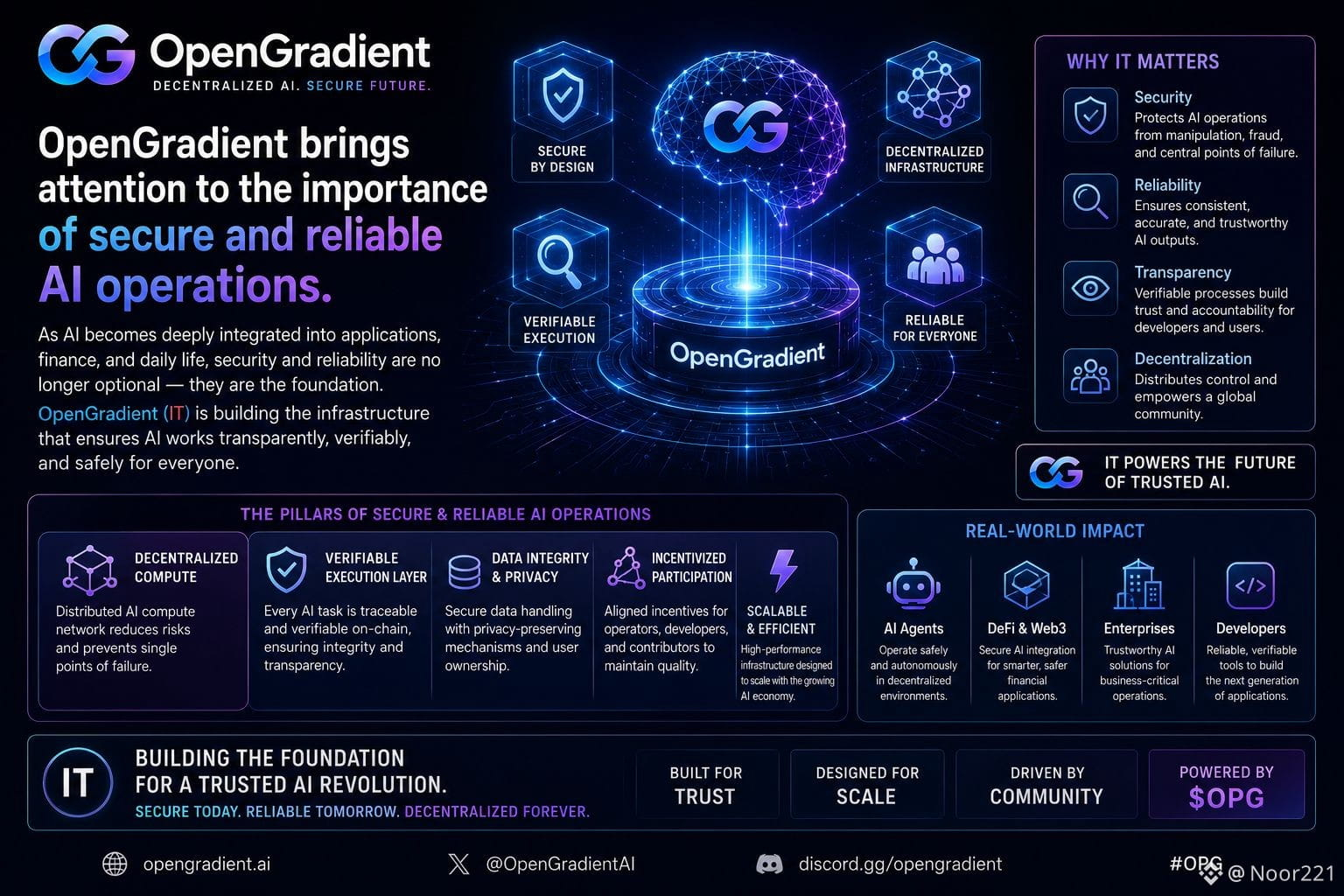
As AI becomes more powerful, trust becomes more important.
The future of AI won't be defined only by better models and faster outputs. It will be defined by whether those outputs can be verified, secured, and trusted.
That's why infrastructure matters.
OpenGradient is focused on building the foundation for secure and reliable AI operations through:
⚡ Verifiable execution
🌐 Decentralized infrastructure
🛡️ Transparent AI processes
🤝 Community-driven participation
📈 Scalable AI economies
As autonomous agents begin managing assets, interacting with applications, and making decisions, reliability can no longer be an afterthought.
The next generation of AI needs more than intelligence.
It needs accountability.
Projects building trusted execution layers today could become the backbone of tomorrow's AI economy.
Secure AI. Reliable AI. Verifiable AI.
$OPG #OPG #DecentralizedAI #VerifiableAI 🚀#writetoearn @OpenGradient $CLO $BTW
As AI becomes more powerful, trust becomes more important.
The future of AI won't be defined only by better models and faster outputs. It will be defined by whether those outputs can be verified, secured, and trusted.
That's why infrastructure matters.
OpenGradient is focused on building the foundation for secure and reliable AI operations through:
⚡ Verifiable execution
🌐 Decentralized infrastructure
🛡️ Transparent AI processes
🤝 Community-driven participation
📈 Scalable AI economies
As autonomous agents begin managing assets, interacting with applications, and making decisions, reliability can no longer be an afterthought.
The next generation of AI needs more than intelligence.
It needs accountability.
Projects building trusted execution layers today could become the backbone of tomorrow's AI economy.
Secure AI. Reliable AI. Verifiable AI.
$OPG #OPG #DecentralizedAI #VerifiableAI 🚀#writetoearn @OpenGradient $CLO $BTW
The future of AI won't be defined only by better models and faster outputs. It will be defined by whether those outputs can be verified, secured, and trusted.
That's why infrastructure matters.
OpenGradient is focused on building the foundation for secure and reliable AI operations through:
⚡ Verifiable execution
🌐 Decentralized infrastructure
🛡️ Transparent AI processes
🤝 Community-driven participation
📈 Scalable AI economies
As autonomous agents begin managing assets, interacting with applications, and making decisions, reliability can no longer be an afterthought.
The next generation of AI needs more than intelligence.
It needs accountability.
Projects building trusted execution layers today could become the backbone of tomorrow's AI economy.
Secure AI. Reliable AI. Verifiable AI.
$OPG #OPG #DecentralizedAI #VerifiableAI 🚀#writetoearn @OpenGradient $CLO $BTW
39
1
28
326
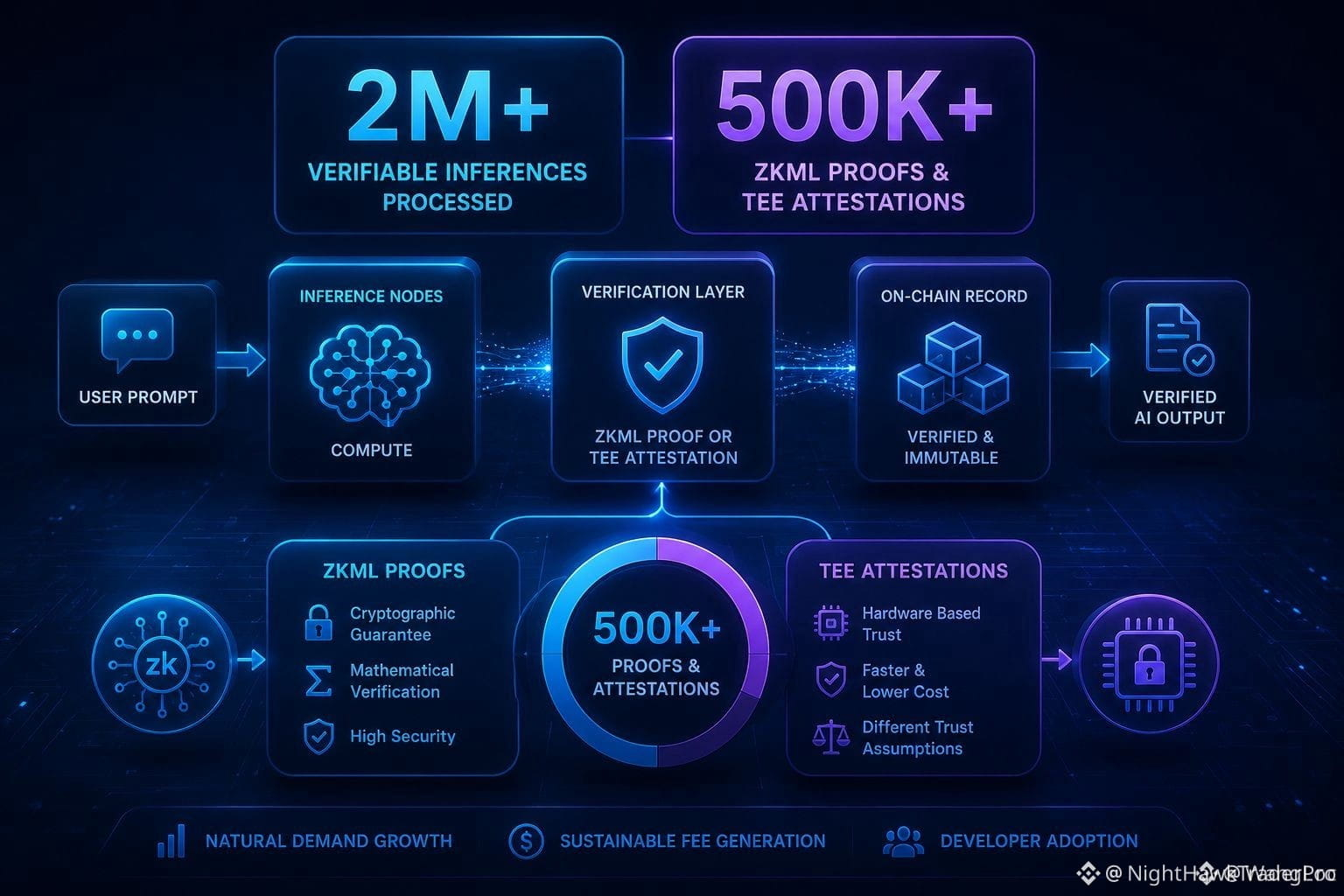
A deeper look at $OPG reveals a fascinating number: over 500,000 zkML proofs and TEE attestations, which is actually more telling than the 2M+ verifiable inferences processed by the network 🚀
Entry: 0.50 🔥
Target: 0.75 🚀
Stop Loss: 0.35 ⚠️
This milestone showcases the potential of verifiable AI and its growing demand, with OpenGradient's approach focusing on verification and trust assumptions.
Not financial advice. Manage your risk.
#OPG #VerifiableAI #LongSetup
✅
A deeper look at $OPG reveals a fascinating number: over 500,000 zkML proofs and TEE attestations, which is actually more telling than the 2M+ verifiable inferences processed by the network 🚀
Entry: 0.50 🔥
Target: 0.75 🚀
Stop Loss: 0.35 ⚠️
This milestone showcases the potential of verifiable AI and its growing demand, with OpenGradient's approach focusing on verification and trust assumptions.
Not financial advice. Manage your risk.
#OPG #VerifiableAI #LongSetup
✅
Entry: 0.50 🔥
Target: 0.75 🚀
Stop Loss: 0.35 ⚠️
This milestone showcases the potential of verifiable AI and its growing demand, with OpenGradient's approach focusing on verification and trust assumptions.
Not financial advice. Manage your risk.
#OPG #VerifiableAI #LongSetup
✅
67

·
--
Bullish
#opg $OPG
🤖 Verifiable AI meets decentralized infrastructure — $OPG on Binance.
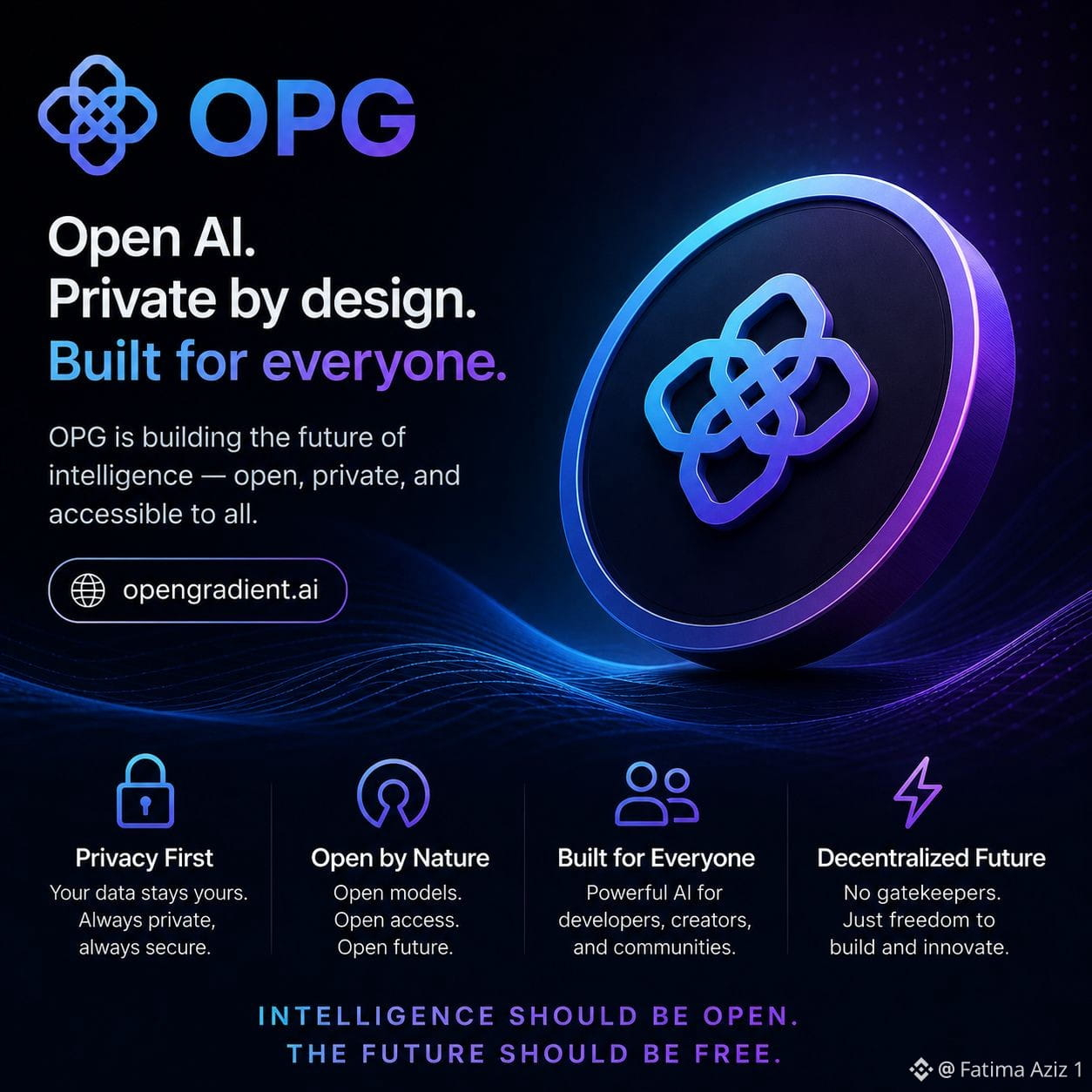
OpenGradient is revolutionizing how AI operates on-chain. With 2,000+ models, 100+ developer teams, and millions of verifiable AI inferences processed, OPG is building the trust layer that AI-powered blockchain applications demand. Now listed on Binance with deep liquidity across major pairs, $OPG enters a new phase of mainstream accessibility and adoption. #VerifiableAI #OpenGradient #Web3AI
@OpenGradient
#opg $OPG
🤖 Verifiable AI meets decentralized infrastructure — $OPG on Binance.
OpenGradient is revolutionizing how AI operates on-chain. With 2,000+ models, 100+ developer teams, and millions of verifiable AI inferences processed, OPG is building the trust layer that AI-powered blockchain applications demand. Now listed on Binance with deep liquidity across major pairs, $OPG enters a new phase of mainstream accessibility and adoption. #VerifiableAI #OpenGradient #Web3AI
@OpenGradient
🤖 Verifiable AI meets decentralized infrastructure — $OPG on Binance.
OpenGradient is revolutionizing how AI operates on-chain. With 2,000+ models, 100+ developer teams, and millions of verifiable AI inferences processed, OPG is building the trust layer that AI-powered blockchain applications demand. Now listed on Binance with deep liquidity across major pairs, $OPG enters a new phase of mainstream accessibility and adoption. #VerifiableAI #OpenGradient #Web3AI
@OpenGradient
4
4
115

·
--
Most AI is a black box — you never know if the output was tampered with. @OpenGradient changes that by attaching cryptographic proofs to every single inference on-chain. With $OPG powering the network, AI computation finally becomes transparent, auditable, and trustless. This is the infrastructure layer Web3 AI has been missing. #OPG #verifiableAI #BNBChain
Most AI is a black box — you never know if the output was tampered with. @OpenGradient changes that by attaching cryptographic proofs to every single inference on-chain. With $OPG powering the network, AI computation finally becomes transparent, auditable, and trustless. This is the infrastructure layer Web3 AI has been missing. #OPG #verifiableAI #BNBChain
1
93

Most decentralized AI talk still treats the output like it’s automatically more trustworthy just because no single company touched it. Spread the GPUs around and suddenly the result feels honest.
The part that gets skipped is simpler and more uncomfortable: even on distributed networks, you still can’t prove the model that was supposed to run actually ran, with the exact weights claimed, without someone in the middle being able to quietly change the outcome. The system rewards nodes for showing up and computing. It rarely punishes them for being wrong or deceptive in ways that are hard to detect after the fact.
What OpenGradient is actually pushing is different. They’re not mainly competing on cheaper inference or more available GPUs. They’re trying to make the execution itself something you can audit cryptographically proof that this specific model saw this specific input inside a protected environment, and here’s the attestation. Once that exists, the trust moves from “I hope the network is honest” to “the proof either checks out or it doesn’t.”
They’ve already processed millions of inferences this way across thousands of models. That number shows the infrastructure is running, not just theorized. But it also quietly reveals the trade-off: every layer of verification adds cost, latency, and complexity. Most people using AI right now don’t need or want that friction for casual questions.
Will people pay for cryptographic proof, or keep accepting AI results on faith?
#DecentralizedAI
#VerifiableAI
#OPG @OpenGradient $OPG
{spot}(OPGUSDT)
Most decentralized AI talk still treats the output like it’s automatically more trustworthy just because no single company touched it. Spread the GPUs around and suddenly the result feels honest.
The part that gets skipped is simpler and more uncomfortable: even on distributed networks, you still can’t prove the model that was supposed to run actually ran, with the exact weights claimed, without someone in the middle being able to quietly change the outcome. The system rewards nodes for showing up and computing. It rarely punishes them for being wrong or deceptive in ways that are hard to detect after the fact.
What OpenGradient is actually pushing is different. They’re not mainly competing on cheaper inference or more available GPUs. They’re trying to make the execution itself something you can audit cryptographically proof that this specific model saw this specific input inside a protected environment, and here’s the attestation. Once that exists, the trust moves from “I hope the network is honest” to “the proof either checks out or it doesn’t.”
They’ve already processed millions of inferences this way across thousands of models. That number shows the infrastructure is running, not just theorized. But it also quietly reveals the trade-off: every layer of verification adds cost, latency, and complexity. Most people using AI right now don’t need or want that friction for casual questions.
Will people pay for cryptographic proof, or keep accepting AI results on faith?
#DecentralizedAI
#VerifiableAI
#OPG @OpenGradient $OPG
The part that gets skipped is simpler and more uncomfortable: even on distributed networks, you still can’t prove the model that was supposed to run actually ran, with the exact weights claimed, without someone in the middle being able to quietly change the outcome. The system rewards nodes for showing up and computing. It rarely punishes them for being wrong or deceptive in ways that are hard to detect after the fact.
What OpenGradient is actually pushing is different. They’re not mainly competing on cheaper inference or more available GPUs. They’re trying to make the execution itself something you can audit cryptographically proof that this specific model saw this specific input inside a protected environment, and here’s the attestation. Once that exists, the trust moves from “I hope the network is honest” to “the proof either checks out or it doesn’t.”
They’ve already processed millions of inferences this way across thousands of models. That number shows the infrastructure is running, not just theorized. But it also quietly reveals the trade-off: every layer of verification adds cost, latency, and complexity. Most people using AI right now don’t need or want that friction for casual questions.
Will people pay for cryptographic proof, or keep accepting AI results on faith?
#DecentralizedAI
#VerifiableAI
#OPG @OpenGradient $OPG
14
11
136

The rise of verifiable AI is shifting the focus from intelligence to trust, and $OPG is at the forefront of this movement 🚀
Entry: 0.50 🔥
Target: 0.75 🚀
Stop Loss: 0.30 ⚠️
As the demand for transparency and accountability grows, the importance of trust in AI systems will become increasingly evident, and $OPG is well-positioned to capitalize on this trend.
Not financial advice. Manage your risk.
#OPG #VerifiableAI #LongSetup
✅
The rise of verifiable AI is shifting the focus from intelligence to trust, and $OPG is at the forefront of this movement 🚀
Entry: 0.50 🔥
Target: 0.75 🚀
Stop Loss: 0.30 ⚠️
As the demand for transparency and accountability grows, the importance of trust in AI systems will become increasingly evident, and $OPG is well-positioned to capitalize on this trend.
Not financial advice. Manage your risk.
#OPG #VerifiableAI #LongSetup
✅
Entry: 0.50 🔥
Target: 0.75 🚀
Stop Loss: 0.30 ⚠️
As the demand for transparency and accountability grows, the importance of trust in AI systems will become increasingly evident, and $OPG is well-positioned to capitalize on this trend.
Not financial advice. Manage your risk.
#OPG #VerifiableAI #LongSetup
✅
15

·
--
Bullish
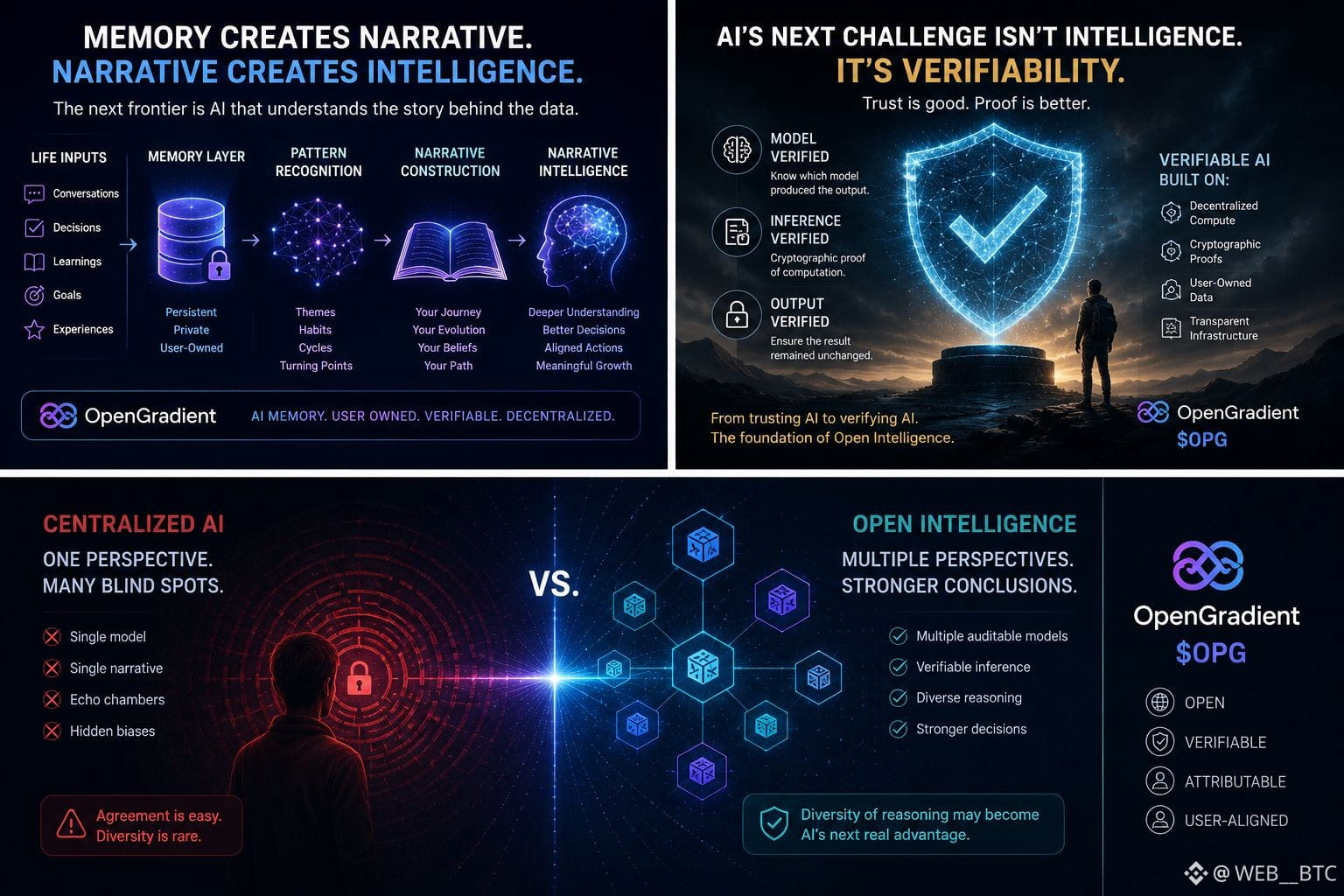
Most people think AI's biggest problem is accuracy.
I'm starting to think it's attribution.
When an AI gives you an answer, what are you actually trusting?
The model? The data? The infrastructure? The company operating it?
As AI becomes part of finance, healthcare, research, education, and personal decision-making, this question becomes increasingly important.
That's one reason I've been paying attention to $OPG
The AI industry is obsessed with building larger models, but intelligence alone doesn't solve the trust problem.
Imagine asking an AI to analyze a smart contract, review medical data, or identify patterns in years of personal information.
The answer might be excellent.
But how do you verify:
✓ Which model generated it? ✓ Whether the output was modified? ✓ Whether the computation happened as claimed? ✓ Whether the context used was authentic?
This is where OpenGradient's vision feels different.
The project isn't simply focused on AI outputs.
It's focused on making intelligence auditable.
What's especially interesting is how this connects several trends that are often discussed separately:
• Verifiable inference • User-owned memory • Attribution • Decentralized model execution • Persistent AI context
Individually these are useful.
Together they begin to form something larger:
An infrastructure layer where intelligence can be inspected instead of blindly trusted.
I keep coming back to a simple thought.
The internet gave the world access to information.
AI gives the world access to intelligence.
The next challenge may be proving where that intelligence came from.
And if AI becomes critical infrastructure, verification may eventually become just as important as performance.
Not because people distrust AI.
Because intelligence becomes far more valuable when it can be audited.
What interests me most about OpenGradient is that it is approaching this problem from the infrastructure layer rather than the application layer.
That feels like a much bigger opportunity than many people realize today.
#OPG #OpenGradient #VerifiableAI @OpenGradient
Most people think AI's biggest problem is accuracy.
I'm starting to think it's attribution.
When an AI gives you an answer, what are you actually trusting?
The model? The data? The infrastructure? The company operating it?
As AI becomes part of finance, healthcare, research, education, and personal decision-making, this question becomes increasingly important.
That's one reason I've been paying attention to $OPG
The AI industry is obsessed with building larger models, but intelligence alone doesn't solve the trust problem.
Imagine asking an AI to analyze a smart contract, review medical data, or identify patterns in years of personal information.
The answer might be excellent.
But how do you verify:
✓ Which model generated it? ✓ Whether the output was modified? ✓ Whether the computation happened as claimed? ✓ Whether the context used was authentic?
This is where OpenGradient's vision feels different.
The project isn't simply focused on AI outputs.
It's focused on making intelligence auditable.
What's especially interesting is how this connects several trends that are often discussed separately:
• Verifiable inference • User-owned memory • Attribution • Decentralized model execution • Persistent AI context
Individually these are useful.
Together they begin to form something larger:
An infrastructure layer where intelligence can be inspected instead of blindly trusted.
I keep coming back to a simple thought.
The internet gave the world access to information.
AI gives the world access to intelligence.
The next challenge may be proving where that intelligence came from.
And if AI becomes critical infrastructure, verification may eventually become just as important as performance.
Not because people distrust AI.
Because intelligence becomes far more valuable when it can be audited.
What interests me most about OpenGradient is that it is approaching this problem from the infrastructure layer rather than the application layer.
That feels like a much bigger opportunity than many people realize today.
#OPG #OpenGradient #VerifiableAI @OpenGradient
I'm starting to think it's attribution.
When an AI gives you an answer, what are you actually trusting?
The model? The data? The infrastructure? The company operating it?
As AI becomes part of finance, healthcare, research, education, and personal decision-making, this question becomes increasingly important.
That's one reason I've been paying attention to $OPG
The AI industry is obsessed with building larger models, but intelligence alone doesn't solve the trust problem.
Imagine asking an AI to analyze a smart contract, review medical data, or identify patterns in years of personal information.
The answer might be excellent.
But how do you verify:
✓ Which model generated it? ✓ Whether the output was modified? ✓ Whether the computation happened as claimed? ✓ Whether the context used was authentic?
This is where OpenGradient's vision feels different.
The project isn't simply focused on AI outputs.
It's focused on making intelligence auditable.
What's especially interesting is how this connects several trends that are often discussed separately:
• Verifiable inference • User-owned memory • Attribution • Decentralized model execution • Persistent AI context
Individually these are useful.
Together they begin to form something larger:
An infrastructure layer where intelligence can be inspected instead of blindly trusted.
I keep coming back to a simple thought.
The internet gave the world access to information.
AI gives the world access to intelligence.
The next challenge may be proving where that intelligence came from.
And if AI becomes critical infrastructure, verification may eventually become just as important as performance.
Not because people distrust AI.
Because intelligence becomes far more valuable when it can be audited.
What interests me most about OpenGradient is that it is approaching this problem from the infrastructure layer rather than the application layer.
That feels like a much bigger opportunity than many people realize today.
#OPG #OpenGradient #VerifiableAI @OpenGradient

9
1
5
135

·
--
$OPG Could Be The Verification Meta 🚀
Entry: 0.00
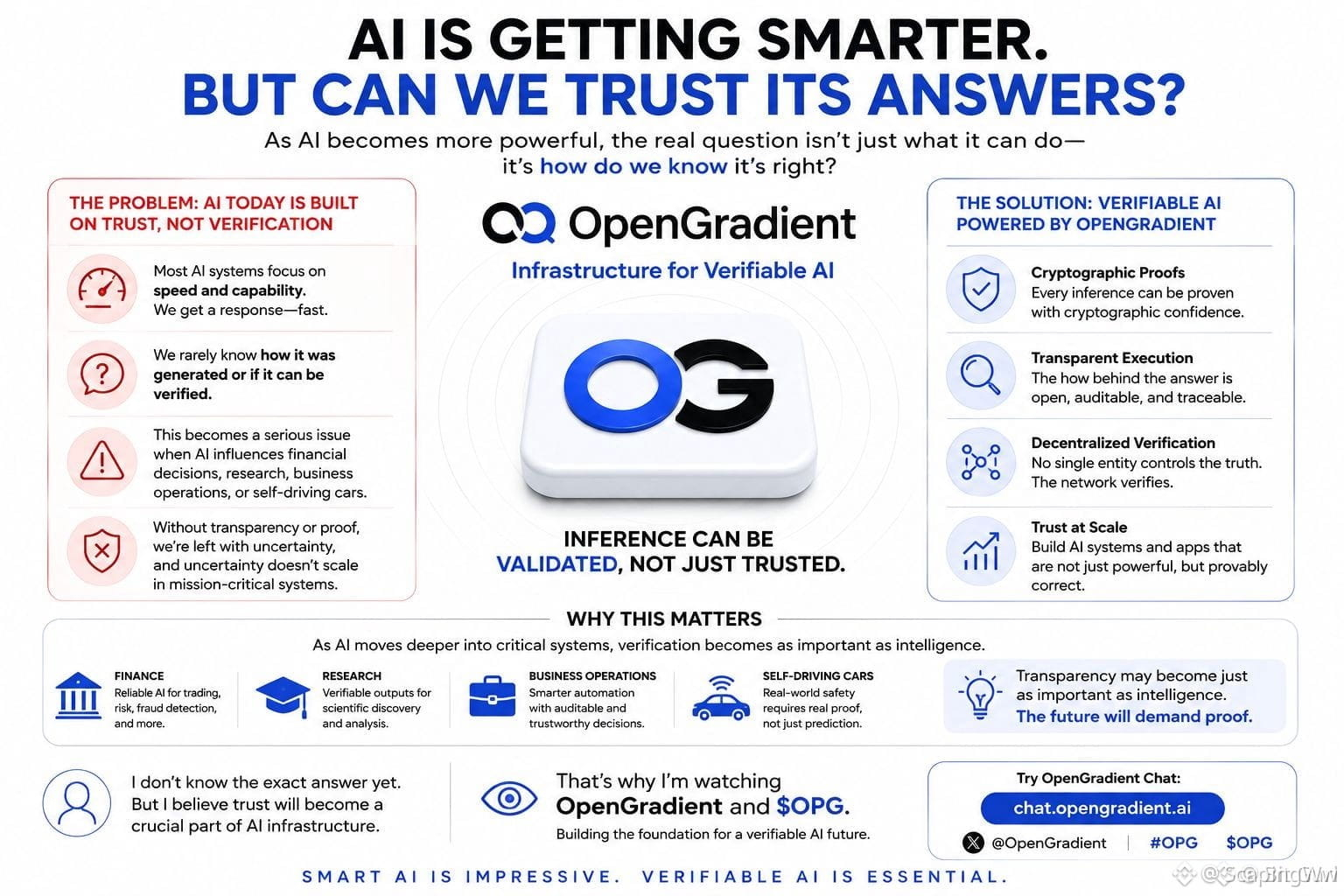
Look, guys, the real AI trade isn’t just smarter models. It’s trust, proof, and verifiable outputs, and that’s exactly why $OPG is getting attention.
If AI keeps moving into real-world use, the projects that can prove their answers will stand out hard. This is the kind of narrative that can catch fast once the market starts rotating.
Not financial advice. Manage your risk.
#OPG #AI #VerifiableAI #LongSetup
🔥
$OPG Could Be The Verification Meta 🚀
Entry: 0.00
Look, guys, the real AI trade isn’t just smarter models. It’s trust, proof, and verifiable outputs, and that’s exactly why $OPG is getting attention.
If AI keeps moving into real-world use, the projects that can prove their answers will stand out hard. This is the kind of narrative that can catch fast once the market starts rotating.
Not financial advice. Manage your risk.
#OPG #AI #VerifiableAI #LongSetup
🔥
Entry: 0.00
Look, guys, the real AI trade isn’t just smarter models. It’s trust, proof, and verifiable outputs, and that’s exactly why $OPG is getting attention.
If AI keeps moving into real-world use, the projects that can prove their answers will stand out hard. This is the kind of narrative that can catch fast once the market starts rotating.
Not financial advice. Manage your risk.
#OPG #AI #VerifiableAI #LongSetup
🔥
66

$OPG IS ON THE VERGE OF A MASSIVE BREAKTHROUGH 🚀
Verifiable AI is becoming the new standard and $OPG is at the forefront of this revolution, with projects exploring trust and transparency in AI systems.
The demand for proof and reliability is surging right now, and this window of opportunity is narrowing fast, will you be investing in $OPG at current levels or waiting for a pullback?
Not financial advice. Manage your risk.
#OPG #VerifiableAI #LongSetup
⚡️
$OPG IS ON THE VERGE OF A MASSIVE BREAKTHROUGH 🚀
Verifiable AI is becoming the new standard and $OPG is at the forefront of this revolution, with projects exploring trust and transparency in AI systems.
The demand for proof and reliability is surging right now, and this window of opportunity is narrowing fast, will you be investing in $OPG at current levels or waiting for a pullback?
Not financial advice. Manage your risk.
#OPG #VerifiableAI #LongSetup
⚡️
Verifiable AI is becoming the new standard and $OPG is at the forefront of this revolution, with projects exploring trust and transparency in AI systems.
The demand for proof and reliability is surging right now, and this window of opportunity is narrowing fast, will you be investing in $OPG at current levels or waiting for a pullback?
Not financial advice. Manage your risk.
#OPG #VerifiableAI #LongSetup
⚡️
1
50

·
--
OpenGradient $OPG: Building the Trust Layer for AI x Web3AI is everywhere today, but there’s one fundamental flaw nobody talks about enough: trust. When you use ChatGPT, Claude, or Gemini, you’re trusting a centralized server blindly. Did it actually run the model it claimed? Was your data leaked? Was the output modified before reaching you? There’s no way to verify any of this. For casual chats it’s fine, but for DeFi protocols, trading bots, and DAOs managing millions, “trust me bro” AI doesn’t work at all. This is exactly the gap OpenGradient $OPG is closing. OpenGradient is the world’s first Verifiable AI platform built specifically for Web3. It combines two breakthrough technologies to solve the trust problem. First is TEE plus zk-proofs which creates Verifiable Inference. TEE means Trusted Execution Environment, think of it as a secure hardware vault inside the GPU where computation happens completely isolated from the OS and even the server owner. After inference, zk-proof generates a cryptographic proof that lets anyone verify three things without seeing private data: the exact model was used, the exact input was processed, and the output wasn’t tampered with. This means DeFi apps can now use AI for price prediction, risk scoring, and automation while proving to users that the AI wasn’t rigged. Second is DePIN GPU Network for Decentralized Compute. Centralized GPUs from AWS and Nvidia are expensive and centralized. One ban or API shutdown and your entire AI app dies. OpenGradient uses DePIN, Decentralized Physical Infrastructure Network, where thousands of GPU nodes worldwide contribute compute power. This gives three massive benefits: 70% plus lower cost because there’s no AWS middleman markup, censorship resistance because no single entity can shut you down, and 24/7 uptime because distributed nodes mean no single point of failure. Why does this matter so much for Web3? bStocks, perpetual DEXs, lending protocols, all of them need AI but they can’t trust black boxes. OpenGradient gives them auditable, verifiable AI that works on-chain. Imagine a trading bot that proves “I sold because AI detected X pattern” with cryptographic proof. Or a DAO that verifies its governance AI wasn’t manipulated by anyone. We moved from centralized databases to decentralized blockchains. Now we’re moving from centralized AI to verifiable AI. OpenGradient $OPG isn’t just another AI token. It’s the trust infrastructure layer for AI x Web3. Centralized AI had its run. The future is verifiable, decentralized, and open. DYOR. $OPG
@OpenGradient
#OpenGradient #OPG #VerifiableAI #DePIN
OpenGradient $OPG: Building the Trust Layer for AI x Web3
AI is everywhere today, but there’s one fundamental flaw nobody talks about enough: trust. When you use ChatGPT, Claude, or Gemini, you’re trusting a centralized server blindly. Did it actually run the model it claimed? Was your data leaked? Was the output modified before reaching you? There’s no way to verify any of this. For casual chats it’s fine, but for DeFi protocols, trading bots, and DAOs managing millions, “trust me bro” AI doesn’t work at all. This is exactly the gap OpenGradient $OPG is closing. OpenGradient is the world’s first Verifiable AI platform built specifically for Web3. It combines two breakthrough technologies to solve the trust problem. First is TEE plus zk-proofs which creates Verifiable Inference. TEE means Trusted Execution Environment, think of it as a secure hardware vault inside the GPU where computation happens completely isolated from the OS and even the server owner. After inference, zk-proof generates a cryptographic proof that lets anyone verify three things without seeing private data: the exact model was used, the exact input was processed, and the output wasn’t tampered with. This means DeFi apps can now use AI for price prediction, risk scoring, and automation while proving to users that the AI wasn’t rigged. Second is DePIN GPU Network for Decentralized Compute. Centralized GPUs from AWS and Nvidia are expensive and centralized. One ban or API shutdown and your entire AI app dies. OpenGradient uses DePIN, Decentralized Physical Infrastructure Network, where thousands of GPU nodes worldwide contribute compute power. This gives three massive benefits: 70% plus lower cost because there’s no AWS middleman markup, censorship resistance because no single entity can shut you down, and 24/7 uptime because distributed nodes mean no single point of failure. Why does this matter so much for Web3? bStocks, perpetual DEXs, lending protocols, all of them need AI but they can’t trust black boxes. OpenGradient gives them auditable, verifiable AI that works on-chain. Imagine a trading bot that proves “I sold because AI detected X pattern” with cryptographic proof. Or a DAO that verifies its governance AI wasn’t manipulated by anyone. We moved from centralized databases to decentralized blockchains. Now we’re moving from centralized AI to verifiable AI. OpenGradient $OPG isn’t just another AI token. It’s the trust infrastructure layer for AI x Web3. Centralized AI had its run. The future is verifiable, decentralized, and open. DYOR. $OPG
@OpenGradient
#OpenGradient #OPG #VerifiableAI #DePIN
@OpenGradient
#OpenGradient #OPG #VerifiableAI #DePIN
1
81

🚨 AI risk feels boring... until AI starts making real decisions.
A bad chatbot answer? I can ignore it.
But I can't ignore an AI that: 💰 Moves money 🤖 Guides autonomous agents 🔒 Handles private data ⚙️ Controls real-world actions
That's why I keep coming back to OpenGradient.
At first glance, it's easy to see it as another project building verifiable AI.
I think it's tackling a much bigger question:
If AI is going to act on our behalf, what counts as proof that it actually made the right decision?
TEE-based inference makes sense when speed and privacy matter. Builders need fast AI execution without exposing sensitive requests.
ZKML also has a critical role. Some decisions need more than hardware trust—they need mathematical proof, especially when real capital, security, or sensitive logic is involved.
The interesting part is that not every AI task needs the same level of verification.
OpenGradient appears to treat verification as a spectrum instead of forcing a one-size-fits-all solution.
That approach feels practical.
I'm still cautious about near-term demand. Builders often say they want trust, but in practice they usually choose whatever is fastest and easiest—until something breaks.
Even so, I can't ignore where this is heading.
✅ DeFi needs AI outputs that can be verified. ✅ AI agents need an auditable trail behind every action. ✅ Robotics needs accountability because mistakes don't stay on a screen. ✅ Private AI applications need to protect user data while remaining useful.
I don't see OpenGradient as just another AI project.
I see it as a bet on a future where the output isn't the product anymore.
The proof behind the output is.$OPG
#OPGUSD🔥🔥🔥🔥 #verifiableAI #Web3
{spot}(OPGUSDT)
🚨 AI risk feels boring... until AI starts making real decisions.
A bad chatbot answer? I can ignore it.
But I can't ignore an AI that: 💰 Moves money 🤖 Guides autonomous agents 🔒 Handles private data ⚙️ Controls real-world actions
That's why I keep coming back to OpenGradient.
At first glance, it's easy to see it as another project building verifiable AI.
I think it's tackling a much bigger question:
If AI is going to act on our behalf, what counts as proof that it actually made the right decision?
TEE-based inference makes sense when speed and privacy matter. Builders need fast AI execution without exposing sensitive requests.
ZKML also has a critical role. Some decisions need more than hardware trust—they need mathematical proof, especially when real capital, security, or sensitive logic is involved.
The interesting part is that not every AI task needs the same level of verification.
OpenGradient appears to treat verification as a spectrum instead of forcing a one-size-fits-all solution.
That approach feels practical.
I'm still cautious about near-term demand. Builders often say they want trust, but in practice they usually choose whatever is fastest and easiest—until something breaks.
Even so, I can't ignore where this is heading.
✅ DeFi needs AI outputs that can be verified. ✅ AI agents need an auditable trail behind every action. ✅ Robotics needs accountability because mistakes don't stay on a screen. ✅ Private AI applications need to protect user data while remaining useful.
I don't see OpenGradient as just another AI project.
I see it as a bet on a future where the output isn't the product anymore.
The proof behind the output is.$OPG
#OPGUSD🔥🔥🔥🔥 #verifiableAI #Web3
A bad chatbot answer? I can ignore it.
But I can't ignore an AI that: 💰 Moves money 🤖 Guides autonomous agents 🔒 Handles private data ⚙️ Controls real-world actions
That's why I keep coming back to OpenGradient.
At first glance, it's easy to see it as another project building verifiable AI.
I think it's tackling a much bigger question:
If AI is going to act on our behalf, what counts as proof that it actually made the right decision?
TEE-based inference makes sense when speed and privacy matter. Builders need fast AI execution without exposing sensitive requests.
ZKML also has a critical role. Some decisions need more than hardware trust—they need mathematical proof, especially when real capital, security, or sensitive logic is involved.
The interesting part is that not every AI task needs the same level of verification.
OpenGradient appears to treat verification as a spectrum instead of forcing a one-size-fits-all solution.
That approach feels practical.
I'm still cautious about near-term demand. Builders often say they want trust, but in practice they usually choose whatever is fastest and easiest—until something breaks.
Even so, I can't ignore where this is heading.
✅ DeFi needs AI outputs that can be verified. ✅ AI agents need an auditable trail behind every action. ✅ Robotics needs accountability because mistakes don't stay on a screen. ✅ Private AI applications need to protect user data while remaining useful.
I don't see OpenGradient as just another AI project.
I see it as a bet on a future where the output isn't the product anymore.
The proof behind the output is.$OPG
#OPGUSD🔥🔥🔥🔥 #verifiableAI #Web3
84

Article
OpenGradient ($OPG) Structural Analysis 2026:True Post-MiCAR Impact Measured via Execution Layer Activity
OpenGradient ($OPG) is establishing a critical framework for verifiable AI processes, pushing past the initial waves of market speculation. Following its alignment under the MiCAR "Other Crypto-Asset" lane, institutional friction has cleared, positioning the network for sustainable structural development rather than short-term market hype.
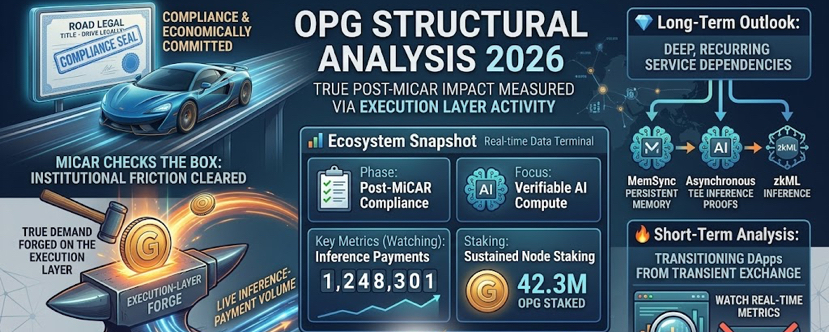
Ecosystem Snapshot Current Phase: Post-MiCAR Compliance Verification Core Focus: Memory Sovereignty & Verifiable AI Compute Core Infrastructure: MemSync, Asynchronous TEE, zkML Inference Proofs Key Metrics: Live Inference-Payment Count & Sustained Node Staking
What's Next for OpenGradient? Short-term network progress hinges on transitioning applications away from treating the utility token as a transient medium of exchange. The focus shifts entirely away from vanity chart metrics and onto tracking the live inference-payment volume as decentralized applications integrate native infrastructure loops.
Long-Term Outlook OpenGradient's longevity relies on creating deep, recurring service dependencies. By enabling AI agents to natively rely on MemSync for persistent memory and utilize the execution layer for secure asynchronous TEE and zkML inference proofs, the network ensures tokens remain economically committed and staked by nodes rather than immediately liquidated.
Final Thoughts A regulatory pass clears the highway, but execution puts fuel in the tank. To gauge true network health and upcoming structural breakouts, watch the on-chain deployment of persistent AI agents and node staking totals over speculative trading volume.
Disclaimer: Deep tech and infrastructure deployments require strict fundamental monitoring. Always track on-chain data before making capital allocations. $OPG #DePIN #verifiableAI
OpenGradient ($OPG) Structural Analysis 2026:
True Post-MiCAR Impact Measured via Execution Layer Activity
OpenGradient ($OPG ) is establishing a critical framework for verifiable AI processes, pushing past the initial waves of market speculation. Following its alignment under the MiCAR "Other Crypto-Asset" lane, institutional friction has cleared, positioning the network for sustainable structural development rather than short-term market hype.
Ecosystem Snapshot Current Phase: Post-MiCAR Compliance Verification Core Focus: Memory Sovereignty & Verifiable AI Compute Core Infrastructure: MemSync, Asynchronous TEE, zkML Inference Proofs Key Metrics: Live Inference-Payment Count & Sustained Node Staking
What's Next for OpenGradient? Short-term network progress hinges on transitioning applications away from treating the utility token as a transient medium of exchange. The focus shifts entirely away from vanity chart metrics and onto tracking the live inference-payment volume as decentralized applications integrate native infrastructure loops.
Long-Term Outlook OpenGradient's longevity relies on creating deep, recurring service dependencies. By enabling AI agents to natively rely on MemSync for persistent memory and utilize the execution layer for secure asynchronous TEE and zkML inference proofs, the network ensures tokens remain economically committed and staked by nodes rather than immediately liquidated.
Final Thoughts A regulatory pass clears the highway, but execution puts fuel in the tank. To gauge true network health and upcoming structural breakouts, watch the on-chain deployment of persistent AI agents and node staking totals over speculative trading volume.
Disclaimer: Deep tech and infrastructure deployments require strict fundamental monitoring. Always track on-chain data before making capital allocations. $OPG #DePIN #verifiableAI
OpenGradient ($OPG ) is establishing a critical framework for verifiable AI processes, pushing past the initial waves of market speculation. Following its alignment under the MiCAR "Other Crypto-Asset" lane, institutional friction has cleared, positioning the network for sustainable structural development rather than short-term market hype.
Ecosystem Snapshot Current Phase: Post-MiCAR Compliance Verification Core Focus: Memory Sovereignty & Verifiable AI Compute Core Infrastructure: MemSync, Asynchronous TEE, zkML Inference Proofs Key Metrics: Live Inference-Payment Count & Sustained Node Staking
What's Next for OpenGradient? Short-term network progress hinges on transitioning applications away from treating the utility token as a transient medium of exchange. The focus shifts entirely away from vanity chart metrics and onto tracking the live inference-payment volume as decentralized applications integrate native infrastructure loops.
Long-Term Outlook OpenGradient's longevity relies on creating deep, recurring service dependencies. By enabling AI agents to natively rely on MemSync for persistent memory and utilize the execution layer for secure asynchronous TEE and zkML inference proofs, the network ensures tokens remain economically committed and staked by nodes rather than immediately liquidated.
Final Thoughts A regulatory pass clears the highway, but execution puts fuel in the tank. To gauge true network health and upcoming structural breakouts, watch the on-chain deployment of persistent AI agents and node staking totals over speculative trading volume.
Disclaimer: Deep tech and infrastructure deployments require strict fundamental monitoring. Always track on-chain data before making capital allocations. $OPG #DePIN #verifiableAI
12
11
174

·
--

Article
**Everyone's clapping at AI agent demos.
I'm just wondering... who's watching the agent? 🤔****Everyone's clapping at AI agent demos.
I'm just wondering... who's watching the agent? 🤔**
For years crypto said *"don't trust, verify"*.
*We left banks because we didn't want someone else deciding for our money.*
Now we're handing keys to software that thinks faster than us.
And we're calling it progress.
But we talk about both like the risk is the same.
That's why @NewtonProtocol caught my Attention.
Not for another AI narrative. God knows we have enough.
But because it asks the question nobody wants to sit with:
*What happens AFTER the AI clicks "confirm"?*
AI is smart enough to read 10 chains & pick "best" APY.
The problem is Proof.
If my agent drains my wallet at 3am...
What do I tell my future self?
"The model decided it was optimal"?
That's not an answer. That's a shrug.
**> *Seatbelts were invisible... until they weren't.*
*> Security is like that. Nobody cares until the crash.**
Newton doesn't pretend AI is perfect.
It doesn't sell "set and forget".
It builds a layer where AI can act,
but every action leaves a cryptographic proof.
Not a log file anyone can fake.
Something you can actually check.
Let the agent work inside boundaries you set.
And make sure you can see WHY it did what it did?
$NEWT isn't selling hype.
It's building seatbelts for the AI age.
Boring right now. Obvious later.
If AI will manage money, "I think it worked" can't be the standard anymore.
It has to be "I can prove it worked".
*Agree? Type PROOF if you agree.*
#verifiableAI #OnChainTrust $NEWT
**Everyone's clapping at AI agent demos. I'm just wondering... who's watching the agent? 🤔**
**Everyone's clapping at AI agent demos.
I'm just wondering... who's watching the agent? 🤔**
For years crypto said *"don't trust, verify"*.
*We left banks because we didn't want someone else deciding for our money.*
Now we're handing keys to software that thinks faster than us.
And we're calling it progress.
But we talk about both like the risk is the same.
That's why @NewtonProtocol caught my Attention.
Not for another AI narrative. God knows we have enough.
But because it asks the question nobody wants to sit with:
*What happens AFTER the AI clicks "confirm"?*
AI is smart enough to read 10 chains & pick "best" APY.
The problem is Proof.
If my agent drains my wallet at 3am...
What do I tell my future self?
"The model decided it was optimal"?
That's not an answer. That's a shrug.
**> *Seatbelts were invisible... until they weren't.*
*> Security is like that. Nobody cares until the crash.**
Newton doesn't pretend AI is perfect.
It doesn't sell "set and forget".
It builds a layer where AI can act,
but every action leaves a cryptographic proof.
Not a log file anyone can fake.
Something you can actually check.
Let the agent work inside boundaries you set.
And make sure you can see WHY it did what it did?
$NEWT isn't selling hype.
It's building seatbelts for the AI age.
Boring right now. Obvious later.
If AI will manage money, "I think it worked" can't be the standard anymore.
It has to be "I can prove it worked".
*Agree? Type PROOF if you agree.*
#verifiableAI #OnChainTrust $NEWT
I'm just wondering... who's watching the agent? 🤔**
For years crypto said *"don't trust, verify"*.
*We left banks because we didn't want someone else deciding for our money.*
Now we're handing keys to software that thinks faster than us.
And we're calling it progress.
But we talk about both like the risk is the same.
That's why @NewtonProtocol caught my Attention.
Not for another AI narrative. God knows we have enough.
But because it asks the question nobody wants to sit with:
*What happens AFTER the AI clicks "confirm"?*
AI is smart enough to read 10 chains & pick "best" APY.
The problem is Proof.
If my agent drains my wallet at 3am...
What do I tell my future self?
"The model decided it was optimal"?
That's not an answer. That's a shrug.
**> *Seatbelts were invisible... until they weren't.*
*> Security is like that. Nobody cares until the crash.**
Newton doesn't pretend AI is perfect.
It doesn't sell "set and forget".
It builds a layer where AI can act,
but every action leaves a cryptographic proof.
Not a log file anyone can fake.
Something you can actually check.
Let the agent work inside boundaries you set.
And make sure you can see WHY it did what it did?
$NEWT isn't selling hype.
It's building seatbelts for the AI age.
Boring right now. Obvious later.
If AI will manage money, "I think it worked" can't be the standard anymore.
It has to be "I can prove it worked".
*Agree? Type PROOF if you agree.*
#verifiableAI #OnChainTrust $NEWT
16
6
112

·
--
Article
I think the real AI gap in crypto isn't "which model scores higher on a benchmark" — it's whether...I think the real AI gap in crypto isn't "which model scores higher on a benchmark" — it's whether a normal person can actually check the reasoning behind an answer before acting on it.
That's the split I've been sitting with today. On one side, the usual chatbot loop: headlines about GPT-5.6 rumors, people swearing ChatGPT got sharper overnight, zero paper trail beyond vibes and screenshots. On the other, projects like @OpenGradient pushing verifiable AI reasoning — inference where the steps aren't locked in a black box you just have to trust.
"Verifiable reasoning" sounds abstract until you put it plainly. Regular AI gives you a polished paragraph and asks you to believe it. Verifiable AI is closer to showing your work: what inputs went in, what logic path got followed, what can be replayed or challenged. For crypto users that's not a nerd flex. It's the difference between copying a trade tip from a bot and actually seeing why the bot reached that conclusion.
OpenGradient Chat is where that idea stops being whitepaper talk. @OpenGradient is building around decentralized inference — models running across a network instead of one company's server — and what hooked me is auditability. If an agent recommends something about a token, a risk flag, or even just market context, I want a trace I can follow, not a confident tone with nothing underneath. That matters even more when my feed is full of "AI alpha" accounts that never show how they got there.
Compare that to how most people actually use AI today. You paste a chart, ask for a read, get a paragraph that sounds smart, maybe tweak the prompt twice, and move on. No proof the model saw what you think it saw. No way to check the chain of thought wasn't hallucinated. Verifiable reasoning flips the burden: the system has to earn trust through steps you can replay, not marketing copy about being "smarter."
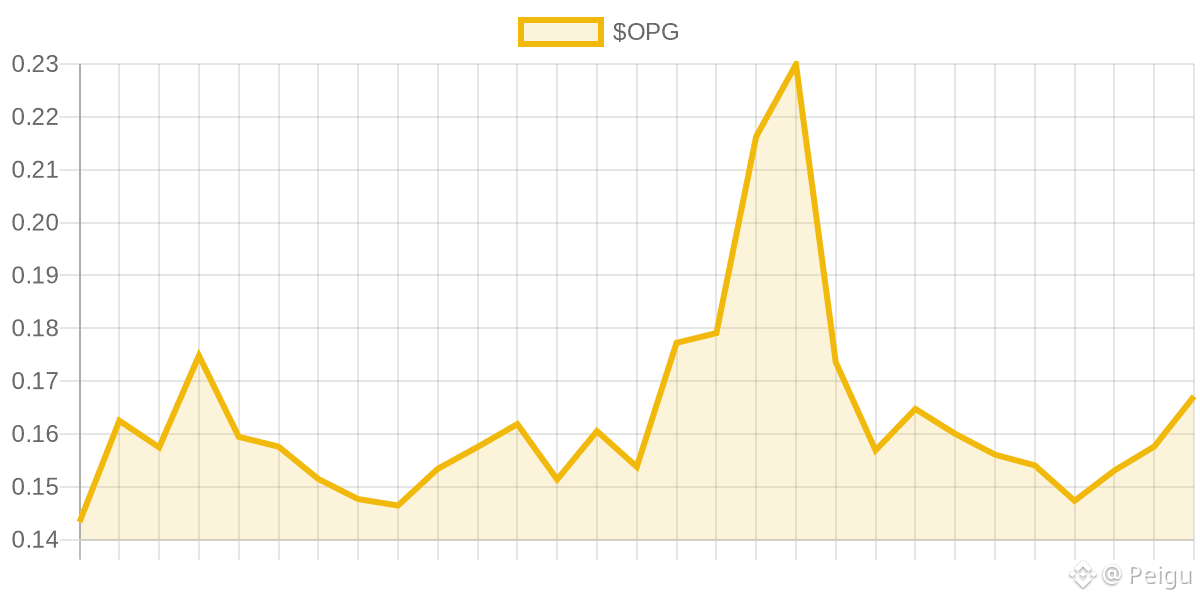
$OPG caught my eye in that frame today — up roughly 9.3% to about $0.167 while the gainers board couldn't scrape together a single green ticker. Price moves alone don't validate a thesis, but the timing felt telling. Total market cap across crypto is only up about 1% on the session, BTC hanging near $63,800, and yet a name tied to verifiable inference was one of the few moving. Market cap sits around $31.75 million on about 190 million circulating tokens against a 1 billion total supply, still roughly 65% below its ATH near $0.48. Small cap, long runway, and a narrative that actually maps to a real user problem instead of another "AI agent" sticker on a Telegram bot.
What keeps me curious about @OpenGradient specifically is the user-facing piece, not just infra jargon. OpenGradient Chat isn't framed like another wrapper on OpenAI with a token attached. The profile lays out inference tooling meant for people who want answers they can push back on — which feels more honest than the GPT-5.6 rumor cycle where everyone's guessing whether the model changed or their expectations did.
I'm not treating verifiable AI as a magic filter that kills bad takes. Models can still be wrong even with transparent steps. But wrong with receipts beats wrong with confidence every time, especially in a market where one screenshot can move sentiment faster than any due diligence.
https://www.binance.com/en/square/profile/OpenGradient
#OPG #VerifiableAI #OpenGradient
I think the real AI gap in crypto isn't "which model scores higher on a benchmark" — it's whether...
I think the real AI gap in crypto isn't "which model scores higher on a benchmark" — it's whether a normal person can actually check the reasoning behind an answer before acting on it.
That's the split I've been sitting with today. On one side, the usual chatbot loop: headlines about GPT-5.6 rumors, people swearing ChatGPT got sharper overnight, zero paper trail beyond vibes and screenshots. On the other, projects like @OpenGradient pushing verifiable AI reasoning — inference where the steps aren't locked in a black box you just have to trust.
"Verifiable reasoning" sounds abstract until you put it plainly. Regular AI gives you a polished paragraph and asks you to believe it. Verifiable AI is closer to showing your work: what inputs went in, what logic path got followed, what can be replayed or challenged. For crypto users that's not a nerd flex. It's the difference between copying a trade tip from a bot and actually seeing why the bot reached that conclusion.
OpenGradient Chat is where that idea stops being whitepaper talk. @OpenGradient is building around decentralized inference — models running across a network instead of one company's server — and what hooked me is auditability. If an agent recommends something about a token, a risk flag, or even just market context, I want a trace I can follow, not a confident tone with nothing underneath. That matters even more when my feed is full of "AI alpha" accounts that never show how they got there.
Compare that to how most people actually use AI today. You paste a chart, ask for a read, get a paragraph that sounds smart, maybe tweak the prompt twice, and move on. No proof the model saw what you think it saw. No way to check the chain of thought wasn't hallucinated. Verifiable reasoning flips the burden: the system has to earn trust through steps you can replay, not marketing copy about being "smarter."
$OPG caught my eye in that frame today — up roughly 9.3% to about $0.167 while the gainers board couldn't scrape together a single green ticker. Price moves alone don't validate a thesis, but the timing felt telling. Total market cap across crypto is only up about 1% on the session, BTC hanging near $63,800, and yet a name tied to verifiable inference was one of the few moving. Market cap sits around $31.75 million on about 190 million circulating tokens against a 1 billion total supply, still roughly 65% below its ATH near $0.48. Small cap, long runway, and a narrative that actually maps to a real user problem instead of another "AI agent" sticker on a Telegram bot.
What keeps me curious about @OpenGradient specifically is the user-facing piece, not just infra jargon. OpenGradient Chat isn't framed like another wrapper on OpenAI with a token attached. The profile lays out inference tooling meant for people who want answers they can push back on — which feels more honest than the GPT-5.6 rumor cycle where everyone's guessing whether the model changed or their expectations did.
I'm not treating verifiable AI as a magic filter that kills bad takes. Models can still be wrong even with transparent steps. But wrong with receipts beats wrong with confidence every time, especially in a market where one screenshot can move sentiment faster than any due diligence.
https://www.binance.com/en/square/profile/OpenGradient
#OPG #VerifiableAI #OpenGradient
That's the split I've been sitting with today. On one side, the usual chatbot loop: headlines about GPT-5.6 rumors, people swearing ChatGPT got sharper overnight, zero paper trail beyond vibes and screenshots. On the other, projects like @OpenGradient pushing verifiable AI reasoning — inference where the steps aren't locked in a black box you just have to trust.
"Verifiable reasoning" sounds abstract until you put it plainly. Regular AI gives you a polished paragraph and asks you to believe it. Verifiable AI is closer to showing your work: what inputs went in, what logic path got followed, what can be replayed or challenged. For crypto users that's not a nerd flex. It's the difference between copying a trade tip from a bot and actually seeing why the bot reached that conclusion.
OpenGradient Chat is where that idea stops being whitepaper talk. @OpenGradient is building around decentralized inference — models running across a network instead of one company's server — and what hooked me is auditability. If an agent recommends something about a token, a risk flag, or even just market context, I want a trace I can follow, not a confident tone with nothing underneath. That matters even more when my feed is full of "AI alpha" accounts that never show how they got there.
Compare that to how most people actually use AI today. You paste a chart, ask for a read, get a paragraph that sounds smart, maybe tweak the prompt twice, and move on. No proof the model saw what you think it saw. No way to check the chain of thought wasn't hallucinated. Verifiable reasoning flips the burden: the system has to earn trust through steps you can replay, not marketing copy about being "smarter."
$OPG caught my eye in that frame today — up roughly 9.3% to about $0.167 while the gainers board couldn't scrape together a single green ticker. Price moves alone don't validate a thesis, but the timing felt telling. Total market cap across crypto is only up about 1% on the session, BTC hanging near $63,800, and yet a name tied to verifiable inference was one of the few moving. Market cap sits around $31.75 million on about 190 million circulating tokens against a 1 billion total supply, still roughly 65% below its ATH near $0.48. Small cap, long runway, and a narrative that actually maps to a real user problem instead of another "AI agent" sticker on a Telegram bot.
What keeps me curious about @OpenGradient specifically is the user-facing piece, not just infra jargon. OpenGradient Chat isn't framed like another wrapper on OpenAI with a token attached. The profile lays out inference tooling meant for people who want answers they can push back on — which feels more honest than the GPT-5.6 rumor cycle where everyone's guessing whether the model changed or their expectations did.
I'm not treating verifiable AI as a magic filter that kills bad takes. Models can still be wrong even with transparent steps. But wrong with receipts beats wrong with confidence every time, especially in a market where one screenshot can move sentiment faster than any due diligence.
https://www.binance.com/en/square/profile/OpenGradient
#OPG #VerifiableAI #OpenGradient
122

·
--
$OPG : Verifiable AI Is Moving From Concept to Infrastructure 🔍
OpenGradient is positioning verifiable inference as a practical layer for AI, not just a technical experiment. With over 2 million verifiable inferences and 500,000+ zkML proofs and TEE attestations, the market is starting to see real usage, not just narrative.
The key question is adoption. If developers begin prioritizing proof-backed outputs for higher-stakes applications, $OPG could benefit from a structural shift in how AI infrastructure is built and trusted.
Not financial advice. Manage your risk.
#OPG #AIInfrastructure #zkML #VerifiableAI
◼
$OPG : Verifiable AI Is Moving From Concept to Infrastructure 🔍
OpenGradient is positioning verifiable inference as a practical layer for AI, not just a technical experiment. With over 2 million verifiable inferences and 500,000+ zkML proofs and TEE attestations, the market is starting to see real usage, not just narrative.
The key question is adoption. If developers begin prioritizing proof-backed outputs for higher-stakes applications, $OPG could benefit from a structural shift in how AI infrastructure is built and trusted.
Not financial advice. Manage your risk.
#OPG #AIInfrastructure #zkML #VerifiableAI
◼
OpenGradient is positioning verifiable inference as a practical layer for AI, not just a technical experiment. With over 2 million verifiable inferences and 500,000+ zkML proofs and TEE attestations, the market is starting to see real usage, not just narrative.
The key question is adoption. If developers begin prioritizing proof-backed outputs for higher-stakes applications, $OPG could benefit from a structural shift in how AI infrastructure is built and trusted.
Not financial advice. Manage your risk.
#OPG #AIInfrastructure #zkML #VerifiableAI
◼

39

·
--
#opg $OPG Here's a copyright-safe second version with a different structure and wording while keeping the same core idea:
One observation I've had while researching $OPG is that the future of AI governance may depend less on intelligence alone and more on accountability.
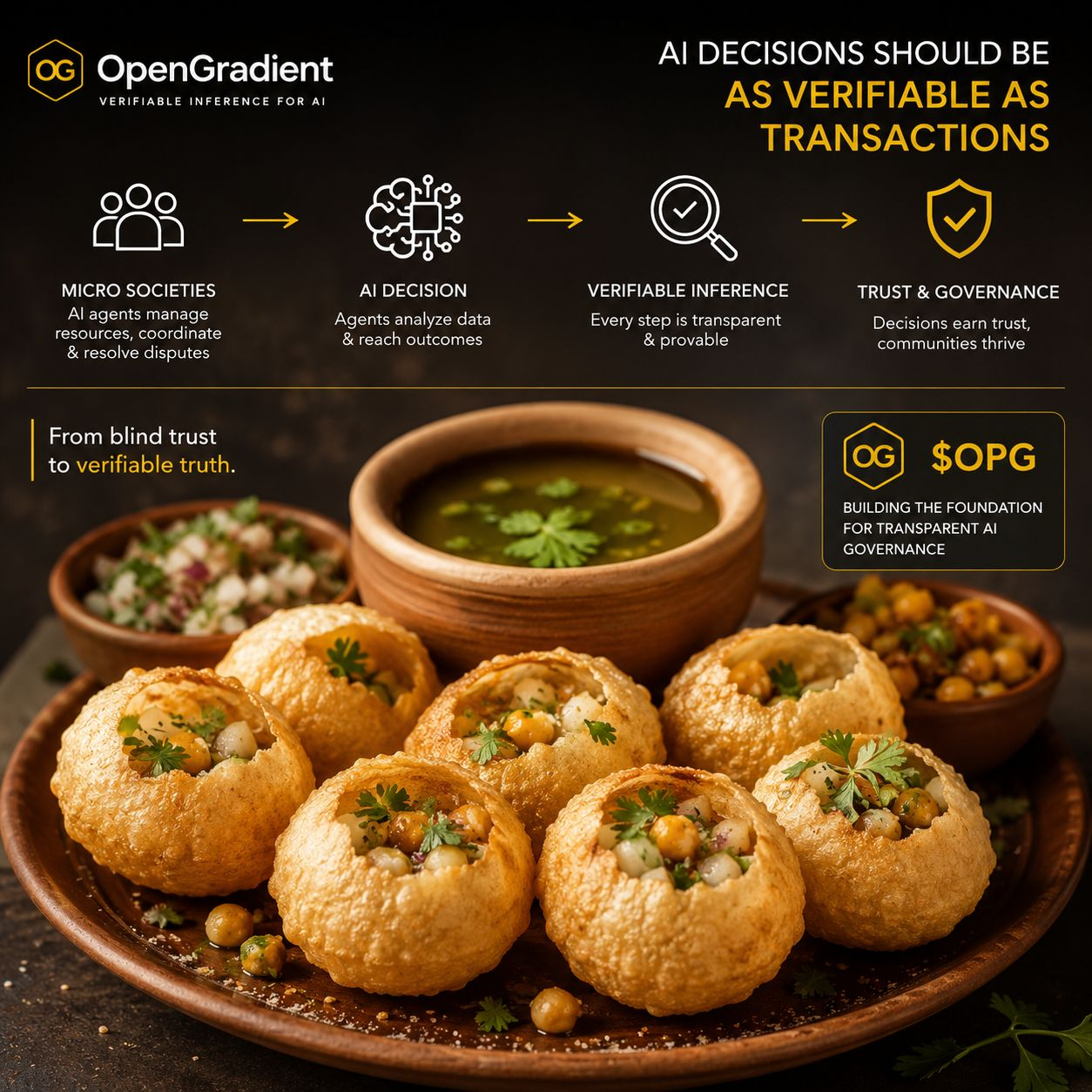
Before AI systems influence large institutions, they'll likely be tested in smaller digital environments where autonomous agents handle tasks such as resource allocation, coordination, and rule enforcement. In those settings, performance matters, but transparency matters just as much.
The critical question becomes simple: when an AI agent makes a decision, can people independently verify how that outcome was produced?
That's one reason I find @OpenGradient interesting. Its emphasis on verifiable inference moves beyond the traditional "trust the model" approach and introduces a framework where execution can be validated rather than assumed.
Coming from a crypto background, the idea feels natural. Blockchain networks gained adoption because actions could be audited and verified. As AI takes on greater responsibility, applying similar principles to decision-making may become increasingly important.
#OPG #AI #CryptoAI #VerifiableAI
#opg $OPG Here's a copyright-safe second version with a different structure and wording while keeping the same core idea:
One observation I've had while researching $OPG is that the future of AI governance may depend less on intelligence alone and more on accountability.
Before AI systems influence large institutions, they'll likely be tested in smaller digital environments where autonomous agents handle tasks such as resource allocation, coordination, and rule enforcement. In those settings, performance matters, but transparency matters just as much.
The critical question becomes simple: when an AI agent makes a decision, can people independently verify how that outcome was produced?
That's one reason I find @OpenGradient interesting. Its emphasis on verifiable inference moves beyond the traditional "trust the model" approach and introduces a framework where execution can be validated rather than assumed.
Coming from a crypto background, the idea feels natural. Blockchain networks gained adoption because actions could be audited and verified. As AI takes on greater responsibility, applying similar principles to decision-making may become increasingly important.
#OPG #AI #CryptoAI #VerifiableAI
One observation I've had while researching $OPG is that the future of AI governance may depend less on intelligence alone and more on accountability.
Before AI systems influence large institutions, they'll likely be tested in smaller digital environments where autonomous agents handle tasks such as resource allocation, coordination, and rule enforcement. In those settings, performance matters, but transparency matters just as much.
The critical question becomes simple: when an AI agent makes a decision, can people independently verify how that outcome was produced?
That's one reason I find @OpenGradient interesting. Its emphasis on verifiable inference moves beyond the traditional "trust the model" approach and introduces a framework where execution can be validated rather than assumed.
Coming from a crypto background, the idea feels natural. Blockchain networks gained adoption because actions could be audited and verified. As AI takes on greater responsibility, applying similar principles to decision-making may become increasingly important.
#OPG #AI #CryptoAI #VerifiableAI
1
1
251

A few years ago I remember losing internet access for almost an entire day.
The strange part wasn't that everything stopped working.
It was realizing how many things I never think about when they do work.
Messages arrive.
Payments clear.
Videos load.
Maps update.
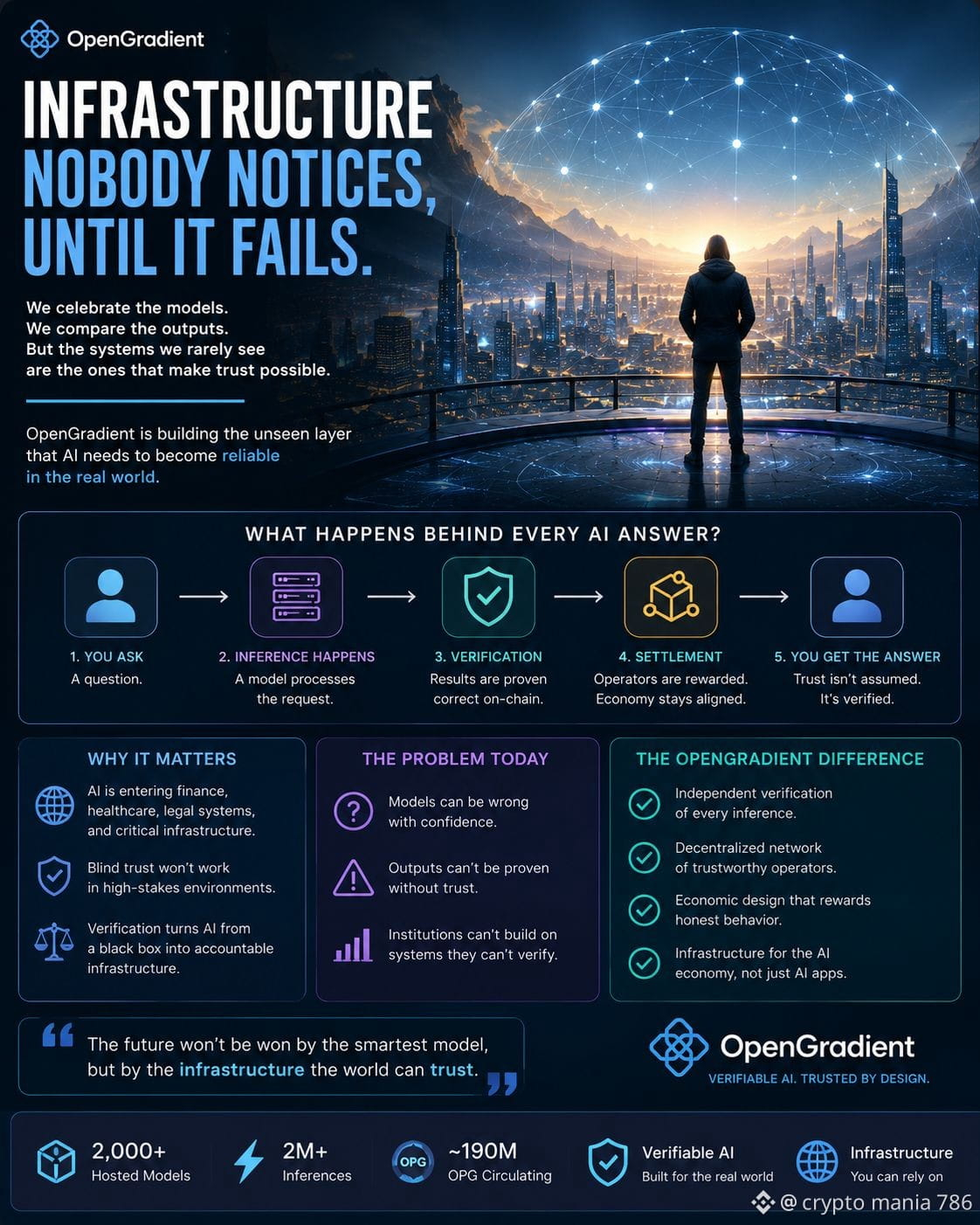
Most infrastructure becomes invisible the moment it starts doing its job properly.
That thought came back while I was reading more about OpenGradient.
Most discussions around AI still focus on models.
Which model is smarter?
Which model is faster?
Which model gives the best answers?
But if AI eventually becomes part of finance, healthcare, legal systems or autonomous agents, I wonder if the bigger question changes.
Not:
"How intelligent is the model?"
But:
"Can the result actually be trusted?"
Because intelligence can be impressive.
Trust is useful.
OpenGradient's approach to verifiable inference makes me think the AI industry may eventually treat verification the same way the internet treats network infrastructure today:
Mostly invisible.
Absolutely essential.
Maybe the future winners won't be the systems with the most impressive demos.
Maybe they'll be the systems nobody notices because they simply work.
And strangely enough, invisible infrastructure often ends up becoming the hardest thing to replace.
What do you think becomes more valuable as AI matures:
Better intelligence or better trust?
@OpenGradient
#OPG #AI #VerifiableAI
$OPG
A few years ago I remember losing internet access for almost an entire day.
The strange part wasn't that everything stopped working.
It was realizing how many things I never think about when they do work.
Messages arrive.
Payments clear.
Videos load.
Maps update.
Most infrastructure becomes invisible the moment it starts doing its job properly.
That thought came back while I was reading more about OpenGradient.
Most discussions around AI still focus on models.
Which model is smarter?
Which model is faster?
Which model gives the best answers?
But if AI eventually becomes part of finance, healthcare, legal systems or autonomous agents, I wonder if the bigger question changes.
Not:
"How intelligent is the model?"
But:
"Can the result actually be trusted?"
Because intelligence can be impressive.
Trust is useful.
OpenGradient's approach to verifiable inference makes me think the AI industry may eventually treat verification the same way the internet treats network infrastructure today:
Mostly invisible.
Absolutely essential.
Maybe the future winners won't be the systems with the most impressive demos.
Maybe they'll be the systems nobody notices because they simply work.
And strangely enough, invisible infrastructure often ends up becoming the hardest thing to replace.
What do you think becomes more valuable as AI matures:
Better intelligence or better trust?
@OpenGradient
#OPG #AI #VerifiableAI
$OPG
The strange part wasn't that everything stopped working.
It was realizing how many things I never think about when they do work.
Messages arrive.
Payments clear.
Videos load.
Maps update.
Most infrastructure becomes invisible the moment it starts doing its job properly.
That thought came back while I was reading more about OpenGradient.
Most discussions around AI still focus on models.
Which model is smarter?
Which model is faster?
Which model gives the best answers?
But if AI eventually becomes part of finance, healthcare, legal systems or autonomous agents, I wonder if the bigger question changes.
Not:
"How intelligent is the model?"
But:
"Can the result actually be trusted?"
Because intelligence can be impressive.
Trust is useful.
OpenGradient's approach to verifiable inference makes me think the AI industry may eventually treat verification the same way the internet treats network infrastructure today:
Mostly invisible.
Absolutely essential.
Maybe the future winners won't be the systems with the most impressive demos.
Maybe they'll be the systems nobody notices because they simply work.
And strangely enough, invisible infrastructure often ends up becoming the hardest thing to replace.
What do you think becomes more valuable as AI matures:
Better intelligence or better trust?
@OpenGradient
#OPG #AI #VerifiableAI
$OPG
3
103

#opg $OPG @OpenGradient
🧠 OpenGradient The AI you can verify, not just trust
Today, AI is a black box: when a model decides your loan or manages your investments, there’s no way to prove it hasn’t been manipulated. OpenGradient was born to solve that.
🔍 What is it?
It’s a decentralized network that hosts, executes, and verifies AI models at scale. Every calculation generates a verifiable cryptographic proof on-chain. You go from "trust me" to "check it out yourself".
⚙️ How does it work? HACA Architecture
The network is divided into three types of nodes:
· Inference: run models with GPUs and generate proofs
· Full: verify the proofs and manage consensus
· Data: fetch reliable external information for the models
Result: latency similar to Web2, but each result is auditable forever.
🏗️ Team and Backing
Came out of the a16z crypto accelerator and raised $9.5M from Coinbase Ventures, SV Angel, and Foresight Ventures. The team hails from Two Sigma, Palantir, and Google.
🪙 The OPG token
· Price: ~$0.16 USD
· Market Cap: ~$30.7M
· Circulation: 190M OPG (19% of total 1B)
· Listed on Binance Spot: since May 22
Utilities: pay for inferences, monetize models, staking for validators, governance, and access to premium features.
📈 Market Context
OPG jumped +84% last week driven by the Binance listing and renewed interest in decentralized AI following the U.S. order against Anthropic.
In summary: OpenGradient builds the infrastructure for AI to be transparent and verifiable by default. It’s not smoke: it's a functional network with top-tier backing, a token with real utility, and a clear mission.
Do you think verifiable AI will be the standard of the future? 👇
{spot}(OPGUSDT)
{future}(TAOUSDT)
#verifiableAI #DeAI
#opg $OPG @OpenGradient
🧠 OpenGradient The AI you can verify, not just trust
Today, AI is a black box: when a model decides your loan or manages your investments, there’s no way to prove it hasn’t been manipulated. OpenGradient was born to solve that.
🔍 What is it?
It’s a decentralized network that hosts, executes, and verifies AI models at scale. Every calculation generates a verifiable cryptographic proof on-chain. You go from "trust me" to "check it out yourself".
⚙️ How does it work? HACA Architecture
The network is divided into three types of nodes:
· Inference: run models with GPUs and generate proofs
· Full: verify the proofs and manage consensus
· Data: fetch reliable external information for the models
Result: latency similar to Web2, but each result is auditable forever.
🏗️ Team and Backing
Came out of the a16z crypto accelerator and raised $9.5M from Coinbase Ventures, SV Angel, and Foresight Ventures. The team hails from Two Sigma, Palantir, and Google.
🪙 The OPG token
· Price: ~$0.16 USD
· Market Cap: ~$30.7M
· Circulation: 190M OPG (19% of total 1B)
· Listed on Binance Spot: since May 22
Utilities: pay for inferences, monetize models, staking for validators, governance, and access to premium features.
📈 Market Context
OPG jumped +84% last week driven by the Binance listing and renewed interest in decentralized AI following the U.S. order against Anthropic.
In summary: OpenGradient builds the infrastructure for AI to be transparent and verifiable by default. It’s not smoke: it's a functional network with top-tier backing, a token with real utility, and a clear mission.
Do you think verifiable AI will be the standard of the future? 👇
#verifiableAI #DeAI
🧠 OpenGradient The AI you can verify, not just trust
Today, AI is a black box: when a model decides your loan or manages your investments, there’s no way to prove it hasn’t been manipulated. OpenGradient was born to solve that.
🔍 What is it?
It’s a decentralized network that hosts, executes, and verifies AI models at scale. Every calculation generates a verifiable cryptographic proof on-chain. You go from "trust me" to "check it out yourself".
⚙️ How does it work? HACA Architecture
The network is divided into three types of nodes:
· Inference: run models with GPUs and generate proofs
· Full: verify the proofs and manage consensus
· Data: fetch reliable external information for the models
Result: latency similar to Web2, but each result is auditable forever.
🏗️ Team and Backing
Came out of the a16z crypto accelerator and raised $9.5M from Coinbase Ventures, SV Angel, and Foresight Ventures. The team hails from Two Sigma, Palantir, and Google.
🪙 The OPG token
· Price: ~$0.16 USD
· Market Cap: ~$30.7M
· Circulation: 190M OPG (19% of total 1B)
· Listed on Binance Spot: since May 22
Utilities: pay for inferences, monetize models, staking for validators, governance, and access to premium features.
📈 Market Context
OPG jumped +84% last week driven by the Binance listing and renewed interest in decentralized AI following the U.S. order against Anthropic.
In summary: OpenGradient builds the infrastructure for AI to be transparent and verifiable by default. It’s not smoke: it's a functional network with top-tier backing, a token with real utility, and a clear mission.
Do you think verifiable AI will be the standard of the future? 👇
#verifiableAI #DeAI
48
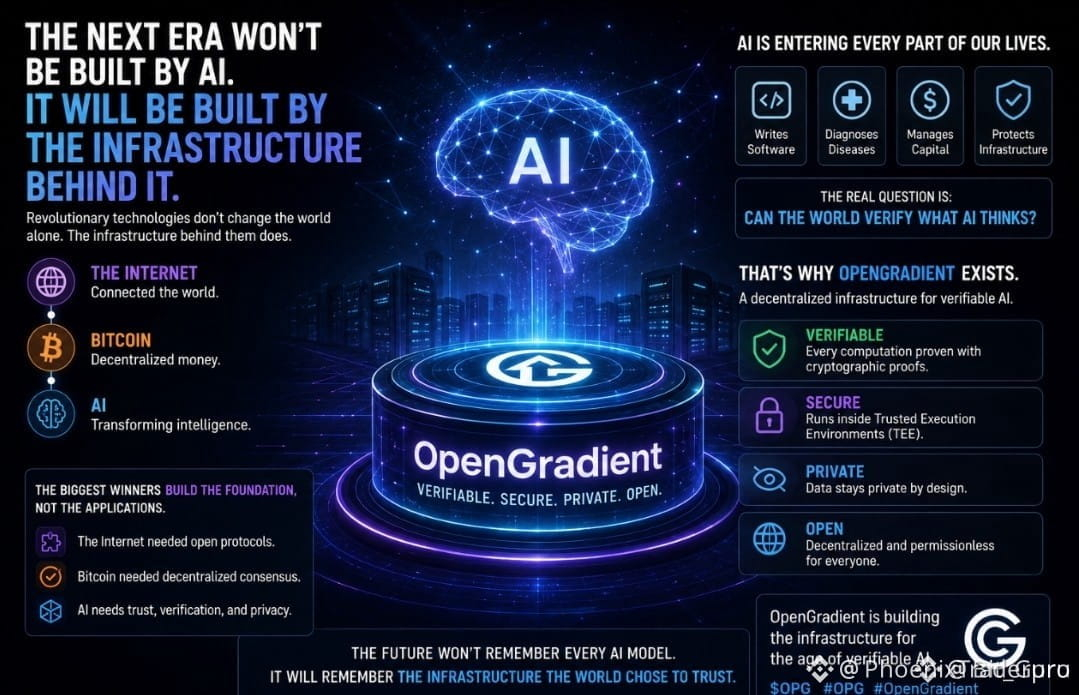
$OPG IS BUILDING THE INFRASTRUCTURE THAT MAKES AI TRUSTWORTHY 🧠
AI's next phase isn't about smarter models — it's about verifiable execution. OpenGradient combines TEEs with cryptographic proof to keep computations private and independently verifiable. That shift is already backed by heavyweights like NVIDIA and Microsoft investing in confidential computing.
The market is starting to price in infrastructure plays over hype tokens. Early volume on top-tier exchanges suggests this narrative has legs. Are you watching the infrastructure layer or still chasing chatbots?
Not financial advice. Always manage your risk.
#OPG #AIInfrastructure #VerifiableAI #Crypto
🔥
$OPG IS BUILDING THE INFRASTRUCTURE THAT MAKES AI TRUSTWORTHY 🧠
AI's next phase isn't about smarter models — it's about verifiable execution. OpenGradient combines TEEs with cryptographic proof to keep computations private and independently verifiable. That shift is already backed by heavyweights like NVIDIA and Microsoft investing in confidential computing.
The market is starting to price in infrastructure plays over hype tokens. Early volume on top-tier exchanges suggests this narrative has legs. Are you watching the infrastructure layer or still chasing chatbots?
Not financial advice. Always manage your risk.
#OPG #AIInfrastructure #VerifiableAI #Crypto
🔥
AI's next phase isn't about smarter models — it's about verifiable execution. OpenGradient combines TEEs with cryptographic proof to keep computations private and independently verifiable. That shift is already backed by heavyweights like NVIDIA and Microsoft investing in confidential computing.
The market is starting to price in infrastructure plays over hype tokens. Early volume on top-tier exchanges suggests this narrative has legs. Are you watching the infrastructure layer or still chasing chatbots?
Not financial advice. Always manage your risk.
#OPG #AIInfrastructure #VerifiableAI #Crypto
🔥
1
34
Log in to explore more content
Join global crypto users on Binance Square
⚡️ Get latest and useful information about crypto.
💬 Trusted by the world’s largest crypto exchange.
👍 Discover real insights from verified creators.
Email / Phone number
Trending Topics
1
#BitwiseFilesFinalNEARSpotETFProspectus
38,381 views
1,021 Discussing
2
#BitgetHackerMoves$83MStolenXRP
21,686 views
142 Discussing
3
#SOLSpotETFWeeklyInflow$188M
12,207 views
107 Discussing
4
#DogecoinETFsPostBiggestWeekSinceLaunch
30,389 views
777 Discussing
5
#StrategyStriveAdd2305BitcoinThisWeek
99,316 views
1,902 Discussing
6
#TrumpRejectsIranHormuzReopening
92,130 views
1,470 Discussing
7
#CircleTetherFreezeBitgetHackerWallet
88,997 views
1,394 Discussing
8
#SECSaysTokenBuybacksNotAutoSecurities
55,890 views
816 Discussing
9
#ChinaUSAgreeOn$30BTariffCut
4,464 views
43 Discussing
10
#CoinMarketCapCompletesCoinglassAcquisition
63,491 views
925 Discussing