
#ukraineparliamentpassesvirtualassetlegalizationbill
ukraineparliamentpassesvirtualassetlegalizationbill
Hot
Latest

·
--
Bullish
#UkraineParliamentPassesVirtualAssetLegalizationBill
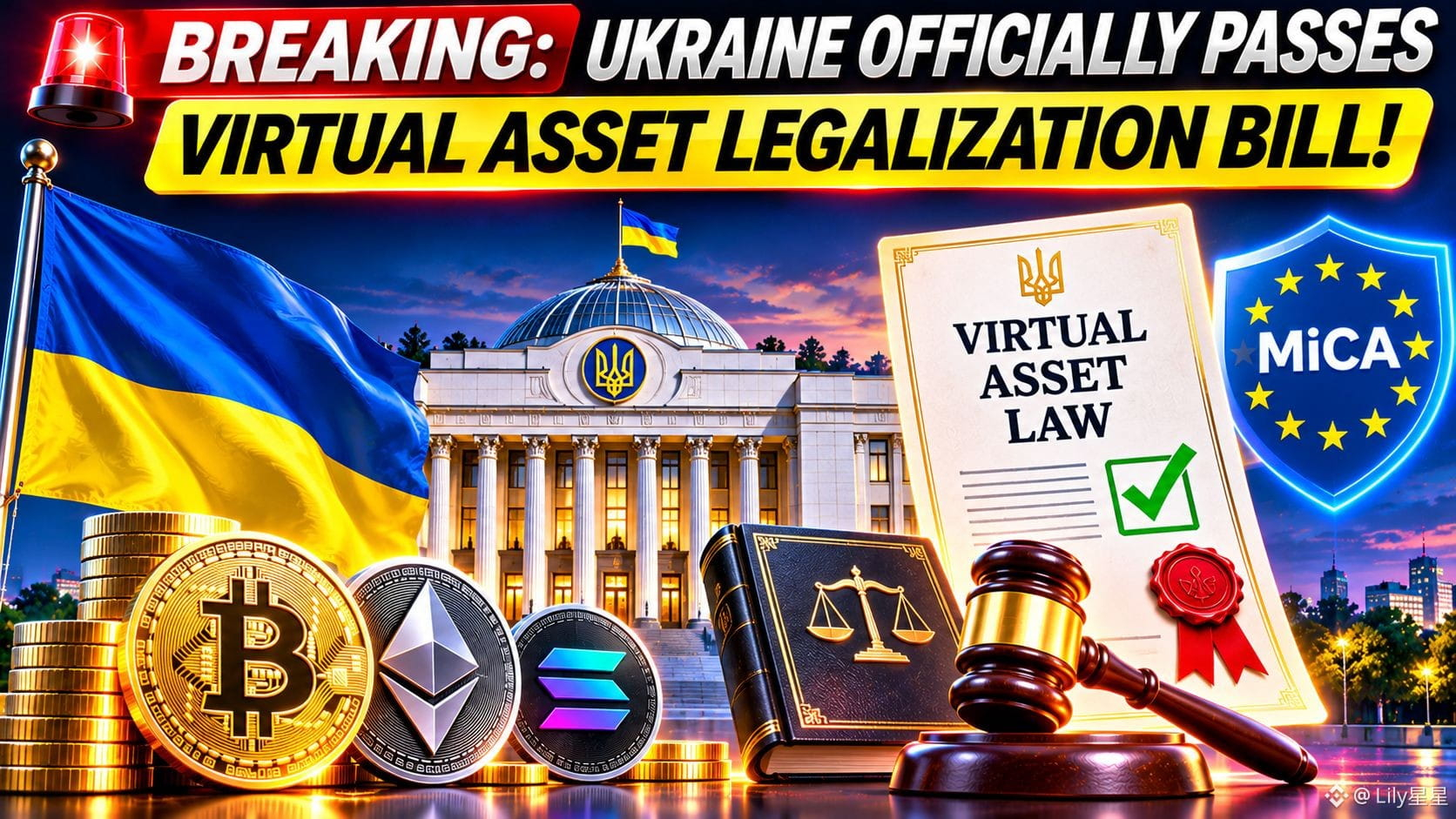
🚨 BREAKING: Ukraine Officially Passes Landmark Virtual Asset Legalization Bill! 🇺🇦⚡
On Nov 25, Ukraine’s parliament (Verkhovna Rada) approved Bill No. 10225-d in its final reading with 271 votes in favor, establishing a comprehensive legal and tax framework for cryptocurrencies ahead of a planned July 1, 2027 rollout.
📊 Key Highlights & Market Impact:
• Clear Tax Rules: Standard 18% income tax + 5% military levy on net crypto profits—with crypto-to-crypto swaps remaining tax-free and a preferential 5% + 5% rate for cashing out legacy holdings through 2028
• Shared Regulatory Oversight: Market licensing and supervision will be split between the National Securities and Stock Market Commission (NSSMC) and the National Bank of Ukraine (NBU)
• EU MiCA Alignment: Mandatory authorization, segregated customer funds, and stricter AML compliance for exchanges and custodians—projected to generate ~$300M+ annually in state revenue
$BTC
{future}(BTCUSDT)
Another major European economy moves from gray-market uncertainty to full MiCA-aligned crypto adoption. Bullish for global institutional clarity? Drop your take below! $SOL
{future}(SOLUSDT)
👇
$ETH
{future}(ETHUSDT)
#TradFiForBeginners #AnthropicBreaksBelowIPOPriceAmidAISlump #CryptoNews #web3空投
#UkraineParliamentPassesVirtualAssetLegalizationBill
🚨 BREAKING: Ukraine Officially Passes Landmark Virtual Asset Legalization Bill! 🇺🇦⚡
On Nov 25, Ukraine’s parliament (Verkhovna Rada) approved Bill No. 10225-d in its final reading with 271 votes in favor, establishing a comprehensive legal and tax framework for cryptocurrencies ahead of a planned July 1, 2027 rollout.
📊 Key Highlights & Market Impact:
• Clear Tax Rules: Standard 18% income tax + 5% military levy on net crypto profits—with crypto-to-crypto swaps remaining tax-free and a preferential 5% + 5% rate for cashing out legacy holdings through 2028
• Shared Regulatory Oversight: Market licensing and supervision will be split between the National Securities and Stock Market Commission (NSSMC) and the National Bank of Ukraine (NBU)
• EU MiCA Alignment: Mandatory authorization, segregated customer funds, and stricter AML compliance for exchanges and custodians—projected to generate ~$300M+ annually in state revenue
$BTC
Another major European economy moves from gray-market uncertainty to full MiCA-aligned crypto adoption. Bullish for global institutional clarity? Drop your take below! $SOL
👇
$ETH
#TradFiForBeginners #AnthropicBreaksBelowIPOPriceAmidAISlump #CryptoNews #web3空投
1
2
5.9k
#UkraineParliamentPassesVirtualAssetLegalizationBill
Ukraine's parliament approved Bill No. 10225-d with 271 votes, paving the way for a formal regulatory framework for crypto trading, custody and exchange services.
💰 Here's what's changing:
23% combined tax: 18% income tax + 5% military levy on crypto profits.
July 2027: Expected implementation date.
Exchanges and custodians will need authorization and face reporting and financial-monitoring requirements.
Customer assets must be separated from company funds.
Investor protection and transparency rules are also included.
Lawmaker Yaroslav Zheleznyak estimates the framework could generate an additional 15 billion hryvnias in state revenue.
The move reportedly aligns with Ukraine's broader commitments to the EU and IMF. 👀 #Write2Earn $BTC $ETH $BNB

3
6.1k

·
--
Article
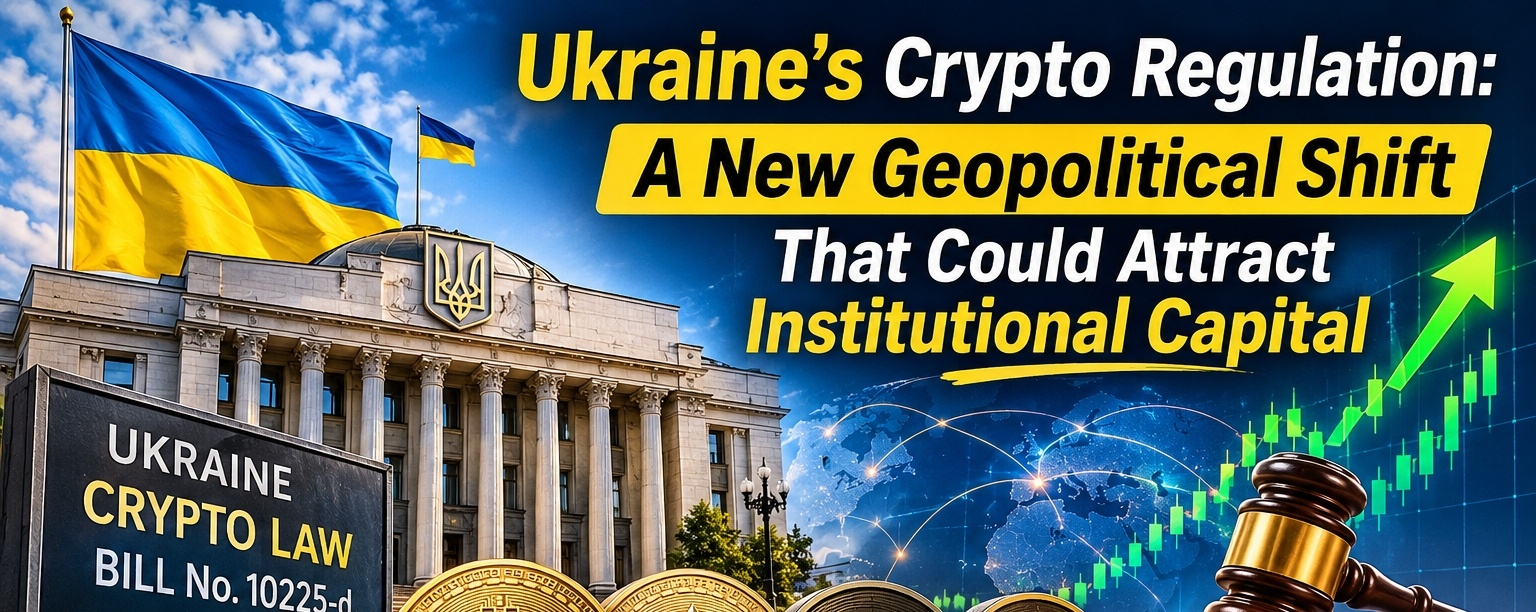
Ukraine’s Crypto Regulation: A New Geopolitical Shift That Could Attract Institutional CapitalCan a country fighting a war become an important player in the next phase of global crypto adoption? Ukraine’s latest regulatory move suggests it wants to try. And the implications could extend far beyond its borders.
On November 25, 2026, Ukraine’s parliament approved Bill No. 10225-d in its final reading, with 271 votes in favour. The legislation establishes a formal framework for cryptocurrency trading, taxation, custody and exchange services, with implementation expected from July 1, 2027.
For investors, this is more than another country introducing crypto regulations. It signals how governments are beginning to connect digital assets with financial sovereignty, international capital flows and geopolitical strategy.
The bigger question is whether Ukraine can turn regulatory clarity into actual investment.
1. Why Ukraine is changing its approach
Ukraine’s relationship with cryptocurrency has developed under extraordinary economic pressure.
Since Russia's full-scale invasion in February 2022, the country has faced enormous demands on public finances, currency stability, foreign reserves and international funding.
Cryptocurrency also became relevant to its wartime financial ecosystem. Digital assets provided an additional channel for international donations, cross-border transfers and financial activity when traditional payment infrastructure faced operational challenges.
But crypto adoption expanded faster than the regulatory framework.
Ukraine had already passed a virtual assets law in March 2022. However, the legislation needed supporting tax provisions before a complete regulatory system could become operational.
Bill No. 10225-d addresses that gap.
The government's objective is to bring crypto activity into a formal financial structure, with defined tax obligations, authorised service providers and stronger investor protections.
This is also part of Ukraine’s broader effort to align its financial system with European standards.
In practical terms, Kyiv is no longer treating cryptocurrency simply as a technology sector. It is becoming part of the country's financial policy.
2. What the new law changes for investors
The legislation introduces several important changes.
Taxation: The standard combined tax rate on qualifying crypto profits will be 23%, consisting of 18% personal income tax and a 5% military levy.
However, not every crypto transaction will be taxed in the same way.
Crypto-to-crypto exchanges are exempt under the new framework. Qualifying net profits are generally calculated after accounting for documented acquisition costs.
There is also preferential treatment for certain pre-existing crypto holdings, with a reduced 5% personal income tax rate plus the 5% military levy during the transitional period through 2028.
Licensing and supervision: Exchanges, custodians and other virtual asset service providers will need regulatory authorisation. They will also face reporting and financial-monitoring requirements.
Investor protection: Customer assets must be separated from company funds.
This is particularly important. If an exchange faces financial difficulties, customer assets should not automatically become exposed to the same risks as the company's corporate liabilities.
Regulatory supervision will be shared between the National Securities and Stock Market Commission (NSSMC) and the National Bank of Ukraine (NBU).
For investors, the main benefit is greater legal clarity. The challenge is that compliance costs could make it harder for smaller platforms to operate.
3. The geopolitical calculation: EU integration and IMF commitments
Ukraine's regulatory decision cannot be separated from its international political and financial position.
The country is seeking deeper integration with the European Union while relying heavily on international financial assistance to maintain economic stability and support reconstruction.
The EU's Markets in Crypto-Assets Regulation (MiCA) provides an important reference point.
MiCA establishes common standards for crypto service providers, including authorisation, transparency and consumer protection.
Ukraine's new framework is intended to bring its domestic regulatory structure closer to European standards.
There is also an IMF dimension. Ukraine's financial reform commitments include clearer regulatory responsibilities, stronger oversight of virtual asset service providers and alignment with European financial standards.
Why should investors care?
International financial institutions do not look only at a country's ability to generate revenue. They also examine whether its financial system is transparent, whether capital flows can be monitored and whether regulators can enforce their rules.
A credible crypto framework could strengthen confidence among foreign investors and international financial partners.
But there is another side to this equation.
Ukraine must balance innovation against monetary sovereignty and financial stability. The National Bank has previously raised concerns about regulatory gaps and the potential risks of poorly controlled virtual asset activity.
That makes implementation just as important as parliamentary approval.
4. Institutional capital: Where could the money move?
The biggest potential market impact may come from institutional participation rather than immediate retail buying.
Large investment firms, custodians and financial service providers generally look for three things before entering a market:
Legal certainty.
Reliable asset protection.
Predictable compliance requirements.
Ukraine's proposed framework addresses all three.
The requirement to separate customer assets from company funds could improve confidence in custody arrangements.
Licensing could also encourage established exchanges and financial technology companies to explore the Ukrainian market.
However, regulation alone does not guarantee capital inflows.
Investors will still consider war-related security risks, currency restrictions, banking infrastructure, political stability and the enforceability of legal protections.
There is also a competitive angle.
If compliance becomes expensive, smaller exchanges may struggle while established international operators gain market share.
That could gradually shift trading activity towards regulated platforms.
The opportunity, therefore, is not necessarily an immediate cryptocurrency rally. It is the possibility of a more institutionalised market.
5. The $331 million revenue question
Ukrainian lawmaker Yaroslav Zheleznyak estimates that the new framework could generate approximately 15 billion hryvnias in additional state revenue, equivalent to around $331 million at the reported exchange rate.
For a country facing enormous wartime expenditure and reconstruction requirements, that is a meaningful potential revenue source.
There are two major economic benefits.
First, taxation could bring previously underreported crypto activity into the formal economy.
Second, licensing and reporting requirements could give the government a clearer picture of domestic capital flows.
But investors should distinguish between a revenue projection and guaranteed tax collections.
Actual revenue will depend on market participation, enforcement capacity, taxable profits and the willingness of traders to use regulated domestic services.
If the tax burden becomes too restrictive, some activity could move towards foreign platforms or informal channels.
The government will need to strike a balance between collecting revenue and keeping the market competitive.
6. What does this mean for BTC, ETH, $SOL and BNB?
The legislation is not a direct bullish catalyst for every cryptocurrency. Its potential influence is more structural.
Bitcoin (BTC): Greater regulatory acceptance could strengthen Bitcoin's position as an established investment asset. Institutional custody and compliant trading access remain important long-term adoption drivers.
Ethereum ($ETH ): Ethereum could benefit from wider adoption of regulated custody, tokenisation and financial applications. Its infrastructure role makes it relevant to the institutionalisation of digital assets.
Solana (SOL): Faster settlement and its expanding application ecosystem could make Solana relevant to regulated payment and trading services. Actual adoption will depend on compliant products and institutional demand.
BNB: If established international exchanges expand under the new rules, compliant exchange infrastructure could gain importance. However, exchange-level growth does not automatically translate into equivalent $BNB price appreciation.
The distinction is important: these are potential investment channels, not evidence that the Ukrainian law directly increases demand for these assets.
7. How could this affect ordinary investors?
There are three realistic scenarios worth watching.
Bullish scenario: Effective implementation attracts established exchanges, improves custody standards and encourages institutional participation. This could support long-term demand for established digital assets.
Neutral scenario: Regulation improves transparency, but adoption remains limited because of wartime risks, banking restrictions and implementation costs.
Bearish scenario: High compliance costs, restrictive authorisation or weak enforcement push trading activity elsewhere, limiting the expected economic benefits.
For retail investors, the lesson is simple: follow actual capital flows rather than trading solely on regulatory headlines.
8. What should investors monitor before taking positions?
The July 2027 implementation date gives the market time to assess the practical details.
I would focus on five developments:
Completion of the remaining presidential approval and publication process.
Which institutions receive authorisation and whether international exchanges enter the market.
How the NSSMC and NBU divide their supervisory responsibilities.
Whether the tax framework encourages formalisation or pushes traders towards offshore platforms.
Whether institutional custody, banking partnerships and investment products actually expand.
These developments will provide stronger evidence of adoption than parliamentary approval alone.
Markets often price in expectations before a law becomes operational. Therefore, investors should not assume that July 2027 will automatically trigger a BTC or altcoin rally.
The bigger picture: Crypto regulation is becoming a geopolitical instrument
Ukraine's decision highlights a wider change in global finance.
Cryptocurrency regulation is increasingly connected to national security, monetary sovereignty, international financial cooperation and competition for investment capital.
The United States, European Union and other major economies are developing different approaches to digital asset oversight.
Countries that can offer credible regulation without discouraging innovation may gain an advantage in attracting financial businesses and institutional capital.
Ukraine is trying to position itself within that competition while dealing with the extraordinary financial demands of war and reconstruction.
For BTC and ETH investors, the important takeaway is that regulatory acceptance can strengthen the long-term infrastructure supporting the crypto market.
But stronger infrastructure and higher token prices are not the same thing.
My assessment: Ukraine's Bill No. 10225-d is a meaningful long-term structural development, not an immediate trading signal. The real investment opportunity will become clearer when licences are issued, institutional capital enters regulated channels and market participation starts producing measurable results.
What do you think? Could Ukraine's new crypto framework become a catalyst for the next wave of institutional adoption, or do wartime risks and economic uncertainty still outweigh its regulatory progress?
{spot}(BTCUSDT)
{spot}(ETHUSDT)
{spot}(BNBUSDT)
#UkraineParliamentPassesVirtualAssetLegalizationBill #Geopolitics #CryptoAnalysis #UKCrypto #Binance
Ukraine’s Crypto Regulation: A New Geopolitical Shift That Could Attract Institutional Capital
Can a country fighting a war become an important player in the next phase of global crypto adoption? Ukraine’s latest regulatory move suggests it wants to try. And the implications could extend far beyond its borders.
On November 25, 2026, Ukraine’s parliament approved Bill No. 10225-d in its final reading, with 271 votes in favour. The legislation establishes a formal framework for cryptocurrency trading, taxation, custody and exchange services, with implementation expected from July 1, 2027.
For investors, this is more than another country introducing crypto regulations. It signals how governments are beginning to connect digital assets with financial sovereignty, international capital flows and geopolitical strategy.
The bigger question is whether Ukraine can turn regulatory clarity into actual investment.
1. Why Ukraine is changing its approach
Ukraine’s relationship with cryptocurrency has developed under extraordinary economic pressure.
Since Russia's full-scale invasion in February 2022, the country has faced enormous demands on public finances, currency stability, foreign reserves and international funding.
Cryptocurrency also became relevant to its wartime financial ecosystem. Digital assets provided an additional channel for international donations, cross-border transfers and financial activity when traditional payment infrastructure faced operational challenges.
But crypto adoption expanded faster than the regulatory framework.
Ukraine had already passed a virtual assets law in March 2022. However, the legislation needed supporting tax provisions before a complete regulatory system could become operational.
Bill No. 10225-d addresses that gap.
The government's objective is to bring crypto activity into a formal financial structure, with defined tax obligations, authorised service providers and stronger investor protections.
This is also part of Ukraine’s broader effort to align its financial system with European standards.
In practical terms, Kyiv is no longer treating cryptocurrency simply as a technology sector. It is becoming part of the country's financial policy.
2. What the new law changes for investors
The legislation introduces several important changes.
Taxation: The standard combined tax rate on qualifying crypto profits will be 23%, consisting of 18% personal income tax and a 5% military levy.
However, not every crypto transaction will be taxed in the same way.
Crypto-to-crypto exchanges are exempt under the new framework. Qualifying net profits are generally calculated after accounting for documented acquisition costs.
There is also preferential treatment for certain pre-existing crypto holdings, with a reduced 5% personal income tax rate plus the 5% military levy during the transitional period through 2028.
Licensing and supervision: Exchanges, custodians and other virtual asset service providers will need regulatory authorisation. They will also face reporting and financial-monitoring requirements.
Investor protection: Customer assets must be separated from company funds.
This is particularly important. If an exchange faces financial difficulties, customer assets should not automatically become exposed to the same risks as the company's corporate liabilities.
Regulatory supervision will be shared between the National Securities and Stock Market Commission (NSSMC) and the National Bank of Ukraine (NBU).
For investors, the main benefit is greater legal clarity. The challenge is that compliance costs could make it harder for smaller platforms to operate.
3. The geopolitical calculation: EU integration and IMF commitments
Ukraine's regulatory decision cannot be separated from its international political and financial position.
The country is seeking deeper integration with the European Union while relying heavily on international financial assistance to maintain economic stability and support reconstruction.
The EU's Markets in Crypto-Assets Regulation (MiCA) provides an important reference point.
MiCA establishes common standards for crypto service providers, including authorisation, transparency and consumer protection.
Ukraine's new framework is intended to bring its domestic regulatory structure closer to European standards.
There is also an IMF dimension. Ukraine's financial reform commitments include clearer regulatory responsibilities, stronger oversight of virtual asset service providers and alignment with European financial standards.
Why should investors care?
International financial institutions do not look only at a country's ability to generate revenue. They also examine whether its financial system is transparent, whether capital flows can be monitored and whether regulators can enforce their rules.
A credible crypto framework could strengthen confidence among foreign investors and international financial partners.
But there is another side to this equation.
Ukraine must balance innovation against monetary sovereignty and financial stability. The National Bank has previously raised concerns about regulatory gaps and the potential risks of poorly controlled virtual asset activity.
That makes implementation just as important as parliamentary approval.
4. Institutional capital: Where could the money move?
The biggest potential market impact may come from institutional participation rather than immediate retail buying.
Large investment firms, custodians and financial service providers generally look for three things before entering a market:
Legal certainty.
Reliable asset protection.
Predictable compliance requirements.
Ukraine's proposed framework addresses all three.
The requirement to separate customer assets from company funds could improve confidence in custody arrangements.
Licensing could also encourage established exchanges and financial technology companies to explore the Ukrainian market.
However, regulation alone does not guarantee capital inflows.
Investors will still consider war-related security risks, currency restrictions, banking infrastructure, political stability and the enforceability of legal protections.
There is also a competitive angle.
If compliance becomes expensive, smaller exchanges may struggle while established international operators gain market share.
That could gradually shift trading activity towards regulated platforms.
The opportunity, therefore, is not necessarily an immediate cryptocurrency rally. It is the possibility of a more institutionalised market.
5. The $331 million revenue question
Ukrainian lawmaker Yaroslav Zheleznyak estimates that the new framework could generate approximately 15 billion hryvnias in additional state revenue, equivalent to around $331 million at the reported exchange rate.
For a country facing enormous wartime expenditure and reconstruction requirements, that is a meaningful potential revenue source.
There are two major economic benefits.
First, taxation could bring previously underreported crypto activity into the formal economy.
Second, licensing and reporting requirements could give the government a clearer picture of domestic capital flows.
But investors should distinguish between a revenue projection and guaranteed tax collections.
Actual revenue will depend on market participation, enforcement capacity, taxable profits and the willingness of traders to use regulated domestic services.
If the tax burden becomes too restrictive, some activity could move towards foreign platforms or informal channels.
The government will need to strike a balance between collecting revenue and keeping the market competitive.
6. What does this mean for BTC, ETH, $SOL and BNB?
The legislation is not a direct bullish catalyst for every cryptocurrency. Its potential influence is more structural.
Bitcoin (BTC): Greater regulatory acceptance could strengthen Bitcoin's position as an established investment asset. Institutional custody and compliant trading access remain important long-term adoption drivers.
Ethereum ($ETH ): Ethereum could benefit from wider adoption of regulated custody, tokenisation and financial applications. Its infrastructure role makes it relevant to the institutionalisation of digital assets.
Solana (SOL): Faster settlement and its expanding application ecosystem could make Solana relevant to regulated payment and trading services. Actual adoption will depend on compliant products and institutional demand.
BNB: If established international exchanges expand under the new rules, compliant exchange infrastructure could gain importance. However, exchange-level growth does not automatically translate into equivalent $BNB price appreciation.
The distinction is important: these are potential investment channels, not evidence that the Ukrainian law directly increases demand for these assets.
7. How could this affect ordinary investors?
There are three realistic scenarios worth watching.
Bullish scenario: Effective implementation attracts established exchanges, improves custody standards and encourages institutional participation. This could support long-term demand for established digital assets.
Neutral scenario: Regulation improves transparency, but adoption remains limited because of wartime risks, banking restrictions and implementation costs.
Bearish scenario: High compliance costs, restrictive authorisation or weak enforcement push trading activity elsewhere, limiting the expected economic benefits.
For retail investors, the lesson is simple: follow actual capital flows rather than trading solely on regulatory headlines.
8. What should investors monitor before taking positions?
The July 2027 implementation date gives the market time to assess the practical details.
I would focus on five developments:
Completion of the remaining presidential approval and publication process.
Which institutions receive authorisation and whether international exchanges enter the market.
How the NSSMC and NBU divide their supervisory responsibilities.
Whether the tax framework encourages formalisation or pushes traders towards offshore platforms.
Whether institutional custody, banking partnerships and investment products actually expand.
These developments will provide stronger evidence of adoption than parliamentary approval alone.
Markets often price in expectations before a law becomes operational. Therefore, investors should not assume that July 2027 will automatically trigger a BTC or altcoin rally.
The bigger picture: Crypto regulation is becoming a geopolitical instrument
Ukraine's decision highlights a wider change in global finance.
Cryptocurrency regulation is increasingly connected to national security, monetary sovereignty, international financial cooperation and competition for investment capital.
The United States, European Union and other major economies are developing different approaches to digital asset oversight.
Countries that can offer credible regulation without discouraging innovation may gain an advantage in attracting financial businesses and institutional capital.
Ukraine is trying to position itself within that competition while dealing with the extraordinary financial demands of war and reconstruction.
For BTC and ETH investors, the important takeaway is that regulatory acceptance can strengthen the long-term infrastructure supporting the crypto market.
But stronger infrastructure and higher token prices are not the same thing.
My assessment: Ukraine's Bill No. 10225-d is a meaningful long-term structural development, not an immediate trading signal. The real investment opportunity will become clearer when licences are issued, institutional capital enters regulated channels and market participation starts producing measurable results.
What do you think? Could Ukraine's new crypto framework become a catalyst for the next wave of institutional adoption, or do wartime risks and economic uncertainty still outweigh its regulatory progress?
#UkraineParliamentPassesVirtualAssetLegalizationBill #Geopolitics #CryptoAnalysis #UKCrypto #Binance
1
216

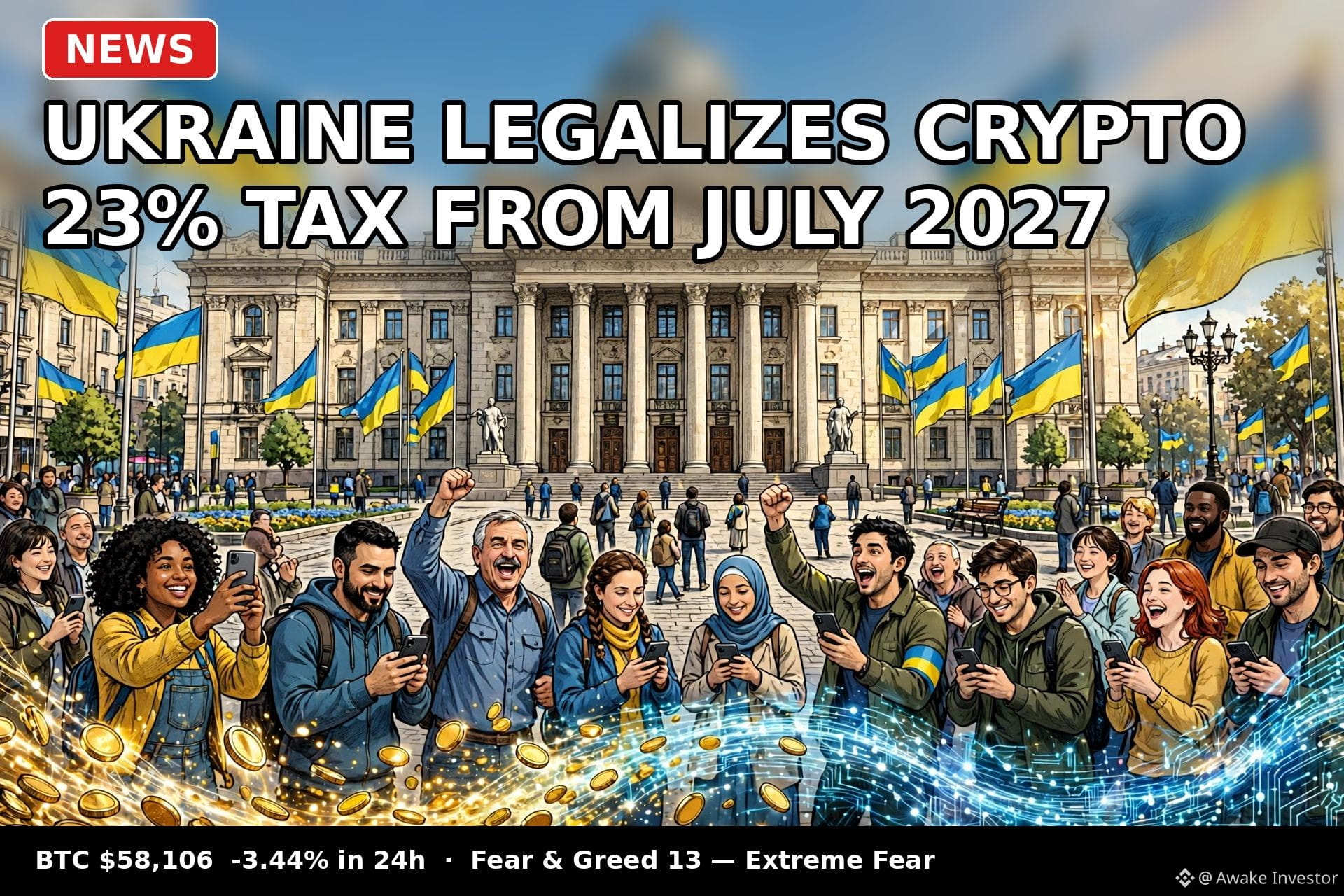
🚨 Ukraine Legalizes Crypto — 23% Tax From July 2027
Ukraine's parliament just passed a crypto regulation bill with 271 votes after three years of work — effective July 1, 2027, pending the president's signature.
Individuals pay 18% income tax + 5% military levy = 23% on net annual crypto profits. Crypto-to-crypto swaps are exempt, and losses can be carried forward to offset future gains. The National Bank of Ukraine will share oversight with the securities regulator and oversee single-currency stablecoin issuers.
A rare clear legal framework in Europe — a long-term positive for crypto adoption, even as the market stays red short-term: $BTC $58,106, -3.44% in 24h (Binance, 21:01 ICT), Fear & Greed 13 — Extreme Fear.
Source: Cointelegraph, 25 Nov 2026.
#UkraineParliamentPassesVirtualAssetLegalizationBill #Bitcoin #Crypto
Not financial advice. DYOR.
$BTC
13

·
--
#ukraineparliamentpassesvirtualassetlegalizationbill
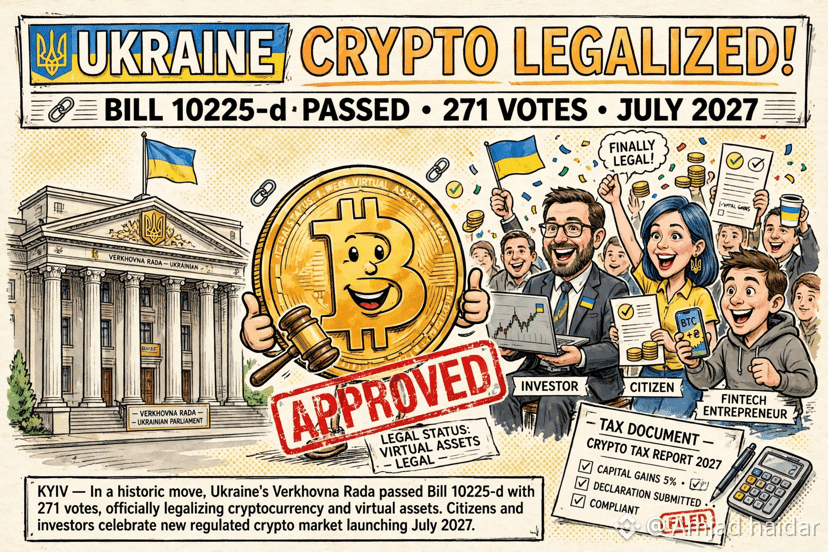
Ukraine officially legalizes crypto
The Ukrainian parliament passed Virtual Assets Bill No. 10225-d with *271 votes* in favor and 8 against, after 3 years of work.
*What does this mean?*
- Crypto is now legal and protected
- Licenses for platforms and protection for investors
- Tax exemption for exchanges between cryptocurrencies
*Taxes:*
*5% + 5%* until 2028, then *18% + 5%* on net profit only.
*Effective date:* July 1, 2027
*Expected revenue:* $330 million annually
Ukraine chose regulation over prohibition, and crypto has become part of the official financial system.
2
181

·
--
Ukraine’s Parliament Passes Virtual Assets Bill | BTC Has Yet to See Direct Buying | I’ll Wait for Price Confirmation
My stance is cautious to neutral. The official website of Ukraine’s Verkhovna Rada announced today that Virtual Assets Circulation and Taxation Bill No. 10225-д passed its second reading and an overall vote; Ukrainian media also verified the vote. The easiest thing to misread here is this: Parliament’s passage of the bill is a confirmed fact, but that does not mean the president has signed it or that implementation rules are already in place—nor does it support the conclusion that the government is starting to buy Bitcoin today. I see it as a medium- to long-term signal that the regulatory framework is gradually becoming clearer, not an immediate bullish signal.
Why does this matter for BTC? If the rules are ultimately implemented, trading platforms, custody, and tax reporting will have clearer divisions of responsibility, potentially lowering the barriers for compliant capital to enter the local market. The impact is on future market access and transaction costs; how quickly it takes effect depends on the signing, when it comes into force, regulatory details, and whether local institutions actually allocate funds. The bill is not approval of a Bitcoin spot ETF, nor does it automatically create new capital flows into the global market. If the market interprets “Parliament passes the bill” as “large amounts of capital are about to pour in,” I think it is pricing in the news too quickly.
The price reaction should also be considered separately. As of 21:06 Beijing time, BTC/USD on Kraken was around $58,605, with a 24-hour range of approximately $58,372 to $60,613—below the 24-hour opening price of $59,741. This order book shows broad pressure, but we cannot attribute the earlier decline or current volatility solely to the news from Ukraine. Tonight’s U.S. macro data releases remain a more direct source of short-term volatility, and price jumps around the announcements could create false breakouts. The policy story provides a framework to watch, but trading volume and closing prices must confirm the actual direction.
I’m watching two levels: around $58,370 is today’s low; if it breaks and price fails to reclaim it on a retest, that would indicate weak buying support. Around $59,750 is the first recovery hurdle above the opening price; only a reclaim and hold would make a move back toward $60,600 worth discussing. If the bill is not subsequently signed, or if the details differ significantly from market expectations, I would downgrade my view of the policy improvement. If BTC rebounds but continues to be pushed back below $59,750, that would also invalidate a short-term bullish view.
If I were trading this myself, I wouldn’t chase the news now; for the time being, I’d stay on the sidelines. Only if BTC’s four-hour candle closes above $59,750, holds the $59,500–$59,750 area on a retest, and volatility settles after the macro data release would I consider a leveraged-free spot trade using no more than 0.5% of my total capital. I’d initially target $60,600, sell half upon reaching it, and hold the rest for $61,500 while moving the stop-loss up to around the entry price. I’d place the initial stop-loss below $58,500. If $58,370 breaks first, I’d cancel the buying plan. If, after entry, BTC falls back below $59,500 on a four-hour candle, or official documents disprove the compliance expectations associated with the news, I’d close the remaining position outright. If none of these conditions are met, I’d stay in cash and make clear that this is a plan, not a trade.
#UkraineParliamentPassesVirtualAssetLegalizationBill #BTC
The above is solely my personal market observation and does not constitute investment advice.

66

·
--
Bullish
𝐁𝐈𝐓𝐂𝐎𝐈𝐍 𝐀𝐍𝐃 𝐓𝐇𝐄 𝐑𝐈𝐒𝐄 𝐎𝐅 𝐎𝐍𝐂𝐇𝐀𝐈𝐍 𝐅𝐈𝐍𝐀𝐍𝐂𝐄
The growth of decentralized finance has changed how people interact with digital assets.
Lending, borrowing, trading, and liquidity provision have created financial opportunities across multiple blockchain ecosystems. Bitcoin, despite holding a significant share of crypto’s total value, still has room to expand its presence in these activities.
This creates an interesting opportunity for BTCFi.
@GOATRollup is focused on building infrastructure that expands Bitcoin’s role in the onchain economy and gives developers more room to create around BTC liquidity.
The broader opportunity includes:
→ Bringing more Bitcoin-related assets into decentralized finance.
→ Supporting applications built around BTC liquidity.
→ Expanding financial opportunities for ecosystem participants.
→ Creating stronger connections between Bitcoin and onchain markets.
For this sector to grow sustainably, infrastructure must support genuine demand, reliable execution, and meaningful utility.
Bitcoin has already established its importance in crypto.
The next stage is about how effectively its value connects with the financial applications being built across the industry.
#UkraineParliamentPassesVirtualAssetLegalizationBill
𝐁𝐈𝐓𝐂𝐎𝐈𝐍 𝐀𝐍𝐃 𝐓𝐇𝐄 𝐑𝐈𝐒𝐄 𝐎𝐅 𝐎𝐍𝐂𝐇𝐀𝐈𝐍 𝐅𝐈𝐍𝐀𝐍𝐂𝐄
The growth of decentralized finance has changed how people interact with digital assets.
Lending, borrowing, trading, and liquidity provision have created financial opportunities across multiple blockchain ecosystems. Bitcoin, despite holding a significant share of crypto’s total value, still has room to expand its presence in these activities.
This creates an interesting opportunity for BTCFi.
@GOAT Network is focused on building infrastructure that expands Bitcoin’s role in the onchain economy and gives developers more room to create around BTC liquidity.
The broader opportunity includes:
→ Bringing more Bitcoin-related assets into decentralized finance.
→ Supporting applications built around BTC liquidity.
→ Expanding financial opportunities for ecosystem participants.
→ Creating stronger connections between Bitcoin and onchain markets.
For this sector to grow sustainably, infrastructure must support genuine demand, reliable execution, and meaningful utility.
Bitcoin has already established its importance in crypto.
The next stage is about how effectively its value connects with the financial applications being built across the industry.
#UkraineParliamentPassesVirtualAssetLegalizationBill
Emperor Oj
·
--
Bullish𝐁𝐈𝐓𝐂𝐎𝐈𝐍 𝐒𝐂𝐀𝐋𝐈𝐍𝐆 𝐀𝐍𝐃 𝐓𝐇𝐄 𝐍𝐄𝐄𝐃 𝐅𝐎𝐑 𝐅𝐀𝐒𝐓𝐄𝐑 𝐎𝐍𝐂𝐇𝐀𝐈𝐍 𝐄𝐗𝐏𝐄𝐑𝐈𝐄𝐍𝐂𝐄𝐒
As blockchain adoption grows, network performance becomes increasingly important.
Users expect transactions to settle efficiently, applications to respond quickly, and costs to remain reasonable. Developers also need infrastructure capable of supporting more complex products without creating unnecessary friction.
Bitcoin’s base layer prioritizes security and decentralization, but its design creates limitations for applications requiring higher transaction throughput.
This is where scaling solutions become important.
@GOAT Network is working to expand Bitcoin’s capabilities through infrastructure designed to support a broader onchain economy.
The benefits of better scaling infrastructure include:
→ More efficient transaction processing.
→ Improved experiences across decentralized applications.
→ Greater room for developers to build.
→ Infrastructure that supports increased ecosystem activity.
Scaling is an important part of Bitcoin’s evolution because wider adoption requires systems capable of supporting growing demand.
The goal is to expand functionality while respecting the principles that make Bitcoin valuable.
GoatNetwork is contributing to this broader effort to make Bitcoin more accessible and useful across decentralized finance.
#AnthropicBreaksBelowIPOPriceAmidAISlump
1
26

Follow @CryptoBriefFirst - follow back!
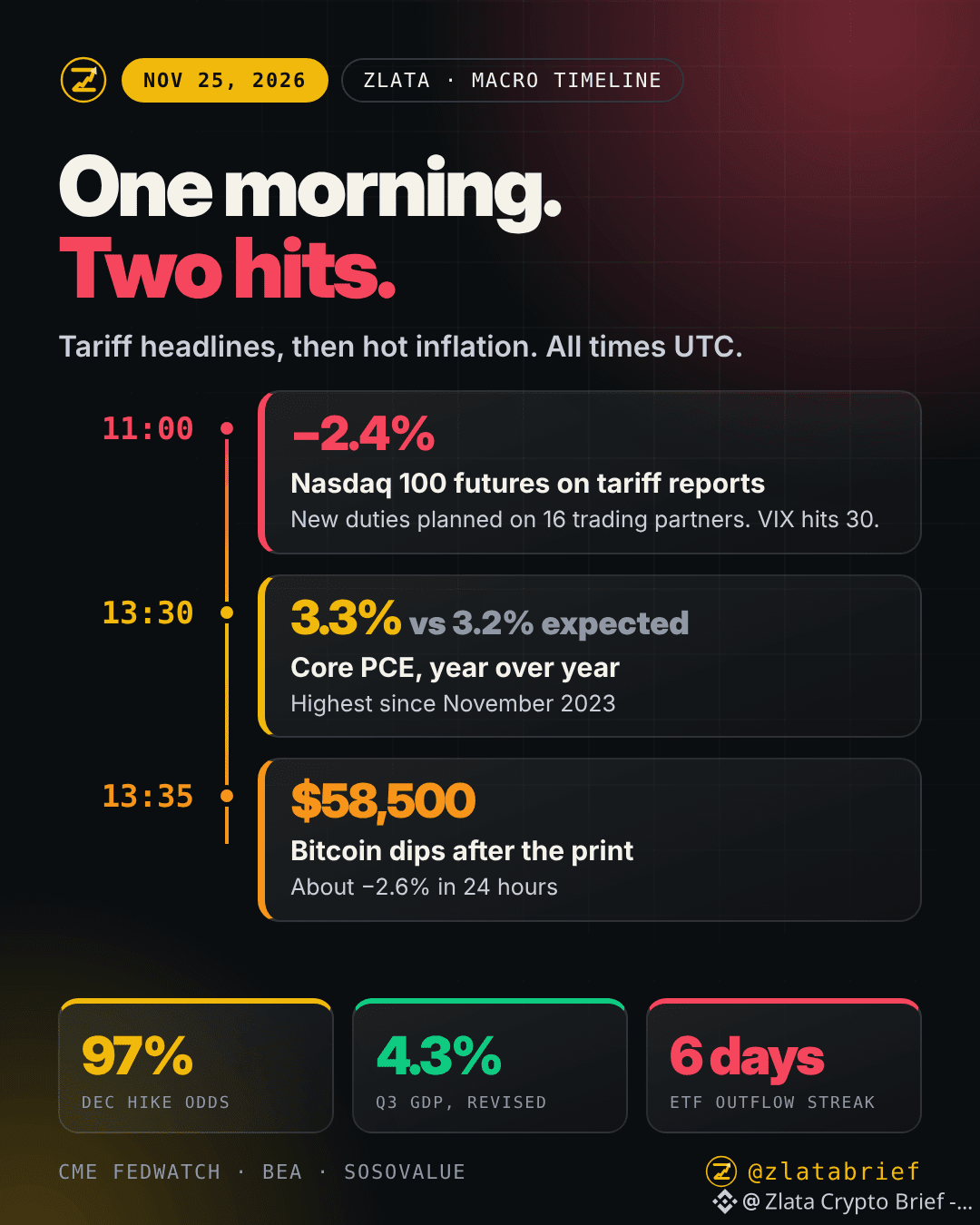
3.3% core PCE and a tariff plan. Same morning, same $BTC.
Wednesday, in UTC:
→ By 11:00, reports say Washington is preparing new tariffs on 16 trading partners. Nasdaq 100 futures slide 2.4% and the VIX tags 30.
→ 13:30: core PCE prints 3.3% y/y vs 3.2% expected. Highest since November 2023.
→ 13:35: $BTC dips to about $58,500.
The twist? Q3 GDP got revised up to 4.3% and jobless claims fell to 186K. Strong growth with sticky prices is the exact mix that keeps a December hike at 97% on CME FedWatch.
So for now $BTC trades on macro headlines. Spot ETFs are on six straight outflow days, and US markets close tomorrow for Thanksgiving. Thin books, big headlines.
My read: a $55K to $62K range into the Dec 8–9 Fed meeting. A daily close under Saturday's $55.1K low opens the next leg down. I'm wrong if BTC closes a day above $62K.
Which hurts $BTC more into December: tariffs or a Fed hike? 👇
#BitcoinAndStocksSlipAgainAmidTrump’sTariffPlans #JensenHuangSaysNvidiaDoesn’tNeedASuccessionPlan #AnthropicBreaksBelowIPOPriceAmidAISlump #UkraineParliamentPassesVirtualAssetLegalizationBill #Write2Earn
Educational content, not financial advice. DYOR.
{future}(BTCUSDT)
{spot}(BTCUSDT)
Follow @Zlata Crypto Brief - Data Over Hype - follow back!
3.3% core PCE and a tariff plan. Same morning, same $BTC .
Wednesday, in UTC:
→ By 11:00, reports say Washington is preparing new tariffs on 16 trading partners. Nasdaq 100 futures slide 2.4% and the VIX tags 30.
→ 13:30: core PCE prints 3.3% y/y vs 3.2% expected. Highest since November 2023.
→ 13:35: $BTC dips to about $58,500.
The twist? Q3 GDP got revised up to 4.3% and jobless claims fell to 186K. Strong growth with sticky prices is the exact mix that keeps a December hike at 97% on CME FedWatch.
So for now $BTC trades on macro headlines. Spot ETFs are on six straight outflow days, and US markets close tomorrow for Thanksgiving. Thin books, big headlines.
My read: a $55K to $62K range into the Dec 8–9 Fed meeting. A daily close under Saturday's $55.1K low opens the next leg down. I'm wrong if BTC closes a day above $62K.
Which hurts $BTC more into December: tariffs or a Fed hike? 👇
#BitcoinAndStocksSlipAgainAmidTrump’sTariffPlans #JensenHuangSaysNvidiaDoesn’tNeedASuccessionPlan #AnthropicBreaksBelowIPOPriceAmidAISlump #UkraineParliamentPassesVirtualAssetLegalizationBill #Write2Earn
Educational content, not financial advice. DYOR.
2
3

·
--
#UkraineParliamentPassesVirtualAssetLegalizationBill
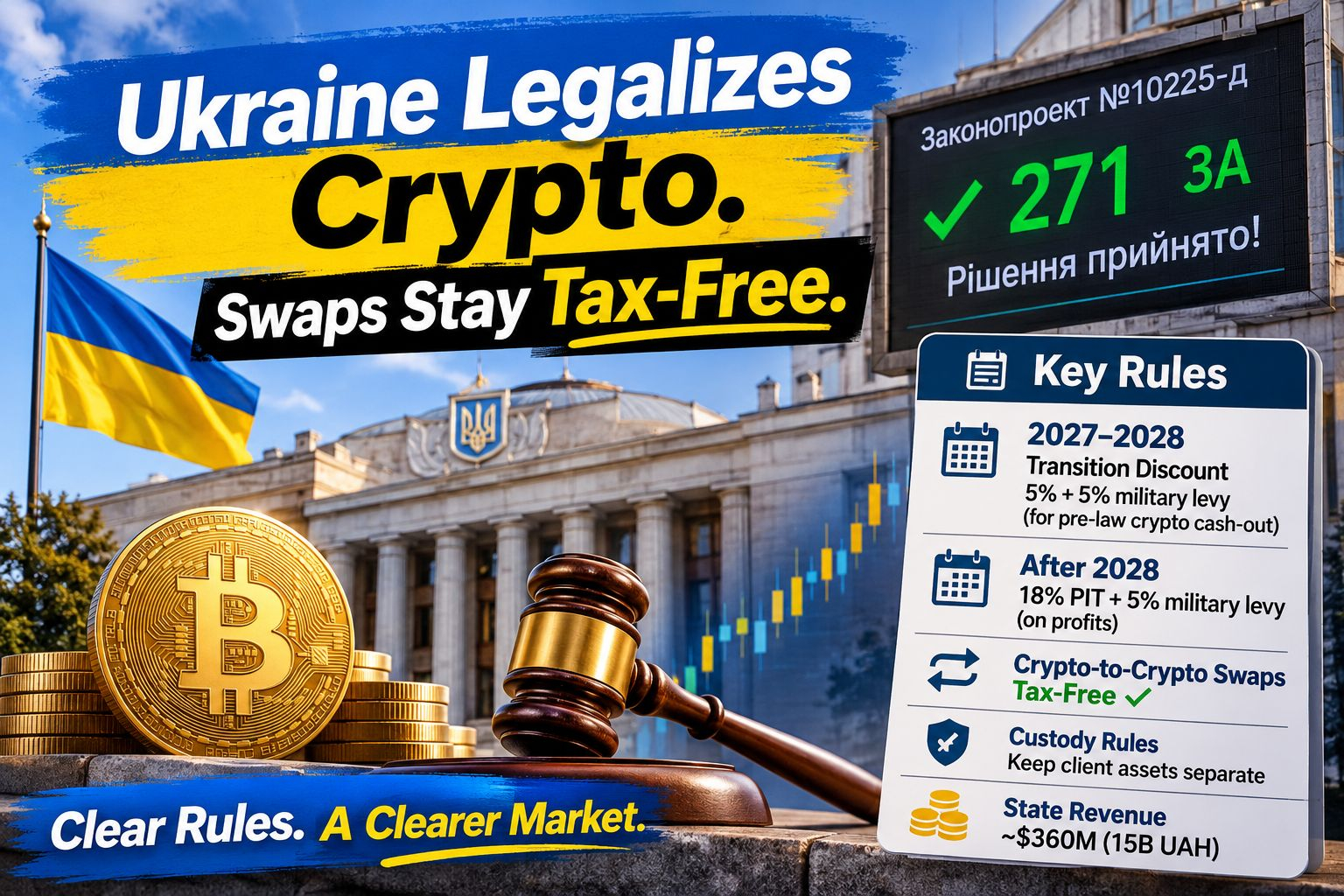
🇺🇦 Ukraine Legalizes Crypto. Swaps Stay Tax-Free.
The Verkhovna Rada passed Bill 10225-d on Nov 25. The gray zone finally gets a rulebook, modeled on the EU's MiCA.
📌 271 votes in favor. The law takes effect in July 2027 once the President signs. Four years of limbo ended in a single vote.
What traders need to know:
Transition discount (2027–2028): Crypto bought before the law takes effect and cashed out to fiat is taxed at 5% + 5% military levy.
After 2028: The standard rate is 18% personal income tax + 5% military levy on profits.
Crypto-to-crypto swaps stay tax-free. No tax event when trading one crypto for another. Tax only applies when exiting to fiat.
Custody rules: Exchanges and custodians must keep client assets separate from company funds.
Budget impact: The state expects roughly $360M (15B UAH) in new revenue.
Square Insight:
Legalization isn't a gift. Expect tighter KYC and a tax bill with a military levy attached.
But clear rules are what large capital waits for. Segregated custody is worth more to users than any fee discount.
It lands the same week as the CFTC's moves in the US and Korea's reforms. The gray zone is shrinking everywhere at once.
Taxing only at the fiat exit while leaving swaps alone: smart design, or a loophole regulators will quietly close once revenue targets slip?
Would you want this model in your country?
$BTC
{future}(BTCUSDT)
$ETH
{future}(ETHUSDT)
$USDT
NFA / DYOR
#UkraineParliamentPassesVirtualAssetLegalizationBill
🇺🇦 Ukraine Legalizes Crypto. Swaps Stay Tax-Free.
The Verkhovna Rada passed Bill 10225-d on Nov 25. The gray zone finally gets a rulebook, modeled on the EU's MiCA.
📌 271 votes in favor. The law takes effect in July 2027 once the President signs. Four years of limbo ended in a single vote.
What traders need to know:
Transition discount (2027–2028): Crypto bought before the law takes effect and cashed out to fiat is taxed at 5% + 5% military levy.
After 2028: The standard rate is 18% personal income tax + 5% military levy on profits.
Crypto-to-crypto swaps stay tax-free. No tax event when trading one crypto for another. Tax only applies when exiting to fiat.
Custody rules: Exchanges and custodians must keep client assets separate from company funds.
Budget impact: The state expects roughly $360M (15B UAH) in new revenue.
Square Insight:
Legalization isn't a gift. Expect tighter KYC and a tax bill with a military levy attached.
But clear rules are what large capital waits for. Segregated custody is worth more to users than any fee discount.
It lands the same week as the CFTC's moves in the US and Korea's reforms. The gray zone is shrinking everywhere at once.
Taxing only at the fiat exit while leaving swaps alone: smart design, or a loophole regulators will quietly close once revenue targets slip?
Would you want this model in your country?
$BTC
$ETH
$USDT
NFA / DYOR
93



Article
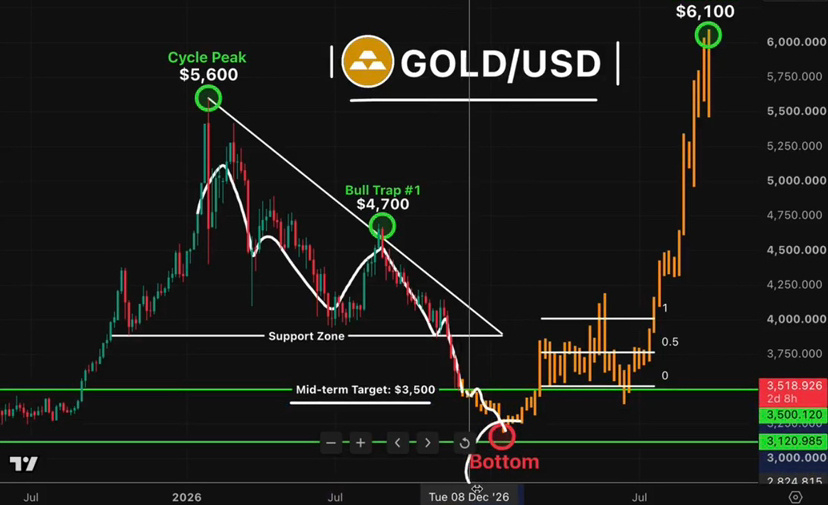
May be Bottom is 2500 if 3100 Breaks. Rotating in Social Media. but DYOR. THE BEST BUY ZONE ISN'T HERE YET
Total negativity across all markets continues
In just 15 days, $XAU lost ~16%
This morning, price hit a potential reversal zone
But expecting an instant reversal is foolish
Based on that, my mid-term roadmap looks like this:
-> BOTTOM in the $3,150-$3,500 zone
-> Move above it
-> 2-3 months of accumulation
-> Break $4,250 + rally to final target of $6,100
Waiting for a breakdown of $3,500 support
Then a long BOTTOM formation + accumulation phase begins
#BitcoinAndStocksSlipAgainAmidTrump’sTariffPlans #WillOctCorePCEShiftFedHikeExpectations? #AnthropicBreaksBelowIPOPriceAmidAISlump #UkraineParliamentPassesVirtualAssetLegalizationBill #SBISolanaGlobalLaunchesInJapanOnChainFinanceMarket
May be Bottom is 2500 if 3100 Breaks. Rotating in Social Media. but DYOR.
THE BEST BUY ZONE ISN'T HERE YET
Total negativity across all markets continues
In just 15 days, $XAU lost ~16%
This morning, price hit a potential reversal zone
But expecting an instant reversal is foolish
Based on that, my mid-term roadmap looks like this:
-> BOTTOM in the $3,150-$3,500 zone
-> Move above it
-> 2-3 months of accumulation
-> Break $4,250 + rally to final target of $6,100
Waiting for a breakdown of $3,500 support
Then a long BOTTOM formation + accumulation phase begins
#BitcoinAndStocksSlipAgainAmidTrump’sTariffPlans #WillOctCorePCEShiftFedHikeExpectations? #AnthropicBreaksBelowIPOPriceAmidAISlump #UkraineParliamentPassesVirtualAssetLegalizationBill #SBISolanaGlobalLaunchesInJapanOnChainFinanceMarket
145
Article
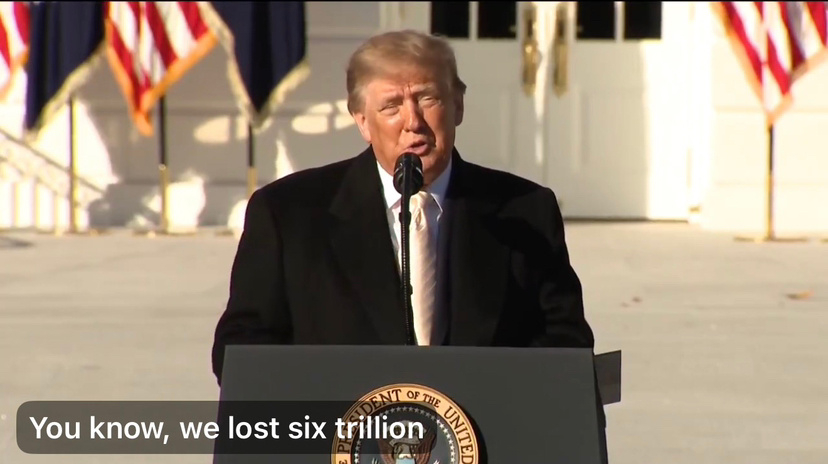
6T Must Be Recovered from Markets.🇪🇺🇺🇸 BREAKING: NEW TARIFFS ON CHINA & THE EU
Folks, the 2025 playbook is back on the table.
🌙 YOUR NIGHT BETWEEN TARIFFS AND NVIDIA
⏳ In 6 days, Jensen Huang will be in front of Congress; in 14 days, the Fed decides.
→ 📉 The Nasdaq 100 loses 2 percent, Nvidia 5.86 percent to 155.38 dollars. A quarter of Monday's jump is gone again.
→ 📈 The Dow closes up 0.85 percent. Money is moving out of chips and into the rest of the market.
→ 🇩🇪 The DAX falls 1.26 percent, Milan 1.84. Europe pays for the tariff report first.
→ 🟠 Bitcoin falls below 60,000 dollars, tonight 59,144. In 24 hours, 351 million dollars were liquidated, 284 million of that longs.
→ 🟠 Bitcoin ETFs have already seen outflows of over 4 billion dollars in November.
→ 📉 Tonight, S&P and Nasdaq futures are back in the red, Nvidia after hours at 151.95 dollars.
⭐ SPECIAL: TRUMP BRINGS THE TARIFFS BACK
According to the Wall Street Journal, Washington is preparing new tariffs on China, the EU and 14 other countries. Including Japan, Taiwan, Mexico, Switzerland and Norway.
The EU, Japan and South Korea are supposed to pay 15 percent or less, China more. Steel, aluminum and cars stay out. All of it would come on top of the 10 to 12.5 percent from July. Jamieson Greer, Trump's trade representative, is supposed to present it; as of tonight he has published nothing.
You can take me out of Hamburg, but you can't take Hamburg out of me. When it comes to tariffs, I look first at who builds and ships. Taiwan, South Korea, Malaysia and Mexico are on the list; the AI supply chain runs through these four. To me, that explains why Nvidia fell almost three times as hard as the Nasdaq 100 yesterday.
📖 THE 2025 PLAYBOOK
→ April 2: Tariffs on almost the whole world. The S&P 500 loses 12 percent in four trading days, Bitcoin 7.5.
→ By April 11, the yield on ten-year US bonds rises from 4.01 to 4.48 percent. Stocks and bonds are sold together.
→ The counter-tariffs escalate, up to 145 percent on China and 125 on the US.
→ April 9: Trump pauses for 90 days. The S&P 500 jumps 9.5 percent in one day, Bitcoin 8.2.
→ May 12: The US cuts to 30 percent, China to 10. The S&P 500 closes above the level of April 2.
🔀 WHAT'S DIFFERENT IN 2026
In April 2025 the Fed stood still and started cutting in September. Today the policy rate is at 4 percent; on Polymarket, 95.8 percent are on a hike by year-end. Tariffs make imports more expensive, which makes it easier for the Fed to hike.
The S&P 500 is already 7.9 percent below its record. China has only suspended its 24 percent counter-tariff until January 10.
According to the Wall Street Journal, the rates are supposed to stay close to those that applied until the Supreme Court ruling. The tariff itself would be a smaller shock than in April 2025.
What I find more dangerous is that the brake is missing. In 2025, a yield of 4.48 percent was enough, and after seven days came the pause. Today the ten-year yield is at 4.9 percent, and Trump is doubling down. Anyone betting on the pause is betting that something other than the bond market will stop him this time.
⭐ SPECIAL 2: TRUMP FLIRTS WITH NVIDIA
Tuesday, Oval Office, interview with the New York Post. Trump says he has thought about a state stake in Nvidia; he hasn't proposed it yet. "It may not be too late yet."
A pardon for Jensen Huang is "always an option"; it probably won't be needed. Huang doesn't need the Fifth Amendment in front of Congress; he should tell the truth.
According to the Financial Times, Trump made up to 15 million dollars on his own Nvidia shares from Huang's return on Monday, at the low end 1.3 million. Now he is holding out the prospect of a pardon for Huang before he testifies, and is openly thinking about a piece of the company for the state.
Anyone who holds a world ETF has Nvidia in it. With the state as a co-owner, the owner would be sitting in the White House when it comes to export rules and China business.
On November 12 I said on the stream that I no longer enter on the short side with Nvidia below 160 dollars. Yesterday the stock closed at 155.38. That stays.
The most important analyst for Nvidia now sits in the Oval Office.
📊 SUPPORT & RESISTANCE
🚦 0 of 7 daily signals green. Bitcoin closed on Tuesday at 59,832 dollars.
→ 🔴 No change. All seven are running red, the ADX is at 49, the RSI at 24.6. The downtrend is strong and oversold at the same time.
→ 🟢 58,800 → Pivot S1, the first hold below the price.
→ 🟢 57,800 → Pivot S2 and the July low, my line.
→ 🔴 61,300 → Pivot R1, where Bitcoin closed on Monday.
→ 🔴 62,700 → Pivot R2.
💡 TRADING IMPLICATION
→ If Bitcoin closes today above 58,800 → room up to 61,300.
→ If it closes below → next hold 57,800.
→ If it closes above 61,300 → 62,700 is the next zone.
🟠 BITCOIN AND MY MODE
Risk stays off for me. On Monday Bitcoin didn't join the Nvidia jump; on Tuesday it did join the setback.
What I don't do today: buy before 14:30. I keep buying spot at 60,000 in small tranches, without leverage, but only after the number.
My mark remains the July low at 57,800 on the weekly close, in the night of November 30 at 1 a.m. My bet: Bitcoin closes the week above it.
My futures fear and greed is at 13, extreme fear.
In 2025 the bond market stopped Trump. Who stops him in 2026, I still don't know, which is why I only buy in tranches.
🎯 FOCUS OF THE DAY: PCE AT 14:30
Today the October PCE price data comes out, the inflation number the Fed looks at, and the last big one before December 9.
A monthly increase of 0.3 percent is expected, the core rate at 3.2 to 3.3 percent after 3.1 in September. What happens after that depends on the core rate:
→ 0.4 percent or more → the hike on December 9 is set, and it's about the next one.
→ 0.3 percent → that's already in the prices, then the tariffs lead again.
→ 0.2 percent or less → the first relief in weeks, for Bitcoin the test of 61,300.
On Sunday I said on the stream that this number is the most important of the week for me. Tomorrow Wall Street stays closed for Thanksgiving.
And our money is waiting today on two papers: the inflation at 14:30 and Greer's tariff list, whenever it comes.
Not financial investment advice!
#BitcoinAndStocksSlipAgainAmidTrump’sTariffPlans #WillOctCorePCEShiftFedHikeExpectations? #AnthropicBreaksBelowIPOPriceAmidAISlump #UkraineParliamentPassesVirtualAssetLegalizationBill #SouthKoreaPlansToRequireCryptoReferralMarketersToRegister
6T Must Be Recovered from Markets.
🇪🇺🇺🇸 BREAKING: NEW TARIFFS ON CHINA & THE EU
Folks, the 2025 playbook is back on the table.
🌙 YOUR NIGHT BETWEEN TARIFFS AND NVIDIA
⏳ In 6 days, Jensen Huang will be in front of Congress; in 14 days, the Fed decides.
→ 📉 The Nasdaq 100 loses 2 percent, Nvidia 5.86 percent to 155.38 dollars. A quarter of Monday's jump is gone again.
→ 📈 The Dow closes up 0.85 percent. Money is moving out of chips and into the rest of the market.
→ 🇩🇪 The DAX falls 1.26 percent, Milan 1.84. Europe pays for the tariff report first.
→ 🟠 Bitcoin falls below 60,000 dollars, tonight 59,144. In 24 hours, 351 million dollars were liquidated, 284 million of that longs.
→ 🟠 Bitcoin ETFs have already seen outflows of over 4 billion dollars in November.
→ 📉 Tonight, S&P and Nasdaq futures are back in the red, Nvidia after hours at 151.95 dollars.
⭐ SPECIAL: TRUMP BRINGS THE TARIFFS BACK
According to the Wall Street Journal, Washington is preparing new tariffs on China, the EU and 14 other countries. Including Japan, Taiwan, Mexico, Switzerland and Norway.
The EU, Japan and South Korea are supposed to pay 15 percent or less, China more. Steel, aluminum and cars stay out. All of it would come on top of the 10 to 12.5 percent from July. Jamieson Greer, Trump's trade representative, is supposed to present it; as of tonight he has published nothing.
You can take me out of Hamburg, but you can't take Hamburg out of me. When it comes to tariffs, I look first at who builds and ships. Taiwan, South Korea, Malaysia and Mexico are on the list; the AI supply chain runs through these four. To me, that explains why Nvidia fell almost three times as hard as the Nasdaq 100 yesterday.
📖 THE 2025 PLAYBOOK
→ April 2: Tariffs on almost the whole world. The S&P 500 loses 12 percent in four trading days, Bitcoin 7.5.
→ By April 11, the yield on ten-year US bonds rises from 4.01 to 4.48 percent. Stocks and bonds are sold together.
→ The counter-tariffs escalate, up to 145 percent on China and 125 on the US.
→ April 9: Trump pauses for 90 days. The S&P 500 jumps 9.5 percent in one day, Bitcoin 8.2.
→ May 12: The US cuts to 30 percent, China to 10. The S&P 500 closes above the level of April 2.
🔀 WHAT'S DIFFERENT IN 2026
In April 2025 the Fed stood still and started cutting in September. Today the policy rate is at 4 percent; on Polymarket, 95.8 percent are on a hike by year-end. Tariffs make imports more expensive, which makes it easier for the Fed to hike.
The S&P 500 is already 7.9 percent below its record. China has only suspended its 24 percent counter-tariff until January 10.
According to the Wall Street Journal, the rates are supposed to stay close to those that applied until the Supreme Court ruling. The tariff itself would be a smaller shock than in April 2025.
What I find more dangerous is that the brake is missing. In 2025, a yield of 4.48 percent was enough, and after seven days came the pause. Today the ten-year yield is at 4.9 percent, and Trump is doubling down. Anyone betting on the pause is betting that something other than the bond market will stop him this time.
⭐ SPECIAL 2: TRUMP FLIRTS WITH NVIDIA
Tuesday, Oval Office, interview with the New York Post. Trump says he has thought about a state stake in Nvidia; he hasn't proposed it yet. "It may not be too late yet."
A pardon for Jensen Huang is "always an option"; it probably won't be needed. Huang doesn't need the Fifth Amendment in front of Congress; he should tell the truth.
According to the Financial Times, Trump made up to 15 million dollars on his own Nvidia shares from Huang's return on Monday, at the low end 1.3 million. Now he is holding out the prospect of a pardon for Huang before he testifies, and is openly thinking about a piece of the company for the state.
Anyone who holds a world ETF has Nvidia in it. With the state as a co-owner, the owner would be sitting in the White House when it comes to export rules and China business.
On November 12 I said on the stream that I no longer enter on the short side with Nvidia below 160 dollars. Yesterday the stock closed at 155.38. That stays.
The most important analyst for Nvidia now sits in the Oval Office.
📊 SUPPORT & RESISTANCE
🚦 0 of 7 daily signals green. Bitcoin closed on Tuesday at 59,832 dollars.
→ 🔴 No change. All seven are running red, the ADX is at 49, the RSI at 24.6. The downtrend is strong and oversold at the same time.
→ 🟢 58,800 → Pivot S1, the first hold below the price.
→ 🟢 57,800 → Pivot S2 and the July low, my line.
→ 🔴 61,300 → Pivot R1, where Bitcoin closed on Monday.
→ 🔴 62,700 → Pivot R2.
💡 TRADING IMPLICATION
→ If Bitcoin closes today above 58,800 → room up to 61,300.
→ If it closes below → next hold 57,800.
→ If it closes above 61,300 → 62,700 is the next zone.
🟠 BITCOIN AND MY MODE
Risk stays off for me. On Monday Bitcoin didn't join the Nvidia jump; on Tuesday it did join the setback.
What I don't do today: buy before 14:30. I keep buying spot at 60,000 in small tranches, without leverage, but only after the number.
My mark remains the July low at 57,800 on the weekly close, in the night of November 30 at 1 a.m. My bet: Bitcoin closes the week above it.
My futures fear and greed is at 13, extreme fear.
In 2025 the bond market stopped Trump. Who stops him in 2026, I still don't know, which is why I only buy in tranches.
🎯 FOCUS OF THE DAY: PCE AT 14:30
Today the October PCE price data comes out, the inflation number the Fed looks at, and the last big one before December 9.
A monthly increase of 0.3 percent is expected, the core rate at 3.2 to 3.3 percent after 3.1 in September. What happens after that depends on the core rate:
→ 0.4 percent or more → the hike on December 9 is set, and it's about the next one.
→ 0.3 percent → that's already in the prices, then the tariffs lead again.
→ 0.2 percent or less → the first relief in weeks, for Bitcoin the test of 61,300.
On Sunday I said on the stream that this number is the most important of the week for me. Tomorrow Wall Street stays closed for Thanksgiving.
And our money is waiting today on two papers: the inflation at 14:30 and Greer's tariff list, whenever it comes.
Not financial investment advice!
#BitcoinAndStocksSlipAgainAmidTrump’sTariffPlans #WillOctCorePCEShiftFedHikeExpectations? #AnthropicBreaksBelowIPOPriceAmidAISlump #UkraineParliamentPassesVirtualAssetLegalizationBill #SouthKoreaPlansToRequireCryptoReferralMarketersToRegister
108

Article
🚨 CZ SAYS ELIZABETH WARREN DECLARED WAR ON #CRYPTO ONE WEEK BEFORE HE WAS SENTENCED. TWO MONTHS LATER BOTH PARTIES WERE PRO-CRYPTO. AND HE WAS STILL IN PRISON.
"A week before I was sentenced, Elizabeth Warren declares a war on crypto."
"And then the judge sentences me and then I went to prison."
"And then by June, Donald Trump is pro-crypto. By end of June, both parties are pro-crypto."
"I'm still sitting in prison like, what the hell happened?"
"Should I have just waited for two months?"
HE SAID THIS ON STAGE IN 2024, WEEKS AFTER HIS RELEASE.
THE FOUNDER OF THE BIGGEST EXCHANGE ON EARTH.
4 MONTHS IN A US PRISON. A $4 BILLION FINE FOR BINANCE.
THEN A PRESIDENTIAL PARDON.
NOW WARREN IS THE FRONT-RUNNER TO RUN THE SENATE BANKING COMMITTEE.
DID CZ JUST GET UNLUCKY WITH THE TIMING… OR IS THE WAR ABOUT TO START AGAIN? 👀
#BitcoinAndStocksSlipAgainAmidTrump’sTariffPlans
#JensenHuangSaysNvidiaDoesn’tNeedASuccessionPlan
#CorePCEBeatLiftsFedHikeOdds
#AnthropicBreaksBelowIPOPriceAmidAISlump
#UkraineParliamentPassesVirtualAssetLegalizationBill
$BTC
{spot}(BTCUSDT)
🚨 CZ SAYS ELIZABETH WARREN DECLARED WAR ON #CRYPTO
ONE WEEK BEFORE HE WAS SENTENCED. TWO MONTHS LATER BOTH PARTIES WERE PRO-CRYPTO. AND HE WAS STILL IN PRISON.
"A week before I was sentenced, Elizabeth Warren declares a war on crypto."
"And then the judge sentences me and then I went to prison."
"And then by June, Donald Trump is pro-crypto. By end of June, both parties are pro-crypto."
"I'm still sitting in prison like, what the hell happened?"
"Should I have just waited for two months?"
HE SAID THIS ON STAGE IN 2024, WEEKS AFTER HIS RELEASE.
THE FOUNDER OF THE BIGGEST EXCHANGE ON EARTH.
4 MONTHS IN A US PRISON. A $4 BILLION FINE FOR BINANCE.
THEN A PRESIDENTIAL PARDON.
NOW WARREN IS THE FRONT-RUNNER TO RUN THE SENATE BANKING COMMITTEE.
DID CZ JUST GET UNLUCKY WITH THE TIMING… OR IS THE WAR ABOUT TO START AGAIN? 👀
#BitcoinAndStocksSlipAgainAmidTrump’sTariffPlans
#JensenHuangSaysNvidiaDoesn’tNeedASuccessionPlan
#CorePCEBeatLiftsFedHikeOdds
#AnthropicBreaksBelowIPOPriceAmidAISlump
#UkraineParliamentPassesVirtualAssetLegalizationBill
$BTC
116

·
--
What do you think of predictions? Are any of them useful? 🤔#BitcoinAndStocksSlipAgainAmidTrump’sTariffPlans #JensenHuangSaysNvidiaDoesn’tNeedASuccessionPlan #AnthropicBreaksBelowIPOPriceAmidAISlump #AnthropicBreaksBelowIPOPriceAmidAISlump #UkraineParliamentPassesVirtualAssetLegalizationBill
What do you think of predictions? Are any of them useful?
What do you think of predictions? Are any of them useful? 🤔
#BitcoinAndStocksSlipAgainAmidTrump’sTariffPlans #JensenHuangSaysNvidiaDoesn’tNeedASuccessionPlan #AnthropicBreaksBelowIPOPriceAmidAISlump #AnthropicBreaksBelowIPOPriceAmidAISlump #UkraineParliamentPassesVirtualAssetLegalizationBill
What do you think of predictions? Are any of them useful?
What do you think of predictions? Are any of them useful?
1
26

·
--
Bullish
$TRUMP The price of gold is going through a historic phase and stands at a crossroads… Don’t let gold catch you off guard
Gold is going through one of its most volatile periods this year, having lost around 7.7% in a week. All eyes are now on U.S. inflation data, which could determine its next direction. At times like these, the WarrenAI AI assistant can analyze a gold chart in seconds and identify the trend, support and resistance levels, and potential scenarios. Here’s how to use it, step by step.
{future}(TRUMPUSDT)
$XAU
{future}(XAUUSDT)
#BitcoinAndStocksSlipAgainAmidTrump’sTariffPlans #JensenHuangSaysNvidiaDoesn’tNeedASuccessionPlan #SouthKoreaProposesCryptoExchangeStaffUseOwnPlatform #SouthKoreaProposesCryptoExchangeStaffUseOwnPlatform #UkraineParliamentPassesVirtualAssetLegalizationBill
$TRUMP The price of gold is going through a historic phase and stands at a crossroads… Don’t let gold catch you off guard
Gold is going through one of its most volatile periods this year, having lost around 7.7% in a week. All eyes are now on U.S. inflation data, which could determine its next direction. At times like these, the WarrenAI AI assistant can analyze a gold chart in seconds and identify the trend, support and resistance levels, and potential scenarios. Here’s how to use it, step by step.
$XAU
#BitcoinAndStocksSlipAgainAmidTrump’sTariffPlans #JensenHuangSaysNvidiaDoesn’tNeedASuccessionPlan #SouthKoreaProposesCryptoExchangeStaffUseOwnPlatform #SouthKoreaProposesCryptoExchangeStaffUseOwnPlatform #UkraineParliamentPassesVirtualAssetLegalizationBill

101

·
--
Bearish
#UkraineParliamentPassesVirtualAssetLegalizationBill
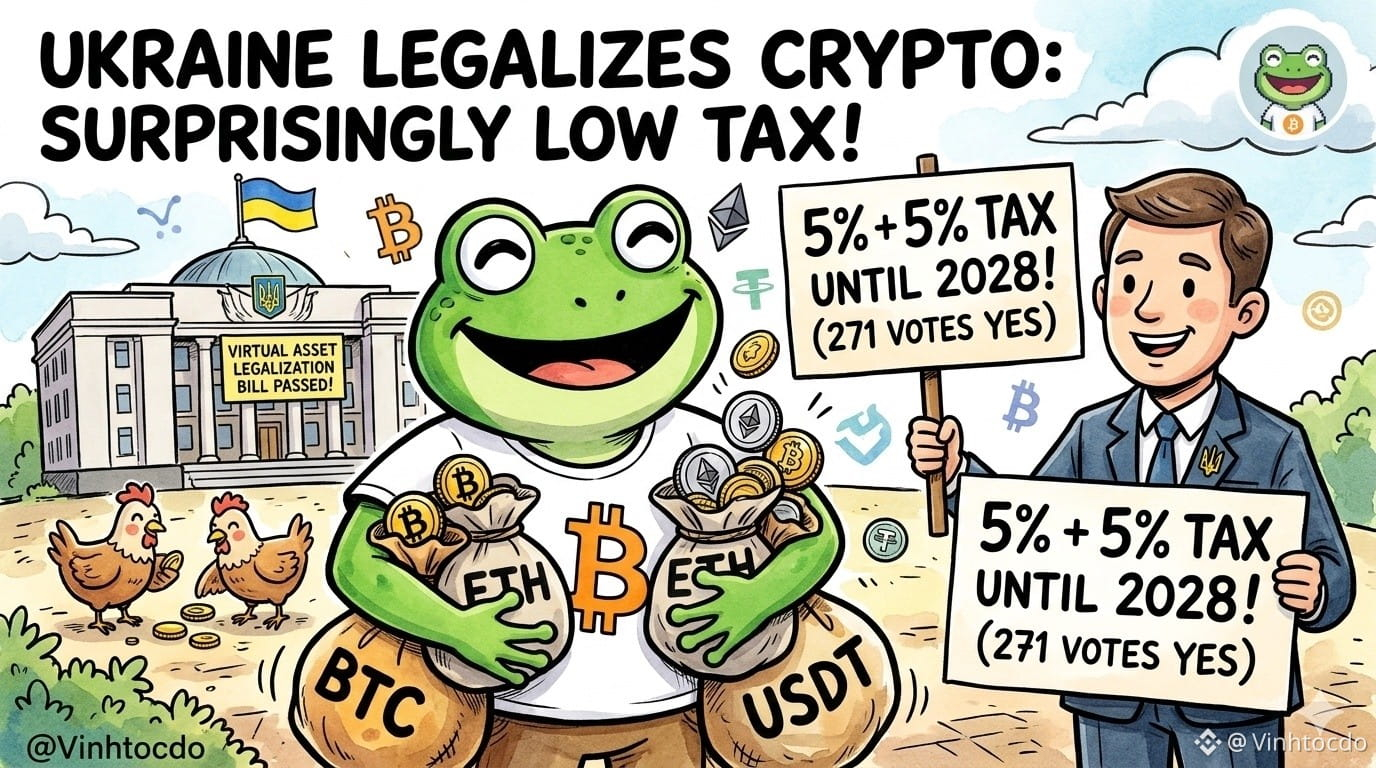
UKRAINE OFFICIALLY LEGALIZES CRYPTO: SURPRISINGLY LOW TAXES!
Crypto holders in Ukraine can now trade legally with their heads held high! The country's parliament has just passed Draft Law No. 10225-d with 271 votes in favor, bringing the virtual asset market into an official legal framework.
Specifically, the law takes effect in July 2027 and applies an exceptionally "soft" preferential tax rate of 5% + 5% through the end of 2028 (only then rising to 18% + 5%). It is expected to bring in USD 360 million for the state budget, as pledged to the IMF and EU.
What should traders do? The global trend toward legalization is accelerating! Keep an eye on capital flowing into highly liquid top coins and prepare for a more transparent market. This is not financial advice.
Click below to trade and support me: $BTC $ETH
{spot}(ETHUSDT)
{future}(ETHUSDT)
$EVAA
{future}(EVAAUSDT)
#CryptoRegulation #Ukraine #CryptoNews #Web3 #Adoption #VINHTOCDO
#UkraineParliamentPassesVirtualAssetLegalizationBill
UKRAINE OFFICIALLY LEGALIZES CRYPTO: SURPRISINGLY LOW TAXES!
Crypto holders in Ukraine can now trade legally with their heads held high! The country's parliament has just passed Draft Law No. 10225-d with 271 votes in favor, bringing the virtual asset market into an official legal framework.
Specifically, the law takes effect in July 2027 and applies an exceptionally "soft" preferential tax rate of 5% + 5% through the end of 2028 (only then rising to 18% + 5%). It is expected to bring in USD 360 million for the state budget, as pledged to the IMF and EU.
What should traders do? The global trend toward legalization is accelerating! Keep an eye on capital flowing into highly liquid top coins and prepare for a more transparent market. This is not financial advice.
Click below to trade and support me: $BTC $ETH
$EVAA
#CryptoRegulation #Ukraine #CryptoNews #Web3 #Adoption #VINHTOCDO
2
535
Log in to explore more content
Join global crypto users on Binance Square
⚡️ Get latest and useful information about crypto.
💬 Trusted by the world’s largest crypto exchange.
👍 Discover real insights from verified creators.
Email / Phone number
Trending Topics
1
#CorePCEBeatLiftsFedHikeOdds
3,385 views
144 Discussing
2
#BitcoinAndStocksSlipAgainAmidTrump’sTariffPlans
88,856 views
1,108 Discussing
3
#JensenHuangSaysNvidiaDoesn’tNeedASuccessionPlan
48,705 views
663 Discussing
4
#NasdaqFuturesSlideMoreThan3%
304 views
32 Discussing
5
#USOctoberPCEPriceIndexAt0.3%MoM
155 views
42 Discussing
6
#BitcoinETFsPostRecord$4.94BNovemberOutflows
79 views
9 Discussing
7
#TetherInvestsInArgentinasLemon
234 views
10 Discussing
8
#AnthropicBreaksBelowIPOPriceAmidAISlump
162,921 views
1,442 Discussing
9
#SouthKoreaProposesCryptoExchangeStaffUseOwnPlatform
659 views
19 Discussing
10
#UkraineParliamentPassesVirtualAssetLegalizationBill
4,903 views
18 Discussing