
#tradingbasico
tradingbasico
1,863 views
12 Discussing
Hot
Latest

Spot vs. Futures: What’s the Real Difference?
With spot trading, you buy the asset. You pay the market price, receive your coins, and they’re yours. You can hold them, move them, and use them. Your risk is limited to what you invested: if the price drops, you only lose money if you sell.
With futures, you don’t buy anything. You open a contract that tracks the price and use leverage: with 1,000 USD, you can control 10,000 USD or more. You can make (or lose) money quickly, and if the market moves against you beyond your margin, your position gets liquidated. You can also bet on prices going down (short), which you can’t do directly with spot trading.
Spot means ownership. Futures means speculation with margin.
The key difference: with spot, you can’t be liquidated; with futures, leverage can be your ally or your downfall.
If you’re just starting out, build your judgment with spot first. Futures require timing, discipline, and risk management—things you only learn through experience.
Want more guides on trading and crypto? Follow us for clear, straightforward content.
#BasicTrading
1
490
What is margin in futures trading?
It’s the collateral you deposit to open a leveraged position. You don’t pay the full value of the asset; instead, you put up a fraction that lets you control a larger amount.
Example: You want to trade 10,000 USDT worth of BTC with 10x leverage. Your initial margin is 1,000 USDT. If BTC rises 5%, you make 500 USDT (50% of your margin). If it falls 5%, you lose 500 USDT.
There are two key types:
• Initial margin: what you need to open a position.
• Maintenance margin: the minimum required to keep the position open. If your margin falls below this level, your position is liquidated.
You can also choose between isolated margin (risk is limited to that position) and cross margin (your entire account is used as collateral).
Understanding margin is essential: it determines your actual exposure, how close you are to liquidation, and how much risk you take on per trade. High leverage = low margin = less room for error.
Follow us for more beginner’s guides to futures, leverage, and risk management.
#BasicTrading
98
What are a Long and a Short?
If you’re just getting started with trading, these are the two moves you need to master:
→ LONG: You buy because you think the price is going to rise. You profit if it goes up and lose if it goes down. It’s the most intuitive move. Example: BTC at 80k, you buy, it rises to 85k, you profit.
→ SHORT: You sell something you don’t own (the exchange lends it to you) because you think the price is going to fall. You profit if it goes down and lose if it goes up. Example: BTC at 80k, you open a short, it drops to 75k, you profit.
Key difference: a long has limited risk (you can lose at most 100%). A short has theoretically unlimited risk, because the price can rise without limit. That’s why shorting requires more discipline and a tight stop loss.
When do you use each one? When your analysis tells you the price is moving in that direction. Not because you “like” the project or because it’s “already fallen a lot.” The market doesn’t care about your beliefs.
Learn to read market structure, identify the direction, and choose the right tool. Long or short, what matters is that it aligns with what the chart is telling you.
Follow us for more practical, no-nonsense guides.
#BasicTrading
79

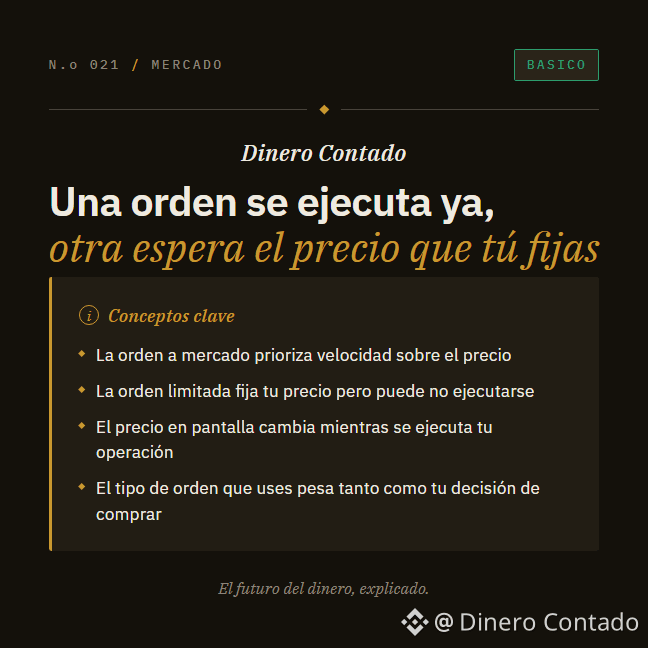
Two people buy $BTC in the same minute and end up paying different prices. One asked that the order be executed immediately, without setting a number. The other set a limit and waited until the market reached it.
The order book moves quickly. Ana asks for her purchase to be executed right away. The exchange gives her the best available price at that moment: she pays 84,700 USDT. That is a market order. It prioritizes speed over price.
Bruno is in no rush. He sets the maximum price he will pay: he puts 84,500 USDT and waits. If $BTC drops to that level, he buys. If it doesn’t, nothing happens. His order may remain unexecuted all day.
As of October 3, 2026, 11:45 UTC, BTC was trading at 84,659.46 USDT and had fallen 2.13% over the last 24 hours.
What Bruno did has a name: a limit order. You set the price. You give up execution certainty.
KEY CONCEPTS
- A market order prioritizes speed, not the price you see on the screen. The number can move while the order is being filled.
- A limit order fixes the price you’re willing to pay or receive. It may go unfilled if the market never reaches that level.
- Not all exchanges work the same. Standard ones match orders in a central order book. Peer-to-peer connects the counterparties directly, without holding the funds.
- Leaving $BTC stored on an exchange for years is not the same as having your own control. A hack won’t return your balance the way a bank would.
This difference explains why the price on the screen almost never matches the final price you pay. But the order’s mechanics matter as much as the decision to buy or sell.
Transparency: Binance may pay us a commission if you trade after clicking an asset symbol or a price link in this publication.
#TiposDeOrden #OrdenLimitada #MercadoCripto #SECProposesCryptoCustodyRules #TradingBasico
1
1.6k

·
--
Conservative Portfolio or Aggressive Portfolio? ⚖️ How to Split Your Cryptocurrencies
Finding the perfect balance in your portfolio is the difference between sleeping soundly or spending the night staring at candlesticks. There’s no one-size-fits-all strategy, but there are rules based on your investor profile:
🔴 The Safe Base (60% - 70%): To protect your capital in the long run, most of your portfolio should be in market giants like $BTC and #ETH . These are high-liquidity assets that lead every bullish cycle.
🟡 The Growth Engine (20% - 30%): This is where solid project altcoins with real ecosystems come into play (like Layer 1 networks, Artificial Intelligence, or RWA). They have higher volatility but offer greater return potential.
🟢 The Strategic Reserve (10%): Never keep 0% liquidity. Holding a percentage in stablecoins like $USDC allows you to capitalize on sudden market dips for discount buys.
The key to success isn't always winning, but surviving market corrections.
Let’s open the floor! What percentage of your portfolio do you currently have in Bitcoin and how much in Altcoins? I’m reading your thoughts below 👇
#CryptoPortfolio #inversioninteligente #TradingBasico #BinanceSquare #AltcoinSeason
102

·
--
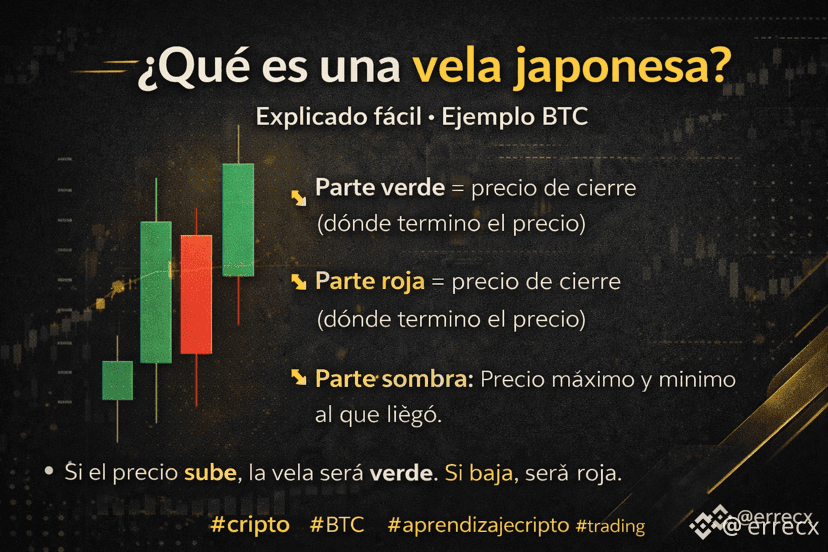
💡 What is a Japanese candlestick?
If you're just starting out in crypto, this is the first thing you need to understand 👇
When you see a chart filled with green and red bars, you're looking at Japanese candlesticks.
📌 Simple explanation:
🟢 Green candle
→ The price went up (closed higher than it opened)
🔴 Red candle
→ The price went down (closed lower than it opened)
🕯️ Parts of a candle:
• Body: opening and closing prices
• Upper wick: highest price
• Lower wick: lowest price
📊 Example with BTC:
If BTC opens at 40,000 and closes at 41,000 → green candle
If it opens at 41,000 and closes at 40,500 → red candle
👉 Understanding this is the first step to reading any chart.
📩 In the next post, you'll learn about support and resistance, explained just as easily.
$BTC
#TradingBasico
#BinanceSquare
#AprendeCripto
#CriptoFacil
3
316
Log in to explore more content
Join global crypto users on Binance Square
⚡️ Get latest and useful information about crypto.
💬 Trusted by the world’s largest crypto exchange.
👍 Discover real insights from verified creators.
Email / Phone number
Trending Topics
1
#BinanceReopensWithdrawalsForMoreAssets
40,831 views
888 Discussing
2
#AppleReportsMixedResults
24,503 views
631 Discussing
3
#BinanceHourlyDepositsExceedWithdrawals
10,738 views
281 Discussing
4
#PalantirSlides3PercentOn$2BRevenue
709 views
17 Discussing
5
#USMidtermElections
744,821 views
4,054 Discussing
6
#ThailandSECProposesDerivativesLicensesForDigitalAssetOperators
33 views
4 Discussing
7
#Nasdaq100EntersCorrection
1,293 views
48 Discussing
8
#USOctoberNFP-AreRateCutsStillPossible
126,414 views
1,041 Discussing
9
#Verify1to1BinanceReserves
116,353 views
768 Discussing
10
#YuanbiTechnologyAnnouncesUSDollarRDUSDPlan
975 views
24 Discussing