

#tokensnofungibles
tokensnofungibles
355 views
2 Discussing
Hot
Latest

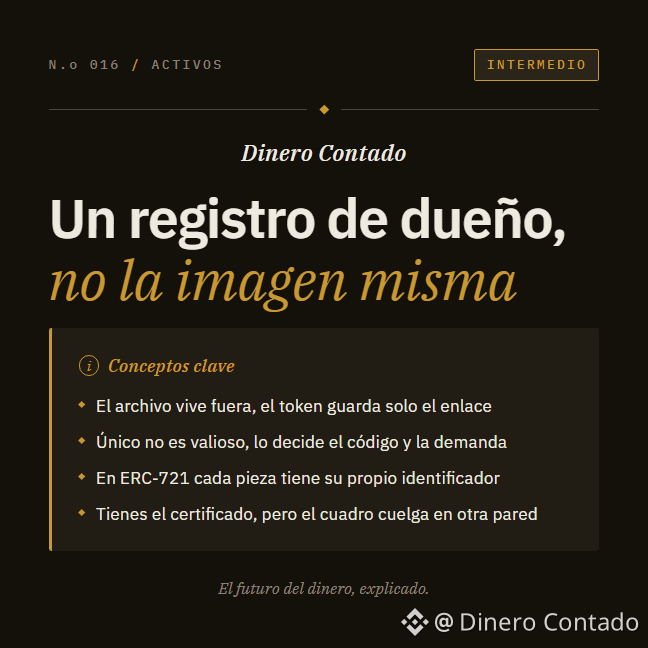
When you buy an NFT, you don’t buy the image.
You’re buying a record that says who owns that image. That’s it. The file almost never lives inside the chain; it’s too heavy. The token stores a link that points to it, stored on another server. If that server goes down, the token is still there. The image, not so much.
And here comes the same old mistake: thinking that “unique” is the same as “valuable.” It isn’t. Imagine someone mints the same photo ten times. Each copy has its own token number. That’s ten unique records, but the photo is identical in all ten. Uniqueness is set by the code. The price is set by someone else.
That—the record that distinguishes one piece from all the others—is what’s known as a non-fungible token, or NFT.
On Ethereum, most follow the ERC-721 standard: each piece has its own identifier, and you can’t swap one for another as easily as you can with $ETH.
KEY CONCEPTS
- An NFT is not the file: almost always, it’s a link pointing to a file stored off-chain.
- “Unique” is not synonymous with “valuable.” Uniqueness is guaranteed by the contract; the price is decided by demand.
- An NFT is not the same as a governance or utility token: those give voting power or access, but they don’t prove ownership of a piece.
- Not every NFT collection is 100% non-reproducible. Standards like ERC-1155 mix unique pieces with repeatable ones in the same contract.
It’s like having the certificate for a painting without the painting: the paper is real, but the artwork is still hanging on another wall.
Transparency: Binance may pay us a commission if you trade after clicking an asset symbol or a price link from this publication.
#TokensNoFungibles #ActivosDigitales #Coleccionables #EducacionCripto
When you buy an NFT, you don’t buy the image.
You’re buying a record that says who owns that image. That’s it. The file almost never lives inside the chain; it’s too heavy. The token stores a link that points to it, stored on another server. If that server goes down, the token is still there. The image, not so much.
And here comes the same old mistake: thinking that “unique” is the same as “valuable.” It isn’t. Imagine someone mints the same photo ten times. Each copy has its own token number. That’s ten unique records, but the photo is identical in all ten. Uniqueness is set by the code. The price is set by someone else.
That—the record that distinguishes one piece from all the others—is what’s known as a non-fungible token, or NFT.
On Ethereum, most follow the ERC-721 standard: each piece has its own identifier, and you can’t swap one for another as easily as you can with $ETH .
KEY CONCEPTS
- An NFT is not the file: almost always, it’s a link pointing to a file stored off-chain.
- “Unique” is not synonymous with “valuable.” Uniqueness is guaranteed by the contract; the price is decided by demand.
- An NFT is not the same as a governance or utility token: those give voting power or access, but they don’t prove ownership of a piece.
- Not every NFT collection is 100% non-reproducible. Standards like ERC-1155 mix unique pieces with repeatable ones in the same contract.
It’s like having the certificate for a painting without the painting: the paper is real, but the artwork is still hanging on another wall.
Transparency: Binance may pay us a commission if you trade after clicking an asset symbol or a price link from this publication.
#TokensNoFungibles #ActivosDigitales #Coleccionables #EducacionCripto
You’re buying a record that says who owns that image. That’s it. The file almost never lives inside the chain; it’s too heavy. The token stores a link that points to it, stored on another server. If that server goes down, the token is still there. The image, not so much.
And here comes the same old mistake: thinking that “unique” is the same as “valuable.” It isn’t. Imagine someone mints the same photo ten times. Each copy has its own token number. That’s ten unique records, but the photo is identical in all ten. Uniqueness is set by the code. The price is set by someone else.
That—the record that distinguishes one piece from all the others—is what’s known as a non-fungible token, or NFT.
On Ethereum, most follow the ERC-721 standard: each piece has its own identifier, and you can’t swap one for another as easily as you can with $ETH .
KEY CONCEPTS
- An NFT is not the file: almost always, it’s a link pointing to a file stored off-chain.
- “Unique” is not synonymous with “valuable.” Uniqueness is guaranteed by the contract; the price is decided by demand.
- An NFT is not the same as a governance or utility token: those give voting power or access, but they don’t prove ownership of a piece.
- Not every NFT collection is 100% non-reproducible. Standards like ERC-1155 mix unique pieces with repeatable ones in the same contract.
It’s like having the certificate for a painting without the painting: the paper is real, but the artwork is still hanging on another wall.
Transparency: Binance may pay us a commission if you trade after clicking an asset symbol or a price link from this publication.
#TokensNoFungibles #ActivosDigitales #Coleccionables #EducacionCripto
1
2
714
Log in to explore more content
Join global crypto users on Binance Square
⚡️ Get latest and useful information about crypto.
💬 Trusted by the world’s largest crypto exchange.
👍 Discover real insights from verified creators.
Email / Phone number
Trending Topics
1
#EarningsSeason
306,425 views
2,464 Discussing
2
#BitwiseLaunchesFirstSpotNEARETF
25,573 views
513 Discussing
3
#USJobOpeningsFallToFiveMonthLow
30,768 views
393 Discussing
4
#ECBToTestAIAgentsInDigitalEuroPayments
24,792 views
530 Discussing
5
#JapanFSABacksFourthStablecoinTradeSettlementPilot
28,399 views
559 Discussing
6
#BitgetHackerFailsToMoveStolenFunds
43,838 views
622 Discussing
7
#BitMineETHHoldingsTop6Million
36,478 views
718 Discussing
8
#StrategyAdds1666BTCHoldingsReach847666
30,254 views
500 Discussing
9
#NvidiaApproves$150BBuyback
5,384 views
75 Discussing
10
#OpenAIDelaysGPT6.1OverSafetyIssues
45,503 views
890 Discussing