
#southkoreaplanstorequiretethercirclelocalreserves
southkoreaplanstorequiretethercirclelocalreserves
Hot
Latest
·
--
#southkoreaplanstorequiretethercirclelocalreserves
South Korea to Tether and Circle: Open a branch, park reserves at home, and Korean users get paid first if things go wrong
Seoul just stopped asking nicely. The FSC's draft Digital Asset Basic Act, published Nov 26, tells foreign stablecoin issuers that direct issuance and redemption for Korean users comes with a local address and local collateral.
📌 The facts:
Branch + registration: USDT and USDC issuers must set up a Korean branch and register with the FSC before offering mint/redeem services to residents.
Reserves on Korean soil: A portion of backing assets (bank deposits, government bonds) must sit with Korean banks or custodians, ring-fenced from the company's own funds. Size is tied to the amount circulating in Korea and the home-country regime.
Local creditors first: If the Korean branch fails or is wound down, the reserves held in Korea go to Korean users and creditors before anyone else sees a cent.
Won stablecoins get a lane: Domestic issuers need banks holding over 50% of the consortium, 100% reserves and monthly audits. Cozy for banks, obviously.
It's still a draft heading to the National Assembly, so nothing changes tomorrow. But the direction is hard to miss: "our reserves are offshore, trust us" is losing its charm in large retail markets.
Square Insight: Localizing reserves protects users better than a PDF attestation ever did. The price is higher compliance costs and stablecoin liquidity split into regional pools, which is not exactly what "global dollar" was supposed to mean.
Korea trades more crypto per capita than almost anyone, so if this template spreads across Asia, does the dollar stablecoin become a patchwork of local-rule tokens, or do issuers just pay the toll and move on? Where do you land: $USDT and $USDC adapt, or $BTC quietly picks up the slack?
{future}(BTCUSDT)
{future}(USDCUSDT)
NFA / DYOR
#southkoreaplanstorequiretethercirclelocalreserves
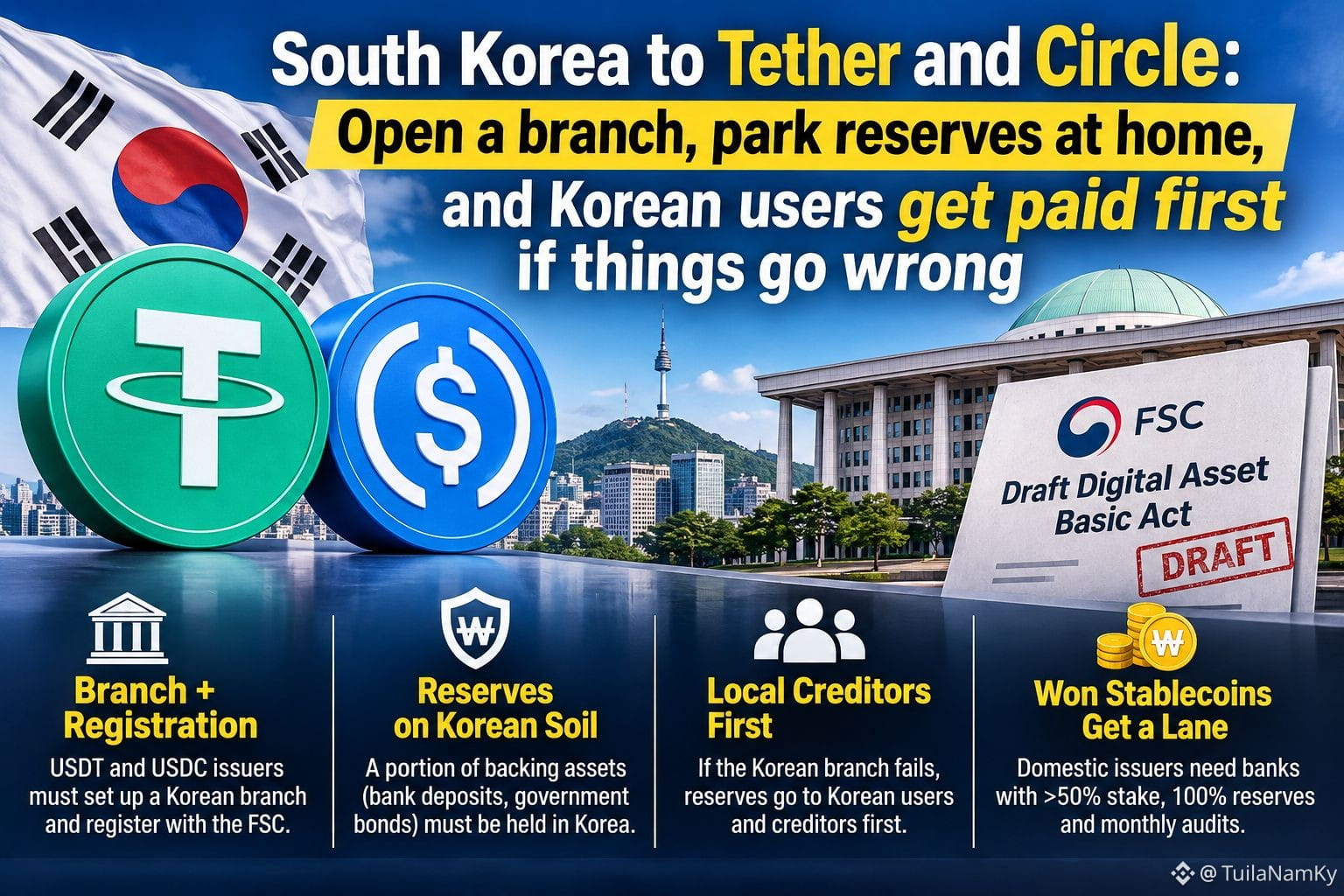
South Korea to Tether and Circle: Open a branch, park reserves at home, and Korean users get paid first if things go wrong
Seoul just stopped asking nicely. The FSC's draft Digital Asset Basic Act, published Nov 26, tells foreign stablecoin issuers that direct issuance and redemption for Korean users comes with a local address and local collateral.
📌 The facts:
Branch + registration: USDT and USDC issuers must set up a Korean branch and register with the FSC before offering mint/redeem services to residents.
Reserves on Korean soil: A portion of backing assets (bank deposits, government bonds) must sit with Korean banks or custodians, ring-fenced from the company's own funds. Size is tied to the amount circulating in Korea and the home-country regime.
Local creditors first: If the Korean branch fails or is wound down, the reserves held in Korea go to Korean users and creditors before anyone else sees a cent.
Won stablecoins get a lane: Domestic issuers need banks holding over 50% of the consortium, 100% reserves and monthly audits. Cozy for banks, obviously.
It's still a draft heading to the National Assembly, so nothing changes tomorrow. But the direction is hard to miss: "our reserves are offshore, trust us" is losing its charm in large retail markets.
Square Insight: Localizing reserves protects users better than a PDF attestation ever did. The price is higher compliance costs and stablecoin liquidity split into regional pools, which is not exactly what "global dollar" was supposed to mean.
Korea trades more crypto per capita than almost anyone, so if this template spreads across Asia, does the dollar stablecoin become a patchwork of local-rule tokens, or do issuers just pay the toll and move on? Where do you land: $USDT and $USDC adapt, or $BTC quietly picks up the slack?
NFA / DYOR
2.6k

·
--
#SouthKoreaPlansToRequireTetherCircleLocalReserves
🇰🇷 Branch, Register, Park Reserves: Korea's Terms for USDT
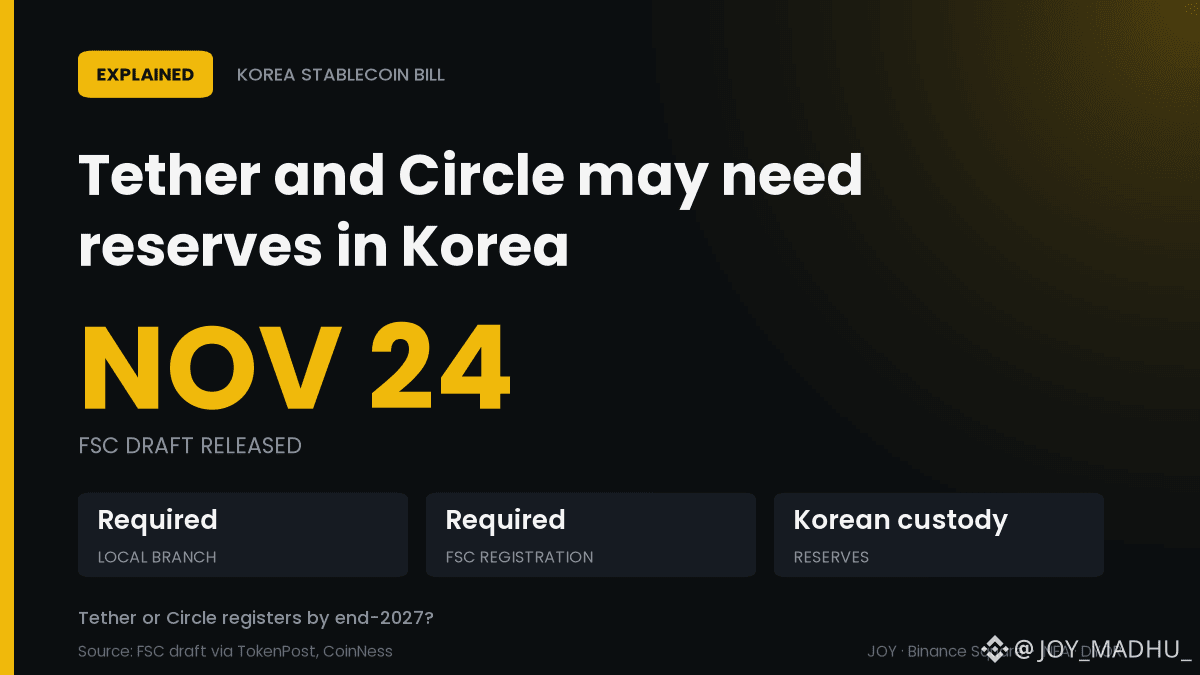
Korea's FSC draft would make offshore issuers like Tether and Circle keep reserves in Korea to serve residents.
🏦 Local branch plus FSC registration required
📊 Reserves segregated at Korean banks or trustees
⚠️ Size tied to home-country rules and Korean circulation
📅 Draft out Nov 24, still needs a National Assembly vote
Watch next: the same bill also ends Korea's 2017 ICO ban.
Tether or Circle registers with the FSC by end-2027, yes or no? 👇
$USDT $USDC
#SouthKoreaPlansToRequireTetherCircleLocalReserves #Stablecoins #Korea
23

·
--
Bullish
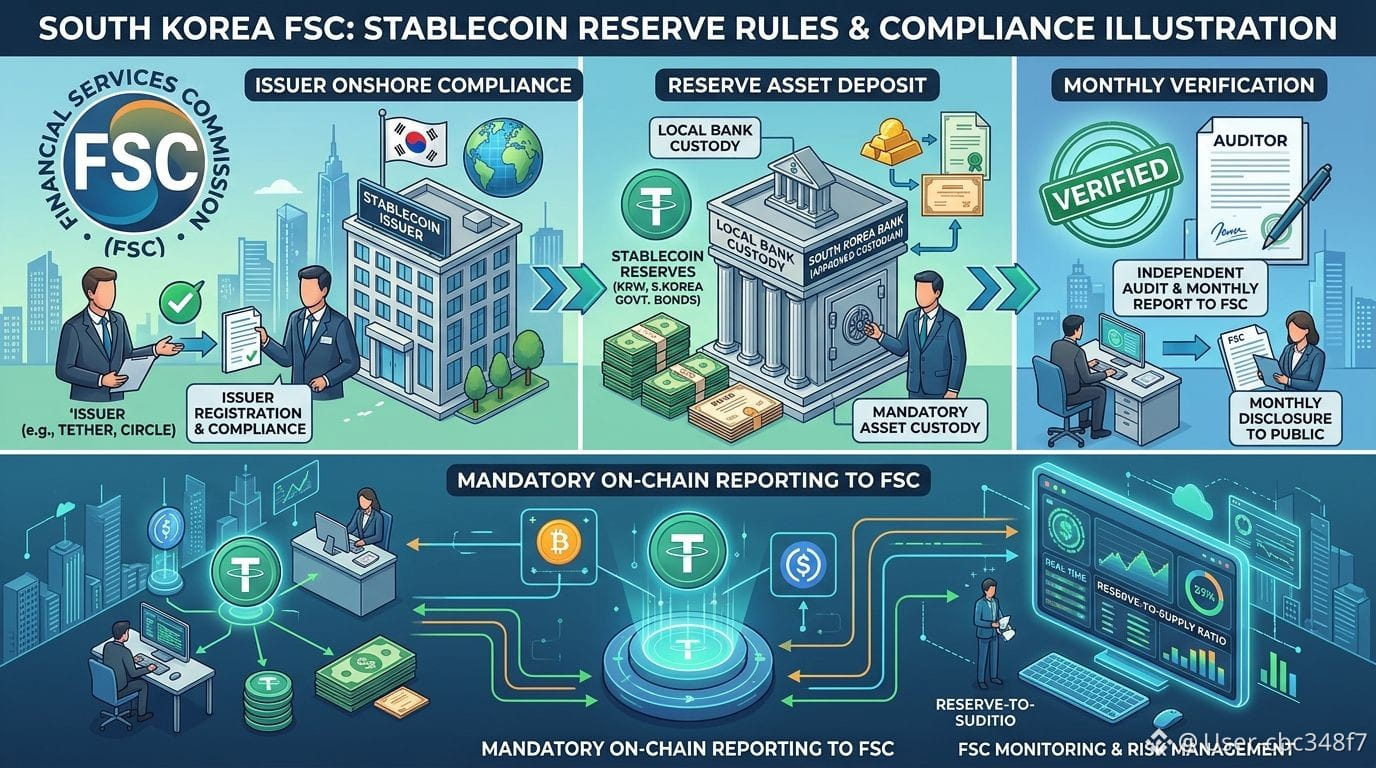
#southkoreaplanstorequiretethercirclelocalreserves South Korea’s Financial Services Commission draft rules would require overseas stablecoin issuers like Tether and Circle to set up local branches, register domestically, and keep segregated reserve assets with local custodians or banks if serving Korean users. Domestic assets would also prioritize local creditors in liquidation. The proposal raises compliance costs for foreign issuers while aiming to protect users and build onshore oversight. Watch legislative progress in Korea’s National Assembly closely. $BTC $ETH $HYPE
{spot}(HYPEUSDT)
{spot}(ETHUSDT)
{spot}(BTCUSDT)
#southkoreaplanstorequiretethercirclelocalreserves South Korea’s Financial Services Commission draft rules would require overseas stablecoin issuers like Tether and Circle to set up local branches, register domestically, and keep segregated reserve assets with local custodians or banks if serving Korean users. Domestic assets would also prioritize local creditors in liquidation. The proposal raises compliance costs for foreign issuers while aiming to protect users and build onshore oversight. Watch legislative progress in Korea’s National Assembly closely. $BTC $ETH $HYPE
2.2k

·
--

Article
SOUTH KOREA WANTS TETHER & CIRCLE TO KEEP RESERVES LOCALLY!#SouthKoreaPlansToRequireTetherCircleLocalReserves 🇰🇷 South Korea is tightening its grip on the stablecoin industry, and two major players could face new compliance requirements: Tether (USDT) and Circle (USDC).
🔥 What's being proposed?
🏦 Local Reserves: Foreign stablecoin issuers may need to hold reserve assets with South Korean banks or approved custodians.
📋 Local Registration: Tether and Circle would need a domestic branch and regulatory registration.
💰 Investor Protection: Customer reserves must remain separate from company assets.
⚠️ Strict Compliance: Issuers may need to maintain operating capital inside South Korea.
📊 Market Impact:
USDT and USDC could face higher compliance costs.Local exchanges may restrict unregistered stablecoins.Greater transparency could improve investor confidence.Global stablecoin regulation could become stricter.
MY TAKE: This isn't necessarily bearish for stablecoins. Stronger reserve protection could build long-term trust, but compliance costs may reshape competition.
💬 BIG QUESTION: Will Tether and Circle accept South Korea's rules, or could stricter regulations push them away?
#Tether #USDTfree #Circle #USDC
SOUTH KOREA WANTS TETHER & CIRCLE TO KEEP RESERVES LOCALLY!
#SouthKoreaPlansToRequireTetherCircleLocalReserves 🇰🇷 South Korea is tightening its grip on the stablecoin industry, and two major players could face new compliance requirements: Tether (USDT) and Circle (USDC).
🔥 What's being proposed?
🏦 Local Reserves: Foreign stablecoin issuers may need to hold reserve assets with South Korean banks or approved custodians.
📋 Local Registration: Tether and Circle would need a domestic branch and regulatory registration.
💰 Investor Protection: Customer reserves must remain separate from company assets.
⚠️ Strict Compliance: Issuers may need to maintain operating capital inside South Korea.
📊 Market Impact:
USDT and USDC could face higher compliance costs.Local exchanges may restrict unregistered stablecoins.Greater transparency could improve investor confidence.Global stablecoin regulation could become stricter.
MY TAKE: This isn't necessarily bearish for stablecoins. Stronger reserve protection could build long-term trust, but compliance costs may reshape competition.
💬 BIG QUESTION: Will Tether and Circle accept South Korea's rules, or could stricter regulations push them away?
#Tether #USDTfree #Circle #USDC
11
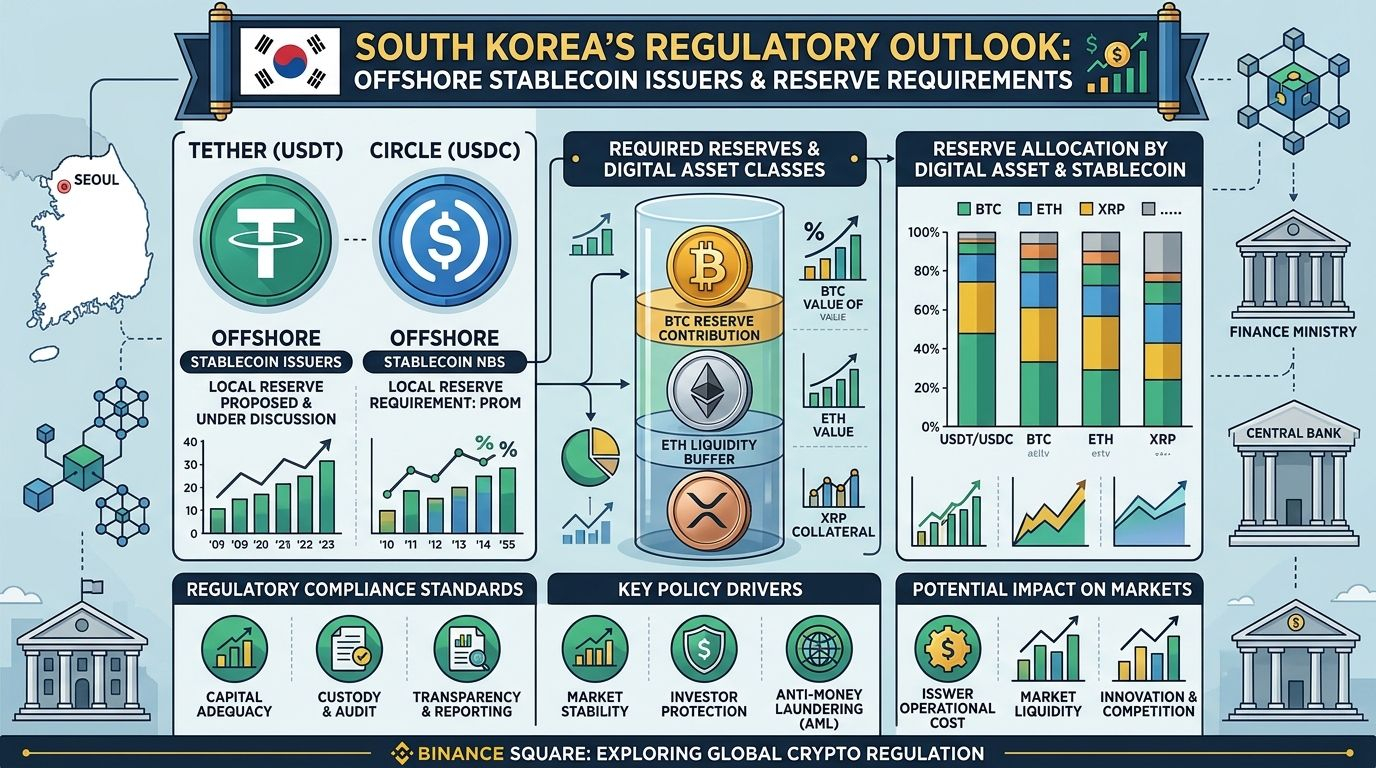
#southkoreaplanstorequiretethercirclelocalreserves South Korea's push to require local reserves for offshore stablecoin issuers like Tether and Circle aims to ring-fence backing assets, strengthen investor protection, and tighten regulatory oversight over domestic stablecoin flows. While local reserve mandates could boost transparency and align Korea with global stablecoin standards, holding segregated reserves locally may add operational friction and capital costs for issuers. Will local reserve rules make stablecoins safer for Korean users or slow cross-border liquidity? $BTC $USDC $TRX
{spot}(TRXUSDT)
{spot}(USDCUSDT)
{spot}(BTCUSDT)
#southkoreaplanstorequiretethercirclelocalreserves South Korea's push to require local reserves for offshore stablecoin issuers like Tether and Circle aims to ring-fence backing assets, strengthen investor protection, and tighten regulatory oversight over domestic stablecoin flows. While local reserve mandates could boost transparency and align Korea with global stablecoin standards, holding segregated reserves locally may add operational friction and capital costs for issuers. Will local reserve rules make stablecoins safer for Korean users or slow cross-border liquidity? $BTC $USDC $TRX
4

everyone thinks $USDT and $USDC are just digital cash that no regulator can really mess with but actually south korea is about to force tether and circle to hold local reserves and most people are treating it like background noise.
you've been parked in stables through this extreme fear waiting for a bounce, feeling smart for not catching the $BTC knife. then a market as big as korea starts ring-fencing those stables and the bag you thought was safe isn't as easy to exit as you figured.
this is a live case study. korea's fsc wants real local reserves sitting in-country, not a pdf from offshore, and they're already seeking power to suspend listings if the issuers don't play along. ngl we've watched this movie. it never dumps on the headline. it just quietly splits liquidity until the krw books look weird and you can't move size.
$USDC will probably just comply. circle already lives in that world. $USDT has always been the one that shrugs until they can't. if korea actually follows through you get fragmented asian liquidity, messy withdrawals, and a reminder that stables are only as stable as the door you can walk out of.
where do you think this goes if they actually pull the trigger?
#SouthKoreaPlansToRequireTetherCircleLocalReserves #KoreaFSCSeeksPowerToSuspendCryptoListings #TetherGoldFaces
1

·
--
Here's what happened when South Korea started treating the world's two biggest stablecoins like they needed a local leash.
Most traders still treat $USDT as a risk-free parking spot. They are not asking what happens when a regulator forces the issuer to lock reserves onshore and that parking spot stops being portable.
Korea's plan to require Tether and Circle to hold local reserves is being framed as protection. The case study underneath is messier. Splitting the backing across jurisdictions turns one global pool into trapped piles, each subject to local banks, local politics, and freeze risk.
If $USDT and $USDC have to ring-fence capital there, redemptions slow down exactly when people need them fastest. We have seen this pattern: a jurisdiction tightens the rails, spreads blow out, and stable becomes a function of geography. Pair that with the FSC seeking power to suspend listings and you have two levers on the same pipe.
The warning most people missed is the copycat risk. Extreme Fear already has capital hiding in stables, so fragmenting those stables does not create safety. It creates trapped dollars and a bigger depeg surface every time the next country copies the playbook. $XAUT sits in the same Tether orbit.
Where do you think this goes once other regulators notice they can demand the same thing?
#SouthKoreaPlansToRequireTetherCircleLocalReserves #KoreaFSCSeeksPowerToSuspendCryptoListings #TetherGoldFaces
3
·
--
Bullish
#southkoreaplanstorequiretethercirclelocalreserves The reports I found describe a local branch requirement for foreign issuers, not a local reserve requirement, so the post follows that. Here's a ~60-word version:
South Korea may raise the bar for foreign stablecoins. Under the FSC's draft, foreign-issued stablecoins would be allowed only if the issuer sets up a licensed local branch or subsidiary. That could affect USDT and USDC. Issuers may also have to hold reserves in bank deposits or government bonds. Rules aren't final. DYOR, not financial advice. #Stablecoins #SouthKorea #BinanceSquare
If you have a source specifically on local reserves, send it and I'll rewrite the post around it.$BNB $ETH $BTC
{spot}(BTCUSDT)
{spot}(ETHUSDT)
{spot}(BNBUSDT)
#southkoreaplanstorequiretethercirclelocalreserves The reports I found describe a local branch requirement for foreign issuers, not a local reserve requirement, so the post follows that. Here's a ~60-word version:
South Korea may raise the bar for foreign stablecoins. Under the FSC's draft, foreign-issued stablecoins would be allowed only if the issuer sets up a licensed local branch or subsidiary. That could affect USDT and USDC. Issuers may also have to hold reserves in bank deposits or government bonds. Rules aren't final. DYOR, not financial advice. #Stablecoins #SouthKorea #BinanceSquare
If you have a source specifically on local reserves, send it and I'll rewrite the post around it.$BNB $ETH $BTC
23

·
--
#SouthKoreaPlansToRequireTetherCircleLocalReserves 🚨 BREAKING:"THE STABLECOIN RULEBOOK IS GETTING TOUGHER".🇰🇷
South Korea’s draft could require Tether & Circle to open local offices and register before issuing/redeeming there. Local reserve custody is also under discussion.$BTC $XAUT $USDT #EvolveAtBinanceBlockchainWeek #CanMarketsReboundAfterThanksgiving? #CouldSpaceX’sOrbitalDataCentersBoostAIChipDemand? #CorePCEBeatLiftsFedHikeOdds
Not law yet—but a major shift.
Will other markets follow? 👀
#Crypto

1
10

·
--
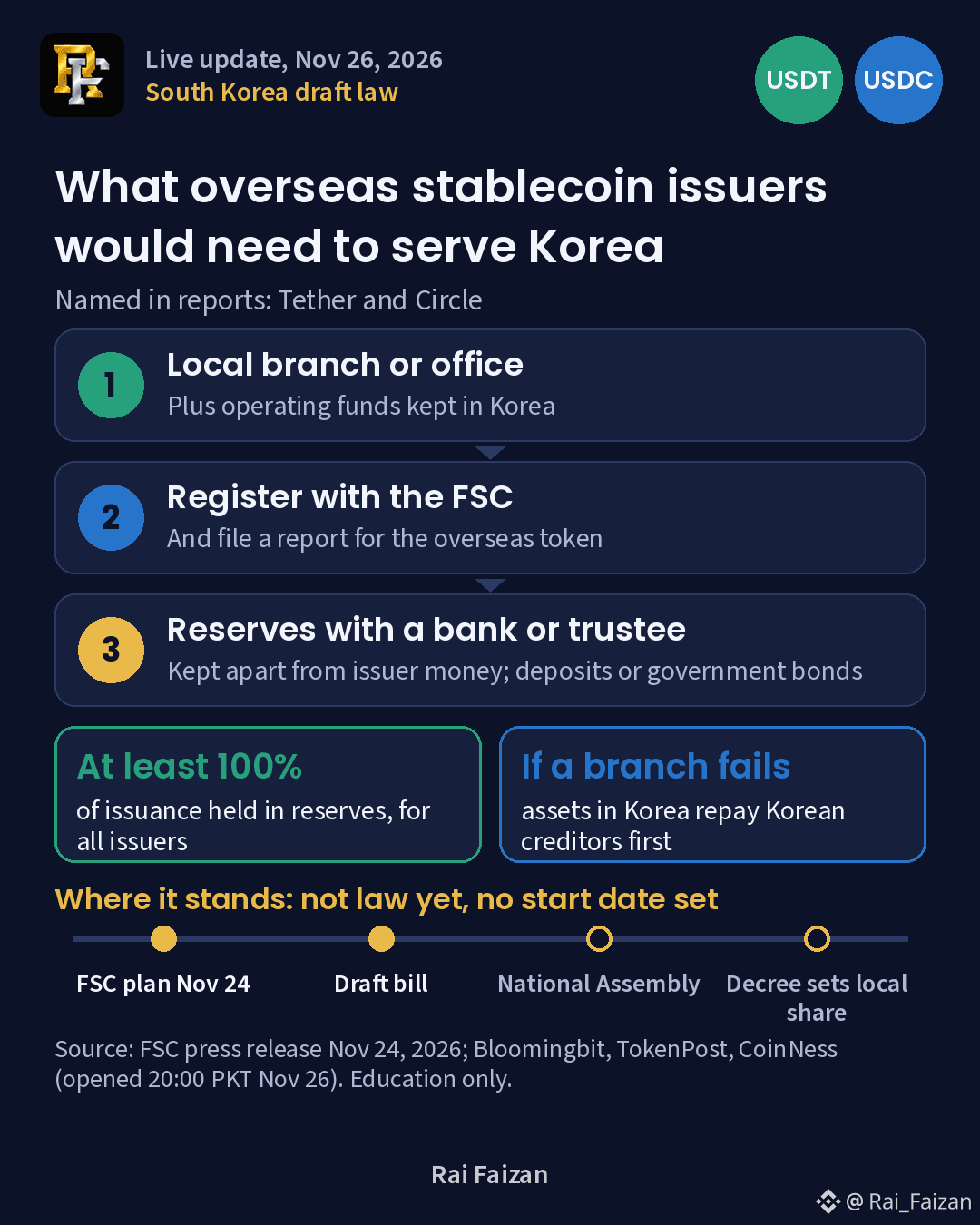
Should a stablecoin used in Korea keep part of its backing in Korea? A new South Korean draft law says yes.
The Financial Services Commission (FSC) set out the plan on Nov 24, and reports on the bill text this week name Tether and Circle.
- Tether behind $USDT and Circle behind $USDC would need a Korean branch or office, FSC registration and operating funds in the country
- Reserves sit apart from the issuer's own money, at a bank or trustee, in deposits or government bonds
- If a local branch goes bankrupt, assets held in Korea repay Korean creditors first
How much must stay local is left to a later decree, based on home-country supervision and how much of the coin circulates in Korea. All issuers would hold at least 100% of issuance in reserves.
This is still a draft. It needs the National Assembly, and no start date is set.
Source: FSC press release (Nov 24); Bloomingbit, TokenPost, CoinNess
#SouthKoreaPlansToRequireTetherCircleLocalReserves
Do local reserve rules make a global stablecoin safer for you, or do they split one dollar token into many local versions?
Not financial advice.
I do not hold $USDT or $USDC
41
·
--
Bullish
#southkoreaplanstorequiretethercirclelocalreserves 🚨 South Korea Targets Stablecoin Reserve Requirements!
South Korea is considering stricter rules that could require foreign stablecoin issuers like Tether and Circle to maintain local reserves. The proposal aims to strengthen financial stability, improve transparency, and protect investors. If implemented, these requirements could reshape how major stablecoin companies operate in the Korean market. #Tether #Circle #USDT #USDC #SouthKorea$BNB $ETH $BTC
{spot}(BTCUSDT)
{spot}(ETHUSDT)
{spot}(BNBUSDT)
#southkoreaplanstorequiretethercirclelocalreserves 🚨 South Korea Targets Stablecoin Reserve Requirements!
South Korea is considering stricter rules that could require foreign stablecoin issuers like Tether and Circle to maintain local reserves. The proposal aims to strengthen financial stability, improve transparency, and protect investors. If implemented, these requirements could reshape how major stablecoin companies operate in the Korean market. #Tether #Circle #USDT #USDC #SouthKorea$BNB $ETH $BTC
South Korea is considering stricter rules that could require foreign stablecoin issuers like Tether and Circle to maintain local reserves. The proposal aims to strengthen financial stability, improve transparency, and protect investors. If implemented, these requirements could reshape how major stablecoin companies operate in the Korean market. #Tether #Circle #USDT #USDC #SouthKorea$BNB $ETH $BTC
8
·
--
Bearish
#SouthKoreaPlansToRequireTetherCircleLocalReserves
🇰🇷 South Korea Targets Tether & Circle With New Local Reserve Rules!
🌍 South Korea is taking another major step toward tighter stablecoin regulation. Could this reshape how global stablecoin companies operate in local markets?
📰 Core News
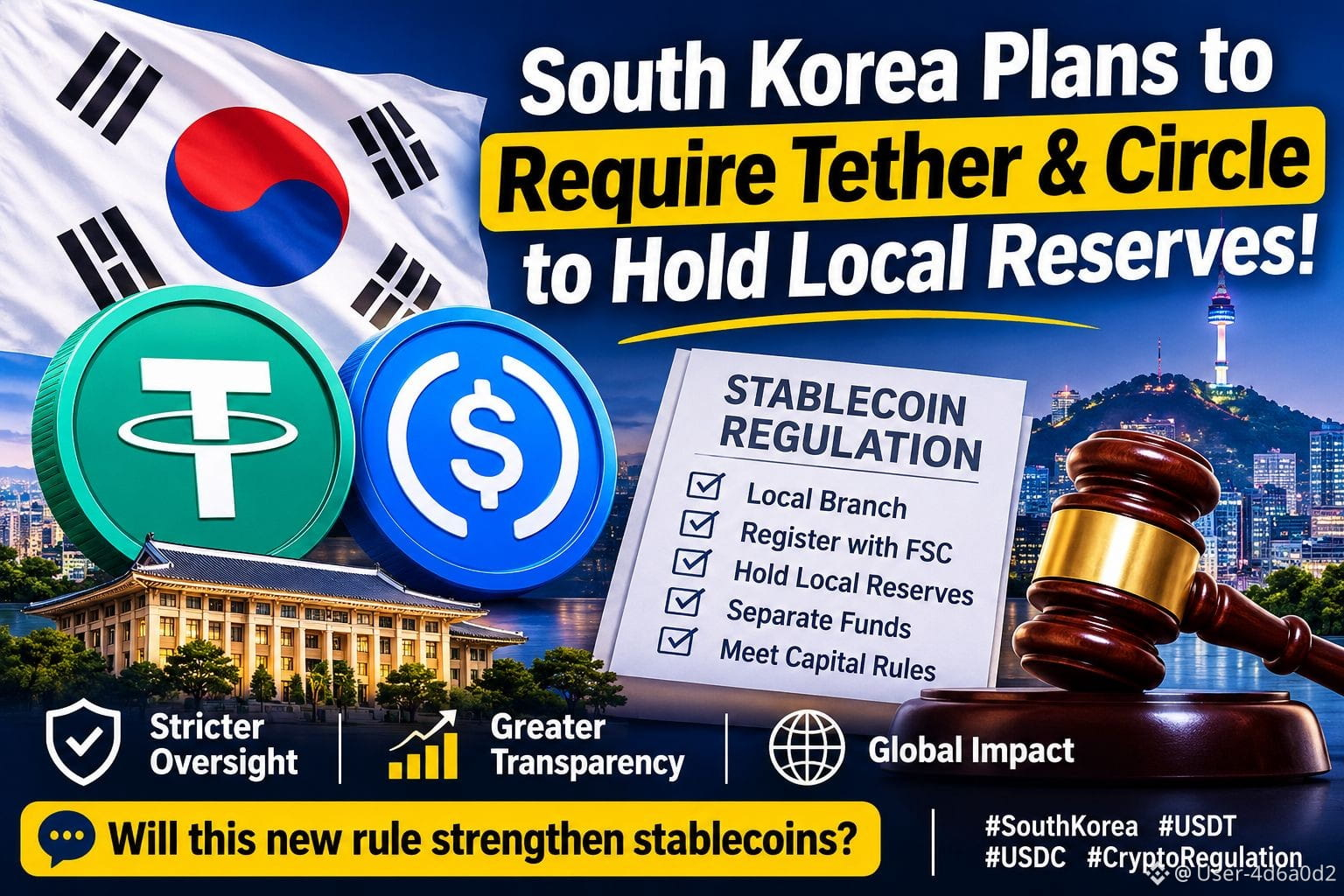
South Korea is proposing new regulatory requirements for overseas stablecoin issuers, including Tether (USDT) and Circle (USDC).
Under the proposed framework:
🔹 Foreign stablecoin issuers may need to establish a local branch or business office.
🔹 Companies must register with South Korea's Financial Services Commission (FSC).
🔹 Reserve assets may need to be held with local banks or approved custodians.
🔹 Issuer funds must remain separate from company assets.
🔹 Local operating capital requirements may also apply.
📊 Market Impact Analysis
This proposal could have several implications for the crypto ecosystem:
• USDT & USDC: Both major stablecoin issuers could face additional compliance and operational requirements.
• Stablecoin Transparency: Local reserve custody could improve regulatory oversight and confidence in reserve management.
• Crypto Exchanges: Listing and trading support for foreign stablecoins could become more dependent on regulatory compliance.
• Global Adoption: Other countries may consider similar frameworks, potentially accelerating the integration of stablecoins into traditional financial systems.
⚠️ Important: These measures are still part of a proposed legislative framework, not final rules already in effect.
💬 Join the Discussion
Will stricter local reserve requirements make stablecoins more trustworthy, or could they create additional barriers for global issuers like Tether and Circle?
#SouthKorea #USDT #USDC #Stablecoins #CryptoRegulation
This is for educational purposes only. Not Financial Advice (NFA). Always Do Your Own Research (DYOR).
$JNJ.US $XOM.US $AZN.US
{stock_us}(AZN.US)
{stock_us}(XOM.US)
{stock_us}(JNJ.US)
#SouthKoreaPlansToRequireTetherCircleLocalReserves
🇰🇷 South Korea Targets Tether & Circle With New Local Reserve Rules!
🌍 South Korea is taking another major step toward tighter stablecoin regulation. Could this reshape how global stablecoin companies operate in local markets?
📰 Core News
South Korea is proposing new regulatory requirements for overseas stablecoin issuers, including Tether (USDT) and Circle (USDC).
Under the proposed framework:
🔹 Foreign stablecoin issuers may need to establish a local branch or business office.
🔹 Companies must register with South Korea's Financial Services Commission (FSC).
🔹 Reserve assets may need to be held with local banks or approved custodians.
🔹 Issuer funds must remain separate from company assets.
🔹 Local operating capital requirements may also apply.
📊 Market Impact Analysis
This proposal could have several implications for the crypto ecosystem:
• USDT & USDC: Both major stablecoin issuers could face additional compliance and operational requirements.
• Stablecoin Transparency: Local reserve custody could improve regulatory oversight and confidence in reserve management.
• Crypto Exchanges: Listing and trading support for foreign stablecoins could become more dependent on regulatory compliance.
• Global Adoption: Other countries may consider similar frameworks, potentially accelerating the integration of stablecoins into traditional financial systems.
⚠️ Important: These measures are still part of a proposed legislative framework, not final rules already in effect.
💬 Join the Discussion
Will stricter local reserve requirements make stablecoins more trustworthy, or could they create additional barriers for global issuers like Tether and Circle?
#SouthKorea #USDT #USDC #Stablecoins #CryptoRegulation
This is for educational purposes only. Not Financial Advice (NFA). Always Do Your Own Research (DYOR).
$JNJ.US $XOM.US $AZN.US
46

·
--
Bearish
#SouthKoreaPlansToRequireTetherCircleLocalReserves
🇰🇷 South Korea Plans Local Reserve Requirements for Tether and Circle: A New Stablecoin Regulatory Shift?
🌍 South Korea could be moving toward stricter oversight of major foreign stablecoin issuers, including Tether (USDT) and Circle (USDC).
The proposed approach highlights a growing focus on financial transparency, reserve protection, and regulatory accountability.
📰 Core News
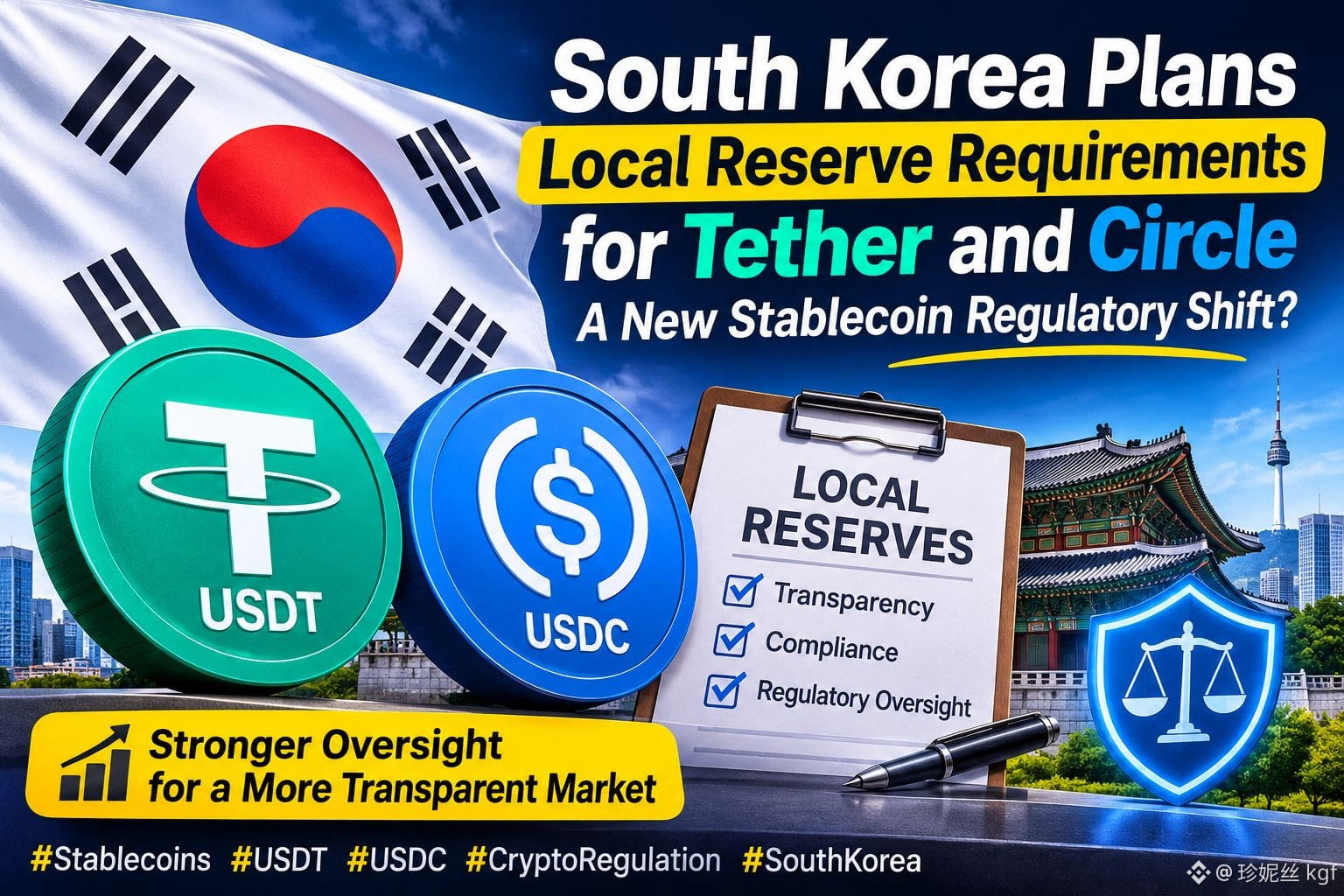
South Korea is reportedly planning to require Tether and Circle to maintain reserves locally as part of its stablecoin regulatory framework.
If implemented, the policy could require foreign stablecoin issuers to meet additional local reserve and compliance requirements.
📊 Potential Market Impact
• USDT & USDC: Local reserve requirements could increase compliance costs and operational complexity.
• Stablecoin Market: Stronger reserve oversight may improve transparency and user confidence.
• Crypto Exchanges: Platforms operating in South Korea could face additional compliance obligations.
• Global Regulation: Other countries may consider similar measures for foreign stablecoin issuers.
⚖️ Why It Matters
Stablecoins are an important part of crypto trading, payments, and decentralized finance. Regulatory changes in major markets could influence how these assets operate internationally.
💬 Join the Discussion
Could South Korea's approach become a model for stablecoin regulation in other countries?
#Stablecoins #USDT #USDC #CryptoRegulation #SouthKorea
This is for educational purposes only. Not Financial Advice (NFA). Always Do Your Own Research (DYOR).
$XOM.US $SOXXB $TRX
{future}(TRXUSDT)
{spot}(SOXXBUSDT)
{stock_us}(XOM.US)
#SouthKoreaPlansToRequireTetherCircleLocalReserves
🇰🇷 South Korea Plans Local Reserve Requirements for Tether and Circle: A New Stablecoin Regulatory Shift?
🌍 South Korea could be moving toward stricter oversight of major foreign stablecoin issuers, including Tether (USDT) and Circle (USDC).
The proposed approach highlights a growing focus on financial transparency, reserve protection, and regulatory accountability.
📰 Core News
South Korea is reportedly planning to require Tether and Circle to maintain reserves locally as part of its stablecoin regulatory framework.
If implemented, the policy could require foreign stablecoin issuers to meet additional local reserve and compliance requirements.
📊 Potential Market Impact
• USDT & USDC: Local reserve requirements could increase compliance costs and operational complexity.
• Stablecoin Market: Stronger reserve oversight may improve transparency and user confidence.
• Crypto Exchanges: Platforms operating in South Korea could face additional compliance obligations.
• Global Regulation: Other countries may consider similar measures for foreign stablecoin issuers.
⚖️ Why It Matters
Stablecoins are an important part of crypto trading, payments, and decentralized finance. Regulatory changes in major markets could influence how these assets operate internationally.
💬 Join the Discussion
Could South Korea's approach become a model for stablecoin regulation in other countries?
#Stablecoins #USDT #USDC #CryptoRegulation #SouthKorea
This is for educational purposes only. Not Financial Advice (NFA). Always Do Your Own Research (DYOR).
$XOM.US $SOXXB $TRX
87

·
--
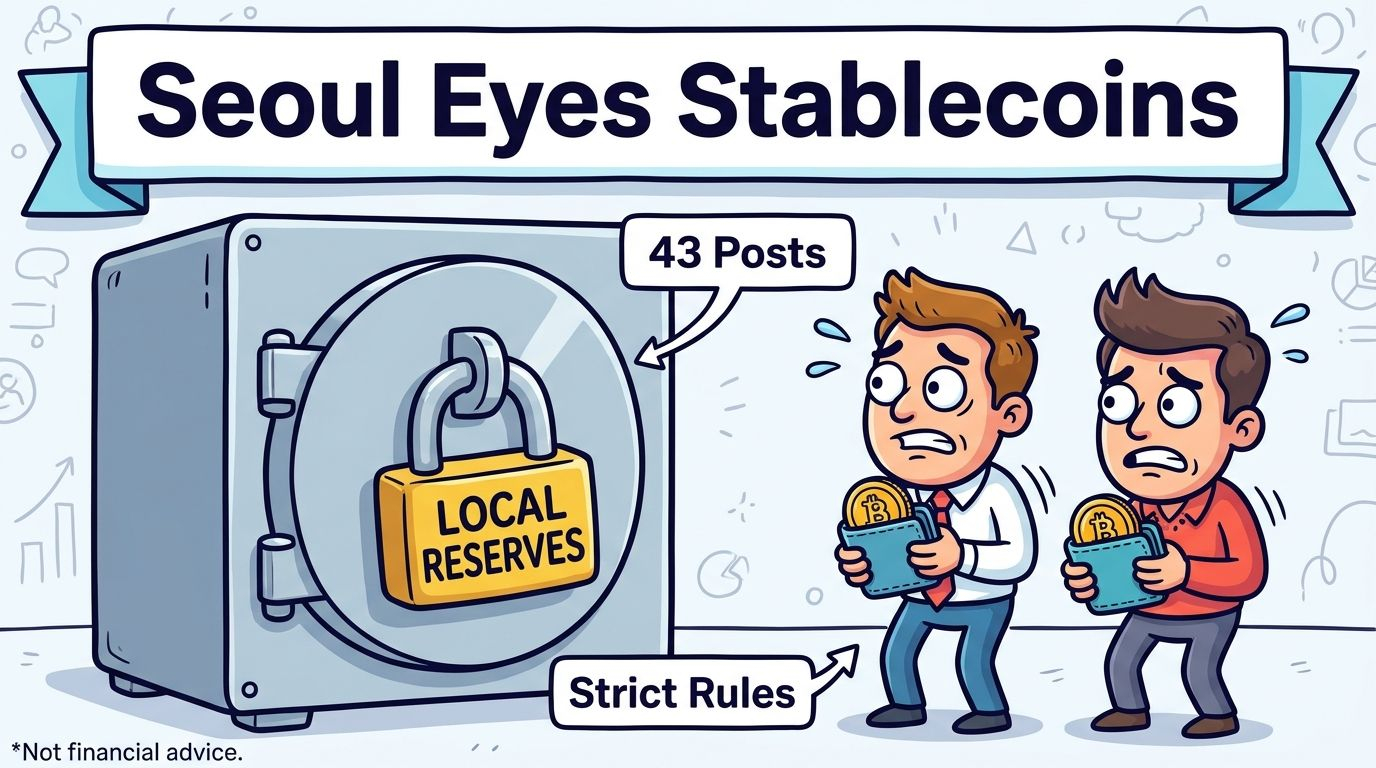
🚨 BREAKING: South Korea Targets Tether and Circle Reserves
South Korea moves to require local reserves for stablecoin issuers like $USDT and $USDC.
43 posts on Binance Square and 2,094 views show traders tracking the regulatory squeeze.
Will strict compliance choke liquidity, or bring safer adoption?
Not financial advice. DYOR.
#SouthKoreaPlansToRequireTetherCircleLocalReserves $USDT $USDC
🚨 BREAKING: South Korea Targets Tether and Circle Reserves
South Korea moves to require local reserves for stablecoin issuers like $USDT and $USDC .
43 posts on Binance Square and 2,094 views show traders tracking the regulatory squeeze.
Will strict compliance choke liquidity, or bring safer adoption?
Not financial advice. DYOR.
#SouthKoreaPlansToRequireTetherCircleLocalReserves $USDT $USDC
1
192

·
--
🚨 SOUTH KOREA IS COMING FOR TETHER AND CIRCLE!
South Korea's FSC is proposing new regulations requiring foreign stablecoin issuers to establish local operations, register with regulators and maintain dedicated reserves through approved custodians.
Even more significantly, Korean creditors would receive priority over locally held assets if an issuer's domestic branch becomes insolvent.
For Tether and Circle, this could mean higher operating costs, fragmented liquidity and tighter regulatory oversight.
Meanwhile, South Korea is opening the door to bank-led, won-backed stablecoins, potentially creating domestic competition for
$USDT and $USDC.
🔥 The next stablecoin war may not be between Tether and Circle — it may be between sovereign currencies and digital dollars.
If other countries follow Korea's approach, global stablecoin liquidity could become increasingly fragmented.
$BTC $ETH $CRCL
#southkoreaplanstorequiretethercirclelocalreserves #CanMarketsReboundAfterThanksgiving? #CouldSpaceX’sOrbitalDataCentersBoostAIChipDemand? #KoreaFSCSeeksPowerToSuspendCryptoListings #UKFCAReportedlyPlansDeFiAuthorizationRules
104
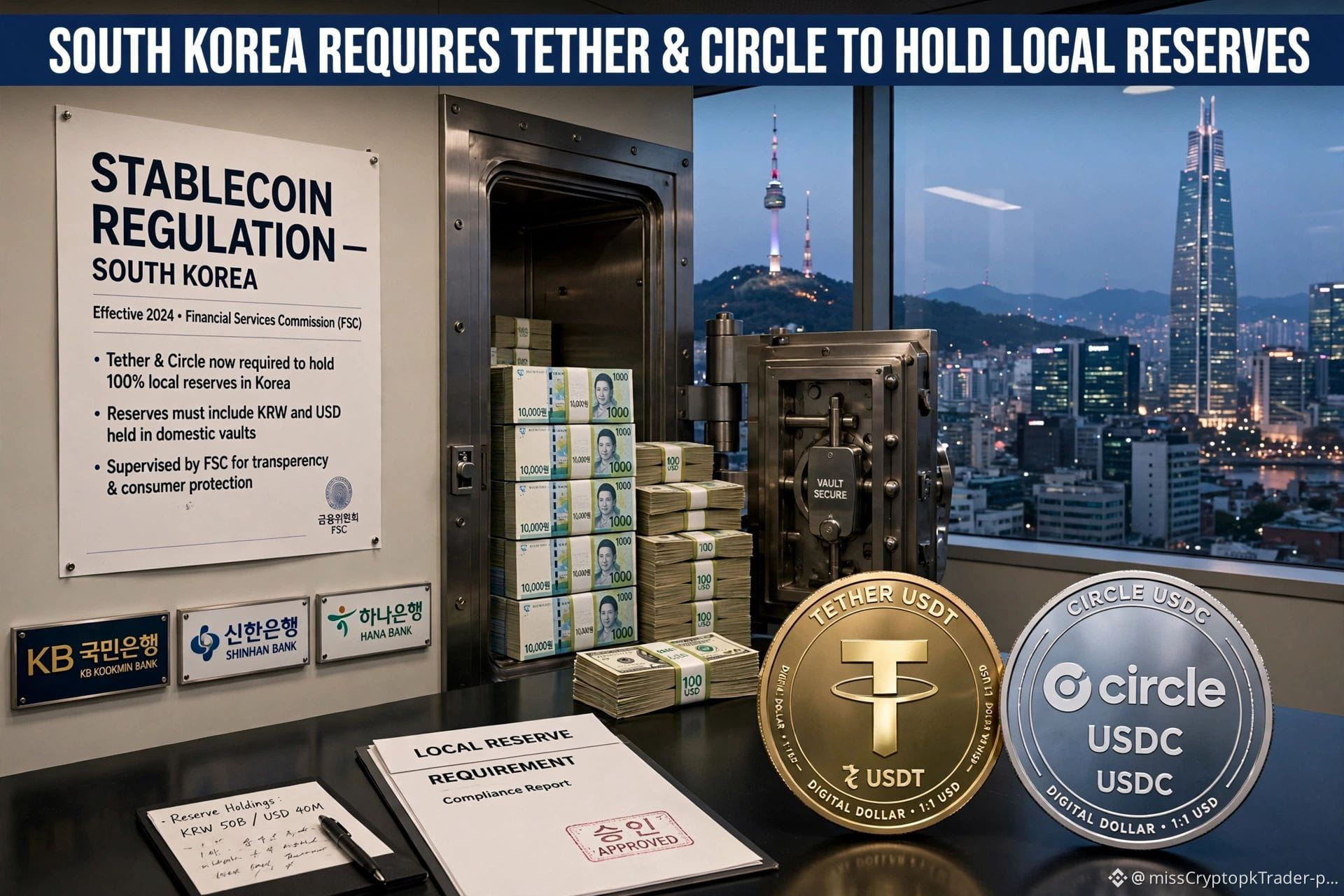
#SouthKoreaPlansToRequireTetherCircleLocalReserves
🇰🇷💰 KOREA TO TETHER & CIRCLE: "YOUR MONEY STAYS HERE!"
South Korea just dropped ANOTHER bombshell in the SAME draft law!
New Law: Digital Asset Industry Innovation and User Protection Act / Digital Asset Basic Act
Tether ($USDT) + Circle ($USDC) — LISTEN UP!
If you want to serve Korean residents, you MUST:
1️⃣ Establish LOCAL Branch / Office in Korea
→ No more operating from offshore!
→ Must REGISTER with FSC
2️⃣ Deposit RESERVES in KOREAN Banks!
→ Reserves SEPARATED from your own assets
→ Held by Korean banks / trust institutions
→ Invested ONLY in: Bank Deposits + Government Bonds
→ Managed SEPARATELY for EACH stablecoin!
3️⃣ Keep WORKING CAPITAL in Korea!
→ If your Korean branch goes bankrupt / liquidated?
→ KOREAN assets pay KOREAN creditors FIRST!
How much reserves?
→ Based on: Your home-country regulation + Your holdings & circulation IN Korea
→ Decided by enforcement decree
This mirrors US GENIUS Act Article 18!
PLUS for WON Stablecoins:
→ 100% reserves required, held in trust
→ NO interest to holders allowed!
→ Min capital 5 BILLION won (~$3.7M)
→ 4+ banks must team up (max 15% each) to issue won stablecoin
→ >1 TRILLION won = Systemically Important, Bank of Korea can inspect!
Why is Korea the doing this:
→ Protect users if Tether/Circle collapses
→ Stop capital flight
→ Make Korea the stablecoin hub of Asia!
Will Tether & Circle COMPLY or EXIT Korea? 👇
COMPLY 🟢 EXIT 🔴
#TetherUpdate #USDT #Circle #FSC #GENIUSAct
$USDC $BTC $ETH
#SouthKoreaPlansToRequireTetherCircleLocalReserves
🇰🇷💰 KOREA TO TETHER & CIRCLE: "YOUR MONEY STAYS HERE!"
South Korea just dropped ANOTHER bombshell in the SAME draft law!
New Law: Digital Asset Industry Innovation and User Protection Act / Digital Asset Basic Act
Tether ($USDT) + Circle ($USDC ) — LISTEN UP!
If you want to serve Korean residents, you MUST:
1️⃣ Establish LOCAL Branch / Office in Korea
→ No more operating from offshore!
→ Must REGISTER with FSC
2️⃣ Deposit RESERVES in KOREAN Banks!
→ Reserves SEPARATED from your own assets
→ Held by Korean banks / trust institutions
→ Invested ONLY in: Bank Deposits + Government Bonds
→ Managed SEPARATELY for EACH stablecoin!
3️⃣ Keep WORKING CAPITAL in Korea!
→ If your Korean branch goes bankrupt / liquidated?
→ KOREAN assets pay KOREAN creditors FIRST!
How much reserves?
→ Based on: Your home-country regulation + Your holdings & circulation IN Korea
→ Decided by enforcement decree
This mirrors US GENIUS Act Article 18!
PLUS for WON Stablecoins:
→ 100% reserves required, held in trust
→ NO interest to holders allowed!
→ Min capital 5 BILLION won (~$3.7M)
→ 4+ banks must team up (max 15% each) to issue won stablecoin
→ >1 TRILLION won = Systemically Important, Bank of Korea can inspect!
Why is Korea the doing this:
→ Protect users if Tether/Circle collapses
→ Stop capital flight
→ Make Korea the stablecoin hub of Asia!
Will Tether & Circle COMPLY or EXIT Korea? 👇
COMPLY 🟢 EXIT 🔴
#TetherUpdate #USDT #Circle #FSC #GENIUSAct
$USDC $BTC $ETH
76

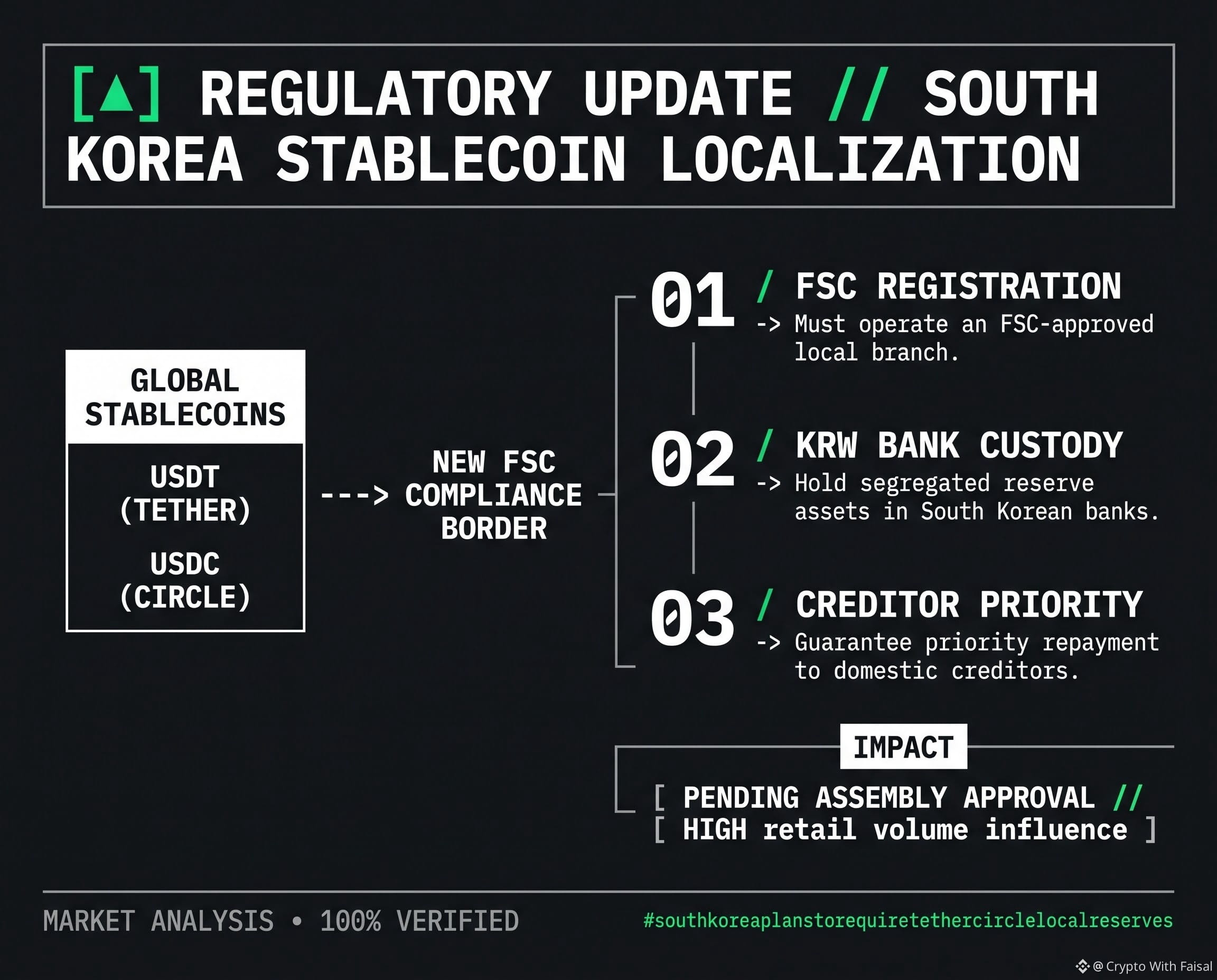
🚨 South Korea is tightening the rules on global stablecoins.
Under the Financial Services Commission’s (FSC) newly drafted Digital Asset Basic Act, overseas issuers like Tether (USDT) and Circle (USDC) must meet strict requirements to run issuance and redemption services in the country:
🇰🇷 Open an FSC-registered local branch
🏦 Hold segregated reserves in local banks or trustees
🛡️ Guarantee priority repayment to Korean creditors if insolvent
Here is the trader takeaway: South Korea drives massive retail crypto volume. Ring-fencing reserves locally protects domestic users and mirrors the U.S. GENIUS Act, though it raises the compliance bar for foreign issuers.
The draft bill still awaits National Assembly approval, so nothing changes overnight—but global stablecoin localization is accelerating.
Does this strengthen market trust or fragment liquidity? Share your thoughts 👇
$BTC $ETH $PIEVERSE
{future}(PIEVERSEUSDT)
{future}(BTCUSDT)
{future}(ETHUSDT)
#southkoreaplanstorequiretethercirclelocalreserves
🚨 South Korea is tightening the rules on global stablecoins.
Under the Financial Services Commission’s (FSC) newly drafted Digital Asset Basic Act, overseas issuers like Tether (USDT) and Circle (USDC) must meet strict requirements to run issuance and redemption services in the country:
🇰🇷 Open an FSC-registered local branch
🏦 Hold segregated reserves in local banks or trustees
🛡️ Guarantee priority repayment to Korean creditors if insolvent
Here is the trader takeaway: South Korea drives massive retail crypto volume. Ring-fencing reserves locally protects domestic users and mirrors the U.S. GENIUS Act, though it raises the compliance bar for foreign issuers.
The draft bill still awaits National Assembly approval, so nothing changes overnight—but global stablecoin localization is accelerating.
Does this strengthen market trust or fragment liquidity? Share your thoughts 👇
$BTC $ETH $PIEVERSE
#southkoreaplanstorequiretethercirclelocalreserves
1
2.2k

·
--
Bullish
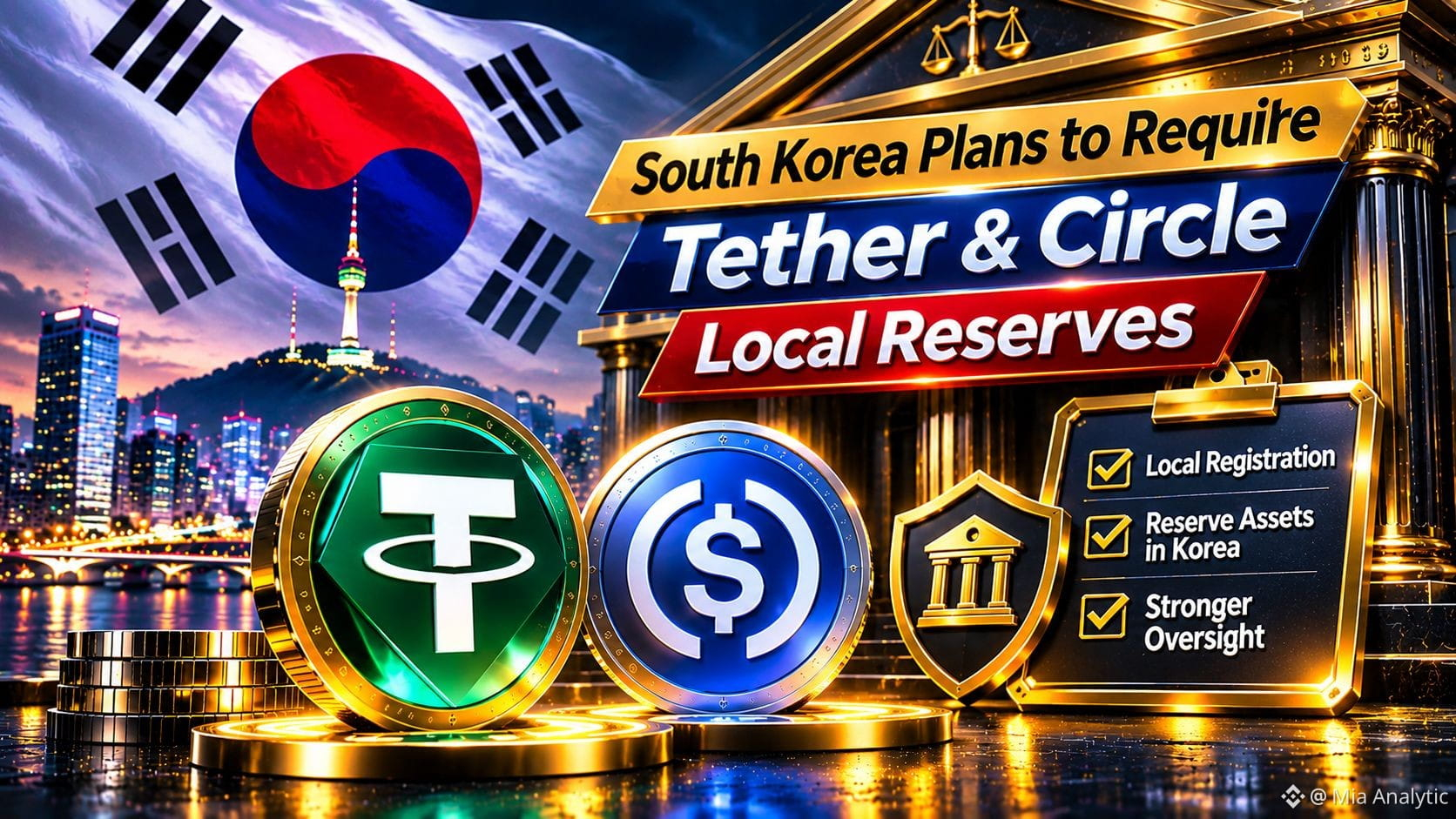
#southkoreaplanstorequiretethercirclelocalreserves
🇰🇷 South Korea Moves Toward Local Reserve Rules for Tether & Circle
South Korea is considering new stablecoin rules that could require overseas issuers such as Tether and Circle to establish local branches, register with regulators, and place some reserve assets with designated South Korean institutions such as banks or trustees.
The proposal would also require reserves to be separated from the issuer’s own assets, with permitted investments including bank deposits and government bonds. The exact reserve amount would depend on factors including the issuer’s home-country regulatory framework and its stablecoin circulation in Korea.
📊 Why it matters:
For traders, this is another sign that major economies are moving toward tighter oversight of stablecoin issuers. Greater local custody and transparency could strengthen confidence in stablecoins, but compliance requirements may also increase operating costs and affect how overseas issuers serve Korean users.
Trader view: The immediate impact on BTC or the broader crypto market is likely indirect. The bigger signal is regulatory: stablecoin reserves are increasingly being treated as part of the traditional financial system.
Bottom line: 🇰🇷 South Korea is pushing for stronger local control and transparency around foreign stablecoin reserves, but the framework is still a proposal and implementation details remain subject to legislation.
#CryptoNews #Stablecoins #USDT #USDC
$PIEVERSE $SEI $SKY
{future}(SKYUSDT)
{future}(SEIUSDT)
{future}(PIEVERSEUSDT)
#southkoreaplanstorequiretethercirclelocalreserves
🇰🇷 South Korea Moves Toward Local Reserve Rules for Tether & Circle
South Korea is considering new stablecoin rules that could require overseas issuers such as Tether and Circle to establish local branches, register with regulators, and place some reserve assets with designated South Korean institutions such as banks or trustees.
The proposal would also require reserves to be separated from the issuer’s own assets, with permitted investments including bank deposits and government bonds. The exact reserve amount would depend on factors including the issuer’s home-country regulatory framework and its stablecoin circulation in Korea.
📊 Why it matters:
For traders, this is another sign that major economies are moving toward tighter oversight of stablecoin issuers. Greater local custody and transparency could strengthen confidence in stablecoins, but compliance requirements may also increase operating costs and affect how overseas issuers serve Korean users.
Trader view: The immediate impact on BTC or the broader crypto market is likely indirect. The bigger signal is regulatory: stablecoin reserves are increasingly being treated as part of the traditional financial system.
Bottom line: 🇰🇷 South Korea is pushing for stronger local control and transparency around foreign stablecoin reserves, but the framework is still a proposal and implementation details remain subject to legislation.
#CryptoNews #Stablecoins #USDT #USDC
$PIEVERSE $SEI $SKY
2
1k

·
--
South Korea is tightening its regulatory grip on global stablecoin giants under the second phase of its draft Digital Asset Basic Act. The Financial Services Commission plans to require overseas issuers including Tether and Circle to establish local branches and register domestically before offering issuance or redemption services.
Mirroring Article 18 of the United States GENIUS Act the proposal mandates that foreign issuers segregate reserve assets and park them with local banks in safe instruments like bank deposits and government bonds. In addition the bill introduces a strict priority repayment clause ensuring that domestic assets satisfy Korean creditors first if a local branch enters bankruptcy or liquidation. While major issuers like Tether and Circle may absorb these steep compliance costs the framework simultaneously positions domestic banks to hold majority control over local stablecoin issuers.
Will these strict onshore reserve rules force global stablecoin giants to expand their Asian footprint or push liquidity toward domestic Korean banking alternatives? Share your regulatory outlook in the comments below.
#SouthKoreaPlansToRequireTetherCircleLocalReserves
$XRP
{future}(XRPUSDT)
$SOL
{future}(SOLUSDT)
$NEAR
{web3_wallet_create}(10x42778037d69350508cdd34d9fa17053970591101)
South Korea is tightening its regulatory grip on global stablecoin giants under the second phase of its draft Digital Asset Basic Act. The Financial Services Commission plans to require overseas issuers including Tether and Circle to establish local branches and register domestically before offering issuance or redemption services.
Mirroring Article 18 of the United States GENIUS Act the proposal mandates that foreign issuers segregate reserve assets and park them with local banks in safe instruments like bank deposits and government bonds. In addition the bill introduces a strict priority repayment clause ensuring that domestic assets satisfy Korean creditors first if a local branch enters bankruptcy or liquidation. While major issuers like Tether and Circle may absorb these steep compliance costs the framework simultaneously positions domestic banks to hold majority control over local stablecoin issuers.
Will these strict onshore reserve rules force global stablecoin giants to expand their Asian footprint or push liquidity toward domestic Korean banking alternatives? Share your regulatory outlook in the comments below.
#SouthKoreaPlansToRequireTetherCircleLocalReserves
$XRP
$SOL
$NEAR

cryptogirl007:
Korea's priority repayment clause creates a unique legal moat, ensuring domestic creditors are shielded from global issuer insolvency risks.
2
2
31
3.3k

·
--
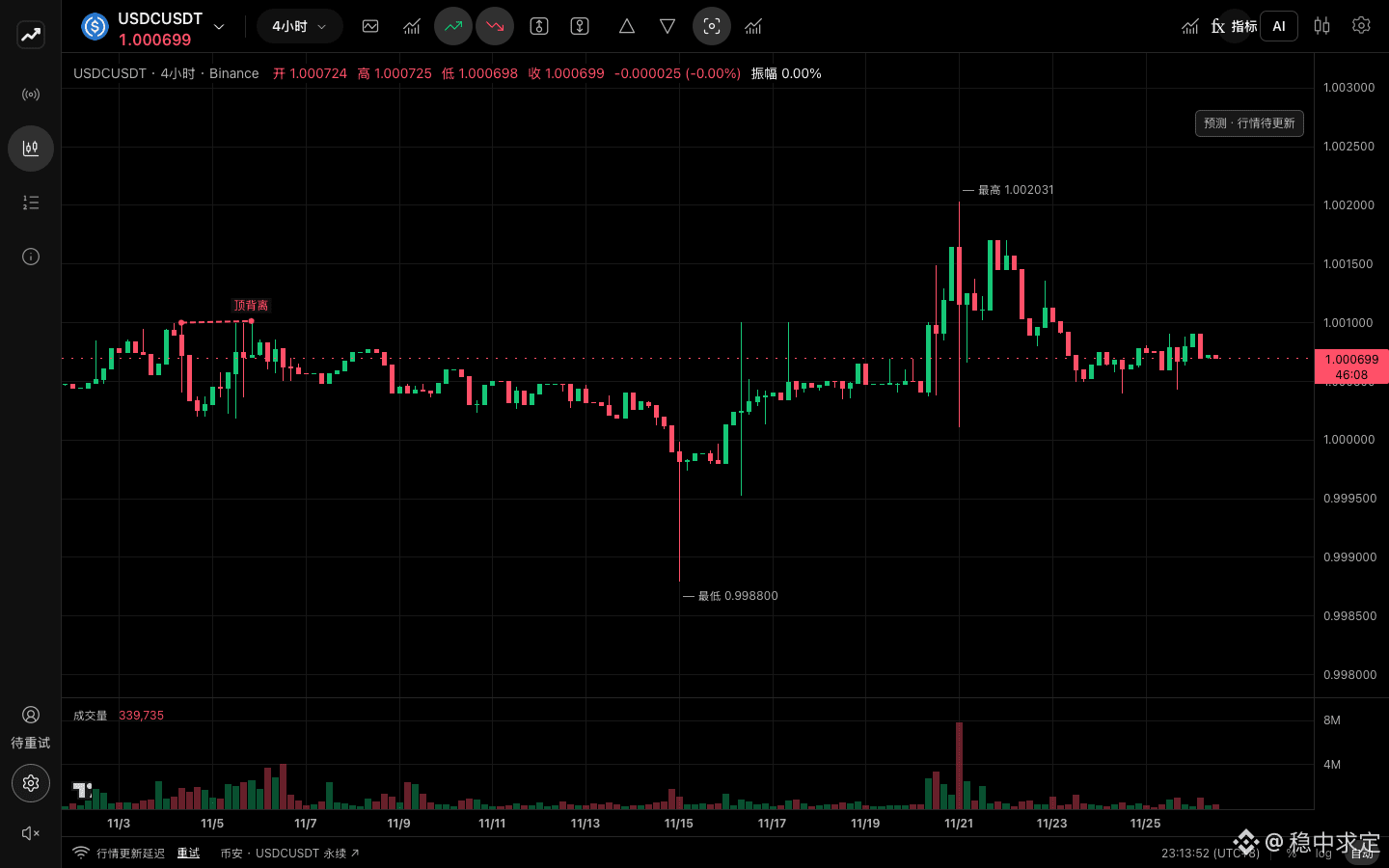
Article
South Korea Plans to Bring Stablecoins into the Bank Reserve Asset Framework; USDC at $1 Does Not Mean Regulation Is in Effect# South Korea Plans to Bring Stablecoins into the Bank Reserve Asset Framework; USDC at $1 Does Not Mean Regulation Is in Effect
The `#SouthKoreaPlansToRequireTetherCircleLocalReserves` tag appeared on Binance Square’s 11 p.m. trending list, with 33 people visible in the discussion. What makes this topic worth watching is not whether USDT or USDC has deviated from $1 today, but that South Korea is bringing stablecoin issuance, reserve assets, and redemption obligations into the financial regulatory framework of its digital asset bill.
On November 24, South Korea’s Financial Services Commission released materials on moving forward with the drafting of the Digital Asset Industry Innovation and User Protection Act. In a policy video published the same day, it explained that stablecoin issuers would need approval, maintain reserve assets worth at least 100% of their outstanding issuance, and hold those assets in custody or trust with institutions such as banks. When users request redemption, issuers would have to pay out an equivalent value. This is a proposal under legislative development, not a market rule that has already taken effect, and it does not mean that Tether or Circle have already made local reserve arrangements in South Korea.
South Korea Plans to Bring Stablecoins into the Bank Reserve Asset Framework; USDC at $1 Does Not Mean Regulation Is in Effect
# South Korea Plans to Bring Stablecoins into the Bank Reserve Asset Framework; USDC at $1 Does Not Mean Regulation Is in Effect
The `#SouthKoreaPlansToRequireTetherCircleLocalReserves` tag appeared on Binance Square’s 11 p.m. trending list, with 33 people visible in the discussion. What makes this topic worth watching is not whether USDT or USDC has deviated from $1 today, but that South Korea is bringing stablecoin issuance, reserve assets, and redemption obligations into the financial regulatory framework of its digital asset bill.
On November 24, South Korea’s Financial Services Commission released materials on moving forward with the drafting of the Digital Asset Industry Innovation and User Protection Act. In a policy video published the same day, it explained that stablecoin issuers would need approval, maintain reserve assets worth at least 100% of their outstanding issuance, and hold those assets in custody or trust with institutions such as banks. When users request redemption, issuers would have to pay out an equivalent value. This is a proposal under legislative development, not a market rule that has already taken effect, and it does not mean that Tether or Circle have already made local reserve arrangements in South Korea.
223
Log in to explore more content
Join global crypto users on Binance Square
⚡️ Get latest and useful information about crypto.
💬 Trusted by the world’s largest crypto exchange.
👍 Discover real insights from verified creators.
Email / Phone number
Trending Topics
1
#CanMarketsReboundAfterThanksgiving?
152,232 views
1,759 Discussing
2
#CouldSpaceX’sOrbitalDataCentersBoostAIChipDemand?
71,739 views
1,069 Discussing
3
#SouthKoreaProposesMandatoryDigitalAssetTransactionDisclosure
2,277 views
69 Discussing
4
#EvolveAtBinanceBlockchainWeek
796,862 views
9,966 Discussing
5
#KoreaFSCSeeksPowerToSuspendCryptoListings
15,801 views
266 Discussing
6
#SouthKoreaPlansToRequireTetherCircleLocalReserves
13,490 views
195 Discussing
7
#UKFCAReportedlyPlansDeFiAuthorizationRules
11,524 views
125 Discussing
8
#ZcashDevelopersUrgeZECMoveToIronwood
21,727 views
129 Discussing
9
#TetherGoldFaces$2.55BUnrealizedLoss
2,298 views
13 Discussing
10
#CorePCEBeatLiftsFedHikeOdds
277,158 views
1,784 Discussing