

#sswp
sswp
17,651 views
13 Discussing
Hot
Latest

·
--
$ALGO An intraday liquidity sweep absorbed stop-loss orders below the local pivot point to fuel a quick recovery.
Momentum Implication: Removing weak hands creates a clean path for standard trend continuation.
Levels:
• Entry Price (EP): 0.1120 - 0.1144
• Trade Target 1 (TG1): 0.1220
• Trade Target 2 (TG2): 0.1290
• Trade Target 3 (TG3): 0.1350
• Stop Loss (SL): 0.1075
Trade Decision: Long execution is triggered following the confirmed reclamation of the swept support line.
Close: If this reclaimed level remains protected, the market should accelerate toward macro resistance.#ALGO #SSWP #TrendingTopic #bnb #BTC
$ALGO An intraday liquidity sweep absorbed stop-loss orders below the local pivot point to fuel a quick recovery.
Momentum Implication: Removing weak hands creates a clean path for standard trend continuation.
Levels:
• Entry Price (EP): 0.1120 - 0.1144
• Trade Target 1 (TG1): 0.1220
• Trade Target 2 (TG2): 0.1290
• Trade Target 3 (TG3): 0.1350
• Stop Loss (SL): 0.1075
Trade Decision: Long execution is triggered following the confirmed reclamation of the swept support line.
Close: If this reclaimed level remains protected, the market should accelerate toward macro resistance.#ALGO #SSWP #TrendingTopic #bnb #BTC
Momentum Implication: Removing weak hands creates a clean path for standard trend continuation.
Levels:
• Entry Price (EP): 0.1120 - 0.1144
• Trade Target 1 (TG1): 0.1220
• Trade Target 2 (TG2): 0.1290
• Trade Target 3 (TG3): 0.1350
• Stop Loss (SL): 0.1075
Trade Decision: Long execution is triggered following the confirmed reclamation of the swept support line.
Close: If this reclaimed level remains protected, the market should accelerate toward macro resistance.#ALGO #SSWP #TrendingTopic #bnb #BTC
94
·
--
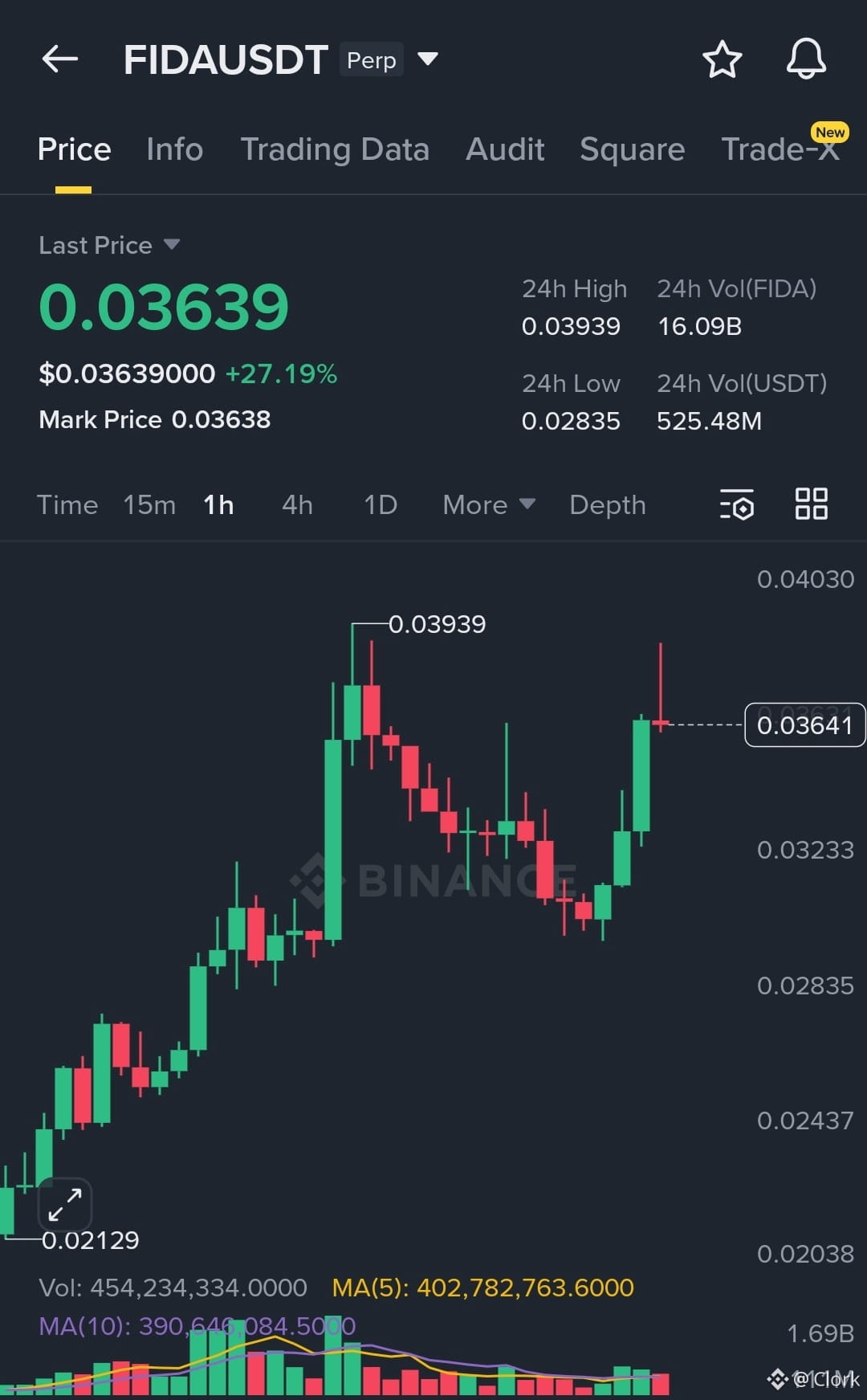
$FIDA
{spot}(FIDAUSDT)
Market Event: Price pushed through key resistance after a sustained compression phase triggered a breakout squeeze.
Momentum Implication: Buyers remain active as long as the breakout level converts into support.
Levels: • Entry Price (EP): 0.0369 – 0.0375
• Trade Target 1 (TG1): 0.0398
• Trade Target 2 (TG2): 0.0416
• Trade Target 3 (TG3): 0.0440
• Stop Loss (SL): 0.0352
Trade Decision: Long setups remain favorable during controlled pullbacks into support.
Close: Further upside remains open if breakout structure holds intact.#FIDA #BB #bnb #SSWP #BTC
$FIDA
Market Event: Price pushed through key resistance after a sustained compression phase triggered a breakout squeeze.
Momentum Implication: Buyers remain active as long as the breakout level converts into support.
Levels: • Entry Price (EP): 0.0369 – 0.0375
• Trade Target 1 (TG1): 0.0398
• Trade Target 2 (TG2): 0.0416
• Trade Target 3 (TG3): 0.0440
• Stop Loss (SL): 0.0352
Trade Decision: Long setups remain favorable during controlled pullbacks into support.
Close: Further upside remains open if breakout structure holds intact.#FIDA #BB #bnb #SSWP #BTC
Market Event: Price pushed through key resistance after a sustained compression phase triggered a breakout squeeze.
Momentum Implication: Buyers remain active as long as the breakout level converts into support.
Levels: • Entry Price (EP): 0.0369 – 0.0375
• Trade Target 1 (TG1): 0.0398
• Trade Target 2 (TG2): 0.0416
• Trade Target 3 (TG3): 0.0440
• Stop Loss (SL): 0.0352
Trade Decision: Long setups remain favorable during controlled pullbacks into support.
Close: Further upside remains open if breakout structure holds intact.#FIDA #BB #bnb #SSWP #BTC
32

·
--
When Coordination Meets Stress: What Fails Before the System Does$CBRSB $ARX $USDC
#SSWP #Qwen25Max #JBVIP🎯 #SamouraiWallet #DDoS
I have spent enough time watching markets move through different cycles to notice a pattern that rarely changes. The hardest test for a decentralized system is not whether the technology works when conditions are calm. It is what happens when confidence becomes expensive. I have watched capital move from one narrative to another, seen communities form around promising designs, and watched the same communities react differently once incentives were under pressure. The difficult part is never the original idea. The difficult part is whether participants continue coordinating when their personal interests start pulling in different directions.
For systems built around removing intermediaries, this creates a deeper question than technical performance. What breaks first when a system designed for coordination is exposed to real economic stress? My focus is not on whether the architecture is elegant or whether the assumptions look reasonable on paper. I am more interested in the moment when users, developers, liquidity providers, and operators no longer share the same expectations. That is where the real structure appears. Coordination is easy when everyone benefits from cooperation. The harder problem is maintaining cooperation when everyone begins calculating their own survival.
The first pressure point I look at is incentive alignment under volatility. A protocol like Newton Protocol, which positions itself around decentralized coordination for AI-driven strategies, automated execution, and developer participation, depends on many independent actors behaving in ways that collectively support the system. The challenge is that participants do not experience the same market conditions at the same time. A developer may think in years, a liquidity provider may think in days, and a trader may think in seconds. The protocol can create rules that define participation, but it cannot remove the different time horizons people bring with them.
This is where technical design turns into human behavior. A secure rollup or decentralized coordination layer may reduce certain forms of trust dependency, but it does not eliminate strategic behavior. When markets are stable, participants often accept delays, additional verification, or higher operational costs because the expected reward justifies the effort. During stress, those same costs become visible. Every additional step becomes friction. Every requirement for transparency becomes a potential slowdown. Every mechanism designed to prevent abuse becomes something participants evaluate through the lens of opportunity cost.
The uncomfortable question is whether participants are truly committed to decentralized coordination or whether they are only committed while the incentives remain attractive. A system can survive technical attacks because it has security assumptions built into its design. It is much harder to defend against a gradual decline in economic confidence, where users simply begin making rational decisions for themselves instead of the network. The failure does not necessarily come from a flaw in the code. It comes from the gap between what the system needs people to do and what people choose to do when conditions change.
The second pressure point is the tension between verification and speed. In high-value coordination systems, trust cannot simply be assumed. Actions need to be visible, measurable, and accountable. That is especially important when automated strategies and AI-driven processes are involved because the cost of unclear responsibility increases when decisions happen faster than humans can manually evaluate them. More verification creates stronger confidence, but it also introduces complexity. The system becomes more resilient because participants can check what happened, but less flexible because every additional layer requires agreement, processing, and maintenance.
I have seen this same trade-off appear across financial markets. The fastest systems are not always the most reliable, and the most controlled systems are not always the most adaptable. Decentralized protocols face a similar tension. A structure that prioritizes transparency may attract participants who value accountability, but during periods of extreme market movement, those same safeguards can be viewed as obstacles by participants seeking immediate action. The problem is not that one side is correct. The problem is that the system has to satisfy both needs at the same time.
Token design fits into this discussion, but only as coordination infrastructure rather than as the center of the system. A token can help organize participation, align certain behaviors, and create mechanisms for network interaction. But when capital becomes nervous, the market value of that coordination layer is tested by the same forces affecting everything else. Participants start asking whether their role in the system still makes economic sense. The token does not create commitment by itself. It only reflects whether participants still believe coordination produces enough value to justify their involvement.
This is where many decentralized systems face a reality that is uncomfortable but unavoidable. Removing intermediaries does not remove the need for coordination. It changes who carries the burden of coordination. In traditional systems, institutions often absorb uncertainty, enforce standards, and manage conflicts. In decentralized systems, those responsibilities are distributed among participants who may have competing incentives. That distribution can create resilience, but it can also create hesitation when fast decisions are required.
The deeper issue is that trust and efficiency rarely move together. A system can become more trustworthy by requiring stronger verification, clearer attribution, and more transparent processes. But every additional safeguard has a cost. It demands time, resources, and patience from participants. The structural trade-off is simple: stronger coordination guarantees usually come at the expense of faster adaptation. The question is not whether the trade-off exists. The question is who remains willing to pay that cost when the market stops rewarding patience.
Watching protocols develop through different cycles has made me less interested in whether a system can attract attention during periods of optimism. Attention is easy to find when capital is expanding and narratives are strong. The more revealing moment comes when conditions become uncomfortable and participants begin questioning whether cooperation still serves their individual interests. That is when the difference between a technical framework and a functioning coordination system becomes clear.
The real test for any decentralized coordination model is not whether people believe in the idea when everything is moving upward. It is whether they continue to coordinate when uncertainty becomes the dominant incentive. And that leaves the hardest question unanswered: when belief weakens and every participant starts protecting their own position, is the system strong enough to preserve cooperation, or does coordination itself become the first thing that disappears
When Coordination Meets Stress: What Fails Before the System Does
$CBRSB $ARX $USDC
#SSWP #Qwen25Max #JBVIP🎯 #SamouraiWallet #DDoS
I have spent enough time watching markets move through different cycles to notice a pattern that rarely changes. The hardest test for a decentralized system is not whether the technology works when conditions are calm. It is what happens when confidence becomes expensive. I have watched capital move from one narrative to another, seen communities form around promising designs, and watched the same communities react differently once incentives were under pressure. The difficult part is never the original idea. The difficult part is whether participants continue coordinating when their personal interests start pulling in different directions.
For systems built around removing intermediaries, this creates a deeper question than technical performance. What breaks first when a system designed for coordination is exposed to real economic stress? My focus is not on whether the architecture is elegant or whether the assumptions look reasonable on paper. I am more interested in the moment when users, developers, liquidity providers, and operators no longer share the same expectations. That is where the real structure appears. Coordination is easy when everyone benefits from cooperation. The harder problem is maintaining cooperation when everyone begins calculating their own survival.
The first pressure point I look at is incentive alignment under volatility. A protocol like Newton Protocol, which positions itself around decentralized coordination for AI-driven strategies, automated execution, and developer participation, depends on many independent actors behaving in ways that collectively support the system. The challenge is that participants do not experience the same market conditions at the same time. A developer may think in years, a liquidity provider may think in days, and a trader may think in seconds. The protocol can create rules that define participation, but it cannot remove the different time horizons people bring with them.
This is where technical design turns into human behavior. A secure rollup or decentralized coordination layer may reduce certain forms of trust dependency, but it does not eliminate strategic behavior. When markets are stable, participants often accept delays, additional verification, or higher operational costs because the expected reward justifies the effort. During stress, those same costs become visible. Every additional step becomes friction. Every requirement for transparency becomes a potential slowdown. Every mechanism designed to prevent abuse becomes something participants evaluate through the lens of opportunity cost.
The uncomfortable question is whether participants are truly committed to decentralized coordination or whether they are only committed while the incentives remain attractive. A system can survive technical attacks because it has security assumptions built into its design. It is much harder to defend against a gradual decline in economic confidence, where users simply begin making rational decisions for themselves instead of the network. The failure does not necessarily come from a flaw in the code. It comes from the gap between what the system needs people to do and what people choose to do when conditions change.
The second pressure point is the tension between verification and speed. In high-value coordination systems, trust cannot simply be assumed. Actions need to be visible, measurable, and accountable. That is especially important when automated strategies and AI-driven processes are involved because the cost of unclear responsibility increases when decisions happen faster than humans can manually evaluate them. More verification creates stronger confidence, but it also introduces complexity. The system becomes more resilient because participants can check what happened, but less flexible because every additional layer requires agreement, processing, and maintenance.
I have seen this same trade-off appear across financial markets. The fastest systems are not always the most reliable, and the most controlled systems are not always the most adaptable. Decentralized protocols face a similar tension. A structure that prioritizes transparency may attract participants who value accountability, but during periods of extreme market movement, those same safeguards can be viewed as obstacles by participants seeking immediate action. The problem is not that one side is correct. The problem is that the system has to satisfy both needs at the same time.
Token design fits into this discussion, but only as coordination infrastructure rather than as the center of the system. A token can help organize participation, align certain behaviors, and create mechanisms for network interaction. But when capital becomes nervous, the market value of that coordination layer is tested by the same forces affecting everything else. Participants start asking whether their role in the system still makes economic sense. The token does not create commitment by itself. It only reflects whether participants still believe coordination produces enough value to justify their involvement.
This is where many decentralized systems face a reality that is uncomfortable but unavoidable. Removing intermediaries does not remove the need for coordination. It changes who carries the burden of coordination. In traditional systems, institutions often absorb uncertainty, enforce standards, and manage conflicts. In decentralized systems, those responsibilities are distributed among participants who may have competing incentives. That distribution can create resilience, but it can also create hesitation when fast decisions are required.
The deeper issue is that trust and efficiency rarely move together. A system can become more trustworthy by requiring stronger verification, clearer attribution, and more transparent processes. But every additional safeguard has a cost. It demands time, resources, and patience from participants. The structural trade-off is simple: stronger coordination guarantees usually come at the expense of faster adaptation. The question is not whether the trade-off exists. The question is who remains willing to pay that cost when the market stops rewarding patience.
Watching protocols develop through different cycles has made me less interested in whether a system can attract attention during periods of optimism. Attention is easy to find when capital is expanding and narratives are strong. The more revealing moment comes when conditions become uncomfortable and participants begin questioning whether cooperation still serves their individual interests. That is when the difference between a technical framework and a functioning coordination system becomes clear.
The real test for any decentralized coordination model is not whether people believe in the idea when everything is moving upward. It is whether they continue to coordinate when uncertainty becomes the dominant incentive. And that leaves the hardest question unanswered: when belief weakens and every participant starts protecting their own position, is the system strong enough to preserve cooperation, or does coordination itself become the first thing that disappears
#SSWP #Qwen25Max #JBVIP🎯 #SamouraiWallet #DDoS
I have spent enough time watching markets move through different cycles to notice a pattern that rarely changes. The hardest test for a decentralized system is not whether the technology works when conditions are calm. It is what happens when confidence becomes expensive. I have watched capital move from one narrative to another, seen communities form around promising designs, and watched the same communities react differently once incentives were under pressure. The difficult part is never the original idea. The difficult part is whether participants continue coordinating when their personal interests start pulling in different directions.
For systems built around removing intermediaries, this creates a deeper question than technical performance. What breaks first when a system designed for coordination is exposed to real economic stress? My focus is not on whether the architecture is elegant or whether the assumptions look reasonable on paper. I am more interested in the moment when users, developers, liquidity providers, and operators no longer share the same expectations. That is where the real structure appears. Coordination is easy when everyone benefits from cooperation. The harder problem is maintaining cooperation when everyone begins calculating their own survival.
The first pressure point I look at is incentive alignment under volatility. A protocol like Newton Protocol, which positions itself around decentralized coordination for AI-driven strategies, automated execution, and developer participation, depends on many independent actors behaving in ways that collectively support the system. The challenge is that participants do not experience the same market conditions at the same time. A developer may think in years, a liquidity provider may think in days, and a trader may think in seconds. The protocol can create rules that define participation, but it cannot remove the different time horizons people bring with them.
This is where technical design turns into human behavior. A secure rollup or decentralized coordination layer may reduce certain forms of trust dependency, but it does not eliminate strategic behavior. When markets are stable, participants often accept delays, additional verification, or higher operational costs because the expected reward justifies the effort. During stress, those same costs become visible. Every additional step becomes friction. Every requirement for transparency becomes a potential slowdown. Every mechanism designed to prevent abuse becomes something participants evaluate through the lens of opportunity cost.
The uncomfortable question is whether participants are truly committed to decentralized coordination or whether they are only committed while the incentives remain attractive. A system can survive technical attacks because it has security assumptions built into its design. It is much harder to defend against a gradual decline in economic confidence, where users simply begin making rational decisions for themselves instead of the network. The failure does not necessarily come from a flaw in the code. It comes from the gap between what the system needs people to do and what people choose to do when conditions change.
The second pressure point is the tension between verification and speed. In high-value coordination systems, trust cannot simply be assumed. Actions need to be visible, measurable, and accountable. That is especially important when automated strategies and AI-driven processes are involved because the cost of unclear responsibility increases when decisions happen faster than humans can manually evaluate them. More verification creates stronger confidence, but it also introduces complexity. The system becomes more resilient because participants can check what happened, but less flexible because every additional layer requires agreement, processing, and maintenance.
I have seen this same trade-off appear across financial markets. The fastest systems are not always the most reliable, and the most controlled systems are not always the most adaptable. Decentralized protocols face a similar tension. A structure that prioritizes transparency may attract participants who value accountability, but during periods of extreme market movement, those same safeguards can be viewed as obstacles by participants seeking immediate action. The problem is not that one side is correct. The problem is that the system has to satisfy both needs at the same time.
Token design fits into this discussion, but only as coordination infrastructure rather than as the center of the system. A token can help organize participation, align certain behaviors, and create mechanisms for network interaction. But when capital becomes nervous, the market value of that coordination layer is tested by the same forces affecting everything else. Participants start asking whether their role in the system still makes economic sense. The token does not create commitment by itself. It only reflects whether participants still believe coordination produces enough value to justify their involvement.
This is where many decentralized systems face a reality that is uncomfortable but unavoidable. Removing intermediaries does not remove the need for coordination. It changes who carries the burden of coordination. In traditional systems, institutions often absorb uncertainty, enforce standards, and manage conflicts. In decentralized systems, those responsibilities are distributed among participants who may have competing incentives. That distribution can create resilience, but it can also create hesitation when fast decisions are required.
The deeper issue is that trust and efficiency rarely move together. A system can become more trustworthy by requiring stronger verification, clearer attribution, and more transparent processes. But every additional safeguard has a cost. It demands time, resources, and patience from participants. The structural trade-off is simple: stronger coordination guarantees usually come at the expense of faster adaptation. The question is not whether the trade-off exists. The question is who remains willing to pay that cost when the market stops rewarding patience.
Watching protocols develop through different cycles has made me less interested in whether a system can attract attention during periods of optimism. Attention is easy to find when capital is expanding and narratives are strong. The more revealing moment comes when conditions become uncomfortable and participants begin questioning whether cooperation still serves their individual interests. That is when the difference between a technical framework and a functioning coordination system becomes clear.
The real test for any decentralized coordination model is not whether people believe in the idea when everything is moving upward. It is whether they continue to coordinate when uncertainty becomes the dominant incentive. And that leaves the hardest question unanswered: when belief weakens and every participant starts protecting their own position, is the system strong enough to preserve cooperation, or does coordination itself become the first thing that disappears
1
361

·
--
Bullish
SpaceX to launch Grok 4.5 model
For the public tomorrow, according to what Musk announced
SpaceX announced that it will roll out the Grok 4.5 AI model to the public tomorrow, according to what CEO Elon Musk revealed in a post on social media Tuesday evening.
Musk described the model as being in the "Opus" category, referring to its comparison with Anthropic’s Claude model. However, he confirmed that it is "faster, more efficient in using tokens, and lower cost."#SSWP #GamingCoins #hottrendingtopics #Jasmyusdt⚠️#SouthKoreaHoldsEmergencyStockMeeting #RussiaToRecognizeCryptoAsLegalProperty $SPCXB ⚠️
{spot}(SPCXBUSDT)
SpaceX to launch Grok 4.5 model
For the public tomorrow, according to what Musk announced
SpaceX announced that it will roll out the Grok 4.5 AI model to the public tomorrow, according to what CEO Elon Musk revealed in a post on social media Tuesday evening.
Musk described the model as being in the "Opus" category, referring to its comparison with Anthropic’s Claude model. However, he confirmed that it is "faster, more efficient in using tokens, and lower cost."#SSWP #GamingCoins #hottrendingtopics #Jasmyusdt⚠️#SouthKoreaHoldsEmergencyStockMeeting #RussiaToRecognizeCryptoAsLegalProperty $SPCXB ⚠️
For the public tomorrow, according to what Musk announced
SpaceX announced that it will roll out the Grok 4.5 AI model to the public tomorrow, according to what CEO Elon Musk revealed in a post on social media Tuesday evening.
Musk described the model as being in the "Opus" category, referring to its comparison with Anthropic’s Claude model. However, he confirmed that it is "faster, more efficient in using tokens, and lower cost."#SSWP #GamingCoins #hottrendingtopics #Jasmyusdt⚠️#SouthKoreaHoldsEmergencyStockMeeting #RussiaToRecognizeCryptoAsLegalProperty $SPCXB ⚠️

1
827
Log in to explore more content
Join global crypto users on Binance Square
⚡️ Get latest and useful information about crypto.
💬 Trusted by the world’s largest crypto exchange.
👍 Discover real insights from verified creators.
Email / Phone number
Trending Topics
1
#SOLSpotETFWeeklyInflow$188M
0 views
7 Discussing
2
#StrategyStriveAdd2305BitcoinThisWeek
17,947 views
617 Discussing
3
#TrumpRejectsIranHormuzReopening
21,118 views
548 Discussing
4
#CircleTetherFreezeBitgetHackerWallet
40,810 views
652 Discussing
5
#SECSaysTokenBuybacksNotAutoSecurities
18,666 views
330 Discussing
6
#ChinaUSAgreeOn$30BTariffCut
835 views
24 Discussing
7
#CoinMarketCapCompletesCoinglassAcquisition
36,329 views
493 Discussing
8
#CircleMints500MUSDCOnSolana
205,889 views
3,047 Discussing
9
#PolymarketBankFailureBetsDrawFDICConcern
177,297 views
2,352 Discussing
10
#BlackRockBuildsTokenizedPortfoliosForOndo
166,941 views
1,693 Discussing