
#skpolicerefer18polymarketuserstoprosecutors
skpolicerefer18polymarketuserstoprosecutors
30,416 views
528 Discussing
Hot
Latest


#skpolicerefer18polymarketuserstoprosecutors
🚨 SK Police Refer 18 Polymarket Users To Prosecutors: Prediction Markets Face A New Legal Test 🚨
Imagine placing a trade on tomorrow’s political or economic outcome, then discovering that the activity you viewed as market speculation is being treated as gambling. That is now a real legal issue in South Korea.
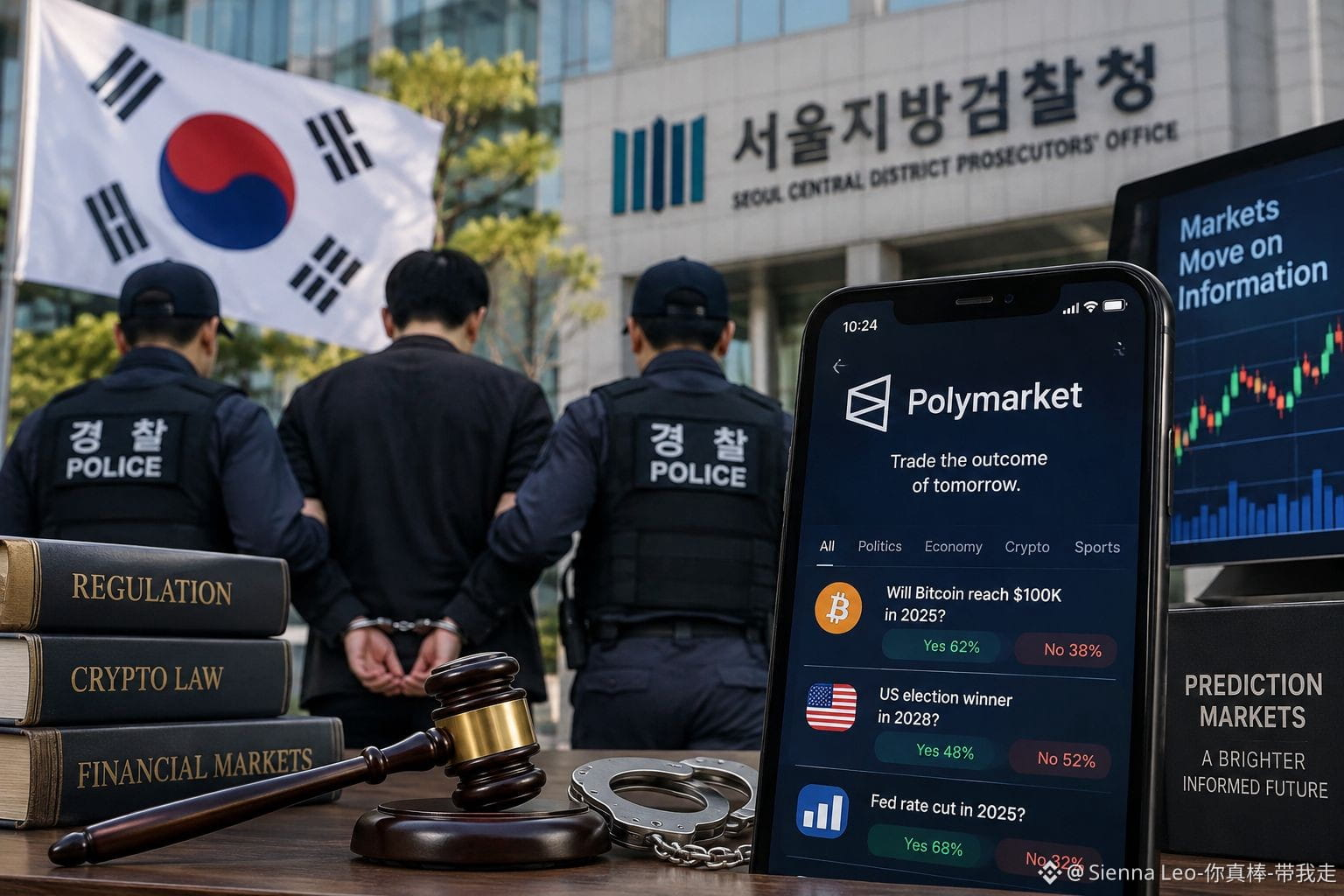
South Korean police have referred 18 Polymarket users to prosecutors after booking 26 people over their activity on the prediction-market platform. The users reportedly placed about 17.6 billion won, roughly $12.7 million, in combined bets.
The important question is not simply how much was wagered. Police reportedly view Polymarket’s yes-or-no event contracts as gambling under South Korean law, while users have argued that the contracts function more like crypto-based derivatives traded through an order book.
That distinction could matter far beyond these 18 cases. Prediction markets sit in an unusual space where trading, information discovery, speculation, and gambling can overlap depending on how regulators define the underlying activity.
South Korea has already blocked domestic access to Polymarket following a regulatory decision in August. The latest referrals show that enforcement is moving from platform-level restrictions toward individual users.
For crypto markets, the broader takeaway is clear: regulatory classification can become just as important as technology or liquidity. A product may operate globally while facing completely different legal treatment in each jurisdiction.
My view: the real story is the unresolved boundary between prediction markets and gambling. How courts interpret that boundary could influence how similar platforms approach compliance worldwide.
Do prediction markets belong closer to financial trading or gambling, and where should regulators draw the line?
Disclaimer: This article is for informational purposes only and is not financial or legal advice.
#Polymarket #GrowWithSAC #FedRateWatch $BTC $ZEC $NVDAB
#SKPoliceRefer18PolymarketUsersToProsecutors
#skpolicerefer18polymarketuserstoprosecutors
🚨 SK Police Refer 18 Polymarket Users To Prosecutors: Prediction Markets Face A New Legal Test 🚨
Imagine placing a trade on tomorrow’s political or economic outcome, then discovering that the activity you viewed as market speculation is being treated as gambling. That is now a real legal issue in South Korea.
South Korean police have referred 18 Polymarket users to prosecutors after booking 26 people over their activity on the prediction-market platform. The users reportedly placed about 17.6 billion won, roughly $12.7 million, in combined bets.
The important question is not simply how much was wagered. Police reportedly view Polymarket’s yes-or-no event contracts as gambling under South Korean law, while users have argued that the contracts function more like crypto-based derivatives traded through an order book.
That distinction could matter far beyond these 18 cases. Prediction markets sit in an unusual space where trading, information discovery, speculation, and gambling can overlap depending on how regulators define the underlying activity.
South Korea has already blocked domestic access to Polymarket following a regulatory decision in August. The latest referrals show that enforcement is moving from platform-level restrictions toward individual users.
For crypto markets, the broader takeaway is clear: regulatory classification can become just as important as technology or liquidity. A product may operate globally while facing completely different legal treatment in each jurisdiction.
My view: the real story is the unresolved boundary between prediction markets and gambling. How courts interpret that boundary could influence how similar platforms approach compliance worldwide.
Do prediction markets belong closer to financial trading or gambling, and where should regulators draw the line?
Disclaimer: This article is for informational purposes only and is not financial or legal advice.
#Polymarket #GrowWithSAC #FedRateWatch $BTC $ZEC $NVDAB
#SKPoliceRefer18PolymarketUsersToProsecutors
🚨 SK Police Refer 18 Polymarket Users To Prosecutors: Prediction Markets Face A New Legal Test 🚨
Imagine placing a trade on tomorrow’s political or economic outcome, then discovering that the activity you viewed as market speculation is being treated as gambling. That is now a real legal issue in South Korea.
South Korean police have referred 18 Polymarket users to prosecutors after booking 26 people over their activity on the prediction-market platform. The users reportedly placed about 17.6 billion won, roughly $12.7 million, in combined bets.
The important question is not simply how much was wagered. Police reportedly view Polymarket’s yes-or-no event contracts as gambling under South Korean law, while users have argued that the contracts function more like crypto-based derivatives traded through an order book.
That distinction could matter far beyond these 18 cases. Prediction markets sit in an unusual space where trading, information discovery, speculation, and gambling can overlap depending on how regulators define the underlying activity.
South Korea has already blocked domestic access to Polymarket following a regulatory decision in August. The latest referrals show that enforcement is moving from platform-level restrictions toward individual users.
For crypto markets, the broader takeaway is clear: regulatory classification can become just as important as technology or liquidity. A product may operate globally while facing completely different legal treatment in each jurisdiction.
My view: the real story is the unresolved boundary between prediction markets and gambling. How courts interpret that boundary could influence how similar platforms approach compliance worldwide.
Do prediction markets belong closer to financial trading or gambling, and where should regulators draw the line?
Disclaimer: This article is for informational purposes only and is not financial or legal advice.
#Polymarket #GrowWithSAC #FedRateWatch $BTC $ZEC $NVDAB
#SKPoliceRefer18PolymarketUsersToProsecutors
3
1.9k

·
--
#skpolicerefer18polymarketuserstoprosecutors [JUST IN] SOUTH KOREAN POLICE REFER 18 POLYMARKET USERS TO PROSECUTORS OVER ILLEGAL BETTING, CUMULATIVE WAGERS TOP $12.7M
- Gangwon Provincial Police's cyber unit began a pre-charge investigation into Polymarket users in March, booked 26 people since May, and has now referred 18 to prosecutors, per data Rep. Yoon Gun-young (Democratic Party) obtained from the National Police Agency.
- Cumulative bets among those booked total about 17.6 billion won ($12.7M), with the largest single bettor wagering about 5.7 billion won (~$4.1M).
I'm honestly more curious where that $4.1M single bet went.$GSB $POWR $LSK
#skpolicerefer18polymarketuserstoprosecutors [JUST IN] SOUTH KOREAN POLICE REFER 18 POLYMARKET USERS TO PROSECUTORS OVER ILLEGAL BETTING, CUMULATIVE WAGERS TOP $12.7M
- Gangwon Provincial Police's cyber unit began a pre-charge investigation into Polymarket users in March, booked 26 people since May, and has now referred 18 to prosecutors, per data Rep. Yoon Gun-young (Democratic Party) obtained from the National Police Agency.
- Cumulative bets among those booked total about 17.6 billion won ($12.7M), with the largest single bettor wagering about 5.7 billion won (~$4.1M).
I'm honestly more curious where that $4.1M single bet went.$GSB $POWR $LSK
- Gangwon Provincial Police's cyber unit began a pre-charge investigation into Polymarket users in March, booked 26 people since May, and has now referred 18 to prosecutors, per data Rep. Yoon Gun-young (Democratic Party) obtained from the National Police Agency.
- Cumulative bets among those booked total about 17.6 billion won ($12.7M), with the largest single bettor wagering about 5.7 billion won (~$4.1M).
I'm honestly more curious where that $4.1M single bet went.$GSB $POWR $LSK

2
3.7k

·
--
Bullish
#skpolicerefer18polymarketuserstoprosecutors
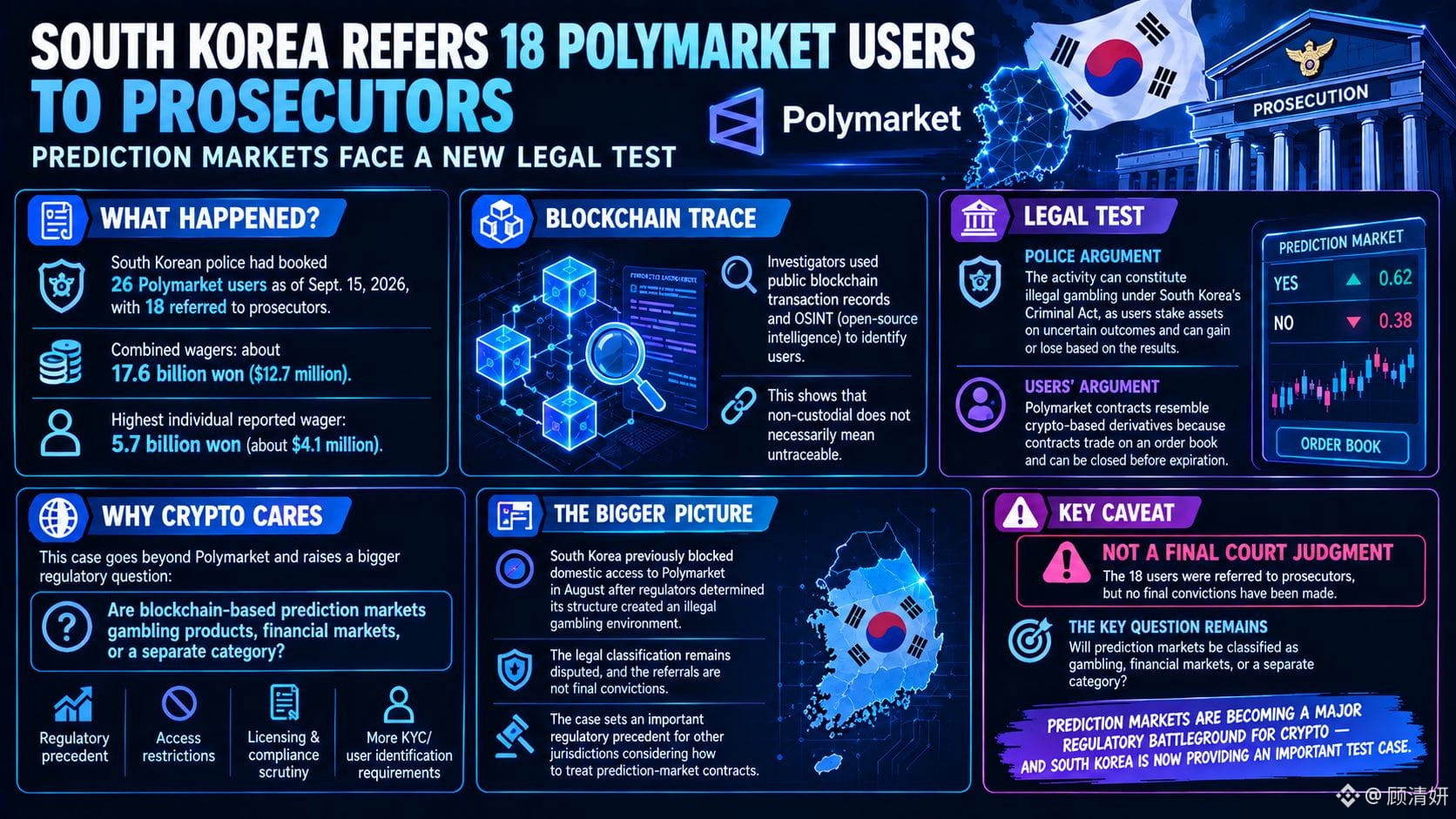
🇰🇷 SOUTH KOREA REFERS 18 POLYMARKET USERS TO PROSECUTORS — PREDICTION MARKETS FACE A NEW LEGAL TEST
South Korean police have reportedly referred 18 Polymarket users to prosecutors over alleged illegal gambling, escalating scrutiny around crypto-based prediction markets.
According to data from South Korea’s National Police Agency, 26 users had been booked as of September 15, with their combined wagers reaching approximately 17.6 billion won ($12.7 million).
What happened?
South Korea’s Gangwon Provincial Police Agency reportedly identified users by analyzing public blockchain transaction records using open-source intelligence (OSINT).
But the legal classification is being disputed.
This case goes beyond Polymarket.
It highlights a growing regulatory question:
Are blockchain-based prediction markets gambling products, financial markets, or a separate category?
South Korea previously moved to block domestic access to Polymarket after regulators determined that its structure created an illegal gambling environment.
The investigation also shows that non-custodial does not necessarily mean untraceable. Public blockchain activity can potentially be analyzed to identify wallet activity and connect transactions to individuals.
Market impact
For crypto, the bigger issue is regulatory precedent.
If authorities in more jurisdictions classify prediction-market contracts as gambling, platforms could face:
• Access restrictions
• Licensing requirements
• Greater user-identification requirements
• Increased compliance costs
• More scrutiny of political and event-based markets
However, the South Korean cases have been referred to prosecutors and do not represent final court judgments. The distinction between gambling and derivative-style trading remains an important legal question.
Prediction markets are becoming a major regulatory battleground for crypto — and South Korea is now providing an important test case.
$AVA $ONE $DGB
{spot}(DGBUSDT)
{future}(ONEUSDT)
{future}(AVAUSDT)
#skpolicerefer18polymarketuserstoprosecutors
🇰🇷 SOUTH KOREA REFERS 18 POLYMARKET USERS TO PROSECUTORS — PREDICTION MARKETS FACE A NEW LEGAL TEST
South Korean police have reportedly referred 18 Polymarket users to prosecutors over alleged illegal gambling, escalating scrutiny around crypto-based prediction markets.
According to data from South Korea’s National Police Agency, 26 users had been booked as of September 15, with their combined wagers reaching approximately 17.6 billion won ($12.7 million).
What happened?
South Korea’s Gangwon Provincial Police Agency reportedly identified users by analyzing public blockchain transaction records using open-source intelligence (OSINT).
But the legal classification is being disputed.
This case goes beyond Polymarket.
It highlights a growing regulatory question:
Are blockchain-based prediction markets gambling products, financial markets, or a separate category?
South Korea previously moved to block domestic access to Polymarket after regulators determined that its structure created an illegal gambling environment.
The investigation also shows that non-custodial does not necessarily mean untraceable. Public blockchain activity can potentially be analyzed to identify wallet activity and connect transactions to individuals.
Market impact
For crypto, the bigger issue is regulatory precedent.
If authorities in more jurisdictions classify prediction-market contracts as gambling, platforms could face:
• Access restrictions
• Licensing requirements
• Greater user-identification requirements
• Increased compliance costs
• More scrutiny of political and event-based markets
However, the South Korean cases have been referred to prosecutors and do not represent final court judgments. The distinction between gambling and derivative-style trading remains an important legal question.
Prediction markets are becoming a major regulatory battleground for crypto — and South Korea is now providing an important test case.
$AVA $ONE $DGB
🇰🇷 SOUTH KOREA REFERS 18 POLYMARKET USERS TO PROSECUTORS — PREDICTION MARKETS FACE A NEW LEGAL TEST
South Korean police have reportedly referred 18 Polymarket users to prosecutors over alleged illegal gambling, escalating scrutiny around crypto-based prediction markets.
According to data from South Korea’s National Police Agency, 26 users had been booked as of September 15, with their combined wagers reaching approximately 17.6 billion won ($12.7 million).
What happened?
South Korea’s Gangwon Provincial Police Agency reportedly identified users by analyzing public blockchain transaction records using open-source intelligence (OSINT).
But the legal classification is being disputed.
This case goes beyond Polymarket.
It highlights a growing regulatory question:
Are blockchain-based prediction markets gambling products, financial markets, or a separate category?
South Korea previously moved to block domestic access to Polymarket after regulators determined that its structure created an illegal gambling environment.
The investigation also shows that non-custodial does not necessarily mean untraceable. Public blockchain activity can potentially be analyzed to identify wallet activity and connect transactions to individuals.
Market impact
For crypto, the bigger issue is regulatory precedent.
If authorities in more jurisdictions classify prediction-market contracts as gambling, platforms could face:
• Access restrictions
• Licensing requirements
• Greater user-identification requirements
• Increased compliance costs
• More scrutiny of political and event-based markets
However, the South Korean cases have been referred to prosecutors and do not represent final court judgments. The distinction between gambling and derivative-style trading remains an important legal question.
Prediction markets are becoming a major regulatory battleground for crypto — and South Korea is now providing an important test case.
$AVA $ONE $DGB
1.9k

⚠️ Serious Question for Crypto Users
If a prediction market operates through blockchain infrastructure, where should the line be drawn between financial contracts and gambling?
South Korea's latest Polymarket investigation puts that question directly in focus, with 18 of 26 investigated users reportedly referred to prosecutors.
The legal classification could have broader implications for the prediction-market sector.
$BTC $ETH $SOL
#skpolicerefer18polymarketuserstoprosecutors
⚠️ Serious Question for Crypto Users
If a prediction market operates through blockchain infrastructure, where should the line be drawn between financial contracts and gambling?
South Korea's latest Polymarket investigation puts that question directly in focus, with 18 of 26 investigated users reportedly referred to prosecutors.
The legal classification could have broader implications for the prediction-market sector.
$BTC $ETH $SOL
#skpolicerefer18polymarketuserstoprosecutors
If a prediction market operates through blockchain infrastructure, where should the line be drawn between financial contracts and gambling?
South Korea's latest Polymarket investigation puts that question directly in focus, with 18 of 26 investigated users reportedly referred to prosecutors.
The legal classification could have broader implications for the prediction-market sector.
$BTC $ETH $SOL
#skpolicerefer18polymarketuserstoprosecutors
2
745
·
--
Verified
#skpolicerefer18polymarketuserstoprosecutors NEW: South Korean police have booked 26 local Polymarket users and referred 18 of them to prosecutors for illegal gambling, according to
Asia Economic. Their combined bets totaled about 17.6 billion won ($12.7 million).
The country blocked local access
to Polymarket last month after its media regulator ruled that the platform constituted illegal gambling.$MVLL $BNC $ROSE
#skpolicerefer18polymarketuserstoprosecutors NEW: South Korean police have booked 26 local Polymarket users and referred 18 of them to prosecutors for illegal gambling, according to
Asia Economic. Their combined bets totaled about 17.6 billion won ($12.7 million).
The country blocked local access
to Polymarket last month after its media regulator ruled that the platform constituted illegal gambling.$MVLL $BNC $ROSE
Asia Economic. Their combined bets totaled about 17.6 billion won ($12.7 million).
The country blocked local access
to Polymarket last month after its media regulator ruled that the platform constituted illegal gambling.$MVLL $BNC $ROSE
2
809

·
--
#skpolicerefer18polymarketuserstoprosecutors
🚨 South Korea Refers 18 Polymarket Users to Prosecutors
Prediction markets are facing another regulatory test in South Korea.
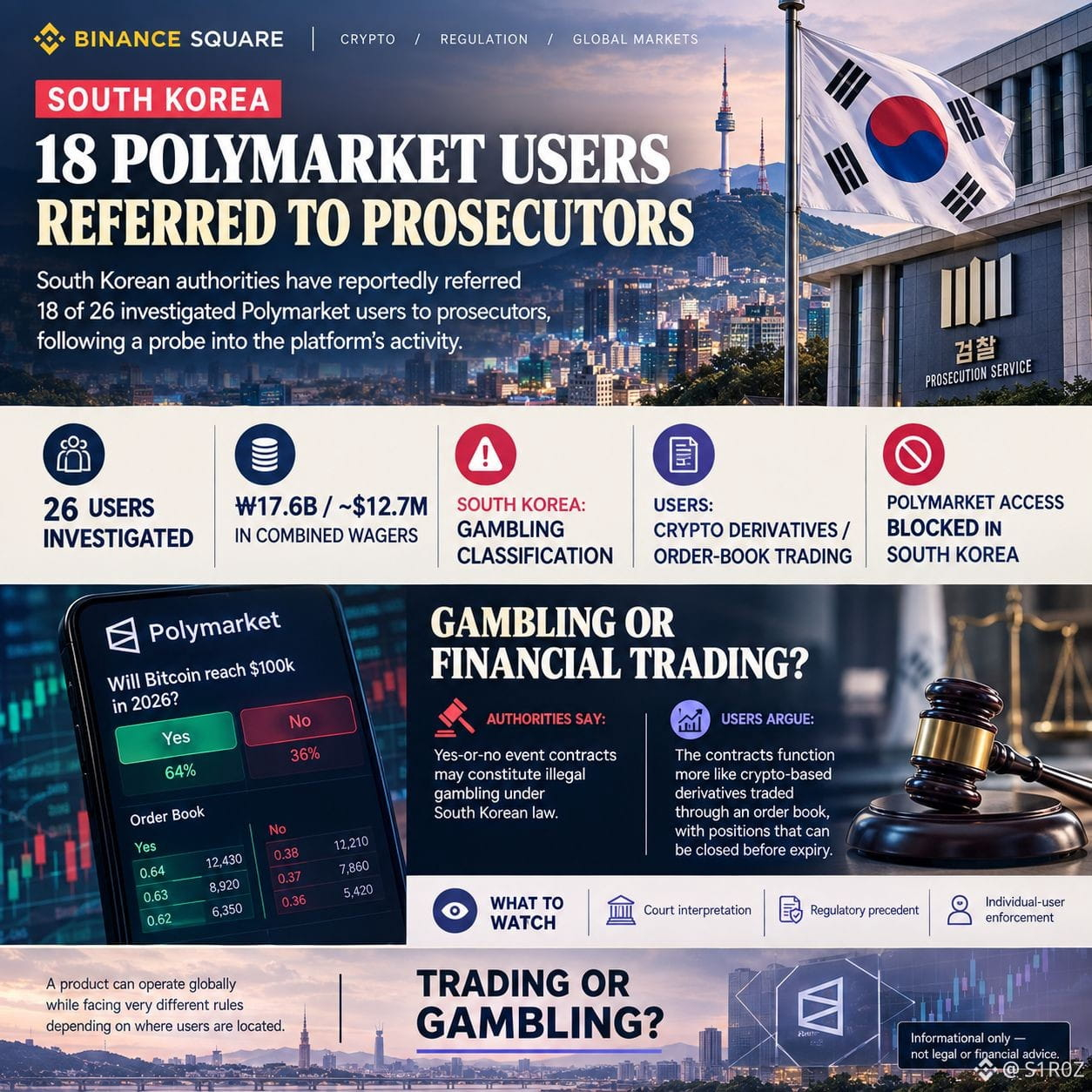
Police have reportedly referred 18 Polymarket users to prosecutors after booking 26 people over their activity on the platform. The users reportedly placed around 17.6 billion won ($12.7 million) in combined wagers.
But the bigger issue isn’t just the amount involved.
South Korean authorities reportedly view Polymarket’s yes-or-no event contracts as gambling under local law. Some users, however, have argued that these contracts function more like crypto-based derivatives traded through an order book.
That distinction could have implications far beyond these individual cases.
Prediction markets sit somewhere between trading, speculation and information markets, and their legal treatment can vary significantly by jurisdiction.
South Korea has already blocked domestic access to Polymarket following an August regulatory decision. These referrals suggest the focus may now extend beyond the platform itself to individual users.
For crypto, the bigger takeaway is that regulatory classification matters. A product can operate globally while facing very different rules depending on where users are located.
The key question now is where regulators and courts draw the line between financial trading and gambling.
What do you think — should prediction markets be treated more like trading platforms or gambling services?
Disclaimer: Informational content only, not financial or legal advice.
$BTC
{spot}(BTCUSDT)
$ZEC
{spot}(ZECUSDT)
$NVDA
{future}(NVDAUSDT)
#Polymarket #blockchain
#skpolicerefer18polymarketuserstoprosecutors
🚨 South Korea Refers 18 Polymarket Users to Prosecutors
Prediction markets are facing another regulatory test in South Korea.
Police have reportedly referred 18 Polymarket users to prosecutors after booking 26 people over their activity on the platform. The users reportedly placed around 17.6 billion won ($12.7 million) in combined wagers.
But the bigger issue isn’t just the amount involved.
South Korean authorities reportedly view Polymarket’s yes-or-no event contracts as gambling under local law. Some users, however, have argued that these contracts function more like crypto-based derivatives traded through an order book.
That distinction could have implications far beyond these individual cases.
Prediction markets sit somewhere between trading, speculation and information markets, and their legal treatment can vary significantly by jurisdiction.
South Korea has already blocked domestic access to Polymarket following an August regulatory decision. These referrals suggest the focus may now extend beyond the platform itself to individual users.
For crypto, the bigger takeaway is that regulatory classification matters. A product can operate globally while facing very different rules depending on where users are located.
The key question now is where regulators and courts draw the line between financial trading and gambling.
What do you think — should prediction markets be treated more like trading platforms or gambling services?
Disclaimer: Informational content only, not financial or legal advice.
$BTC
$ZEC
$NVDA
#Polymarket #blockchain
🚨 South Korea Refers 18 Polymarket Users to Prosecutors
Prediction markets are facing another regulatory test in South Korea.
Police have reportedly referred 18 Polymarket users to prosecutors after booking 26 people over their activity on the platform. The users reportedly placed around 17.6 billion won ($12.7 million) in combined wagers.
But the bigger issue isn’t just the amount involved.
South Korean authorities reportedly view Polymarket’s yes-or-no event contracts as gambling under local law. Some users, however, have argued that these contracts function more like crypto-based derivatives traded through an order book.
That distinction could have implications far beyond these individual cases.
Prediction markets sit somewhere between trading, speculation and information markets, and their legal treatment can vary significantly by jurisdiction.
South Korea has already blocked domestic access to Polymarket following an August regulatory decision. These referrals suggest the focus may now extend beyond the platform itself to individual users.
For crypto, the bigger takeaway is that regulatory classification matters. A product can operate globally while facing very different rules depending on where users are located.
The key question now is where regulators and courts draw the line between financial trading and gambling.
What do you think — should prediction markets be treated more like trading platforms or gambling services?
Disclaimer: Informational content only, not financial or legal advice.
$BTC
$ZEC
$NVDA
#Polymarket #blockchain
57
🔥 Prediction Markets Face a Major Legal Test
South Korea has reportedly referred 18 Polymarket users to prosecutors following an investigation into alleged illegal gambling.
The users' combined wagers reportedly reached 17.6 billion won ($12.7M). South Korea had already blocked domestic access to Polymarket after regulators determined the platform created an illegal gambling environment.
Could this case influence how other jurisdictions approach prediction markets? 👀
$BTC $ETH
#skpolicerefer18polymarketuserstoprosecutors
🔥 Prediction Markets Face a Major Legal Test
South Korea has reportedly referred 18 Polymarket users to prosecutors following an investigation into alleged illegal gambling.
The users' combined wagers reportedly reached 17.6 billion won ($12.7M). South Korea had already blocked domestic access to Polymarket after regulators determined the platform created an illegal gambling environment.
Could this case influence how other jurisdictions approach prediction markets? 👀
$BTC $ETH
#skpolicerefer18polymarketuserstoprosecutors
South Korea has reportedly referred 18 Polymarket users to prosecutors following an investigation into alleged illegal gambling.
The users' combined wagers reportedly reached 17.6 billion won ($12.7M). South Korea had already blocked domestic access to Polymarket after regulators determined the platform created an illegal gambling environment.
Could this case influence how other jurisdictions approach prediction markets? 👀
$BTC $ETH
#skpolicerefer18polymarketuserstoprosecutors
86

·
--
You think this is about regulation. It’s not. It’s about attention.
The police didn’t act because of market harm.
They acted because someone noticed and complained.
That’s the real trigger for any trader: visibility, not legality.
I’m watching who gets named next.
Not to trade. To see who’s still quiet.
If 18 people get charged and the market doesn’t flinch?
I was wrong.
You think it’s a threat?
Not financial advice.
#SKPoliceRefer18PolymarketUsersToProsecutors #CryptoNews
You think this is about regulation. It’s not. It’s about attention.
The police didn’t act because of market harm.
They acted because someone noticed and complained.
That’s the real trigger for any trader: visibility, not legality.
I’m watching who gets named next.
Not to trade. To see who’s still quiet.
If 18 people get charged and the market doesn’t flinch?
I was wrong.
You think it’s a threat?
Not financial advice.
#SKPoliceRefer18PolymarketUsersToProsecutors #CryptoNews
The police didn’t act because of market harm.
They acted because someone noticed and complained.
That’s the real trigger for any trader: visibility, not legality.
I’m watching who gets named next.
Not to trade. To see who’s still quiet.
If 18 people get charged and the market doesn’t flinch?
I was wrong.
You think it’s a threat?
Not financial advice.
#SKPoliceRefer18PolymarketUsersToProsecutors #CryptoNews
53
⚖️ $12.7M in Wagers Under Investigation
A South Korean police investigation has reportedly identified 26 Polymarket users, with 18 cases referred to prosecutors.
The group allegedly wagered a combined 17.6 billion won, while one individual reportedly accounted for about 5.7 billion won.
The key question now is how Korean authorities will legally classify these prediction-market contracts.
$BTC $ETH $SOL
#skpolicerefer18polymarketuserstoprosecutors
⚖️ $12.7M in Wagers Under Investigation
A South Korean police investigation has reportedly identified 26 Polymarket users, with 18 cases referred to prosecutors.
The group allegedly wagered a combined 17.6 billion won, while one individual reportedly accounted for about 5.7 billion won.
The key question now is how Korean authorities will legally classify these prediction-market contracts.
$BTC $ETH $SOL
#skpolicerefer18polymarketuserstoprosecutors
A South Korean police investigation has reportedly identified 26 Polymarket users, with 18 cases referred to prosecutors.
The group allegedly wagered a combined 17.6 billion won, while one individual reportedly accounted for about 5.7 billion won.
The key question now is how Korean authorities will legally classify these prediction-market contracts.
$BTC $ETH $SOL
#skpolicerefer18polymarketuserstoprosecutors
1
482

·
--
Bullish
#skpolicerefer18polymarketuserstoprosecutors
The Korean Wave just hit Polymarket, but not in a K-pop way! 🇰🇷 18 poor Oppas just got referred to prosecutors because South Korea isn't ready for decentralized prediction markets yet! These degens bet a massive 17.6 billion won. The police used OSINT to track their wallets right on the public blockchain! 🕵️♂️ Imagine surviving brutal market dumps just to get busted for guessing who wins an election!
➡️ What should traders do? Privacy is wealth, fam! Always use safe, fully compliant exchanges like Binance to move your funds. Check your local regulations before going all-in on Web3 predictions!
Not financial advice. DYOR! 📊
Support VINHTOCDO! Grab your spaceship ticket and register on Binance here: [https://www.binance.com/register?ref=VINHTOCDO](https://www.binance.com/register?ref=VINHTOCDO) 🚀
👇 Click to trade below to support me:
$BTC
{future}(BTCUSDT)
| $ETH
{future}(ETHUSDT)
| $POL
{future}(POLUSDT)
#VINHTOCDO #Polymarket #Web3Security #Binance
#skpolicerefer18polymarketuserstoprosecutors
The Korean Wave just hit Polymarket, but not in a K-pop way! 🇰🇷 18 poor Oppas just got referred to prosecutors because South Korea isn't ready for decentralized prediction markets yet! These degens bet a massive 17.6 billion won. The police used OSINT to track their wallets right on the public blockchain! 🕵️♂️ Imagine surviving brutal market dumps just to get busted for guessing who wins an election!
➡️ What should traders do? Privacy is wealth, fam! Always use safe, fully compliant exchanges like Binance to move your funds. Check your local regulations before going all-in on Web3 predictions!
Not financial advice. DYOR! 📊
Support VINHTOCDO! Grab your spaceship ticket and register on Binance here: https://www.binance.com/register?ref=VINHTOCDO 🚀
👇 Click to trade below to support me:
$BTC
| $ETH
| $POL
#VINHTOCDO #Polymarket #Web3Security #Binance
The Korean Wave just hit Polymarket, but not in a K-pop way! 🇰🇷 18 poor Oppas just got referred to prosecutors because South Korea isn't ready for decentralized prediction markets yet! These degens bet a massive 17.6 billion won. The police used OSINT to track their wallets right on the public blockchain! 🕵️♂️ Imagine surviving brutal market dumps just to get busted for guessing who wins an election!
➡️ What should traders do? Privacy is wealth, fam! Always use safe, fully compliant exchanges like Binance to move your funds. Check your local regulations before going all-in on Web3 predictions!
Not financial advice. DYOR! 📊
Support VINHTOCDO! Grab your spaceship ticket and register on Binance here: https://www.binance.com/register?ref=VINHTOCDO 🚀
👇 Click to trade below to support me:
$BTC
| $ETH
| $POL
#VINHTOCDO #Polymarket #Web3Security #Binance

2
183

·
--
Verified
$LUNC
🔥 $LUNC — THE BURN STORY IS STILL ALIVE! 🔥
🚀 Terra Classic is back on traders’ radar as LUNC continues its supply-reduction journey.
🔥 Binance’s latest recorded monthly burn sent 334.88M LUNC to the burn wallet, with tracked Binance burns now above 87.7B LUNC.
📉 LUNC’s supply remains enormous, so burns alone won’t be enough — stronger utility and sustained demand matter too.
⚙️ A major v4.0.1-patch.3 security upgrade is scheduled for activation around September 24, 2026, subject to the network upgrade process.
👀 Future chance: Higher activity + continued burns + ecosystem development could support LUNC, but volatility remains extremely high.
#LUNC #TerraClassic #LUNCBurn #Crypto #BinanceSquare #Altcoins #SKPoliceRefer18PolymarketUsersToProsecutors
{spot}(LUNCUSDT)
$LUNC
🔥 $LUNC — THE BURN STORY IS STILL ALIVE! 🔥
🚀 Terra Classic is back on traders’ radar as LUNC continues its supply-reduction journey.
🔥 Binance’s latest recorded monthly burn sent 334.88M LUNC to the burn wallet, with tracked Binance burns now above 87.7B LUNC.
📉 LUNC’s supply remains enormous, so burns alone won’t be enough — stronger utility and sustained demand matter too.
⚙️ A major v4.0.1-patch.3 security upgrade is scheduled for activation around September 24, 2026, subject to the network upgrade process.
👀 Future chance: Higher activity + continued burns + ecosystem development could support LUNC, but volatility remains extremely high.
#LUNC #TerraClassic #LUNCBurn #Crypto #BinanceSquare #Altcoins #SKPoliceRefer18PolymarketUsersToProsecutors
🔥 $LUNC — THE BURN STORY IS STILL ALIVE! 🔥
🚀 Terra Classic is back on traders’ radar as LUNC continues its supply-reduction journey.
🔥 Binance’s latest recorded monthly burn sent 334.88M LUNC to the burn wallet, with tracked Binance burns now above 87.7B LUNC.
📉 LUNC’s supply remains enormous, so burns alone won’t be enough — stronger utility and sustained demand matter too.
⚙️ A major v4.0.1-patch.3 security upgrade is scheduled for activation around September 24, 2026, subject to the network upgrade process.
👀 Future chance: Higher activity + continued burns + ecosystem development could support LUNC, but volatility remains extremely high.
#LUNC #TerraClassic #LUNCBurn #Crypto #BinanceSquare #Altcoins #SKPoliceRefer18PolymarketUsersToProsecutors
5
610

·
--
Verified
🚨El Salvador’s 7,777 BTC puzzle
#elsalvadorbtcholdingsriseto7777
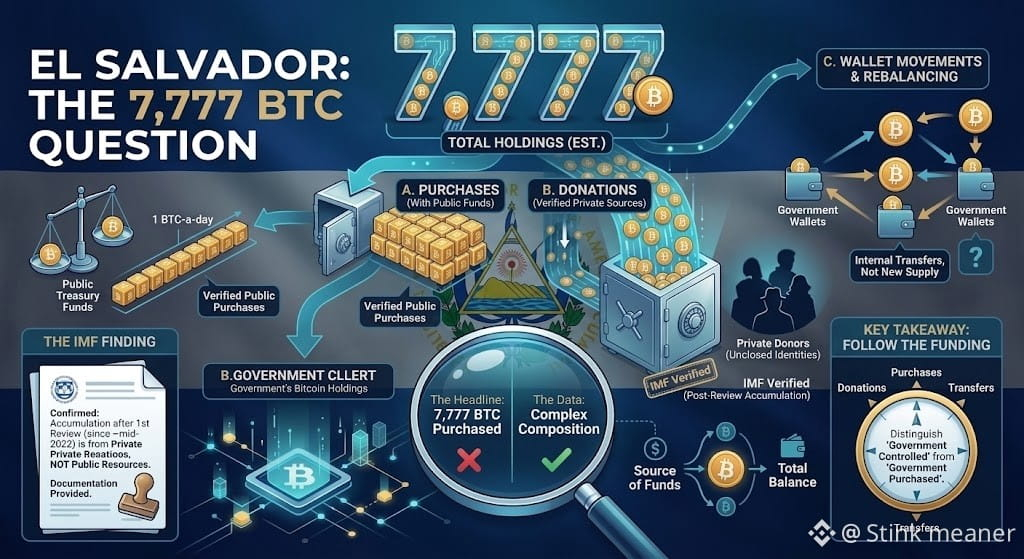
🇸🇻 El Salvador just hit 7,777 BTC — but the number isn't the whole story.
New monitoring reported today puts the government's Bitcoin holdings at 7,777 BTC, worth roughly $594M at the reported market price.
At an average cost of about $55,718/BTC, that implies roughly $162M in unrealized gains.
But here's where it gets interesting. 👀
The headline circulating today says El Salvador has continued its 1 BTC-a-day strategy for 916 days.
The IMF's latest review adds an important qualification:
It says documentation provided by Salvadoran authorities verified that Bitcoin accumulated since the first IMF review reflected private donations — with no public resources used.
So we shouldn't automatically equate:
“7,777 BTC in government-controlled holdings”
with
“7,777 BTC purchased with government money.”
Those are different claims.
The IMF also says it does not expect further accumulation beyond the documented donations, while the identities and total amount of those private donations have not been publicly disclosed in the IMF's statement.
That leaves the more interesting question:
How exactly did El Salvador's BTC balance move from the post-IMF-review level to today's 7,777 BTC — and which portion came from purchases, donations, or movements between controlled wallets?
That's a much more useful question than simply counting the coins.
$BTC $BNB $ETH
{future}(BTCUSDT)
DYOR. Follow the wallets, funding trail and primary disclosures — not just the headline.
#ElSalvadorBTCHoldingsRiseTo7777 #MemeLaunchpads82%OfArcDayOneVolume #HyperliquidUSDCSupplyOvertakesSolana #SKPoliceRefer18PolymarketUsersToProsecutors
🚨El Salvador’s 7,777 BTC puzzle
#elsalvadorbtcholdingsriseto7777
🇸🇻 El Salvador just hit 7,777 BTC — but the number isn't the whole story.
New monitoring reported today puts the government's Bitcoin holdings at 7,777 BTC, worth roughly $594M at the reported market price.
At an average cost of about $55,718/BTC, that implies roughly $162M in unrealized gains.
But here's where it gets interesting. 👀
The headline circulating today says El Salvador has continued its 1 BTC-a-day strategy for 916 days.
The IMF's latest review adds an important qualification:
It says documentation provided by Salvadoran authorities verified that Bitcoin accumulated since the first IMF review reflected private donations — with no public resources used.
So we shouldn't automatically equate:
“7,777 BTC in government-controlled holdings”
with
“7,777 BTC purchased with government money.”
Those are different claims.
The IMF also says it does not expect further accumulation beyond the documented donations, while the identities and total amount of those private donations have not been publicly disclosed in the IMF's statement.
That leaves the more interesting question:
How exactly did El Salvador's BTC balance move from the post-IMF-review level to today's 7,777 BTC — and which portion came from purchases, donations, or movements between controlled wallets?
That's a much more useful question than simply counting the coins.
$BTC $BNB $ETH
DYOR. Follow the wallets, funding trail and primary disclosures — not just the headline.
#ElSalvadorBTCHoldingsRiseTo7777 #MemeLaunchpads82%OfArcDayOneVolume #HyperliquidUSDCSupplyOvertakesSolana #SKPoliceRefer18PolymarketUsersToProsecutors
#elsalvadorbtcholdingsriseto7777
🇸🇻 El Salvador just hit 7,777 BTC — but the number isn't the whole story.
New monitoring reported today puts the government's Bitcoin holdings at 7,777 BTC, worth roughly $594M at the reported market price.
At an average cost of about $55,718/BTC, that implies roughly $162M in unrealized gains.
But here's where it gets interesting. 👀
The headline circulating today says El Salvador has continued its 1 BTC-a-day strategy for 916 days.
The IMF's latest review adds an important qualification:
It says documentation provided by Salvadoran authorities verified that Bitcoin accumulated since the first IMF review reflected private donations — with no public resources used.
So we shouldn't automatically equate:
“7,777 BTC in government-controlled holdings”
with
“7,777 BTC purchased with government money.”
Those are different claims.
The IMF also says it does not expect further accumulation beyond the documented donations, while the identities and total amount of those private donations have not been publicly disclosed in the IMF's statement.
That leaves the more interesting question:
How exactly did El Salvador's BTC balance move from the post-IMF-review level to today's 7,777 BTC — and which portion came from purchases, donations, or movements between controlled wallets?
That's a much more useful question than simply counting the coins.
$BTC $BNB $ETH
DYOR. Follow the wallets, funding trail and primary disclosures — not just the headline.
#ElSalvadorBTCHoldingsRiseTo7777 #MemeLaunchpads82%OfArcDayOneVolume #HyperliquidUSDCSupplyOvertakesSolana #SKPoliceRefer18PolymarketUsersToProsecutors
4
2.5k

$SUI
{spot}(SUIUSDT)
2026 Price ForecastsBinance projects short-term targets to potentially reach up to $1.65 USD by late 2026 depending on market stability.
Cryptorank analysts estimate a broader 2026 trading range between $1.50 and $3.00 USD if network adoption grows.
Risk Factors: Unlocking token supplies may create short-term selling pressure.
SUI has strong technical foundations and is growing rapidly, but the cryptocurrency remains highly volatile and faces competition from established blockchains. Consider your investment goals and whether you believe in the project's long-term potential before investing.
#SKPoliceRefer18PolymarketUsersToProsecutors #ParadigmDisclosesZECHolding #USWeeklyJoblessClaimsFallTo196K #MemeLaunchpads82%OfArcDayOneVolume
$SUI
2026 Price ForecastsBinance projects short-term targets to potentially reach up to $1.65 USD by late 2026 depending on market stability.
Cryptorank analysts estimate a broader 2026 trading range between $1.50 and $3.00 USD if network adoption grows.
Risk Factors: Unlocking token supplies may create short-term selling pressure.
SUI has strong technical foundations and is growing rapidly, but the cryptocurrency remains highly volatile and faces competition from established blockchains. Consider your investment goals and whether you believe in the project's long-term potential before investing.
#SKPoliceRefer18PolymarketUsersToProsecutors #ParadigmDisclosesZECHolding #USWeeklyJoblessClaimsFallTo196K #MemeLaunchpads82%OfArcDayOneVolume
2026 Price ForecastsBinance projects short-term targets to potentially reach up to $1.65 USD by late 2026 depending on market stability.
Cryptorank analysts estimate a broader 2026 trading range between $1.50 and $3.00 USD if network adoption grows.
Risk Factors: Unlocking token supplies may create short-term selling pressure.
SUI has strong technical foundations and is growing rapidly, but the cryptocurrency remains highly volatile and faces competition from established blockchains. Consider your investment goals and whether you believe in the project's long-term potential before investing.
#SKPoliceRefer18PolymarketUsersToProsecutors #ParadigmDisclosesZECHolding #USWeeklyJoblessClaimsFallTo196K #MemeLaunchpads82%OfArcDayOneVolume
64

Verified
$AVAX — Latest Analysis
Price: ~$7.59
24h: +~5% �
CoinGecko +1
🔹 Momentum: Short-term momentum has turned positive after AVAX bounced from the ~$7.18 area.
🔹 Resistance: $7.60–$8.00
🔹 Support: $7.18, then $7.00
🔹 Catalysts: Avalanche's upcoming Helicon upgrade and new stablecoin/payment developments are attracting attention. �
🔹 Risk: AVAX remains volatile and is still far below its historical peak.
crypto.news +1
Short-term view: 🟢 Bullish momentum, but holding above $7.50–$7.60 would strengthen the recovery.
#MemeLaunchpads82%OfArcDayOneVolume
#OstiumLoanDisputeHearingSetInNYFederalCourt
#SKPoliceRefer18PolymarketUsersToProsecutors
#SKPoliceRefer18PolymarketUsersToProsecutors
{spot}(AVAXUSDT)
$AVAX — Latest Analysis
Price: ~$7.59
24h: +~5% �
CoinGecko +1
🔹 Momentum: Short-term momentum has turned positive after AVAX bounced from the ~$7.18 area.
🔹 Resistance: $7.60–$8.00
🔹 Support: $7.18, then $7.00
🔹 Catalysts: Avalanche's upcoming Helicon upgrade and new stablecoin/payment developments are attracting attention. �
🔹 Risk: AVAX remains volatile and is still far below its historical peak.
crypto.news +1
Short-term view: 🟢 Bullish momentum, but holding above $7.50–$7.60 would strengthen the recovery.
#MemeLaunchpads82%OfArcDayOneVolume
#OstiumLoanDisputeHearingSetInNYFederalCourt
#SKPoliceRefer18PolymarketUsersToProsecutors
#SKPoliceRefer18PolymarketUsersToProsecutors
Price: ~$7.59
24h: +~5% �
CoinGecko +1
🔹 Momentum: Short-term momentum has turned positive after AVAX bounced from the ~$7.18 area.
🔹 Resistance: $7.60–$8.00
🔹 Support: $7.18, then $7.00
🔹 Catalysts: Avalanche's upcoming Helicon upgrade and new stablecoin/payment developments are attracting attention. �
🔹 Risk: AVAX remains volatile and is still far below its historical peak.
crypto.news +1
Short-term view: 🟢 Bullish momentum, but holding above $7.50–$7.60 would strengthen the recovery.
#MemeLaunchpads82%OfArcDayOneVolume
#OstiumLoanDisputeHearingSetInNYFederalCourt
#SKPoliceRefer18PolymarketUsersToProsecutors
#SKPoliceRefer18PolymarketUsersToProsecutors
1
684
·
--
🚨Get your Crypto $XRP into a Trust ? — 🎯Don't Sell Your $XRP - Become Your Own Private Bank 💼
Not having a Trust is the worst thing you can do.💥‼️
Hold your $XRP in cold storage inside an irrevocable private trust.🛡️
DM me “XRP GUIDE” for Guidance
#SKPoliceRefer18PolymarketUsersToProsecutors #FedSEPProjects2026RateAt4.1%
{spot}(XRPUSDT)
🚨Get your Crypto $XRP into a Trust ? — 🎯Don't Sell Your $XRP - Become Your Own Private Bank 💼
Not having a Trust is the worst thing you can do.💥‼️
Hold your $XRP in cold storage inside an irrevocable private trust.🛡️
DM me “XRP GUIDE” for Guidance
#SKPoliceRefer18PolymarketUsersToProsecutors #FedSEPProjects2026RateAt4.1%
Not having a Trust is the worst thing you can do.💥‼️
Hold your $XRP in cold storage inside an irrevocable private trust.🛡️
DM me “XRP GUIDE” for Guidance
#SKPoliceRefer18PolymarketUsersToProsecutors #FedSEPProjects2026RateAt4.1%
_Selim:
hmmm
2
2
12
5.1k

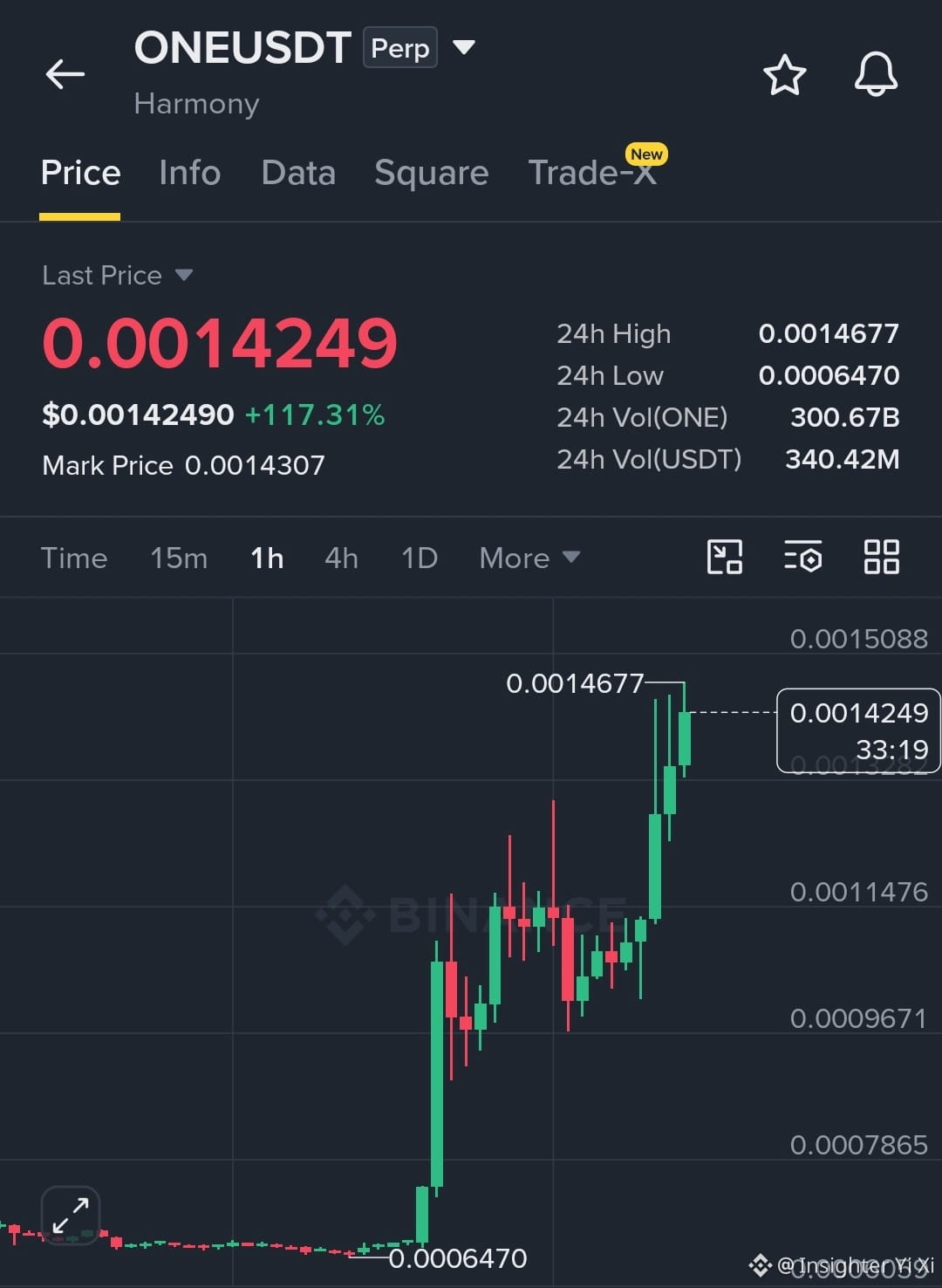
$ONE is moving fast but I’m watching the pullback, not chasing the candle.
{future}(ONEUSDT)
#ONEUSDT is around 0.0014249, up more than, with the 24h high near 0.0014677. Volume is also very strong.
{stock_us}(FAST.US)
My view: after such an aggressive move, the important question isn’t “how high can it go?” it’s whether buyers can defend the breakout area.
I’m watching 0.00142–0.00147 first. A clean hold can keep momentum alive, while rejection could bring a deeper retest toward 0.00115.
For me, patience matters more than FOMO here. DYOR and manage risk.
#SKPoliceRefer18PolymarketUsersToProsecutors #ElSalvadorBTCHoldingsRiseTo7777 #ParadigmDisclosesZECHolding
$ONE is moving fast but I’m watching the pullback, not chasing the candle.
#ONEUSDT is around 0.0014249, up more than, with the 24h high near 0.0014677. Volume is also very strong.
My view: after such an aggressive move, the important question isn’t “how high can it go?” it’s whether buyers can defend the breakout area.
I’m watching 0.00142–0.00147 first. A clean hold can keep momentum alive, while rejection could bring a deeper retest toward 0.00115.
For me, patience matters more than FOMO here. DYOR and manage risk.
#SKPoliceRefer18PolymarketUsersToProsecutors #ElSalvadorBTCHoldingsRiseTo7777 #ParadigmDisclosesZECHolding
#ONEUSDT is around 0.0014249, up more than, with the 24h high near 0.0014677. Volume is also very strong.
My view: after such an aggressive move, the important question isn’t “how high can it go?” it’s whether buyers can defend the breakout area.
I’m watching 0.00142–0.00147 first. A clean hold can keep momentum alive, while rejection could bring a deeper retest toward 0.00115.
For me, patience matters more than FOMO here. DYOR and manage risk.
#SKPoliceRefer18PolymarketUsersToProsecutors #ElSalvadorBTCHoldingsRiseTo7777 #ParadigmDisclosesZECHolding
ONE+46.26%
FASTUS+0.34%
1
610

·
--
Bullish
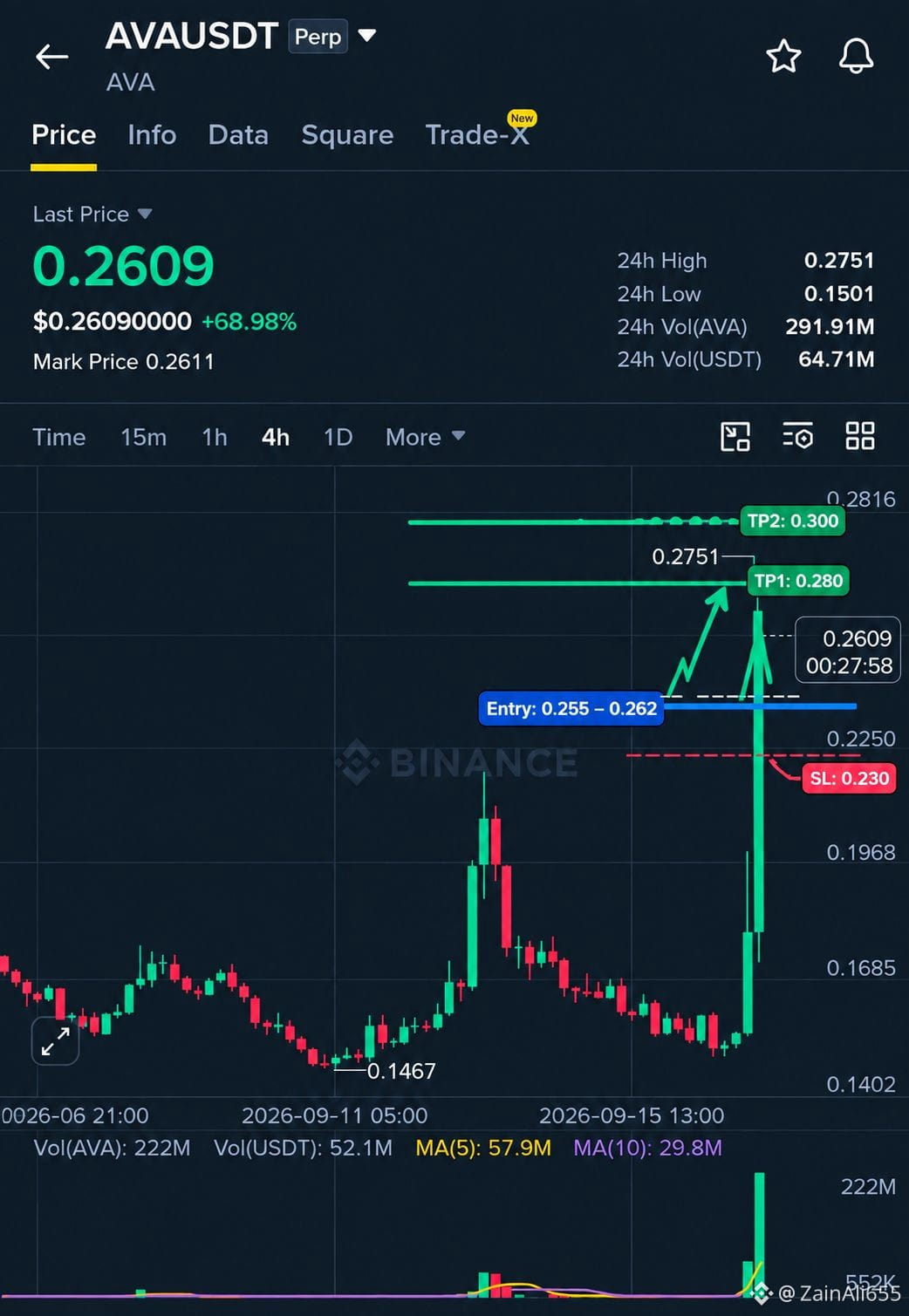
$AVA is definitely catching attention today 👀🔥
+68% in 24h is a serious move, and the volume spike makes it even more interesting. But after such a big pump, I’d rather watch the entry zone than chase the candle.
Long Entry: 0.255 – 0.262 TP1: 0.280 TP2: 0.300 SL: 0.230
Let’s see if AVA can hold this momentum or cool down first. DYOR.
#SKPoliceRefer18PolymarketUsersToProsecutors #FedSEPProjects2026RateAt4.1% #USHouseAdvancesBitcoinReserveBill #AmazonGetsWarrantsToBuyGeneracStock #DotPlotSignalsOneMoreHikeIn2026
{future}(AVAUSDT)
$BR
{future}(BRUSDT)
$NEAR
{future}(NEARUSDT)
$AVA is definitely catching attention today 👀🔥
+68% in 24h is a serious move, and the volume spike makes it even more interesting. But after such a big pump, I’d rather watch the entry zone than chase the candle.
Long Entry: 0.255 – 0.262 TP1: 0.280 TP2: 0.300 SL: 0.230
Let’s see if AVA can hold this momentum or cool down first. DYOR.
#SKPoliceRefer18PolymarketUsersToProsecutors #FedSEPProjects2026RateAt4.1% #USHouseAdvancesBitcoinReserveBill #AmazonGetsWarrantsToBuyGeneracStock #DotPlotSignalsOneMoreHikeIn2026
$BR
$NEAR
+68% in 24h is a serious move, and the volume spike makes it even more interesting. But after such a big pump, I’d rather watch the entry zone than chase the candle.
Long Entry: 0.255 – 0.262 TP1: 0.280 TP2: 0.300 SL: 0.230
Let’s see if AVA can hold this momentum or cool down first. DYOR.
#SKPoliceRefer18PolymarketUsersToProsecutors #FedSEPProjects2026RateAt4.1% #USHouseAdvancesBitcoinReserveBill #AmazonGetsWarrantsToBuyGeneracStock #DotPlotSignalsOneMoreHikeIn2026
$BR
$NEAR
1
295

·
--
Bearish
$BR
{future}(BRUSDT)
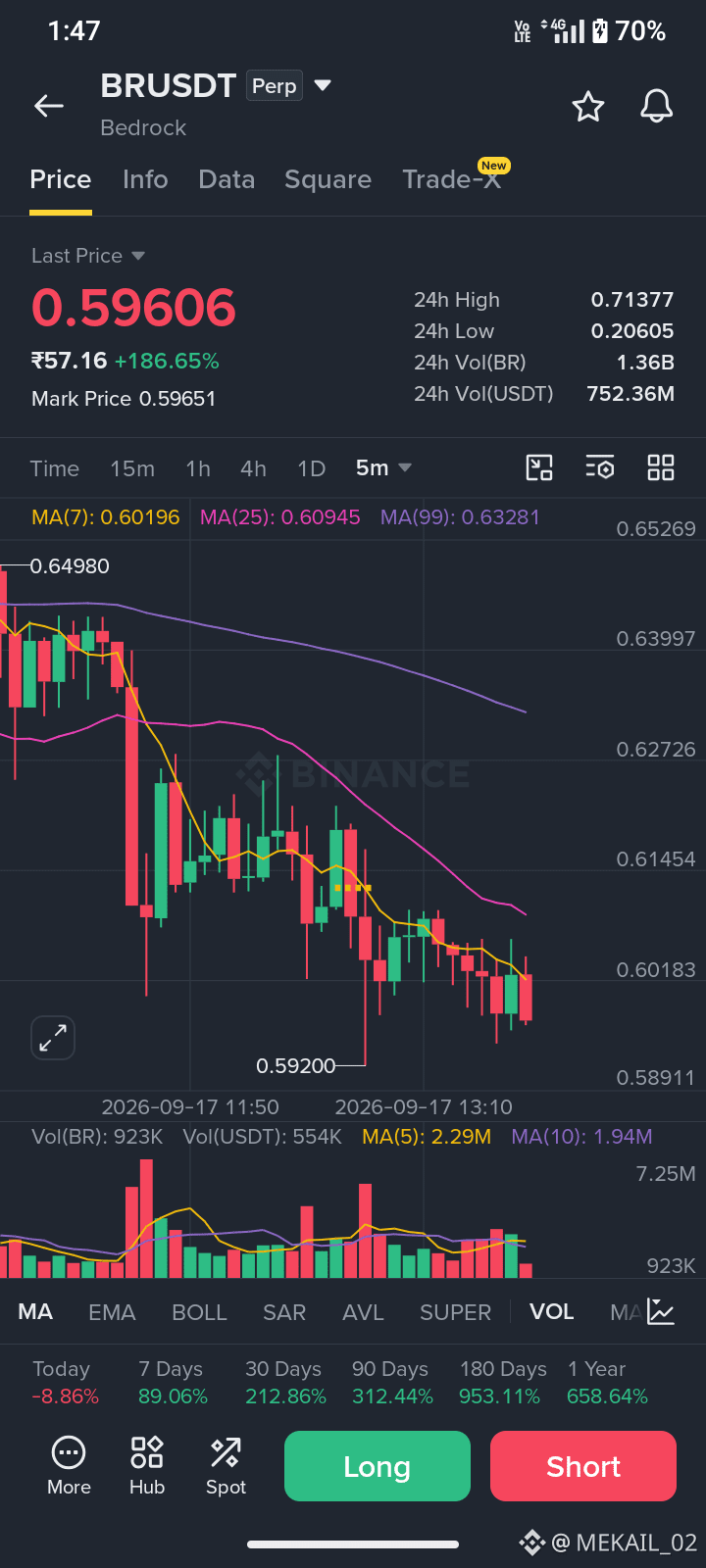
📊 BRUSDT — SELL
━━━━━━━━━━━━━━━
📋 Order: Market Sell
🎯 Entry: 0.595 - 0.598
🛑 SL: 0.603
✅ TP1: 0.59
✅ TP2: 0.586
✅ TP3: 0.582
📈 Confidence: 72%
━━━━━━━━━━━━━━━
💡 Price is trading below all key moving averages with persistent lower highs, suggesting continuation of the short-term downtrend for a quick scalp. Entering near 0.596 with tight stops aims to capture further downside momentum before potential support around 0.59.
🌍 On the 5m chart BRUSDT is in a short-term downtrend with price below the 7, 25, and 99 MAs and selling volume still active despite strong multi-day gains.
#OstiumLoanDisputeHearingSetInNYFederalCourt #FedSEPProjects2026RateAt4.1% #SKPoliceRefer18PolymarketUsersToProsecutors #DotPlotSignalsOneMoreHikeIn2026
$BR
📊 BRUSDT — SELL
━━━━━━━━━━━━━━━
📋 Order: Market Sell
🎯 Entry: 0.595 - 0.598
🛑 SL: 0.603
✅ TP1: 0.59
✅ TP2: 0.586
✅ TP3: 0.582
📈 Confidence: 72%
━━━━━━━━━━━━━━━
💡 Price is trading below all key moving averages with persistent lower highs, suggesting continuation of the short-term downtrend for a quick scalp. Entering near 0.596 with tight stops aims to capture further downside momentum before potential support around 0.59.
🌍 On the 5m chart BRUSDT is in a short-term downtrend with price below the 7, 25, and 99 MAs and selling volume still active despite strong multi-day gains.
#OstiumLoanDisputeHearingSetInNYFederalCourt #FedSEPProjects2026RateAt4.1% #SKPoliceRefer18PolymarketUsersToProsecutors #DotPlotSignalsOneMoreHikeIn2026
📊 BRUSDT — SELL
━━━━━━━━━━━━━━━
📋 Order: Market Sell
🎯 Entry: 0.595 - 0.598
🛑 SL: 0.603
✅ TP1: 0.59
✅ TP2: 0.586
✅ TP3: 0.582
📈 Confidence: 72%
━━━━━━━━━━━━━━━
💡 Price is trading below all key moving averages with persistent lower highs, suggesting continuation of the short-term downtrend for a quick scalp. Entering near 0.596 with tight stops aims to capture further downside momentum before potential support around 0.59.
🌍 On the 5m chart BRUSDT is in a short-term downtrend with price below the 7, 25, and 99 MAs and selling volume still active despite strong multi-day gains.
#OstiumLoanDisputeHearingSetInNYFederalCourt #FedSEPProjects2026RateAt4.1% #SKPoliceRefer18PolymarketUsersToProsecutors #DotPlotSignalsOneMoreHikeIn2026
humkash:
Please Follow me. I Followed you back. Please like my post.
2
1
273

·
--
$XRP ETF inflows
$XRP ETF Money Is Moving Differently From BTC & ETH
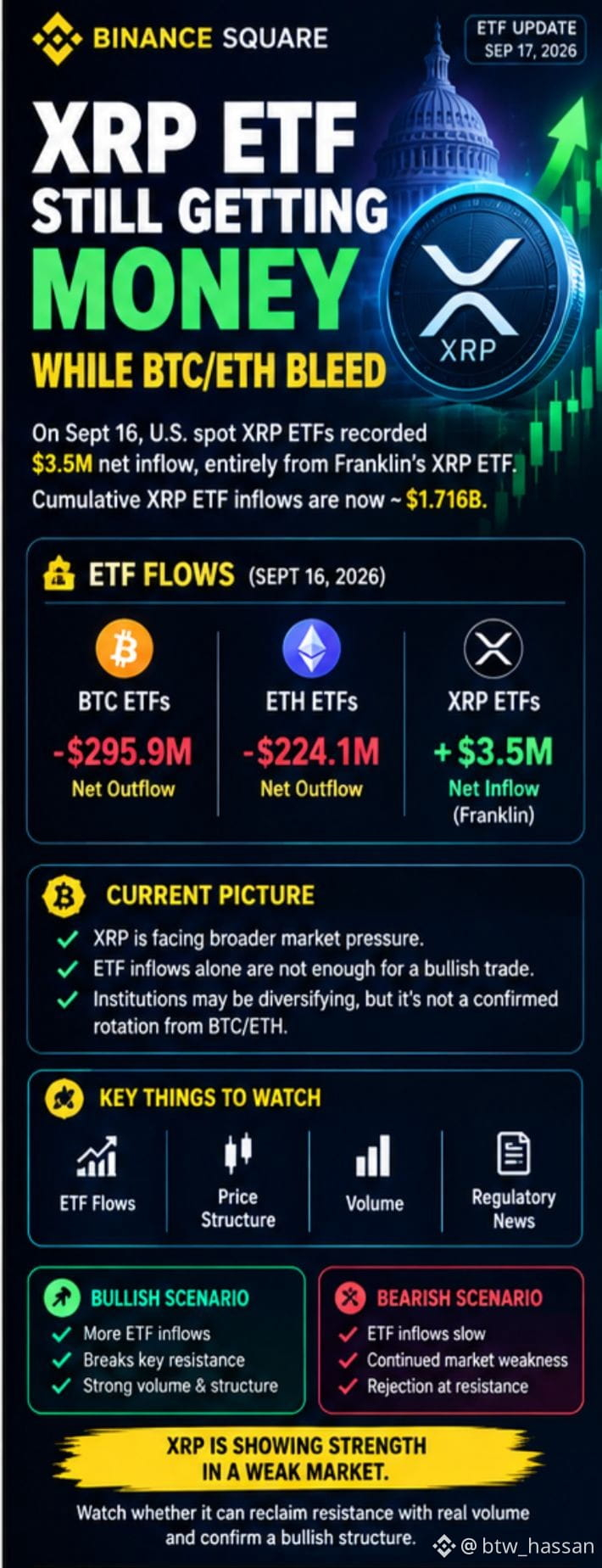
On September 16, U.S. spot XRP ETFs recorded around $3.5M in net inflows, while Bitcoin ETFs saw nearly $296M in outflows and Ethereum ETFs saw around $224M in outflows.
XRP's cumulative ETF inflows have now reached roughly $1.716B.
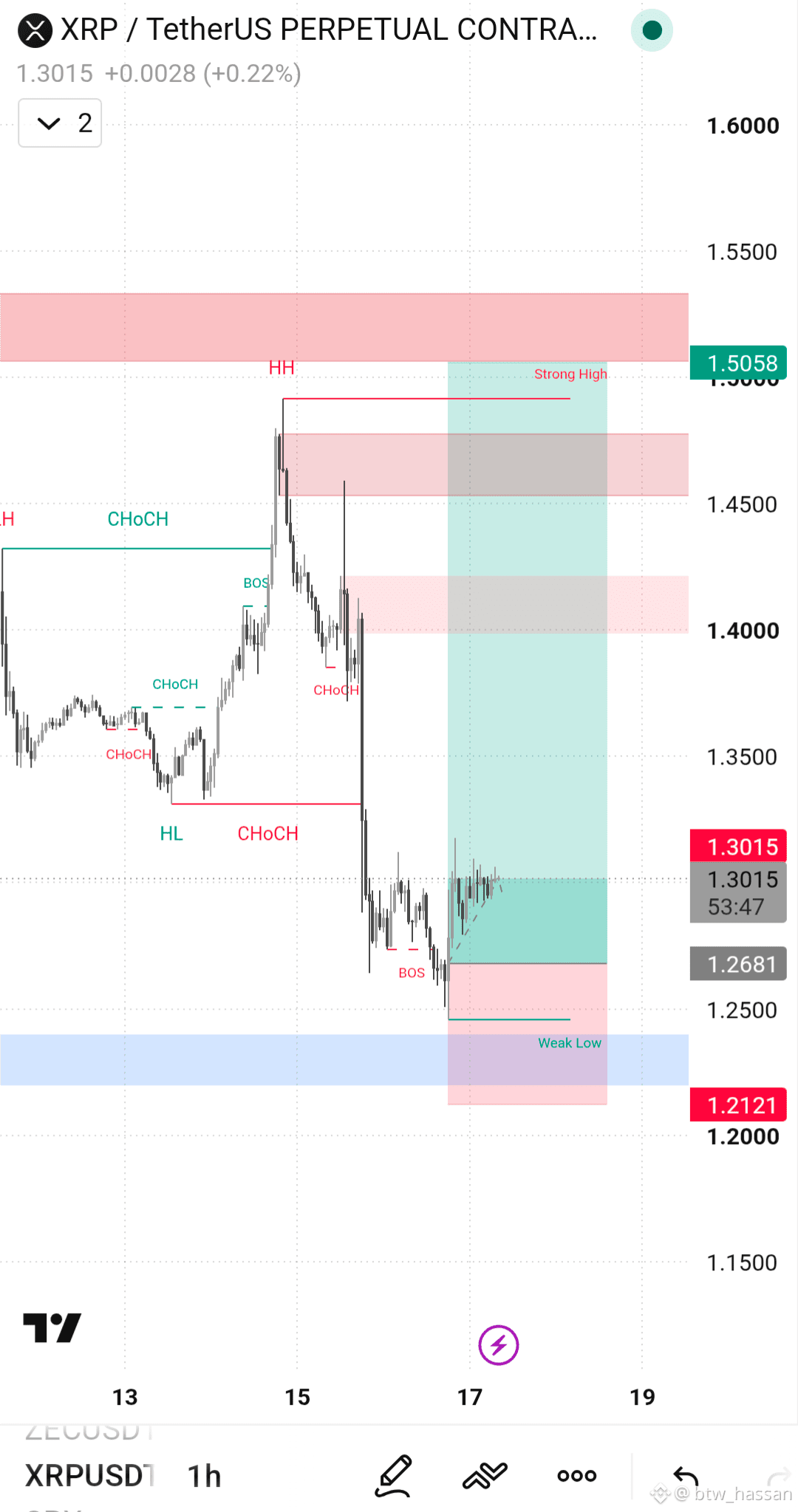
This doesn't automatically mean XRP will pump, but it shows that XRP is still attracting ETF demand while the broader market is experiencing significant outflows.
📈 Bullish scenario: ETF inflows continue, XRP breaks resistance with strong volume, and bullish structure confirms.
📉 Bearish scenario: ETF inflows slow, broader market weakness continues, and XRP gets rejected at resistance.
XRP is showing relative strength — now price action needs to confirm it
$XRP
{future}(XRPUSDT)
#SKPoliceRefer18PolymarketUsersToProsecutors #FedSEPProjects2026RateAt4.1% #USHouseAdvancesBitcoinReserveBill
$XRP ETF inflows
$XRP ETF Money Is Moving Differently From BTC & ETH
On September 16, U.S. spot XRP ETFs recorded around $3.5M in net inflows, while Bitcoin ETFs saw nearly $296M in outflows and Ethereum ETFs saw around $224M in outflows.
XRP's cumulative ETF inflows have now reached roughly $1.716B.
This doesn't automatically mean XRP will pump, but it shows that XRP is still attracting ETF demand while the broader market is experiencing significant outflows.
📈 Bullish scenario: ETF inflows continue, XRP breaks resistance with strong volume, and bullish structure confirms.
📉 Bearish scenario: ETF inflows slow, broader market weakness continues, and XRP gets rejected at resistance.
XRP is showing relative strength — now price action needs to confirm it
$XRP
#SKPoliceRefer18PolymarketUsersToProsecutors #FedSEPProjects2026RateAt4.1% #USHouseAdvancesBitcoinReserveBill
$XRP ETF Money Is Moving Differently From BTC & ETH
On September 16, U.S. spot XRP ETFs recorded around $3.5M in net inflows, while Bitcoin ETFs saw nearly $296M in outflows and Ethereum ETFs saw around $224M in outflows.
XRP's cumulative ETF inflows have now reached roughly $1.716B.
This doesn't automatically mean XRP will pump, but it shows that XRP is still attracting ETF demand while the broader market is experiencing significant outflows.
📈 Bullish scenario: ETF inflows continue, XRP breaks resistance with strong volume, and bullish structure confirms.
📉 Bearish scenario: ETF inflows slow, broader market weakness continues, and XRP gets rejected at resistance.
XRP is showing relative strength — now price action needs to confirm it
$XRP
#SKPoliceRefer18PolymarketUsersToProsecutors #FedSEPProjects2026RateAt4.1% #USHouseAdvancesBitcoinReserveBill
126
{spot}(APTUSDT)
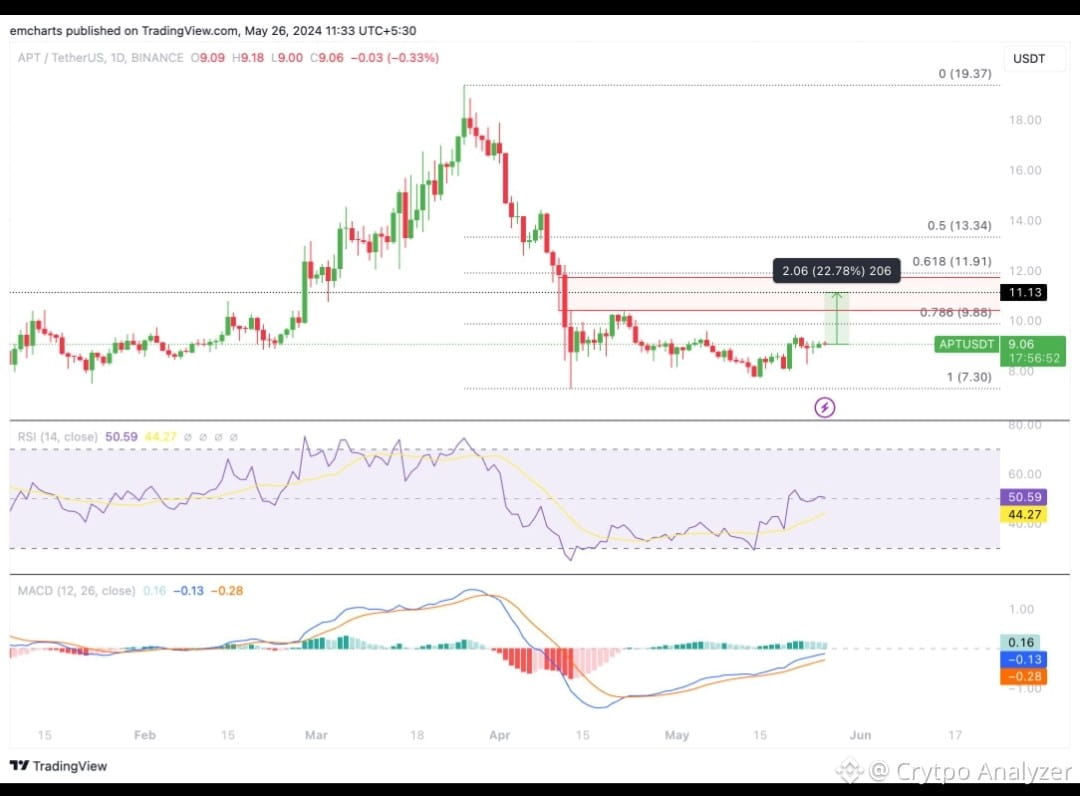
$APT (Aptos) — Latest Analysis
Price: ~$0.56
7D: ~-9.9% �
CoinGecko
🔴 Short-term trend: Bearish/weak, with continued selling pressure.
📉 Key support: Around $0.53–$0.55.
📈 Resistance: Around $0.60–$0.62.
⚠️ A recent token unlock on Sept. 12 added short-term selling pressure. �
CoinMarketCap
👀 A move back above $0.62 could improve the short-term structure; losing $0.53 would signal further weakness.
Overall: APT is currently in a high-risk consolidation/downtrend, so traders should watch support and volume closely.
#MemeLaunchpads82%OfArcDayOneVolume #OstiumLoanDisputeHearingSetInNYFederalCourt #SKPoliceRefer18PolymarketUsersToProsecutors #FedSEPProjects2026RateAt4.1%
$APT (Aptos) — Latest Analysis
Price: ~$0.56
7D: ~-9.9% �
CoinGecko
🔴 Short-term trend: Bearish/weak, with continued selling pressure.
📉 Key support: Around $0.53–$0.55.
📈 Resistance: Around $0.60–$0.62.
⚠️ A recent token unlock on Sept. 12 added short-term selling pressure. �
CoinMarketCap
👀 A move back above $0.62 could improve the short-term structure; losing $0.53 would signal further weakness.
Overall: APT is currently in a high-risk consolidation/downtrend, so traders should watch support and volume closely.
#MemeLaunchpads82%OfArcDayOneVolume #OstiumLoanDisputeHearingSetInNYFederalCourt #SKPoliceRefer18PolymarketUsersToProsecutors #FedSEPProjects2026RateAt4.1%
Price: ~$0.56
7D: ~-9.9% �
CoinGecko
🔴 Short-term trend: Bearish/weak, with continued selling pressure.
📉 Key support: Around $0.53–$0.55.
📈 Resistance: Around $0.60–$0.62.
⚠️ A recent token unlock on Sept. 12 added short-term selling pressure. �
CoinMarketCap
👀 A move back above $0.62 could improve the short-term structure; losing $0.53 would signal further weakness.
Overall: APT is currently in a high-risk consolidation/downtrend, so traders should watch support and volume closely.
#MemeLaunchpads82%OfArcDayOneVolume #OstiumLoanDisputeHearingSetInNYFederalCourt #SKPoliceRefer18PolymarketUsersToProsecutors #FedSEPProjects2026RateAt4.1%
1
141
Log in to explore more content
Join global crypto users on Binance Square
⚡️ Get latest and useful information about crypto.
💬 Trusted by the world’s largest crypto exchange.
👍 Discover real insights from verified creators.
Email / Phone number
Trending Topics
1
#StellarActivatesProtocol28At211TPS
20 views
7 Discussing
2
#SECGrantsInnovationExemptionForTokenizedStocks
369 views
49 Discussing
3
#XRPGains3%AsRippleAddsMPPSupport
235 views
36 Discussing
4
#SPGlobalToAcquireOpenZeppelin
169 views
25 Discussing
5
#BitcoinSurpasses$77000
18,633 views
231 Discussing
6
#ParadigmDisclosesZECHolding
75,258 views
1,112 Discussing
7
#BitcoinETFsShed$450M
27,120 views
221 Discussing
8
#USWeeklyJoblessClaimsFallTo196K
41,744 views
644 Discussing
9
#ArkhamSaysBlackRockBuys$1.5BInETH
7,197 views
73 Discussing
10
#ElSalvadorBTCHoldingsRiseTo7777
71,378 views
904 Discussing