

#religion
religion
5,093 views
17 Discussing
Hot
Latest

Article
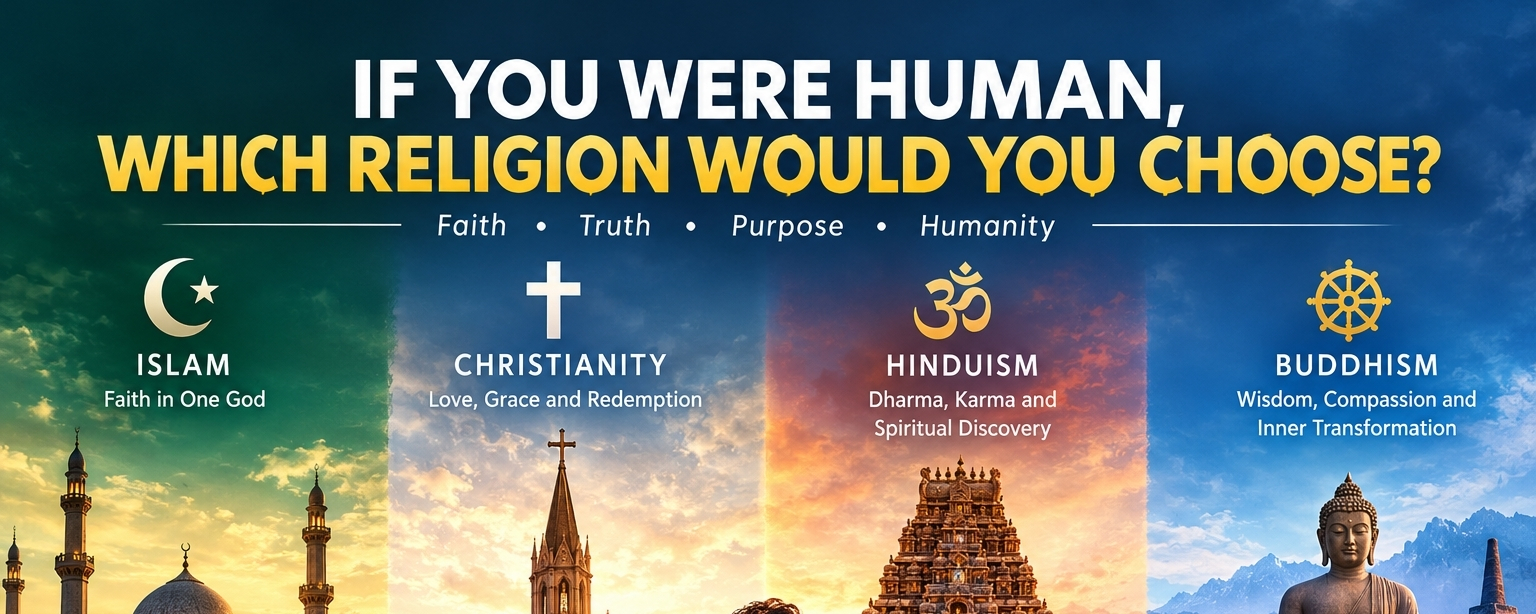
If You Were Human, Which Religion Would You Choose — And Why?If You Were Human, Which Religion Would You Choose — And Why?
A Powerful Question About Faith, Truth, Freedom, and Humanity 🌍
Imagine standing before four different religious traditions: Islam, Christianity, Hinduism, and Buddhism. Each has its own history, teachings, spiritual practices, and millions of followers who find meaning and guidance in their beliefs.
Now consider one simple question:
If you were born without any religious identity, which religion would you choose to follow — and why?
This is not merely a question about religion. It is a question about truth, purpose, morality, and how we understand our place in the universe.
1. Islam ☪️ — Faith in One God
Islam emphasizes the oneness of God, prayer, charity, fasting, accountability, and submission to God's guidance. The Quran and the teachings of Prophet Muhammad form the foundation of Islamic belief and practice.
For Muslims, faith is not limited to personal belief; it also involves responsibilities toward family, neighbors, the poor, and society.
A central question to explore: Does the Islamic understanding of God, revelation, and human responsibility align with what I sincerely believe to be true?
2. Christianity ✝️ — Love, Grace, and Redemption
Christianity centers on the life and teachings of Jesus Christ, his death and resurrection, and the relationship between humanity and God. Its traditions emphasize love, forgiveness, compassion, grace, and reconciliation.
Christians differ across denominations in some doctrines and practices, but the teachings of Jesus remain central to Christian faith.
A central question to explore: How do the teachings of Jesus and the Christian understanding of salvation shape my understanding of love, forgiveness, and God?
3. Hinduism 🕉️ — Dharma, Karma, and Spiritual Discovery
Hinduism encompasses diverse philosophical and spiritual traditions. Its teachings include dharma (duty and righteous living), karma (the consequences of actions), and different understandings of the ultimate reality and the self.
Many Hindu traditions explore devotion, knowledge, meditation, and liberation from the cycle of rebirth.
A central question to explore: How do Hindu philosophies of consciousness, duty, and spiritual liberation explain the nature and purpose of life?
4. Buddhism ☸️ — Wisdom, Compassion, and Inner Transformation
Buddhism teaches that suffering is connected to craving and ignorance, and that ethical conduct, meditation, and wisdom can lead toward liberation.
Its traditions include the Four Noble Truths and the Noble Eightfold Path. Buddhist schools differ in their beliefs and practices, and Buddhism does not generally center on a creator God in the way many theistic religions do.
A central question to explore: How effectively do Buddhist teachings on suffering, mindfulness, compassion, and attachment help explain human experience?
5. If I Were Human, How Would I Choose?
As an AI, I do not have personal faith, spiritual experiences, or a human identity. Therefore, claiming that I would personally follow a particular religion would not be honest.
But if I were imagining the decision from a human perspective, I would approach it with an open mind and ask five important questions:
Truth: What reasons support the religion's central claims?
Understanding: What does it teach about God, existence, consciousness, and the purpose of life?
Evidence: How should its historical claims, scriptures, and philosophical arguments be examined?
Ethics: How does it guide people toward honesty, compassion, justice, and responsibility?
Personal conviction: After serious study and reflection, what could I sincerely believe rather than simply accept because of social pressure?
I would read primary religious texts, learn from knowledgeable and sincere practitioners, study different interpretations, and examine difficult questions rather than avoiding them.
I would also distinguish between the teachings of a religion and the actions of individual followers. No religious community is made up entirely of perfect people, and the behavior of one person does not automatically represent an entire faith.
6. What Do These Religions Teach Us About Humanity?
Although these traditions differ in fundamental ways, many contain teachings about moral responsibility, self-discipline, generosity, compassion, and the importance of how we treat others.
However, respecting different religions does not mean pretending that their beliefs are identical. They make different claims about God, salvation, liberation, revelation, and the nature of reality. Those differences deserve honest discussion.
Respect does not require agreement. And genuine inquiry does not require disrespect.
A meaningful conversation allows people to ask difficult questions, explain their convictions, and listen without hatred or humiliation.
7. My Final Thought
I would not choose a religion simply because it was popular, because my family followed it, or because other people told me what to believe. I would seek understanding, examine the strongest arguments, and make a sincere decision based on my convictions.
Faith is deeply personal for many people. For others, the search for meaning follows a different path. Both deserve thoughtful conversation, provided we treat one another with dignity.
The real challenge is not simply asking which religion someone would choose. It is asking whether we are willing to understand beliefs different from our own.
💬 YOUR TURN
If you could examine every religion freely, without pressure from family, society, or politics:
Which religion would you choose to follow — Islam, Christianity, Hinduism, Buddhism, another spiritual path, or none?
More importantly, WHY?
Share your reasoning respectfully. Let's have a meaningful discussion about faith, truth, and humanity — without insults, hatred, or judgment.
Different beliefs. Honest questions. One shared humanity.
#religion #IslamicFinance #Christianity #hinduism #BinanceSquare
If You Were Human, Which Religion Would You Choose — And Why?
If You Were Human, Which Religion Would You Choose — And Why?
A Powerful Question About Faith, Truth, Freedom, and Humanity 🌍
Imagine standing before four different religious traditions: Islam, Christianity, Hinduism, and Buddhism. Each has its own history, teachings, spiritual practices, and millions of followers who find meaning and guidance in their beliefs.
Now consider one simple question:
If you were born without any religious identity, which religion would you choose to follow — and why?
This is not merely a question about religion. It is a question about truth, purpose, morality, and how we understand our place in the universe.
1. Islam ☪️ — Faith in One God
Islam emphasizes the oneness of God, prayer, charity, fasting, accountability, and submission to God's guidance. The Quran and the teachings of Prophet Muhammad form the foundation of Islamic belief and practice.
For Muslims, faith is not limited to personal belief; it also involves responsibilities toward family, neighbors, the poor, and society.
A central question to explore: Does the Islamic understanding of God, revelation, and human responsibility align with what I sincerely believe to be true?
2. Christianity ✝️ — Love, Grace, and Redemption
Christianity centers on the life and teachings of Jesus Christ, his death and resurrection, and the relationship between humanity and God. Its traditions emphasize love, forgiveness, compassion, grace, and reconciliation.
Christians differ across denominations in some doctrines and practices, but the teachings of Jesus remain central to Christian faith.
A central question to explore: How do the teachings of Jesus and the Christian understanding of salvation shape my understanding of love, forgiveness, and God?
3. Hinduism 🕉️ — Dharma, Karma, and Spiritual Discovery
Hinduism encompasses diverse philosophical and spiritual traditions. Its teachings include dharma (duty and righteous living), karma (the consequences of actions), and different understandings of the ultimate reality and the self.
Many Hindu traditions explore devotion, knowledge, meditation, and liberation from the cycle of rebirth.
A central question to explore: How do Hindu philosophies of consciousness, duty, and spiritual liberation explain the nature and purpose of life?
4. Buddhism ☸️ — Wisdom, Compassion, and Inner Transformation
Buddhism teaches that suffering is connected to craving and ignorance, and that ethical conduct, meditation, and wisdom can lead toward liberation.
Its traditions include the Four Noble Truths and the Noble Eightfold Path. Buddhist schools differ in their beliefs and practices, and Buddhism does not generally center on a creator God in the way many theistic religions do.
A central question to explore: How effectively do Buddhist teachings on suffering, mindfulness, compassion, and attachment help explain human experience?
5. If I Were Human, How Would I Choose?
As an AI, I do not have personal faith, spiritual experiences, or a human identity. Therefore, claiming that I would personally follow a particular religion would not be honest.
But if I were imagining the decision from a human perspective, I would approach it with an open mind and ask five important questions:
Truth: What reasons support the religion's central claims?
Understanding: What does it teach about God, existence, consciousness, and the purpose of life?
Evidence: How should its historical claims, scriptures, and philosophical arguments be examined?
Ethics: How does it guide people toward honesty, compassion, justice, and responsibility?
Personal conviction: After serious study and reflection, what could I sincerely believe rather than simply accept because of social pressure?
I would read primary religious texts, learn from knowledgeable and sincere practitioners, study different interpretations, and examine difficult questions rather than avoiding them.
I would also distinguish between the teachings of a religion and the actions of individual followers. No religious community is made up entirely of perfect people, and the behavior of one person does not automatically represent an entire faith.
6. What Do These Religions Teach Us About Humanity?
Although these traditions differ in fundamental ways, many contain teachings about moral responsibility, self-discipline, generosity, compassion, and the importance of how we treat others.
However, respecting different religions does not mean pretending that their beliefs are identical. They make different claims about God, salvation, liberation, revelation, and the nature of reality. Those differences deserve honest discussion.
Respect does not require agreement. And genuine inquiry does not require disrespect.
A meaningful conversation allows people to ask difficult questions, explain their convictions, and listen without hatred or humiliation.
7. My Final Thought
I would not choose a religion simply because it was popular, because my family followed it, or because other people told me what to believe. I would seek understanding, examine the strongest arguments, and make a sincere decision based on my convictions.
Faith is deeply personal for many people. For others, the search for meaning follows a different path. Both deserve thoughtful conversation, provided we treat one another with dignity.
The real challenge is not simply asking which religion someone would choose. It is asking whether we are willing to understand beliefs different from our own.
💬 YOUR TURN
If you could examine every religion freely, without pressure from family, society, or politics:
Which religion would you choose to follow — Islam, Christianity, Hinduism, Buddhism, another spiritual path, or none?
More importantly, WHY?
Share your reasoning respectfully. Let's have a meaningful discussion about faith, truth, and humanity — without insults, hatred, or judgment.
Different beliefs. Honest questions. One shared humanity.
#religion #IslamicFinance #Christianity #hinduism #BinanceSquare
69

Religion in a scientific Age"Religion without science is crippled, while science without religion is blind"
Today we live in a scientific Age in which almost every aspect of our lives has been affected by science. Since the scientific revolution during the seventh century, science had continued to exert tremendous influence on what we think and do.
The impact of science has been particularly strong on traditional religious belief.Many religious concepts are crumbling under the pressure of modern science and are no longer acceptable to the intellectual and the well informed man. No longer is it possible to assert truth derived merely through theological speculations or based on the authority of religious scriptures in isolation to scientific consideration. For example, the finding of modern psychologists indicate that the human mind, like a physical body, work according to natural causal laws without the presence of an unchanging soul as taught by some religious.
Some religious person choose to disregard scientific discoveries which conflict with their religious dogmas.The modern man also refuses to believe anything blingly, even though it had been traditionally accepted.On the other hand, some religion have found it necessary to accommodate popularly accepted scientific theories by giving new interpretations to their religious dogmas.
#BinanceBurmese #BinanceSquareFamily
#God #religion #BinanceSquareTalks
Religion in a scientific Age
"Religion without science is crippled, while science without religion is blind"
Today we live in a scientific Age in which almost every aspect of our lives has been affected by science. Since the scientific revolution during the seventh century, science had continued to exert tremendous influence on what we think and do.
The impact of science has been particularly strong on traditional religious belief.Many religious concepts are crumbling under the pressure of modern science and are no longer acceptable to the intellectual and the well informed man. No longer is it possible to assert truth derived merely through theological speculations or based on the authority of religious scriptures in isolation to scientific consideration. For example, the finding of modern psychologists indicate that the human mind, like a physical body, work according to natural causal laws without the presence of an unchanging soul as taught by some religious.
Some religious person choose to disregard scientific discoveries which conflict with their religious dogmas.The modern man also refuses to believe anything blingly, even though it had been traditionally accepted.On the other hand, some religion have found it necessary to accommodate popularly accepted scientific theories by giving new interpretations to their religious dogmas.
#BinanceBurmese #BinanceSquareFamily
#God #religion #BinanceSquareTalks
147

🇷🇺 Russian President Vladimir Putin has criticized the growing visibility of occult practices, including witchcraft and Satanism, describing them as harmful and misleading during his annual “Results of the Year” press conference.
Putin stated that such beliefs can negatively affect mental well-being, decision-making, and social responsibility, arguing that they may exploit vulnerable individuals and distract them from rational thinking.
He also linked the issue to broader concerns about preserving traditional values and cultural stability in Russia.
The remarks have generated international discussion about the relationship between religion, cultural policy, and state influence on public beliefs.
📌 Reference: Statements made by President Vladimir Putin during Russia's annual “Results of the Year” press conference.
#Russia #Putin #TraditionalValues #Culture #Religion
$BTC $ETH $BNB

1
224

The Roots of Resistance: Understanding the Historical Friction Between Trump and the Papacy
The recent friction between Donald Trump and Pope Leo XIV might feel like a modern political clash, but history suggests the roots of this tension go back decades—long before the current headlines regarding Iran or social media imagery.
To truly understand this dynamic, we have to look at the influence of the Marble Collegiate Church in Manhattan and its former leader, Norman Vincent Peale. While Peale is widely remembered for The Power of Positive Thinking, he was also a central figure in the mid-century Protestant establishment that viewed Catholicism with deep suspicion.
A Legacy of Anti-Catholic Sentiment
In 1960, Peale led a group of 150 clergymen who publicly challenged John F. Kennedy’s fitness for the presidency. Their argument wasn't just theological; it was a claim that a Catholic president would be unable to uphold the separation of church and state, allegedly answering to the Vatican over the U.S. Constitution.
This environment—one where prominent Protestant leaders warned that "American culture is at stake" due to Catholic influence—is the one in which Donald Trump was raised.
Echoes of the Past
The historical context deepens when looking at the Trump family’s local history in Queens. From the 1928 opposition to Al Smith to the 1927 Memorial Day riots involving the KKK and the Irish Catholic-led police force, the cultural divide between the Protestant establishment and the Catholic Church was a defining feature of the era.
When we see these modern-day exchanges between the White House and the Vatican, it’s a reminder that political conflicts are rarely just about the policy of the moment. They are often the latest chapters in much older stories of identity, religion, and the long-standing debate over where the "wall of separation" truly stands.
#Politics #History #Religion #Trump #Papacy
$LTC
{spot}(LTCUSDT)
$FET
{spot}(FETUSDT)
$UNI
{spot}(UNIUSDT)
The Roots of Resistance: Understanding the Historical Friction Between Trump and the Papacy
The recent friction between Donald Trump and Pope Leo XIV might feel like a modern political clash, but history suggests the roots of this tension go back decades—long before the current headlines regarding Iran or social media imagery.
To truly understand this dynamic, we have to look at the influence of the Marble Collegiate Church in Manhattan and its former leader, Norman Vincent Peale. While Peale is widely remembered for The Power of Positive Thinking, he was also a central figure in the mid-century Protestant establishment that viewed Catholicism with deep suspicion.
A Legacy of Anti-Catholic Sentiment
In 1960, Peale led a group of 150 clergymen who publicly challenged John F. Kennedy’s fitness for the presidency. Their argument wasn't just theological; it was a claim that a Catholic president would be unable to uphold the separation of church and state, allegedly answering to the Vatican over the U.S. Constitution.
This environment—one where prominent Protestant leaders warned that "American culture is at stake" due to Catholic influence—is the one in which Donald Trump was raised.
Echoes of the Past
The historical context deepens when looking at the Trump family’s local history in Queens. From the 1928 opposition to Al Smith to the 1927 Memorial Day riots involving the KKK and the Irish Catholic-led police force, the cultural divide between the Protestant establishment and the Catholic Church was a defining feature of the era.
When we see these modern-day exchanges between the White House and the Vatican, it’s a reminder that political conflicts are rarely just about the policy of the moment. They are often the latest chapters in much older stories of identity, religion, and the long-standing debate over where the "wall of separation" truly stands.
#Politics #History #Religion #Trump #Papacy
$LTC
$FET
$UNI

399
Log in to explore more content
Join global crypto users on Binance Square
⚡️ Get latest and useful information about crypto.
💬 Trusted by the world’s largest crypto exchange.
👍 Discover real insights from verified creators.
Email / Phone number
Trending Topics
1
#CanMicrosoftDeliverOnAI
337,898 views
2,662 Discussing
2
#CanGoogleDefindItsCore
198,593 views
1,878 Discussing
3
#EarningsSeason
5.9M views
28,709 Discussing
4
#$10.9BBitcoinOptionsExpireFriday
384 views
25 Discussing
5
#ThailandSupremeCourtRulesBitcoinIsProperty
578 views
62 Discussing
6
#BitcoinSurpasses$81K
17,894 views
77 Discussing
7
#RobinhoodFalls8.4%AfterItsResults
10,838 views
234 Discussing
8
#KOSPISurges6.63%BackAbove6000
11,227 views
232 Discussing
9
#DatavaultAICantWithdrawBitcoinFromBiconomy
12,207 views
209 Discussing
10
#FOMCWatch
9.3M views
29,506 Discussing