

#opengradientis
opengradientis
1,052 views
31 Discussing
Hot
Latest

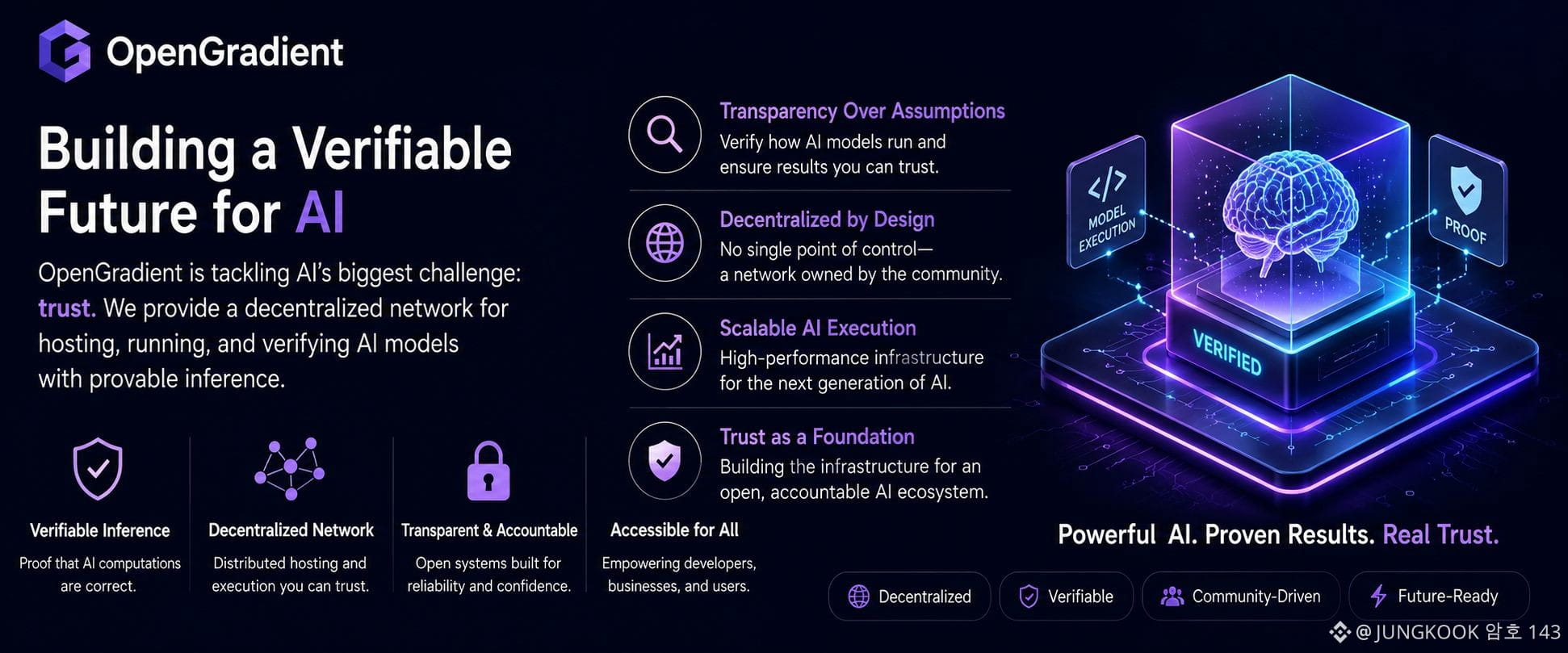
#opg $OPG One of the most important challenges facing artificial intelligence today is trust. AI systems are becoming increasingly involved in research, business operations, content creation, and decision-making, yet most users have very little visibility into how these systems actually operate.The Open gradient is approaching this challenge from a different angle by focusing on transparency and verifiability rather than simply increasing model size or computational power.
The project is building a decentralized infrastructure where AI models can be hosted, executed, and verified across a distributed network.@OpenGradient Instead of relying entirely on centralized providers, The Open gradient aims to create an environment where participants can have greater confidence that AI computations were performed correctly. This focus on verifiable inference helps address concerns about reliability and accountability, especially as AI becomes more deeply integrated into critical workflows.
What makes this approach compelling is that it shifts attention from the AI model itself to the underlying infrastructure that enables trustworthy intelligence.$OPG By combining decentralized technologies with scalable AI execution, Open Gradient is exploring how transparency can become a core feature of modern AI systems rather than an afterthought.
As the AI ecosystem continues to evolve, users, developers, and organizations may increasingly demand proof and accountability alongside performance.The Open Gradient's vision reflects this growing need by working toward a future where intelligence is not only powerful and accessible but also transparent and verifiable. In the long run, creating systems that people can confidently trust may be just as important as creating systems that are highly capable.
@OpenGradient #OpenGradientis #opg $OPG
#opg $OPG One of the most important challenges facing artificial intelligence today is trust. AI systems are becoming increasingly involved in research, business operations, content creation, and decision-making, yet most users have very little visibility into how these systems actually operate.The Open gradient is approaching this challenge from a different angle by focusing on transparency and verifiability rather than simply increasing model size or computational power.
The project is building a decentralized infrastructure where AI models can be hosted, executed, and verified across a distributed network.@OpenGradient Instead of relying entirely on centralized providers, The Open gradient aims to create an environment where participants can have greater confidence that AI computations were performed correctly. This focus on verifiable inference helps address concerns about reliability and accountability, especially as AI becomes more deeply integrated into critical workflows.
What makes this approach compelling is that it shifts attention from the AI model itself to the underlying infrastructure that enables trustworthy intelligence.$OPG By combining decentralized technologies with scalable AI execution, Open Gradient is exploring how transparency can become a core feature of modern AI systems rather than an afterthought.
As the AI ecosystem continues to evolve, users, developers, and organizations may increasingly demand proof and accountability alongside performance.The Open Gradient's vision reflects this growing need by working toward a future where intelligence is not only powerful and accessible but also transparent and verifiable. In the long run, creating systems that people can confidently trust may be just as important as creating systems that are highly capable.
@OpenGradient #OpenGradientis #opg $OPG
The project is building a decentralized infrastructure where AI models can be hosted, executed, and verified across a distributed network.@OpenGradient Instead of relying entirely on centralized providers, The Open gradient aims to create an environment where participants can have greater confidence that AI computations were performed correctly. This focus on verifiable inference helps address concerns about reliability and accountability, especially as AI becomes more deeply integrated into critical workflows.
What makes this approach compelling is that it shifts attention from the AI model itself to the underlying infrastructure that enables trustworthy intelligence.$OPG By combining decentralized technologies with scalable AI execution, Open Gradient is exploring how transparency can become a core feature of modern AI systems rather than an afterthought.
As the AI ecosystem continues to evolve, users, developers, and organizations may increasingly demand proof and accountability alongside performance.The Open Gradient's vision reflects this growing need by working toward a future where intelligence is not only powerful and accessible but also transparent and verifiable. In the long run, creating systems that people can confidently trust may be just as important as creating systems that are highly capable.
@OpenGradient #OpenGradientis #opg $OPG

16
11
186

·
--
Bullish
AI is changing faster than most people expected, but there’s still a big challenge sitting underneath it all: trust.
We are giving AI more responsibility every day from creating content to helping with complex decisions. But the infrastructure behind these systems matters just as much as the models themselves.
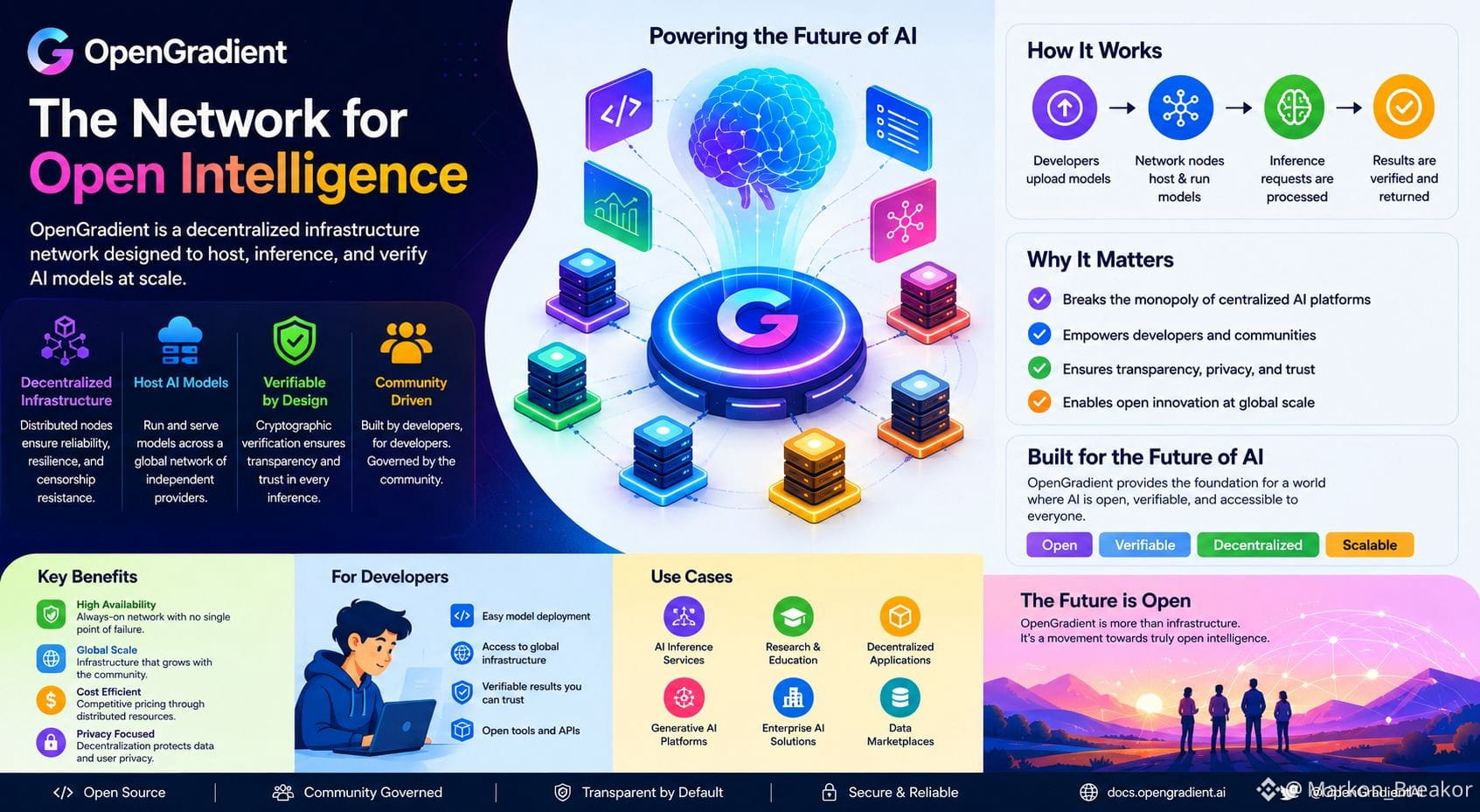
OpenGradient is building an open intelligence network focused on making AI models easier to host, run, and verify at scale.
What I find interesting is the idea of moving away from a world where only a few platforms control the entire AI experience. A more open approach could give developers and creators more freedom to experiment, improve, and build.
The future of AI won’t only belong to the biggest companies.
It will belong to the systems that give more people a chance to participate.
#opg $OPG #OpenGradientis $OPG
{spot}(OPGUSDT)
AI is changing faster than most people expected, but there’s still a big challenge sitting underneath it all: trust.
We are giving AI more responsibility every day from creating content to helping with complex decisions. But the infrastructure behind these systems matters just as much as the models themselves.
OpenGradient is building an open intelligence network focused on making AI models easier to host, run, and verify at scale.
What I find interesting is the idea of moving away from a world where only a few platforms control the entire AI experience. A more open approach could give developers and creators more freedom to experiment, improve, and build.
The future of AI won’t only belong to the biggest companies.
It will belong to the systems that give more people a chance to participate.
#opg $OPG #OpenGradientis $OPG
We are giving AI more responsibility every day from creating content to helping with complex decisions. But the infrastructure behind these systems matters just as much as the models themselves.
OpenGradient is building an open intelligence network focused on making AI models easier to host, run, and verify at scale.
What I find interesting is the idea of moving away from a world where only a few platforms control the entire AI experience. A more open approach could give developers and creators more freedom to experiment, improve, and build.
The future of AI won’t only belong to the biggest companies.
It will belong to the systems that give more people a chance to participate.
#opg $OPG #OpenGradientis $OPG
2
110
·
--
Bullish
AI is everywhere now, but the real question is what happens behind the screen.
We see the answers. We use the tools. But the systems powering them are often hidden, and that creates a gap between innovation and trust.
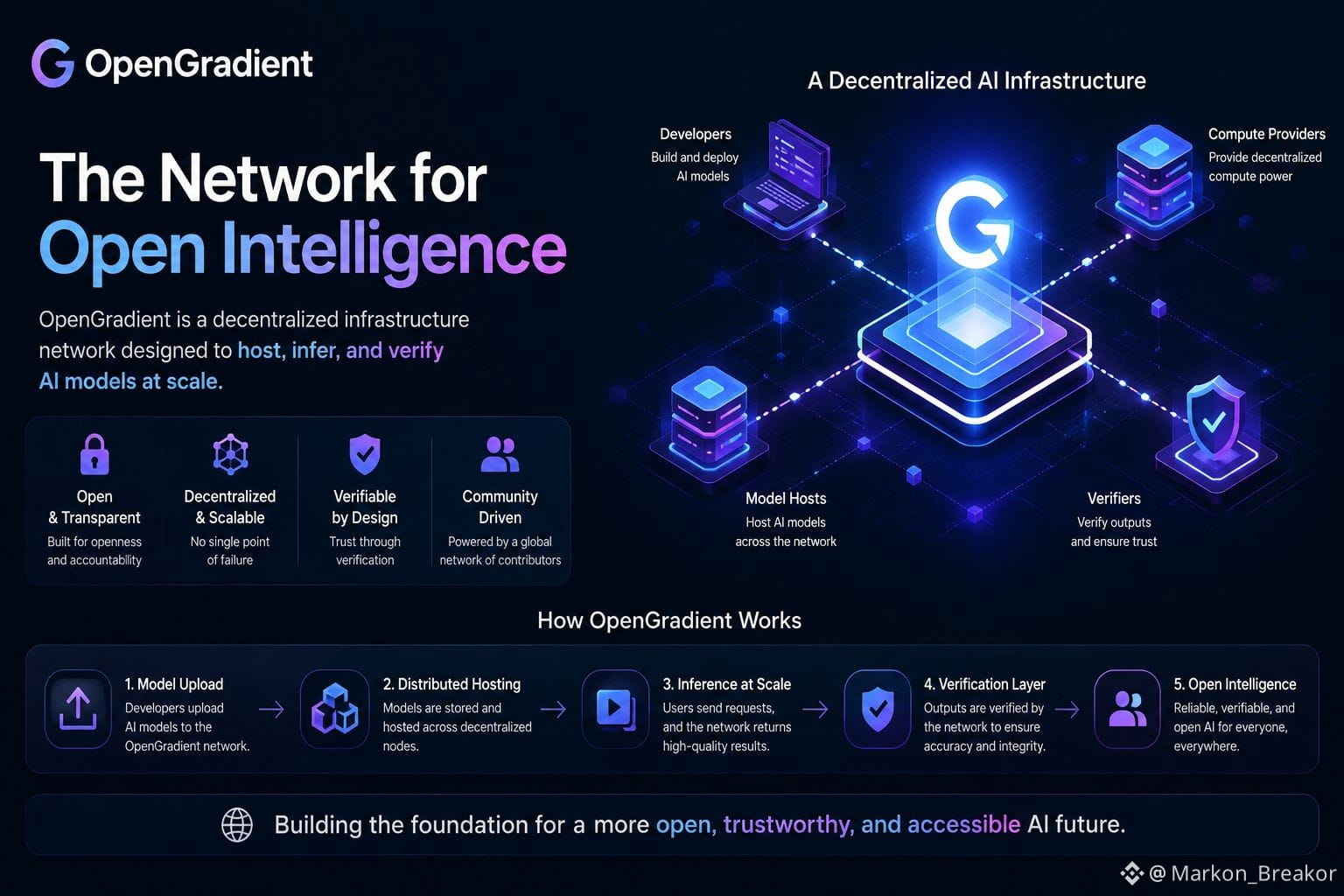
OpenGradient is working on changing that by building an open infrastructure network where AI models can be hosted, run, and verified at scale.
What I find interesting is the bigger picture. AI should not only be about having a powerful model it should also be about having a system where people can understand, test, and build with confidence.
The internet became huge because people could create on top of it. AI may follow the same path if the foundation becomes more open and accessible.
The future of intelligence won’t be built in isolation. It will be built by the people who make it open enough for everyone to shape.
#opg $OPG #OpenGradientis
{spot}(OPGUSDT)
AI is everywhere now, but the real question is what happens behind the screen.
We see the answers. We use the tools. But the systems powering them are often hidden, and that creates a gap between innovation and trust.
OpenGradient is working on changing that by building an open infrastructure network where AI models can be hosted, run, and verified at scale.
What I find interesting is the bigger picture. AI should not only be about having a powerful model it should also be about having a system where people can understand, test, and build with confidence.
The internet became huge because people could create on top of it. AI may follow the same path if the foundation becomes more open and accessible.
The future of intelligence won’t be built in isolation. It will be built by the people who make it open enough for everyone to shape.
#opg $OPG #OpenGradientis
We see the answers. We use the tools. But the systems powering them are often hidden, and that creates a gap between innovation and trust.
OpenGradient is working on changing that by building an open infrastructure network where AI models can be hosted, run, and verified at scale.
What I find interesting is the bigger picture. AI should not only be about having a powerful model it should also be about having a system where people can understand, test, and build with confidence.
The internet became huge because people could create on top of it. AI may follow the same path if the foundation becomes more open and accessible.
The future of intelligence won’t be built in isolation. It will be built by the people who make it open enough for everyone to shape.
#opg $OPG #OpenGradientis
1
1
128

·
--
#opg $OPG
OPG is trading around $0.15–$0.17 range.
Market cap is roughly $30–35 million.
The token remains about 60–70% below its April 2026 ATH (~$0.47).
$OPG
#OpenGradientis
#OpenGradinet
{future}(OPGUSDT)
#opg $OPG
OPG is trading around $0.15–$0.17 range.
Market cap is roughly $30–35 million.
The token remains about 60–70% below its April 2026 ATH (~$0.47).
$OPG
#OpenGradientis
#OpenGradinet
OPG is trading around $0.15–$0.17 range.
Market cap is roughly $30–35 million.
The token remains about 60–70% below its April 2026 ATH (~$0.47).
$OPG
#OpenGradientis
#OpenGradinet
1
71

·
--
Recently, I did a deep review of @OpenGradient . This project is taking “verifiable AI” from concept to enterprise-grade deployment—definitely worth watching.
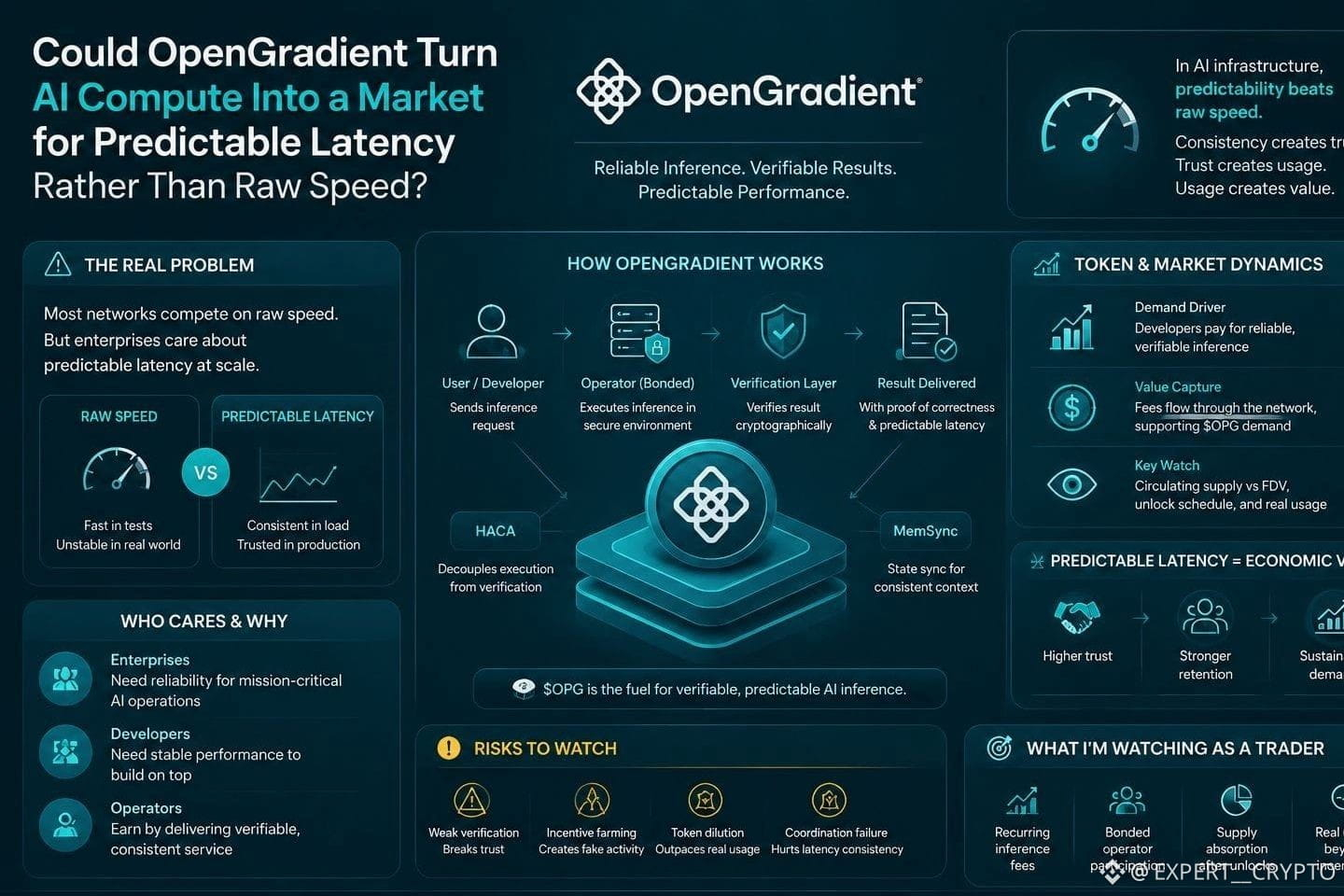
Unlike Bittensor’s focus on mining model performance, OpenGradient follows a route centered on AI inference verification and auditing, primarily addressing the question of whether the results are actually true. Its HACA architecture separates AI execution from verification: inference nodes generate proofs, while the full node only verifies them without repeating computation—balancing Web2-level response speed with on-chain trust. It supports TEE remote attestation and ZKML mathematical verification. In everyday scenarios it boosts efficiency, while in high-risk scenarios it provides strong security.
The deployment data is impressive: in February 2026, it completed key upgrades, embedding the x402 payment protocol into the TEE to eliminate the need to trust centralized payment infrastructure. As of June, the network has processed over 2 million instances of verifiable inference, generated 500,000 cryptographic proofs, and deployed 4,400+ AI models. Recently, OpenGradient Chat was launched: with a triple-layer privacy protection mechanism—local encryption, Oblivious HTTP relays, and TEE execution—it forces privacy protection when chatting. It supports calls to multiple cutting-edge models, allowing users to discuss sensitive topics without trust assumptions.
Token $OPG total supply is 1 billion; circulating supply is about 190 million (less than 20%). It is not a governance “airdrop coin”—OPG must be consumed to pay for AI inference, and nodes must stake OPG; malicious behavior will result in penalties. More than 50% of the ecosystem and staking allocations are reserved, with the team and institutions locked in long-term. Near-term selling pressure is controllable.
Currently, the project focuses on enterprise-grade on-chain intelligence compute. By using a native inference architecture, it reduces Gas fees and enables complex AI computations to run on-chain. It has addressed two major industry pain points: it developed a lightweight proof system in-house, removing reliance on a single TEE chip and adapting to multi-brand hardware; it also deployed a random ordering mechanism to compress the opportunity for asynchronous inference MEV arbitrage.
Please note: the project is still early, and there are uncertainties in both the technology and the supply chain—so it is not suitable for heavy positions. It’s recommended to allocate a small amount in batches, continuously track hardware compatibility progress and iterations of the ordering mechanism, and take a low-position approach to capture long-term upside. (Involves token $OPG—risk is your own)
#OpenGradientis
#opg $OPG
Recently, I did a deep review of @OpenGradient . This project is taking “verifiable AI” from concept to enterprise-grade deployment—definitely worth watching.
Unlike Bittensor’s focus on mining model performance, OpenGradient follows a route centered on AI inference verification and auditing, primarily addressing the question of whether the results are actually true. Its HACA architecture separates AI execution from verification: inference nodes generate proofs, while the full node only verifies them without repeating computation—balancing Web2-level response speed with on-chain trust. It supports TEE remote attestation and ZKML mathematical verification. In everyday scenarios it boosts efficiency, while in high-risk scenarios it provides strong security.
The deployment data is impressive: in February 2026, it completed key upgrades, embedding the x402 payment protocol into the TEE to eliminate the need to trust centralized payment infrastructure. As of June, the network has processed over 2 million instances of verifiable inference, generated 500,000 cryptographic proofs, and deployed 4,400+ AI models. Recently, OpenGradient Chat was launched: with a triple-layer privacy protection mechanism—local encryption, Oblivious HTTP relays, and TEE execution—it forces privacy protection when chatting. It supports calls to multiple cutting-edge models, allowing users to discuss sensitive topics without trust assumptions.
Token $OPG total supply is 1 billion; circulating supply is about 190 million (less than 20%). It is not a governance “airdrop coin”—OPG must be consumed to pay for AI inference, and nodes must stake OPG; malicious behavior will result in penalties. More than 50% of the ecosystem and staking allocations are reserved, with the team and institutions locked in long-term. Near-term selling pressure is controllable.
Currently, the project focuses on enterprise-grade on-chain intelligence compute. By using a native inference architecture, it reduces Gas fees and enables complex AI computations to run on-chain. It has addressed two major industry pain points: it developed a lightweight proof system in-house, removing reliance on a single TEE chip and adapting to multi-brand hardware; it also deployed a random ordering mechanism to compress the opportunity for asynchronous inference MEV arbitrage.
Please note: the project is still early, and there are uncertainties in both the technology and the supply chain—so it is not suitable for heavy positions. It’s recommended to allocate a small amount in batches, continuously track hardware compatibility progress and iterations of the ordering mechanism, and take a low-position approach to capture long-term upside. (Involves token $OPG —risk is your own)
#OpenGradientis
#opg $OPG
Unlike Bittensor’s focus on mining model performance, OpenGradient follows a route centered on AI inference verification and auditing, primarily addressing the question of whether the results are actually true. Its HACA architecture separates AI execution from verification: inference nodes generate proofs, while the full node only verifies them without repeating computation—balancing Web2-level response speed with on-chain trust. It supports TEE remote attestation and ZKML mathematical verification. In everyday scenarios it boosts efficiency, while in high-risk scenarios it provides strong security.
The deployment data is impressive: in February 2026, it completed key upgrades, embedding the x402 payment protocol into the TEE to eliminate the need to trust centralized payment infrastructure. As of June, the network has processed over 2 million instances of verifiable inference, generated 500,000 cryptographic proofs, and deployed 4,400+ AI models. Recently, OpenGradient Chat was launched: with a triple-layer privacy protection mechanism—local encryption, Oblivious HTTP relays, and TEE execution—it forces privacy protection when chatting. It supports calls to multiple cutting-edge models, allowing users to discuss sensitive topics without trust assumptions.
Token $OPG total supply is 1 billion; circulating supply is about 190 million (less than 20%). It is not a governance “airdrop coin”—OPG must be consumed to pay for AI inference, and nodes must stake OPG; malicious behavior will result in penalties. More than 50% of the ecosystem and staking allocations are reserved, with the team and institutions locked in long-term. Near-term selling pressure is controllable.
Currently, the project focuses on enterprise-grade on-chain intelligence compute. By using a native inference architecture, it reduces Gas fees and enables complex AI computations to run on-chain. It has addressed two major industry pain points: it developed a lightweight proof system in-house, removing reliance on a single TEE chip and adapting to multi-brand hardware; it also deployed a random ordering mechanism to compress the opportunity for asynchronous inference MEV arbitrage.
Please note: the project is still early, and there are uncertainties in both the technology and the supply chain—so it is not suitable for heavy positions. It’s recommended to allocate a small amount in batches, continuously track hardware compatibility progress and iterations of the ordering mechanism, and take a low-position approach to capture long-term upside. (Involves token $OPG —risk is your own)
#OpenGradientis
#opg $OPG
4
4
106

·
--
Bullish
#OPG
#OpenGradientis
All time market strategy is good for others Day. ($OPG) Open gradients is currentl treading around $0.16 Reflecting recent Market Consolation after a Major listing on Upbit.
{spot}(OPGUSDT)
@OpenGradient
#OPG
#OpenGradientis
All time market strategy is good for others Day. ($OPG) Open gradients is currentl treading around $0.16 Reflecting recent Market Consolation after a Major listing on Upbit.
@OpenGradient
#OpenGradientis
All time market strategy is good for others Day. ($OPG) Open gradients is currentl treading around $0.16 Reflecting recent Market Consolation after a Major listing on Upbit.
@OpenGradient
1
75

·
--
#opg $OPG
"Infrastructure of @OpenGradient
There are very strong developments underway
In the Web3 and Artificial Intelligence fields.
This ecosystem is expected to explode
Very quickly thanks to the capital from major investment funds. ready to flow into
#OpenGradientis
#OPG
$OPG
#opg $OPG
"Infrastructure of @OpenGradient
There are very strong developments underway
In the Web3 and Artificial Intelligence fields.
This ecosystem is expected to explode
Very quickly thanks to the capital from major investment funds. ready to flow into
#OpenGradientis
#OPG
$OPG
"Infrastructure of @OpenGradient
There are very strong developments underway
In the Web3 and Artificial Intelligence fields.
This ecosystem is expected to explode
Very quickly thanks to the capital from major investment funds. ready to flow into
#OpenGradientis
#OPG
$OPG
2
135

·
--
#opg $OPG
{spot}(OPGUSDT)
$BNB
{spot}(BNBUSDT)
Back in the day, when I was picking AI tools, I’d just look for the ones with the hottest models, tons of parameters, quick inference, and spot-on responses. Those hardware indicators were the deal-breakers for whether I’d use them or not. But over the last six months, tuning into the convo in the community and watching users come and go, I’m realizing I might’ve missed the boat.
It doesn’t mean the model’s quality isn’t crucial, but the question "Will this conversation come back up later?" weighs way heavier in some users’ minds than I ever imagined.
What caught my eye about OpenGradient Chat is exactly that. What’s really intriguing isn’t the number of high-end models they’ve got, but rather a design that separates the identity from the question - thanks to encrypted routing and verifiable execution, they’re turning “privacy” from just a promise into a default setting.
Most folks checking out the AI network are still fixated on throughput, model counts, etc. But I still feel the real impact could be more fundamental. If users believe their interactions won’t easily link back to their identity, they might ask different questions, share various types of files, and gradually pick up new habits.#opengift #OpenGradientis
#opg $OPG
$BNB
Back in the day, when I was picking AI tools, I’d just look for the ones with the hottest models, tons of parameters, quick inference, and spot-on responses. Those hardware indicators were the deal-breakers for whether I’d use them or not. But over the last six months, tuning into the convo in the community and watching users come and go, I’m realizing I might’ve missed the boat.
It doesn’t mean the model’s quality isn’t crucial, but the question "Will this conversation come back up later?" weighs way heavier in some users’ minds than I ever imagined.
What caught my eye about OpenGradient Chat is exactly that. What’s really intriguing isn’t the number of high-end models they’ve got, but rather a design that separates the identity from the question - thanks to encrypted routing and verifiable execution, they’re turning “privacy” from just a promise into a default setting.
Most folks checking out the AI network are still fixated on throughput, model counts, etc. But I still feel the real impact could be more fundamental. If users believe their interactions won’t easily link back to their identity, they might ask different questions, share various types of files, and gradually pick up new habits.#opengift #OpenGradientis
$BNB
Back in the day, when I was picking AI tools, I’d just look for the ones with the hottest models, tons of parameters, quick inference, and spot-on responses. Those hardware indicators were the deal-breakers for whether I’d use them or not. But over the last six months, tuning into the convo in the community and watching users come and go, I’m realizing I might’ve missed the boat.
It doesn’t mean the model’s quality isn’t crucial, but the question "Will this conversation come back up later?" weighs way heavier in some users’ minds than I ever imagined.
What caught my eye about OpenGradient Chat is exactly that. What’s really intriguing isn’t the number of high-end models they’ve got, but rather a design that separates the identity from the question - thanks to encrypted routing and verifiable execution, they’re turning “privacy” from just a promise into a default setting.
Most folks checking out the AI network are still fixated on throughput, model counts, etc. But I still feel the real impact could be more fundamental. If users believe their interactions won’t easily link back to their identity, they might ask different questions, share various types of files, and gradually pick up new habits.#opengift #OpenGradientis
136

·
--
$TSLAB $OPG $USDT
📊 Institutional Deep-Dive: Assessing OpenGradient ($OPG$) and the Era of Verifiable AI Execution
OpenGradient ($OPG$) addresses this gap by operating not as a generic standalone blockchain, but as a specialized, EVM-compatible AI coprocessor network designed specifically to outsource and scale verifiable AI computation.
Backing the infrastructure is a top-tier network including a16z crypto, Coinbase Ventures, SV Angel, and the NVIDIA Inception Program, alongside angel inputs from Illia Polosukhin (co-creator of the Transformer architecture). Following its recent mainnet launch and Token Generation Event (TGE), the network already boasts over 1,200+ active nodes and has successfully processed over 3.2 million verifiable inferences.
How do you view the long-term adoption curve of decentralized coprocessors versus centralized AI models? Drop your technical assessments below. 📈👇
#OPG #DeAI #OpenGradientis #BinanceSquareTalks #Tokenomics
$TSLAB $OPG $USDT
📊 Institutional Deep-Dive: Assessing OpenGradient ($OPG $) and the Era of Verifiable AI Execution
OpenGradient ($OPG $) addresses this gap by operating not as a generic standalone blockchain, but as a specialized, EVM-compatible AI coprocessor network designed specifically to outsource and scale verifiable AI computation.
Backing the infrastructure is a top-tier network including a16z crypto, Coinbase Ventures, SV Angel, and the NVIDIA Inception Program, alongside angel inputs from Illia Polosukhin (co-creator of the Transformer architecture). Following its recent mainnet launch and Token Generation Event (TGE), the network already boasts over 1,200+ active nodes and has successfully processed over 3.2 million verifiable inferences.
How do you view the long-term adoption curve of decentralized coprocessors versus centralized AI models? Drop your technical assessments below. 📈👇
#OPG #DeAI #OpenGradientis #BinanceSquareTalks #Tokenomics
📊 Institutional Deep-Dive: Assessing OpenGradient ($OPG $) and the Era of Verifiable AI Execution
OpenGradient ($OPG $) addresses this gap by operating not as a generic standalone blockchain, but as a specialized, EVM-compatible AI coprocessor network designed specifically to outsource and scale verifiable AI computation.
Backing the infrastructure is a top-tier network including a16z crypto, Coinbase Ventures, SV Angel, and the NVIDIA Inception Program, alongside angel inputs from Illia Polosukhin (co-creator of the Transformer architecture). Following its recent mainnet launch and Token Generation Event (TGE), the network already boasts over 1,200+ active nodes and has successfully processed over 3.2 million verifiable inferences.
How do you view the long-term adoption curve of decentralized coprocessors versus centralized AI models? Drop your technical assessments below. 📈👇
#OPG #DeAI #OpenGradientis #BinanceSquareTalks #Tokenomics
3
1
74

·
--
Over the past few days, I went back and re-examined the underlying assets of the AI track, and found an “inference and certification” shadow line that most people have missed: @OpenGradient ’s “Reasoning Certification.”
Not long ago, everyone was trading AI concepts, focusing on compute power as a bet for Beta, treating OPG as a decentralized GPU project. At first, I followed the crowd too—but then I suddenly realized: this isn’t really about selling the GPU cycle. It’s directly about “input rights” to on-chain smart contracts.
Now, when DeFi and on-chain agents make decisions, they either rely on on-chain data or on centralized oracles. AI can interpret images and read text, but this “cognition” couldn’t previously get into contracts—because there was no way to verify whether the results were tampered with, or whether the model weights were the original ones. In traditional tech stacks, an AI output is essentially a one-time verbal promise, and on-chain contracts don’t dare to trust it. But OpenGradient’s logic is different: it doesn’t just let the model show off. Instead, it turns each AI judgment into a “cryptographic certificate.” zkML ensures the computation isn’t cheated; TEE ensures the environment isn’t tampered with; and over 500,000 proofs have already been settled and recorded on-chain.
This is absolutely not just marketing hype. In the on-chain ecosystem, what’s truly valuable isn’t how fast Llama can run, but whether there’s a protocol willing to write your AI outputs into settlement logic. OPG’s core is to transform “a verbal judgment that’s said once and then over” into auditable, composable cognitive assets. It’s like creating a new kind of input material for smart contracts—before, contracts could only consume numbers; now they can consume “cognitions backed by cryptography.”
Once this material starts to circulate, there are two paths ahead. Either it becomes an on-chain “cognition settlement layer” for agents and DeFi—where clearing, risk control, and governance directly reference inference results to execute automatically, and the barrier grows thicker with deeper adoption; or it’s just an AI wrapper—after the TGE, if nobody calls it, it turns into a second-tier GPU reseller. #opengradient’s ambition isn’t about making models run faster; it’s about whether, after the TGE, these proofs can become the default input for other protocols. If inference results can be written permissionlessly into contract if-statements, that’s cognition financialization. If they can’t, then it’s only compute rental with a zkML filter. Whether we’re building a foundational on-chain intelligence settlement facility, or a toolbox that generates proofs—depends on this strategic move. #OpenGradientis OPG
#opg $OPG
Over the past few days, I went back and re-examined the underlying assets of the AI track, and found an “inference and certification” shadow line that most people have missed: @OpenGradient ’s “Reasoning Certification.”
Not long ago, everyone was trading AI concepts, focusing on compute power as a bet for Beta, treating OPG as a decentralized GPU project. At first, I followed the crowd too—but then I suddenly realized: this isn’t really about selling the GPU cycle. It’s directly about “input rights” to on-chain smart contracts.
Now, when DeFi and on-chain agents make decisions, they either rely on on-chain data or on centralized oracles. AI can interpret images and read text, but this “cognition” couldn’t previously get into contracts—because there was no way to verify whether the results were tampered with, or whether the model weights were the original ones. In traditional tech stacks, an AI output is essentially a one-time verbal promise, and on-chain contracts don’t dare to trust it. But OpenGradient’s logic is different: it doesn’t just let the model show off. Instead, it turns each AI judgment into a “cryptographic certificate.” zkML ensures the computation isn’t cheated; TEE ensures the environment isn’t tampered with; and over 500,000 proofs have already been settled and recorded on-chain.
This is absolutely not just marketing hype. In the on-chain ecosystem, what’s truly valuable isn’t how fast Llama can run, but whether there’s a protocol willing to write your AI outputs into settlement logic. OPG’s core is to transform “a verbal judgment that’s said once and then over” into auditable, composable cognitive assets. It’s like creating a new kind of input material for smart contracts—before, contracts could only consume numbers; now they can consume “cognitions backed by cryptography.”
Once this material starts to circulate, there are two paths ahead. Either it becomes an on-chain “cognition settlement layer” for agents and DeFi—where clearing, risk control, and governance directly reference inference results to execute automatically, and the barrier grows thicker with deeper adoption; or it’s just an AI wrapper—after the TGE, if nobody calls it, it turns into a second-tier GPU reseller. #opengradient’s ambition isn’t about making models run faster; it’s about whether, after the TGE, these proofs can become the default input for other protocols. If inference results can be written permissionlessly into contract if-statements, that’s cognition financialization. If they can’t, then it’s only compute rental with a zkML filter. Whether we’re building a foundational on-chain intelligence settlement facility, or a toolbox that generates proofs—depends on this strategic move. #OpenGradientis OPG
#opg $OPG
Not long ago, everyone was trading AI concepts, focusing on compute power as a bet for Beta, treating OPG as a decentralized GPU project. At first, I followed the crowd too—but then I suddenly realized: this isn’t really about selling the GPU cycle. It’s directly about “input rights” to on-chain smart contracts.
Now, when DeFi and on-chain agents make decisions, they either rely on on-chain data or on centralized oracles. AI can interpret images and read text, but this “cognition” couldn’t previously get into contracts—because there was no way to verify whether the results were tampered with, or whether the model weights were the original ones. In traditional tech stacks, an AI output is essentially a one-time verbal promise, and on-chain contracts don’t dare to trust it. But OpenGradient’s logic is different: it doesn’t just let the model show off. Instead, it turns each AI judgment into a “cryptographic certificate.” zkML ensures the computation isn’t cheated; TEE ensures the environment isn’t tampered with; and over 500,000 proofs have already been settled and recorded on-chain.
This is absolutely not just marketing hype. In the on-chain ecosystem, what’s truly valuable isn’t how fast Llama can run, but whether there’s a protocol willing to write your AI outputs into settlement logic. OPG’s core is to transform “a verbal judgment that’s said once and then over” into auditable, composable cognitive assets. It’s like creating a new kind of input material for smart contracts—before, contracts could only consume numbers; now they can consume “cognitions backed by cryptography.”
Once this material starts to circulate, there are two paths ahead. Either it becomes an on-chain “cognition settlement layer” for agents and DeFi—where clearing, risk control, and governance directly reference inference results to execute automatically, and the barrier grows thicker with deeper adoption; or it’s just an AI wrapper—after the TGE, if nobody calls it, it turns into a second-tier GPU reseller. #opengradient’s ambition isn’t about making models run faster; it’s about whether, after the TGE, these proofs can become the default input for other protocols. If inference results can be written permissionlessly into contract if-statements, that’s cognition financialization. If they can’t, then it’s only compute rental with a zkML filter. Whether we’re building a foundational on-chain intelligence settlement facility, or a toolbox that generates proofs—depends on this strategic move. #OpenGradientis OPG
#opg $OPG
80

#opg $OPG
#OpenGradientis (OPG) fundamentals are looking strong — the project’s growth potential and long-term utility are promising.
@OpenGradient @Square-Creator-d917c5cf3e00
#opg $OPG
#OpenGradientis (OPG) fundamentals are looking strong — the project’s growth potential and long-term utility are promising.
@OpenGradient @Opg
#OpenGradientis (OPG) fundamentals are looking strong — the project’s growth potential and long-term utility are promising.
@OpenGradient @Opg
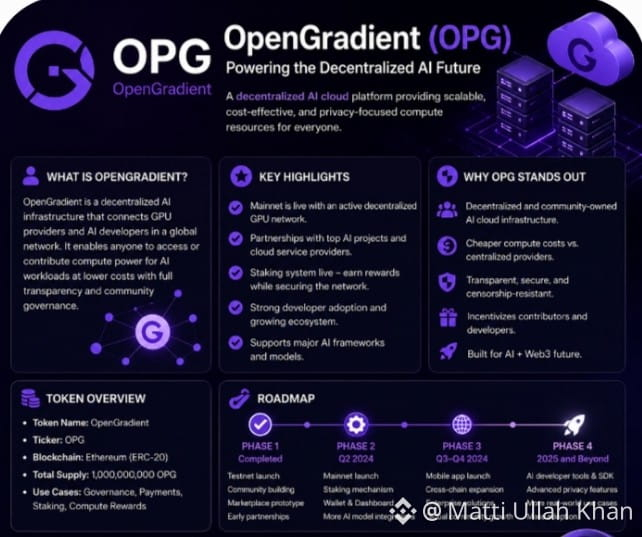
1
74

·
--
$OPG
@OpenGradient
The future of intelligence cannot be centralized behind closed corporate walls.
With OpenGradient, we are building the Network for Open Intelligence—bringing secure, verifiable AI execution straight on-chain. Through our specialized coprocessor architecture, developers can now deploy trustless AI models and power autonomous agents permissionlessly.
The decentralized AI era is here. Let’s build. 🌐🤖
$OPG #DeAI #Web3 #Web3AI
#OpenGradientis
{spot}(OPGUSDT)
$OPG
@OpenGradient
The future of intelligence cannot be centralized behind closed corporate walls.
With OpenGradient, we are building the Network for Open Intelligence—bringing secure, verifiable AI execution straight on-chain. Through our specialized coprocessor architecture, developers can now deploy trustless AI models and power autonomous agents permissionlessly.
The decentralized AI era is here. Let’s build. 🌐🤖
$OPG #DeAI #Web3 #Web3AI
#OpenGradientis
@OpenGradient
The future of intelligence cannot be centralized behind closed corporate walls.
With OpenGradient, we are building the Network for Open Intelligence—bringing secure, verifiable AI execution straight on-chain. Through our specialized coprocessor architecture, developers can now deploy trustless AI models and power autonomous agents permissionlessly.
The decentralized AI era is here. Let’s build. 🌐🤖
$OPG #DeAI #Web3 #Web3AI
#OpenGradientis
85

·
--
Verified
#OpenGradientis ($OPG ) is one of the most talked-about AI coins on Binance right now 🚀🤖
The reason isn’t just hype — it’s the narrative behind it. OPG is pushing the AI + blockchain story in a way that’s getting serious attention from traders. When a project starts combining strong exchange visibility, fresh momentum, and a hot sector like AI infrastructure, it naturally becomes one of the most watched tokens in the market.
Right now, OPG is the type of coin that can move fast on sentiment, volume, and community attention. That’s exactly why so many traders are keeping it on their radar.
Do you think OpenGradient is just a short-term hype play… or one of the strongest AI narratives building on Binance right now? 👇
$OPG $BTC
#OPG #OpenGradient #crypto
#OpenGradientis ($OPG ) is one of the most talked-about AI coins on Binance right now 🚀🤖
The reason isn’t just hype — it’s the narrative behind it. OPG is pushing the AI + blockchain story in a way that’s getting serious attention from traders. When a project starts combining strong exchange visibility, fresh momentum, and a hot sector like AI infrastructure, it naturally becomes one of the most watched tokens in the market.
Right now, OPG is the type of coin that can move fast on sentiment, volume, and community attention. That’s exactly why so many traders are keeping it on their radar.
Do you think OpenGradient is just a short-term hype play… or one of the strongest AI narratives building on Binance right now? 👇
$OPG $BTC
#OPG #OpenGradient #crypto
The reason isn’t just hype — it’s the narrative behind it. OPG is pushing the AI + blockchain story in a way that’s getting serious attention from traders. When a project starts combining strong exchange visibility, fresh momentum, and a hot sector like AI infrastructure, it naturally becomes one of the most watched tokens in the market.
Right now, OPG is the type of coin that can move fast on sentiment, volume, and community attention. That’s exactly why so many traders are keeping it on their radar.
Do you think OpenGradient is just a short-term hype play… or one of the strongest AI narratives building on Binance right now? 👇
$OPG $BTC
#OPG #OpenGradient #crypto
60
1
32
964
·
--
#OpenGradientis The AI narrative has shifted. 🧠🔄🟢
We have spent the last few years obsessing over building "smarter" models, but we have largely ignored the biggest bottleneck to mass adoption: TRUST. In high-stakes industries like Finance, Healthcare, and Enterprise software, a "black box" model simply won't cut it. 🛡️💼
This is exactly why #OpenGradient has become impossible to ignore. 🚀
While the rest of the market is fixated on decentralized compute, OpenGradient is quietly building the critical infrastructure required to host, run, and—most importantly—verify AI models at scale. 🏗️✨
Why does this matter? Because in a world where AI is making billion-dollar decisions, "trust me" isn't a strategy. Verifiable AI creates confidence. It turns AI from a speculative tool into a reliable enterprise asset. Without a verification layer, we are building castles on sand. 🏰📉
OpenGradient is building the foundation that will allow AI to actually scale into the real world. This isn't just about faster inference; it’s about creating the transparency that the entire industry is currently missing. 💎✅
What are your thoughts? Is the verification layer the missing piece of the AI puzzle? Let’s discuss below. 👇
$AGLD $VELVET $OPG
#OpenGradient #VerifiableAI #Web3
#OpenGradientis The AI narrative has shifted. 🧠🔄🟢
We have spent the last few years obsessing over building "smarter" models, but we have largely ignored the biggest bottleneck to mass adoption: TRUST. In high-stakes industries like Finance, Healthcare, and Enterprise software, a "black box" model simply won't cut it. 🛡️💼
This is exactly why #OpenGradient has become impossible to ignore. 🚀
While the rest of the market is fixated on decentralized compute, OpenGradient is quietly building the critical infrastructure required to host, run, and—most importantly—verify AI models at scale. 🏗️✨
Why does this matter? Because in a world where AI is making billion-dollar decisions, "trust me" isn't a strategy. Verifiable AI creates confidence. It turns AI from a speculative tool into a reliable enterprise asset. Without a verification layer, we are building castles on sand. 🏰📉
OpenGradient is building the foundation that will allow AI to actually scale into the real world. This isn't just about faster inference; it’s about creating the transparency that the entire industry is currently missing. 💎✅
What are your thoughts? Is the verification layer the missing piece of the AI puzzle? Let’s discuss below. 👇
$AGLD $VELVET $OPG
#OpenGradient #VerifiableAI #Web3
We have spent the last few years obsessing over building "smarter" models, but we have largely ignored the biggest bottleneck to mass adoption: TRUST. In high-stakes industries like Finance, Healthcare, and Enterprise software, a "black box" model simply won't cut it. 🛡️💼
This is exactly why #OpenGradient has become impossible to ignore. 🚀
While the rest of the market is fixated on decentralized compute, OpenGradient is quietly building the critical infrastructure required to host, run, and—most importantly—verify AI models at scale. 🏗️✨
Why does this matter? Because in a world where AI is making billion-dollar decisions, "trust me" isn't a strategy. Verifiable AI creates confidence. It turns AI from a speculative tool into a reliable enterprise asset. Without a verification layer, we are building castles on sand. 🏰📉
OpenGradient is building the foundation that will allow AI to actually scale into the real world. This isn't just about faster inference; it’s about creating the transparency that the entire industry is currently missing. 💎✅
What are your thoughts? Is the verification layer the missing piece of the AI puzzle? Let’s discuss below. 👇
$AGLD $VELVET $OPG
#OpenGradient #VerifiableAI #Web3
🔵BULLISH 🟢
42%
🟠BEARISH🔴
58%
12 votes • Voting closed
3
1
1.1k

·
--
Bullish
#opg $OPG
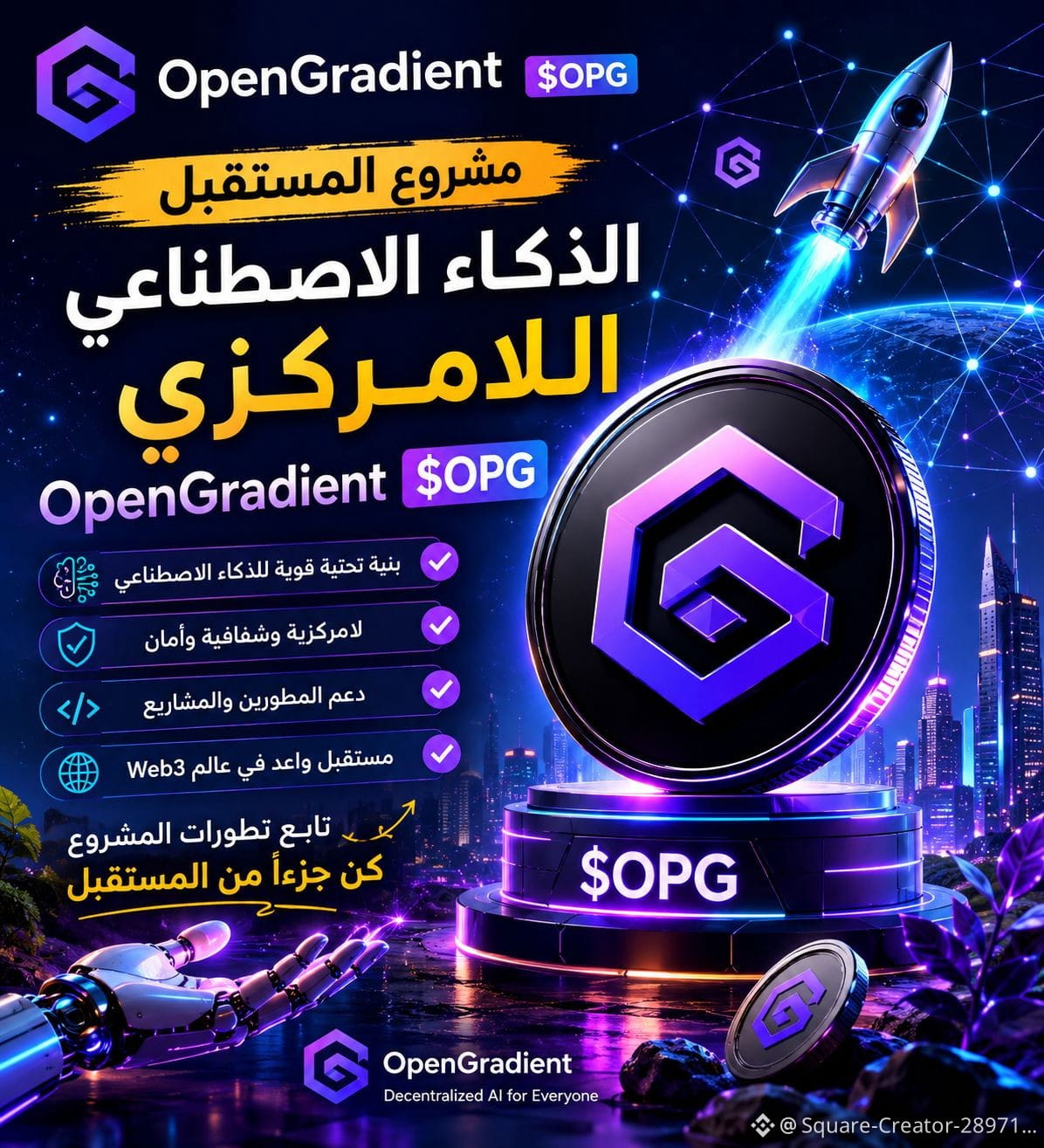
🚀 Project @OpenGradient keeps innovating in decentralized AI, representing $OPG a promising opportunity for the future of Web3. Are you keeping tabs on the project? 🌐
##OPG #OpenGradientis raw#3 #Crypto_Jobs🎯 #BinanceSquare
#opg $OPG
🚀 Project @OpenGradient keeps innovating in decentralized AI, representing $OPG a promising opportunity for the future of Web3. Are you keeping tabs on the project? 🌐
##OPG #OpenGradientis raw#3 #Crypto_Jobs🎯 #BinanceSquare
🚀 Project @OpenGradient keeps innovating in decentralized AI, representing $OPG a promising opportunity for the future of Web3. Are you keeping tabs on the project? 🌐
##OPG #OpenGradientis raw#3 #Crypto_Jobs🎯 #BinanceSquare
71
·
--
#opg $OPG Current Market Status
Price: Around $0.12–$0.13
Market Cap: About $24M
Circulating Supply: 190M OPG
Max Supply: 1B OPG
Trading Volume
#OpenGradientis
{future}(OPGUSDT)
#opg $OPG Current Market Status
Price: Around $0.12–$0.13
Market Cap: About $24M
Circulating Supply: 190M OPG
Max Supply: 1B OPG
Trading Volume
#OpenGradientis
Price: Around $0.12–$0.13
Market Cap: About $24M
Circulating Supply: 190M OPG
Max Supply: 1B OPG
Trading Volume
#OpenGradientis
108

·
--
$BTC 📈Bullish Momentum Update
Bitcoin continues to show strong bullish momentum with buyers maintaining control above key support levels. Rising trading volume and positive market sentiment suggest further upside potential if resistance levels are broken. As long as BTC holds its current structure, the trend remains favorable for bulls.
#Hemi #OpenGradientis
$BTC 📈Bullish Momentum Update
Bitcoin continues to show strong bullish momentum with buyers maintaining control above key support levels. Rising trading volume and positive market sentiment suggest further upside potential if resistance levels are broken. As long as BTC holds its current structure, the trend remains favorable for bulls.
#Hemi #OpenGradientis
Bitcoin continues to show strong bullish momentum with buyers maintaining control above key support levels. Rising trading volume and positive market sentiment suggest further upside potential if resistance levels are broken. As long as BTC holds its current structure, the trend remains favorable for bulls.
#Hemi #OpenGradientis
80

·
--
#opg $OPG
Have you heard about the OpenGradient ( $OPG ) coin, which represents a new breakthrough in integrating artificial intelligence with blockchain? This project acts as a decentralized assistant that allows developers to run and host AI models, validate data and results directly on the network without needing to rely on centralized parties. The network offers secure computation based on nodes supported by advanced encryption technologies and trusted execution environments to ensure privacy. It also solves the black-box problem by providing clear cryptographic proofs for every operation. The code $OPG is used to pay for computing fees, rewards for node operators, and participation in governance. The coin is listed on major platforms such as Binance and Coinbase, reflecting strong institutional interest in its promising future.
#OpenGradientis
#opg $OPG
Have you heard about the OpenGradient ( $OPG ) coin, which represents a new breakthrough in integrating artificial intelligence with blockchain? This project acts as a decentralized assistant that allows developers to run and host AI models, validate data and results directly on the network without needing to rely on centralized parties. The network offers secure computation based on nodes supported by advanced encryption technologies and trusted execution environments to ensure privacy. It also solves the black-box problem by providing clear cryptographic proofs for every operation. The code $OPG is used to pay for computing fees, rewards for node operators, and participation in governance. The coin is listed on major platforms such as Binance and Coinbase, reflecting strong institutional interest in its promising future.
#OpenGradientis
Have you heard about the OpenGradient ( $OPG ) coin, which represents a new breakthrough in integrating artificial intelligence with blockchain? This project acts as a decentralized assistant that allows developers to run and host AI models, validate data and results directly on the network without needing to rely on centralized parties. The network offers secure computation based on nodes supported by advanced encryption technologies and trusted execution environments to ensure privacy. It also solves the black-box problem by providing clear cryptographic proofs for every operation. The code $OPG is used to pay for computing fees, rewards for node operators, and participation in governance. The coin is listed on major platforms such as Binance and Coinbase, reflecting strong institutional interest in its promising future.
#OpenGradientis
82

Log in to explore more content
Join global crypto users on Binance Square
⚡️ Get latest and useful information about crypto.
💬 Trusted by the world’s largest crypto exchange.
👍 Discover real insights from verified creators.
Email / Phone number
Trending Topics
1
#FedProposesPaymentStablecoinRules
2,523 views
111 Discussing
2
#ChinaMayLetAlibabaByteDanceBuyNvidiaChips
4,992 views
213 Discussing
3
#USChinaRelease$30BTariffCutProductLists
838 views
23 Discussing
4
#SKoreaFSCConsidersVirtualAssetMarketMaker
5,589 views
195 Discussing
5
#ChinaIndustrialProfitGrowthSlowsFourthMonth
6,695 views
202 Discussing
6
#BitwiseFilesFinalNEARSpotETFProspectus
118,851 views
1,742 Discussing
7
#BitgetHackerMoves$83MStolenXRP
39,924 views
177 Discussing
8
#SOLSpotETFWeeklyInflow$188M
25,159 views
139 Discussing
9
#DogecoinETFsPostBiggestWeekSinceLaunch
68,304 views
1,118 Discussing
10
#StrategyStriveAdd2305BitcoinThisWeek
168,775 views
2,399 Discussing