

#nyandpolymarketsueeachother
nyandpolymarketsueeachother
21,400 views
287 Discussing
Hot
Latest

·
--
Picture this: a decentralized prediction market gets so big that state regulators and the platform end up filing lawsuits against each other on the exact same afternoon.
Most retail traders get caught in the regulatory crossfire, watching their capital freeze or liquidity vanish overnight simply because they mistook rapid market adoption for legal immunity.
When you look at this showdown, it feels eerily familiar to the early battles Uniswap faced, or even the regulatory scrutiny that pushed builders toward layer-2 ecosystems like $OP and high-throughput chains like $SUI. The core clash is always the same: innovation outpaces legacy frameworks, and instead of clear guidelines, we get enforcement through litigation. Prediction markets have evolved from niche crypto experiments into primary information feeds during high-stakes global events, which naturally puts a massive target on their back.
While centralized platforms usually settle quietly behind closed doors, decentralized protocols are increasingly choosing to fight back in federal court to defend non-custodial settlement rails. Even as the broader market stays risk-on with steady $USDT flows backing volume, this legal clash sets a critical precedent for how prediction markets and decentralized protocols operate going forward.
Where do you think this regulatory tug-of-war heads next for decentralized betting?
#NYAndPolymarketSueEachOther #CFTCUpdatesGuidanceOnTokenizedAssets
Picture this: a decentralized prediction market gets so big that state regulators and the platform end up filing lawsuits against each other on the exact same afternoon.
Most retail traders get caught in the regulatory crossfire, watching their capital freeze or liquidity vanish overnight simply because they mistook rapid market adoption for legal immunity.
When you look at this showdown, it feels eerily familiar to the early battles Uniswap faced, or even the regulatory scrutiny that pushed builders toward layer-2 ecosystems like $OP and high-throughput chains like $SUI . The core clash is always the same: innovation outpaces legacy frameworks, and instead of clear guidelines, we get enforcement through litigation. Prediction markets have evolved from niche crypto experiments into primary information feeds during high-stakes global events, which naturally puts a massive target on their back.
While centralized platforms usually settle quietly behind closed doors, decentralized protocols are increasingly choosing to fight back in federal court to defend non-custodial settlement rails. Even as the broader market stays risk-on with steady $USDT flows backing volume, this legal clash sets a critical precedent for how prediction markets and decentralized protocols operate going forward.
Where do you think this regulatory tug-of-war heads next for decentralized betting?
#NYAndPolymarketSueEachOther #CFTCUpdatesGuidanceOnTokenizedAssets
Most retail traders get caught in the regulatory crossfire, watching their capital freeze or liquidity vanish overnight simply because they mistook rapid market adoption for legal immunity.
When you look at this showdown, it feels eerily familiar to the early battles Uniswap faced, or even the regulatory scrutiny that pushed builders toward layer-2 ecosystems like $OP and high-throughput chains like $SUI . The core clash is always the same: innovation outpaces legacy frameworks, and instead of clear guidelines, we get enforcement through litigation. Prediction markets have evolved from niche crypto experiments into primary information feeds during high-stakes global events, which naturally puts a massive target on their back.
While centralized platforms usually settle quietly behind closed doors, decentralized protocols are increasingly choosing to fight back in federal court to defend non-custodial settlement rails. Even as the broader market stays risk-on with steady $USDT flows backing volume, this legal clash sets a critical precedent for how prediction markets and decentralized protocols operate going forward.
Where do you think this regulatory tug-of-war heads next for decentralized betting?
#NYAndPolymarketSueEachOther #CFTCUpdatesGuidanceOnTokenizedAssets
342

·
--
#nyandpolymarketsueeachother
🚨 New York and Polymarket are now suing each other — and the bigger fight is over who gets to regulate prediction markets.
New York Attorney General Letitia James sued Polymarket on September 24, accusing the platform of operating an unlicensed gambling business and seeking to stop it from operating in the state.
Then Polymarket fired back.
The company filed its own federal lawsuit against New York officials, arguing that the state shouldn't regulate its prediction markets because they fall under the federal derivatives framework.
So this isn't just another lawsuit against a prediction-market platform.
It's a direct clash between state gambling laws and federal oversight of event contracts.
And that could matter far beyond Polymarket.
If courts draw a clearer line between gambling and regulated prediction markets, the outcome could affect how the entire U.S. prediction-market industry operates.
The key question now: where does state authority end and federal market regulation begin?
#Polymarket #PredictionMarkets #CFTC
#nyandpolymarketsueeachother
🚨 New York and Polymarket are now suing each other — and the bigger fight is over who gets to regulate prediction markets.
New York Attorney General Letitia James sued Polymarket on September 24, accusing the platform of operating an unlicensed gambling business and seeking to stop it from operating in the state.
Then Polymarket fired back.
The company filed its own federal lawsuit against New York officials, arguing that the state shouldn't regulate its prediction markets because they fall under the federal derivatives framework.
So this isn't just another lawsuit against a prediction-market platform.
It's a direct clash between state gambling laws and federal oversight of event contracts.
And that could matter far beyond Polymarket.
If courts draw a clearer line between gambling and regulated prediction markets, the outcome could affect how the entire U.S. prediction-market industry operates.
The key question now: where does state authority end and federal market regulation begin?
#Polymarket #PredictionMarkets #CFTC
🚨 New York and Polymarket are now suing each other — and the bigger fight is over who gets to regulate prediction markets.
New York Attorney General Letitia James sued Polymarket on September 24, accusing the platform of operating an unlicensed gambling business and seeking to stop it from operating in the state.
Then Polymarket fired back.
The company filed its own federal lawsuit against New York officials, arguing that the state shouldn't regulate its prediction markets because they fall under the federal derivatives framework.
So this isn't just another lawsuit against a prediction-market platform.
It's a direct clash between state gambling laws and federal oversight of event contracts.
And that could matter far beyond Polymarket.
If courts draw a clearer line between gambling and regulated prediction markets, the outcome could affect how the entire U.S. prediction-market industry operates.
The key question now: where does state authority end and federal market regulation begin?
#Polymarket #PredictionMarkets #CFTC
73

·
--
Fedproposes#FedProposesRulesForBankIssuedStablecoins #CFTCUpdatesGuidanceOnTokenizedAssets *#NYAndPolymarketSueEachOther* ⚖️
Dueling lawsuits filed yesterday - Sept 24, biggest test yet for prediction markets.
### 1. NY sues Polymarket
*Who*: AG Letitia James + Gov Kathy Hochul in Manhattan state court vs QCX LLC d/b/a Polymarket US
*Allegations*:
- Running *unlicensed gambling* - no NY State Gaming Commission license
- Sports event contracts = gambling under NY law (staking on uncertain outcomes you can't control)
- Allows users *18-20*, while NY mobile sports betting requires 21+ - accused of targeting vulnerable youth
- Advertised as sports betting since July 2025 ("BAD NEWS (For sportsbooks)" post)
*Asking*: Injunction to stop NY operations, *forfeit all illegal gains*, restitution to customers, *fines 3x gains*
This follows same suits vs *Kalshi (July, seeking $36B)*, Coinbase Financial Markets, Gemini Titan. James also got $8M settlement from VGW (Chumba Casino) this month.
### 2. Polymarket countersues NY (hours later)
Filed in Manhattan *federal court*.
*Argument*:
- *CFTC has exclusive authority* over prediction markets, not states. Polymarket bought QCEX in July 2025 for $AAPLB 112M - a CFTC-licensed exchange to re-enter US (after$NVDAB 1.4M settlement and exit in 2022)
- NY created "impossible choice": obey state = lose federal right to operate nationwide, or keep operating = "huge" criminal liability
- Quote from Chief Legal Officer Neal Kumar: "This is an extraordinary assertion of state power squarely foreclosed by federal law" - said they tried to negotiate but NY "preferred the media hit"
*Asking*: Declaration that NY cannot enforce gambling laws against it.
### Why it matters
Polymarket = $2Z 0B+ valuation, founded in NYC apartment, now 350 employees in NYC. Launched US app Dec 2025. The question: Are event contracts *financial derivatives (CFTC)* or *gambling (state)*? Outcome will decide if prediction markets need 50 state licenses or just 1 federal.
Polymarket statement: "We believe in New York and we're staying here."#NYAndPolymarketSueEachOther
Fedproposes
#FedProposesRulesForBankIssuedStablecoins #CFTCUpdatesGuidanceOnTokenizedAssets *#NYAndPolymarketSueEachOther* ⚖️
Dueling lawsuits filed yesterday - Sept 24, biggest test yet for prediction markets.
### 1. NY sues Polymarket
*Who*: AG Letitia James + Gov Kathy Hochul in Manhattan state court vs QCX LLC d/b/a Polymarket US
*Allegations*:
- Running *unlicensed gambling* - no NY State Gaming Commission license
- Sports event contracts = gambling under NY law (staking on uncertain outcomes you can't control)
- Allows users *18-20*, while NY mobile sports betting requires 21+ - accused of targeting vulnerable youth
- Advertised as sports betting since July 2025 ("BAD NEWS (For sportsbooks)" post)
*Asking*: Injunction to stop NY operations, *forfeit all illegal gains*, restitution to customers, *fines 3x gains*
This follows same suits vs *Kalshi (July, seeking $36B)*, Coinbase Financial Markets, Gemini Titan. James also got $8M settlement from VGW (Chumba Casino) this month.
### 2. Polymarket countersues NY (hours later)
Filed in Manhattan *federal court*.
*Argument*:
- *CFTC has exclusive authority* over prediction markets, not states. Polymarket bought QCEX in July 2025 for $AAPLB 112M - a CFTC-licensed exchange to re-enter US (after$NVDAB 1.4M settlement and exit in 2022)
- NY created "impossible choice": obey state = lose federal right to operate nationwide, or keep operating = "huge" criminal liability
- Quote from Chief Legal Officer Neal Kumar: "This is an extraordinary assertion of state power squarely foreclosed by federal law" - said they tried to negotiate but NY "preferred the media hit"
*Asking*: Declaration that NY cannot enforce gambling laws against it.
### Why it matters
Polymarket = $2Z 0B+ valuation, founded in NYC apartment, now 350 employees in NYC. Launched US app Dec 2025. The question: Are event contracts *financial derivatives (CFTC)* or *gambling (state)*? Outcome will decide if prediction markets need 50 state licenses or just 1 federal.
Polymarket statement: "We believe in New York and we're staying here."#NYAndPolymarketSueEachOther
Dueling lawsuits filed yesterday - Sept 24, biggest test yet for prediction markets.
### 1. NY sues Polymarket
*Who*: AG Letitia James + Gov Kathy Hochul in Manhattan state court vs QCX LLC d/b/a Polymarket US
*Allegations*:
- Running *unlicensed gambling* - no NY State Gaming Commission license
- Sports event contracts = gambling under NY law (staking on uncertain outcomes you can't control)
- Allows users *18-20*, while NY mobile sports betting requires 21+ - accused of targeting vulnerable youth
- Advertised as sports betting since July 2025 ("BAD NEWS (For sportsbooks)" post)
*Asking*: Injunction to stop NY operations, *forfeit all illegal gains*, restitution to customers, *fines 3x gains*
This follows same suits vs *Kalshi (July, seeking $36B)*, Coinbase Financial Markets, Gemini Titan. James also got $8M settlement from VGW (Chumba Casino) this month.
### 2. Polymarket countersues NY (hours later)
Filed in Manhattan *federal court*.
*Argument*:
- *CFTC has exclusive authority* over prediction markets, not states. Polymarket bought QCEX in July 2025 for $AAPLB 112M - a CFTC-licensed exchange to re-enter US (after$NVDAB 1.4M settlement and exit in 2022)
- NY created "impossible choice": obey state = lose federal right to operate nationwide, or keep operating = "huge" criminal liability
- Quote from Chief Legal Officer Neal Kumar: "This is an extraordinary assertion of state power squarely foreclosed by federal law" - said they tried to negotiate but NY "preferred the media hit"
*Asking*: Declaration that NY cannot enforce gambling laws against it.
### Why it matters
Polymarket = $2Z 0B+ valuation, founded in NYC apartment, now 350 employees in NYC. Launched US app Dec 2025. The question: Are event contracts *financial derivatives (CFTC)* or *gambling (state)*? Outcome will decide if prediction markets need 50 state licenses or just 1 federal.
Polymarket statement: "We believe in New York and we're staying here."#NYAndPolymarketSueEachOther
248

·
--
#NYAndPolymarketSueEachOther
New York is turning up the heat on prediction markets. State Attorney General Letitia James has sued Polymarket (and rival Kalshi) for allegedly running unlicensed gambling operations — with penalties in the billions on the table for Kalshi's case. Polymarket isn't backing down either: it's already filed its own federal lawsuit against Massachusetts over a similar dispute, arguing the CFTC (a federal regulator) has sole authority over these markets, not individual states. On top of that, New York City Council is separately investigating Polymarket over its marketing tactics. It's shaping up to be a real turf war between state regulators and the federal government over who gets to police prediction markets.
{spot}(ETHUSDT)
{spot}(BTCUSDT)
AT THE END
Daily market breakdowns, plain language, zero hype — that's the deal. Follow along so you don't miss tomorrow's update, and drop a like if this helped. 🙌
#NYAndPolymarketSueEachOther
New York is turning up the heat on prediction markets. State Attorney General Letitia James has sued Polymarket (and rival Kalshi) for allegedly running unlicensed gambling operations — with penalties in the billions on the table for Kalshi's case. Polymarket isn't backing down either: it's already filed its own federal lawsuit against Massachusetts over a similar dispute, arguing the CFTC (a federal regulator) has sole authority over these markets, not individual states. On top of that, New York City Council is separately investigating Polymarket over its marketing tactics. It's shaping up to be a real turf war between state regulators and the federal government over who gets to police prediction markets.
AT THE END
Daily market breakdowns, plain language, zero hype — that's the deal. Follow along so you don't miss tomorrow's update, and drop a like if this helped. 🙌
New York is turning up the heat on prediction markets. State Attorney General Letitia James has sued Polymarket (and rival Kalshi) for allegedly running unlicensed gambling operations — with penalties in the billions on the table for Kalshi's case. Polymarket isn't backing down either: it's already filed its own federal lawsuit against Massachusetts over a similar dispute, arguing the CFTC (a federal regulator) has sole authority over these markets, not individual states. On top of that, New York City Council is separately investigating Polymarket over its marketing tactics. It's shaping up to be a real turf war between state regulators and the federal government over who gets to police prediction markets.
AT THE END
Daily market breakdowns, plain language, zero hype — that's the deal. Follow along so you don't miss tomorrow's update, and drop a like if this helped. 🙌
94


·
--
Bullish
#nyandpolymarketsueeachother
New York and Polymarket Sue Each Other: Who Regulates Event Contracts?
The legal fight over
markets now runs in both directions.
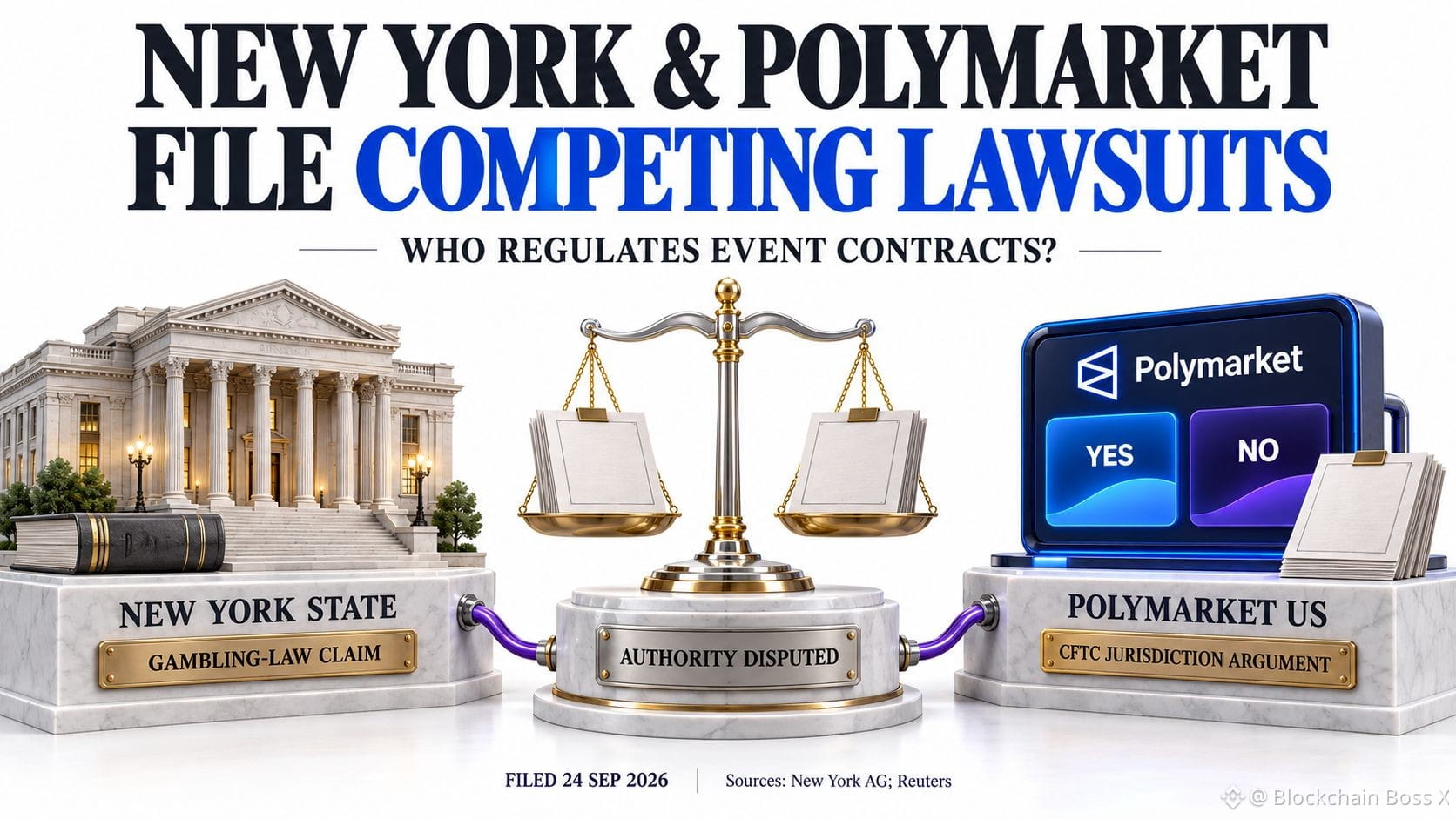
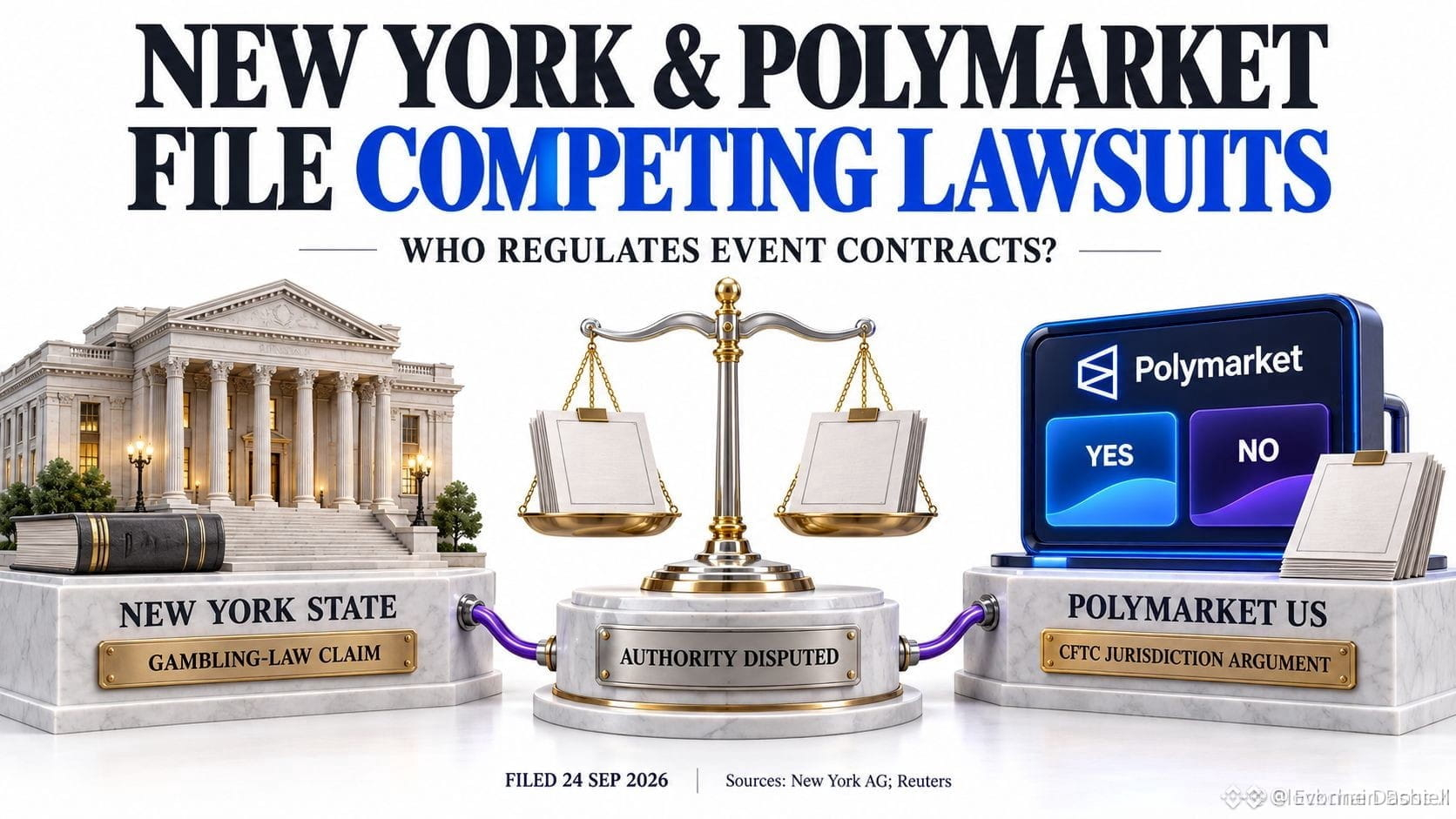
On September 24, New York Attorney General Letitia James sued Polymarket US in state court, alleging it operates an unlicensed gambling business. The state seeks an order stopping that activity, alongside fines, forfeiture of allegedly illegal gains and customer restitution.
Polymarket responded with a separate lawsuit in Manhattan federal court against state officials. It argues that the Commodity Futures Trading Commission has exclusive authority over its markets and seeks to prevent New York from enforcing gambling laws against the company.
Both sides are advancing legal claims that await judicial resolution.
My take: The outcome could influence which contracts platforms offer, where users can participate and how consistently the rules apply across states. For businesses building national markets, geographic restrictions could affect liquidity as well as compliance costs.
For users, a workable framework also needs clear answers about age restrictions, dispute handling and consumer protections. Market access and confidence depend on how those safeguards operate in practice.
I’d watch interim court decisions and changes to user eligibility before drawing conclusions about the wider industry. Those developments would show how this dispute affects everyday access while the larger jurisdiction question is contested.
How should oversight balance national market access with meaningful consumer protections?
#NYAndPolymarketSueEachOther #Polymarket #PredictionMarkets
$QNT $XPL $ONDO
{future}(ONDOUSDT)
{future}(XPLUSDT)
{future}(QNTUSDT)
#nyandpolymarketsueeachother
New York and Polymarket Sue Each Other: Who Regulates Event Contracts?
The legal fight over
markets now runs in both directions.
On September 24, New York Attorney General Letitia James sued Polymarket US in state court, alleging it operates an unlicensed gambling business. The state seeks an order stopping that activity, alongside fines, forfeiture of allegedly illegal gains and customer restitution.
Polymarket responded with a separate lawsuit in Manhattan federal court against state officials. It argues that the Commodity Futures Trading Commission has exclusive authority over its markets and seeks to prevent New York from enforcing gambling laws against the company.
Both sides are advancing legal claims that await judicial resolution.
My take: The outcome could influence which contracts platforms offer, where users can participate and how consistently the rules apply across states. For businesses building national markets, geographic restrictions could affect liquidity as well as compliance costs.
For users, a workable framework also needs clear answers about age restrictions, dispute handling and consumer protections. Market access and confidence depend on how those safeguards operate in practice.
I’d watch interim court decisions and changes to user eligibility before drawing conclusions about the wider industry. Those developments would show how this dispute affects everyday access while the larger jurisdiction question is contested.
How should oversight balance national market access with meaningful consumer protections?
#NYAndPolymarketSueEachOther #Polymarket #PredictionMarkets
$QNT $XPL $ONDO
New York and Polymarket Sue Each Other: Who Regulates Event Contracts?
The legal fight over
markets now runs in both directions.
On September 24, New York Attorney General Letitia James sued Polymarket US in state court, alleging it operates an unlicensed gambling business. The state seeks an order stopping that activity, alongside fines, forfeiture of allegedly illegal gains and customer restitution.
Polymarket responded with a separate lawsuit in Manhattan federal court against state officials. It argues that the Commodity Futures Trading Commission has exclusive authority over its markets and seeks to prevent New York from enforcing gambling laws against the company.
Both sides are advancing legal claims that await judicial resolution.
My take: The outcome could influence which contracts platforms offer, where users can participate and how consistently the rules apply across states. For businesses building national markets, geographic restrictions could affect liquidity as well as compliance costs.
For users, a workable framework also needs clear answers about age restrictions, dispute handling and consumer protections. Market access and confidence depend on how those safeguards operate in practice.
I’d watch interim court decisions and changes to user eligibility before drawing conclusions about the wider industry. Those developments would show how this dispute affects everyday access while the larger jurisdiction question is contested.
How should oversight balance national market access with meaningful consumer protections?
#NYAndPolymarketSueEachOther #Polymarket #PredictionMarkets
$QNT $XPL $ONDO
1
2.5k

#nyandpolymarketsueeachother
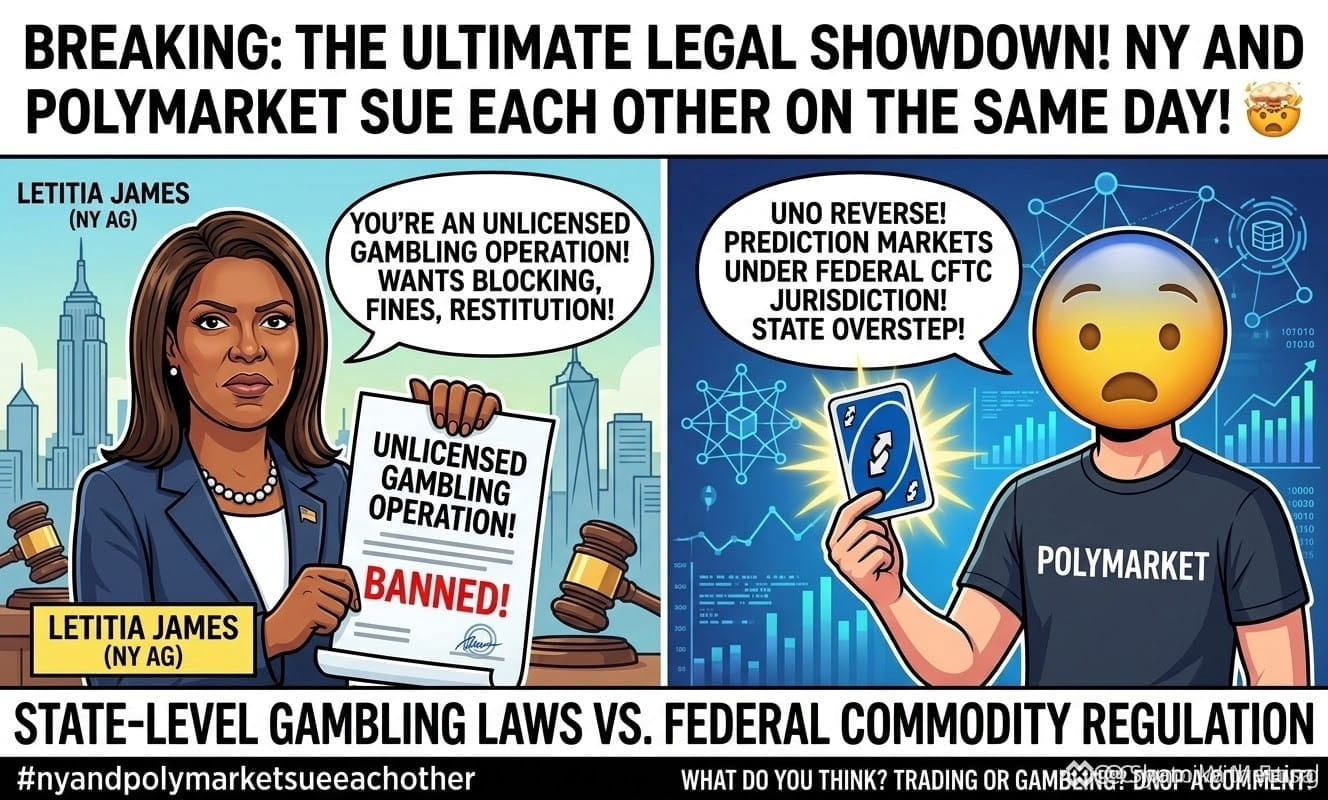
🚨 BREAKING: The Ultimate Legal Showdown Just Dropped 🚨
New York and Polymarket are literally suing each other. Yes, you read that right. Both of them. On the exact same day. 🤯 #nyandpolymarketsueeachother
Here’s the TL;DR of the drama:
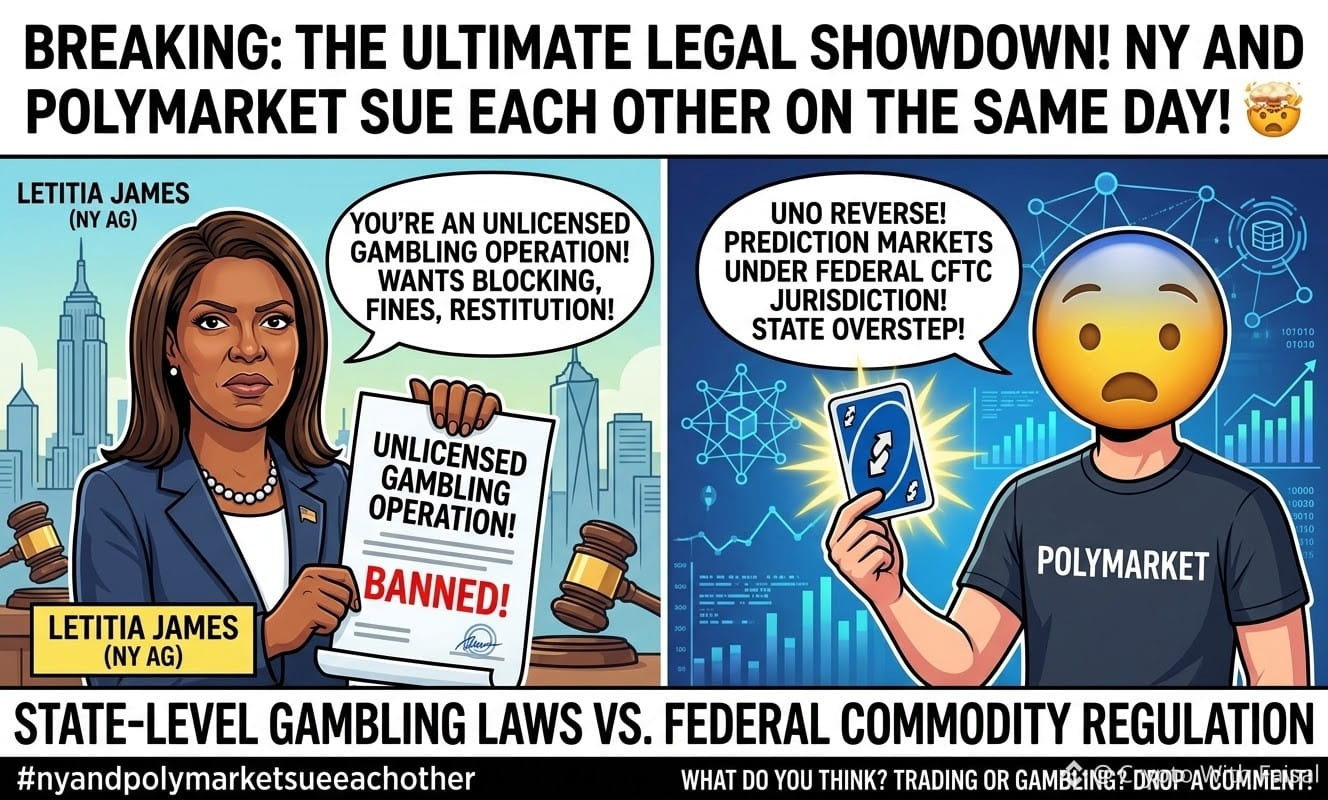
🏛️ NY’s Move: Attorney General Letitia James just sued Polymarket, labeling it an "unlicensed gambling operation". The state wants it blocked entirely, demanding heavy fines and user restitution.
🛡️ Polymarket’s Uno Reverse: Hours later, Polymarket sued NY right back in Manhattan federal court. Their argument? Prediction markets fall strictly under the federal CFTC's jurisdiction—meaning state gambling regulators are overstepping their authority.
Why this is huge for Web3:
Prediction platforms absolutely exploded in 2024, proving highly accurate during the elections. Now, we are watching a historic turf war: State-level gambling laws vs. Federal commodity regulation.
If Polymarket wins, it sets a massive precedent for decentralized prediction markets to operate freely nationwide. If NY wins, get ready for messy state-by-state crackdowns and strict geo-blocks.
👇 What do you think?
Is trading on real-world events "gambling" or "financial forecasting"? Drop your take in the comments! Let's debate. 🗣️
$POL
{future}(POLUSDT)
$UMA
{future}(UMAUSDT)
$QNT
{future}(QNTUSDT)
#CryptoNews #Polymarket
#BinanceSquare
#nyandpolymarketsueeachother
🚨 BREAKING: The Ultimate Legal Showdown Just Dropped 🚨
New York and Polymarket are literally suing each other. Yes, you read that right. Both of them. On the exact same day. 🤯 #nyandpolymarketsueeachother
Here’s the TL;DR of the drama:
🏛️ NY’s Move: Attorney General Letitia James just sued Polymarket, labeling it an "unlicensed gambling operation". The state wants it blocked entirely, demanding heavy fines and user restitution.
🛡️ Polymarket’s Uno Reverse: Hours later, Polymarket sued NY right back in Manhattan federal court. Their argument? Prediction markets fall strictly under the federal CFTC's jurisdiction—meaning state gambling regulators are overstepping their authority.
Why this is huge for Web3:
Prediction platforms absolutely exploded in 2024, proving highly accurate during the elections. Now, we are watching a historic turf war: State-level gambling laws vs. Federal commodity regulation.
If Polymarket wins, it sets a massive precedent for decentralized prediction markets to operate freely nationwide. If NY wins, get ready for messy state-by-state crackdowns and strict geo-blocks.
👇 What do you think?
Is trading on real-world events "gambling" or "financial forecasting"? Drop your take in the comments! Let's debate. 🗣️
$POL
$UMA
$QNT
#CryptoNews #Polymarket
#BinanceSquare
🚨 BREAKING: The Ultimate Legal Showdown Just Dropped 🚨
New York and Polymarket are literally suing each other. Yes, you read that right. Both of them. On the exact same day. 🤯 #nyandpolymarketsueeachother
Here’s the TL;DR of the drama:
🏛️ NY’s Move: Attorney General Letitia James just sued Polymarket, labeling it an "unlicensed gambling operation". The state wants it blocked entirely, demanding heavy fines and user restitution.
🛡️ Polymarket’s Uno Reverse: Hours later, Polymarket sued NY right back in Manhattan federal court. Their argument? Prediction markets fall strictly under the federal CFTC's jurisdiction—meaning state gambling regulators are overstepping their authority.
Why this is huge for Web3:
Prediction platforms absolutely exploded in 2024, proving highly accurate during the elections. Now, we are watching a historic turf war: State-level gambling laws vs. Federal commodity regulation.
If Polymarket wins, it sets a massive precedent for decentralized prediction markets to operate freely nationwide. If NY wins, get ready for messy state-by-state crackdowns and strict geo-blocks.
👇 What do you think?
Is trading on real-world events "gambling" or "financial forecasting"? Drop your take in the comments! Let's debate. 🗣️
$POL
$UMA
$QNT
#CryptoNews #Polymarket
#BinanceSquare
1
607

·
--
Article
Two Lawsuits, Filed the Same Day, Over Who Gets to Regulate Prediction Markets#NYAndPolymarketSueEachOther
New York and Polymarket didn't just clash on Thursday — they sued each other, escalating a fight that's been building across the prediction-market industry for months.
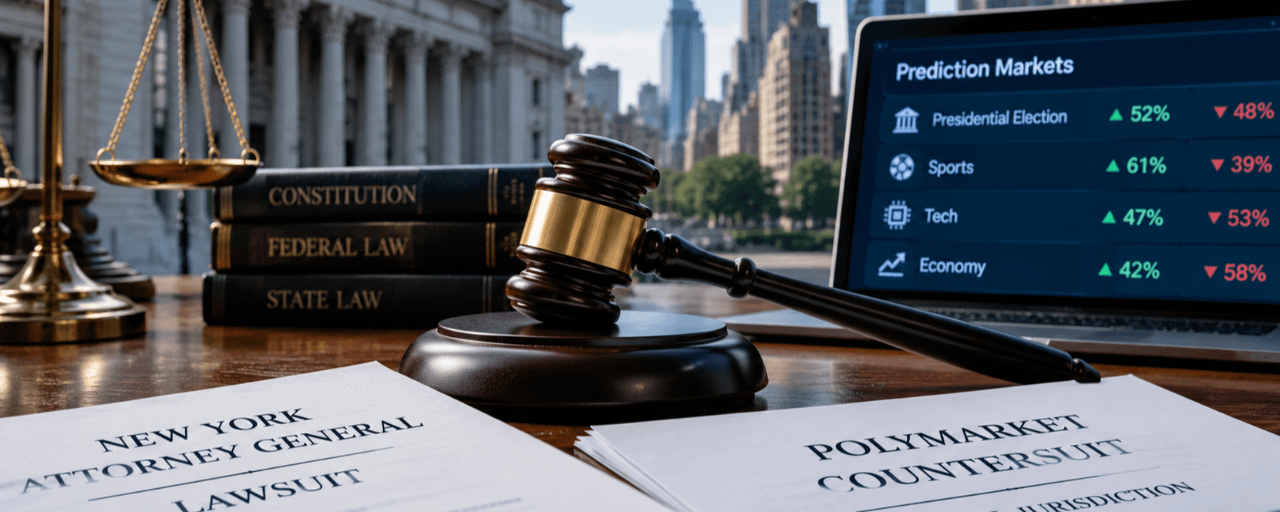
Here's what happened: New York Attorney General Letitia James filed suit in Manhattan state court, accusing Polymarket of running an unlicensed gambling operation that let New Yorkers — including people as young as 18 — wager on sports, elections, and other events without the required state gaming license. The state is seeking civil fines, forfeiture of alleged illegal gains, and restitution for users. Polymarket didn't just respond — it filed its own countersuit in federal court hours later, arguing that the Commodity Futures Trading Commission holds exclusive federal authority over prediction markets, and that New York's action puts the company in an impossible position: comply with state law or keep operating and risk serious criminal liability. This follows a similar pattern already playing out with competitor Kalshi, which New York sued back in July on comparable grounds, along with earlier actions against Coinbase Financial Markets and Gemini.
Why does this matter? Prediction markets sit in a genuinely unsettled legal space — platforms argue their event contracts are financial derivatives regulated federally, while several states argue they're functionally gambling products that fall under state jurisdiction. With multiple states and multiple platforms now in parallel legal fights, the outcome could set a significant precedent for how (and who) regulates this entire category going forward. For an industry that's grown rapidly and drawn substantial trading volume, this kind of jurisdictional uncertainty is the type of overhang that tends to weigh on long-term confidence, regardless of how any single case resolves.
Whether federal or state authority ultimately wins out is a question that's likely headed well beyond this one lawsuit before it's settled.
Should prediction markets be treated as financial products or as gambling — and does the answer even need to be the same in every state? 🤔
#Polymarket #PredictionMarkets #Regulation #CryptoNews
$QNT $QI $XPL
{future}(XPLUSDT)
{spot}(QIUSDT)
{future}(QNTUSDT)
Two Lawsuits, Filed the Same Day, Over Who Gets to Regulate Prediction Markets
#NYAndPolymarketSueEachOther
New York and Polymarket didn't just clash on Thursday — they sued each other, escalating a fight that's been building across the prediction-market industry for months.
Here's what happened: New York Attorney General Letitia James filed suit in Manhattan state court, accusing Polymarket of running an unlicensed gambling operation that let New Yorkers — including people as young as 18 — wager on sports, elections, and other events without the required state gaming license. The state is seeking civil fines, forfeiture of alleged illegal gains, and restitution for users. Polymarket didn't just respond — it filed its own countersuit in federal court hours later, arguing that the Commodity Futures Trading Commission holds exclusive federal authority over prediction markets, and that New York's action puts the company in an impossible position: comply with state law or keep operating and risk serious criminal liability. This follows a similar pattern already playing out with competitor Kalshi, which New York sued back in July on comparable grounds, along with earlier actions against Coinbase Financial Markets and Gemini.
Why does this matter? Prediction markets sit in a genuinely unsettled legal space — platforms argue their event contracts are financial derivatives regulated federally, while several states argue they're functionally gambling products that fall under state jurisdiction. With multiple states and multiple platforms now in parallel legal fights, the outcome could set a significant precedent for how (and who) regulates this entire category going forward. For an industry that's grown rapidly and drawn substantial trading volume, this kind of jurisdictional uncertainty is the type of overhang that tends to weigh on long-term confidence, regardless of how any single case resolves.
Whether federal or state authority ultimately wins out is a question that's likely headed well beyond this one lawsuit before it's settled.
Should prediction markets be treated as financial products or as gambling — and does the answer even need to be the same in every state? 🤔
#Polymarket #PredictionMarkets #Regulation #CryptoNews
$QNT $QI $XPL
New York and Polymarket didn't just clash on Thursday — they sued each other, escalating a fight that's been building across the prediction-market industry for months.
Here's what happened: New York Attorney General Letitia James filed suit in Manhattan state court, accusing Polymarket of running an unlicensed gambling operation that let New Yorkers — including people as young as 18 — wager on sports, elections, and other events without the required state gaming license. The state is seeking civil fines, forfeiture of alleged illegal gains, and restitution for users. Polymarket didn't just respond — it filed its own countersuit in federal court hours later, arguing that the Commodity Futures Trading Commission holds exclusive federal authority over prediction markets, and that New York's action puts the company in an impossible position: comply with state law or keep operating and risk serious criminal liability. This follows a similar pattern already playing out with competitor Kalshi, which New York sued back in July on comparable grounds, along with earlier actions against Coinbase Financial Markets and Gemini.
Why does this matter? Prediction markets sit in a genuinely unsettled legal space — platforms argue their event contracts are financial derivatives regulated federally, while several states argue they're functionally gambling products that fall under state jurisdiction. With multiple states and multiple platforms now in parallel legal fights, the outcome could set a significant precedent for how (and who) regulates this entire category going forward. For an industry that's grown rapidly and drawn substantial trading volume, this kind of jurisdictional uncertainty is the type of overhang that tends to weigh on long-term confidence, regardless of how any single case resolves.
Whether federal or state authority ultimately wins out is a question that's likely headed well beyond this one lawsuit before it's settled.
Should prediction markets be treated as financial products or as gambling — and does the answer even need to be the same in every state? 🤔
#Polymarket #PredictionMarkets #Regulation #CryptoNews
$QNT $QI $XPL
2
361

·
--
Bullish
#nyandpolymarketsueeachother
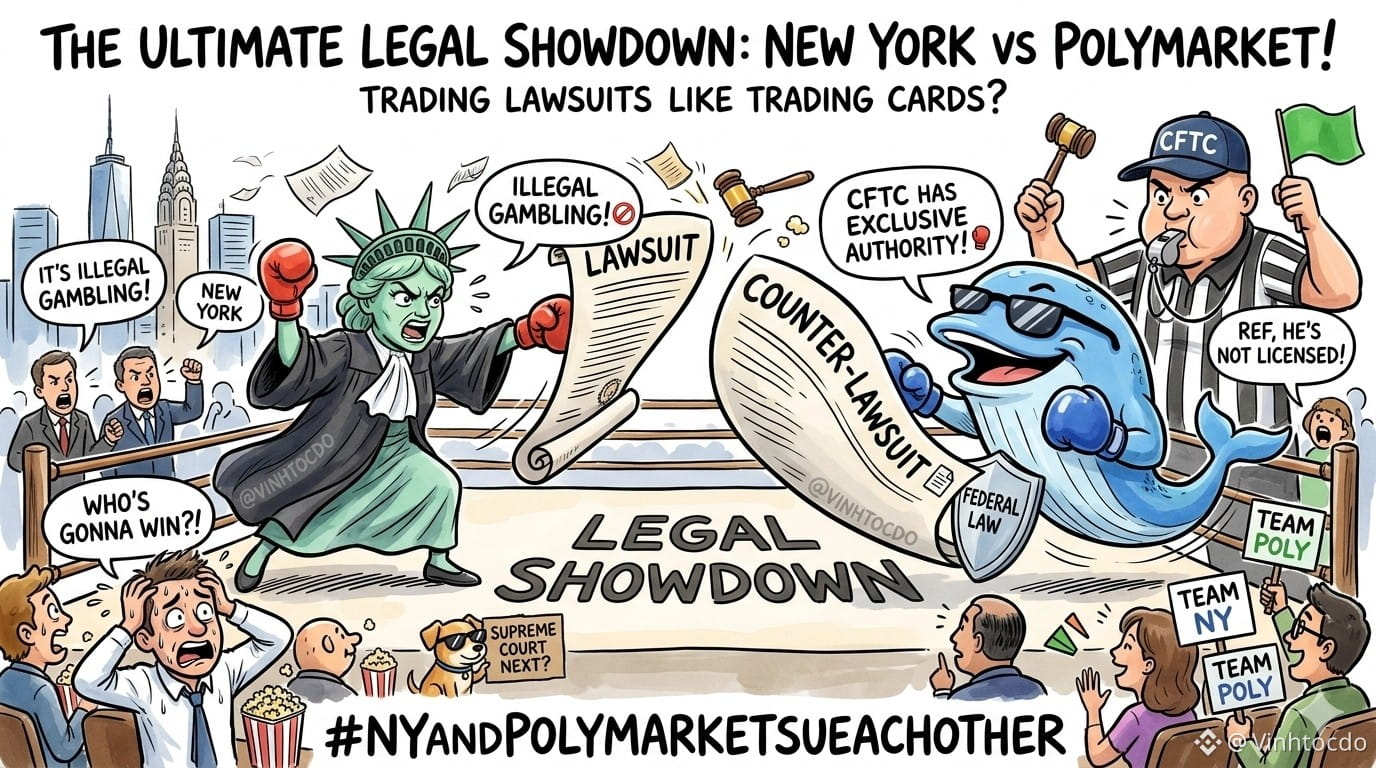
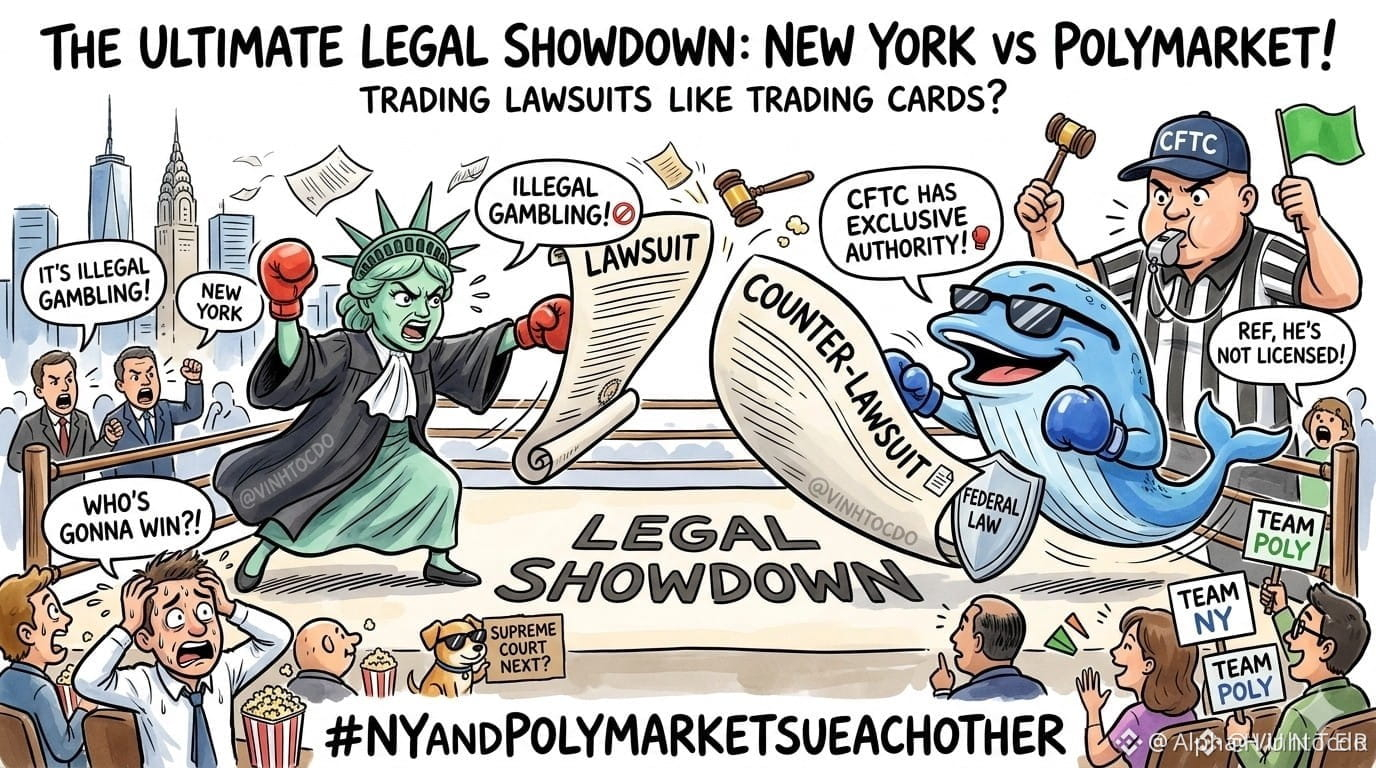
The ultimate crypto showdown is here: #nyandpolymarketsueeachother! 🥊 Pop the popcorn, because New York and Polymarket are trading lawsuits like trading cards.
🗽 The Drama: NY claims Polymarket is running an "illegal gambling den," putting under-21s at risk. Hours later, Polymarket countersued in federal court, claiming the CFTC has exclusive federal authority over prediction markets. Talk about a massive plot twist!
🤷♂️ Who won? No final verdict yet—it just started on Thursday! The case could go all the way to the US Supreme Court.
🤖 Is the CFTC team Polymarket? Well, the CFTC gave the green light for prediction markets last year, which helped Polymarket relaunch. So yes, federal regulators are definitely at odds with state officials!
🛒 What should traders do?
🛑 Expect volatility: Prediction platforms and related tokens will swing wildly based on court updates.
🐋 Watch the backing: Remember, Polymarket is backed by major capital and political figures.
⚠️ Not financial advice. DYOR! New to Binance? Use code VINHTOCDO or click the link: [https://www.binance.com/register?ref=VINHTOCDO](https://www.binance.com/register?ref=VINHTOCDO) to ride the wave!
👉 Click trade below to support me: $UMA
{future}(UMAUSDT)
| $LINK
{future}(LINKUSDT)
| $POL
{future}(POLUSDT)
#Polymarket #CryptoNews #CryptoRegulations #DeFi #VINHTOCDO #BinanceSquare
#nyandpolymarketsueeachother
The ultimate crypto showdown is here: #nyandpolymarketsueeachother! 🥊 Pop the popcorn, because New York and Polymarket are trading lawsuits like trading cards.
🗽 The Drama: NY claims Polymarket is running an "illegal gambling den," putting under-21s at risk. Hours later, Polymarket countersued in federal court, claiming the CFTC has exclusive federal authority over prediction markets. Talk about a massive plot twist!
🤷♂️ Who won? No final verdict yet—it just started on Thursday! The case could go all the way to the US Supreme Court.
🤖 Is the CFTC team Polymarket? Well, the CFTC gave the green light for prediction markets last year, which helped Polymarket relaunch. So yes, federal regulators are definitely at odds with state officials!
🛒 What should traders do?
🛑 Expect volatility: Prediction platforms and related tokens will swing wildly based on court updates.
🐋 Watch the backing: Remember, Polymarket is backed by major capital and political figures.
⚠️ Not financial advice. DYOR! New to Binance? Use code VINHTOCDO or click the link: https://www.binance.com/register?ref=VINHTOCDO to ride the wave!
👉 Click trade below to support me: $UMA
| $LINK
| $POL
#Polymarket #CryptoNews #CryptoRegulations #DeFi #VINHTOCDO #BinanceSquare
The ultimate crypto showdown is here: #nyandpolymarketsueeachother! 🥊 Pop the popcorn, because New York and Polymarket are trading lawsuits like trading cards.
🗽 The Drama: NY claims Polymarket is running an "illegal gambling den," putting under-21s at risk. Hours later, Polymarket countersued in federal court, claiming the CFTC has exclusive federal authority over prediction markets. Talk about a massive plot twist!
🤷♂️ Who won? No final verdict yet—it just started on Thursday! The case could go all the way to the US Supreme Court.
🤖 Is the CFTC team Polymarket? Well, the CFTC gave the green light for prediction markets last year, which helped Polymarket relaunch. So yes, federal regulators are definitely at odds with state officials!
🛒 What should traders do?
🛑 Expect volatility: Prediction platforms and related tokens will swing wildly based on court updates.
🐋 Watch the backing: Remember, Polymarket is backed by major capital and political figures.
⚠️ Not financial advice. DYOR! New to Binance? Use code VINHTOCDO or click the link: https://www.binance.com/register?ref=VINHTOCDO to ride the wave!
👉 Click trade below to support me: $UMA
| $LINK
| $POL
#Polymarket #CryptoNews #CryptoRegulations #DeFi #VINHTOCDO #BinanceSquare
3
446

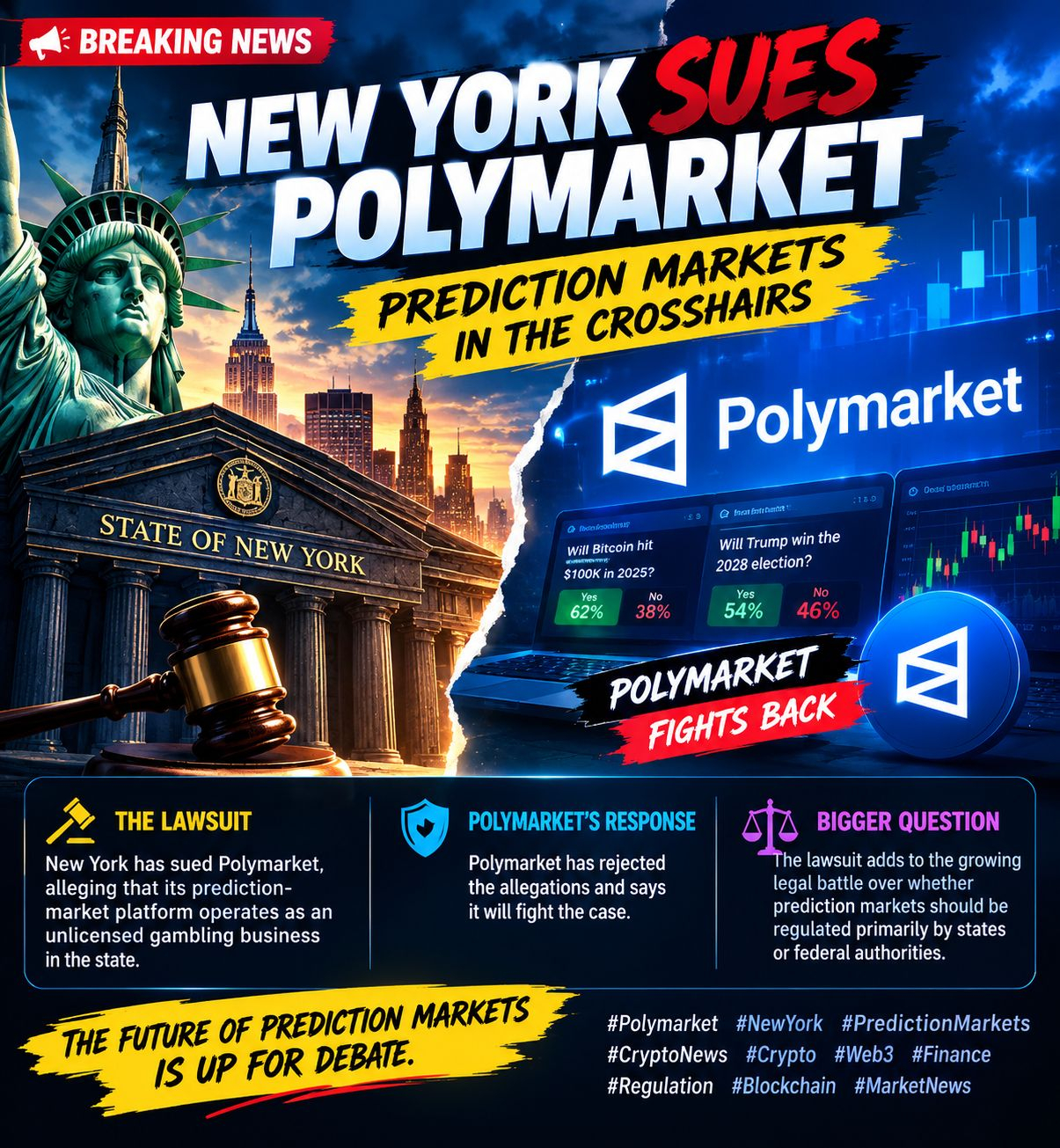
#NYAndPolymarketSueEachOther New York has sued Polymarket, alleging that its prediction-market platform operates as an unlicensed gambling business in the state. Polymarket has rejected the allegations and says it will fight the case.
The lawsuit adds to the growing legal battle over whether prediction markets should be regulated primarily by states or federal authorities.
#Polymarket #NewYork #PredictionMarkets #CryptoNews #Crypto #Web3 #Finance #Regulation #Blockchain #MarketNews
#NYAndPolymarketSueEachOther New York has sued Polymarket, alleging that its prediction-market platform operates as an unlicensed gambling business in the state. Polymarket has rejected the allegations and says it will fight the case.
The lawsuit adds to the growing legal battle over whether prediction markets should be regulated primarily by states or federal authorities.
#Polymarket #NewYork #PredictionMarkets #CryptoNews #Crypto #Web3 #Finance #Regulation #Blockchain #MarketNews
The lawsuit adds to the growing legal battle over whether prediction markets should be regulated primarily by states or federal authorities.
#Polymarket #NewYork #PredictionMarkets #CryptoNews #Crypto #Web3 #Finance #Regulation #Blockchain #MarketNews
1
57

#nyandpolymarketsueeachother
🚨 Urgent: A final legal battle has just been launched 🚨
New York and Polymarket are suing each other—literally. Yes, I read that correctly. Both of them. On the exact same day. 🤯 #nyandpolymarketsueeachother
Here’s a quick rundown of what happened (TL;DR):
🏛️ New York makes a move: New York Attorney General Letitia James filed a lawsuit against Polymarket, calling it an “unlicensed betting operation.”
🛡️ Polymarket hits back with a Uno Reverse: Hours later, Polymarket filed a lawsuit against New York in federal court in Manhattan. What’s their argument? Prediction markets fall exclusively under the jurisdiction of the federal CFTC—meaning state-level regulators have overstepped their authority.
Why this matters a LOT for Web3:
Prediction platforms exploded in 2024 and seemed incredibly accurate during elections. Now we’re watching a historic boundary war: state betting laws vs. federal commodities regulation.
If Polymarket wins, it sets a massive precedent that could allow decentralized prediction markets to operate freely across the country. If New York wins, get ready for a chaotic crackdown at the state level one after another, with strict geo-based restrictions.
Is trading on real-world events “gambling” or “financial predictions”? Drop your take in the comments! Let’s discuss. 🗣️
$POL
$UMA
$QNT
Please follow up
#CryptoNews #Polymarket
#BinanceSquare
#nyandpolymarketsueeachother
🚨 Urgent: A final legal battle has just been launched 🚨
New York and Polymarket are suing each other—literally. Yes, I read that correctly. Both of them. On the exact same day. 🤯 #nyandpolymarketsueeachother
Here’s a quick rundown of what happened (TL;DR):
🏛️ New York makes a move: New York Attorney General Letitia James filed a lawsuit against Polymarket, calling it an “unlicensed betting operation.”
🛡️ Polymarket hits back with a Uno Reverse: Hours later, Polymarket filed a lawsuit against New York in federal court in Manhattan. What’s their argument? Prediction markets fall exclusively under the jurisdiction of the federal CFTC—meaning state-level regulators have overstepped their authority.
Why this matters a LOT for Web3:
Prediction platforms exploded in 2024 and seemed incredibly accurate during elections. Now we’re watching a historic boundary war: state betting laws vs. federal commodities regulation.
If Polymarket wins, it sets a massive precedent that could allow decentralized prediction markets to operate freely across the country. If New York wins, get ready for a chaotic crackdown at the state level one after another, with strict geo-based restrictions.
Is trading on real-world events “gambling” or “financial predictions”? Drop your take in the comments! Let’s discuss. 🗣️
$POL
$UMA
$QNT
Please follow up
#CryptoNews #Polymarket
#BinanceSquare
🚨 Urgent: A final legal battle has just been launched 🚨
New York and Polymarket are suing each other—literally. Yes, I read that correctly. Both of them. On the exact same day. 🤯 #nyandpolymarketsueeachother
Here’s a quick rundown of what happened (TL;DR):
🏛️ New York makes a move: New York Attorney General Letitia James filed a lawsuit against Polymarket, calling it an “unlicensed betting operation.”
🛡️ Polymarket hits back with a Uno Reverse: Hours later, Polymarket filed a lawsuit against New York in federal court in Manhattan. What’s their argument? Prediction markets fall exclusively under the jurisdiction of the federal CFTC—meaning state-level regulators have overstepped their authority.
Why this matters a LOT for Web3:
Prediction platforms exploded in 2024 and seemed incredibly accurate during elections. Now we’re watching a historic boundary war: state betting laws vs. federal commodities regulation.
If Polymarket wins, it sets a massive precedent that could allow decentralized prediction markets to operate freely across the country. If New York wins, get ready for a chaotic crackdown at the state level one after another, with strict geo-based restrictions.
Is trading on real-world events “gambling” or “financial predictions”? Drop your take in the comments! Let’s discuss. 🗣️
$POL
$UMA
$QNT
Please follow up
#CryptoNews #Polymarket
#BinanceSquare
1
1.5k

#NYAndPolymarketSueEachOther
New York and Polymarket clash: who regulates event contracts?
The legal standoff around
markets is now unfolding both ways.
On September 24, New York Attorney General Letitia James sued Polymarket US in state court, accusing it of operating a gambling activity without a license. The state is seeking an injunction to end the activity, along with fines, the forfeiture of alleged illegal gains, and restitution to customers.
Polymarket hit back by filing a separate lawsuit in Manhattan federal court against state officials. The company argues that the Commodity Futures Trading Commission (CFTC) has exclusive authority over its markets and is seeking to prevent New York from applying gambling laws to the company.
Both sides are making legal arguments that will be resolved by the courts.
My view: the outcome could influence the contracts that platforms offer, where users can participate, and how consistently rules are applied from one state to another. For companies building national markets, geographic restrictions could affect both liquidity and compliance costs.
For users, a workable framework should also provide clear answers about age restrictions, dispute handling, and consumer protections. Market access and trust depend on how these safeguards actually work.
#Polymarket #PredictionMarkets
$QNT
{future}(QNTUSDT)
$XPL
{future}(XPLUSDT)
$ONDO
{future}(ONDOUSDT)
#NYAndPolymarketSueEachOther
New York and Polymarket clash: who regulates event contracts?
The legal standoff around
markets is now unfolding both ways.
On September 24, New York Attorney General Letitia James sued Polymarket US in state court, accusing it of operating a gambling activity without a license. The state is seeking an injunction to end the activity, along with fines, the forfeiture of alleged illegal gains, and restitution to customers.
Polymarket hit back by filing a separate lawsuit in Manhattan federal court against state officials. The company argues that the Commodity Futures Trading Commission (CFTC) has exclusive authority over its markets and is seeking to prevent New York from applying gambling laws to the company.
Both sides are making legal arguments that will be resolved by the courts.
My view: the outcome could influence the contracts that platforms offer, where users can participate, and how consistently rules are applied from one state to another. For companies building national markets, geographic restrictions could affect both liquidity and compliance costs.
For users, a workable framework should also provide clear answers about age restrictions, dispute handling, and consumer protections. Market access and trust depend on how these safeguards actually work.
#Polymarket #PredictionMarkets
$QNT
$XPL
$ONDO
New York and Polymarket clash: who regulates event contracts?
The legal standoff around
markets is now unfolding both ways.
On September 24, New York Attorney General Letitia James sued Polymarket US in state court, accusing it of operating a gambling activity without a license. The state is seeking an injunction to end the activity, along with fines, the forfeiture of alleged illegal gains, and restitution to customers.
Polymarket hit back by filing a separate lawsuit in Manhattan federal court against state officials. The company argues that the Commodity Futures Trading Commission (CFTC) has exclusive authority over its markets and is seeking to prevent New York from applying gambling laws to the company.
Both sides are making legal arguments that will be resolved by the courts.
My view: the outcome could influence the contracts that platforms offer, where users can participate, and how consistently rules are applied from one state to another. For companies building national markets, geographic restrictions could affect both liquidity and compliance costs.
For users, a workable framework should also provide clear answers about age restrictions, dispute handling, and consumer protections. Market access and trust depend on how these safeguards actually work.
#Polymarket #PredictionMarkets
$QNT
$XPL
$ONDO
80

·
--
New York sues Polymarket, and Polymarket countersues New York for abusing law enforcement powers. I believe New York’s move is intended to suppress decentralized finance, but it lacks a legal basis. Polymarket’s transparency and compliance are evident to all and should be supported. #NYAndPolymarketSueEachOther
New York sues Polymarket, and Polymarket countersues New York for abusing law enforcement powers. I believe New York’s move is intended to suppress decentralized finance, but it lacks a legal basis. Polymarket’s transparency and compliance are evident to all and should be supported. #NYAndPolymarketSueEachOther
21

Everyone thinks prediction markets are safe havens away from standard crypto volatility, but actually, legal friction can freeze your capital faster than any market crash.
Watching your liquidity get trapped in open contracts while regulatory battles play out is a silent portfolio killer that catching an early trend simply cannot fix.
Think of decentralized prediction platforms like betting on a sports match inside an arena that suddenly gets locked by local authorities. Even if your prediction on $OP or Layer-2 scaling trends is completely right, the gatekeepers outside can still cut off the exits. When state regulators and platforms clash, it is rarely the protocol tech that breaks first, it is the off-ramps and user access points that get jammed.
With legal pressure mounting around jurisdiction boundaries, smart traders need to treat contract risk just like smart contract exploits. If you are locking up $USDT in high-profile speculative outcomes, always calculate whether the potential payout outweighs the risk of drawn-out dispute delays. Keeping your operational stack agile across chains like $SUI matters far more than just picking winning odds.
How are you adjusting your exposure to prediction markets with regulatory scrutiny heating up?
#NYAndPolymarketSueEachOther #CFTCUpdatesGuidanceOnTokenizedAssets
Everyone thinks prediction markets are safe havens away from standard crypto volatility, but actually, legal friction can freeze your capital faster than any market crash.
Watching your liquidity get trapped in open contracts while regulatory battles play out is a silent portfolio killer that catching an early trend simply cannot fix.
Think of decentralized prediction platforms like betting on a sports match inside an arena that suddenly gets locked by local authorities. Even if your prediction on $OP or Layer-2 scaling trends is completely right, the gatekeepers outside can still cut off the exits. When state regulators and platforms clash, it is rarely the protocol tech that breaks first, it is the off-ramps and user access points that get jammed.
With legal pressure mounting around jurisdiction boundaries, smart traders need to treat contract risk just like smart contract exploits. If you are locking up $USDT in high-profile speculative outcomes, always calculate whether the potential payout outweighs the risk of drawn-out dispute delays. Keeping your operational stack agile across chains like $SUI matters far more than just picking winning odds.
How are you adjusting your exposure to prediction markets with regulatory scrutiny heating up?
#NYAndPolymarketSueEachOther #CFTCUpdatesGuidanceOnTokenizedAssets
Watching your liquidity get trapped in open contracts while regulatory battles play out is a silent portfolio killer that catching an early trend simply cannot fix.
Think of decentralized prediction platforms like betting on a sports match inside an arena that suddenly gets locked by local authorities. Even if your prediction on $OP or Layer-2 scaling trends is completely right, the gatekeepers outside can still cut off the exits. When state regulators and platforms clash, it is rarely the protocol tech that breaks first, it is the off-ramps and user access points that get jammed.
With legal pressure mounting around jurisdiction boundaries, smart traders need to treat contract risk just like smart contract exploits. If you are locking up $USDT in high-profile speculative outcomes, always calculate whether the potential payout outweighs the risk of drawn-out dispute delays. Keeping your operational stack agile across chains like $SUI matters far more than just picking winning odds.
How are you adjusting your exposure to prediction markets with regulatory scrutiny heating up?
#NYAndPolymarketSueEachOther #CFTCUpdatesGuidanceOnTokenizedAssets
36

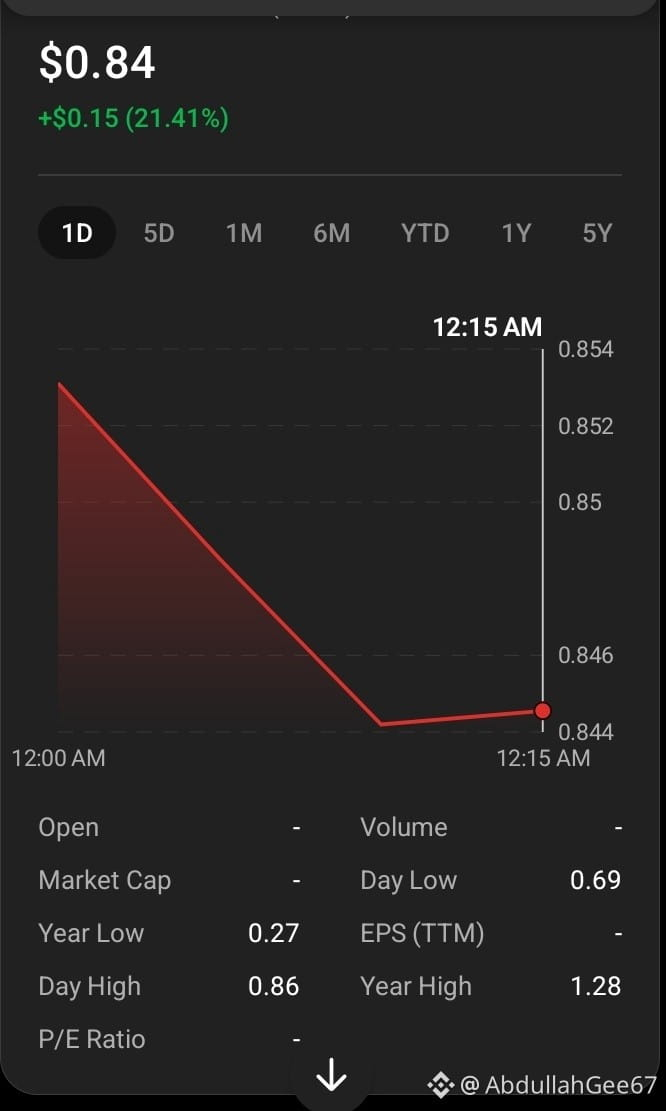
🚀 $AERO LATEST ANALYSIS
💰 Price: ~$0.807
🟢 Support: $0.684
🔴 Resistance: $0.81–$0.86
AERO is showing strong short-term momentum, up about 23% over the past 7 days. Holding above $0.684 keeps the recent structure stronger; a move above $0.86 would be a notable resistance breakout to watch. �
mexc.com +1
📊 Watch the key levels & DYOR ⚠️#QNTRises39% #BitgetBreachForgedRequestsNotStolenKeys #BitcoinSpotETFsTurnNetPositiveYTD #CFTCUpdatesGuidanceOnTokenizedAssets #NYAndPolymarketSueEachOther
{spot}(AEROUSDT)
$NVDAB $AAPLB
🚀 $AERO LATEST ANALYSIS
💰 Price: ~$0.807
🟢 Support: $0.684
🔴 Resistance: $0.81–$0.86
AERO is showing strong short-term momentum, up about 23% over the past 7 days. Holding above $0.684 keeps the recent structure stronger; a move above $0.86 would be a notable resistance breakout to watch. �
mexc.com +1
📊 Watch the key levels & DYOR ⚠️#QNTRises39% #BitgetBreachForgedRequestsNotStolenKeys #BitcoinSpotETFsTurnNetPositiveYTD #CFTCUpdatesGuidanceOnTokenizedAssets #NYAndPolymarketSueEachOther
$NVDAB $AAPLB
💰 Price: ~$0.807
🟢 Support: $0.684
🔴 Resistance: $0.81–$0.86
AERO is showing strong short-term momentum, up about 23% over the past 7 days. Holding above $0.684 keeps the recent structure stronger; a move above $0.86 would be a notable resistance breakout to watch. �
mexc.com +1
📊 Watch the key levels & DYOR ⚠️#QNTRises39% #BitgetBreachForgedRequestsNotStolenKeys #BitcoinSpotETFsTurnNetPositiveYTD #CFTCUpdatesGuidanceOnTokenizedAssets #NYAndPolymarketSueEachOther
$NVDAB $AAPLB
100
$HYPE
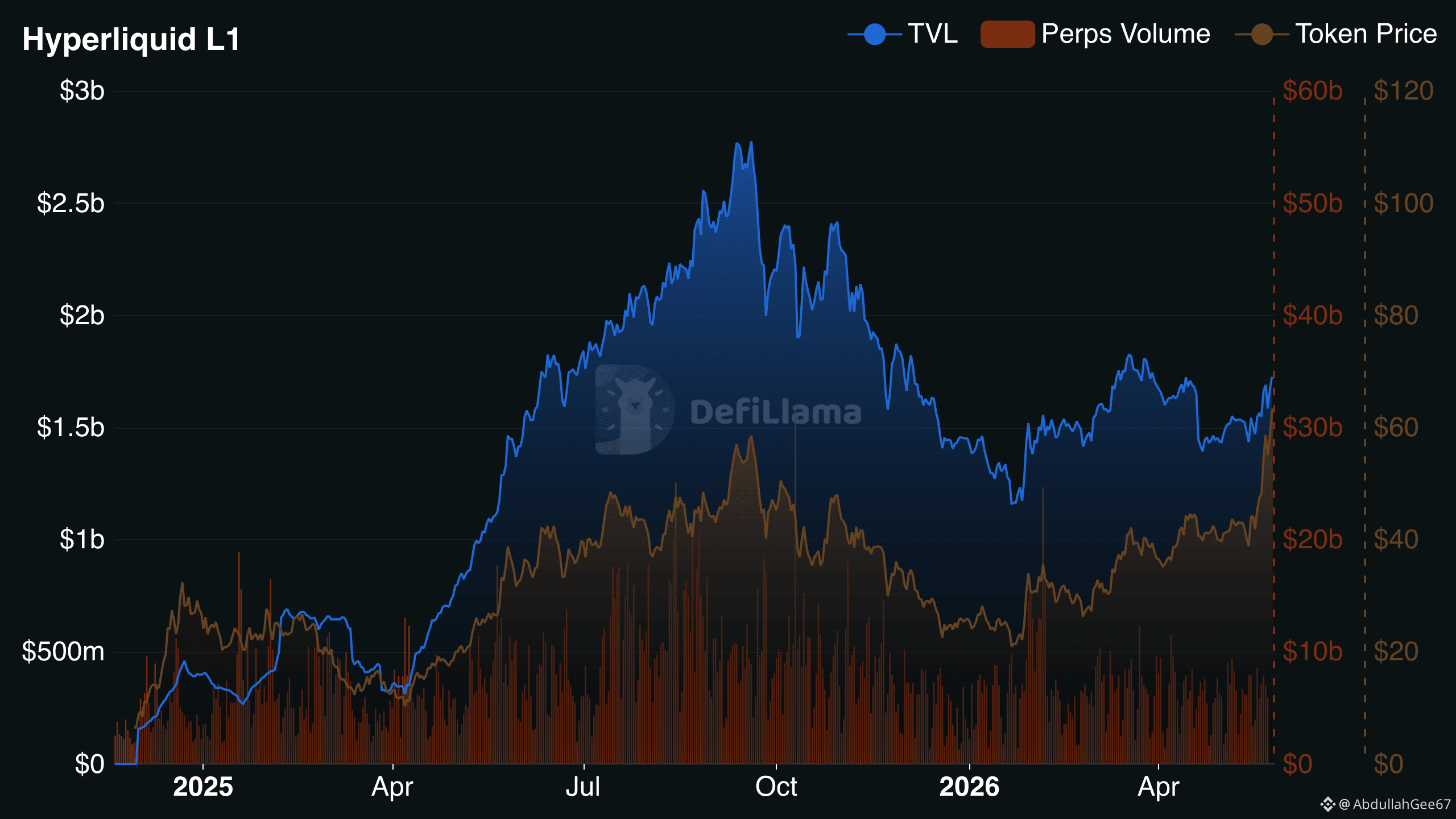
The native token of decentralized perpetual exchange leader Hyperliquid ($HYPE) is trading at approximately $90.45, following a monumental week highlighted by its official Binance Spot listing. The asset surged to an all-time high of $97.99 on September 22, 2026, fueled by the deployment of its highly anticipated native borrowing feature allowing users to leverage $HYPE for stablecoin loans. Institutional support remains heavily robust, with major venture funds like Hyperliquid Strategies expanding their treasury positions by acquiring millions of tokens directly from the market. Technicians note that the 14-day RSI has stabilized near 60.6, presenting a strong bullish consolidation framework just underneath its resistance caps, though traders are keeping a close eye on a 9.92 million token unlock scheduled for early October.$
{spot}(HYPEUSDT)
#QNTRises39% #BitgetBreachForgedRequestsNotStolenKeys #BitcoinSpotETFsTurnNetPositiveYTD #CFTCUpdatesGuidanceOnTokenizedAssets #NYAndPolymarketSueEachOther $NVDAB
$HYPE
The native token of decentralized perpetual exchange leader Hyperliquid ($HYPE ) is trading at approximately $90.45, following a monumental week highlighted by its official Binance Spot listing. The asset surged to an all-time high of $97.99 on September 22, 2026, fueled by the deployment of its highly anticipated native borrowing feature allowing users to leverage $HYPE for stablecoin loans. Institutional support remains heavily robust, with major venture funds like Hyperliquid Strategies expanding their treasury positions by acquiring millions of tokens directly from the market. Technicians note that the 14-day RSI has stabilized near 60.6, presenting a strong bullish consolidation framework just underneath its resistance caps, though traders are keeping a close eye on a 9.92 million token unlock scheduled for early October.$
#QNTRises39% #BitgetBreachForgedRequestsNotStolenKeys #BitcoinSpotETFsTurnNetPositiveYTD #CFTCUpdatesGuidanceOnTokenizedAssets #NYAndPolymarketSueEachOther $NVDAB
The native token of decentralized perpetual exchange leader Hyperliquid ($HYPE ) is trading at approximately $90.45, following a monumental week highlighted by its official Binance Spot listing. The asset surged to an all-time high of $97.99 on September 22, 2026, fueled by the deployment of its highly anticipated native borrowing feature allowing users to leverage $HYPE for stablecoin loans. Institutional support remains heavily robust, with major venture funds like Hyperliquid Strategies expanding their treasury positions by acquiring millions of tokens directly from the market. Technicians note that the 14-day RSI has stabilized near 60.6, presenting a strong bullish consolidation framework just underneath its resistance caps, though traders are keeping a close eye on a 9.92 million token unlock scheduled for early October.$
#QNTRises39% #BitgetBreachForgedRequestsNotStolenKeys #BitcoinSpotETFsTurnNetPositiveYTD #CFTCUpdatesGuidanceOnTokenizedAssets #NYAndPolymarketSueEachOther $NVDAB
116

·
--
$HYPE @ $91.00 — SHORT SIGNAL
Bears are stepping in, and the key level is under pressure. If $91.8 continues to hold as resistance, downside momentum could accelerate.
🔻 Entry: $90.8–$91.2
🎯 TP1: $89.8
🎯 TP2: $88.5
🎯 TP3: $87.2
🛑 SL: $92.3
📉 BEARISH BELOW $91.8
🔥 Watch this level closely — the next move could come fast.
$HYPE #HYPE #Crypto #NYAndPolymarketSueEachOther
{spot}(HYPEUSDT)
$HYPE @ $91.00 — SHORT SIGNAL
Bears are stepping in, and the key level is under pressure. If $91.8 continues to hold as resistance, downside momentum could accelerate.
🔻 Entry: $90.8–$91.2
🎯 TP1: $89.8
🎯 TP2: $88.5
🎯 TP3: $87.2
🛑 SL: $92.3
📉 BEARISH BELOW $91.8
🔥 Watch this level closely — the next move could come fast.
$HYPE #HYPE #Crypto #NYAndPolymarketSueEachOther
Bears are stepping in, and the key level is under pressure. If $91.8 continues to hold as resistance, downside momentum could accelerate.
🔻 Entry: $90.8–$91.2
🎯 TP1: $89.8
🎯 TP2: $88.5
🎯 TP3: $87.2
🛑 SL: $92.3
📉 BEARISH BELOW $91.8
🔥 Watch this level closely — the next move could come fast.
$HYPE #HYPE #Crypto #NYAndPolymarketSueEachOther
145



Article
XRP Coin: A Practical Overview of Its Purpose, Technology, and Risks
XR$XRP P is a digital asset designed to make transferring value across borders faster and more efficient. It is associated with the XRP Ledger, a blockchain network built for payments, currency exchange, and settlement between financial institutions or individuals.
Unlike many cryptocurrencies that rely on mining, X$XRP RP transactions are validated through a consensus mechanism. This approach is intended to keep transaction costs low and settlement times short. Transactions on the XRP Ledger can typically be completed within seconds, making the network relevant to discussions around cross-border payments.
What Is XRP Used For?
XRP can serve as a bridge asset when two parties want to exchange different currencies. For example, instead of moving funds through several banking intermediaries, a payment could potentially be converted into XRP, transferred quickly, and then converted into the receiving currency.
The XRP Ledger also supports token issuance and decentralized exchange features. This means developers and businesses can build payment-related applications or create digital representations of assets on the network.
XRP vs. the XRP Ledger
It is important to separate XRP, the asset, from the XRP Ledger, the network.
XRP is the cryptocurrency used for transaction fees, transfers, and liquidity.
XRP Ledger is the underlying blockchain infrastructure that records transactions and supports other applications.
Ripple, a fintech company, is often discussed alongside XRP because it has developed products for payment providers and has contributed to parts of the XRP ecosystem. However, Ripple and XRP are not the same thing.
Potential Strengths
XRP’s main appeal is its focus on payment efficiency. Supporters often highlight:
Fast transaction settlement
Low network fees
High throughput compared with many older blockchain networks
A clear use case in cross-border transfers and liquidity management
These features may make XRP useful where speed and cost are important, especially for international transfers.
Key Risks to Consider
Like all cryptocurrencies, XRP carries significant risk. Its price can move sharply in short periods, influenced by broader crypto-market conditions, regulation, adoption news, liquidity, and investor sentiment.
There is also concentration risk: XRP’s relationship with Ripple and the attention surrounding regulatory developments can strongly affect public perception. In addition, real-world adoption by institutions may develop differently from expectations.
Conclusion
XRP is a cryptocurrency built around a payments-focused blockchain network. Its fast settlement and low-cost design distinguish it from many other digital assets, but those advantages do not remove the risks of volatility, regulation, and changing market demand.
Anyone researching XR$XRP P should look beyond price movements and consider its technology, ecosystem activity, real-world use cases, token supply dynamics, and personal risk tolerance. Cryptocurrency markets remain highly uncertain, and past performance does not guarantee future results.#BitgetSays$352MAffectedInHack #NYAndPolymarketSueEachOther
{spot}(XRPUSDT)
XR$XRP P is a digital asset designed to make transferring value across borders faster and more efficient. It is associated with the XRP Ledger, a blockchain network built for payments, currency exchange, and settlement between financial institutions or individuals.
Unlike many cryptocurrencies that rely on mining, X$XRP RP transactions are validated through a consensus mechanism. This approach is intended to keep transaction costs low and settlement times short. Transactions on the XRP Ledger can typically be completed within seconds, making the network relevant to discussions around cross-border payments.
What Is XRP Used For?
XRP can serve as a bridge asset when two parties want to exchange different currencies. For example, instead of moving funds through several banking intermediaries, a payment could potentially be converted into XRP, transferred quickly, and then converted into the receiving currency.
The XRP Ledger also supports token issuance and decentralized exchange features. This means developers and businesses can build payment-related applications or create digital representations of assets on the network.
XRP vs. the XRP Ledger
It is important to separate XRP, the asset, from the XRP Ledger, the network.
XRP is the cryptocurrency used for transaction fees, transfers, and liquidity.
XRP Ledger is the underlying blockchain infrastructure that records transactions and supports other applications.
Ripple, a fintech company, is often discussed alongside XRP because it has developed products for payment providers and has contributed to parts of the XRP ecosystem. However, Ripple and XRP are not the same thing.
Potential Strengths
XRP’s main appeal is its focus on payment efficiency. Supporters often highlight:
Fast transaction settlement
Low network fees
High throughput compared with many older blockchain networks
A clear use case in cross-border transfers and liquidity management
These features may make XRP useful where speed and cost are important, especially for international transfers.
Key Risks to Consider
Like all cryptocurrencies, XRP carries significant risk. Its price can move sharply in short periods, influenced by broader crypto-market conditions, regulation, adoption news, liquidity, and investor sentiment.
There is also concentration risk: XRP’s relationship with Ripple and the attention surrounding regulatory developments can strongly affect public perception. In addition, real-world adoption by institutions may develop differently from expectations.
Conclusion
XRP is a cryptocurrency built around a payments-focused blockchain network. Its fast settlement and low-cost design distinguish it from many other digital assets, but those advantages do not remove the risks of volatility, regulation, and changing market demand.
Anyone researching XR$XRP P should look beyond price movements and consider its technology, ecosystem activity, real-world use cases, token supply dynamics, and personal risk tolerance. Cryptocurrency markets remain highly uncertain, and past performance does not guarantee future results.#BitgetSays$352MAffectedInHack #NYAndPolymarketSueEachOther
XRP Coin: A Practical Overview of Its Purpose, Technology, and Risks
XR$XRP P is a digital asset designed to make transferring value across borders faster and more efficient. It is associated with the XRP Ledger, a blockchain network built for payments, currency exchange, and settlement between financial institutions or individuals.
Unlike many cryptocurrencies that rely on mining, X$XRP RP transactions are validated through a consensus mechanism. This approach is intended to keep transaction costs low and settlement times short. Transactions on the XRP Ledger can typically be completed within seconds, making the network relevant to discussions around cross-border payments.
What Is XRP Used For?
XRP can serve as a bridge asset when two parties want to exchange different currencies. For example, instead of moving funds through several banking intermediaries, a payment could potentially be converted into XRP, transferred quickly, and then converted into the receiving currency.
The XRP Ledger also supports token issuance and decentralized exchange features. This means developers and businesses can build payment-related applications or create digital representations of assets on the network.
XRP vs. the XRP Ledger
It is important to separate XRP, the asset, from the XRP Ledger, the network.
XRP is the cryptocurrency used for transaction fees, transfers, and liquidity.
XRP Ledger is the underlying blockchain infrastructure that records transactions and supports other applications.
Ripple, a fintech company, is often discussed alongside XRP because it has developed products for payment providers and has contributed to parts of the XRP ecosystem. However, Ripple and XRP are not the same thing.
Potential Strengths
XRP’s main appeal is its focus on payment efficiency. Supporters often highlight:
Fast transaction settlement
Low network fees
High throughput compared with many older blockchain networks
A clear use case in cross-border transfers and liquidity management
These features may make XRP useful where speed and cost are important, especially for international transfers.
Key Risks to Consider
Like all cryptocurrencies, XRP carries significant risk. Its price can move sharply in short periods, influenced by broader crypto-market conditions, regulation, adoption news, liquidity, and investor sentiment.
There is also concentration risk: XRP’s relationship with Ripple and the attention surrounding regulatory developments can strongly affect public perception. In addition, real-world adoption by institutions may develop differently from expectations.
Conclusion
XRP is a cryptocurrency built around a payments-focused blockchain network. Its fast settlement and low-cost design distinguish it from many other digital assets, but those advantages do not remove the risks of volatility, regulation, and changing market demand.
Anyone researching XR$XRP P should look beyond price movements and consider its technology, ecosystem activity, real-world use cases, token supply dynamics, and personal risk tolerance. Cryptocurrency markets remain highly uncertain, and past performance does not guarantee future results.#BitgetSays$352MAffectedInHack #NYAndPolymarketSueEachOther
1
145

·
--
Bullish
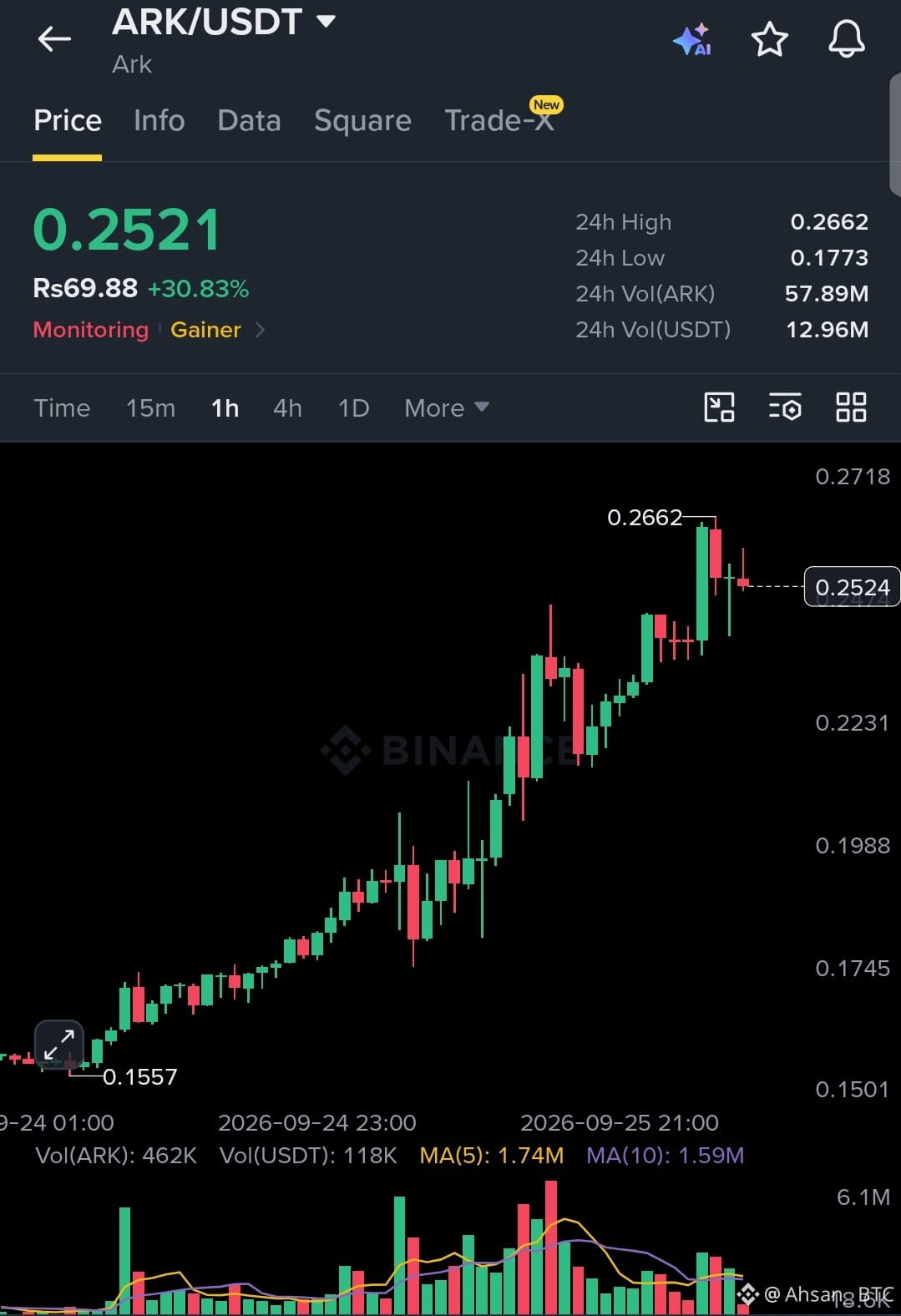
$ARK /USDT — Steady Uptrend, Bulls in Control! 📈🟢
Current Price: ~$0.2521 (+30.83% 24h) 💚
Overview: Ark ($ARK) is a veteran blockchain project focused on interoperability and enterprise solutions. It's currently tagged as a "Monitoring" gainer, showing strong revival momentum. 🏗️
Technical Setup (1H):
📈 Textbook staircase uptrend from $0.1557 to $0.2662.
🐂 Healthy pullback, now consolidating near $0.2521.
📊 MA5 (1.74M) > MA10 (1.59M) = bullish trend firmly intact. 💪
📉 Volume easing off during consolidation = healthy cooling, not a dump.
Key Levels:
🔴 Resistance: $0.2662 → $0.2718
🟢 Support: $0.2231 → $0.1988 (major structure)
Trade Plan (Trend Continuation):
✅ Entry: $0.2450 – $0.2520 (current consolidation zone)
🎯 TP1: $0.2662
🎯 TP2: $0.2800
🎯 TP3: $0.2950
🛑 SL: $0.2200
⚖️ R:R ~ 1:2.5
Outlook:
⚡ Short-term: Holding above $0.24 keeps bulls in play. A clean break above $0.266 targets $0.28+.
🔭 Long-term: Needs to hold the $0.20 structural support to maintain a macro bullish reversal.
Sentiment: $12.96M turnover shows decent interest, but this is still a mid/low-cap mover. Watch for follow-through volume on the next leg up. 🐋
⚠️ Not financial advice. DYOR. Always manage your risk and use stop losses!
Riding the $ARK train? Drop a 🏛️ below!
$ARK
{spot}(ARKUSDT)
#ARK
#NYAndPolymarketSueEachOther #BinanceWillListHyperliquid(HYPE)
$ARK /USDT — Steady Uptrend, Bulls in Control! 📈🟢
Current Price: ~$0.2521 (+30.83% 24h) 💚
Overview: Ark ($ARK ) is a veteran blockchain project focused on interoperability and enterprise solutions. It's currently tagged as a "Monitoring" gainer, showing strong revival momentum. 🏗️
Technical Setup (1H):
📈 Textbook staircase uptrend from $0.1557 to $0.2662.
🐂 Healthy pullback, now consolidating near $0.2521.
📊 MA5 (1.74M) > MA10 (1.59M) = bullish trend firmly intact. 💪
📉 Volume easing off during consolidation = healthy cooling, not a dump.
Key Levels:
🔴 Resistance: $0.2662 → $0.2718
🟢 Support: $0.2231 → $0.1988 (major structure)
Trade Plan (Trend Continuation):
✅ Entry: $0.2450 – $0.2520 (current consolidation zone)
🎯 TP1: $0.2662
🎯 TP2: $0.2800
🎯 TP3: $0.2950
🛑 SL: $0.2200
⚖️ R:R ~ 1:2.5
Outlook:
⚡ Short-term: Holding above $0.24 keeps bulls in play. A clean break above $0.266 targets $0.28+.
🔭 Long-term: Needs to hold the $0.20 structural support to maintain a macro bullish reversal.
Sentiment: $12.96M turnover shows decent interest, but this is still a mid/low-cap mover. Watch for follow-through volume on the next leg up. 🐋
⚠️ Not financial advice. DYOR. Always manage your risk and use stop losses!
Riding the $ARK train? Drop a 🏛️ below!
$ARK
#ARK
#NYAndPolymarketSueEachOther #BinanceWillListHyperliquid(HYPE)
Current Price: ~$0.2521 (+30.83% 24h) 💚
Overview: Ark ($ARK ) is a veteran blockchain project focused on interoperability and enterprise solutions. It's currently tagged as a "Monitoring" gainer, showing strong revival momentum. 🏗️
Technical Setup (1H):
📈 Textbook staircase uptrend from $0.1557 to $0.2662.
🐂 Healthy pullback, now consolidating near $0.2521.
📊 MA5 (1.74M) > MA10 (1.59M) = bullish trend firmly intact. 💪
📉 Volume easing off during consolidation = healthy cooling, not a dump.
Key Levels:
🔴 Resistance: $0.2662 → $0.2718
🟢 Support: $0.2231 → $0.1988 (major structure)
Trade Plan (Trend Continuation):
✅ Entry: $0.2450 – $0.2520 (current consolidation zone)
🎯 TP1: $0.2662
🎯 TP2: $0.2800
🎯 TP3: $0.2950
🛑 SL: $0.2200
⚖️ R:R ~ 1:2.5
Outlook:
⚡ Short-term: Holding above $0.24 keeps bulls in play. A clean break above $0.266 targets $0.28+.
🔭 Long-term: Needs to hold the $0.20 structural support to maintain a macro bullish reversal.
Sentiment: $12.96M turnover shows decent interest, but this is still a mid/low-cap mover. Watch for follow-through volume on the next leg up. 🐋
⚠️ Not financial advice. DYOR. Always manage your risk and use stop losses!
Riding the $ARK train? Drop a 🏛️ below!
$ARK
#ARK
#NYAndPolymarketSueEachOther #BinanceWillListHyperliquid(HYPE)
174

Crypto shrugs off $351M Bitget hack - Altcoins rallying +9% - market is super strong!#QNTRises39% #BitgetBreachForgedRequestsNotStolenKeys #BitcoinSpotETFsTurnNetPositiveYTD #BinanceWillListHyperliquid(HYPE) #NYAndPolymarketSueEachOther
Crypto shrugs off $351M Bitget hack - Altcoins rallying +9% - market is super strong!#QNTRises39% #BitgetBreachForgedRequestsNotStolenKeys #BitcoinSpotETFsTurnNetPositiveYTD #BinanceWillListHyperliquid(HYPE) #NYAndPolymarketSueEachOther
83
Log in to explore more content
Join global crypto users on Binance Square
⚡️ Get latest and useful information about crypto.
💬 Trusted by the world’s largest crypto exchange.
👍 Discover real insights from verified creators.
Email / Phone number
Trending Topics
1
#BitcoinClears$85200
13,691 views
220 Discussing
2
#AltcoinSeasonIndexHoldsAbove60For5Days
67,686 views
1,220 Discussing
3
#USADPAdds90000JobsInSeptember
31,181 views
684 Discussing
4
#USCorePCEEasesTo3%InAugust
21,853 views
511 Discussing
5
#KospiPostsWorstQuarterSince2020
15,238 views
489 Discussing
6
#SECToClarifyOnChainFundraisingRules
38,147 views
665 Discussing
7
#UKFCAOpensCryptoFirmAuthorization
37,376 views
561 Discussing
8
#JapanMOFStudyGroupOnTokenizedGovtBonds
21,873 views
424 Discussing
9
#QNTRises287%
105,509 views
924 Discussing
10
#TrumpRejectsAIRulesForVoluntaryAudits
60,569 views
801 Discussing