

#kitebbw
kitebbw
228,718 views
1,056 Discussing
Hot
Latest

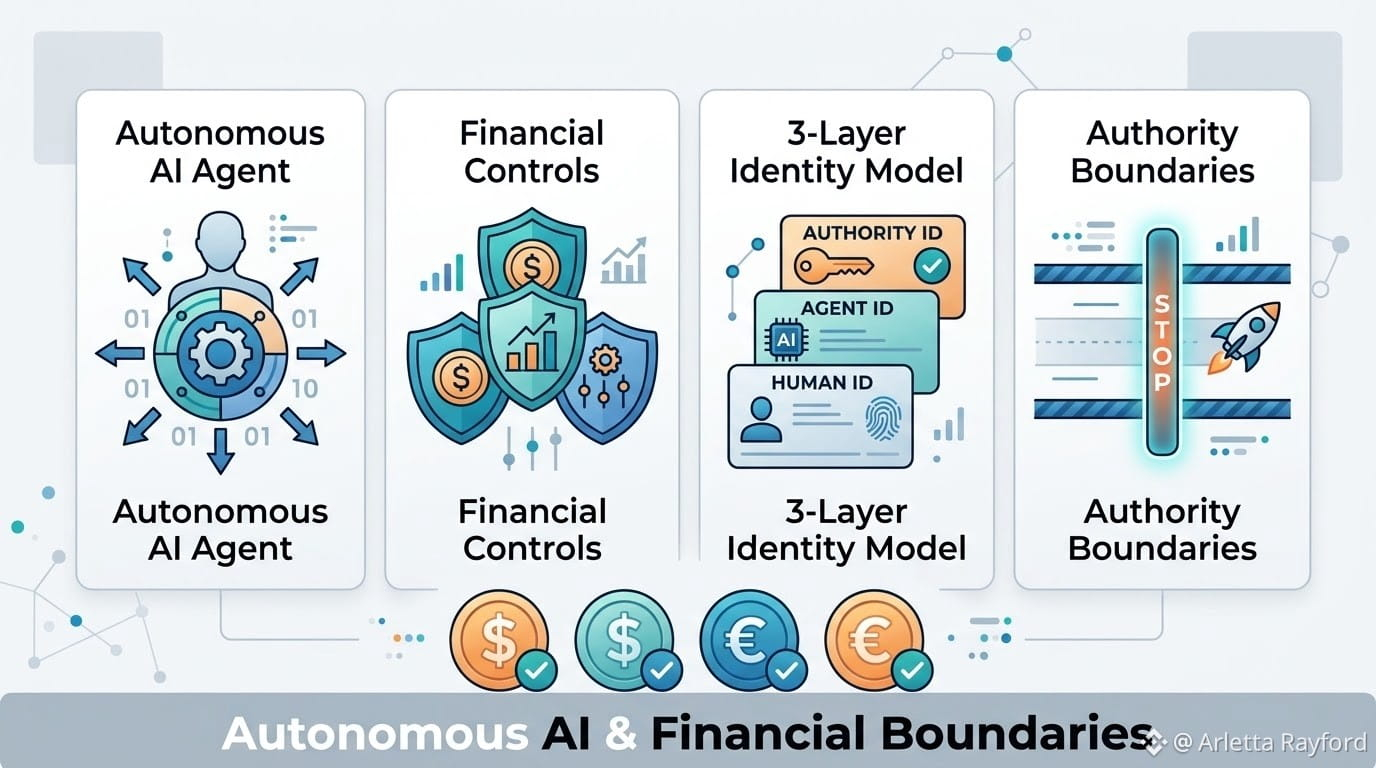
One thing I found interesting while researching Kite is that giving AI agents more intelligence might not be enough to make them truly autonomous.
Imagine an AI agent managing research, purchasing data, and paying for different services on its own. The real challenge isn't just making decisions. It's making sure the agent can spend money without exceeding the authority it was given.
This is where Kite's approach caught my attention.
Its three-layer identity model separates the user, the agent, and individual sessions. In simple terms, an agent doesn't need unlimited access to its owner's funds just because it has permission to perform a task. Its authority can be delegated with specific boundaries, while smart contracts enforce the rules.
The payment side matters too. Through stablecoin-based transactions and compatibility with x402, Kite is designed to support machine-to-machine payments where agents can pay for services as they use them.
I think this addresses an important gap in the AI ecosystem. We often talk about agents replacing manual workflows, but we rarely discuss the financial controls needed to let them operate independently.
The real test will be how reliably these safeguards work in production, especially when agents interact with multiple services or make mistakes.
Autonomous AI needs more than the ability to act. It needs a secure way to decide how far those actions can go.
#KiteBBW @GoKiteAI $KITE
{future}(KITEUSDT)
One thing I found interesting while researching Kite is that giving AI agents more intelligence might not be enough to make them truly autonomous.
Imagine an AI agent managing research, purchasing data, and paying for different services on its own. The real challenge isn't just making decisions. It's making sure the agent can spend money without exceeding the authority it was given.
This is where Kite's approach caught my attention.
Its three-layer identity model separates the user, the agent, and individual sessions. In simple terms, an agent doesn't need unlimited access to its owner's funds just because it has permission to perform a task. Its authority can be delegated with specific boundaries, while smart contracts enforce the rules.
The payment side matters too. Through stablecoin-based transactions and compatibility with x402, Kite is designed to support machine-to-machine payments where agents can pay for services as they use them.
I think this addresses an important gap in the AI ecosystem. We often talk about agents replacing manual workflows, but we rarely discuss the financial controls needed to let them operate independently.
The real test will be how reliably these safeguards work in production, especially when agents interact with multiple services or make mistakes.
Autonomous AI needs more than the ability to act. It needs a secure way to decide how far those actions can go.
#KiteBBW @KITE AI 中文 $KITE
7

·
--
Verified
Article
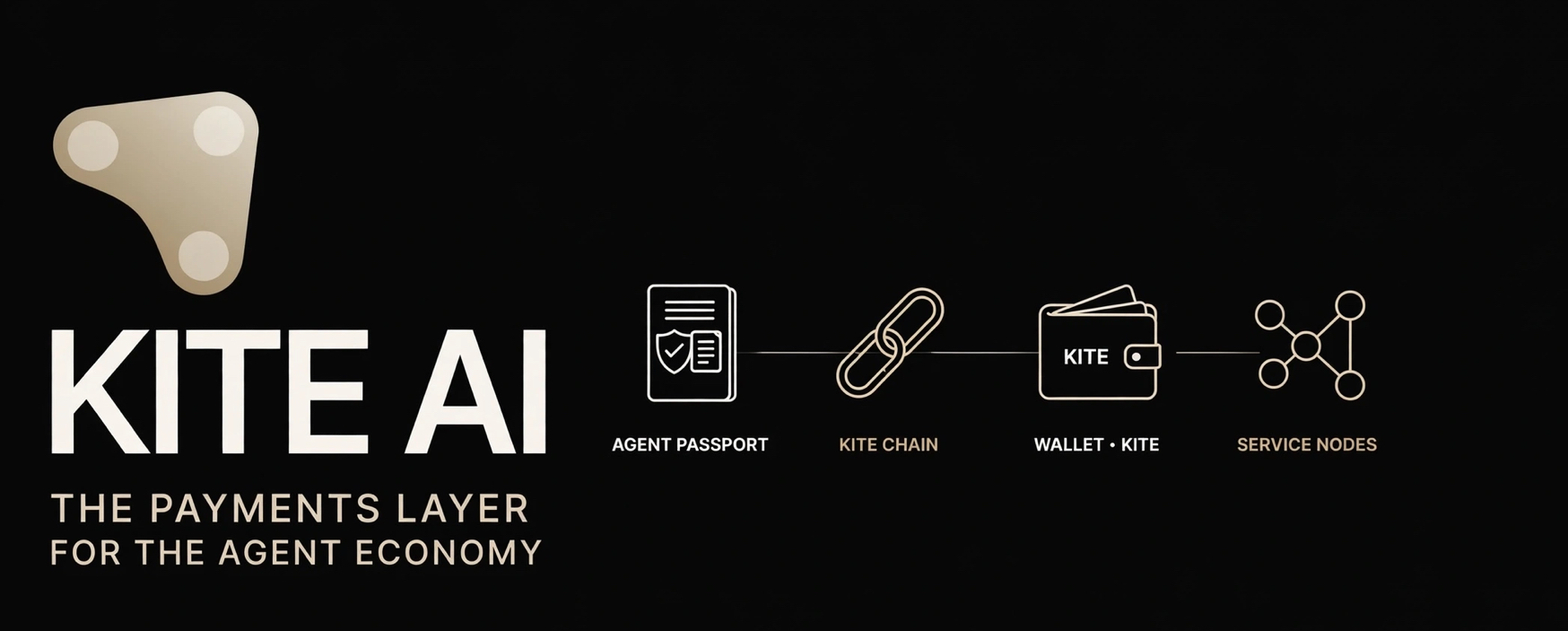
Kite AI: Infrastructure for the Agent EconomyAI is moving beyond answering questions towards carrying out tasks autonomously. But for AI agents to use services and pay one another, they need identity, permissions and transaction infrastructure.
That is where Kite comes in.
⚙️ What is Kite building?
▪️ Agent Passport: Allows users to set up wallets, budgets and spending limits for AI agents.
▪️ Kite Chain: A Layer 1 blockchain designed to support transactions within the agent economy.
▪️ Service ecosystem: Aims to connect agents with services such as paid APIs and data providers.
💡 Where does the value lie?
Imagine an AI agent that needs to purchase data to complete a market report. Instead of approving every payment manually, the user can approve a budget and set transaction limits in advance.
AI can carry out tasks autonomously, but its spending authority should remain within limits set by the user.
🔍 What should we watch?
The technology needs to prove itself through real world usage, costs, effective permission controls and incident response. The potential of the ecosystem does not automatically mean that the price of KITE will rise.
For me, the question is not just how much AI can do on its own, but how well we can keep it under control.
Would you trust an AI agent with a wallet? What is the first limit you would set?
#KiteBBW $KITE
Kite AI: Infrastructure for the Agent Economy
AI is moving beyond answering questions towards carrying out tasks autonomously. But for AI agents to use services and pay one another, they need identity, permissions and transaction infrastructure.
That is where Kite comes in.
⚙️ What is Kite building?
▪️ Agent Passport: Allows users to set up wallets, budgets and spending limits for AI agents.
▪️ Kite Chain: A Layer 1 blockchain designed to support transactions within the agent economy.
▪️ Service ecosystem: Aims to connect agents with services such as paid APIs and data providers.
💡 Where does the value lie?
Imagine an AI agent that needs to purchase data to complete a market report. Instead of approving every payment manually, the user can approve a budget and set transaction limits in advance.
AI can carry out tasks autonomously, but its spending authority should remain within limits set by the user.
🔍 What should we watch?
The technology needs to prove itself through real world usage, costs, effective permission controls and incident response. The potential of the ecosystem does not automatically mean that the price of KITE will rise.
For me, the question is not just how much AI can do on its own, but how well we can keep it under control.
Would you trust an AI agent with a wallet? What is the first limit you would set?
#KiteBBW $KITE
98

·
--

Article
Who Owns the Agent? Why the Agent Economy Splits Into Renters and OwnersMost people talk about agents as tools you use. Almost no one talks about who actually owns them.
In every previous software wave, the valuable layer eventually stopped being the interface and became the thing that could be owned, rented, and passed on. Operating systems, cloud accounts, domain names, then wallets. Agents are heading the same way. The difference is that an agent can already hold money, make decisions, and act while you sleep. That changes what “ownership” means.
@GoKiteAI is building the payment and identity rails for this. Its hierarchical identity model separates the root user, the agent, and the temporary session. The user keeps ultimate control. The agent receives a derived address and bounded permissions. Sessions expire. This structure is not just a security feature. It is the first practical way to treat an agent as something that can be delegated without giving away the keys.
Two Groups, One Market
The agent economy will not stay flat. It will split.
On one side are renters. They connect to someone else’s agent, pay for usage, and leave when the job is done. They care about reliability and price. On the other side are owners. They hold the root authority, set the rules, and can earn when others use what they control.
The gap is not technical skill. It is whether you hold the ability to revoke, reprice, or transfer access. A renter can switch agents tomorrow. An owner can keep earning from the same agent for years, as long as the constraints stay clear and the reputation holds.
Kite’s model makes this distinction concrete. Because every agent address is deterministically derived from the user’s wallet, ownership is cryptographically checkable. Anyone can verify that an agent belongs to a specific root without the root exposing its private key. That verifiable link is what turns a running agent from a temporary service into something closer to an asset.
From Personal Tool to Transferable Asset
Today most agents are personal. You set them up, give them a budget, and they work for you. Tomorrow some of those agents will be offered to others.
For that shift to happen, three things need to be true at the same time. First, the owner must be able to limit what the agent can spend and do, without re-approving every action. Second, a third party must be able to check those limits before trusting the agent with money or data. Third, the owner must be able to revoke or reassign access without breaking the agent’s history.
Kite’s programmable constraints and session keys address the first two. Spending rules are enforced on-chain rather than by trust. Sessions are ephemeral. The hierarchical derivation handles the third: the root can always cut off a derived agent without moving funds or rewriting history. Once those pieces exist, an agent stops being only a tool you run. It becomes something you can license.
A simple example: a research agent that monitors on-chain flows and posts summaries. As a personal tool it saves you time. As a transferable asset the same agent can be rented by ten other people who pay a small stablecoin fee per request. The owner sets the budget ceiling and the data sources once. The renters never touch the root key. If the owner later wants to stop offering it, they revoke the session layer. The agent itself remains under their control.
Why Identity Hierarchy Matters More Than Speed
Most discussions about agent infrastructure focus on throughput or fees. Those matter, but they are not what decides who captures value.
The layer that decides ownership is the identity and permission layer. If an agent’s authority cannot be clearly bounded and proven, no one will pay to use it, and no one will treat it as an asset. If the root can always prove control and instantly revoke, then reputation can accumulate on the agent while risk stays with the owner. That is the condition under which rental markets appear.
Kite’s three-layer design (root, agent, session) is one of the few attempts to make this explicit. It does not require every user to become a developer. It requires the infrastructure to treat delegation as a first-class action rather than an afterthought. Once that exists, the split between renters and owners becomes a normal market outcome instead of a technical accident.
What This Means for Ordinary Users
You do not need to build an agent to feel the difference. If you only ever rent, you will pay for convenience and switch when something cheaper appears. If you eventually own even one agent that others find useful, you start collecting the small fees that used to go to platforms. The size of those fees will depend on how clearly the rules are enforced and how easily outsiders can verify them.
Kite does not guarantee that every user becomes an owner. It makes ownership checkable and revocation reliable. That is the missing piece that lets an agent move from something you run privately to something you can offer, price, and withdraw from the market without losing control of the underlying account.
The agent economy will not be won by the people who use the most agents. It will be shaped by the people who can prove they own them.
#KiteBBW $KITE
{future}(KITEUSDT)
Who Owns the Agent? Why the Agent Economy Splits Into Renters and Owners
Most people talk about agents as tools you use. Almost no one talks about who actually owns them.
In every previous software wave, the valuable layer eventually stopped being the interface and became the thing that could be owned, rented, and passed on. Operating systems, cloud accounts, domain names, then wallets. Agents are heading the same way. The difference is that an agent can already hold money, make decisions, and act while you sleep. That changes what “ownership” means.
@KITE AI 中文 is building the payment and identity rails for this. Its hierarchical identity model separates the root user, the agent, and the temporary session. The user keeps ultimate control. The agent receives a derived address and bounded permissions. Sessions expire. This structure is not just a security feature. It is the first practical way to treat an agent as something that can be delegated without giving away the keys.
Two Groups, One Market
The agent economy will not stay flat. It will split.
On one side are renters. They connect to someone else’s agent, pay for usage, and leave when the job is done. They care about reliability and price. On the other side are owners. They hold the root authority, set the rules, and can earn when others use what they control.
The gap is not technical skill. It is whether you hold the ability to revoke, reprice, or transfer access. A renter can switch agents tomorrow. An owner can keep earning from the same agent for years, as long as the constraints stay clear and the reputation holds.
Kite’s model makes this distinction concrete. Because every agent address is deterministically derived from the user’s wallet, ownership is cryptographically checkable. Anyone can verify that an agent belongs to a specific root without the root exposing its private key. That verifiable link is what turns a running agent from a temporary service into something closer to an asset.
From Personal Tool to Transferable Asset
Today most agents are personal. You set them up, give them a budget, and they work for you. Tomorrow some of those agents will be offered to others.
For that shift to happen, three things need to be true at the same time. First, the owner must be able to limit what the agent can spend and do, without re-approving every action. Second, a third party must be able to check those limits before trusting the agent with money or data. Third, the owner must be able to revoke or reassign access without breaking the agent’s history.
Kite’s programmable constraints and session keys address the first two. Spending rules are enforced on-chain rather than by trust. Sessions are ephemeral. The hierarchical derivation handles the third: the root can always cut off a derived agent without moving funds or rewriting history. Once those pieces exist, an agent stops being only a tool you run. It becomes something you can license.
A simple example: a research agent that monitors on-chain flows and posts summaries. As a personal tool it saves you time. As a transferable asset the same agent can be rented by ten other people who pay a small stablecoin fee per request. The owner sets the budget ceiling and the data sources once. The renters never touch the root key. If the owner later wants to stop offering it, they revoke the session layer. The agent itself remains under their control.
Why Identity Hierarchy Matters More Than Speed
Most discussions about agent infrastructure focus on throughput or fees. Those matter, but they are not what decides who captures value.
The layer that decides ownership is the identity and permission layer. If an agent’s authority cannot be clearly bounded and proven, no one will pay to use it, and no one will treat it as an asset. If the root can always prove control and instantly revoke, then reputation can accumulate on the agent while risk stays with the owner. That is the condition under which rental markets appear.
Kite’s three-layer design (root, agent, session) is one of the few attempts to make this explicit. It does not require every user to become a developer. It requires the infrastructure to treat delegation as a first-class action rather than an afterthought. Once that exists, the split between renters and owners becomes a normal market outcome instead of a technical accident.
What This Means for Ordinary Users
You do not need to build an agent to feel the difference. If you only ever rent, you will pay for convenience and switch when something cheaper appears. If you eventually own even one agent that others find useful, you start collecting the small fees that used to go to platforms. The size of those fees will depend on how clearly the rules are enforced and how easily outsiders can verify them.
Kite does not guarantee that every user becomes an owner. It makes ownership checkable and revocation reliable. That is the missing piece that lets an agent move from something you run privately to something you can offer, price, and withdraw from the market without losing control of the underlying account.
The agent economy will not be won by the people who use the most agents. It will be shaped by the people who can prove they own them.
#KiteBBW $KITE
1
4
213

·
--

Article
The Rise of the Agent Economy and the Pioneering Role of Kite AIIn today’s rapidly evolving technological landscape, artificial intelligence (AI) has moved far beyond being a simple tool for answering user prompts. We are standing at the threshold of a new era: the Agent Economy — a paradigm where autonomous AI agents not only execute tasks but also make decisions, negotiate, collaborate, and generate real economic value.
At the heart of this transformation, Kite AI emerges as a strategic infrastructure layer designed to structure how these agents interact and exchange value transparently.
1. What Is the Agent Economy?
Historically, AI operated under a basic "prompt-response" framework, relying on human intervention at almost every step. Today, autonomous AI agents come equipped with function-calling capabilities, API access, and the ability to execute complex multi-step workflows across distributed networks.
In the Agent Economy:
AI as Economic Actors: Agents can hold digital assets, pay for compute resources, execute smart contracts, and offer services to other agents or humans.
Autonomous Operations: Instead of manual workflows, specialized multi-agent systems—ranging from data analyzers to code builders and portfolio managers—seamlessly collaborate in the background.
However, the primary hurdle in this emerging economy is attribution and value distribution. How do we accurately trace which model or data point contributed to an agent's decision, and how are rewards split fairly? This is precisely the core challenge Kite AI addresses.
2. Kite AI: Building the Infrastructure for Agentic Networks
Kite AI is designed as a decentralized platform specifically built for AI agents, resolving key issues around interoperability and Proof of AI Attribution.
Key architectural highlights include:
Transparent Attribution Systems: In a multi-agent environment, dozens of models and datasets participate in generating an output. Kite AI provides precise tracking of each component's contribution, ensuring revenue and rewards are distributed fairly.
Decentralized Trust & Security: By leveraging blockchain technology and Web3 primitives, interactions between agents run automatically via smart contracts, eliminating single points of failure or centralized tampering.
Economic Efficiency: Kite AI enables an open marketplace where developers can deploy autonomous agents that monetize their services, optimizing operational overhead and scaling digital utility.
3. Impact on the Future of Technology and Markets
The synergy between the agent economy and protocols like Kite AI unlocks entirely new paradigms for developers and users alike:
For Developers: Beyond building standalone apps, creators can now deploy autonomous digital entities capable of self-sustainability, continuous learning, and market participation.
For Users: The tech paradigm shifts from manual tool operation to managing an orchestrated team of specialized AI agents that independently handle research, execution, and resource allocation.
Final Thoughts
The agent economy is no longer a distant theoretical concept; it is actively taking shape. Infrastructure projects like Kite AI are laying the groundwork for a transparent, scalable, and fair ecosystem where autonomous digital agents can thrive alongside human operators.
#KiteBBW $KITE
{spot}(KITEUSDT)
The Rise of the Agent Economy and the Pioneering Role of Kite AI
In today’s rapidly evolving technological landscape, artificial intelligence (AI) has moved far beyond being a simple tool for answering user prompts. We are standing at the threshold of a new era: the Agent Economy — a paradigm where autonomous AI agents not only execute tasks but also make decisions, negotiate, collaborate, and generate real economic value.
At the heart of this transformation, Kite AI emerges as a strategic infrastructure layer designed to structure how these agents interact and exchange value transparently.
1. What Is the Agent Economy?
Historically, AI operated under a basic "prompt-response" framework, relying on human intervention at almost every step. Today, autonomous AI agents come equipped with function-calling capabilities, API access, and the ability to execute complex multi-step workflows across distributed networks.
In the Agent Economy:
AI as Economic Actors: Agents can hold digital assets, pay for compute resources, execute smart contracts, and offer services to other agents or humans.
Autonomous Operations: Instead of manual workflows, specialized multi-agent systems—ranging from data analyzers to code builders and portfolio managers—seamlessly collaborate in the background.
However, the primary hurdle in this emerging economy is attribution and value distribution. How do we accurately trace which model or data point contributed to an agent's decision, and how are rewards split fairly? This is precisely the core challenge Kite AI addresses.
2. Kite AI: Building the Infrastructure for Agentic Networks
Kite AI is designed as a decentralized platform specifically built for AI agents, resolving key issues around interoperability and Proof of AI Attribution.
Key architectural highlights include:
Transparent Attribution Systems: In a multi-agent environment, dozens of models and datasets participate in generating an output. Kite AI provides precise tracking of each component's contribution, ensuring revenue and rewards are distributed fairly.
Decentralized Trust & Security: By leveraging blockchain technology and Web3 primitives, interactions between agents run automatically via smart contracts, eliminating single points of failure or centralized tampering.
Economic Efficiency: Kite AI enables an open marketplace where developers can deploy autonomous agents that monetize their services, optimizing operational overhead and scaling digital utility.
3. Impact on the Future of Technology and Markets
The synergy between the agent economy and protocols like Kite AI unlocks entirely new paradigms for developers and users alike:
For Developers: Beyond building standalone apps, creators can now deploy autonomous digital entities capable of self-sustainability, continuous learning, and market participation.
For Users: The tech paradigm shifts from manual tool operation to managing an orchestrated team of specialized AI agents that independently handle research, execution, and resource allocation.
Final Thoughts
The agent economy is no longer a distant theoretical concept; it is actively taking shape. Infrastructure projects like Kite AI are laying the groundwork for a transparent, scalable, and fair ecosystem where autonomous digital agents can thrive alongside human operators.
#KiteBBW $KITE
88

·
--
Kite: The Next Challenge for AI Agents Is Spending Smarter
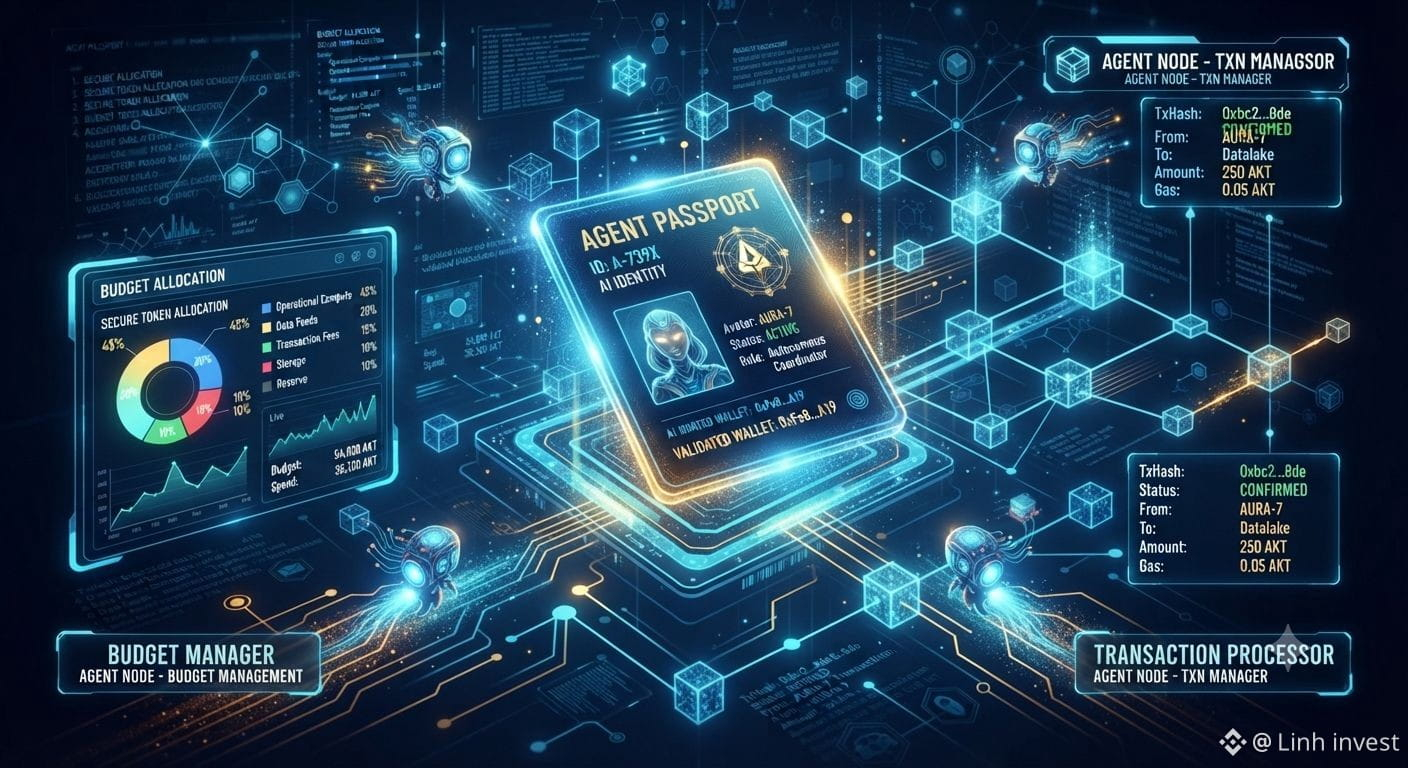
I find KITE Agent Passport interesting because AI Agents need more than reasoning skills. To perform real tasks, they must interact with external services and execute transactions within defined permissions.
But there’s another challenge: being allowed to spend money doesn’t mean spending it wisely.
Imagine an agent searching for market data. It pays for multiple APIs, tests different sources, yet finds nothing better. Every transaction may be valid, but was the money well spent?
A spending limit alone cannot solve this. An agent can follow every rule and still waste its budget.
I see three areas worth exploring: budgets tied to task objectives, tracking whether spending improves results, and identifying which agents create value when working together.
These are potential development directions, not confirmed shortcomings of Kite. Agent Passport addresses permissions, but the next question is how to measure whether an agent is worth its cost.
What should Kite prioritize next: smarter budget controls, agent performance tracking, or cost management across multiple agents?
#KiteBBW $KITE
1
96


·
--
Article
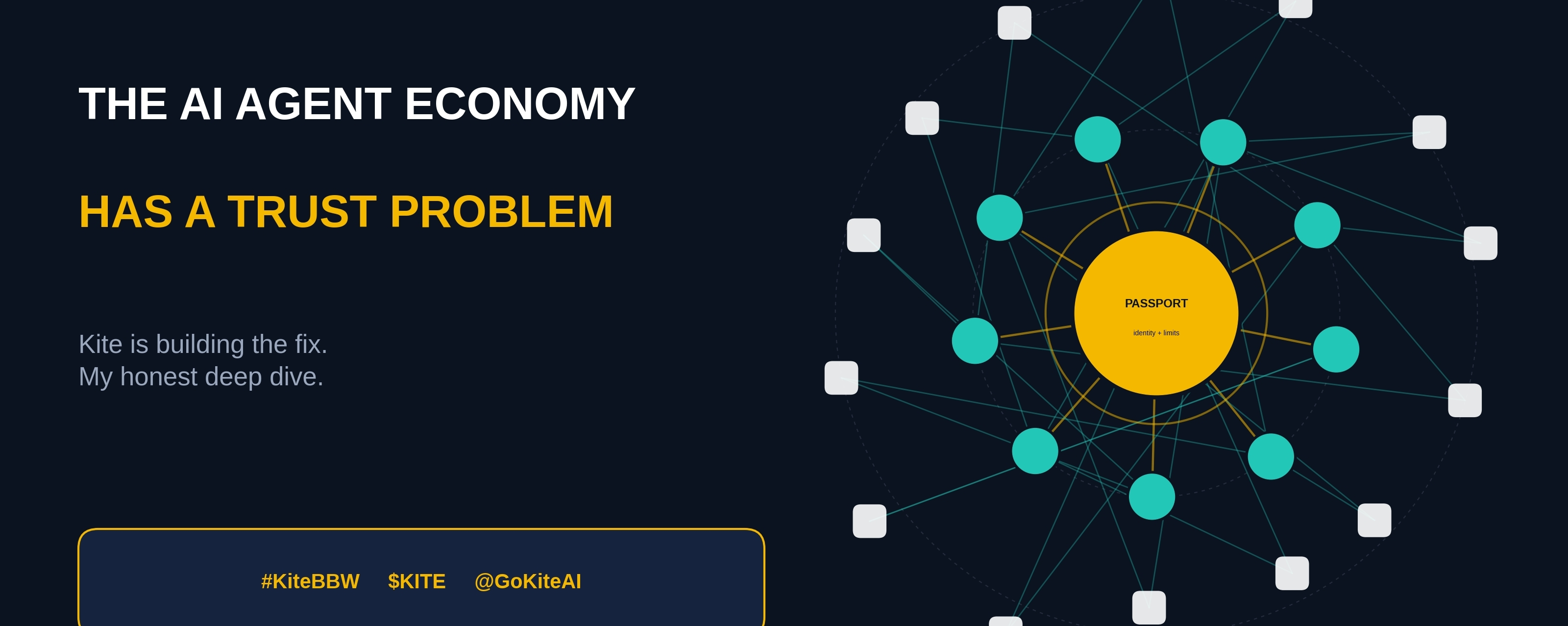
KITE || AGENT PASSPORT || THE AGENT ECONOMYThe AI Agent Economy Has a Trust Problem
Kite is building the fix. My honest deep dive into what is real, what is still unproven and what I am watching.
By Fatima | #LearnWithFatima
The quick takeAI agents can already browse, reason and click buy. What they lack is a safe way to be handedmoney and authority. Kite's bet is that identity and spending rules must come before payments.Its mainnet and Agent Passport are live, the backing is serious and the testnet numbers are big.What is still unproven is paying, repeat, real-world usage. That is the part I am watching.
Picture an AI assistant that books your flight, reorders your groceries and pays for the tools it needs to finish your work. The technology to do most of that already exists. Agents can browse, reason and press the buy button. So why aren't we all letting them?
I don't think the answer is fees. I don't think it's speed either. I think it's trust. Would you hand an autonomous piece of software your card with no limits attached? I wouldn't, and I doubt you would. That gap between what agents can do and what we're willing to let them do is exactly where Kite is aiming.
It's the reason I spent real time digging into it for #KiteBBW .
The real bottleneck is permission, not payment
Most agent economy talk lands on micropayments: agents paying tiny amounts for data, compute or API calls. That matters. But cheap payments alone don't answer the harder question of who is allowed to spend, how much and where.
Think about how we handle this with people. If I send my little cousin to buy lunch, I don't give her access to my whole account. I give her a set amount and one specific shop. The limits are what make delegation possible. Without them I'd just go myself.
Limits are what make delegation possible. Without them, I'd just do it myself
In crypto we learn early that whoever holds the keys holds the money. Agents force a harder version of that lesson. How do you let something act with your money without handing it everything? Kite's answer is to build identity and permissions first, and let payments sit on top of them.
What Kite actually shipped
Kite launched its mainnet in late April 2026 as a sovereign Avalanche L1. It is EVM-compatible and built around native stablecoin settlement for frequent, low-value payments. The design stacks three layers, and the middle one is where the magic is.
Kite Chain is the settlement layer where payments happen. Kite Agent Passport handles identity, delegation and risk control. On top sits the interface layer, where agents and developers register, discover services and plug into agent runtimes. At launch, online shopping was already live and paid API calls were settled through the x402 standard. Kite's treasury also covered network fees during the launch phase, so early users didn't have to think about gas.
Agent Passport: the piece I find most interesting
The Passport works as a programmable wallet plus identity for an AI agent. You fund it, set spending rules, choose which destinations are allowed and keep a kill switch within reach. The agent acts freely inside those boundaries and not outside them.
In practice, Kite describes a flow where you install the Passport skill inside Claude or another major AI model, authorize your agent to buy from major e-commerce sites in a single session and set spending rules and kill switches for each transaction. Developers can also register their agents with the Passport so their skills and services become discoverable to users. Messari's research on the launch notes that PayPal's PYUSD provides a major stablecoin rail for this, with merchant integrations being added.
Why three layers of identity matter
One design choice stands out to me. Kite separates identity into three levels: you, the agent acting for you and a temporary session for each task. The point is containment. If one session misbehaves or gets compromised, the exposure is meant to stay inside that session instead of reaching your agent or main account .
It's the same logic as not reusing one master password everywhere. Limit the blast radius and keep a clear audit trail of who did what. For anyone nervous about handing real money to software, this is the kind of structure that makes the idea feel less scary.
The space frame work in plain English
Kite summarizes its approach with a framework it calls SPACE. I like it because it reads like a checklist for any project that claims to serve agents. Stablecoin-native payments. Programmable constraints. Agent-first authentication. Compliance-ready design. And micropayments that are economically viable
Notice that only one of the five letters is about the money moving itself. The other four are about rules, identity and safety. That tells you what Kite thinks the real problem is.
Betting on Standard instead of One winner
Agent payments is a crowded field of competing standards. Coinbase pushes x402 for per-request stablecoin payments over HTTP. Google has AP2 for agent commerce. Stripe has its Machine Payment Protocol. Anthropic created MCP to connect models with tools.
Kite didn't pick a side. It supports all of them, plus OAuth 2.1, and positions itself as the layer underneath. In an early market nobody knows which standard wins, so broad compatibility lowers the risk of backing the wrong one. It also helps that Coinbase is both an investor and an integration partner on the x402 side.
Evidence versus promises
I always try to separate what's proven from what's only pitched. Here's what's on the record.
Beyond the numbers, the backer list is strong. The $35 million round was led by PayPal Ventures and General Catalyst, and Coinbase Ventures, Samsung Next and 8VC are also listed among backers. Pilot integrations with PayPal and Shopify were announced as underway. Crystal Intelligence, a blockchain analytics and compliance firm, has added transaction monitoring and sanctions screening to the network, which suggests the team is thinking about compliance and not only speed. Kite has also joined the Avalanche Payments Collective as its first AI-agent-focused member.
Where I'm still skeptical
Those are real signals. But I want to be clear about what they are and what they aren't. Testnet interactions aren't paying customers. Pilots aren't production volume. An announced integration isn't the same as people using it every day.
KITE has a total supply of 10 billion tokens. Its utility was designed to roll out in stages: module activation and ecosystem incentives first, then AI service commissions, staking and governance as the network matures. The token's long-term role depends on one thing, which is whether real agents settle real payments on this network. If usage doesn't grow, the narrative alone won't carry it.
There's also competition to respect. The agent payments space is getting crowded, and the big names behind the standards Kite integrates (Coinbase, Google, Stripe) will shape where agent payments flow too. That's my opinion, not a prediction.
What I'm watching instead of the chart1. Do Passport accounts keep growing after campaign attention fades?2. Do merchant and service integrations move from pilots to daily use?3. Do developers keep building on it when incentives are no longer pulling them in?
Why this matters beyond crypto
I create content to help women start in crypto from zero, so here's what I think about when I read projects like this. If agents are going to shop, subscribe and pay on our behalf, the safety controls can't be built only for engineers. A student, a shop owner or a mother managing a household budget should be able to set limits in a couple of minutes and understand exactly what the agent can and can't do.
The projects that make delegation feel safe and simple for ordinary people will matter more than the ones that only win on technical specs. Kite's focus on spending limits, kill switches and verifiable identity points in that direction. Whether it delivers on ease of use is something only time and real adoption will show.
My Takeaway
The agent economy won't be won by whoever has the cheapest transaction. It'll be won by whoever makes people comfortable handing real authority to software. Kite is building around that exact problem, with working infrastructure and serious backers behind it. From here, execution is what counts. I'll keepwatching the usage and not the noise.
So here's my question for you: what's the first thing you'd let an AI agent pay for, and what spending limit would you set?
Beginner glossaryAgent: software powered by AI that can take actions for you, like browsing or buying.L1: a blockchain that runs on its own base network. Kite runs as its own Avalanche L1.Stablecoin: a token designed to track a stable value such as the US dollar.x402: a standard that lets stablecoin payments happen per request over the web.AP2: Google's protocol for agent-driven commerce.MPP: Stripe's Machine Payment Protocol.MCP: Anthropic's Model Context Protocol, which connects AI models to tools and services.Passport: Kite's identity and wallet system for agents, with spending rules and kill switches.
Disclaimer: This is my own research and opinion, not financial advice. Crypto assets are volatile and carry risk. Always do your own research before making any decision.
#KiteBBW $KITE @GoKiteAI @Binance_Square_Official @Binance_Angels @Binance_Academy @CZ
KITE || AGENT PASSPORT || THE AGENT ECONOMY
The AI Agent Economy Has a Trust Problem
Kite is building the fix. My honest deep dive into what is real, what is still unproven and what I am watching.
By Fatima | #LearnWithFatima
The quick takeAI agents can already browse, reason and click buy. What they lack is a safe way to be handedmoney and authority. Kite's bet is that identity and spending rules must come before payments.Its mainnet and Agent Passport are live, the backing is serious and the testnet numbers are big.What is still unproven is paying, repeat, real-world usage. That is the part I am watching.
Picture an AI assistant that books your flight, reorders your groceries and pays for the tools it needs to finish your work. The technology to do most of that already exists. Agents can browse, reason and press the buy button. So why aren't we all letting them?
I don't think the answer is fees. I don't think it's speed either. I think it's trust. Would you hand an autonomous piece of software your card with no limits attached? I wouldn't, and I doubt you would. That gap between what agents can do and what we're willing to let them do is exactly where Kite is aiming.
It's the reason I spent real time digging into it for #KiteBBW .
The real bottleneck is permission, not payment
Most agent economy talk lands on micropayments: agents paying tiny amounts for data, compute or API calls. That matters. But cheap payments alone don't answer the harder question of who is allowed to spend, how much and where.
Think about how we handle this with people. If I send my little cousin to buy lunch, I don't give her access to my whole account. I give her a set amount and one specific shop. The limits are what make delegation possible. Without them I'd just go myself.
Limits are what make delegation possible. Without them, I'd just do it myself
In crypto we learn early that whoever holds the keys holds the money. Agents force a harder version of that lesson. How do you let something act with your money without handing it everything? Kite's answer is to build identity and permissions first, and let payments sit on top of them.
What Kite actually shipped
Kite launched its mainnet in late April 2026 as a sovereign Avalanche L1. It is EVM-compatible and built around native stablecoin settlement for frequent, low-value payments. The design stacks three layers, and the middle one is where the magic is.
Kite Chain is the settlement layer where payments happen. Kite Agent Passport handles identity, delegation and risk control. On top sits the interface layer, where agents and developers register, discover services and plug into agent runtimes. At launch, online shopping was already live and paid API calls were settled through the x402 standard. Kite's treasury also covered network fees during the launch phase, so early users didn't have to think about gas.
Agent Passport: the piece I find most interesting
The Passport works as a programmable wallet plus identity for an AI agent. You fund it, set spending rules, choose which destinations are allowed and keep a kill switch within reach. The agent acts freely inside those boundaries and not outside them.
In practice, Kite describes a flow where you install the Passport skill inside Claude or another major AI model, authorize your agent to buy from major e-commerce sites in a single session and set spending rules and kill switches for each transaction. Developers can also register their agents with the Passport so their skills and services become discoverable to users. Messari's research on the launch notes that PayPal's PYUSD provides a major stablecoin rail for this, with merchant integrations being added.
Why three layers of identity matter
One design choice stands out to me. Kite separates identity into three levels: you, the agent acting for you and a temporary session for each task. The point is containment. If one session misbehaves or gets compromised, the exposure is meant to stay inside that session instead of reaching your agent or main account .
It's the same logic as not reusing one master password everywhere. Limit the blast radius and keep a clear audit trail of who did what. For anyone nervous about handing real money to software, this is the kind of structure that makes the idea feel less scary.
The space frame work in plain English
Kite summarizes its approach with a framework it calls SPACE. I like it because it reads like a checklist for any project that claims to serve agents. Stablecoin-native payments. Programmable constraints. Agent-first authentication. Compliance-ready design. And micropayments that are economically viable
Notice that only one of the five letters is about the money moving itself. The other four are about rules, identity and safety. That tells you what Kite thinks the real problem is.
Betting on Standard instead of One winner
Agent payments is a crowded field of competing standards. Coinbase pushes x402 for per-request stablecoin payments over HTTP. Google has AP2 for agent commerce. Stripe has its Machine Payment Protocol. Anthropic created MCP to connect models with tools.
Kite didn't pick a side. It supports all of them, plus OAuth 2.1, and positions itself as the layer underneath. In an early market nobody knows which standard wins, so broad compatibility lowers the risk of backing the wrong one. It also helps that Coinbase is both an investor and an integration partner on the x402 side.
Evidence versus promises
I always try to separate what's proven from what's only pitched. Here's what's on the record.
Beyond the numbers, the backer list is strong. The $35 million round was led by PayPal Ventures and General Catalyst, and Coinbase Ventures, Samsung Next and 8VC are also listed among backers. Pilot integrations with PayPal and Shopify were announced as underway. Crystal Intelligence, a blockchain analytics and compliance firm, has added transaction monitoring and sanctions screening to the network, which suggests the team is thinking about compliance and not only speed. Kite has also joined the Avalanche Payments Collective as its first AI-agent-focused member.
Where I'm still skeptical
Those are real signals. But I want to be clear about what they are and what they aren't. Testnet interactions aren't paying customers. Pilots aren't production volume. An announced integration isn't the same as people using it every day.
KITE has a total supply of 10 billion tokens. Its utility was designed to roll out in stages: module activation and ecosystem incentives first, then AI service commissions, staking and governance as the network matures. The token's long-term role depends on one thing, which is whether real agents settle real payments on this network. If usage doesn't grow, the narrative alone won't carry it.
There's also competition to respect. The agent payments space is getting crowded, and the big names behind the standards Kite integrates (Coinbase, Google, Stripe) will shape where agent payments flow too. That's my opinion, not a prediction.
What I'm watching instead of the chart1. Do Passport accounts keep growing after campaign attention fades?2. Do merchant and service integrations move from pilots to daily use?3. Do developers keep building on it when incentives are no longer pulling them in?
Why this matters beyond crypto
I create content to help women start in crypto from zero, so here's what I think about when I read projects like this. If agents are going to shop, subscribe and pay on our behalf, the safety controls can't be built only for engineers. A student, a shop owner or a mother managing a household budget should be able to set limits in a couple of minutes and understand exactly what the agent can and can't do.
The projects that make delegation feel safe and simple for ordinary people will matter more than the ones that only win on technical specs. Kite's focus on spending limits, kill switches and verifiable identity points in that direction. Whether it delivers on ease of use is something only time and real adoption will show.
My Takeaway
The agent economy won't be won by whoever has the cheapest transaction. It'll be won by whoever makes people comfortable handing real authority to software. Kite is building around that exact problem, with working infrastructure and serious backers behind it. From here, execution is what counts. I'll keepwatching the usage and not the noise.
So here's my question for you: what's the first thing you'd let an AI agent pay for, and what spending limit would you set?
Beginner glossaryAgent: software powered by AI that can take actions for you, like browsing or buying.L1: a blockchain that runs on its own base network. Kite runs as its own Avalanche L1.Stablecoin: a token designed to track a stable value such as the US dollar.x402: a standard that lets stablecoin payments happen per request over the web.AP2: Google's protocol for agent-driven commerce.MPP: Stripe's Machine Payment Protocol.MCP: Anthropic's Model Context Protocol, which connects AI models to tools and services.Passport: Kite's identity and wallet system for agents, with spending rules and kill switches.
Disclaimer: This is my own research and opinion, not financial advice. Crypto assets are volatile and carry risk. Always do your own research before making any decision.
#KiteBBW $KITE @KITE AI 中文 @Binance Square Official @Binance Angels @Binance Academy @CZ
1
1
16
3.5k

·
--
Bullish
What if your AI assistant could do more than recommend things?
Imagine asking an agent to organize a research project.
It finds the right data provider, pays for access within your budget, and coordinates with other digital services — without requiring you to manage every transaction manually.
This is one possible direction for the agent economy.
But making it work requires more than a capable AI model. Agents need ways to identify themselves, operate under clear permissions, and interact economically.
That’s the infrastructure challenge that makes Kite worth watching.
Of course, this future depends on security, reliable execution, and meaningful user control. Autonomous payments should never mean unlimited permissions.
What would you delegate first: buying digital services, managing research, or coordinating other AI agents?
#KiteBBW $KITE
104

·
--
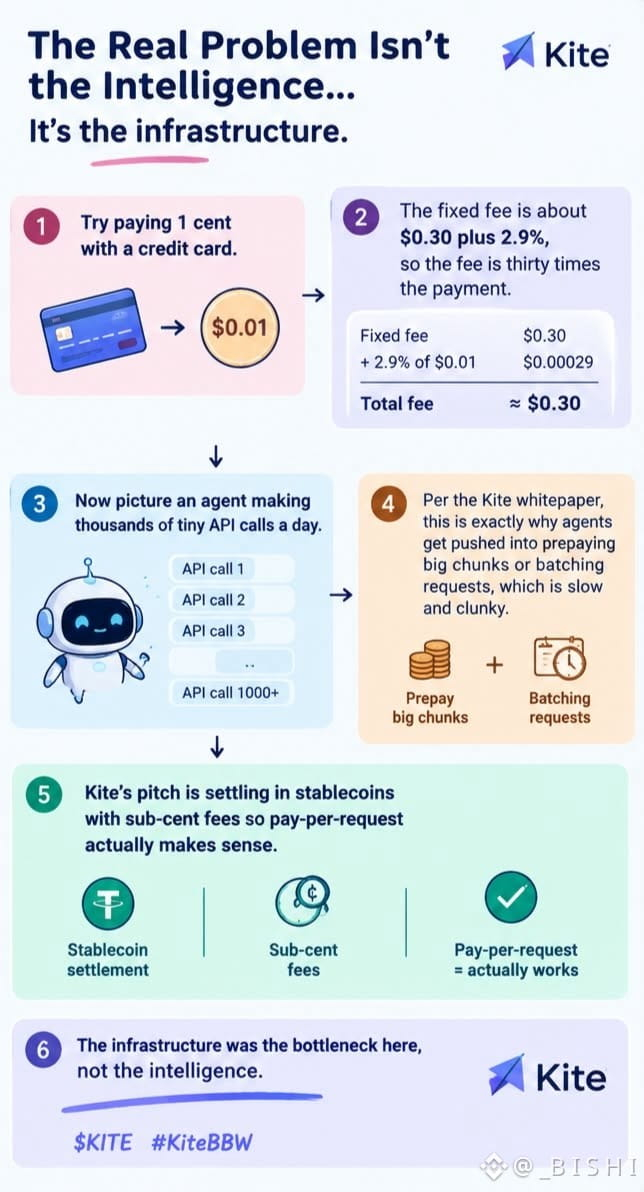
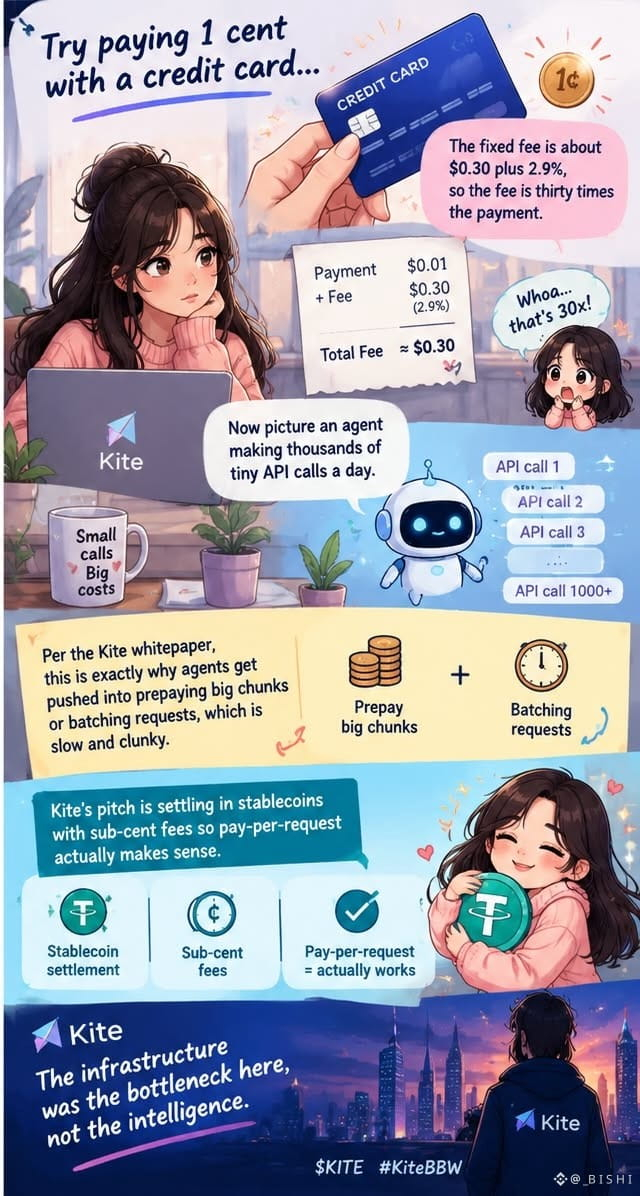
$KITE Try paying one cent with a credit card.
The fixed fee is about $0.30 plus 2.9%, so the fee is thirty times the payment.
Now picture an agent making thousands of tiny API calls a day. Per the Kite whitepaper, this is exactly why agents get pushed into prepaying big chunks or batching requests, which is slow and clunky. Kite’s pitch is settling in stablecoins with sub-cent fees so pay-per-request actually makes sense.
The infrastructure was the bottleneck here, not the intelligence. $KITE #KiteBBW
1
162

·
--
Bullish
The thing I find interesting about Kite AI is the question of accountability. If AI agents start making decisions, purchasing services and interacting with other agents, who sets the rules they operate under?
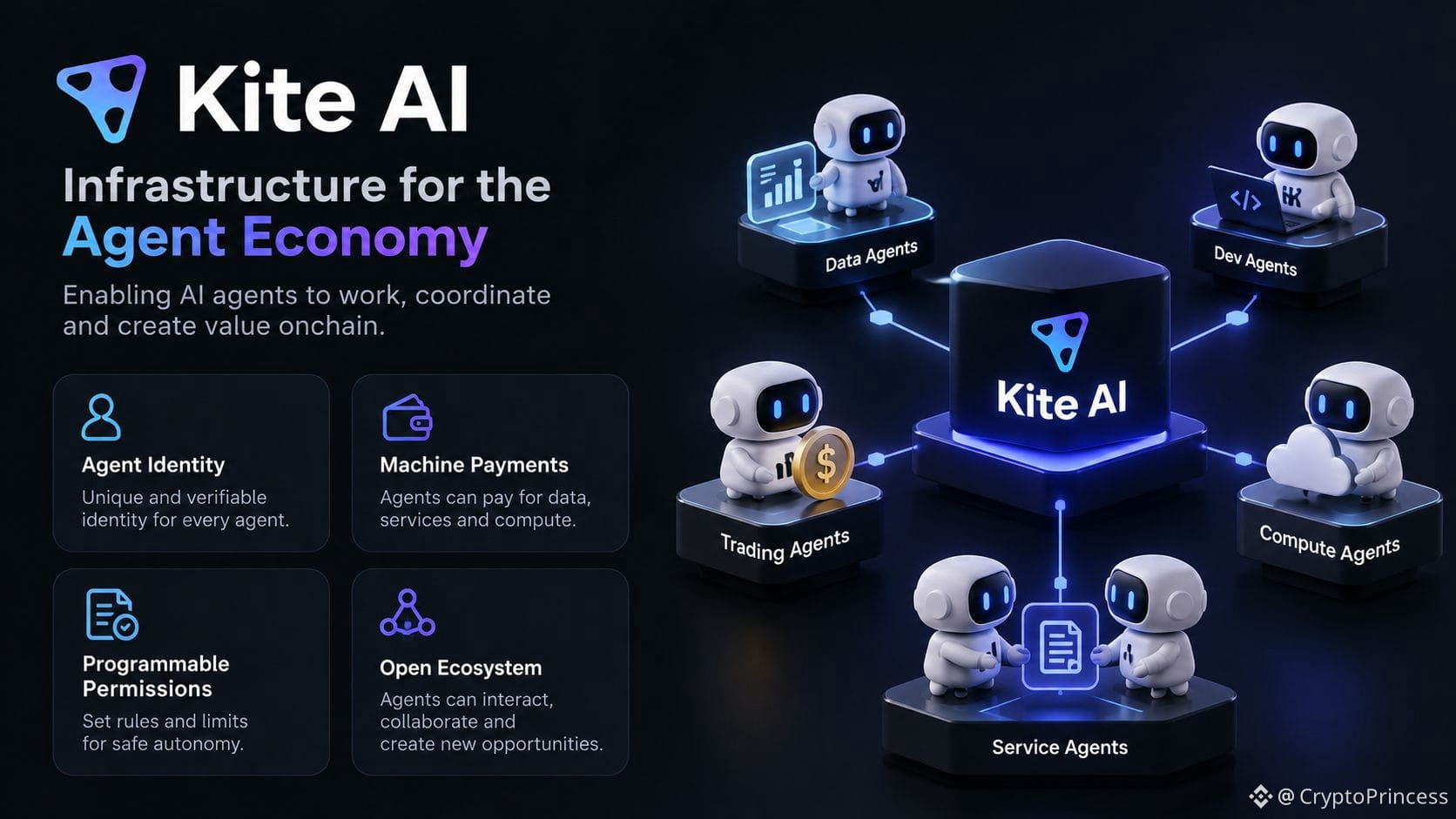
Intelligence alone won't solve that. Agents need verifiable identities, clear permissions and infrastructure that lets them participate in an economy without giving up every control.
That's where Kite's vision for an agent-centric economy gets interesting to me. The goal isn't simply to make AI smarter, but to build an environment where agents can operate, transact and coordinate under defined rules.
I think the real test for the agent economy won't be how many agents we create. It'll be whether those agents can actually work together reliably, without humans having to manage every single interaction.
That's the infrastructure problem worth watching.
@GoKiteAI $KITE #KiteBBW
The thing I find interesting about Kite AI is the question of accountability. If AI agents start making decisions, purchasing services and interacting with other agents, who sets the rules they operate under?
Intelligence alone won't solve that. Agents need verifiable identities, clear permissions and infrastructure that lets them participate in an economy without giving up every control.
That's where Kite's vision for an agent-centric economy gets interesting to me. The goal isn't simply to make AI smarter, but to build an environment where agents can operate, transact and coordinate under defined rules.
I think the real test for the agent economy won't be how many agents we create. It'll be whether those agents can actually work together reliably, without humans having to manage every single interaction.
That's the infrastructure problem worth watching.
@KITE AI 中文 $KITE #KiteBBW
M Ali4:
yes
i have no usd send message but Tip 5 usd i have no usd
4
2
580

·
--
Bullish
One thing about the agent economy that people might be overlooking is how AI agents will pay for the resources they use. An autonomous agent can find the best API or service, but if every transaction still needs human approval, how autonomous is it really?
That’s where Kite AI gets interesting to me. Its focus on agent identity, programmable permissions and machine-native payments addresses the infrastructure needed for agents to operate economically. An agent could have its own identity, spend within defined limits, and pay for data or compute as tasks require.
The important part isn't just letting AI do more things. It's giving agents a framework to act independently without removing the controls around them.
I think that distinction will matter a lot as agent-to-agent interactions grow. Intelligence gets attention, but the payment and identity rails are what could make the whole economy functional.
@GoKiteAI $KITE #KiteBBW
{future}(KITEUSDT)
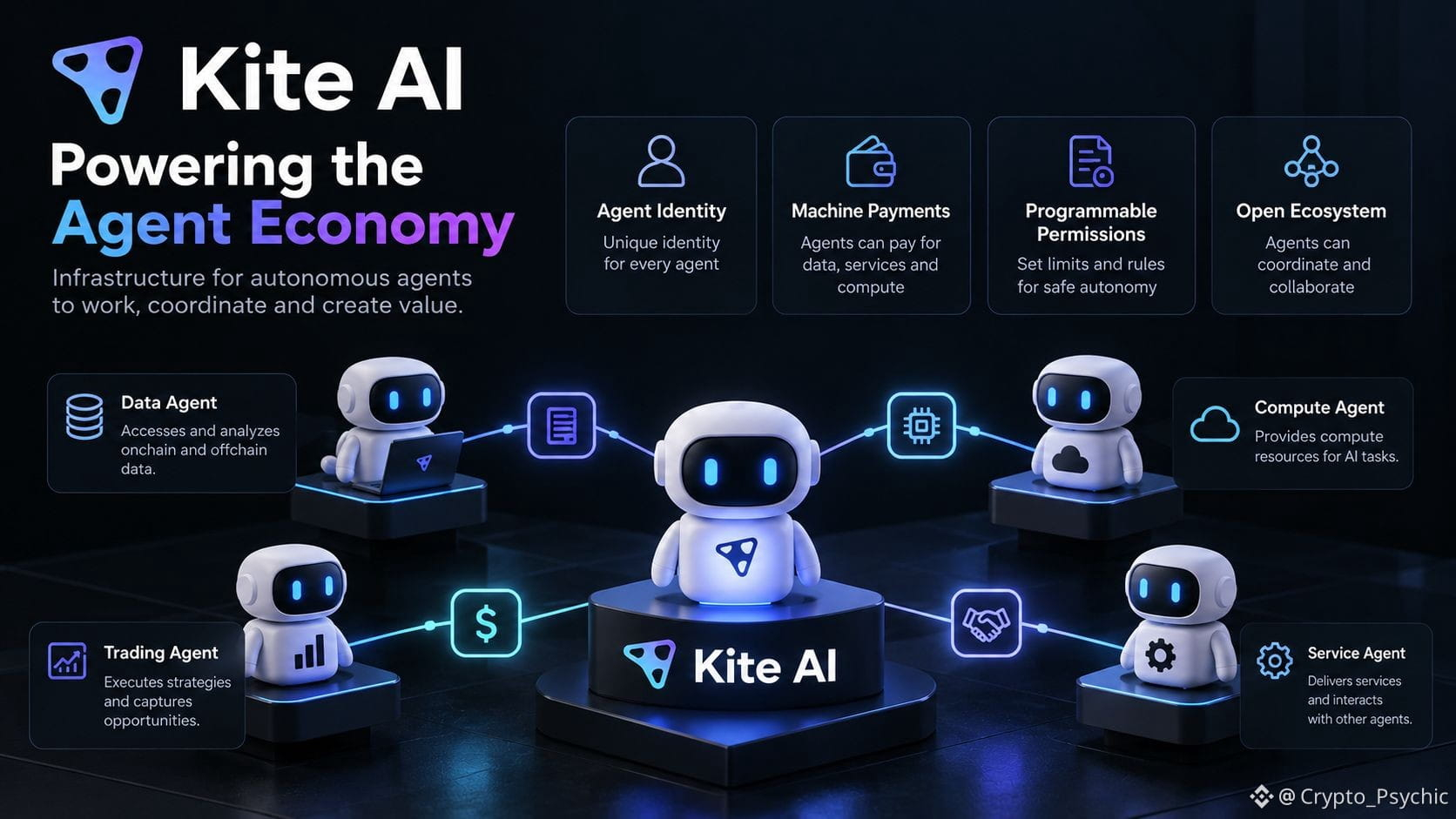
One thing about the agent economy that people might be overlooking is how AI agents will pay for the resources they use. An autonomous agent can find the best API or service, but if every transaction still needs human approval, how autonomous is it really?
That’s where Kite AI gets interesting to me. Its focus on agent identity, programmable permissions and machine-native payments addresses the infrastructure needed for agents to operate economically. An agent could have its own identity, spend within defined limits, and pay for data or compute as tasks require.
The important part isn't just letting AI do more things. It's giving agents a framework to act independently without removing the controls around them.
I think that distinction will matter a lot as agent-to-agent interactions grow. Intelligence gets attention, but the payment and identity rails are what could make the whole economy functional.
@KITE AI 中文 $KITE #KiteBBW
1
419

·
--
Bullish
Most AI-crypto projects I read start with the token and work backwards to a story. Kite felt like it went the other way, and that's what kept me reading.
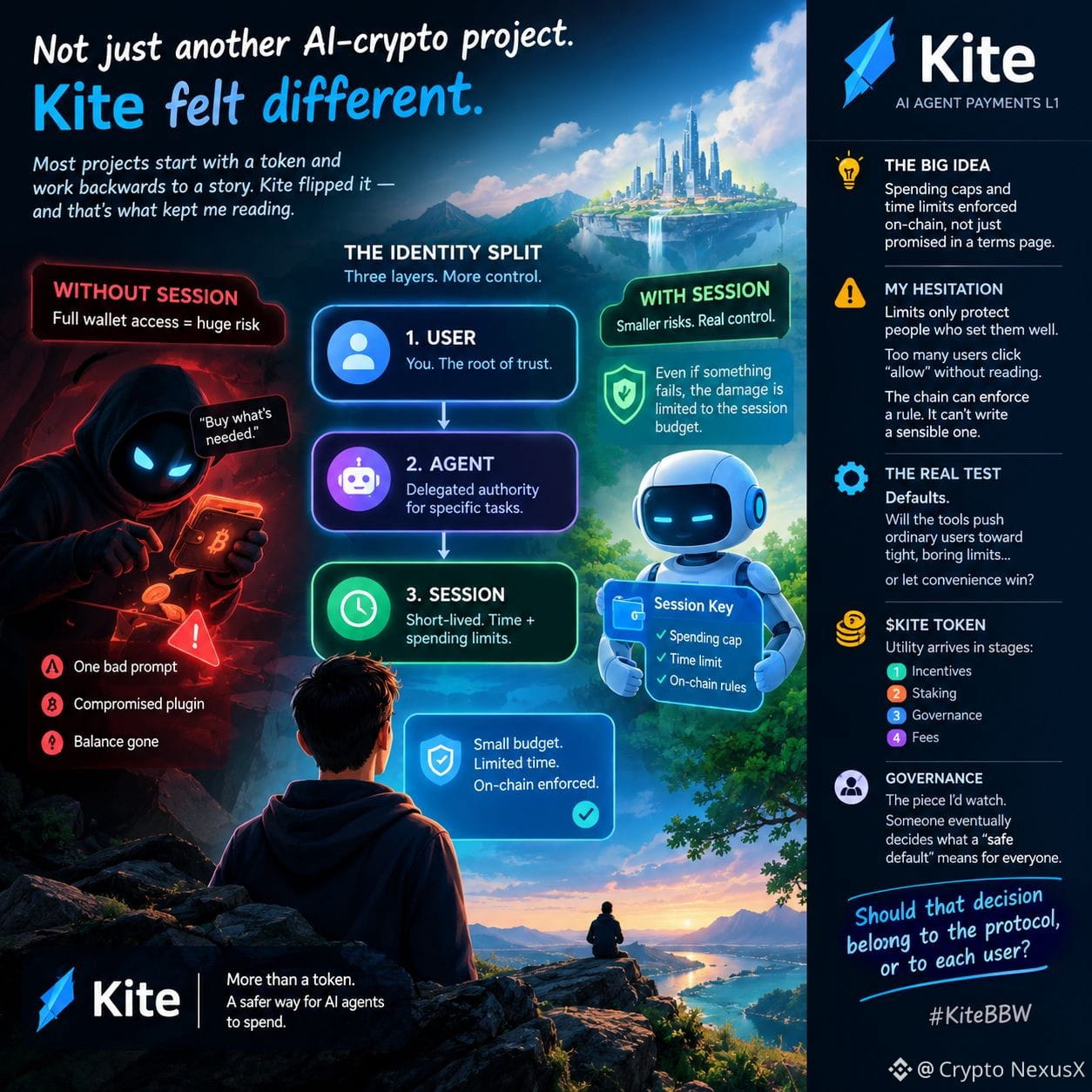
The part that stuck wasn't the speed. It was the identity split. User at the root, an agent underneath with delegated authority, then a session that expires. Sounds like paperwork until you picture the alternative... an agent holding a full wallet key and a vague instruction to "buy what's needed." One bad prompt, one compromised plugin, and the balance is gone.
With a session layer, the worst case shrinks to whatever budget that single task was handed. I think that's the most practical idea in the whole design. Spending caps and time limits enforced on-chain, instead of promised in a terms page.
Here's my hesitation, though. Limits only protect people who set them well. I've watched users click through OAuth screens for years without reading one permission. Why would agent budgets be different? Some will set the cap to "unlimited" because the task keeps failing otherwise. The chain can enforce a rule. It can't write a sensible one.
So the real test might be defaults. Whether the tooling pushes ordinary users toward tight, boring limits... or lets convenience win.
$KITE utility arrives in stages, incentives first, then staking, governance and fees. Governance is the piece I'd watch, because someone eventually decides what a "safe default" means for everyone.
I'm still reading the docs, so call this a working opinion.
Should that decision belong to the protocol, or to each user? #KiteBBW
@GoKiteAI
Most AI-crypto projects I read start with the token and work backwards to a story. Kite felt like it went the other way, and that's what kept me reading.
The part that stuck wasn't the speed. It was the identity split. User at the root, an agent underneath with delegated authority, then a session that expires. Sounds like paperwork until you picture the alternative... an agent holding a full wallet key and a vague instruction to "buy what's needed." One bad prompt, one compromised plugin, and the balance is gone.
With a session layer, the worst case shrinks to whatever budget that single task was handed. I think that's the most practical idea in the whole design. Spending caps and time limits enforced on-chain, instead of promised in a terms page.
Here's my hesitation, though. Limits only protect people who set them well. I've watched users click through OAuth screens for years without reading one permission. Why would agent budgets be different? Some will set the cap to "unlimited" because the task keeps failing otherwise. The chain can enforce a rule. It can't write a sensible one.
So the real test might be defaults. Whether the tooling pushes ordinary users toward tight, boring limits... or lets convenience win.
$KITE utility arrives in stages, incentives first, then staking, governance and fees. Governance is the piece I'd watch, because someone eventually decides what a "safe default" means for everyone.
I'm still reading the docs, so call this a working opinion.
Should that decision belong to the protocol, or to each user? #KiteBBW
@KITE AI 中文
134

Sitting here thinking about one thing. We’re used to AI writing or searching for us. But what happens when it starts paying too? Ordering something, paying for it, negotiating with another agent, all without me stepping in at every move.
That’s what caught my attention about Kite. They’re building a blockchain specifically for agents like that: each one gets its own identity, I can set a spending limit and not worry about it going on a spree, and small payments go through fast.
Will it actually take off? No idea. The market is unpredictable and I’m no prophet. But the idea of an agent economy makes sense to me, so for now I’m just keeping $KITE on my radar.
What about you, would you trust an AI with your money, or nope? #KiteBBW
100

I gave an AI agent my wallet this week. Here's what actually made me trust it.
My Binance Agentic Wallet minted a few free Agent ID NFTs for me. I set one rule: free mints (0 value, gas only) go through on their own. Anything with a price, an approval or a risk flag waits for my yes.
Every single transaction got previewed first: what leaves the wallet, what arrives, any allowance or authority change. When the preview was clean, it executed. When it wasn't, it stopped and asked me.
That's the part of the agent economy people skip. The hard question isn't "can an agent pay?" It's "who set the limit, and can I prove it?"
This is why Kite caught my attention. Its Agent Passport is built around letting users authorize agent payments within rules they set, approved with a passkey, instead of handing over a key and hoping. Agents with identity plus enforced spending rules is the boring, necessary layer that has to exist before agents handle real money.
I'll keep testing agents with tiny amounts first and sharing what breaks.
What's the one rule you'd never let an AI agent break with your money?
#KiteBBW $KITE @GoKiteAI
I gave an AI agent my wallet this week. Here's what actually made me trust it.
My Binance Agentic Wallet minted a few free Agent ID NFTs for me. I set one rule: free mints (0 value, gas only) go through on their own. Anything with a price, an approval or a risk flag waits for my yes.
Every single transaction got previewed first: what leaves the wallet, what arrives, any allowance or authority change. When the preview was clean, it executed. When it wasn't, it stopped and asked me.
That's the part of the agent economy people skip. The hard question isn't "can an agent pay?" It's "who set the limit, and can I prove it?"
This is why Kite caught my attention. Its Agent Passport is built around letting users authorize agent payments within rules they set, approved with a passkey, instead of handing over a key and hoping. Agents with identity plus enforced spending rules is the boring, necessary layer that has to exist before agents handle real money.
I'll keep testing agents with tiny amounts first and sharing what breaks.
What's the one rule you'd never let an AI agent break with your money?
#KiteBBW $KITE @KITE AI 中文

1
101

The Rise of the Agent Economy: Why Kite is Building the Infrastructure for Autonomous AI
We are witnessing a massive paradigm shift in technology. Artificial intelligence is moving past simple prompt-response interactions and evolving into autonomous AI agents - digital entities capable of executing complex multi-step workflows, transacting value, and collaborating without human intervention.
However, a critical bottleneck remains: traditional web infrastructure and centralized finance cannot support an economy run by AI.
What Does the Agent Economy Actually Need?
For AI agents to truly operate independently at scale, they require a specialized ecosystem built on blockchain technology:
-Verifiable Identity & Trust: Every agent needs a secure, immutable on-chain identity to prove its authority and track its computational history.
-Frictionless Micro-transactions: Autonomous programs cannot rely on legacy banking rails; they need instant, low-fee settlement layers for machine-to-machine micro-payments.
-Decentralized Resource Access: Secure, permissionless access to compute, data markets, and smart contract execution.
This is precisely where Kite steps in as the exclusive Premium Partner of The Blockchain 100 2026 on Binance Square. By building foundational architecture tailored for the agent economy, Kite is bridging the gap between artificial intelligence and Web3.
A New Standard for Transparency
What makes Kite’s approach compelling is not just the vision, but their commitment to verifiable systems. From utilizing decentralized mechanics to ensure transparent community interactions, such as anchoring data fingerprints on the Kite chain and leveraging public randomness via drand - they are setting a high bar for how modern web3 projects operate.
The convergence of AI and crypto is arguably the most exciting frontier of this cycle. We are no longer just speculating on tokens; we are building economic rails for artificial intelligence.
#KiteBBW $KITE
1
288

·
--
Bullish
What happens when AI agents start doing business with each other? 🤖
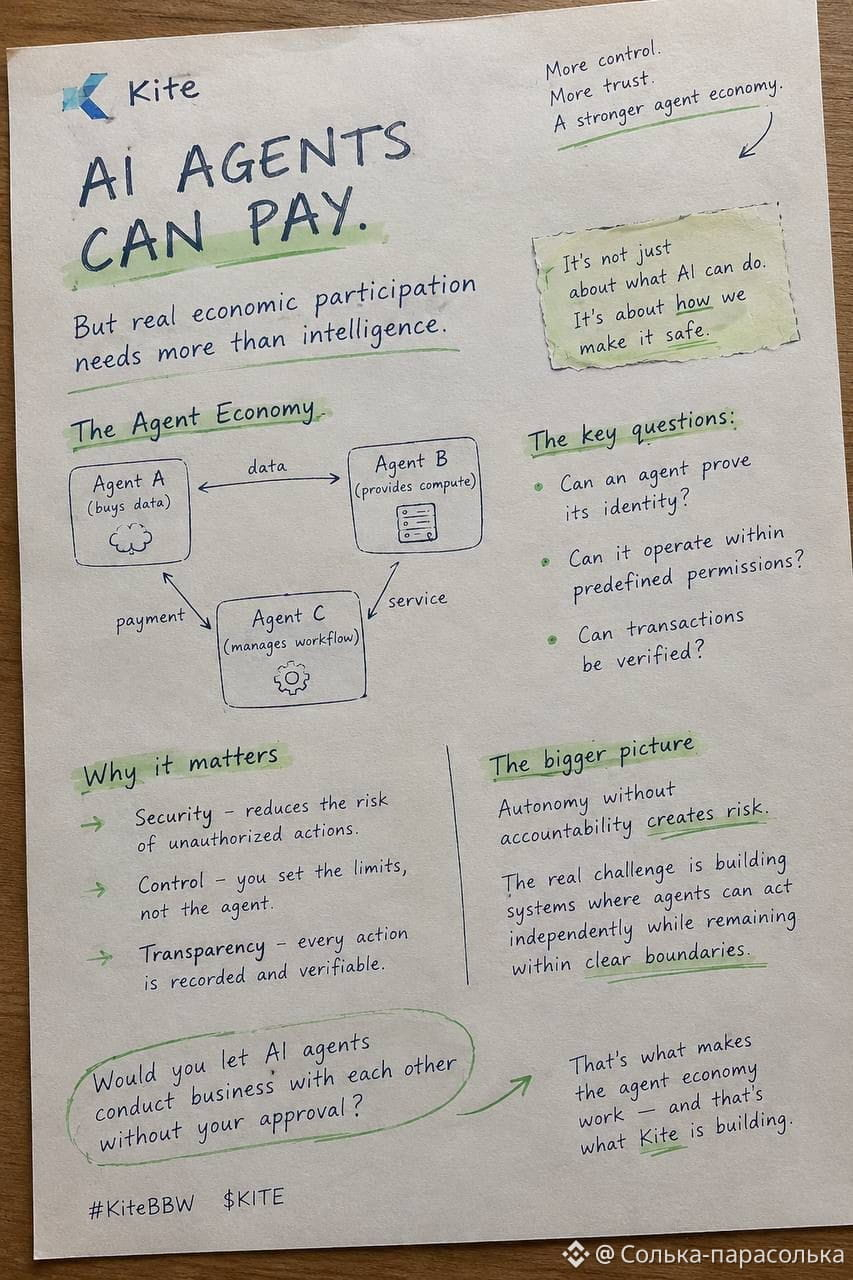
Imagine one agent buying data, another providing computing power, and a third managing a workflow. No human needs to approve every tiny step.
Sounds efficient. But there’s a problem: how do these agents establish trust?
Can an agent prove its identity? Can it operate within predefined permissions? Can transactions be verified?
These are important questions for the emerging agent economy.
This is why I’m interested in what Kite is building. Its approach focuses on infrastructure designed for AI agents to interact and transact.
My biggest takeaway: autonomy without accountability creates risk. The real challenge is building systems where agents can act independently while remaining within clear boundaries.
Would you let AI agents conduct business with each other without your approval for every transaction?
#KiteBBW $KITE
{future}(KITEUSDT)
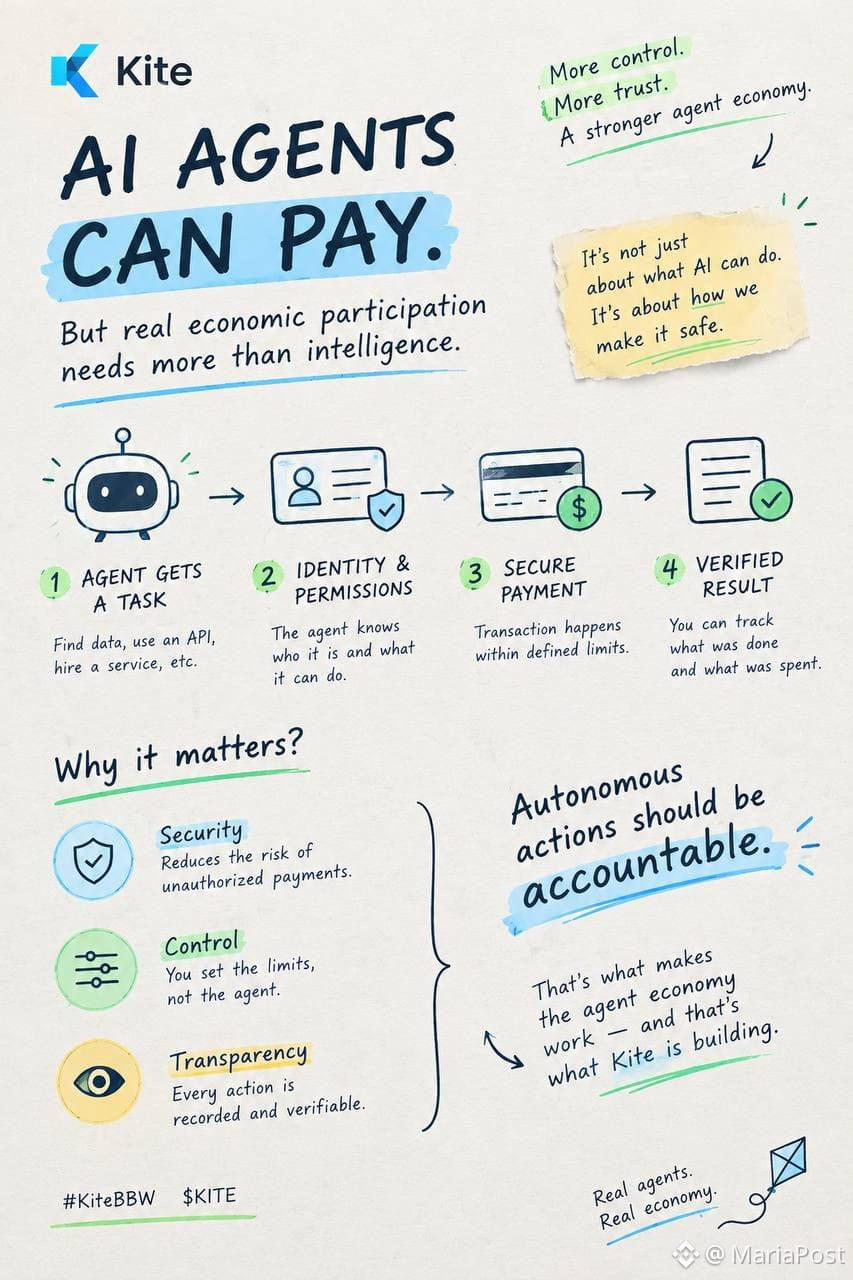
What happens when AI agents start doing business with each other? 🤖
Imagine one agent buying data, another providing computing power, and a third managing a workflow. No human needs to approve every tiny step.
Sounds efficient. But there’s a problem: how do these agents establish trust?
Can an agent prove its identity? Can it operate within predefined permissions? Can transactions be verified?
These are important questions for the emerging agent economy.
This is why I’m interested in what Kite is building. Its approach focuses on infrastructure designed for AI agents to interact and transact.
My biggest takeaway: autonomy without accountability creates risk. The real challenge is building systems where agents can act independently while remaining within clear boundaries.
Would you let AI agents conduct business with each other without your approval for every transaction?
#KiteBBW $KITE
121

What happens when AI agents start spending money on our behalf? 🪁
AI can already help us research, plan, and make decisions. But taking action in the real economy is a different challenge.
Imagine an AI agent that needs to pay for data, access a paid API, or hire another digital service. Who authorizes the payment? How much can it spend? And how can we verify what happened?
This is where Kite is building something interesting.
Kite is developing infrastructure that combines agent identity, programmable spending permissions, and payment settlement. Its Agent Passport lets users define spending limits and authorize agents to pay for services within those boundaries.
For me, the most important idea isn’t simply making AI payments faster. It’s making autonomous actions more controllable.
Three things matter:
🔹 Identity — knowing which agent is acting.
🔹 Permissions — defining what it can do and how much it can spend.
🔹 Verification — maintaining a record of actions and payments.
Of course, no infrastructure removes every risk. Permissions must be configured carefully, and users still need to understand what authority they delegate.
But if AI agents are going to become real economic participants, trust and accountability must be part of the foundation — not added as an afterthought.
My question: Would you trust an AI agent to make payments independently if you could set strict limits and review its activity?
The agent economy needs more than intelligence. It needs responsible execution.
#KiteBBW $KITE
{spot}(KITEUSDT)
What happens when AI agents start spending money on our behalf? 🪁
AI can already help us research, plan, and make decisions. But taking action in the real economy is a different challenge.
Imagine an AI agent that needs to pay for data, access a paid API, or hire another digital service. Who authorizes the payment? How much can it spend? And how can we verify what happened?
This is where Kite is building something interesting.
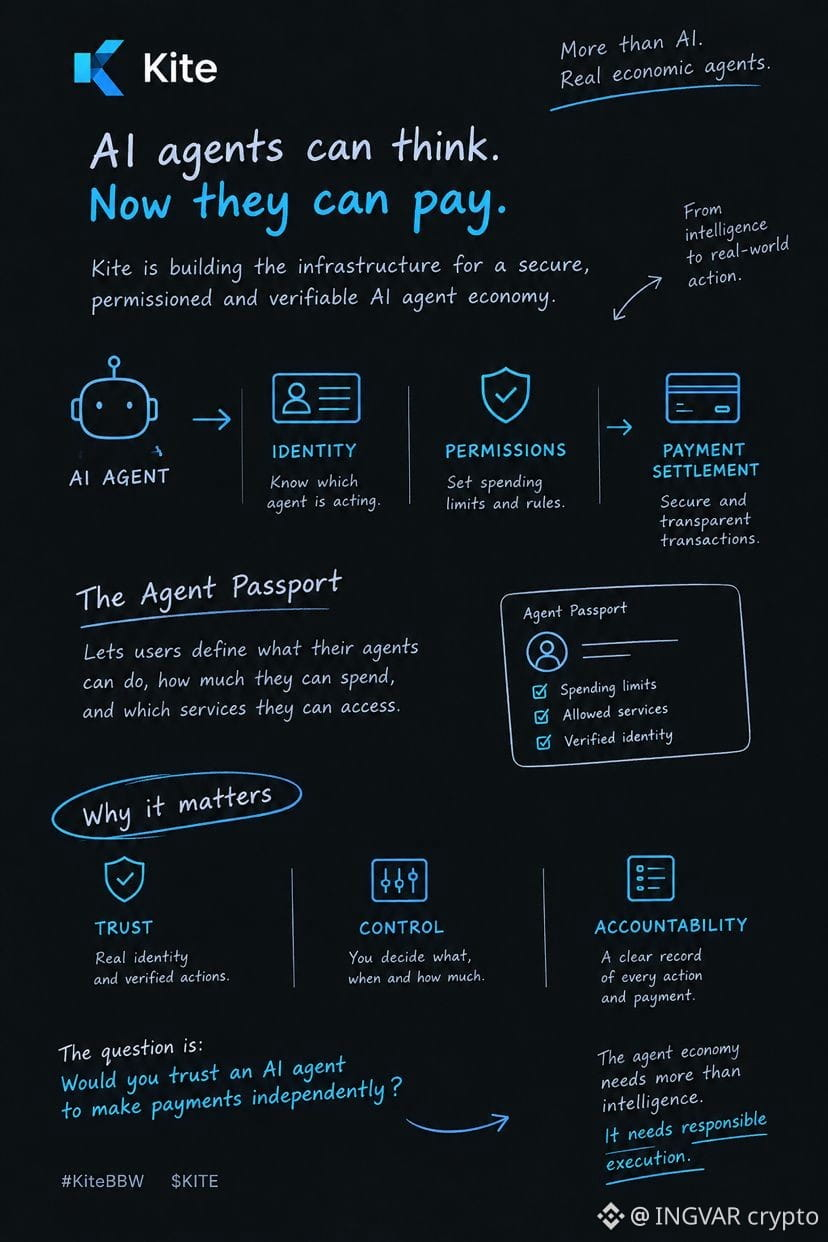
Kite is developing infrastructure that combines agent identity, programmable spending permissions, and payment settlement. Its Agent Passport lets users define spending limits and authorize agents to pay for services within those boundaries.
For me, the most important idea isn’t simply making AI payments faster. It’s making autonomous actions more controllable.
Three things matter:
🔹 Identity — knowing which agent is acting.
🔹 Permissions — defining what it can do and how much it can spend.
🔹 Verification — maintaining a record of actions and payments.
Of course, no infrastructure removes every risk. Permissions must be configured carefully, and users still need to understand what authority they delegate.
But if AI agents are going to become real economic participants, trust and accountability must be part of the foundation — not added as an afterthought.
My question: Would you trust an AI agent to make payments independently if you could set strict limits and review its activity?
The agent economy needs more than intelligence. It needs responsible execution.
#KiteBBW $KITE
86

·
--
Giving an Agent Your Card Is Like Handing an Intern Your Wallet: Kite’s FixYour AI agent can negotiate, compare 40 suppliers and book your trip. Then it freezes at checkout and asks for your credit card. 🪁
That’s the whole problem in one sentence. The agent economy doesn’t have an intelligence problem. It has a permission problem.
Giving an agent your card is like handing an intern your wallet. Not giving it anything means it’s just an expensive search bar. What’s missing is the middle: a company card with hard limits, an ID badge and an audit trail, built for machines.
That is the bet behind $KITE and the reason I’m writing for #KiteBBW
How Kite approaches it:
🔹 Identity: Agent Passport gives every agent a verifiable identity and a programmable wallet
🔹 Rules: the user sets spending limits and allowed destinations, and the agent can’t step outside them
🔹 Settlement: Kite Chain, an Avalanche-based L1, is built for stablecoin payments at machine frequency, with x402 compatibility now extended to Solana
Why machines change the maths.
Humans make a few payments a day. Agents can make thousands of tiny paid calls to APIs, data and compute. Card rails and manual approvals weren’t designed for that. During testnet, Kite processed 1.9B+ agent interactions, mainnet went live on April 30, 2026, PayPal is piloting the infrastructure and Shopify integrations are underway. The backers are PayPal Ventures, General Catalyst and Coinbase Ventures.
Imagine if even a small proportion of online trade were to come under the control of agents; whoever controls the identification and payment processes for those agents would gain a monopoly over this sector.
My checklist, not hype:
1️⃣ Real mainnet agent volume, not testnet numbers
2️⃣ Number of live services integrating Passport
3️⃣ Whether $KITE utility grows from usage, not only incentives
So, in the world of agent economics, it won’t be the smartest model that wins. The winner will be whoever makes agents reliable enough to be entrusted with managing a budget. That is precisely what Kite is aiming for.
Question for you: what’s the first thing you’d let an AI agent buy for you, with no approval step?
@GoKiteAI
Giving an Agent Your Card Is Like Handing an Intern Your Wallet: Kite’s Fix
Your AI agent can negotiate, compare 40 suppliers and book your trip. Then it freezes at checkout and asks for your credit card. 🪁
That’s the whole problem in one sentence. The agent economy doesn’t have an intelligence problem. It has a permission problem.
Giving an agent your card is like handing an intern your wallet. Not giving it anything means it’s just an expensive search bar. What’s missing is the middle: a company card with hard limits, an ID badge and an audit trail, built for machines.
That is the bet behind $KITE and the reason I’m writing for #KiteBBW
How Kite approaches it:
🔹 Identity: Agent Passport gives every agent a verifiable identity and a programmable wallet
🔹 Rules: the user sets spending limits and allowed destinations, and the agent can’t step outside them
🔹 Settlement: Kite Chain, an Avalanche-based L1, is built for stablecoin payments at machine frequency, with x402 compatibility now extended to Solana
Why machines change the maths.
Humans make a few payments a day. Agents can make thousands of tiny paid calls to APIs, data and compute. Card rails and manual approvals weren’t designed for that. During testnet, Kite processed 1.9B+ agent interactions, mainnet went live on April 30, 2026, PayPal is piloting the infrastructure and Shopify integrations are underway. The backers are PayPal Ventures, General Catalyst and Coinbase Ventures.
Imagine if even a small proportion of online trade were to come under the control of agents; whoever controls the identification and payment processes for those agents would gain a monopoly over this sector.
My checklist, not hype:
1️⃣ Real mainnet agent volume, not testnet numbers
2️⃣ Number of live services integrating Passport
3️⃣ Whether $KITE utility grows from usage, not only incentives
So, in the world of agent economics, it won’t be the smartest model that wins. The winner will be whoever makes agents reliable enough to be entrusted with managing a budget. That is precisely what Kite is aiming for.
Question for you: what’s the first thing you’d let an AI agent buy for you, with no approval step?
@GoKiteAI
1
92

·
--

Article
KITE: What Happens When AI Can Spend Money?AI agents can research, plan, and use tools. But what happens when they need to spend real money?
Who authorizes a payment? What stops an agent from exceeding its budget? And how can its owner check what happened?
These questions sit at the heart of Kite’s approach to the agent economy. To understand what the project is building, I’ll explore four key questions:
What problem does Kite solve? Where do existing APIs, accounts, and payment systems fall short for AI agents?How does it work? How are agents identified, granted permissions, and kept within spending limits?What can people actually use it for? How could agents purchase services and complete tasks without approval at every step?What drives its economic value? How could network activity generate revenue and demand for $KITE, and what still needs to be verified?
An agent’s ability to complete a task does not automatically mean it can transact safely. That makes verifiable identity, permissions, and payments essential to understanding @GoKiteAI .
1. What Is KITE Actually Building?
Kite AI
>Payment infrastructure for the AI agent economy
>Kite is building a system that gives AI agents their own identities, permission to spend money, access to paid services, and verifiable transaction records.
$KITE is not an AI model competing directly with ChatGPT. It focuses on the infrastructure that allows AI agents to use services and money within defined controls.
2. The Real Problem Kite Wants to Solve
Imagine asking an AI to handle business tasks for you: find customers, research a market, purchase data analysis services, and prepare a report.
Modern AI can perform many of these steps. But once real money is involved, three problems emerge.
Why Not Use Banks, Stripe, or Another Blockchain?
Not every AI agent needs blockchain. An agent making a few daily API calls inside a closed enterprise system may work well with a database, OAuth, and traditional payments.
Kite’s potential advantage becomes more relevant when agents across organizations need to transact automatically, use stablecoins, and follow verifiable spending rules. It must still demonstrate that its solution is cheaper, easier to use, or safer overall than existing alternatives.
3. How Does Kite Work?
3.1. Technical Architecture
Kite describes an architecture with layers serving different purposes. A simplified overview looks like this:
These layers serve different functions. AI reasoning, service discovery, and many processing tasks can still run off-chain.
3.2. Three-Level Identity: User → Agent → Session
One of the central ideas is to separate identity and permissions into three levels.
For example, suppose your wallet holds 1,000 USDC.
A market research agent receives a budget of 20 USDC per day.A data purchasing agent receives 5 USDC per day.A session is restricted to approved services.Once the session expires, the agent cannot continue using those permissions without renewed authorization.
These amounts are illustrative, not Kite’s default limits.
Technical value: The owner does not need to give the AI unrestricted access to their private key. Separating keys and limiting permissions can reduce the damage from a compromised session or agent.
What needs verification: Security still depends on contract enforcement, key management, revocation, integration vulnerabilities, and the AI’s operating environment. Cryptographic identity does not prove that an AI’s output is correct.
3.3. Programmable Spending — Enforceable Rules
A controlled authorization system needs more than a wallet attached to an AI. Suppose the owner sets these policies:
The agent can choose services and execute eligible transactions, but it cannot increase its own limits.
Total spending limits and service-specific limits are different controls. A total budget alone could still be exhausted on an unwanted service. Effective controls must check permissions, amounts, recipients, expiry, and execution conditions.
Kite describes using cryptographic mechanisms and smart contracts to enforce these rules.
3.4. x402 and MPP — How AI Pays for Services
HTTP 402 Payment Required provides an intuitive example:
The agent requests a data analysis API.The API returns a payment requirement, amount, and conditions.Passport checks the session and the owner-approved budget.The agent submits payment proof through the appropriate protocol.The provider verifies payment and returns the data.
x402 is an HTTP payment protocol using the 402 response, with support for stablecoin payments and on-chain settlement in relevant implementations.
MPP — Machine Payments Protocol supports machine payments, with methods and session capabilities depending on the implementation.
The original article describes Passport as supporting both approaches. Protocol compatibility does not automatically make every provider compatible with Kite; integration and payment verification remain necessary.
3.5. Kite Chain and Micropayments
The original article describes an EVM-compatible Layer 1 using Proof of Stake and stablecoin settlement. It lists mainnet Chain ID 2366, RPC https://rpc.gokite.ai/, and KiteScan as the explorer.
Consider a hypothetical service charging $0.01 per call. An agent making 10,000 calls spends $100 on services. If every payment also incurs a $0.005 on-chain fee, transaction fees add another $50.
A payment channel could combine signed updates and settle on-chain at opening or closing, reducing overhead. This is an illustrative calculation, not a verified Kite benchmark. Actual costs depend on gas, channel operations, infrastructure, latency, and failed transactions.
4. Three Practical Applications
The longer-term opportunity is to let agents purchase inputs, coordinate with other services, and complete multi-step workflows.
Application 1: AI Research and Report Generation
Suppose you want a report on a crypto project.
Kite can provide authorization and payment infrastructure. It does not guarantee data quality, analytical accuracy, or trading profits.
Application 2: AI Shopping
“Buy me noise-cancelling headphones for under $100 , with an official manufacturer warranty.”
Find products and compare prices.Check availability, warranty, and delivery costs.Select a product matching the criteria.Pay only when the order meets authorized conditions.Save the receipt and order details.
Finding a product, completing payment, and delivering the order are distinct outcomes. Payment integration does not solve counterfeits, refunds, delivery issues, or liability for an incorrect purchase.
Application 3: Multiple Agents Working Together
Imagine a small business with four agents:
Agent A finds prospective customers.Agent B verifies customer information.Agent C writes marketing content.Agent D tracks performance and prepares reports.
Each has its own budget and can buy approved external services without a human approving every small expense. Shared identity, authorization, and payments could give the owner a consistent view of costs and transactions.
The project also describes applications in retail, procurement, and portfolio management. Agents do not need KITE to think or perform every task; the network’s value depends on agents and providers using it to transact.
5. What Can You Try?
The KITE references CLI workflows, spending sessions, paid service discovery.
A Concrete Test
A small test could ask an agent to call a paid weather service. The workflow described in the original article includes installing kpass, signing in, funding the wallet, creating a limited spending session, calling the service, and reviewing payment history.
kpass session create \--task-summary "Make one weather API call" \--max-amount-per-tx 2 \--max-total-amount 10 \--ttl 24h \--assets USDC \--output json
Use a small test budget, avoid your main asset-holding wallet, and avoid unlimited permissions. One successful command does not establish long-term security.
6. Where Does Token Value Come From?
The tokenomics materials cited in the original article specify a maximum supply of 10 billion KITE.
7. What Could Give Kite a Lasting Advantage?
Permissioned wallets, stablecoins, EVM infrastructure, HTTP 402, and authorization tools are not exclusive to Kite. Its potential advantage lies in how effectively it brings these components together—and whether developers and users find enough value to keep using the system.
Five factors will matter:
Useful services: Access to reliable providers that agents genuinely need.Repeat usage: Agents returning to purchase services after initial trials or reward campaigns.Simple integration: Tools that save developers time compared with building and maintaining their own solution.Reliable controls: Spending limits and permission revocation that work consistently in real-world conditions.A growing ecosystem: More useful services attracting more agents, giving providers a reason to stay and expand.
The key question is whether Kite can turn these capabilities into a service that developers trust and choose to keep using.
8. Metrics to Track When Researching KITE
For a quarterly evaluation, I would prioritize these metrics over X followers or campaign participation.
9. How Should KITE Be Evaluated?
Kite is building infrastructure for a future in which AI performs tasks, purchases services, and makes payments.
Passport manages identity and spending permissions. Kite Chain provides settlement. Protocols such as x402 and MPP connect agents with paid services.
The concept has a technical foundation, and the product described in the original article has moved beyond a vision alone. Three questions still require separate evaluation:
Product: Can agents transact reliably within their authorized limits?Network: Are enough providers and users generating real demand?Token: Does network activity create enough KITE demand to offset new supply?
I would not conclude that KITE is a strong project solely because it belongs to the AI agent narrative, has prominent investors, or has launched a mainnet.
A firmer assessment requires evidence of paid transactions, revenue, reliability, and token mechanisms operating as designed.
For a substantive Binance Square article, the central idea is this: Kite aims to give AI a verifiable framework for spending money, proving its authority, and operating within enforceable limits.
The biggest question is whether developers will come to depend on that infrastructure—or whether competing platforms can reproduce its functionality.
10. The First Task I’d Give a Kite Agent
If I were to try Kite, I would start with something close to my daily work: researching one crypto project before writing about it.
The task would be simple: find the official documentation, check the latest announcements, compare the important claims, and bring me a short brief with links. If a useful data source required payment, the agent would need to stay within a small budget I had approved.
That is the workflow I would want to test, rather than assume every part already works.
As a creator, I care about what happens between finding information and deciding it deserves to be shared. A confident answer is not enough. I want to know where a number came from, whether the source is current, and which details remain uncertain.
I would also want the agent to tell me when paying for a tool added no real value. Having permission to spend should not become a reason to spend.
What appeals to me about Kite is the possibility of making that process easier to manage. I could set the task and the limits, review what the agent used, and spend more of my attention deciding what matters to my readers.
I would still write the opinion myself. Choosing what deserves emphasis, questioning a claim, and explaining why something interests me are parts of the work I want to keep.
The result I’d hope for is quite ordinary: fewer repetitive steps, a clearer research trail, and more energy left to write something worth reading.
If you could delegate one recurring task to an AI agent with a fixed budget, what would you choose? $KITE #KiteBBW
{spot}(KITEUSDT)
{future}(KITEUSDT)
KITE: What Happens When AI Can Spend Money?
AI agents can research, plan, and use tools. But what happens when they need to spend real money?
Who authorizes a payment? What stops an agent from exceeding its budget? And how can its owner check what happened?
These questions sit at the heart of Kite’s approach to the agent economy. To understand what the project is building, I’ll explore four key questions:
What problem does Kite solve? Where do existing APIs, accounts, and payment systems fall short for AI agents?How does it work? How are agents identified, granted permissions, and kept within spending limits?What can people actually use it for? How could agents purchase services and complete tasks without approval at every step?What drives its economic value? How could network activity generate revenue and demand for $KITE , and what still needs to be verified?
An agent’s ability to complete a task does not automatically mean it can transact safely. That makes verifiable identity, permissions, and payments essential to understanding @KITE AI 中文 .
1. What Is KITE Actually Building?
Kite AI
>Payment infrastructure for the AI agent economy
>Kite is building a system that gives AI agents their own identities, permission to spend money, access to paid services, and verifiable transaction records.
$KITE is not an AI model competing directly with ChatGPT. It focuses on the infrastructure that allows AI agents to use services and money within defined controls.
2. The Real Problem Kite Wants to Solve
Imagine asking an AI to handle business tasks for you: find customers, research a market, purchase data analysis services, and prepare a report.
Modern AI can perform many of these steps. But once real money is involved, three problems emerge.
Why Not Use Banks, Stripe, or Another Blockchain?
Not every AI agent needs blockchain. An agent making a few daily API calls inside a closed enterprise system may work well with a database, OAuth, and traditional payments.
Kite’s potential advantage becomes more relevant when agents across organizations need to transact automatically, use stablecoins, and follow verifiable spending rules. It must still demonstrate that its solution is cheaper, easier to use, or safer overall than existing alternatives.
3. How Does Kite Work?
3.1. Technical Architecture
Kite describes an architecture with layers serving different purposes. A simplified overview looks like this:
These layers serve different functions. AI reasoning, service discovery, and many processing tasks can still run off-chain.
3.2. Three-Level Identity: User → Agent → Session
One of the central ideas is to separate identity and permissions into three levels.
For example, suppose your wallet holds 1,000 USDC.
A market research agent receives a budget of 20 USDC per day.A data purchasing agent receives 5 USDC per day.A session is restricted to approved services.Once the session expires, the agent cannot continue using those permissions without renewed authorization.
These amounts are illustrative, not Kite’s default limits.
Technical value: The owner does not need to give the AI unrestricted access to their private key. Separating keys and limiting permissions can reduce the damage from a compromised session or agent.
What needs verification: Security still depends on contract enforcement, key management, revocation, integration vulnerabilities, and the AI’s operating environment. Cryptographic identity does not prove that an AI’s output is correct.
3.3. Programmable Spending — Enforceable Rules
A controlled authorization system needs more than a wallet attached to an AI. Suppose the owner sets these policies:
The agent can choose services and execute eligible transactions, but it cannot increase its own limits.
Total spending limits and service-specific limits are different controls. A total budget alone could still be exhausted on an unwanted service. Effective controls must check permissions, amounts, recipients, expiry, and execution conditions.
Kite describes using cryptographic mechanisms and smart contracts to enforce these rules.
3.4. x402 and MPP — How AI Pays for Services
HTTP 402 Payment Required provides an intuitive example:
The agent requests a data analysis API.The API returns a payment requirement, amount, and conditions.Passport checks the session and the owner-approved budget.The agent submits payment proof through the appropriate protocol.The provider verifies payment and returns the data.
x402 is an HTTP payment protocol using the 402 response, with support for stablecoin payments and on-chain settlement in relevant implementations.
MPP — Machine Payments Protocol supports machine payments, with methods and session capabilities depending on the implementation.
The original article describes Passport as supporting both approaches. Protocol compatibility does not automatically make every provider compatible with Kite; integration and payment verification remain necessary.
3.5. Kite Chain and Micropayments
The original article describes an EVM-compatible Layer 1 using Proof of Stake and stablecoin settlement. It lists mainnet Chain ID 2366, RPC https://rpc.gokite.ai/, and KiteScan as the explorer.
Consider a hypothetical service charging $0.01 per call. An agent making 10,000 calls spends $100 on services. If every payment also incurs a $0.005 on-chain fee, transaction fees add another $50.
A payment channel could combine signed updates and settle on-chain at opening or closing, reducing overhead. This is an illustrative calculation, not a verified Kite benchmark. Actual costs depend on gas, channel operations, infrastructure, latency, and failed transactions.
4. Three Practical Applications
The longer-term opportunity is to let agents purchase inputs, coordinate with other services, and complete multi-step workflows.
Application 1: AI Research and Report Generation
Suppose you want a report on a crypto project.
Kite can provide authorization and payment infrastructure. It does not guarantee data quality, analytical accuracy, or trading profits.
Application 2: AI Shopping
“Buy me noise-cancelling headphones for under $100 , with an official manufacturer warranty.”
Find products and compare prices.Check availability, warranty, and delivery costs.Select a product matching the criteria.Pay only when the order meets authorized conditions.Save the receipt and order details.
Finding a product, completing payment, and delivering the order are distinct outcomes. Payment integration does not solve counterfeits, refunds, delivery issues, or liability for an incorrect purchase.
Application 3: Multiple Agents Working Together
Imagine a small business with four agents:
Agent A finds prospective customers.Agent B verifies customer information.Agent C writes marketing content.Agent D tracks performance and prepares reports.
Each has its own budget and can buy approved external services without a human approving every small expense. Shared identity, authorization, and payments could give the owner a consistent view of costs and transactions.
The project also describes applications in retail, procurement, and portfolio management. Agents do not need KITE to think or perform every task; the network’s value depends on agents and providers using it to transact.
5. What Can You Try?
The KITE references CLI workflows, spending sessions, paid service discovery.
A Concrete Test
A small test could ask an agent to call a paid weather service. The workflow described in the original article includes installing kpass, signing in, funding the wallet, creating a limited spending session, calling the service, and reviewing payment history.
kpass session create \--task-summary "Make one weather API call" \--max-amount-per-tx 2 \--max-total-amount 10 \--ttl 24h \--assets USDC \--output json
Use a small test budget, avoid your main asset-holding wallet, and avoid unlimited permissions. One successful command does not establish long-term security.
6. Where Does Token Value Come From?
The tokenomics materials cited in the original article specify a maximum supply of 10 billion KITE.
7. What Could Give Kite a Lasting Advantage?
Permissioned wallets, stablecoins, EVM infrastructure, HTTP 402, and authorization tools are not exclusive to Kite. Its potential advantage lies in how effectively it brings these components together—and whether developers and users find enough value to keep using the system.
Five factors will matter:
Useful services: Access to reliable providers that agents genuinely need.Repeat usage: Agents returning to purchase services after initial trials or reward campaigns.Simple integration: Tools that save developers time compared with building and maintaining their own solution.Reliable controls: Spending limits and permission revocation that work consistently in real-world conditions.A growing ecosystem: More useful services attracting more agents, giving providers a reason to stay and expand.
The key question is whether Kite can turn these capabilities into a service that developers trust and choose to keep using.
8. Metrics to Track When Researching KITE
For a quarterly evaluation, I would prioritize these metrics over X followers or campaign participation.
9. How Should KITE Be Evaluated?
Kite is building infrastructure for a future in which AI performs tasks, purchases services, and makes payments.
Passport manages identity and spending permissions. Kite Chain provides settlement. Protocols such as x402 and MPP connect agents with paid services.
The concept has a technical foundation, and the product described in the original article has moved beyond a vision alone. Three questions still require separate evaluation:
Product: Can agents transact reliably within their authorized limits?Network: Are enough providers and users generating real demand?Token: Does network activity create enough KITE demand to offset new supply?
I would not conclude that KITE is a strong project solely because it belongs to the AI agent narrative, has prominent investors, or has launched a mainnet.
A firmer assessment requires evidence of paid transactions, revenue, reliability, and token mechanisms operating as designed.
For a substantive Binance Square article, the central idea is this: Kite aims to give AI a verifiable framework for spending money, proving its authority, and operating within enforceable limits.
The biggest question is whether developers will come to depend on that infrastructure—or whether competing platforms can reproduce its functionality.
10. The First Task I’d Give a Kite Agent
If I were to try Kite, I would start with something close to my daily work: researching one crypto project before writing about it.
The task would be simple: find the official documentation, check the latest announcements, compare the important claims, and bring me a short brief with links. If a useful data source required payment, the agent would need to stay within a small budget I had approved.
That is the workflow I would want to test, rather than assume every part already works.
As a creator, I care about what happens between finding information and deciding it deserves to be shared. A confident answer is not enough. I want to know where a number came from, whether the source is current, and which details remain uncertain.
I would also want the agent to tell me when paying for a tool added no real value. Having permission to spend should not become a reason to spend.
What appeals to me about Kite is the possibility of making that process easier to manage. I could set the task and the limits, review what the agent used, and spend more of my attention deciding what matters to my readers.
I would still write the opinion myself. Choosing what deserves emphasis, questioning a claim, and explaining why something interests me are parts of the work I want to keep.
The result I’d hope for is quite ordinary: fewer repetitive steps, a clearer research trail, and more energy left to write something worth reading.
If you could delegate one recurring task to an AI agent with a fixed budget, what would you choose? $KITE #KiteBBW
Good_26:
thank you
15
20
990

·
--
Bearish
KITE is developing financial infrastructure that allows artificial intelligence agents to make payments, purchase services, and complete tasks autonomously. Its mission is to connect AI intelligence with secure digital money, creating a future where software agents can operate efficiently while respecting human control.
The project combines blockchain technology, stablecoin payments, digital identities, and programmable spending permissions. These features help identify AI agents, define their authority, and process transactions transparently. Instead of approving every payment manually, users can establish spending limits and rules before allowing agents to act independently.
I’m excited by the possibilities. AI agents could pay for computing power, access information, and purchase digital services whenever required. Kite’s infrastructure aims to make these transactions faster, more accessible, and suitable for machine-to-machine commerce.
However, security threats, regulatory uncertainty, competition, and limited adoption remain important challenges. Investors should monitor genuine transaction volume, active agents, network reliability, developer growth, security incidents, and sustainable token utility rather than relying solely on market prices.
They’re building toward a world where AI can participate directly in digital economies. If It becomes successful, KITE could transform online commerce. We’re seeing an ambitious vision emerge, and its lasting success will depend on trust, practical adoption, and responsible innovation.
Strengthen the project health metrics
Improve formal wording and capitalization
Make the conclusion more inspiring
@GoKiteAI #KiteBBW $KITE
{future}(KITEUSDT)
KITE is developing financial infrastructure that allows artificial intelligence agents to make payments, purchase services, and complete tasks autonomously. Its mission is to connect AI intelligence with secure digital money, creating a future where software agents can operate efficiently while respecting human control.
The project combines blockchain technology, stablecoin payments, digital identities, and programmable spending permissions. These features help identify AI agents, define their authority, and process transactions transparently. Instead of approving every payment manually, users can establish spending limits and rules before allowing agents to act independently.
I’m excited by the possibilities. AI agents could pay for computing power, access information, and purchase digital services whenever required. Kite’s infrastructure aims to make these transactions faster, more accessible, and suitable for machine-to-machine commerce.
However, security threats, regulatory uncertainty, competition, and limited adoption remain important challenges. Investors should monitor genuine transaction volume, active agents, network reliability, developer growth, security incidents, and sustainable token utility rather than relying solely on market prices.
They’re building toward a world where AI can participate directly in digital economies. If It becomes successful, KITE could transform online commerce. We’re seeing an ambitious vision emerge, and its lasting success will depend on trust, practical adoption, and responsible innovation.
Strengthen the project health metrics
Improve formal wording and capitalization
Make the conclusion more inspiring
@KITE AI 中文 #KiteBBW $KITE
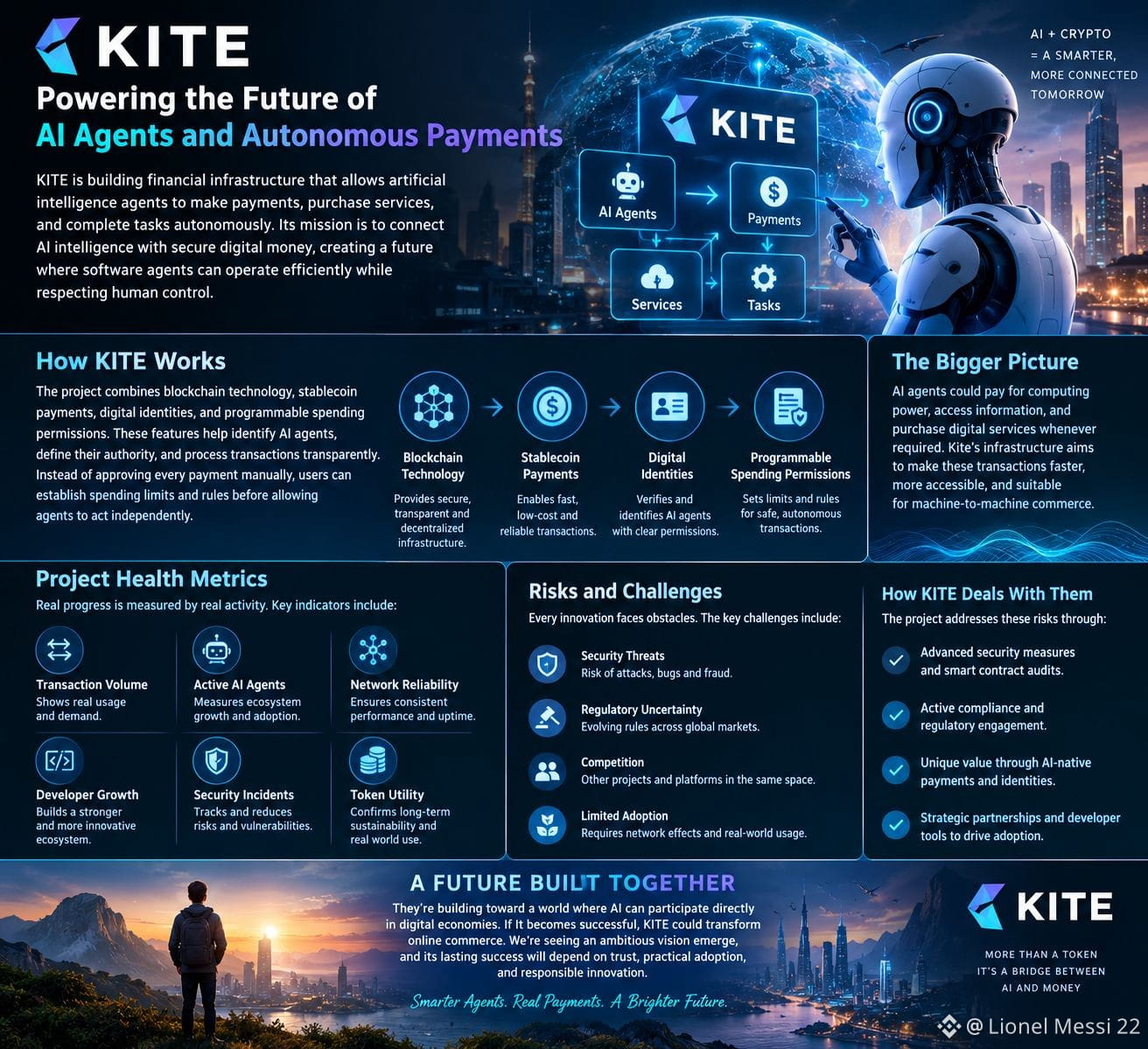
1
115

·
--
Most AI agents today can think, research, and even negotiate… but the moment they need to spend money, everything breaks.
That’s the gap Kite is actually filling.
With Agent Passport, your AI gets its own verifiable identity and a programmable wallet. You set the limits (how much it can spend, where it can pay, for how long), and the agent works inside those rules. No open wallets. No “hope it behaves.” The constraints are enforced on-chain.
Stablecoin settlement means no price swings between decision and payment. And because it’s built for agents from day one, micropayments and high-frequency actions actually make sense.
This is what the agent economy needs if it’s ever going to move past demos. Not more smart chatbots — real economic actors that can pay for compute, data, services, or goods without constant human babysitting.
Kite isn’t trying to be everything. It’s focused on the payment + identity layer so agents can finally act in the real economy under your control.
Curious to see how far this goes once more services plug in.
#KiteBBW $KITE @GoKiteAI
{future}(KITEUSDT)
Most AI agents today can think, research, and even negotiate… but the moment they need to spend money, everything breaks.
That’s the gap Kite is actually filling.
With Agent Passport, your AI gets its own verifiable identity and a programmable wallet. You set the limits (how much it can spend, where it can pay, for how long), and the agent works inside those rules. No open wallets. No “hope it behaves.” The constraints are enforced on-chain.
Stablecoin settlement means no price swings between decision and payment. And because it’s built for agents from day one, micropayments and high-frequency actions actually make sense.
This is what the agent economy needs if it’s ever going to move past demos. Not more smart chatbots — real economic actors that can pay for compute, data, services, or goods without constant human babysitting.
Kite isn’t trying to be everything. It’s focused on the payment + identity layer so agents can finally act in the real economy under your control.
Curious to see how far this goes once more services plug in.
#KiteBBW $KITE @KITE AI 中文

310
Log in to explore more content
Join global crypto users on Binance Square
⚡️ Get latest and useful information about crypto.
💬 Trusted by the world’s largest crypto exchange.
👍 Discover real insights from verified creators.
Email / Phone number
Trending Topics
1
#CanMicrosoftDeliverOnAI
231,580 views
1,920 Discussing
2
#CanGoogleDefindItsCore
132,411 views
1,405 Discussing
3
#EarningsSeason
5.8M views
27,896 Discussing
4
#BitcoinSurpasses$81K
1,160 views
30 Discussing
5
#RobinhoodFalls8.4%AfterItsResults
0 views
6 Discussing
6
#KOSPISurges6.63%BackAbove6000
651 views
41 Discussing
7
#DatavaultAICantWithdrawBitcoinFromBiconomy
2,027 views
60 Discussing
8
#FOMCWatch
9.2M views
29,106 Discussing
9
#HKPlacesTokenizedFundSecondaryTradingUnderETFLikeFramework
629 views
31 Discussing
10
#USGovSellsFTXLinkedAnthropicSharesFor$627M
941 views
29 Discussing