
#justinsunprize
justinsunprize
104 views
7 Discussing
Hot
Latest

·
--
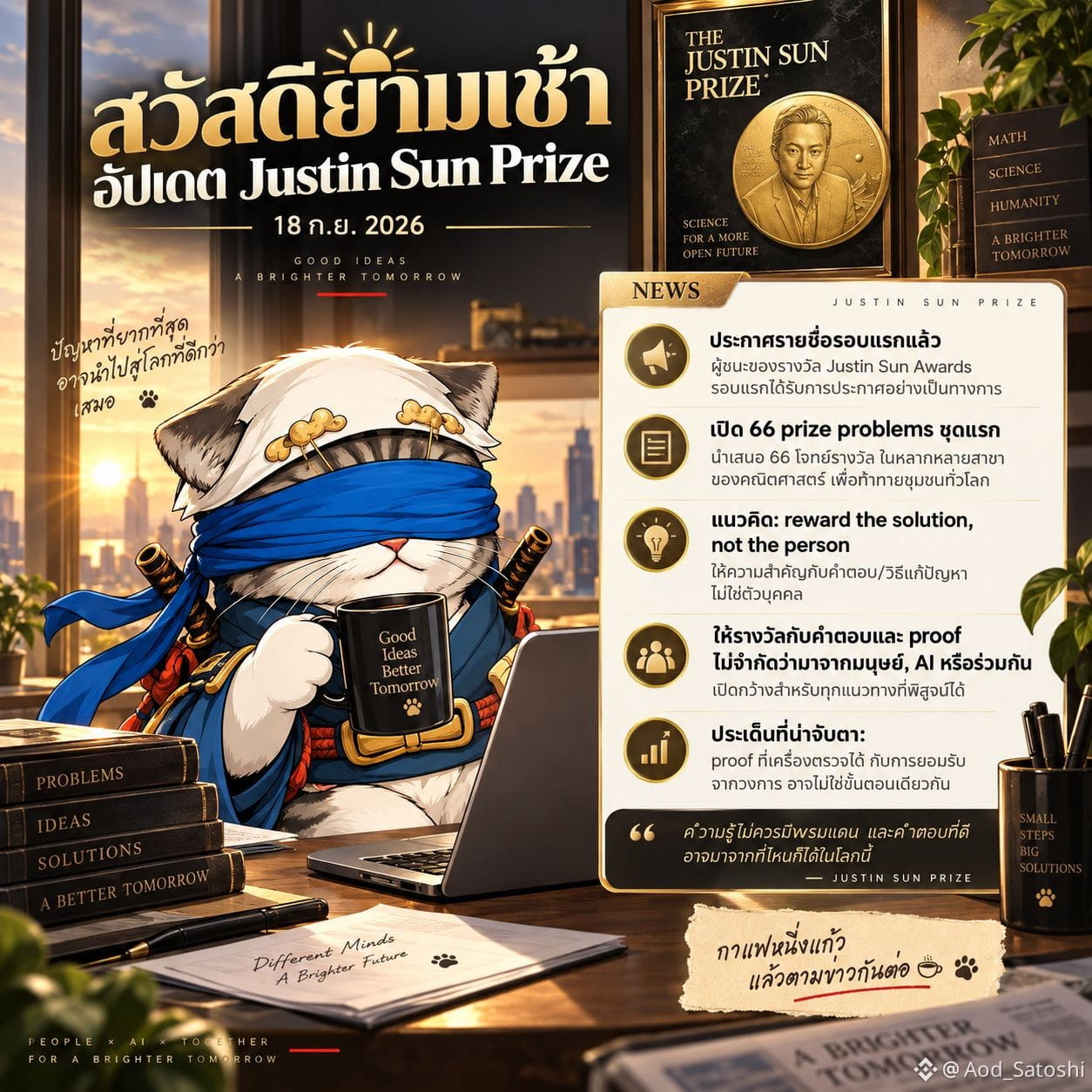
☀️ Good morning, everyone.
Yesterday I wrote about the Justin Sun Prize and why the interesting part isn’t just the prize money, but the idea of rewarding work that can actually be verified.
This morning, there’s another update worth watching 👀
Justin Sun has announced the first round of recognized winners, along with 66 prize problems built around a simple idea:
reward the solution, not the person.
That’s the part I find most interesting.
The focus is on the answer and the proof itself, whether it comes from a human, AI, or a collaboration between the two.
And that raises a bigger question.
In the AI era, should we care more about who produced the solution, or whether the result can actually be checked, reproduced, and verified?
Those two things are not always the same.
A proof that passes machine verification and a result that is formally accepted by the wider academic community may happen at different stages.
For me, that’s where this gets much more interesting than just “who won the prize.”
If AI starts contributing more seriously to mathematics and research, then verification may become just as important as discovery.
Coffee first, then back to following this story ☕️
I think this one still has a lot more to unfold.
@TRONDAO @TronDao_THA @justinsuntron
#TRONGlobalFriends #TGF #TRON #JustinSunPrize
☀️ Good morning, everyone.
Yesterday I wrote about the Justin Sun Prize and why the interesting part isn’t just the prize money, but the idea of rewarding work that can actually be verified.
This morning, there’s another update worth watching 👀
Justin Sun has announced the first round of recognized winners, along with 66 prize problems built around a simple idea:
reward the solution, not the person.
That’s the part I find most interesting.
The focus is on the answer and the proof itself, whether it comes from a human, AI, or a collaboration between the two.
And that raises a bigger question.
In the AI era, should we care more about who produced the solution, or whether the result can actually be checked, reproduced, and verified?
Those two things are not always the same.
A proof that passes machine verification and a result that is formally accepted by the wider academic community may happen at different stages.
For me, that’s where this gets much more interesting than just “who won the prize.”
If AI starts contributing more seriously to mathematics and research, then verification may become just as important as discovery.
Coffee first, then back to following this story ☕️
I think this one still has a lot more to unfold.
@TRON DAO @TronDao_THA @justinsuntron
#TRONGlobalFriends #TGF #TRON #JustinSunPrize
Yesterday I wrote about the Justin Sun Prize and why the interesting part isn’t just the prize money, but the idea of rewarding work that can actually be verified.
This morning, there’s another update worth watching 👀
Justin Sun has announced the first round of recognized winners, along with 66 prize problems built around a simple idea:
reward the solution, not the person.
That’s the part I find most interesting.
The focus is on the answer and the proof itself, whether it comes from a human, AI, or a collaboration between the two.
And that raises a bigger question.
In the AI era, should we care more about who produced the solution, or whether the result can actually be checked, reproduced, and verified?
Those two things are not always the same.
A proof that passes machine verification and a result that is formally accepted by the wider academic community may happen at different stages.
For me, that’s where this gets much more interesting than just “who won the prize.”
If AI starts contributing more seriously to mathematics and research, then verification may become just as important as discovery.
Coffee first, then back to following this story ☕️
I think this one still has a lot more to unfold.
@TRON DAO @TronDao_THA @justinsuntron
#TRONGlobalFriends #TGF #TRON #JustinSunPrize
1
64
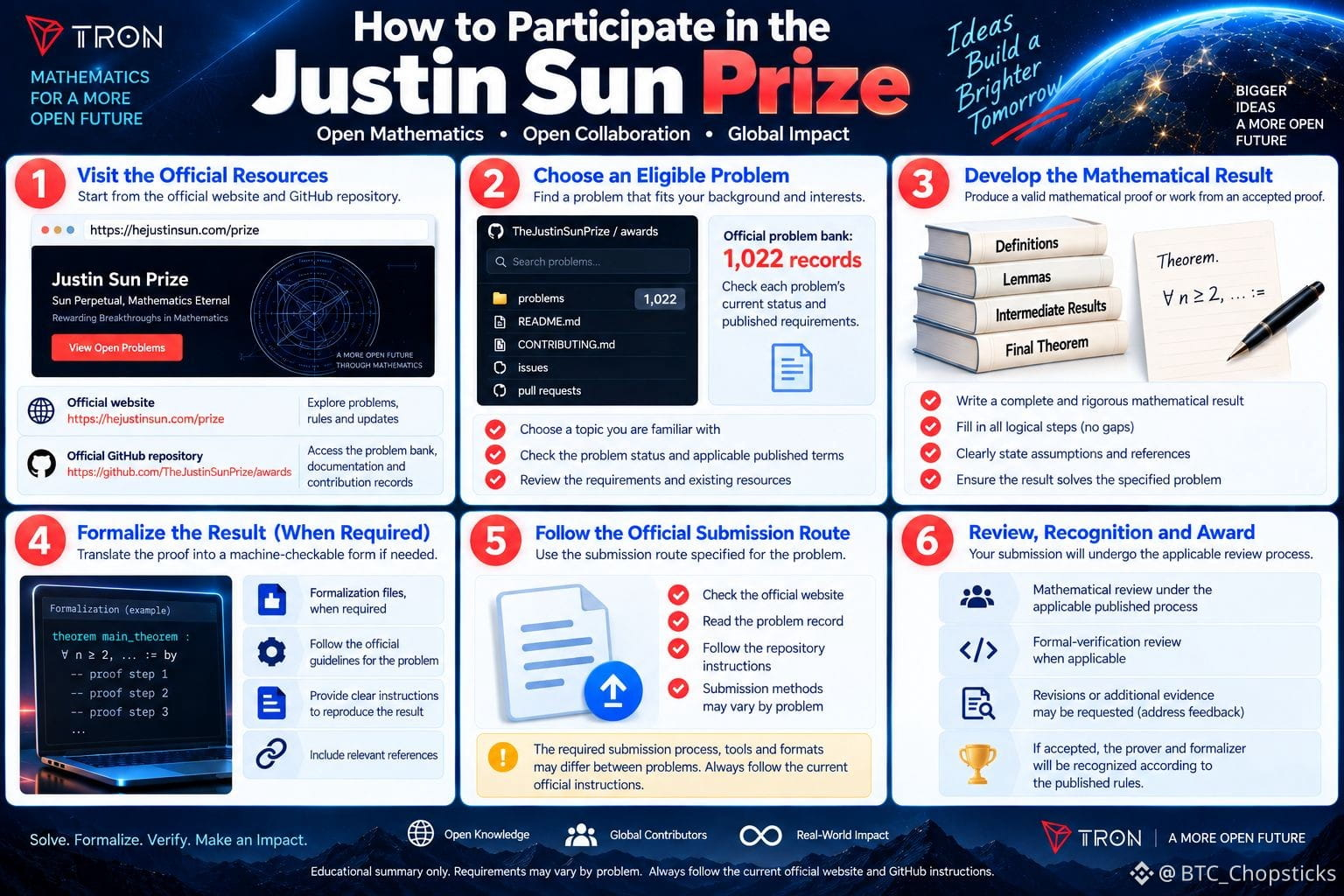
🏆 How do you participate in the Justin Sun Prize?
Start with the official question bank, which currently contains 1,022 mathematical problems.
But choosing a problem is only the beginning.
The program recognizes two important contributions:
🧠 The prover produces the mathematical result.
💻 The formalizer turns an accepted proof into a machine-checkable form when formal verification is required.
The same person may perform both roles, or different contributors can complete them.
📚 The basic process:
1️⃣ Choose an eligible problem from the official bank
2️⃣ Check its status and published requirements
3️⃣ Develop a complete mathematical proof
4️⃣ Formalize the result when required
5️⃣ Follow the official submission route for that problem
6️⃣ Complete the applicable review and verification process
⚠️ One important distinction:
A GitHub submission or successful software build alone does not mean a prize has been won. Requirements, tools and submission methods may differ between problems, and recognition follows the published rules.
💡 What interests me most is the standard being created for the AI era.
AI can generate answers quickly. Mathematics asks a harder question:
Can every step of the answer be proved and independently verified?
That combination of human reasoning, AI assistance and formal verification could become increasingly important as AI attempts harder mathematical problems.
Choose. Prove. Formalize. Verify. 🧠⚡
Official website:
https://hejustinsun.com/prize
Official GitHub:
https://github.com/TheJustinSunPrize/awards
@justinsuntron @TRONDAO @TronDao_THA
#JustinSunPrize #TRONGlobalFriends #TGF
🏆 How do you participate in the Justin Sun Prize?
Start with the official question bank, which currently contains 1,022 mathematical problems.
But choosing a problem is only the beginning.
The program recognizes two important contributions:
🧠 The prover produces the mathematical result.
💻 The formalizer turns an accepted proof into a machine-checkable form when formal verification is required.
The same person may perform both roles, or different contributors can complete them.
📚 The basic process:
1️⃣ Choose an eligible problem from the official bank
2️⃣ Check its status and published requirements
3️⃣ Develop a complete mathematical proof
4️⃣ Formalize the result when required
5️⃣ Follow the official submission route for that problem
6️⃣ Complete the applicable review and verification process
⚠️ One important distinction:
A GitHub submission or successful software build alone does not mean a prize has been won. Requirements, tools and submission methods may differ between problems, and recognition follows the published rules.
💡 What interests me most is the standard being created for the AI era.
AI can generate answers quickly. Mathematics asks a harder question:
Can every step of the answer be proved and independently verified?
That combination of human reasoning, AI assistance and formal verification could become increasingly important as AI attempts harder mathematical problems.
Choose. Prove. Formalize. Verify. 🧠⚡
Official website:
https://hejustinsun.com/prize
Official GitHub:
https://github.com/TheJustinSunPrize/awards
@justinsuntron @TRON DAO @TronDao_THA
#JustinSunPrize #TRONGlobalFriends #TGF
Start with the official question bank, which currently contains 1,022 mathematical problems.
But choosing a problem is only the beginning.
The program recognizes two important contributions:
🧠 The prover produces the mathematical result.
💻 The formalizer turns an accepted proof into a machine-checkable form when formal verification is required.
The same person may perform both roles, or different contributors can complete them.
📚 The basic process:
1️⃣ Choose an eligible problem from the official bank
2️⃣ Check its status and published requirements
3️⃣ Develop a complete mathematical proof
4️⃣ Formalize the result when required
5️⃣ Follow the official submission route for that problem
6️⃣ Complete the applicable review and verification process
⚠️ One important distinction:
A GitHub submission or successful software build alone does not mean a prize has been won. Requirements, tools and submission methods may differ between problems, and recognition follows the published rules.
💡 What interests me most is the standard being created for the AI era.
AI can generate answers quickly. Mathematics asks a harder question:
Can every step of the answer be proved and independently verified?
That combination of human reasoning, AI assistance and formal verification could become increasingly important as AI attempts harder mathematical problems.
Choose. Prove. Formalize. Verify. 🧠⚡
Official website:
https://hejustinsun.com/prize
Official GitHub:
https://github.com/TheJustinSunPrize/awards
@justinsuntron @TRON DAO @TronDao_THA
#JustinSunPrize #TRONGlobalFriends #TGF
140

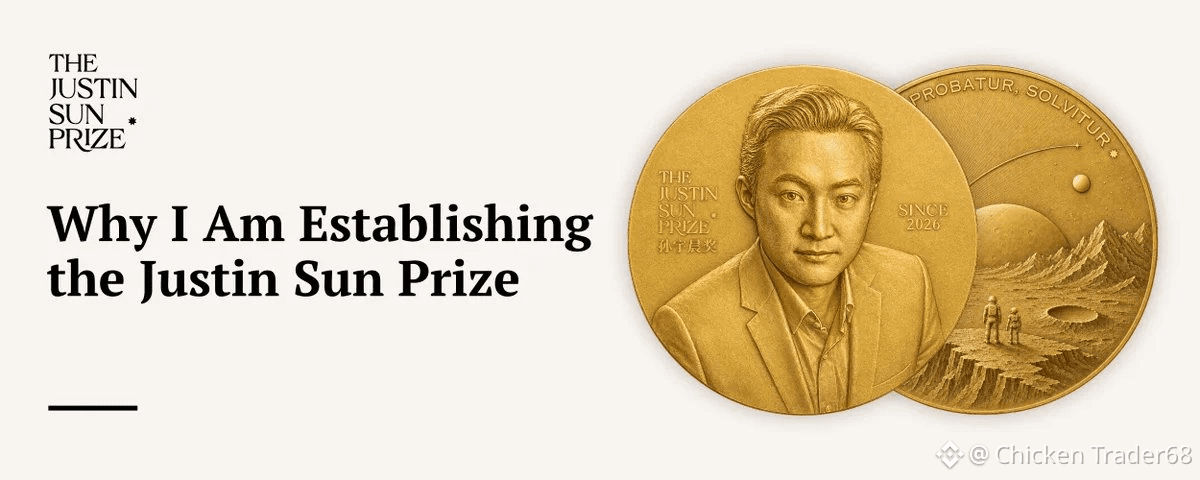
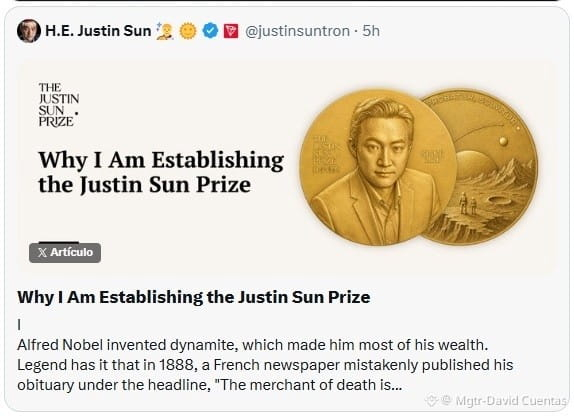
Reading Justin Sun’s post about the Justin Sun Prize, I don’t see this as just another mathematics award.
I see it as a way for someone from the blockchain industry to give back to the foundation that made crypto possible: mathematics, cryptography, hash functions, and elliptic curves.
Without mathematics, blockchain might still be nothing more than an idea on a whiteboard waiting for its first block while the gas fees keep rising.
What makes the Justin Sun Prize interesting is its focus on results rather than age, reputation, or traditional nominations.
A breakthrough can come from a human, an AI, or a combination of both. But to receive the reward, the proof must be formalized and verified by a machine from the first line to the last, without errors.
In simple terms:
→ The prover creates the breakthrough.
→ The formalizer turns it into something a machine can verify.
→ The blockchain records the process publicly and transparently.
I especially like the “waiting” mechanism. Once the mathematical community accepts a proof, the prover’s name is recorded first. The prize remains locked until the proof is formally verified.
That waiting period is not wasted time. It becomes a public list of important tasks for mathematicians, developers, and AI researchers to complete.
Justin Sun may still be a controversial figure, but reputation is not built by words alone. It is built by what remains after many years.
If this system works as designed, it could become a long-term investment in knowledge transparent like blockchain and enduring like mathematics.
LFG!!!
#Tron #JustinSunPrize
Reading Justin Sun’s post about the Justin Sun Prize, I don’t see this as just another mathematics award.
I see it as a way for someone from the blockchain industry to give back to the foundation that made crypto possible: mathematics, cryptography, hash functions, and elliptic curves.
Without mathematics, blockchain might still be nothing more than an idea on a whiteboard waiting for its first block while the gas fees keep rising.
What makes the Justin Sun Prize interesting is its focus on results rather than age, reputation, or traditional nominations.
A breakthrough can come from a human, an AI, or a combination of both. But to receive the reward, the proof must be formalized and verified by a machine from the first line to the last, without errors.
In simple terms:
→ The prover creates the breakthrough.
→ The formalizer turns it into something a machine can verify.
→ The blockchain records the process publicly and transparently.
I especially like the “waiting” mechanism. Once the mathematical community accepts a proof, the prover’s name is recorded first. The prize remains locked until the proof is formally verified.
That waiting period is not wasted time. It becomes a public list of important tasks for mathematicians, developers, and AI researchers to complete.
Justin Sun may still be a controversial figure, but reputation is not built by words alone. It is built by what remains after many years.
If this system works as designed, it could become a long-term investment in knowledge transparent like blockchain and enduring like mathematics.
LFG!!!
#Tron #JustinSunPrize
I see it as a way for someone from the blockchain industry to give back to the foundation that made crypto possible: mathematics, cryptography, hash functions, and elliptic curves.
Without mathematics, blockchain might still be nothing more than an idea on a whiteboard waiting for its first block while the gas fees keep rising.
What makes the Justin Sun Prize interesting is its focus on results rather than age, reputation, or traditional nominations.
A breakthrough can come from a human, an AI, or a combination of both. But to receive the reward, the proof must be formalized and verified by a machine from the first line to the last, without errors.
In simple terms:
→ The prover creates the breakthrough.
→ The formalizer turns it into something a machine can verify.
→ The blockchain records the process publicly and transparently.
I especially like the “waiting” mechanism. Once the mathematical community accepts a proof, the prover’s name is recorded first. The prize remains locked until the proof is formally verified.
That waiting period is not wasted time. It becomes a public list of important tasks for mathematicians, developers, and AI researchers to complete.
Justin Sun may still be a controversial figure, but reputation is not built by words alone. It is built by what remains after many years.
If this system works as designed, it could become a long-term investment in knowledge transparent like blockchain and enduring like mathematics.
LFG!!!
#Tron #JustinSunPrize
1
71

·
--
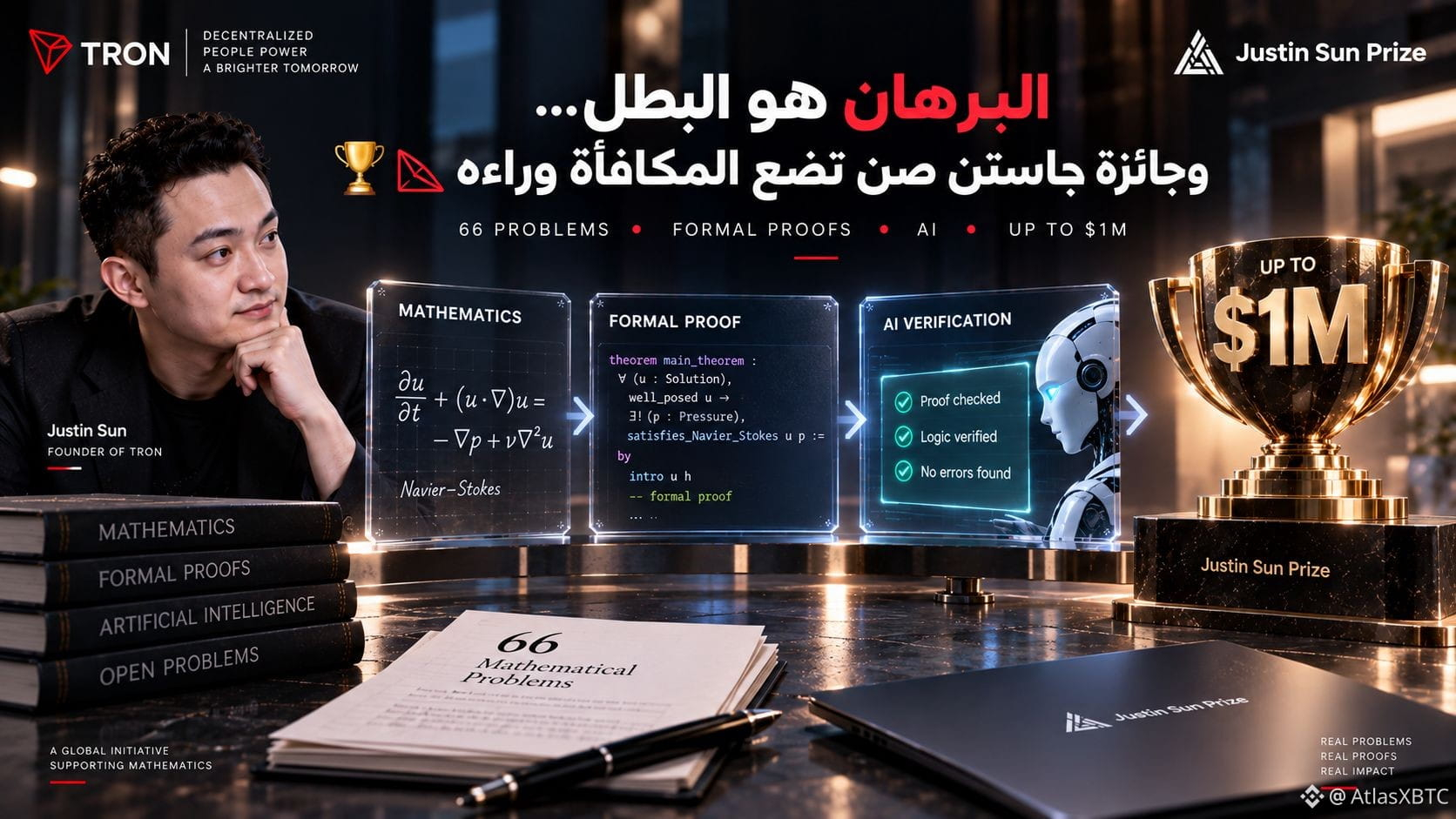
📢 Mathematics takes up a new space… and the Justin Sun Prize puts proof at the heart of the competition 🏆📐
The Justin Sun Prize offers rewards that can reach $1M for major achievements in fundamental mathematics, with a focus on formal proofs that machines can verify.
🧠 The program includes 66 problems related to solutions and formal proofs, and it opens the door to various areas of fundamental mathematics.
💻 The idea isn’t just to reach a correct answer, but to turn the result into a Formal Proof that can be verified using software tools—creating a clear intersection between mathematics and AI.
🤖 And according to the announcement, one of the early winners is a research team from OpenAI for work related to the Navier-Stokes problem.
🌍 Participation isn’t based on nominations or academic credentials, but on the contribution itself: whether the problem was solved and proven in the required form.
🎯 Bottom line: The prize provides a different model for rewarding mathematical achievements, combining fundamental mathematics, verifiable proofs, and AI, with rewards reaching up to $1M. 🚀
#TRON #TGF #TRONGlobalFriends
#JustinSunPrize #TRX
@JustinSun @TRONDAO
📢 Mathematics takes up a new space… and the Justin Sun Prize puts proof at the heart of the competition 🏆📐
The Justin Sun Prize offers rewards that can reach $1M for major achievements in fundamental mathematics, with a focus on formal proofs that machines can verify.
🧠 The program includes 66 problems related to solutions and formal proofs, and it opens the door to various areas of fundamental mathematics.
💻 The idea isn’t just to reach a correct answer, but to turn the result into a Formal Proof that can be verified using software tools—creating a clear intersection between mathematics and AI.
🤖 And according to the announcement, one of the early winners is a research team from OpenAI for work related to the Navier-Stokes problem.
🌍 Participation isn’t based on nominations or academic credentials, but on the contribution itself: whether the problem was solved and proven in the required form.
🎯 Bottom line: The prize provides a different model for rewarding mathematical achievements, combining fundamental mathematics, verifiable proofs, and AI, with rewards reaching up to $1M. 🚀
#TRON #TGF #TRONGlobalFriends
#JustinSunPrize #TRX
@Justin Sun孙宇晨 @TRON DAO
The Justin Sun Prize offers rewards that can reach $1M for major achievements in fundamental mathematics, with a focus on formal proofs that machines can verify.
🧠 The program includes 66 problems related to solutions and formal proofs, and it opens the door to various areas of fundamental mathematics.
💻 The idea isn’t just to reach a correct answer, but to turn the result into a Formal Proof that can be verified using software tools—creating a clear intersection between mathematics and AI.
🤖 And according to the announcement, one of the early winners is a research team from OpenAI for work related to the Navier-Stokes problem.
🌍 Participation isn’t based on nominations or academic credentials, but on the contribution itself: whether the problem was solved and proven in the required form.
🎯 Bottom line: The prize provides a different model for rewarding mathematical achievements, combining fundamental mathematics, verifiable proofs, and AI, with rewards reaching up to $1M. 🚀
#TRON #TGF #TRONGlobalFriends
#JustinSunPrize #TRX
@Justin Sun孙宇晨 @TRON DAO
صقر صنعاء:
ثروتي جاءت من الرياضيات وستعود إلى الرياضيات.. مقولة للتاريخ.
أقوى شيء في جائزة Justin Sun أنها أول جائزة بحثية zero-trust، لا واسطات ولا مجلات علمية، برهانك صحيح والماكينة تثبته في Lean تاخذ المليون دولار USDT مباشرة على السلسلة.
حل معادلة Navier-Stokes بعد 200 سنة من طرف OpenAI يثبت أننا دخلنا عصر جديد، عصر البرهان الآلي.
1
2
136

Verified
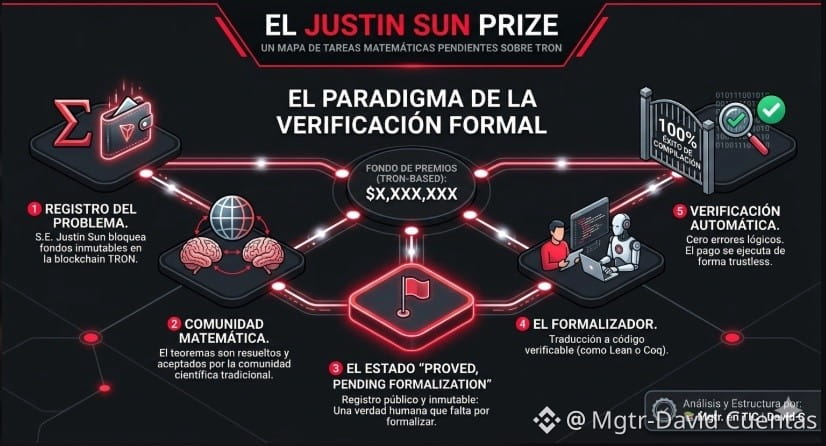
An exceptional analysis of the new formal verification paradigm introduced by Mr @Square-Creator-123571426 with #JustinSunPrize .🔴
In contrast to traditional philanthropy, this decentralized model rewards pure logic at the speed of the AI era, transforming human truths into immutable code verified by machines on the blockchain of $TRX .
I leave you a visual breakdown of the flow and its key states.
📚M.Sc. in ICT | David C🔽
An exceptional analysis of the new formal verification paradigm introduced by Mr @JustinSun with #JustinSunPrize .🔴
In contrast to traditional philanthropy, this decentralized model rewards pure logic at the speed of the AI era, transforming human truths into immutable code verified by machines on the blockchain of $TRX .
I leave you a visual breakdown of the flow and its key states.
📚M.Sc. in ICT | David C🔽
In contrast to traditional philanthropy, this decentralized model rewards pure logic at the speed of the AI era, transforming human truths into immutable code verified by machines on the blockchain of $TRX .
I leave you a visual breakdown of the flow and its key states.
📚M.Sc. in ICT | David C🔽
1
96
·
--
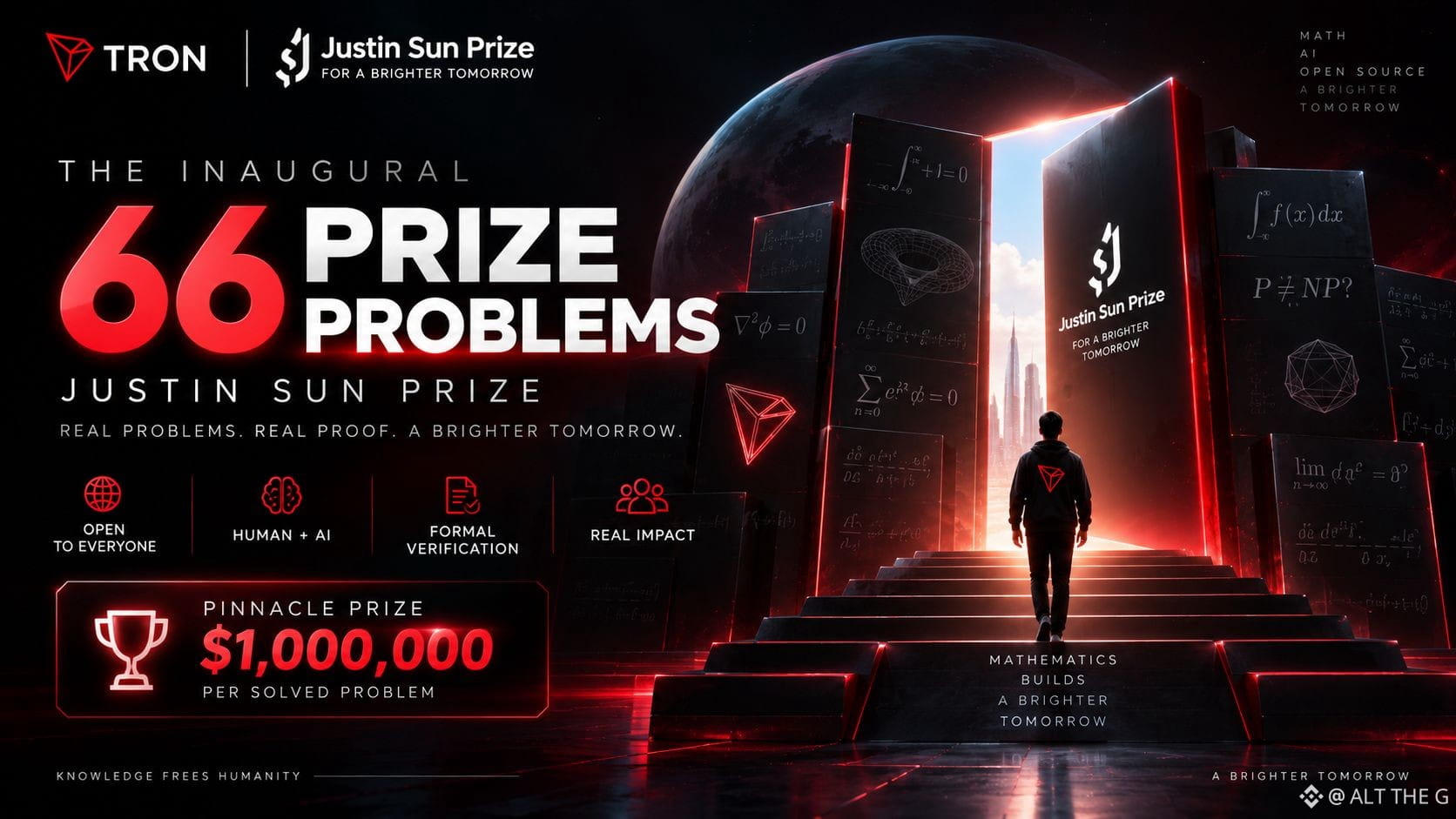
Another project by Justin Sun that I find extremely interesting this time has nothing to do with the price of $TRX or DeFi. Instead, it focuses on mathematics + AI + open source.
Recently, @justinsuntron launched The Inaugural 66 Prize Problems of #JustinSunPrize. The concept is quite different from traditional academic awards because this prize does not focus on “who you are, which university you come from, or how famous you are.”
What really matters is:
Can you solve the problem, and can your proof be verified by a machine?
The Justin Sun Prize uses a problem-list model, opening mathematical problems to participants from around the world—including researchers, developers, independent contributors, Human + AI teams, and AI-assisted researchers.
What I like most is that qualifying proofs must pass formal verification, such as through Lean. It is not enough to write an answer that merely appears correct. The proof must allow a machine to verify the logic from beginning to end.
Simply put:
It is not about “believing that it is correct.” It is about “proving it in a verifiable way.”
The highest prize tier, Pinnacle, offers a reward of $1,000,000 for each problem successfully solved and closed.
For me, the most interesting aspect of the first 66 Prize Problems is not just the prize money. It is the fact that this initiative is experimenting with a new model for research in the AI era.
Traditionally, the process looks like this:
A person formulates the problem → a mathematician develops the proof → experts read and review it.
But it could evolve into:
Humans think + AI assists with discovery + Machines verify the proof + Open source allows everyone to review it afterward
If this model succeeds, it could give individuals, small teams, and people outside prestigious universities more opportunities to solve world-class problems. In the end, what gets measured is not reputation, but the quality of the proof.
@JustinSunPrize @justinsuntron
#JustinSunPrize #TGF #TRONGlobalFriends #TRON
Another project by Justin Sun that I find extremely interesting this time has nothing to do with the price of $TRX or DeFi. Instead, it focuses on mathematics + AI + open source.
Recently, @justinsuntron launched The Inaugural 66 Prize Problems of #JustinSunPrize. The concept is quite different from traditional academic awards because this prize does not focus on “who you are, which university you come from, or how famous you are.”
What really matters is:
Can you solve the problem, and can your proof be verified by a machine?
The Justin Sun Prize uses a problem-list model, opening mathematical problems to participants from around the world—including researchers, developers, independent contributors, Human + AI teams, and AI-assisted researchers.
What I like most is that qualifying proofs must pass formal verification, such as through Lean. It is not enough to write an answer that merely appears correct. The proof must allow a machine to verify the logic from beginning to end.
Simply put:
It is not about “believing that it is correct.” It is about “proving it in a verifiable way.”
The highest prize tier, Pinnacle, offers a reward of $1,000,000 for each problem successfully solved and closed.
For me, the most interesting aspect of the first 66 Prize Problems is not just the prize money. It is the fact that this initiative is experimenting with a new model for research in the AI era.
Traditionally, the process looks like this:
A person formulates the problem → a mathematician develops the proof → experts read and review it.
But it could evolve into:
Humans think + AI assists with discovery + Machines verify the proof + Open source allows everyone to review it afterward
If this model succeeds, it could give individuals, small teams, and people outside prestigious universities more opportunities to solve world-class problems. In the end, what gets measured is not reputation, but the quality of the proof.
@JustinSunPrize @justinsuntron
#JustinSunPrize #TGF #TRONGlobalFriends #TRON
Recently, @justinsuntron launched The Inaugural 66 Prize Problems of #JustinSunPrize. The concept is quite different from traditional academic awards because this prize does not focus on “who you are, which university you come from, or how famous you are.”
What really matters is:
Can you solve the problem, and can your proof be verified by a machine?
The Justin Sun Prize uses a problem-list model, opening mathematical problems to participants from around the world—including researchers, developers, independent contributors, Human + AI teams, and AI-assisted researchers.
What I like most is that qualifying proofs must pass formal verification, such as through Lean. It is not enough to write an answer that merely appears correct. The proof must allow a machine to verify the logic from beginning to end.
Simply put:
It is not about “believing that it is correct.” It is about “proving it in a verifiable way.”
The highest prize tier, Pinnacle, offers a reward of $1,000,000 for each problem successfully solved and closed.
For me, the most interesting aspect of the first 66 Prize Problems is not just the prize money. It is the fact that this initiative is experimenting with a new model for research in the AI era.
Traditionally, the process looks like this:
A person formulates the problem → a mathematician develops the proof → experts read and review it.
But it could evolve into:
Humans think + AI assists with discovery + Machines verify the proof + Open source allows everyone to review it afterward
If this model succeeds, it could give individuals, small teams, and people outside prestigious universities more opportunities to solve world-class problems. In the end, what gets measured is not reputation, but the quality of the proof.
@JustinSunPrize @justinsuntron
#JustinSunPrize #TGF #TRONGlobalFriends #TRON
1
114
Log in to explore more content
Join global crypto users on Binance Square
⚡️ Get latest and useful information about crypto.
💬 Trusted by the world’s largest crypto exchange.
👍 Discover real insights from verified creators.
Email / Phone number
Trending Topics
1
#HYPEJumpsOver11%
747 views
56 Discussing
2
#BitcoinSpotETFsNetInflow$159M
248 views
31 Discussing
3
#HKMAPlansWholesaleCBDCByYearEnd
8,295 views
308 Discussing
4
#NEARSurges26%Past$3.45
9,732 views
102 Discussing
5
#BOJHikesRatesTo31YearHigh
26,525 views
665 Discussing
6
#EvernorthRaises$30MToBuyXRP
404 views
20 Discussing
7
#ChainlinkPowersBottomlinePaymentPlatform
27,608 views
624 Discussing
8
#DtcpayCompletes$25MSeriesA
854 views
26 Discussing
9
#InjectiveLaunchesINJOnSolana
5,997 views
148 Discussing
10
#StellarActivatesProtocol28At211TPS
33,075 views
700 Discussing