gonka

815 views
9 Discussing
WEB3韭菜小凯
·
--
Article
One key swap, and the money in the bridge belonged to someone elseOn November 18, Gonka’s Ethereum bridge was drained. The bridge wasn’t broken into; its key was replaced first. Blockaid raised the alarm that day: the attacker replaced the BLS group key, which the bridge rotates every epoch, with their own, withdrew the stablecoins left in the bridge, and minted 22 million WGNK out of thin air. Five transactions totaling about $1.05 million. The attack was still underway when the alarm was raised. At 12:08 UTC, the attack address first received 0.05 ETH. At exactly 18:00 UTC, an ordinary account called submitGroupKey, writing a new group key into the bridge contract. A minute later, 884,150.87 USDT and 647.74 USDC were withdrawn. Another minute later, 22 million WGNK were minted, worth about $172,000 at the time. Six hours to prepare; two minutes to strike.

One key swap, and the money in the bridge belonged to someone else

On November 18, Gonka’s Ethereum bridge was drained. The bridge wasn’t broken into; its key was replaced first. Blockaid raised the alarm that day: the attacker replaced the BLS group key, which the bridge rotates every epoch, with their own, withdrew the stablecoins left in the bridge, and minted 22 million WGNK out of thin air. Five transactions totaling about $1.05 million. The attack was still underway when the alarm was raised.
At 12:08 UTC, the attack address first received 0.05 ETH. At exactly 18:00 UTC, an ordinary account called submitGroupKey, writing a new group key into the bridge contract. A minute later, 884,150.87 USDT and 647.74 USDC were withdrawn. Another minute later, 22 million WGNK were minted, worth about $172,000 at the time. Six hours to prepare; two minutes to strike.
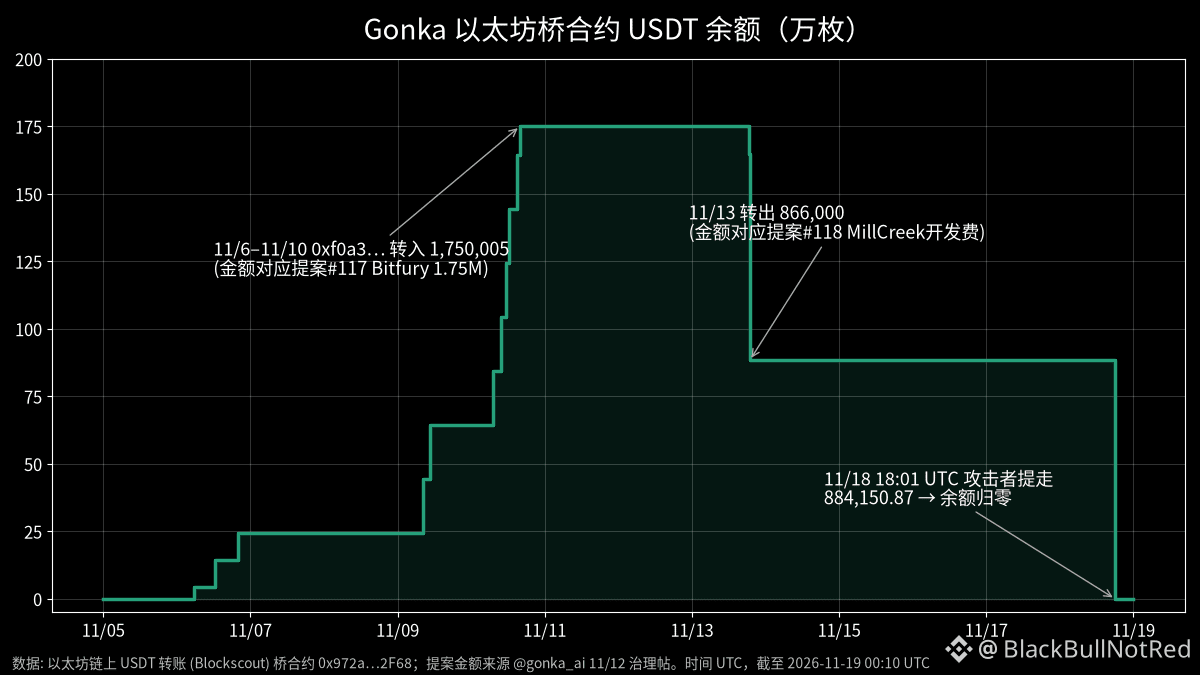
The 884,000 USDT taken from the Gonka bridge this time was not some kind of “user cross-chain reserve”—it was basically money from their own community treasury. You can see it clearly by checking the on-chain transactions. From 11/6 to 11/10, address 0xf0a3… sent 1,750,005 USDT to the Ethereum bridge contract in more than a dozen transactions. That matches Gonka governance proposal #117: Bitfury would buy another batch of GNK under a 12M USDT framework agreement, paying 1.75M USDT. I can't confirm whether this address actually belongs to Bitfury; I can only say that the numbers match. On 11/13, the bridge contract sent out exactly 866,000 USDT in four transactions—down to the last cent, that matches the amount for two months of development fees for proposal #118付给MillCreek R&D (a company set up by Gonka contributors). That left 884,150 USDT. At 2 a.m. Beijing time on the 19th (18:01 UTC on the 18th), the attacker took 884,150.87 in a single transaction, leaving not even the spare change behind. In other words, this bridge was moonlighting as the treasury's safe. Even more ironic, proposal #117 explicitly says that 0.6M of the 1.75M was to reimburse bug bounty and security audit costs. The audit fees had just been reimbursed, and then the money disappeared into the bridge. The exploit wasn't fancy. According to the bridge contract documentation in Gonka's public repository, anyone can call submitGroupKey, as long as they provide the previous epoch validators' BLS threshold signature; then the new group key takes effect. And this key controls two things at once: batch withdrawals and batch WGNK minting. The on-chain sequence was: a new key was submitted at 18:00:59, stablecoins were withdrawn at 18:01, and 22 million WGNK were minted at 18:02. It's still unclear whether the previous round's signature was forged, the threshold private key was leaked, or there was a bug in the signature verification itself. But the takeaway is already clear: threshold signatures may sound decentralized, but in practice, their security is only as strong as the weakest validator handover. The ones who should really be losing sleep are WGNK holders. Before the attack, the total WGNK supply was about 13.09 million tokens. The attacker minted 22 million in one go—1.68 times the original supply. Of those, 13 million were sent back to the bridge contract to be burned; under the contract's design, that amounts to a request to exchange them for native GNK. Whether the Gonka chain has approved that request will directly determine how much GNK remains to back all the WGNK in custody. That's the biggest unknown right now. The official X account's latest post is still a repost of a Forbes article from the 17th; not a word since. The price has already voted: according to CoinGecko hourly data, WGNK was still at 0.143 at 18:00 UTC on the 18th; now it's at 0.023, down 84%. Don't rush in to buy the dip just because it's trading at a discount. A wrapped token's discount is essentially a discount on its redemption rights—and those rights are in the hands of a team that hasn't said a word. One more bit of dark humor: the attacker converted the money to ETH and sent it out, but the address is full of fake token transfers impersonating ETH and spoofed addresses starting with 0xdE35…. The hacker got hit by address poisoning too. No one in this space is safe. #Gonka #Cross-chain bridge
The 884,000 USDT taken from the Gonka bridge this time was not some kind of “user cross-chain reserve”—it was basically money from their own community treasury.

You can see it clearly by checking the on-chain transactions.
From 11/6 to 11/10, address 0xf0a3… sent 1,750,005 USDT to the Ethereum bridge contract in more than a dozen transactions. That matches Gonka governance proposal #117: Bitfury would buy another batch of GNK under a 12M USDT framework agreement, paying 1.75M USDT. I can't confirm whether this address actually belongs to Bitfury; I can only say that the numbers match.
On 11/13, the bridge contract sent out exactly 866,000 USDT in four transactions—down to the last cent, that matches the amount for two months of development fees for proposal #118付给MillCreek R&D (a company set up by Gonka contributors).
That left 884,150 USDT. At 2 a.m. Beijing time on the 19th (18:01 UTC on the 18th), the attacker took 884,150.87 in a single transaction, leaving not even the spare change behind.

In other words, this bridge was moonlighting as the treasury's safe. Even more ironic, proposal #117 explicitly says that 0.6M of the 1.75M was to reimburse bug bounty and security audit costs. The audit fees had just been reimbursed, and then the money disappeared into the bridge.

The exploit wasn't fancy. According to the bridge contract documentation in Gonka's public repository, anyone can call submitGroupKey, as long as they provide the previous epoch validators' BLS threshold signature; then the new group key takes effect. And this key controls two things at once: batch withdrawals and batch WGNK minting. The on-chain sequence was: a new key was submitted at 18:00:59, stablecoins were withdrawn at 18:01, and 22 million WGNK were minted at 18:02. It's still unclear whether the previous round's signature was forged, the threshold private key was leaked, or there was a bug in the signature verification itself. But the takeaway is already clear: threshold signatures may sound decentralized, but in practice, their security is only as strong as the weakest validator handover.

The ones who should really be losing sleep are WGNK holders. Before the attack, the total WGNK supply was about 13.09 million tokens. The attacker minted 22 million in one go—1.68 times the original supply. Of those, 13 million were sent back to the bridge contract to be burned; under the contract's design, that amounts to a request to exchange them for native GNK. Whether the Gonka chain has approved that request will directly determine how much GNK remains to back all the WGNK in custody. That's the biggest unknown right now. The official X account's latest post is still a repost of a Forbes article from the 17th; not a word since.

The price has already voted: according to CoinGecko hourly data, WGNK was still at 0.143 at 18:00 UTC on the 18th; now it's at 0.023, down 84%. Don't rush in to buy the dip just because it's trading at a discount. A wrapped token's discount is essentially a discount on its redemption rights—and those rights are in the hands of a team that hasn't said a word.

One more bit of dark humor: the attacker converted the money to ETH and sent it out, but the address is full of fake token transfers impersonating ETH and spoofed addresses starting with 0xdE35…. The hacker got hit by address poisoning too. No one in this space is safe.

#Gonka #Cross-chain bridge

Bitcoin Up or Down on November 19?

Bitcoin Up or Down on November 19?

99%Up1%Down
Volume $191,850.23
Log in to explore more content
Join global crypto users on Binance Square
⚡️ Get latest and useful information about crypto.
💬 Trusted by the world’s largest crypto exchange.
👍 Discover real insights from verified creators.
Email / Phone number