
#gtlb
gtlb
1,100 views
48 Discussing
Hot
Latest

$GTLB current price 47.32; in the past 24 hours it fell 5.284%. The funding rate is 0.00108717, staying positive. Open interest is 2282.89. Downward price movement combined with positive funding is a typical signal that longs are holding up the position. Longs are paying the shorts while their own positions are still showing unrealized losses. This structure can easily evolve into a passive liquidation cascade.
Why do I see it this way? A funding rate greater than zero means long sentiment hasn’t cooled off yet, but the price has already dropped. This suggests longs may be adding to positions while prices are falling, trying to average down their cost. This is different from simply chasing bullish momentum. Here, longs add after being trapped, and costs are accumulating. Open interest of 2282.89 shows no dramatic change, indicating that the large players haven’t admitted defeat yet; the battle within the market is still in a stalemate. Judging purely from the contract data, this is a fragile equilibrium: longs are propping themselves up with positive funding. If the price drops again, their margin may not hold, triggering a chain reaction of liquidations.
The strongest counter-indicator is a sudden shift in external macro risk appetite. If the US stock market rebounds strongly due to favorable macro data—lifting risk assets broadly—$GTLB may be picked up by capital, helping longs unwind their positions and possibly allowing the funding rate to be absorbed by price increases. But the input contains no current macro variables, such as non-farm payrolls or CPI, so I can’t quantify that probability. Therefore, my current view is entirely based on a single inference from the contract structure.
The second-order effects are very direct: if the price continues to drift lower, with positive funding persisting, longs will be forced to gradually close positions, increasing sell pressure and possibly accelerating the decline. On the short side, they’re collecting funding, so they have an incentive to maintain their positions until longs get liquidated. Liquidity will flow from longs’ pockets to shorts’. As a result, the longs’ cost basis in the entire contract market keeps getting higher.
My conclusion is: the contract structure of $GTLB is issuing an early warning of short-term pullback risk. Longs are crowded and trapped/passive. The condition under which this view fails is if the price strongly rebounds to above 48 and funding simultaneously turns negative, indicating shorts are starting to concede—then a squeeze could begin.
In terms of action, I won’t touch any long positions. If there are existing long positions, I would cut half when the price tests 47 again. I’ll treat the funding rate as the core monitoring indicator. If funding rises above 0.002 and the price hasn’t increased, I will fully exit the remaining position.
Trading tag: #TradFi #链上美股 #GTLB
Where do you think this analysis is most likely to be wrong?
Why do I see it this way? A funding rate greater than zero means long sentiment hasn’t cooled off yet, but the price has already dropped. This suggests longs may be adding to positions while prices are falling, trying to average down their cost. This is different from simply chasing bullish momentum. Here, longs add after being trapped, and costs are accumulating. Open interest of 2282.89 shows no dramatic change, indicating that the large players haven’t admitted defeat yet; the battle within the market is still in a stalemate. Judging purely from the contract data, this is a fragile equilibrium: longs are propping themselves up with positive funding. If the price drops again, their margin may not hold, triggering a chain reaction of liquidations.
The strongest counter-indicator is a sudden shift in external macro risk appetite. If the US stock market rebounds strongly due to favorable macro data—lifting risk assets broadly—$GTLB may be picked up by capital, helping longs unwind their positions and possibly allowing the funding rate to be absorbed by price increases. But the input contains no current macro variables, such as non-farm payrolls or CPI, so I can’t quantify that probability. Therefore, my current view is entirely based on a single inference from the contract structure.
The second-order effects are very direct: if the price continues to drift lower, with positive funding persisting, longs will be forced to gradually close positions, increasing sell pressure and possibly accelerating the decline. On the short side, they’re collecting funding, so they have an incentive to maintain their positions until longs get liquidated. Liquidity will flow from longs’ pockets to shorts’. As a result, the longs’ cost basis in the entire contract market keeps getting higher.
My conclusion is: the contract structure of $GTLB is issuing an early warning of short-term pullback risk. Longs are crowded and trapped/passive. The condition under which this view fails is if the price strongly rebounds to above 48 and funding simultaneously turns negative, indicating shorts are starting to concede—then a squeeze could begin.
In terms of action, I won’t touch any long positions. If there are existing long positions, I would cut half when the price tests 47 again. I’ll treat the funding rate as the core monitoring indicator. If funding rises above 0.002 and the price hasn’t increased, I will fully exit the remaining position.
Trading tag: #TradFi #链上美股 #GTLB
Where do you think this analysis is most likely to be wrong?
$GTLB In the past 24 hours, it has fallen 5.28%, quoted at 47.32, with the funding rate stuck at a high 0.001087. The longs are still paying the shorts, yet the price keeps moving down—this structure clearly indicates the longs are trapped.
Falling price plus a positive funding rate means the longs’ position cost is accumulating every 8 hours. The shorts just lie back and collect money without taking on any funding pressure. If the price continues to drift lower, the long liquidation threshold will keep getting closer. This is a single-signal assessment. Since the input does not provide any sector rotation or macro variables, the causal chain cannot be expanded; but based on the contract data, the longs are holding the bag while the shorts are pressing the price.
The strongest counterevidence is that the funding rate suddenly turns negative. If in the next phase $GTLB ’s funding drops below zero, it would indicate the shorts start covering, and the price could rebound quickly. The current data does not support this scenario, but this possibility must be pointed out. Another counterpoint is that volume expands in tandem with price stabilizing; however, vol is 332286 in the input and its unit is unknown, so it cannot be converted with OI—therefore I won’t write that in.
The second-order effects are direct: if longs are forced to liquidate, selling pressure increases, and the price could fall faster. After shorts take profit, they might roll into other assets, causing liquidity to rotate. Who bears the cost? The longs. Who is forced to act? Heavily positioned longs and low-leverage accounts.
Invalidation conditions must be clearly stated: if the $GTLB price reclaims 47.32 and the funding rate drops below 0.0005, then my judgment fails. The current price is merely a reference point—I am not fabricating any support levels.
Action layer: don’t touch the longs. The trigger condition is the funding rate turning negative—then I will reassess the opportunity to go long; if the price breaks below 45 and the funding rate remains positive, I will consider flipping to short.
Aggressive strategy: wait until funding turns negative, then try a small long position. Conservative strategy: stay on the sidelines until the price holds above 47.32 and the open position size declines. Risk-avoidance strategy: stay away from any long positions until the funding rate returns to zero.
What the market is ignoring is that positive funding in a falling market is poison—longs are bleeding every hour.
Trading tag: #TradFi #链上美股 #GTLB
Where do you think this set of judgments is most likely to be wrong?
Falling price plus a positive funding rate means the longs’ position cost is accumulating every 8 hours. The shorts just lie back and collect money without taking on any funding pressure. If the price continues to drift lower, the long liquidation threshold will keep getting closer. This is a single-signal assessment. Since the input does not provide any sector rotation or macro variables, the causal chain cannot be expanded; but based on the contract data, the longs are holding the bag while the shorts are pressing the price.
The strongest counterevidence is that the funding rate suddenly turns negative. If in the next phase $GTLB ’s funding drops below zero, it would indicate the shorts start covering, and the price could rebound quickly. The current data does not support this scenario, but this possibility must be pointed out. Another counterpoint is that volume expands in tandem with price stabilizing; however, vol is 332286 in the input and its unit is unknown, so it cannot be converted with OI—therefore I won’t write that in.
The second-order effects are direct: if longs are forced to liquidate, selling pressure increases, and the price could fall faster. After shorts take profit, they might roll into other assets, causing liquidity to rotate. Who bears the cost? The longs. Who is forced to act? Heavily positioned longs and low-leverage accounts.
Invalidation conditions must be clearly stated: if the $GTLB price reclaims 47.32 and the funding rate drops below 0.0005, then my judgment fails. The current price is merely a reference point—I am not fabricating any support levels.
Action layer: don’t touch the longs. The trigger condition is the funding rate turning negative—then I will reassess the opportunity to go long; if the price breaks below 45 and the funding rate remains positive, I will consider flipping to short.
Aggressive strategy: wait until funding turns negative, then try a small long position. Conservative strategy: stay on the sidelines until the price holds above 47.32 and the open position size declines. Risk-avoidance strategy: stay away from any long positions until the funding rate returns to zero.
What the market is ignoring is that positive funding in a falling market is poison—longs are bleeding every hour.
Trading tag: #TradFi #链上美股 #GTLB
Where do you think this set of judgments is most likely to be wrong?
$GTLB The current price is 47.32, and within the past 24 hours it’s fallen by 5.284%. Looking at price movement alone, it doesn’t seem that dramatic, but combined with its current funding rate, things get more interesting: the rate is positive, at 0.00108717.
What does this mean? The rules are strict: when the funding rate is positive, longs are paying shorts. The price is dropping, yet longs are still paying money—that’s the classic structure of longs getting trapped while still adding to positions. This kind of combination often implies that long positions’ cost basis is accumulating. Once the price fails to rebound meaningfully, long losses and funding-rate costs can pile up together, pushing closer to the liquidation line. This is a single-signal judgment, because I don’t have any news or more macro variables in hand to cross-validate.
What’s the strongest counterargument? If the price rebounds quickly next, and the funding rate turns negative in sync, that would suggest today’s drop may have triggered large-scale buildup by shorts—instead, you might see a burst aimed at shorts (a short squeeze), and my judgment would no longer hold. Watching whether the funding rate shifts as the price rebounds is key to judging whether this long-side predicament persists.
So my move is clear: for the long positions holding this contract, if the price near 47.32 can’t stabilize effectively, I’ll consider trimming on the rebound—not stubbornly holding on.
For observers on the sidelines: now is not the time to buy the dip; you need to wait for the funding-rate structure to change.
Three scenario summaries:
Aggressive: If the price can hold above the current level and the funding rate flips to negative quickly, you can try a small long position to bet on the upside elasticity of a short squeeze.
Steady: Wait and watch. Wait for the price to show a clear direction, or for the funding rate to turn neutral or even negative.
Avoidance: Absolutely avoid going long when price is falling and the funding rate is positive at the same time—this is the beginning of a typical negative-feedback loop.
One thing the market is ignoring right now: in an environment where overall risk appetite is shrinking, this kind of “stocks-style” perpetual contract with price falling and funding rate positive may be more fragile—and more lethal—than a plain price decline alone.
Trading tag: #TradFi #链上美股 #GTLB
Where do you think this whole assessment is most likely to be wrong?
What does this mean? The rules are strict: when the funding rate is positive, longs are paying shorts. The price is dropping, yet longs are still paying money—that’s the classic structure of longs getting trapped while still adding to positions. This kind of combination often implies that long positions’ cost basis is accumulating. Once the price fails to rebound meaningfully, long losses and funding-rate costs can pile up together, pushing closer to the liquidation line. This is a single-signal judgment, because I don’t have any news or more macro variables in hand to cross-validate.
What’s the strongest counterargument? If the price rebounds quickly next, and the funding rate turns negative in sync, that would suggest today’s drop may have triggered large-scale buildup by shorts—instead, you might see a burst aimed at shorts (a short squeeze), and my judgment would no longer hold. Watching whether the funding rate shifts as the price rebounds is key to judging whether this long-side predicament persists.
So my move is clear: for the long positions holding this contract, if the price near 47.32 can’t stabilize effectively, I’ll consider trimming on the rebound—not stubbornly holding on.
For observers on the sidelines: now is not the time to buy the dip; you need to wait for the funding-rate structure to change.
Three scenario summaries:
Aggressive: If the price can hold above the current level and the funding rate flips to negative quickly, you can try a small long position to bet on the upside elasticity of a short squeeze.
Steady: Wait and watch. Wait for the price to show a clear direction, or for the funding rate to turn neutral or even negative.
Avoidance: Absolutely avoid going long when price is falling and the funding rate is positive at the same time—this is the beginning of a typical negative-feedback loop.
One thing the market is ignoring right now: in an environment where overall risk appetite is shrinking, this kind of “stocks-style” perpetual contract with price falling and funding rate positive may be more fragile—and more lethal—than a plain price decline alone.
Trading tag: #TradFi #链上美股 #GTLB
Where do you think this whole assessment is most likely to be wrong?
$GTLB 24 hours saw a 5.284% drop, price at 47.32, while the funding rate stayed positive at 0.00108717. This combination is clear: the price is falling, yet longs are still paying shorts; the bullish consensus hasn’t broken—it’s just losing money while holding on.
A price drop paired with a positive funding rate—translated into positioning language—means longs are getting trapped and adding more. A funding rate above zero means longs pay shorts. As price moves downward, longs pay every 8 hours, and their position costs keep accumulating. Open interest is 2282.89. If this number doesn’t drop quickly, it suggests longs haven’t broadly pulled out yet, and liquidation pressure is building. This is a single-signal read, because there’s no cross-validation with news or macro data—purely based on the funding rate and the price structure.
The strongest counterevidence is: a positive funding rate could simply reflect market inertia. If price rebounds next, longs can shift from losses to profit, and the “paying” state turns into a position advantage. What data would invalidate my view? If the $GTLB price returns above 48 and the funding rate turns negative, then my judgment fails—meaning shorts start to dominate and market sentiment flips.
Second-order effects: if price continues to test lower, longs will be forced to rebalance and reduce positions, especially for accounts with high leverage—liquidations can drive liquidity out. In the on-chain derivatives market, if the funding rate stays consistently positive, market makers may increase short exposure to earn the funding, further pressuring the price downward.
My plan: wait and watch. The trigger is: if $GTLB drops below 45 and the funding rate remains above 0.001, I would consider going short on the on-chain derivatives market, but the position must be light. Conversely, if price holds above 46 and the funding rate quickly falls back near 0, that might just be a technical pullback, and I’ll wait for more data.
Three scenarios: the aggressive traders short small size now, betting on liquidation acceleration; the cautious wait for the funding rate to turn negative or for a breakdown before acting; avoiders don’t touch it and wait for macro events like O or FOMC to land. The market ignores the reality that longs are paying and losing time—this structure won’t hold for long.
Trading tag: #TradFi #链上美股 #GTLB
Where do you think this assessment is most likely to be wrong?
A price drop paired with a positive funding rate—translated into positioning language—means longs are getting trapped and adding more. A funding rate above zero means longs pay shorts. As price moves downward, longs pay every 8 hours, and their position costs keep accumulating. Open interest is 2282.89. If this number doesn’t drop quickly, it suggests longs haven’t broadly pulled out yet, and liquidation pressure is building. This is a single-signal read, because there’s no cross-validation with news or macro data—purely based on the funding rate and the price structure.
The strongest counterevidence is: a positive funding rate could simply reflect market inertia. If price rebounds next, longs can shift from losses to profit, and the “paying” state turns into a position advantage. What data would invalidate my view? If the $GTLB price returns above 48 and the funding rate turns negative, then my judgment fails—meaning shorts start to dominate and market sentiment flips.
Second-order effects: if price continues to test lower, longs will be forced to rebalance and reduce positions, especially for accounts with high leverage—liquidations can drive liquidity out. In the on-chain derivatives market, if the funding rate stays consistently positive, market makers may increase short exposure to earn the funding, further pressuring the price downward.
My plan: wait and watch. The trigger is: if $GTLB drops below 45 and the funding rate remains above 0.001, I would consider going short on the on-chain derivatives market, but the position must be light. Conversely, if price holds above 46 and the funding rate quickly falls back near 0, that might just be a technical pullback, and I’ll wait for more data.
Three scenarios: the aggressive traders short small size now, betting on liquidation acceleration; the cautious wait for the funding rate to turn negative or for a breakdown before acting; avoiders don’t touch it and wait for macro events like O or FOMC to land. The market ignores the reality that longs are paying and losing time—this structure won’t hold for long.
Trading tag: #TradFi #链上美股 #GTLB
Where do you think this assessment is most likely to be wrong?

An old dog glanced at the order book of $GTLB : over the past 24 hours it’s down 6.659%, and the current price is stuck at 47.38. This drop isn’t small, but more importantly, the funding rate over the same period is 0.00019852—still positive. With prices falling, longs are still paying shorts. In the old dog’s experience, that combination is rarely a good sign.
The funding-rate direction rule is crystal clear: if the rate is above zero, it means longs are subsidizing shorts. It implies that the on-exchange long sentiment is still crowded—or that a group of longs, when the price is falling, chooses to hold their positions or even add more, keeping the funding rate stubbornly positive. This matches the classic structure of “price falling + positive funding = longs trapped and adding to the trap.” At this moment, the longs are passively accumulating cost, but there’s no upward breakout momentum. They’re the ones stuck.
The trading volume is over 330,000—nothing particularly active. Open interest is 2026.88, which suggests the leverage capital itself isn’t large. But precisely because the position size is relatively small, once crowded positions face a concentrated liquidation, the price’s instant volatility could be more violent than people expect. There’s no on-chain open-position data here, so the old dog can’t tell whether a whale is dominating. He can only infer market sentiment imbalance from this single derivative funding-rate signal.
So the old dog’s conclusion is straightforward: $GTLB is in a fragile equilibrium right now. Longs are paying a positive funding rate just to barely maintain their positions, while the price is moving down—that’s purely a war of attrition. For longs, time isn’t on their side. If there isn’t a strong wave of buyers pushing the price back to higher levels, these trapped long positions will eventually be forced to cut losses due to expanding losses and funding costs. Once a chain liquidation is triggered, the downward slope could accelerate. In the market, someone always thinks, “It’s dropped so much, it should bounce.” But before the funding structure flips, that dip-buying idea can easily turn into trying to catch a falling knife.
So what’s the move? The old dog chooses not to act. The risk of a crowded long side hasn’t been released yet. Entering now—whether long or short—doesn’t make sense in terms of leverage and risk-reward ratio. I’ll keep watching until at least one of two signals appears: either the funding rate turns negative, indicating shorts are becoming crowded and long sentiment has fully flushed out, and the market structure may be set up for a reversal; or the price can strongly hold above the current 47.38 level and even break upward, while also watching whether open interest increases in sync—then that would indicate that new, decisive buying has entered and taken control.
Trading tag: #BinanceFutures #TradFi #USDⓈM #GTLB #GTLBUSDT $GTLB
The funding-rate direction rule is crystal clear: if the rate is above zero, it means longs are subsidizing shorts. It implies that the on-exchange long sentiment is still crowded—or that a group of longs, when the price is falling, chooses to hold their positions or even add more, keeping the funding rate stubbornly positive. This matches the classic structure of “price falling + positive funding = longs trapped and adding to the trap.” At this moment, the longs are passively accumulating cost, but there’s no upward breakout momentum. They’re the ones stuck.
The trading volume is over 330,000—nothing particularly active. Open interest is 2026.88, which suggests the leverage capital itself isn’t large. But precisely because the position size is relatively small, once crowded positions face a concentrated liquidation, the price’s instant volatility could be more violent than people expect. There’s no on-chain open-position data here, so the old dog can’t tell whether a whale is dominating. He can only infer market sentiment imbalance from this single derivative funding-rate signal.
So the old dog’s conclusion is straightforward: $GTLB is in a fragile equilibrium right now. Longs are paying a positive funding rate just to barely maintain their positions, while the price is moving down—that’s purely a war of attrition. For longs, time isn’t on their side. If there isn’t a strong wave of buyers pushing the price back to higher levels, these trapped long positions will eventually be forced to cut losses due to expanding losses and funding costs. Once a chain liquidation is triggered, the downward slope could accelerate. In the market, someone always thinks, “It’s dropped so much, it should bounce.” But before the funding structure flips, that dip-buying idea can easily turn into trying to catch a falling knife.
So what’s the move? The old dog chooses not to act. The risk of a crowded long side hasn’t been released yet. Entering now—whether long or short—doesn’t make sense in terms of leverage and risk-reward ratio. I’ll keep watching until at least one of two signals appears: either the funding rate turns negative, indicating shorts are becoming crowded and long sentiment has fully flushed out, and the market structure may be set up for a reversal; or the price can strongly hold above the current 47.38 level and even break upward, while also watching whether open interest increases in sync—then that would indicate that new, decisive buying has entered and taken control.
Trading tag: #BinanceFutures #TradFi #USDⓈM #GTLB #GTLBUSDT $GTLB

$GTLB fell 2.18% over the past 24 hours; current price is 49.36. The market structure shows a signal: the funding rate is 0, which is uncommon in Binance perpetual contracts. Typically, a non-zero funding rate means one side (longs or shorts) is paying the other; a zero funding rate reflects a subtle temporary balance between long and short power in the derivatives market—neither side is actively opening positions to squeeze the other. Combined with the price drop, this leg of downside may not be driven by leveraged longs panic-closing or shorts concentrating their pressure; it seems more like mild selling or cautious waiting in the spot market.
Trading tag: #TradFi #链上美股 #GTLB
Where do you think this assessment is most likely to be wrong?
Trading tag: #TradFi #链上美股 #GTLB
Where do you think this assessment is most likely to be wrong?
$GTLB 24 hours drops 2.18%, quoted at 49.36. But there is one data point that’s even more worth paying attention to: the funding rate has dropped to zero. In perpetual futures, a zero funding rate is not the norm.
This usually means neither long nor short positions are willing to pay a premium for holding—there is very little disagreement in the market at current levels, and both sides are waiting. The price is slightly down without triggering a fee-paying squeeze from shorts also suggests that bearish sentiment hasn’t formed a consensus buildup. On the macro level, this reflects traders waiting for clearer signals: they’re neither betting on a quick rebound nor making panic bets.
Trading tag: #TradFi #链上美股 #GTLB
Where do you think this assessment is most likely to be wrong?
This usually means neither long nor short positions are willing to pay a premium for holding—there is very little disagreement in the market at current levels, and both sides are waiting. The price is slightly down without triggering a fee-paying squeeze from shorts also suggests that bearish sentiment hasn’t formed a consensus buildup. On the macro level, this reflects traders waiting for clearer signals: they’re neither betting on a quick rebound nor making panic bets.
Trading tag: #TradFi #链上美股 #GTLB
Where do you think this assessment is most likely to be wrong?
$GTLB 24 hours down 2.18% to 49.36. Contract funding rates have continued to be zero. This suggests the perpetual contract market is making almost no directional bets on this underlying—both longs and shorts are unwilling to pay fees to the other.
The price has dipped slightly without triggering extreme funding rates from either side, indicating that current holders are keeping a wait-and-see stance, or that the position structure itself is fairly balanced. With no funding-cost burden, any breakout could quickly attract follow-on orders, because holders are not weighed down by carrying costs.
However, this could also be a sign of insufficient liquidity.
Trading tag: #TradFi #链上美股 #GTLB
Where do you think this assessment is most likely to be wrong?
The price has dipped slightly without triggering extreme funding rates from either side, indicating that current holders are keeping a wait-and-see stance, or that the position structure itself is fairly balanced. With no funding-cost burden, any breakout could quickly attract follow-on orders, because holders are not weighed down by carrying costs.
However, this could also be a sign of insufficient liquidity.
Trading tag: #TradFi #链上美股 #GTLB
Where do you think this assessment is most likely to be wrong?
$GTLB 24 hours down 2.18% to 49.36, funding rate is zero, and open interest is 1511.54. The price has pulled back, but financing costs haven’t moved; neither side has exerted leverage. A zero funding rate indicates neutral market sentiment—this decline hasn’t triggered short-covering or liquidation pressure. The counterpoint is that if macro risk appetite improves, this low-volatility structure can be quickly lifted. The invalidation condition is if the funding rate turns positive or if the price climbs back above 49.36. For now, we don’t touch it and wait for the financing signal to change.
Trading tag: #TradFi #链上美股 #GTLB
Where do you think this assessment is most likely to be wrong?
Trading tag: #TradFi #链上美股 #GTLB
Where do you think this assessment is most likely to be wrong?
$GTLB 24 falls 2.18% within 24 hours; current price is 49.36. The funding rate is flat at 0.
With the funding rate at zero, neither long nor short positions are paying anything, indicating that neither side has strong intent at the current price level. The price is slightly down, but open interest has stayed around 1,511 lots, with no clear reduction in positions. These data point, at a macro level, to a single conclusion: funds are on standby—neither proactively chasing longs on the dip nor adding to shorts.
The strongest counterevidence would be the appearance of strong macro positive news that boosts risk appetite, or a significant increase in open interest.
Trading tag: #TradFi #链上美股 #GTLB
Where do you think this assessment is most likely to be wrong?
With the funding rate at zero, neither long nor short positions are paying anything, indicating that neither side has strong intent at the current price level. The price is slightly down, but open interest has stayed around 1,511 lots, with no clear reduction in positions. These data point, at a macro level, to a single conclusion: funds are on standby—neither proactively chasing longs on the dip nor adding to shorts.
The strongest counterevidence would be the appearance of strong macro positive news that boosts risk appetite, or a significant increase in open interest.
Trading tag: #TradFi #链上美股 #GTLB
Where do you think this assessment is most likely to be wrong?

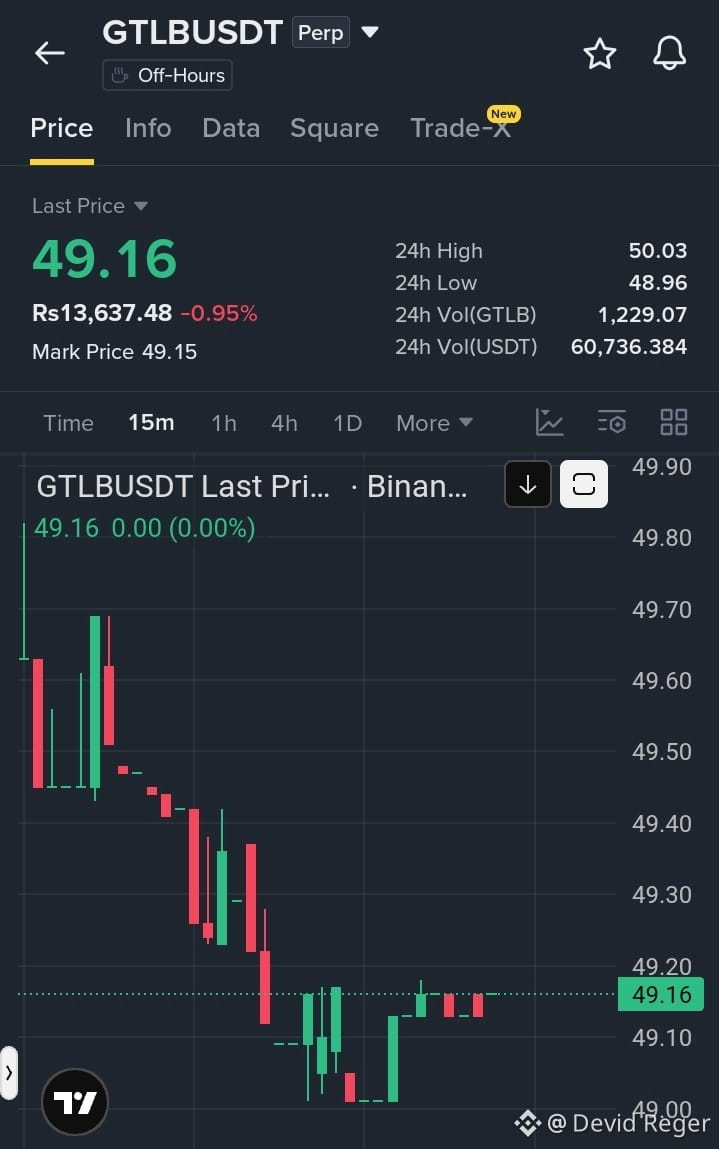
$GTLB /USDT — Momentum Setup
Price: $49.16
↑ Targets: $49.80 → $50.03 → $51.00
↓ Targets: $48.96 → $48.30 → $47.70
Signal: Bullish above $49.80 | Bearish below $48.96
Holding $49 support keeps the setup constructive, while a breakout above $50.03 could open the way toward $51.00.
#GTLB #Write2Earn #Write2Earn! #devidReger #ZECHitsANewAllTimeHigh
Price: $49.16
↑ Targets: $49.80 → $50.03 → $51.00
↓ Targets: $48.96 → $48.30 → $47.70
Signal: Bullish above $49.80 | Bearish below $48.96
Holding $49 support keeps the setup constructive, while a breakout above $50.03 could open the way toward $51.00.
#GTLB #Write2Earn #Write2Earn! #devidReger #ZECHitsANewAllTimeHigh
$GTLB 24 hours saw a 2.516% rise; the price is 50.93. However, the funding rate has remained positive at the moment, 0.00016234. Longs are paying shorts—this is a clear signal of crowded longs. As an on-chain U.S. stock futures contract, the open interest at 1352.08 is relatively stable, but the funding-rate structure suggests longs’ costs are accumulating. Price moving upward could attract more leveraged longs, increasing the risk of a short-term squeeze. I believe that if the funding rate does not turn negative, this rally is unlikely to be sustained. I will reduce my position if the price falls below 50.93 or if the funding rate drops to zero. For now, I’m only observing and not adding.
Trading tag: #BinanceFutures #TradFi #USDⓈM #GTLB #GTLBUSDT $GTLB
Trading tag: #BinanceFutures #TradFi #USDⓈM #GTLB #GTLBUSDT $GTLB
$GTLB Over the past 24 hours, it rose 1.688%, price 49.99, funding rate is zero, and open interest is 1343.71. There has been no new shock on the political and policy front. This trend is relatively steady among tech stocks. A funding rate of zero suggests neither side has made heavy bets, and the open interest is not high, indicating that leveraged funds are watching from the sidelines. It may be because the market is waiting for the details of the Congress’s stance on technology regulation. Rumors are everywhere, but nothing has materialized. Behind this calm is the fact that investors are unwilling to take positions before political signals become clear. The second-order effect is that if a regulatory draft is suddenly released, tech stocks like $GTLB would be hit first, and funds would quickly close positions. The invalidation condition is if the price stays below 49 for two consecutive days or breaks above 51—this would mean that political risk has been repriced. For now, I won’t touch it; I’ll wait for the price to choose a direction.
Trading tag: #TradFi #链上美股 #GTLB
Where do you think this set of assumptions is most likely to be wrong?
Trading tag: #TradFi #链上美股 #GTLB
Where do you think this set of assumptions is most likely to be wrong?
$GTLB 24 hours up 1.688% to $49.99, with the price hovering close to the 50-dollar whole number. The funding rate stays at zero; neither longs nor shorts pay anyone. Open interest in terms of positioning interest is only 1,343.71 contracts, with a trading volume of $172,000. Market liquidity is rather thin.
On the political and policy front, tariff rhetoric has heated up around the U.S. election cycle, suppressing valuation expectations for growth stocks, but the software sector where $GTLB is located has reacted sluggishly. With funding at zero plus low OI, it suggests leveraged capital is waiting on the sidelines—no one is betting on a one-direction breakout. This low-volatility equilibrium is fragile, and any policy signal could break the deadlock.
If price breaks above $50 on increased volume and OI simultaneously rises above 2,000 contracts, I would consider going long with 5x leverage, with a stop-loss set at 48. If it falls below 48, I’ll give up and wait for clearer policy signals before looking for another opportunity. Under the current structure, chasing highs carries more risk than potential reward.
Trading tag: #TradFi #链上美股 #GTLB
Where do you think this outlook is most likely to be wrong?
On the political and policy front, tariff rhetoric has heated up around the U.S. election cycle, suppressing valuation expectations for growth stocks, but the software sector where $GTLB is located has reacted sluggishly. With funding at zero plus low OI, it suggests leveraged capital is waiting on the sidelines—no one is betting on a one-direction breakout. This low-volatility equilibrium is fragile, and any policy signal could break the deadlock.
If price breaks above $50 on increased volume and OI simultaneously rises above 2,000 contracts, I would consider going long with 5x leverage, with a stop-loss set at 48. If it falls below 48, I’ll give up and wait for clearer policy signals before looking for another opportunity. Under the current structure, chasing highs carries more risk than potential reward.
Trading tag: #TradFi #链上美股 #GTLB
Where do you think this outlook is most likely to be wrong?
The old dog glanced at $GTLB . It was up 2.238% over 24 hours, with the price sitting at 50.26. What’s interesting is that its funding rate is 0.00000000, and open interest (OI) is shown as 1410. Those two numbers alone, put together, already tell you something.
The price moved up a step, but the funding rate didn’t budge at all. That suggests this small rally didn’t stir up leveraged long sentiment, or more bluntly, there probably wasn’t much leveraged long participation to begin with. A funding rate above zero means longs pay shorts, which indicates crowded longs; right now it’s zero, so longs and shorts are temporarily balanced, or you could even say market players are cold on the short-term game for $GTLB . Looking at positions, with OI at 1410 and the current price of 50.26, the notional value is roughly around seventy thousand dollars. In any mainstream trading pair, that is a very light position size. In plain terms, the force driving $GTLB ’s price movements right now is more likely a small amount of spot buying and selling, rather than leveraged pressure built up in the derivatives market.
So the old dog’s view is that $GTLB is currently in a quiet period with low leverage and low open interest. The upside lacks positive feedback and acceleration from the derivatives market. A structure like this is hard to turn into a trend on its own; it looks more like it’s waiting for a tailwind, or it may need a stronger beta from the broader semiconductor/AI narrative sector.
What’s the strongest counterexample? If tomorrow its funding rate turns positive and keeps rising, while OI also expands rapidly, that would mean market sentiment has suddenly shifted and leveraged capital has started chasing the move. In that case, the current calm would be broken. But based on the zero funding rate and light positioning right now, I don’t see that sign.
If this state continues, then for capital looking to go long $GTLB , the cost is time. Because there are no crowded longs, there’s less panic pressure from liquidations on the downside, but at the same time, there’s also a lack of fuel for a short squeeze on the upside. Liquidity will flow toward those names with more dramatic funding rate and OI changes, and more active trading.
My action is very clear: observe. The current price action in $GTLB doesn’t attract me; I won’t add to the position and I won’t short it either—I’ll just wait. I’ll wait until its funding rate shows sustained positive values, such as above 0.01%, and OI expands in sync, then I’ll reassess a long opportunity; or, if the price drops and the funding rate turns negative, that may be a contrarian long setup.
Where is this judgment most likely wrong?
Trading tags: #BinanceFutures #TradFi #USDⓈM #GTLB #GTLBUSDT $GTLB
The price moved up a step, but the funding rate didn’t budge at all. That suggests this small rally didn’t stir up leveraged long sentiment, or more bluntly, there probably wasn’t much leveraged long participation to begin with. A funding rate above zero means longs pay shorts, which indicates crowded longs; right now it’s zero, so longs and shorts are temporarily balanced, or you could even say market players are cold on the short-term game for $GTLB . Looking at positions, with OI at 1410 and the current price of 50.26, the notional value is roughly around seventy thousand dollars. In any mainstream trading pair, that is a very light position size. In plain terms, the force driving $GTLB ’s price movements right now is more likely a small amount of spot buying and selling, rather than leveraged pressure built up in the derivatives market.
So the old dog’s view is that $GTLB is currently in a quiet period with low leverage and low open interest. The upside lacks positive feedback and acceleration from the derivatives market. A structure like this is hard to turn into a trend on its own; it looks more like it’s waiting for a tailwind, or it may need a stronger beta from the broader semiconductor/AI narrative sector.
What’s the strongest counterexample? If tomorrow its funding rate turns positive and keeps rising, while OI also expands rapidly, that would mean market sentiment has suddenly shifted and leveraged capital has started chasing the move. In that case, the current calm would be broken. But based on the zero funding rate and light positioning right now, I don’t see that sign.
If this state continues, then for capital looking to go long $GTLB , the cost is time. Because there are no crowded longs, there’s less panic pressure from liquidations on the downside, but at the same time, there’s also a lack of fuel for a short squeeze on the upside. Liquidity will flow toward those names with more dramatic funding rate and OI changes, and more active trading.
My action is very clear: observe. The current price action in $GTLB doesn’t attract me; I won’t add to the position and I won’t short it either—I’ll just wait. I’ll wait until its funding rate shows sustained positive values, such as above 0.01%, and OI expands in sync, then I’ll reassess a long opportunity; or, if the price drops and the funding rate turns negative, that may be a contrarian long setup.
Where is this judgment most likely wrong?
Trading tags: #BinanceFutures #TradFi #USDⓈM #GTLB #GTLBUSDT $GTLB
The old dog glanced at the order book: $GTLB has risen 3.237% over the past 24 hours, with the price sitting at 51.03. This kind of gain itself isn’t explosive, but it gets interesting when paired with the funding rate. The current funding rate is 0.00064112, which is positive. By the iron rule of funding rates, a positive rate means longs are paying shorts. With the price rising and the rate still positive, it suggests long positions in the market may be getting crowded.
Volume is over 136,000, but open interest (OI) is only 1,285.97. That absolute number isn’t high, and converted into notional value it’s only a bit over $60,000, so the position base is not large.
The angle is M4_mover, an intraday anomaly. The old dog’s view is clear: this modest rally, combined with a relatively high positive funding rate, signals short-term momentum release from the bulls, but it also plants the seed for an easy pullback. The core contradiction is that price has risen and long crowding is increasing, but the pool of capital supporting it (OI) is not deep. That means once price softens, there may be a lack of enough long-side support to stabilize things, making a quick wave of profit-taking more likely.
The market may think that after a 3%+ move it should keep pushing higher, but I disagree. At the current stage, the risk-reward of continuing to go long above $51 is deteriorating. On the cost side, longs have to keep paying funding; on the structure side, low OI suggests big money hasn’t really stepped in yet, and the main buyers may be retail funds or short-term sentiment-driven flow. This kind of move won’t go far; it looks more like a pulse. My move is to wait and watch, absolutely not chase. If price retraces and breaks below the $50 round number, I’ll directly judge that this pulse is over and turn bearish. Unless I see OI rise sharply along with price while the funding rate starts to fall, there’s no proof that new, healthier capital is coming in to absorb the move.
Where am I most likely to be wrong? If $GTLB suddenly gets a meaningful fundamental or sector-level positive catalyst, drawing in a wave of new long-term buyers, OI could jump instantly and dilute the impact of the funding rate, allowing the price to break into an independent trend. Or, if price directly breaks above and holds $52.50 (the recent high), that would also show the bulls are stronger than I expected, and my bearish call would have to concede. Until then, I choose to stay on the sidelines and watch the show.
Trading tag: #BinanceFutures #TradFi #USDⓈM #GTLB #GTLBUSDT $GTLB
Volume is over 136,000, but open interest (OI) is only 1,285.97. That absolute number isn’t high, and converted into notional value it’s only a bit over $60,000, so the position base is not large.
The angle is M4_mover, an intraday anomaly. The old dog’s view is clear: this modest rally, combined with a relatively high positive funding rate, signals short-term momentum release from the bulls, but it also plants the seed for an easy pullback. The core contradiction is that price has risen and long crowding is increasing, but the pool of capital supporting it (OI) is not deep. That means once price softens, there may be a lack of enough long-side support to stabilize things, making a quick wave of profit-taking more likely.
The market may think that after a 3%+ move it should keep pushing higher, but I disagree. At the current stage, the risk-reward of continuing to go long above $51 is deteriorating. On the cost side, longs have to keep paying funding; on the structure side, low OI suggests big money hasn’t really stepped in yet, and the main buyers may be retail funds or short-term sentiment-driven flow. This kind of move won’t go far; it looks more like a pulse. My move is to wait and watch, absolutely not chase. If price retraces and breaks below the $50 round number, I’ll directly judge that this pulse is over and turn bearish. Unless I see OI rise sharply along with price while the funding rate starts to fall, there’s no proof that new, healthier capital is coming in to absorb the move.
Where am I most likely to be wrong? If $GTLB suddenly gets a meaningful fundamental or sector-level positive catalyst, drawing in a wave of new long-term buyers, OI could jump instantly and dilute the impact of the funding rate, allowing the price to break into an independent trend. Or, if price directly breaks above and holds $52.50 (the recent high), that would also show the bulls are stronger than I expected, and my bearish call would have to concede. Until then, I choose to stay on the sidelines and watch the show.
Trading tag: #BinanceFutures #TradFi #USDⓈM #GTLB #GTLBUSDT $GTLB
$GTLB rose 3.399% over the past 24 hours, and the price moved above 51.11, but Old Dog took a look at the funding and open interest and felt this rally was a bit suspicious. The funding rate is 0.00088163, positive, meaning longs are paying shorts, which suggests that the people betting on further upside are crowded together and costs are building. Open interest is 1,309.15 contracts; by itself that number means little, but combined with the positive funding rate, the signal of crowded longs becomes much more obvious.
From the perspective of M4_mover abnormal movement, price up, positive funding, and open interest not declining together form a typical short-term long-side tug-of-war setup. The problem is that under this kind of structure, if price cannot quickly break through resistance, it is easy to trigger a chain reaction of profit-taking and liquidations among high-cost longs. I have no other sector coins for comparison, but $GTLB ’s own combination of “price rise + positive funding + stable open interest” usually means that upward momentum depends on new money rather than existing positioning. Once buying pressure fails to keep up, the pullback tends to be fairly sharp.
So my judgment is that this is not the place to chase strength. In terms of action, if your position cost is above 51.11, I would consider trimming to lock in profits; if your cost is below that, I would also suggest taking some profits first.
Trading tag: #BinanceFutures #TradFi #USDⓈM #GTLB #GTLBUSDT $GTLB
From the perspective of M4_mover abnormal movement, price up, positive funding, and open interest not declining together form a typical short-term long-side tug-of-war setup. The problem is that under this kind of structure, if price cannot quickly break through resistance, it is easy to trigger a chain reaction of profit-taking and liquidations among high-cost longs. I have no other sector coins for comparison, but $GTLB ’s own combination of “price rise + positive funding + stable open interest” usually means that upward momentum depends on new money rather than existing positioning. Once buying pressure fails to keep up, the pullback tends to be fairly sharp.
So my judgment is that this is not the place to chase strength. In terms of action, if your position cost is above 51.11, I would consider trimming to lock in profits; if your cost is below that, I would also suggest taking some profits first.
Trading tag: #BinanceFutures #TradFi #USDⓈM #GTLB #GTLBUSDT $GTLB
$GTLB 24-hour micro decline of 1.33%, funding rate reset to zero, and open interest remains around 1445. Prices are moving lower, but the funding rate is neutral, meaning there is no bias in leverage costs for longs or shorts. The current volatility lacks a clear directional catalyst.
This is a single-signal judgment. A zero funding rate means neither side is paying fees, which usually appears in the middle of a trend or when market participation cools off. Combined with open interest not expanding significantly, the decline is more likely driven by spot selling pressure or random fluctuations in low liquidity rather than a short-led squeeze.
Trading tag: #TradFi #链上美股 #GTLB
What do you think is the most likely flaw in this judgment?
This is a single-signal judgment. A zero funding rate means neither side is paying fees, which usually appears in the middle of a trend or when market participation cools off. Combined with open interest not expanding significantly, the decline is more likely driven by spot selling pressure or random fluctuations in low liquidity rather than a short-led squeeze.
Trading tag: #TradFi #链上美股 #GTLB
What do you think is the most likely flaw in this judgment?
$GTLB fell slightly by 1.33% over the past 24 hours, trading at 49.09. The funding rate is back to zero, long and short costs are balanced, and open interest is 1445.
The market seems to be waiting for a direction. Prices are drifting down slowly, but the funding rate is unchanged, suggesting the decline has not triggered any obvious long liquidations or short additions. It looks more like existing capital is taking a wait-and-see approach. This kind of calm usually does not last long; liquidity will look for an exit.
The strongest counterexample would be a high-volume long bullish candle or bearish candle, directly breaking the current low-volatility balance.
Trading tag: #TradFi #链上美股 #GTLB
Where do you think this line of reasoning is most likely to be wrong?
The market seems to be waiting for a direction. Prices are drifting down slowly, but the funding rate is unchanged, suggesting the decline has not triggered any obvious long liquidations or short additions. It looks more like existing capital is taking a wait-and-see approach. This kind of calm usually does not last long; liquidity will look for an exit.
The strongest counterexample would be a high-volume long bullish candle or bearish candle, directly breaking the current low-volatility balance.
Trading tag: #TradFi #链上美股 #GTLB
Where do you think this line of reasoning is most likely to be wrong?
$GTLB reported at 49.09, down slightly 1.327% over the past 24 hours. On the surface, the decline is not severe, but as a traditional stock asset, the funding rate remaining at 0 shows that both long and short sides in the derivatives market are currently displaying no strong directional bias.
The drop is more likely follow-through selling caused by an overall adjustment in market risk appetite, rather than a strong bearish consensus specific to the asset itself. A zero funding rate means leveraged traders are mostly waiting on the sidelines at this moment, with neither longs chasing at a premium nor shorts pressing at a discount.
Trading tag: #TradFi #链上美股 #GTLB
Where do you think this judgment is most likely wrong?
The drop is more likely follow-through selling caused by an overall adjustment in market risk appetite, rather than a strong bearish consensus specific to the asset itself. A zero funding rate means leveraged traders are mostly waiting on the sidelines at this moment, with neither longs chasing at a premium nor shorts pressing at a discount.
Trading tag: #TradFi #链上美股 #GTLB
Where do you think this judgment is most likely wrong?
Log in to explore more content