
#dfusdt
dfusdt
371,258 views
636 Discussing
Hot
Latest

There’s a line in the document that’s worth noticing more than the marketing around it: in cross margin, the default mode, if a position moves against you enough, your entire balance and every other position could be at risk of liquidation.
It’s not from the “effective leverage” numbers being advertised. Not from the appealing matching speed or negative fees. Not from the name “unified margin” that sounds very optimal.
A simpler question is this: when a platform makes cross margin the default, do users understand they’re pooling risk alongside pooled collateral—or are they only hearing the “capital efficiency” angle?
That’s what the @grvt_io unified margin model forces to be answered more clearly than most existing marketing materials.
Selling the idea of “one account that both generates yield and serves as collateral” is easy, because it’s true and appealing. Modeling the correlated risk across the whole order book is harder—and requires thinking beyond the usual exercise most traders are comfortable with: calculating worst-case liquidation scenarios for each individual asset. Isolated margin is the optional escape hatch.
Platforms that clearly state this trade-off—though it may not be good for marketing—are the ones worth putting large capital into. If GRVT wants to be positioned as infrastructure for institutional capital.
Self-critique: this is an observation from technical documentation, not proof that real users misunderstand this risk. Professional traders on GRVT may already be aware.
But “efficiency” and “safety” are two different products in terms of structure, and the fact that the platform implements an efficiency-focused version as the default deserves to be stated loudly.
#grvt $LAB $AA
#DGB #DFUSDT #mnirob231537 #UtilityTokens
It’s not from the “effective leverage” numbers being advertised. Not from the appealing matching speed or negative fees. Not from the name “unified margin” that sounds very optimal.
A simpler question is this: when a platform makes cross margin the default, do users understand they’re pooling risk alongside pooled collateral—or are they only hearing the “capital efficiency” angle?
That’s what the @grvt_io unified margin model forces to be answered more clearly than most existing marketing materials.
Selling the idea of “one account that both generates yield and serves as collateral” is easy, because it’s true and appealing. Modeling the correlated risk across the whole order book is harder—and requires thinking beyond the usual exercise most traders are comfortable with: calculating worst-case liquidation scenarios for each individual asset. Isolated margin is the optional escape hatch.
Platforms that clearly state this trade-off—though it may not be good for marketing—are the ones worth putting large capital into. If GRVT wants to be positioned as infrastructure for institutional capital.
Self-critique: this is an observation from technical documentation, not proof that real users misunderstand this risk. Professional traders on GRVT may already be aware.
But “efficiency” and “safety” are two different products in terms of structure, and the fact that the platform implements an efficiency-focused version as the default deserves to be stated loudly.
#grvt $LAB $AA
#DGB #DFUSDT #mnirob231537 #UtilityTokens
Bullish
55%
Bearish
45%
22 votes • Voting closed

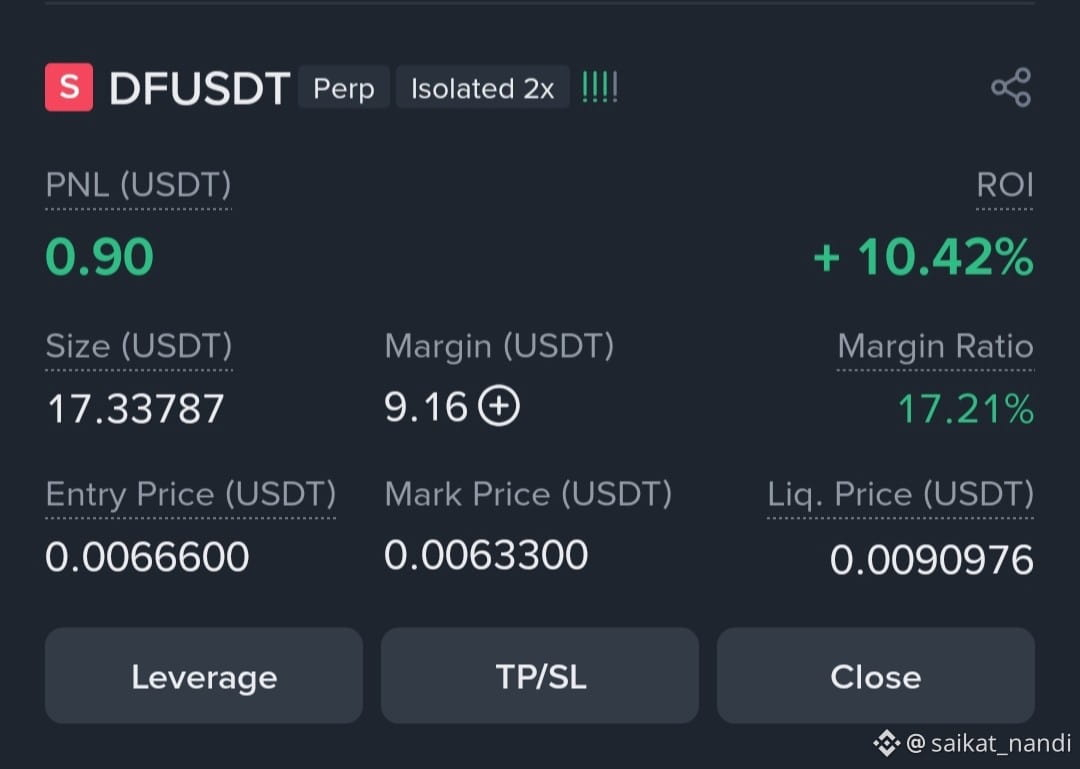
⚠️ Hold or Exit? My $DF position is up +10.42% but Mark Price is below Entry! Downside risk? Need your advice ASAP! 📉📈 #Crypto #Trading #DFUSDT #PerpetualFutures #TradingAdvice

I'm watching Newton Protocol (NEWT), and the more I think about it, the less I'm interested in the AI itself. What keeps pulling me back is the question of trust. It's easy to build excitement around automation, but once an AI starts making decisions that affect real money on-chain, simply saying "it works" doesn't feel like enough. Someone has to be able to see what happened and why. That's the part Newton seems to be focused on, and I think it's a harder problem than people give it credit for. The idea makes sense, but ideas don't get tested until they meet unpredictable markets, unexpected edge cases, and the kind of pressure that exposes weak assumptions.
Maybe that's where Newton proves its value, or maybe that's where the cracks begin to show. I'm not in a rush to decide. For now, I'm more interested in watching how it behaves when expectations collide with reality than getting caught up in the excitement that usually comes long before the evidence.
$AA
$SYN
$LAB
#DGB #YRUMPUSDT #DFUSDT #mnirob231537 #USStrikesIranAfterHormuzShipAttack
Maybe that's where Newton proves its value, or maybe that's where the cracks begin to show. I'm not in a rush to decide. For now, I'm more interested in watching how it behaves when expectations collide with reality than getting caught up in the excitement that usually comes long before the evidence.
$AA
$SYN
$LAB
#DGB #YRUMPUSDT #DFUSDT #mnirob231537 #USStrikesIranAfterHormuzShipAttack
bullet 🚅
100%
bullish 🌳
0%
Speed 🛂
0%
Bearish 🍅
0%
1 votes • Voting closed
Verified
There’s one question I always ask when I see a floor proclaim itself as “regulated”: what exactly does that license allow—real authorization—or just a nice-looking line on the homepage.
It’s not about how many times the word “regulated” appears in the press release. Not about the regulator’s logo in the footer. Not about the “world’s first” claim being repeated in every PR piece.
It’s a simpler question: does that license allow operations right away, or is it only the first step—still with additional new conditions that must be fulfilled before it can serve mainstream users?
That’s the question to ask about the Class M license that @grvt_io received from the Bermuda Monetary Authority—a real milestone, yet still “modified,” not a Full Class license that GRVT is continuing to pursue.
Once a license has been announced, it’s easy—news is concise and viral. Finishing the journey from modified to full license, and then repeating that success in other regions like MiCA or ADGM, is harder—each place has its own standards, and a license in one jurisdiction doesn’t guarantee success in another.
If GRVT completes the roadmap from Class M to Full Class and expands into other regions, GRVT’s value will be tied to the role of truly licensed infrastructure—not just the label “the first regulated DEX.”
Self-critique: the Class M license is still in the stage of finalizing operating conditions, with no concrete data yet on the progress toward Full Class licensing or on other regions to confirm that the roadmap is on the right timeline.
But the title “the first” only has lasting value if it leads to a complete license—not merely a PR milestone—and that’s something I’ll continue to monitor with @grvt_io .
#grvt $EVAA $LAB $BEE
#DGB #DFUSDT #mnirob231537
#UtilityTokens
It’s not about how many times the word “regulated” appears in the press release. Not about the regulator’s logo in the footer. Not about the “world’s first” claim being repeated in every PR piece.
It’s a simpler question: does that license allow operations right away, or is it only the first step—still with additional new conditions that must be fulfilled before it can serve mainstream users?
That’s the question to ask about the Class M license that @grvt_io received from the Bermuda Monetary Authority—a real milestone, yet still “modified,” not a Full Class license that GRVT is continuing to pursue.
Once a license has been announced, it’s easy—news is concise and viral. Finishing the journey from modified to full license, and then repeating that success in other regions like MiCA or ADGM, is harder—each place has its own standards, and a license in one jurisdiction doesn’t guarantee success in another.
If GRVT completes the roadmap from Class M to Full Class and expands into other regions, GRVT’s value will be tied to the role of truly licensed infrastructure—not just the label “the first regulated DEX.”
Self-critique: the Class M license is still in the stage of finalizing operating conditions, with no concrete data yet on the progress toward Full Class licensing or on other regions to confirm that the roadmap is on the right timeline.
But the title “the first” only has lasting value if it leads to a complete license—not merely a PR milestone—and that’s something I’ll continue to monitor with @grvt_io .
#grvt $EVAA $LAB $BEE
#DGB #DFUSDT #mnirob231537
#UtilityTokens
bull
53%
bear
47%
55 votes • Voting closed


The more I read about onchain finance, the more one idea surprised me: the biggest risks aren't always the ones reflected in price charts. Sometimes a market can look healthy while the underlying credit quality, collateral strength, or liquidity is quietly getting weaker.
That changed how I think about financial applications. Trading activity tells us what people are doing today, but it doesn't always explain how much risk is building underneath. Credit ratings, stress simulations, collateral structure, and default probabilities offer a different layer of information that markets may not price in immediately.
What caught my attention about @[NewtonProtocol] is the idea that policies can respond to verified risk signals instead of waiting for visible failures. In simple terms, a policy engine acts like a programmable rulebook: if trusted data shows risk crossing predefined limits, it can automatically adjust permissions or restrict certain actions before small issues become larger ones.
In that kind of system, NEWT isn't only connected to network activity—it also supports the coordination between policies, automation, and ongoing risk evaluation.
I still wonder whether these models can remain reliable as financial products become more complex. Can automated policy systems continue making good decisions when risk itself keeps evolving?
#DGB #YRUMPUSDT #DFUSDT #mnirob231537 #UtilityTokens
$BEE
$T
$EVAA
That changed how I think about financial applications. Trading activity tells us what people are doing today, but it doesn't always explain how much risk is building underneath. Credit ratings, stress simulations, collateral structure, and default probabilities offer a different layer of information that markets may not price in immediately.
What caught my attention about @[NewtonProtocol] is the idea that policies can respond to verified risk signals instead of waiting for visible failures. In simple terms, a policy engine acts like a programmable rulebook: if trusted data shows risk crossing predefined limits, it can automatically adjust permissions or restrict certain actions before small issues become larger ones.
In that kind of system, NEWT isn't only connected to network activity—it also supports the coordination between policies, automation, and ongoing risk evaluation.
I still wonder whether these models can remain reliable as financial products become more complex. Can automated policy systems continue making good decisions when risk itself keeps evolving?
#DGB #YRUMPUSDT #DFUSDT #mnirob231537 #UtilityTokens
$BEE
$T
$EVAA
Log in to explore more content