
#coreweave
coreweave
11,063 views
112 Discussing
Hot
Latest

·
--
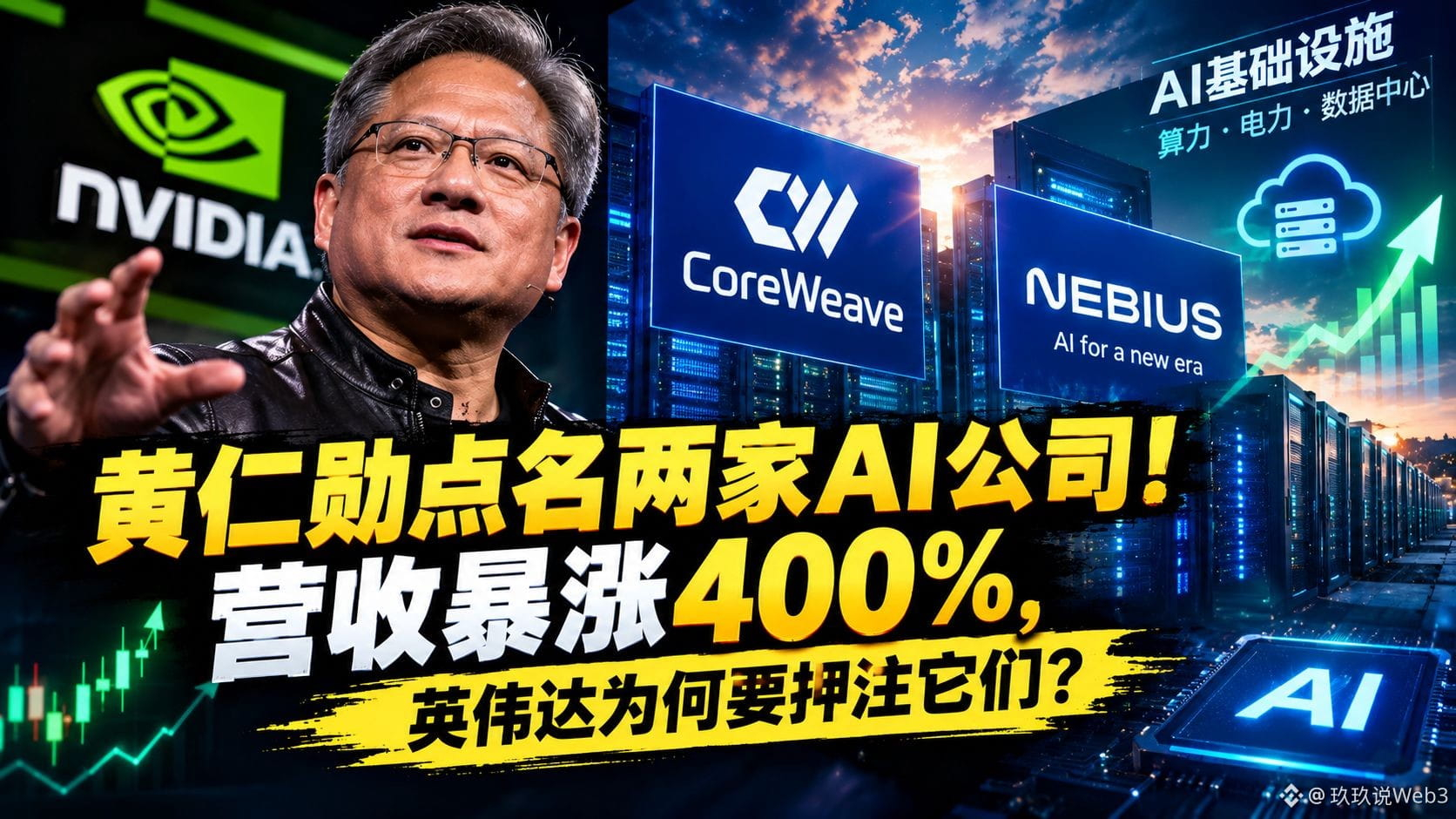
🚨 Jensen Huang suddenly names two AI companies!
Revenue surges 400%—why is Nvidia betting on them?🔥
Group: [点击进入玖玖的粉丝群](https://app.binance.com/uni-qr/YXXQJrPb)
At the Goldman Sachs Technology Conference, Nvidia CEO Jensen Huang recently publicly praised CoreWeave and Nebius, saying both companies “are doing an excellent job.”
Why is this worth paying attention to?
Because the real bottleneck in the AI industry may no longer be just chips.⚡
Huang believes that as AI demand continues to explode, land, power, data centers, and compute infrastructure are becoming the new limiting factors. In other words, selling GPUs is only the first step. Whoever can get these GPUs into data centers, connect them to power, and deliver compute power quickly may become a key player in the next phase of AI infrastructure.
First, take a look at CoreWeave.
Second-quarter revenue reached $2.58 billion, up 112% year over year. Meanwhile, the order backlog is about $104 billion. That number is staggering.📈 But the other side can’t be ignored: CoreWeave’s debt is around $33.8 billion. In the second quarter, it still posted a net loss of $626 million, and its expected capital expenditures this year are as high as $35–$39 billion. So it’s more like a high-speed “AI compute machine” expanding rapidly—fast growth, but enormous capital pressure as well.
Now Nebius—the story is a bit different.
Second-quarter revenue hit $582 million, up 454% year over year. After adjustments, the AI cloud business achieved an EBITDA profit margin of 50%, and the adjusted net loss also decreased 64% year over year.
It has also secured infrastructure partnership commitments from major tech companies, including Meta and Microsoft.
Nvidia has invested about $2 billion in each of the two companies.🏦
This actually sends a very clear signal:
Nvidia isn’t just betting on GPU demand—it’s betting on the entire AI compute infrastructure ecosystem.
If AI models, AI agents, and enterprise applications keep growing at high speed in the coming years, compute demand could far exceed the capacity that traditional cloud providers can offer today.
That’s why “new cloud providers” like CoreWeave and Nebius are starting to draw market attention.
Click the avatar to join the Jiujiu chat group for daily strategies 🚀
#英伟达 #NVIDIA #CoreWeave
🚨 Jensen Huang suddenly names two AI companies!
Revenue surges 400%—why is Nvidia betting on them?🔥
Group: 点击进入玖玖的粉丝群
At the Goldman Sachs Technology Conference, Nvidia CEO Jensen Huang recently publicly praised CoreWeave and Nebius, saying both companies “are doing an excellent job.”
Why is this worth paying attention to?
Because the real bottleneck in the AI industry may no longer be just chips.⚡
Huang believes that as AI demand continues to explode, land, power, data centers, and compute infrastructure are becoming the new limiting factors. In other words, selling GPUs is only the first step. Whoever can get these GPUs into data centers, connect them to power, and deliver compute power quickly may become a key player in the next phase of AI infrastructure.
First, take a look at CoreWeave.
Second-quarter revenue reached $2.58 billion, up 112% year over year. Meanwhile, the order backlog is about $104 billion. That number is staggering.📈 But the other side can’t be ignored: CoreWeave’s debt is around $33.8 billion. In the second quarter, it still posted a net loss of $626 million, and its expected capital expenditures this year are as high as $35–$39 billion. So it’s more like a high-speed “AI compute machine” expanding rapidly—fast growth, but enormous capital pressure as well.
Now Nebius—the story is a bit different.
Second-quarter revenue hit $582 million, up 454% year over year. After adjustments, the AI cloud business achieved an EBITDA profit margin of 50%, and the adjusted net loss also decreased 64% year over year.
It has also secured infrastructure partnership commitments from major tech companies, including Meta and Microsoft.
Nvidia has invested about $2 billion in each of the two companies.🏦
This actually sends a very clear signal:
Nvidia isn’t just betting on GPU demand—it’s betting on the entire AI compute infrastructure ecosystem.
If AI models, AI agents, and enterprise applications keep growing at high speed in the coming years, compute demand could far exceed the capacity that traditional cloud providers can offer today.
That’s why “new cloud providers” like CoreWeave and Nebius are starting to draw market attention.
Click the avatar to join the Jiujiu chat group for daily strategies 🚀
#英伟达 #NVIDIA #CoreWeave
Revenue surges 400%—why is Nvidia betting on them?🔥
Group: 点击进入玖玖的粉丝群
At the Goldman Sachs Technology Conference, Nvidia CEO Jensen Huang recently publicly praised CoreWeave and Nebius, saying both companies “are doing an excellent job.”
Why is this worth paying attention to?
Because the real bottleneck in the AI industry may no longer be just chips.⚡
Huang believes that as AI demand continues to explode, land, power, data centers, and compute infrastructure are becoming the new limiting factors. In other words, selling GPUs is only the first step. Whoever can get these GPUs into data centers, connect them to power, and deliver compute power quickly may become a key player in the next phase of AI infrastructure.
First, take a look at CoreWeave.
Second-quarter revenue reached $2.58 billion, up 112% year over year. Meanwhile, the order backlog is about $104 billion. That number is staggering.📈 But the other side can’t be ignored: CoreWeave’s debt is around $33.8 billion. In the second quarter, it still posted a net loss of $626 million, and its expected capital expenditures this year are as high as $35–$39 billion. So it’s more like a high-speed “AI compute machine” expanding rapidly—fast growth, but enormous capital pressure as well.
Now Nebius—the story is a bit different.
Second-quarter revenue hit $582 million, up 454% year over year. After adjustments, the AI cloud business achieved an EBITDA profit margin of 50%, and the adjusted net loss also decreased 64% year over year.
It has also secured infrastructure partnership commitments from major tech companies, including Meta and Microsoft.
Nvidia has invested about $2 billion in each of the two companies.🏦
This actually sends a very clear signal:
Nvidia isn’t just betting on GPU demand—it’s betting on the entire AI compute infrastructure ecosystem.
If AI models, AI agents, and enterprise applications keep growing at high speed in the coming years, compute demand could far exceed the capacity that traditional cloud providers can offer today.
That’s why “new cloud providers” like CoreWeave and Nebius are starting to draw market attention.
Click the avatar to join the Jiujiu chat group for daily strategies 🚀
#英伟达 #NVIDIA #CoreWeave
5

·
--
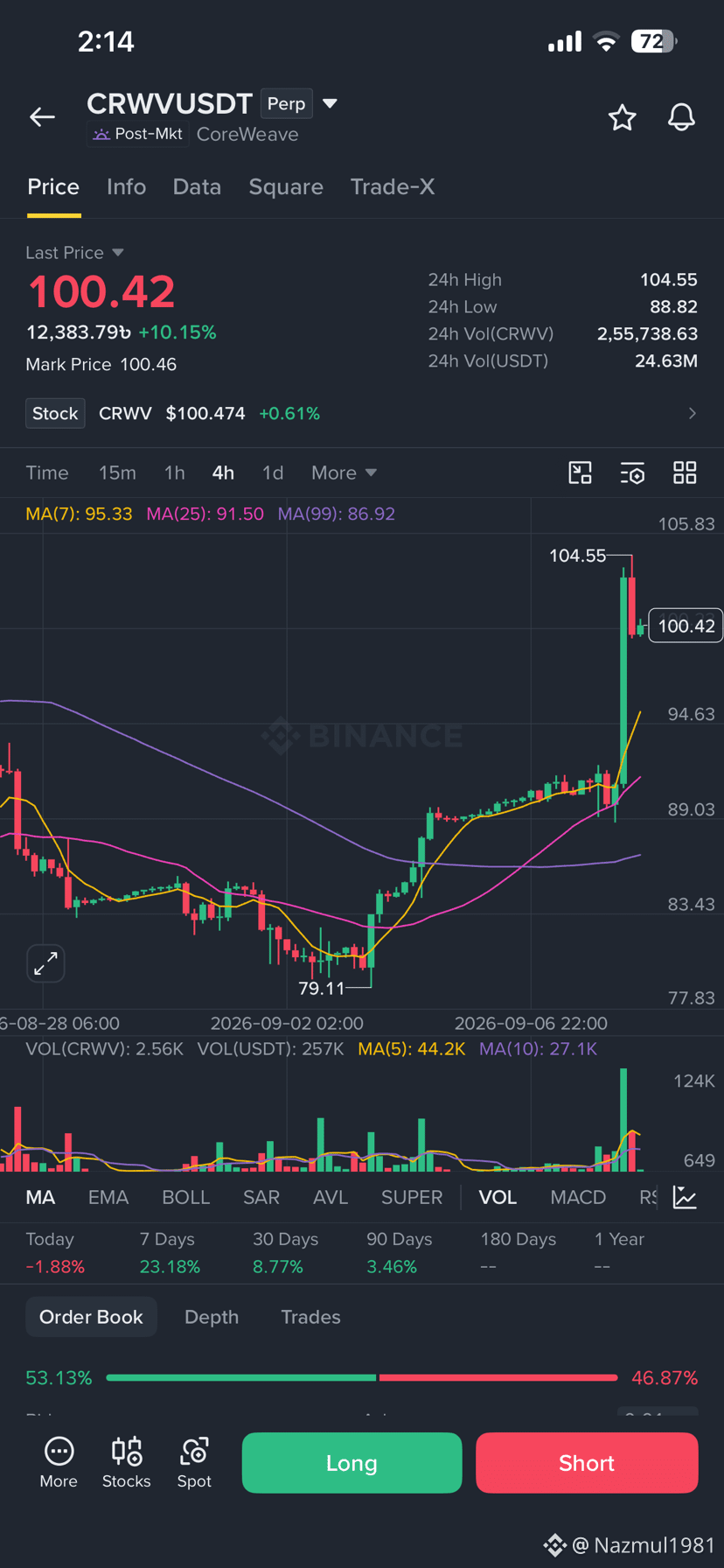
🔥 CRWV/USDT 4H Setup
CRWV is showing strong bullish momentum, currently around 100.42 (+10.15%) with a huge volume spike. Price remains above MA(7) 95.33, MA(25) 91.50 & MA(99) 86.92.
📌 Resistance: 104.55 → 106 → 110
📌 Support: 100 → 94.6 → 91.5
📈 Bullish: Hold above 100 and reclaim 104.55
⚠️ A pullback is possible after the sharp breakout.
Strong momentum, but avoid chasing the spike. Manage risk & DYOR.
#CRWV #CoreWeave #Crypto #Binance #Trading
{future}(CRWVUSDT)
🔥 CRWV/USDT 4H Setup
CRWV is showing strong bullish momentum, currently around 100.42 (+10.15%) with a huge volume spike. Price remains above MA(7) 95.33, MA(25) 91.50 & MA(99) 86.92.
📌 Resistance: 104.55 → 106 → 110
📌 Support: 100 → 94.6 → 91.5
📈 Bullish: Hold above 100 and reclaim 104.55
⚠️ A pullback is possible after the sharp breakout.
Strong momentum, but avoid chasing the spike. Manage risk & DYOR.
#CRWV #CoreWeave #Crypto #Binance #Trading
CRWV is showing strong bullish momentum, currently around 100.42 (+10.15%) with a huge volume spike. Price remains above MA(7) 95.33, MA(25) 91.50 & MA(99) 86.92.
📌 Resistance: 104.55 → 106 → 110
📌 Support: 100 → 94.6 → 91.5
📈 Bullish: Hold above 100 and reclaim 104.55
⚠️ A pullback is possible after the sharp breakout.
Strong momentum, but avoid chasing the spike. Manage risk & DYOR.
#CRWV #CoreWeave #Crypto #Binance #Trading
11

💸 Increase in interest expenses for CoreWeave to $640 million
AI infrastructure provider CoreWeave reported $640 million in interest expenses. This rise is 2.4 times higher than last year, highlighting the financial pressures associated with the company’s rapid expansion in the AI market.
━━━━━━━━━━━━━━
📊 Impact: 📊 Medium
🏷️ OTHER
#CoreWeave #AIInfrastructure #FinancialNews #TechCompany #MarketInsights
📰 Source: cryptobriefing.com
💸 Increase in interest expenses for CoreWeave to $640 million
AI infrastructure provider CoreWeave reported $640 million in interest expenses. This rise is 2.4 times higher than last year, highlighting the financial pressures associated with the company’s rapid expansion in the AI market.
━━━━━━━━━━━━━━
📊 Impact: 📊 Medium
🏷️ OTHER
#CoreWeave #AIInfrastructure #FinancialNews #TechCompany #MarketInsights
📰 Source: cryptobriefing.com
AI infrastructure provider CoreWeave reported $640 million in interest expenses. This rise is 2.4 times higher than last year, highlighting the financial pressures associated with the company’s rapid expansion in the AI market.
━━━━━━━━━━━━━━
📊 Impact: 📊 Medium
🏷️ OTHER
#CoreWeave #AIInfrastructure #FinancialNews #TechCompany #MarketInsights
📰 Source: cryptobriefing.com


·
--
The pricing for that September meeting shifted completely in the other direction after last Friday. They were originally debating whether the Fed would cut rates, but now the discussion is whether it will raise rates instead. The employment data far exceeded expectations. There is PPI on Thursday and CPI on Friday—those two data releases directly moved ahead of the meeting. This week has no meaningful earnings reports, so interest rates are the only main storyline.
On the interest-rate futures side, the probability of a September rate hike is currently hovering around 60%. Today is the U.S. Labor Day holiday, and the quotes on $CRWVB are basically just carrying forward last Friday’s move—there’s nothing to see there. In the meantime, I’ll take advantage of the lull to go back and review CoreWeave’s accounts again.
Its predecessor was an Ethereum-mining operation. Today, its business is building clusters out of Nvidia GPUs and renting them out. On its customer list are OpenAI, Meta, Anthropic, and Google. As of the end of June, contract backlog is roughly $104 billion. On the demand side, there’s nothing much to argue about.
The problem is how those cards were bought back.
At the end of the second quarter, its balance sheet shows total debt with recourse and without recourse of about $35.1 billion. In the same quarter, net interest expense was $640 million. In the company’s guidance for the third quarter, interest expense is expected to rise to between $860 million and $940 million, while adjusted operating profit in the same guidance is between $200 million and $260 million. Interest alone is roughly three or four times operating profit—this ratio isn’t just especially ugly in one quarter; it has been like this all along.
If you extend it to the full year, the ratio becomes even more extreme. Management’s capital expenditure guidance is $35–39 billion, while revenue guidance for the same year is only a bit more than one-third of that—everything in the gap has to be covered by financing. The interest CoreWeave pays each quarter is real cash—changes in interest rates flow directly into its income statement, without having to wait for valuation-model transmission.
If rate hikes land on its head, my original thought was about the valuation layer. But the announcement of the new $2.6 billion loan on August 10 changed that—there’s harder stuff baked into the liability structure.
That was a $2.6 billion delayed-draw term loan priced at SOFR plus 550 basis points, with a maturity of about five years. The announcement itself states that the underlying customer contracts have an average remaining term of about three years.
The assets mature in three years, but the liabilities are not fully repaid until five years. The two-year gap in the middle has to be filled by renewals or new customers. When the market is hot, this isn’t a problem—the cards are scarce and renewals queue up. But once the demand rhythm changes, those two years become an open exposure.
How the company explains this money is one thing, and how you read the terms is another. The CEO’s explanation on the earnings call was that this structure allows the company to serve enterprise customers that only want to sign for two to three years—sounds like it opens up a new market. Truist analyst Arvind Ramnani gave bullish reasons at the end of August, and his conclusion lands precisely on long-term contracts. He thinks the pricing increase will first pass through into customer contracts, and cost increases on Nvidia’s side won’t show up until the machines that ship in early next year. Over the intervening months, the contribution margin from long-term deals would be lifted clearly.
The company is opening the door to short-term contracts, yet the bullish logic is built on the margin from long-term contracts. Both can be true at the same time, but they point to two different businesses.
How exactly this rate line will hit, the CFO has already given the calibration. He said that over the past year, the weighted average cost of debt was lowered by about 300 basis points. Based on the debt balance at quarter-end, that saves roughly $1.1 billion in interest per year. Those 300 basis points came from improving credit conditions and opening up financing channels—not from the benchmark interest rate. If you flip that same logic and apply it the other way: for the same debt size, if the benchmark rate rises by 25 basis points, the additional interest paid in a year comes to nearly $100 million. After two or three hikes, a large chunk of what management worked hard to save would be eaten away.
So if this round truly moves into a rate-hike path, what the market needs to reprice first is CoreWeave’s ability to refinance and the financing-cost curve; the P/E multiple comes later. On the demand side, I don’t doubt it—those four biggest model companies have signed, and you can’t draw those orders out of thin air. What I question is whether, in an environment where borrowing gets more expensive, the three-year-to-five-year gap might shift from a technical arrangement into a real problem.
Evidence to overturn that view should come this week. If Thursday’s PPI and Friday’s CPI both cool off, and the rate-hike bets get cut back to below 40%, then the stress-test calculations above would be discounted overall. Conversely, if both data points come in hot, only next week’s meeting will put this logic on the table.
For a heavy-asset AI company, that contract backlog number is so large that it can lull people into complacency. When the next earnings report comes—#CoreWeave —you can check whether the gap between interest expense and adjusted operating profit continues to widen. How much that gap has expanded, more than how much the backlog has grown, is what better shows how far the company can hold on into which year.
The pricing for that September meeting shifted completely in the other direction after last Friday. They were originally debating whether the Fed would cut rates, but now the discussion is whether it will raise rates instead. The employment data far exceeded expectations. There is PPI on Thursday and CPI on Friday—those two data releases directly moved ahead of the meeting. This week has no meaningful earnings reports, so interest rates are the only main storyline.
On the interest-rate futures side, the probability of a September rate hike is currently hovering around 60%. Today is the U.S. Labor Day holiday, and the quotes on $CRWVB are basically just carrying forward last Friday’s move—there’s nothing to see there. In the meantime, I’ll take advantage of the lull to go back and review CoreWeave’s accounts again.
Its predecessor was an Ethereum-mining operation. Today, its business is building clusters out of Nvidia GPUs and renting them out. On its customer list are OpenAI, Meta, Anthropic, and Google. As of the end of June, contract backlog is roughly $104 billion. On the demand side, there’s nothing much to argue about.
The problem is how those cards were bought back.
At the end of the second quarter, its balance sheet shows total debt with recourse and without recourse of about $35.1 billion. In the same quarter, net interest expense was $640 million. In the company’s guidance for the third quarter, interest expense is expected to rise to between $860 million and $940 million, while adjusted operating profit in the same guidance is between $200 million and $260 million. Interest alone is roughly three or four times operating profit—this ratio isn’t just especially ugly in one quarter; it has been like this all along.
If you extend it to the full year, the ratio becomes even more extreme. Management’s capital expenditure guidance is $35–39 billion, while revenue guidance for the same year is only a bit more than one-third of that—everything in the gap has to be covered by financing. The interest CoreWeave pays each quarter is real cash—changes in interest rates flow directly into its income statement, without having to wait for valuation-model transmission.
If rate hikes land on its head, my original thought was about the valuation layer. But the announcement of the new $2.6 billion loan on August 10 changed that—there’s harder stuff baked into the liability structure.
That was a $2.6 billion delayed-draw term loan priced at SOFR plus 550 basis points, with a maturity of about five years. The announcement itself states that the underlying customer contracts have an average remaining term of about three years.
The assets mature in three years, but the liabilities are not fully repaid until five years. The two-year gap in the middle has to be filled by renewals or new customers. When the market is hot, this isn’t a problem—the cards are scarce and renewals queue up. But once the demand rhythm changes, those two years become an open exposure.
How the company explains this money is one thing, and how you read the terms is another. The CEO’s explanation on the earnings call was that this structure allows the company to serve enterprise customers that only want to sign for two to three years—sounds like it opens up a new market. Truist analyst Arvind Ramnani gave bullish reasons at the end of August, and his conclusion lands precisely on long-term contracts. He thinks the pricing increase will first pass through into customer contracts, and cost increases on Nvidia’s side won’t show up until the machines that ship in early next year. Over the intervening months, the contribution margin from long-term deals would be lifted clearly.
The company is opening the door to short-term contracts, yet the bullish logic is built on the margin from long-term contracts. Both can be true at the same time, but they point to two different businesses.
How exactly this rate line will hit, the CFO has already given the calibration. He said that over the past year, the weighted average cost of debt was lowered by about 300 basis points. Based on the debt balance at quarter-end, that saves roughly $1.1 billion in interest per year. Those 300 basis points came from improving credit conditions and opening up financing channels—not from the benchmark interest rate. If you flip that same logic and apply it the other way: for the same debt size, if the benchmark rate rises by 25 basis points, the additional interest paid in a year comes to nearly $100 million. After two or three hikes, a large chunk of what management worked hard to save would be eaten away.
So if this round truly moves into a rate-hike path, what the market needs to reprice first is CoreWeave’s ability to refinance and the financing-cost curve; the P/E multiple comes later. On the demand side, I don’t doubt it—those four biggest model companies have signed, and you can’t draw those orders out of thin air. What I question is whether, in an environment where borrowing gets more expensive, the three-year-to-five-year gap might shift from a technical arrangement into a real problem.
Evidence to overturn that view should come this week. If Thursday’s PPI and Friday’s CPI both cool off, and the rate-hike bets get cut back to below 40%, then the stress-test calculations above would be discounted overall. Conversely, if both data points come in hot, only next week’s meeting will put this logic on the table.
For a heavy-asset AI company, that contract backlog number is so large that it can lull people into complacency. When the next earnings report comes—#CoreWeave —you can check whether the gap between interest expense and adjusted operating profit continues to widen. How much that gap has expanded, more than how much the backlog has grown, is what better shows how far the company can hold on into which year.
On the interest-rate futures side, the probability of a September rate hike is currently hovering around 60%. Today is the U.S. Labor Day holiday, and the quotes on $CRWVB are basically just carrying forward last Friday’s move—there’s nothing to see there. In the meantime, I’ll take advantage of the lull to go back and review CoreWeave’s accounts again.
Its predecessor was an Ethereum-mining operation. Today, its business is building clusters out of Nvidia GPUs and renting them out. On its customer list are OpenAI, Meta, Anthropic, and Google. As of the end of June, contract backlog is roughly $104 billion. On the demand side, there’s nothing much to argue about.
The problem is how those cards were bought back.
At the end of the second quarter, its balance sheet shows total debt with recourse and without recourse of about $35.1 billion. In the same quarter, net interest expense was $640 million. In the company’s guidance for the third quarter, interest expense is expected to rise to between $860 million and $940 million, while adjusted operating profit in the same guidance is between $200 million and $260 million. Interest alone is roughly three or four times operating profit—this ratio isn’t just especially ugly in one quarter; it has been like this all along.
If you extend it to the full year, the ratio becomes even more extreme. Management’s capital expenditure guidance is $35–39 billion, while revenue guidance for the same year is only a bit more than one-third of that—everything in the gap has to be covered by financing. The interest CoreWeave pays each quarter is real cash—changes in interest rates flow directly into its income statement, without having to wait for valuation-model transmission.
If rate hikes land on its head, my original thought was about the valuation layer. But the announcement of the new $2.6 billion loan on August 10 changed that—there’s harder stuff baked into the liability structure.
That was a $2.6 billion delayed-draw term loan priced at SOFR plus 550 basis points, with a maturity of about five years. The announcement itself states that the underlying customer contracts have an average remaining term of about three years.
The assets mature in three years, but the liabilities are not fully repaid until five years. The two-year gap in the middle has to be filled by renewals or new customers. When the market is hot, this isn’t a problem—the cards are scarce and renewals queue up. But once the demand rhythm changes, those two years become an open exposure.
How the company explains this money is one thing, and how you read the terms is another. The CEO’s explanation on the earnings call was that this structure allows the company to serve enterprise customers that only want to sign for two to three years—sounds like it opens up a new market. Truist analyst Arvind Ramnani gave bullish reasons at the end of August, and his conclusion lands precisely on long-term contracts. He thinks the pricing increase will first pass through into customer contracts, and cost increases on Nvidia’s side won’t show up until the machines that ship in early next year. Over the intervening months, the contribution margin from long-term deals would be lifted clearly.
The company is opening the door to short-term contracts, yet the bullish logic is built on the margin from long-term contracts. Both can be true at the same time, but they point to two different businesses.
How exactly this rate line will hit, the CFO has already given the calibration. He said that over the past year, the weighted average cost of debt was lowered by about 300 basis points. Based on the debt balance at quarter-end, that saves roughly $1.1 billion in interest per year. Those 300 basis points came from improving credit conditions and opening up financing channels—not from the benchmark interest rate. If you flip that same logic and apply it the other way: for the same debt size, if the benchmark rate rises by 25 basis points, the additional interest paid in a year comes to nearly $100 million. After two or three hikes, a large chunk of what management worked hard to save would be eaten away.
So if this round truly moves into a rate-hike path, what the market needs to reprice first is CoreWeave’s ability to refinance and the financing-cost curve; the P/E multiple comes later. On the demand side, I don’t doubt it—those four biggest model companies have signed, and you can’t draw those orders out of thin air. What I question is whether, in an environment where borrowing gets more expensive, the three-year-to-five-year gap might shift from a technical arrangement into a real problem.
Evidence to overturn that view should come this week. If Thursday’s PPI and Friday’s CPI both cool off, and the rate-hike bets get cut back to below 40%, then the stress-test calculations above would be discounted overall. Conversely, if both data points come in hot, only next week’s meeting will put this logic on the table.
For a heavy-asset AI company, that contract backlog number is so large that it can lull people into complacency. When the next earnings report comes—#CoreWeave —you can check whether the gap between interest expense and adjusted operating profit continues to widen. How much that gap has expanded, more than how much the backlog has grown, is what better shows how far the company can hold on into which year.
87

Everyone is talking about AI tokens, but nobody
is looking at the real physical bottleneck:
CoreWeave just flexed a massive $104 Billion revenue backlog! 🤯
Yahoo Finance’s new neocloud ETF discussion put CRWV in the spotlight reporting Q2 revenue hitting $2.6B (up 112% YoY) with over $25B in new customer commitments in Q3.
Why it matters:
AI isn0t just code - itz heavy hardware, compute rent, and massive energy. Their 59% adjusted EBITDA margin shows scale is turning into real operating leverage.
The real challenge ahead:
Converting a $104B backlog into actual cash flow. Markets will watch:
GPU access & energy availability
Financing rates & expansions
Customer concentration
If they execute, the compute-rental play wins. If funding slips, sentiment flips fast.
#binancesquareofficial #BTCETH #CoreWeave #Neocloud #BinanceSquare
$CRWV
{future}(CRWVUSDT)
Where is the real future of AI compute? Vote below! 👇
Everyone is talking about AI tokens, but nobody
is looking at the real physical bottleneck:
CoreWeave just flexed a massive $104 Billion revenue backlog! 🤯
Yahoo Finance’s new neocloud ETF discussion put CRWV in the spotlight reporting Q2 revenue hitting $2.6B (up 112% YoY) with over $25B in new customer commitments in Q3.
Why it matters:
AI isn0t just code - itz heavy hardware, compute rent, and massive energy. Their 59% adjusted EBITDA margin shows scale is turning into real operating leverage.
The real challenge ahead:
Converting a $104B backlog into actual cash flow. Markets will watch:
GPU access & energy availability
Financing rates & expansions
Customer concentration
If they execute, the compute-rental play wins. If funding slips, sentiment flips fast.
#binancesquareofficial #BTCETH #CoreWeave #Neocloud #BinanceSquare
$CRWV
Where is the real future of AI compute? Vote below! 👇
is looking at the real physical bottleneck:
CoreWeave just flexed a massive $104 Billion revenue backlog! 🤯
Yahoo Finance’s new neocloud ETF discussion put CRWV in the spotlight reporting Q2 revenue hitting $2.6B (up 112% YoY) with over $25B in new customer commitments in Q3.
Why it matters:
AI isn0t just code - itz heavy hardware, compute rent, and massive energy. Their 59% adjusted EBITDA margin shows scale is turning into real operating leverage.
The real challenge ahead:
Converting a $104B backlog into actual cash flow. Markets will watch:
GPU access & energy availability
Financing rates & expansions
Customer concentration
If they execute, the compute-rental play wins. If funding slips, sentiment flips fast.
#binancesquareofficial #BTCETH #CoreWeave #Neocloud #BinanceSquare
$CRWV
Where is the real future of AI compute? Vote below! 👇
Traditional Cloud
100%
DePIN / Crypto AI
0%
1 votes • Voting closed
2
958

·
--
Bullish
CoreWeave faces a strong upside opportunity?
Truist analysts believe CoreWeave’s stock could be approaching weakness, despite higher chip costs.
The key bet: continued strong demand for AI infrastructure and cloud computing could offset rising infrastructure costs.
AI remains a major driver for data center stocks.
{future}(CRWVUSDT)
#CoreWeave #AI #Stocks #tech
CoreWeave faces a strong upside opportunity?
Truist analysts believe CoreWeave’s stock could be approaching weakness, despite higher chip costs.
The key bet: continued strong demand for AI infrastructure and cloud computing could offset rising infrastructure costs.
AI remains a major driver for data center stocks.
#CoreWeave #AI #Stocks #tech
Truist analysts believe CoreWeave’s stock could be approaching weakness, despite higher chip costs.
The key bet: continued strong demand for AI infrastructure and cloud computing could offset rising infrastructure costs.
AI remains a major driver for data center stocks.
#CoreWeave #AI #Stocks #tech
1
520
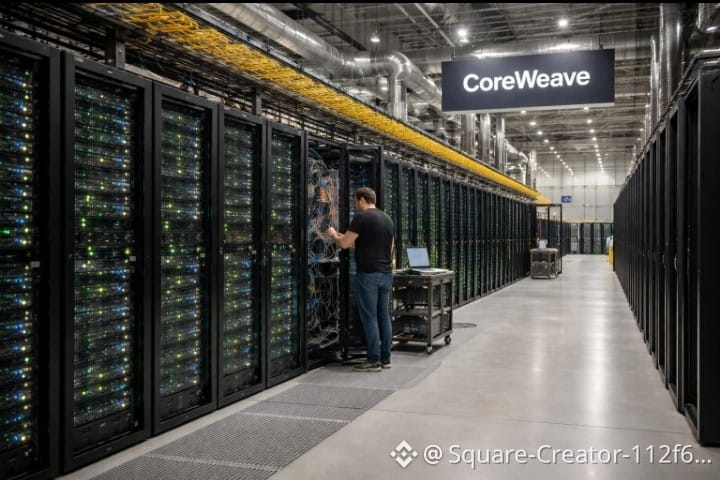
🇮🇩 CoreWeave expands in Asia with data centers in Indonesia
CoreWeave, a company specialized in cloud computing services tailored for artificial intelligence, has announced its entry into the Asian market by establishing new data centers in Indonesia. This move aims to meet the growing demand for specialized cloud computing services in the region.
━━━━━━━━━━━━━━
📊 Impact: 📈 High
🏷️ OTHER
#CoreWeave #AI #CloudComputing #Indonesia #TechExpansion
📰 Source: cryptobriefing.com
🇮🇩 CoreWeave expands in Asia with data centers in Indonesia
CoreWeave, a company specialized in cloud computing services tailored for artificial intelligence, has announced its entry into the Asian market by establishing new data centers in Indonesia. This move aims to meet the growing demand for specialized cloud computing services in the region.
━━━━━━━━━━━━━━
📊 Impact: 📈 High
🏷️ OTHER
#CoreWeave #AI #CloudComputing #Indonesia #TechExpansion
📰 Source: cryptobriefing.com
CoreWeave, a company specialized in cloud computing services tailored for artificial intelligence, has announced its entry into the Asian market by establishing new data centers in Indonesia. This move aims to meet the growing demand for specialized cloud computing services in the region.
━━━━━━━━━━━━━━
📊 Impact: 📈 High
🏷️ OTHER
#CoreWeave #AI #CloudComputing #Indonesia #TechExpansion
📰 Source: cryptobriefing.com
11

·
--
CoreWeave plunges 13% in a single day, and HPC and new cloud concept stocks all weaken.
The trigger was a rumor coming from Meta—markets started to doubt whether hyperscale vendors’ pace of AI compute purchases is about to slow down. Once expectations for orders from top-tier customers are revised downward, those new cloud stocks whose valuations are propped up mainly by the “AI compute narrative” will have more room to pull back than people think.
My view: this selloff isn’t driven by fundamentals, but by the gap between expectations. CoreWeave’s revenue is highly concentrated among a handful of major customers. In a bull market, nobody talks about customer concentration risk—then the moment there’s a hint of trouble, they cash out in a concentrated way.
This is also not completely unrelated to the crypto market—sentiment in the AI+Crypto sector will, to some extent, transmit along this chain. In the short term, you can watch the capital flows into compute-related tokens. If pessimism from traditional markets spreads, targets like $TAO $RENDER may face pressure first.
#AI算力 #CoreWeave #New cloud stocks
CoreWeave plunges 13% in a single day, and HPC and new cloud concept stocks all weaken.
The trigger was a rumor coming from Meta—markets started to doubt whether hyperscale vendors’ pace of AI compute purchases is about to slow down. Once expectations for orders from top-tier customers are revised downward, those new cloud stocks whose valuations are propped up mainly by the “AI compute narrative” will have more room to pull back than people think.
My view: this selloff isn’t driven by fundamentals, but by the gap between expectations. CoreWeave’s revenue is highly concentrated among a handful of major customers. In a bull market, nobody talks about customer concentration risk—then the moment there’s a hint of trouble, they cash out in a concentrated way.
This is also not completely unrelated to the crypto market—sentiment in the AI+Crypto sector will, to some extent, transmit along this chain. In the short term, you can watch the capital flows into compute-related tokens. If pessimism from traditional markets spreads, targets like $TAO $RENDER may face pressure first.
#AI算力 #CoreWeave #New cloud stocks
The trigger was a rumor coming from Meta—markets started to doubt whether hyperscale vendors’ pace of AI compute purchases is about to slow down. Once expectations for orders from top-tier customers are revised downward, those new cloud stocks whose valuations are propped up mainly by the “AI compute narrative” will have more room to pull back than people think.
My view: this selloff isn’t driven by fundamentals, but by the gap between expectations. CoreWeave’s revenue is highly concentrated among a handful of major customers. In a bull market, nobody talks about customer concentration risk—then the moment there’s a hint of trouble, they cash out in a concentrated way.
This is also not completely unrelated to the crypto market—sentiment in the AI+Crypto sector will, to some extent, transmit along this chain. In the short term, you can watch the capital flows into compute-related tokens. If pessimism from traditional markets spreads, targets like $TAO $RENDER may face pressure first.
#AI算力 #CoreWeave #New cloud stocks
52

·
--
CoreWeave’s Q2 performance exceeded expectations, with the stock price up 17% before the open, directly lifting sentiment across the entire software sector. Nebius Group also surged 9.4%, and AI compute concept stocks once again became the focus of the market.
Key takeaways from this earnings report:
1. Both revenue and order backlog exceeded expectations, confirming real growth in AI compute demand
2. The composition of large customers and the progress of capacity expansion were recognized by the market, easing earlier concerns about capital expenditures
3. Clear sector linkage effects—$CRWV and $NBIS moved up in sync, with capital flowing back into the AI software track
In the short term, earnings-driven momentum often provides 1–3 days of sentiment premium, making it worth watching for the follow-through after volume picks up. But it’s also important to note that when pre-market gains are large, there’s a relatively high chance of a pullback after the open—chasing the price should be done cautiously.
Over the medium to long term, what’s more worth tracking is the actual pace at which GPU compute supply-demand and inference-side demand are being realized. Whether earnings can continue to beat expectations is the fundamental support for the sector to keep running strong.
#AI算力 #CoreWeave #Nebius
CoreWeave’s Q2 performance exceeded expectations, with the stock price up 17% before the open, directly lifting sentiment across the entire software sector. Nebius Group also surged 9.4%, and AI compute concept stocks once again became the focus of the market.
Key takeaways from this earnings report:
1. Both revenue and order backlog exceeded expectations, confirming real growth in AI compute demand
2. The composition of large customers and the progress of capacity expansion were recognized by the market, easing earlier concerns about capital expenditures
3. Clear sector linkage effects—$CRWV and $NBIS moved up in sync, with capital flowing back into the AI software track
In the short term, earnings-driven momentum often provides 1–3 days of sentiment premium, making it worth watching for the follow-through after volume picks up. But it’s also important to note that when pre-market gains are large, there’s a relatively high chance of a pullback after the open—chasing the price should be done cautiously.
Over the medium to long term, what’s more worth tracking is the actual pace at which GPU compute supply-demand and inference-side demand are being realized. Whether earnings can continue to beat expectations is the fundamental support for the sector to keep running strong.
#AI算力 #CoreWeave #Nebius
Key takeaways from this earnings report:
1. Both revenue and order backlog exceeded expectations, confirming real growth in AI compute demand
2. The composition of large customers and the progress of capacity expansion were recognized by the market, easing earlier concerns about capital expenditures
3. Clear sector linkage effects—$CRWV and $NBIS moved up in sync, with capital flowing back into the AI software track
In the short term, earnings-driven momentum often provides 1–3 days of sentiment premium, making it worth watching for the follow-through after volume picks up. But it’s also important to note that when pre-market gains are large, there’s a relatively high chance of a pullback after the open—chasing the price should be done cautiously.
Over the medium to long term, what’s more worth tracking is the actual pace at which GPU compute supply-demand and inference-side demand are being realized. Whether earnings can continue to beat expectations is the fundamental support for the sector to keep running strong.
#AI算力 #CoreWeave #Nebius
157
CoreWeave drops 13% and stocks tied to HPC and new cloud services slide across the board. The trigger was Meta’s news flow— the market has started to reassess the valuation logic behind the AI compute rental space.
Personal view: this pullback may not be a bad thing. Over the past year, as long as a stock picked up an "AI cloud" label, capital would bid it up aggressively, but the timing of the conversion into real cash flows has been much slower than the stock price. When the giants send signals about building in-house or negotiating pricing, the intermediaries’ room for premium markup gets squeezed.
The mapping to the crypto market is also worth watching: the on-chain compute and decentralized GPU rental narrative has previously tracked the strength of traditional HPC stocks, and in the short term sentiment will likely face pressure. But looking further out, if traditional cloud pricing power is indeed weakened, decentralized compute gains another window for differentiation.
Don’t chase the highs, don’t catch falling knives—wait until the structure becomes clearer.
#CoreWeave #AI算力 #HPC
CoreWeave drops 13% and stocks tied to HPC and new cloud services slide across the board. The trigger was Meta’s news flow— the market has started to reassess the valuation logic behind the AI compute rental space.
Personal view: this pullback may not be a bad thing. Over the past year, as long as a stock picked up an "AI cloud" label, capital would bid it up aggressively, but the timing of the conversion into real cash flows has been much slower than the stock price. When the giants send signals about building in-house or negotiating pricing, the intermediaries’ room for premium markup gets squeezed.
The mapping to the crypto market is also worth watching: the on-chain compute and decentralized GPU rental narrative has previously tracked the strength of traditional HPC stocks, and in the short term sentiment will likely face pressure. But looking further out, if traditional cloud pricing power is indeed weakened, decentralized compute gains another window for differentiation.
Don’t chase the highs, don’t catch falling knives—wait until the structure becomes clearer.
#CoreWeave #AI算力 #HPC
Personal view: this pullback may not be a bad thing. Over the past year, as long as a stock picked up an "AI cloud" label, capital would bid it up aggressively, but the timing of the conversion into real cash flows has been much slower than the stock price. When the giants send signals about building in-house or negotiating pricing, the intermediaries’ room for premium markup gets squeezed.
The mapping to the crypto market is also worth watching: the on-chain compute and decentralized GPU rental narrative has previously tracked the strength of traditional HPC stocks, and in the short term sentiment will likely face pressure. But looking further out, if traditional cloud pricing power is indeed weakened, decentralized compute gains another window for differentiation.
Don’t chase the highs, don’t catch falling knives—wait until the structure becomes clearer.
#CoreWeave #AI算力 #HPC
101
·
--
CoreWeave plunges 13% in a single night—HPC and new cloud concept stocks all weaken together, with the trigger being related news from Meta.
The market’s pricing of the AI computing power narrative has started to loosen. Not long ago, investors chased these kinds of names to an extreme, with valuations already pricing in several years’ worth of future compute-demand expectations. Any piece of negative news would be amplified. What does Meta’s news indicate? Large-scale customers’ reliance on third-party GPU cloud services is not set in stone. If they build their own capacity or adjust their procurement timeline, the “water seller” story will be discounted.
The takeaway for the crypto space is equally clear: on-chain compute narratives and decentralized GPU projects previously also rode the same beta. If traditional HPC stocks begin to revert in valuation, the premium logic behind related tokens needs to be re-examined as well. Don’t treat the AI narrative as an invincibility card—cash flow and customer concentration are the real yardsticks.
In the short term, keep an eye on whether more ultra-large-scale vendors follow similar moves; this will determine whether this drop is an emotion-driven selloff or a logic-driven one.
#AI #HPC #CoreWeave
CoreWeave plunges 13% in a single night—HPC and new cloud concept stocks all weaken together, with the trigger being related news from Meta.
The market’s pricing of the AI computing power narrative has started to loosen. Not long ago, investors chased these kinds of names to an extreme, with valuations already pricing in several years’ worth of future compute-demand expectations. Any piece of negative news would be amplified. What does Meta’s news indicate? Large-scale customers’ reliance on third-party GPU cloud services is not set in stone. If they build their own capacity or adjust their procurement timeline, the “water seller” story will be discounted.
The takeaway for the crypto space is equally clear: on-chain compute narratives and decentralized GPU projects previously also rode the same beta. If traditional HPC stocks begin to revert in valuation, the premium logic behind related tokens needs to be re-examined as well. Don’t treat the AI narrative as an invincibility card—cash flow and customer concentration are the real yardsticks.
In the short term, keep an eye on whether more ultra-large-scale vendors follow similar moves; this will determine whether this drop is an emotion-driven selloff or a logic-driven one.
#AI #HPC #CoreWeave
The market’s pricing of the AI computing power narrative has started to loosen. Not long ago, investors chased these kinds of names to an extreme, with valuations already pricing in several years’ worth of future compute-demand expectations. Any piece of negative news would be amplified. What does Meta’s news indicate? Large-scale customers’ reliance on third-party GPU cloud services is not set in stone. If they build their own capacity or adjust their procurement timeline, the “water seller” story will be discounted.
The takeaway for the crypto space is equally clear: on-chain compute narratives and decentralized GPU projects previously also rode the same beta. If traditional HPC stocks begin to revert in valuation, the premium logic behind related tokens needs to be re-examined as well. Don’t treat the AI narrative as an invincibility card—cash flow and customer concentration are the real yardsticks.
In the short term, keep an eye on whether more ultra-large-scale vendors follow similar moves; this will determine whether this drop is an emotion-driven selloff or a logic-driven one.
#AI #HPC #CoreWeave
69
·
--
CoreWeave plunges 13% in a single day as HPC and emerging cloud-computing stocks collectively weaken; the trigger is Meta’s latest moves.
The market’s core concern is actually quite simple: once hyperscale customers start re-evaluating the pacing of their AI compute spending, “new cloud” vendors that are highly dependent on orders from a single major customer will see their valuation logic re-priced almost instantly. Companies like CoreWeave were treated as pure AI infrastructure Beta over the past year—but now they must face the realities of customer concentration and the capital-expenditure payback cycle.
What’s worth noting is that this round of adjustment is not only emotional. The entire HPC sector is moving down with it, suggesting the market is putting a question mark—at least in the near-term—on the narrative that “AI compute will never be enough.”
For the crypto industry, this signal is far from trivial. The DePIN and decentralized compute tracks have long used the high premium valuation of centralized GPU cloud services as their reference anchor. If traditional cloud valuations continue to loosen, the narrative support for on-chain compute projects could also be shaken.
Points to watch in the short term: Meta’s subsequent capital expenditure guidance, whether other cloud providers follow suit with adjustments, and how the secondary market re-prices the “AI infrastructure” label.
#AI算力 #CoreWeave #DePIN
CoreWeave plunges 13% in a single day as HPC and emerging cloud-computing stocks collectively weaken; the trigger is Meta’s latest moves.
The market’s core concern is actually quite simple: once hyperscale customers start re-evaluating the pacing of their AI compute spending, “new cloud” vendors that are highly dependent on orders from a single major customer will see their valuation logic re-priced almost instantly. Companies like CoreWeave were treated as pure AI infrastructure Beta over the past year—but now they must face the realities of customer concentration and the capital-expenditure payback cycle.
What’s worth noting is that this round of adjustment is not only emotional. The entire HPC sector is moving down with it, suggesting the market is putting a question mark—at least in the near-term—on the narrative that “AI compute will never be enough.”
For the crypto industry, this signal is far from trivial. The DePIN and decentralized compute tracks have long used the high premium valuation of centralized GPU cloud services as their reference anchor. If traditional cloud valuations continue to loosen, the narrative support for on-chain compute projects could also be shaken.
Points to watch in the short term: Meta’s subsequent capital expenditure guidance, whether other cloud providers follow suit with adjustments, and how the secondary market re-prices the “AI infrastructure” label.
#AI算力 #CoreWeave #DePIN
The market’s core concern is actually quite simple: once hyperscale customers start re-evaluating the pacing of their AI compute spending, “new cloud” vendors that are highly dependent on orders from a single major customer will see their valuation logic re-priced almost instantly. Companies like CoreWeave were treated as pure AI infrastructure Beta over the past year—but now they must face the realities of customer concentration and the capital-expenditure payback cycle.
What’s worth noting is that this round of adjustment is not only emotional. The entire HPC sector is moving down with it, suggesting the market is putting a question mark—at least in the near-term—on the narrative that “AI compute will never be enough.”
For the crypto industry, this signal is far from trivial. The DePIN and decentralized compute tracks have long used the high premium valuation of centralized GPU cloud services as their reference anchor. If traditional cloud valuations continue to loosen, the narrative support for on-chain compute projects could also be shaken.
Points to watch in the short term: Meta’s subsequent capital expenditure guidance, whether other cloud providers follow suit with adjustments, and how the secondary market re-prices the “AI infrastructure” label.
#AI算力 #CoreWeave #DePIN
76

·
--
Bullish
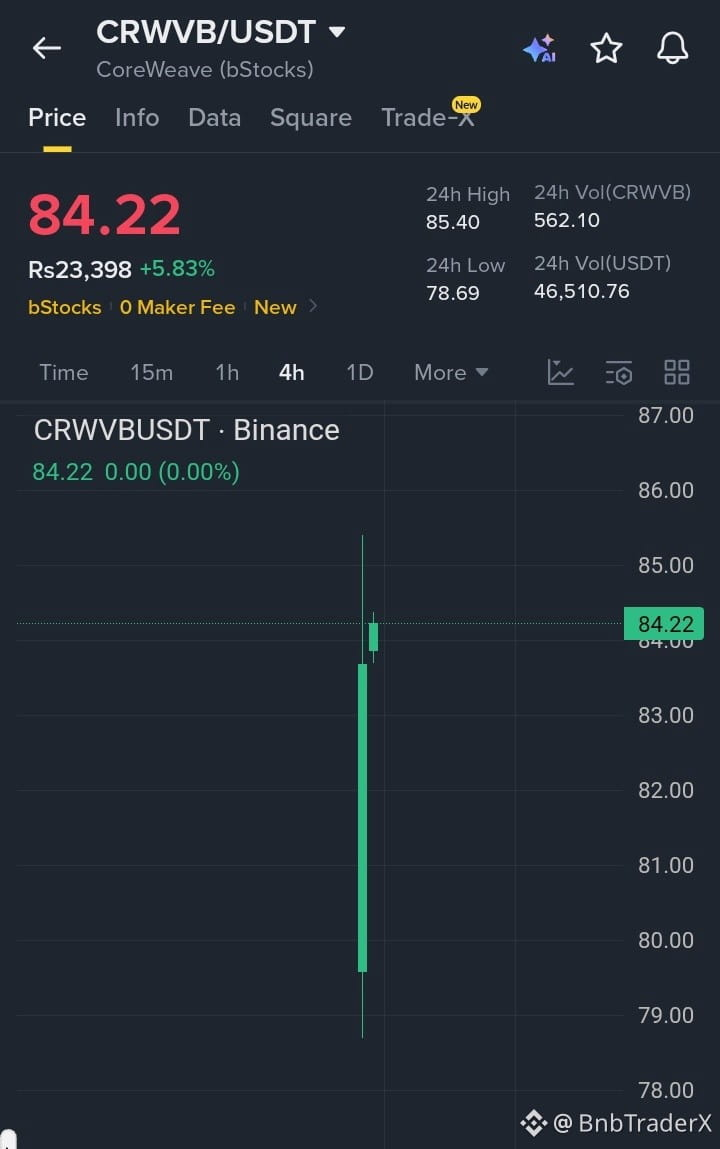
$CRWVB is maintaining a strong bullish structure after reclaiming higher levels with steady buying pressure. Holding above the current support zone keeps the momentum positive, and a breakout above the recent high could trigger another leg higher.
Targets:
• $86.00
• $89.00
• $94.00
#CRWVB #CoreWeave #A #Stocks
{spot}(CRWVBUSDT)
$CRWVB is maintaining a strong bullish structure after reclaiming higher levels with steady buying pressure. Holding above the current support zone keeps the momentum positive, and a breakout above the recent high could trigger another leg higher.
Targets:
• $86.00
• $89.00
• $94.00
#CRWVB #CoreWeave #A #Stocks
Targets:
• $86.00
• $89.00
• $94.00
#CRWVB #CoreWeave #A #Stocks
2
67
CoreWeave’s single-day plunge of 13%, weakness spreading across HPC and new cloud service concept stocks, and the trigger was a message reported by Meta.
The market’s main concern is actually very simple: once the biggest buyer of AI computing power begins to face doubts about the timing of capital expenditures, the valuation logic across the entire “shovel-seller” industry chain will be reassessed. Companies like CoreWeave—with high leverage and heavy dependence on major customers—are the first to be hit.
A few points worth noting:
1) The AI computing narrative has shifted from “mindless expansion” to a “verified ROI” phase, and customer concentration risk is being repriced;
2) The new cloud and HPC sector had surged too much earlier on, so any sign of trouble can easily trigger profit-taking;
3) This pullback is also a stress test for the AI+DePIN computing race in the crypto market. Whether on-chain compute projects can tell a differentiated story will determine whether they can break out into an independent trend.
In the short term, sentiment is cautious. However, if this is only a one-off disruption from Meta rather than an industry-wide turning point, oversold conditions could be an opportunity to position for quality targets.
#AI算力 #CoreWeave #DePIN
CoreWeave’s single-day plunge of 13%, weakness spreading across HPC and new cloud service concept stocks, and the trigger was a message reported by Meta.
The market’s main concern is actually very simple: once the biggest buyer of AI computing power begins to face doubts about the timing of capital expenditures, the valuation logic across the entire “shovel-seller” industry chain will be reassessed. Companies like CoreWeave—with high leverage and heavy dependence on major customers—are the first to be hit.
A few points worth noting:
1) The AI computing narrative has shifted from “mindless expansion” to a “verified ROI” phase, and customer concentration risk is being repriced;
2) The new cloud and HPC sector had surged too much earlier on, so any sign of trouble can easily trigger profit-taking;
3) This pullback is also a stress test for the AI+DePIN computing race in the crypto market. Whether on-chain compute projects can tell a differentiated story will determine whether they can break out into an independent trend.
In the short term, sentiment is cautious. However, if this is only a one-off disruption from Meta rather than an industry-wide turning point, oversold conditions could be an opportunity to position for quality targets.
#AI算力 #CoreWeave #DePIN
The market’s main concern is actually very simple: once the biggest buyer of AI computing power begins to face doubts about the timing of capital expenditures, the valuation logic across the entire “shovel-seller” industry chain will be reassessed. Companies like CoreWeave—with high leverage and heavy dependence on major customers—are the first to be hit.
A few points worth noting:
1) The AI computing narrative has shifted from “mindless expansion” to a “verified ROI” phase, and customer concentration risk is being repriced;
2) The new cloud and HPC sector had surged too much earlier on, so any sign of trouble can easily trigger profit-taking;
3) This pullback is also a stress test for the AI+DePIN computing race in the crypto market. Whether on-chain compute projects can tell a differentiated story will determine whether they can break out into an independent trend.
In the short term, sentiment is cautious. However, if this is only a one-off disruption from Meta rather than an industry-wide turning point, oversold conditions could be an opportunity to position for quality targets.
#AI算力 #CoreWeave #DePIN
65

·
--
$CRWVB #CoreWeave #NewListing #TradingVolume
{spot}(CRWVBUSDT)
🚀 CRWVB/USDT – Newly Listed on Binance
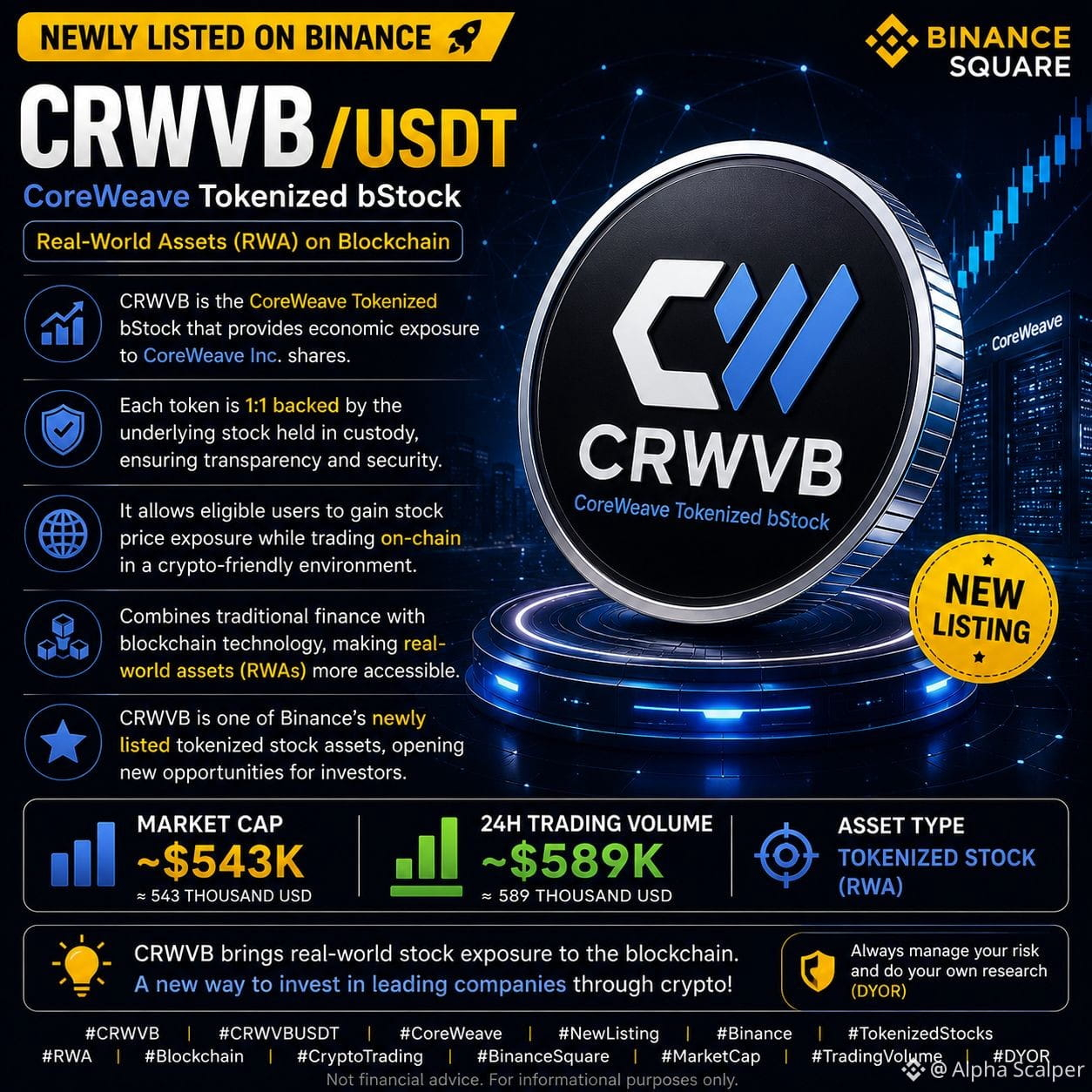
CRWVB is the CoreWeave Tokenized bStock, a blockchain-based token that provides economic exposure to CoreWeave Inc. shares. Each token is backed 1:1 by the underlying stock held in custody, allowing eligible users to gain stock price exposure while trading on-chain. It combines traditional finance with blockchain technology, making real-world assets (RWAs) accessible in a crypto-friendly format. CRWVB is one of Binance's newly listed tokenized stock assets, making it an interesting product to watch.
📊 Market Cap: ~$543K
📈 24H Trading Volume: ~$589K
💡 As a newly listed asset, CRWVB may experience higher volatility. Always use proper risk management and do your own research (DYOR).
$CRWVB #CoreWeave #NewListing #TradingVolume
🚀 CRWVB/USDT – Newly Listed on Binance
CRWVB is the CoreWeave Tokenized bStock, a blockchain-based token that provides economic exposure to CoreWeave Inc. shares. Each token is backed 1:1 by the underlying stock held in custody, allowing eligible users to gain stock price exposure while trading on-chain. It combines traditional finance with blockchain technology, making real-world assets (RWAs) accessible in a crypto-friendly format. CRWVB is one of Binance's newly listed tokenized stock assets, making it an interesting product to watch.
📊 Market Cap: ~$543K
📈 24H Trading Volume: ~$589K
💡 As a newly listed asset, CRWVB may experience higher volatility. Always use proper risk management and do your own research (DYOR).
🚀 CRWVB/USDT – Newly Listed on Binance
CRWVB is the CoreWeave Tokenized bStock, a blockchain-based token that provides economic exposure to CoreWeave Inc. shares. Each token is backed 1:1 by the underlying stock held in custody, allowing eligible users to gain stock price exposure while trading on-chain. It combines traditional finance with blockchain technology, making real-world assets (RWAs) accessible in a crypto-friendly format. CRWVB is one of Binance's newly listed tokenized stock assets, making it an interesting product to watch.
📊 Market Cap: ~$543K
📈 24H Trading Volume: ~$589K
💡 As a newly listed asset, CRWVB may experience higher volatility. Always use proper risk management and do your own research (DYOR).
86

·
--
Bullish
🚀 $CRWV Surges as AI Demand Drives Record Revenue:
CoreWeave ($CRWV ) is emerging as a major beneficiary of the accelerating AI infrastructure boom.
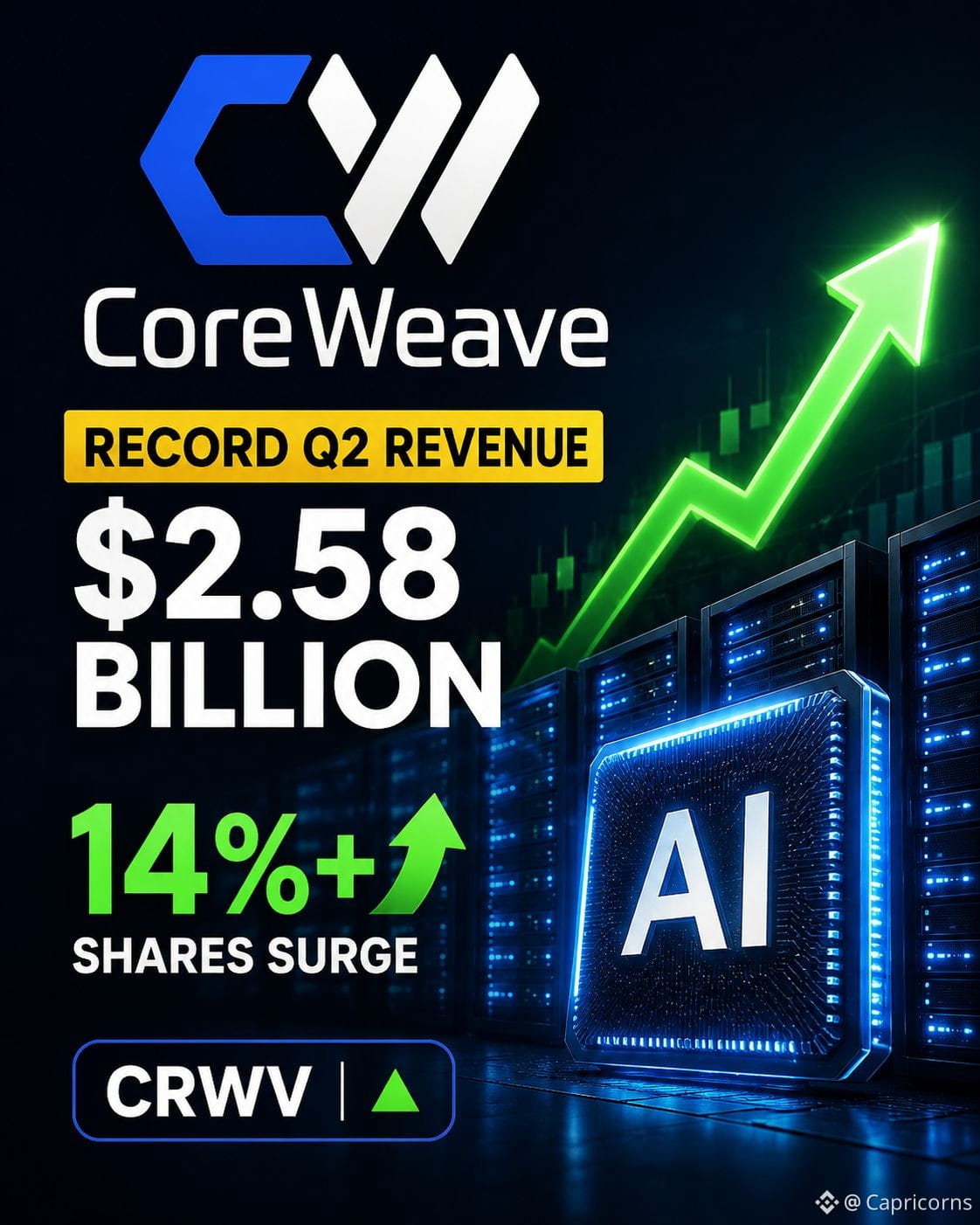
The AI-focused cloud provider reported $2.58 billion in Q2 2026 revenue, up roughly 112% year over year, beating market expectations. Its revenue backlog reached approximately $104.2 billion, highlighting strong long-term demand for AI computing capacity.
Investor reaction was immediate:
CRWV shares jumped more than 14% in extended trading following the earnings release. The company also raised its 2026 revenue outlook to $12.4–$13.2 billion and increased its capital-expenditure forecast to $35–$39 billion as it continues expanding its AI infrastructure.
However, the picture is not entirely bullish. CoreWeave reported a $626 million net loss, underscoring the enormous cost of scaling data centers and AI computing capacity.
📊 Why It Matters for Crypto?
The bigger takeaway for digital-asset investors is the growing competition for GPUs, electricity and data-center capacity.
AI infrastructure is attracting massive amounts of capital, creating a powerful investment theme that increasingly overlaps with the same computing and energy resources relevant to crypto mining and blockchain infrastructure.
AI demand is accelerating — but will this capital shift become a long-term headwind for crypto, or could AI and blockchain eventually benefit from the same infrastructure boom?
#CoreWeave #CryptoNewss #topnews
🚀 $CRWV Surges as AI Demand Drives Record Revenue:
CoreWeave ($CRWV ) is emerging as a major beneficiary of the accelerating AI infrastructure boom.
The AI-focused cloud provider reported $2.58 billion in Q2 2026 revenue, up roughly 112% year over year, beating market expectations. Its revenue backlog reached approximately $104.2 billion, highlighting strong long-term demand for AI computing capacity.
Investor reaction was immediate:
CRWV shares jumped more than 14% in extended trading following the earnings release. The company also raised its 2026 revenue outlook to $12.4–$13.2 billion and increased its capital-expenditure forecast to $35–$39 billion as it continues expanding its AI infrastructure.
However, the picture is not entirely bullish. CoreWeave reported a $626 million net loss, underscoring the enormous cost of scaling data centers and AI computing capacity.
📊 Why It Matters for Crypto?
The bigger takeaway for digital-asset investors is the growing competition for GPUs, electricity and data-center capacity.
AI infrastructure is attracting massive amounts of capital, creating a powerful investment theme that increasingly overlaps with the same computing and energy resources relevant to crypto mining and blockchain infrastructure.
AI demand is accelerating — but will this capital shift become a long-term headwind for crypto, or could AI and blockchain eventually benefit from the same infrastructure boom?
#CoreWeave #CryptoNewss #topnews
CoreWeave ($CRWV ) is emerging as a major beneficiary of the accelerating AI infrastructure boom.
The AI-focused cloud provider reported $2.58 billion in Q2 2026 revenue, up roughly 112% year over year, beating market expectations. Its revenue backlog reached approximately $104.2 billion, highlighting strong long-term demand for AI computing capacity.
Investor reaction was immediate:
CRWV shares jumped more than 14% in extended trading following the earnings release. The company also raised its 2026 revenue outlook to $12.4–$13.2 billion and increased its capital-expenditure forecast to $35–$39 billion as it continues expanding its AI infrastructure.
However, the picture is not entirely bullish. CoreWeave reported a $626 million net loss, underscoring the enormous cost of scaling data centers and AI computing capacity.
📊 Why It Matters for Crypto?
The bigger takeaway for digital-asset investors is the growing competition for GPUs, electricity and data-center capacity.
AI infrastructure is attracting massive amounts of capital, creating a powerful investment theme that increasingly overlaps with the same computing and energy resources relevant to crypto mining and blockchain infrastructure.
AI demand is accelerating — but will this capital shift become a long-term headwind for crypto, or could AI and blockchain eventually benefit from the same infrastructure boom?
#CoreWeave #CryptoNewss #topnews
135

CoreWeave single-day plunge of 13% as HPC and “new cloud” concept stocks collectively weaken; the trigger was a piece of related information reported by Meta.
There are a few signals worth noting in this pullback:
1. “Buyer/tenant-side risk” in the AI compute narrative is beginning to surface. Cloud vendors like CoreWeave rely heavily on the capital-expenditure cadence of top-tier customers. As soon as Meta or Microsoft shows signs of slowing or negotiating harder, valuations will be repriced.
2. In the prior rally of the HPC sector, there were too many assumptions of “perpetual expansion.” Once a hyperscale customer’s compute procurement shifts from scrambling to more precise calculation, intermediaries’ gross margin headroom will be clearly squeezed.
3. Don’t ignore the mapping to the crypto market either. On-chain compute narratives, DePIN, and AI tokens previously rode the tailwind of GPU shortages to a large extent. Now it’s time to reassess: if supply on the traditional HPC side starts to loosen, how long can the compute premium on the crypto side hold up?
In the short term, this looks like an emotion-driven selloff; in the medium term, it’s a turning point for AI infrastructure moving from being “story-driven” to “cash-flow-driven.” Those who can keep up with earnings stay; those trading on valuation narratives get cleared out.
#AI算力 #HPC #CoreWeave
CoreWeave single-day plunge of 13% as HPC and “new cloud” concept stocks collectively weaken; the trigger was a piece of related information reported by Meta.
There are a few signals worth noting in this pullback:
1. “Buyer/tenant-side risk” in the AI compute narrative is beginning to surface. Cloud vendors like CoreWeave rely heavily on the capital-expenditure cadence of top-tier customers. As soon as Meta or Microsoft shows signs of slowing or negotiating harder, valuations will be repriced.
2. In the prior rally of the HPC sector, there were too many assumptions of “perpetual expansion.” Once a hyperscale customer’s compute procurement shifts from scrambling to more precise calculation, intermediaries’ gross margin headroom will be clearly squeezed.
3. Don’t ignore the mapping to the crypto market either. On-chain compute narratives, DePIN, and AI tokens previously rode the tailwind of GPU shortages to a large extent. Now it’s time to reassess: if supply on the traditional HPC side starts to loosen, how long can the compute premium on the crypto side hold up?
In the short term, this looks like an emotion-driven selloff; in the medium term, it’s a turning point for AI infrastructure moving from being “story-driven” to “cash-flow-driven.” Those who can keep up with earnings stay; those trading on valuation narratives get cleared out.
#AI算力 #HPC #CoreWeave
There are a few signals worth noting in this pullback:
1. “Buyer/tenant-side risk” in the AI compute narrative is beginning to surface. Cloud vendors like CoreWeave rely heavily on the capital-expenditure cadence of top-tier customers. As soon as Meta or Microsoft shows signs of slowing or negotiating harder, valuations will be repriced.
2. In the prior rally of the HPC sector, there were too many assumptions of “perpetual expansion.” Once a hyperscale customer’s compute procurement shifts from scrambling to more precise calculation, intermediaries’ gross margin headroom will be clearly squeezed.
3. Don’t ignore the mapping to the crypto market either. On-chain compute narratives, DePIN, and AI tokens previously rode the tailwind of GPU shortages to a large extent. Now it’s time to reassess: if supply on the traditional HPC side starts to loosen, how long can the compute premium on the crypto side hold up?
In the short term, this looks like an emotion-driven selloff; in the medium term, it’s a turning point for AI infrastructure moving from being “story-driven” to “cash-flow-driven.” Those who can keep up with earnings stay; those trading on valuation narratives get cleared out.
#AI算力 #HPC #CoreWeave
108
·
--
CoreWeave plunges 13% in a single day; HPC and new cloud concept stocks slide together, with Meta’s announcement as the trigger.
What is the market worried about? If the procurement pace for AI compute by ultra-large customers slows down, or the proportion of in-house buildouts rises, then those “new cloud” players betting on “selling shovels to the giants” will be directly exposed to concentration risk—CoreWeave’s revenue is highly dependent on large customers like Microsoft and Meta, so any small change can be amplified.
It’s worth noting that this is not just a problem for CoreWeave alone, but a stress test of the valuation logic across the entire AI infrastructure space. Early on, the market treated “compute shortage” as a perpetual narrative; however, the risks—customer concentration, the sustainability of long-term contracts, and depreciation pressure—are issues that can’t be avoided.
The mapping to the crypto market is also worth关注: The DePIN and decentralized compute narratives are essentially the same industry chain as new cloud, just with different competitive positions. If traditional HPC concept stocks start to be repriced, the valuation anchor for distributed compute could loosen as well. Near term, sentiment is likely to take pressure, but in the medium to long term, the decentralised supply’s advantage in resisting concentration may stand out.
The risk isn’t that AI demand disappears, but that not everyone can secure that demand.
#AI #DePIN #CoreWeave
CoreWeave plunges 13% in a single day; HPC and new cloud concept stocks slide together, with Meta’s announcement as the trigger.
What is the market worried about? If the procurement pace for AI compute by ultra-large customers slows down, or the proportion of in-house buildouts rises, then those “new cloud” players betting on “selling shovels to the giants” will be directly exposed to concentration risk—CoreWeave’s revenue is highly dependent on large customers like Microsoft and Meta, so any small change can be amplified.
It’s worth noting that this is not just a problem for CoreWeave alone, but a stress test of the valuation logic across the entire AI infrastructure space. Early on, the market treated “compute shortage” as a perpetual narrative; however, the risks—customer concentration, the sustainability of long-term contracts, and depreciation pressure—are issues that can’t be avoided.
The mapping to the crypto market is also worth关注: The DePIN and decentralized compute narratives are essentially the same industry chain as new cloud, just with different competitive positions. If traditional HPC concept stocks start to be repriced, the valuation anchor for distributed compute could loosen as well. Near term, sentiment is likely to take pressure, but in the medium to long term, the decentralised supply’s advantage in resisting concentration may stand out.
The risk isn’t that AI demand disappears, but that not everyone can secure that demand.
#AI #DePIN #CoreWeave
What is the market worried about? If the procurement pace for AI compute by ultra-large customers slows down, or the proportion of in-house buildouts rises, then those “new cloud” players betting on “selling shovels to the giants” will be directly exposed to concentration risk—CoreWeave’s revenue is highly dependent on large customers like Microsoft and Meta, so any small change can be amplified.
It’s worth noting that this is not just a problem for CoreWeave alone, but a stress test of the valuation logic across the entire AI infrastructure space. Early on, the market treated “compute shortage” as a perpetual narrative; however, the risks—customer concentration, the sustainability of long-term contracts, and depreciation pressure—are issues that can’t be avoided.
The mapping to the crypto market is also worth关注: The DePIN and decentralized compute narratives are essentially the same industry chain as new cloud, just with different competitive positions. If traditional HPC concept stocks start to be repriced, the valuation anchor for distributed compute could loosen as well. Near term, sentiment is likely to take pressure, but in the medium to long term, the decentralised supply’s advantage in resisting concentration may stand out.
The risk isn’t that AI demand disappears, but that not everyone can secure that demand.
#AI #DePIN #CoreWeave
99
·
--
Bullish
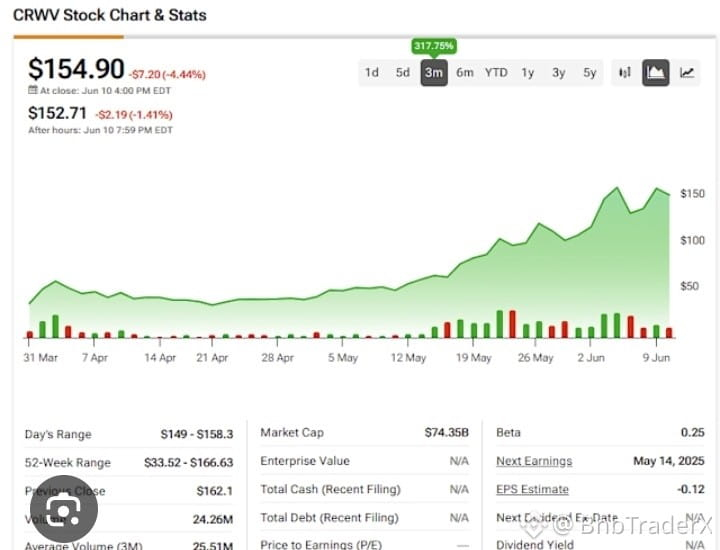
$CRWV on the 1-hour chart shows a strong V-shaped recovery after testing a local low near $95.00. The price has successfully reclaimed the psychological level of $100.00 and is showing strong bullish momentum with consecutive green candles leading up to $102.07. If buyers manage to maintain this pressure, the asset is highly likely to challenge the immediate resistance cluster around $104.00, opening the door for an extended upward move. However, if the price gets rejected at the current local resistance, a brief retest of the $100.00 support level can be expected before the next directional expansion.
Target 1: $103.80
Target 2: $106.00
Target 3: $108.50
#CRWV #CoreWeave #CryptoTrading
{future}(CRWVUSDT)
$CRWV on the 1-hour chart shows a strong V-shaped recovery after testing a local low near $95.00. The price has successfully reclaimed the psychological level of $100.00 and is showing strong bullish momentum with consecutive green candles leading up to $102.07. If buyers manage to maintain this pressure, the asset is highly likely to challenge the immediate resistance cluster around $104.00, opening the door for an extended upward move. However, if the price gets rejected at the current local resistance, a brief retest of the $100.00 support level can be expected before the next directional expansion.
Target 1: $103.80
Target 2: $106.00
Target 3: $108.50
#CRWV #CoreWeave #CryptoTrading
Target 1: $103.80
Target 2: $106.00
Target 3: $108.50
#CRWV #CoreWeave #CryptoTrading
1
114
CoreWeave Tokenized Stock ($CRWV) has been performing exceptionally well recently—up more than 26% in a single week, backed by solid fundamentals.
First, let’s look at performance: Q2 revenue doubled, reaching $257 million. This kind of growth isn’t common in today’s macro environment. Even more important is the order backlog—$104.2 billion, which does not yet include the additional $25 billion in orders added in Q3. From the demand side, it’s essentially a “ceiling you can’t see.”
The supply side also has its own story: existing A100 contracts have been extended through 2029, meaning core customers are locked into long-term partnerships. Meanwhile, pricing for the Black Gold and Vera Rubin series GPUs has set new historical highs, with per-card economics continuing to improve.
From market data, the current quote for $CRWV is $82.53, with $36.26 traded over the past 24 hours. While the trading volume is relatively small, volatility and upside elasticity are sufficient. Order backlog, revenue growth momentum, and product pricing are all resonating together, so near-term upward drivers still look strong.
One thing to note: these tokenized stocks are still influenced by U.S. stock trading hours and underlying liquidity, so after-hours or during Asian session time, price deviations may occur. Accordingly, managing position size reasonably and setting stop-loss levels remain key.
#CoreWeave #代币化股票 #AI算力
CoreWeave Tokenized Stock ($CRWV ) has been performing exceptionally well recently—up more than 26% in a single week, backed by solid fundamentals.
First, let’s look at performance: Q2 revenue doubled, reaching $257 million. This kind of growth isn’t common in today’s macro environment. Even more important is the order backlog—$104.2 billion, which does not yet include the additional $25 billion in orders added in Q3. From the demand side, it’s essentially a “ceiling you can’t see.”
The supply side also has its own story: existing A100 contracts have been extended through 2029, meaning core customers are locked into long-term partnerships. Meanwhile, pricing for the Black Gold and Vera Rubin series GPUs has set new historical highs, with per-card economics continuing to improve.
From market data, the current quote for $CRWV is $82.53, with $36.26 traded over the past 24 hours. While the trading volume is relatively small, volatility and upside elasticity are sufficient. Order backlog, revenue growth momentum, and product pricing are all resonating together, so near-term upward drivers still look strong.
One thing to note: these tokenized stocks are still influenced by U.S. stock trading hours and underlying liquidity, so after-hours or during Asian session time, price deviations may occur. Accordingly, managing position size reasonably and setting stop-loss levels remain key.
#CoreWeave #代币化股票 #AI算力
First, let’s look at performance: Q2 revenue doubled, reaching $257 million. This kind of growth isn’t common in today’s macro environment. Even more important is the order backlog—$104.2 billion, which does not yet include the additional $25 billion in orders added in Q3. From the demand side, it’s essentially a “ceiling you can’t see.”
The supply side also has its own story: existing A100 contracts have been extended through 2029, meaning core customers are locked into long-term partnerships. Meanwhile, pricing for the Black Gold and Vera Rubin series GPUs has set new historical highs, with per-card economics continuing to improve.
From market data, the current quote for $CRWV is $82.53, with $36.26 traded over the past 24 hours. While the trading volume is relatively small, volatility and upside elasticity are sufficient. Order backlog, revenue growth momentum, and product pricing are all resonating together, so near-term upward drivers still look strong.
One thing to note: these tokenized stocks are still influenced by U.S. stock trading hours and underlying liquidity, so after-hours or during Asian session time, price deviations may occur. Accordingly, managing position size reasonably and setting stop-loss levels remain key.
#CoreWeave #代币化股票 #AI算力
103
Log in to explore more content
Join global crypto users on Binance Square
⚡️ Get latest and useful information about crypto.
💬 Trusted by the world’s largest crypto exchange.
👍 Discover real insights from verified creators.
Email / Phone number
Trending Topics
1
#BitcoinReboundsTo$79K
93 views
24 Discussing
2
#FedHikeOddsRiseTo89%
43,525 views
774 Discussing
3
#RLUSDSupplyHitsRecord$2.442B
1,869 views
36 Discussing
4
#AvalancheIntegratesIntoUAEPassDigitalVault
50,202 views
834 Discussing
5
#UKSeeksViewsOnTokenizingGold
37,452 views
602 Discussing
6
#AnthropicCEOCallsForAISlowdown
208,971 views
3,132 Discussing
7
#RevolutDataLeakReportedlyPostedAttackersThreatenDailyReleases
3,897 views
81 Discussing
8
#BrazilCentralBankRaisesVASPCapitalRequirements
32,925 views
736 Discussing
9
#BitcoinThirdSingleBlockReorgInFourWeeks
80,577 views
1,540 Discussing
10
#EthereumFallsBelow$2500
6,459 views
91 Discussing