
#cftcseekstodismisscmemotioninperpfutures
cftcseekstodismisscmemotioninperpfutures
44,469 views
551 Discussing
Hot
Latest

Picture this: institutional players quietly push for regulated crypto perpetuals in the US, and regulators immediately move to shut the door.
Most retail traders treat perpetual futures as a frictionless way to trade with leverage, assuming liquidity will always be there when volatility spikes. The real danger is building strategies around derivative access that could vanish or get heavily restricted overnight when legal battles escalate.
The CFTC's latest push to dismiss CME's motion regarding perpetual futures is not just bureaucratic red tape. It signals a fundamental clash over where decentralized mechanics and traditional oversight meet. While offshore venues rely on pairs backed by $USDT to maintain massive perp volumes, domestic venues trying to offer compliant versions are running into a regulatory wall.
When institutional rails hit friction, the liquidity shock trickles straight down into altcoin ecosystems like $ONDO and $ICP where synthetic exposures and structured yields depend on predictable hedging instruments. If US-regulated entities cannot offer perpetual contracts, capital either retreats into safer yield or gets pushed further offshore, widening the risk spread for everyone holding open positions.
Where do you think institutional derivatives liquidity heads if US perp futures remain blocked?
#CFTCSeeksToDismissCMEMotionInPerpFutures #US10YearTreasuryYieldHitsHighestSinceNov2023
Picture this: institutional players quietly push for regulated crypto perpetuals in the US, and regulators immediately move to shut the door.
Most retail traders treat perpetual futures as a frictionless way to trade with leverage, assuming liquidity will always be there when volatility spikes. The real danger is building strategies around derivative access that could vanish or get heavily restricted overnight when legal battles escalate.
The CFTC's latest push to dismiss CME's motion regarding perpetual futures is not just bureaucratic red tape. It signals a fundamental clash over where decentralized mechanics and traditional oversight meet. While offshore venues rely on pairs backed by $USDT to maintain massive perp volumes, domestic venues trying to offer compliant versions are running into a regulatory wall.
When institutional rails hit friction, the liquidity shock trickles straight down into altcoin ecosystems like $ONDO and $ICP where synthetic exposures and structured yields depend on predictable hedging instruments. If US-regulated entities cannot offer perpetual contracts, capital either retreats into safer yield or gets pushed further offshore, widening the risk spread for everyone holding open positions.
Where do you think institutional derivatives liquidity heads if US perp futures remain blocked?
#CFTCSeeksToDismissCMEMotionInPerpFutures #US10YearTreasuryYieldHitsHighestSinceNov2023
Most retail traders treat perpetual futures as a frictionless way to trade with leverage, assuming liquidity will always be there when volatility spikes. The real danger is building strategies around derivative access that could vanish or get heavily restricted overnight when legal battles escalate.
The CFTC's latest push to dismiss CME's motion regarding perpetual futures is not just bureaucratic red tape. It signals a fundamental clash over where decentralized mechanics and traditional oversight meet. While offshore venues rely on pairs backed by $USDT to maintain massive perp volumes, domestic venues trying to offer compliant versions are running into a regulatory wall.
When institutional rails hit friction, the liquidity shock trickles straight down into altcoin ecosystems like $ONDO and $ICP where synthetic exposures and structured yields depend on predictable hedging instruments. If US-regulated entities cannot offer perpetual contracts, capital either retreats into safer yield or gets pushed further offshore, widening the risk spread for everyone holding open positions.
Where do you think institutional derivatives liquidity heads if US perp futures remain blocked?
#CFTCSeeksToDismissCMEMotionInPerpFutures #US10YearTreasuryYieldHitsHighestSinceNov2023

119

·
--
Why is nobody talking about how the CFTC pushing back against CME perpetual futures could actually redefine retail leverage for good?
Most traders keep getting wrecked on sudden liquidation cascades while chasing hype on tokens like $NEIRO or $CATI, simply because they treat high-leverage perps like spot holding without understanding structural counterparty risks. When regulators step in to challenge traditional exchange frameworks on perpetual contracts, retail usually panics and dumps, missing the bigger shift entirely.
Here is how you actually navigate this transition without losing capital. First, stop parking your entire speculative margin in unregulated synthetic contracts; rotate your core safety allocations into transparent yield infrastructure or RWA plays like $ONDO to maintain stability while the legal dust settles. Second, treat leverage as a surgical tool for hedging rather than directional gambling, especially when macro liquidity signals are shifting across institutional desks.
The goal is not to avoid perpetual markets, but to position yourself where institutional settlement standards will eventually land before everyone else catches up.
Where do you think perpetual contracts will find their equilibrium once the regulatory battle clears out?
#CFTCSeeksToDismissCMEMotionInPerpFutures #US10YearTreasuryYieldHitsHighestSinceNov2023
Why is nobody talking about how the CFTC pushing back against CME perpetual futures could actually redefine retail leverage for good?
Most traders keep getting wrecked on sudden liquidation cascades while chasing hype on tokens like $NEIRO or $CATI , simply because they treat high-leverage perps like spot holding without understanding structural counterparty risks. When regulators step in to challenge traditional exchange frameworks on perpetual contracts, retail usually panics and dumps, missing the bigger shift entirely.
Here is how you actually navigate this transition without losing capital. First, stop parking your entire speculative margin in unregulated synthetic contracts; rotate your core safety allocations into transparent yield infrastructure or RWA plays like $ONDO to maintain stability while the legal dust settles. Second, treat leverage as a surgical tool for hedging rather than directional gambling, especially when macro liquidity signals are shifting across institutional desks.
The goal is not to avoid perpetual markets, but to position yourself where institutional settlement standards will eventually land before everyone else catches up.
Where do you think perpetual contracts will find their equilibrium once the regulatory battle clears out?
#CFTCSeeksToDismissCMEMotionInPerpFutures #US10YearTreasuryYieldHitsHighestSinceNov2023
Most traders keep getting wrecked on sudden liquidation cascades while chasing hype on tokens like $NEIRO or $CATI , simply because they treat high-leverage perps like spot holding without understanding structural counterparty risks. When regulators step in to challenge traditional exchange frameworks on perpetual contracts, retail usually panics and dumps, missing the bigger shift entirely.
Here is how you actually navigate this transition without losing capital. First, stop parking your entire speculative margin in unregulated synthetic contracts; rotate your core safety allocations into transparent yield infrastructure or RWA plays like $ONDO to maintain stability while the legal dust settles. Second, treat leverage as a surgical tool for hedging rather than directional gambling, especially when macro liquidity signals are shifting across institutional desks.
The goal is not to avoid perpetual markets, but to position yourself where institutional settlement standards will eventually land before everyone else catches up.
Where do you think perpetual contracts will find their equilibrium once the regulatory battle clears out?
#CFTCSeeksToDismissCMEMotionInPerpFutures #US10YearTreasuryYieldHitsHighestSinceNov2023
81

·
--
Over seventy percent of global crypto trading volume relies on perpetual futures, yet almost none of that volume operates under a clear legal framework in major financial jurisdictions.
Most traders ignore regulatory filings until open interest suddenly evaporates and liquidity gets wiped out mid-trade. If you think courtroom friction between legacy exchanges and regulators only matters to institutional lawyers, your collateral might be at far greater risk than you realize.
The CFTC pushing to dismiss CME's motion around perpetual contracts exposes a massive structural vulnerability in how the market prices derivative risk. Most retail participants assume funding rates and offshore perp mechanics will run smoothly forever as long as they hold safe collateral in $USDT. In reality, if regulators successfully establish precedents that restrict how cash-settled perpetuals are offered, the first thing to dry up will be market maker depth across the board.
We are already watching tokenized assets and yield instruments like $ONDO bridge the gap between traditional rails and decentralized markets. When legal battles shake the foundation of derivative market makers, bid-ask spreads widen violently, meaning routine volatility can trigger cascade liquidations long before your stop-loss even has time to execute.
Where do you think perp liquidity migrates if US courts side against standardized exchange frameworks?
#CFTCSeeksToDismissCMEMotionInPerpFutures #US10YearTreasuryYieldHitsHighestSinceNov2023
Over seventy percent of global crypto trading volume relies on perpetual futures, yet almost none of that volume operates under a clear legal framework in major financial jurisdictions.
Most traders ignore regulatory filings until open interest suddenly evaporates and liquidity gets wiped out mid-trade. If you think courtroom friction between legacy exchanges and regulators only matters to institutional lawyers, your collateral might be at far greater risk than you realize.
The CFTC pushing to dismiss CME's motion around perpetual contracts exposes a massive structural vulnerability in how the market prices derivative risk. Most retail participants assume funding rates and offshore perp mechanics will run smoothly forever as long as they hold safe collateral in $USDT. In reality, if regulators successfully establish precedents that restrict how cash-settled perpetuals are offered, the first thing to dry up will be market maker depth across the board.
We are already watching tokenized assets and yield instruments like $ONDO bridge the gap between traditional rails and decentralized markets. When legal battles shake the foundation of derivative market makers, bid-ask spreads widen violently, meaning routine volatility can trigger cascade liquidations long before your stop-loss even has time to execute.
Where do you think perp liquidity migrates if US courts side against standardized exchange frameworks?
#CFTCSeeksToDismissCMEMotionInPerpFutures #US10YearTreasuryYieldHitsHighestSinceNov2023
Most traders ignore regulatory filings until open interest suddenly evaporates and liquidity gets wiped out mid-trade. If you think courtroom friction between legacy exchanges and regulators only matters to institutional lawyers, your collateral might be at far greater risk than you realize.
The CFTC pushing to dismiss CME's motion around perpetual contracts exposes a massive structural vulnerability in how the market prices derivative risk. Most retail participants assume funding rates and offshore perp mechanics will run smoothly forever as long as they hold safe collateral in $USDT. In reality, if regulators successfully establish precedents that restrict how cash-settled perpetuals are offered, the first thing to dry up will be market maker depth across the board.
We are already watching tokenized assets and yield instruments like $ONDO bridge the gap between traditional rails and decentralized markets. When legal battles shake the foundation of derivative market makers, bid-ask spreads widen violently, meaning routine volatility can trigger cascade liquidations long before your stop-loss even has time to execute.
Where do you think perp liquidity migrates if US courts side against standardized exchange frameworks?
#CFTCSeeksToDismissCMEMotionInPerpFutures #US10YearTreasuryYieldHitsHighestSinceNov2023

67

·
--
Bearish
#cftcseekstodismisscmemotioninperpfutures
🚨 CFTC MOVES TO DISMISS CME’S CRYPTO PERPS LAWSUIT
The CFTC has asked a federal court to dismiss CME’s challenge to the regulator’s treatment of crypto perpetual contracts as futures. The CFTC argues CME has not shown sufficient competitive harm.
📊 TRADING VIEW: SELL 📉
The legal uncertainty around crypto perpetuals could create short-term pressure on sentiment, especially for derivatives-focused markets. Traders should watch the court battle closely.
❓ Could this case change the future of U.S. crypto derivatives?"CLICK ON THE BELOW YELLOW COIN TAG TO GO TO DESIRED TRADING PAGE TO GET BENEFIT TRADE"$T $MUBARAK $AKE
{future}(AKEUSDT)
{spot}(MUBARAKUSDT)
{spot}(TUSDT)
#cftcseekstodismisscmemotioninperpfutures
🚨 CFTC MOVES TO DISMISS CME’S CRYPTO PERPS LAWSUIT
The CFTC has asked a federal court to dismiss CME’s challenge to the regulator’s treatment of crypto perpetual contracts as futures. The CFTC argues CME has not shown sufficient competitive harm.
📊 TRADING VIEW: SELL 📉
The legal uncertainty around crypto perpetuals could create short-term pressure on sentiment, especially for derivatives-focused markets. Traders should watch the court battle closely.
❓ Could this case change the future of U.S. crypto derivatives?"CLICK ON THE BELOW YELLOW COIN TAG TO GO TO DESIRED TRADING PAGE TO GET BENEFIT TRADE"$T $MUBARAK $AKE
🚨 CFTC MOVES TO DISMISS CME’S CRYPTO PERPS LAWSUIT
The CFTC has asked a federal court to dismiss CME’s challenge to the regulator’s treatment of crypto perpetual contracts as futures. The CFTC argues CME has not shown sufficient competitive harm.
📊 TRADING VIEW: SELL 📉
The legal uncertainty around crypto perpetuals could create short-term pressure on sentiment, especially for derivatives-focused markets. Traders should watch the court battle closely.
❓ Could this case change the future of U.S. crypto derivatives?"CLICK ON THE BELOW YELLOW COIN TAG TO GO TO DESIRED TRADING PAGE TO GET BENEFIT TRADE"$T $MUBARAK $AKE
2
311

·
--
#CFTCSeeksToDismissCMEMotionInPerpFutures
⚖️ CFTC Moves to Dismiss CME Lawsuit Over Bitcoin Perpetual Futures
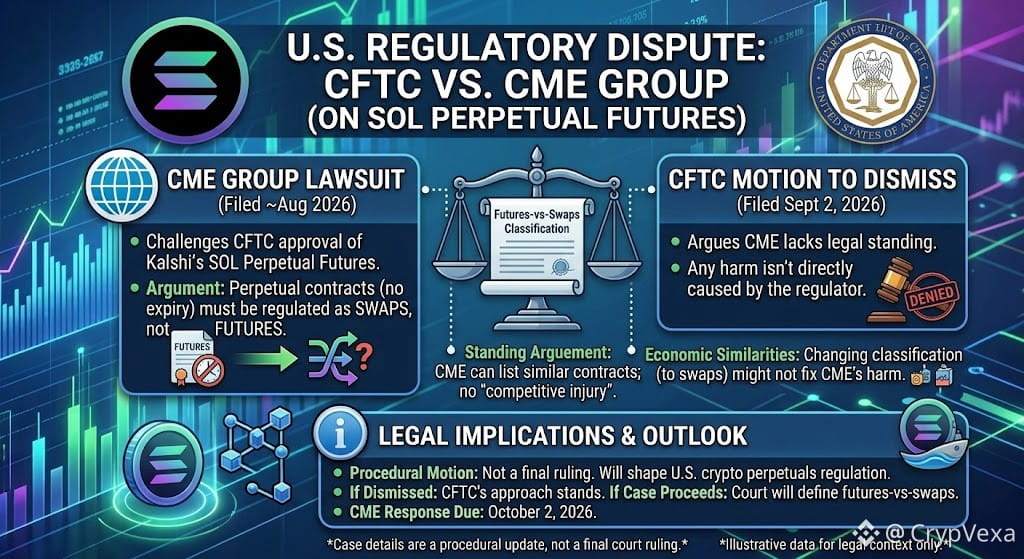
On September 2, 2026, the CFTC asked a U.S. federal court to dismiss CME Group’s lawsuit challenging the approval of a Bitcoin perpetual futures contract offered by Kalshi.
🔍 CME argues that perpetual contracts, because they have no fixed expiry, should be regulated as swaps rather than futures.
The CFTC says CME lacks legal standing because it could potentially list similar perpetual products itself. The regulator also argues CME has not shown concrete competitive harm from the approval.
📌 Why it matters: The case could influence how crypto perpetual contracts are classified and offered on regulated U.S. markets.
⚠️ This is a procedural motion, not a final court ruling. CME’s response is reportedly due October 2, 2026.
👀 Do you think U.S. crypto perpetuals should be regulated as futures or swaps?
#CryptoRegulation #BitcoinFutures #CFTC #CryptoDerivatives
#CFTCSeeksToDismissCMEMotionInPerpFutures
⚖️ CFTC Moves to Dismiss CME Lawsuit Over Bitcoin Perpetual Futures
On September 2, 2026, the CFTC asked a U.S. federal court to dismiss CME Group’s lawsuit challenging the approval of a Bitcoin perpetual futures contract offered by Kalshi.
🔍 CME argues that perpetual contracts, because they have no fixed expiry, should be regulated as swaps rather than futures.
The CFTC says CME lacks legal standing because it could potentially list similar perpetual products itself. The regulator also argues CME has not shown concrete competitive harm from the approval.
📌 Why it matters: The case could influence how crypto perpetual contracts are classified and offered on regulated U.S. markets.
⚠️ This is a procedural motion, not a final court ruling. CME’s response is reportedly due October 2, 2026.
👀 Do you think U.S. crypto perpetuals should be regulated as futures or swaps?
#CryptoRegulation #BitcoinFutures #CFTC #CryptoDerivatives
⚖️ CFTC Moves to Dismiss CME Lawsuit Over Bitcoin Perpetual Futures
On September 2, 2026, the CFTC asked a U.S. federal court to dismiss CME Group’s lawsuit challenging the approval of a Bitcoin perpetual futures contract offered by Kalshi.
🔍 CME argues that perpetual contracts, because they have no fixed expiry, should be regulated as swaps rather than futures.
The CFTC says CME lacks legal standing because it could potentially list similar perpetual products itself. The regulator also argues CME has not shown concrete competitive harm from the approval.
📌 Why it matters: The case could influence how crypto perpetual contracts are classified and offered on regulated U.S. markets.
⚠️ This is a procedural motion, not a final court ruling. CME’s response is reportedly due October 2, 2026.
👀 Do you think U.S. crypto perpetuals should be regulated as futures or swaps?
#CryptoRegulation #BitcoinFutures #CFTC #CryptoDerivatives
49

·
--
#cftcseekstodismisscmemotioninperpfutures
🔥 The U.S. CFTC has formally filed a motion in federal district court to dismiss CME Group’s lawsuit over the regulatory classification of crypto perpetual futures.
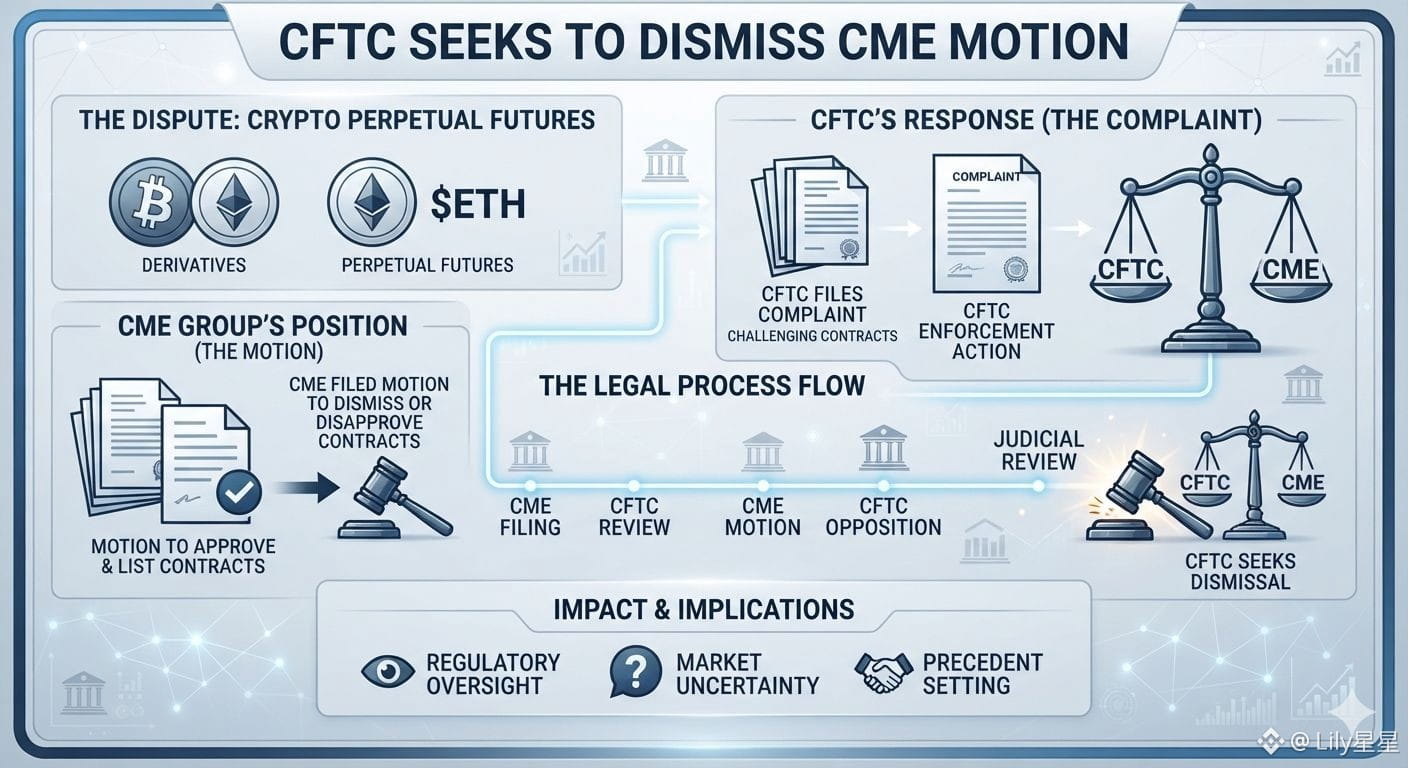
CME challenged the agency’s approval of perpetual contracts—arguing they should be classified and regulated as swaps rather than futures. However, the CFTC countered that CME lacks constitutional standing, asserting that any registered designated contract market is already free to list perpetual futures under current rules. The agency further pointed out that CME's own crypto trading volumes actually increased following the policy decision, rendering claims of competitive harm unfounded. 🏛️
Do you think perpetual futures belong classified as traditional futures or swaps? Drop your thoughts below! 👇
#CFTC
#cftcseekstodismisscmemotioninperpfutures
🔥 The U.S. CFTC has formally filed a motion in federal district court to dismiss CME Group’s lawsuit over the regulatory classification of crypto perpetual futures.
CME challenged the agency’s approval of perpetual contracts—arguing they should be classified and regulated as swaps rather than futures. However, the CFTC countered that CME lacks constitutional standing, asserting that any registered designated contract market is already free to list perpetual futures under current rules. The agency further pointed out that CME's own crypto trading volumes actually increased following the policy decision, rendering claims of competitive harm unfounded. 🏛️
Do you think perpetual futures belong classified as traditional futures or swaps? Drop your thoughts below! 👇
#CFTC
🔥 The U.S. CFTC has formally filed a motion in federal district court to dismiss CME Group’s lawsuit over the regulatory classification of crypto perpetual futures.
CME challenged the agency’s approval of perpetual contracts—arguing they should be classified and regulated as swaps rather than futures. However, the CFTC countered that CME lacks constitutional standing, asserting that any registered designated contract market is already free to list perpetual futures under current rules. The agency further pointed out that CME's own crypto trading volumes actually increased following the policy decision, rendering claims of competitive harm unfounded. 🏛️
Do you think perpetual futures belong classified as traditional futures or swaps? Drop your thoughts below! 👇
#CFTC
2
287
·
--
Picture this: you are managing your derivatives risk thinking institutional players have clear regulatory lanes, only to find the regulators themselves pulling the rug on product innovation.
Most retail traders park their capital in $USDT and jump straight into perpetual swaps without realizing how fragile the legal infrastructure behind leveraged products actually is. When uncertainty hits the underlying framework, liquidity fragments, spreads widen, and sudden liquidation cascades catch everyday accounts completely off guard.
We have seen this movie before when traditional institutions clashed with regulators over crypto native primitives. Back in 2021, when standardized futures tried bridging the gap, legacy venues struggled against flexible offshore volume. Now, as the CFTC moves against CME over perp futures, it is clear the battle for compliant decentralized mechanics is far from settled, leaving tokens like $ONDO and even infrastructure plays like $ICP navigating an unpredictable regulatory gray zone.
Do you think institutional perp products will ever find common ground with US regulators, or will volume just permanently stay onchain?
#CFTCSeeksToDismissCMEMotionInPerpFutures #US10YearTreasuryYieldHitsHighestSinceNov2023
Picture this: you are managing your derivatives risk thinking institutional players have clear regulatory lanes, only to find the regulators themselves pulling the rug on product innovation.
Most retail traders park their capital in $USDT and jump straight into perpetual swaps without realizing how fragile the legal infrastructure behind leveraged products actually is. When uncertainty hits the underlying framework, liquidity fragments, spreads widen, and sudden liquidation cascades catch everyday accounts completely off guard.
We have seen this movie before when traditional institutions clashed with regulators over crypto native primitives. Back in 2021, when standardized futures tried bridging the gap, legacy venues struggled against flexible offshore volume. Now, as the CFTC moves against CME over perp futures, it is clear the battle for compliant decentralized mechanics is far from settled, leaving tokens like $ONDO and even infrastructure plays like $ICP navigating an unpredictable regulatory gray zone.
Do you think institutional perp products will ever find common ground with US regulators, or will volume just permanently stay onchain?
#CFTCSeeksToDismissCMEMotionInPerpFutures #US10YearTreasuryYieldHitsHighestSinceNov2023
Most retail traders park their capital in $USDT and jump straight into perpetual swaps without realizing how fragile the legal infrastructure behind leveraged products actually is. When uncertainty hits the underlying framework, liquidity fragments, spreads widen, and sudden liquidation cascades catch everyday accounts completely off guard.
We have seen this movie before when traditional institutions clashed with regulators over crypto native primitives. Back in 2021, when standardized futures tried bridging the gap, legacy venues struggled against flexible offshore volume. Now, as the CFTC moves against CME over perp futures, it is clear the battle for compliant decentralized mechanics is far from settled, leaving tokens like $ONDO and even infrastructure plays like $ICP navigating an unpredictable regulatory gray zone.
Do you think institutional perp products will ever find common ground with US regulators, or will volume just permanently stay onchain?
#CFTCSeeksToDismissCMEMotionInPerpFutures #US10YearTreasuryYieldHitsHighestSinceNov2023

135

·
--
Why is everyone celebrating institutional access while ignoring the regulatory wall quietly being built around derivatives?
Most traders keep getting blindsided by sudden liquidation cascades and dried-up liquidity, simply because they track charts instead of structural shifts in market plumbing.
Look at what is happening with the CFTC seeking to dismiss CME's motion regarding perpetual futures. For years, retail liquidity has thrived on offshore perps, but traditional venues want that volume on their own terms. When regulatory bodies push back against regulated exchange models trying to adopt crypto-native mechanics, it creates a massive jurisdictional bottleneck.
This friction directly spills over into broad liquidity routing, impacting how collateral like $USDT moves and how market makers hedge high-beta assets like $ONDO and $ICP. If US-regulated giants cannot smoothly integrate perpetuals, the gap between onshore institutional products and decentralized or offshore order books will only widen, leaving everyday traders exposed to fragmented pricing.
Do you think perpetual futures will ever truly integrate into traditional US exchanges, or are we permanently stuck in a split market?
#CFTCSeeksToDismissCMEMotionInPerpFutures #US10YearTreasuryYieldHitsHighestSinceNov2023
Why is everyone celebrating institutional access while ignoring the regulatory wall quietly being built around derivatives?
Most traders keep getting blindsided by sudden liquidation cascades and dried-up liquidity, simply because they track charts instead of structural shifts in market plumbing.
Look at what is happening with the CFTC seeking to dismiss CME's motion regarding perpetual futures. For years, retail liquidity has thrived on offshore perps, but traditional venues want that volume on their own terms. When regulatory bodies push back against regulated exchange models trying to adopt crypto-native mechanics, it creates a massive jurisdictional bottleneck.
This friction directly spills over into broad liquidity routing, impacting how collateral like $USDT moves and how market makers hedge high-beta assets like $ONDO and $ICP . If US-regulated giants cannot smoothly integrate perpetuals, the gap between onshore institutional products and decentralized or offshore order books will only widen, leaving everyday traders exposed to fragmented pricing.
Do you think perpetual futures will ever truly integrate into traditional US exchanges, or are we permanently stuck in a split market?
#CFTCSeeksToDismissCMEMotionInPerpFutures #US10YearTreasuryYieldHitsHighestSinceNov2023
Most traders keep getting blindsided by sudden liquidation cascades and dried-up liquidity, simply because they track charts instead of structural shifts in market plumbing.
Look at what is happening with the CFTC seeking to dismiss CME's motion regarding perpetual futures. For years, retail liquidity has thrived on offshore perps, but traditional venues want that volume on their own terms. When regulatory bodies push back against regulated exchange models trying to adopt crypto-native mechanics, it creates a massive jurisdictional bottleneck.
This friction directly spills over into broad liquidity routing, impacting how collateral like $USDT moves and how market makers hedge high-beta assets like $ONDO and $ICP . If US-regulated giants cannot smoothly integrate perpetuals, the gap between onshore institutional products and decentralized or offshore order books will only widen, leaving everyday traders exposed to fragmented pricing.
Do you think perpetual futures will ever truly integrate into traditional US exchanges, or are we permanently stuck in a split market?
#CFTCSeeksToDismissCMEMotionInPerpFutures #US10YearTreasuryYieldHitsHighestSinceNov2023
96

everyone thinks the cme perps lawsuit is just boring legal noise, but actually this might be the sneaky catalyst that nukes high-leverage traders out of nowhere. most degen plays get completely wrecked not by chart breakdowns, but by sudden regulatory and structural liquidity shifts that blindside retail before anyone can exit.
take a look at how perp mechanics actually work when traditional giants step into our playground. the cftc pushing back against cme's motion around crypto perp futures shows just how split the legal rails still are. while everyone is staring at greed levels sitting around 72 and blindly aping into momentum names like $NEIRO or rotating heavy stables like $USDT into high-beta plays, institutional backdoors might get clamped down hard.
if cme faces hurdles listing compliant perps, you are essentially looking at fragmented liquidity corridors that force sudden liquidations across onshore and offshore books. we saw similar case studies before where regulatory friction in derivative plumbing dried up market maker spreads overnight, leaving retail holding bags on protocols like $ONDO while funding rates went crazy. ngl ser, if you are trading perps on high leverage right now without hedging basis risk, you are basically playing musical chairs.
where do you think perp liquidity moves if traditional clearinghouses get pushed back further?
#CFTCSeeksToDismissCMEMotionInPerpFutures #US10YearTreasuryYieldHitsHighestSinceNov2023
everyone thinks the cme perps lawsuit is just boring legal noise, but actually this might be the sneaky catalyst that nukes high-leverage traders out of nowhere. most degen plays get completely wrecked not by chart breakdowns, but by sudden regulatory and structural liquidity shifts that blindside retail before anyone can exit.
take a look at how perp mechanics actually work when traditional giants step into our playground. the cftc pushing back against cme's motion around crypto perp futures shows just how split the legal rails still are. while everyone is staring at greed levels sitting around 72 and blindly aping into momentum names like $NEIRO or rotating heavy stables like $USDT into high-beta plays, institutional backdoors might get clamped down hard.
if cme faces hurdles listing compliant perps, you are essentially looking at fragmented liquidity corridors that force sudden liquidations across onshore and offshore books. we saw similar case studies before where regulatory friction in derivative plumbing dried up market maker spreads overnight, leaving retail holding bags on protocols like $ONDO while funding rates went crazy. ngl ser, if you are trading perps on high leverage right now without hedging basis risk, you are basically playing musical chairs.
where do you think perp liquidity moves if traditional clearinghouses get pushed back further?
#CFTCSeeksToDismissCMEMotionInPerpFutures #US10YearTreasuryYieldHitsHighestSinceNov2023
take a look at how perp mechanics actually work when traditional giants step into our playground. the cftc pushing back against cme's motion around crypto perp futures shows just how split the legal rails still are. while everyone is staring at greed levels sitting around 72 and blindly aping into momentum names like $NEIRO or rotating heavy stables like $USDT into high-beta plays, institutional backdoors might get clamped down hard.
if cme faces hurdles listing compliant perps, you are essentially looking at fragmented liquidity corridors that force sudden liquidations across onshore and offshore books. we saw similar case studies before where regulatory friction in derivative plumbing dried up market maker spreads overnight, leaving retail holding bags on protocols like $ONDO while funding rates went crazy. ngl ser, if you are trading perps on high leverage right now without hedging basis risk, you are basically playing musical chairs.
where do you think perp liquidity moves if traditional clearinghouses get pushed back further?
#CFTCSeeksToDismissCMEMotionInPerpFutures #US10YearTreasuryYieldHitsHighestSinceNov2023

47

#CFTCSeeksToDismissCMEMotionInPerpFutures Big Win For Crypto?
#CFTCSeeksToDismissCME Lawsuit - CFTC moving to dismiss the case.
This is HUGE. Regulatory pressure easing = Good for the US crypto market.
If CFTC is softening stance, could we see more crypto futures and ETF approvals?
#CFTCSeeksToDismissCMELawsuit #CFTC #Bullish
#CFTCSeeksToDismissCMEMotionInPerpFutures Big Win For Crypto?
#CFTCSeeksToDismissCME Lawsuit - CFTC moving to dismiss the case.
This is HUGE. Regulatory pressure easing = Good for the US crypto market.
If CFTC is softening stance, could we see more crypto futures and ETF approvals?
#CFTCSeeksToDismissCMELawsuit #CFTC #Bullish
#CFTCSeeksToDismissCME Lawsuit - CFTC moving to dismiss the case.
This is HUGE. Regulatory pressure easing = Good for the US crypto market.
If CFTC is softening stance, could we see more crypto futures and ETF approvals?
#CFTCSeeksToDismissCMELawsuit #CFTC #Bullish
66

·
--
#cftcseekstodismisscmemotioninperpfutures
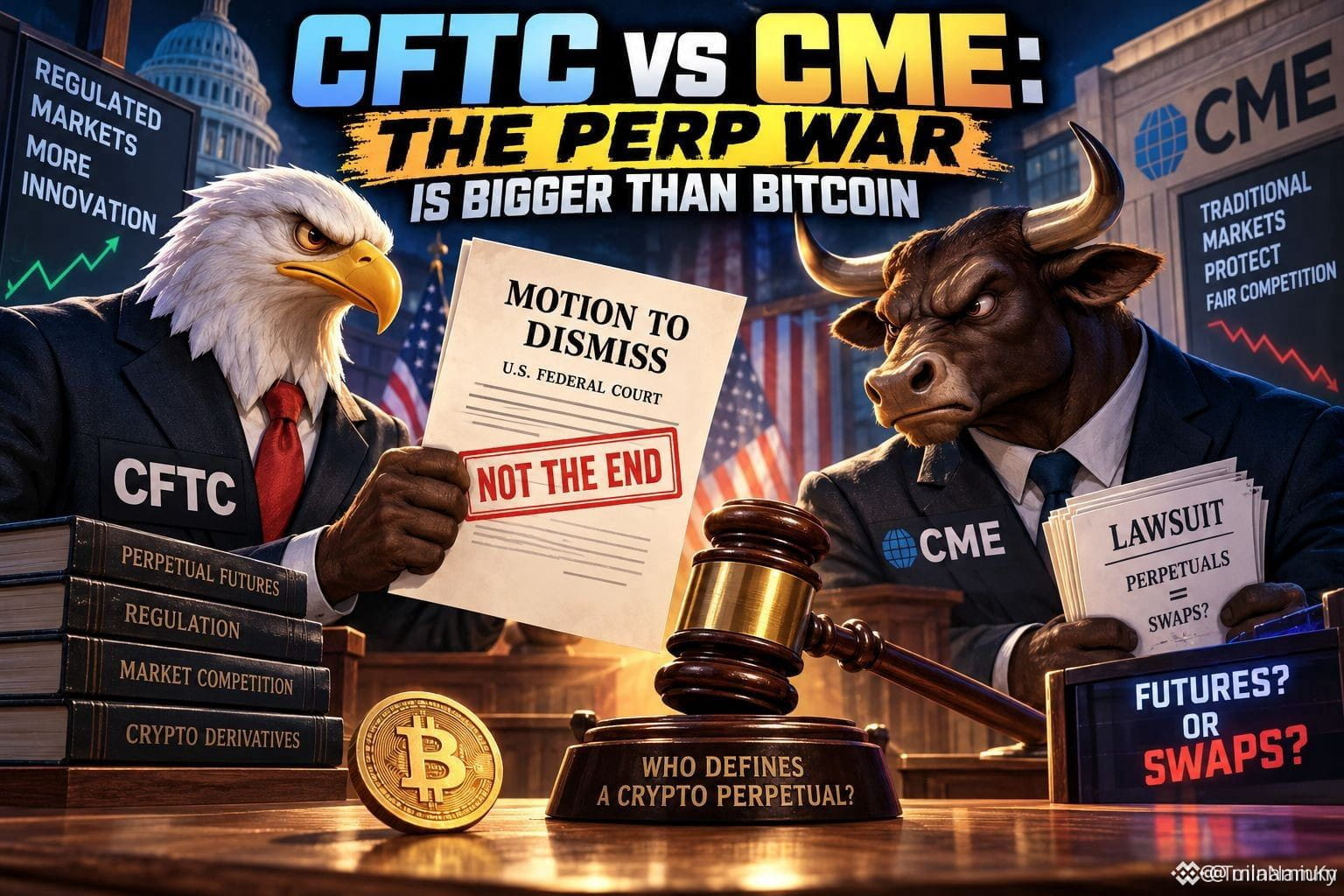
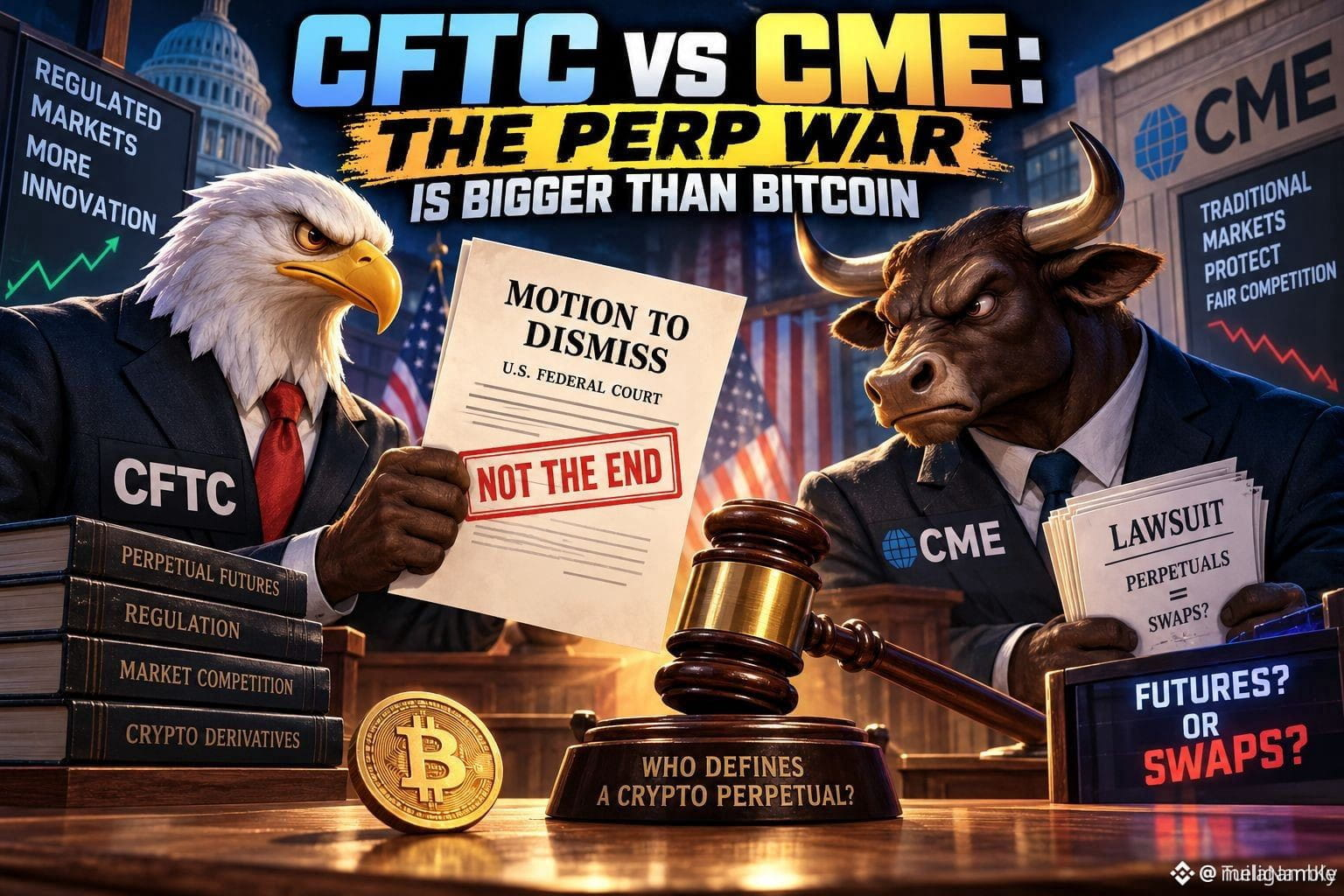
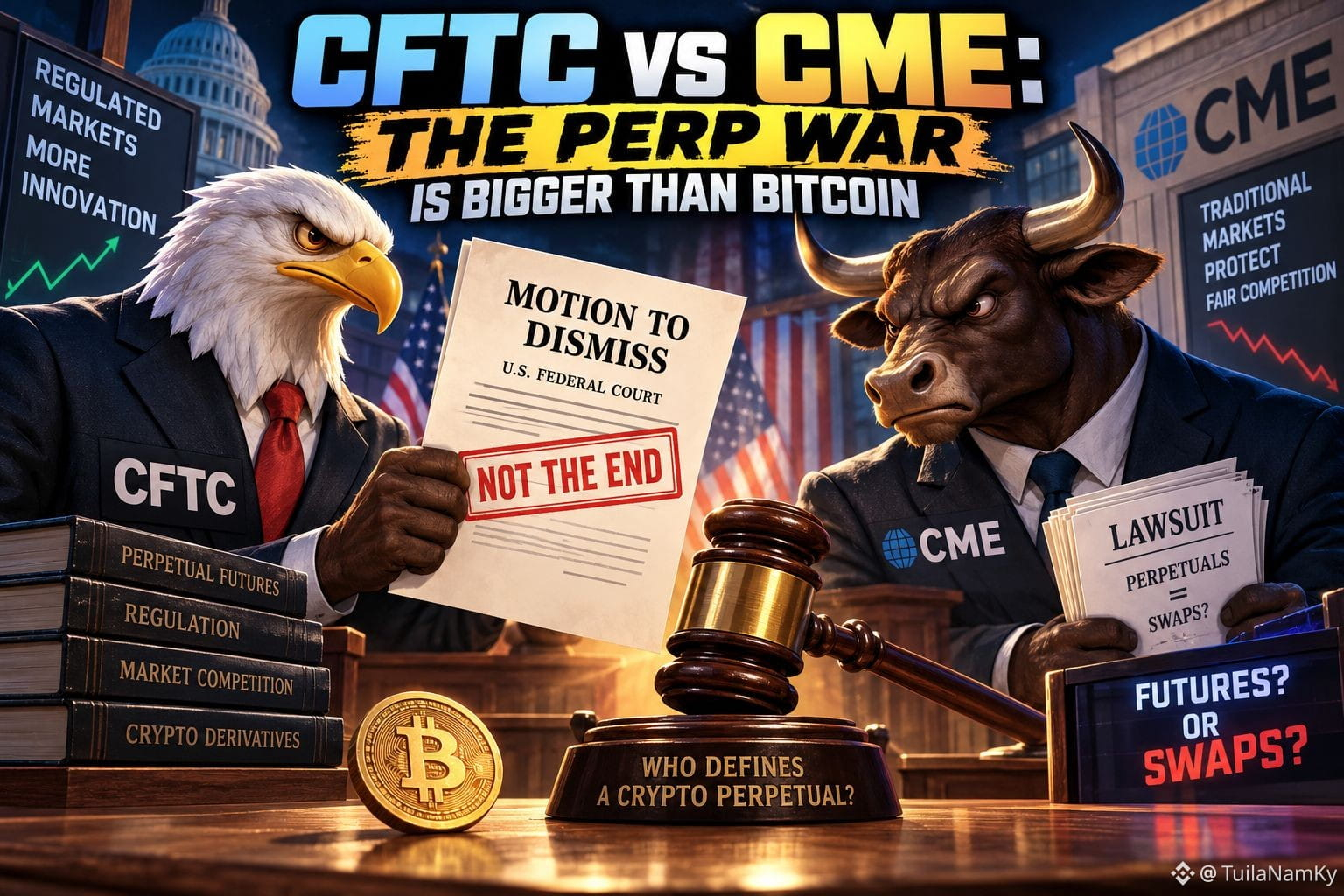
⚖️ CFTC vs CME: The Perp War Is Bigger Than Bitcoin
CFTC just asked a U.S. federal court to dismiss CME’s lawsuit over crypto perpetual futures.
But this is not the end of the case.
It may be the beginning of a much bigger fight:
Who gets to define what a crypto perpetual actually is in the U.S.?
On May 29, the CFTC approved Kalshi’s BTCPERP as a futures contract. CME sued on June 18, arguing that perpetuals should instead be treated as swaps under the Commodity Exchange Act and Dodd-Frank.
Now the CFTC is fighting back.
Its argument is surprisingly simple:
CME says Kalshi’s perps create competitive harm.
The CFTC says CME can simply list its own perps.
In other words:
“You could compete. You chose not to.”
And that’s the twist.
The court doesn't have to decide the entire “futures vs swaps” debate just yet. It could first decide whether CME has enough legal standing to bring the case.
But the bigger market question remains.
If U.S.-regulated perps gain a clearer legal path, liquidity could gradually move from offshore venues toward regulated American markets.
That would matter far beyond $BTC.
It could reshape funding markets, leverage, liquidity and crypto derivatives competition in the U.S.
But don't confuse a motion to dismiss with a court victory.
CME’s opposition is due October 2.
The perp battle is still alive. ⚖️
Is this really a legal fight — or a fight over who controls the next generation of crypto derivatives?
#PerpetualFutures #CryptoRegulation #CryptoDerivatives
$BTC
{future}(BTCUSDT)
#cftcseekstodismisscmemotioninperpfutures
⚖️ CFTC vs CME: The Perp War Is Bigger Than Bitcoin
CFTC just asked a U.S. federal court to dismiss CME’s lawsuit over crypto perpetual futures.
But this is not the end of the case.
It may be the beginning of a much bigger fight:
Who gets to define what a crypto perpetual actually is in the U.S.?
On May 29, the CFTC approved Kalshi’s BTCPERP as a futures contract. CME sued on June 18, arguing that perpetuals should instead be treated as swaps under the Commodity Exchange Act and Dodd-Frank.
Now the CFTC is fighting back.
Its argument is surprisingly simple:
CME says Kalshi’s perps create competitive harm.
The CFTC says CME can simply list its own perps.
In other words:
“You could compete. You chose not to.”
And that’s the twist.
The court doesn't have to decide the entire “futures vs swaps” debate just yet. It could first decide whether CME has enough legal standing to bring the case.
But the bigger market question remains.
If U.S.-regulated perps gain a clearer legal path, liquidity could gradually move from offshore venues toward regulated American markets.
That would matter far beyond $BTC .
It could reshape funding markets, leverage, liquidity and crypto derivatives competition in the U.S.
But don't confuse a motion to dismiss with a court victory.
CME’s opposition is due October 2.
The perp battle is still alive. ⚖️
Is this really a legal fight — or a fight over who controls the next generation of crypto derivatives?
#PerpetualFutures #CryptoRegulation #CryptoDerivatives
$BTC
⚖️ CFTC vs CME: The Perp War Is Bigger Than Bitcoin
CFTC just asked a U.S. federal court to dismiss CME’s lawsuit over crypto perpetual futures.
But this is not the end of the case.
It may be the beginning of a much bigger fight:
Who gets to define what a crypto perpetual actually is in the U.S.?
On May 29, the CFTC approved Kalshi’s BTCPERP as a futures contract. CME sued on June 18, arguing that perpetuals should instead be treated as swaps under the Commodity Exchange Act and Dodd-Frank.
Now the CFTC is fighting back.
Its argument is surprisingly simple:
CME says Kalshi’s perps create competitive harm.
The CFTC says CME can simply list its own perps.
In other words:
“You could compete. You chose not to.”
And that’s the twist.
The court doesn't have to decide the entire “futures vs swaps” debate just yet. It could first decide whether CME has enough legal standing to bring the case.
But the bigger market question remains.
If U.S.-regulated perps gain a clearer legal path, liquidity could gradually move from offshore venues toward regulated American markets.
That would matter far beyond $BTC .
It could reshape funding markets, leverage, liquidity and crypto derivatives competition in the U.S.
But don't confuse a motion to dismiss with a court victory.
CME’s opposition is due October 2.
The perp battle is still alive. ⚖️
Is this really a legal fight — or a fight over who controls the next generation of crypto derivatives?
#PerpetualFutures #CryptoRegulation #CryptoDerivatives
$BTC
495

#CFTCSeeksToDismissCMEMotionInPerpFutures
🚨 BREAKING NEWS 🚨
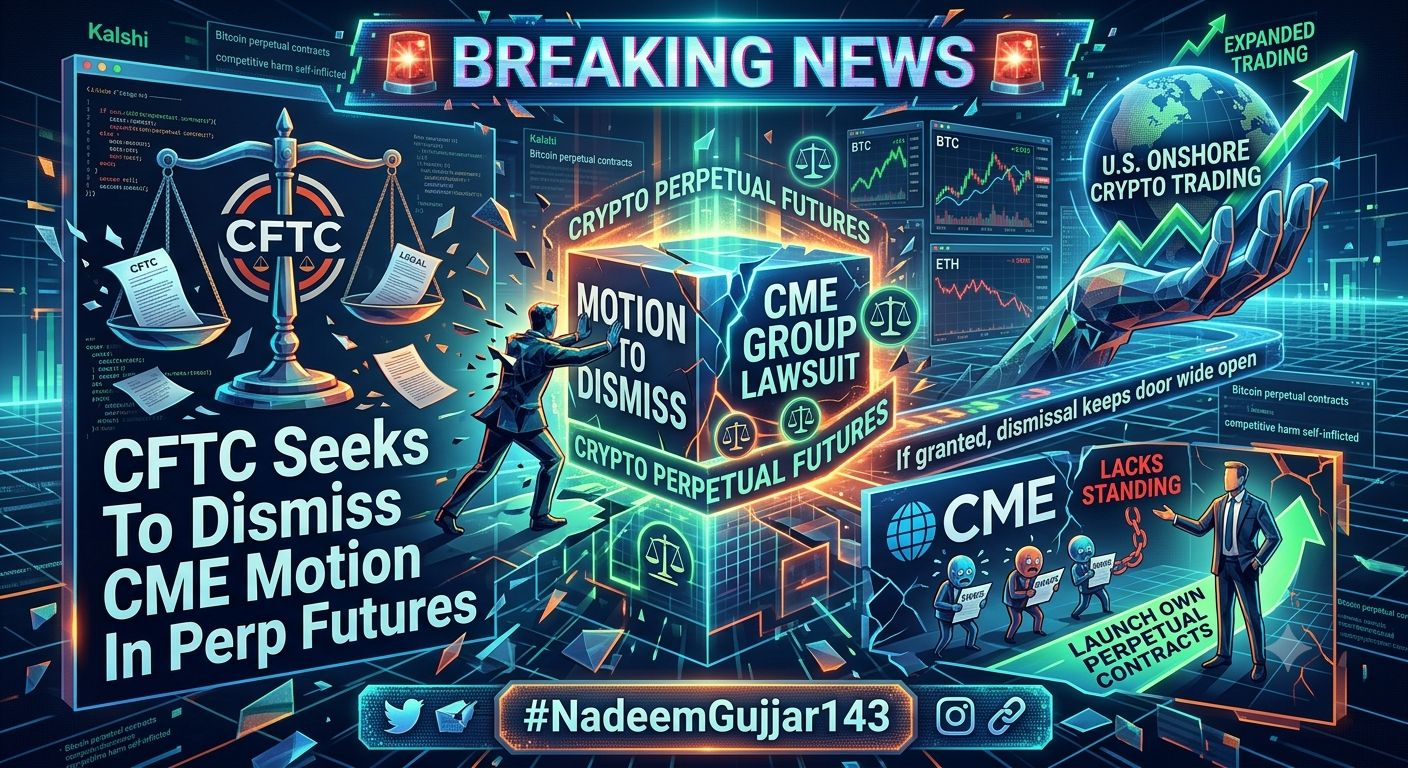
The U.S. CFTC has filed a motion to dismiss CME Group's lawsuit over crypto perpetual futures! ⚖️
CME previously sued the regulator after it approved Kalshi to offer Bitcoin perpetual contracts, arguing they should be regulated strictly as swaps.
However, the CFTC asserts that CME lacks standing. The regulator points out that CME could launch its own perpetual contracts anytime, making any claimed competitive harm completely self-inflicted.
If granted, this dismissal keeps the door wide open for expanded, onshore crypto perpetual trading in the U.S. 📈
#CryptoRegulations2026 #CME #CFTC
#Nadeemgujjar143
@RahulBhati @Square-Creator-f3ffb6967ae3 @NADEEMGujjar @Square-Creator-1f3790994 @CT988
$BTC
{spot}(BTCUSDT)
$NEO
{future}(NEOUSDT)
$KAITO
{spot}(KAITOUSDT)
#CFTCSeeksToDismissCMEMotionInPerpFutures
🚨 BREAKING NEWS 🚨
The U.S. CFTC has filed a motion to dismiss CME Group's lawsuit over crypto perpetual futures! ⚖️
CME previously sued the regulator after it approved Kalshi to offer Bitcoin perpetual contracts, arguing they should be regulated strictly as swaps.
However, the CFTC asserts that CME lacks standing. The regulator points out that CME could launch its own perpetual contracts anytime, making any claimed competitive harm completely self-inflicted.
If granted, this dismissal keeps the door wide open for expanded, onshore crypto perpetual trading in the U.S. 📈
#CryptoRegulations2026 #CME #CFTC
#Nadeemgujjar143
@ProTrendBoss @aasho @NADEEM Gujjar143 @A锦源 @Luna春婷
$BTC
$NEO
$KAITO
🚨 BREAKING NEWS 🚨
The U.S. CFTC has filed a motion to dismiss CME Group's lawsuit over crypto perpetual futures! ⚖️
CME previously sued the regulator after it approved Kalshi to offer Bitcoin perpetual contracts, arguing they should be regulated strictly as swaps.
However, the CFTC asserts that CME lacks standing. The regulator points out that CME could launch its own perpetual contracts anytime, making any claimed competitive harm completely self-inflicted.
If granted, this dismissal keeps the door wide open for expanded, onshore crypto perpetual trading in the U.S. 📈
#CryptoRegulations2026 #CME #CFTC
#Nadeemgujjar143
@ProTrendBoss @aasho @NADEEM Gujjar143 @A锦源 @Luna春婷
$BTC
$NEO
$KAITO
1
122

·
--
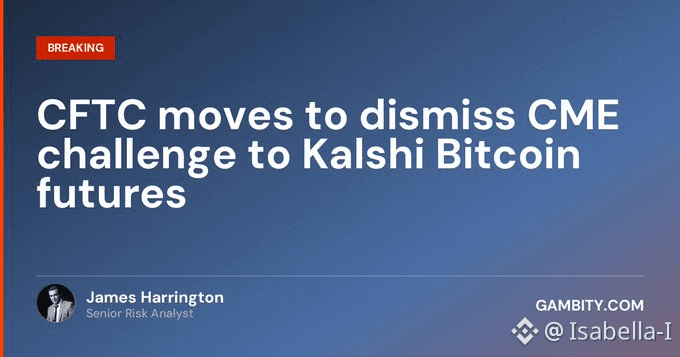
#cftcseekstodismisscmemotioninperpfutures The CFTC moved to dismiss CME Group's lawsuit challenging its approval of Kalshi's Bitcoin perpetual futures, arguing CME failed to show competitive injury and lacks standing to challenge the decision.$ONDS $XRP $SUI
#cftcseekstodismisscmemotioninperpfutures The CFTC moved to dismiss CME Group's lawsuit challenging its approval of Kalshi's Bitcoin perpetual futures, arguing CME failed to show competitive injury and lacks standing to challenge the decision.$ONDS $XRP $SUI
1
1.9k


·
--
The CFTC vs CME fight over perpetual futures classification matters more than the headline suggests. CME wants perps treated as swaps, facing stricter clearing and margin, which would slow down anyone competing with its own expiring futures franchise. CFTC calling CME's damages self inflicted is the real tell, the door was always open for CME to list perps itself and it chose not to.
What's actually at stake is where onshore US perp liquidity ends up living. Right now the deepest perp order books sit offshore on crypto native exchanges precisely because of this regulatory gray zone. A CFTC win could start pulling that volume and funding rate influence back onshore instead of leaving it split globally.
$BTC $ETH open interest concentration could look very different a year from now. Who do you think ends up hosting that flow, CME or crypto native exchanges?
#CFTCSeeksToDismissCMEMotionInPerpFutures #PerpetualFutures #CryptoRegulation
The CFTC vs CME fight over perpetual futures classification matters more than the headline suggests. CME wants perps treated as swaps, facing stricter clearing and margin, which would slow down anyone competing with its own expiring futures franchise. CFTC calling CME's damages self inflicted is the real tell, the door was always open for CME to list perps itself and it chose not to.
What's actually at stake is where onshore US perp liquidity ends up living. Right now the deepest perp order books sit offshore on crypto native exchanges precisely because of this regulatory gray zone. A CFTC win could start pulling that volume and funding rate influence back onshore instead of leaving it split globally.
$BTC $ETH open interest concentration could look very different a year from now. Who do you think ends up hosting that flow, CME or crypto native exchanges?
#CFTCSeeksToDismissCMEMotionInPerpFutures #PerpetualFutures #CryptoRegulation
What's actually at stake is where onshore US perp liquidity ends up living. Right now the deepest perp order books sit offshore on crypto native exchanges precisely because of this regulatory gray zone. A CFTC win could start pulling that volume and funding rate influence back onshore instead of leaving it split globally.
$BTC $ETH open interest concentration could look very different a year from now. Who do you think ends up hosting that flow, CME or crypto native exchanges?
#CFTCSeeksToDismissCMEMotionInPerpFutures #PerpetualFutures #CryptoRegulation
6
345

·
--
CME vs CFTC: The Perp Battle Escalates
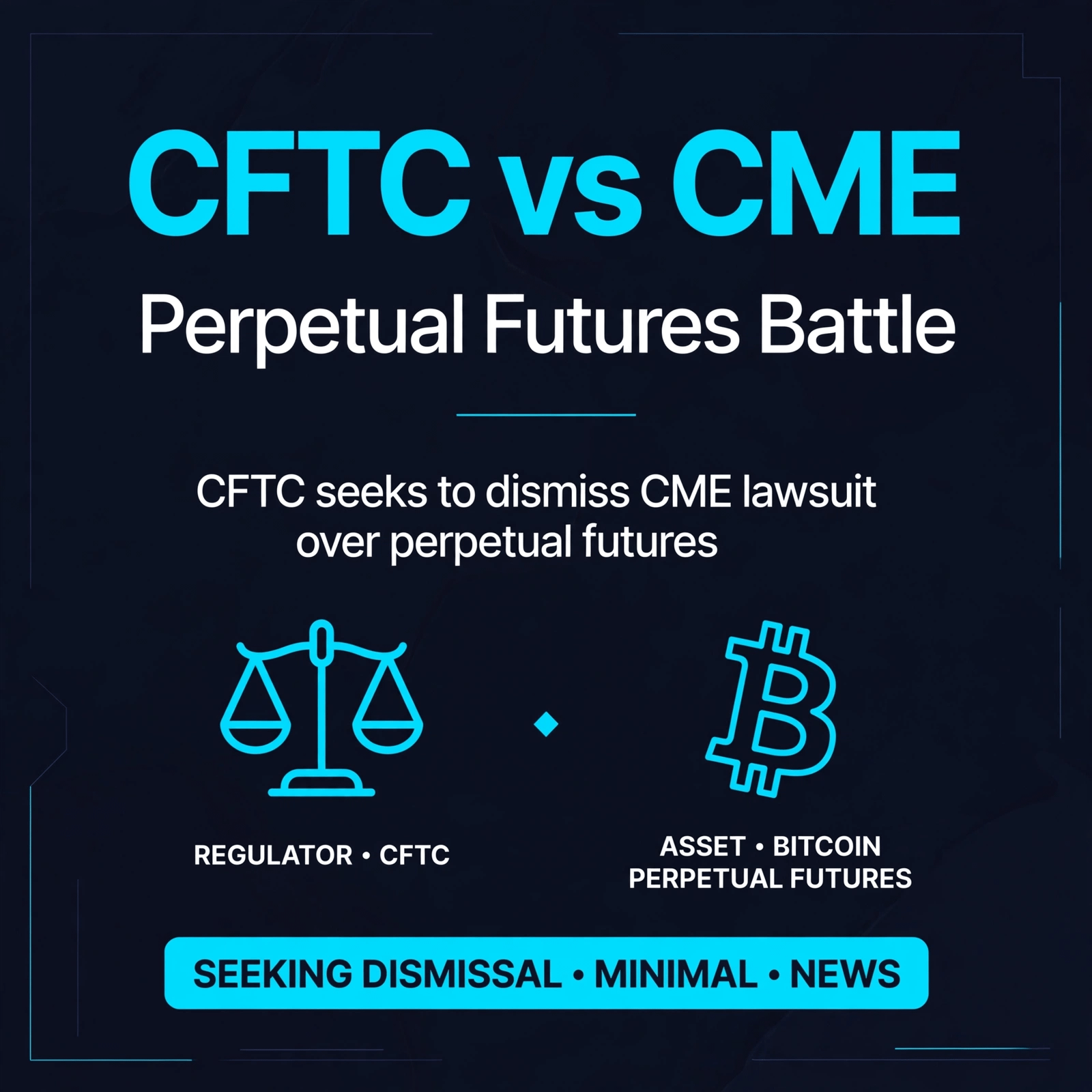
The CFTC has moved to dismiss CME Group's lawsuit over perpetual futures.
Quick recap:
• On May 29, CFTC approved Kalshi to list BTC perpetual futures as futures contracts
• CME sued, arguing perps are swaps under the Commodity Exchange Act and should face stricter clearing/margin rules
• CFTC calls the suit "frivolous" - says CME is trying to block competition rather than compete
CFTC's argument for dismissal: CME's alleged damages are "self-inflicted" - it has the capacity to offer perps itself.
At stake: Who gets to list crypto's most liquid product in the US, and whether perps are regulated as futures or swaps.
This will define the future of US crypto derivatives. Who do you think wins?
#CFTC #CME #PerpetualFutures #CryptoRegulation #Kalshi#cftcseekstodismisscmemotioninperpfutures
CME vs CFTC: The Perp Battle Escalates
The CFTC has moved to dismiss CME Group's lawsuit over perpetual futures.
Quick recap:
• On May 29, CFTC approved Kalshi to list BTC perpetual futures as futures contracts
• CME sued, arguing perps are swaps under the Commodity Exchange Act and should face stricter clearing/margin rules
• CFTC calls the suit "frivolous" - says CME is trying to block competition rather than compete
CFTC's argument for dismissal: CME's alleged damages are "self-inflicted" - it has the capacity to offer perps itself.
At stake: Who gets to list crypto's most liquid product in the US, and whether perps are regulated as futures or swaps.
This will define the future of US crypto derivatives. Who do you think wins?
#CFTC #CME #PerpetualFutures #CryptoRegulation #Kalshi#cftcseekstodismisscmemotioninperpfutures
The CFTC has moved to dismiss CME Group's lawsuit over perpetual futures.
Quick recap:
• On May 29, CFTC approved Kalshi to list BTC perpetual futures as futures contracts
• CME sued, arguing perps are swaps under the Commodity Exchange Act and should face stricter clearing/margin rules
• CFTC calls the suit "frivolous" - says CME is trying to block competition rather than compete
CFTC's argument for dismissal: CME's alleged damages are "self-inflicted" - it has the capacity to offer perps itself.
At stake: Who gets to list crypto's most liquid product in the US, and whether perps are regulated as futures or swaps.
This will define the future of US crypto derivatives. Who do you think wins?
#CFTC #CME #PerpetualFutures #CryptoRegulation #Kalshi#cftcseekstodismisscmemotioninperpfutures
2
464

·
--
Bullish
#cftcseekstodismisscmemotioninperpfutures
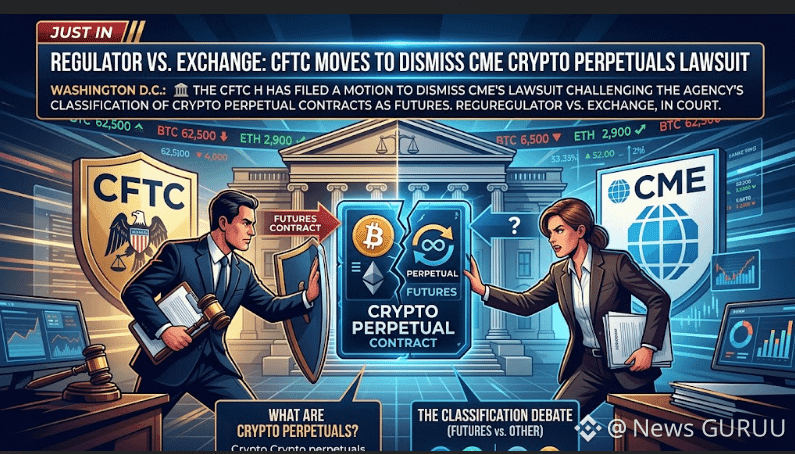
JUST IN: 🏛 The CFTC has filed a motion to dismiss CME's lawsuit challenging the agency's classification of crypto perpetual contracts as futures. Regulator vs. exchange, in court
$AKE
{future}(AKEUSDT)
$T
{future}(TUSDT)
$MUBARAK
{future}(MUBARAKUSDT)
#cftcseekstodismisscmemotioninperpfutures
JUST IN: 🏛 The CFTC has filed a motion to dismiss CME's lawsuit challenging the agency's classification of crypto perpetual contracts as futures. Regulator vs. exchange, in court
$AKE
$T
$MUBARAK
JUST IN: 🏛 The CFTC has filed a motion to dismiss CME's lawsuit challenging the agency's classification of crypto perpetual contracts as futures. Regulator vs. exchange, in court
$AKE
$T
$MUBARAK


2
4
1.5k
·
--
Bullish
#cftcseekstodismisscmemotioninperpfutures
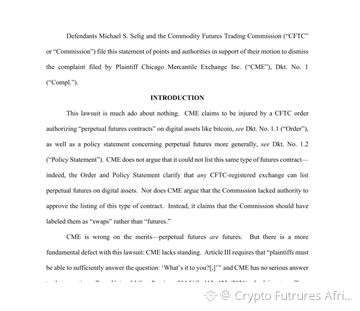
THE BLOCK: US CFTC has filed a motion to dismiss CME's lawsuit over the agency’s decision to classify perpetual futures as futures contracts rather than swaps. CFTC said CME "lacks standing," calling its competitive-injury claims empty because CME
could list perpetuals itself.
"This lawsuit is much ado about nothing," CFTC said.
$AKE
{future}(AKEUSDT)
$MUBARAK
{future}(MUBARAKUSDT)
$T
{future}(TUSDT)
#cftcseekstodismisscmemotioninperpfutures
THE BLOCK: US CFTC has filed a motion to dismiss CME's lawsuit over the agency’s decision to classify perpetual futures as futures contracts rather than swaps. CFTC said CME "lacks standing," calling its competitive-injury claims empty because CME
could list perpetuals itself.
"This lawsuit is much ado about nothing," CFTC said.
$AKE
$MUBARAK
$T
THE BLOCK: US CFTC has filed a motion to dismiss CME's lawsuit over the agency’s decision to classify perpetual futures as futures contracts rather than swaps. CFTC said CME "lacks standing," calling its competitive-injury claims empty because CME
could list perpetuals itself.
"This lawsuit is much ado about nothing," CFTC said.
$AKE
$MUBARAK
$T
1
2
367

·
--
Bullish
#cftcseekstodismisscmemotioninperpfutures
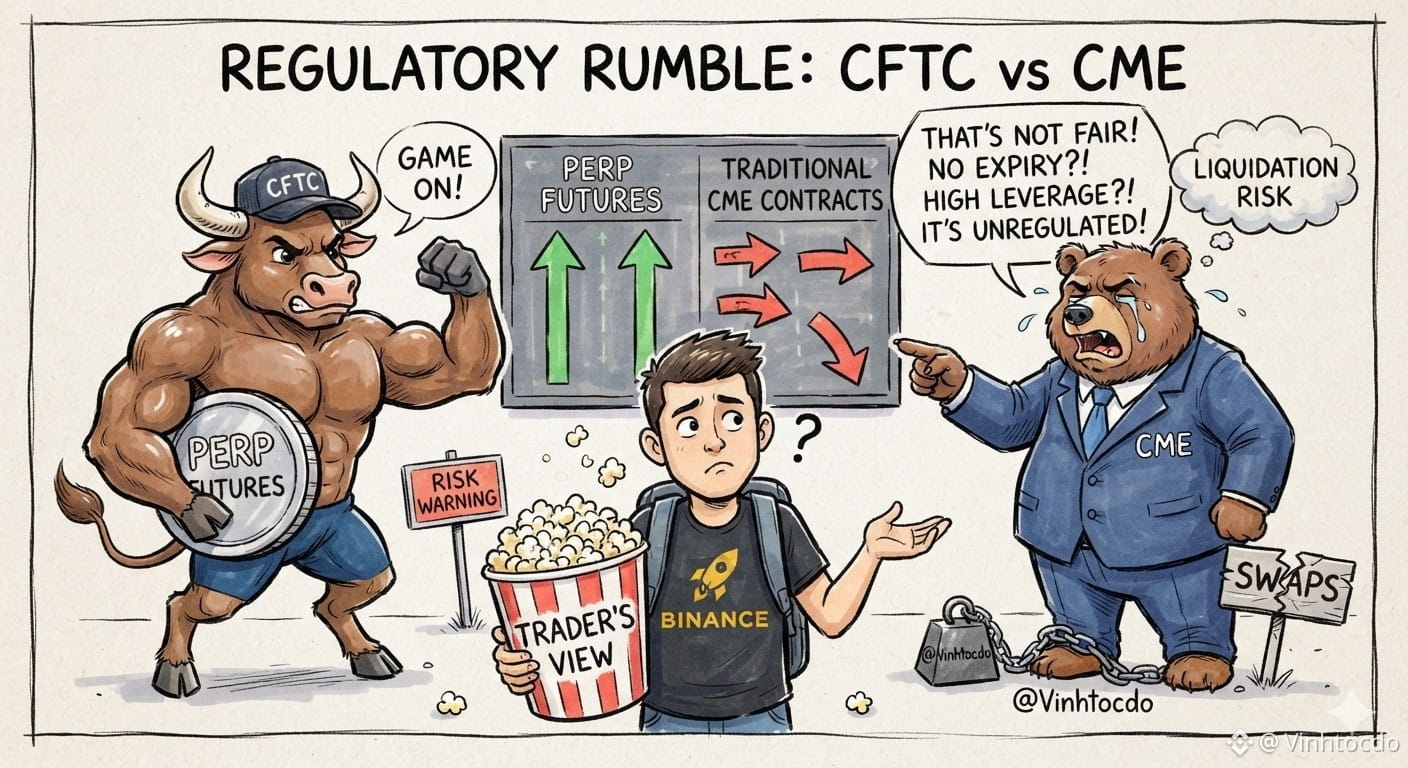
The regulatory drama is spicier than a leveraged long position on a meme coin! 🌶️
CFTC to CME: "If you can’t beat ’em, copy ’em!" 😂
So, why is the mighty CME crying foul over Perpetual Futures (Perps)? Is it because they are scared of high leverage and liquidation risks? Well, partially! CME loves their safe, traditional, expiring contracts. Perps are like that wild party animal that never goes to sleep. With no expiry dates and massive leverage, CME thinks Perps look way too much like unregulated swaps. But let’s be real—they are mostly terrified of retail traders ditching them for the non-stop, high-octane Perp action on crypto exchanges! 💸
What should traders do?
Grab your popcorn, maintain strict risk management, and watch the giants fight! 🍿
Not financial advice.
Join the fun on Binance using code VINHTOCDO or click here: [https://www.binance.com/register?ref=VINHTOCDO](https://www.binance.com/register?ref=VINHTOCDO) 🚀
#CFTC #CMEGroup #PerpetualFutures #VINHTOCDO
$BTC
{future}(BTCUSDT)
$ETH
{future}(ETHUSDT)
$BNB
{future}(BNBUSDT)
#cftcseekstodismisscmemotioninperpfutures
The regulatory drama is spicier than a leveraged long position on a meme coin! 🌶️
CFTC to CME: "If you can’t beat ’em, copy ’em!" 😂
So, why is the mighty CME crying foul over Perpetual Futures (Perps)? Is it because they are scared of high leverage and liquidation risks? Well, partially! CME loves their safe, traditional, expiring contracts. Perps are like that wild party animal that never goes to sleep. With no expiry dates and massive leverage, CME thinks Perps look way too much like unregulated swaps. But let’s be real—they are mostly terrified of retail traders ditching them for the non-stop, high-octane Perp action on crypto exchanges! 💸
What should traders do?
Grab your popcorn, maintain strict risk management, and watch the giants fight! 🍿
Not financial advice.
Join the fun on Binance using code VINHTOCDO or click here: https://www.binance.com/register?ref=VINHTOCDO 🚀
#CFTC #CMEGroup #PerpetualFutures #VINHTOCDO
$BTC
$ETH
$BNB
The regulatory drama is spicier than a leveraged long position on a meme coin! 🌶️
CFTC to CME: "If you can’t beat ’em, copy ’em!" 😂
So, why is the mighty CME crying foul over Perpetual Futures (Perps)? Is it because they are scared of high leverage and liquidation risks? Well, partially! CME loves their safe, traditional, expiring contracts. Perps are like that wild party animal that never goes to sleep. With no expiry dates and massive leverage, CME thinks Perps look way too much like unregulated swaps. But let’s be real—they are mostly terrified of retail traders ditching them for the non-stop, high-octane Perp action on crypto exchanges! 💸
What should traders do?
Grab your popcorn, maintain strict risk management, and watch the giants fight! 🍿
Not financial advice.
Join the fun on Binance using code VINHTOCDO or click here: https://www.binance.com/register?ref=VINHTOCDO 🚀
#CFTC #CMEGroup #PerpetualFutures #VINHTOCDO
$BTC
$ETH
$BNB
2
817

·
--
Bullish
#CFTCSeeksToDismissCMEMotionInPerpFutures 🚨 BREAKING: CFTC Fights Back Against CME! 🚨
The U.S. CFTC just filed a motion to dismiss CME Group’s lawsuit over the approval of crypto perpetual futures.
Legacy derivatives giant CME previously sued the regulator, claiming that perpetual contracts should be strictly regulated as "swaps" instead of futures. Now, the CFTC is officially standing its ground.
Why it matters: If the CFTC wins this legal battle, it keeps the door open for regulated, onshore crypto perps in the U.S.—a massive win for crypto innovation and a major blow to traditional finance gatekeepers. 🚀
Whose side are you on in this market showdown? Let us know! 👇
#Binance #CryptoNews #PerpetualFutures
#CFTCSeeksToDismissCMEMotionInPerpFutures 🚨 BREAKING: CFTC Fights Back Against CME! 🚨
The U.S. CFTC just filed a motion to dismiss CME Group’s lawsuit over the approval of crypto perpetual futures.
Legacy derivatives giant CME previously sued the regulator, claiming that perpetual contracts should be strictly regulated as "swaps" instead of futures. Now, the CFTC is officially standing its ground.
Why it matters: If the CFTC wins this legal battle, it keeps the door open for regulated, onshore crypto perps in the U.S.—a massive win for crypto innovation and a major blow to traditional finance gatekeepers. 🚀
Whose side are you on in this market showdown? Let us know! 👇
#Binance #CryptoNews #PerpetualFutures
The U.S. CFTC just filed a motion to dismiss CME Group’s lawsuit over the approval of crypto perpetual futures.
Legacy derivatives giant CME previously sued the regulator, claiming that perpetual contracts should be strictly regulated as "swaps" instead of futures. Now, the CFTC is officially standing its ground.
Why it matters: If the CFTC wins this legal battle, it keeps the door open for regulated, onshore crypto perps in the U.S.—a massive win for crypto innovation and a major blow to traditional finance gatekeepers. 🚀
Whose side are you on in this market showdown? Let us know! 👇
#Binance #CryptoNews #PerpetualFutures
118

·
--
#CFTCSeeksToDismissCMEMotionInPerpFutures
The CFTC asks the judge to dismiss CME's lawsuit over perpetual cryptocurrency futures.
The regulator says the dispute is "a lot of noise and little substance" and notes that the order allows any designated contract market, including the CME, to trade these products.
The U.S. Commodity Futures Trading Commission (CFTC) has asked a federal judge to dismiss CME’s challenge to its approval of perpetual cryptocurrency futures, arguing that the derivatives exchange cannot demonstrate that it has suffered any harm.
$NVDAB
{spot}(NVDABUSDT)
$AAPLB
{spot}(AAPLBUSDT)
$GOOGL.US
{stock_us}(GOOGL.US)
#CFTCSeeksToDismissCMEMotionInPerpFutures
The CFTC asks the judge to dismiss CME's lawsuit over perpetual cryptocurrency futures.
The regulator says the dispute is "a lot of noise and little substance" and notes that the order allows any designated contract market, including the CME, to trade these products.
The U.S. Commodity Futures Trading Commission (CFTC) has asked a federal judge to dismiss CME’s challenge to its approval of perpetual cryptocurrency futures, arguing that the derivatives exchange cannot demonstrate that it has suffered any harm.
$NVDAB
$AAPLB
$GOOGL.US
The CFTC asks the judge to dismiss CME's lawsuit over perpetual cryptocurrency futures.
The regulator says the dispute is "a lot of noise and little substance" and notes that the order allows any designated contract market, including the CME, to trade these products.
The U.S. Commodity Futures Trading Commission (CFTC) has asked a federal judge to dismiss CME’s challenge to its approval of perpetual cryptocurrency futures, arguing that the derivatives exchange cannot demonstrate that it has suffered any harm.
$NVDAB
$AAPLB
$GOOGL.US
1
1
161
Log in to explore more content
Join global crypto users on Binance Square
⚡️ Get latest and useful information about crypto.
💬 Trusted by the world’s largest crypto exchange.
👍 Discover real insights from verified creators.
Email / Phone number
Trending Topics
1
#AnthropicCEOCallsForAISlowdown
72,269 views
1,035 Discussing
2
#BitcoinThirdSingleBlockReorgInFourWeeks
5,087 views
214 Discussing
3
#EthereumFallsBelow$2500
474 views
42 Discussing
4
#BitcoinDropsToIntradayLow$76367
210 views
7 Discussing
5
#BitcoinSpotETFsRecord$463MNetOutflowLastWeek
0 views
2 Discussing
6
#LSKSurgesOver515%In24Hours
5,838 views
152 Discussing
7
#ClarityActLawIn2026OddsRiseTo30%
2,897 views
70 Discussing
8
#KoreaCryptoTaxDelayPetitionMeetsReviewThreshold
601 views
46 Discussing
9
#EURequiresWalletMakersReportFlawsIn24Hours
871 views
61 Discussing
10
#ZcashNU7VoteEndsSeptember14
3,557 views
71 Discussing