

#bitcoinhack
bitcoinhack
15,949 views
25 Discussing
Hot
Latest

·
--
Bearish
Another serious incident occurred in the Bitcoin ecosystem.
This time, LIQUID, one of the main BTC second-layer networks, was targeted in a theft of approximately 1.5 billion reais (about 4 thousand Bitcoin).
The theft transaction was accompanied by a message claiming it involved “whitehats” (ethical hackers).
We await the next developments in the situation.
$BTC #bitcoinhack
Another serious incident occurred in the Bitcoin ecosystem.
This time, LIQUID, one of the main BTC second-layer networks, was targeted in a theft of approximately 1.5 billion reais (about 4 thousand Bitcoin).
The theft transaction was accompanied by a message claiming it involved “whitehats” (ethical hackers).
We await the next developments in the situation.
$BTC #bitcoinhack
This time, LIQUID, one of the main BTC second-layer networks, was targeted in a theft of approximately 1.5 billion reais (about 4 thousand Bitcoin).
The theft transaction was accompanied by a message claiming it involved “whitehats” (ethical hackers).
We await the next developments in the situation.
$BTC #bitcoinhack
2
493

#coldcardexploitfundssenttomixers
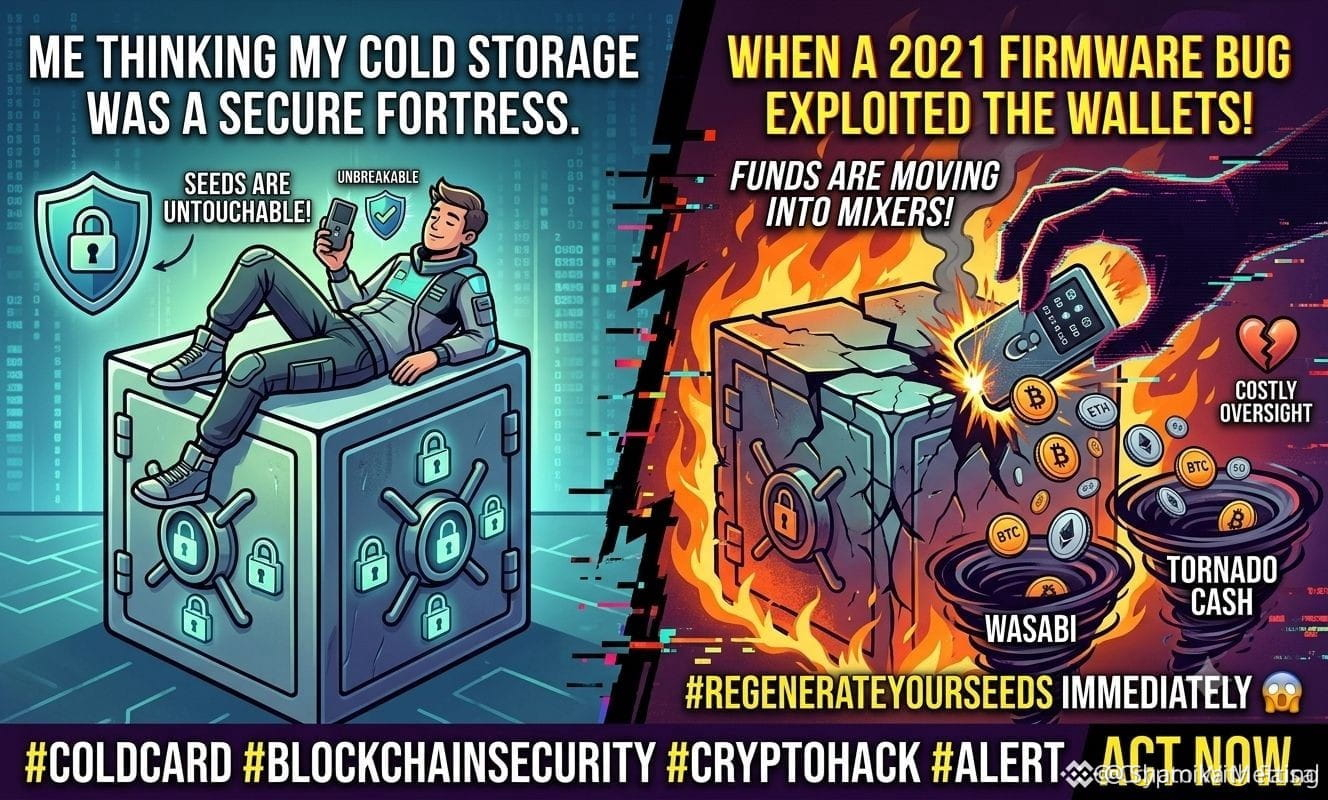
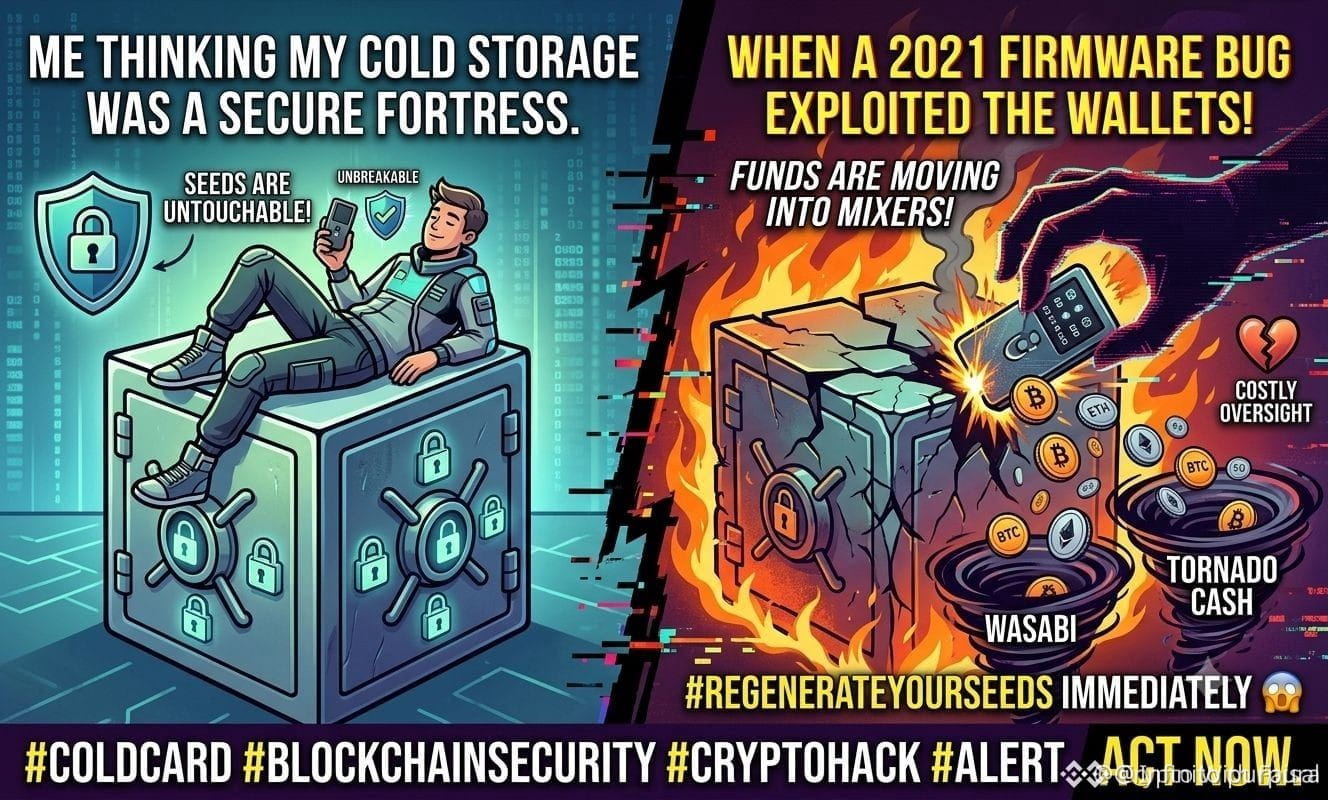
🚨 Is the “Cold Secure Storage” you use actually a burning hot mess? 🚨
The sleeping giants have awakened, washing dirty money. Security firm CertiK reported a major on-chain movement by the attackers: 64 Bitcoin were sent to Wasabi, and 200 Ethereum vanished via Tornado Cash. 🌪️
The root that led to disaster:
This entire catastrophe traces back to a serious vulnerability in a 2021 (Firmware) program that left seed phrases completely exposed to brute-force attacks. And what’s the bigger irony? A simple $2 security audit using artificial intelligence (AI) could have prevented the entire $100M+ disaster. Take a moment and really absorb that. 🤯
What are the odds of recovery?
Be ready. Industry insiders estimate a grim probability of just 20% to 40% for recovering the assets, and dealing with the fallout could easily take years.
🛡️ Urgent action required for traders:
If you currently hold assets in specific wallets from these compromised wallets, you need to act now.
Create entirely new seed phrases immediately.
Move your entire wallet to a new, secure wallet. Don’t wait for the dust to settle—protect your capital! 💼🔒
👉 Disclaimer: Always do your own research (DYOR). This is not financial advice.
Please follow up
#Coldcard #BitcoinHack #BlockchainSecurity
$ACE
{future}(ACEUSDT)
#coldcardexploitfundssenttomixers
🚨 Is the “Cold Secure Storage” you use actually a burning hot mess? 🚨
The sleeping giants have awakened, washing dirty money. Security firm CertiK reported a major on-chain movement by the attackers: 64 Bitcoin were sent to Wasabi, and 200 Ethereum vanished via Tornado Cash. 🌪️
The root that led to disaster:
This entire catastrophe traces back to a serious vulnerability in a 2021 (Firmware) program that left seed phrases completely exposed to brute-force attacks. And what’s the bigger irony? A simple $2 security audit using artificial intelligence (AI) could have prevented the entire $100M+ disaster. Take a moment and really absorb that. 🤯
What are the odds of recovery?
Be ready. Industry insiders estimate a grim probability of just 20% to 40% for recovering the assets, and dealing with the fallout could easily take years.
🛡️ Urgent action required for traders:
If you currently hold assets in specific wallets from these compromised wallets, you need to act now.
Create entirely new seed phrases immediately.
Move your entire wallet to a new, secure wallet. Don’t wait for the dust to settle—protect your capital! 💼🔒
👉 Disclaimer: Always do your own research (DYOR). This is not financial advice.
Please follow up
#Coldcard #BitcoinHack #BlockchainSecurity
$ACE
🚨 Is the “Cold Secure Storage” you use actually a burning hot mess? 🚨
The sleeping giants have awakened, washing dirty money. Security firm CertiK reported a major on-chain movement by the attackers: 64 Bitcoin were sent to Wasabi, and 200 Ethereum vanished via Tornado Cash. 🌪️
The root that led to disaster:
This entire catastrophe traces back to a serious vulnerability in a 2021 (Firmware) program that left seed phrases completely exposed to brute-force attacks. And what’s the bigger irony? A simple $2 security audit using artificial intelligence (AI) could have prevented the entire $100M+ disaster. Take a moment and really absorb that. 🤯
What are the odds of recovery?
Be ready. Industry insiders estimate a grim probability of just 20% to 40% for recovering the assets, and dealing with the fallout could easily take years.
🛡️ Urgent action required for traders:
If you currently hold assets in specific wallets from these compromised wallets, you need to act now.
Create entirely new seed phrases immediately.
Move your entire wallet to a new, secure wallet. Don’t wait for the dust to settle—protect your capital! 💼🔒
👉 Disclaimer: Always do your own research (DYOR). This is not financial advice.
Please follow up
#Coldcard #BitcoinHack #BlockchainSecurity
$ACE
1
97

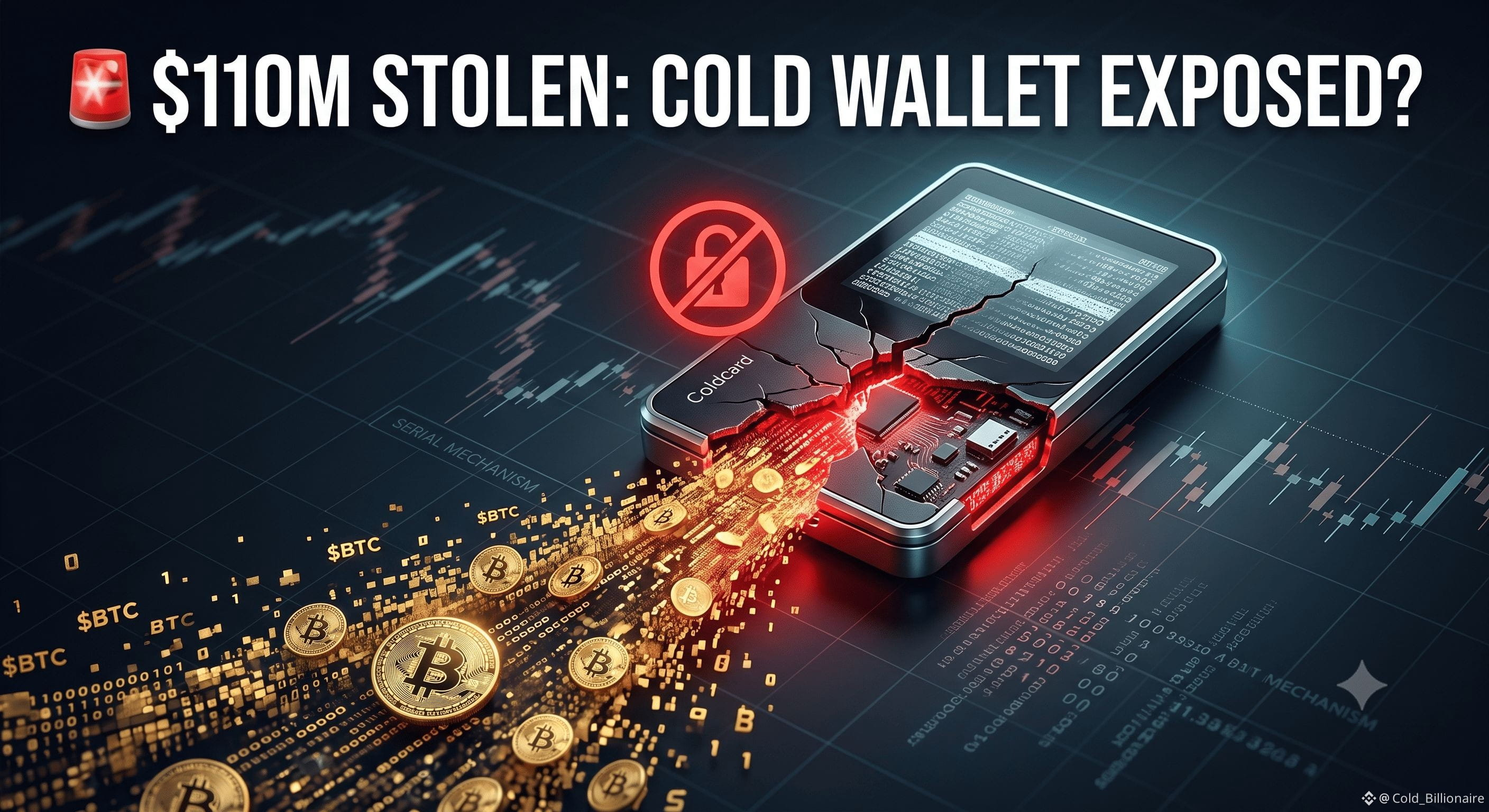
🚨 $110M STOLEN: Is Your Cold Wallet Seed Phrase Actually Safe?
The ultimate crypto security standard—cold storage—just took a massive hit. Hackers exploited a critical software flaw in the random-number generator of Coldcard hardware wallets, rendering generated seed phrases totally predictable.
The ongoing attack has drained over 1,755 $BTC (~$110 million) from 5,000 wallets since late July. Coinkite confirmed the vulnerability stems from a deterministic fallback mechanism that generates keys based on device serial numbers rather than true randomness.
This exploit shatters the "cold storage is perfectly safe" narrative, directly impacting offline crypto holders and reigniting the debate between self-custody and exchange custody.
Here is how the market is reading this unprecedented breach:
🐻 The Bearish Reality: A Blow to Self-Custody
🔹 This severely hurts the "Not your keys, not your coins" narrative. Beyond the panic of compromised hardware, there is an immediate market impact: the 1,755 stolen $BTC could be dumped by hackers, creating sudden and aggressive sell pressure.
🐂 The Bullish Reality: Bitcoin Isn't Broken
🔹 Despite the panic, the Bitcoin network itself remains perfectly secure. This is a localized hardware supply-chain failure, not a blockchain protocol flaw. It heavily highlights the importance of multi-sig setups, where a single compromised vendor cannot result in lost funds.
🎓 The Educational Survival Guide: Migrate Safely
🔹 True randomness is the foundation of cryptography. A deterministic fallback uses predictable inputs (like a serial number) to generate a seed, making it mathematically guessable offline. To migrate safely, you must generate an entirely NEW seed phrase on patched firmware and immediately transfer funds to those new secure addresses.
{spot}(BTCUSDT)
Share your thoughts on self-custody vs. exchange custody below! 👇
#BitcoinHack #CryptoSecurity #ColdStorage #BTC
🚨 $110M STOLEN: Is Your Cold Wallet Seed Phrase Actually Safe?
The ultimate crypto security standard—cold storage—just took a massive hit. Hackers exploited a critical software flaw in the random-number generator of Coldcard hardware wallets, rendering generated seed phrases totally predictable.
The ongoing attack has drained over 1,755 $BTC (~$110 million) from 5,000 wallets since late July. Coinkite confirmed the vulnerability stems from a deterministic fallback mechanism that generates keys based on device serial numbers rather than true randomness.
This exploit shatters the "cold storage is perfectly safe" narrative, directly impacting offline crypto holders and reigniting the debate between self-custody and exchange custody.
Here is how the market is reading this unprecedented breach:
🐻 The Bearish Reality: A Blow to Self-Custody
🔹 This severely hurts the "Not your keys, not your coins" narrative. Beyond the panic of compromised hardware, there is an immediate market impact: the 1,755 stolen $BTC could be dumped by hackers, creating sudden and aggressive sell pressure.
🐂 The Bullish Reality: Bitcoin Isn't Broken
🔹 Despite the panic, the Bitcoin network itself remains perfectly secure. This is a localized hardware supply-chain failure, not a blockchain protocol flaw. It heavily highlights the importance of multi-sig setups, where a single compromised vendor cannot result in lost funds.
🎓 The Educational Survival Guide: Migrate Safely
🔹 True randomness is the foundation of cryptography. A deterministic fallback uses predictable inputs (like a serial number) to generate a seed, making it mathematically guessable offline. To migrate safely, you must generate an entirely NEW seed phrase on patched firmware and immediately transfer funds to those new secure addresses.
Share your thoughts on self-custody vs. exchange custody below! 👇
#BitcoinHack #CryptoSecurity #ColdStorage #BTC
The ultimate crypto security standard—cold storage—just took a massive hit. Hackers exploited a critical software flaw in the random-number generator of Coldcard hardware wallets, rendering generated seed phrases totally predictable.
The ongoing attack has drained over 1,755 $BTC (~$110 million) from 5,000 wallets since late July. Coinkite confirmed the vulnerability stems from a deterministic fallback mechanism that generates keys based on device serial numbers rather than true randomness.
This exploit shatters the "cold storage is perfectly safe" narrative, directly impacting offline crypto holders and reigniting the debate between self-custody and exchange custody.
Here is how the market is reading this unprecedented breach:
🐻 The Bearish Reality: A Blow to Self-Custody
🔹 This severely hurts the "Not your keys, not your coins" narrative. Beyond the panic of compromised hardware, there is an immediate market impact: the 1,755 stolen $BTC could be dumped by hackers, creating sudden and aggressive sell pressure.
🐂 The Bullish Reality: Bitcoin Isn't Broken
🔹 Despite the panic, the Bitcoin network itself remains perfectly secure. This is a localized hardware supply-chain failure, not a blockchain protocol flaw. It heavily highlights the importance of multi-sig setups, where a single compromised vendor cannot result in lost funds.
🎓 The Educational Survival Guide: Migrate Safely
🔹 True randomness is the foundation of cryptography. A deterministic fallback uses predictable inputs (like a serial number) to generate a seed, making it mathematically guessable offline. To migrate safely, you must generate an entirely NEW seed phrase on patched firmware and immediately transfer funds to those new secure addresses.
Share your thoughts on self-custody vs. exchange custody below! 👇
#BitcoinHack #CryptoSecurity #ColdStorage #BTC
2
115
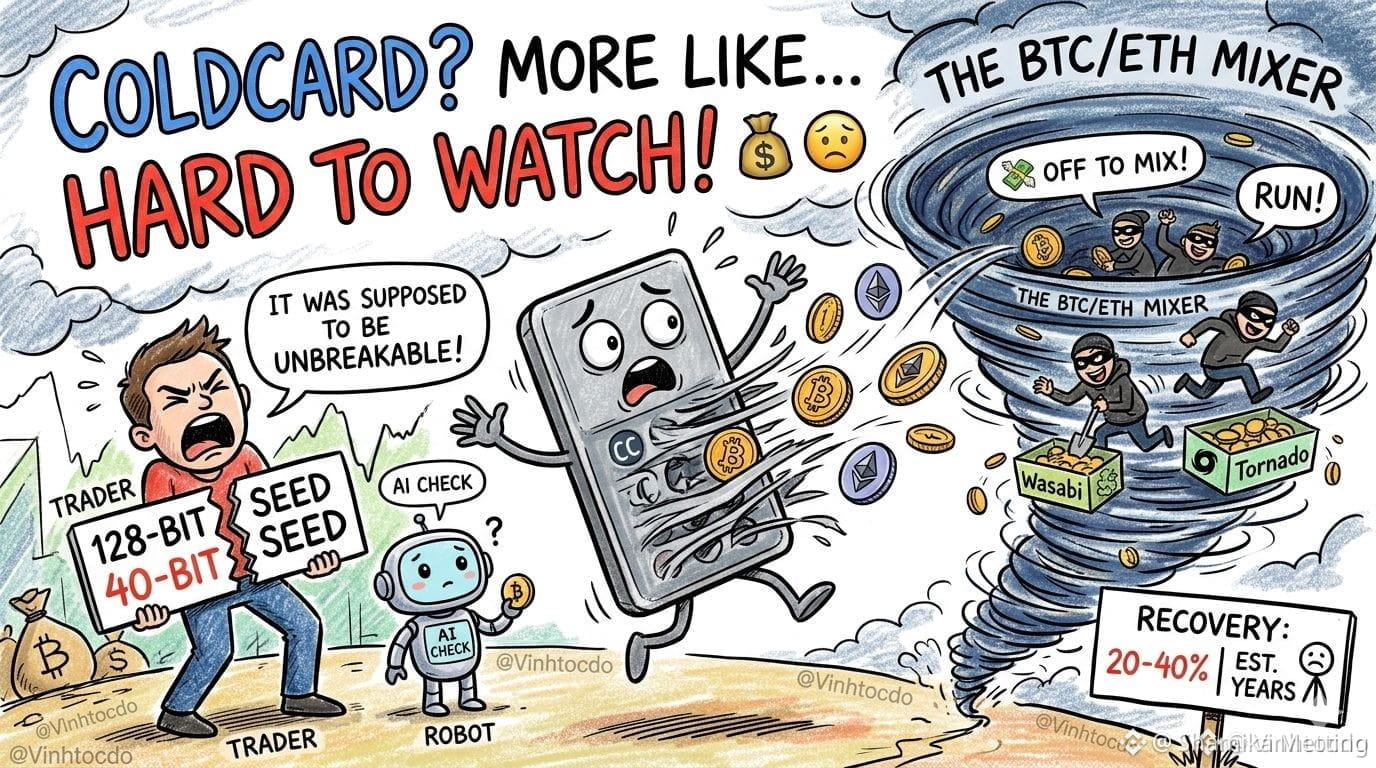
🥶 A hardware wallet? More like something hard to watch! 💸
#ColdcardExploitFundsSentToMixers Finally, the attackers woke up! CertiK spotted 64 BTC moving to Wasabi and 200 ETH entering Tornado Cash. 🌪️🏃♂️
They say on the street that the recovery odds will be brutal at 20–40%, and it could take years to get anything back. All because of a firmware glitch from 2021 that made seed phrases vulnerable to brute-force attacks. 🤦♂️💀
It seems a $2 AI-powered check could have saved more than $100 million. What an expensive oversight!
What should traders do? If you’re using those specific wallets, recreate the seed phrases immediately. Move your assets to new ground! 🛡️💼
👉 Not financial advice! Do your own research (DYOR)!
Please stay tuned
#Coldcard #BitcoinHack #BlockchainSecurity
$BTC
{future}(BTCUSDT)
🥶 A hardware wallet? More like something hard to watch! 💸
#ColdcardExploitFundsSentToMixers Finally, the attackers woke up! CertiK spotted 64 BTC moving to Wasabi and 200 ETH entering Tornado Cash. 🌪️🏃♂️
They say on the street that the recovery odds will be brutal at 20–40%, and it could take years to get anything back. All because of a firmware glitch from 2021 that made seed phrases vulnerable to brute-force attacks. 🤦♂️💀
It seems a $2 AI-powered check could have saved more than $100 million. What an expensive oversight!
What should traders do? If you’re using those specific wallets, recreate the seed phrases immediately. Move your assets to new ground! 🛡️💼
👉 Not financial advice! Do your own research (DYOR)!
Please stay tuned
#Coldcard #BitcoinHack #BlockchainSecurity
$BTC
#ColdcardExploitFundsSentToMixers Finally, the attackers woke up! CertiK spotted 64 BTC moving to Wasabi and 200 ETH entering Tornado Cash. 🌪️🏃♂️
They say on the street that the recovery odds will be brutal at 20–40%, and it could take years to get anything back. All because of a firmware glitch from 2021 that made seed phrases vulnerable to brute-force attacks. 🤦♂️💀
It seems a $2 AI-powered check could have saved more than $100 million. What an expensive oversight!
What should traders do? If you’re using those specific wallets, recreate the seed phrases immediately. Move your assets to new ground! 🛡️💼
👉 Not financial advice! Do your own research (DYOR)!
Please stay tuned
#Coldcard #BitcoinHack #BlockchainSecurity
$BTC
1
118

🚨 #coldcardexploitfundssenttomixers | IS “SECURE COLD STORAGE” REALLY A HOT MESS?
The sleeping giants have awakened, and they’re washing the funds. CertiK, a security firm, has just flagged a major on-chain movement by attackers: 64 Bitcoin were sent to Wasabi, and 200 Ethereum simply vanished through Tornado Cash. 🌪️
🔍 THE ROOT CAUSE:
All this chaos stems from a critical 2021 firmware flaw that left the seed phrases completely exposed to brute-force attacks. The ultimate irony? A basic security audit with $2 AI could have completely prevented this $100M+ disaster. Let that sink in. 🤯
📌 WHAT’S THE CHANCE OF RECOVERY?
Get ready. Industry experts estimate a grim 20% to 40% chance of recovery, and dealing with the fallout can easily take years.
🛡️ URGENT ACTION REQUIRED FOR TRADERS:
If you currently have assets in these specifically compromised wallets, you need to act now.
• Immediately generate brand-new seed phrases.
• Migrate your entire portfolio to a new, secure wallet.
Don’t wait for the dust to settle — protect your capital! 💼🔒
👉 Notice: Always do your own research (DYOR). This is not financial advice.
$ACE
#Coldcard #BitcoinHack #BlockchainSecurity
{future}(ACEUSDT)
$ZBT
{future}(ZBTUSDT)
$BTC
{future}(BTCUSDT)
🚨 #coldcardexploitfundssenttomixers | IS “SECURE COLD STORAGE” REALLY A HOT MESS?
The sleeping giants have awakened, and they’re washing the funds. CertiK, a security firm, has just flagged a major on-chain movement by attackers: 64 Bitcoin were sent to Wasabi, and 200 Ethereum simply vanished through Tornado Cash. 🌪️
🔍 THE ROOT CAUSE:
All this chaos stems from a critical 2021 firmware flaw that left the seed phrases completely exposed to brute-force attacks. The ultimate irony? A basic security audit with $2 AI could have completely prevented this $100M+ disaster. Let that sink in. 🤯
📌 WHAT’S THE CHANCE OF RECOVERY?
Get ready. Industry experts estimate a grim 20% to 40% chance of recovery, and dealing with the fallout can easily take years.
🛡️ URGENT ACTION REQUIRED FOR TRADERS:
If you currently have assets in these specifically compromised wallets, you need to act now.
• Immediately generate brand-new seed phrases.
• Migrate your entire portfolio to a new, secure wallet.
Don’t wait for the dust to settle — protect your capital! 💼🔒
👉 Notice: Always do your own research (DYOR). This is not financial advice.
$ACE
#Coldcard #BitcoinHack #BlockchainSecurity
$ZBT
$BTC
The sleeping giants have awakened, and they’re washing the funds. CertiK, a security firm, has just flagged a major on-chain movement by attackers: 64 Bitcoin were sent to Wasabi, and 200 Ethereum simply vanished through Tornado Cash. 🌪️
🔍 THE ROOT CAUSE:
All this chaos stems from a critical 2021 firmware flaw that left the seed phrases completely exposed to brute-force attacks. The ultimate irony? A basic security audit with $2 AI could have completely prevented this $100M+ disaster. Let that sink in. 🤯
📌 WHAT’S THE CHANCE OF RECOVERY?
Get ready. Industry experts estimate a grim 20% to 40% chance of recovery, and dealing with the fallout can easily take years.
🛡️ URGENT ACTION REQUIRED FOR TRADERS:
If you currently have assets in these specifically compromised wallets, you need to act now.
• Immediately generate brand-new seed phrases.
• Migrate your entire portfolio to a new, secure wallet.
Don’t wait for the dust to settle — protect your capital! 💼🔒
👉 Notice: Always do your own research (DYOR). This is not financial advice.
$ACE
#Coldcard #BitcoinHack #BlockchainSecurity
$ZBT
$BTC
1
168
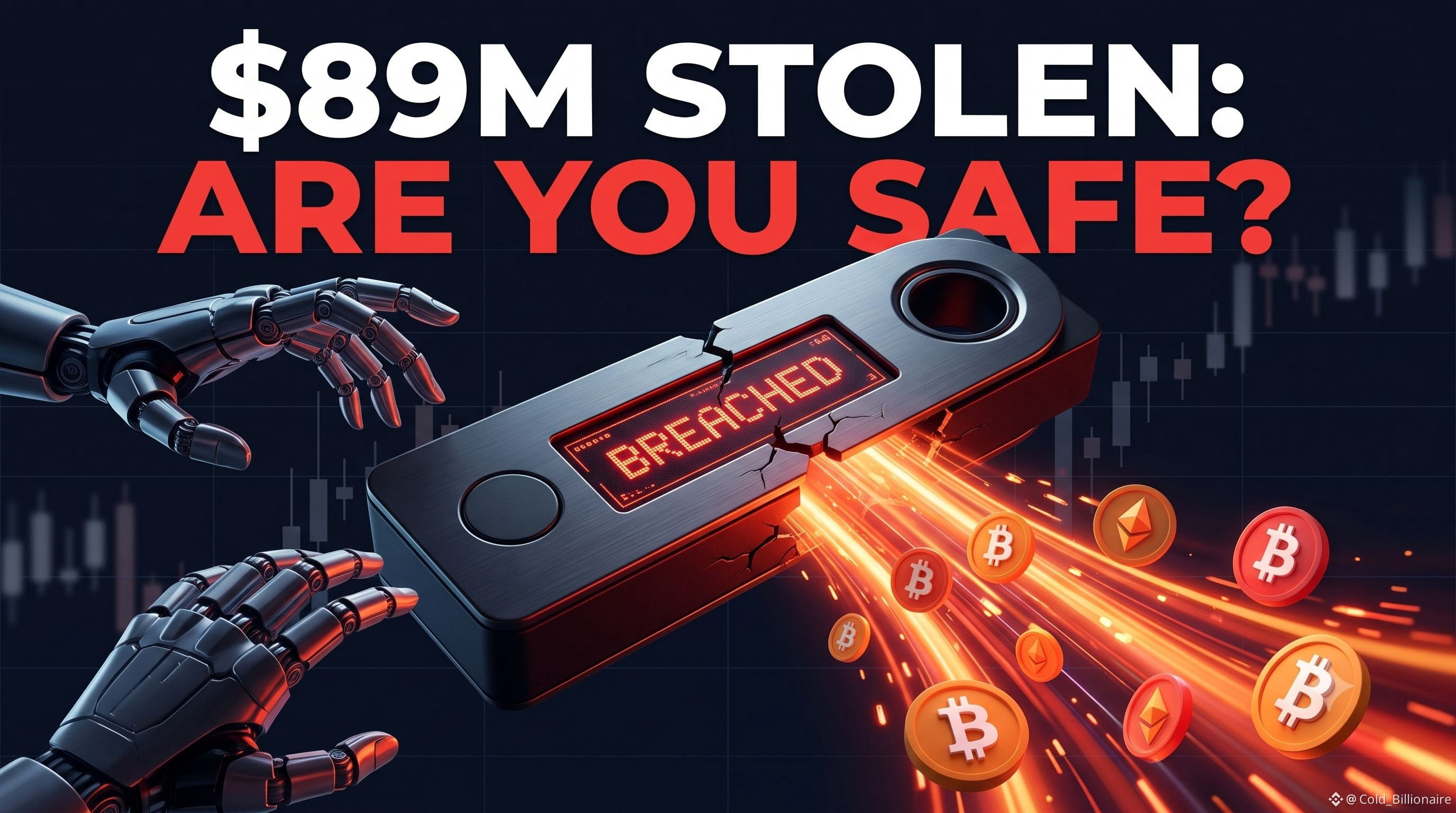
🚨 $89M STOLEN: Is Your Hardware Wallet Safe?
Cold storage just took a massive hit. Since July 30, attackers exploited a firmware flaw in the Coldcard hardware wallet, draining 1,367 $BTC (~$89M) from 4,585 addresses across three waves.
This incident sparks debate: is cold storage truly bulletproof? Here is what you must understand:
🐻 The Bearish Reality: Updates Won't Save Compromised Seeds
-> A 2021 firmware flaw bypassed the hardware's random-number generator, using a predictable software fallback. Attackers can mathematically recreate private keys completely offline. Simply updating your firmware today will NOT protect seeds generated with weak entropy. Those keys are permanently at risk.
🐂 The Bullish Reality: Bitcoin Isn't Broken
-> The Bitcoin network remains perfectly secure. This is a localized hardware vulnerability, not a blockchain protocol flaw. Self-custody still avoids centralized exchange counterparty risks, provided the device's entropy is secure.
🎓 The Educational Survival Guide: Migrate Safely
-> A weak random number generator makes cryptographic locks easily guessable.
📌 If you use Coldcard:
🔹 Update to the latest patched firmware immediately.
🔹 DO NOT STOP THERE. Generate an entirely NEW seed phrase on the patched device.
🔹 Transfer your $BTC to the new secure addresses.
🔹 Using a unique BIP-39 passphrase adds significant security.
Share your thoughts on self-custody vs. exchange custody below! 👇
#BitcoinHack #CryptoSecurity #ColdStorage #BTC
🚨 $89M STOLEN: Is Your Hardware Wallet Safe?
Cold storage just took a massive hit. Since July 30, attackers exploited a firmware flaw in the Coldcard hardware wallet, draining 1,367 $BTC (~$89M) from 4,585 addresses across three waves.
This incident sparks debate: is cold storage truly bulletproof? Here is what you must understand:
🐻 The Bearish Reality: Updates Won't Save Compromised Seeds
-> A 2021 firmware flaw bypassed the hardware's random-number generator, using a predictable software fallback. Attackers can mathematically recreate private keys completely offline. Simply updating your firmware today will NOT protect seeds generated with weak entropy. Those keys are permanently at risk.
🐂 The Bullish Reality: Bitcoin Isn't Broken
-> The Bitcoin network remains perfectly secure. This is a localized hardware vulnerability, not a blockchain protocol flaw. Self-custody still avoids centralized exchange counterparty risks, provided the device's entropy is secure.
🎓 The Educational Survival Guide: Migrate Safely
-> A weak random number generator makes cryptographic locks easily guessable.
📌 If you use Coldcard:
🔹 Update to the latest patched firmware immediately.
🔹 DO NOT STOP THERE. Generate an entirely NEW seed phrase on the patched device.
🔹 Transfer your $BTC to the new secure addresses.
🔹 Using a unique BIP-39 passphrase adds significant security.
Share your thoughts on self-custody vs. exchange custody below! 👇
#BitcoinHack #CryptoSecurity #ColdStorage #BTC
Cold storage just took a massive hit. Since July 30, attackers exploited a firmware flaw in the Coldcard hardware wallet, draining 1,367 $BTC (~$89M) from 4,585 addresses across three waves.
This incident sparks debate: is cold storage truly bulletproof? Here is what you must understand:
🐻 The Bearish Reality: Updates Won't Save Compromised Seeds
-> A 2021 firmware flaw bypassed the hardware's random-number generator, using a predictable software fallback. Attackers can mathematically recreate private keys completely offline. Simply updating your firmware today will NOT protect seeds generated with weak entropy. Those keys are permanently at risk.
🐂 The Bullish Reality: Bitcoin Isn't Broken
-> The Bitcoin network remains perfectly secure. This is a localized hardware vulnerability, not a blockchain protocol flaw. Self-custody still avoids centralized exchange counterparty risks, provided the device's entropy is secure.
🎓 The Educational Survival Guide: Migrate Safely
-> A weak random number generator makes cryptographic locks easily guessable.
📌 If you use Coldcard:
🔹 Update to the latest patched firmware immediately.
🔹 DO NOT STOP THERE. Generate an entirely NEW seed phrase on the patched device.
🔹 Transfer your $BTC to the new secure addresses.
🔹 Using a unique BIP-39 passphrase adds significant security.
Share your thoughts on self-custody vs. exchange custody below! 👇
#BitcoinHack #CryptoSecurity #ColdStorage #BTC
1
75

#coldcardexploitfundssenttomixers
🚨 Is your “cold storage” actually safe—or a disaster? 🚨
The sleeping giants have woken up and are wiping the bottoms. Security firm CertiK has just flagged a major on-chain move by the attackers: 64 Bitcoin have been routed to Wasabi, and 200 Ethereum have vanished via Tornado Cash. 🌪️
The root cause:
All of this catastrophe stems from a critical 2021 firmware flaw that left the seed phrases completely exposed to brute-force attacks. The final irony? A basic $2 AI security audit could have prevented this entire 100M+ disaster. Let that sink in. 🤯
What are the odds of getting it back?
Get ready. Industry experts estimate a grim 20% to 40% chance of recovery, and navigating the fallout could easily take years.
🛡️ URGENT ACTION REQUIRED FOR TRADERS:
If you currently hold assets in these specific compromised wallets, you need to act now.
Generate entirely new seed phrases immediately.
Move your entire wallet to a new, secure wallet. Don’t wait for the dust to settle: protect your capital! 💼🔒
👉 Notice: Always do your own research (DYOR). This is not financial advice.
#Coldcard #BitcoinHack #BlockchainSecurity
$ACE
$ZBT
$BTC
#coldcardexploitfundssenttomixers
🚨 Is your “cold storage” actually safe—or a disaster? 🚨
The sleeping giants have woken up and are wiping the bottoms. Security firm CertiK has just flagged a major on-chain move by the attackers: 64 Bitcoin have been routed to Wasabi, and 200 Ethereum have vanished via Tornado Cash. 🌪️
The root cause:
All of this catastrophe stems from a critical 2021 firmware flaw that left the seed phrases completely exposed to brute-force attacks. The final irony? A basic $2 AI security audit could have prevented this entire 100M+ disaster. Let that sink in. 🤯
What are the odds of getting it back?
Get ready. Industry experts estimate a grim 20% to 40% chance of recovery, and navigating the fallout could easily take years.
🛡️ URGENT ACTION REQUIRED FOR TRADERS:
If you currently hold assets in these specific compromised wallets, you need to act now.
Generate entirely new seed phrases immediately.
Move your entire wallet to a new, secure wallet. Don’t wait for the dust to settle: protect your capital! 💼🔒
👉 Notice: Always do your own research (DYOR). This is not financial advice.
#Coldcard #BitcoinHack #BlockchainSecurity
$ACE
$ZBT
$BTC
🚨 Is your “cold storage” actually safe—or a disaster? 🚨
The sleeping giants have woken up and are wiping the bottoms. Security firm CertiK has just flagged a major on-chain move by the attackers: 64 Bitcoin have been routed to Wasabi, and 200 Ethereum have vanished via Tornado Cash. 🌪️
The root cause:
All of this catastrophe stems from a critical 2021 firmware flaw that left the seed phrases completely exposed to brute-force attacks. The final irony? A basic $2 AI security audit could have prevented this entire 100M+ disaster. Let that sink in. 🤯
What are the odds of getting it back?
Get ready. Industry experts estimate a grim 20% to 40% chance of recovery, and navigating the fallout could easily take years.
🛡️ URGENT ACTION REQUIRED FOR TRADERS:
If you currently hold assets in these specific compromised wallets, you need to act now.
Generate entirely new seed phrases immediately.
Move your entire wallet to a new, secure wallet. Don’t wait for the dust to settle: protect your capital! 💼🔒
👉 Notice: Always do your own research (DYOR). This is not financial advice.
#Coldcard #BitcoinHack #BlockchainSecurity
$ACE
$ZBT
$BTC
3
11.8k
·
--
Article
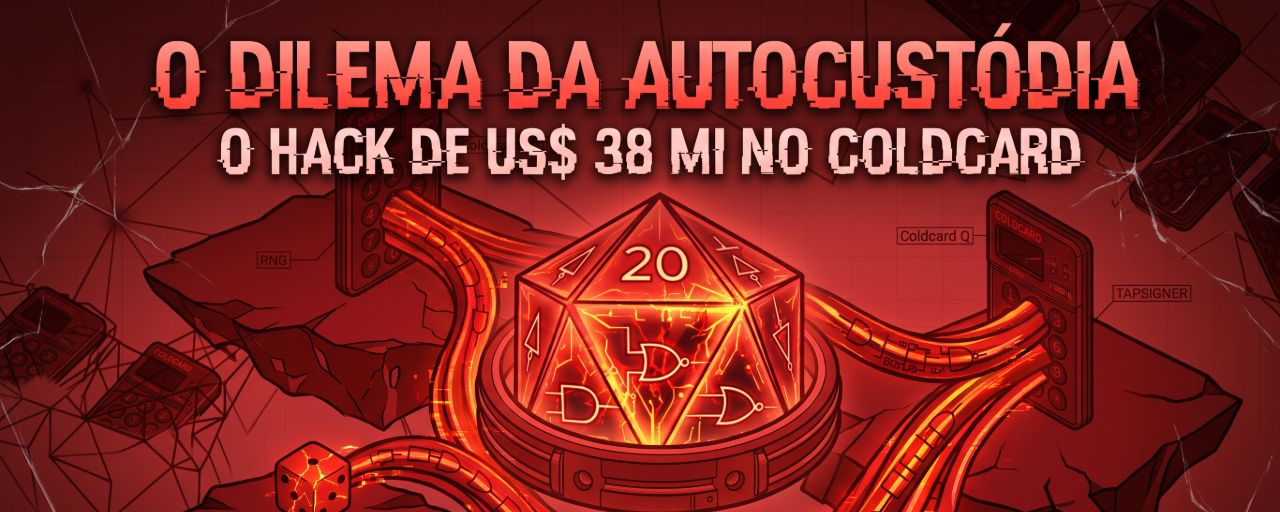
The Self-Custody Dilemma: The $38M Coldcard Hack and What It Means for YouBitcoin’s original promise was always simple and revolutionary: "be your own bank". By controlling your own private keys through a hardware wallet, you eliminate the need to trust banks or exchanges. However, the recent case involving Coldcard — one of the most respected brands on the market — brought up an uncomfortable question: what if the problem is actually in the very device that should be protecting you?
A critical software flaw in the wallet randomness generation allowed attackers to recreate recovery phrases (seeds) and drain nearly 600 bitcoins (about US$ 38 million) from users who believed they were 100% safe.
The Self-Custody Dilemma: The $38M Coldcard Hack and What It Means for You
Bitcoin’s original promise was always simple and revolutionary: "be your own bank". By controlling your own private keys through a hardware wallet, you eliminate the need to trust banks or exchanges. However, the recent case involving Coldcard — one of the most respected brands on the market — brought up an uncomfortable question: what if the problem is actually in the very device that should be protecting you?
A critical software flaw in the wallet randomness generation allowed attackers to recreate recovery phrases (seeds) and drain nearly 600 bitcoins (about US$ 38 million) from users who believed they were 100% safe.
A critical software flaw in the wallet randomness generation allowed attackers to recreate recovery phrases (seeds) and drain nearly 600 bitcoins (about US$ 38 million) from users who believed they were 100% safe.
1.1k

#coldcardexploitfundssenttomixers
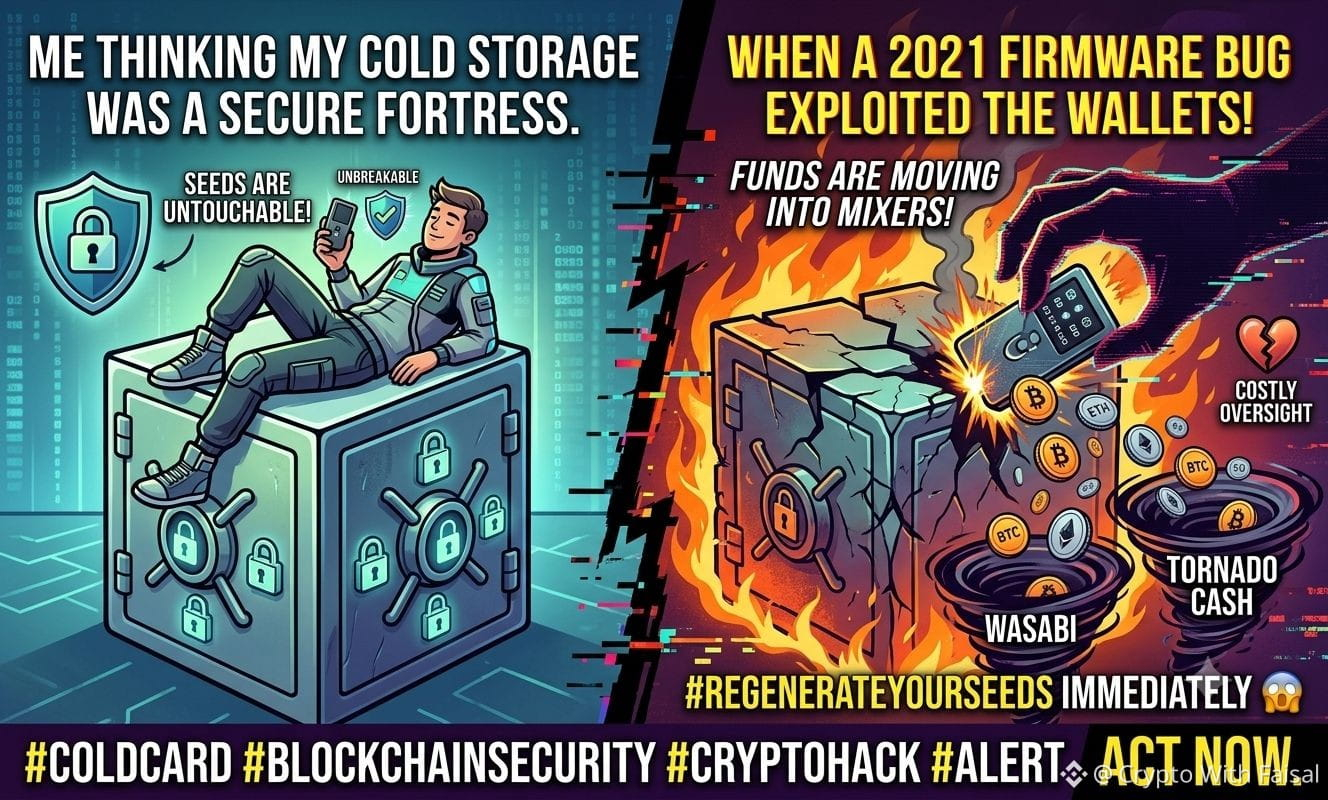
🚨 Is Your "Safe" Cold Storage Actually a Hot Mess? 🚨
The sleeping giants have awakened, and they are washing the funds. Security firm CertiK just flagged major on-chain movement from the attackers: 64 Bitcoin have been funneled into Wasabi, and 200 Ethereum just vanished through Tornado Cash. 🌪️
The Root Cause:
This entire catastrophe stems from a critical 2021 firmware flaw that left seed phrases completely exposed to brute-force attacks. The ultimate irony? A basic $2 AI security audit could have completely prevented this $100M+ disaster. Let that sink in. 🤯
What are the odds of getting it back?
Brace yourself. Industry insiders are estimating a grim 20% to 40% chance of recovery, and navigating the aftermath could easily take years.
🛡️ URGENT ACTION REQUIRED FOR TRADERS:
If you are currently holding assets on these specific compromised wallets, you need to act now.
Generate entirely new seed phrases immediately.
Migrate your entire portfolio to a fresh, secure wallet. Do not wait for the dust to settle—protect your capital! 💼🔒
👉 Disclaimer: Always do your own research (DYOR). This is not financial advice.
#Coldcard #BitcoinHack #BlockchainSecurity
$ACE
{future}(ACEUSDT)
$ZBT
{future}(ZBTUSDT)
$BTC
{future}(BTCUSDT)
#coldcardexploitfundssenttomixers
🚨 Is Your "Safe" Cold Storage Actually a Hot Mess? 🚨
The sleeping giants have awakened, and they are washing the funds. Security firm CertiK just flagged major on-chain movement from the attackers: 64 Bitcoin have been funneled into Wasabi, and 200 Ethereum just vanished through Tornado Cash. 🌪️
The Root Cause:
This entire catastrophe stems from a critical 2021 firmware flaw that left seed phrases completely exposed to brute-force attacks. The ultimate irony? A basic $2 AI security audit could have completely prevented this $100M+ disaster. Let that sink in. 🤯
What are the odds of getting it back?
Brace yourself. Industry insiders are estimating a grim 20% to 40% chance of recovery, and navigating the aftermath could easily take years.
🛡️ URGENT ACTION REQUIRED FOR TRADERS:
If you are currently holding assets on these specific compromised wallets, you need to act now.
Generate entirely new seed phrases immediately.
Migrate your entire portfolio to a fresh, secure wallet. Do not wait for the dust to settle—protect your capital! 💼🔒
👉 Disclaimer: Always do your own research (DYOR). This is not financial advice.
#Coldcard #BitcoinHack #BlockchainSecurity
$ACE
$ZBT
$BTC
🚨 Is Your "Safe" Cold Storage Actually a Hot Mess? 🚨
The sleeping giants have awakened, and they are washing the funds. Security firm CertiK just flagged major on-chain movement from the attackers: 64 Bitcoin have been funneled into Wasabi, and 200 Ethereum just vanished through Tornado Cash. 🌪️
The Root Cause:
This entire catastrophe stems from a critical 2021 firmware flaw that left seed phrases completely exposed to brute-force attacks. The ultimate irony? A basic $2 AI security audit could have completely prevented this $100M+ disaster. Let that sink in. 🤯
What are the odds of getting it back?
Brace yourself. Industry insiders are estimating a grim 20% to 40% chance of recovery, and navigating the aftermath could easily take years.
🛡️ URGENT ACTION REQUIRED FOR TRADERS:
If you are currently holding assets on these specific compromised wallets, you need to act now.
Generate entirely new seed phrases immediately.
Migrate your entire portfolio to a fresh, secure wallet. Do not wait for the dust to settle—protect your capital! 💼🔒
👉 Disclaimer: Always do your own research (DYOR). This is not financial advice.
#Coldcard #BitcoinHack #BlockchainSecurity
$ACE
$ZBT
$BTC
1
5
10.2k

·
--
Bullish
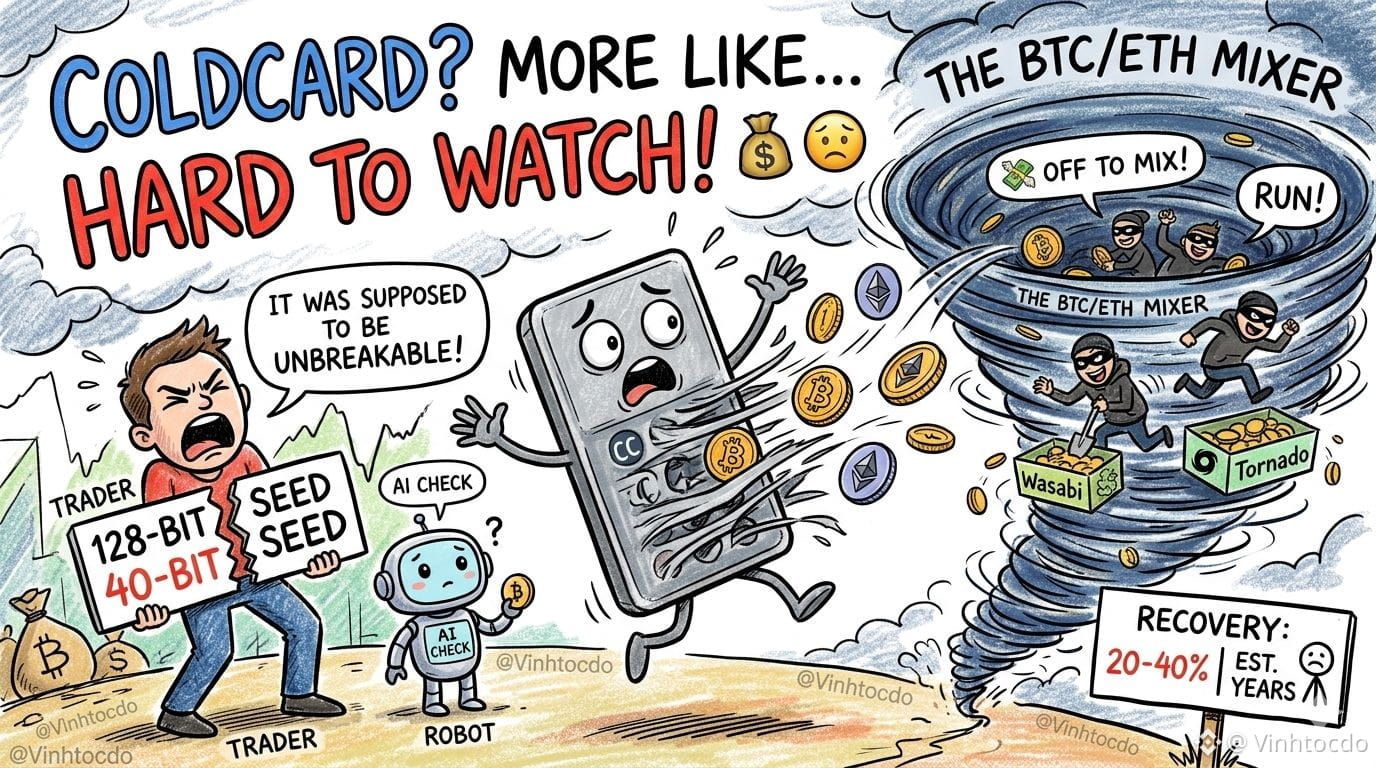
🥶 HARDWARE WALLET? MORE LIKE HARD TO WATCH! 💸
#coldcardexploitfundssenttomixers as the hackers finally woke up! CertiK spotted 64 BTC moving to Wasabi and 200 ETH into Tornado Cash. 🌪️🏃♂️
Word on the street is recovery chances are a brutal 20-40%, and it might take years to get anything back. All because of a firmware bug from 2021 that made seed phrases brute-forceable. 🤦♂️💀
Apparently, a $2 AI check could've saved $100M+. Talk about a costly oversight!
What should traders do? If you used those specific wallets, regenerate your seeds IMMEDIATELY. Move your bags to fresh ground! 🛡️💼
👉 Not financial advice! DYOR!
#Coldcard #BitcoinHack #BlockchainSecurity #VINHTOCDO
$BTC
{future}(BTCUSDT)
$DIA
{future}(DIAUSDT)
$GUN
{future}(GUNUSDT)
🥶 HARDWARE WALLET? MORE LIKE HARD TO WATCH! 💸
#coldcardexploitfundssenttomixers as the hackers finally woke up! CertiK spotted 64 BTC moving to Wasabi and 200 ETH into Tornado Cash. 🌪️🏃♂️
Word on the street is recovery chances are a brutal 20-40%, and it might take years to get anything back. All because of a firmware bug from 2021 that made seed phrases brute-forceable. 🤦♂️💀
Apparently, a $2 AI check could've saved $100M+. Talk about a costly oversight!
What should traders do? If you used those specific wallets, regenerate your seeds IMMEDIATELY. Move your bags to fresh ground! 🛡️💼
👉 Not financial advice! DYOR!
#Coldcard #BitcoinHack #BlockchainSecurity #VINHTOCDO
$BTC
$DIA
$GUN
#coldcardexploitfundssenttomixers as the hackers finally woke up! CertiK spotted 64 BTC moving to Wasabi and 200 ETH into Tornado Cash. 🌪️🏃♂️
Word on the street is recovery chances are a brutal 20-40%, and it might take years to get anything back. All because of a firmware bug from 2021 that made seed phrases brute-forceable. 🤦♂️💀
Apparently, a $2 AI check could've saved $100M+. Talk about a costly oversight!
What should traders do? If you used those specific wallets, regenerate your seeds IMMEDIATELY. Move your bags to fresh ground! 🛡️💼
👉 Not financial advice! DYOR!
#Coldcard #BitcoinHack #BlockchainSecurity #VINHTOCDO
$BTC
$DIA
$GUN
8
2.7k
Log in to explore more content
Join global crypto users on Binance Square
⚡️ Get latest and useful information about crypto.
💬 Trusted by the world’s largest crypto exchange.
👍 Discover real insights from verified creators.
Email / Phone number
Trending Topics
1
#GoldFallsTo$4144
896 views
28 Discussing
2
#QNTFallsOver40%FromMorningHigh
4,895 views
205 Discussing
3
#KospiFalls2.7%SamsungSKHynixDropOver5%
1 views
12 Discussing
4
#BitgetCEOConfirms$388MStolenInHack
276 views
15 Discussing
5
#BTCFallsBelow$83000
8,654 views
89 Discussing
6
#BitgetDetailsSecurityIncidentTimeline
5,601 views
200 Discussing
7
#BitcoinSpotETFs$2.39BWeeklyNetInflow
2,372 views
17 Discussing
8
#FedProposesPaymentStablecoinRules
29,736 views
561 Discussing
9
#ChinaMayLetAlibabaByteDanceBuyNvidiaChips
31,488 views
598 Discussing
10
#USChinaRelease$30BTariffCutProductLists
3,279 views
49 Discussing