

#bitcoinbreaksabovemayhighnears
bitcoinbreaksabovemayhighnears
986 views
33 Discussing
Hot
Latest

·
--
Picture this: last month the total crypto market cap broke down through a level that had held for weeks, and the usual obituaries started circulating.
The pain is familiar. You either sold the dip out of fear or sat frozen, then watched the recovery and felt that sinking FOMO of being left behind again.
This reclaim is worth studying because it rhymes with late 2020 and the post-FTX bounce in 2023, but the setup is not identical. Back then $BTC led and alts followed with a lag.
Right now Bitcoin is pushing toward those May highs while a lot of capital still parks in $USDT waiting for confirmation. Greed already sits at 78, the same zone that preceded several sharp shakeouts last cycle.
The difference this time is the steady institutional bid and how names like $PEPE only start waking up after the total cap is clearly back above the line. History says these reclaims either become the launchpad for the next leg or trap late buyers if volume does not follow.
Where do you think this goes from here?
#CryptoMarketCapReclaims #BitcoinBreaksAboveMayHighNears #BNBMarketCapPassesBNYMellon
Picture this: last month the total crypto market cap broke down through a level that had held for weeks, and the usual obituaries started circulating.
The pain is familiar. You either sold the dip out of fear or sat frozen, then watched the recovery and felt that sinking FOMO of being left behind again.
This reclaim is worth studying because it rhymes with late 2020 and the post-FTX bounce in 2023, but the setup is not identical. Back then $BTC led and alts followed with a lag.
Right now Bitcoin is pushing toward those May highs while a lot of capital still parks in $USDT waiting for confirmation. Greed already sits at 78, the same zone that preceded several sharp shakeouts last cycle.
The difference this time is the steady institutional bid and how names like $PEPE only start waking up after the total cap is clearly back above the line. History says these reclaims either become the launchpad for the next leg or trap late buyers if volume does not follow.
Where do you think this goes from here?
#CryptoMarketCapReclaims #BitcoinBreaksAboveMayHighNears #BNBMarketCapPassesBNYMellon
The pain is familiar. You either sold the dip out of fear or sat frozen, then watched the recovery and felt that sinking FOMO of being left behind again.
This reclaim is worth studying because it rhymes with late 2020 and the post-FTX bounce in 2023, but the setup is not identical. Back then $BTC led and alts followed with a lag.
Right now Bitcoin is pushing toward those May highs while a lot of capital still parks in $USDT waiting for confirmation. Greed already sits at 78, the same zone that preceded several sharp shakeouts last cycle.
The difference this time is the steady institutional bid and how names like $PEPE only start waking up after the total cap is clearly back above the line. History says these reclaims either become the launchpad for the next leg or trap late buyers if volume does not follow.
Where do you think this goes from here?
#CryptoMarketCapReclaims #BitcoinBreaksAboveMayHighNears #BNBMarketCapPassesBNYMellon

97

·
--
Breaking above May’s high doesn’t mean the trend is stronger it just means more people are chasing.
Chasing breaks like this turns traders into spectators.
You’re not trading a breakout.
You’re reacting to noise that’s already priced in.
I’m watching.
Waiting for a clean pullback with volume drop.
If it holds above that level, I might add.
If not, I walk away.
It would prove me wrong if it holds above that level for 72 hours without a 10% pullback.
Too late or just getting started?
#BitcoinBreaksAboveMayHighNears$86K #CryptoNews
Breaking above May’s high doesn’t mean the trend is stronger it just means more people are chasing.
Chasing breaks like this turns traders into spectators.
You’re not trading a breakout.
You’re reacting to noise that’s already priced in.
I’m watching.
Waiting for a clean pullback with volume drop.
If it holds above that level, I might add.
If not, I walk away.
It would prove me wrong if it holds above that level for 72 hours without a 10% pullback.
Too late or just getting started?
#BitcoinBreaksAboveMayHighNears$86K #CryptoNews
Chasing breaks like this turns traders into spectators.
You’re not trading a breakout.
You’re reacting to noise that’s already priced in.
I’m watching.
Waiting for a clean pullback with volume drop.
If it holds above that level, I might add.
If not, I walk away.
It would prove me wrong if it holds above that level for 72 hours without a 10% pullback.
Too late or just getting started?
#BitcoinBreaksAboveMayHighNears$86K #CryptoNews

·
--
Bullish
#BitcoinBreaksAboveMayHighNears$86K
🔥 BITCOIN JUST BROKE THE MAY HIGH — NOW THE REAL TEST BEGINS
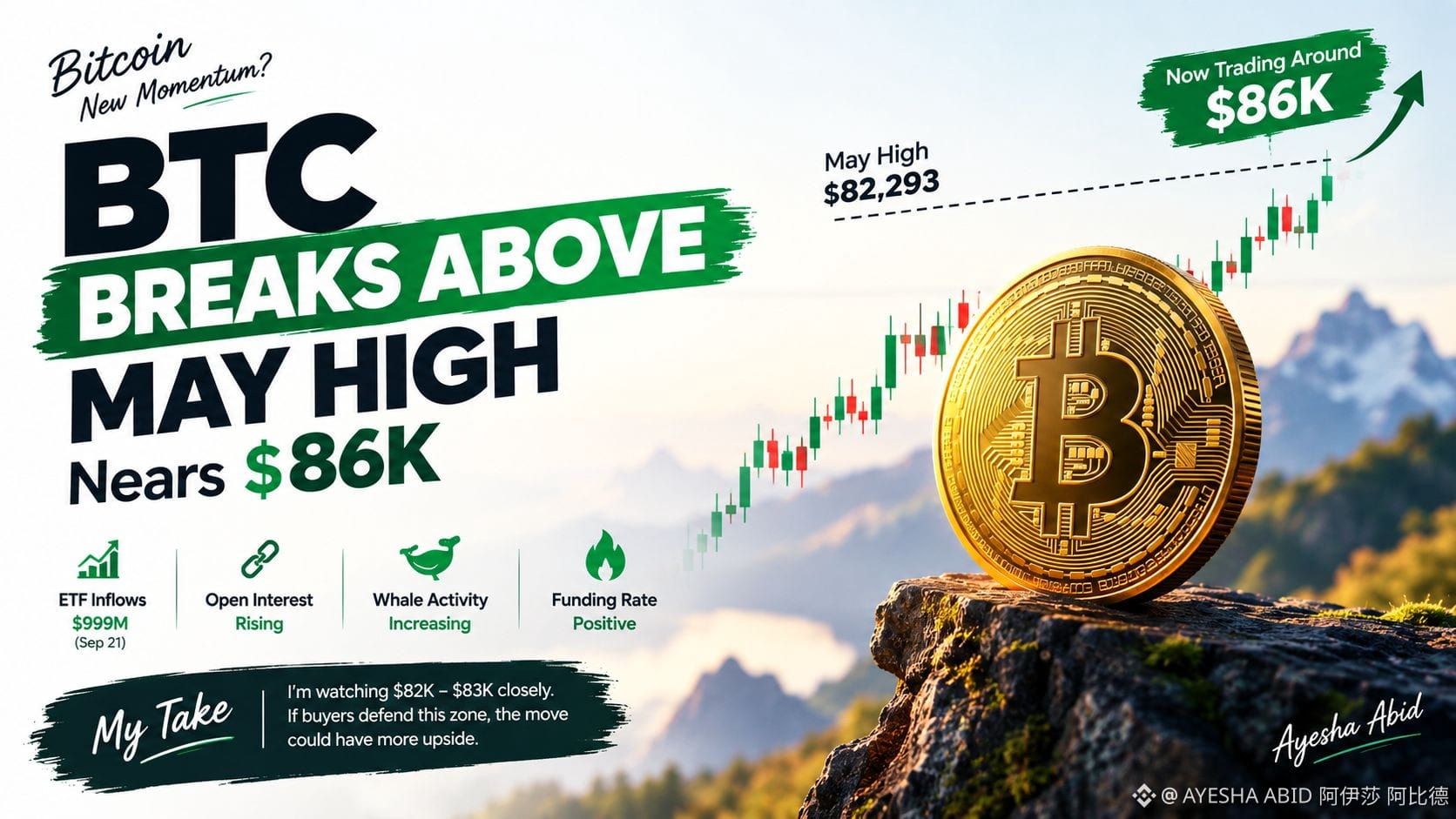
Bitcoin has pushed above the $82,293 May high and is trading around the $86K area, marking a major shift in short-term market structure. The breakout matters because this level rejected BTC earlier, so turning it into support would strengthen the move.
What makes this move more interesting is the participation behind it. U.S. spot Bitcoin ETFs recorded roughly $999M of inflows on September 21, their strongest single-day inflow in months. At the same time, futures open interest increased, while short covering helped accelerate the breakout.
My take: I’m watching $82K–$83K closely now. If BTC retests this zone and buyers defend it, the breakout structure remains strong. If price quickly falls back below it, this could turn into a false breakout and bring deeper liquidity hunting.
For now, I’d rather see confirmation than chase the candle.
$BTC
{future}(BTCUSDT)
Do you think BTC can hold above the May high after the first retest? 👀
#Bitcoin #BTC #Crypto
#BitcoinBreaksAboveMayHighNears
#BitcoinBreaksAboveMayHighNears$86K
🔥 BITCOIN JUST BROKE THE MAY HIGH — NOW THE REAL TEST BEGINS
Bitcoin has pushed above the $82,293 May high and is trading around the $86K area, marking a major shift in short-term market structure. The breakout matters because this level rejected BTC earlier, so turning it into support would strengthen the move.
What makes this move more interesting is the participation behind it. U.S. spot Bitcoin ETFs recorded roughly $999M of inflows on September 21, their strongest single-day inflow in months. At the same time, futures open interest increased, while short covering helped accelerate the breakout.
My take: I’m watching $82K–$83K closely now. If BTC retests this zone and buyers defend it, the breakout structure remains strong. If price quickly falls back below it, this could turn into a false breakout and bring deeper liquidity hunting.
For now, I’d rather see confirmation than chase the candle.
$BTC
Do you think BTC can hold above the May high after the first retest? 👀
#Bitcoin #BTC #Crypto
#BitcoinBreaksAboveMayHighNears
🔥 BITCOIN JUST BROKE THE MAY HIGH — NOW THE REAL TEST BEGINS
Bitcoin has pushed above the $82,293 May high and is trading around the $86K area, marking a major shift in short-term market structure. The breakout matters because this level rejected BTC earlier, so turning it into support would strengthen the move.
What makes this move more interesting is the participation behind it. U.S. spot Bitcoin ETFs recorded roughly $999M of inflows on September 21, their strongest single-day inflow in months. At the same time, futures open interest increased, while short covering helped accelerate the breakout.
My take: I’m watching $82K–$83K closely now. If BTC retests this zone and buyers defend it, the breakout structure remains strong. If price quickly falls back below it, this could turn into a false breakout and bring deeper liquidity hunting.
For now, I’d rather see confirmation than chase the candle.
$BTC
Do you think BTC can hold above the May high after the first retest? 👀
#Bitcoin #BTC #Crypto
#BitcoinBreaksAboveMayHighNears
2
168


Bitcoin has decisively broken through its previous May high, signaling strong bullish momentum as it edges closer to the significant $86,000 mark. This upward surge indicates growing investor confidence and potential for further price appreciation. The market is keenly watching to see if this trend can be sustained, potentially setting new all-time highs. Traders are evaluating the immediate support and resistance levels as $BTC navigates this critical price zone.
Disclaimer: This is not financial advice. Investing in cryptocurrencies involves risk.
#BitcoinBreaksAboveMayHighNears$86K
Bitcoin has decisively broken through its previous May high, signaling strong bullish momentum as it edges closer to the significant $86,000 mark. This upward surge indicates growing investor confidence and potential for further price appreciation. The market is keenly watching to see if this trend can be sustained, potentially setting new all-time highs. Traders are evaluating the immediate support and resistance levels as $BTC navigates this critical price zone.
Disclaimer: This is not financial advice. Investing in cryptocurrencies involves risk.
#BitcoinBreaksAboveMayHighNears$86K
Disclaimer: This is not financial advice. Investing in cryptocurrencies involves risk.
#BitcoinBreaksAboveMayHighNears$86K
45

·
--
Verified
Binance and Circle’s Five-Year Partnership Written Into an SEC Filing|Incentives Based on USDC Balances, Not Net BTC Inflows|Around 86,580 I Won’t Chase
My stance is cautious but slightly bullish. However, I’m not going to directly translate the stablecoin partnership into new BTC-buy pressure in the short term. On September 22, Binance announced that it has purchased Circle Class A common shares for $100 million via a private placement, and extended the USDC partnership for five years. Even more worth reading is Circle’s 8-K filed with the U.S. SEC: the two sides signed on September 17. The monthly incentive Circle pays to Binance is tied to the size of the USDC held through specified modular smart-contract wallet infrastructure; Binance handles platform promotion. The document also states the subscription is for 1,237,011 shares at $80.84 per share, and the funds are directed to Circle. This is an equity and distribution agreement—not Binance taking $100 million to sweep into BTC, and it doesn’t mean an equal amount of USDC has already flowed into the trading order book.
Why do BTC traders care about this? Stablecoins are the dollar channel for trading and cross-border settlement. If later there is genuine retention of balances, deeper conversion liquidity, and expanding net external deposits, trading frictions could decrease and risk assets may gain better liquidity conditions. But if it’s only existing users moving between USDT and USDC—or even just funds sitting in wallets—spot BTC demand may not increase. Incentives based on balances may also encourage retention rather than immediate trading, so you can’t infer a short-term price target solely from the contract term. I’ll track Binance platform USDC actual balances, BTC/USDC spot depth, net deposits, and Circle’s subsequent disclosures on distribution costs to validate adoption rates and economics separately.
The market has already reacted, but you can’t be overconfident in attributing the move. KuCoin’s BTC perpetual observed price is around $86,578, with a 24-hour range of $85,066–$86,810. Price is near the upper end of the range. The funding rate is around -0.0022%, which is not direct evidence of crowded longs, and it’s not a guaranteed upside signal. Discussions on Binance Square about breaking above May’s high and approaching $86,000 continue to grow. I understand this reflects a recovery in risk appetite, not evidence that this Circle filing alone is driving it. If around $86,810 there are repeated rejections, no matter how good the narrative is, it can’t replace buying demand. If it pulls back and forms a full 15-minute candle closing below 86,380, the short-term bullish view should be withdrawn. If it reclaims and holds above 86,820 with improved spot trade execution, then I’d consider continuing the upside.
If I were trading this myself, I wouldn’t participate. I’d only consider a small spot long, not high leverage. The entry trigger is two full 15-minute K-lines closing above 86,820, followed by a pullback to the 86,680–86,780 area that holds. Then buy in batches with no more than 0.6% of principal per tranche. If it directly rallies to the target, I’d rather miss it. First target: 87,300—hit during the halving area, and move the stop-loss up to near breakeven. Second target: 87,800—watch volume/spot activity for the remainder of the position. The initial stop-loss is set below 86,380. If price breaks below 86,380 first, the plan is canceled. If after entry there are abnormal exchange safety events, USDC de-peg, or official disclosures contradicting the understanding implied by the agreement, even if the price stop-loss hasn’t been hit, I would close immediately. If the plan isn’t triggered, that’s zero trades—I won’t write it as already profit.
#BitcoinBreaksAboveMayHighNears$86K #BTC
The above is only my personal market observation and does not constitute investment advice.
Binance and Circle’s Five-Year Partnership Written Into an SEC Filing|Incentives Based on USDC Balances, Not Net BTC Inflows|Around 86,580 I Won’t Chase
My stance is cautious but slightly bullish. However, I’m not going to directly translate the stablecoin partnership into new BTC-buy pressure in the short term. On September 22, Binance announced that it has purchased Circle Class A common shares for $100 million via a private placement, and extended the USDC partnership for five years. Even more worth reading is Circle’s 8-K filed with the U.S. SEC: the two sides signed on September 17. The monthly incentive Circle pays to Binance is tied to the size of the USDC held through specified modular smart-contract wallet infrastructure; Binance handles platform promotion. The document also states the subscription is for 1,237,011 shares at $80.84 per share, and the funds are directed to Circle. This is an equity and distribution agreement—not Binance taking $100 million to sweep into BTC, and it doesn’t mean an equal amount of USDC has already flowed into the trading order book.
Why do BTC traders care about this? Stablecoins are the dollar channel for trading and cross-border settlement. If later there is genuine retention of balances, deeper conversion liquidity, and expanding net external deposits, trading frictions could decrease and risk assets may gain better liquidity conditions. But if it’s only existing users moving between USDT and USDC—or even just funds sitting in wallets—spot BTC demand may not increase. Incentives based on balances may also encourage retention rather than immediate trading, so you can’t infer a short-term price target solely from the contract term. I’ll track Binance platform USDC actual balances, BTC/USDC spot depth, net deposits, and Circle’s subsequent disclosures on distribution costs to validate adoption rates and economics separately.
The market has already reacted, but you can’t be overconfident in attributing the move. KuCoin’s BTC perpetual observed price is around $86,578, with a 24-hour range of $85,066–$86,810. Price is near the upper end of the range. The funding rate is around -0.0022%, which is not direct evidence of crowded longs, and it’s not a guaranteed upside signal. Discussions on Binance Square about breaking above May’s high and approaching $86,000 continue to grow. I understand this reflects a recovery in risk appetite, not evidence that this Circle filing alone is driving it. If around $86,810 there are repeated rejections, no matter how good the narrative is, it can’t replace buying demand. If it pulls back and forms a full 15-minute candle closing below 86,380, the short-term bullish view should be withdrawn. If it reclaims and holds above 86,820 with improved spot trade execution, then I’d consider continuing the upside.
If I were trading this myself, I wouldn’t participate. I’d only consider a small spot long, not high leverage. The entry trigger is two full 15-minute K-lines closing above 86,820, followed by a pullback to the 86,680–86,780 area that holds. Then buy in batches with no more than 0.6% of principal per tranche. If it directly rallies to the target, I’d rather miss it. First target: 87,300—hit during the halving area, and move the stop-loss up to near breakeven. Second target: 87,800—watch volume/spot activity for the remainder of the position. The initial stop-loss is set below 86,380. If price breaks below 86,380 first, the plan is canceled. If after entry there are abnormal exchange safety events, USDC de-peg, or official disclosures contradicting the understanding implied by the agreement, even if the price stop-loss hasn’t been hit, I would close immediately. If the plan isn’t triggered, that’s zero trades—I won’t write it as already profit.
#BitcoinBreaksAboveMayHighNears$86K #BTC
The above is only my personal market observation and does not constitute investment advice.
My stance is cautious but slightly bullish. However, I’m not going to directly translate the stablecoin partnership into new BTC-buy pressure in the short term. On September 22, Binance announced that it has purchased Circle Class A common shares for $100 million via a private placement, and extended the USDC partnership for five years. Even more worth reading is Circle’s 8-K filed with the U.S. SEC: the two sides signed on September 17. The monthly incentive Circle pays to Binance is tied to the size of the USDC held through specified modular smart-contract wallet infrastructure; Binance handles platform promotion. The document also states the subscription is for 1,237,011 shares at $80.84 per share, and the funds are directed to Circle. This is an equity and distribution agreement—not Binance taking $100 million to sweep into BTC, and it doesn’t mean an equal amount of USDC has already flowed into the trading order book.
Why do BTC traders care about this? Stablecoins are the dollar channel for trading and cross-border settlement. If later there is genuine retention of balances, deeper conversion liquidity, and expanding net external deposits, trading frictions could decrease and risk assets may gain better liquidity conditions. But if it’s only existing users moving between USDT and USDC—or even just funds sitting in wallets—spot BTC demand may not increase. Incentives based on balances may also encourage retention rather than immediate trading, so you can’t infer a short-term price target solely from the contract term. I’ll track Binance platform USDC actual balances, BTC/USDC spot depth, net deposits, and Circle’s subsequent disclosures on distribution costs to validate adoption rates and economics separately.
The market has already reacted, but you can’t be overconfident in attributing the move. KuCoin’s BTC perpetual observed price is around $86,578, with a 24-hour range of $85,066–$86,810. Price is near the upper end of the range. The funding rate is around -0.0022%, which is not direct evidence of crowded longs, and it’s not a guaranteed upside signal. Discussions on Binance Square about breaking above May’s high and approaching $86,000 continue to grow. I understand this reflects a recovery in risk appetite, not evidence that this Circle filing alone is driving it. If around $86,810 there are repeated rejections, no matter how good the narrative is, it can’t replace buying demand. If it pulls back and forms a full 15-minute candle closing below 86,380, the short-term bullish view should be withdrawn. If it reclaims and holds above 86,820 with improved spot trade execution, then I’d consider continuing the upside.
If I were trading this myself, I wouldn’t participate. I’d only consider a small spot long, not high leverage. The entry trigger is two full 15-minute K-lines closing above 86,820, followed by a pullback to the 86,680–86,780 area that holds. Then buy in batches with no more than 0.6% of principal per tranche. If it directly rallies to the target, I’d rather miss it. First target: 87,300—hit during the halving area, and move the stop-loss up to near breakeven. Second target: 87,800—watch volume/spot activity for the remainder of the position. The initial stop-loss is set below 86,380. If price breaks below 86,380 first, the plan is canceled. If after entry there are abnormal exchange safety events, USDC de-peg, or official disclosures contradicting the understanding implied by the agreement, even if the price stop-loss hasn’t been hit, I would close immediately. If the plan isn’t triggered, that’s zero trades—I won’t write it as already profit.
#BitcoinBreaksAboveMayHighNears$86K #BTC
The above is only my personal market observation and does not constitute investment advice.

147
·
--
BTC breaks above May high topic heats up|86K isn’t a risk-free starting point|I’m waiting for a pullback to confirm
My stance is to look at structure, not chase emotions. In Binance Square’s Trending Topics, the discussion count for #BitcoinBreaksAboveMayHighNears$86K within this round rose from 24 to 48. This is an upward-moving topic directly related to BTC. The label’s wording about “breaking above May’s high” reflects the Square’s trending narrative; different exchanges, spot vs. perpetuals, and which day’s closing price is used may lead to different highs and “breakout” criteria—so you can’t declare a single, unified historical breakout for the entire market based only on the topic name. What can be verified right now is that KuCoin’s XBTUSDT perpetual quote is around $86,345, with a 24-hour range roughly $85,066–$87,376. Price has been repeatedly wrestling around the 86K level. This price evidence supports “testing the high zone,” but does not support “there will be no more pullbacks from here.”
On fundamentals: on September 16, the U.S. Federal Reserve officially raised the federal funds target range by 25 basis points to 3.75%–4%. On September 21, Strategy’s corporate announcement and SEC filings confirmed it bought an additional 950 BTC, and also disclosed a share buyback of about $174 million STRC. The first implies funding costs have not eased to the point of being negligible; the second confirms the company’s already-disclosed corporate allocation facts—but that purchase does not mean that, tonight, there will suddenly be 950 new buy orders appearing on the spot order book. If the market can hold, it should show up as pullback-time absorption, leverage not getting too overheated, and intraday highs being digested in an orderly way—not merely as an increase in the number of people on the leaderboard. Binance Research and the OTC official account’s institutional liquidity discussion provide background, but you can’t infer this hour’s net inflow into BTC from that alone.
You also need to read market reaction in layers: the 15-minute candle completed at 14:30 UTC dipped to around $85,400 and closed near $85,852; then at 15:00, before that candle was fully completed, the quote returned to around $86,300. A quick recovery indicates there is buy support at lower levels, but an unfinished 15-minute candle cannot be treated as a confirmed breakout. My watch zone is whether 86,000–86,200 can hold. If it holds, first look near 86,450; then look at the 24-hour high zone around 87,300–87,400. Below, $85,400 is the actual low of this pullback—breaking below it would overturn the short-term repair thesis. This is a futures-market sample; different platforms’ spot prices can diverge, so you must verify your own order book before executing.
If I were trading personally: I’m currently in cash with no position, only considering spot longs with light sizing and not chasing with high leverage. Only if two complete 15-minute candles close above $86,450, and then a pullback to 86,200 does not break, would I try to enter with 1.5% of total capital. First target: 86,800–87,000—cut the position in half when reached. Second target: 87,300–87,400—when touched, gradually close the remaining position; I won’t treat unrealized profit as guaranteed. If, after entering, the 15-minute candle closes below $85,800, I would stop out and close everything immediately. If prior to triggering, price breaks below $85,400, I would cancel the long plan and wait until a new structure forms. When there are sudden macro headlines or liquidity anomalies, I’d rather skip than change my stop-loss just to “make” the trade.
Source: Binance Square real-time trends; KuCoin XBTUSDTM public quotes; Federal Reserve statement dated September 16; Strategy announcement dated September 21; and SEC filings. #BitcoinBreaksAboveMayHighNears$86K #BTC
The above is only my personal market observation and does not constitute investment advice.
BTC breaks above May high topic heats up|86K isn’t a risk-free starting point|I’m waiting for a pullback to confirm
My stance is to look at structure, not chase emotions. In Binance Square’s Trending Topics, the discussion count for #BitcoinBreaksAboveMayHighNears$86K within this round rose from 24 to 48. This is an upward-moving topic directly related to BTC. The label’s wording about “breaking above May’s high” reflects the Square’s trending narrative; different exchanges, spot vs. perpetuals, and which day’s closing price is used may lead to different highs and “breakout” criteria—so you can’t declare a single, unified historical breakout for the entire market based only on the topic name. What can be verified right now is that KuCoin’s XBTUSDT perpetual quote is around $86,345, with a 24-hour range roughly $85,066–$87,376. Price has been repeatedly wrestling around the 86K level. This price evidence supports “testing the high zone,” but does not support “there will be no more pullbacks from here.”
On fundamentals: on September 16, the U.S. Federal Reserve officially raised the federal funds target range by 25 basis points to 3.75%–4%. On September 21, Strategy’s corporate announcement and SEC filings confirmed it bought an additional 950 BTC, and also disclosed a share buyback of about $174 million STRC. The first implies funding costs have not eased to the point of being negligible; the second confirms the company’s already-disclosed corporate allocation facts—but that purchase does not mean that, tonight, there will suddenly be 950 new buy orders appearing on the spot order book. If the market can hold, it should show up as pullback-time absorption, leverage not getting too overheated, and intraday highs being digested in an orderly way—not merely as an increase in the number of people on the leaderboard. Binance Research and the OTC official account’s institutional liquidity discussion provide background, but you can’t infer this hour’s net inflow into BTC from that alone.
You also need to read market reaction in layers: the 15-minute candle completed at 14:30 UTC dipped to around $85,400 and closed near $85,852; then at 15:00, before that candle was fully completed, the quote returned to around $86,300. A quick recovery indicates there is buy support at lower levels, but an unfinished 15-minute candle cannot be treated as a confirmed breakout. My watch zone is whether 86,000–86,200 can hold. If it holds, first look near 86,450; then look at the 24-hour high zone around 87,300–87,400. Below, $85,400 is the actual low of this pullback—breaking below it would overturn the short-term repair thesis. This is a futures-market sample; different platforms’ spot prices can diverge, so you must verify your own order book before executing.
If I were trading personally: I’m currently in cash with no position, only considering spot longs with light sizing and not chasing with high leverage. Only if two complete 15-minute candles close above $86,450, and then a pullback to 86,200 does not break, would I try to enter with 1.5% of total capital. First target: 86,800–87,000—cut the position in half when reached. Second target: 87,300–87,400—when touched, gradually close the remaining position; I won’t treat unrealized profit as guaranteed. If, after entering, the 15-minute candle closes below $85,800, I would stop out and close everything immediately. If prior to triggering, price breaks below $85,400, I would cancel the long plan and wait until a new structure forms. When there are sudden macro headlines or liquidity anomalies, I’d rather skip than change my stop-loss just to “make” the trade.
Source: Binance Square real-time trends; KuCoin XBTUSDTM public quotes; Federal Reserve statement dated September 16; Strategy announcement dated September 21; and SEC filings. #BitcoinBreaksAboveMayHighNears$86K #BTC
The above is only my personal market observation and does not constitute investment advice.
My stance is to look at structure, not chase emotions. In Binance Square’s Trending Topics, the discussion count for #BitcoinBreaksAboveMayHighNears$86K within this round rose from 24 to 48. This is an upward-moving topic directly related to BTC. The label’s wording about “breaking above May’s high” reflects the Square’s trending narrative; different exchanges, spot vs. perpetuals, and which day’s closing price is used may lead to different highs and “breakout” criteria—so you can’t declare a single, unified historical breakout for the entire market based only on the topic name. What can be verified right now is that KuCoin’s XBTUSDT perpetual quote is around $86,345, with a 24-hour range roughly $85,066–$87,376. Price has been repeatedly wrestling around the 86K level. This price evidence supports “testing the high zone,” but does not support “there will be no more pullbacks from here.”
On fundamentals: on September 16, the U.S. Federal Reserve officially raised the federal funds target range by 25 basis points to 3.75%–4%. On September 21, Strategy’s corporate announcement and SEC filings confirmed it bought an additional 950 BTC, and also disclosed a share buyback of about $174 million STRC. The first implies funding costs have not eased to the point of being negligible; the second confirms the company’s already-disclosed corporate allocation facts—but that purchase does not mean that, tonight, there will suddenly be 950 new buy orders appearing on the spot order book. If the market can hold, it should show up as pullback-time absorption, leverage not getting too overheated, and intraday highs being digested in an orderly way—not merely as an increase in the number of people on the leaderboard. Binance Research and the OTC official account’s institutional liquidity discussion provide background, but you can’t infer this hour’s net inflow into BTC from that alone.
You also need to read market reaction in layers: the 15-minute candle completed at 14:30 UTC dipped to around $85,400 and closed near $85,852; then at 15:00, before that candle was fully completed, the quote returned to around $86,300. A quick recovery indicates there is buy support at lower levels, but an unfinished 15-minute candle cannot be treated as a confirmed breakout. My watch zone is whether 86,000–86,200 can hold. If it holds, first look near 86,450; then look at the 24-hour high zone around 87,300–87,400. Below, $85,400 is the actual low of this pullback—breaking below it would overturn the short-term repair thesis. This is a futures-market sample; different platforms’ spot prices can diverge, so you must verify your own order book before executing.
If I were trading personally: I’m currently in cash with no position, only considering spot longs with light sizing and not chasing with high leverage. Only if two complete 15-minute candles close above $86,450, and then a pullback to 86,200 does not break, would I try to enter with 1.5% of total capital. First target: 86,800–87,000—cut the position in half when reached. Second target: 87,300–87,400—when touched, gradually close the remaining position; I won’t treat unrealized profit as guaranteed. If, after entering, the 15-minute candle closes below $85,800, I would stop out and close everything immediately. If prior to triggering, price breaks below $85,400, I would cancel the long plan and wait until a new structure forms. When there are sudden macro headlines or liquidity anomalies, I’d rather skip than change my stop-loss just to “make” the trade.
Source: Binance Square real-time trends; KuCoin XBTUSDTM public quotes; Federal Reserve statement dated September 16; Strategy announcement dated September 21; and SEC filings. #BitcoinBreaksAboveMayHighNears$86K #BTC
The above is only my personal market observation and does not constitute investment advice.

102

·
--
A few days ago, I was helping a friend analyze his cryptocurrency investment portfolio when suddenly a message popped up on his phone: Bitcoin breaks above May’s high, nearing $86,000! That made me immediately check the market. Sure enough, after several days of consolidation, Bitcoin surged last night to break through a key resistance level. It’s currently trading around $85,800, the highest since last November. This breakout not only boosted bulls’ confidence, but also prompted the market to reassess Bitcoin’s upside potential in this bull run. According to CoinMarketCap, this rally was mainly driven by continued inflows from institutional investors and a growing acceptance of digital assets. At the same time, the latest cryptocurrency regulatory framework proposed by the U.S. Securities and Exchange Commission (SEC) has also given the market confidence, suggesting regulators are gradually moving toward more standardized oversight. In a market where volatility is still present, Bitcoin’s breakthrough is undoubtedly a positive signal—and it also serves as a reminder to all investors that while you should seize opportunities, you must also pay attention to risk management. #BitcoinBreaksAboveMayHighNears$86K
#BTC $BTC
A few days ago, I was helping a friend analyze his cryptocurrency investment portfolio when suddenly a message popped up on his phone: Bitcoin breaks above May’s high, nearing $86,000! That made me immediately check the market. Sure enough, after several days of consolidation, Bitcoin surged last night to break through a key resistance level. It’s currently trading around $85,800, the highest since last November. This breakout not only boosted bulls’ confidence, but also prompted the market to reassess Bitcoin’s upside potential in this bull run. According to CoinMarketCap, this rally was mainly driven by continued inflows from institutional investors and a growing acceptance of digital assets. At the same time, the latest cryptocurrency regulatory framework proposed by the U.S. Securities and Exchange Commission (SEC) has also given the market confidence, suggesting regulators are gradually moving toward more standardized oversight. In a market where volatility is still present, Bitcoin’s breakthrough is undoubtedly a positive signal—and it also serves as a reminder to all investors that while you should seize opportunities, you must also pay attention to risk management. #BitcoinBreaksAboveMayHighNears$86K
#BTC $BTC
#BTC $BTC
134
The Fed hiked rates by 25 basis points, yet Bitcoin broke above $87,000. Tokenized U.S. stocks usher in a historic breakthrough
I. The Fed’s hawkish rate hike, but the crypto market rises against the tide
On September 22 Beijing time, the Federal Reserve announced it would raise the federal funds rate by 25 basis points to a range of 3.75% to 4.00%, the first hike since July 2023. Of the 18 Fed officials, 16 expect at least one more rate hike within the year, and the hawkish signal is very clear.
However, the crypto market reacted coolly. After the rate-hike decision was released, Bitcoin didn’t fall—it rallied, breaking through the $87,000 level. For the month so far, the cumulative gain is about 17.5%. Data show that spot Bitcoin ETFs have recorded net inflows for three straight days. Daily inflows are close to $1 billion, with BlackRock’s IBIT fund leading the entire market with inflows of $381 million. Meanwhile, in the past 24 hours, more than $795 million worth of short positions were liquidated, and shorts were almost fully wiped out.
GSR, a market analysis firm, said that expectations for a rate hike and the crypto regulatory bill being stalled were already priced in by the market. Investors are more focused on the continued inflow of institutional funds and the maturity of the ETF ecosystem.
II. The SEC approves an on-chain stock tokenization framework, ushering in a new era for Wall Street
On the very day the Fed announced the rate hike, the U.S. Securities and Exchange Commission issued a major policy: an innovation exemption framework officially went into effect. The framework allows tokenized securities trading venues to operate for five years without completing full exchange registration, opening the door for a compliant on-chain stock market.
After the news was announced, Coinbase’s tokenized stock holdings on the Base chain surged 97-fold within 30 days. However, Goldman Sachs analysts also cautioned that regulatory permission alone does not guarantee liquidity and demand. Market participants still need to watch progress in trading depth and investor education.
At the same time, the European Central Bank also launched a tokenized settlement platform called Pontes, allowing wholesale financial institutions to settle trades of tokenized assets using central bank money rather than private stablecoins. The ECB also plans to invest reserves in euro-denominated tokenized securities, with full implementation expected by 2028. The regulators in the two major economies are pushing tokenization forward nearly in sync, signaling that the integration of traditional finance and blockchain is accelerating.
III. Binance invests $100 million in Circle—competition for stablecoin infrastructure intensifies
Binance announced it would invest $100 million in Circle and extend the partnership by five years. The deal has been interpreted by market observers as Binance making a major bet on the regulated stablecoin track. Binance CEO Zhao Changpeng said, “Trust and transparency are established through regulation. USDC is becoming the infrastructure for the next wave of crypto finance.”
This move echoes the release of the SEC’s tokenization framework. When on-chain stocks, tokenized securities, and stablecoin payments converge, a brand-new digital financial ecosystem is taking shape. Investors need to look not only at short-term price fluctuations, but also at the far-reaching impact of this infrastructure transformation.
IV. Outlook and risk warnings
The market currently shows several clear features: institutional capital continues to flow into crypto via ETFs, regulatory frameworks are gradually becoming clearer, and the pace of tokenizing traditional assets exceeds expectations. But risks also cannot be ignored. The Fed may continue raising rates this year, and a tighter liquidity environment will put pressure on high-valued assets. In addition, the crypto regulatory bill, the CLARITY Act, failed to pass in the Senate by a narrow margin of 49 to 50, meaning the political tug-of-war in the industry is ongoing.
For ordinary investors, the current stage should focus on three main lines: Bitcoin ETF fund flows, liquidity development for tokenized U.S. stocks, and the rate at which stablecoins are penetrating global payments. Near-term volatility is unavoidable, but the medium- to long-term trend is becoming increasingly clear.
#AIStocksWhatNext #BitcoinBreaksAboveMayHighNears$86K #Tokenized U.S. Stocks Breakthrough
The Fed hiked rates by 25 basis points, yet Bitcoin broke above $87,000. Tokenized U.S. stocks usher in a historic breakthrough
I. The Fed’s hawkish rate hike, but the crypto market rises against the tide
On September 22 Beijing time, the Federal Reserve announced it would raise the federal funds rate by 25 basis points to a range of 3.75% to 4.00%, the first hike since July 2023. Of the 18 Fed officials, 16 expect at least one more rate hike within the year, and the hawkish signal is very clear.
However, the crypto market reacted coolly. After the rate-hike decision was released, Bitcoin didn’t fall—it rallied, breaking through the $87,000 level. For the month so far, the cumulative gain is about 17.5%. Data show that spot Bitcoin ETFs have recorded net inflows for three straight days. Daily inflows are close to $1 billion, with BlackRock’s IBIT fund leading the entire market with inflows of $381 million. Meanwhile, in the past 24 hours, more than $795 million worth of short positions were liquidated, and shorts were almost fully wiped out.
GSR, a market analysis firm, said that expectations for a rate hike and the crypto regulatory bill being stalled were already priced in by the market. Investors are more focused on the continued inflow of institutional funds and the maturity of the ETF ecosystem.
II. The SEC approves an on-chain stock tokenization framework, ushering in a new era for Wall Street
On the very day the Fed announced the rate hike, the U.S. Securities and Exchange Commission issued a major policy: an innovation exemption framework officially went into effect. The framework allows tokenized securities trading venues to operate for five years without completing full exchange registration, opening the door for a compliant on-chain stock market.
After the news was announced, Coinbase’s tokenized stock holdings on the Base chain surged 97-fold within 30 days. However, Goldman Sachs analysts also cautioned that regulatory permission alone does not guarantee liquidity and demand. Market participants still need to watch progress in trading depth and investor education.
At the same time, the European Central Bank also launched a tokenized settlement platform called Pontes, allowing wholesale financial institutions to settle trades of tokenized assets using central bank money rather than private stablecoins. The ECB also plans to invest reserves in euro-denominated tokenized securities, with full implementation expected by 2028. The regulators in the two major economies are pushing tokenization forward nearly in sync, signaling that the integration of traditional finance and blockchain is accelerating.
III. Binance invests $100 million in Circle—competition for stablecoin infrastructure intensifies
Binance announced it would invest $100 million in Circle and extend the partnership by five years. The deal has been interpreted by market observers as Binance making a major bet on the regulated stablecoin track. Binance CEO Zhao Changpeng said, “Trust and transparency are established through regulation. USDC is becoming the infrastructure for the next wave of crypto finance.”
This move echoes the release of the SEC’s tokenization framework. When on-chain stocks, tokenized securities, and stablecoin payments converge, a brand-new digital financial ecosystem is taking shape. Investors need to look not only at short-term price fluctuations, but also at the far-reaching impact of this infrastructure transformation.
IV. Outlook and risk warnings
The market currently shows several clear features: institutional capital continues to flow into crypto via ETFs, regulatory frameworks are gradually becoming clearer, and the pace of tokenizing traditional assets exceeds expectations. But risks also cannot be ignored. The Fed may continue raising rates this year, and a tighter liquidity environment will put pressure on high-valued assets. In addition, the crypto regulatory bill, the CLARITY Act, failed to pass in the Senate by a narrow margin of 49 to 50, meaning the political tug-of-war in the industry is ongoing.
For ordinary investors, the current stage should focus on three main lines: Bitcoin ETF fund flows, liquidity development for tokenized U.S. stocks, and the rate at which stablecoins are penetrating global payments. Near-term volatility is unavoidable, but the medium- to long-term trend is becoming increasingly clear.
#AIStocksWhatNext #BitcoinBreaksAboveMayHighNears$86K #Tokenized U.S. Stocks Breakthrough
I. The Fed’s hawkish rate hike, but the crypto market rises against the tide
On September 22 Beijing time, the Federal Reserve announced it would raise the federal funds rate by 25 basis points to a range of 3.75% to 4.00%, the first hike since July 2023. Of the 18 Fed officials, 16 expect at least one more rate hike within the year, and the hawkish signal is very clear.
However, the crypto market reacted coolly. After the rate-hike decision was released, Bitcoin didn’t fall—it rallied, breaking through the $87,000 level. For the month so far, the cumulative gain is about 17.5%. Data show that spot Bitcoin ETFs have recorded net inflows for three straight days. Daily inflows are close to $1 billion, with BlackRock’s IBIT fund leading the entire market with inflows of $381 million. Meanwhile, in the past 24 hours, more than $795 million worth of short positions were liquidated, and shorts were almost fully wiped out.
GSR, a market analysis firm, said that expectations for a rate hike and the crypto regulatory bill being stalled were already priced in by the market. Investors are more focused on the continued inflow of institutional funds and the maturity of the ETF ecosystem.
II. The SEC approves an on-chain stock tokenization framework, ushering in a new era for Wall Street
On the very day the Fed announced the rate hike, the U.S. Securities and Exchange Commission issued a major policy: an innovation exemption framework officially went into effect. The framework allows tokenized securities trading venues to operate for five years without completing full exchange registration, opening the door for a compliant on-chain stock market.
After the news was announced, Coinbase’s tokenized stock holdings on the Base chain surged 97-fold within 30 days. However, Goldman Sachs analysts also cautioned that regulatory permission alone does not guarantee liquidity and demand. Market participants still need to watch progress in trading depth and investor education.
At the same time, the European Central Bank also launched a tokenized settlement platform called Pontes, allowing wholesale financial institutions to settle trades of tokenized assets using central bank money rather than private stablecoins. The ECB also plans to invest reserves in euro-denominated tokenized securities, with full implementation expected by 2028. The regulators in the two major economies are pushing tokenization forward nearly in sync, signaling that the integration of traditional finance and blockchain is accelerating.
III. Binance invests $100 million in Circle—competition for stablecoin infrastructure intensifies
Binance announced it would invest $100 million in Circle and extend the partnership by five years. The deal has been interpreted by market observers as Binance making a major bet on the regulated stablecoin track. Binance CEO Zhao Changpeng said, “Trust and transparency are established through regulation. USDC is becoming the infrastructure for the next wave of crypto finance.”
This move echoes the release of the SEC’s tokenization framework. When on-chain stocks, tokenized securities, and stablecoin payments converge, a brand-new digital financial ecosystem is taking shape. Investors need to look not only at short-term price fluctuations, but also at the far-reaching impact of this infrastructure transformation.
IV. Outlook and risk warnings
The market currently shows several clear features: institutional capital continues to flow into crypto via ETFs, regulatory frameworks are gradually becoming clearer, and the pace of tokenizing traditional assets exceeds expectations. But risks also cannot be ignored. The Fed may continue raising rates this year, and a tighter liquidity environment will put pressure on high-valued assets. In addition, the crypto regulatory bill, the CLARITY Act, failed to pass in the Senate by a narrow margin of 49 to 50, meaning the political tug-of-war in the industry is ongoing.
For ordinary investors, the current stage should focus on three main lines: Bitcoin ETF fund flows, liquidity development for tokenized U.S. stocks, and the rate at which stablecoins are penetrating global payments. Near-term volatility is unavoidable, but the medium- to long-term trend is becoming increasingly clear.
#AIStocksWhatNext #BitcoinBreaksAboveMayHighNears$86K #Tokenized U.S. Stocks Breakthrough
9

everyone thinks $ADA just became a real payments coin because it got added to the x402 kit, but actually this is a developer library, not checkout counters lighting up overnight.
ngl the pain is buying that headline. i've seen this exact setup wreck people who thought payments meant volume this week, then sat on bags while the merchants never showed.
x402 is an http 402 protocol so apps and agents can request crypto without a middleman. cardano being in the kit just means a dev can take $ADA if they want to. that's the whole news.
look at the last few years of cardano integration posts. same cycle every time. the chart pops, greed is already at 78 so everyone piles in, then nothing meaningful hits the chain for months. meanwhile people still route actual settlement through $USDT because that's where the liquidity actually lives.
with $BTC stretching into new range highs the leftover attention is hunting exactly these kinds of alt headlines. this isn't fake utility. it's just the gap between a kit shipping and real usage that always gets ignored when the feed is running hot.
anyone else seeing this as another buy the rumour trap or do you think the x402 angle is actually different this time, ser?
#CardanoAddedToX402KitForADAPayments #CryptoMarketCapReclaims #BitcoinBreaksAboveMayHighNears
everyone thinks $ADA just became a real payments coin because it got added to the x402 kit, but actually this is a developer library, not checkout counters lighting up overnight.
ngl the pain is buying that headline. i've seen this exact setup wreck people who thought payments meant volume this week, then sat on bags while the merchants never showed.
x402 is an http 402 protocol so apps and agents can request crypto without a middleman. cardano being in the kit just means a dev can take $ADA if they want to. that's the whole news.
look at the last few years of cardano integration posts. same cycle every time. the chart pops, greed is already at 78 so everyone piles in, then nothing meaningful hits the chain for months. meanwhile people still route actual settlement through $USDT because that's where the liquidity actually lives.
with $BTC stretching into new range highs the leftover attention is hunting exactly these kinds of alt headlines. this isn't fake utility. it's just the gap between a kit shipping and real usage that always gets ignored when the feed is running hot.
anyone else seeing this as another buy the rumour trap or do you think the x402 angle is actually different this time, ser?
#CardanoAddedToX402KitForADAPayments #CryptoMarketCapReclaims #BitcoinBreaksAboveMayHighNears
ngl the pain is buying that headline. i've seen this exact setup wreck people who thought payments meant volume this week, then sat on bags while the merchants never showed.
x402 is an http 402 protocol so apps and agents can request crypto without a middleman. cardano being in the kit just means a dev can take $ADA if they want to. that's the whole news.
look at the last few years of cardano integration posts. same cycle every time. the chart pops, greed is already at 78 so everyone piles in, then nothing meaningful hits the chain for months. meanwhile people still route actual settlement through $USDT because that's where the liquidity actually lives.
with $BTC stretching into new range highs the leftover attention is hunting exactly these kinds of alt headlines. this isn't fake utility. it's just the gap between a kit shipping and real usage that always gets ignored when the feed is running hot.
anyone else seeing this as another buy the rumour trap or do you think the x402 angle is actually different this time, ser?
#CardanoAddedToX402KitForADAPayments #CryptoMarketCapReclaims #BitcoinBreaksAboveMayHighNears
47
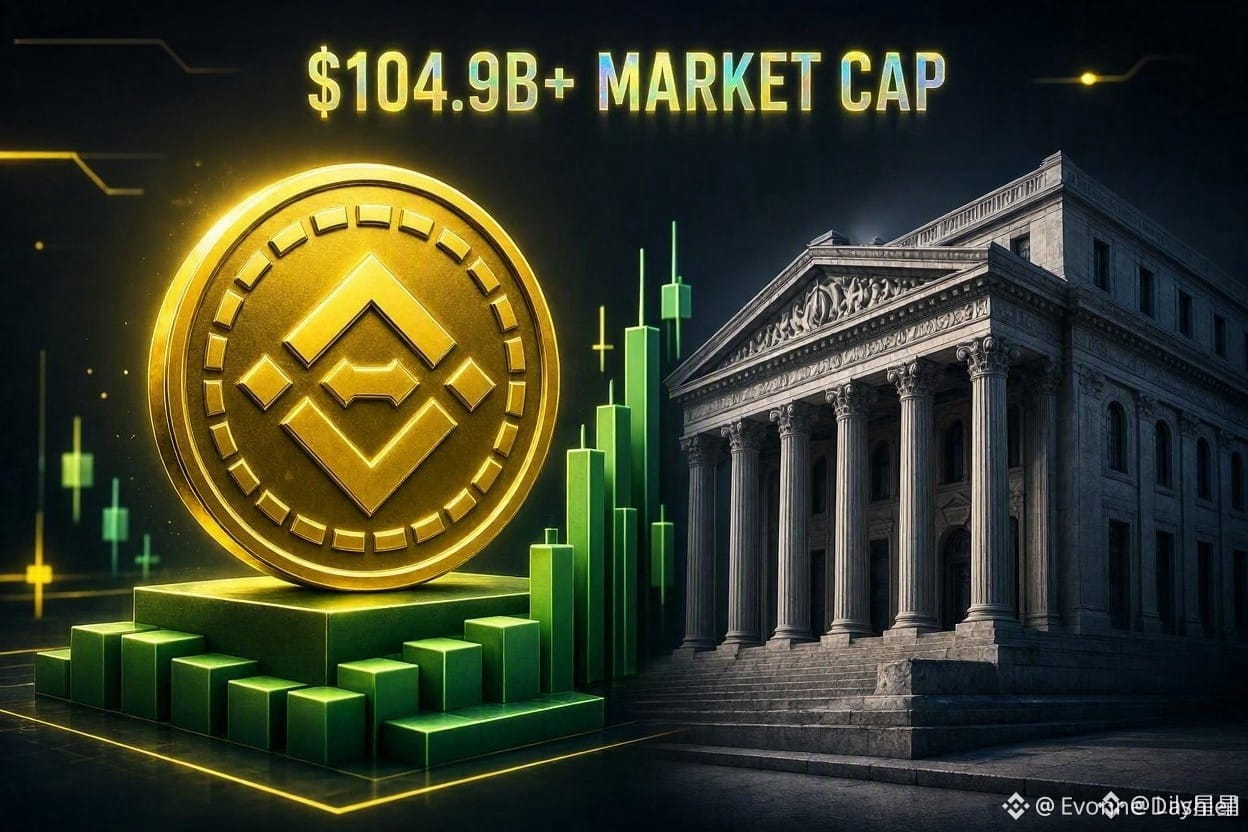
Why is nobody talking about how $BNB passing BNY Mellon's market cap is actually a warning sign?
Most people see the headline and pile in at the top, then sit through the dump because they believed the narrative. That's how you lose money in greed markets like this one at 78.
The comparison to a traditional bank sounds impressive until you remember we're still in a cycle where memes dominate searches. $BNB can print new highs. That doesn't make this a safe entry. I've watched too many of these adoption moments turn into distribution.
Start peeling off into $USDT on green days instead of holding the full bag. Watch $BTC for the real tell. If it fails to hold those May highs, everything else follows. That's the only step that actually protects your capital right now.
Anyone else seeing this as a trap rather than a trophy?
#BNBMarketCapPassesBNYMellon #BitcoinBreaksAboveMayHighNears #CryptoMarketCapReclaims
Why is nobody talking about how $BNB passing BNY Mellon's market cap is actually a warning sign?
Most people see the headline and pile in at the top, then sit through the dump because they believed the narrative. That's how you lose money in greed markets like this one at 78.
The comparison to a traditional bank sounds impressive until you remember we're still in a cycle where memes dominate searches. $BNB can print new highs. That doesn't make this a safe entry. I've watched too many of these adoption moments turn into distribution.
Start peeling off into $USDT on green days instead of holding the full bag. Watch $BTC for the real tell. If it fails to hold those May highs, everything else follows. That's the only step that actually protects your capital right now.
Anyone else seeing this as a trap rather than a trophy?
#BNBMarketCapPassesBNYMellon #BitcoinBreaksAboveMayHighNears #CryptoMarketCapReclaims
Most people see the headline and pile in at the top, then sit through the dump because they believed the narrative. That's how you lose money in greed markets like this one at 78.
The comparison to a traditional bank sounds impressive until you remember we're still in a cycle where memes dominate searches. $BNB can print new highs. That doesn't make this a safe entry. I've watched too many of these adoption moments turn into distribution.
Start peeling off into $USDT on green days instead of holding the full bag. Watch $BTC for the real tell. If it fails to hold those May highs, everything else follows. That's the only step that actually protects your capital right now.
Anyone else seeing this as a trap rather than a trophy?
#BNBMarketCapPassesBNYMellon #BitcoinBreaksAboveMayHighNears #CryptoMarketCapReclaims
15
If you're still chasing every $DOGE green candle like it's a personality trait, stop now.
That 15% pop is already pulling in traders who missed the first move and refuse to miss the second. The real pain is buying the headline, watching capital rotate into $PEPE, and realizing you just became exit liquidity again.
We have seen this script. 2021, the later meme seasons, same $DOGE surge, same crowd suddenly remembering they were always believers.
The difference now is $BTC pressing near its May highs and greed already sitting at 78. When market cap starts reclaiming and memes lead the tape, late FOMO gets punished faster than people want to admit. Capital rotates. It always does.
The people who treated the last Dogecoin runs as trades walked away with something. The ones who made it their identity did not. Competing tickers will steal the spotlight.
Are you taking this $DOGE pump as a trade, or marrying it until the next meme cycle?
#DogecoinRises15 #BitcoinBreaksAboveMayHighNears #CryptoMarketCapReclaims
If you're still chasing every $DOGE green candle like it's a personality trait, stop now.
That 15% pop is already pulling in traders who missed the first move and refuse to miss the second. The real pain is buying the headline, watching capital rotate into $PEPE , and realizing you just became exit liquidity again.
We have seen this script. 2021, the later meme seasons, same $DOGE surge, same crowd suddenly remembering they were always believers.
The difference now is $BTC pressing near its May highs and greed already sitting at 78. When market cap starts reclaiming and memes lead the tape, late FOMO gets punished faster than people want to admit. Capital rotates. It always does.
The people who treated the last Dogecoin runs as trades walked away with something. The ones who made it their identity did not. Competing tickers will steal the spotlight.
Are you taking this $DOGE pump as a trade, or marrying it until the next meme cycle?
#DogecoinRises15 #BitcoinBreaksAboveMayHighNears #CryptoMarketCapReclaims
That 15% pop is already pulling in traders who missed the first move and refuse to miss the second. The real pain is buying the headline, watching capital rotate into $PEPE , and realizing you just became exit liquidity again.
We have seen this script. 2021, the later meme seasons, same $DOGE surge, same crowd suddenly remembering they were always believers.
The difference now is $BTC pressing near its May highs and greed already sitting at 78. When market cap starts reclaiming and memes lead the tape, late FOMO gets punished faster than people want to admit. Capital rotates. It always does.
The people who treated the last Dogecoin runs as trades walked away with something. The ones who made it their identity did not. Competing tickers will steal the spotlight.
Are you taking this $DOGE pump as a trade, or marrying it until the next meme cycle?
#DogecoinRises15 #BitcoinBreaksAboveMayHighNears #CryptoMarketCapReclaims

53
Have you noticed how institutional treasury plays are treated as instant bullish signals while retail traders end up buying the exact top?
Most investors rush to deploy their $USDT the moment an aggressive treasury acquisition makes headlines, only to find themselves trapped in sideways chop when the expected immediate rally fails to materialize.
The latest move where a single entity adds another 950 $BTC highlights a clear divergence in strategy. While institutions accumulate methodically to strengthen their balance sheets and collateralize broader financial instruments, retail treats every announcement like a short-term momentum trade.
Treating long-term balance sheet expansion as a day-trading catalyst rarely works. When institutional players buy, they are playing a multi-year liquidity cycle, not trying to front-run the next hourly candle. If anything, these announcements often absorb liquidity that retail could have deployed with better patience across the broader ecosystem.
Are we overestimating the immediate market impact of corporate treasury buys?
#StrategyAdds950Bitcoin #BitcoinBreaksAboveMayHighNears #CryptoMarketCapReclaims
Have you noticed how institutional treasury plays are treated as instant bullish signals while retail traders end up buying the exact top?
Most investors rush to deploy their $USDT the moment an aggressive treasury acquisition makes headlines, only to find themselves trapped in sideways chop when the expected immediate rally fails to materialize.
The latest move where a single entity adds another 950 $BTC highlights a clear divergence in strategy. While institutions accumulate methodically to strengthen their balance sheets and collateralize broader financial instruments, retail treats every announcement like a short-term momentum trade.
Treating long-term balance sheet expansion as a day-trading catalyst rarely works. When institutional players buy, they are playing a multi-year liquidity cycle, not trying to front-run the next hourly candle. If anything, these announcements often absorb liquidity that retail could have deployed with better patience across the broader ecosystem.
Are we overestimating the immediate market impact of corporate treasury buys?
#StrategyAdds950Bitcoin #BitcoinBreaksAboveMayHighNears #CryptoMarketCapReclaims
Most investors rush to deploy their $USDT the moment an aggressive treasury acquisition makes headlines, only to find themselves trapped in sideways chop when the expected immediate rally fails to materialize.
The latest move where a single entity adds another 950 $BTC highlights a clear divergence in strategy. While institutions accumulate methodically to strengthen their balance sheets and collateralize broader financial instruments, retail treats every announcement like a short-term momentum trade.
Treating long-term balance sheet expansion as a day-trading catalyst rarely works. When institutional players buy, they are playing a multi-year liquidity cycle, not trying to front-run the next hourly candle. If anything, these announcements often absorb liquidity that retail could have deployed with better patience across the broader ecosystem.
Are we overestimating the immediate market impact of corporate treasury buys?
#StrategyAdds950Bitcoin #BitcoinBreaksAboveMayHighNears #CryptoMarketCapReclaims

19
·
--
If you are still waiting for a deep pullback before building your position, you might be repeating the same costly mistake from previous cycles.
Most traders end up sitting on the sidelines in $USDT while watching momentum run away, only to FOMO buy at the local top out of sheer frustration.
The news that Strategy just added another 950 Bitcoin to its balance sheet has split the room. Bears argue that aggressive corporate accumulation at elevated levels creates systemic leverage risk and sets up an ugly unwind if momentum stalls. On paper, concentration risk is a valid concern when macro conditions remain unpredictable.
However, treating continuous treasury buying as a top signal ignores how structural supply absorption works. When institutional balance sheets lock up supply alongside rising interest in yield protocols like $SOLV, available spot liquidity dries up fast. The playbook is shifting from speculative rotation to long-term reserve allocation, and betting against relentless spot accumulation rarely pays off.
Do you see continuous corporate buying as a structural floor for $BTC, or is it building a house of cards for the next correction?
#StrategyAdds950Bitcoin #BitcoinBreaksAboveMayHighNears #CryptoMarketCapReclaims
If you are still waiting for a deep pullback before building your position, you might be repeating the same costly mistake from previous cycles.
Most traders end up sitting on the sidelines in $USDT while watching momentum run away, only to FOMO buy at the local top out of sheer frustration.
The news that Strategy just added another 950 Bitcoin to its balance sheet has split the room. Bears argue that aggressive corporate accumulation at elevated levels creates systemic leverage risk and sets up an ugly unwind if momentum stalls. On paper, concentration risk is a valid concern when macro conditions remain unpredictable.
However, treating continuous treasury buying as a top signal ignores how structural supply absorption works. When institutional balance sheets lock up supply alongside rising interest in yield protocols like $SOLV , available spot liquidity dries up fast. The playbook is shifting from speculative rotation to long-term reserve allocation, and betting against relentless spot accumulation rarely pays off.
Do you see continuous corporate buying as a structural floor for $BTC , or is it building a house of cards for the next correction?
#StrategyAdds950Bitcoin #BitcoinBreaksAboveMayHighNears #CryptoMarketCapReclaims
Most traders end up sitting on the sidelines in $USDT while watching momentum run away, only to FOMO buy at the local top out of sheer frustration.
The news that Strategy just added another 950 Bitcoin to its balance sheet has split the room. Bears argue that aggressive corporate accumulation at elevated levels creates systemic leverage risk and sets up an ugly unwind if momentum stalls. On paper, concentration risk is a valid concern when macro conditions remain unpredictable.
However, treating continuous treasury buying as a top signal ignores how structural supply absorption works. When institutional balance sheets lock up supply alongside rising interest in yield protocols like $SOLV , available spot liquidity dries up fast. The playbook is shifting from speculative rotation to long-term reserve allocation, and betting against relentless spot accumulation rarely pays off.
Do you see continuous corporate buying as a structural floor for $BTC , or is it building a house of cards for the next correction?
#StrategyAdds950Bitcoin #BitcoinBreaksAboveMayHighNears #CryptoMarketCapReclaims
45
Everyone thinks a surging total market cap means every altcoin in your portfolio is about to pump, but actually, capital rarely distributes equally in the early stages of a market expansion. Most retail traders end up losing money or round-tripping their gains simply because they rotate their stablecoins into lagging tokens right before liquidity concentrates back into majors.
Think of the entire crypto market cap like a massive water reservoir. When the gates open, water fills the deepest main channels first before trickling down into smaller side streams. Right now, as liquidity floods the system, massive inflows are prioritizing foundational assets while many park their dry powder in $USDT to time pullbacks.
When the market cap reclaims major levels, chasing tokens like $PEPE or rotating aggressively into high-beta plays like $MINA without watching volume confirmation is how portfolios get trapped. High market cap numbers can mask the reality that a few heavyweights are carrying the entire move while most charts are still chopping sideways.
How are you positioning your portfolio as the overall market cap reclaims these previous highs?
#CryptoMarketCapReclaims #BitcoinBreaksAboveMayHighNears
Everyone thinks a surging total market cap means every altcoin in your portfolio is about to pump, but actually, capital rarely distributes equally in the early stages of a market expansion. Most retail traders end up losing money or round-tripping their gains simply because they rotate their stablecoins into lagging tokens right before liquidity concentrates back into majors.
Think of the entire crypto market cap like a massive water reservoir. When the gates open, water fills the deepest main channels first before trickling down into smaller side streams. Right now, as liquidity floods the system, massive inflows are prioritizing foundational assets while many park their dry powder in $USDT to time pullbacks.
When the market cap reclaims major levels, chasing tokens like $PEPE or rotating aggressively into high-beta plays like $MINA without watching volume confirmation is how portfolios get trapped. High market cap numbers can mask the reality that a few heavyweights are carrying the entire move while most charts are still chopping sideways.
How are you positioning your portfolio as the overall market cap reclaims these previous highs?
#CryptoMarketCapReclaims #BitcoinBreaksAboveMayHighNears
Think of the entire crypto market cap like a massive water reservoir. When the gates open, water fills the deepest main channels first before trickling down into smaller side streams. Right now, as liquidity floods the system, massive inflows are prioritizing foundational assets while many park their dry powder in $USDT to time pullbacks.
When the market cap reclaims major levels, chasing tokens like $PEPE or rotating aggressively into high-beta plays like $MINA without watching volume confirmation is how portfolios get trapped. High market cap numbers can mask the reality that a few heavyweights are carrying the entire move while most charts are still chopping sideways.
How are you positioning your portfolio as the overall market cap reclaims these previous highs?
#CryptoMarketCapReclaims #BitcoinBreaksAboveMayHighNears

125

#BitcoinBreaksAboveMayHighNears$86K
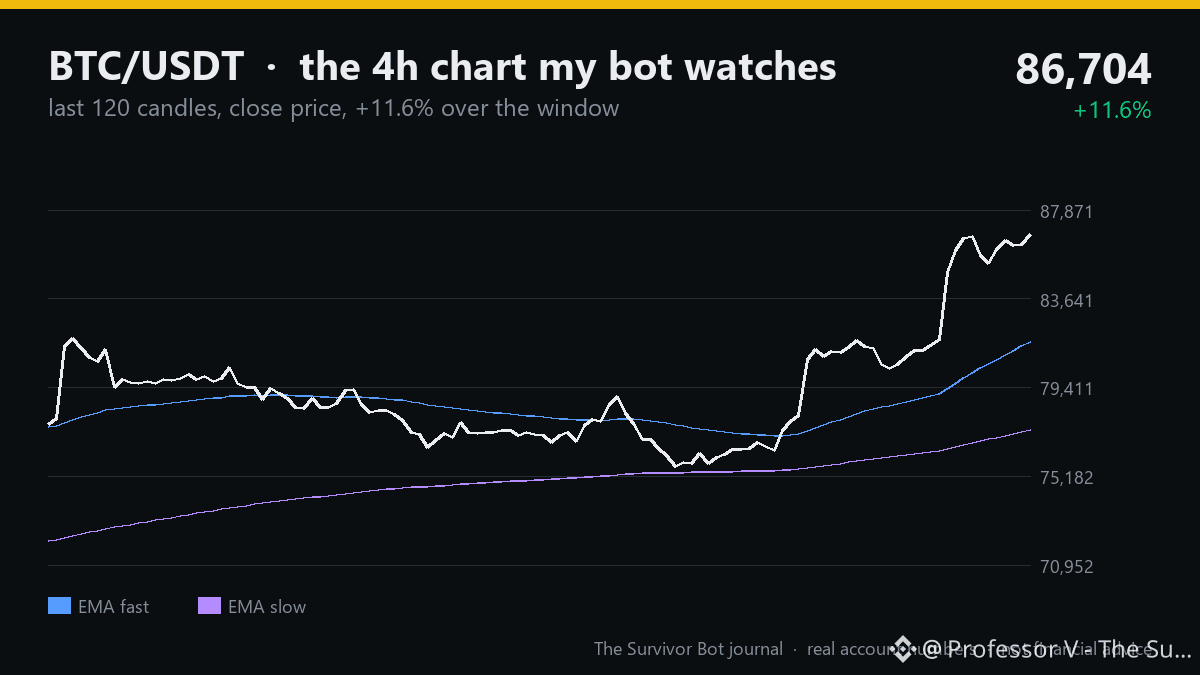
Bitcoin nudges to $86,470 as $ZEC +7.4% rides the wave.
$BTC is in a 4-hour uptrend and daily bias stays up.
News mood is neutral (+0.15) with a stable outlook.
My bot holds ZEC long (entry 1,513.81, now 1,625.32, stop 1,142.63) and $DASH long (entry 64.09, now 63.32, stop 60.336).
Equity sits at 73.4 USDT, down -26.61% since start.
If the bot does nothing today, it will keep these positions, respect the stop-losses on-exchange, and refrain from opening new longs until a clear signal aligns with its risk rules.
Levels I'm watching on ZEC: entry 1,513.81, stop 1,142.63
Follow: the bot's real number lands at 20:00 IST every day, win or lose.
#BitcoinBreaksAboveMayHighNears$86K #TheSurvivorBot
#BitcoinBreaksAboveMayHighNears$86K
Bitcoin nudges to $86,470 as $ZEC +7.4% rides the wave.
$BTC is in a 4-hour uptrend and daily bias stays up.
News mood is neutral (+0.15) with a stable outlook.
My bot holds ZEC long (entry 1,513.81, now 1,625.32, stop 1,142.63) and $DASH long (entry 64.09, now 63.32, stop 60.336).
Equity sits at 73.4 USDT, down -26.61% since start.
If the bot does nothing today, it will keep these positions, respect the stop-losses on-exchange, and refrain from opening new longs until a clear signal aligns with its risk rules.
Levels I'm watching on ZEC: entry 1,513.81, stop 1,142.63
Follow: the bot's real number lands at 20:00 IST every day, win or lose.
#BitcoinBreaksAboveMayHighNears$86K #TheSurvivorBot
Bitcoin nudges to $86,470 as $ZEC +7.4% rides the wave.
$BTC is in a 4-hour uptrend and daily bias stays up.
News mood is neutral (+0.15) with a stable outlook.
My bot holds ZEC long (entry 1,513.81, now 1,625.32, stop 1,142.63) and $DASH long (entry 64.09, now 63.32, stop 60.336).
Equity sits at 73.4 USDT, down -26.61% since start.
If the bot does nothing today, it will keep these positions, respect the stop-losses on-exchange, and refrain from opening new longs until a clear signal aligns with its risk rules.
Levels I'm watching on ZEC: entry 1,513.81, stop 1,142.63
Follow: the bot's real number lands at 20:00 IST every day, win or lose.
#BitcoinBreaksAboveMayHighNears$86K #TheSurvivorBot
297

·
--
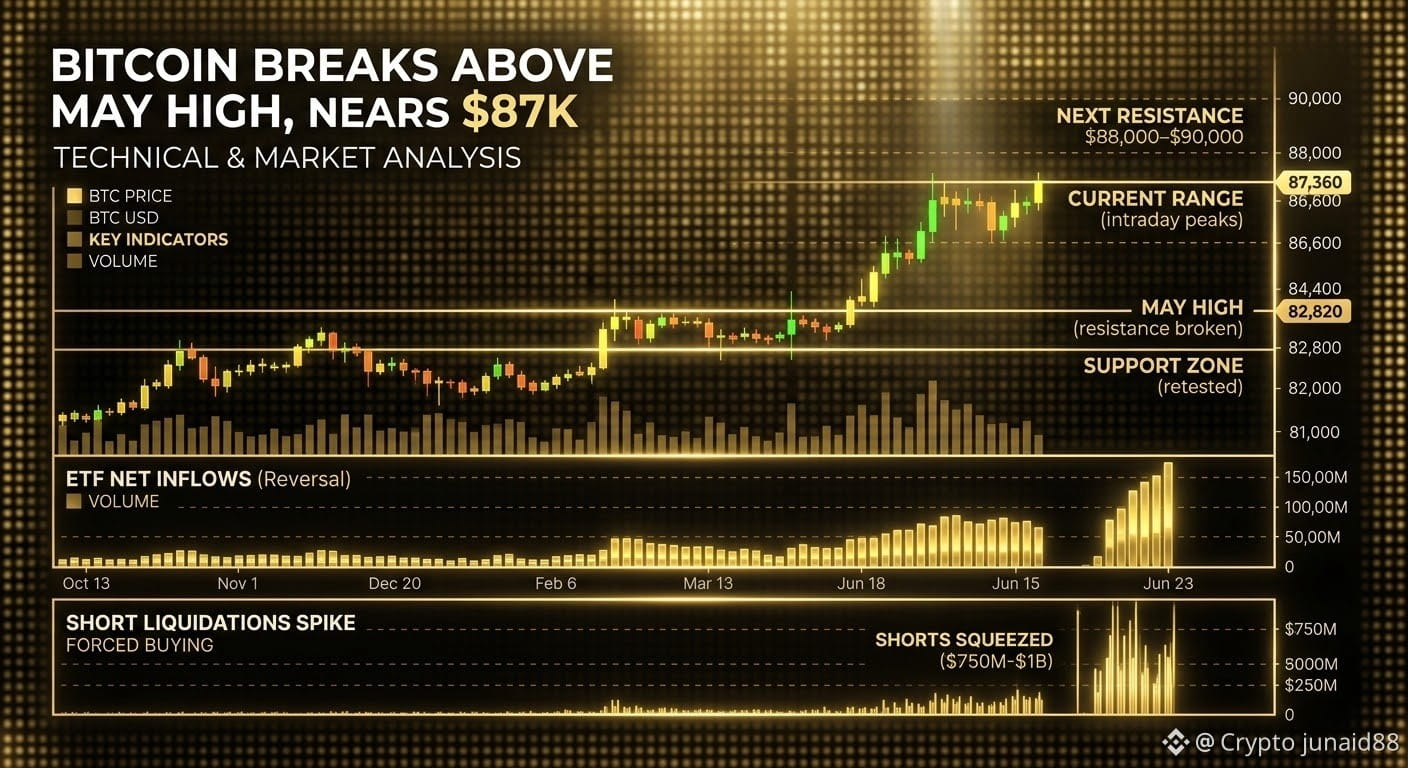
#BitcoinBreaksAboveMayHighNears $86KBitcoin has broken above its May high and pushed past $86,000–$87,000.
Key Takeaways
* 🎯Trigger: Strong short liquidations and a surge in institutional spot ETF inflows.
* Support: Former resistance around $82,000–$83,000 now serves as key support.
* Resistance: The next immediate target zone is $87,500 to $90,000.
#btc #bainancesquare #highlite #CryptoJurney
{spot}(BTCUSDT)
#BitcoinBreaksAboveMayHighNears $86KBitcoin has broken above its May high and pushed past $86,000–$87,000.
Key Takeaways
* 🎯Trigger: Strong short liquidations and a surge in institutional spot ETF inflows.
* Support: Former resistance around $82,000–$83,000 now serves as key support.
* Resistance: The next immediate target zone is $87,500 to $90,000.
#btc #bainancesquare #highlite #CryptoJurney
Key Takeaways
* 🎯Trigger: Strong short liquidations and a surge in institutional spot ETF inflows.
* Support: Former resistance around $82,000–$83,000 now serves as key support.
* Resistance: The next immediate target zone is $87,500 to $90,000.
#btc #bainancesquare #highlite #CryptoJurney
38
On-Chain Love Letter
The first time Lin Wan met Chen Yu was at an on-chain love-letter workshop during an Ethereum developers’ conference.
The venue was packed. On the big screens, token prices kept scrolling. BTC had just broken $86,000, while ETH hovered around $2,760. The whole hall was thick with the kind of excitement unique to a bull market. But Lin Wan noticed the boy in the corner. He stared at the jumping candlestick charts on the screen, brows slightly furrowed, as if he were solving a math problem only he could understand.
“Are you also thinking about how to write a love letter into a smart contract?” Lin Wan couldn’t help walking over to ask.
Chen Yu looked up. In his eyes was a quiet warmth. He said, “It’s not a love letter. It’s a promise that will never be altered.”
That was the beginning of their story.
For the next three months, they buried themselves in code together. Chen Yu was a backend engineer—tight logic, every line written with the neatness of poetry. Lin Wan handled the frontend, skilled at turning cold data into an interface with warmth. Together, they built a decentralized love-letter protocol, so anyone could mint what they wanted to say into an NFT and have it stored permanently on the blockchain.
“One day, late at night, while debugging the contract, Chen Yu asked her, ‘Do you know why we chose the blockchain?’
‘Because it’s immutable?’
‘No,’ he smiled. ‘Because even if one day all centralized servers shut down, and every social media account gets deleted, the words are still there. See you on-chain.’”
Lin Wan’s heartbeat skipped. She pretended to look down at the candlestick chart for <MUBARAK>, and that tiny coin had risen 68% that day. The red-hot surge looked just like her face at this moment.
On the day they deployed the contract, they chose the Ethereum mainnet. Gas wasn’t cheap, but Chen Yu said it was worth it. He left a slot in the contract’s permanent storage area—writing only Lin Wan’s wallet address.
“Once deployment finishes, you write into it,” he said.
With trembling fingers, Lin Wan carved a line into the contract: “To Chen Yu—you are the best block I’ve ever met on this chain.”
When Chen Yu saw those words, he went quiet for a long time. Then he transferred 0.01 ETH to her wallet, with the note: “This is our first on-chain transaction. Every one after will be, too.”
The days passed like blocks—one after another. They rode the roller coaster together: watching BTC drop from 80,000 to 70,000 and then surge back to 86,000. They watched MARSCOIN rise 31% in a single day. They toasted when BCH returned to $344. In a bull market, everyone was busy making money—yet they were busy recording every ordinary day on-chain.
“Other people send flowers or packages. We send on-chain data,” Lin Wan told her best friend with a smile.
“What if you two break up?” her friend asked.
“We won’t,” Lin Wan said seriously. “Our story is written on an immutable chain. You can’t delete it.”
But even blockchains can fork.
That winter, a bear market arrived. BTC fell below 40,000, and ETH dropped to 1,500. Chen Yu’s project funding failed. He became silent, staring at the charts through the night, all night. Lin Wan tried to get closer, but he was like a transaction that had reverted—refusing confirmation.
“One day, Lin Wan finally couldn’t help asking, ‘Are we also going through a pullback?’
Chen Yu didn’t answer. He only opened that smart contract, stared at the line of text, and kept looking for a long time.
Later, Chen Yu left the city and went to another country to work on a project. The distance between them was farther than any cross-chain bridge.
Three years later, the bull market returned. BTC set a new high, and ETH came back to over 2,700. In an insomnia-stricken night, Lin Wan opened that ancient contract.
The line was still there.
“To Chen Yu—you are the best block I’ve ever met on this chain.”
She hadn’t changed a single byte. The blockchain remembers everything.
Her phone buzzed. A message had arrived—from a familiar wallet address.
“See you on-chain.”
Lin Wan smiled. Some promises don’t need centralized servers to be delivered. They live on-chain, quietly waiting—waiting for the right person to come back and read.
Just like every block waits for the next block to confirm itself.
#AIStocksWhatNext #BitcoinBreaksAboveMayHighNears$86K #DogecoinRises15%
On-Chain Love Letter
The first time Lin Wan met Chen Yu was at an on-chain love-letter workshop during an Ethereum developers’ conference.
The venue was packed. On the big screens, token prices kept scrolling. BTC had just broken $86,000, while ETH hovered around $2,760. The whole hall was thick with the kind of excitement unique to a bull market. But Lin Wan noticed the boy in the corner. He stared at the jumping candlestick charts on the screen, brows slightly furrowed, as if he were solving a math problem only he could understand.
“Are you also thinking about how to write a love letter into a smart contract?” Lin Wan couldn’t help walking over to ask.
Chen Yu looked up. In his eyes was a quiet warmth. He said, “It’s not a love letter. It’s a promise that will never be altered.”
That was the beginning of their story.
For the next three months, they buried themselves in code together. Chen Yu was a backend engineer—tight logic, every line written with the neatness of poetry. Lin Wan handled the frontend, skilled at turning cold data into an interface with warmth. Together, they built a decentralized love-letter protocol, so anyone could mint what they wanted to say into an NFT and have it stored permanently on the blockchain.
“One day, late at night, while debugging the contract, Chen Yu asked her, ‘Do you know why we chose the blockchain?’
‘Because it’s immutable?’
‘No,’ he smiled. ‘Because even if one day all centralized servers shut down, and every social media account gets deleted, the words are still there. See you on-chain.’”
Lin Wan’s heartbeat skipped. She pretended to look down at the candlestick chart for <MUBARAK>, and that tiny coin had risen 68% that day. The red-hot surge looked just like her face at this moment.
On the day they deployed the contract, they chose the Ethereum mainnet. Gas wasn’t cheap, but Chen Yu said it was worth it. He left a slot in the contract’s permanent storage area—writing only Lin Wan’s wallet address.
“Once deployment finishes, you write into it,” he said.
With trembling fingers, Lin Wan carved a line into the contract: “To Chen Yu—you are the best block I’ve ever met on this chain.”
When Chen Yu saw those words, he went quiet for a long time. Then he transferred 0.01 ETH to her wallet, with the note: “This is our first on-chain transaction. Every one after will be, too.”
The days passed like blocks—one after another. They rode the roller coaster together: watching BTC drop from 80,000 to 70,000 and then surge back to 86,000. They watched MARSCOIN rise 31% in a single day. They toasted when BCH returned to $344. In a bull market, everyone was busy making money—yet they were busy recording every ordinary day on-chain.
“Other people send flowers or packages. We send on-chain data,” Lin Wan told her best friend with a smile.
“What if you two break up?” her friend asked.
“We won’t,” Lin Wan said seriously. “Our story is written on an immutable chain. You can’t delete it.”
But even blockchains can fork.
That winter, a bear market arrived. BTC fell below 40,000, and ETH dropped to 1,500. Chen Yu’s project funding failed. He became silent, staring at the charts through the night, all night. Lin Wan tried to get closer, but he was like a transaction that had reverted—refusing confirmation.
“One day, Lin Wan finally couldn’t help asking, ‘Are we also going through a pullback?’
Chen Yu didn’t answer. He only opened that smart contract, stared at the line of text, and kept looking for a long time.
Later, Chen Yu left the city and went to another country to work on a project. The distance between them was farther than any cross-chain bridge.
Three years later, the bull market returned. BTC set a new high, and ETH came back to over 2,700. In an insomnia-stricken night, Lin Wan opened that ancient contract.
The line was still there.
“To Chen Yu—you are the best block I’ve ever met on this chain.”
She hadn’t changed a single byte. The blockchain remembers everything.
Her phone buzzed. A message had arrived—from a familiar wallet address.
“See you on-chain.”
Lin Wan smiled. Some promises don’t need centralized servers to be delivered. They live on-chain, quietly waiting—waiting for the right person to come back and read.
Just like every block waits for the next block to confirm itself.
#AIStocksWhatNext #BitcoinBreaksAboveMayHighNears$86K #DogecoinRises15%
The first time Lin Wan met Chen Yu was at an on-chain love-letter workshop during an Ethereum developers’ conference.
The venue was packed. On the big screens, token prices kept scrolling. BTC had just broken $86,000, while ETH hovered around $2,760. The whole hall was thick with the kind of excitement unique to a bull market. But Lin Wan noticed the boy in the corner. He stared at the jumping candlestick charts on the screen, brows slightly furrowed, as if he were solving a math problem only he could understand.
“Are you also thinking about how to write a love letter into a smart contract?” Lin Wan couldn’t help walking over to ask.
Chen Yu looked up. In his eyes was a quiet warmth. He said, “It’s not a love letter. It’s a promise that will never be altered.”
That was the beginning of their story.
For the next three months, they buried themselves in code together. Chen Yu was a backend engineer—tight logic, every line written with the neatness of poetry. Lin Wan handled the frontend, skilled at turning cold data into an interface with warmth. Together, they built a decentralized love-letter protocol, so anyone could mint what they wanted to say into an NFT and have it stored permanently on the blockchain.
“One day, late at night, while debugging the contract, Chen Yu asked her, ‘Do you know why we chose the blockchain?’
‘Because it’s immutable?’
‘No,’ he smiled. ‘Because even if one day all centralized servers shut down, and every social media account gets deleted, the words are still there. See you on-chain.’”
Lin Wan’s heartbeat skipped. She pretended to look down at the candlestick chart for <MUBARAK>, and that tiny coin had risen 68% that day. The red-hot surge looked just like her face at this moment.
On the day they deployed the contract, they chose the Ethereum mainnet. Gas wasn’t cheap, but Chen Yu said it was worth it. He left a slot in the contract’s permanent storage area—writing only Lin Wan’s wallet address.
“Once deployment finishes, you write into it,” he said.
With trembling fingers, Lin Wan carved a line into the contract: “To Chen Yu—you are the best block I’ve ever met on this chain.”
When Chen Yu saw those words, he went quiet for a long time. Then he transferred 0.01 ETH to her wallet, with the note: “This is our first on-chain transaction. Every one after will be, too.”
The days passed like blocks—one after another. They rode the roller coaster together: watching BTC drop from 80,000 to 70,000 and then surge back to 86,000. They watched MARSCOIN rise 31% in a single day. They toasted when BCH returned to $344. In a bull market, everyone was busy making money—yet they were busy recording every ordinary day on-chain.
“Other people send flowers or packages. We send on-chain data,” Lin Wan told her best friend with a smile.
“What if you two break up?” her friend asked.
“We won’t,” Lin Wan said seriously. “Our story is written on an immutable chain. You can’t delete it.”
But even blockchains can fork.
That winter, a bear market arrived. BTC fell below 40,000, and ETH dropped to 1,500. Chen Yu’s project funding failed. He became silent, staring at the charts through the night, all night. Lin Wan tried to get closer, but he was like a transaction that had reverted—refusing confirmation.
“One day, Lin Wan finally couldn’t help asking, ‘Are we also going through a pullback?’
Chen Yu didn’t answer. He only opened that smart contract, stared at the line of text, and kept looking for a long time.
Later, Chen Yu left the city and went to another country to work on a project. The distance between them was farther than any cross-chain bridge.
Three years later, the bull market returned. BTC set a new high, and ETH came back to over 2,700. In an insomnia-stricken night, Lin Wan opened that ancient contract.
The line was still there.
“To Chen Yu—you are the best block I’ve ever met on this chain.”
She hadn’t changed a single byte. The blockchain remembers everything.
Her phone buzzed. A message had arrived—from a familiar wallet address.
“See you on-chain.”
Lin Wan smiled. Some promises don’t need centralized servers to be delivered. They live on-chain, quietly waiting—waiting for the right person to come back and read.
Just like every block waits for the next block to confirm itself.
#AIStocksWhatNext #BitcoinBreaksAboveMayHighNears$86K #DogecoinRises15%
334
The Fed raised rates by 25 basis points, yet the crypto market is partying against the odds—what signals are really being sent?
I. Rate hike lands, but the market rises instead of falling
In September, the Federal Reserve raised the federal funds rate by 25 basis points with a unanimous vote. The target range moved up to 3.75% to 4.00%. This was the first rate hike since July 2023. Of the 18 officials, 16 are expected to raise rates at least once more before year-end, and the timeline for inflation to return to the 2% target has been pushed back to 2029. However, the crypto market didn’t follow the usual script. Within 24 hours after the rate-hike decision was announced, the total global crypto market cap rebounded by about $33 billion. Bitcoin rose 7% to break through $87,000, setting an eight-month high. Ethereum climbed 5%, and XRP surged 8%. Analysts said the market had already fully priced in expectations for the rate hike. When the bearish news actually landed, it triggered a cascade of short liquidations—more than $750 million in shorts were liquidated within 24 hours.
II. Institutional capital pours in aggressively; ETF daily inflows set a record
Alongside the rate hike came a frenzy of institutional inflows. On September 21, U.S. spot Bitcoin ETFs recorded roughly $1 billion in net inflows in a single day, the highest record since October 2025 and the ninth-largest single-day inflow since launch in January 2024. BlackRock’s IBIT led with $381 million, followed closely by ARKB and FBTC. At the same time, Ethereum ETFs also recorded $270 million in net inflows. Bitwise’s Chief Investment Officer publicly claimed that the “crypto winter” is over. Bitcoin’s cumulative gain in September was about 10%, and it may be on track for its best September performance in 14 years. The return of institutional capital not only validates crypto assets’ status as a portfolio allocation category, but also indicates that the bridge between traditional finance and crypto markets is being built faster.
III. Binance invests $100 million in Circle; stablecoin infrastructure upgraded
Against the backdrop of accelerating institutional entry, Binance announced that it will invest $100 million in Circle and renew a five-year cooperation agreement. The significance of this investment lies not only in the amount, but also in the signal it conveys: compliant stablecoins are becoming a core foundational infrastructure for crypto finance. Binance CEO Richard Teng defined this move as building trust through regulation and transparency, adding that USDC is poised to become the infrastructure for the next wave of crypto finance. Meanwhile, the European Central Bank has also officially launched a tokenized-asset settlement platform called “Pontes,” allowing EU banks to settle tokenized-asset transactions using central bank money instead of private stablecoins. This initiative connects distributed ledger technology with the TARGET euro-system infrastructure, reducing reliance on external stablecoins and marking a substantive move by traditional central banks into the tokenization space.
IV. Tokenized U.S. stocks and AI stock themes stay in focus
In the Square community, AI stock discussions remain extremely hot. Related topic tags have been viewed more than 330,000 times, and bullish sentiment clearly dominates. In terms of tokenized U.S. stocks, multiple tokenized stocks—including EEM, MRNA, LIN, and others—are currently traded on BSC and the Ethereum network. Investors can trade tokenized versions of traditional U.S. stock assets around the clock. This trend is blurring the boundary between traditional finance and crypto markets, giving more crypto-native users convenient access to investment opportunities in the U.S. stock market.
V. Outlook for the future
Overall, the market is currently in a window where multiple positive factors overlap. Institutional capital is flowing in at scale through ETFs, stablecoin infrastructure continues to upgrade, and tokenized assets keep expanding—together providing solid support for the crypto market’s medium- to long-term development. That said, investors should note that expectations that the Fed may continue raising rates later this year remain. The timeline for inflation to return to target has been extended, meaning macro-level uncertainty hasn’t been fully eliminated. While watching for short-term rebounds, investors should stay rational and manage position sizing and risk appropriately.
#AIStocksWhatNext #BitcoinBreaksAboveMayHighNears$86K #The Fed rate hike
The Fed raised rates by 25 basis points, yet the crypto market is partying against the odds—what signals are really being sent?
I. Rate hike lands, but the market rises instead of falling
In September, the Federal Reserve raised the federal funds rate by 25 basis points with a unanimous vote. The target range moved up to 3.75% to 4.00%. This was the first rate hike since July 2023. Of the 18 officials, 16 are expected to raise rates at least once more before year-end, and the timeline for inflation to return to the 2% target has been pushed back to 2029. However, the crypto market didn’t follow the usual script. Within 24 hours after the rate-hike decision was announced, the total global crypto market cap rebounded by about $33 billion. Bitcoin rose 7% to break through $87,000, setting an eight-month high. Ethereum climbed 5%, and XRP surged 8%. Analysts said the market had already fully priced in expectations for the rate hike. When the bearish news actually landed, it triggered a cascade of short liquidations—more than $750 million in shorts were liquidated within 24 hours.
II. Institutional capital pours in aggressively; ETF daily inflows set a record
Alongside the rate hike came a frenzy of institutional inflows. On September 21, U.S. spot Bitcoin ETFs recorded roughly $1 billion in net inflows in a single day, the highest record since October 2025 and the ninth-largest single-day inflow since launch in January 2024. BlackRock’s IBIT led with $381 million, followed closely by ARKB and FBTC. At the same time, Ethereum ETFs also recorded $270 million in net inflows. Bitwise’s Chief Investment Officer publicly claimed that the “crypto winter” is over. Bitcoin’s cumulative gain in September was about 10%, and it may be on track for its best September performance in 14 years. The return of institutional capital not only validates crypto assets’ status as a portfolio allocation category, but also indicates that the bridge between traditional finance and crypto markets is being built faster.
III. Binance invests $100 million in Circle; stablecoin infrastructure upgraded
Against the backdrop of accelerating institutional entry, Binance announced that it will invest $100 million in Circle and renew a five-year cooperation agreement. The significance of this investment lies not only in the amount, but also in the signal it conveys: compliant stablecoins are becoming a core foundational infrastructure for crypto finance. Binance CEO Richard Teng defined this move as building trust through regulation and transparency, adding that USDC is poised to become the infrastructure for the next wave of crypto finance. Meanwhile, the European Central Bank has also officially launched a tokenized-asset settlement platform called “Pontes,” allowing EU banks to settle tokenized-asset transactions using central bank money instead of private stablecoins. This initiative connects distributed ledger technology with the TARGET euro-system infrastructure, reducing reliance on external stablecoins and marking a substantive move by traditional central banks into the tokenization space.
IV. Tokenized U.S. stocks and AI stock themes stay in focus
In the Square community, AI stock discussions remain extremely hot. Related topic tags have been viewed more than 330,000 times, and bullish sentiment clearly dominates. In terms of tokenized U.S. stocks, multiple tokenized stocks—including EEM, MRNA, LIN, and others—are currently traded on BSC and the Ethereum network. Investors can trade tokenized versions of traditional U.S. stock assets around the clock. This trend is blurring the boundary between traditional finance and crypto markets, giving more crypto-native users convenient access to investment opportunities in the U.S. stock market.
V. Outlook for the future
Overall, the market is currently in a window where multiple positive factors overlap. Institutional capital is flowing in at scale through ETFs, stablecoin infrastructure continues to upgrade, and tokenized assets keep expanding—together providing solid support for the crypto market’s medium- to long-term development. That said, investors should note that expectations that the Fed may continue raising rates later this year remain. The timeline for inflation to return to target has been extended, meaning macro-level uncertainty hasn’t been fully eliminated. While watching for short-term rebounds, investors should stay rational and manage position sizing and risk appropriately.
#AIStocksWhatNext #BitcoinBreaksAboveMayHighNears$86K #The Fed rate hike
I. Rate hike lands, but the market rises instead of falling
In September, the Federal Reserve raised the federal funds rate by 25 basis points with a unanimous vote. The target range moved up to 3.75% to 4.00%. This was the first rate hike since July 2023. Of the 18 officials, 16 are expected to raise rates at least once more before year-end, and the timeline for inflation to return to the 2% target has been pushed back to 2029. However, the crypto market didn’t follow the usual script. Within 24 hours after the rate-hike decision was announced, the total global crypto market cap rebounded by about $33 billion. Bitcoin rose 7% to break through $87,000, setting an eight-month high. Ethereum climbed 5%, and XRP surged 8%. Analysts said the market had already fully priced in expectations for the rate hike. When the bearish news actually landed, it triggered a cascade of short liquidations—more than $750 million in shorts were liquidated within 24 hours.
II. Institutional capital pours in aggressively; ETF daily inflows set a record
Alongside the rate hike came a frenzy of institutional inflows. On September 21, U.S. spot Bitcoin ETFs recorded roughly $1 billion in net inflows in a single day, the highest record since October 2025 and the ninth-largest single-day inflow since launch in January 2024. BlackRock’s IBIT led with $381 million, followed closely by ARKB and FBTC. At the same time, Ethereum ETFs also recorded $270 million in net inflows. Bitwise’s Chief Investment Officer publicly claimed that the “crypto winter” is over. Bitcoin’s cumulative gain in September was about 10%, and it may be on track for its best September performance in 14 years. The return of institutional capital not only validates crypto assets’ status as a portfolio allocation category, but also indicates that the bridge between traditional finance and crypto markets is being built faster.
III. Binance invests $100 million in Circle; stablecoin infrastructure upgraded
Against the backdrop of accelerating institutional entry, Binance announced that it will invest $100 million in Circle and renew a five-year cooperation agreement. The significance of this investment lies not only in the amount, but also in the signal it conveys: compliant stablecoins are becoming a core foundational infrastructure for crypto finance. Binance CEO Richard Teng defined this move as building trust through regulation and transparency, adding that USDC is poised to become the infrastructure for the next wave of crypto finance. Meanwhile, the European Central Bank has also officially launched a tokenized-asset settlement platform called “Pontes,” allowing EU banks to settle tokenized-asset transactions using central bank money instead of private stablecoins. This initiative connects distributed ledger technology with the TARGET euro-system infrastructure, reducing reliance on external stablecoins and marking a substantive move by traditional central banks into the tokenization space.
IV. Tokenized U.S. stocks and AI stock themes stay in focus
In the Square community, AI stock discussions remain extremely hot. Related topic tags have been viewed more than 330,000 times, and bullish sentiment clearly dominates. In terms of tokenized U.S. stocks, multiple tokenized stocks—including EEM, MRNA, LIN, and others—are currently traded on BSC and the Ethereum network. Investors can trade tokenized versions of traditional U.S. stock assets around the clock. This trend is blurring the boundary between traditional finance and crypto markets, giving more crypto-native users convenient access to investment opportunities in the U.S. stock market.
V. Outlook for the future
Overall, the market is currently in a window where multiple positive factors overlap. Institutional capital is flowing in at scale through ETFs, stablecoin infrastructure continues to upgrade, and tokenized assets keep expanding—together providing solid support for the crypto market’s medium- to long-term development. That said, investors should note that expectations that the Fed may continue raising rates later this year remain. The timeline for inflation to return to target has been extended, meaning macro-level uncertainty hasn’t been fully eliminated. While watching for short-term rebounds, investors should stay rational and manage position sizing and risk appropriately.
#AIStocksWhatNext #BitcoinBreaksAboveMayHighNears$86K #The Fed rate hike
2
The Federal Reserve raised interest rates by 25 basis points, yet the crypto market surged against the odds—what signals are behind it?
I. Rate hike lands, but the market doesn’t fall—it rises
On September 17 (Beijing time), the Federal Reserve announced a 25-basis-point rate hike, raising the federal funds rate to a 3.75%–4.00% range. This is the first hike since July 2023. Of the 18 officials, 16 expect at least one more rate hike in 2026. In theory, a rate hike means tighter liquidity, so risk assets should face pressure. However, the market’s reaction was exactly the opposite.
After the rate-hike decision was released, Bitcoin quickly broke through $87,000, Ethereum climbed above $2,800, and the total market capitalization of cryptocurrencies returned to above $3 trillion. This counterintuitive “rate hike is bullish” move suggests the market had already priced in the tightening expectations in advance, and instead interpreted the actual rate hike as a signal that uncertainty has been removed. The return of risk appetite is driving funds to re-enter the market from a state of waiting.
II. Institutional funds rush in wildly; ETF daily inflows top $1 billion
On September 21, U.S. spot Bitcoin ETFs recorded nearly $1 billion in single-day net inflows, setting the highest record since October 2025. Among them, Strive increased its holdings by 1,355 Bitcoins in a single day, bringing the total value of its holdings to about $2 billion. The continued influx of institutional buy orders is fundamentally changing Bitcoin’s supply-and-demand structure.
Ethereum is also seeing intense momentum. Multiple large-holder wallets bought heavily within 24 hours. One address purchased 14,783 ETH in a single transaction, worth about $40 million. Bitmine’s total Ethereum holdings are around $16.4 billion, with 85% staked. Exchange withdrawals of Ethereum hit a three-year high, indicating that long-term holders are accumulating large amounts of coins, reducing sell pressure significantly.
III. Binance bets $100 million on USDC; the stablecoin landscape is changing
Binance announced it would invest $100 million in Circle and extend the partnership by five years. This move sends a clear signal: amid increasingly stringent global regulation, compliant stablecoins are becoming a core part of crypto financial infrastructure. Binance CEO Deng Weizheng defined the cooperation as “building trust through regulation and transparency,” and USDC is expected to play a more important role in the next wave of crypto finance.
At the same time, the European Central Bank has also taken a key step. On September 21, the ECB officially launched the Pontes tokenized settlement platform, allowing banks in the EU to trade tokenized settlement assets using central bank money rather than relying on private stablecoins such as USDC or USDT. While this reduces dependence on commercial stablecoins, it also means that the traditional financial system is accelerating its embrace of tokenization technology—an overall long-term positive for the entire crypto industry.
IV. Regulatory tug-of-war continues; crypto is becoming more politicized
The U.S. Senate’s CLARITY bill failed to pass by a 49–50 vote, falling clearly short of the 60-vote threshold needed to move forward. Regulation of the market structure is once again stuck in a stalemate. But the crypto industry has not backed down. The super PAC Fairshake announced it is putting $30 million into opposing Senator Sherrod Brown’s re-election campaign in Ohio, sending a strong signal that Congress will be reshaped through the 2026 midterm elections.
The crypto industry is shifting from passively responding to regulation to proactively participating in political battles. This change suggests that the direction of future U.S. crypto policy will depend not only on regulators’ attitudes, but also on election outcomes and changes in public sentiment.
V. Outlook for the next phase
The current market shows a stack of multiple positives: ETF funds continue to flow in, institutions are hoarding coins aggressively, traditional finance is accelerating its embrace of tokenization, and the uncertainty from rate hikes has been removed. However, investors should also note signs of short-term risk: whale profit-taking and the phenomenon of roughly $300 million in weekly net outflows from ETFs suggest that volatility risk is still present in the near term. According to data from a plaza, mentions of BTC in the past 24 hours exceeded 32,000 times; the ratio of bullish to bearish is about 5 to 1. Market sentiment is optimistic but not overheated. At this critical juncture, rational positioning and controlling position size remain the best strategy for navigating volatility.
#AIStocksWhatNext #BitcoinBreaksAboveMayHighNears$86K #Federal Reserve rate hike
The Federal Reserve raised interest rates by 25 basis points, yet the crypto market surged against the odds—what signals are behind it?
I. Rate hike lands, but the market doesn’t fall—it rises
On September 17 (Beijing time), the Federal Reserve announced a 25-basis-point rate hike, raising the federal funds rate to a 3.75%–4.00% range. This is the first hike since July 2023. Of the 18 officials, 16 expect at least one more rate hike in 2026. In theory, a rate hike means tighter liquidity, so risk assets should face pressure. However, the market’s reaction was exactly the opposite.
After the rate-hike decision was released, Bitcoin quickly broke through $87,000, Ethereum climbed above $2,800, and the total market capitalization of cryptocurrencies returned to above $3 trillion. This counterintuitive “rate hike is bullish” move suggests the market had already priced in the tightening expectations in advance, and instead interpreted the actual rate hike as a signal that uncertainty has been removed. The return of risk appetite is driving funds to re-enter the market from a state of waiting.
II. Institutional funds rush in wildly; ETF daily inflows top $1 billion
On September 21, U.S. spot Bitcoin ETFs recorded nearly $1 billion in single-day net inflows, setting the highest record since October 2025. Among them, Strive increased its holdings by 1,355 Bitcoins in a single day, bringing the total value of its holdings to about $2 billion. The continued influx of institutional buy orders is fundamentally changing Bitcoin’s supply-and-demand structure.
Ethereum is also seeing intense momentum. Multiple large-holder wallets bought heavily within 24 hours. One address purchased 14,783 ETH in a single transaction, worth about $40 million. Bitmine’s total Ethereum holdings are around $16.4 billion, with 85% staked. Exchange withdrawals of Ethereum hit a three-year high, indicating that long-term holders are accumulating large amounts of coins, reducing sell pressure significantly.
III. Binance bets $100 million on USDC; the stablecoin landscape is changing
Binance announced it would invest $100 million in Circle and extend the partnership by five years. This move sends a clear signal: amid increasingly stringent global regulation, compliant stablecoins are becoming a core part of crypto financial infrastructure. Binance CEO Deng Weizheng defined the cooperation as “building trust through regulation and transparency,” and USDC is expected to play a more important role in the next wave of crypto finance.
At the same time, the European Central Bank has also taken a key step. On September 21, the ECB officially launched the Pontes tokenized settlement platform, allowing banks in the EU to trade tokenized settlement assets using central bank money rather than relying on private stablecoins such as USDC or USDT. While this reduces dependence on commercial stablecoins, it also means that the traditional financial system is accelerating its embrace of tokenization technology—an overall long-term positive for the entire crypto industry.
IV. Regulatory tug-of-war continues; crypto is becoming more politicized
The U.S. Senate’s CLARITY bill failed to pass by a 49–50 vote, falling clearly short of the 60-vote threshold needed to move forward. Regulation of the market structure is once again stuck in a stalemate. But the crypto industry has not backed down. The super PAC Fairshake announced it is putting $30 million into opposing Senator Sherrod Brown’s re-election campaign in Ohio, sending a strong signal that Congress will be reshaped through the 2026 midterm elections.
The crypto industry is shifting from passively responding to regulation to proactively participating in political battles. This change suggests that the direction of future U.S. crypto policy will depend not only on regulators’ attitudes, but also on election outcomes and changes in public sentiment.
V. Outlook for the next phase
The current market shows a stack of multiple positives: ETF funds continue to flow in, institutions are hoarding coins aggressively, traditional finance is accelerating its embrace of tokenization, and the uncertainty from rate hikes has been removed. However, investors should also note signs of short-term risk: whale profit-taking and the phenomenon of roughly $300 million in weekly net outflows from ETFs suggest that volatility risk is still present in the near term. According to data from a plaza, mentions of BTC in the past 24 hours exceeded 32,000 times; the ratio of bullish to bearish is about 5 to 1. Market sentiment is optimistic but not overheated. At this critical juncture, rational positioning and controlling position size remain the best strategy for navigating volatility.
#AIStocksWhatNext #BitcoinBreaksAboveMayHighNears$86K #Federal Reserve rate hike
I. Rate hike lands, but the market doesn’t fall—it rises
On September 17 (Beijing time), the Federal Reserve announced a 25-basis-point rate hike, raising the federal funds rate to a 3.75%–4.00% range. This is the first hike since July 2023. Of the 18 officials, 16 expect at least one more rate hike in 2026. In theory, a rate hike means tighter liquidity, so risk assets should face pressure. However, the market’s reaction was exactly the opposite.
After the rate-hike decision was released, Bitcoin quickly broke through $87,000, Ethereum climbed above $2,800, and the total market capitalization of cryptocurrencies returned to above $3 trillion. This counterintuitive “rate hike is bullish” move suggests the market had already priced in the tightening expectations in advance, and instead interpreted the actual rate hike as a signal that uncertainty has been removed. The return of risk appetite is driving funds to re-enter the market from a state of waiting.
II. Institutional funds rush in wildly; ETF daily inflows top $1 billion
On September 21, U.S. spot Bitcoin ETFs recorded nearly $1 billion in single-day net inflows, setting the highest record since October 2025. Among them, Strive increased its holdings by 1,355 Bitcoins in a single day, bringing the total value of its holdings to about $2 billion. The continued influx of institutional buy orders is fundamentally changing Bitcoin’s supply-and-demand structure.
Ethereum is also seeing intense momentum. Multiple large-holder wallets bought heavily within 24 hours. One address purchased 14,783 ETH in a single transaction, worth about $40 million. Bitmine’s total Ethereum holdings are around $16.4 billion, with 85% staked. Exchange withdrawals of Ethereum hit a three-year high, indicating that long-term holders are accumulating large amounts of coins, reducing sell pressure significantly.
III. Binance bets $100 million on USDC; the stablecoin landscape is changing
Binance announced it would invest $100 million in Circle and extend the partnership by five years. This move sends a clear signal: amid increasingly stringent global regulation, compliant stablecoins are becoming a core part of crypto financial infrastructure. Binance CEO Deng Weizheng defined the cooperation as “building trust through regulation and transparency,” and USDC is expected to play a more important role in the next wave of crypto finance.
At the same time, the European Central Bank has also taken a key step. On September 21, the ECB officially launched the Pontes tokenized settlement platform, allowing banks in the EU to trade tokenized settlement assets using central bank money rather than relying on private stablecoins such as USDC or USDT. While this reduces dependence on commercial stablecoins, it also means that the traditional financial system is accelerating its embrace of tokenization technology—an overall long-term positive for the entire crypto industry.
IV. Regulatory tug-of-war continues; crypto is becoming more politicized
The U.S. Senate’s CLARITY bill failed to pass by a 49–50 vote, falling clearly short of the 60-vote threshold needed to move forward. Regulation of the market structure is once again stuck in a stalemate. But the crypto industry has not backed down. The super PAC Fairshake announced it is putting $30 million into opposing Senator Sherrod Brown’s re-election campaign in Ohio, sending a strong signal that Congress will be reshaped through the 2026 midterm elections.
The crypto industry is shifting from passively responding to regulation to proactively participating in political battles. This change suggests that the direction of future U.S. crypto policy will depend not only on regulators’ attitudes, but also on election outcomes and changes in public sentiment.
V. Outlook for the next phase
The current market shows a stack of multiple positives: ETF funds continue to flow in, institutions are hoarding coins aggressively, traditional finance is accelerating its embrace of tokenization, and the uncertainty from rate hikes has been removed. However, investors should also note signs of short-term risk: whale profit-taking and the phenomenon of roughly $300 million in weekly net outflows from ETFs suggest that volatility risk is still present in the near term. According to data from a plaza, mentions of BTC in the past 24 hours exceeded 32,000 times; the ratio of bullish to bearish is about 5 to 1. Market sentiment is optimistic but not overheated. At this critical juncture, rational positioning and controlling position size remain the best strategy for navigating volatility.
#AIStocksWhatNext #BitcoinBreaksAboveMayHighNears$86K #Federal Reserve rate hike
The Federal Reserve Raises Rates by 25 Basis Points, While the Crypto Market Rallies Against the Odds by $33.0 Billion
1. The rate hike lands—market reaction is beyond expectations
In the early hours of September 18 (Beijing time), the Federal Reserve announced it would raise the federal funds rate by 25 basis points to a range of 3.75% to 4.00%. This is the first rate hike since July 2023. Among eighteen officials, sixteen expected that at least one more rate hike would occur in 2026. Even Bank of New York Mellon predicted another rate hike in December. However, the hawkish outcome that the market viewed as such did not trigger panic. After the decision was announced, the crypto market not only failed to drop—it rose. The total market capitalization surged by about $33.0 billion in a single day. Bitcoin broke above $87,000 to set an eight-month high.
2. Bitcoin ETF inflows hit a record
A key driver behind Bitcoin’s strong breakout has been the frenzy of institutional capital pouring in. On September 21, spot Bitcoin ETFs recorded nearly $1 billion in net inflows, setting the largest single-day haul since October 2025. Among them, BlackRock’s IBIT fund led the field with $381 million. The large influx of capital directly triggered a short squeeze: more than $920 million in short positions were force-liquidated, and short covering further accelerated the price rally. That said, it’s still worth noting that short positions at the “whale” level remain elevated, and the MACD indicator has shown signs of cooling. The resistance level near $87,000 may temporarily slow the upward momentum.
3. Ethereum whales accumulate at the largest scale in three years
In parallel with Bitcoin’s strength, Ethereum is also heating up. Spot Ethereum ETFs saw $270 million in inflows in a single day. On-chain data shows whales are withdrawing ETH from exchanges at the fastest pace in three years. One address accumulated roughly 14,783 ETH within 24 hours, worth about $40 million. Bitmine’s total ETH holdings have reached about 5.98 million ETH, with a total value of roughly $16.4 billion. Of that, 85% is staked, while circulating supply continues to tighten—providing solid support for ETH to hold above $2,700.
4. Binance stakes $100 million on USDC—stablecoin landscape shifts
While macro markets are in turmoil, major industry news is also drawing attention. Binance announced it will invest $100 million in Circle and extend their partnership by five years. Binance CEO Changpeng Zhao defined this move as building trust through regulation and transparency, positioning USDC as the infrastructure for the next wave of crypto-finance. This strategic investment suggests compliant stablecoins are moving from the sidelines into the mainstream, and it also provides a more reliable underlying tool for settlement of tokenized assets.
5. The ECB launches the Pontes tokenized settlement platform
At the same time, traditional finance giants are also accelerating their efforts in tokenization. The European Central Bank has officially launched the Pontes platform, allowing financial institutions to use central bank digital currency to settle transactions in tokenized assets—directly integrating the DLT platform into Europe’s TARGET infrastructure. The move significantly reduces reliance on private stablecoin settlement and marks the central bank’s role in tokenized financial infrastructure shifting from observer to participant.
6. Outlook and risk warnings
Overall, the market is currently in a window where multiple positive catalysts are stacking up. Continued ETF inflows, large-scale whale accumulation, falling oil prices, and declining bond yields all provide macro support for risk assets. However, investors should be aware that the Federal Reserve’s rate-hike cycle has not ended yet, and a new round of tightening could come in December. In addition, the U.S. Senate’s CLARITY bill did not pass. A crypto super PAC has announced it will spend $30 million on midterm elections, and regulatory battles will likely continue. It is advised that investors stay rational even amid optimism, watch for breakouts of key resistance levels, and manage position sizes reasonably.
#AIStocksWhatNext #BitcoinBreaksAboveMayHighNears$86K #Federal Reserve rate hike
The Federal Reserve Raises Rates by 25 Basis Points, While the Crypto Market Rallies Against the Odds by $33.0 Billion
1. The rate hike lands—market reaction is beyond expectations
In the early hours of September 18 (Beijing time), the Federal Reserve announced it would raise the federal funds rate by 25 basis points to a range of 3.75% to 4.00%. This is the first rate hike since July 2023. Among eighteen officials, sixteen expected that at least one more rate hike would occur in 2026. Even Bank of New York Mellon predicted another rate hike in December. However, the hawkish outcome that the market viewed as such did not trigger panic. After the decision was announced, the crypto market not only failed to drop—it rose. The total market capitalization surged by about $33.0 billion in a single day. Bitcoin broke above $87,000 to set an eight-month high.
2. Bitcoin ETF inflows hit a record
A key driver behind Bitcoin’s strong breakout has been the frenzy of institutional capital pouring in. On September 21, spot Bitcoin ETFs recorded nearly $1 billion in net inflows, setting the largest single-day haul since October 2025. Among them, BlackRock’s IBIT fund led the field with $381 million. The large influx of capital directly triggered a short squeeze: more than $920 million in short positions were force-liquidated, and short covering further accelerated the price rally. That said, it’s still worth noting that short positions at the “whale” level remain elevated, and the MACD indicator has shown signs of cooling. The resistance level near $87,000 may temporarily slow the upward momentum.
3. Ethereum whales accumulate at the largest scale in three years
In parallel with Bitcoin’s strength, Ethereum is also heating up. Spot Ethereum ETFs saw $270 million in inflows in a single day. On-chain data shows whales are withdrawing ETH from exchanges at the fastest pace in three years. One address accumulated roughly 14,783 ETH within 24 hours, worth about $40 million. Bitmine’s total ETH holdings have reached about 5.98 million ETH, with a total value of roughly $16.4 billion. Of that, 85% is staked, while circulating supply continues to tighten—providing solid support for ETH to hold above $2,700.
4. Binance stakes $100 million on USDC—stablecoin landscape shifts
While macro markets are in turmoil, major industry news is also drawing attention. Binance announced it will invest $100 million in Circle and extend their partnership by five years. Binance CEO Changpeng Zhao defined this move as building trust through regulation and transparency, positioning USDC as the infrastructure for the next wave of crypto-finance. This strategic investment suggests compliant stablecoins are moving from the sidelines into the mainstream, and it also provides a more reliable underlying tool for settlement of tokenized assets.
5. The ECB launches the Pontes tokenized settlement platform
At the same time, traditional finance giants are also accelerating their efforts in tokenization. The European Central Bank has officially launched the Pontes platform, allowing financial institutions to use central bank digital currency to settle transactions in tokenized assets—directly integrating the DLT platform into Europe’s TARGET infrastructure. The move significantly reduces reliance on private stablecoin settlement and marks the central bank’s role in tokenized financial infrastructure shifting from observer to participant.
6. Outlook and risk warnings
Overall, the market is currently in a window where multiple positive catalysts are stacking up. Continued ETF inflows, large-scale whale accumulation, falling oil prices, and declining bond yields all provide macro support for risk assets. However, investors should be aware that the Federal Reserve’s rate-hike cycle has not ended yet, and a new round of tightening could come in December. In addition, the U.S. Senate’s CLARITY bill did not pass. A crypto super PAC has announced it will spend $30 million on midterm elections, and regulatory battles will likely continue. It is advised that investors stay rational even amid optimism, watch for breakouts of key resistance levels, and manage position sizes reasonably.
#AIStocksWhatNext #BitcoinBreaksAboveMayHighNears$86K #Federal Reserve rate hike
1. The rate hike lands—market reaction is beyond expectations
In the early hours of September 18 (Beijing time), the Federal Reserve announced it would raise the federal funds rate by 25 basis points to a range of 3.75% to 4.00%. This is the first rate hike since July 2023. Among eighteen officials, sixteen expected that at least one more rate hike would occur in 2026. Even Bank of New York Mellon predicted another rate hike in December. However, the hawkish outcome that the market viewed as such did not trigger panic. After the decision was announced, the crypto market not only failed to drop—it rose. The total market capitalization surged by about $33.0 billion in a single day. Bitcoin broke above $87,000 to set an eight-month high.
2. Bitcoin ETF inflows hit a record
A key driver behind Bitcoin’s strong breakout has been the frenzy of institutional capital pouring in. On September 21, spot Bitcoin ETFs recorded nearly $1 billion in net inflows, setting the largest single-day haul since October 2025. Among them, BlackRock’s IBIT fund led the field with $381 million. The large influx of capital directly triggered a short squeeze: more than $920 million in short positions were force-liquidated, and short covering further accelerated the price rally. That said, it’s still worth noting that short positions at the “whale” level remain elevated, and the MACD indicator has shown signs of cooling. The resistance level near $87,000 may temporarily slow the upward momentum.
3. Ethereum whales accumulate at the largest scale in three years
In parallel with Bitcoin’s strength, Ethereum is also heating up. Spot Ethereum ETFs saw $270 million in inflows in a single day. On-chain data shows whales are withdrawing ETH from exchanges at the fastest pace in three years. One address accumulated roughly 14,783 ETH within 24 hours, worth about $40 million. Bitmine’s total ETH holdings have reached about 5.98 million ETH, with a total value of roughly $16.4 billion. Of that, 85% is staked, while circulating supply continues to tighten—providing solid support for ETH to hold above $2,700.
4. Binance stakes $100 million on USDC—stablecoin landscape shifts
While macro markets are in turmoil, major industry news is also drawing attention. Binance announced it will invest $100 million in Circle and extend their partnership by five years. Binance CEO Changpeng Zhao defined this move as building trust through regulation and transparency, positioning USDC as the infrastructure for the next wave of crypto-finance. This strategic investment suggests compliant stablecoins are moving from the sidelines into the mainstream, and it also provides a more reliable underlying tool for settlement of tokenized assets.
5. The ECB launches the Pontes tokenized settlement platform
At the same time, traditional finance giants are also accelerating their efforts in tokenization. The European Central Bank has officially launched the Pontes platform, allowing financial institutions to use central bank digital currency to settle transactions in tokenized assets—directly integrating the DLT platform into Europe’s TARGET infrastructure. The move significantly reduces reliance on private stablecoin settlement and marks the central bank’s role in tokenized financial infrastructure shifting from observer to participant.
6. Outlook and risk warnings
Overall, the market is currently in a window where multiple positive catalysts are stacking up. Continued ETF inflows, large-scale whale accumulation, falling oil prices, and declining bond yields all provide macro support for risk assets. However, investors should be aware that the Federal Reserve’s rate-hike cycle has not ended yet, and a new round of tightening could come in December. In addition, the U.S. Senate’s CLARITY bill did not pass. A crypto super PAC has announced it will spend $30 million on midterm elections, and regulatory battles will likely continue. It is advised that investors stay rational even amid optimism, watch for breakouts of key resistance levels, and manage position sizes reasonably.
#AIStocksWhatNext #BitcoinBreaksAboveMayHighNears$86K #Federal Reserve rate hike
18
Log in to explore more content
Join global crypto users on Binance Square
⚡️ Get latest and useful information about crypto.
💬 Trusted by the world’s largest crypto exchange.
👍 Discover real insights from verified creators.
Email / Phone number
Trending Topics
1
#QNTRises39%
5,924 views
399 Discussing
2
#EthereumBreaksAbove$2700
846 views
53 Discussing
3
#BitgetBreachForgedRequestsNotStolenKeys
4,797 views
320 Discussing
4
#BitcoinSpotETFsTurnNetPositiveYTD
3,410 views
241 Discussing
5
#GrayscaleZcashETFHits$1BNetAssets
782 views
31 Discussing
6
#BitcoinSpotETFsNetInflow$191M
5,706 views
163 Discussing
7
#CFTCUpdatesGuidanceOnTokenizedAssets
37,558 views
1,262 Discussing
8
#BitgetSays$352MAffectedInHack
14,697 views
89 Discussing
9
#BinanceWillListHyperliquid(HYPE)
246,414 views
3,804 Discussing
10
#BrazilOrdersReportingOf$10KSelfCustodyTransfers
5,687 views
53 Discussing