
#babylabubu
babylabubu
17,910 views
52 Discussing
Hot
Latest


·
--
Bullish
Verified
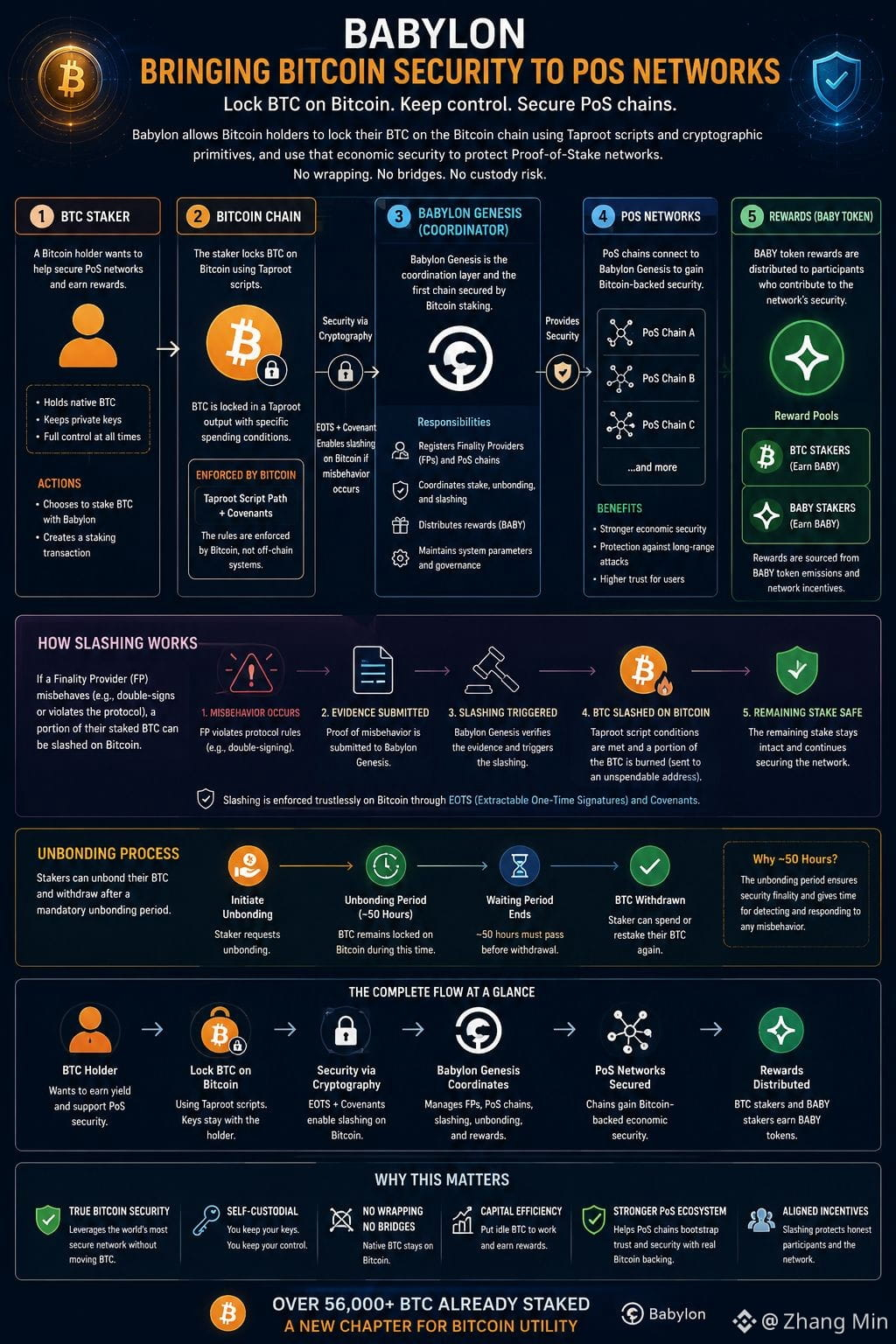
I’ve been sitting with @babylonlabs_io for a while now. The idea is simple enough on the surface: you lock your actual BTC on the Bitcoin chain using Taproot scripts, keep the keys, and let that locked capital help secure other proof-of-stake networks. No wrapping, no bridges, no one else holding your coins. Just a set of spending rules enforced by Bitcoin itself.
They get around Bitcoin’s limited scripting with some clever cryptography—extractable one-time signatures and a covenant setup—so that if a finality provider messes up, part of the stake can actually be burned on Bitcoin. Unbonding takes about fifty hours. Not instant, but short enough that it doesn’t feel like a prison sentence.
Babylon Genesis, the Cosmos chain that went live last year, sits in the middle of all this. It’s both the first network using the security and the place that coordinates everything. The BABY token pays out the rewards, split between people staking BTC and people staking BABY.
Over fifty-six thousand BTC is already locked in. That’s a real number. Still, I keep wondering whether enough outside chains will actually pay decent yields for this kind of security, and whether most long-term Bitcoin holders will ever feel comfortable putting their coins to work this way. The tech is solid. Whether the demand side shows up is a different story.
@babylonlabs_io #baby $BABY
$BLESS #BABYLABUBU
{future}(BLESSUSDT)
$TAKE
{future}(TAKEUSDT)
{future}(LABUSDT)
I’ve been sitting with @BabylonLabs_io for a while now. The idea is simple enough on the surface: you lock your actual BTC on the Bitcoin chain using Taproot scripts, keep the keys, and let that locked capital help secure other proof-of-stake networks. No wrapping, no bridges, no one else holding your coins. Just a set of spending rules enforced by Bitcoin itself.
They get around Bitcoin’s limited scripting with some clever cryptography—extractable one-time signatures and a covenant setup—so that if a finality provider messes up, part of the stake can actually be burned on Bitcoin. Unbonding takes about fifty hours. Not instant, but short enough that it doesn’t feel like a prison sentence.
Babylon Genesis, the Cosmos chain that went live last year, sits in the middle of all this. It’s both the first network using the security and the place that coordinates everything. The BABY token pays out the rewards, split between people staking BTC and people staking BABY.
Over fifty-six thousand BTC is already locked in. That’s a real number. Still, I keep wondering whether enough outside chains will actually pay decent yields for this kind of security, and whether most long-term Bitcoin holders will ever feel comfortable putting their coins to work this way. The tech is solid. Whether the demand side shows up is a different story.
@BabylonLabs_io #baby $BABY
$BLESS #BABYLABUBU
$TAKE
They get around Bitcoin’s limited scripting with some clever cryptography—extractable one-time signatures and a covenant setup—so that if a finality provider messes up, part of the stake can actually be burned on Bitcoin. Unbonding takes about fifty hours. Not instant, but short enough that it doesn’t feel like a prison sentence.
Babylon Genesis, the Cosmos chain that went live last year, sits in the middle of all this. It’s both the first network using the security and the place that coordinates everything. The BABY token pays out the rewards, split between people staking BTC and people staking BABY.
Over fifty-six thousand BTC is already locked in. That’s a real number. Still, I keep wondering whether enough outside chains will actually pay decent yields for this kind of security, and whether most long-term Bitcoin holders will ever feel comfortable putting their coins to work this way. The tech is solid. Whether the demand side shows up is a different story.
@BabylonLabs_io #baby $BABY
$BLESS #BABYLABUBU
$TAKE
149
60
3.8k

·
--
Bullish
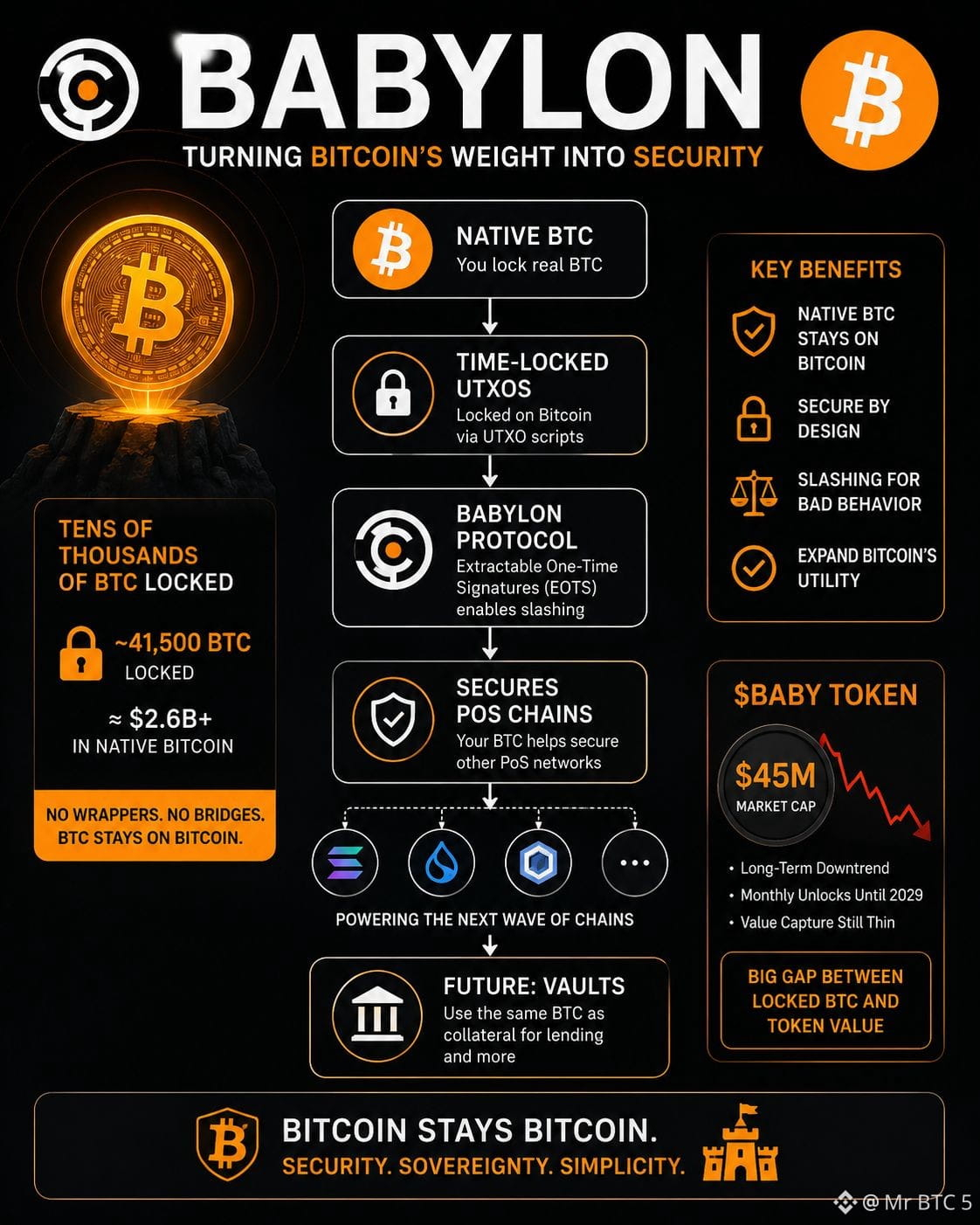
I keep ending up back at Babylon’s numbers even when I’m trying to look at something else. You’ve got billions in actual Bitcoin locked in place—still sitting on the Bitcoin chain, no wrapping, no bridges—and the BABY token that comes with it is only priced around forty-five million. That difference just sits there and feels wrong.
They tried to solve a simple problem in a careful way. Bitcoin has spent most of its life as pure weight. @babylonlabs_io lets people lock native BTC into time-locked UTXOs so that weight can help secure other chains. Bad behavior can get the stake slashed, but the coins never leave. Real capital has shown up too—tens of thousands of BTC are already sitting there. Hard to call that nothing.
The everyday side still feels limited though. Yields stay low. The setup takes more steps than most people want to bother with. Wrappers have grown around the edges and found uses in other places, yet the main thing remains a security service more than anything that throws off strong cash flow. Tokens keep unlocking every month from the early investors and the team, inflation adding a bit more pressure. The link between all that locked Bitcoin and the token itself still feels pretty thin.
They’re working on vaults that could let the same BTC act as collateral for lending. If that actually holds up, the picture might start to change. For now the market mostly seems to treat BABY as a bet on the story. I’ve watched gaps like this hang around longer than they should and sometimes close when no one is really paying attention. What’s still open isn’t the technology so much as the quieter question of who ends up with the upside when that idle Bitcoin finally begins to move.
@babylonlabs_io #baby $BABY
#BABYLABUBU $SNDKB
{spot}(SNDKBUSDT)
{spot}(BABYUSDT)
$TRADOOR
{future}(TRADOORUSDT)
I keep ending up back at Babylon’s numbers even when I’m trying to look at something else. You’ve got billions in actual Bitcoin locked in place—still sitting on the Bitcoin chain, no wrapping, no bridges—and the BABY token that comes with it is only priced around forty-five million. That difference just sits there and feels wrong.
They tried to solve a simple problem in a careful way. Bitcoin has spent most of its life as pure weight. @BabylonLabs_io lets people lock native BTC into time-locked UTXOs so that weight can help secure other chains. Bad behavior can get the stake slashed, but the coins never leave. Real capital has shown up too—tens of thousands of BTC are already sitting there. Hard to call that nothing.
The everyday side still feels limited though. Yields stay low. The setup takes more steps than most people want to bother with. Wrappers have grown around the edges and found uses in other places, yet the main thing remains a security service more than anything that throws off strong cash flow. Tokens keep unlocking every month from the early investors and the team, inflation adding a bit more pressure. The link between all that locked Bitcoin and the token itself still feels pretty thin.
They’re working on vaults that could let the same BTC act as collateral for lending. If that actually holds up, the picture might start to change. For now the market mostly seems to treat BABY as a bet on the story. I’ve watched gaps like this hang around longer than they should and sometimes close when no one is really paying attention. What’s still open isn’t the technology so much as the quieter question of who ends up with the upside when that idle Bitcoin finally begins to move.
@BabylonLabs_io #baby $BABY
#BABYLABUBU $SNDKB
$TRADOOR
They tried to solve a simple problem in a careful way. Bitcoin has spent most of its life as pure weight. @BabylonLabs_io lets people lock native BTC into time-locked UTXOs so that weight can help secure other chains. Bad behavior can get the stake slashed, but the coins never leave. Real capital has shown up too—tens of thousands of BTC are already sitting there. Hard to call that nothing.
The everyday side still feels limited though. Yields stay low. The setup takes more steps than most people want to bother with. Wrappers have grown around the edges and found uses in other places, yet the main thing remains a security service more than anything that throws off strong cash flow. Tokens keep unlocking every month from the early investors and the team, inflation adding a bit more pressure. The link between all that locked Bitcoin and the token itself still feels pretty thin.
They’re working on vaults that could let the same BTC act as collateral for lending. If that actually holds up, the picture might start to change. For now the market mostly seems to treat BABY as a bet on the story. I’ve watched gaps like this hang around longer than they should and sometimes close when no one is really paying attention. What’s still open isn’t the technology so much as the quieter question of who ends up with the upside when that idle Bitcoin finally begins to move.
@BabylonLabs_io #baby $BABY
#BABYLABUBU $SNDKB
$TRADOOR
128
41
1.2k

·
--
Bullish
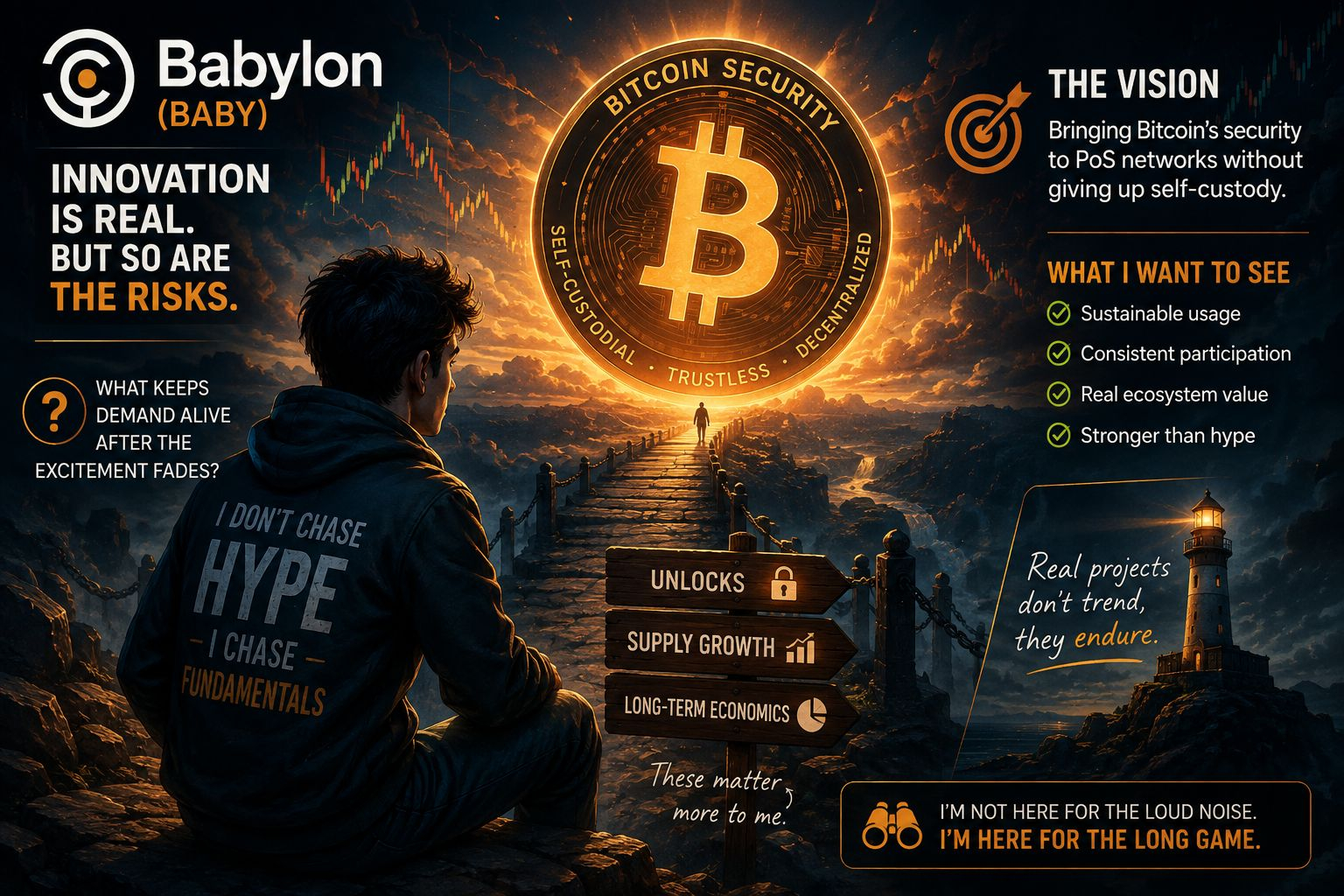
Babylon (BABY) keeps making me think about how easily the market falls in love with a powerful narrative. I genuinely like the idea behind the project. Giving Bitcoin a bigger role in securing PoS networks without giving up self-custody feels like a meaningful step forward. But I've been in this market long enough to know that a strong concept doesn't automatically create a strong token.
I keep coming back to one question: what keeps demand alive after the excitement fades? That's where my attention stays. Unlocks, growing supply, and long-term token economics matter far more to me than another wave of bullish posts. I've watched too many promising projects lose momentum because the economics couldn't support the story.
I see Babylon as a project with real innovation, but I don't want to confuse innovation with inevitability. I want to see sustainable usage, consistent participation, and an ecosystem that creates lasting value instead of depending on hype. To me, that's the difference between a project that survives and one that simply trends for a while.
I'm not chasing the loudest narrative. I'm watching whether Babylon can prove that its fundamentals are stronger than the emotions driving today's market.
@Babylon #baby $BITCOIN
#BABYLABUBU
$BABY
{future}(BABYUSDT)
Babylon (BABY) keeps making me think about how easily the market falls in love with a powerful narrative. I genuinely like the idea behind the project. Giving Bitcoin a bigger role in securing PoS networks without giving up self-custody feels like a meaningful step forward. But I've been in this market long enough to know that a strong concept doesn't automatically create a strong token.
I keep coming back to one question: what keeps demand alive after the excitement fades? That's where my attention stays. Unlocks, growing supply, and long-term token economics matter far more to me than another wave of bullish posts. I've watched too many promising projects lose momentum because the economics couldn't support the story.
I see Babylon as a project with real innovation, but I don't want to confuse innovation with inevitability. I want to see sustainable usage, consistent participation, and an ecosystem that creates lasting value instead of depending on hype. To me, that's the difference between a project that survives and one that simply trends for a while.
I'm not chasing the loudest narrative. I'm watching whether Babylon can prove that its fundamentals are stronger than the emotions driving today's market.
@Babylon #baby $BITCOIN
#BABYLABUBU
$BABY
I keep coming back to one question: what keeps demand alive after the excitement fades? That's where my attention stays. Unlocks, growing supply, and long-term token economics matter far more to me than another wave of bullish posts. I've watched too many promising projects lose momentum because the economics couldn't support the story.
I see Babylon as a project with real innovation, but I don't want to confuse innovation with inevitability. I want to see sustainable usage, consistent participation, and an ecosystem that creates lasting value instead of depending on hype. To me, that's the difference between a project that survives and one that simply trends for a while.
I'm not chasing the loudest narrative. I'm watching whether Babylon can prove that its fundamentals are stronger than the emotions driving today's market.
@Babylon #baby $BITCOIN
#BABYLABUBU
$BABY
5
333

·
--
Bearish
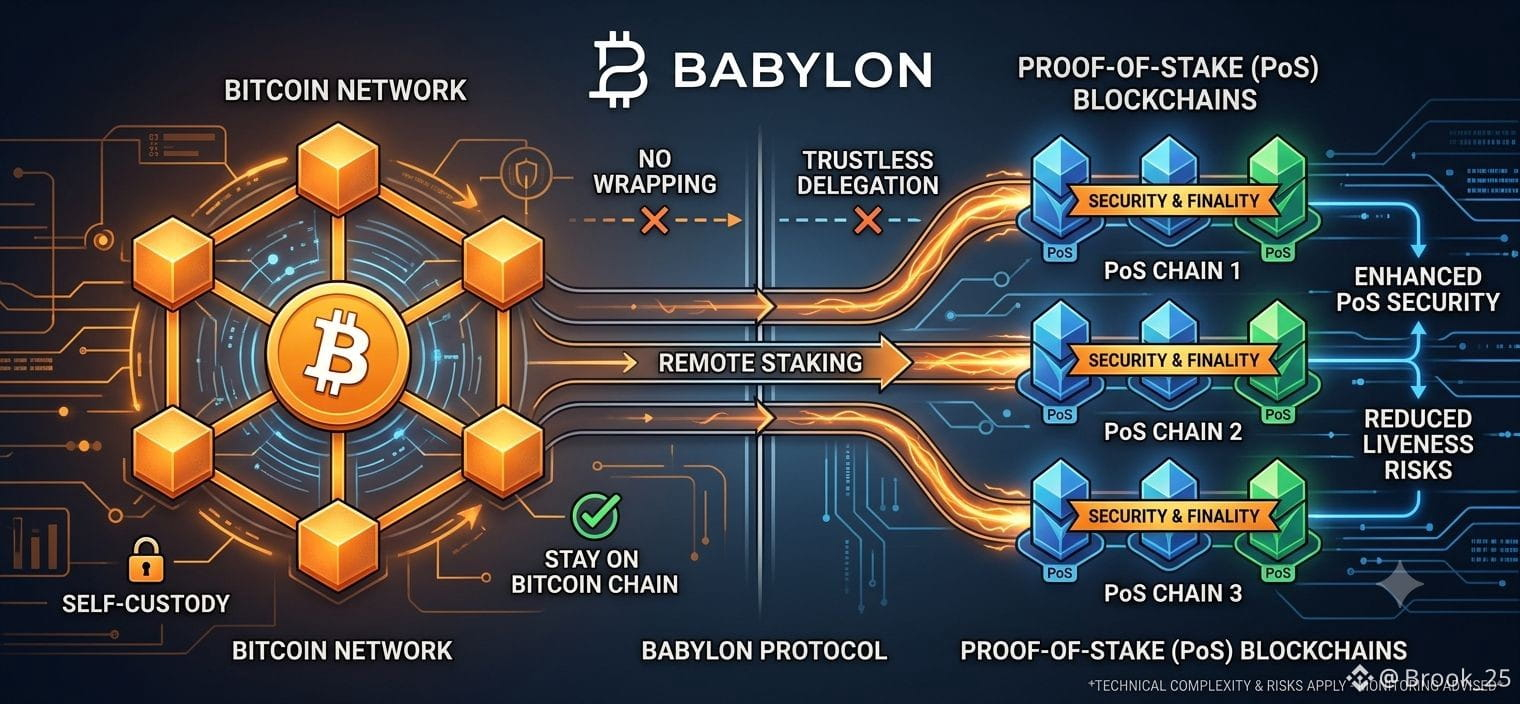
When I first looked into Babylon (BABY), what caught my attention wasn't the token—it was the idea behind the project. Bitcoin is often seen as the most secure blockchain, yet that security has mostly remained within its own network. Babylon asks whether Bitcoin can help secure Proof-of-Stake blockchains without leaving the Bitcoin chain or giving up self-custody.
From what I've learned, the project takes a different approach from wrapped BTC or custodial staking models. Instead of moving Bitcoin across chains, it allows BTC to stay on its native network while participating in staking through Babylon's protocol. I think that's an interesting design choice because it tries to reduce some of the trust assumptions that older solutions introduced.
That said, I don't see it as a perfect answer. The protocol is technically complex, users still need to understand delegation and staking risks, and self-custody doesn't eliminate every possible risk. Success will ultimately depend on how the system performs under real-world conditions over time.
For me, Babylon is worth following because it explores a problem that has existed for years rather than simply adding another feature to crypto. Whether this approach can strengthen Proof-of-Stake networks while preserving Bitcoin's core principles is something I'll be watching closely.
@Babylon #baby $BABY $BTC $BITCOIN
#BABYLABUBU .
{future}(BABYUSDT)
{spot}(COTIUSDT)
{future}(BANKUSDT)
When I first looked into Babylon (BABY), what caught my attention wasn't the token—it was the idea behind the project. Bitcoin is often seen as the most secure blockchain, yet that security has mostly remained within its own network. Babylon asks whether Bitcoin can help secure Proof-of-Stake blockchains without leaving the Bitcoin chain or giving up self-custody.
From what I've learned, the project takes a different approach from wrapped BTC or custodial staking models. Instead of moving Bitcoin across chains, it allows BTC to stay on its native network while participating in staking through Babylon's protocol. I think that's an interesting design choice because it tries to reduce some of the trust assumptions that older solutions introduced.
That said, I don't see it as a perfect answer. The protocol is technically complex, users still need to understand delegation and staking risks, and self-custody doesn't eliminate every possible risk. Success will ultimately depend on how the system performs under real-world conditions over time.
For me, Babylon is worth following because it explores a problem that has existed for years rather than simply adding another feature to crypto. Whether this approach can strengthen Proof-of-Stake networks while preserving Bitcoin's core principles is something I'll be watching closely.
@Babylon #baby $BABY $BTC $BITCOIN
#BABYLABUBU .
From what I've learned, the project takes a different approach from wrapped BTC or custodial staking models. Instead of moving Bitcoin across chains, it allows BTC to stay on its native network while participating in staking through Babylon's protocol. I think that's an interesting design choice because it tries to reduce some of the trust assumptions that older solutions introduced.
That said, I don't see it as a perfect answer. The protocol is technically complex, users still need to understand delegation and staking risks, and self-custody doesn't eliminate every possible risk. Success will ultimately depend on how the system performs under real-world conditions over time.
For me, Babylon is worth following because it explores a problem that has existed for years rather than simply adding another feature to crypto. Whether this approach can strengthen Proof-of-Stake networks while preserving Bitcoin's core principles is something I'll be watching closely.
@Babylon #baby $BABY $BTC $BITCOIN
#BABYLABUBU .
37
13
2k

·
--
Bullish
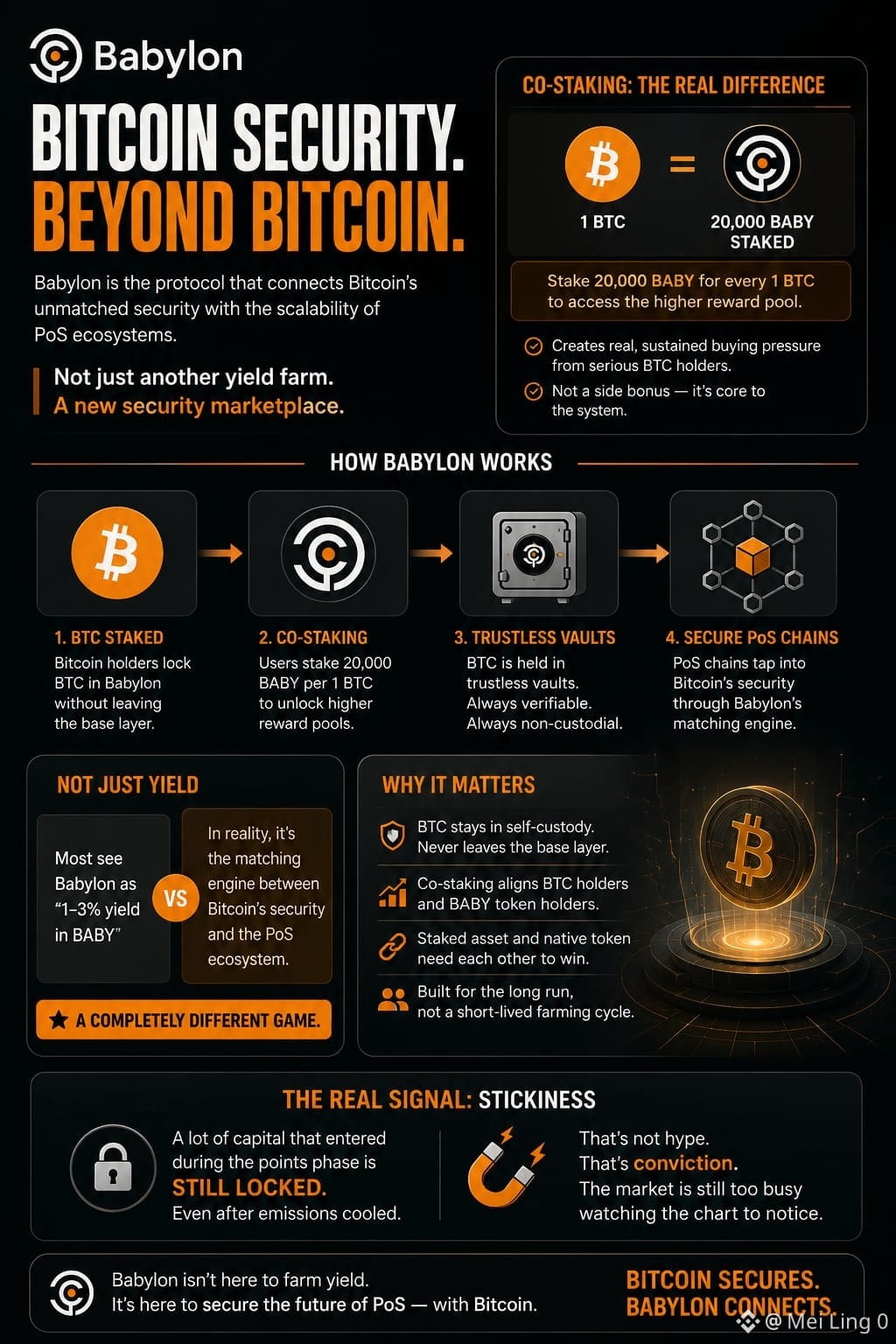
Most people still look at Babylon and just see another yield farm that happens to use BTC. But the co-staking thing they switched on last year keeps sticking with me. You need 20k BABY staked for every 1 BTC to unlock the better reward pool. That’s not some side bonus. It actually creates real buying pressure from the same people who already locked up tens of thousands of BTC.
Everyone keeps treating BABY like it’s just another inflation token with weak yields. Meanwhile the protocol is turning into the actual matching engine between Bitcoin’s security and whatever PoS chain wants a piece of it. When multi-staking and those trustless vaults start working properly, the same BTC can sit as collateral without ever leaving the base layer. That’s a completely different game from “earn 1-3% in BABY.”
I’ve seen enough restaking cycles come and go. The ones that last are the ones that force the staked asset and the native token to need each other. Babylon is doing that on purpose. A lot of the capital that piled in during the points phase is still sitting there even after emissions cooled off. That stickiness is the real signal, and the market is still too busy staring at the chart to notice.
@Babylon #baby $BITCOIN $BABY
#BABYLABUBU
$BABY
{future}(BABYUSDT)
Most people still look at Babylon and just see another yield farm that happens to use BTC. But the co-staking thing they switched on last year keeps sticking with me. You need 20k BABY staked for every 1 BTC to unlock the better reward pool. That’s not some side bonus. It actually creates real buying pressure from the same people who already locked up tens of thousands of BTC.
Everyone keeps treating BABY like it’s just another inflation token with weak yields. Meanwhile the protocol is turning into the actual matching engine between Bitcoin’s security and whatever PoS chain wants a piece of it. When multi-staking and those trustless vaults start working properly, the same BTC can sit as collateral without ever leaving the base layer. That’s a completely different game from “earn 1-3% in BABY.”
I’ve seen enough restaking cycles come and go. The ones that last are the ones that force the staked asset and the native token to need each other. Babylon is doing that on purpose. A lot of the capital that piled in during the points phase is still sitting there even after emissions cooled off. That stickiness is the real signal, and the market is still too busy staring at the chart to notice.
@Babylon #baby $BITCOIN $BABY
#BABYLABUBU
$BABY
Everyone keeps treating BABY like it’s just another inflation token with weak yields. Meanwhile the protocol is turning into the actual matching engine between Bitcoin’s security and whatever PoS chain wants a piece of it. When multi-staking and those trustless vaults start working properly, the same BTC can sit as collateral without ever leaving the base layer. That’s a completely different game from “earn 1-3% in BABY.”
I’ve seen enough restaking cycles come and go. The ones that last are the ones that force the staked asset and the native token to need each other. Babylon is doing that on purpose. A lot of the capital that piled in during the points phase is still sitting there even after emissions cooled off. That stickiness is the real signal, and the market is still too busy staring at the chart to notice.
@Babylon #baby $BITCOIN $BABY
#BABYLABUBU
$BABY
9
4
171
·
--
Bearish
I've been exploring Babylon (BABY), and what keeps me interested isn't the token or the hype—it's the problem the project is trying to solve.
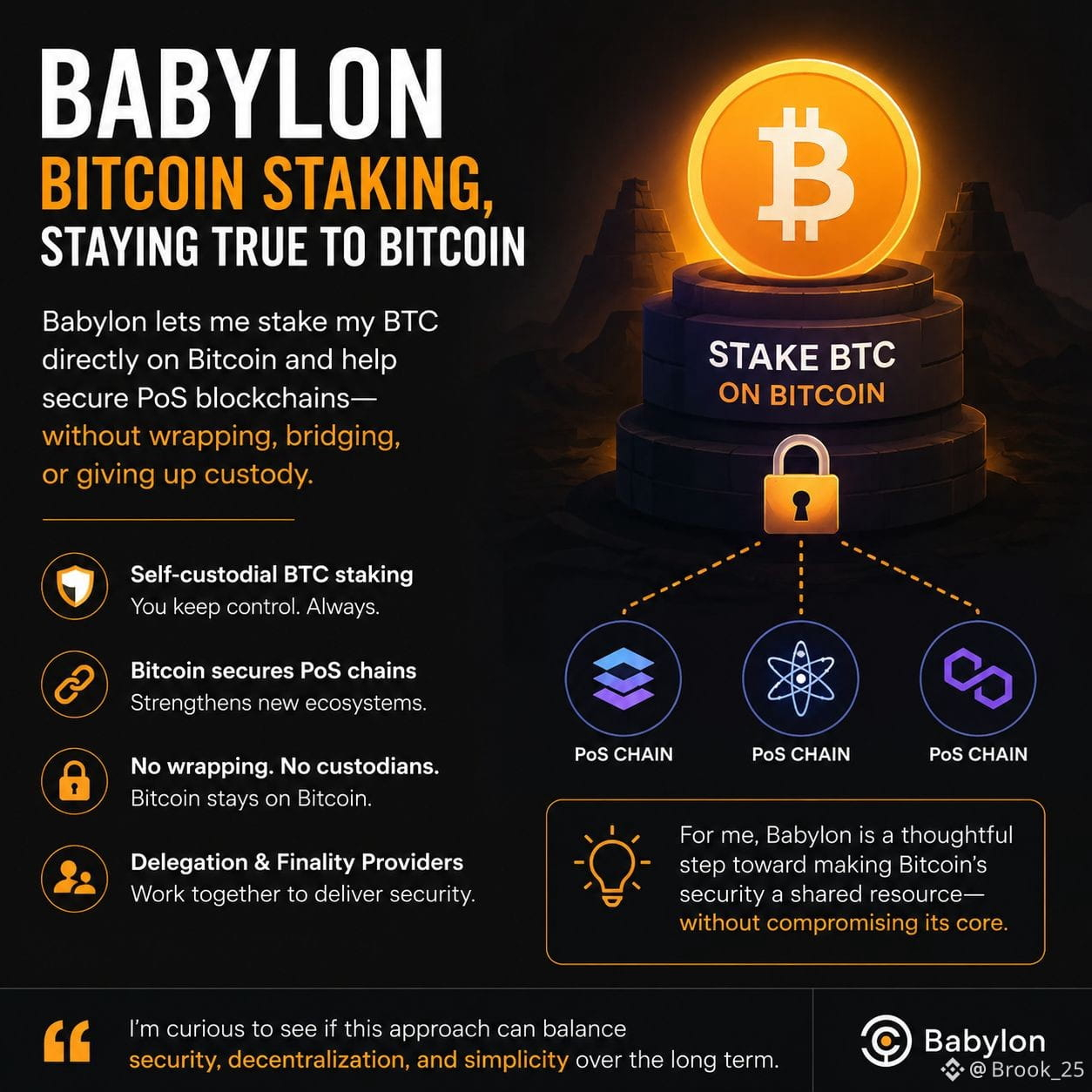
I've always seen Bitcoin as one of the most secure blockchain networks, but that security has largely stayed within Bitcoin itself. Babylon makes me think differently by asking whether Bitcoin's security can help protect Proof-of-Stake blockchains without requiring BTC holders to give up self-custody or move their coins through wrapped assets and traditional bridges.
What I appreciate is the design philosophy. From what I've learned, Bitcoin stays on its native network while its economic security can be used to strengthen participating PoS chains. To me, that's a more thoughtful approach than simply moving assets across different blockchains.
At the same time, I don't see Babylon as a complete solution. I think cross-chain security is naturally complex, and ideas like delegation, finality providers, and staking coordination add layers that many users may find difficult to understand. In my view, simplicity is one of Bitcoin's greatest strengths, so any additional complexity deserves careful attention.
I'm also curious about whether this model can achieve meaningful adoption over the long term. It depends on both Bitcoin holders and PoS networks finding enough value to participate consistently.
For now, I see Babylon as a thoughtful experiment rather than a finished answer. I'll be watching closely to see whether it can balance security, decentralization, and simplicity while staying true to Bitcoin's core principles.
@babylonlabs_io #baby $BITCOIN
#BABYLABUBU #baby $BTC
$BABY
{future}(BABYUSDT)
I've been exploring Babylon (BABY), and what keeps me interested isn't the token or the hype—it's the problem the project is trying to solve.
I've always seen Bitcoin as one of the most secure blockchain networks, but that security has largely stayed within Bitcoin itself. Babylon makes me think differently by asking whether Bitcoin's security can help protect Proof-of-Stake blockchains without requiring BTC holders to give up self-custody or move their coins through wrapped assets and traditional bridges.
What I appreciate is the design philosophy. From what I've learned, Bitcoin stays on its native network while its economic security can be used to strengthen participating PoS chains. To me, that's a more thoughtful approach than simply moving assets across different blockchains.
At the same time, I don't see Babylon as a complete solution. I think cross-chain security is naturally complex, and ideas like delegation, finality providers, and staking coordination add layers that many users may find difficult to understand. In my view, simplicity is one of Bitcoin's greatest strengths, so any additional complexity deserves careful attention.
I'm also curious about whether this model can achieve meaningful adoption over the long term. It depends on both Bitcoin holders and PoS networks finding enough value to participate consistently.
For now, I see Babylon as a thoughtful experiment rather than a finished answer. I'll be watching closely to see whether it can balance security, decentralization, and simplicity while staying true to Bitcoin's core principles.
@BabylonLabs_io #baby $BITCOIN
#BABYLABUBU #baby $BTC
$BABY
I've always seen Bitcoin as one of the most secure blockchain networks, but that security has largely stayed within Bitcoin itself. Babylon makes me think differently by asking whether Bitcoin's security can help protect Proof-of-Stake blockchains without requiring BTC holders to give up self-custody or move their coins through wrapped assets and traditional bridges.
What I appreciate is the design philosophy. From what I've learned, Bitcoin stays on its native network while its economic security can be used to strengthen participating PoS chains. To me, that's a more thoughtful approach than simply moving assets across different blockchains.
At the same time, I don't see Babylon as a complete solution. I think cross-chain security is naturally complex, and ideas like delegation, finality providers, and staking coordination add layers that many users may find difficult to understand. In my view, simplicity is one of Bitcoin's greatest strengths, so any additional complexity deserves careful attention.
I'm also curious about whether this model can achieve meaningful adoption over the long term. It depends on both Bitcoin holders and PoS networks finding enough value to participate consistently.
For now, I see Babylon as a thoughtful experiment rather than a finished answer. I'll be watching closely to see whether it can balance security, decentralization, and simplicity while staying true to Bitcoin's core principles.
@BabylonLabs_io #baby $BITCOIN
#BABYLABUBU #baby $BTC
$BABY
100
31
368
·
--
Bullish
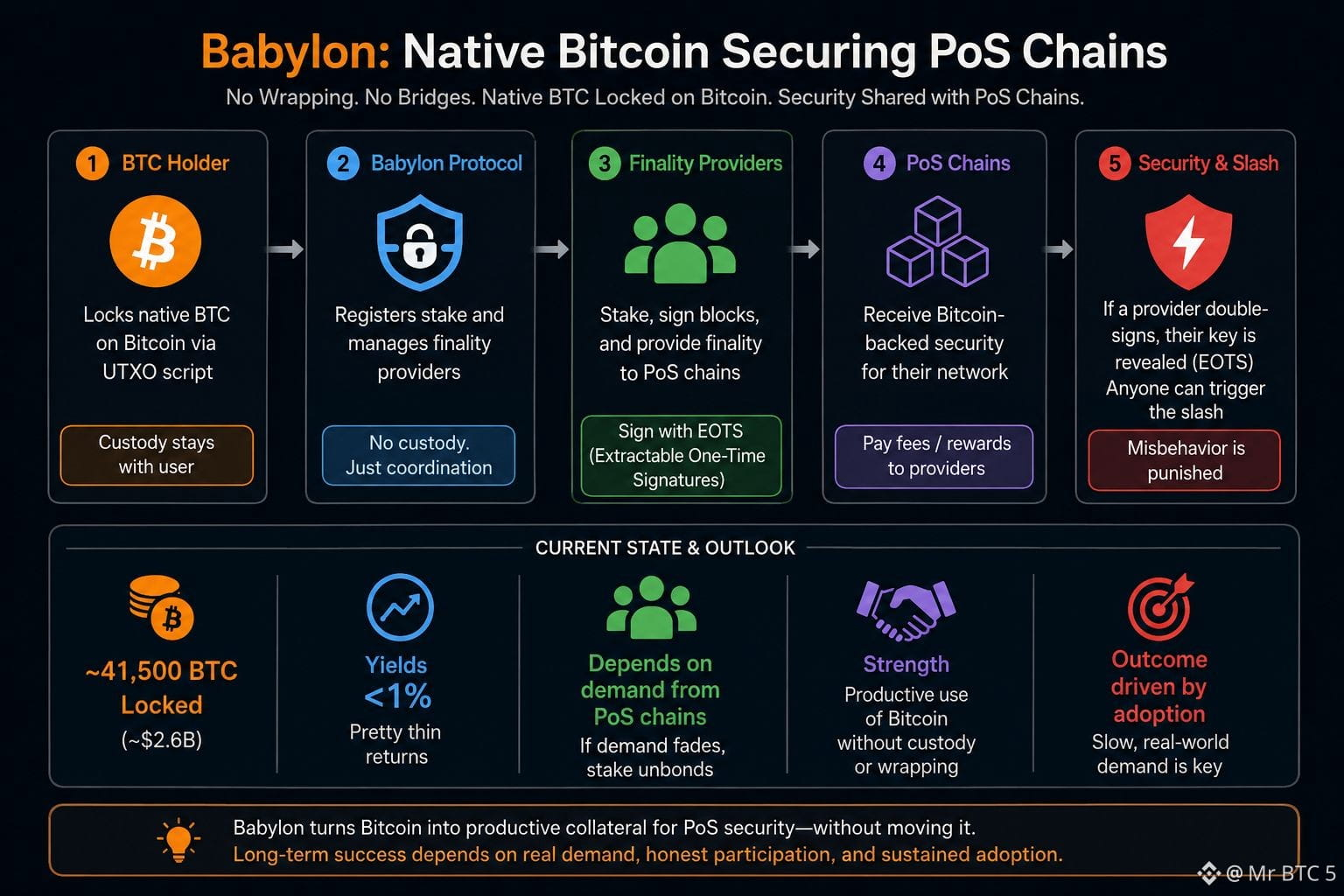
I’ve been digging into Babylon lately, and the part that keeps sticking with me is how stubbornly it refuses to move the coins. Almost every other Bitcoin yield idea ends up wrapping the stuff or bridging it somewhere else. @babylonlabs_io just locks native BTC right on Bitcoin itself with those UTXO scripts, then lets that capital help secure other proof-of-stake chains. You never hand over custody. Your private key stays exactly where it is.
The clever bit is these extractable one-time signatures. If a finality provider double-signs, their key basically spills out and anyone can trigger the slash. Looks clean on paper. Realistically though, it still hinges on the scripts being airtight, the providers staying honest, and enough other chains actually wanting to pay for the security so the yields don’t look pathetic.
Right now there’s about 41,500 BTC locked up, something like $2.6 billion. The returns? Pretty thin, often under one percent. Bitcoin people already hold the hardest money around. They’re not exactly starving for yield the way some new chain’s stakers are. That leaves the whole setup feeling a bit fragile. If the consumer chains don’t show up with real demand, people will just unbond and walk. Suddenly the hard part isn’t the crypto math anymore—it’s getting everyone to keep playing along.
I like that Babylon treats Bitcoin like productive collateral without trying to turn it into something it’s not. The idea’s sharp. Whether it grows into actual lasting infrastructure or just stays this interesting niche is going to come down to slow, unglamorous adoption, not some flashy technical win. Still watching.
@babylonlabs_io #baby $BABY
#BABYLABUBU $OPG $AKE
{spot}(OPGUSDT)
{spot}(BABYUSDT)
{future}(AKEUSDT)
I’ve been digging into Babylon lately, and the part that keeps sticking with me is how stubbornly it refuses to move the coins. Almost every other Bitcoin yield idea ends up wrapping the stuff or bridging it somewhere else. @BabylonLabs_io just locks native BTC right on Bitcoin itself with those UTXO scripts, then lets that capital help secure other proof-of-stake chains. You never hand over custody. Your private key stays exactly where it is.
The clever bit is these extractable one-time signatures. If a finality provider double-signs, their key basically spills out and anyone can trigger the slash. Looks clean on paper. Realistically though, it still hinges on the scripts being airtight, the providers staying honest, and enough other chains actually wanting to pay for the security so the yields don’t look pathetic.
Right now there’s about 41,500 BTC locked up, something like $2.6 billion. The returns? Pretty thin, often under one percent. Bitcoin people already hold the hardest money around. They’re not exactly starving for yield the way some new chain’s stakers are. That leaves the whole setup feeling a bit fragile. If the consumer chains don’t show up with real demand, people will just unbond and walk. Suddenly the hard part isn’t the crypto math anymore—it’s getting everyone to keep playing along.
I like that Babylon treats Bitcoin like productive collateral without trying to turn it into something it’s not. The idea’s sharp. Whether it grows into actual lasting infrastructure or just stays this interesting niche is going to come down to slow, unglamorous adoption, not some flashy technical win. Still watching.
@BabylonLabs_io #baby $BABY
#BABYLABUBU $OPG $AKE
The clever bit is these extractable one-time signatures. If a finality provider double-signs, their key basically spills out and anyone can trigger the slash. Looks clean on paper. Realistically though, it still hinges on the scripts being airtight, the providers staying honest, and enough other chains actually wanting to pay for the security so the yields don’t look pathetic.
Right now there’s about 41,500 BTC locked up, something like $2.6 billion. The returns? Pretty thin, often under one percent. Bitcoin people already hold the hardest money around. They’re not exactly starving for yield the way some new chain’s stakers are. That leaves the whole setup feeling a bit fragile. If the consumer chains don’t show up with real demand, people will just unbond and walk. Suddenly the hard part isn’t the crypto math anymore—it’s getting everyone to keep playing along.
I like that Babylon treats Bitcoin like productive collateral without trying to turn it into something it’s not. The idea’s sharp. Whether it grows into actual lasting infrastructure or just stays this interesting niche is going to come down to slow, unglamorous adoption, not some flashy technical win. Still watching.
@BabylonLabs_io #baby $BABY
#BABYLABUBU $OPG $AKE
185
62
3.3k
·
--
Bearish
Verified
I've always wondered why Bitcoin, despite being the most secure blockchain, has remained largely separate from securing Proof-of-Stake networks. It feels like such a massive source of security that has mostly stayed within its own ecosystem.
That's why Babylon caught my attention.
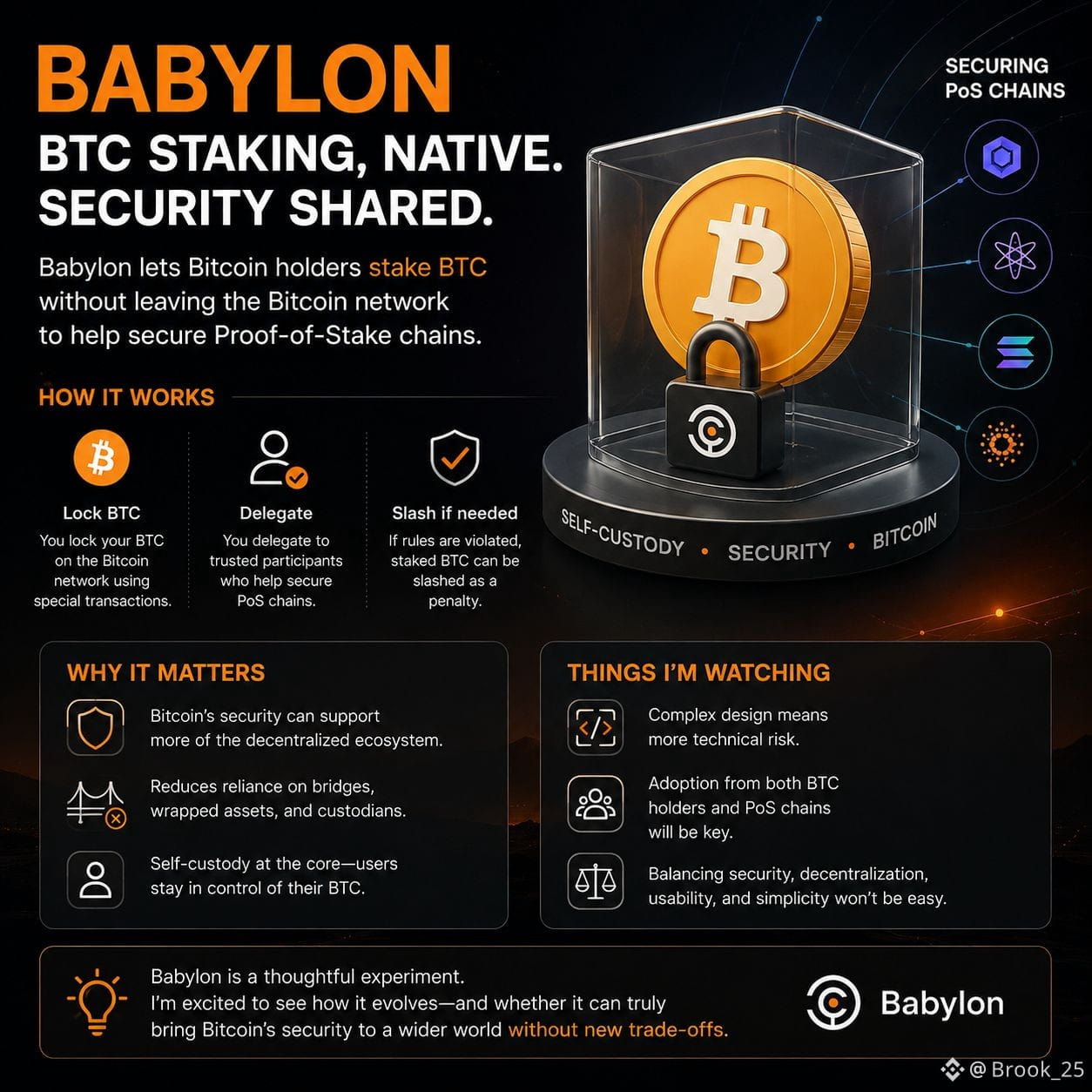
From what I've learned, Babylon allows BTC holders to stake their Bitcoin while keeping it on the Bitcoin network through a self-custodial approach. Instead of relying on wrapped BTC or traditional cross-chain bridges, it aims to let Bitcoin's economic security support PoS blockchains without changing Bitcoin's core design.
What I find most interesting is that Babylon isn't trying to reinvent Bitcoin. It's trying to build around Bitcoin's existing strengths. After seeing so many bridge-related security issues over the years, I think reducing dependence on custodians and asset wrapping is a meaningful design choice.
That said, I don't see Babylon as a perfect solution. In my view, cross-chain security will always involve trade-offs. Concepts like delegation, slashing, and coordination layers add complexity, and complexity itself can become a source of risk if it isn't carefully managed.
I also think this approach isn't for everyone. If I were completely new to crypto, I'd probably need time to understand how everything works before participating. More experienced Bitcoin holders may find the model easier to evaluate.
For now, I see Babylon as a thoughtful experiment rather than a final answer. I'll be watching closely to see whether it can truly balance security, decentralization, and simplicity as the ecosystem continues to evolve.
#babyLon #baby $BITCOIN
#BABYLABUBU $BABY
$BABY
{future}(BABYUSDT)
I've always wondered why Bitcoin, despite being the most secure blockchain, has remained largely separate from securing Proof-of-Stake networks. It feels like such a massive source of security that has mostly stayed within its own ecosystem.
That's why Babylon caught my attention.
From what I've learned, Babylon allows BTC holders to stake their Bitcoin while keeping it on the Bitcoin network through a self-custodial approach. Instead of relying on wrapped BTC or traditional cross-chain bridges, it aims to let Bitcoin's economic security support PoS blockchains without changing Bitcoin's core design.
What I find most interesting is that Babylon isn't trying to reinvent Bitcoin. It's trying to build around Bitcoin's existing strengths. After seeing so many bridge-related security issues over the years, I think reducing dependence on custodians and asset wrapping is a meaningful design choice.
That said, I don't see Babylon as a perfect solution. In my view, cross-chain security will always involve trade-offs. Concepts like delegation, slashing, and coordination layers add complexity, and complexity itself can become a source of risk if it isn't carefully managed.
I also think this approach isn't for everyone. If I were completely new to crypto, I'd probably need time to understand how everything works before participating. More experienced Bitcoin holders may find the model easier to evaluate.
For now, I see Babylon as a thoughtful experiment rather than a final answer. I'll be watching closely to see whether it can truly balance security, decentralization, and simplicity as the ecosystem continues to evolve.
#babyLon #baby $BITCOIN
#BABYLABUBU $BABY
$BABY
That's why Babylon caught my attention.
From what I've learned, Babylon allows BTC holders to stake their Bitcoin while keeping it on the Bitcoin network through a self-custodial approach. Instead of relying on wrapped BTC or traditional cross-chain bridges, it aims to let Bitcoin's economic security support PoS blockchains without changing Bitcoin's core design.
What I find most interesting is that Babylon isn't trying to reinvent Bitcoin. It's trying to build around Bitcoin's existing strengths. After seeing so many bridge-related security issues over the years, I think reducing dependence on custodians and asset wrapping is a meaningful design choice.
That said, I don't see Babylon as a perfect solution. In my view, cross-chain security will always involve trade-offs. Concepts like delegation, slashing, and coordination layers add complexity, and complexity itself can become a source of risk if it isn't carefully managed.
I also think this approach isn't for everyone. If I were completely new to crypto, I'd probably need time to understand how everything works before participating. More experienced Bitcoin holders may find the model easier to evaluate.
For now, I see Babylon as a thoughtful experiment rather than a final answer. I'll be watching closely to see whether it can truly balance security, decentralization, and simplicity as the ecosystem continues to evolve.
#babyLon #baby $BITCOIN
#BABYLABUBU $BABY
$BABY
40
11
3.1k
·
--
Bearish
I recently took a closer look at Babylon, and what interested me most wasn't the technology itself—it was the problem it's trying to solve. I've always felt that Bitcoin is one of the strongest sources of decentralized security, yet it has remained largely separate from the Proof-of-Stake ecosystem.
From what I've learned, Babylon takes a different approach. Instead of asking me to wrap my BTC or hand it over to a custodian, it lets me keep my Bitcoin on the Bitcoin network while contributing economic security to participating PoS chains through self-custodial staking. I think that's an interesting design because it tries to preserve Bitcoin's core principles.
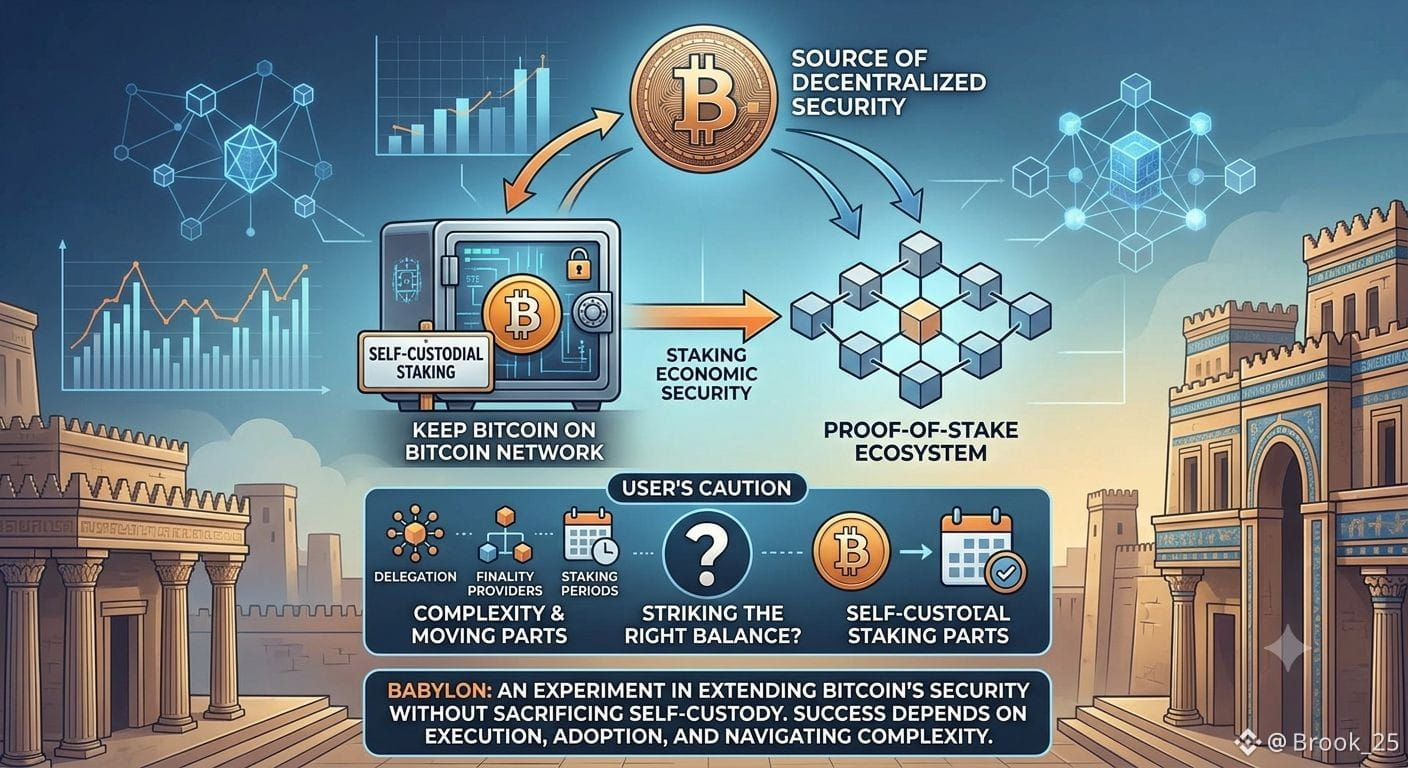
At the same time, I don't think it's a perfect solution. As I dug deeper, I realized the protocol introduces more complexity than simply holding BTC. Delegation, finality providers, staking periods, and other moving parts mean there's more to understand before participating confidently.
Personally, I'm not looking at Babylon as something that will solve every challenge facing cross-chain security. I see it as an experiment that explores whether Bitcoin's security can be extended without sacrificing self-custody. Whether that vision succeeds will depend on careful execution, broad adoption, and continued security over time.
For now, I'm simply following its progress with an open mind. I'm interested to see whether Babylon can strike the right balance between security, simplicity, and decentralization—or whether the added complexity will become its biggest challenge.
@Babylon #baby $BITCOIN $BABY
#BABYLABUBU .
$BABY
{future}(BABYUSDT)
I recently took a closer look at Babylon, and what interested me most wasn't the technology itself—it was the problem it's trying to solve. I've always felt that Bitcoin is one of the strongest sources of decentralized security, yet it has remained largely separate from the Proof-of-Stake ecosystem.
From what I've learned, Babylon takes a different approach. Instead of asking me to wrap my BTC or hand it over to a custodian, it lets me keep my Bitcoin on the Bitcoin network while contributing economic security to participating PoS chains through self-custodial staking. I think that's an interesting design because it tries to preserve Bitcoin's core principles.
At the same time, I don't think it's a perfect solution. As I dug deeper, I realized the protocol introduces more complexity than simply holding BTC. Delegation, finality providers, staking periods, and other moving parts mean there's more to understand before participating confidently.
Personally, I'm not looking at Babylon as something that will solve every challenge facing cross-chain security. I see it as an experiment that explores whether Bitcoin's security can be extended without sacrificing self-custody. Whether that vision succeeds will depend on careful execution, broad adoption, and continued security over time.
For now, I'm simply following its progress with an open mind. I'm interested to see whether Babylon can strike the right balance between security, simplicity, and decentralization—or whether the added complexity will become its biggest challenge.
@Babylon #baby $BITCOIN $BABY
#BABYLABUBU .
$BABY
From what I've learned, Babylon takes a different approach. Instead of asking me to wrap my BTC or hand it over to a custodian, it lets me keep my Bitcoin on the Bitcoin network while contributing economic security to participating PoS chains through self-custodial staking. I think that's an interesting design because it tries to preserve Bitcoin's core principles.
At the same time, I don't think it's a perfect solution. As I dug deeper, I realized the protocol introduces more complexity than simply holding BTC. Delegation, finality providers, staking periods, and other moving parts mean there's more to understand before participating confidently.
Personally, I'm not looking at Babylon as something that will solve every challenge facing cross-chain security. I see it as an experiment that explores whether Bitcoin's security can be extended without sacrificing self-custody. Whether that vision succeeds will depend on careful execution, broad adoption, and continued security over time.
For now, I'm simply following its progress with an open mind. I'm interested to see whether Babylon can strike the right balance between security, simplicity, and decentralization—or whether the added complexity will become its biggest challenge.
@Babylon #baby $BITCOIN $BABY
#BABYLABUBU .
$BABY
51
14
2.4k
·
--
Bearish
Been watching Babylon for months now. Still see most people treating it like just another points farm that dumped hard after the airdrop.
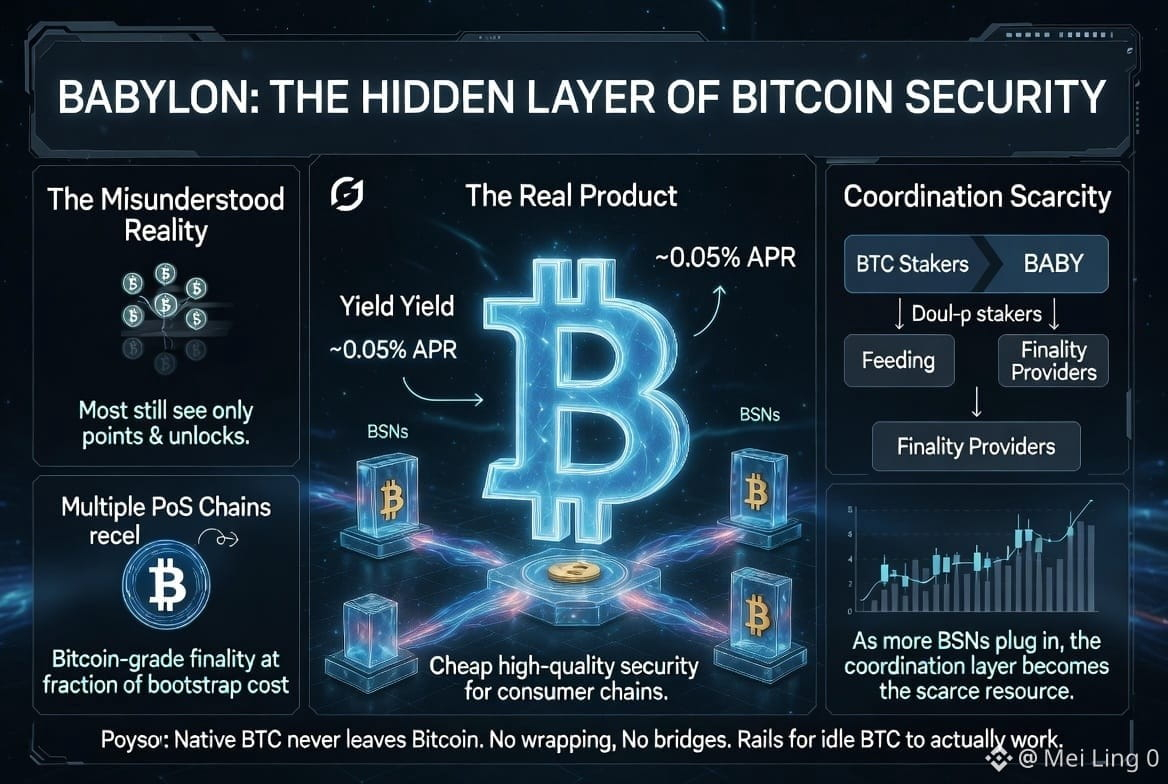
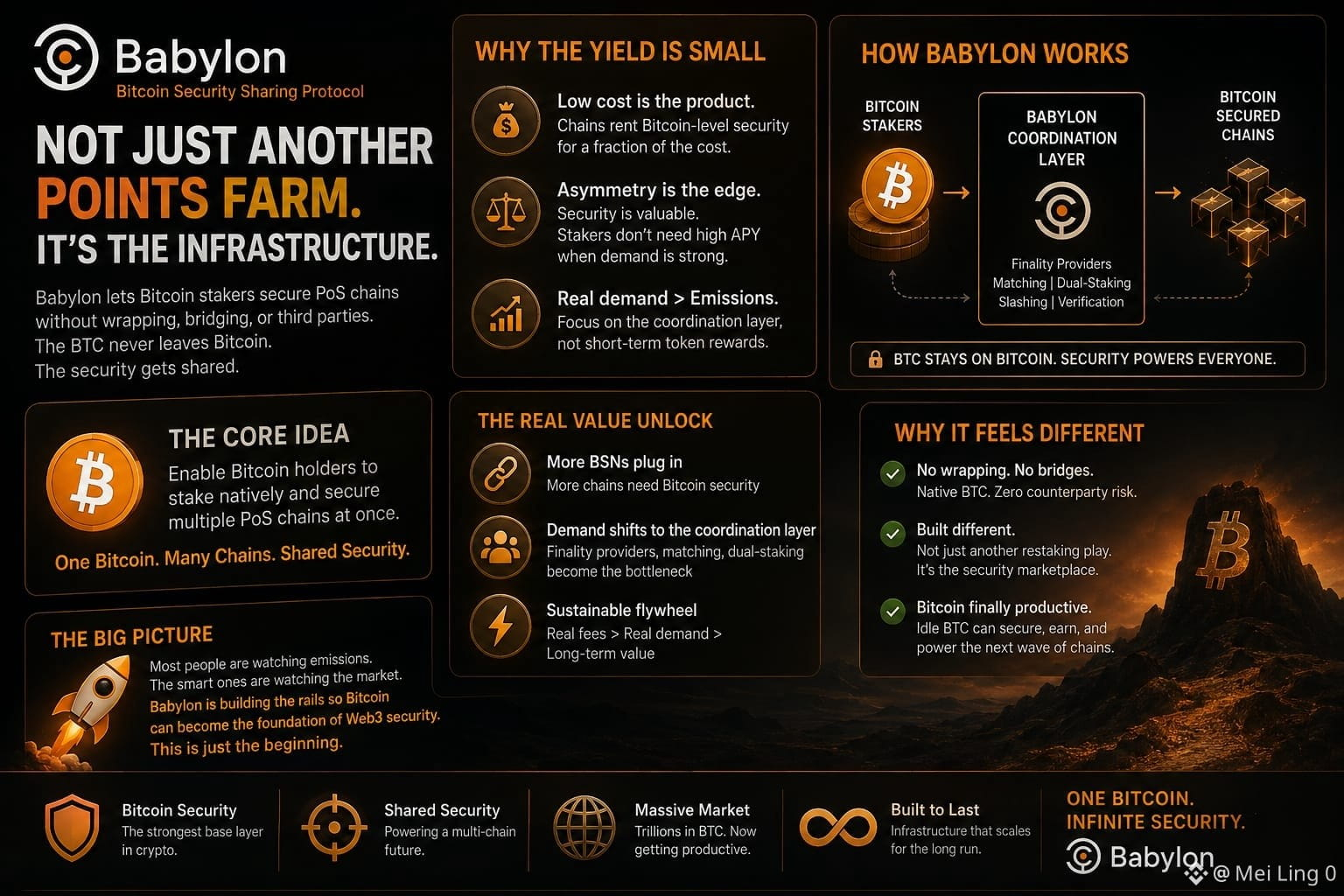
Here’s what I think everyone’s missing. The yield BTC stakers actually get is tiny. Like almost nothing for locking up tens of thousands of coins. That low cost is the whole point. New chains can basically rent Bitcoin-level security for a fraction of what it would cost them to bootstrap their own validators. The asymmetry is the product, not the APY screenshots.
Once more BSNs start plugging in, the real bottleneck becomes the coordination layer itself. Finality providers, the matching, the dual-staking setup. People keep staring at BABY emissions and unlock charts while the actual demand is forming on the other side of that market.
Most restaking narratives already feel tired this cycle. Babylon still feels different to me because the BTC never left Bitcoin. I’ve watched enough incentive games die the second emissions slow down. This one’s quietly building the rails so idle BTC can actually do something useful without wrapping or trusting some third party. That part sticks with me.
@Babylon #baby $BLESS
{future}(BLESSUSDT)
$BABY
#BABYLABUBU
$BABY
{future}(BABYUSDT)
Been watching Babylon for months now. Still see most people treating it like just another points farm that dumped hard after the airdrop.
Here’s what I think everyone’s missing. The yield BTC stakers actually get is tiny. Like almost nothing for locking up tens of thousands of coins. That low cost is the whole point. New chains can basically rent Bitcoin-level security for a fraction of what it would cost them to bootstrap their own validators. The asymmetry is the product, not the APY screenshots.
Once more BSNs start plugging in, the real bottleneck becomes the coordination layer itself. Finality providers, the matching, the dual-staking setup. People keep staring at BABY emissions and unlock charts while the actual demand is forming on the other side of that market.
Most restaking narratives already feel tired this cycle. Babylon still feels different to me because the BTC never left Bitcoin. I’ve watched enough incentive games die the second emissions slow down. This one’s quietly building the rails so idle BTC can actually do something useful without wrapping or trusting some third party. That part sticks with me.
@Babylon #baby $BLESS
$BABY
#BABYLABUBU
$BABY
Here’s what I think everyone’s missing. The yield BTC stakers actually get is tiny. Like almost nothing for locking up tens of thousands of coins. That low cost is the whole point. New chains can basically rent Bitcoin-level security for a fraction of what it would cost them to bootstrap their own validators. The asymmetry is the product, not the APY screenshots.
Once more BSNs start plugging in, the real bottleneck becomes the coordination layer itself. Finality providers, the matching, the dual-staking setup. People keep staring at BABY emissions and unlock charts while the actual demand is forming on the other side of that market.
Most restaking narratives already feel tired this cycle. Babylon still feels different to me because the BTC never left Bitcoin. I’ve watched enough incentive games die the second emissions slow down. This one’s quietly building the rails so idle BTC can actually do something useful without wrapping or trusting some third party. That part sticks with me.
@Babylon #baby $BLESS
$BABY
#BABYLABUBU
$BABY
4
2
348

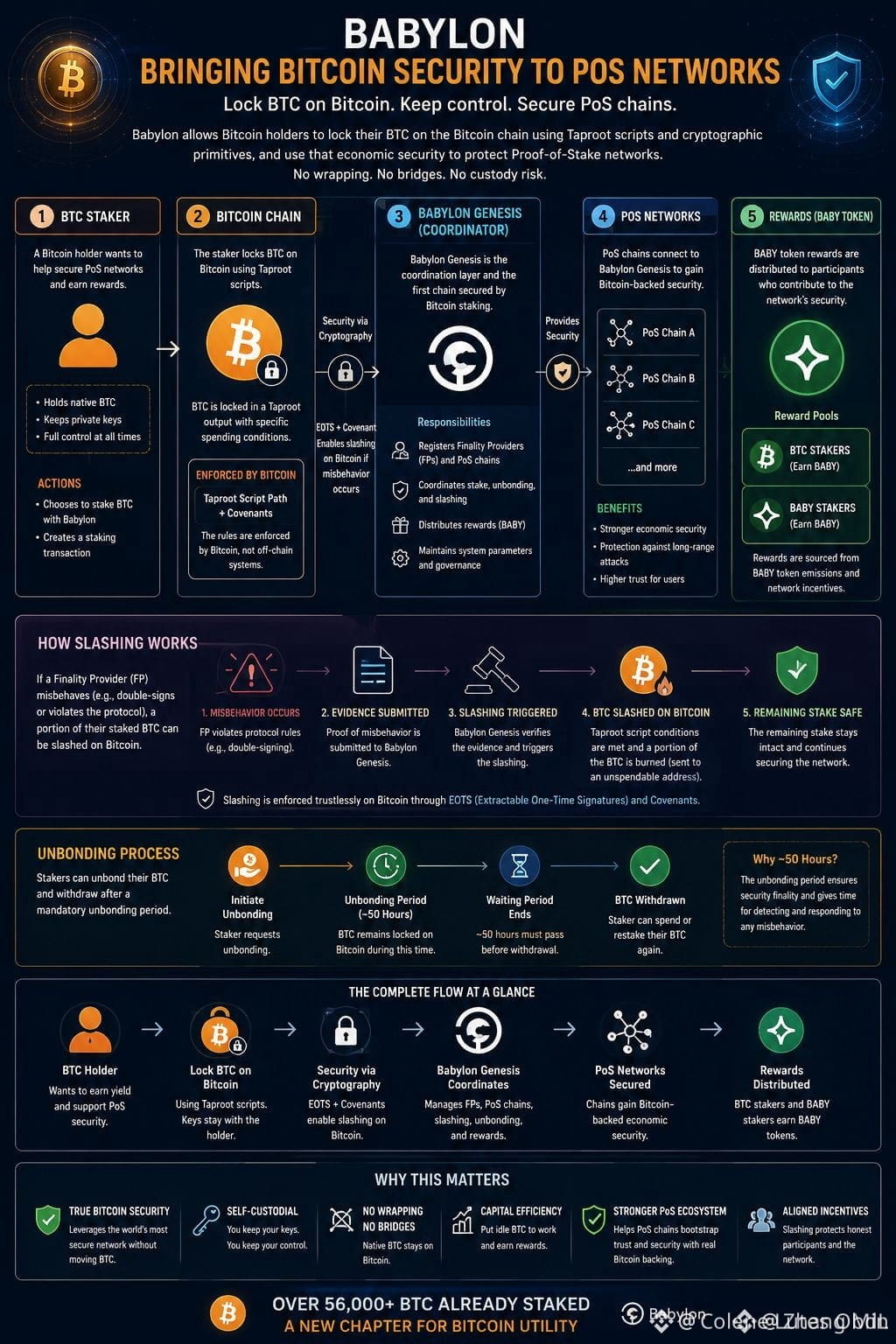
I’ve been sitting with @BabylonLabs_io for a while now. The idea is simple enough on the surface: you lock your actual BTC on the Bitcoin chain using Taproot scripts, keep the keys, and let that locked capital help secure other proof-of-stake networks. No wrapping, no bridges, no one else holding your coins. Just a set of spending rules enforced by Bitcoin itself.
They get around Bitcoin’s limited scripting with some clever cryptography—extractable one-time signatures and a covenant setup—so that if a finality provider messes up, part of the stake can actually be burned on Bitcoin. Unbonding takes about fifty hours. Not instant, but short enough that it doesn’t feel like a prison sentence.
Babylon Genesis, the Cosmos chain that went live last year, sits in the middle of all this. It’s both the first network using the security and the place that coordinates everything. The BABY token pays out the rewards, split between people staking BTC and people staking BABY.
Over fifty-six thousand BTC is already locked in. That’s a real number. Still, I keep wondering whether enough outside chains will actually pay decent yields for this kind of security, and whether most long-term Bitcoin holders will ever feel comfortable putting their coins to work this way. The tech is solid. Whether the demand side shows up is a different story.
@BabylonLabs_io #baby $BABY
$BLESS #BABYLABUBU
I’ve been sitting with @BabylonLabs_io for a while now. The idea is simple enough on the surface: you lock your actual BTC on the Bitcoin chain using Taproot scripts, keep the keys, and let that locked capital help secure other proof-of-stake networks. No wrapping, no bridges, no one else holding your coins. Just a set of spending rules enforced by Bitcoin itself.
They get around Bitcoin’s limited scripting with some clever cryptography—extractable one-time signatures and a covenant setup—so that if a finality provider messes up, part of the stake can actually be burned on Bitcoin. Unbonding takes about fifty hours. Not instant, but short enough that it doesn’t feel like a prison sentence.
Babylon Genesis, the Cosmos chain that went live last year, sits in the middle of all this. It’s both the first network using the security and the place that coordinates everything. The BABY token pays out the rewards, split between people staking BTC and people staking BABY.
Over fifty-six thousand BTC is already locked in. That’s a real number. Still, I keep wondering whether enough outside chains will actually pay decent yields for this kind of security, and whether most long-term Bitcoin holders will ever feel comfortable putting their coins to work this way. The tech is solid. Whether the demand side shows up is a different story.
@BabylonLabs_io #baby $BABY
$BLESS #BABYLABUBU
They get around Bitcoin’s limited scripting with some clever cryptography—extractable one-time signatures and a covenant setup—so that if a finality provider messes up, part of the stake can actually be burned on Bitcoin. Unbonding takes about fifty hours. Not instant, but short enough that it doesn’t feel like a prison sentence.
Babylon Genesis, the Cosmos chain that went live last year, sits in the middle of all this. It’s both the first network using the security and the place that coordinates everything. The BABY token pays out the rewards, split between people staking BTC and people staking BABY.
Over fifty-six thousand BTC is already locked in. That’s a real number. Still, I keep wondering whether enough outside chains will actually pay decent yields for this kind of security, and whether most long-term Bitcoin holders will ever feel comfortable putting their coins to work this way. The tech is solid. Whether the demand side shows up is a different story.
@BabylonLabs_io #baby $BABY
$BLESS #BABYLABUBU
101
·
--
Bullish
Verified
For years, I've wondered whether Bitcoin could do more than simply sit in a wallet as a store of value. Babylon caught my attention because it explores that question without asking users to move their BTC off the Bitcoin network.
From what I've studied, Babylon introduces self-custodial Bitcoin staking, aiming to let BTC help strengthen participating Proof-of-Stake blockchains while remaining on Bitcoin. That makes it different from earlier approaches that relied on wrapped tokens, bridges, or centralized custodians, each of which introduced additional trust and security concerns.
What I find interesting is that the project tries to preserve Bitcoin's native security model while expanding its potential use. At the same time, I don't think it's free of trade-offs. The protocol adds technical complexity, introduces slashing conditions, and depends on coordination beyond Bitcoin's base layer. Those are important considerations that shouldn't be ignored.
In my view, Babylon is better understood as an experiment than a final answer. It offers a different approach to shared blockchain security, but whether it succeeds will depend on real-world adoption, reliability, and how well users understand the risks involved.
I'm curious to see whether Bitcoin-backed security can become a practical model for PoS ecosystems—or whether simplicity will remain Bitcoin's greatest strength.
@Babylon #baby $BITCOIN $BABY #BABYLABUBU
$BABY
{future}(BABYUSDT)
For years, I've wondered whether Bitcoin could do more than simply sit in a wallet as a store of value. Babylon caught my attention because it explores that question without asking users to move their BTC off the Bitcoin network.
From what I've studied, Babylon introduces self-custodial Bitcoin staking, aiming to let BTC help strengthen participating Proof-of-Stake blockchains while remaining on Bitcoin. That makes it different from earlier approaches that relied on wrapped tokens, bridges, or centralized custodians, each of which introduced additional trust and security concerns.
What I find interesting is that the project tries to preserve Bitcoin's native security model while expanding its potential use. At the same time, I don't think it's free of trade-offs. The protocol adds technical complexity, introduces slashing conditions, and depends on coordination beyond Bitcoin's base layer. Those are important considerations that shouldn't be ignored.
In my view, Babylon is better understood as an experiment than a final answer. It offers a different approach to shared blockchain security, but whether it succeeds will depend on real-world adoption, reliability, and how well users understand the risks involved.
I'm curious to see whether Bitcoin-backed security can become a practical model for PoS ecosystems—or whether simplicity will remain Bitcoin's greatest strength.
@Babylon #baby $BITCOIN $BABY #BABYLABUBU
$BABY
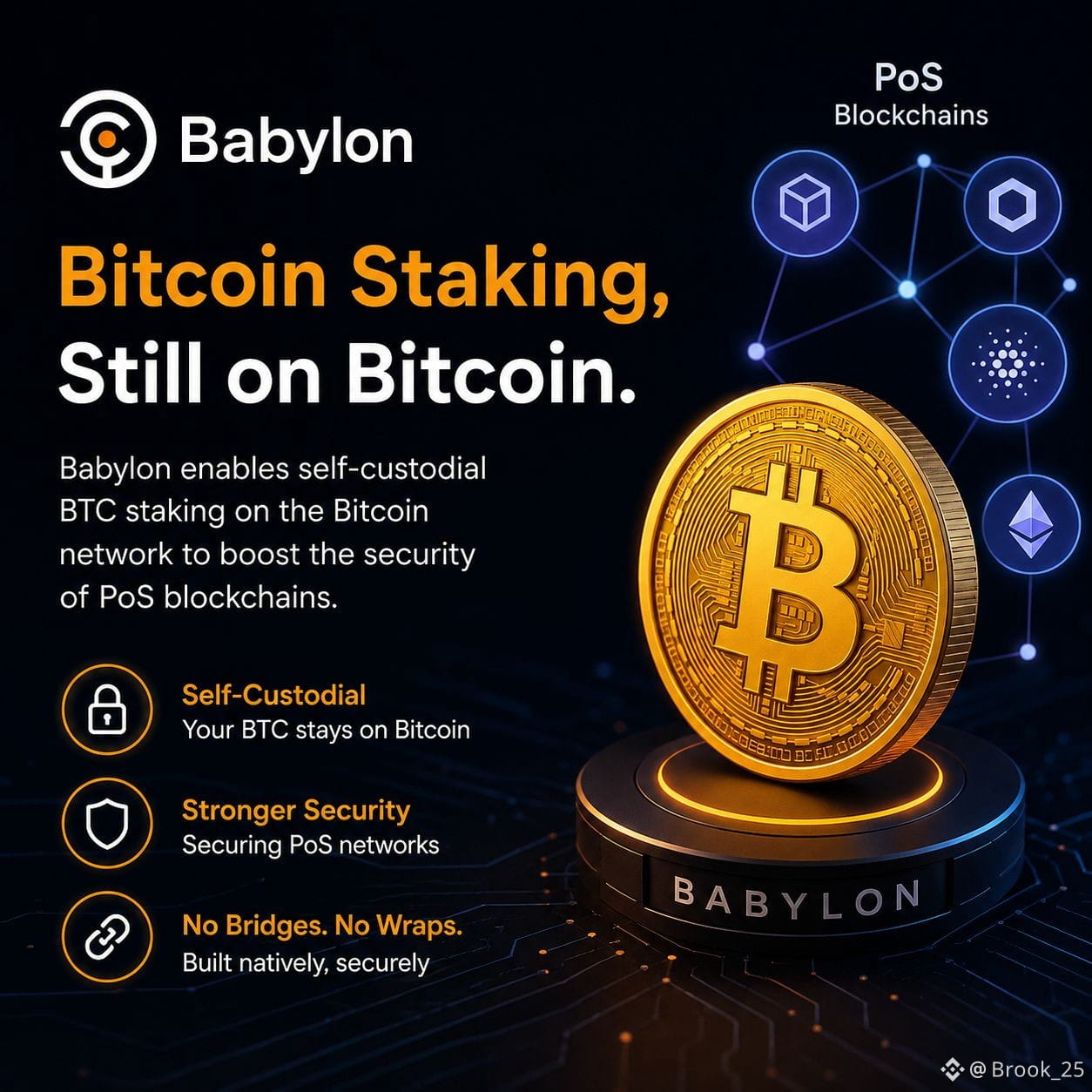
From what I've studied, Babylon introduces self-custodial Bitcoin staking, aiming to let BTC help strengthen participating Proof-of-Stake blockchains while remaining on Bitcoin. That makes it different from earlier approaches that relied on wrapped tokens, bridges, or centralized custodians, each of which introduced additional trust and security concerns.
What I find interesting is that the project tries to preserve Bitcoin's native security model while expanding its potential use. At the same time, I don't think it's free of trade-offs. The protocol adds technical complexity, introduces slashing conditions, and depends on coordination beyond Bitcoin's base layer. Those are important considerations that shouldn't be ignored.
In my view, Babylon is better understood as an experiment than a final answer. It offers a different approach to shared blockchain security, but whether it succeeds will depend on real-world adoption, reliability, and how well users understand the risks involved.
I'm curious to see whether Bitcoin-backed security can become a practical model for PoS ecosystems—or whether simplicity will remain Bitcoin's greatest strength.
@Babylon #baby $BITCOIN $BABY #BABYLABUBU
$BABY
61
33
5.4k
·
--
Bearish
I've always found it interesting that Bitcoin is the most secure blockchain, yet for years it couldn't directly contribute to the security of Proof-of-Stake (PoS) networks without relying on wrapped BTC or custodians. That trade-off never felt ideal because it introduced extra trust and additional risks.
When I looked into Babylon (BABY), what stood out to me was its different approach. Instead of moving BTC to another blockchain, the project aims to enable self-custodial Bitcoin staking directly on the Bitcoin network while helping secure participating PoS chains. In theory, this allows users to keep control of their Bitcoin rather than handing it over to a third party.
That said, I don't see Babylon as a perfect solution. The protocol is technically complex, depends on specialized infrastructure, and its long-term success will rely on secure implementation and broader adoption across PoS ecosystems. Self-custody also means users remain responsible for protecting their own assets.
From my perspective, Babylon is tackling a genuine problem rather than simply adding another crypto feature. Whether its model proves sustainable over time is something only real-world adoption and continued testing can answer.
I'm curious to see whether Bitcoin can become a broader security layer for other blockchains without losing the simplicity and trust assumptions that made it valuable in the first place.
@Babylon #baby $BITCOIN
#BABYLABUBU
$BABY
{future}(BABYUSDT)
I've always found it interesting that Bitcoin is the most secure blockchain, yet for years it couldn't directly contribute to the security of Proof-of-Stake (PoS) networks without relying on wrapped BTC or custodians. That trade-off never felt ideal because it introduced extra trust and additional risks.
When I looked into Babylon (BABY), what stood out to me was its different approach. Instead of moving BTC to another blockchain, the project aims to enable self-custodial Bitcoin staking directly on the Bitcoin network while helping secure participating PoS chains. In theory, this allows users to keep control of their Bitcoin rather than handing it over to a third party.
That said, I don't see Babylon as a perfect solution. The protocol is technically complex, depends on specialized infrastructure, and its long-term success will rely on secure implementation and broader adoption across PoS ecosystems. Self-custody also means users remain responsible for protecting their own assets.
From my perspective, Babylon is tackling a genuine problem rather than simply adding another crypto feature. Whether its model proves sustainable over time is something only real-world adoption and continued testing can answer.
I'm curious to see whether Bitcoin can become a broader security layer for other blockchains without losing the simplicity and trust assumptions that made it valuable in the first place.
@Babylon #baby $BITCOIN
#BABYLABUBU
$BABY
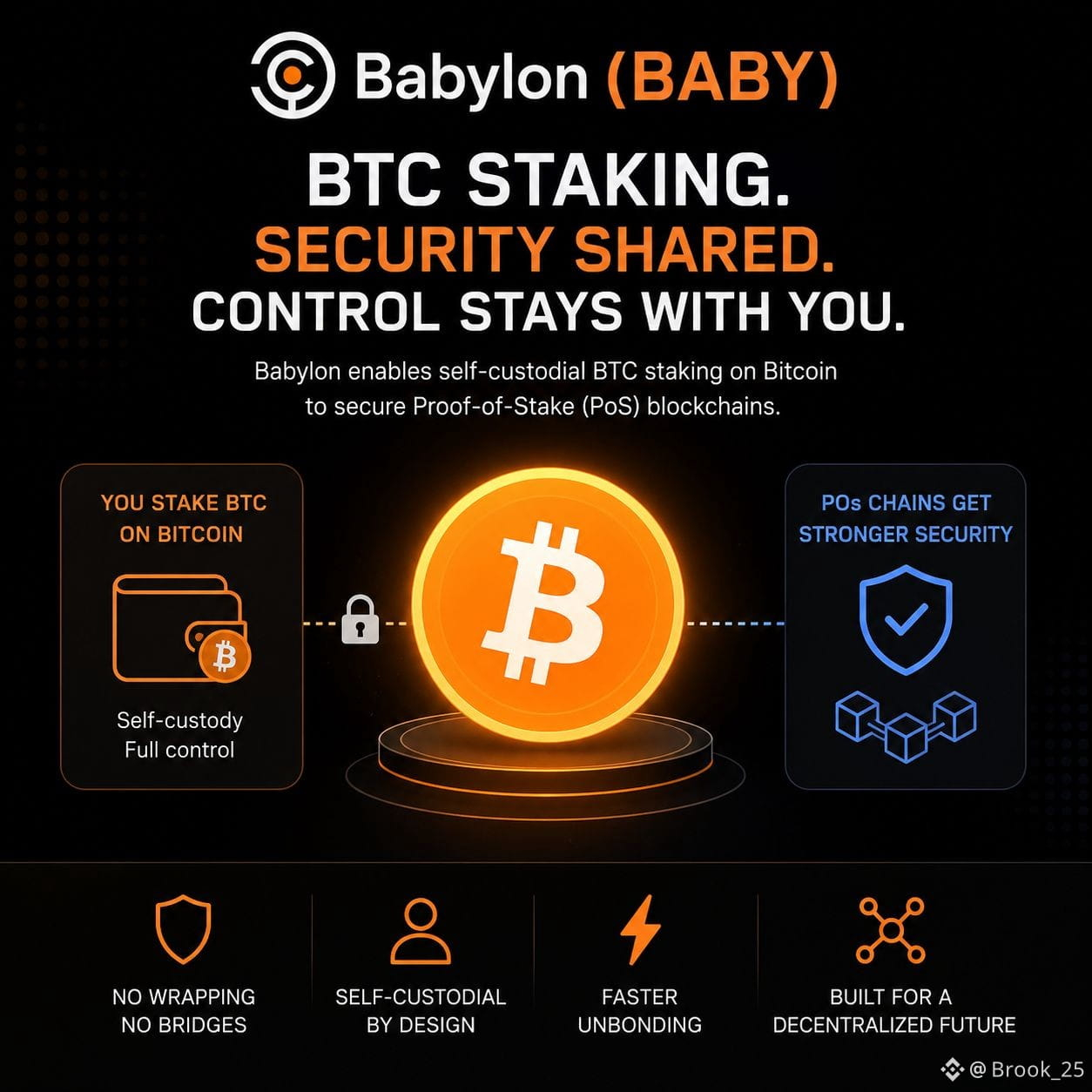
When I looked into Babylon (BABY), what stood out to me was its different approach. Instead of moving BTC to another blockchain, the project aims to enable self-custodial Bitcoin staking directly on the Bitcoin network while helping secure participating PoS chains. In theory, this allows users to keep control of their Bitcoin rather than handing it over to a third party.
That said, I don't see Babylon as a perfect solution. The protocol is technically complex, depends on specialized infrastructure, and its long-term success will rely on secure implementation and broader adoption across PoS ecosystems. Self-custody also means users remain responsible for protecting their own assets.
From my perspective, Babylon is tackling a genuine problem rather than simply adding another crypto feature. Whether its model proves sustainable over time is something only real-world adoption and continued testing can answer.
I'm curious to see whether Bitcoin can become a broader security layer for other blockchains without losing the simplicity and trust assumptions that made it valuable in the first place.
@Babylon #baby $BITCOIN
#BABYLABUBU
$BABY
49
15
3.2k
·
--
Bearish
Verified
I've always found it interesting that Bitcoin is widely viewed as the most secure blockchain, yet it has played only a limited role in securing other blockchain networks. Traditionally, if I wanted to put my BTC to work, I often had to rely on wrapped Bitcoin or custodial solutions, both of which introduced additional trust assumptions and potential risks.
Babylon (BABY) takes a different approach. From what I've studied, it enables self-custodial BTC staking directly on the Bitcoin network instead of moving Bitcoin to another chain. The goal is to allow Bitcoin to help secure participating Proof-of-Stake blockchains while remaining on its native blockchain.
That said, I don't see this as a perfect solution. The protocol introduces added complexity through staking scripts, finality providers, and slashing conditions. While these features are intended to improve security, they also require users to understand a more advanced system and accept new protocol-level risks.
In my view, Babylon is an interesting experiment that explores whether Bitcoin's security can be extended beyond its own ecosystem without sacrificing self-custody. Whether this model achieves broad adoption will depend on its reliability, ease of use, and how comfortable Bitcoin holders are with its trade-offs.
I'm curious to see whether this approach will reshape Bitcoin's role in the broader blockchain ecosystem or remain a niche solution for technically experienced users.
@Babylon $BABY #baby $BITCOIN
#BABYLABUBU
$BABY
{future}(BABYUSDT)
I've always found it interesting that Bitcoin is widely viewed as the most secure blockchain, yet it has played only a limited role in securing other blockchain networks. Traditionally, if I wanted to put my BTC to work, I often had to rely on wrapped Bitcoin or custodial solutions, both of which introduced additional trust assumptions and potential risks.
Babylon (BABY) takes a different approach. From what I've studied, it enables self-custodial BTC staking directly on the Bitcoin network instead of moving Bitcoin to another chain. The goal is to allow Bitcoin to help secure participating Proof-of-Stake blockchains while remaining on its native blockchain.
That said, I don't see this as a perfect solution. The protocol introduces added complexity through staking scripts, finality providers, and slashing conditions. While these features are intended to improve security, they also require users to understand a more advanced system and accept new protocol-level risks.
In my view, Babylon is an interesting experiment that explores whether Bitcoin's security can be extended beyond its own ecosystem without sacrificing self-custody. Whether this model achieves broad adoption will depend on its reliability, ease of use, and how comfortable Bitcoin holders are with its trade-offs.
I'm curious to see whether this approach will reshape Bitcoin's role in the broader blockchain ecosystem or remain a niche solution for technically experienced users.
@Babylon $BABY #baby $BITCOIN
#BABYLABUBU
$BABY
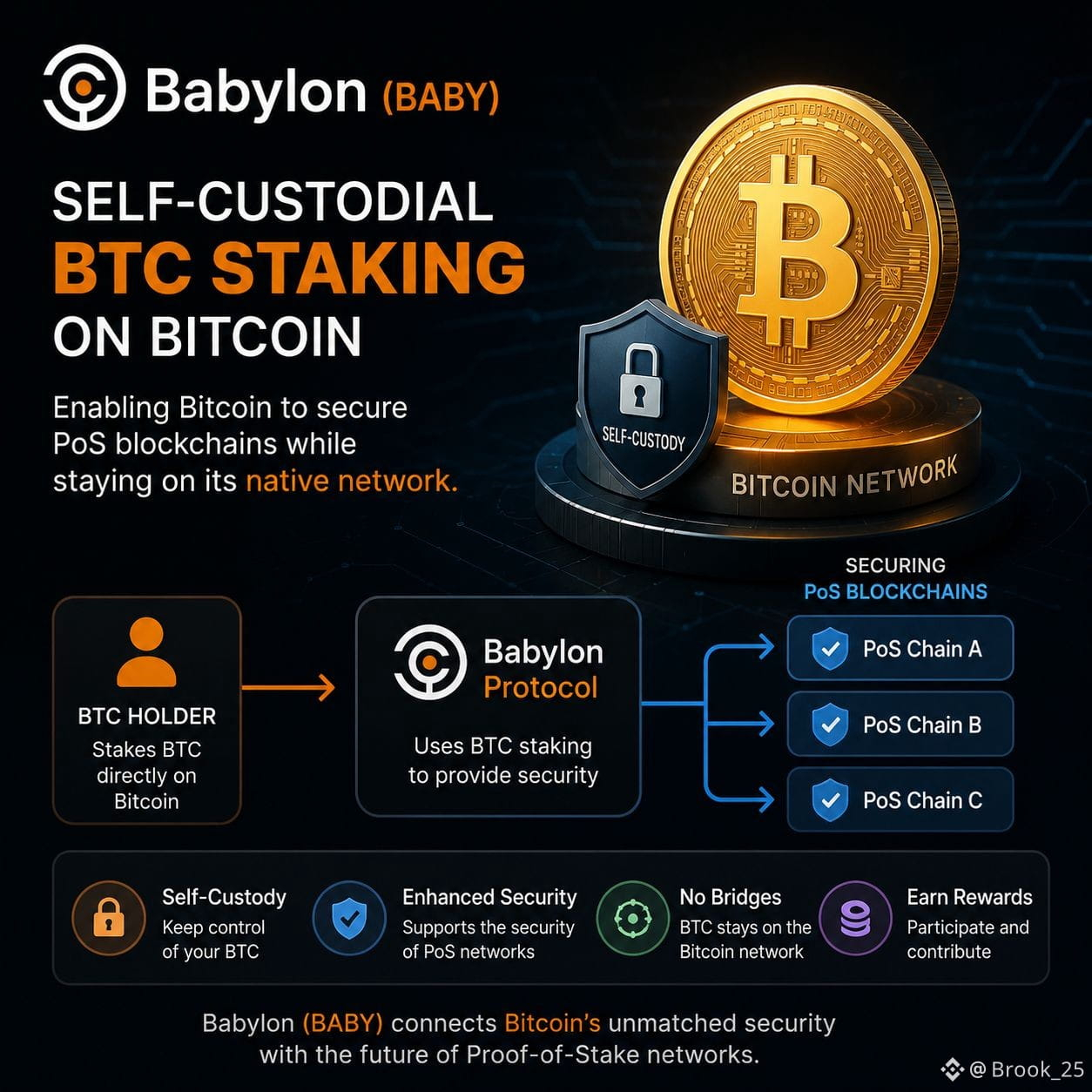
Babylon (BABY) takes a different approach. From what I've studied, it enables self-custodial BTC staking directly on the Bitcoin network instead of moving Bitcoin to another chain. The goal is to allow Bitcoin to help secure participating Proof-of-Stake blockchains while remaining on its native blockchain.
That said, I don't see this as a perfect solution. The protocol introduces added complexity through staking scripts, finality providers, and slashing conditions. While these features are intended to improve security, they also require users to understand a more advanced system and accept new protocol-level risks.
In my view, Babylon is an interesting experiment that explores whether Bitcoin's security can be extended beyond its own ecosystem without sacrificing self-custody. Whether this model achieves broad adoption will depend on its reliability, ease of use, and how comfortable Bitcoin holders are with its trade-offs.
I'm curious to see whether this approach will reshape Bitcoin's role in the broader blockchain ecosystem or remain a niche solution for technically experienced users.
@Babylon $BABY #baby $BITCOIN
#BABYLABUBU
$BABY
57
16
5.5k
·
--
I’ve mostly stopped getting excited about this stuff. After a few full cycles you notice the same rhythm: DeFi, then NFTs, then AI, then RWAs. Each wave shows up loud, burns bright, and leaves the same old problems sitting there with new labels.
Babylon still made me pause, though. Not in a hype way. It just lets people lock real Bitcoin on Bitcoin itself with a time-locked script and use that stake to help secure other proof-of-stake chains. The coins never leave the network. No wrapping. No bridges. No giving anyone else the keys. If the validators double-sign or mess up in specific ways, a small slice can get burned on Bitcoin. Everyone else keeps their coins.
That feels cleaner than most of what I’ve seen. There’s a mountain of idle BTC out there, and plenty of newer chains that still can’t get enough real economic weight behind them. Trying to connect those two without moving the asset is a real problem someone finally tackled without the usual shortcuts.
I’m still not convinced it’ll stick. Other networks have to actually want the security and build around it. The rewards come mostly in BABY, and I’m not sure that’s enough to keep people locking up BTC long-term. There’s an unbonding delay. And the token itself—gas, governance, dual staking—has a way of becoming the loudest thing in the room instead of quiet infrastructure.
Maybe it works. Maybe it just joins the long list of careful ideas that never quite break through. Either way, it made me stop and think longer than most things do these days.
@babylonlabs_io #baby $BABY
#BABYLABUBU $OPG $AKE
{spot}(OPGUSDT)
{spot}(BABYUSDT)
{future}(AKEUSDT)
I’ve mostly stopped getting excited about this stuff. After a few full cycles you notice the same rhythm: DeFi, then NFTs, then AI, then RWAs. Each wave shows up loud, burns bright, and leaves the same old problems sitting there with new labels.
Babylon still made me pause, though. Not in a hype way. It just lets people lock real Bitcoin on Bitcoin itself with a time-locked script and use that stake to help secure other proof-of-stake chains. The coins never leave the network. No wrapping. No bridges. No giving anyone else the keys. If the validators double-sign or mess up in specific ways, a small slice can get burned on Bitcoin. Everyone else keeps their coins.
That feels cleaner than most of what I’ve seen. There’s a mountain of idle BTC out there, and plenty of newer chains that still can’t get enough real economic weight behind them. Trying to connect those two without moving the asset is a real problem someone finally tackled without the usual shortcuts.
I’m still not convinced it’ll stick. Other networks have to actually want the security and build around it. The rewards come mostly in BABY, and I’m not sure that’s enough to keep people locking up BTC long-term. There’s an unbonding delay. And the token itself—gas, governance, dual staking—has a way of becoming the loudest thing in the room instead of quiet infrastructure.
Maybe it works. Maybe it just joins the long list of careful ideas that never quite break through. Either way, it made me stop and think longer than most things do these days.
@BabylonLabs_io #baby $BABY
#BABYLABUBU $OPG $AKE
Babylon still made me pause, though. Not in a hype way. It just lets people lock real Bitcoin on Bitcoin itself with a time-locked script and use that stake to help secure other proof-of-stake chains. The coins never leave the network. No wrapping. No bridges. No giving anyone else the keys. If the validators double-sign or mess up in specific ways, a small slice can get burned on Bitcoin. Everyone else keeps their coins.
That feels cleaner than most of what I’ve seen. There’s a mountain of idle BTC out there, and plenty of newer chains that still can’t get enough real economic weight behind them. Trying to connect those two without moving the asset is a real problem someone finally tackled without the usual shortcuts.
I’m still not convinced it’ll stick. Other networks have to actually want the security and build around it. The rewards come mostly in BABY, and I’m not sure that’s enough to keep people locking up BTC long-term. There’s an unbonding delay. And the token itself—gas, governance, dual staking—has a way of becoming the loudest thing in the room instead of quiet infrastructure.
Maybe it works. Maybe it just joins the long list of careful ideas that never quite break through. Either way, it made me stop and think longer than most things do these days.
@BabylonLabs_io #baby $BABY
#BABYLABUBU $OPG $AKE
BABY👌❤️
54%
Bullish🚀
46%
39 votes • Voting closed
74
1
37
11.3k
·
--
Bullish
I've been following Babylon (BABY) because it explores a question I've had for a while: can Bitcoin help secure other blockchains without leaving the Bitcoin network?
What stands out to me is its self-custodial staking model. Instead of wrapping or bridging my BTC, the protocol is designed to let me keep my Bitcoin on its native chain while contributing security to participating Proof-of-Stake networks. I think that's a meaningful design choice because self-custody has always been one of Bitcoin's strongest principles.
That said, I don't see Babylon as a perfect solution. The more I read about it, the more I realize that cross-chain security isn't simple. Finality Providers, delegation, and protocol coordination all add layers of complexity that Bitcoin holders need to understand before participating.
From my perspective, self-custody reduces one type of risk, but it doesn't remove every responsibility. If I decide to stake, I still need to evaluate who I'm delegating to and understand how the protocol works. That's a trade-off I can't ignore.
For me, Babylon isn't interesting because it promises something revolutionary. It's interesting because it's testing whether Bitcoin's security can be extended beyond its own network without changing Bitcoin's core design.
I'm curious to see whether this approach can truly balance security, decentralization, and simplicity—or whether those goals will always require difficult compromises.
#babylon #baby $BITCOIN
#BABYLABUBU #baby
$BABY
{future}(BABYUSDT)
$GIGGLE
{future}(GIGGLEUSDT)
I've been following Babylon (BABY) because it explores a question I've had for a while: can Bitcoin help secure other blockchains without leaving the Bitcoin network?
What stands out to me is its self-custodial staking model. Instead of wrapping or bridging my BTC, the protocol is designed to let me keep my Bitcoin on its native chain while contributing security to participating Proof-of-Stake networks. I think that's a meaningful design choice because self-custody has always been one of Bitcoin's strongest principles.
That said, I don't see Babylon as a perfect solution. The more I read about it, the more I realize that cross-chain security isn't simple. Finality Providers, delegation, and protocol coordination all add layers of complexity that Bitcoin holders need to understand before participating.
From my perspective, self-custody reduces one type of risk, but it doesn't remove every responsibility. If I decide to stake, I still need to evaluate who I'm delegating to and understand how the protocol works. That's a trade-off I can't ignore.
For me, Babylon isn't interesting because it promises something revolutionary. It's interesting because it's testing whether Bitcoin's security can be extended beyond its own network without changing Bitcoin's core design.
I'm curious to see whether this approach can truly balance security, decentralization, and simplicity—or whether those goals will always require difficult compromises.
#babylon #baby $BITCOIN
#BABYLABUBU #baby
$BABY
$GIGGLE
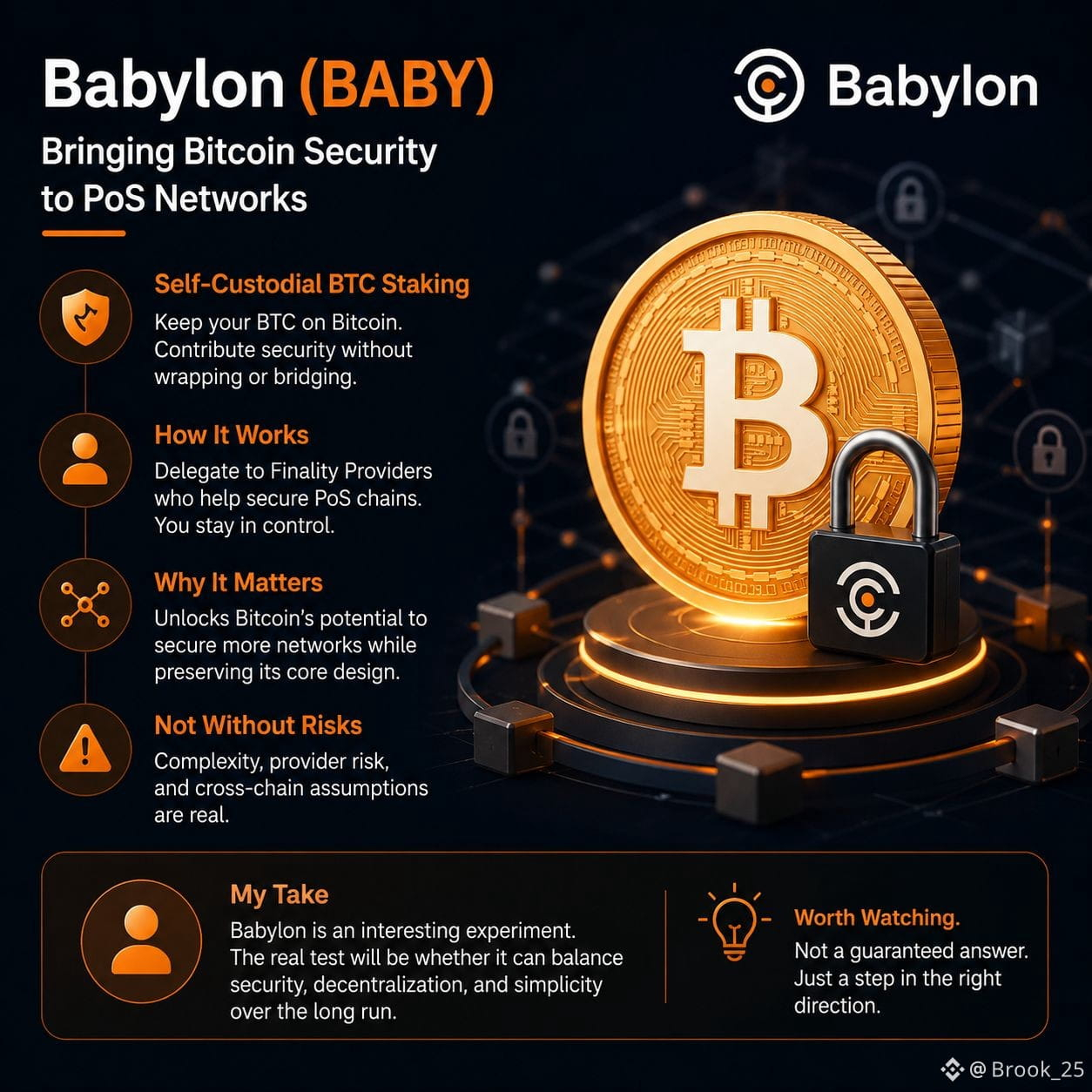
What stands out to me is its self-custodial staking model. Instead of wrapping or bridging my BTC, the protocol is designed to let me keep my Bitcoin on its native chain while contributing security to participating Proof-of-Stake networks. I think that's a meaningful design choice because self-custody has always been one of Bitcoin's strongest principles.
That said, I don't see Babylon as a perfect solution. The more I read about it, the more I realize that cross-chain security isn't simple. Finality Providers, delegation, and protocol coordination all add layers of complexity that Bitcoin holders need to understand before participating.
From my perspective, self-custody reduces one type of risk, but it doesn't remove every responsibility. If I decide to stake, I still need to evaluate who I'm delegating to and understand how the protocol works. That's a trade-off I can't ignore.
For me, Babylon isn't interesting because it promises something revolutionary. It's interesting because it's testing whether Bitcoin's security can be extended beyond its own network without changing Bitcoin's core design.
I'm curious to see whether this approach can truly balance security, decentralization, and simplicity—or whether those goals will always require difficult compromises.
#babylon #baby $BITCOIN
#BABYLABUBU #baby
$BABY
$GIGGLE
75
22
3.3k
Log in to explore more content
Join global crypto users on Binance Square
⚡️ Get latest and useful information about crypto.
💬 Trusted by the world’s largest crypto exchange.
👍 Discover real insights from verified creators.
Email / Phone number
Trending Topics
1
#HYPEJumpsOver11%
5,358 views
279 Discussing
2
#ZcashDevelopersTargetNU7MainnetActivationNov5
0 views
2 Discussing
3
#BitcoinSpotETFsNetInflow$159M
1,707 views
73 Discussing
4
#HKMAPlansWholesaleCBDCByYearEnd
14,227 views
475 Discussing
5
#NEARSurges26%Past$3.45
11,757 views
117 Discussing
6
#BOJHikesRatesTo31YearHigh
31,955 views
754 Discussing
7
#EvernorthRaises$30MToBuyXRP
862 views
30 Discussing
8
#ChainlinkPowersBottomlinePaymentPlatform
31,924 views
718 Discussing
9
#DtcpayCompletes$25MSeriesA
959 views
27 Discussing
10
#InjectiveLaunchesINJOnSolana
8,499 views
211 Discussing