

#anonimato
anonimato
1,852 views
4 Discussing
Hot
Latest

Almost everyone thinks cryptocurrencies are anonymous. That’s a lie.
What you have is pseudonymity, not anonymity. Your name doesn’t appear on the blockchain. But your address does. And that address has a memory.
The network runs on a public ledger. Anyone can open it and see every transaction, without asking permission. There’s no lock on the door. Total transparency, hidden identity. Until someone connects the dots.
Here’s an example. You receive 1 $USDC at an address. You pay 0.6 $USDC to a store, and the 0.4 $USDC in change goes back to a new address. So far, nobody knows those two addresses are yours. But if you use that change address to receive another payment, anyone checking the ledger can link the two transactions. That’s when the disguise falls apart.
It has a name: address reuse. It’s the most common mistake in crypto, and the one that has exposed the most complete transaction histories.
KEY CONCEPTS
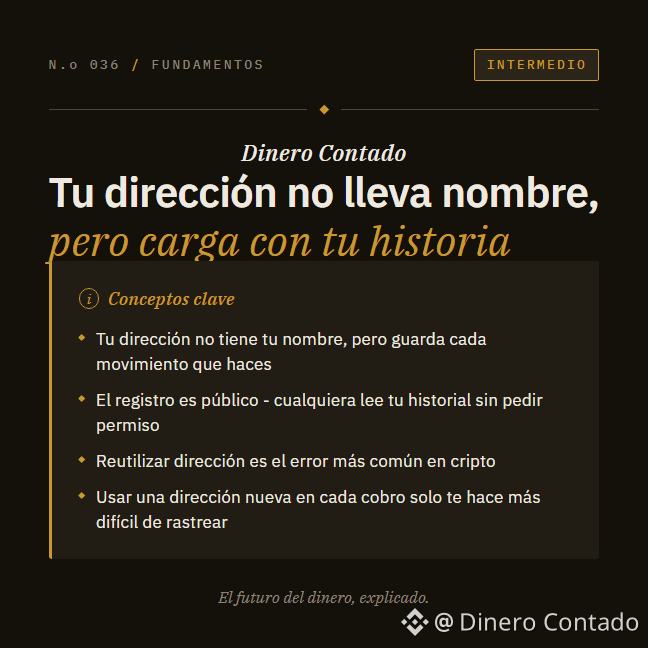
- It’s not anonymity, it’s pseudonymity. Your address doesn’t carry your name, but it does carry your entire transaction history.
- The ledger isn’t hidden anywhere. Anyone can read it without asking permission.
- Reusing an address doesn’t expose you instantly, but it gives away the clue that links your payments.
- Using a new address for every payment doesn’t make you invisible. It just makes you harder to track.
Your wallet isn’t a room with the door closed. It’s a display case with crystal-clear glass.
Transparency: Binance may pay us a commission if you trade after clicking an asset symbol or a price link in this post.
#Anonimato #Blockchain #Criptomonedas #BinancePick #Traceability
1
91

·
--

Article
🚀 Private CryptosBitcoin is not anonymous.
All Bitcoin transactions are permanently recorded on the blockchain.
"Anyone can see which address sent and how much."
It's just a pseudonym because your name doesn't show up, but with enough info, they can ID you.
There are cryptocurrencies specifically designed to be private and anonymous.
In this article, I'll break down the most important ones: Monero and Zcash.
What is anonymity in cryptocurrencies?
An anonymous transaction means that no one can tell who sent, who received, and how much was sent.
🚀 Private Cryptos
Bitcoin is not anonymous.
All Bitcoin transactions are permanently recorded on the blockchain.
"Anyone can see which address sent and how much."
It's just a pseudonym because your name doesn't show up, but with enough info, they can ID you.
There are cryptocurrencies specifically designed to be private and anonymous.
In this article, I'll break down the most important ones: Monero and Zcash.
What is anonymity in cryptocurrencies?
An anonymous transaction means that no one can tell who sent, who received, and how much was sent.
91
Log in to explore more content
Join global crypto users on Binance Square
⚡️ Get latest and useful information about crypto.
💬 Trusted by the world’s largest crypto exchange.
👍 Discover real insights from verified creators.
Email / Phone number
Trending Topics
1
#CanMicrosoftDeliverOnAI
330,698 views
2,650 Discussing
2
#CanGoogleDefindItsCore
193,822 views
1,869 Discussing
3
#EarningsSeason
5.9M views
28,697 Discussing
4
#$10.9BBitcoinOptionsExpireFriday
384 views
25 Discussing
5
#ThailandSupremeCourtRulesBitcoinIsProperty
375 views
56 Discussing
6
#BitcoinSurpasses$81K
17,894 views
77 Discussing
7
#RobinhoodFalls8.4%AfterItsResults
10,838 views
228 Discussing
8
#KOSPISurges6.63%BackAbove6000
11,227 views
229 Discussing
9
#DatavaultAICantWithdrawBitcoinFromBiconomy
12,207 views
207 Discussing
10
#FOMCWatch
9.3M views
29,506 Discussing