Binance Square
B L O C K T R A I L
1.9k Posting

B L O C K T R A I L

Exploring the world of crypto and blockchain, I share insights that turn complex trends into actionable strategies. Passionate about the future of decentralize
Perdagangan Terbuka
Pedagang Rutin
8.8 Bulan
21 Mengikuti
5.8K+ Pengikut
1.9K+ Disukai
Posting
Portofolio
ยท
--
Lapisan yang Hilang dalam Keuangan Otonom Bukanlah Kecerdasan. Melainkan Akuntabilitas.Lapisan yang Hilang dalam Keuangan Otonom Bukanlah Kecerdasan. Melainkan Akuntabilitas. Perbincangan seputar AI dalam kripto telah menetap pada pola yang sudah familiar. Setiap minggu tampaknya ada proyek lain yang menjanjikan agen yang bisa berdagang lebih cepat, mengelola portofolio, melakukan penyeimbangan kembali treasury, atau mengoptimalkan yield tanpa menunggu masukan dari manusia. Patokan (benchmark) hampir selalu terdengar sama: lebih banyak otonomi, lebih sedikit intervensi. Untuk sementara, itu terasa seperti arah yang paling jelas. Lalu saya mulai bertanya-tanya apakah kita sedang mengukur hal yang salah.

Lapisan yang Hilang dalam Keuangan Otonom Bukanlah Kecerdasan. Melainkan Akuntabilitas.

Lapisan yang Hilang dalam Keuangan Otonom Bukanlah Kecerdasan. Melainkan Akuntabilitas.
Perbincangan seputar AI dalam kripto telah menetap pada pola yang sudah familiar.
Setiap minggu tampaknya ada proyek lain yang menjanjikan agen yang bisa berdagang lebih cepat, mengelola portofolio, melakukan penyeimbangan kembali treasury, atau mengoptimalkan yield tanpa menunggu masukan dari manusia. Patokan (benchmark) hampir selalu terdengar sama: lebih banyak otonomi, lebih sedikit intervensi.
Untuk sementara, itu terasa seperti arah yang paling jelas.
Lalu saya mulai bertanya-tanya apakah kita sedang mengukur hal yang salah.
Lihat terjemahan
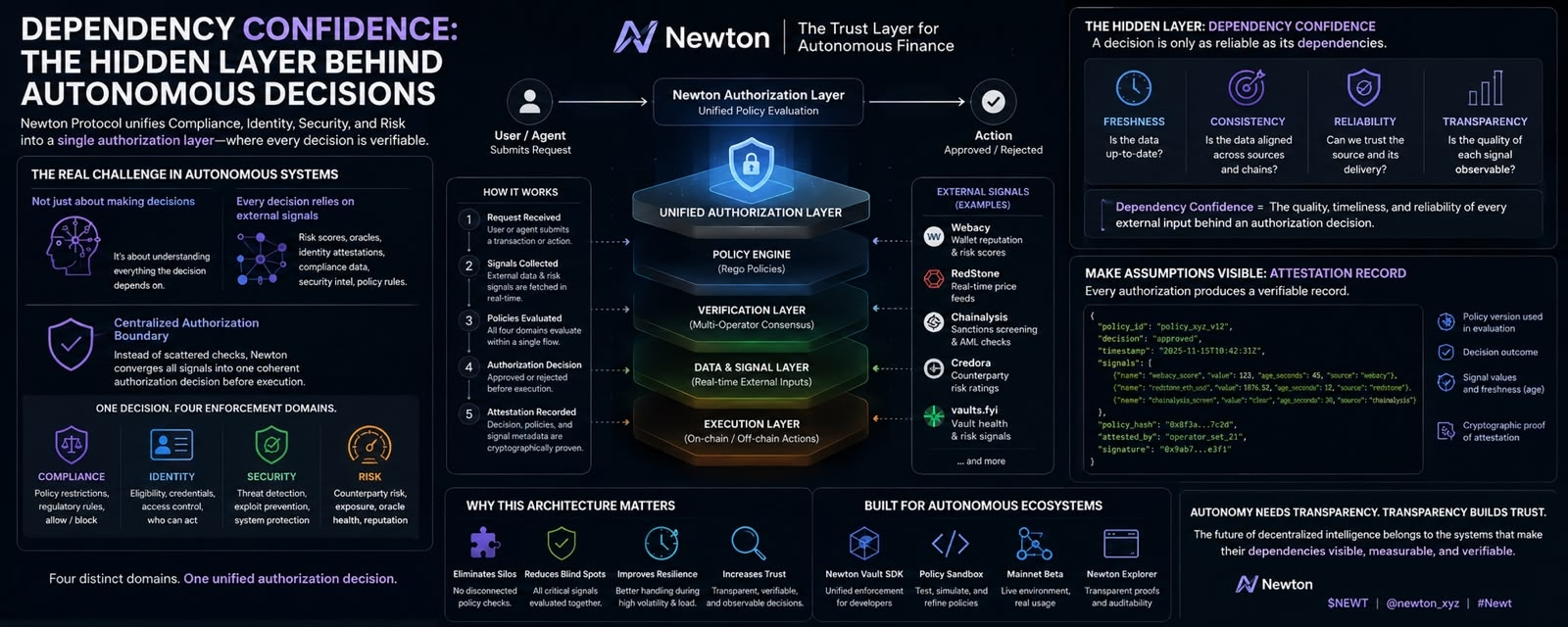
I've been thinking about something that rarely gets discussed when people talk about AI in crypto. Everyone seems obsessed with making agents more autonomous, but autonomy isn't the same as reliability. An AI can make decisions faster than any human, yet every action still has to survive the reality of blockchain execution. That's why I find the architecture behind Newton Protocol interesting. The design separates permission from outcome. A policy can authorize an action after predefined checks are satisfied, but the network doesn't pretend that approval guarantees success. The destination contract can still reject the transaction, run out of required conditions, or fail for reasons completely outside the policy layer. To me, that's a healthier way to think about automation. Security isn't just preventing bad actions; it's making failures understandable instead of mysterious. If an approved intent fails, developers know they're debugging execution rather than questioning whether authorization was valid in the first place. The bigger question isn't whether AI can automate DeFi. It's whether users and builders can clearly understand what happened when something doesn't go as planned. Transparent boundaries create confidence far more effectively than marketing claims about "intelligent agents." If Newton Protocol can keep that separation clear as the ecosystem grows, I think its long-term value will come less from AI itself and more from making automated systems easier to verify, reason about, and ultimately trust. @NewtonProtocol $NEWT #Newt
I've been thinking about something that rarely gets discussed when people talk about AI in crypto.

Everyone seems obsessed with making agents more autonomous, but autonomy isn't the same as reliability. An AI can make decisions faster than any human, yet every action still has to survive the reality of blockchain execution.

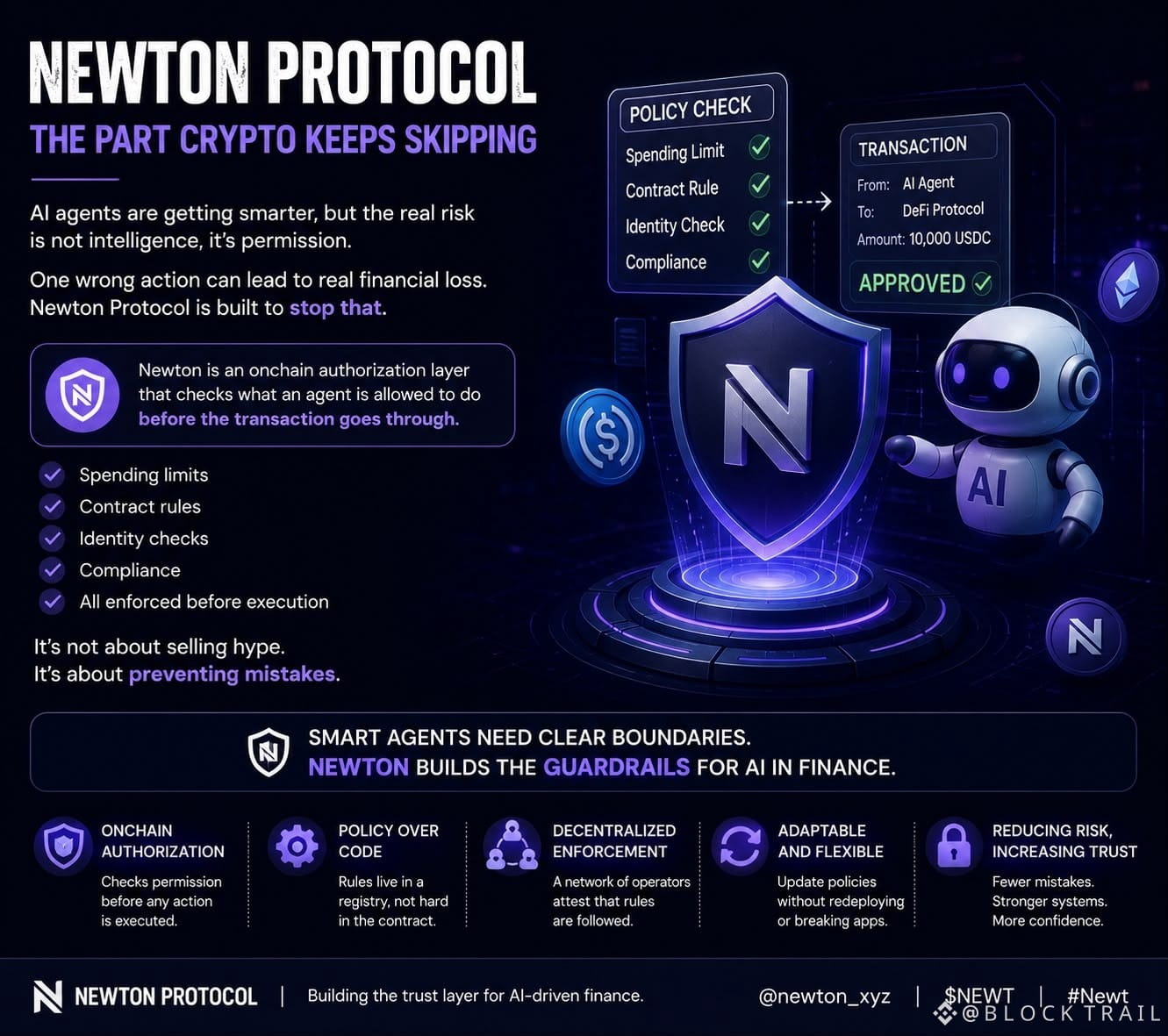
That's why I find the architecture behind Newton Protocol interesting. The design separates permission from outcome. A policy can authorize an action after predefined checks are satisfied, but the network doesn't pretend that approval guarantees success. The destination contract can still reject the transaction, run out of required conditions, or fail for reasons completely outside the policy layer.

To me, that's a healthier way to think about automation. Security isn't just preventing bad actions; it's making failures understandable instead of mysterious. If an approved intent fails, developers know they're debugging execution rather than questioning whether authorization was valid in the first place.

The bigger question isn't whether AI can automate DeFi. It's whether users and builders can clearly understand what happened when something doesn't go as planned. Transparent boundaries create confidence far more effectively than marketing claims about "intelligent agents."

If Newton Protocol can keep that separation clear as the ecosystem grows, I think its long-term value will come less from AI itself and more from making automated systems easier to verify, reason about, and ultimately trust.

@NewtonProtocol $NEWT #Newt
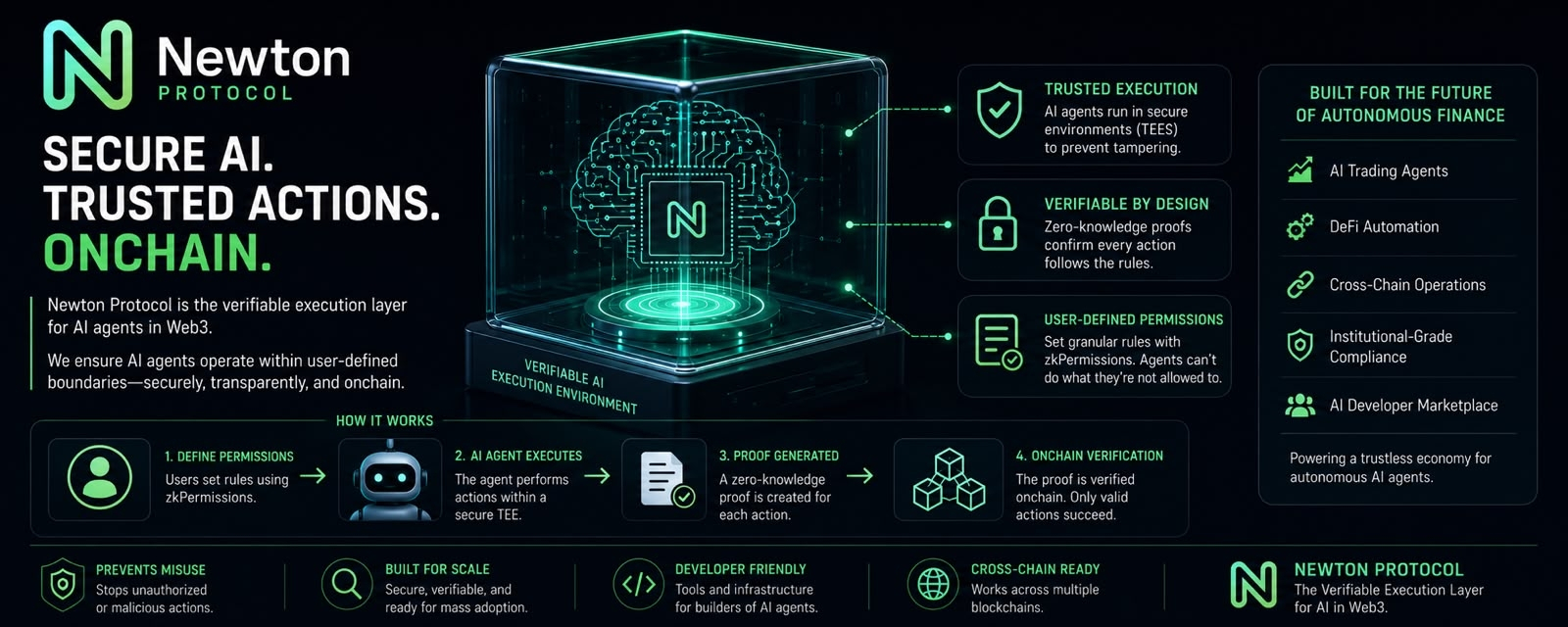
Newton Protocol: Membangun Lapisan Kebijakan untuk Eksekusi Onchain yang Aman Berbasis AINewton Protocol lebih baik dipahami bukan sebagai proyek kripto biasa, melainkan sebagai lapisan kontrol untuk masa depan ketika agen AI berinteraksi langsung dengan sistem onchain. Kebanyakan pembahasan tentang AI di Web3 berfokus pada kecepatan, otomatisasi, dan skalabilitas. Namun tantangan yang sebenarnya bukan membuat sistem bertindak lebih cepatโ€”melainkan memastikan sistem tersebut bertindak dengan aman. Setelah agen otonom mulai mengeksekusi perdagangan, memindahkan dana, atau berinteraksi dengan smart contract, risikonya bergeser dari kesalahan pengguna menjadi perilaku tingkat sistem. Di situlah Newton Protocol menempatkan dirinya.

Newton Protocol: Membangun Lapisan Kebijakan untuk Eksekusi Onchain yang Aman Berbasis AI

Newton Protocol lebih baik dipahami bukan sebagai proyek kripto biasa, melainkan sebagai lapisan kontrol untuk masa depan ketika agen AI berinteraksi langsung dengan sistem onchain.
Kebanyakan pembahasan tentang AI di Web3 berfokus pada kecepatan, otomatisasi, dan skalabilitas. Namun tantangan yang sebenarnya bukan membuat sistem bertindak lebih cepatโ€”melainkan memastikan sistem tersebut bertindak dengan aman. Setelah agen otonom mulai mengeksekusi perdagangan, memindahkan dana, atau berinteraksi dengan smart contract, risikonya bergeser dari kesalahan pengguna menjadi perilaku tingkat sistem. Di situlah Newton Protocol menempatkan dirinya.
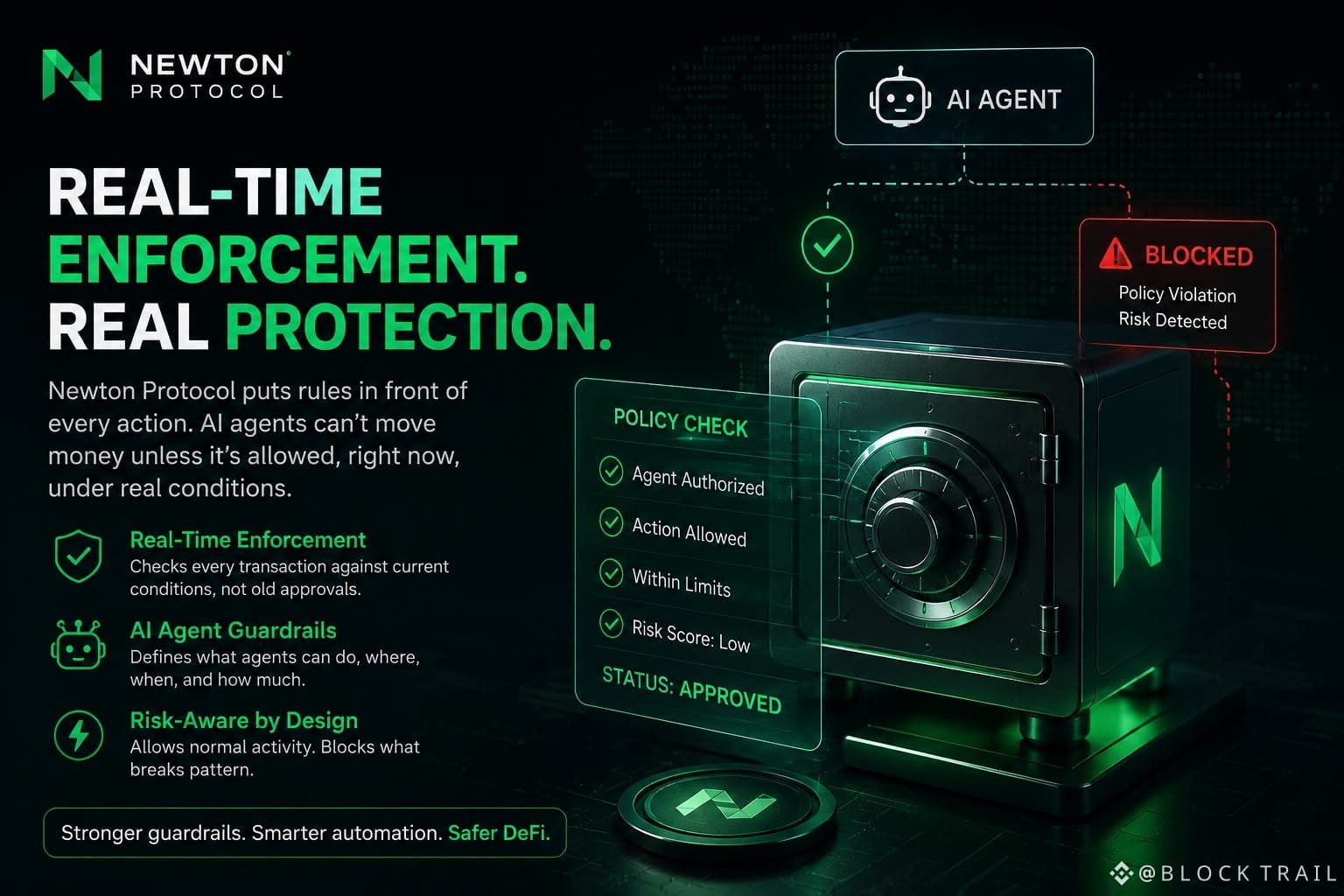
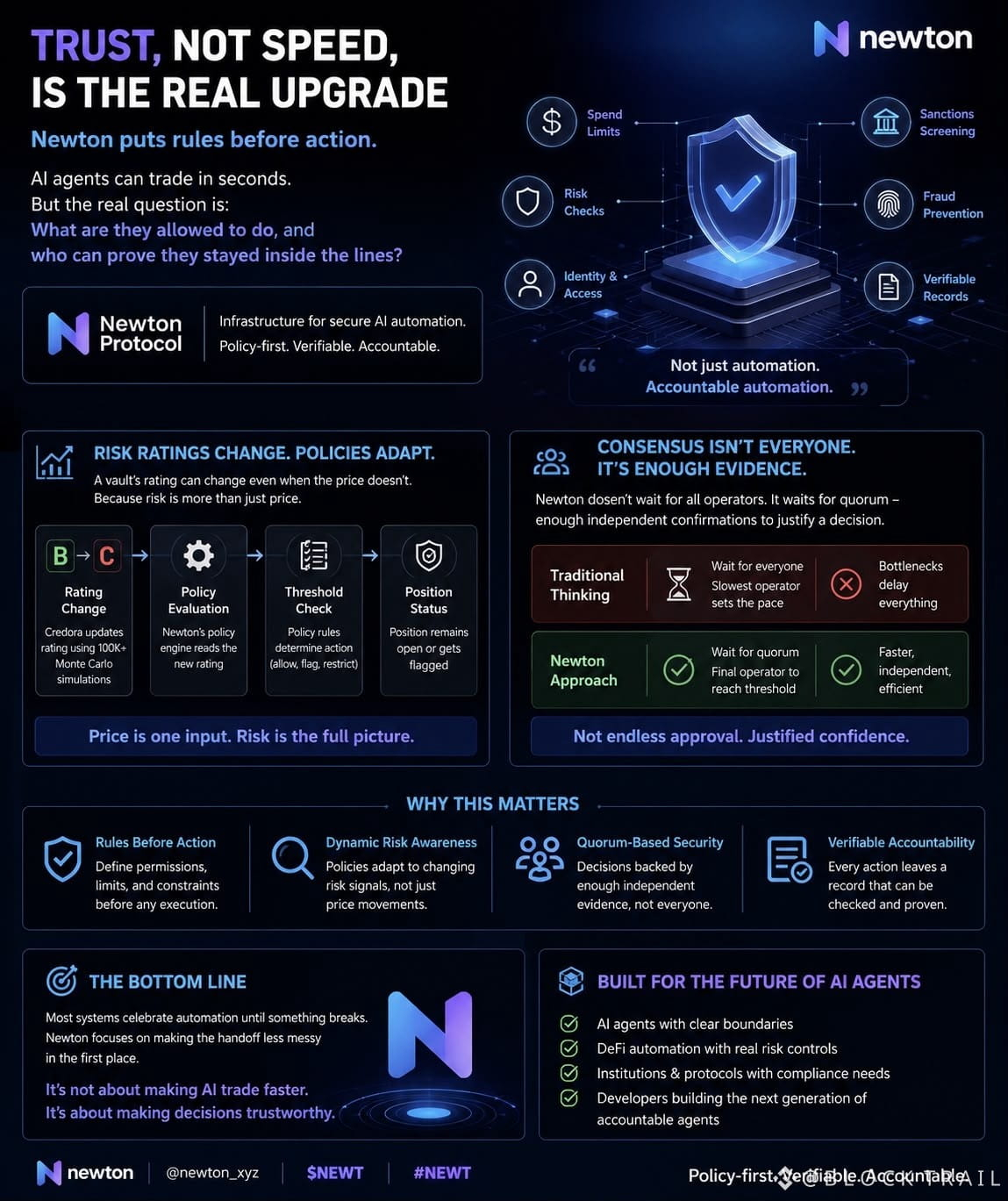
Newton Protocol terasa lebih seperti infrastruktur yang mencoba memecahkan masalah koordinasi nyata antara agen AI dan sistem onchain, bukan sekadar eksperimen token lainnya. Gagasan utamanya bukan otomatisasi, melainkan otomatisasi yang terkontrolโ€”di mana tindakan disaring melalui aturan kebijakan sebelum diteruskan ke eksekusi. Ia berperilaku seperti lapisan kepercayaan dan keamanan untuk smart contract. Alih-alih mengasumsikan transaksi valid saat dipicu, ia memperkenalkan batasan yang mengevaluasi konteks secara offchain dan menegakkan batas tersebut di onchain. Perubahan ini penting di tempat di mana agen AI bisa bertindak terlalu bebas. Saat menelusuri data aktivitas, muncul pola terkait perilaku operator. Utilisasi dapat berubah bahkan ketika operator tetap aktif, dipengaruhi oleh routing berbobot stake. Hal ini menciptakan kesenjangan antara partisipasi jaringan vs pemilihan untuk pekerjaan, sehingga memunculkan pertanyaan tentang cakupan real-time dan seberapa cepat sistem beradaptasi ketika bobot berubah. Dari sisi pengembang, model integrasinya patut dicatat. Alih-alih memaksa migrasi, ia terhubung ke kontrak upgradeable yang sudah ada. Namun, poin kritisnya adalah inisialisasi, di mana izin, koneksi kebijakan, dan asumsi kepercayaan ditetapkan. Jika lapisan itu salah konfigurasi, upgrade kehilangan nilainya. Secara keseluruhan, Newton Protocol bertujuan membuat otomatisasi lebih aman sebelum menjadi tidak terkendali. $TLM @NewtonProtocol #Newt {spot}(TLMUSDT) $NEWT {spot}(NEWTUSDT) $VELVET {future}(VELVETUSDT)
Newton Protocol terasa lebih seperti infrastruktur yang mencoba memecahkan masalah koordinasi nyata antara agen AI dan sistem onchain, bukan sekadar eksperimen token lainnya. Gagasan utamanya bukan otomatisasi, melainkan otomatisasi yang terkontrolโ€”di mana tindakan disaring melalui aturan kebijakan sebelum diteruskan ke eksekusi.

Ia berperilaku seperti lapisan kepercayaan dan keamanan untuk smart contract. Alih-alih mengasumsikan transaksi valid saat dipicu, ia memperkenalkan batasan yang mengevaluasi konteks secara offchain dan menegakkan batas tersebut di onchain.

Perubahan ini penting di tempat di mana agen AI bisa bertindak terlalu bebas.

Saat menelusuri data aktivitas, muncul pola terkait perilaku operator. Utilisasi dapat berubah bahkan ketika operator tetap aktif, dipengaruhi oleh routing berbobot stake.

Hal ini menciptakan kesenjangan antara partisipasi jaringan vs pemilihan untuk pekerjaan, sehingga memunculkan pertanyaan tentang cakupan real-time dan seberapa cepat sistem beradaptasi ketika bobot berubah.

Dari sisi pengembang, model integrasinya patut dicatat. Alih-alih memaksa migrasi, ia terhubung ke kontrak upgradeable yang sudah ada.

Namun, poin kritisnya adalah inisialisasi, di mana izin, koneksi kebijakan, dan asumsi kepercayaan ditetapkan.

Jika lapisan itu salah konfigurasi, upgrade kehilangan nilainya.

Secara keseluruhan, Newton Protocol bertujuan membuat otomatisasi lebih aman sebelum menjadi tidak terkendali.

$TLM @NewtonProtocol #Newt

$NEWT

$VELVET
Bullish ๐Ÿ’š๐Ÿ’š
57%
Bearish โค๏ธโค๏ธ
43%
7 Voting โ€ข Voting ditutup
Lihat terjemahan
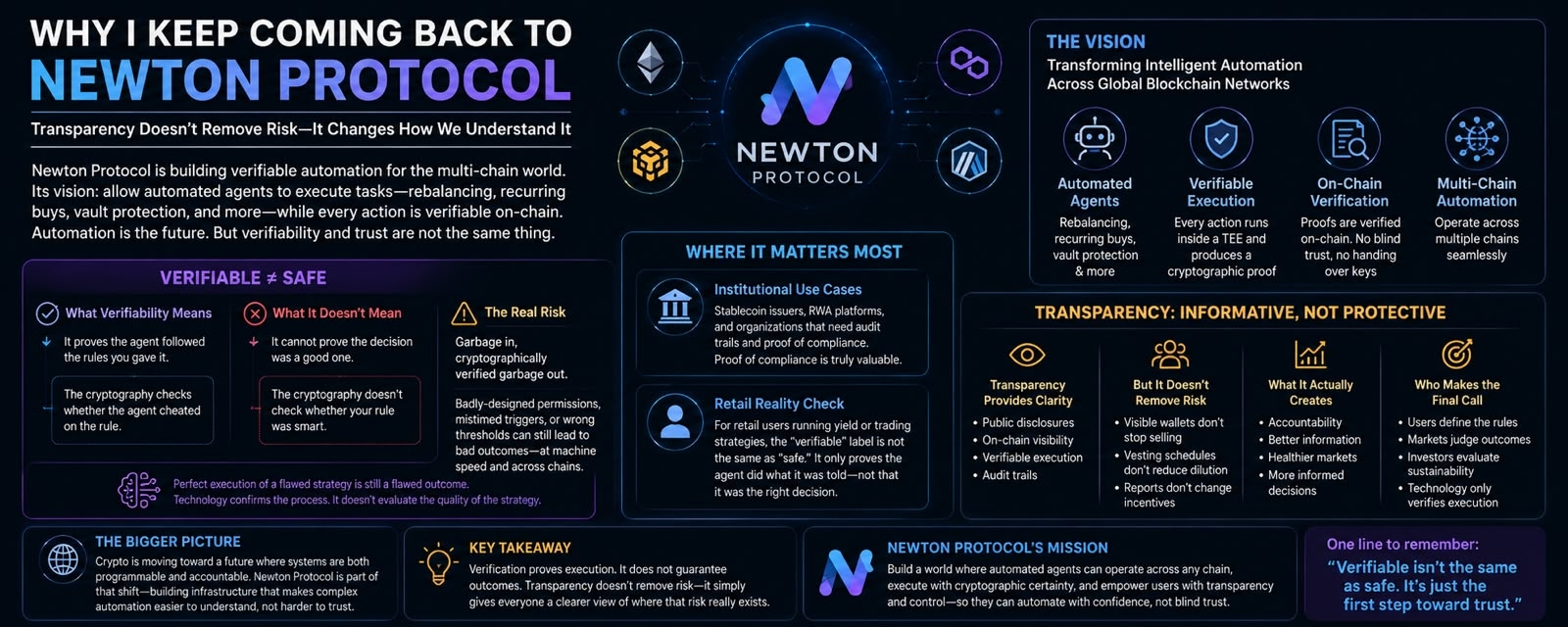
Everyone talks about making AI agents smarter, but I think we're asking the wrong question. The real challenge isn't intelligence it's trust. That's the part of Newton Protocol NEWT that caught my attention. Instead of focusing only on what AI can do, Newton is building the infrastructure that determines what AI should be allowed to do before it executes an on-chain action. As AI begins managing wallets, trading strategies and automated financial workflows, giving an agent unlimited permission simply isn't realistic. Every autonomous system needs boundaries, and Newton is trying to make those boundaries programmable. The recent Mainnet Beta launch makes this idea more tangible because developers can now start building and testing these security models in a live environment. Combined with its growing ecosystem and transparent token release schedule, the project is gradually moving beyond theory into execution. What I also find interesting is the role of NEWT itself. It isn't just designed as another payment token. Staking, governance and network participation create demand around coordinating trust across the protocol rather than simply moving value from one address to another. Many people see Newton as another AI project. I see something different. If AI becomes a permanent part of on-chain finance, the protocols defining what autonomous agents are allowed to do could become just as important as the AI models making those decisions. Sometimes the strongest infrastructure is the one users barely notice but rely on every single day. @NewtonProtocol $NEWT #Newt {spot}(NEWTUSDT) $LAB {future}(LABUSDT) $TAC {future}(TACUSDT)
Everyone talks about making AI agents smarter, but I think we're asking the wrong question.

The real challenge isn't intelligence it's trust.

That's the part of Newton Protocol NEWT that caught my attention. Instead of focusing only on what AI can do, Newton is building the infrastructure that determines what AI should be allowed to do before it executes an on-chain action.

As AI begins managing wallets, trading strategies and automated financial workflows, giving an agent unlimited permission simply isn't realistic. Every autonomous system needs boundaries, and Newton is trying to make those boundaries programmable.

The recent Mainnet Beta launch makes this idea more tangible because developers can now start building and testing these security models in a live environment. Combined with its growing ecosystem and transparent token release schedule, the project is gradually moving beyond theory into execution.

What I also find interesting is the role of NEWT itself. It isn't just designed as another payment token. Staking, governance and network participation create demand around coordinating trust across the protocol rather than simply moving value from one address to another.

Many people see Newton as another AI project. I see something different.

If AI becomes a permanent part of on-chain finance, the protocols defining what autonomous agents are allowed to do could become just as important as the AI models making those decisions.

Sometimes the strongest infrastructure is the one users barely notice but rely on every single day.

@NewtonProtocol $NEWT #Newt

$LAB

$TAC
Lihat terjemahan
Why Trust, Not Intelligence, Could Define Newton Protocolโ€™s FutureEveryone seems to believe the future of AI in crypto will be decided by whoever builds the smartest agent. I'm not convinced. Intelligence is becoming cheaper, models improve almost every month, and eventually many AI agents will be capable of doing similar things. What won't become easy is trusting those agents with real money. That's why Newton Protocol caught my attention. Instead of trying to build another AI application, Newton is building the layer that decides what AI is actually allowed to do. To me, that's a much more interesting problem. An AI that can execute thousands of actions per second isn't particularly useful if one wrong permission can empty a wallet or misuse capital. The challenge isn't making AI fasterโ€”it's making automation trustworthy. A simple analogy comes to mind. Giving an AI unrestricted wallet access is like handing someone the master key to an entire office building. It doesn't matter how intelligent they are if every door opens without permission. Newton is trying to replace that master key with a smart access card that only opens the doors needed for a specific task. That idea feels far more relevant today than it did a year ago because the project has started moving beyond theory. The launch of Mainnet Beta is an important step, not because mainnet launches automatically create value, but because they replace assumptions with real-world behavior. Infrastructure only proves itself when people begin relying on it under actual economic conditions. The public launch of the NEWT token is another piece of that transition. Most people immediately focus on price, but price is probably the least interesting part in these early stages. What matters more is that validators, developers, users, and governors finally share the same economic incentives. A protocol becomes stronger when everyone contributing to it also has something meaningful at stake. One update I appreciated was the transparency around token distribution and future unlocks. Markets usually dislike uncertainty more than they dislike dilution. Knowing when additional supply enters circulation allows participants to evaluate whether ecosystem growth is keeping pace instead of constantly guessing what comes next. Looking at the numbers, Newton currently has a fixed maximum supply of one billion NEWT, meaning there isn't endless inflation waiting in the background. Roughly a quarter of that supply is circulating today, which also means future unlocks deserve attention. Daily trading volume has remained relatively healthy compared to the current market capitalization, suggesting there's genuine market participation rather than completely inactive liquidity. The holder count has also continued growing, showing that ownership is gradually spreading beyond the earliest participants. Those statistics become meaningful when they're connected together. A fixed supply alone doesn't create value. Healthy trading volume alone doesn't prove adoption. More token holders don't automatically create a stronger network. The real question is whether these metrics begin moving alongside actual protocol usage. If more developers integrate Newton while staking participation increases and authorization requests continue growing, those numbers start reinforcing one another instead of existing in isolation. That's where I think many people misunderstand the role of the NEWT token. I don't see it primarily as something designed for speculation. It functions more like a coordination mechanism. Validators secure the network, governance participants shape future upgrades, developers build applications on top of the infrastructure, and users benefit from secure automation. The token exists to keep all of those participants moving in the same direction. Demand can come from staking, governance, network operations, and eventually the growing number of AI-powered applications using Newton's infrastructure. On the other hand, scheduled unlocks remain an obvious consideration. If ecosystem activity expands faster than circulating supply, the token economy strengthens. If adoption stalls while supply keeps increasing, pressure naturally builds. That's the balance every long-term investor should keep watching. Another thing I find interesting is what Newton isn't trying to become. It isn't positioning itself as the next AI chatbot or another autonomous trading platform competing for users. It seems more interested in becoming infrastructure that other builders quietly depend on. History shows that invisible infrastructure often creates more durable value than highly visible applications. Most people remember the apps they use every day, but those apps couldn't function without the underlying systems they rarely think about. Here's the part I think the market may still be underestimating. We spend so much time talking about smarter AI that we overlook something much more valuable: confidence. AI models will continue improving across the industry, but confidence can't simply be downloaded with the next software update. As autonomous systems begin controlling larger amounts of capital, trust may become scarcer than intelligence itself. If that happens, protocols focused on secure authorization could become significantly more important than protocols focused solely on making AI more capable. Of course, there are still plenty of unanswered questions. Mainnet activity needs to grow consistently. Developers need to prove that programmable authorization solves real problems instead of creating unnecessary complexity. Future token unlocks will test whether organic demand is strong enough to absorb additional supply. Competition in AI infrastructure is also increasing quickly, so execution will matter much more than vision. Over the coming months, I'll be paying much closer attention to three things than to the token price itself. First, whether real on-chain authorization activity keeps increasing. Second, whether staking participation grows as the network matures. And third, whether developers continue choosing Newton as the foundation for new AI-powered applications. For me, that's the real story behind Newton Protocol. It's not trying to build the smartest AI. It's trying to build the trust layer that smarter AI will eventually need. If autonomous agents become common across Web3, intelligence may stop being the competitive advantage. Trust may become the one thing every application has to borrow, and that's exactly where Newton seems to be positioning itself. @NewtonProtocol $NEWT #Newt {spot}(NEWTUSDT) $LAB {future}(LABUSDT) $TAC {future}(TACUSDT)

Why Trust, Not Intelligence, Could Define Newton Protocolโ€™s Future

Everyone seems to believe the future of AI in crypto will be decided by whoever builds the smartest agent. I'm not convinced. Intelligence is becoming cheaper, models improve almost every month, and eventually many AI agents will be capable of doing similar things. What won't become easy is trusting those agents with real money.
That's why Newton Protocol caught my attention.
Instead of trying to build another AI application, Newton is building the layer that decides what AI is actually allowed to do. To me, that's a much more interesting problem. An AI that can execute thousands of actions per second isn't particularly useful if one wrong permission can empty a wallet or misuse capital. The challenge isn't making AI fasterโ€”it's making automation trustworthy.
A simple analogy comes to mind. Giving an AI unrestricted wallet access is like handing someone the master key to an entire office building. It doesn't matter how intelligent they are if every door opens without permission. Newton is trying to replace that master key with a smart access card that only opens the doors needed for a specific task.
That idea feels far more relevant today than it did a year ago because the project has started moving beyond theory. The launch of Mainnet Beta is an important step, not because mainnet launches automatically create value, but because they replace assumptions with real-world behavior. Infrastructure only proves itself when people begin relying on it under actual economic conditions.
The public launch of the NEWT token is another piece of that transition. Most people immediately focus on price, but price is probably the least interesting part in these early stages. What matters more is that validators, developers, users, and governors finally share the same economic incentives. A protocol becomes stronger when everyone contributing to it also has something meaningful at stake.
One update I appreciated was the transparency around token distribution and future unlocks. Markets usually dislike uncertainty more than they dislike dilution. Knowing when additional supply enters circulation allows participants to evaluate whether ecosystem growth is keeping pace instead of constantly guessing what comes next.
Looking at the numbers, Newton currently has a fixed maximum supply of one billion NEWT, meaning there isn't endless inflation waiting in the background. Roughly a quarter of that supply is circulating today, which also means future unlocks deserve attention. Daily trading volume has remained relatively healthy compared to the current market capitalization, suggesting there's genuine market participation rather than completely inactive liquidity. The holder count has also continued growing, showing that ownership is gradually spreading beyond the earliest participants.
Those statistics become meaningful when they're connected together. A fixed supply alone doesn't create value. Healthy trading volume alone doesn't prove adoption. More token holders don't automatically create a stronger network. The real question is whether these metrics begin moving alongside actual protocol usage. If more developers integrate Newton while staking participation increases and authorization requests continue growing, those numbers start reinforcing one another instead of existing in isolation.
That's where I think many people misunderstand the role of the NEWT token. I don't see it primarily as something designed for speculation. It functions more like a coordination mechanism. Validators secure the network, governance participants shape future upgrades, developers build applications on top of the infrastructure, and users benefit from secure automation. The token exists to keep all of those participants moving in the same direction.
Demand can come from staking, governance, network operations, and eventually the growing number of AI-powered applications using Newton's infrastructure. On the other hand, scheduled unlocks remain an obvious consideration. If ecosystem activity expands faster than circulating supply, the token economy strengthens. If adoption stalls while supply keeps increasing, pressure naturally builds. That's the balance every long-term investor should keep watching.
Another thing I find interesting is what Newton isn't trying to become. It isn't positioning itself as the next AI chatbot or another autonomous trading platform competing for users. It seems more interested in becoming infrastructure that other builders quietly depend on. History shows that invisible infrastructure often creates more durable value than highly visible applications. Most people remember the apps they use every day, but those apps couldn't function without the underlying systems they rarely think about.
Here's the part I think the market may still be underestimating. We spend so much time talking about smarter AI that we overlook something much more valuable: confidence. AI models will continue improving across the industry, but confidence can't simply be downloaded with the next software update. As autonomous systems begin controlling larger amounts of capital, trust may become scarcer than intelligence itself. If that happens, protocols focused on secure authorization could become significantly more important than protocols focused solely on making AI more capable.
Of course, there are still plenty of unanswered questions. Mainnet activity needs to grow consistently. Developers need to prove that programmable authorization solves real problems instead of creating unnecessary complexity. Future token unlocks will test whether organic demand is strong enough to absorb additional supply. Competition in AI infrastructure is also increasing quickly, so execution will matter much more than vision.
Over the coming months, I'll be paying much closer attention to three things than to the token price itself. First, whether real on-chain authorization activity keeps increasing. Second, whether staking participation grows as the network matures. And third, whether developers continue choosing Newton as the foundation for new AI-powered applications.
For me, that's the real story behind Newton Protocol. It's not trying to build the smartest AI. It's trying to build the trust layer that smarter AI will eventually need. If autonomous agents become common across Web3, intelligence may stop being the competitive advantage. Trust may become the one thing every application has to borrow, and that's exactly where Newton seems to be positioning itself.
@NewtonProtocol $NEWT #Newt
$LAB
$TAC
Apakah Newton Protocol Membangun Infrastruktur yang Hilang untuk AI di Blockchain?Saya sudah lama mengikuti perkembangan ruang AI dan blockchain, dan satu hal yang saya perhatikan adalah percakapannya perlahan bergeser. Setahun atau dua tahun lalu, sebagian besar proyek berfokus pada pembuktian bahwa AI bisa dihubungkan dengan kripto. Saat ini, pertanyaan yang lebih menarik adalah apakah blockchain benar-benar mampu mendukung aplikasi bertenaga AI dalam skala besar. Perubahan cara pandang itulah yang membuat saya meluangkan waktu untuk menelusuri Newton Protocol NEWT. Alih-alih mencoba menjadi chatbot AI atau platform trading lainnya, proyek ini membangun infrastruktur yang dapat memungkinkan agen AI beroperasi di-chain dengan cara yang lebih aman dan efisien. Ini adalah gagasan yang ambisius, tetapi proyek infrastruktur biasanya dinilai berdasarkan eksekusi, bukan hanya visi.

Apakah Newton Protocol Membangun Infrastruktur yang Hilang untuk AI di Blockchain?

Saya sudah lama mengikuti perkembangan ruang AI dan blockchain, dan satu hal yang saya perhatikan adalah percakapannya perlahan bergeser. Setahun atau dua tahun lalu, sebagian besar proyek berfokus pada pembuktian bahwa AI bisa dihubungkan dengan kripto. Saat ini, pertanyaan yang lebih menarik adalah apakah blockchain benar-benar mampu mendukung aplikasi bertenaga AI dalam skala besar. Perubahan cara pandang itulah yang membuat saya meluangkan waktu untuk menelusuri Newton Protocol NEWT. Alih-alih mencoba menjadi chatbot AI atau platform trading lainnya, proyek ini membangun infrastruktur yang dapat memungkinkan agen AI beroperasi di-chain dengan cara yang lebih aman dan efisien. Ini adalah gagasan yang ambisius, tetapi proyek infrastruktur biasanya dinilai berdasarkan eksekusi, bukan hanya visi.
Lihat terjemahan
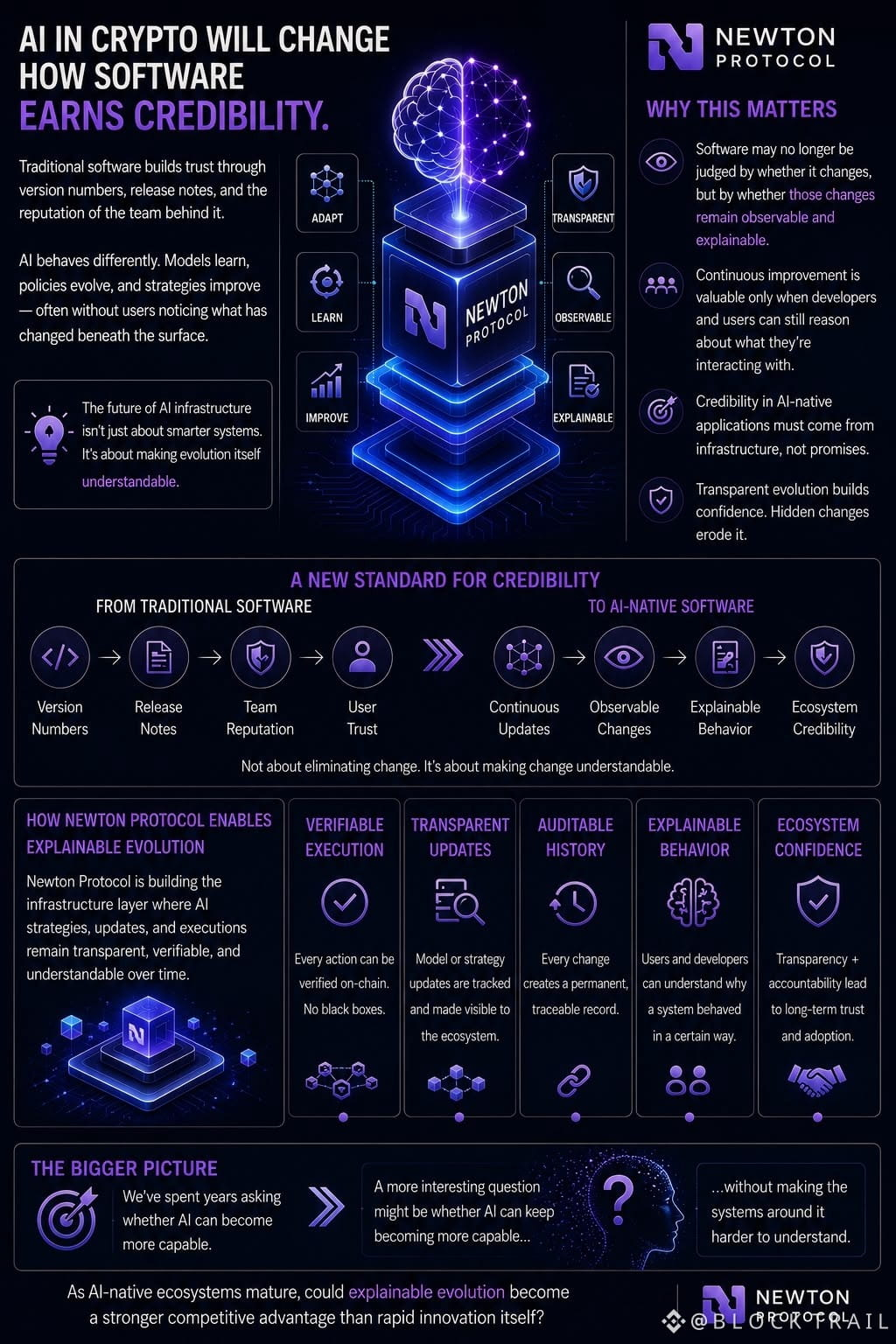
I've noticed that most AI crypto projects compete by promising smarter models or faster automation. Newton Protocol stands out because it focuses on something that's easy to overlook: trust. As AI agents become capable of managing wallets, executing strategies, and interacting with decentralized applications, verifying their actions will become just as important as the actions themselves. That's where Newton Protocol is trying to make a difference. Rather than treating security as an afterthought, the project is building an infrastructure where AI-driven actions can be verified while maintaining privacy. It's an approach that shifts the conversation from "How smart is the AI?" to "Can users confidently rely on it?" What makes Newton interesting to me is that it's solving an infrastructure problem instead of chasing hype. If developers begin integrating its verification layer into real-world applications, the project's value could be driven by actual utility rather than speculation. The AI narrative is evolving quickly, but trust may become the foundation that determines which ecosystems last. Newton Protocol is a project I'll be watching closely as that story unfolds. @NewtonProtocol $NEWT #Newt
I've noticed that most AI crypto projects compete by promising smarter models or faster automation. Newton Protocol stands out because it focuses on something that's easy to overlook: trust.

As AI agents become capable of managing wallets, executing strategies, and interacting with decentralized applications, verifying their actions will become just as important as the actions themselves. That's where Newton Protocol is trying to make a difference.

Rather than treating security as an afterthought, the project is building an infrastructure where AI-driven actions can be verified while maintaining privacy. It's an approach that shifts the conversation from "How smart is the AI?" to "Can users confidently rely on it?"

What makes Newton interesting to me is that it's solving an infrastructure problem instead of chasing hype. If developers begin integrating its verification layer into real-world applications, the project's value could be driven by actual utility rather than speculation.

The AI narrative is evolving quickly, but trust may become the foundation that determines which ecosystems last. Newton Protocol is a project I'll be watching closely as that story unfolds.

@NewtonProtocol $NEWT #Newt
Lihat terjemahan
I have watched the crypto market for years, and one thing has become clear: strong narratives alone are never enough. Projects that survive long term usually solve a real problem and continue building even after the hype fades. Newton Protocol (NEWT) is one of the projects trying to position itself at the intersection of AI and blockchain. Instead of simply adding AI as a feature, it aims to build infrastructure where autonomous AI agents can execute strategies, interact with on-chain applications, and operate in a secure environment. One of the most interesting aspects is its vision for an AI developer marketplace. If developers actively build useful AI agents and users find real value in them, the network could create sustainable demand beyond speculation. However, success will depend on execution, ecosystem growth, and developer adoptionโ€”not just the technology itself. Tokenomics also deserve attention. Utility, governance, emissions, vesting schedules, and real network activity will all play a role in determining whether the ecosystem can grow sustainably over time. Newton Protocol has an ambitious vision, but it still has important milestones to achieve. For me, the key indicators to watch are developer activity, real-world adoption, and consistent on-chain usage. As always, do your own research and focus on fundamentals rather than hype. @NewtonProtocol $NEWT #Newt {spot}(NEWTUSDT)
I have watched the crypto market for years, and one thing has become clear: strong narratives alone are never enough. Projects that survive long term usually solve a real problem and continue building even after the hype fades.

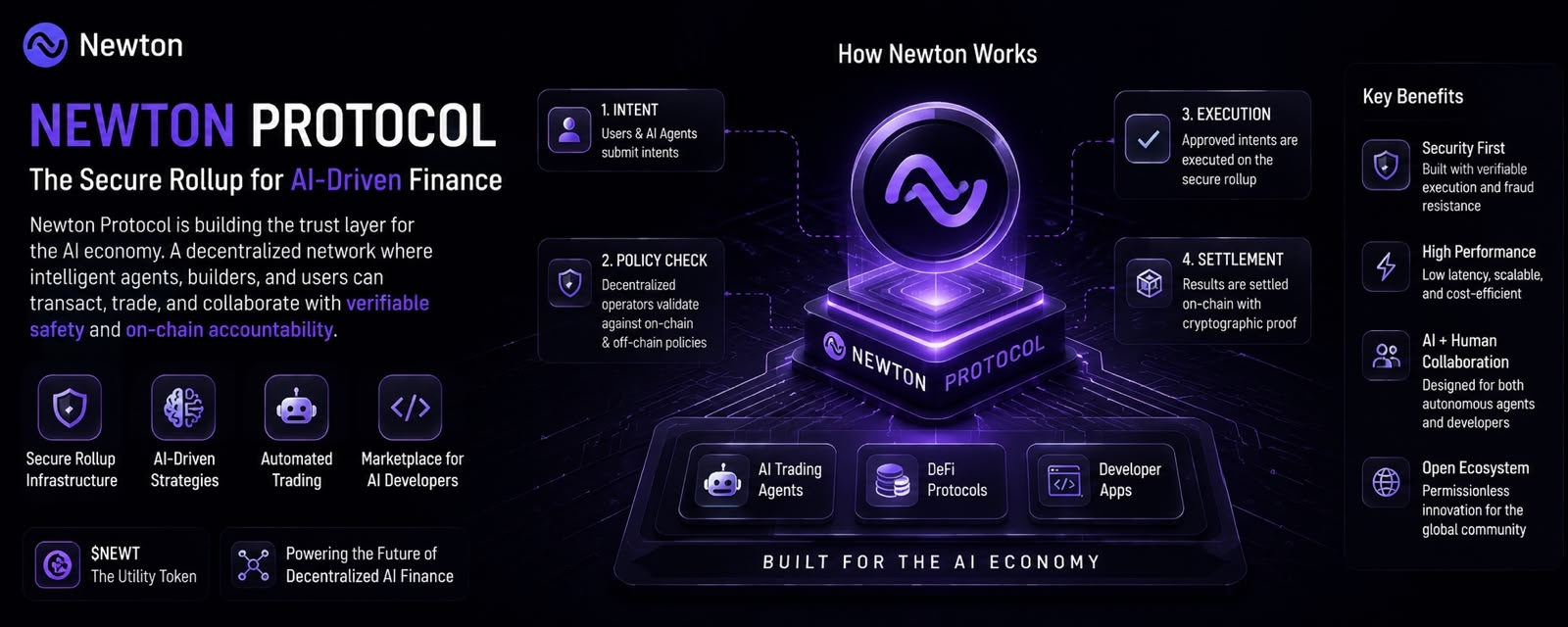
Newton Protocol (NEWT) is one of the projects trying to position itself at the intersection of AI and blockchain. Instead of simply adding AI as a feature, it aims to build infrastructure where autonomous AI agents can execute strategies, interact with on-chain applications, and operate in a secure environment.

One of the most interesting aspects is its vision for an AI developer marketplace. If developers actively build useful AI agents and users find real value in them, the network could create sustainable demand beyond speculation. However, success will depend on execution, ecosystem growth, and developer adoptionโ€”not just the technology itself.

Tokenomics also deserve attention. Utility, governance, emissions, vesting schedules, and real network activity will all play a role in determining whether the ecosystem can grow sustainably over time.

Newton Protocol has an ambitious vision, but it still has important milestones to achieve. For me, the key indicators to watch are developer activity, real-world adoption, and consistent on-chain usage. As always, do your own research and focus on fundamentals rather than hype.

@NewtonProtocol $NEWT #Newt
Artikel
Newton Protocol (NEWT): Bisakah Infrastruktur Blockchain Berbasis AI Memberikan Nilai Nyata?Saya telah mengamati pasar kripto selama bertahun-tahun, dan satu pelajaran yang konsisten terlihat: proyek yang menciptakan nilai jangka panjang biasanya adalah proyek yang menyelesaikan masalah nyata, bukan sekadar mengejar narasi terbaru. Setiap siklus pasar menghadirkan tren-tren baru, dan saat ini, kecerdasan buatan telah menjadi salah satu tema terkuat di industri blockchain. Karena itu, penting untuk memisahkan proyek infrastruktur yang benar-benar membangun dari proyek yang hanya menambahkan "AI" ke dalam branding mereka. Newton Protocol (NEWT) pantas mendapat perhatian karena mereka berupaya membangun infrastruktur yang dibutuhkan agar agen AI dapat berinteraksi dengan jaringan blockchain dengan cara yang aman dan dapat diverifikasi.

Newton Protocol (NEWT): Bisakah Infrastruktur Blockchain Berbasis AI Memberikan Nilai Nyata?

Saya telah mengamati pasar kripto selama bertahun-tahun, dan satu pelajaran yang konsisten terlihat: proyek yang menciptakan nilai jangka panjang biasanya adalah proyek yang menyelesaikan masalah nyata, bukan sekadar mengejar narasi terbaru. Setiap siklus pasar menghadirkan tren-tren baru, dan saat ini, kecerdasan buatan telah menjadi salah satu tema terkuat di industri blockchain. Karena itu, penting untuk memisahkan proyek infrastruktur yang benar-benar membangun dari proyek yang hanya menambahkan "AI" ke dalam branding mereka. Newton Protocol (NEWT) pantas mendapat perhatian karena mereka berupaya membangun infrastruktur yang dibutuhkan agar agen AI dapat berinteraksi dengan jaringan blockchain dengan cara yang aman dan dapat diverifikasi.
Banyak modal dalam AI masih mengejar kecerdasan. Model yang lebih baik menarik pendanaan. Tolok ukur yang lebih baik menarik perhatian. Asumsinya tampak sederhana: siapa pun yang membangun asisten paling pintar akan menang. Tapi perilaku pengguna mungkin menunjukkan arah yang berbeda. Kebanyakan orang tidak meninggalkan AI karena satu jawaban salah. Mereka pergi karena setiap interaksi terasa seperti memulai dari awal. Asisten melupakan preferensi, konteks, dan riwayat mereka. Kecerdasan meningkat, tetapi kontinuitas menghilang. Itulah sebabnya visi OpenGradient terasa menarik bagi saya. Kesempatan nyata mungkin bukan membangun asisten yang lebih pintar. Melainkan membangun lapisan memori yang bertahan lebih lama dari aplikasi tunggal mana pun. Jika memori menjadi portabel dan dapat diverifikasi, ekonomi AI mulai berubah. Pengguna dapat berpindah antar asisten tanpa kehilangan bertahun-tahun konteks. Pengembang mendapatkan akses ke pengalaman yang lebih kaya tanpa memiliki semua data pengguna. Agen menjadi berguna lebih cepat karena mereka mewarisi memori alih-alih membangunnya dari nol. Dan ketika saya melihat orang-orang yang mendukung OpenGradient, sinyalnya menjadi semakin menarik. Ini bukan tentang nama-nama besar. Ini tentang konvergensi penelitian AI dan infrastruktur crypto. Investor dan pembangun yang terhubung dengan kedua dunia tampaknya bertaruh pada ide yang sama: kecerdasan saja tidak cukup. Masa depan membutuhkan infrastruktur terbuka dan dapat diverifikasi yang dapat mengoordinasikan model, komputasi, agen, dan memori dalam skala besar. Mungkin parit terbesar dalam AI bukanlah kecerdasan. Mungkin itu adalah kontinuitas. @OpenGradient $OPG #OPG
Banyak modal dalam AI masih mengejar kecerdasan.

Model yang lebih baik menarik pendanaan. Tolok ukur yang lebih baik menarik perhatian. Asumsinya tampak sederhana: siapa pun yang membangun asisten paling pintar akan menang.

Tapi perilaku pengguna mungkin menunjukkan arah yang berbeda.

Kebanyakan orang tidak meninggalkan AI karena satu jawaban salah. Mereka pergi karena setiap interaksi terasa seperti memulai dari awal. Asisten melupakan preferensi, konteks, dan riwayat mereka. Kecerdasan meningkat, tetapi kontinuitas menghilang.

Itulah sebabnya visi OpenGradient terasa menarik bagi saya.

Kesempatan nyata mungkin bukan membangun asisten yang lebih pintar. Melainkan membangun lapisan memori yang bertahan lebih lama dari aplikasi tunggal mana pun.

Jika memori menjadi portabel dan dapat diverifikasi, ekonomi AI mulai berubah. Pengguna dapat berpindah antar asisten tanpa kehilangan bertahun-tahun konteks. Pengembang mendapatkan akses ke pengalaman yang lebih kaya tanpa memiliki semua data pengguna. Agen menjadi berguna lebih cepat karena mereka mewarisi memori alih-alih membangunnya dari nol.

Dan ketika saya melihat orang-orang yang mendukung OpenGradient, sinyalnya menjadi semakin menarik.

Ini bukan tentang nama-nama besar. Ini tentang konvergensi penelitian AI dan infrastruktur crypto. Investor dan pembangun yang terhubung dengan kedua dunia tampaknya bertaruh pada ide yang sama: kecerdasan saja tidak cukup. Masa depan membutuhkan infrastruktur terbuka dan dapat diverifikasi yang dapat mengoordinasikan model, komputasi, agen, dan memori dalam skala besar.

Mungkin parit terbesar dalam AI bukanlah kecerdasan.

Mungkin itu adalah kontinuitas.

@OpenGradient $OPG #OPG
Lihat terjemahan
I kept thinking about a strange contradiction in AI. Everyone assumes the biggest challenge is generating intelligence. More models. More agents. More compute. But what if that's no longer the bottleneck? As AI becomes cheaper and faster, intelligence starts behaving like an abundant resource. The real scarcity shifts somewhere else. I call it Trust Velocity. Trust Velocity is the speed at which a system can turn an AI output into something others are willing to rely on. At first, this sounds like a technical problem. But it's actually an economic one. When creating answers becomes nearly free, rational actors optimize for volume. More content. More predictions. More decisions. More automation. Yet verification doesn't scale at the same rate. The result is a growing gap between what AI can produce and what people can confidently trust. That gap creates hidden friction across the entire ecosystem. Not because intelligence is missing. Because confidence is. The more I thought about it, the more AI markets started resembling financial markets. In finance, transactions are easy. Settlement is what matters. Maybe AI is heading in the same direction. Maybe the most valuable networks won't be the ones generating the most intelligence, but the ones reducing the cost of proving intelligence. That's why OpenGradient caught my attention. Not as an AI project, but as a coordination experiment. Because in a world overflowing with machine-generated outputs, the scarce asset may not be intelligence itself. It may be verifiable trust. And that changes how value is created. @OpenGradient $OPG #OPG $BICO {spot}(BICOUSDT) $ALICE {spot}(ALICEUSDT)
I kept thinking about a strange contradiction in AI.

Everyone assumes the biggest challenge is generating intelligence.

More models. More agents. More compute.

But what if that's no longer the bottleneck?

As AI becomes cheaper and faster, intelligence starts behaving like an abundant resource. The real scarcity shifts somewhere else.

I call it Trust Velocity.

Trust Velocity is the speed at which a system can turn an AI output into something others are willing to rely on.

At first, this sounds like a technical problem.

But it's actually an economic one.

When creating answers becomes nearly free, rational actors optimize for volume. More content. More predictions. More decisions. More automation.

Yet verification doesn't scale at the same rate.

The result is a growing gap between what AI can produce and what people can confidently trust.

That gap creates hidden friction across the entire ecosystem.

Not because intelligence is missing.

Because confidence is.

The more I thought about it, the more AI markets started resembling financial markets.

In finance, transactions are easy.

Settlement is what matters.

Maybe AI is heading in the same direction.

Maybe the most valuable networks won't be the ones generating the most intelligence, but the ones reducing the cost of proving intelligence.

That's why OpenGradient caught my attention.

Not as an AI project, but as a coordination experiment.

Because in a world overflowing with machine-generated outputs, the scarce asset may not be intelligence itself.

It may be verifiable trust.

And that changes how value is created.
@OpenGradient $OPG #OPG

$BICO
$ALICE
Lihat terjemahan
I kept thinking about a strange contradiction in AI. Everyone talks about intelligence as if it's the scarce resource. Better models. Better agents. Better reasoning. But the more I looked at AI infrastructure, the more something felt off. Intelligence is becoming cheaper every year. Verification isn't. I started calling this Trust Congestion. It's what happens when the production of intelligence grows faster than the ability to verify it. At first, more models create more value. Then a tipping point appears. Outputs become abundant. Confidence becomes abundant. Claims become abundant. But proof remains scarce. That's when incentives change. Rational actors stop optimizing for being correct and start optimizing for being accepted as correct. The market gradually rewards persuasive outputs more than verifiable outputs. What looked like an intelligence economy quietly becomes a trust economy. That's why I find OpenGradient interesting. Not because it helps produce intelligence. Because it points toward a different bottleneck. In most digital markets, the highest value layer isn't creation. It's coordination. Search coordinates information. Exchanges coordinate capital. Verification networks may end up coordinating intelligence. If that happens, the most important question for AI won't be "How smart can models become?" It will be: "How cheaply can society verify what models produce?" The answer to that question may determine where value ultimately accumulates in the AI economy. And that feels far more important than the race for bigger models. $OPG #OPG @OpenGradient
I kept thinking about a strange contradiction in AI.

Everyone talks about intelligence as if it's the scarce resource. Better models. Better agents. Better reasoning.

But the more I looked at AI infrastructure, the more something felt off.

Intelligence is becoming cheaper every year.

Verification isn't.

I started calling this Trust Congestion.

It's what happens when the production of intelligence grows faster than the ability to verify it.

At first, more models create more value. Then a tipping point appears.

Outputs become abundant.

Confidence becomes abundant.

Claims become abundant.

But proof remains scarce.

That's when incentives change.

Rational actors stop optimizing for being correct and start optimizing for being accepted as correct.

The market gradually rewards persuasive outputs more than verifiable outputs.

What looked like an intelligence economy quietly becomes a trust economy.

That's why I find OpenGradient interesting.

Not because it helps produce intelligence.

Because it points toward a different bottleneck.

In most digital markets, the highest value layer isn't creation. It's coordination.

Search coordinates information.

Exchanges coordinate capital.

Verification networks may end up coordinating intelligence.

If that happens, the most important question for AI won't be "How smart can models become?"

It will be:

"How cheaply can society verify what models produce?"

The answer to that question may determine where value ultimately accumulates in the AI economy.

And that feels far more important than the race for bigger models.

$OPG #OPG @OpenGradient
Saya terus memikirkan kontradiksi aneh dalam AI. Semua orang membicarakan tentang membuat model lebih pintar, lebih cepat, dan lebih murah. Asumsi ini adalah bahwa kecerdasan adalah sumber daya yang langka. Tapi semakin saya melihat infrastruktur AI, semakin tidak benar itu tampak. Model-model baru muncul setiap minggu. Ekosistem open-source terus berkembang. Pasar komputasi menjadi lebih efisien. Kecerdasan berkembang pesat. Jadi apa yang sebenarnya menjadi langka? Awalnya saya berpikir jawabannya adalah kepercayaan. Kemudian saya menyadari bahwa kepercayaan bukanlah hambatan yang sebenarnya. Hambatan sebenarnya adalah verifikasi. Saya mulai menyebut fenomena ini "Verifikasi Drift." Verifikasi Drift terjadi ketika sistem AI berkembang lebih cepat daripada mekanisme yang digunakan untuk memverifikasinya. Model-model meningkat, agen beradaptasi, dan jaringan berkembang, tetapi sistem bukti kesulitan untuk mengikuti. Yang menarik adalah bahwa aktor rasional secara alami mengoptimalkan sekitar celah ini. Pasar segera menghargai kinerja, sementara verifikasi biasanya datang belakangan. Itu menciptakan struktur insentif tersembunyi di mana klaim dapat berkembang lebih cepat daripada bukti. Hasilnya adalah ekonomi di mana sumber daya yang paling berharga bukanlah kecerdasan itu sendiri, tetapi kepercayaan bahwa kecerdasan berperilaku seperti yang diharapkan. Ini sebabnya OpenGradient dan $OPG menonjol bagi saya. Bukan karena mereka adalah bagian dari ekonomi AI, tetapi karena mereka fokus pada lapisan yang lebih dalam dari tumpukan. Jika kecerdasan akhirnya menjadi melimpah, persaingan yang sebenarnya mungkin bergeser ke infrastruktur verifikasi. Pertanyaan masa depan mungkin bukan "Siapa yang memiliki model paling pintar?" Tapi mungkin "Siapa yang bisa membuktikannya?" @OpenGradient $OPG #OPG
Saya terus memikirkan kontradiksi aneh dalam AI.

Semua orang membicarakan tentang membuat model lebih pintar, lebih cepat, dan lebih murah. Asumsi ini adalah bahwa kecerdasan adalah sumber daya yang langka.

Tapi semakin saya melihat infrastruktur AI, semakin tidak benar itu tampak.

Model-model baru muncul setiap minggu. Ekosistem open-source terus berkembang. Pasar komputasi menjadi lebih efisien. Kecerdasan berkembang pesat.

Jadi apa yang sebenarnya menjadi langka?

Awalnya saya berpikir jawabannya adalah kepercayaan.

Kemudian saya menyadari bahwa kepercayaan bukanlah hambatan yang sebenarnya.

Hambatan sebenarnya adalah verifikasi.

Saya mulai menyebut fenomena ini "Verifikasi Drift."

Verifikasi Drift terjadi ketika sistem AI berkembang lebih cepat daripada mekanisme yang digunakan untuk memverifikasinya. Model-model meningkat, agen beradaptasi, dan jaringan berkembang, tetapi sistem bukti kesulitan untuk mengikuti.

Yang menarik adalah bahwa aktor rasional secara alami mengoptimalkan sekitar celah ini.

Pasar segera menghargai kinerja, sementara verifikasi biasanya datang belakangan.

Itu menciptakan struktur insentif tersembunyi di mana klaim dapat berkembang lebih cepat daripada bukti.

Hasilnya adalah ekonomi di mana sumber daya yang paling berharga bukanlah kecerdasan itu sendiri, tetapi kepercayaan bahwa kecerdasan berperilaku seperti yang diharapkan.

Ini sebabnya OpenGradient dan $OPG menonjol bagi saya.

Bukan karena mereka adalah bagian dari ekonomi AI, tetapi karena mereka fokus pada lapisan yang lebih dalam dari tumpukan.

Jika kecerdasan akhirnya menjadi melimpah, persaingan yang sebenarnya mungkin bergeser ke infrastruktur verifikasi.

Pertanyaan masa depan mungkin bukan "Siapa yang memiliki model paling pintar?"

Tapi mungkin "Siapa yang bisa membuktikannya?" @OpenGradient $OPG #OPG
Saya terus memikirkan apa yang terjadi ketika AI menjadi melimpah. Kebanyakan orang menganggap bahwa hambatan terbesar adalah komputasi. Yang lain berpikir itu adalah data. Tapi ada sesuatu yang terasa aneh. Sejarah menunjukkan bahwa kelimpahan jarang menghancurkan pasar. Yang menghancurkan pasar adalah ketidakmampuan untuk memverifikasi dari mana nilai berasal. Internet menciptakan konten yang tak ada habisnya, tetapi akhirnya atribusi menjadi sulit. Media sosial menciptakan informasi yang tak ada habisnya, tetapi asal-usulnya menjadi lebih sulit untuk dilacak. AI tampaknya bergerak menuju pola yang sama. Saat model dilatih dengan data sintetis, agen berinteraksi dengan agen lain, dan kecerdasan menjadi semakin rekursif, masalah baru muncul. Saya menyebutnya Entropi Asal. Entropi Asal adalah hilangnya jejak asal yang dapat dilacak seiring kecerdasan bergerak melalui jaringan. Setiap optimisasi meningkatkannya. Inferensi yang lebih cepat meningkatkannya. Sistem yang lebih otonom meningkatkannya. Bahkan model yang lebih baik meningkatkannya. Karena setiap lapisan menciptakan lebih banyak jarak antara output dan sumber aslinya. Konsekuensi mengejutkan adalah bahwa ekonomi AI di masa depan mungkin tidak bersaing terutama pada kecerdasan itu sendiri. Mereka mungkin bersaing dalam mempertahankan atribusi. Bukan karena transparansi terdengar bagus, tetapi karena sistem ekonomi memerlukan akuntabilitas. Royalti, reputasi, transaksi otomatis, dan perdagangan mesin-ke-mesin semua bergantung pada mengetahui dari mana keputusan berasal. Tanpa asal yang dapat diverifikasi, kecerdasan menjadi bernilai tetapi sulit untuk menentukan kepemilikannya. Itulah sebabnya OpenGradient mulai menarik perhatian saya. Bukan sebagai jaringan AI, tetapi sebagai infrastruktur yang dirancang untuk menahan Entropi Asal. Mungkin sumber daya langka berikutnya dalam AI tidak akan menjadi kecerdasan. Mungkin itu akan menjadi bukti dari mana kecerdasan berasal. $OPG #OPG @OpenGradient $ETH {spot}(ETHUSDT) $PORTAL {spot}(PORTALUSDT)
Saya terus memikirkan apa yang terjadi ketika AI menjadi melimpah.

Kebanyakan orang menganggap bahwa hambatan terbesar adalah komputasi.

Yang lain berpikir itu adalah data.

Tapi ada sesuatu yang terasa aneh.

Sejarah menunjukkan bahwa kelimpahan jarang menghancurkan pasar. Yang menghancurkan pasar adalah ketidakmampuan untuk memverifikasi dari mana nilai berasal.

Internet menciptakan konten yang tak ada habisnya, tetapi akhirnya atribusi menjadi sulit.

Media sosial menciptakan informasi yang tak ada habisnya, tetapi asal-usulnya menjadi lebih sulit untuk dilacak.

AI tampaknya bergerak menuju pola yang sama.

Saat model dilatih dengan data sintetis, agen berinteraksi dengan agen lain, dan kecerdasan menjadi semakin rekursif, masalah baru muncul.

Saya menyebutnya Entropi Asal.

Entropi Asal adalah hilangnya jejak asal yang dapat dilacak seiring kecerdasan bergerak melalui jaringan.

Setiap optimisasi meningkatkannya.

Inferensi yang lebih cepat meningkatkannya.

Sistem yang lebih otonom meningkatkannya.

Bahkan model yang lebih baik meningkatkannya.

Karena setiap lapisan menciptakan lebih banyak jarak antara output dan sumber aslinya.

Konsekuensi mengejutkan adalah bahwa ekonomi AI di masa depan mungkin tidak bersaing terutama pada kecerdasan itu sendiri.

Mereka mungkin bersaing dalam mempertahankan atribusi.

Bukan karena transparansi terdengar bagus, tetapi karena sistem ekonomi memerlukan akuntabilitas.

Royalti, reputasi, transaksi otomatis, dan perdagangan mesin-ke-mesin semua bergantung pada mengetahui dari mana keputusan berasal.

Tanpa asal yang dapat diverifikasi, kecerdasan menjadi bernilai tetapi sulit untuk menentukan kepemilikannya.

Itulah sebabnya OpenGradient mulai menarik perhatian saya.

Bukan sebagai jaringan AI, tetapi sebagai infrastruktur yang dirancang untuk menahan Entropi Asal.

Mungkin sumber daya langka berikutnya dalam AI tidak akan menjadi kecerdasan.

Mungkin itu akan menjadi bukti dari mana kecerdasan berasal.

$OPG #OPG @OpenGradient

$ETH
$PORTAL
Satu pertanyaan yang kurang dieksplorasi dalam AI terdesentralisasi adalah apakah verifikasi itu sendiri menjadi kekuatan sentralisasi yang baru. Semua orang berasumsi bahwa jika inferensi model dapat diverifikasi, masalah kepercayaan akan hilang. Tapi verifikasi itu tidak gratis. Semakin canggih modelnya, semakin mahal untuk membuktikan bahwa output tertentu dihasilkan dengan benar. Pada skala besar, ini menciptakan asimetri ekonomi yang menarik: menghasilkan kecerdasan mungkin menjadi lebih murah daripada memverifikasi kecerdasan. Jaringan seperti OpenGradient ($OPG) berada langsung di tengah ketegangan ini. Jika biaya verifikasi tumbuh lebih cepat daripada biaya inferensi, siapa yang sebenarnya melakukan verifikasi? Jaringan luas peserta, atau subset kecil aktor spesialis dengan perangkat keras, modal, dan keahlian teknis untuk melakukannya dengan efisien? Desentralisasi pada lapisan eksekusi tidak secara otomatis berarti desentralisasi pada lapisan verifikasi. Dampak urutan kedua bahkan lebih menarik. Pengguna jarang membayar untuk kepercayaan secara langsung; mereka membayar untuk kecepatan, kenyamanan, dan hasil. Jika verifikasi memperkenalkan latensi atau biaya tambahan, pasar mungkin secara alami tertarik pada standar verifikasi yang lebih lemah bahkan ketika jaminan yang lebih kuat secara teknis tersedia. Ini mengangkat masalah koordinasi yang lebih dalam. Tantangannya mungkin bukan membuktikan kecerdasan, tetapi menciptakan insentif bagi orang untuk peduli tentang bukti sejak awal. Mungkin bottleneck jangka panjang untuk AI terdesentralisasi bukanlah kapasitas komputasi atau kualitas model, tetapi ekonomi meyakinkan peserta bahwa verifikasi layak untuk dibayar. Jika demikian, apa sebenarnya yang kita desentralisasikan: kecerdasan itu sendiri, atau hanya penampilan kepercayaan? @OpenGradient $OPG #OPG
Satu pertanyaan yang kurang dieksplorasi dalam AI terdesentralisasi adalah apakah verifikasi itu sendiri menjadi kekuatan sentralisasi yang baru.

Semua orang berasumsi bahwa jika inferensi model dapat diverifikasi, masalah kepercayaan akan hilang. Tapi verifikasi itu tidak gratis. Semakin canggih modelnya, semakin mahal untuk membuktikan bahwa output tertentu dihasilkan dengan benar. Pada skala besar, ini menciptakan asimetri ekonomi yang menarik: menghasilkan kecerdasan mungkin menjadi lebih murah daripada memverifikasi kecerdasan.

Jaringan seperti OpenGradient ($OPG ) berada langsung di tengah ketegangan ini.

Jika biaya verifikasi tumbuh lebih cepat daripada biaya inferensi, siapa yang sebenarnya melakukan verifikasi? Jaringan luas peserta, atau subset kecil aktor spesialis dengan perangkat keras, modal, dan keahlian teknis untuk melakukannya dengan efisien? Desentralisasi pada lapisan eksekusi tidak secara otomatis berarti desentralisasi pada lapisan verifikasi.

Dampak urutan kedua bahkan lebih menarik. Pengguna jarang membayar untuk kepercayaan secara langsung; mereka membayar untuk kecepatan, kenyamanan, dan hasil. Jika verifikasi memperkenalkan latensi atau biaya tambahan, pasar mungkin secara alami tertarik pada standar verifikasi yang lebih lemah bahkan ketika jaminan yang lebih kuat secara teknis tersedia.

Ini mengangkat masalah koordinasi yang lebih dalam. Tantangannya mungkin bukan membuktikan kecerdasan, tetapi menciptakan insentif bagi orang untuk peduli tentang bukti sejak awal.

Mungkin bottleneck jangka panjang untuk AI terdesentralisasi bukanlah kapasitas komputasi atau kualitas model, tetapi ekonomi meyakinkan peserta bahwa verifikasi layak untuk dibayar. Jika demikian, apa sebenarnya yang kita desentralisasikan: kecerdasan itu sendiri, atau hanya penampilan kepercayaan?

@OpenGradient $OPG #OPG
Selama bertahun-tahun, kita mengukur teknologi berdasarkan apa yang bisa dilakukannya. Proses yang lebih cepat. Biaya yang lebih rendah. Skala yang lebih besar. Tapi semakin saya mengamati AI dan blockchain berkembang, semakin saya berpikir bahwa pertanyaan sebenarnya sedang berubah. Ini tidak lagi hanya tentang kemampuan. Ini tentang kepercayaan. AI menjadi tempat di mana orang membawa pertanyaan paling sensitif merekaโ€”keuangan, masalah kesehatan, keputusan karir, dan dilema pribadi. Pada saat yang sama, blockchain semakin bertanggung jawab dalam mengelola aset, perjanjian, dan nilai digital secara global. Satu menangani informasi. Yang lainnya menangani nilai. Keduanya memerlukan lebih dari sekadar performa. Mereka memerlukan kepercayaan. Itulah sebabnya konvergensi AI yang menjaga privasi dan sistem terdesentralisasi yang cerdas sangat menarik. Bukan karena membuat teknologi lebih kuat. Tapi karena mungkin membuat teknologi lebih dapat dipercaya. Bab berikutnya dari internet mungkin tidak didefinisikan oleh sistem yang bisa melakukan lebih banyak. Ini mungkin didefinisikan oleh sistem yang bisa dipercaya dengan lebih banyak. Karena orang tidak mengadopsi teknologi hanya karena itu mampu. Mereka mengadopsinya ketika mereka merasa nyaman menyerahkan sesuatu yang berharga di tangannya. Dalam jangka panjang, kepercayaan mungkin menjadi infrastruktur terpenting dari semuanya. @OpenGradient $OPG #OPG {spot}(OPGUSDT)
Selama bertahun-tahun, kita mengukur teknologi berdasarkan apa yang bisa dilakukannya.

Proses yang lebih cepat.

Biaya yang lebih rendah.

Skala yang lebih besar.

Tapi semakin saya mengamati AI dan blockchain berkembang, semakin saya berpikir bahwa pertanyaan sebenarnya sedang berubah.

Ini tidak lagi hanya tentang kemampuan.

Ini tentang kepercayaan.

AI menjadi tempat di mana orang membawa pertanyaan paling sensitif merekaโ€”keuangan, masalah kesehatan, keputusan karir, dan dilema pribadi.

Pada saat yang sama, blockchain semakin bertanggung jawab dalam mengelola aset, perjanjian, dan nilai digital secara global.

Satu menangani informasi.

Yang lainnya menangani nilai.

Keduanya memerlukan lebih dari sekadar performa.

Mereka memerlukan kepercayaan.

Itulah sebabnya konvergensi AI yang menjaga privasi dan sistem terdesentralisasi yang cerdas sangat menarik.

Bukan karena membuat teknologi lebih kuat.

Tapi karena mungkin membuat teknologi lebih dapat dipercaya.

Bab berikutnya dari internet mungkin tidak didefinisikan oleh sistem yang bisa melakukan lebih banyak.

Ini mungkin didefinisikan oleh sistem yang bisa dipercaya dengan lebih banyak.

Karena orang tidak mengadopsi teknologi hanya karena itu mampu.

Mereka mengadopsinya ketika mereka merasa nyaman menyerahkan sesuatu yang berharga di tangannya.

Dalam jangka panjang, kepercayaan mungkin menjadi infrastruktur terpenting dari semuanya. @OpenGradient $OPG #OPG
Sebagian besar sistem AI saat ini dinilai berdasarkan seberapa cerdas jawaban mereka terdengar. Namun, kecerdasan saja tidak menjamin kepercayaan. Sebuah respons yang meyakinkan tentang posisi $52.000 masih bisa menyisakan satu pertanyaan yang belum terjawab: bagaimana kita tahu bahwa AI benar-benar melakukan apa yang diklaimnya? Di sinilah pergeseran yang lebih dalam dimulaiโ€”dari kecerdasan ke verifikasi. Dalam dunia di mana AI bergerak ke penelitian, alokasi modal, dan pengambilan keputusan otonom, "cerdas" tidak cukup. Yang penting adalah apakah hasil keluaran dapat dipercaya, dilacak, dan diverifikasi. Gagasan ini sederhana namun kuat: jangan hanya percaya pada AIโ€”verifikasi. Sama seperti Bitcoin mengubah keuangan dengan mengganti kepercayaan dengan bukti, evolusi berikutnya dari AI mungkin bergantung pada membuat perhitungan itu sendiri dapat diverifikasi. OpenGradient mengeksplorasi transisi ini dengan memisahkan dua mode AI. Dalam model copilot, AI membantu tetapi selalu mengembalikan kontrol ke manusia. Kamu membaca, menilai, dan memutuskan langkah selanjutnya. Manusia adalah titik pemeriksaan. Dalam model autopilot, keputusan mengalir secara otomatisโ€”data memicu inferensi, inferensi memicu logika, dan sistem terus berjalan tanpa menunggu persetujuan manusia. Agar ini dapat berjalan dengan aman, setiap langkah memerlukan bukti bahwa perhitungan benar-benar terjadi seperti yang dimaksud. Itulah pergeseran inti: copilot mengembalikan kecerdasan kepada pengguna, sementara autopilot membawa kecerdasan maju dengan bukti yang dapat diverifikasi. Di masa depan ini, AI yang paling berharga bukan hanya yang paling cerdasโ€”tetapi yang dapat kamu buktikan kamu bisa percayai.@OpenGradient $OPG #OPG
Sebagian besar sistem AI saat ini dinilai berdasarkan seberapa cerdas jawaban mereka terdengar. Namun, kecerdasan saja tidak menjamin kepercayaan. Sebuah respons yang meyakinkan tentang posisi $52.000 masih bisa menyisakan satu pertanyaan yang belum terjawab: bagaimana kita tahu bahwa AI benar-benar melakukan apa yang diklaimnya?

Di sinilah pergeseran yang lebih dalam dimulaiโ€”dari kecerdasan ke verifikasi. Dalam dunia di mana AI bergerak ke penelitian, alokasi modal, dan pengambilan keputusan otonom, "cerdas" tidak cukup. Yang penting adalah apakah hasil keluaran dapat dipercaya, dilacak, dan diverifikasi.

Gagasan ini sederhana namun kuat: jangan hanya percaya pada AIโ€”verifikasi. Sama seperti Bitcoin mengubah keuangan dengan mengganti kepercayaan dengan bukti, evolusi berikutnya dari AI mungkin bergantung pada membuat perhitungan itu sendiri dapat diverifikasi.

OpenGradient mengeksplorasi transisi ini dengan memisahkan dua mode AI. Dalam model copilot, AI membantu tetapi selalu mengembalikan kontrol ke manusia. Kamu membaca, menilai, dan memutuskan langkah selanjutnya. Manusia adalah titik pemeriksaan.

Dalam model autopilot, keputusan mengalir secara otomatisโ€”data memicu inferensi, inferensi memicu logika, dan sistem terus berjalan tanpa menunggu persetujuan manusia. Agar ini dapat berjalan dengan aman, setiap langkah memerlukan bukti bahwa perhitungan benar-benar terjadi seperti yang dimaksud.

Itulah pergeseran inti: copilot mengembalikan kecerdasan kepada pengguna, sementara autopilot membawa kecerdasan maju dengan bukti yang dapat diverifikasi. Di masa depan ini, AI yang paling berharga bukan hanya yang paling cerdasโ€”tetapi yang dapat kamu buktikan kamu bisa percayai.@OpenGradient $OPG #OPG
Lihat terjemahan
Bedrockโ€™s Next Phase: Transparency, Governance & the Evolution of BRClaw The more I explore Bedrock 2.0, the more I realize that its future may depend on two things that rarely get discussed together: transparency and intelligent infrastructure. On one side, Bedrockโ€™s PoSL model introduced a compelling idea back in March 2025: protocol fees supporting BR buybacks under veBR governance. It was presented as a mechanism designed to strengthen token value and ecosystem liquidity. Yet today, many community members are still looking for a clear on-chain execution trail, treasury disclosure, or governance reference confirming completed buybacks. The mechanism exists on paper, but greater visibility around execution could significantly strengthen community confidence. On the other side sits BRClaw, Bedrockโ€™s AI-powered analytics layer. At first glance, seeing it remain in beta may raise questions. However, the Bedrock 2.0 roadmap suggests a different perspective. BRClaw is evolving alongside the protocol itself, adapting as new vault strategies, BTCFi products, and yield opportunities are introduced. Rather than being a static tool, it appears designed to grow with the ecosystem. What makes this particularly interesting is the governance connection. The same $BR holders influencing protocol decisions are also among the earliest users testing and refining the platformโ€™s analytical infrastructure. That creates a feedback loop between governance, product development, and user experience. For me, the biggest question isn't whether Bedrock can launch more features. It's whether the protocol can combine innovation with measurable transparency. If Bedrock succeeds in both, the long-term potential of $BR could become far more compelling than most people currently realize. @Bedrock #Bedrock $BR
Bedrockโ€™s Next Phase: Transparency, Governance & the Evolution of BRClaw

The more I explore Bedrock 2.0, the more I realize that its future may depend on two things that rarely get discussed together: transparency and intelligent infrastructure.

On one side, Bedrockโ€™s PoSL model introduced a compelling idea back in March 2025: protocol fees supporting BR buybacks under veBR governance. It was presented as a mechanism designed to strengthen token value and ecosystem liquidity. Yet today, many community members are still looking for a clear on-chain execution trail, treasury disclosure, or governance reference confirming completed buybacks. The mechanism exists on paper, but greater visibility around execution could significantly strengthen community confidence.

On the other side sits BRClaw, Bedrockโ€™s AI-powered analytics layer. At first glance, seeing it remain in beta may raise questions. However, the Bedrock 2.0 roadmap suggests a different perspective. BRClaw is evolving alongside the protocol itself, adapting as new vault strategies, BTCFi products, and yield opportunities are introduced. Rather than being a static tool, it appears designed to grow with the ecosystem.

What makes this particularly interesting is the governance connection. The same $BR holders influencing protocol decisions are also among the earliest users testing and refining the platformโ€™s analytical infrastructure. That creates a feedback loop between governance, product development, and user experience.

For me, the biggest question isn't whether Bedrock can launch more features. It's whether the protocol can combine innovation with measurable transparency. If Bedrock succeeds in both, the long-term potential of $BR could become far more compelling than most people currently realize.

@Bedrock #Bedrock $BR
informasi yang bagus ๐Ÿ’ฏ
S T E P H E N
ยท
--
Aku terus memikirkan tentang perusahaan Treasury Bitcoin yang mengumpulkan BTC dengan kecepatan rekor. Tapi aku yakin bagian sulitnya sudah berbalik. Selama bertahun-tahun, itu simpel: dapatkan eksposur, akumulasi, HODL. Hari ini? Modal mengalir deras, dan medan tempur telah bergeser ke penerapan.
Pasar pinjaman, peluang kredit, RWAs, strategi yield, brankas institusionalโ€”BitcoinFi sedang meledak dengan opsi. Apa yang dulunya terasa seperti kemajuan sekarang terasa semakin kompleks. Akses menjadi tanpa usaha. Alokasi cerdas? Itu adalah keunggulan.
Menjelajahi Bedrock 2.0 sangat memukulku. uniBTC berfungsi sebagai titik masuk terintegrasi, mengurangi fragmentasi di seluruh ekosistem. Rute cerdas memindahkan modal dengan lancar melalui labirin ini, sementara BRClawโ€”analisis AI on-chainโ€”memotong kelebihan informasi. Angka-angkanya berbicara banyak: 15+ rantai, lebih dari 5.000 BTC yang dipertaruhkan, dan puncak TVL mendekati $700M. Modal Bitcoin tidak lagi statisโ€”itu bergerak, terhubung, dan hidup.
Aku mencobanya sendiri. Mendepositkan jumlah kecil dan melihatnya menghasilkan 3-4% tahunan sementara tetap sepenuhnya bisa digunakan di tempat lain. Tidak ada kunci yang menyakitkan atau pilihan yang terpaksa. Secara psikologis, itu membalikkan pemikirankuโ€”dari "Di mana ini berada?" menjadi "Berapa banyak lapisan cerdas yang bisa aku tambahkan sebelum kompleksitas menggigit balik?"
Di atas kertas, yield tambahan 1-2% terlihat bersih. Dalam kenyataannya, setiap lapisan baru menambah risiko kontrak pintar, asumsi likuiditas, dan variabel penebusan. Spreadsheet menang. Radar risikoku mengangkat alis.
Ketika Treasury Bitcoin mempercepat dan BTCFi berkembang, satu pertanyaan akan menentukan pemenangnya: Apakah masa depan akan dimiliki oleh akses yang lebih baik, atau pengambilan keputusan yang lebih unggul ketika akses ada di mana-mana?
Sensasiโ€”dan keteganganโ€”terletak pada menemukan garis itu.

@Bedrock $BR #Bedrock
Masuk untuk menjelajahi konten lainnya
Bergabunglah dengan pengguna kripto global di Binance Square
โšก๏ธ Dapatkan informasi terbaru dan berguna tentang kripto.
๐Ÿ’ฌ Dipercayai oleh bursa kripto terbesar di dunia.
๐Ÿ‘ Temukan wawasan nyata dari kreator terverifikasi.
Email/Nomor Ponsel
Sitemap
Preferensi Cookie
S&K Platform