

Muhamamd Adeel
284 Publications

Muhamamd Adeel
Signaler
Bloquer l’utilisateur
Daily provide Latest News.
10 Suivis
50 Abonnés
58 J’aime
Publications
Tous
Citations
Article
Voir la traduction
Bitcoin's $80K Flip Exposed a Split Market — Whales Can't Agree EitherBitcoin spent today arguing with itself — and the on-chain data proves it.
It got rejected near $81,700 after the Fed's hold, dumped under $80,000 in Asia, then clawed its way back above it by the evening. Old support became resistance, then support again, all inside 24 hours. If you only watched the price, you'd think nothing happened. The flows tell a different story.
Here's what actually split the market today.
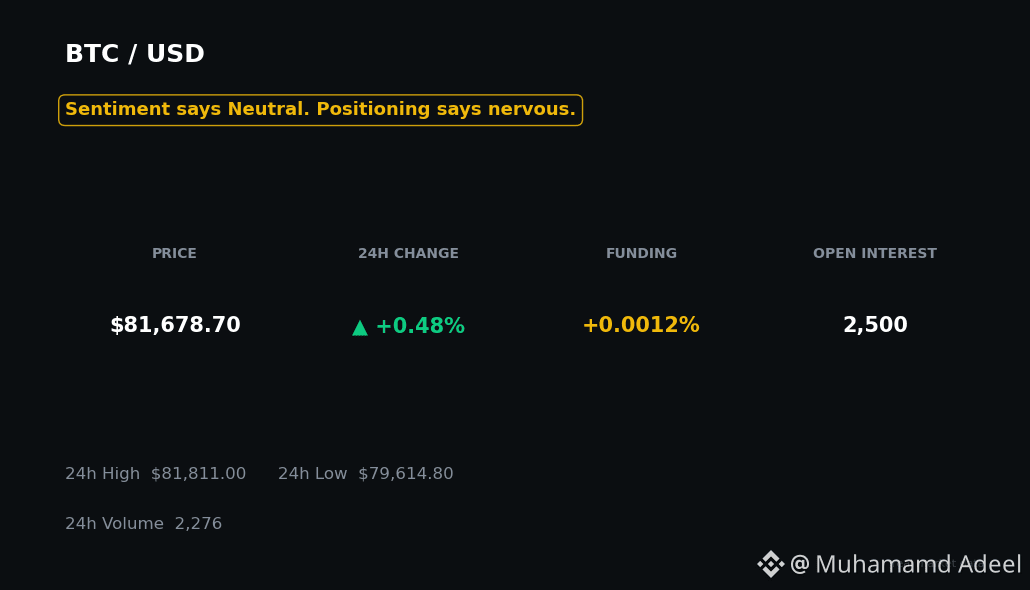
The sentiment gauge says calm. The Crypto Fear & Greed Index sits at 51 — Neutral, down from around 68 a week ago and 74 a month ago. No panic, no euphoria.
But underneath that calm, positioning turned nervous. Glassnode data shows Hyperliquid whales flipped net short on $BTC for the first time since March — the big leveraged money quietly betting the bounce fails.
Meanwhile the spot buyers refused to blink. US spot Bitcoin ETFs pulled in $137.3 million on October 28, a third straight inflow day worth $423.6 million across three sessions. Yet on the very same break below $80,000, roughly $350 million in leveraged positions got liquidated, mostly longs. Same price, two opposite bets: ETF money buying the dip, leveraged traders getting flushed out of it.
And the exchange flows? They can't make up their mind either. Santiment tracked a 14,942 BTC net outflow on October 27, the biggest in five weeks — while other trackers recorded net inflows into exchanges on October 28 itself. Deposits are not sales, and withdrawals can be custody moves, but the flip-flopping itself is the signal: conviction is thin on both sides.
$ETH tells the same split story, only messier. Analyst Ali Martinez flagged large holders cutting roughly 160,000 ETH over recent days, with exchange balances rising by about 100,000 ETH — while ETH ETFs bled for a third straight session, down $21.4 million on October 28. ETH is still pinned near $2,300, and every bounce toward $2,400 has been sold so far.
So what does this really mean for the market?
Glassnode's read is the one to keep on your screen: $85,000 has rejected Bitcoin on all but five daily closes since January, and above it sits a wall of holders who bought between $85,000 and $118,000 and would love to sell at breakeven. Below, the floor is short-term holder cost around $76,500, with heavy bids near $78,000–$79,000. That's the real range: $85,000 ceiling, $76,500–$79,000 floor, $80,000 flipping sides in between.
Watch what happens if $BTC reclaims $81,700 and holds it — that starts to repair the damage. Lose $79,000 decisively, and the $76,500 holder floor becomes the next test.
The honest take? This isn't a market with a clear villain or hero. It's a market waiting — for Friday's $11 billion-plus options expiry, for the next inflation print, for someone to finally commit. Until then, the flows will keep contradicting each other.
Check $BTC's chart before you decide which side you're on — the levels above are where this story gets settled.
Not financial advice. DYOR.
Bitcoin's $80K Flip Exposed a Split Market — Whales Can't Agree Either
Bitcoin spent today arguing with itself — and the on-chain data proves it.
It got rejected near $81,700 after the Fed's hold, dumped under $80,000 in Asia, then clawed its way back above it by the evening. Old support became resistance, then support again, all inside 24 hours. If you only watched the price, you'd think nothing happened. The flows tell a different story.
Here's what actually split the market today.
The sentiment gauge says calm. The Crypto Fear & Greed Index sits at 51 — Neutral, down from around 68 a week ago and 74 a month ago. No panic, no euphoria.
But underneath that calm, positioning turned nervous. Glassnode data shows Hyperliquid whales flipped net short on $BTC for the first time since March — the big leveraged money quietly betting the bounce fails.
Meanwhile the spot buyers refused to blink. US spot Bitcoin ETFs pulled in $137.3 million on October 28, a third straight inflow day worth $423.6 million across three sessions. Yet on the very same break below $80,000, roughly $350 million in leveraged positions got liquidated, mostly longs. Same price, two opposite bets: ETF money buying the dip, leveraged traders getting flushed out of it.
And the exchange flows? They can't make up their mind either. Santiment tracked a 14,942 BTC net outflow on October 27, the biggest in five weeks — while other trackers recorded net inflows into exchanges on October 28 itself. Deposits are not sales, and withdrawals can be custody moves, but the flip-flopping itself is the signal: conviction is thin on both sides.
$ETH tells the same split story, only messier. Analyst Ali Martinez flagged large holders cutting roughly 160,000 ETH over recent days, with exchange balances rising by about 100,000 ETH — while ETH ETFs bled for a third straight session, down $21.4 million on October 28. ETH is still pinned near $2,300, and every bounce toward $2,400 has been sold so far.
So what does this really mean for the market?
Glassnode's read is the one to keep on your screen: $85,000 has rejected Bitcoin on all but five daily closes since January, and above it sits a wall of holders who bought between $85,000 and $118,000 and would love to sell at breakeven. Below, the floor is short-term holder cost around $76,500, with heavy bids near $78,000–$79,000. That's the real range: $85,000 ceiling, $76,500–$79,000 floor, $80,000 flipping sides in between.
Watch what happens if $BTC reclaims $81,700 and holds it — that starts to repair the damage. Lose $79,000 decisively, and the $76,500 holder floor becomes the next test.
The honest take? This isn't a market with a clear villain or hero. It's a market waiting — for Friday's $11 billion-plus options expiry, for the next inflation print, for someone to finally commit. Until then, the flows will keep contradicting each other.
Check $BTC 's chart before you decide which side you're on — the levels above are where this story gets settled.
Not financial advice. DYOR.
Article
Voir la traduction
PCE came in hot at 3.6% — and $80K is now Bitcoin's line in the sandInflation just went the wrong way — and Bitcoin is paying for it.
September PCE landed this morning at 3.6% year-on-year, up from 3.4%. Core PCE ticked up to 3.1%, from 3.0%. Both were in line with Bloomberg consensus, but "in line" is not "good." Inflation is accelerating again, still well above the Fed's 2% target.
That matters because of what happened less than 24 hours earlier. The Fed held rates at 3.75%–4.00% on 28 October in a split 10–2 vote, with Lisa Cook and Beth Hammack dissenting in favour of a hike. Chair Kevin Warsh refused to signal December. The market did the signalling for him: traders now price roughly 4-in-5 odds of a December hike, with the next meeting on 8–9 December.
Because the tone was hawkish, not the decision. Warsh warned inflation has run above target for close to six years. The 10-year Treasury yield pushed back above 5%. And then this morning's PCE print removed the last excuse for relief.
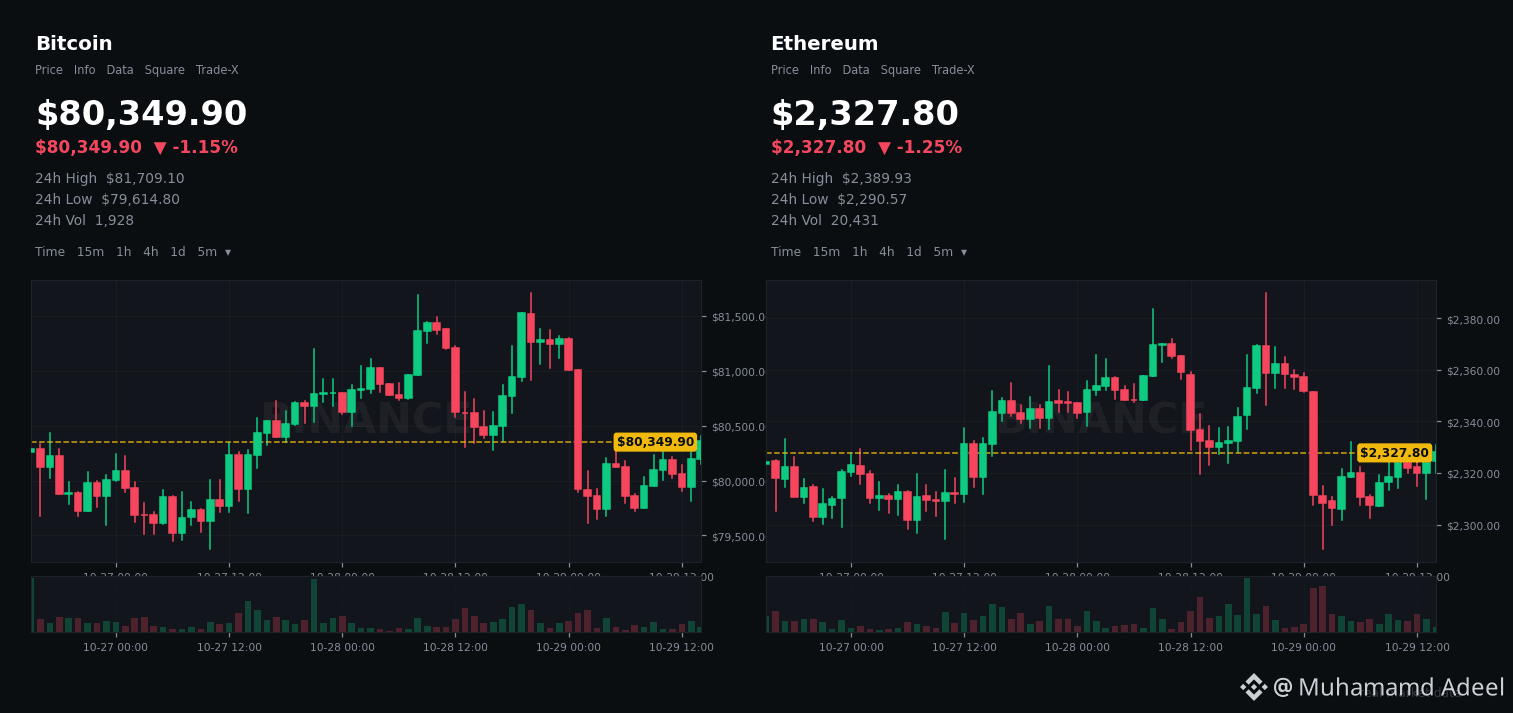
The price action tells the story. $BTC spiked toward $81,700 after the hold, then gave it all back, sliding to around $79,700–$80,200, down roughly 1–1.7% in 24 hours. About $356 million in futures positions were liquidated in 24 hours around the break, mostly longs. $ETH fared worse, around $2,303–$2,321, down roughly 1.7–2.4%, with its funding rate flipping bearish.
Now the twist nobody is talking about enough: the money was actually coming in.
US spot Bitcoin ETFs took in $137.3 million on 28 October — almost entirely BlackRock's IBIT at $136 million — the third straight inflow day, $423.6 million over three days. And Bitcoin still fell. Absorption met a macro headwind, and the headwind won, for now.
$ETH is the mirror image. Its ETFs bled about $21 million on 28 October, a third straight outflow day. On-chain, whales cut around 160,000 ETH around the $2,400 rejection while exchange balances rose. Bitcoin quietly left exchanges — Santiment counted 14,942 BTC withdrawn ahead of the decision, a five-week high — while Ethereum holders headed for the exits.
History says don't expect one print to settle this. In 2026, fully expected Fed holds have drifted lower the next day — January's hold was followed by a 6.2% slide, June's by 5.1%. And when a softer PCE print popped Bitcoin above $85,500 on 30 September, the move fully faded within about two hours because bond yields refused to fall.
So what am I watching? Pull up the $BTC chart and watch $80,000 first. Analyst levels put support at $79,500–$80,000, with $77,000–$78,000 below if that gives way, and resistance at $81,500–$82,000, then $84,000–$85,000 above. Hold $80,000 and reclaim $81,500, and the ETF inflows start to look like accumulation. Lose it, and the December-hike trade has room to run the other way.
The consensus says one clean December hike, then recovery. But that consensus is priced off accelerating inflation and a consumer whose saving rate just hit 3.8% — its lowest since October 2022. That's not a settled path. That's a live question, and $80,000 is where it gets answered.
Not financial advice. DYOR.
PCE came in hot at 3.6% — and $80K is now Bitcoin's line in the sand
Inflation just went the wrong way — and Bitcoin is paying for it.
September PCE landed this morning at 3.6% year-on-year, up from 3.4%. Core PCE ticked up to 3.1%, from 3.0%. Both were in line with Bloomberg consensus, but "in line" is not "good." Inflation is accelerating again, still well above the Fed's 2% target.
That matters because of what happened less than 24 hours earlier. The Fed held rates at 3.75%–4.00% on 28 October in a split 10–2 vote, with Lisa Cook and Beth Hammack dissenting in favour of a hike. Chair Kevin Warsh refused to signal December. The market did the signalling for him: traders now price roughly 4-in-5 odds of a December hike, with the next meeting on 8–9 December.
Because the tone was hawkish, not the decision. Warsh warned inflation has run above target for close to six years. The 10-year Treasury yield pushed back above 5%. And then this morning's PCE print removed the last excuse for relief.
The price action tells the story. $BTC spiked toward $81,700 after the hold, then gave it all back, sliding to around $79,700–$80,200, down roughly 1–1.7% in 24 hours. About $356 million in futures positions were liquidated in 24 hours around the break, mostly longs. $ETH fared worse, around $2,303–$2,321, down roughly 1.7–2.4%, with its funding rate flipping bearish.
Now the twist nobody is talking about enough: the money was actually coming in.
US spot Bitcoin ETFs took in $137.3 million on 28 October — almost entirely BlackRock's IBIT at $136 million — the third straight inflow day, $423.6 million over three days. And Bitcoin still fell. Absorption met a macro headwind, and the headwind won, for now.
$ETH is the mirror image. Its ETFs bled about $21 million on 28 October, a third straight outflow day. On-chain, whales cut around 160,000 ETH around the $2,400 rejection while exchange balances rose. Bitcoin quietly left exchanges — Santiment counted 14,942 BTC withdrawn ahead of the decision, a five-week high — while Ethereum holders headed for the exits.
History says don't expect one print to settle this. In 2026, fully expected Fed holds have drifted lower the next day — January's hold was followed by a 6.2% slide, June's by 5.1%. And when a softer PCE print popped Bitcoin above $85,500 on 30 September, the move fully faded within about two hours because bond yields refused to fall.
So what am I watching? Pull up the $BTC chart and watch $80,000 first. Analyst levels put support at $79,500–$80,000, with $77,000–$78,000 below if that gives way, and resistance at $81,500–$82,000, then $84,000–$85,000 above. Hold $80,000 and reclaim $81,500, and the ETF inflows start to look like accumulation. Lose it, and the December-hike trade has room to run the other way.
The consensus says one clean December hike, then recovery. But that consensus is priced off accelerating inflation and a consumer whose saving rate just hit 3.8% — its lowest since October 2022. That's not a settled path. That's a live question, and $80,000 is where it gets answered.
Not financial advice. DYOR.
Article
S&P vient de mettre en ligne sur la blockchain les données sur les risques des coffres via Chainlink — $LINK toujours en baisse de 24 %S&P Global Ratings vient de mettre en ligne sur la blockchain ses données sur les risques des coffres via Chainlink.
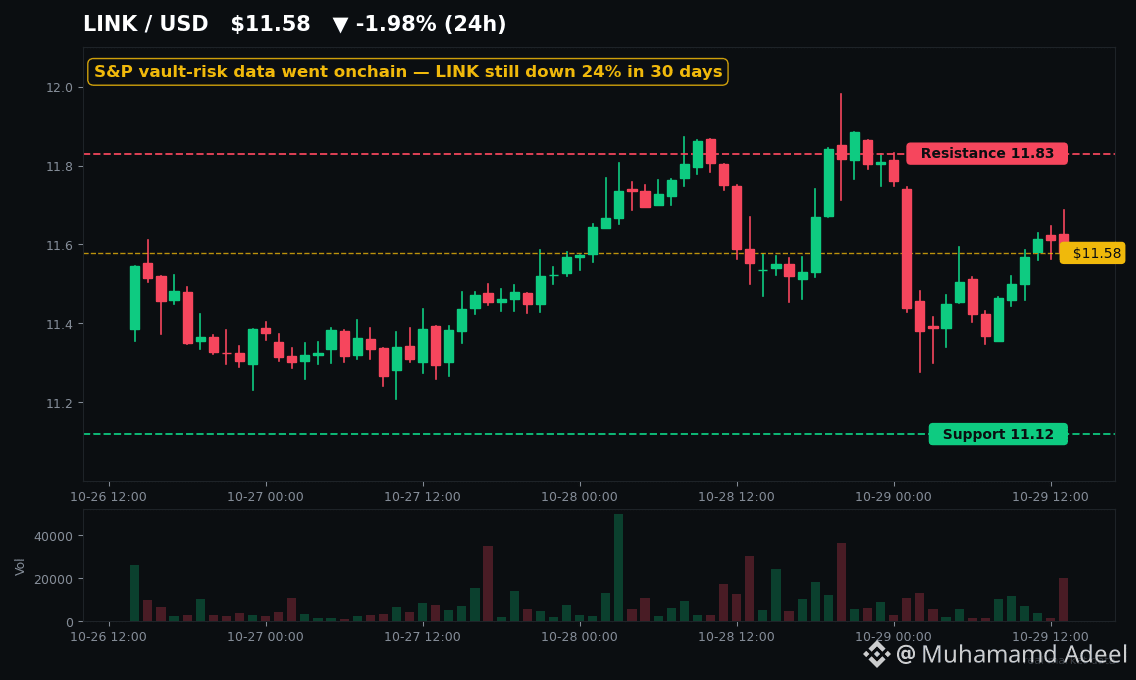
Et LINK a à peine bronché. Le token est toujours en baisse d’environ 24 % sur les 30 derniers jours. Cet écart entre ce que Chainlink construit et l’évolution de son token, c’est toute l’histoire du moment.
Voici ce qui s’est réellement passé le 28 octobre. Les données de l’évaluation des risques des coffres de S&P ont été mises en ligne sur la blockchain via Chainlink DataLink, Chainlink Runtime Environment orchestrant leur récupération et leur publication, en commençant par Base. Un réseau d’oracles parvient à un consensus sur les valeurs avant qu’elles ne soient inscrites sur la blockchain.
S&P vient de mettre en ligne sur la blockchain les données sur les risques des coffres via Chainlink — $LINK toujours en baisse de 24 %
S&P Global Ratings vient de mettre en ligne sur la blockchain ses données sur les risques des coffres via Chainlink.
Et LINK a à peine bronché. Le token est toujours en baisse d’environ 24 % sur les 30 derniers jours. Cet écart entre ce que Chainlink construit et l’évolution de son token, c’est toute l’histoire du moment.
Voici ce qui s’est réellement passé le 28 octobre. Les données de l’évaluation des risques des coffres de S&P ont été mises en ligne sur la blockchain via Chainlink DataLink, Chainlink Runtime Environment orchestrant leur récupération et leur publication, en commençant par Base. Un réseau d’oracles parvient à un consensus sur les valeurs avant qu’elles ne soient inscrites sur la blockchain.
LINK-3,57%
SPGIUS+2,44%
La vente de PREDICT à 0,29 $ vient de se terminer. Sa cotation demain sera le véritable testBinance vient de clôturer la vente. Demain, le marché aura son mot à dire.
La vente principale de $PREDICT à 0,29 $ s’est terminée aujourd’hui — et les chiffres résument toute la tension autour de ce lancement. Les acheteurs ont pu entrer à 0,29 $. Le pré-marché s’est négocié à des multiples de ce prix. Demain à 15 h, heure du Pakistan (PKT), les échanges au comptant commenceront avec une étiquette Seed. Tout le monde veut participer. Personne ne s’accorde sur sa valeur.
Qu’est-ce que c’est ?
Predict.fun est le marché de prédiction créé par BNB Chain. Vous achetez des parts Oui ou Non sur des événements futurs ; une part gagnante est réglée à 1 $. Sur ses marchés « Yield », votre garantie continue de générer des rendements via la DeFi (notamment Venus) tant que votre position est ouverte. Son fondateur, dingaling, est l’ancien responsable de la recherche chez Binance ; YZi Labs l’a accompagné en incubation.
La vente de PREDICT à 0,29 $ vient de se terminer. Sa cotation demain sera le véritable test
Binance vient de clôturer la vente. Demain, le marché aura son mot à dire.
La vente principale de $PREDICT à 0,29 $ s’est terminée aujourd’hui — et les chiffres résument toute la tension autour de ce lancement. Les acheteurs ont pu entrer à 0,29 $. Le pré-marché s’est négocié à des multiples de ce prix. Demain à 15 h, heure du Pakistan (PKT), les échanges au comptant commenceront avec une étiquette Seed. Tout le monde veut participer. Personne ne s’accorde sur sa valeur.
Qu’est-ce que c’est ?
Predict.fun est le marché de prédiction créé par BNB Chain. Vous achetez des parts Oui ou Non sur des événements futurs ; une part gagnante est réglée à 1 $. Sur ses marchés « Yield », votre garantie continue de générer des rendements via la DeFi (notamment Venus) tant que votre position est ouverte. Son fondateur, dingaling, est l’ancien responsable de la recherche chez Binance ; YZi Labs l’a accompagné en incubation.
12
Article
Voir la traduction
PCE Drops in 15 Minutes — ETH Is Pinned to $2,300In about 15 minutes, one inflation number decides whether ETH holds the line or starts sliding.
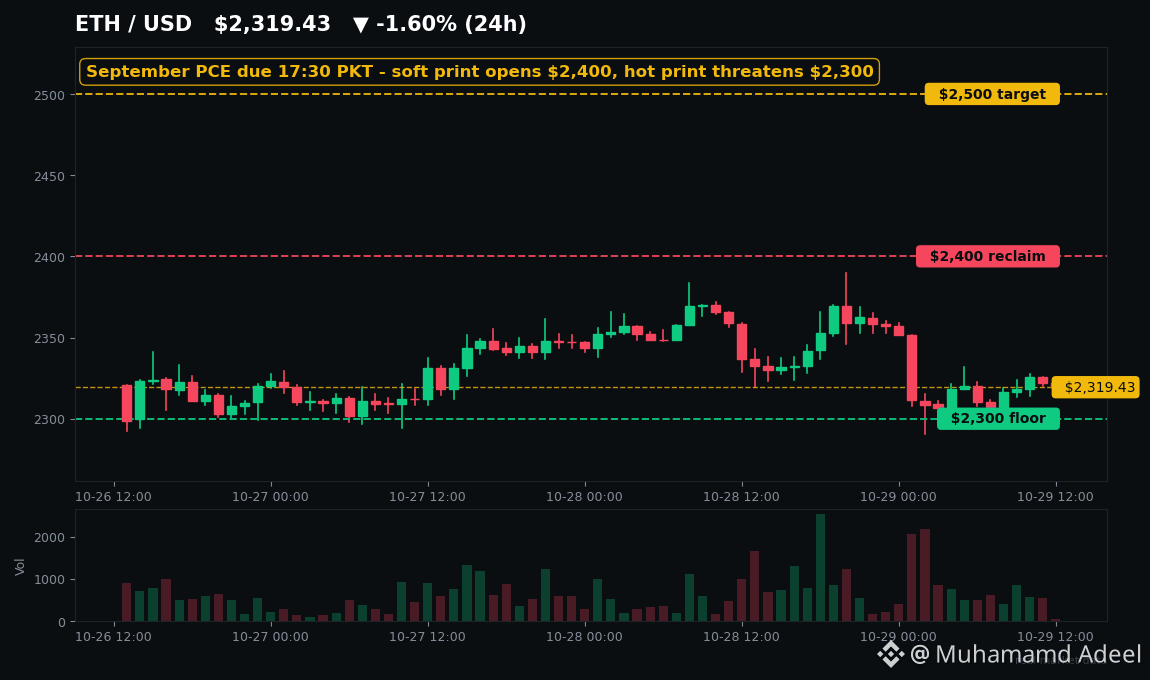
That's not hype. September PCE — the Fed's favourite inflation gauge — lands at 5:30 PM PKT today, minutes after this post. And $ETH is sitting right on the edge at ~$2,320, testing the $2,300 floor it already dipped under today (day low ~$2,292).
Here's why tonight is different from yesterday.
The Fed already had its say. It held rates at 3.75–4.00% on 28 October in a 10–2 vote, with two officials dissenting in favour of a hike. ETH popped briefly above $2,350, then gave it all back. Yesterday's decision is priced in. Tonight's print is not.
The setup underneath is a tug-of-war, and both sides have receipts.
The bears point to the ETF tape: US spot ETH funds have now bled for three straight sessions — $88.6M out on 26 October, $60.2M on 27 October, $21.4M on 28 October. October's total is around $1.32B, closing in on the worst month on record. Dormant whales aren't helping either — roughly 56,000 ETH from long-quiet wallets has moved toward exchanges since early October. A deposit isn't a sale, but coins don't move to exchanges to sit there.
The bulls have a quieter case, and it's actually interesting. The outflow pace is slowing fast — down 64% day-on-day. Fidelity just added staking to its FETH fund on 28 October, turning ETF exposure yield-bearing. And Bitwise's end-Q3 report put roughly 43.8M ETH staked — about 36% of supply — while Arbitrum just hit a 30-day high of 1.09M active addresses. The ecosystem isn't dead. It's just waiting.
So what actually happens at 5:30?
Consensus expects core PCE at 3.1% year-on-year, headline at 3.7% — both up from last month. That's the bar.
A soft print — core clearly below 3.1% — eases the December hike bets that spiked after the Fed hold, and relief runs toward $2,360 first, then $2,400, the level analysts call the first real sign of strength. Clear that, and the $2,480–$2,520 zone opens the path back toward $2,500.
A hot print does the opposite, fast. Recent history says hot inflation doesn't drift — it drops. A hot CPI in mid-October knocked ETH down over 3% the same day and another 6% the next. If $2,300 breaks on a daily close tonight, the next floors are $2,250, then $2,200, with $2,150 as the deeper support analysts are watching.
One honest warning: $2,500 is not tonight's target, it's the prize after the ladder. Anyone telling you one print takes ETH straight there is selling you something.
Watch the print, then watch the reaction. If $BTC loses $80K on a hot number, ETH rarely holds alone — check $ETH's chart at $2,300 first, because that's where this whole night gets decided.
Not financial advice. DYOR.
PCE Drops in 15 Minutes — ETH Is Pinned to $2,300
In about 15 minutes, one inflation number decides whether ETH holds the line or starts sliding.
That's not hype. September PCE — the Fed's favourite inflation gauge — lands at 5:30 PM PKT today, minutes after this post. And $ETH is sitting right on the edge at ~$2,320, testing the $2,300 floor it already dipped under today (day low ~$2,292).
Here's why tonight is different from yesterday.
The Fed already had its say. It held rates at 3.75–4.00% on 28 October in a 10–2 vote, with two officials dissenting in favour of a hike. ETH popped briefly above $2,350, then gave it all back. Yesterday's decision is priced in. Tonight's print is not.
The setup underneath is a tug-of-war, and both sides have receipts.
The bears point to the ETF tape: US spot ETH funds have now bled for three straight sessions — $88.6M out on 26 October, $60.2M on 27 October, $21.4M on 28 October. October's total is around $1.32B, closing in on the worst month on record. Dormant whales aren't helping either — roughly 56,000 ETH from long-quiet wallets has moved toward exchanges since early October. A deposit isn't a sale, but coins don't move to exchanges to sit there.
The bulls have a quieter case, and it's actually interesting. The outflow pace is slowing fast — down 64% day-on-day. Fidelity just added staking to its FETH fund on 28 October, turning ETF exposure yield-bearing. And Bitwise's end-Q3 report put roughly 43.8M ETH staked — about 36% of supply — while Arbitrum just hit a 30-day high of 1.09M active addresses. The ecosystem isn't dead. It's just waiting.
So what actually happens at 5:30?
Consensus expects core PCE at 3.1% year-on-year, headline at 3.7% — both up from last month. That's the bar.
A soft print — core clearly below 3.1% — eases the December hike bets that spiked after the Fed hold, and relief runs toward $2,360 first, then $2,400, the level analysts call the first real sign of strength. Clear that, and the $2,480–$2,520 zone opens the path back toward $2,500.
A hot print does the opposite, fast. Recent history says hot inflation doesn't drift — it drops. A hot CPI in mid-October knocked ETH down over 3% the same day and another 6% the next. If $2,300 breaks on a daily close tonight, the next floors are $2,250, then $2,200, with $2,150 as the deeper support analysts are watching.
One honest warning: $2,500 is not tonight's target, it's the prize after the ladder. Anyone telling you one print takes ETH straight there is selling you something.
Watch the print, then watch the reaction. If $BTC loses $80K on a hot number, ETH rarely holds alone — check $ETH 's chart at $2,300 first, because that's where this whole night gets decided.
Not financial advice. DYOR.
Article
Voir la traduction
The Fed Whipsawed Both Sides — Then $80K Gave WayThe Fed didn't cut. It didn't hike either. It just sat there — and $BTC still lost $80K overnight.
If you trade futures, you felt both sides of it in the last 24 hours.
The decision was almost boring: the Fed held rates at 3.75%–4.00% on 28 October in a 10–2 vote, with Lisa Cook and Beth Hammack dissenting in favour of a hike. Chair Kevin Warsh gave no signal about December. The market read it as a hawkish hold — and then whipsawed everyone.
First, the shorts got squeezed: $BTC popped from $80,860 at the announcement to $81,788 within two hours. Then, in the Asian session, tech risk-off took over — Samsung's chip miss, Alphabet's earnings disappointment — and Bitcoin slid to $79,605. By morning it was back near $80,100, and it now hovers right on $80,000.
**The derivatives tape tells the real story**
In the early-morning window on 29 October, roughly $356 million in crypto futures were liquidated, about $205 million of it longs — $94 million in Bitcoin and $72 million in $ETH. Shorts squeezed, then longs flushed.
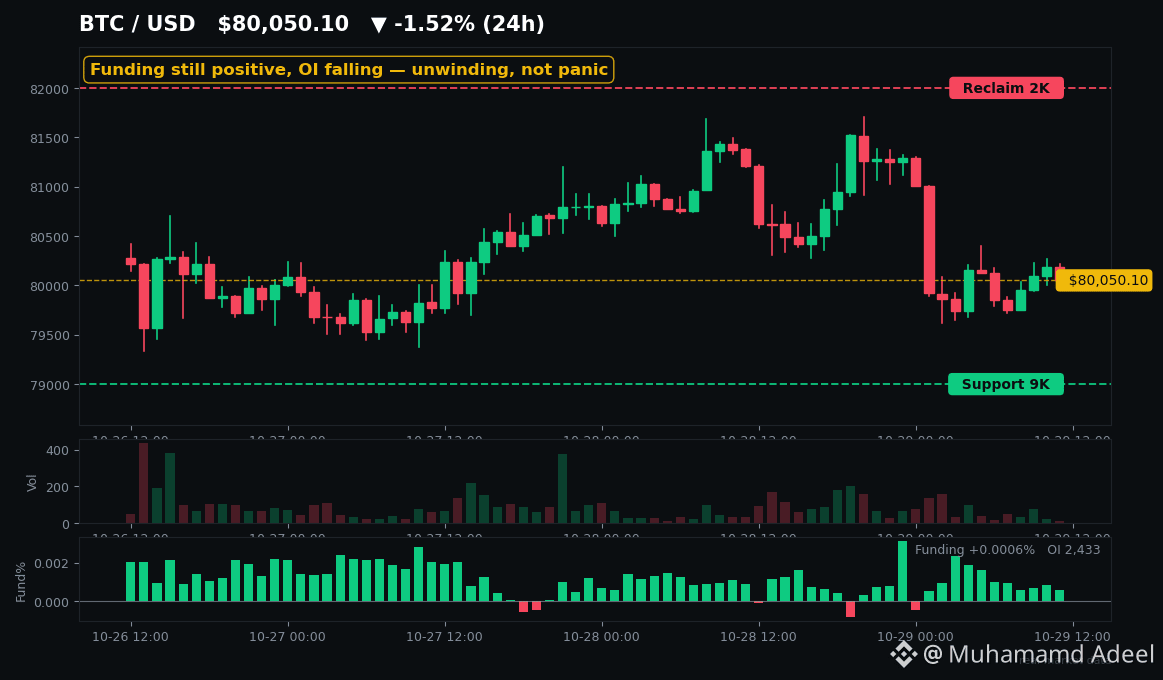
But this is NOT a capitulation. Funding is still positive: Binance Bitcoin funding sits at 0.0062% per 8 hours, with the cross-exchange average at 0.0051%. And open interest is falling, not surging — total Bitcoin futures open interest is around $53.6 billion, down 2.8% in 24 hours. Price down plus open interest down means positions are unwinding, not fresh shorts piling in — even though futures volume hit $55.8 billion in 24 hours against just $4.3 billion of spot volume.
**Why $80K is so fragile**
On-chain data explains it. Long-term holders own roughly 4 million Bitcoin bought between $85,000 and $118,000 — most of it now underwater. Bids at $80,000 have dried up: only about $3.4 million were left after the 15 and 24 October drops swept them. The real bid wall now sits at $78,000–$79,000, $42 million stacked there, with the densest cluster of newer buyers near $77,000.
Bitcoin ETFs still took in $137.3 million on 28 October while Ethereum ETFs lost about $21.4 million.
**What to watch**
History warns this isn't decided: after past hawkish holds, Bitcoin typically fell a median 4.1% over five sessions, with the low forming around 48 hours after the announcement, not at it.
Pull up the $BTC chart and watch two lines. A reclaim of $82,000 flips the near-term picture back toward the bulls. A daily close below $79,000 opens the door to that $77,000–$78,000 bid zone — where Friday's $11 billion Bitcoin options expiry, with max pain near $78,000, is waiting to add volatility. $ETH, near $2,305, faces the same test at $2,300.
The catalysts keep coming: the PCE inflation report later today, Friday's options expiry, and the 31 October Mt. Gox deadline as overhang, not confirmed selling. A December hike is priced at over 80% — priced, not decided.
The Fed didn't move. The leverage did. And the next 48 hours will tell us whether $80,000 was a dip to buy — or a floor giving way.
Not financial advice. DYOR.
The Fed Whipsawed Both Sides — Then $80K Gave Way
The Fed didn't cut. It didn't hike either. It just sat there — and $BTC still lost $80K overnight.
If you trade futures, you felt both sides of it in the last 24 hours.
The decision was almost boring: the Fed held rates at 3.75%–4.00% on 28 October in a 10–2 vote, with Lisa Cook and Beth Hammack dissenting in favour of a hike. Chair Kevin Warsh gave no signal about December. The market read it as a hawkish hold — and then whipsawed everyone.
First, the shorts got squeezed: $BTC popped from $80,860 at the announcement to $81,788 within two hours. Then, in the Asian session, tech risk-off took over — Samsung's chip miss, Alphabet's earnings disappointment — and Bitcoin slid to $79,605. By morning it was back near $80,100, and it now hovers right on $80,000.
**The derivatives tape tells the real story**
In the early-morning window on 29 October, roughly $356 million in crypto futures were liquidated, about $205 million of it longs — $94 million in Bitcoin and $72 million in $ETH . Shorts squeezed, then longs flushed.
But this is NOT a capitulation. Funding is still positive: Binance Bitcoin funding sits at 0.0062% per 8 hours, with the cross-exchange average at 0.0051%. And open interest is falling, not surging — total Bitcoin futures open interest is around $53.6 billion, down 2.8% in 24 hours. Price down plus open interest down means positions are unwinding, not fresh shorts piling in — even though futures volume hit $55.8 billion in 24 hours against just $4.3 billion of spot volume.
**Why $80K is so fragile**
On-chain data explains it. Long-term holders own roughly 4 million Bitcoin bought between $85,000 and $118,000 — most of it now underwater. Bids at $80,000 have dried up: only about $3.4 million were left after the 15 and 24 October drops swept them. The real bid wall now sits at $78,000–$79,000, $42 million stacked there, with the densest cluster of newer buyers near $77,000.
Bitcoin ETFs still took in $137.3 million on 28 October while Ethereum ETFs lost about $21.4 million.
**What to watch**
History warns this isn't decided: after past hawkish holds, Bitcoin typically fell a median 4.1% over five sessions, with the low forming around 48 hours after the announcement, not at it.
Pull up the $BTC chart and watch two lines. A reclaim of $82,000 flips the near-term picture back toward the bulls. A daily close below $79,000 opens the door to that $77,000–$78,000 bid zone — where Friday's $11 billion Bitcoin options expiry, with max pain near $78,000, is waiting to add volatility. $ETH , near $2,305, faces the same test at $2,300.
The catalysts keep coming: the PCE inflation report later today, Friday's options expiry, and the 31 October Mt. Gox deadline as overhang, not confirmed selling. A December hike is priced at over 80% — priced, not decided.
The Fed didn't move. The leverage did. And the next 48 hours will tell us whether $80,000 was a dip to buy — or a floor giving way.
Not financial advice. DYOR.
Article
Voir la traduction
Fed Held, BTC Slipped Under $80K — BNB Refused to Follow. PCE Is NextThe Fed didn't cut. Bitcoin slipped under $80,000. And BNB? It refused to follow — the only major in the green on the morning after the decision.
So what's BNB got that the rest of the market doesn't? The next few hours might decide whether this is real strength or just a delayed fall.
THE SETUP
On 28 October the Fed held rates at 3.75%-4.00% in a 10-2 vote — and the two dissents actually wanted a hike. Chair Kevin Warsh promised nothing about December, but futures pricing jumped to around 87% for a December hike anyway. That's a hawkish hold, plain and simple.
$BTC felt it first, falling from above $81,700 to around $79,800 in Asian trading on 29 October, back under the $80K line everyone was watching. ETH, SOL and XRP slid with it.
BNB didn't — at first. It closed 28 October up 2.2% at $759, and TokenPost's morning snapshot had it as the only gainer among the six majors, up 1.25% while BTC fell 0.83% and ETH fell 1.32%. That's not decoupling. That's relative strength, and there's a difference.
THE LEVELS THAT MATTER
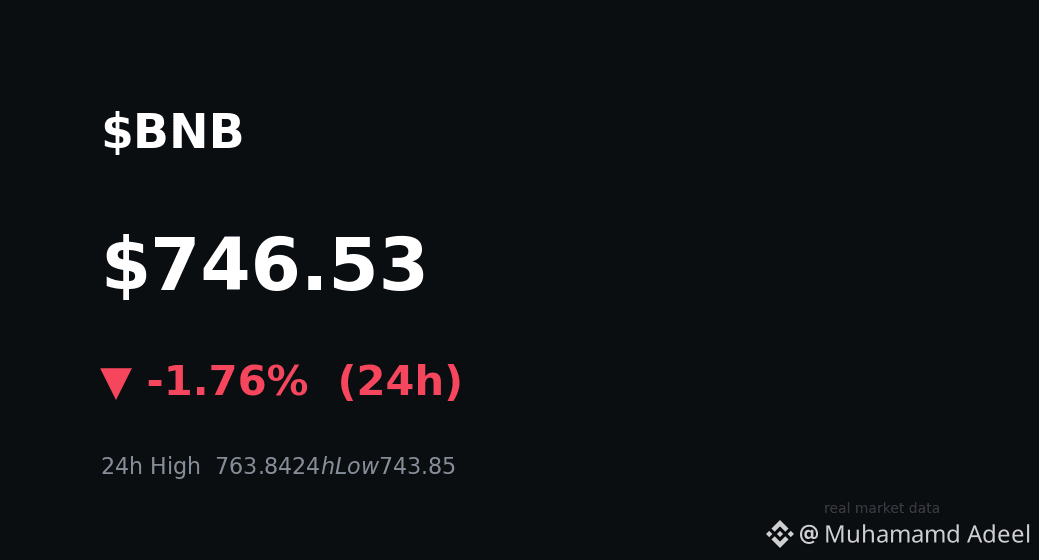
Here's the battleground, and it's live right now. $BNB is trading just under a $753 pivot, near its 50-day average around $750.
Above: $761.74, the ceiling that already capped the 24-hour high of $762.20. A daily close above that opens $770.89. Below: $743.89, then the stronger $735 floor that held the October pullback. Lose $744 and the "BNB is different" story starts to crack fast.
Check $BNB's chart yourself — this is a coin parked dead on a decision level, not one running away in either direction.
WHY IT'S HOLDING UP
Two things landed on the same day as the Fed decision, and both are real. BNB Chain activated the Jenner hard fork on its testnet on 28 October: a Payment Lane reserving 5% of block gas for payment transactions, groundwork for a compliant-asset standard aimed at stablecoins and tokenized assets, and millisecond block timestamps. Testnet only — no mainnet date announced, and the big features still need governance approval — so don't let anyone sell you this as a launch-day pump.
The quieter cushion is the chain itself: $5.52 billion in TVL, $6.17 billion in 7-day DEX volume, and a 19 October burn that destroyed 1.65 million BNB worth roughly $1.2 billion. That's the fundamental floor under the price action.
THE HONEST RISK
Now the part the bulls skip. Positioning is crowded: around 70% of tracked Binance accounts are long BNB, yet aggressive short-term flow has been selling, not buying. If today's PCE inflation print comes in hot, the December hike gets locked in — and if $BTC loses $79K decisively, BNB's premium usually compresses with everything else. Last December's hawkish Fed moment bled BNB about 3% in a day. Not a crash. An orderly slide — and that's exactly what this setup risks repeating.
WHAT TO WATCH NEXT
September PCE lands today at 17:30 PKT, with core expected at +0.3% month-on-month. Hot print, hike locked, risk-off. Soft print, and the only dovish escape hatch opens.
So the question isn't whether BNB is strong. It's whether $750 holds through PCE and through $BTC's fight for $80K. That's the trade to watch — not the hype, the levels.
Not financial advice. DYOR.
Fed Held, BTC Slipped Under $80K — BNB Refused to Follow. PCE Is Next
The Fed didn't cut. Bitcoin slipped under $80,000. And BNB? It refused to follow — the only major in the green on the morning after the decision.
So what's BNB got that the rest of the market doesn't? The next few hours might decide whether this is real strength or just a delayed fall.
THE SETUP
On 28 October the Fed held rates at 3.75%-4.00% in a 10-2 vote — and the two dissents actually wanted a hike. Chair Kevin Warsh promised nothing about December, but futures pricing jumped to around 87% for a December hike anyway. That's a hawkish hold, plain and simple.
$BTC felt it first, falling from above $81,700 to around $79,800 in Asian trading on 29 October, back under the $80K line everyone was watching. ETH, SOL and XRP slid with it.
BNB didn't — at first. It closed 28 October up 2.2% at $759, and TokenPost's morning snapshot had it as the only gainer among the six majors, up 1.25% while BTC fell 0.83% and ETH fell 1.32%. That's not decoupling. That's relative strength, and there's a difference.
THE LEVELS THAT MATTER
Here's the battleground, and it's live right now. $BNB is trading just under a $753 pivot, near its 50-day average around $750.
Above: $761.74, the ceiling that already capped the 24-hour high of $762.20. A daily close above that opens $770.89. Below: $743.89, then the stronger $735 floor that held the October pullback. Lose $744 and the "BNB is different" story starts to crack fast.
Check $BNB 's chart yourself — this is a coin parked dead on a decision level, not one running away in either direction.
WHY IT'S HOLDING UP
Two things landed on the same day as the Fed decision, and both are real. BNB Chain activated the Jenner hard fork on its testnet on 28 October: a Payment Lane reserving 5% of block gas for payment transactions, groundwork for a compliant-asset standard aimed at stablecoins and tokenized assets, and millisecond block timestamps. Testnet only — no mainnet date announced, and the big features still need governance approval — so don't let anyone sell you this as a launch-day pump.
The quieter cushion is the chain itself: $5.52 billion in TVL, $6.17 billion in 7-day DEX volume, and a 19 October burn that destroyed 1.65 million BNB worth roughly $1.2 billion. That's the fundamental floor under the price action.
THE HONEST RISK
Now the part the bulls skip. Positioning is crowded: around 70% of tracked Binance accounts are long BNB, yet aggressive short-term flow has been selling, not buying. If today's PCE inflation print comes in hot, the December hike gets locked in — and if $BTC loses $79K decisively, BNB's premium usually compresses with everything else. Last December's hawkish Fed moment bled BNB about 3% in a day. Not a crash. An orderly slide — and that's exactly what this setup risks repeating.
WHAT TO WATCH NEXT
September PCE lands today at 17:30 PKT, with core expected at +0.3% month-on-month. Hot print, hike locked, risk-off. Soft print, and the only dovish escape hatch opens.
So the question isn't whether BNB is strong. It's whether $750 holds through PCE and through $BTC 's fight for $80K. That's the trade to watch — not the hype, the levels.
Not financial advice. DYOR.
Article
Voir la traduction
Fetch.ai Just Shipped ASI:Work. So Why Is $FET Still Stuck at $0.18?Fetch.ai just shipped the most useful product in its history. The market yawned — and $FET is now testing the level it can't afford to lose.
Yesterday, Fetch.ai launched ASI:Work inside its ASI:One desktop app. Point it at a folder, describe a job, and it reads files, writes files, runs commands, even works through code projects and runs tests. Not a roadmap slide — a real tool, shipping on Mac and Windows, right now.
And the price? Down. FET trades around $0.18 — roughly 95% below its March 2024 high near $3.45, down about 20% in the last month. The community mood says it all: everyone agrees Fetch.ai is building; nobody agrees it's paying yet.
Here's the tension.
The setup
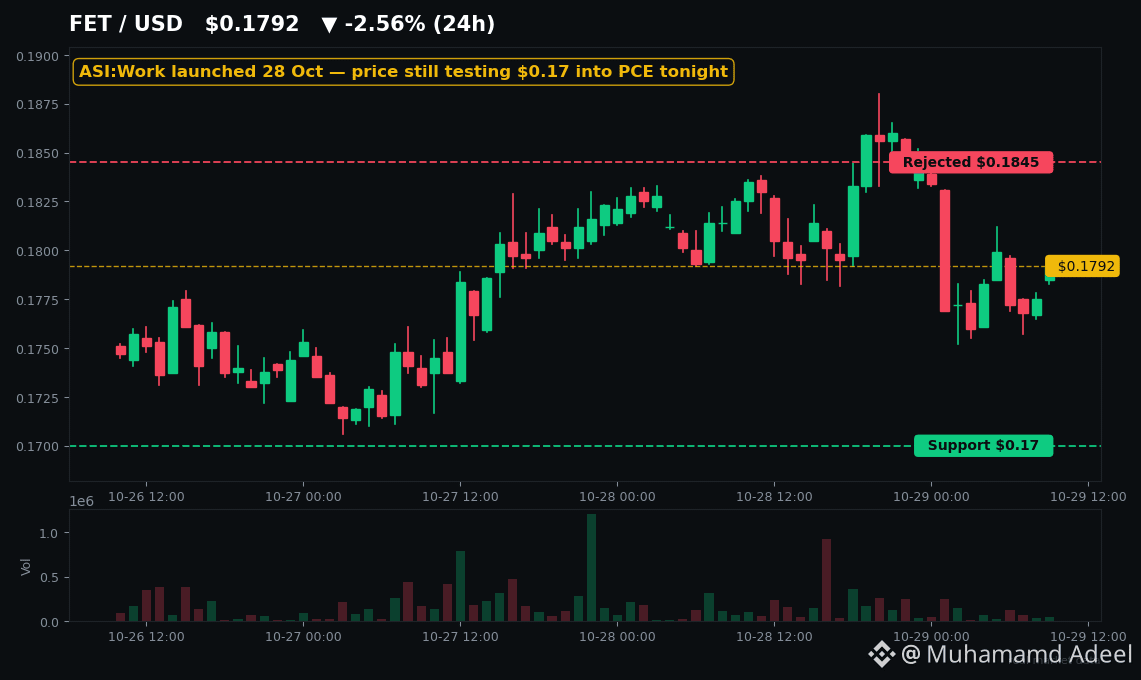
FET is sitting right on support. The $0.17 area is where buyers have to show up. Below it, the next real floor is around $0.16, and most models see FET stuck in a $0.15–$0.25 range into year-end unless something changes.
Above, the first test is $0.1845 — today's intraday high, already rejected once. Reclaim that, then $0.1885, and the conversation changes. Lose $0.17, and the "beaten-down AI token" story gets a lot harder to tell.
Pull up the $FET chart and you'll see how tight this range is — support and resistance only cents apart, and the next move will be fast in one direction or the other.
Why this time could be different
History is not kind to FET headlines. When the ASI merger launched in July 2024, FET fell anyway. When the Fed turned hawkish in December 2024, FET bled for four straight months. AI tokens move as a basket, and right now the basket is under pressure: Anthropic's S-1 showed an $80.7B first-half loss, and the AI sector fell sharply in the last 24 hours.
But two things are genuinely new. ASI:Work is a product people can use today — not a partnership announcement, not a rebranded old launch. And the tape is about to deliver a verdict either way: September PCE lands tonight, and a hot print strengthens the case for a December rate hike the market already prices at roughly 80%.
The honest risks
Let's not pretend the slate is clean. A September exploit drained about $1.56M from Fetch.ai's token conversion contract. Ocean Protocol quit the ASI Alliance last October. And the Phase II migration from FET to an ASI token is still shelved — FET is the ticker, full stop.
One more wrinkle: Binance removes the FET/U margin pair tomorrow. That's a pair removal, not a token delisting — spot trading continues — but it trims leverage access right when volatility is about to spike.
So here's my take: FET is a product story colliding with a macro story. If PCE comes in cool and $0.17 holds, the beaten-down AI laggard gets room to breathe — AI peers like $TAO are watching the same macro tape. If PCE runs hot and $0.17 breaks, no product launch saves it.
Shipping finally matters. Tonight we find out whether the market agrees.
Not financial advice. DYOR.
Fetch.ai Just Shipped ASI:Work. So Why Is $FET Still Stuck at $0.18?
Fetch.ai just shipped the most useful product in its history. The market yawned — and $FET is now testing the level it can't afford to lose.
Yesterday, Fetch.ai launched ASI:Work inside its ASI:One desktop app. Point it at a folder, describe a job, and it reads files, writes files, runs commands, even works through code projects and runs tests. Not a roadmap slide — a real tool, shipping on Mac and Windows, right now.
And the price? Down. FET trades around $0.18 — roughly 95% below its March 2024 high near $3.45, down about 20% in the last month. The community mood says it all: everyone agrees Fetch.ai is building; nobody agrees it's paying yet.
Here's the tension.
The setup
FET is sitting right on support. The $0.17 area is where buyers have to show up. Below it, the next real floor is around $0.16, and most models see FET stuck in a $0.15–$0.25 range into year-end unless something changes.
Above, the first test is $0.1845 — today's intraday high, already rejected once. Reclaim that, then $0.1885, and the conversation changes. Lose $0.17, and the "beaten-down AI token" story gets a lot harder to tell.
Pull up the $FET chart and you'll see how tight this range is — support and resistance only cents apart, and the next move will be fast in one direction or the other.
Why this time could be different
History is not kind to FET headlines. When the ASI merger launched in July 2024, FET fell anyway. When the Fed turned hawkish in December 2024, FET bled for four straight months. AI tokens move as a basket, and right now the basket is under pressure: Anthropic's S-1 showed an $80.7B first-half loss, and the AI sector fell sharply in the last 24 hours.
But two things are genuinely new. ASI:Work is a product people can use today — not a partnership announcement, not a rebranded old launch. And the tape is about to deliver a verdict either way: September PCE lands tonight, and a hot print strengthens the case for a December rate hike the market already prices at roughly 80%.
The honest risks
Let's not pretend the slate is clean. A September exploit drained about $1.56M from Fetch.ai's token conversion contract. Ocean Protocol quit the ASI Alliance last October. And the Phase II migration from FET to an ASI token is still shelved — FET is the ticker, full stop.
One more wrinkle: Binance removes the FET/U margin pair tomorrow. That's a pair removal, not a token delisting — spot trading continues — but it trims leverage access right when volatility is about to spike.
So here's my take: FET is a product story colliding with a macro story. If PCE comes in cool and $0.17 holds, the beaten-down AI laggard gets room to breathe — AI peers like $TAO are watching the same macro tape. If PCE runs hot and $0.17 breaks, no product launch saves it.
Shipping finally matters. Tonight we find out whether the market agrees.
Not financial advice. DYOR.
33
Article
La Fed n’a pas baissé ses taux — elle a lancé un avertissement. Le PCE décidera maintenant du sort des 80 000 $ du BitcoinLa Fed n’a pas baissé ses taux. Elle a lancé un avertissement — et le Bitcoin vient d’en payer le prix.
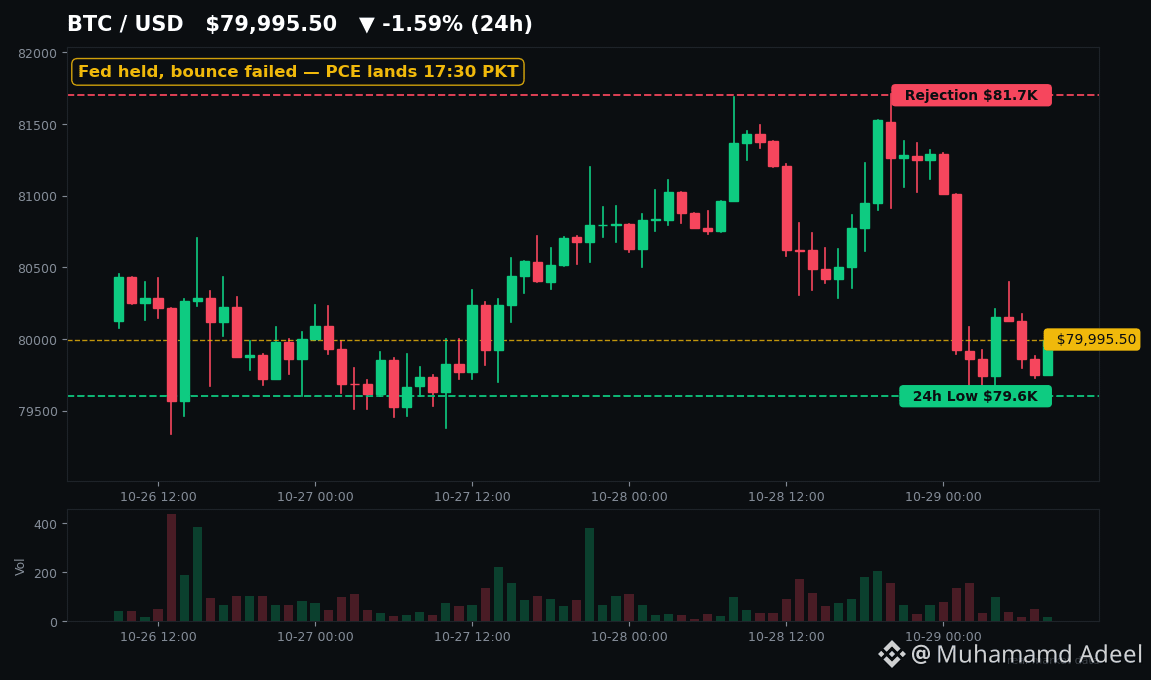
$BTC est repassé sous les 80 000 $ lors de la séance asiatique de jeudi, effaçant tout son rebond après la décision de la Fed. La question n’est plus ce qu’a fait la Fed. C’est ce que le chiffre de l’inflation publié ce soir va provoquer.
**Le rebond avorté**
Après que la Fed a maintenu ses taux entre 3,75 % et 4,00 % mercredi, le Bitcoin a bondi au-dessus de 81 700 $. Puis le ton s’est fait sentir : le vote était de 10 contre 2, les deux voix dissidentes plaidant pour une hausse, et non une baisse. Le président Kevin Warsh a refusé de prendre position sur décembre et a répété que l’inflation « reste élevée ».
La Fed n’a pas baissé ses taux — elle a lancé un avertissement. Le PCE décidera maintenant du sort des 80 000 $ du Bitcoin
La Fed n’a pas baissé ses taux. Elle a lancé un avertissement — et le Bitcoin vient d’en payer le prix.
$BTC est repassé sous les 80 000 $ lors de la séance asiatique de jeudi, effaçant tout son rebond après la décision de la Fed. La question n’est plus ce qu’a fait la Fed. C’est ce que le chiffre de l’inflation publié ce soir va provoquer.
**Le rebond avorté**
Après que la Fed a maintenu ses taux entre 3,75 % et 4,00 % mercredi, le Bitcoin a bondi au-dessus de 81 700 $. Puis le ton s’est fait sentir : le vote était de 10 contre 2, les deux voix dissidentes plaidant pour une hausse, et non une baisse. Le président Kevin Warsh a refusé de prendre position sur décembre et a répété que l’inflation « reste élevée ».
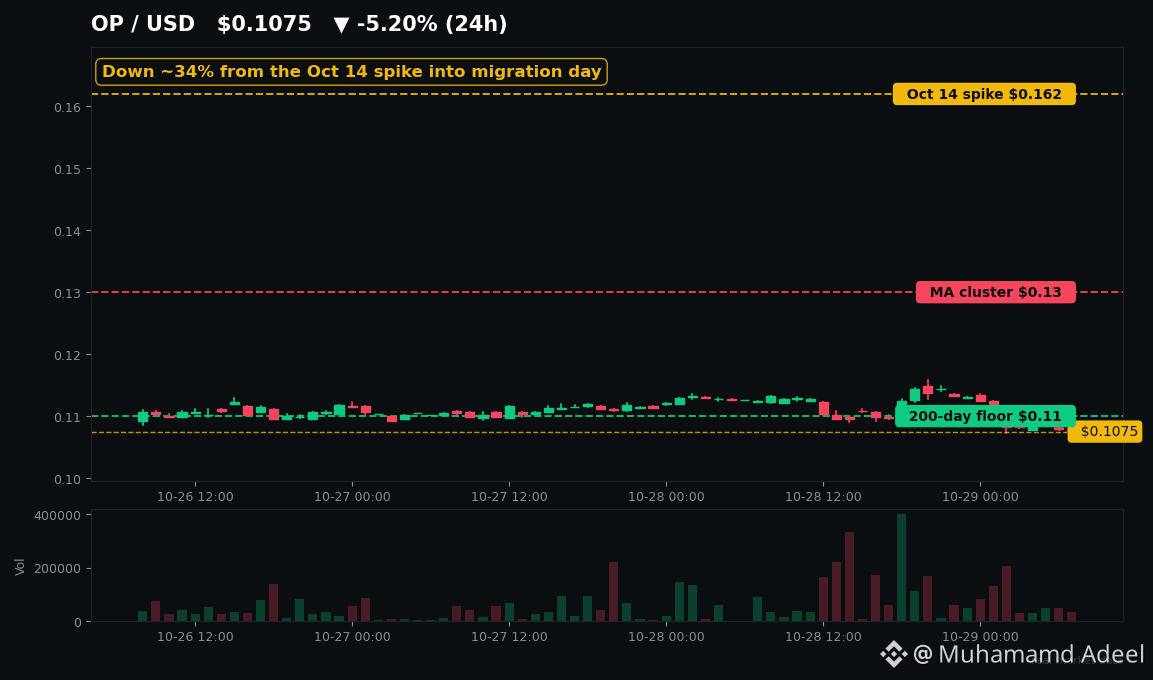
Article
Uniswap vient de confier sa blockchain à Optimism — et $OP reste toujours 97 % en dessous de son sommetUniswap vient de confier sa propre blockchain à Optimism — et $OP reste toujours 97 % en dessous de son plus haut historique.
Laissez bien cela vous imprégner. Aujourd’hui, 29 octobre, le mainnet d’Unichain doit migrer vers OP Enterprise, confiant à Optimism la gestion des séquenceurs, du RPC et de la surveillance de cette blockchain créée par le plus grand DEX du secteur crypto. C’est la plus forte marque de confiance d’une entreprise envers la Superchain à ce jour. Et le token ? Il s’échange autour de 0,11 $, soit environ un tiers de moins que son pic atteint il y a deux semaines à la suite de cette même annonce.
Uniswap vient de confier sa blockchain à Optimism — et $OP reste toujours 97 % en dessous de son sommet
Uniswap vient de confier sa propre blockchain à Optimism — et $OP reste toujours 97 % en dessous de son plus haut historique.
Laissez bien cela vous imprégner. Aujourd’hui, 29 octobre, le mainnet d’Unichain doit migrer vers OP Enterprise, confiant à Optimism la gestion des séquenceurs, du RPC et de la surveillance de cette blockchain créée par le plus grand DEX du secteur crypto. C’est la plus forte marque de confiance d’une entreprise envers la Superchain à ce jour. Et le token ? Il s’échange autour de 0,11 $, soit environ un tiers de moins que son pic atteint il y a deux semaines à la suite de cette même annonce.
Laissez bien cela vous imprégner. Aujourd’hui, 29 octobre, le mainnet d’Unichain doit migrer vers OP Enterprise, confiant à Optimism la gestion des séquenceurs, du RPC et de la surveillance de cette blockchain créée par le plus grand DEX du secteur crypto. C’est la plus forte marque de confiance d’une entreprise envers la Superchain à ce jour. Et le token ? Il s’échange autour de 0,11 $, soit environ un tiers de moins que son pic atteint il y a deux semaines à la suite de cette même annonce.
7
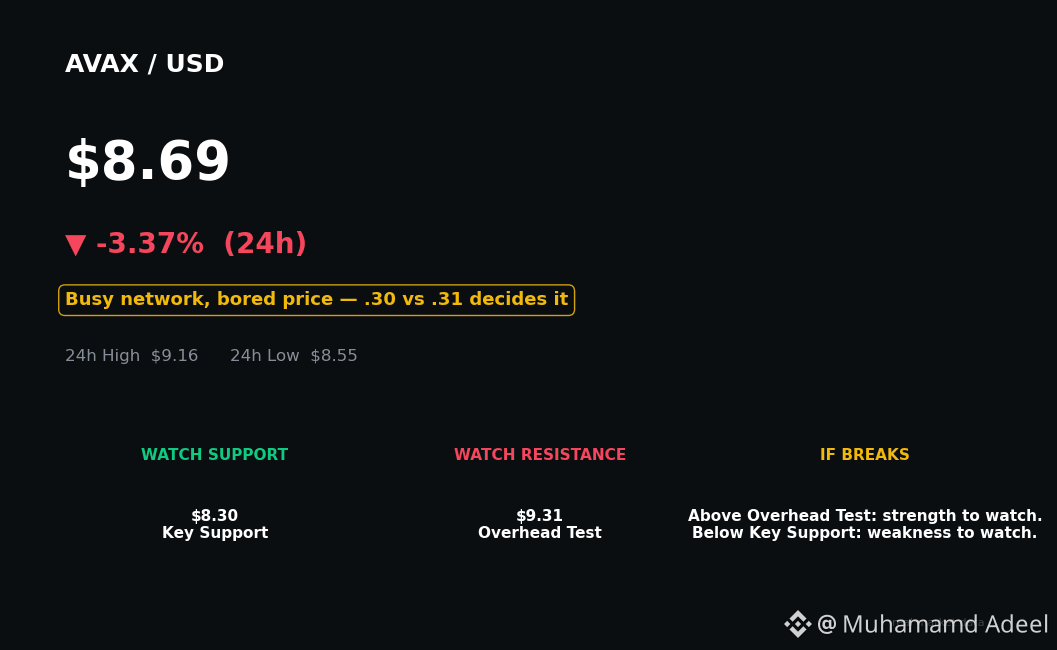
Article
Le réseau d’AVAX est en plein essor. Son cours stagne à 8,70 $.Tout le monde se demande pourquoi le cours d’Avalanche ne bouge pas.
Voici la réponse qui dérange : le réseau est en plein essor — mais pour l’instant, le marché s’en moque.
$AVAX s’échange autour de 8,70 $ aujourd’hui, en baisse sur la journée, après un léger rebond le 28 octobre à 8,98 $, qui l’a tout de même laissé bloqué sous une série de moyennes mobiles à court terme. La fourchette sur 24 heures, de 8,58 $ à 9,16 $, en dit long : cette cryptomonnaie ne va nulle part, et ce n’est pas près de changer, dans un marché qui vient de recevoir un message très clair de la Fed.
Et ce message n’était pas une baisse des taux.
Le 28 octobre, la Fed a maintenu ses taux entre 3,75 et 4,00 %, par 10 voix contre 2, deux membres dissidents souhaitant même une hausse. La prochaine décision sera annoncée les 8 et 9 décembre. Alors, si vous attendiez une politique monétaire accommodante pour faire grimper tous les altcoins, il va encore falloir patienter — et $BTC, l’ancrage du marché, donne actuellement le ton pour tout le reste.
Le réseau d’AVAX est en plein essor. Son cours stagne à 8,70 $.
Tout le monde se demande pourquoi le cours d’Avalanche ne bouge pas.
Voici la réponse qui dérange : le réseau est en plein essor — mais pour l’instant, le marché s’en moque.
$AVAX s’échange autour de 8,70 $ aujourd’hui, en baisse sur la journée, après un léger rebond le 28 octobre à 8,98 $, qui l’a tout de même laissé bloqué sous une série de moyennes mobiles à court terme. La fourchette sur 24 heures, de 8,58 $ à 9,16 $, en dit long : cette cryptomonnaie ne va nulle part, et ce n’est pas près de changer, dans un marché qui vient de recevoir un message très clair de la Fed.
Et ce message n’était pas une baisse des taux.
Le 28 octobre, la Fed a maintenu ses taux entre 3,75 et 4,00 %, par 10 voix contre 2, deux membres dissidents souhaitant même une hausse. La prochaine décision sera annoncée les 8 et 9 décembre. Alors, si vous attendiez une politique monétaire accommodante pour faire grimper tous les altcoins, il va encore falloir patienter — et $BTC , l’ancrage du marché, donne actuellement le ton pour tout le reste.
24
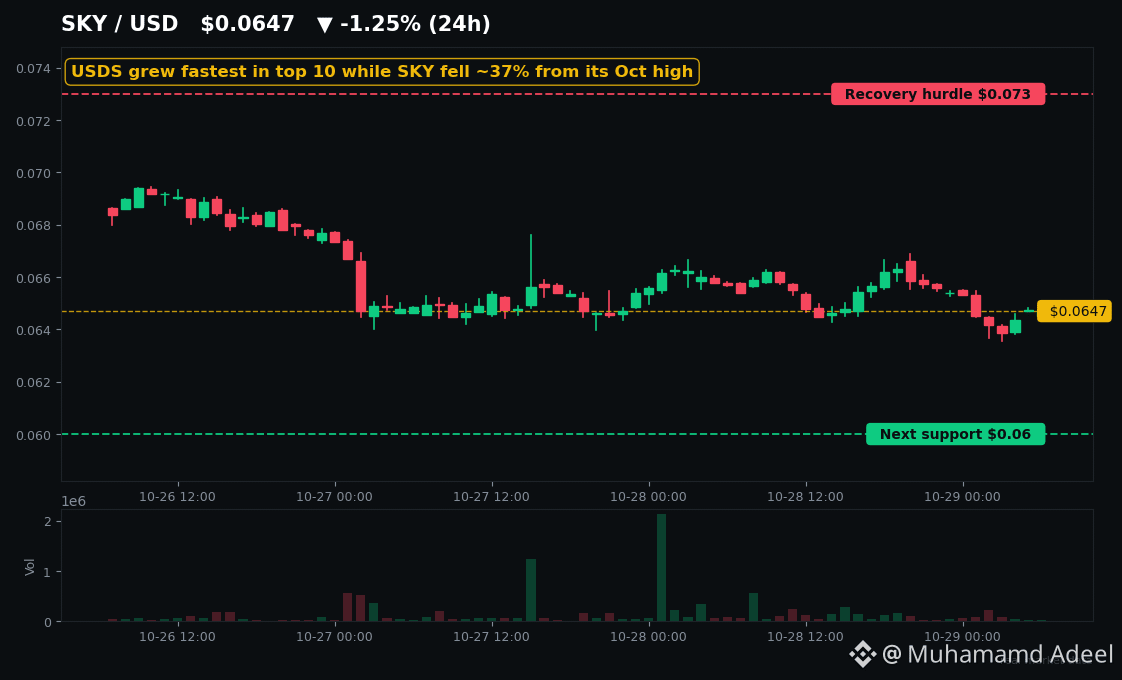
Article
Le stablecoin de Sky s’impose. Son jeton vient de franchir un seuil de support clé à la baisse.Alors que tout le monde observait la Fed maintenir ses taux mercredi, la plus ancienne banque de la DeFi s’est discrètement scindée en deux.
Son stablecoin connaît une croissance plus rapide que celui de tous ses concurrents du top 10. Son jeton vient de passer sous un seuil que les traders défendaient. Cette contradiction résume à elle seule le pari sur Sky en ce moment — et la plupart des gens qui le recherchent regardent le mauvais symbole.
D’abord, la confusion autour des symboles. MakerDAO s’appelle désormais Sky. L’ancien jeton de gouvernance $MKR a été converti en $SKY au taux de 1 pour 24 000, et les principales plateformes d’échange ont converti les soldes et retiré les paires MKR de la cote. MKR s’affiche toujours autour de 1 510 $ sur les sites de cotation, mais les échanges sont désormais peu liquides — $SKY est le graphique qui compte.
Le stablecoin de Sky s’impose. Son jeton vient de franchir un seuil de support clé à la baisse.
Alors que tout le monde observait la Fed maintenir ses taux mercredi, la plus ancienne banque de la DeFi s’est discrètement scindée en deux.
Son stablecoin connaît une croissance plus rapide que celui de tous ses concurrents du top 10. Son jeton vient de passer sous un seuil que les traders défendaient. Cette contradiction résume à elle seule le pari sur Sky en ce moment — et la plupart des gens qui le recherchent regardent le mauvais symbole.
D’abord, la confusion autour des symboles. MakerDAO s’appelle désormais Sky. L’ancien jeton de gouvernance $MKR a été converti en $SKY au taux de 1 pour 24 000, et les principales plateformes d’échange ont converti les soldes et retiré les paires MKR de la cote. MKR s’affiche toujours autour de 1 510 $ sur les sites de cotation, mais les échanges sont désormais peu liquides — $SKY est le graphique qui compte.
3
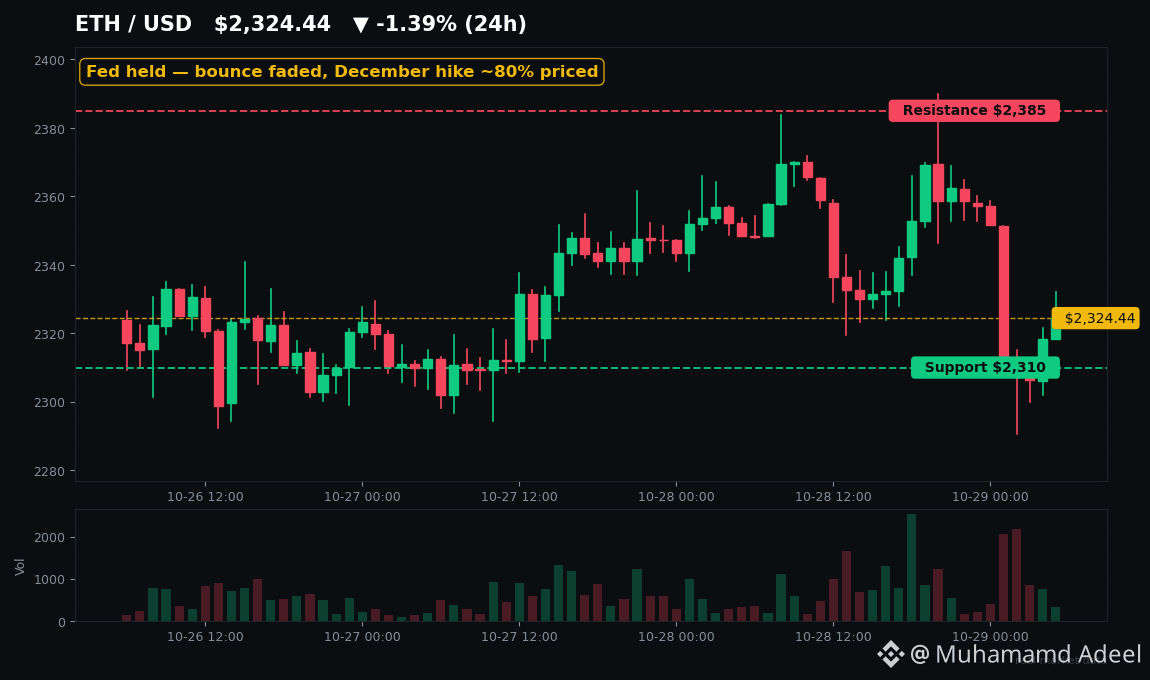
Article
La Fed a maintenu ses taux — et le rebond de l’ETH s’est déjà essoufflé. Le vrai combat se jouera en décembreHier, la Fed a donné au marché crypto exactement ce qu’il attendait — et le marché a tout de même reculé pendant la nuit.
Voilà le signal. Le statu quo n’était pas le sujet. C’était le ton restrictif.
Le FOMC a voté à 10 contre 2 pour maintenir les taux entre 3,75 % et 4,00 %, deux responsables plaidant déjà pour une hausse. Le communiqué a qualifié l’inflation d’« élevée », le président Warsh a refusé de s’engager sur décembre, et les traders ont immédiatement révisé leurs anticipations pour la réunion de décembre : la probabilité d’une hausse est désormais d’environ 8 sur 10.
Comme l’a dit Iggy Ioppe, directeur des investissements chez Theo : « Les marchés avaient anticipé le statu quo, mais pas le ton restrictif. » Avec une inflation globale à 3,7 % et le taux des obligations à 10 ans proche de 5 %, les actifs risqués doivent désormais rivaliser avec un taux sans risque proche de 5 %.
La Fed a maintenu ses taux — et le rebond de l’ETH s’est déjà essoufflé. Le vrai combat se jouera en décembre
Hier, la Fed a donné au marché crypto exactement ce qu’il attendait — et le marché a tout de même reculé pendant la nuit.
Voilà le signal. Le statu quo n’était pas le sujet. C’était le ton restrictif.
Le FOMC a voté à 10 contre 2 pour maintenir les taux entre 3,75 % et 4,00 %, deux responsables plaidant déjà pour une hausse. Le communiqué a qualifié l’inflation d’« élevée », le président Warsh a refusé de s’engager sur décembre, et les traders ont immédiatement révisé leurs anticipations pour la réunion de décembre : la probabilité d’une hausse est désormais d’environ 8 sur 10.
Comme l’a dit Iggy Ioppe, directeur des investissements chez Theo : « Les marchés avaient anticipé le statu quo, mais pas le ton restrictif. » Avec une inflation globale à 3,7 % et le taux des obligations à 10 ans proche de 5 %, les actifs risqués doivent désormais rivaliser avec un taux sans risque proche de 5 %.
Article
Voir la traduction
WIF at $0.18 While BTC Fights for $80K — Is the Meme Trade Quietly Giving Up?Bitcoin got the Fed pause. Dogwifhat got the slide.
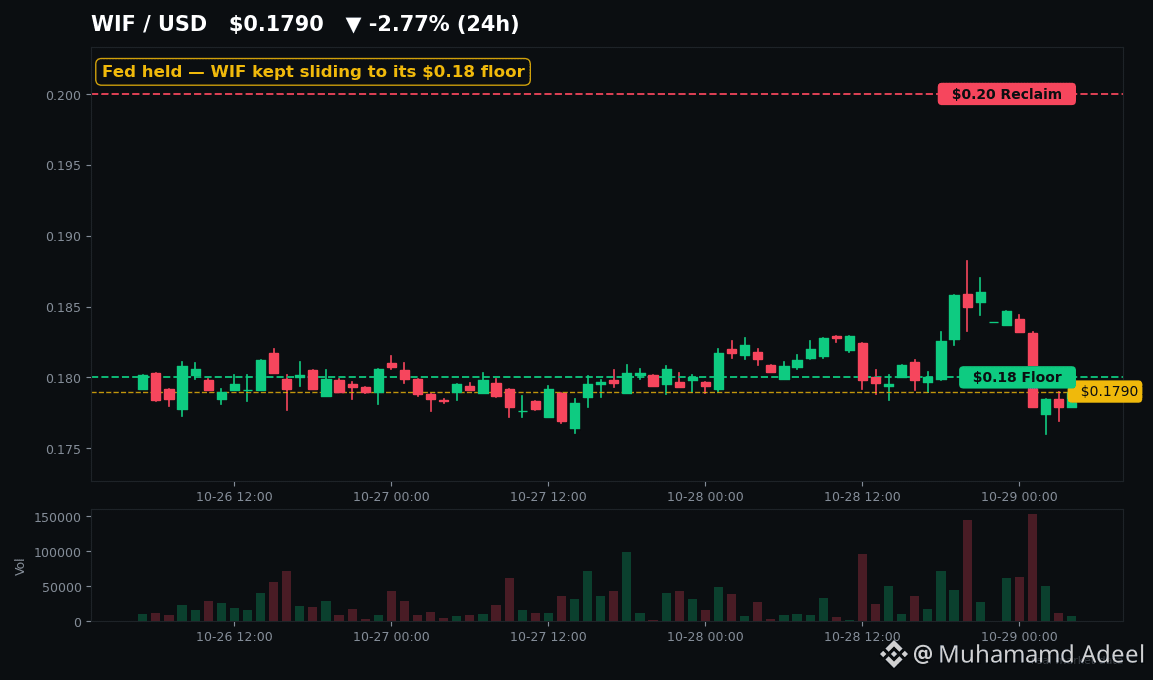
The Fed held rates at 3.75%-4.00% on 28 October in a 10-2 vote — both dissenters wanted a hike, not a cut. Bitcoin first held near $81K, then slipped under $80K overnight. And $WIF? It didn't bounce or panic. It just kept sliding, down roughly 2-3% in 24 hours to about $0.179.
Here's the interesting part: WIF isn't falling on its own bad news. No fresh listing, delisting or confirmed scandal — and no unlock cliff, because all roughly 999 million WIF already circulate, with mint and freeze authorities revoked. Nobody can print more of it.
In a risk-off tape, nobody is rushing to defend the meme trade.
The numbers tell a slow bleed, not a crash. WIF traded near $0.21 on 21 October and drifted to $0.18 by 27 October — down about 13% on the week and 22% on the month, with a market cap of roughly $178 million, about 96% below its $4.83 all-time high from 31 March 2024. Yet 24-hour volume is still near $50 million. People are still trading it — just not bidding it up.
The line to watch is $0.18 — WIF's 200-day moving average and lower Bollinger Band, its last obvious floor. Hold above it and the floor stays intact, even with every shorter average overhead. Break below and supports sit near $0.175 and $0.173, then about $0.154. Reclaim $0.19-$0.20 first, and that's the first sign sellers are losing their grip.
Worth pulling up the $WIF chart here — the next break decides which scenario plays out.
Now the rotation question. Across Solana memes, there is no visible rush into WIF. $SOL itself is sliding with the broader market, and fellow Solana meme $BONK has been flat and quiet into the Fed decision too. The social chatter feels retrospective, not electric — the crowd debating whether attention alone is still enough, rather than starting a new hype wave. Holders agree: roughly 265,000, essentially flat over the last day — not fleeing, but no new crowd arriving either.
And the honest risks: WIF has no product, no revenue and no burn — its value rests entirely on attention and liquidity. The top 10 accounts hold roughly 44-45% of supply, though that includes exchange wallets, so the true whale share can't be stated precisely. And the cautionary tale is in WIF's own history: the Las Vegas Sphere campaign that helped fuel the 2024 run raised about $700,000 from the community — and the ad never ran.
So here's my take: not a crash, not an unlock, not a scandal. Just a coin with no catalyst and no crowd rushing back, sitting on its last obvious floor while Bitcoin decides whether $80K holds. If $0.18 holds and $0.19-$0.20 gets reclaimed, the conversation changes. Until then, the hat stays on — but the party hasn't restarted.
Keep $WIF on your watchlist and check its chart alongside $SOL before the next move.
Not financial advice. DYOR.
WIF at $0.18 While BTC Fights for $80K — Is the Meme Trade Quietly Giving Up?
Bitcoin got the Fed pause. Dogwifhat got the slide.
The Fed held rates at 3.75%-4.00% on 28 October in a 10-2 vote — both dissenters wanted a hike, not a cut. Bitcoin first held near $81K, then slipped under $80K overnight. And $WIF ? It didn't bounce or panic. It just kept sliding, down roughly 2-3% in 24 hours to about $0.179.
Here's the interesting part: WIF isn't falling on its own bad news. No fresh listing, delisting or confirmed scandal — and no unlock cliff, because all roughly 999 million WIF already circulate, with mint and freeze authorities revoked. Nobody can print more of it.
In a risk-off tape, nobody is rushing to defend the meme trade.
The numbers tell a slow bleed, not a crash. WIF traded near $0.21 on 21 October and drifted to $0.18 by 27 October — down about 13% on the week and 22% on the month, with a market cap of roughly $178 million, about 96% below its $4.83 all-time high from 31 March 2024. Yet 24-hour volume is still near $50 million. People are still trading it — just not bidding it up.
The line to watch is $0.18 — WIF's 200-day moving average and lower Bollinger Band, its last obvious floor. Hold above it and the floor stays intact, even with every shorter average overhead. Break below and supports sit near $0.175 and $0.173, then about $0.154. Reclaim $0.19-$0.20 first, and that's the first sign sellers are losing their grip.
Worth pulling up the $WIF chart here — the next break decides which scenario plays out.
Now the rotation question. Across Solana memes, there is no visible rush into WIF. $SOL itself is sliding with the broader market, and fellow Solana meme $BONK has been flat and quiet into the Fed decision too. The social chatter feels retrospective, not electric — the crowd debating whether attention alone is still enough, rather than starting a new hype wave. Holders agree: roughly 265,000, essentially flat over the last day — not fleeing, but no new crowd arriving either.
And the honest risks: WIF has no product, no revenue and no burn — its value rests entirely on attention and liquidity. The top 10 accounts hold roughly 44-45% of supply, though that includes exchange wallets, so the true whale share can't be stated precisely. And the cautionary tale is in WIF's own history: the Las Vegas Sphere campaign that helped fuel the 2024 run raised about $700,000 from the community — and the ad never ran.
So here's my take: not a crash, not an unlock, not a scandal. Just a coin with no catalyst and no crowd rushing back, sitting on its last obvious floor while Bitcoin decides whether $80K holds. If $0.18 holds and $0.19-$0.20 gets reclaimed, the conversation changes. Until then, the hat stays on — but the party hasn't restarted.
Keep $WIF on your watchlist and check its chart alongside $SOL before the next move.
Not financial advice. DYOR.
7
Article
Voir la traduction
Bitcoin Lost $80K Hours After the Fed Held — December Is the Real FightThe Fed didn't cut. And $BTC didn't celebrate.
It held $81,000 for a few hours after the decision — then gave it all back overnight, slipping back under $80,000. If you thought the FOMC would settle this market, think again. It just moved the fight to December.
Here's what actually happened.
On October 28, the Fed held rates at 3.75%–4.00% in a 10–2 vote. But look at who dissented: Governor Lisa Cook and Cleveland Fed President Beth Hammack both wanted a hike, not a cut. There was no dovish voice in the room at all. Chair Kevin Warsh called inflation "too high" — above target for close to six years — and flatly refused to pre-commit on December.
Traders now price roughly an 85% chance of a December hike. The Fed didn't promise one — the market priced one anyway.
So how did Bitcoin react? With a shrug, then a fade.
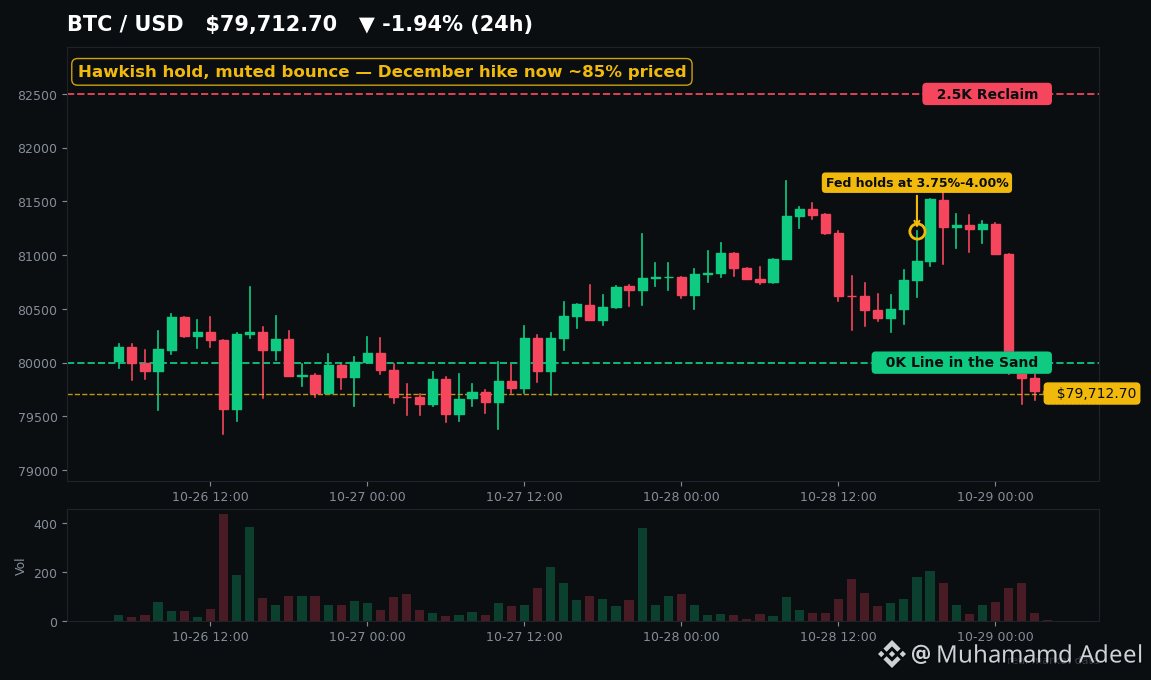
Before the announcement, $BTC spiked to $81,687, dipped below $80,500, then reclaimed roughly $81,000–$81,200 — a gain of under 1%. Options volatility barely moved. Not a breakout — the hold was already priced in.
Then Asia woke up, tech stocks wobbled, and the bounce unwound. By this morning Bitcoin was back around $79,700, below the line it had just defended. The relief rally lasted hours, not days.
Now the levels that actually matter.
$80,000 is the line in the sand. Hold it on a daily close and the next tests are $81,500–$81,750, then $82,500 — the reclaim that would flip the short-term story. Lose it and the path points to $79,440, then $77,466, where over $1.3 billion in long liquidations cluster. Check $BTC's chart against those levels — that's where this story gets decided.
Here's what this really means, and why I'm not calling this a bottom yet.
History says decision day is usually the quiet part. Across five past hawkish holds, Bitcoin averaged a 4.1% drop over the following five sessions. The damage, when it came, came after — not during. The exception proves the rule: September's fully priced-in hike rallied, because uncertainty clearing was the event. This time, uncertainty didn't clear. It moved to December 8–9.
Bright spots exist, though. Spot Bitcoin ETFs posted two straight inflow days heading into the decision — $110 million Monday, $176 million Tuesday — cutting October's net outflows to roughly $26 million. And nearly 15,000 BTC left exchanges on October 27, the biggest daily outflow in five weeks. But whales also parked roughly $500 million on Coinbase Prime around the same time. That's two-way positioning, not conviction — and a deposit is not a sale.
$ETH ticked slightly higher after the decision, but nothing screamed risk-on.
What I'm watching next: today's PCE print and Q3 GDP — the data Warsh said will decide December — then nearly $11 billion in Bitcoin options expiring October 30.
The Fed didn't rescue Bitcoin yesterday. It just postponed the decision. Until Bitcoin reclaims $82,500 or December pricing cools off, every bounce is guilty until proven innocent.
Not financial advice. DYOR.
Bitcoin Lost $80K Hours After the Fed Held — December Is the Real Fight
The Fed didn't cut. And $BTC didn't celebrate.
It held $81,000 for a few hours after the decision — then gave it all back overnight, slipping back under $80,000. If you thought the FOMC would settle this market, think again. It just moved the fight to December.
Here's what actually happened.
On October 28, the Fed held rates at 3.75%–4.00% in a 10–2 vote. But look at who dissented: Governor Lisa Cook and Cleveland Fed President Beth Hammack both wanted a hike, not a cut. There was no dovish voice in the room at all. Chair Kevin Warsh called inflation "too high" — above target for close to six years — and flatly refused to pre-commit on December.
Traders now price roughly an 85% chance of a December hike. The Fed didn't promise one — the market priced one anyway.
So how did Bitcoin react? With a shrug, then a fade.
Before the announcement, $BTC spiked to $81,687, dipped below $80,500, then reclaimed roughly $81,000–$81,200 — a gain of under 1%. Options volatility barely moved. Not a breakout — the hold was already priced in.
Then Asia woke up, tech stocks wobbled, and the bounce unwound. By this morning Bitcoin was back around $79,700, below the line it had just defended. The relief rally lasted hours, not days.
Now the levels that actually matter.
$80,000 is the line in the sand. Hold it on a daily close and the next tests are $81,500–$81,750, then $82,500 — the reclaim that would flip the short-term story. Lose it and the path points to $79,440, then $77,466, where over $1.3 billion in long liquidations cluster. Check $BTC 's chart against those levels — that's where this story gets decided.
Here's what this really means, and why I'm not calling this a bottom yet.
History says decision day is usually the quiet part. Across five past hawkish holds, Bitcoin averaged a 4.1% drop over the following five sessions. The damage, when it came, came after — not during. The exception proves the rule: September's fully priced-in hike rallied, because uncertainty clearing was the event. This time, uncertainty didn't clear. It moved to December 8–9.
Bright spots exist, though. Spot Bitcoin ETFs posted two straight inflow days heading into the decision — $110 million Monday, $176 million Tuesday — cutting October's net outflows to roughly $26 million. And nearly 15,000 BTC left exchanges on October 27, the biggest daily outflow in five weeks. But whales also parked roughly $500 million on Coinbase Prime around the same time. That's two-way positioning, not conviction — and a deposit is not a sale.
$ETH ticked slightly higher after the decision, but nothing screamed risk-on.
What I'm watching next: today's PCE print and Q3 GDP — the data Warsh said will decide December — then nearly $11 billion in Bitcoin options expiring October 30.
The Fed didn't rescue Bitcoin yesterday. It just postponed the decision. Until Bitcoin reclaims $82,500 or December pricing cools off, every bounce is guilty until proven innocent.
Not financial advice. DYOR.
Article
Des baleines déposent 498 millions de dollars sur Coinbase Prime quelques heures avant la décision de la FedTrois baleines viennent de déposer 498 millions de dollars en Bitcoin sur Coinbase Prime — quelques heures avant la décision de la Fed.
Et voici le rebondissement : le marché dans son ensemble a fait exactement l’inverse. Alors, quel signal croire ce soir ?
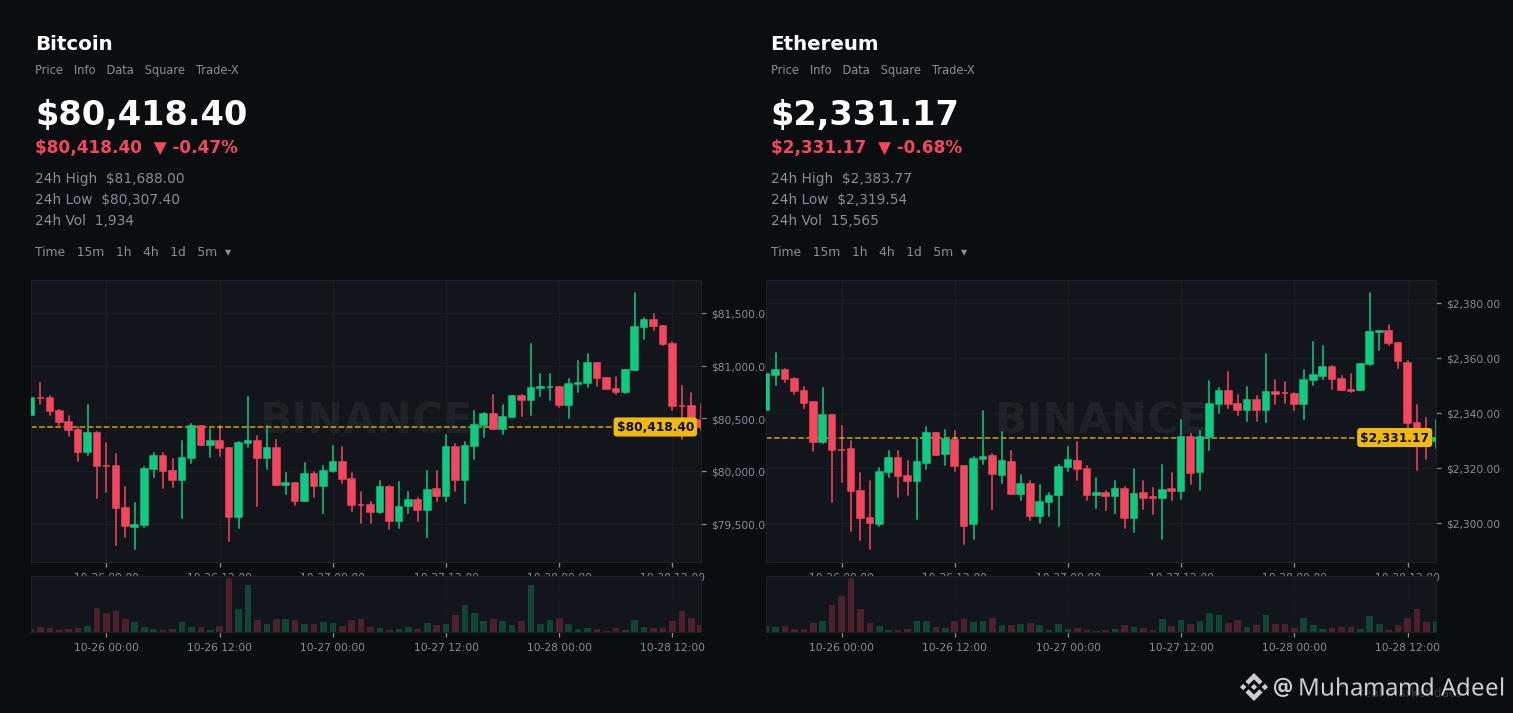
Lookonchain l’a signalé pendant la nuit : trois baleines ont déposé au total 6 168 $BTC, d’une valeur d’environ 498,5 millions de dollars, sur Coinbase Prime. Il s’agit d’une plateforme destinée aux institutions, et non d’une appli d’échange pour les particuliers. Aucune vente n’a toutefois été confirmée : un dépôt n’est pas une liquidation — des jetons mis de côté sont prêts à bouger, pas vendus.
Des baleines déposent 498 millions de dollars sur Coinbase Prime quelques heures avant la décision de la Fed
Trois baleines viennent de déposer 498 millions de dollars en Bitcoin sur Coinbase Prime — quelques heures avant la décision de la Fed.
Et voici le rebondissement : le marché dans son ensemble a fait exactement l’inverse. Alors, quel signal croire ce soir ?
Lookonchain l’a signalé pendant la nuit : trois baleines ont déposé au total 6 168 $BTC , d’une valeur d’environ 498,5 millions de dollars, sur Coinbase Prime. Il s’agit d’une plateforme destinée aux institutions, et non d’une appli d’échange pour les particuliers. Aucune vente n’a toutefois été confirmée : un dépôt n’est pas une liquidation — des jetons mis de côté sont prêts à bouger, pas vendus.
Article
Deux banques centrales ont pris des décisions opposées aujourd’hui. Ce soir, la Fed décide du sort du BitcoinDeux banques centrales ont voté aujourd’hui — et elles ont pris des directions opposées.
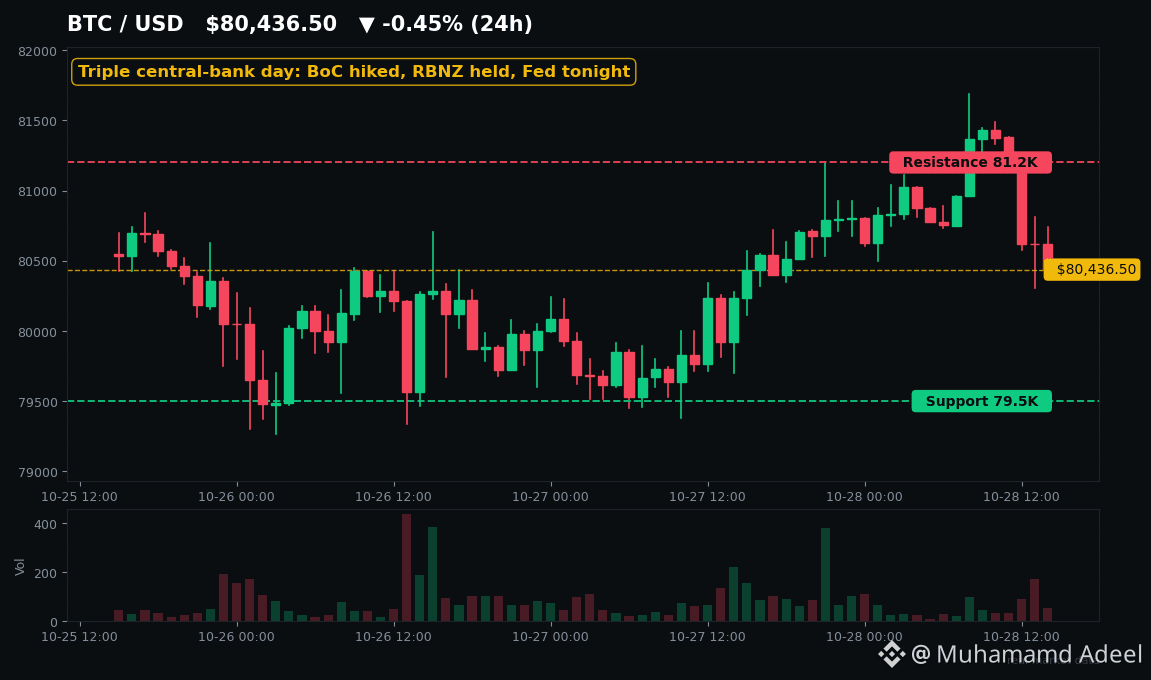
Le Canada a relevé ses taux. La Nouvelle-Zélande a surpris tout le monde en les maintenant. Ce soir à 23 h, heure du Pakistan, la Fed vote — et le Bitcoin se trouve exactement au seuil qui déterminera la suite des événements.
Le Canada a relevé ses taux de 25 points de base, à 2,50 % — sa première hausse depuis juillet 2023 — après que l’inflation de septembre a atteint 3,1 %. Quelques heures plus tôt, la Nouvelle-Zélande avait maintenu son taux à 2,75 %, à l’issue d’un vote serré de 4 voix contre 3, alors même que les marchés tablaient sur une probabilité de hausse d’environ 9 sur 10. Le dollar néo-zélandais a chuté de plus de 1 % à la suite de cette surprise.
Deux banques centrales ont pris des décisions opposées aujourd’hui. Ce soir, la Fed décide du sort du Bitcoin
Deux banques centrales ont voté aujourd’hui — et elles ont pris des directions opposées.
Le Canada a relevé ses taux. La Nouvelle-Zélande a surpris tout le monde en les maintenant. Ce soir à 23 h, heure du Pakistan, la Fed vote — et le Bitcoin se trouve exactement au seuil qui déterminera la suite des événements.
Le Canada a relevé ses taux de 25 points de base, à 2,50 % — sa première hausse depuis juillet 2023 — après que l’inflation de septembre a atteint 3,1 %. Quelques heures plus tôt, la Nouvelle-Zélande avait maintenu son taux à 2,75 %, à l’issue d’un vote serré de 4 voix contre 3, alors même que les marchés tablaient sur une probabilité de hausse d’environ 9 sur 10. Le dollar néo-zélandais a chuté de plus de 1 % à la suite de cette surprise.
Article
Voir la traduction
Ondo Just Put Nvidia & Tesla on Robinhood Chain — While $ONDO Sits at $0.42You can now buy Nvidia on Robinhood Chain — and trade it against the exact same stock issued by someone else.
That sounds like a small technical detail. It is actually the moment tokenized stocks stopped being a press release and started being a market.
On 27 October, Ondo bridged 15 tokenized stocks and ETFs — Nvidia, Apple, Tesla, Meta, Alphabet, SpaceX, Strategy, Circle, GameStop, plus the S&P 500 and Nasdaq-100 ETFs — onto Robinhood Chain. Eleven of them now sit in new Uniswap v4 StablePair pools, paired directly against Robinhood's own Stock Tokens for the same underlying share.
Two issuers. Same stock. One pool. Traders can swap between the two versions, liquidity providers earn the fees, and any price gap becomes an arbitrage trade. Add 24/7 Ondo mint and redeem — including weekends, when Robinhood's window is closed — and you have something tokenized stocks never really had: a live, always-on liquidity loop.
Issuance was never the hard part. Anybody can mint a token and call it a stock. What was missing was a reason for two different versions of the same asset to trade against each other, in size, around the clock. Ondo just built that reason.
And it is not happening in isolation. On 28 October, Securitize — the firm behind BlackRock's BUIDL — added Stellar to its institutional tokenization network, citing built-in compliance tools like KYC, sanctions screening and asset clawbacks. Wall Street's backbone, DTCC, also went live with its tokenization service today. Institutions are not debating tokenization anymore. They are wiring it in.
So here is the uncomfortable question: if all of this is shipping, why is the token at the centre of it still sitting near $0.42?
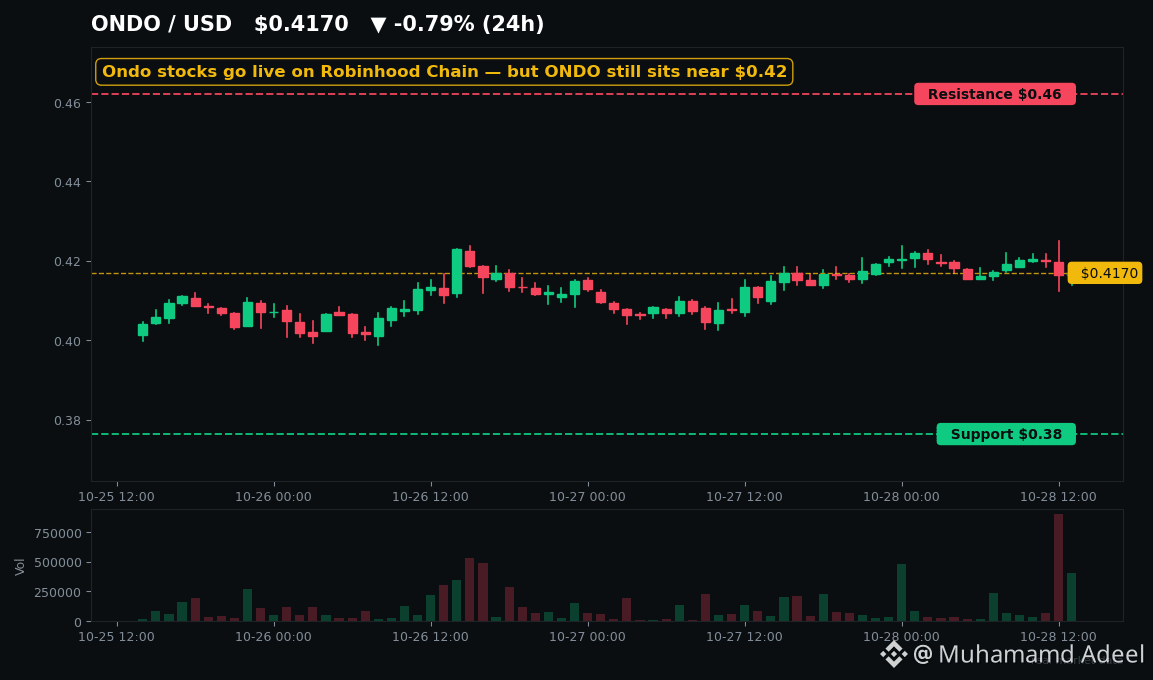
$ONDO is trading around $0.42, roughly flat on the day and still about 9% down on the week. The honest setup is a bounce inside a range, not a breakout. Support sits near $0.38, with resistance near $0.46. A break above $0.46 would signal buyers finally backing the news with real money; a slip below $0.38 would say the market still does not believe the story yet. Pull up $ONDO's chart and watch which of those two lines breaks first — that is the line that decides the next leg.
The pipes tell the same story. Chainlink launched CustodySync with Anchorage Digital on 26 October, connecting a qualified custodian's collateral system to onchain lending, and $LINK is trading near $11.75, above roughly $11.66 support with resistance near $12.20. Real usage shipping, price still waiting for proof.
Let us also be honest about scale, because the big numbers get abused. Distributed, actually-tradable tokenized real-world assets sit near $39 billion (RWA.xyz, October 2026). You will see a $400 billion figure floating around — but that counts assets merely recorded on blockchains. Only about $39 billion of it is genuinely circulating. The gap between those two numbers is the gap between the pitch and the product.
The risks are just as real. Nine companies have already objected to the OKX-ICE tokenized-stock venue, and a Wall Street Journal ad this week urged S&P 500 CEOs to use the SEC's 30-day opt-out to block tokenization of their shares. ONDO itself is a governance token — it gives holders no shareholder rights or dividends. And Ondo's request for SEC no-action relief is exactly that: a request, not an approval. We have seen this movie before — Binance's tokenized stocks in 2021 lasted about three months before regulators shut them down.
So here is my take. Tokenized stocks just grew up a little: two issuers, one pool, 24/7 trading. But the trade is not "RWA grows, therefore the token moons." It is watching whether real volume follows real infrastructure — starting with whether $ONDO breaks $0.46, or fades back to $0.38 first.
Not financial advice. DYOR.
Ondo Just Put Nvidia & Tesla on Robinhood Chain — While $ONDO Sits at $0.42
You can now buy Nvidia on Robinhood Chain — and trade it against the exact same stock issued by someone else.
That sounds like a small technical detail. It is actually the moment tokenized stocks stopped being a press release and started being a market.
On 27 October, Ondo bridged 15 tokenized stocks and ETFs — Nvidia, Apple, Tesla, Meta, Alphabet, SpaceX, Strategy, Circle, GameStop, plus the S&P 500 and Nasdaq-100 ETFs — onto Robinhood Chain. Eleven of them now sit in new Uniswap v4 StablePair pools, paired directly against Robinhood's own Stock Tokens for the same underlying share.
Two issuers. Same stock. One pool. Traders can swap between the two versions, liquidity providers earn the fees, and any price gap becomes an arbitrage trade. Add 24/7 Ondo mint and redeem — including weekends, when Robinhood's window is closed — and you have something tokenized stocks never really had: a live, always-on liquidity loop.
Issuance was never the hard part. Anybody can mint a token and call it a stock. What was missing was a reason for two different versions of the same asset to trade against each other, in size, around the clock. Ondo just built that reason.
And it is not happening in isolation. On 28 October, Securitize — the firm behind BlackRock's BUIDL — added Stellar to its institutional tokenization network, citing built-in compliance tools like KYC, sanctions screening and asset clawbacks. Wall Street's backbone, DTCC, also went live with its tokenization service today. Institutions are not debating tokenization anymore. They are wiring it in.
So here is the uncomfortable question: if all of this is shipping, why is the token at the centre of it still sitting near $0.42?
$ONDO is trading around $0.42, roughly flat on the day and still about 9% down on the week. The honest setup is a bounce inside a range, not a breakout. Support sits near $0.38, with resistance near $0.46. A break above $0.46 would signal buyers finally backing the news with real money; a slip below $0.38 would say the market still does not believe the story yet. Pull up $ONDO 's chart and watch which of those two lines breaks first — that is the line that decides the next leg.
The pipes tell the same story. Chainlink launched CustodySync with Anchorage Digital on 26 October, connecting a qualified custodian's collateral system to onchain lending, and $LINK is trading near $11.75, above roughly $11.66 support with resistance near $12.20. Real usage shipping, price still waiting for proof.
Let us also be honest about scale, because the big numbers get abused. Distributed, actually-tradable tokenized real-world assets sit near $39 billion (RWA.xyz, October 2026). You will see a $400 billion figure floating around — but that counts assets merely recorded on blockchains. Only about $39 billion of it is genuinely circulating. The gap between those two numbers is the gap between the pitch and the product.
The risks are just as real. Nine companies have already objected to the OKX-ICE tokenized-stock venue, and a Wall Street Journal ad this week urged S&P 500 CEOs to use the SEC's 30-day opt-out to block tokenization of their shares. ONDO itself is a governance token — it gives holders no shareholder rights or dividends. And Ondo's request for SEC no-action relief is exactly that: a request, not an approval. We have seen this movie before — Binance's tokenized stocks in 2021 lasted about three months before regulators shut them down.
So here is my take. Tokenized stocks just grew up a little: two issuers, one pool, 24/7 trading. But the trade is not "RWA grows, therefore the token moons." It is watching whether real volume follows real infrastructure — starting with whether $ONDO breaks $0.46, or fades back to $0.38 first.
Not financial advice. DYOR.
2
Article
5 actions tokenisées viennent d’être lancées sur Binance — quelques heures avant la décision de la FedBinance vient d’ajouter cinq autres noms de Wall Street à la crypto — quelques heures avant la décision de la Fed.
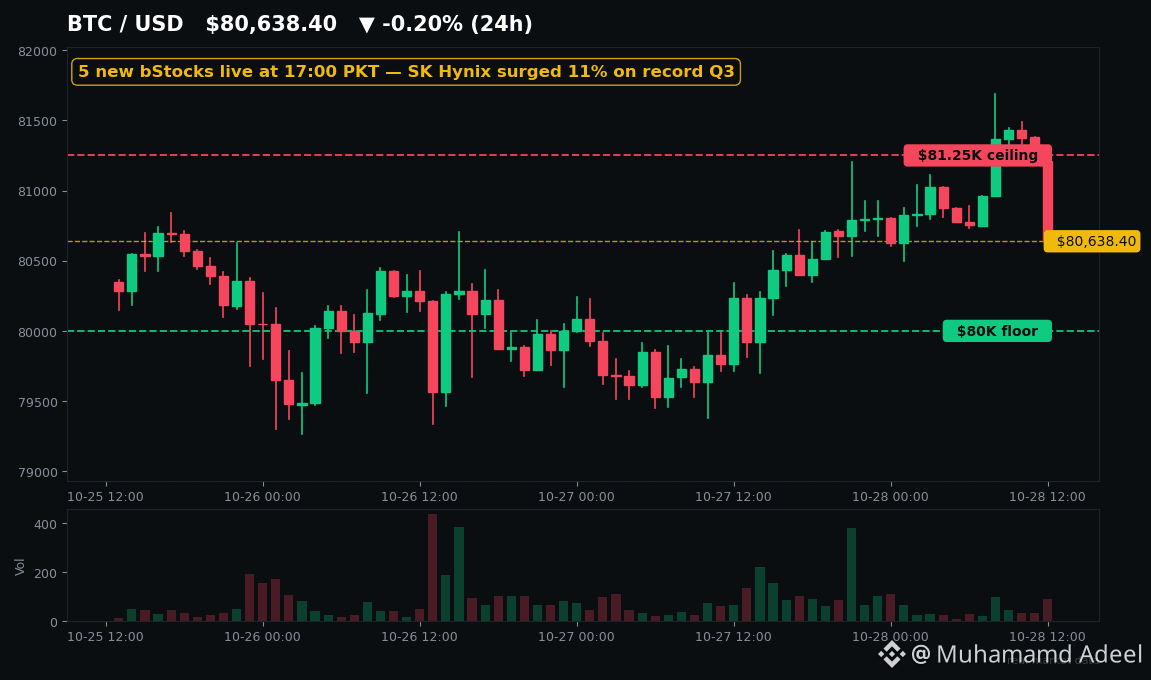
Les cinq nouveaux bStocks ont été lancés aujourd’hui sur Binance Spot à 17 h PKT : AppLovin (APPB), Bending Spoons (BSPB), GE Vernova (GEVB), ainsi qu’une paire à effet de levier long/court sur SK Hynix — les ETF journaliers GraniteShares x2 Long (SKUUB) et x2 Short (SKDDB). Les cinq se négocient contre des $USDT, avec des bots algorithmiques de trading au comptant activés et un accès à Convert disponible dans l’heure suivant le lancement, sans frais de conversion.
Le timing, c’est toute l’histoire. L’action SK Hynix a bondi de 10,89 % aujourd’hui à Séoul, à 1 487 000 wons, après la publication de résultats records au troisième trimestre — un chiffre d’affaires de 104 620 milliards de wons et un bénéfice d’exploitation de 83 330 milliards de wons, tous deux à des niveaux historiques — ainsi que d’un plan de retour aux actionnaires d’une valeur d’environ 100 000 milliards de wons. La paire à effet de levier est donc cotée le jour même où son actif sous-jacent s’envole — ce qui est aussi un avertissement : SKUUB et SKDDB réinitialisent leur effet de levier x2 chaque jour. Si vous les gardez une semaine dans un marché volatil, les mathématiques jouent contre vous, même si l’action SK Hynix finit à peu près au même niveau. Ce sont des outils de day trading, pas des placements à conserver à long terme.
5 actions tokenisées viennent d’être lancées sur Binance — quelques heures avant la décision de la Fed
Binance vient d’ajouter cinq autres noms de Wall Street à la crypto — quelques heures avant la décision de la Fed.
Les cinq nouveaux bStocks ont été lancés aujourd’hui sur Binance Spot à 17 h PKT : AppLovin (APPB), Bending Spoons (BSPB), GE Vernova (GEVB), ainsi qu’une paire à effet de levier long/court sur SK Hynix — les ETF journaliers GraniteShares x2 Long (SKUUB) et x2 Short (SKDDB). Les cinq se négocient contre des $USDT, avec des bots algorithmiques de trading au comptant activés et un accès à Convert disponible dans l’heure suivant le lancement, sans frais de conversion.
Le timing, c’est toute l’histoire. L’action SK Hynix a bondi de 10,89 % aujourd’hui à Séoul, à 1 487 000 wons, après la publication de résultats records au troisième trimestre — un chiffre d’affaires de 104 620 milliards de wons et un bénéfice d’exploitation de 83 330 milliards de wons, tous deux à des niveaux historiques — ainsi que d’un plan de retour aux actionnaires d’une valeur d’environ 100 000 milliards de wons. La paire à effet de levier est donc cotée le jour même où son actif sous-jacent s’envole — ce qui est aussi un avertissement : SKUUB et SKDDB réinitialisent leur effet de levier x2 chaque jour. Si vous les gardez une semaine dans un marché volatil, les mathématiques jouent contre vous, même si l’action SK Hynix finit à peu près au même niveau. Ce sont des outils de day trading, pas des placements à conserver à long terme.
Article
Voir la traduction
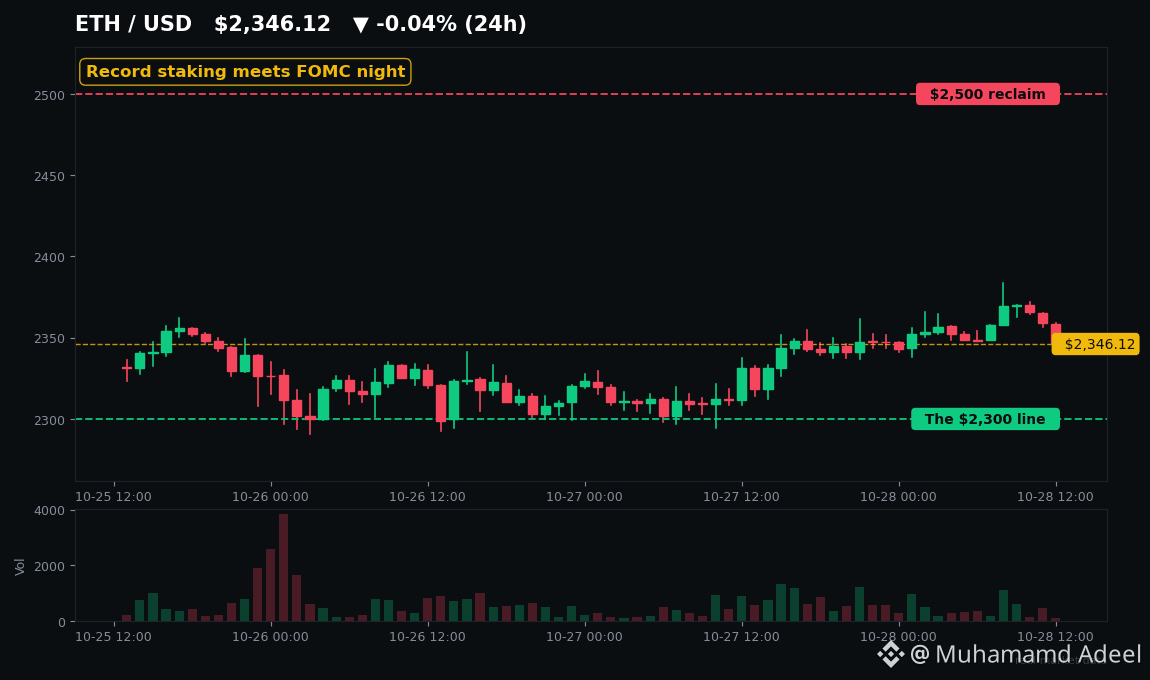
ETH staking just hit a record — and tonight's FOMC could light the fuse44 million ETH are now locked in staking. A record — over 36% of all ETH in existence.
And yet the price is sitting near $2,350, down about 12% in a month. So why are holders locking up MORE, hours before the biggest macro event of the month?
Because something just flipped under the surface. And tonight's Fed decision is the spark.
**The queue flip nobody is talking about**
In late October, roughly 1.27 million ETH were queued up waiting to ENTER staking — against only about 3,500 ETH queued to exit. That's not a typo. Three weeks earlier, the exit queue was 850,000 ETH long after a validator scare sent stakers rushing for the door.
That overhang is gone. Bitwise's Q4 report put total staked ETH at a record 43.8 million (35.9% of supply), with nearly 2 million ETH flowing in during Q3 alone — the sixth straight quarter of growth.
Translation: the people who already own ETH aren't selling it. They're locking it away.
**But here's the uncomfortable part**
Staking locks supply. It doesn't create demand. And demand is the hole in this story.
Spot ETH ETFs have bled roughly $1.18 billion in October — their worst month of 2026 — even as Bitcoin ETFs pulled in money on the same days. BitMine, the biggest ETH treasury, now holds 6.05 million ETH with 86% of it staked, and it's nearly at its self-imposed 5% of supply cap. So the obvious question: who buys once the biggest buyer stops?
Meanwhile $ETH is still losing the war that matters most. The ETH/BTC ratio sits near 0.029, close to the low end of its range, and $BTC dominance is near 58–60%. Staking is absorbing supply, but relative strength hasn't followed — yet.
**Tonight decides which side blinks**
The Fed announces at 11pm PKT tonight, with a hold at 3.75–4.00% widely expected. The decision itself is mostly priced in. What isn't priced in is the tone — specifically, what it signals about December.
History says that's exactly what moves ETH. Priced-in decisions have produced muted reactions; hawkish guidance has repeatedly knocked ETH down harder than BTC.
So here's what I'm watching — check the $ETH chart before the announcement, because this is where it gets decided:
If $2,300 holds (the 27 October low was $2,297) and the guidance leans soft, the reclaim target traders keep citing is $2,500. If a hawkish tone breaks $2,300, the next zone to watch is $2,240–$2,280, with $2,150 flagged by QCP Capital below that.
One honest warning: staked ETH isn't gone forever. With the exit queue now near-empty, unstaking is fast — if support breaks after the press conference, a fresh exit wave could build quickly. And staking yield has already compressed to 2.63% from 2.81%.
Record staking. Record ETF outflows. Both true at the same time. Tonight tells us which one the market believes.
Does record staking matter if ETH/BTC keeps falling? Tell me in the comments.
Not financial advice. DYOR.
ETH staking just hit a record — and tonight's FOMC could light the fuse
44 million ETH are now locked in staking. A record — over 36% of all ETH in existence.
And yet the price is sitting near $2,350, down about 12% in a month. So why are holders locking up MORE, hours before the biggest macro event of the month?
Because something just flipped under the surface. And tonight's Fed decision is the spark.
**The queue flip nobody is talking about**
In late October, roughly 1.27 million ETH were queued up waiting to ENTER staking — against only about 3,500 ETH queued to exit. That's not a typo. Three weeks earlier, the exit queue was 850,000 ETH long after a validator scare sent stakers rushing for the door.
That overhang is gone. Bitwise's Q4 report put total staked ETH at a record 43.8 million (35.9% of supply), with nearly 2 million ETH flowing in during Q3 alone — the sixth straight quarter of growth.
Translation: the people who already own ETH aren't selling it. They're locking it away.
**But here's the uncomfortable part**
Staking locks supply. It doesn't create demand. And demand is the hole in this story.
Spot ETH ETFs have bled roughly $1.18 billion in October — their worst month of 2026 — even as Bitcoin ETFs pulled in money on the same days. BitMine, the biggest ETH treasury, now holds 6.05 million ETH with 86% of it staked, and it's nearly at its self-imposed 5% of supply cap. So the obvious question: who buys once the biggest buyer stops?
Meanwhile $ETH is still losing the war that matters most. The ETH/BTC ratio sits near 0.029, close to the low end of its range, and $BTC dominance is near 58–60%. Staking is absorbing supply, but relative strength hasn't followed — yet.
**Tonight decides which side blinks**
The Fed announces at 11pm PKT tonight, with a hold at 3.75–4.00% widely expected. The decision itself is mostly priced in. What isn't priced in is the tone — specifically, what it signals about December.
History says that's exactly what moves ETH. Priced-in decisions have produced muted reactions; hawkish guidance has repeatedly knocked ETH down harder than BTC.
So here's what I'm watching — check the $ETH chart before the announcement, because this is where it gets decided:
If $2,300 holds (the 27 October low was $2,297) and the guidance leans soft, the reclaim target traders keep citing is $2,500. If a hawkish tone breaks $2,300, the next zone to watch is $2,240–$2,280, with $2,150 flagged by QCP Capital below that.
One honest warning: staked ETH isn't gone forever. With the exit queue now near-empty, unstaking is fast — if support breaks after the press conference, a fresh exit wave could build quickly. And staking yield has already compressed to 2.63% from 2.81%.
Record staking. Record ETF outflows. Both true at the same time. Tonight tells us which one the market believes.
Does record staking matter if ETH/BTC keeps falling? Tell me in the comments.
Not financial advice. DYOR.
Connectez-vous pour découvrir plus de contenu
Rejoignez la communauté mondiale des adeptes de cryptomonnaies sur Binance Square
⚡️ Suviez les dernières informations importantes sur les cryptomonnaies.
💬 Jugé digne de confiance par la plus grande plateforme d’échange de cryptomonnaies au monde.
👍 Découvrez les connaissances que partagent les créateurs vérifiés.
Adresse e-mail/Nº de téléphone
Sujets d’actualité
FedWatch
16.4M vues
39,825 mentions
#fedwatch
🚨 La Fed maintient ses taux — mais les divisions aux positions restrictives changent tout ! 📊
La Réserve fédérale vient d’annoncer sa décision de maintenir les taux d’intérêt entre 3,75 % et 4,00 %, mais ne vous laissez pas tromper par le titre parlant de « pause ». En réalité, le message est sans équivoque : la Fed reste restrictive !
Voici les principaux points à retenir de la dernière réunion du FOMC, que tout trader devrait surveiller :
Un vote divisé, 10 contre 2 : la majorité a voté en faveur du maintien des taux, mais deux responsables ont exprimé leur désaccord (préférant une hausse immédiate de 25 points de base). Cette division interne montre que le débat sur la persistance de l’inflation est loin d’être clos.
L’inflation reste « élevée » : dans son communiqué, la Fed a explicitement indiqué que l’activité économique demeure solide, mais que les tensions sur les prix et l’inflation restent fortes.
Décembre reste une option : la banque centrale ayant choisi de marquer une pause plutôt que de s’engager sur de futures baisses, la probabilité d’une hausse des taux en décembre reste élevée, ce qui soutient les rendements et le dollar.
Ce que cela signifie pour les cryptos et les actifs risqués : le marché a obtenu la pause à court terme qu’il anticipait, mais une Fed restrictive et une inflation tenace signifient que les pressions sur la liquidité ne vont pas disparaître de sitôt. Les investisseurs avisés surveillent de près les rendements des bons du Trésor et les données macroéconomiques avant de faire leur prochain grand mouvement.
Ajustez-vous vos positions en prévision d’une éventuelle hausse en décembre, ou attendez-vous une sortie de cette fourchette ? Parlons-en ci-dessous.
$APR
$PARTI
$SOXS
Alpha H U N T E R
·1 mentions J’aime
·3k vues
EarningsSeason
6.5M vues
32,533 mentions
USMidtermElections
66,430 vues
835 mentions