Actualités


·
--
Strategy ajoute 1 666 Bitcoin, les avoirs atteignent 847 666La stratégie a augmenté ses avoirs en Bitcoin de 1 666 la semaine dernière, les portant à 847 666. Selon Foresight News, l’achat a été signalé par unfolded.
Strategy ajoute 1 666 Bitcoin, les avoirs atteignent 847 666
La stratégie a augmenté ses avoirs en Bitcoin de 1 666 la semaine dernière, les portant à 847 666. Selon Foresight News, l’achat a été signalé par unfolded.
11
15
47
55.6k
·
--

Article
Voir la traduction
AMD to Buy Fei-Fei Li's World Labs AI Startup for $8.2 BillionAdvanced Micro Devices agreed to acquire World Labs for $8.2 billion, gaining the artificial intelligence startup founded by pioneer and researcher Fei-Fei Li, according to Bloomberg. The all-stock deal is expected to close by year-end, subject to regulatory approvals, the companies said Monday. For AMD, a key challenger to Nvidia in AI chips, the deal adds a team of leading researchers and their models, plus insight into how the field is evolving to help plan future hardware. "The more you understand end to end, the better system you are going to build," Chief Executive Officer Lisa Su said in a Bloomberg Television interview, adding: "That's why we are acquiring World Labs — to have access to the world-class talent Fei-Fei has brought together and bring it together with AMD's capabilities around hardware, software and systems."
World Labs develops so-called world models — AI software that runs applications in the physical world by generating and reconstructing 3D environments, which the startup says can advance robots, scientific discovery and factory equipment. Li, its CEO and a renowned Stanford computer scientist, will join AMD as executive vice president and chief scientist reporting directly to Su. "As our company grows, so does our ambition," Li said, noting rising computing needs. "If we can join forces with AMD, we really are giving ourselves, AMD and the ecosystem an opportunity to accelerate the flywheel between software and hardware development." The deal also lets AMD offer a variety of AI models to data-center clients, its biggest revenue source, with Su saying the company will expand its contribution across "both open as well as proprietary models" and aims to "define the future of AI compute."
The move follows Nvidia's recent agreement to buy AI startup Hugging Face in a deal valued at about $13 billion. Launched in 2024, World Labs has about 70 employees, including robotics experts from its July acquisition of SceniX, which builds software to train robots in realistic virtual worlds. During Su's 12-year tenure, AMD has emerged from Intel's shadow in its core processor market with products rated best in the industry, though in AI accelerators it remains a distant second to Nvidia even as Su rolls out chips she says can outperform its rival. Investors, viewing AMD as a key AI-spending beneficiary, have bid its shares up nearly threefold this year, giving it a valuation of roughly $1 trillion. Nvidia remains the world's most valuable company, with a market capitalization above $5 trillion, though its shares are up about 22% this year — underperforming nearly all major chipmakers in 2026.
AMD to Buy Fei-Fei Li's World Labs AI Startup for $8.2 Billion
Advanced Micro Devices agreed to acquire World Labs for $8.2 billion, gaining the artificial intelligence startup founded by pioneer and researcher Fei-Fei Li, according to Bloomberg. The all-stock deal is expected to close by year-end, subject to regulatory approvals, the companies said Monday. For AMD, a key challenger to Nvidia in AI chips, the deal adds a team of leading researchers and their models, plus insight into how the field is evolving to help plan future hardware. "The more you understand end to end, the better system you are going to build," Chief Executive Officer Lisa Su said in a Bloomberg Television interview, adding: "That's why we are acquiring World Labs — to have access to the world-class talent Fei-Fei has brought together and bring it together with AMD's capabilities around hardware, software and systems."
World Labs develops so-called world models — AI software that runs applications in the physical world by generating and reconstructing 3D environments, which the startup says can advance robots, scientific discovery and factory equipment. Li, its CEO and a renowned Stanford computer scientist, will join AMD as executive vice president and chief scientist reporting directly to Su. "As our company grows, so does our ambition," Li said, noting rising computing needs. "If we can join forces with AMD, we really are giving ourselves, AMD and the ecosystem an opportunity to accelerate the flywheel between software and hardware development." The deal also lets AMD offer a variety of AI models to data-center clients, its biggest revenue source, with Su saying the company will expand its contribution across "both open as well as proprietary models" and aims to "define the future of AI compute."
The move follows Nvidia's recent agreement to buy AI startup Hugging Face in a deal valued at about $13 billion. Launched in 2024, World Labs has about 70 employees, including robotics experts from its July acquisition of SceniX, which builds software to train robots in realistic virtual worlds. During Su's 12-year tenure, AMD has emerged from Intel's shadow in its core processor market with products rated best in the industry, though in AI accelerators it remains a distant second to Nvidia even as Su rolls out chips she says can outperform its rival. Investors, viewing AMD as a key AI-spending beneficiary, have bid its shares up nearly threefold this year, giving it a valuation of roughly $1 trillion. Nvidia remains the world's most valuable company, with a market capitalization above $5 trillion, though its shares are up about 22% this year — underperforming nearly all major chipmakers in 2026.
World Labs develops so-called world models — AI software that runs applications in the physical world by generating and reconstructing 3D environments, which the startup says can advance robots, scientific discovery and factory equipment. Li, its CEO and a renowned Stanford computer scientist, will join AMD as executive vice president and chief scientist reporting directly to Su. "As our company grows, so does our ambition," Li said, noting rising computing needs. "If we can join forces with AMD, we really are giving ourselves, AMD and the ecosystem an opportunity to accelerate the flywheel between software and hardware development." The deal also lets AMD offer a variety of AI models to data-center clients, its biggest revenue source, with Su saying the company will expand its contribution across "both open as well as proprietary models" and aims to "define the future of AI compute."
The move follows Nvidia's recent agreement to buy AI startup Hugging Face in a deal valued at about $13 billion. Launched in 2024, World Labs has about 70 employees, including robotics experts from its July acquisition of SceniX, which builds software to train robots in realistic virtual worlds. During Su's 12-year tenure, AMD has emerged from Intel's shadow in its core processor market with products rated best in the industry, though in AI accelerators it remains a distant second to Nvidia even as Su rolls out chips she says can outperform its rival. Investors, viewing AMD as a key AI-spending beneficiary, have bid its shares up nearly threefold this year, giving it a valuation of roughly $1 trillion. Nvidia remains the world's most valuable company, with a market capitalization above $5 trillion, though its shares are up about 22% this year — underperforming nearly all major chipmakers in 2026.
759
·
--
Binance Wallet alerte sur les risques d’arnaque USDT aux noms trompeursBinance Wallet a annoncé sur X que les utilisateurs devraient faire preuve de prudence lorsqu’ils reçoivent des paiements libellés « USDT » après avoir vendu des biens ou des actifs. Le message indiquait qu’un portefeuille peut afficher « USDT », mais que le token pourrait être un actif ressemblant créé par des escrocs et ne pas être le même que le véritable USDT. D’après l’annonce, cela peut amener les utilisateurs à remettre des biens sans vérifier le paiement avec davantage d’attention. L’avertissement portait sur le risque que ces tokens valent beaucoup moins que prévu lorsque les utilisateurs essaieront par la suite de les convertir en espèces. Binance Wallet n’a pas fourni de détails supplémentaires dans le message, au-delà d’expliquer comment fonctionne l’arnaque et d’inviter les utilisateurs à prendre conscience de la possibilité de noms de tokens trompeurs.
Binance Wallet alerte sur les risques d’arnaque USDT aux noms trompeurs
Binance Wallet a annoncé sur X que les utilisateurs devraient faire preuve de prudence lorsqu’ils reçoivent des paiements libellés « USDT » après avoir vendu des biens ou des actifs. Le message indiquait qu’un portefeuille peut afficher « USDT », mais que le token pourrait être un actif ressemblant créé par des escrocs et ne pas être le même que le véritable USDT. D’après l’annonce, cela peut amener les utilisateurs à remettre des biens sans vérifier le paiement avec davantage d’attention. L’avertissement portait sur le risque que ces tokens valent beaucoup moins que prévu lorsque les utilisateurs essaieront par la suite de les convertir en espèces. Binance Wallet n’a pas fourni de détails supplémentaires dans le message, au-delà d’expliquer comment fonctionne l’arnaque et d’inviter les utilisateurs à prendre conscience de la possibilité de noms de tokens trompeurs.
3
6
34
46.9k
·
--
Article
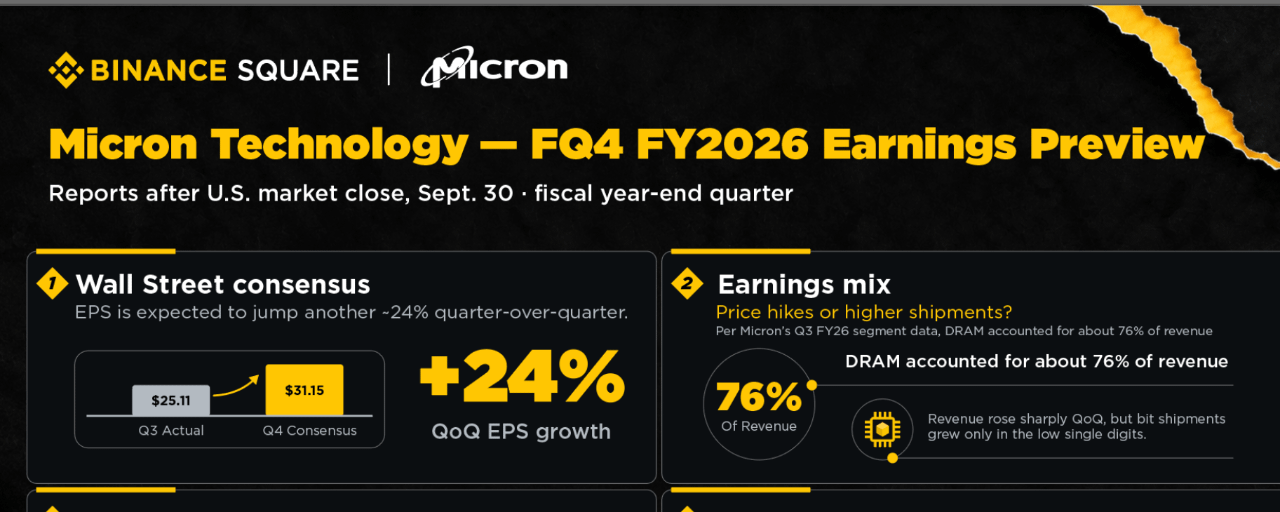
Micron aborde ses résultats du T4 fiscal avec la barre—et l’action—déjà hautMicron Technology (Nasdaq : MU) $MUB publiera ses résultats du quatrième trimestre fiscal après la clôture des marchés le 30 septembre, clôturant ainsi une année fiscale au cours de laquelle l’action a fortement progressé. La question pour les investisseurs n’est plus de savoir si le fabricant de mémoire peut battre les estimations. Il s’agit de savoir si les résultats, et surtout les indications (guidance), peuvent justifier une valorisation qui a déjà largement dépassé celle du secteur.
Pour le trimestre d’août, Micron a guidé vers un chiffre d’affaires de 1 milliard ; des bénéfices non-GAAP de 1 ; des bénéfices dilués GAAP de 1 ; et une marge brute d’environ 86 %. Wall Street se situe à, ou légèrement au-dessus, du milieu de cette fourchette. D’après TipRanks, le consensus côté vendeurs prévoit un chiffre d’affaires d’environ 50,6 milliards et un résultat ajusté proche de 31,16. Il y a un trimestre, au cours du T3 fiscal, Micron a gagné 25,11 $ par action, tandis que son chiffre d’affaires a bondi d’environ 346 % par rapport à l’année précédente. Atteindre le consensus signifierait une nouvelle hausse d’environ 24 % des bénéfices, d’un trimestre à l’autre—un échelon marqué pour n’importe quel fabricant de puces.
Micron aborde ses résultats du T4 fiscal avec la barre—et l’action—déjà haut
Micron Technology (Nasdaq : MU) $MUB publiera ses résultats du quatrième trimestre fiscal après la clôture des marchés le 30 septembre, clôturant ainsi une année fiscale au cours de laquelle l’action a fortement progressé. La question pour les investisseurs n’est plus de savoir si le fabricant de mémoire peut battre les estimations. Il s’agit de savoir si les résultats, et surtout les indications (guidance), peuvent justifier une valorisation qui a déjà largement dépassé celle du secteur.
Pour le trimestre d’août, Micron a guidé vers un chiffre d’affaires de 1 milliard ; des bénéfices non-GAAP de 1 ; des bénéfices dilués GAAP de 1 ; et une marge brute d’environ 86 %. Wall Street se situe à, ou légèrement au-dessus, du milieu de cette fourchette. D’après TipRanks, le consensus côté vendeurs prévoit un chiffre d’affaires d’environ 50,6 milliards et un résultat ajusté proche de 31,16. Il y a un trimestre, au cours du T3 fiscal, Micron a gagné 25,11 $ par action, tandis que son chiffre d’affaires a bondi d’environ 346 % par rapport à l’année précédente. Atteindre le consensus signifierait une nouvelle hausse d’environ 24 % des bénéfices, d’un trimestre à l’autre—un échelon marqué pour n’importe quel fabricant de puces.
Pour le trimestre d’août, Micron a guidé vers un chiffre d’affaires de 1 milliard ; des bénéfices non-GAAP de 1 ; des bénéfices dilués GAAP de 1 ; et une marge brute d’environ 86 %. Wall Street se situe à, ou légèrement au-dessus, du milieu de cette fourchette. D’après TipRanks, le consensus côté vendeurs prévoit un chiffre d’affaires d’environ 50,6 milliards et un résultat ajusté proche de 31,16. Il y a un trimestre, au cours du T3 fiscal, Micron a gagné 25,11 $ par action, tandis que son chiffre d’affaires a bondi d’environ 346 % par rapport à l’année précédente. Atteindre le consensus signifierait une nouvelle hausse d’environ 24 % des bénéfices, d’un trimestre à l’autre—un échelon marqué pour n’importe quel fabricant de puces.
50
17
137
11.6k
·
--
Des pirates vidangent plus de 12,4 millions de XRP de portefeuilles D'CENT dans le deuxième plus grand vol de l'annéeDes pirates ont siphonné plus de 12,4 millions de XRP depuis plus de 7 000 portefeuilles D'CENT lors de la deuxième plus importante attaque par vol de XRP de l'année. Selon NS3.AI, les utilisateurs de D'CENT ont également perdu des actifs sur des blockchains autres que le XRP, et un utilisateur de Stellar a perdu des XLM dans cet incident.
IoTrust a confirmé au moins 110 signalements de transferts anormaux, y compris des cas impliquant des actifs autres que le XRP, selon ZDNet Korea.
Des pirates vidangent plus de 12,4 millions de XRP de portefeuilles D'CENT dans le deuxième plus grand vol de l'année
Des pirates ont siphonné plus de 12,4 millions de XRP depuis plus de 7 000 portefeuilles D'CENT lors de la deuxième plus importante attaque par vol de XRP de l'année. Selon NS3.AI, les utilisateurs de D'CENT ont également perdu des actifs sur des blockchains autres que le XRP, et un utilisateur de Stellar a perdu des XLM dans cet incident.
IoTrust a confirmé au moins 110 signalements de transferts anormaux, y compris des cas impliquant des actifs autres que le XRP, selon ZDNet Korea.
IoTrust a confirmé au moins 110 signalements de transferts anormaux, y compris des cas impliquant des actifs autres que le XRP, selon ZDNet Korea.
3
18
30.8k
·
--
La PDG de Bitget déclare que des transferts non autorisés touchent l’infrastructure des portefeuilles chaud et tièdeLa PDG de Bitget, Gracy Chen, a déclaré lors d’une diffusion en direct analysant l’incident de la bourse qu’à 2 h 31 le 25 septembre, des transferts non autorisés se sont produits sur plusieurs chaînes, impliquant certains actifs dans l’infrastructure de portefeuille chaud et de portefeuille tiède de Bitget. Selon Foresight News, des enquêteurs ont constaté que l’attaquant a exploité une vulnérabilité dans un produit de sécurité tiers pour voler l’accès aux identifiants du réseau interne, a falsifié des instructions de retrait destinées au système de portefeuille et a contourné les contrôles de risque.
Chen a déclaré que les clés privées n’avaient pas été divulguées et que les portefeuilles froids n’avaient pas été touchés. Le chemin d’attaque a été identifié, la vulnérabilité a été corrigée et l’incident est désormais entièrement sous contrôle. Les actifs transférés ont été confirmés à environ 388 millions de dollars, et les adresses des attaquants ainsi que les données de suivi on-chain ont été publiquement communiquées.
La PDG de Bitget déclare que des transferts non autorisés touchent l’infrastructure des portefeuilles chaud et tiède
La PDG de Bitget, Gracy Chen, a déclaré lors d’une diffusion en direct analysant l’incident de la bourse qu’à 2 h 31 le 25 septembre, des transferts non autorisés se sont produits sur plusieurs chaînes, impliquant certains actifs dans l’infrastructure de portefeuille chaud et de portefeuille tiède de Bitget. Selon Foresight News, des enquêteurs ont constaté que l’attaquant a exploité une vulnérabilité dans un produit de sécurité tiers pour voler l’accès aux identifiants du réseau interne, a falsifié des instructions de retrait destinées au système de portefeuille et a contourné les contrôles de risque.
Chen a déclaré que les clés privées n’avaient pas été divulguées et que les portefeuilles froids n’avaient pas été touchés. Le chemin d’attaque a été identifié, la vulnérabilité a été corrigée et l’incident est désormais entièrement sous contrôle. Les actifs transférés ont été confirmés à environ 388 millions de dollars, et les adresses des attaquants ainsi que les données de suivi on-chain ont été publiquement communiquées.
Chen a déclaré que les clés privées n’avaient pas été divulguées et que les portefeuilles froids n’avaient pas été touchés. Le chemin d’attaque a été identifié, la vulnérabilité a été corrigée et l’incident est désormais entièrement sous contrôle. Les actifs transférés ont été confirmés à environ 388 millions de dollars, et les adresses des attaquants ainsi que les données de suivi on-chain ont été publiquement communiquées.
5
2
9
19.6k
·
--
Les avoirs en Ethereum de BitMine dépassent 6 millions pendant que Tom Lee voit davantage d’achats institutionnelsBitMine a ajouté 17 362 ethers la semaine dernière, portant ses avoirs totaux en Ethereum à plus de 6 millions pour la première fois. D’après Foresight News, au 27 septembre 2026, la société détenait 6 001 302 ethers, soit environ 4,9 % de l’offre totale d’Ethereum, et a continué d’ajouter chaque semaine sans interruption depuis le lancement de sa stratégie de trésorerie ETH le 30 juin 2025.
BitMine a déclaré que ses actifs crypto, sa trésorerie et ses autres actifs d’investissement valaient environ 17,2 milliards de dollars, dont 672 millions de dollars en liquidités et en titres négociables, 213 bitcoins, 180 millions de dollars d’actifs en actions de Beast Industries, et un investissement de 115 millions de dollars dans Eightco Holdings (ORBS). Son ether mis en jeu est resté à 5 067 309, soit 84 % de la totalité de ses avoirs, pour une valeur d’environ 13,7 milliards de dollars et un rendement annuelisé du staking d’environ 358 millions de dollars.
Les avoirs en Ethereum de BitMine dépassent 6 millions pendant que Tom Lee voit davantage d’achats institutionnels
BitMine a ajouté 17 362 ethers la semaine dernière, portant ses avoirs totaux en Ethereum à plus de 6 millions pour la première fois. D’après Foresight News, au 27 septembre 2026, la société détenait 6 001 302 ethers, soit environ 4,9 % de l’offre totale d’Ethereum, et a continué d’ajouter chaque semaine sans interruption depuis le lancement de sa stratégie de trésorerie ETH le 30 juin 2025.
BitMine a déclaré que ses actifs crypto, sa trésorerie et ses autres actifs d’investissement valaient environ 17,2 milliards de dollars, dont 672 millions de dollars en liquidités et en titres négociables, 213 bitcoins, 180 millions de dollars d’actifs en actions de Beast Industries, et un investissement de 115 millions de dollars dans Eightco Holdings (ORBS). Son ether mis en jeu est resté à 5 067 309, soit 84 % de la totalité de ses avoirs, pour une valeur d’environ 13,7 milliards de dollars et un rendement annuelisé du staking d’environ 358 millions de dollars.
BitMine a déclaré que ses actifs crypto, sa trésorerie et ses autres actifs d’investissement valaient environ 17,2 milliards de dollars, dont 672 millions de dollars en liquidités et en titres négociables, 213 bitcoins, 180 millions de dollars d’actifs en actions de Beast Industries, et un investissement de 115 millions de dollars dans Eightco Holdings (ORBS). Son ether mis en jeu est resté à 5 067 309, soit 84 % de la totalité de ses avoirs, pour une valeur d’environ 13,7 milliards de dollars et un rendement annuelisé du staking d’environ 358 millions de dollars.
1
14
41.5k
·
--
Une baleine vend 15 000 ZEC sur Hyperliquid à un prix en dessous du coursUne baleine identifiée comme Lee Goon Wang a récemment vendu 15 000 ZEC sur Hyperliquid via un ordre de vente à cours limité. Selon la détection en chaîne de BlockBeats, l’ordre était estimé environ 30 $ en dessous du prix du marché à ce moment-là, ce qui représentait une remise d’environ 2%.
La vente a été signalée le 28 septembre et portait sur des ZEC d’une valeur d’environ 23 millions de dollars.
Une baleine vend 15 000 ZEC sur Hyperliquid à un prix en dessous du cours
Une baleine identifiée comme Lee Goon Wang a récemment vendu 15 000 ZEC sur Hyperliquid via un ordre de vente à cours limité. Selon la détection en chaîne de BlockBeats, l’ordre était estimé environ 30 $ en dessous du prix du marché à ce moment-là, ce qui représentait une remise d’environ 2%.
La vente a été signalée le 28 septembre et portait sur des ZEC d’une valeur d’environ 23 millions de dollars.
La vente a été signalée le 28 septembre et portait sur des ZEC d’une valeur d’environ 23 millions de dollars.
3
11
38.2k
·
--
Article
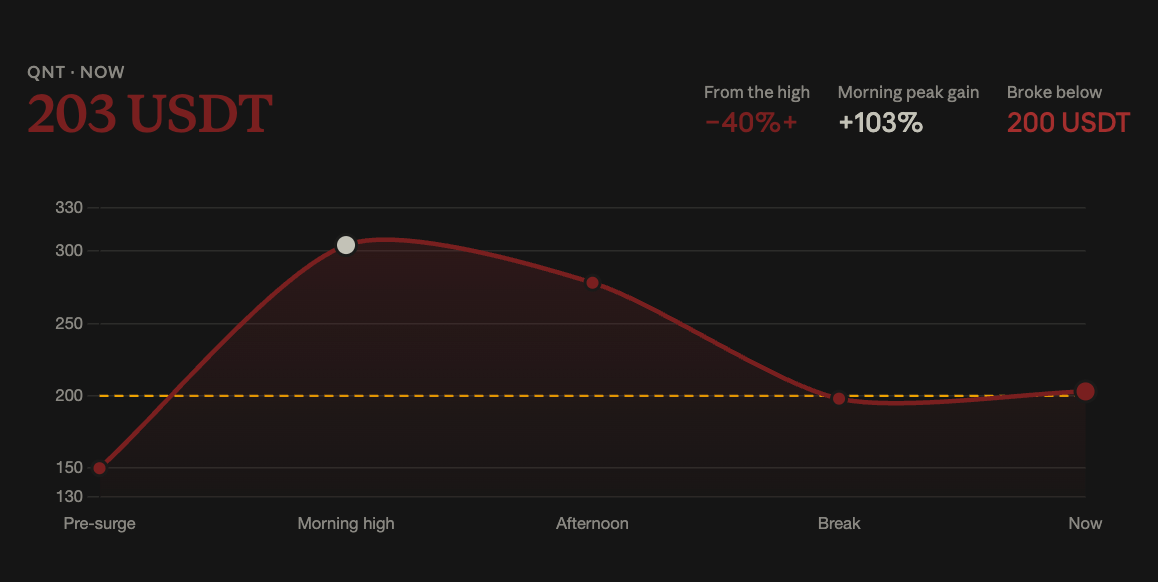
Actualités sur les altcoins | La QNT chute de plus de 40% par rapport à son sommet du matin, franchissant brièvement la barre des 200 USDTLa QNT est brièvement passée sous 200 USDT et s’échange désormais à 203, en baisse de plus de 40% par rapport à son plus haut plus tôt dans la séance.Le jeton avait gagné jusqu’à 103% lors des échanges du matin, atteignant 304$, avant le retournement.Le aller-retour est désormais terminéCe n’est plus un repli depuis un niveau prolongé.Tout au long de l’après-midi, la QNT avait maintenu un gain de 59% à 278$, ce qui la laissait encore largement en avance dans la journée. À 203 USDT, elle a rendu la majeure partie d’un mouvement qui avait brièvement doublé le jeton.Un gain de 103% jusqu’à un sommet à 304$ implique un point de départ proche de 150$. La QNT reste au-dessus de cela, mais la distance s’est réduite, passant d’environ 154$ au pic à environ 53$.
Actualités sur les altcoins | La QNT chute de plus de 40% par rapport à son sommet du matin, franchissant brièvement la barre des 200 USDT
La QNT est brièvement passée sous 200 USDT et s’échange désormais à 203, en baisse de plus de 40% par rapport à son plus haut plus tôt dans la séance.Le jeton avait gagné jusqu’à 103% lors des échanges du matin, atteignant 304$, avant le retournement.Le aller-retour est désormais terminéCe n’est plus un repli depuis un niveau prolongé.Tout au long de l’après-midi, la QNT avait maintenu un gain de 59% à 278$, ce qui la laissait encore largement en avance dans la journée. À 203 USDT, elle a rendu la majeure partie d’un mouvement qui avait brièvement doublé le jeton.Un gain de 103% jusqu’à un sommet à 304$ implique un point de départ proche de 150$. La QNT reste au-dessus de cela, mais la distance s’est réduite, passant d’environ 154$ au pic à environ 53$.
6
3
27
40.3k
·
--
Réclamation et séance de trading pour l’airdrop Binance Alpha à 14 h 30 (UTC)Binance Wallet a annoncé sur X que les utilisateurs doivent se préparer à réclamer l’airdrop Binance Alpha et à trader aujourd’hui à 14 h 30 (UTC). Les utilisateurs disposant d’au moins 230 points Binance Alpha peuvent réclamer le jeton selon le principe du premier arrivé, premier servi jusqu’à ce que le pool de l’airdrop soit entièrement distribué ou que l’événement d’airdrop expire. De plus amples détails seront annoncés sous peu. L’annonce ne précisait pas le token de l’airdrop. Aucun autre détail n’a été fourni dans l’avis.
Réclamation et séance de trading pour l’airdrop Binance Alpha à 14 h 30 (UTC)
Binance Wallet a annoncé sur X que les utilisateurs doivent se préparer à réclamer l’airdrop Binance Alpha et à trader aujourd’hui à 14 h 30 (UTC). Les utilisateurs disposant d’au moins 230 points Binance Alpha peuvent réclamer le jeton selon le principe du premier arrivé, premier servi jusqu’à ce que le pool de l’airdrop soit entièrement distribué ou que l’événement d’airdrop expire. De plus amples détails seront annoncés sous peu. L’annonce ne précisait pas le token de l’airdrop. Aucun autre détail n’a été fourni dans l’avis.
2
1
21
8.1k
·
--
Chainlink Lance CCIP 2 Avec des Contrôles de Vérification Optionnels pour les EntreprisesChainlink a lancé CCIP 2 ce lundi, une mise à niveau majeure de son interopérabilité inter-chaînes et de son infrastructure de pont. D’après ChainCatcher, la nouvelle version permet aux entreprises d’ajouter leurs propres contrôles de vérification de sécurité par-dessus le réseau par défaut de Chainlink, composé de 16 opérateurs de nœuds indépendants. Les entreprises peuvent ainsi exécuter leurs propres validateurs ou faire appel à des prestataires externes tels qu’Infosys et Nethermind.
La mise à niveau intervient environ cinq mois après le piratage du DAO Kelp en avril. Les attaquants, présumés liés au groupe Lazarus d’intérêt nord-coréen, auraient trompé un unique validateur utilisé par le pont inter-chaînes de Kelp et volé environ 292 millions de dollars de rsETH à partir d’un pont fonctionnant sur LayerZero. LayerZero a reproché à Kelp d’utiliser un seul validateur, tandis que Kelp a indiqué que le personnel de LayerZero avait examiné sa configuration et n’avait soulevé aucune objection. Kelp a ensuite déclaré qu’il migrerait le rsETH vers Chainlink.
Chainlink Lance CCIP 2 Avec des Contrôles de Vérification Optionnels pour les Entreprises
Chainlink a lancé CCIP 2 ce lundi, une mise à niveau majeure de son interopérabilité inter-chaînes et de son infrastructure de pont. D’après ChainCatcher, la nouvelle version permet aux entreprises d’ajouter leurs propres contrôles de vérification de sécurité par-dessus le réseau par défaut de Chainlink, composé de 16 opérateurs de nœuds indépendants. Les entreprises peuvent ainsi exécuter leurs propres validateurs ou faire appel à des prestataires externes tels qu’Infosys et Nethermind.
La mise à niveau intervient environ cinq mois après le piratage du DAO Kelp en avril. Les attaquants, présumés liés au groupe Lazarus d’intérêt nord-coréen, auraient trompé un unique validateur utilisé par le pont inter-chaînes de Kelp et volé environ 292 millions de dollars de rsETH à partir d’un pont fonctionnant sur LayerZero. LayerZero a reproché à Kelp d’utiliser un seul validateur, tandis que Kelp a indiqué que le personnel de LayerZero avait examiné sa configuration et n’avait soulevé aucune objection. Kelp a ensuite déclaré qu’il migrerait le rsETH vers Chainlink.
La mise à niveau intervient environ cinq mois après le piratage du DAO Kelp en avril. Les attaquants, présumés liés au groupe Lazarus d’intérêt nord-coréen, auraient trompé un unique validateur utilisé par le pont inter-chaînes de Kelp et volé environ 292 millions de dollars de rsETH à partir d’un pont fonctionnant sur LayerZero. LayerZero a reproché à Kelp d’utiliser un seul validateur, tandis que Kelp a indiqué que le personnel de LayerZero avait examiné sa configuration et n’avait soulevé aucune objection. Kelp a ensuite déclaré qu’il migrerait le rsETH vers Chainlink.
2
1
16
16.4k
·
--
Nvidia approuve un rachat record de 150 milliards de dollars tandis que le pétrole grimpeLe pétrole a bondi après que le président américain Donald Trump a rejeté la proposition iranienne concernant Hormuz, tandis que Nvidia a approuvé un rachat d’actions record de 150 milliards de dollars, d’après Bloomberg.
Le briefing comprenait également le directeur général d’Akamai, Tom Leighton, au sujet d’un accord de 12 milliards de dollars avec Anthropic, le directeur général de LPL Financial, Rich Steinmeier, sur la raison pour laquelle l’IA ne remplacera pas les conseillers financiers, et le retour de Starship de SpaceX dans le ciel.
Nvidia approuve un rachat record de 150 milliards de dollars tandis que le pétrole grimpe
Le pétrole a bondi après que le président américain Donald Trump a rejeté la proposition iranienne concernant Hormuz, tandis que Nvidia a approuvé un rachat d’actions record de 150 milliards de dollars, d’après Bloomberg.
Le briefing comprenait également le directeur général d’Akamai, Tom Leighton, au sujet d’un accord de 12 milliards de dollars avec Anthropic, le directeur général de LPL Financial, Rich Steinmeier, sur la raison pour laquelle l’IA ne remplacera pas les conseillers financiers, et le retour de Starship de SpaceX dans le ciel.
Le briefing comprenait également le directeur général d’Akamai, Tom Leighton, au sujet d’un accord de 12 milliards de dollars avec Anthropic, le directeur général de LPL Financial, Rich Steinmeier, sur la raison pour laquelle l’IA ne remplacera pas les conseillers financiers, et le retour de Starship de SpaceX dans le ciel.
2
9
24.3k
·
--
Le fonds de protection de Bitget transfère 2 042,28 BTC vers des portefeuilles hot après l’ouverture du portail de retraitLe 28 septembre, l’analyste on-chain Ai Yi (@ai_9684xtpa) a observé qu’après que Bitget a ouvert son portail de retrait BTC, une partie du fonds de protection de 5 500 BTC a été transférée par lots aux portefeuilles hot de Bitget afin de préparer les retraits. D’après la détection on-chain de BlockBeats, 2 042,28 BTC ont déjà été déplacés jusqu’à présent, tandis que 3 457,72 BTC restent sur la chaîne.
L’analyste a déclaré que les jetons avaient été transférés à l’avance et qu’ils ne devaient pas être assimilés au montant réel retiré.
Le fonds de protection de Bitget transfère 2 042,28 BTC vers des portefeuilles hot après l’ouverture du portail de retrait
Le 28 septembre, l’analyste on-chain Ai Yi (@ai_9684xtpa) a observé qu’après que Bitget a ouvert son portail de retrait BTC, une partie du fonds de protection de 5 500 BTC a été transférée par lots aux portefeuilles hot de Bitget afin de préparer les retraits. D’après la détection on-chain de BlockBeats, 2 042,28 BTC ont déjà été déplacés jusqu’à présent, tandis que 3 457,72 BTC restent sur la chaîne.
L’analyste a déclaré que les jetons avaient été transférés à l’avance et qu’ils ne devaient pas être assimilés au montant réel retiré.
L’analyste a déclaré que les jetons avaient été transférés à l’avance et qu’ils ne devaient pas être assimilés au montant réel retiré.
3
1
13
62.9k
·
--
Le Sénat échoue à faire avancer la loi CLARITY après un vote de 50 voix contre 49Le Sénat n’est pas parvenu à faire avancer le projet de loi CLARITY ce mois-ci après que le texte a reçu 50 voix pour et 49 contre. Selon NS3.AI, la mesure nécessitait 60 voix pour invoquer la cloture.
L’article 404 du projet de loi aurait interdit aux fournisseurs de services d’actifs numériques couverts et à leurs affiliés de verser aux clients américains un rendement passif, de type dépôt, sur les soldes de stablecoins de paiement.
Le Sénat échoue à faire avancer la loi CLARITY après un vote de 50 voix contre 49
Le Sénat n’est pas parvenu à faire avancer le projet de loi CLARITY ce mois-ci après que le texte a reçu 50 voix pour et 49 contre. Selon NS3.AI, la mesure nécessitait 60 voix pour invoquer la cloture.
L’article 404 du projet de loi aurait interdit aux fournisseurs de services d’actifs numériques couverts et à leurs affiliés de verser aux clients américains un rendement passif, de type dépôt, sur les soldes de stablecoins de paiement.
L’article 404 du projet de loi aurait interdit aux fournisseurs de services d’actifs numériques couverts et à leurs affiliés de verser aux clients américains un rendement passif, de type dépôt, sur les soldes de stablecoins de paiement.
1
4
6.6k
·
--
QNT, BTW Et SUI Se Classent Parmi Les Meilleurs Gagnants Sur Sept JoursQuant (QNT), Bitway (BTW) et Sui (SUI) figurent parmi les sept meilleures hausses d’altcoins sur sept jours, avec QNT en hausse de 300 %, BTW de 78 % et SUI de 30 %. D’après BeInCrypto, les trois graphiques restent haussiers, mais des signaux de surachat et un volume qui s’essouffle laissent penser que la première semaine d’octobre pourrait mettre la résistance à l’épreuve.
QNT a bondi après que The Clearing House a sélectionné Quant le 24 septembre pour des règlements de dépôt tokenisés auprès de 25 grandes banques américaines, tandis que BTW et SUI ont également affiché des configurations haussières, avec des risques de repli à court terme.
QNT, BTW Et SUI Se Classent Parmi Les Meilleurs Gagnants Sur Sept Jours
Quant (QNT), Bitway (BTW) et Sui (SUI) figurent parmi les sept meilleures hausses d’altcoins sur sept jours, avec QNT en hausse de 300 %, BTW de 78 % et SUI de 30 %. D’après BeInCrypto, les trois graphiques restent haussiers, mais des signaux de surachat et un volume qui s’essouffle laissent penser que la première semaine d’octobre pourrait mettre la résistance à l’épreuve.
QNT a bondi après que The Clearing House a sélectionné Quant le 24 septembre pour des règlements de dépôt tokenisés auprès de 25 grandes banques américaines, tandis que BTW et SUI ont également affiché des configurations haussières, avec des risques de repli à court terme.
QNT a bondi après que The Clearing House a sélectionné Quant le 24 septembre pour des règlements de dépôt tokenisés auprès de 25 grandes banques américaines, tandis que BTW et SUI ont également affiché des configurations haussières, avec des risques de repli à court terme.
1
15
27.9k
·
--
USDT ajoute 845 900 détenteurs au cours des 7 derniers joursUSDT ajoute 845 900 détenteurs au cours des 7 derniers jours, tandis que USDC en ajoute 390 800, EURC 69 800, USDG 23 300 et CASH 18 600. D’après Odaily, ces chiffres couvrent la même période de 7 jours.
USDT ajoute 845 900 détenteurs au cours des 7 derniers jours
USDT ajoute 845 900 détenteurs au cours des 7 derniers jours, tandis que USDC en ajoute 390 800, EURC 69 800, USDG 23 300 et CASH 18 600. D’après Odaily, ces chiffres couvrent la même période de 7 jours.
9
15
32
12.9k
·
--
Evernorth prévoit une cotation au Nasdaq sous XRPN alors que les actionnaires fixent le vote de fusion au 30 septembreEvernorth, une société de trésorerie en XRP, prévoit de s’inscrire sur le Nasdaq sous le symbole XRPN. Selon Odaily, les actionnaires d’Armada Acquisition Corp. II voteront sur la fusion d’entreprises le 30 septembre, et son approbation éliminerait le dernier obstacle majeur à la cotation publique d’Evernorth.
Evernorth prévoit de déployer XRP pour des stratégies de rendement, la participation aux infrastructures et des activités sur les marchés des capitaux. La société détient environ 473 millions de XRP et fait partie des plus importants détenteurs corporatifs identifiables. Evernorth a également accepté de refinancer 30 millions de dollars via des billets préférentiels convertibles avec paiement en nature (PIK) à 4 %, mais les fonds ne peuvent être utilisés qu’après l’approbation de la fusion d’entreprises.
Evernorth prévoit une cotation au Nasdaq sous XRPN alors que les actionnaires fixent le vote de fusion au 30 septembre
Evernorth, une société de trésorerie en XRP, prévoit de s’inscrire sur le Nasdaq sous le symbole XRPN. Selon Odaily, les actionnaires d’Armada Acquisition Corp. II voteront sur la fusion d’entreprises le 30 septembre, et son approbation éliminerait le dernier obstacle majeur à la cotation publique d’Evernorth.
Evernorth prévoit de déployer XRP pour des stratégies de rendement, la participation aux infrastructures et des activités sur les marchés des capitaux. La société détient environ 473 millions de XRP et fait partie des plus importants détenteurs corporatifs identifiables. Evernorth a également accepté de refinancer 30 millions de dollars via des billets préférentiels convertibles avec paiement en nature (PIK) à 4 %, mais les fonds ne peuvent être utilisés qu’après l’approbation de la fusion d’entreprises.
Evernorth prévoit de déployer XRP pour des stratégies de rendement, la participation aux infrastructures et des activités sur les marchés des capitaux. La société détient environ 473 millions de XRP et fait partie des plus importants détenteurs corporatifs identifiables. Evernorth a également accepté de refinancer 30 millions de dollars via des billets préférentiels convertibles avec paiement en nature (PIK) à 4 %, mais les fonds ne peuvent être utilisés qu’après l’approbation de la fusion d’entreprises.
1
1
8
12.6k
·
--
Binance prendra en charge les airdrops SPCXB et QQQB pour les détenteurs de MARSCOIN et 牛来Selon l’annonce [announcement](https://www.binance.com/en/support/announcement/detail/1ea1d5c29a0a4c2c8c7f4c4e947c07f2) de Binance, la plateforme prendra en charge l’airdrop SpaceX (SPCXB) pour les détenteurs de MarsCoin (MARSCOIN) et l’airdrop Invesco QQQ Trust (QQQB) pour les détenteurs de 牛来. La distribution comprend deux composantes de récompense. Premièrement, Binance distribuera les jetons SPCXB et QQQB alloués on-chain par les projets respectifs aux détenteurs éligibles de MARSCOIN et 牛来. Deuxièmement, Binance allouera 30 % des frais de trading au comptant de MARSCOIN et 牛来 comme récompenses supplémentaires, à distribuer sous forme de SPCXB et QQQB respectivement, jusqu’à nouvel ordre. Les deux composantes de récompense utiliseront la même méthode de calcul des détentions valides. Binance a indiqué qu’elle prendra une capture aléatoire par jour des avoirs en MARSCOIN et 牛来 des utilisateurs tout au long de chaque mois civil, et que seuls les avoirs quotidiens dépassant 10 000 jetons compteront comme détentions valides pour chaque jeton. Les détentions mensuelles valides seront calculées comme la somme des détentions quotidiennes valides de chaque utilisateur au cours du mois, et les récompenses seront distribuées en fonction de la part de chaque utilisateur dans le total des détentions valides parmi les utilisateurs éligibles. Les avoirs en MARSCOIN et 牛来 seront calculés séparément.
Binance prendra en charge les airdrops SPCXB et QQQB pour les détenteurs de MARSCOIN et 牛来
Selon l’annonce announcement de Binance, la plateforme prendra en charge l’airdrop SpaceX (SPCXB) pour les détenteurs de MarsCoin (MARSCOIN) et l’airdrop Invesco QQQ Trust (QQQB) pour les détenteurs de 牛来. La distribution comprend deux composantes de récompense. Premièrement, Binance distribuera les jetons SPCXB et QQQB alloués on-chain par les projets respectifs aux détenteurs éligibles de MARSCOIN et 牛来. Deuxièmement, Binance allouera 30 % des frais de trading au comptant de MARSCOIN et 牛来 comme récompenses supplémentaires, à distribuer sous forme de SPCXB et QQQB respectivement, jusqu’à nouvel ordre. Les deux composantes de récompense utiliseront la même méthode de calcul des détentions valides. Binance a indiqué qu’elle prendra une capture aléatoire par jour des avoirs en MARSCOIN et 牛来 des utilisateurs tout au long de chaque mois civil, et que seuls les avoirs quotidiens dépassant 10 000 jetons compteront comme détentions valides pour chaque jeton. Les détentions mensuelles valides seront calculées comme la somme des détentions quotidiennes valides de chaque utilisateur au cours du mois, et les récompenses seront distribuées en fonction de la part de chaque utilisateur dans le total des détentions valides parmi les utilisateurs éligibles. Les avoirs en MARSCOIN et 牛来 seront calculés séparément.
4
8
35
13.5k
·
--
La Russie ouvre les demandes d’inscription à un registre officiel pour les échanges de crypto et les dépositaires numériquesLes opérateurs de plateformes d'échange de crypto et les dépositaires numériques en Russie peuvent commencer à demander leur inscription à un registre officiel à partir du 5 octobre. Selon NS3.AI, la Banque de Russie disposera de 30 jours ouvrables pour décider des demandes d'opérateurs d'échange, tandis que les demandes de dépositaires numériques seront examinées dans un délai de 60 jours ouvrables.
Une liste de brouillon distincte destinée au trading de détail avait inclus le Bitcoin, mais les règles d'admission d'octobre ne finalisent pas cette liste.
La Russie ouvre les demandes d’inscription à un registre officiel pour les échanges de crypto et les dépositaires numériques
Les opérateurs de plateformes d'échange de crypto et les dépositaires numériques en Russie peuvent commencer à demander leur inscription à un registre officiel à partir du 5 octobre. Selon NS3.AI, la Banque de Russie disposera de 30 jours ouvrables pour décider des demandes d'opérateurs d'échange, tandis que les demandes de dépositaires numériques seront examinées dans un délai de 60 jours ouvrables.
Une liste de brouillon distincte destinée au trading de détail avait inclus le Bitcoin, mais les règles d'admission d'octobre ne finalisent pas cette liste.
Une liste de brouillon distincte destinée au trading de détail avait inclus le Bitcoin, mais les règles d'admission d'octobre ne finalisent pas cette liste.
8
2.4k
·
--
Une adresse NEAR liquide 748 100 tokens lorsque le prix baisseUne adresse a liquidé 748 100 NEAR lorsque le token a chuté, la position étant évaluée à 3,67 millions de dollars. D’après Odaily, la liquidation a été suivie par Lookonchain.
Une adresse NEAR liquide 748 100 tokens lorsque le prix baisse
Une adresse a liquidé 748 100 NEAR lorsque le token a chuté, la position étant évaluée à 3,67 millions de dollars. D’après Odaily, la liquidation a été suivie par Lookonchain.
1
5
26.9k
·
--
Bitget détaille la chronologie de l’incident de sécurité, rapport officiel attendu cette semaineBitget a publié une chronologie détaillée d’un incident de sécurité, et son rapport d’enquête officiel devrait être publié cette semaine. La directrice générale de Bitget, Gracy Chen, a partagé la chronologie lors d’une diffusion en direct consacrée à l’examen de l’incident.
Le 25 septembre à 2h31, des pirates ont effectué de petits transferts de 0,84 ETH et de 93 TRX depuis les portefeuilles chauds Ethereum et Tron, respectivement. Les montants étaient inférieurs au seuil de contrôle des risques, donc aucune alerte n’a été déclenchée. De 2h58 à 4h09, les attaquants ont réalisé 17 transferts importants sur les réseaux XRP, ZEC, BSC, Base, Arbitrum, Optimism et d’autres chaînes, pour une valeur totale d’environ 360 millions de dollars.
Bitget détaille la chronologie de l’incident de sécurité, rapport officiel attendu cette semaine
Bitget a publié une chronologie détaillée d’un incident de sécurité, et son rapport d’enquête officiel devrait être publié cette semaine. La directrice générale de Bitget, Gracy Chen, a partagé la chronologie lors d’une diffusion en direct consacrée à l’examen de l’incident.
Le 25 septembre à 2h31, des pirates ont effectué de petits transferts de 0,84 ETH et de 93 TRX depuis les portefeuilles chauds Ethereum et Tron, respectivement. Les montants étaient inférieurs au seuil de contrôle des risques, donc aucune alerte n’a été déclenchée. De 2h58 à 4h09, les attaquants ont réalisé 17 transferts importants sur les réseaux XRP, ZEC, BSC, Base, Arbitrum, Optimism et d’autres chaînes, pour une valeur totale d’environ 360 millions de dollars.
Le 25 septembre à 2h31, des pirates ont effectué de petits transferts de 0,84 ETH et de 93 TRX depuis les portefeuilles chauds Ethereum et Tron, respectivement. Les montants étaient inférieurs au seuil de contrôle des risques, donc aucune alerte n’a été déclenchée. De 2h58 à 4h09, les attaquants ont réalisé 17 transferts importants sur les réseaux XRP, ZEC, BSC, Base, Arbitrum, Optimism et d’autres chaînes, pour une valeur totale d’environ 360 millions de dollars.
1
3
17
18.3k
·
--
Article
Les États-Unis et la Chine publient des listes de produits pour un accord sur des droits de douane de 30 milliardsLes États-Unis et la Chine ont détaillé un plan visant à réduire les droits de douane sur environ 30 milliards de dollars d’importations en provenance de chaque pays, alors que les rivaux cherchent à stabiliser leurs relations après un sommet entre Donald Trump et Xi Jinping, selon Bloomberg. Des documents publiés par les deux gouvernements montrent que la liste des produits entrant aux États-Unis comporte 77 entrées, dont des feux d’artifice, des articles ménagers, du matériel de sport et des jouets, tandis que 1 619 produits pourraient entrer en Chine, comme de la viande, des produits de la mer, des produits laitiers, des céréales, du charbon, du bois et du matériel médical. Le soulagement attendu de 60 milliards de dollars sur le commerce bilatéral figure parmi les résultats les plus concrets de la visite d’État de Xi à Washington la semaine dernière, bien qu’il ne représente qu’une fraction des 415 milliards de dollars de marchandises échangées l’an dernier par les deux plus grandes économies du monde. Les deux parties ont prolongé leur trêve commerciale jusqu’en janvier et cherchent à conclure un accord plus large en vue de deux autres rencontres attendues entre Trump et Xi cette année.
Les États-Unis et la Chine publient des listes de produits pour un accord sur des droits de douane de 30 milliards
Les États-Unis et la Chine ont détaillé un plan visant à réduire les droits de douane sur environ 30 milliards de dollars d’importations en provenance de chaque pays, alors que les rivaux cherchent à stabiliser leurs relations après un sommet entre Donald Trump et Xi Jinping, selon Bloomberg. Des documents publiés par les deux gouvernements montrent que la liste des produits entrant aux États-Unis comporte 77 entrées, dont des feux d’artifice, des articles ménagers, du matériel de sport et des jouets, tandis que 1 619 produits pourraient entrer en Chine, comme de la viande, des produits de la mer, des produits laitiers, des céréales, du charbon, du bois et du matériel médical. Le soulagement attendu de 60 milliards de dollars sur le commerce bilatéral figure parmi les résultats les plus concrets de la visite d’État de Xi à Washington la semaine dernière, bien qu’il ne représente qu’une fraction des 415 milliards de dollars de marchandises échangées l’an dernier par les deux plus grandes économies du monde. Les deux parties ont prolongé leur trêve commerciale jusqu’en janvier et cherchent à conclure un accord plus large en vue de deux autres rencontres attendues entre Trump et Xi cette année.
1
2
25
34.7k
·
--
Peter Brandt affirme que les graphiques du XRP suffisent à justifier l’achat alors que les entrées d’ETF s’intensifientPeter Brandt a déclaré que les détenteurs de XRP n’ont pas besoin de « certified cult membership » pour justifier le fait de détenir le token, affirmant que les graphiques seuls suffisent comme raison d’acheter. D’après BeInCrypto, ses propos sont arrivés au moment où des signaux techniques haussiers, l’accumulation par des baleines et des entrées régulières d’ETF étayaient un scénario constructif pour XRP.
Le graphique à long terme de Brandt indique un potentiel de hausse proche de 5,40 $, tandis que le XRP s’échangeait autour de 1,52 $. Des analystes ont également cité une figure en tête et épaules inversée dont la ligne de cou se situerait vers 1,55, et ont indiqué qu’une cassure pourrait propulser le XRP vers 2 $.
Peter Brandt affirme que les graphiques du XRP suffisent à justifier l’achat alors que les entrées d’ETF s’intensifient
Peter Brandt a déclaré que les détenteurs de XRP n’ont pas besoin de « certified cult membership » pour justifier le fait de détenir le token, affirmant que les graphiques seuls suffisent comme raison d’acheter. D’après BeInCrypto, ses propos sont arrivés au moment où des signaux techniques haussiers, l’accumulation par des baleines et des entrées régulières d’ETF étayaient un scénario constructif pour XRP.
Le graphique à long terme de Brandt indique un potentiel de hausse proche de 5,40 $, tandis que le XRP s’échangeait autour de 1,52 $. Des analystes ont également cité une figure en tête et épaules inversée dont la ligne de cou se situerait vers 1,55, et ont indiqué qu’une cassure pourrait propulser le XRP vers 2 $.
Le graphique à long terme de Brandt indique un potentiel de hausse proche de 5,40 $, tandis que le XRP s’échangeait autour de 1,52 $. Des analystes ont également cité une figure en tête et épaules inversée dont la ligne de cou se situerait vers 1,55, et ont indiqué qu’une cassure pourrait propulser le XRP vers 2 $.
2
17
43.2k
·
--
Article
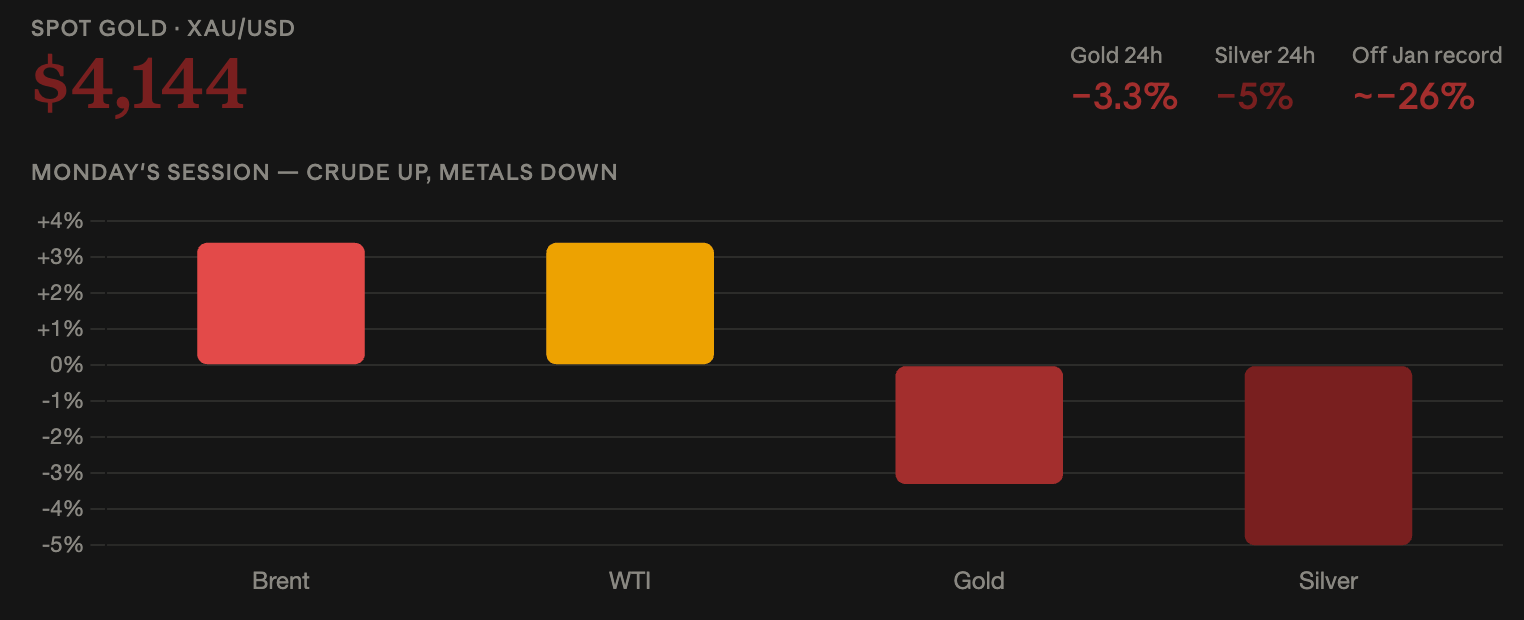
Actualités du marché | L’or recule à 4 144 $ tandis que le Brent franchit 100 $ sous l’effet d’espoirs de paix déçusLes métaux précieux ont prolongé leur baisse lundi : l’or au comptant a reculé d’environ 3,3 % pour s’établir à quelque 4 144 $ la once troy, tandis que l’argent plongeait de 5 %.Les deux références du brut ont évolué en sens inverse. Le Brent, la référence internationale dont les prix reflètent la majeure partie du brut le plus échangé mondialement, a dépassé 100 $, tandis que le WTI, la référence américaine, a progressé d’environ 3,4 % pour s’établir à 95,60 $. L’affaiblissement des espoirs de paix et le regain du risque géopolitique au Moyen-Orient ont alimenté ce mouvement.Les contrats à terme sur l’or au Comex se sont négociés près de 4 176 $.L’écart de référence signale un problème d’exportationL’écart entre les deux contrats contient une information que les prix mis en avant ne reflètent pas.
Actualités du marché | L’or recule à 4 144 $ tandis que le Brent franchit 100 $ sous l’effet d’espoirs de paix déçus
Les métaux précieux ont prolongé leur baisse lundi : l’or au comptant a reculé d’environ 3,3 % pour s’établir à quelque 4 144 $ la once troy, tandis que l’argent plongeait de 5 %.Les deux références du brut ont évolué en sens inverse. Le Brent, la référence internationale dont les prix reflètent la majeure partie du brut le plus échangé mondialement, a dépassé 100 $, tandis que le WTI, la référence américaine, a progressé d’environ 3,4 % pour s’établir à 95,60 $. L’affaiblissement des espoirs de paix et le regain du risque géopolitique au Moyen-Orient ont alimenté ce mouvement.Les contrats à terme sur l’or au Comex se sont négociés près de 4 176 $.L’écart de référence signale un problème d’exportationL’écart entre les deux contrats contient une information que les prix mis en avant ne reflètent pas.
3
1
19
12.1k
·
--
Bitget détaille les correctifs des vulnérabilités et la reprise des retraits après un incident de sécuritéLa responsable de Bitget Greater China, Xie Jiayin, a présenté lors d’un live l’avancement des correctifs liés aux vulnérabilités ainsi que les mesures de contrôle des risques. Elle a ainsi examiné l’incident de sécurité de l’échange. D’après Foresight News, l’entreprise a isolé les systèmes concernés, révoqué les identifiants internes, renforcé les autorisations des accès à haute sensibilité et instauré une validation par plusieurs personnes pour les opérations clés.
Bitget a également partagé les détails des vulnérabilités avec des prestataires tiers de sécurité concernés afin d’aider à l’analyse et à la remédiation, et a cessé d’utiliser les fonctions associées avant que les correctifs ne soient finalisés. L’entreprise a indiqué qu’elle renforcerait davantage la vérification des retraits, en exigeant que tous les retraits fassent l’objet de contrôles indépendants.
Bitget détaille les correctifs des vulnérabilités et la reprise des retraits après un incident de sécurité
La responsable de Bitget Greater China, Xie Jiayin, a présenté lors d’un live l’avancement des correctifs liés aux vulnérabilités ainsi que les mesures de contrôle des risques. Elle a ainsi examiné l’incident de sécurité de l’échange. D’après Foresight News, l’entreprise a isolé les systèmes concernés, révoqué les identifiants internes, renforcé les autorisations des accès à haute sensibilité et instauré une validation par plusieurs personnes pour les opérations clés.
Bitget a également partagé les détails des vulnérabilités avec des prestataires tiers de sécurité concernés afin d’aider à l’analyse et à la remédiation, et a cessé d’utiliser les fonctions associées avant que les correctifs ne soient finalisés. L’entreprise a indiqué qu’elle renforcerait davantage la vérification des retraits, en exigeant que tous les retraits fassent l’objet de contrôles indépendants.
Bitget a également partagé les détails des vulnérabilités avec des prestataires tiers de sécurité concernés afin d’aider à l’analyse et à la remédiation, et a cessé d’utiliser les fonctions associées avant que les correctifs ne soient finalisés. L’entreprise a indiqué qu’elle renforcerait davantage la vérification des retraits, en exigeant que tous les retraits fassent l’objet de contrôles indépendants.
3
9
21
55.6k
·
--
ACTIONS | DeFi Development Corp. Augmente ses Avoirs en SOL de 47 706 Jetons du 21 au 25 septembreDeFi Development Corp. a indiqué dans un dépôt 8-K auprès de la SEC américaine qu’elle avait augmenté ses avoirs de 47 706 SOL et d’équivalents de SOL du 21 au 25 septembre 2026. D’après Foresight News, les avoirs totaux de la société en SOL et en équivalents de SOL ont atteint 2 538 010 jetons au 25 septembre, soit environ 2 % de plus que la semaine précédente.
ACTIONS | DeFi Development Corp. Augmente ses Avoirs en SOL de 47 706 Jetons du 21 au 25 septembre
DeFi Development Corp. a indiqué dans un dépôt 8-K auprès de la SEC américaine qu’elle avait augmenté ses avoirs de 47 706 SOL et d’équivalents de SOL du 21 au 25 septembre 2026. D’après Foresight News, les avoirs totaux de la société en SOL et en équivalents de SOL ont atteint 2 538 010 jetons au 25 septembre, soit environ 2 % de plus que la semaine précédente.
4
4
9
7.1k
·
--
La BNB Chain nomme Thomas Chen au poste de directeur des affaires commercialesLa BNB Chain a nommé Thomas Chen au poste de directeur des affaires commerciales (Chief Business Officer, CBO). D’après Odaily, Chen dispose de 15 ans d’expérience dans le secteur, dont plus de sept ans consacrés à l’infrastructure des actifs numériques.
Il a auparavant travaillé sur les marchés de capitaux, la garde (custody), le trading et la croissance des activités. Sur la BNB Chain, il se concentrera sur l’adoption institutionnelle et des capitaux onchain, la liquidité, le volume de transactions et la valeur à long terme de l’écosystème.
La BNB Chain nomme Thomas Chen au poste de directeur des affaires commerciales
La BNB Chain a nommé Thomas Chen au poste de directeur des affaires commerciales (Chief Business Officer, CBO). D’après Odaily, Chen dispose de 15 ans d’expérience dans le secteur, dont plus de sept ans consacrés à l’infrastructure des actifs numériques.
Il a auparavant travaillé sur les marchés de capitaux, la garde (custody), le trading et la croissance des activités. Sur la BNB Chain, il se concentrera sur l’adoption institutionnelle et des capitaux onchain, la liquidité, le volume de transactions et la valeur à long terme de l’écosystème.
Il a auparavant travaillé sur les marchés de capitaux, la garde (custody), le trading et la croissance des activités. Sur la BNB Chain, il se concentrera sur l’adoption institutionnelle et des capitaux onchain, la liquidité, le volume de transactions et la valeur à long terme de l’écosystème.
5
2.6k
·
--
La Corée du Nord, d’après les informations, blanchirait des fonds sur plusieurs blockchains, en ouvrant des positions perpétuelles sur dYdXSelon l’analyste on-chain Specter, la Corée du Nord blanchit des fonds sur plusieurs blockchains, y compris des chaînes sous-jacentes telles que dYdX, Noble et Osmosis. D’après ChainCatcher, l’activité comprend également l’ouverture de positions sur contrats perpétuels sur dYdX.
La Corée du Nord, d’après les informations, blanchirait des fonds sur plusieurs blockchains, en ouvrant des positions perpétuelles sur dYdX
Selon l’analyste on-chain Specter, la Corée du Nord blanchit des fonds sur plusieurs blockchains, y compris des chaînes sous-jacentes telles que dYdX, Noble et Osmosis. D’après ChainCatcher, l’activité comprend également l’ouverture de positions sur contrats perpétuels sur dYdX.
1
4
6.5k
·
--
Une adresse achète 8 017 ZEC tandis que la position longue passe à 18 400 piècesUne adresse a acheté 8 017 ZEC lors d’une correction, la transaction s’élevant à environ 12,62 millions de dollars. D’après Odaily, l’adresse a augmenté sa position longue en ZEC à environ 18 400 pièces, tandis que la position globale affichait une perte d’environ 1,31 million de dollars. L’adresse a commencé à constituer la position le 27 septembre, avec un prix d’achat moyen d’environ 1 659 dollars. Après avoir renforcé la position, le coût moyen de détention est tombé à environ 1 622 dollars.
Une adresse achète 8 017 ZEC tandis que la position longue passe à 18 400 pièces
Une adresse a acheté 8 017 ZEC lors d’une correction, la transaction s’élevant à environ 12,62 millions de dollars. D’après Odaily, l’adresse a augmenté sa position longue en ZEC à environ 18 400 pièces, tandis que la position globale affichait une perte d’environ 1,31 million de dollars. L’adresse a commencé à constituer la position le 27 septembre, avec un prix d’achat moyen d’environ 1 659 dollars. Après avoir renforcé la position, le coût moyen de détention est tombé à environ 1 622 dollars.
3
2
13.6k
·
--
THORChain Dit Que Les Pannes Réseau Sont Des Mesures De Sécurité D’Urgence, Pas Des Gels SélectifsTHORChain a déclaré que des pannes réseau constituent des mesures de sécurité d’urgence destinées à protéger la sécurité du protocole, et non des gels sélectifs de fonds spécifiques ou de swaps individuels. Selon Odaily, 10,7 millions de dollars ont été volés à partir de pools de liquidité lors d’un incident de sécurité en mai 2026, et l’adresse de l’attaquant n’avait pas été blacklistée à ce moment-là, permettant aux transactions de continuer sur THORChain. La plateforme a indiqué qu’il s’agit d’une blockchain sans permission conçue pour éviter la censure, et qu’elle a refusé de bloquer l’activité, invoquant sa structure décentralisée et sans permission.
THORChain Dit Que Les Pannes Réseau Sont Des Mesures De Sécurité D’Urgence, Pas Des Gels Sélectifs
THORChain a déclaré que des pannes réseau constituent des mesures de sécurité d’urgence destinées à protéger la sécurité du protocole, et non des gels sélectifs de fonds spécifiques ou de swaps individuels. Selon Odaily, 10,7 millions de dollars ont été volés à partir de pools de liquidité lors d’un incident de sécurité en mai 2026, et l’adresse de l’attaquant n’avait pas été blacklistée à ce moment-là, permettant aux transactions de continuer sur THORChain. La plateforme a indiqué qu’il s’agit d’une blockchain sans permission conçue pour éviter la censure, et qu’elle a refusé de bloquer l’activité, invoquant sa structure décentralisée et sans permission.
3
2
4
4.5k
·
--
Le Bitcoin (BTC) dépasse 84 000 USDT avec une baisse de 0,63 % plus limitée sur 24 heuresLe 28 septembre 2026, à 16 h 27 (UTC). D’après les données de marché de Binance, le Bitcoin a franchi la barre des 84 000 USDT et s’échange désormais à 84 064,007813 USDT, avec une baisse de 0,63 % sur 24 heures, plus limitée.
Le Bitcoin (BTC) dépasse 84 000 USDT avec une baisse de 0,63 % plus limitée sur 24 heures
Le 28 septembre 2026, à 16 h 27 (UTC). D’après les données de marché de Binance, le Bitcoin a franchi la barre des 84 000 USDT et s’échange désormais à 84 064,007813 USDT, avec une baisse de 0,63 % sur 24 heures, plus limitée.
4
2
10
4.1k
·
--
Sei Network : REX Shares et Osprey Funds mettent à jour le dépôt d’ETF en SEI miséLe réseau Sei a déclaré sur X que REX Shares et Osprey Funds ont mis à jour leur dépôt d’ETF en SEI misé auprès de la Securities and Exchange Commission américaine et ont fixé le 23 octobre comme date d’entrée en vigueur. D’après Odaily, l’ETF vise à fournir une exposition au SEI au comptant et à soutenir le rendement du staking. REX Shares et Osprey Funds avaient auparavant déposé des demandes d’ETF similaires pour NEAR, HYPE, SUI et AVAX.
Sei Network : REX Shares et Osprey Funds mettent à jour le dépôt d’ETF en SEI misé
Le réseau Sei a déclaré sur X que REX Shares et Osprey Funds ont mis à jour leur dépôt d’ETF en SEI misé auprès de la Securities and Exchange Commission américaine et ont fixé le 23 octobre comme date d’entrée en vigueur. D’après Odaily, l’ETF vise à fournir une exposition au SEI au comptant et à soutenir le rendement du staking. REX Shares et Osprey Funds avaient auparavant déposé des demandes d’ETF similaires pour NEAR, HYPE, SUI et AVAX.
4
6.3k
·
--
L’ETH forme une figure haussière alors que le support à $2,640 tient, selon AliL’analyste crypto Ali a déclaré sur X que l’ETH semble former une configuration haussière sur des périodes plus courtes. D’après Odaily, Ali a indiqué que le schéma reste haussier tant que le $2,640 continue de jouer le rôle de support.
Ali a ajouté que le niveau des $2,700 est désormais au centre de l’attention. Il a déclaré qu’une clôture horaire au-dessus de $2,700 pourrait confirmer une cassure à la hausse et ouvrir la voie à un mouvement supplémentaire vers $3,000.
L’ETH forme une figure haussière alors que le support à $2,640 tient, selon Ali
L’analyste crypto Ali a déclaré sur X que l’ETH semble former une configuration haussière sur des périodes plus courtes. D’après Odaily, Ali a indiqué que le schéma reste haussier tant que le $2,640 continue de jouer le rôle de support.
Ali a ajouté que le niveau des $2,700 est désormais au centre de l’attention. Il a déclaré qu’une clôture horaire au-dessus de $2,700 pourrait confirmer une cassure à la hausse et ouvrir la voie à un mouvement supplémentaire vers $3,000.
Ali a ajouté que le niveau des $2,700 est désormais au centre de l’attention. Il a déclaré qu’une clôture horaire au-dessus de $2,700 pourrait confirmer une cassure à la hausse et ouvrir la voie à un mouvement supplémentaire vers $3,000.
2
10
8.6k
·
--
QNT Chute Brièvement Sous 200 $, En Baisse De Plus De 40 % Par Rapport Au Plus Haut De La MatinQNT a brièvement chuté sous 200 $ et a été la dernière fois signalée à 203 $. Selon Odaily, elle a baissé de plus de 40 % par rapport à son plus haut du matin.
QNT Chute Brièvement Sous 200 $, En Baisse De Plus De 40 % Par Rapport Au Plus Haut De La Matin
QNT a brièvement chuté sous 200 $ et a été la dernière fois signalée à 203 $. Selon Odaily, elle a baissé de plus de 40 % par rapport à son plus haut du matin.
1
4
19.6k
·
--
Solana réduit le temps de slot cible à 250 ms et met en garde contre une nouvelle baisseSolana a déclaré avoir progressivement réduit son temps de slot cible de 400 ms à 250 ms tout en maintenant le taux de skip du réseau stable et en réduisant les temps d’arrêt causés par des blocs consécutifs ignorés. D’après ChainCatcher, le temps de slot plus court a aussi augmenté la latence de vote, les nœuds en Asie et en Amérique du Sud étant les plus touchés. Par conséquent, une nouvelle baisse de la cible à 200 ms avant la mise en ligne d’Alpenglow devrait être envisagée avec prudence.
Solana réduit le temps de slot cible à 250 ms et met en garde contre une nouvelle baisse
Solana a déclaré avoir progressivement réduit son temps de slot cible de 400 ms à 250 ms tout en maintenant le taux de skip du réseau stable et en réduisant les temps d’arrêt causés par des blocs consécutifs ignorés. D’après ChainCatcher, le temps de slot plus court a aussi augmenté la latence de vote, les nœuds en Asie et en Amérique du Sud étant les plus touchés. Par conséquent, une nouvelle baisse de la cible à 200 ms avant la mise en ligne d’Alpenglow devrait être envisagée avec prudence.
5
3.7k
·
--

Article
La FSC sud-coréenne envisage des règles de tenue de marché pour le marché des actifs virtuelsLa Commission des services financiers de Corée du Sud envisage d’introduire un système de teneurs de marché pour le marché des actifs virtuels afin d’en améliorer l’efficacité et la stabilité, selon Digital Asset. D’après ChainCatcher, le responsable de la politique de finance numérique au sein de la FSC, Ryu Young-jun, a indiqué que la proposition serait réexaminée lors de la deuxième phase du processus législatif, même si l’actuelle loi sur la protection des utilisateurs d’actifs virtuels interdit la tenue de marché.
Ryu a également déclaré que les échanges devraient disposer d’un capital et de capacités d’exploitation suffisants, et que des fonctions essentielles telles que l’exécution, le support de trading et la surveillance des opérations anormales pourraient passer de l’autorégulation à la régulation publique. Il a ajouté que les règles de gouvernance destinées aux principaux actionnaires et à la direction pourraient être renforcées, tandis que la mise en œuvre de la loi pourrait soutenir la diversification des activités, un environnement de trading plus fiable, un cadre d’émission et de divulgation d’actifs numériques, des stablecoins libellés en won coréen, et une meilleure protection des utilisateurs.
La FSC sud-coréenne envisage des règles de tenue de marché pour le marché des actifs virtuels
La Commission des services financiers de Corée du Sud envisage d’introduire un système de teneurs de marché pour le marché des actifs virtuels afin d’en améliorer l’efficacité et la stabilité, selon Digital Asset. D’après ChainCatcher, le responsable de la politique de finance numérique au sein de la FSC, Ryu Young-jun, a indiqué que la proposition serait réexaminée lors de la deuxième phase du processus législatif, même si l’actuelle loi sur la protection des utilisateurs d’actifs virtuels interdit la tenue de marché.
Ryu a également déclaré que les échanges devraient disposer d’un capital et de capacités d’exploitation suffisants, et que des fonctions essentielles telles que l’exécution, le support de trading et la surveillance des opérations anormales pourraient passer de l’autorégulation à la régulation publique. Il a ajouté que les règles de gouvernance destinées aux principaux actionnaires et à la direction pourraient être renforcées, tandis que la mise en œuvre de la loi pourrait soutenir la diversification des activités, un environnement de trading plus fiable, un cadre d’émission et de divulgation d’actifs numériques, des stablecoins libellés en won coréen, et une meilleure protection des utilisateurs.
Ryu a également déclaré que les échanges devraient disposer d’un capital et de capacités d’exploitation suffisants, et que des fonctions essentielles telles que l’exécution, le support de trading et la surveillance des opérations anormales pourraient passer de l’autorégulation à la régulation publique. Il a ajouté que les règles de gouvernance destinées aux principaux actionnaires et à la direction pourraient être renforcées, tandis que la mise en œuvre de la loi pourrait soutenir la diversification des activités, un environnement de trading plus fiable, un cadre d’émission et de divulgation d’actifs numériques, des stablecoins libellés en won coréen, et une meilleure protection des utilisateurs.
1
14
4.9k
·
--
Le Bitcoin (BTC) passe sous 83 000 USDT avec une baisse de 2,11 % sur 24 heuresLe 28 septembre 2026, à 14h43 (UTC). D’après les données de marché de Binance, le Bitcoin est passé sous 83 000 USDT et s’échange désormais à 82 985,007813 USDT, avec une baisse de 2,11 % sur 24 heures légèrement réduite.
Le Bitcoin (BTC) passe sous 83 000 USDT avec une baisse de 2,11 % sur 24 heures
Le 28 septembre 2026, à 14h43 (UTC). D’après les données de marché de Binance, le Bitcoin est passé sous 83 000 USDT et s’échange désormais à 82 985,007813 USDT, avec une baisse de 2,11 % sur 24 heures légèrement réduite.
1
3
2.8k
·
--
Le fondateur d’Aave, Stani Kulechov, affirme que le protocole s’étendra à l’énergie solaire, aux batteries, aux GPU, aux robots et aux infrastructures spatialesLe fondateur et PDG d’Aave, Stani Kulechov, a déclaré que la taille du marché potentiel d’Aave devait être mesurée par l’univers des actifs pouvant servir de garanties, estimant qu’une base de garanties plus large crée davantage de marge pour les prêts. D’après Foresight News, il a indiqué que l’activité future d’Aave s’étendra à des actifs abondants, notamment l’énergie solaire, les batteries, les GPU, les robots et les infrastructures spatiales.
Il a déclaré que la transition se poursuivra jusqu’en 2050 et que l’objectif d’Aave est d’accélérer le processus d’environ 10 ans en finançant des actifs liés.
Le fondateur d’Aave, Stani Kulechov, affirme que le protocole s’étendra à l’énergie solaire, aux batteries, aux GPU, aux robots et aux infrastructures spatiales
Le fondateur et PDG d’Aave, Stani Kulechov, a déclaré que la taille du marché potentiel d’Aave devait être mesurée par l’univers des actifs pouvant servir de garanties, estimant qu’une base de garanties plus large crée davantage de marge pour les prêts. D’après Foresight News, il a indiqué que l’activité future d’Aave s’étendra à des actifs abondants, notamment l’énergie solaire, les batteries, les GPU, les robots et les infrastructures spatiales.
Il a déclaré que la transition se poursuivra jusqu’en 2050 et que l’objectif d’Aave est d’accélérer le processus d’environ 10 ans en finançant des actifs liés.
Il a déclaré que la transition se poursuivra jusqu’en 2050 et que l’objectif d’Aave est d’accélérer le processus d’environ 10 ans en finançant des actifs liés.
9
6.5k
·
--
Apple condamné à payer plus de 5,7 milliards de dollars dans l’affaire de brevets TactionUn jury fédéral de San Diego a statué, vendredi, qu’Apple doit verser plus de 5,7 milliards de dollars de dommages et intérêts pour avoir utilisé une technologie brevetée appartenant à Taction Technology, dans ce que les médias chinois ont décrit comme la plus grande attribution de dommages liés à des brevets de l’histoire des États-Unis. D’après ChainCatcher, Taction a poursuivi Apple en 2021, en alléguant que les appareils vendus par l’entreprise enfreignaient ses brevets de technologie tactile et utilisaient de manière inappropriée des innovations connexes.
L’affaire a été classée en 2023 avant que la Cour d’appel des États-Unis pour le Circuit fédéral ne la rétablisse. Apple a déclaré être en désaccord total avec le verdict et le montant des dommages, estimant que la décision n’était pas étayée par les faits. L’entreprise a précisé que son moteur haptique est fondamentalement différent de la technologie de Taction, que les tests des produits Apple effectués pendant le procès ont confirmé cette différence et qu’elle n’a pas utilisé la technologie de Taction. Apple a indiqué qu’elle fera appel.
Apple condamné à payer plus de 5,7 milliards de dollars dans l’affaire de brevets Taction
Un jury fédéral de San Diego a statué, vendredi, qu’Apple doit verser plus de 5,7 milliards de dollars de dommages et intérêts pour avoir utilisé une technologie brevetée appartenant à Taction Technology, dans ce que les médias chinois ont décrit comme la plus grande attribution de dommages liés à des brevets de l’histoire des États-Unis. D’après ChainCatcher, Taction a poursuivi Apple en 2021, en alléguant que les appareils vendus par l’entreprise enfreignaient ses brevets de technologie tactile et utilisaient de manière inappropriée des innovations connexes.
L’affaire a été classée en 2023 avant que la Cour d’appel des États-Unis pour le Circuit fédéral ne la rétablisse. Apple a déclaré être en désaccord total avec le verdict et le montant des dommages, estimant que la décision n’était pas étayée par les faits. L’entreprise a précisé que son moteur haptique est fondamentalement différent de la technologie de Taction, que les tests des produits Apple effectués pendant le procès ont confirmé cette différence et qu’elle n’a pas utilisé la technologie de Taction. Apple a indiqué qu’elle fera appel.
L’affaire a été classée en 2023 avant que la Cour d’appel des États-Unis pour le Circuit fédéral ne la rétablisse. Apple a déclaré être en désaccord total avec le verdict et le montant des dommages, estimant que la décision n’était pas étayée par les faits. L’entreprise a précisé que son moteur haptique est fondamentalement différent de la technologie de Taction, que les tests des produits Apple effectués pendant le procès ont confirmé cette différence et qu’elle n’a pas utilisé la technologie de Taction. Apple a indiqué qu’elle fera appel.
1
10.4k
·
--
MÉTAUX PRÉCIEUX | Les contrats à terme sur l’or du COMEX passent sous 4 200 dollars tandis que les prix des bijoux à Shenzhen s’assouplissentD’après Jin10, les contrats à terme sur l’or du COMEX sont descendus sous 4 200 dollars l’once et ont chuté de plus de 3 %, tandis que le marché de la bijouterie en or de Shenzhen a vu ses prix affichés pour l’or de bijouterie s’assouplir à 1 068 yuan par gramme. Les commerçants ont indiqué que la fréquentation de leurs magasins a récemment augmenté, que les réassorts sont devenus plus fréquents qu’au mois dernier et que certains styles populaires se sont même retrouvés en rupture de stock. Un négociant en or a déclaré que les ventes mensuelles avaient progressé d’environ 20 % à 30 % par rapport au mois précédent.
MÉTAUX PRÉCIEUX | Les contrats à terme sur l’or du COMEX passent sous 4 200 dollars tandis que les prix des bijoux à Shenzhen s’assouplissent
D’après Jin10, les contrats à terme sur l’or du COMEX sont descendus sous 4 200 dollars l’once et ont chuté de plus de 3 %, tandis que le marché de la bijouterie en or de Shenzhen a vu ses prix affichés pour l’or de bijouterie s’assouplir à 1 068 yuan par gramme. Les commerçants ont indiqué que la fréquentation de leurs magasins a récemment augmenté, que les réassorts sont devenus plus fréquents qu’au mois dernier et que certains styles populaires se sont même retrouvés en rupture de stock. Un négociant en or a déclaré que les ventes mensuelles avaient progressé d’environ 20 % à 30 % par rapport au mois précédent.
2
4
7.7k
Filtre
Les plus populaires (6 h)
USDT