

TradeDog Market Maker
243 Publications

TradeDog Market Maker
Signaler
Bloquer l’utilisateur
TDMM helps #crypto projects with #MarketMaking, liquidity provisioning, token management, orderbook management and exchange listing support.
10 Suivis
182 Abonnés
207 J’aime
Publications
Tous
Vidéos
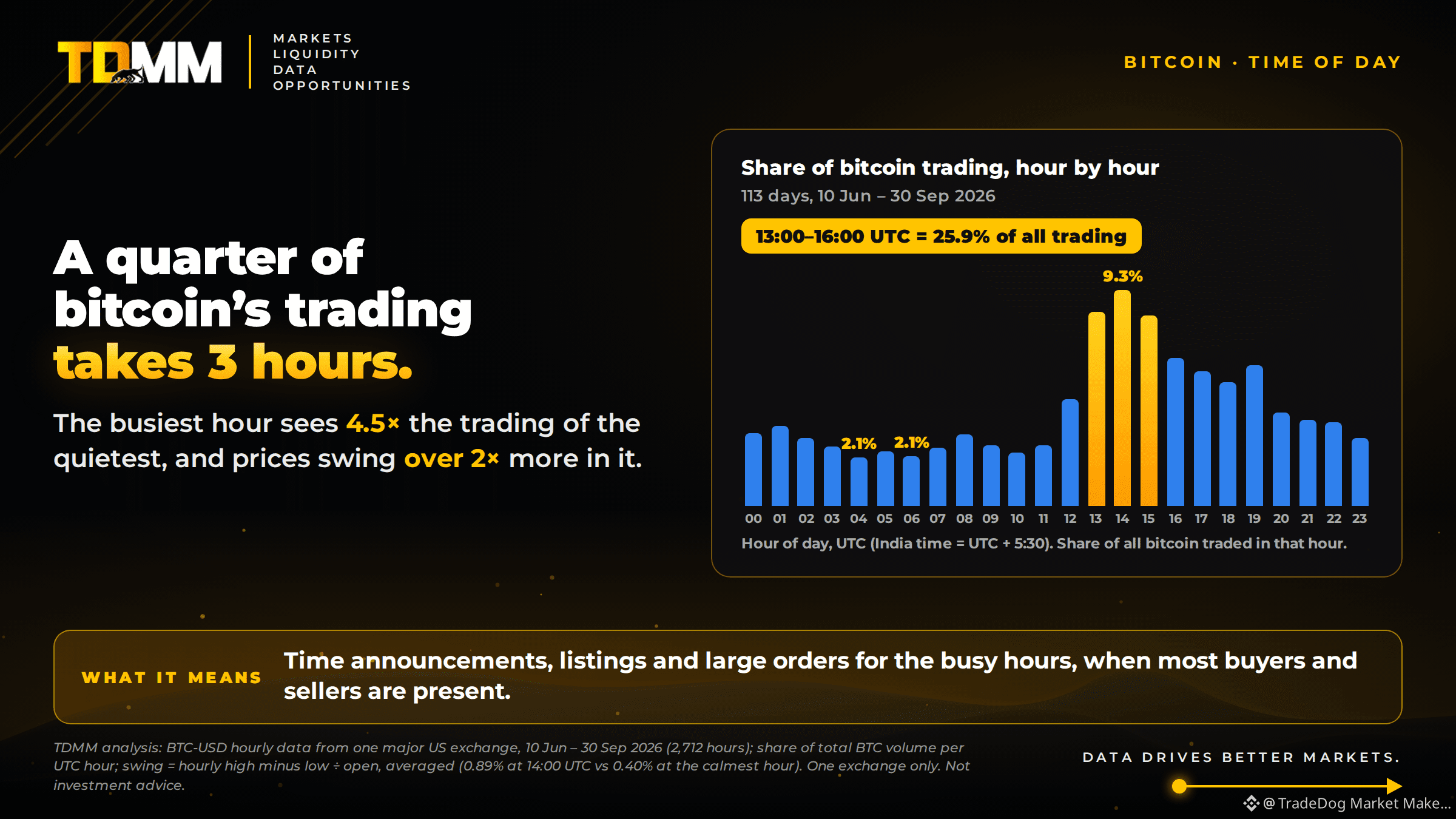
⏰ A quarter of bitcoin's trading happens in just 3 hours.
📊 13:00–16:00 UTC (6:30–9:30pm India time) = 25.9% of all $BTC volume.
😴 Quietest hours: 04:00 and 06:00 UTC, 2.1% each.
⚡ Busiest hour = 4.5x the trading of the quietest, and price swings more than twice as much (0.89% vs 0.40% average hourly range).
💡 Time announcements, listings and big orders for the busy hours, when most buyers and sellers are present.
⚠️ One major exchange, 113 days of hourly data.
Which hours does your community trade in? 👇
#Bitcoin #Liquidity #TradingHours
Not financial advice. DYOR.
⏰ A quarter of bitcoin's trading happens in just 3 hours.
📊 13:00–16:00 UTC (6:30–9:30pm India time) = 25.9% of all $BTC volume.
😴 Quietest hours: 04:00 and 06:00 UTC, 2.1% each.
⚡ Busiest hour = 4.5x the trading of the quietest, and price swings more than twice as much (0.89% vs 0.40% average hourly range).
💡 Time announcements, listings and big orders for the busy hours, when most buyers and sellers are present.
⚠️ One major exchange, 113 days of hourly data.
Which hours does your community trade in? 👇
#Bitcoin #Liquidity #TradingHours
Not financial advice. DYOR.
📊 13:00–16:00 UTC (6:30–9:30pm India time) = 25.9% of all $BTC volume.
😴 Quietest hours: 04:00 and 06:00 UTC, 2.1% each.
⚡ Busiest hour = 4.5x the trading of the quietest, and price swings more than twice as much (0.89% vs 0.40% average hourly range).
💡 Time announcements, listings and big orders for the busy hours, when most buyers and sellers are present.
⚠️ One major exchange, 113 days of hourly data.
Which hours does your community trade in? 👇
#Bitcoin #Liquidity #TradingHours
Not financial advice. DYOR.
2
58
Article
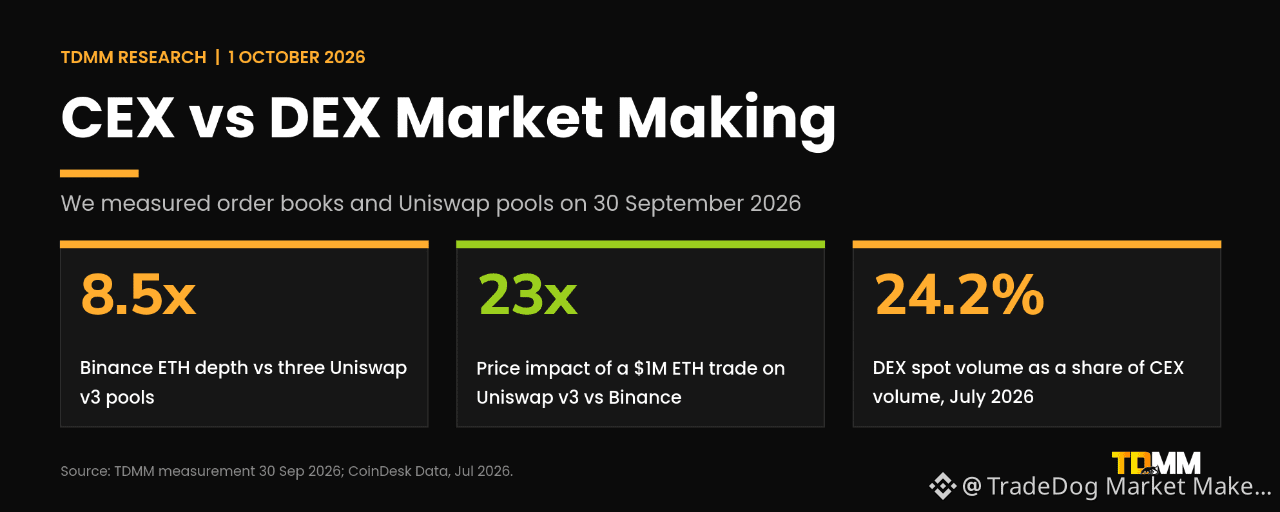
CEX vs DEX Market Making: We Measured Both on 30 SeptemberKey takeaways
Binance showed $38.4M of $ETH depth within 1% of the price. Three Uniswap v3 ETH/USDC pools together showed $4.5M, about 8.5x less. (TDMM measurement, 30 Sep 2026.)A $1M ETH trade moved Binance by 2.7 bps and the largest Uniswap v3 pool by 63.2 bps before fees, about 23x more. At $100k the all-in cost was almost the same, 10.2 vs 11.3 bps.DEX spot volume hit a record 24.2% of CEX spot volume in July 2026 ($176B vs $727B, CoinDesk Data). CEX still carries four times more spot volume.A full-range pool needs about 100x the capital of an order book for the same 2% depth. A passive pool at new-token volatility (166%) loses about 34.4% a year to arbitrage before fees.Most tokens that trade on both need both, run as one book with one reference price.
CEX market making is posting buy and sell limit orders on an exchange order book from one reference price. The market maker earns the spread and maker rebates and carries inventory risk and adverse selection.
DEX market making is supplying and managing liquidity in pools, price ranges, on-chain order books or proprietary AMMs. The market maker earns pool fees and pays arbitrageurs, and carries MEV, contract and stale-range risk.
Depth. On ETH, the spot books on Binance, Kraken, OKX and Coinbase were 2.7 to 8.5x as deep within 1% as three Uniswap v3 pools combined. On $LINK the gap narrowed to 1.7 to 4.0x, because DEX liquidity is split across several thin pools.
Capital. $10,000 of depth a side within 2% takes about $20,000 of resting orders, $2.01M in a full-range pool, or about $98,000 in a range of plus or minus 10% that someone keeps on the price.
Arbitrage. Loss-versus-rebalancing is volatility squared over eight a year: 2.5% at 45% volatility, 34.4% at 166%. A 0.3% pool needs about 31.5% of its value to trade every day to break even at 166%.
Rules. Binance's March 2026 guidelines ask issuers to disclose their market maker's identity and terms and ban profit-sharing and guaranteed-return deals. A DEX has no listing team, so the standard comes from your own contract.
Which one?
One DEX pool, no listing planned: managed DEX liquidity is enoughSeveral pools or chains: DEX market making across poolsFirst CEX listing onward: CEX and DEX together, on one price
TDMM runs CEX and DEX market making as one service across 100+ integrations and 200+ markets, active since 2015, with spread, depth and uptime reported for each venue. We publish this, so read it with that in mind. No price or volume promises.
Full study, method and sources: tdmm.io/insights/blog/cex-vs-dex-market-making
#MarketMaking #CEX #DEX #CryptoLiquidity #DeFi
Not investment, legal or tax advice. TDMM provides the services discussed. Measurements are single-moment snapshots of two tokens (ETH, LINK) on 30 Sep 2026 and exclude Uniswap v4, other DEXs and RFQ liquidity; model figures rest on stated assumptions. Crypto is volatile and you can lose your entire position.
CEX vs DEX Market Making: We Measured Both on 30 September
Key takeaways
Binance showed $38.4M of $ETH depth within 1% of the price. Three Uniswap v3 ETH/USDC pools together showed $4.5M, about 8.5x less. (TDMM measurement, 30 Sep 2026.)A $1M ETH trade moved Binance by 2.7 bps and the largest Uniswap v3 pool by 63.2 bps before fees, about 23x more. At $100k the all-in cost was almost the same, 10.2 vs 11.3 bps.DEX spot volume hit a record 24.2% of CEX spot volume in July 2026 ($176B vs $727B, CoinDesk Data). CEX still carries four times more spot volume.A full-range pool needs about 100x the capital of an order book for the same 2% depth. A passive pool at new-token volatility (166%) loses about 34.4% a year to arbitrage before fees.Most tokens that trade on both need both, run as one book with one reference price.
CEX market making is posting buy and sell limit orders on an exchange order book from one reference price. The market maker earns the spread and maker rebates and carries inventory risk and adverse selection.
DEX market making is supplying and managing liquidity in pools, price ranges, on-chain order books or proprietary AMMs. The market maker earns pool fees and pays arbitrageurs, and carries MEV, contract and stale-range risk.
Depth. On ETH, the spot books on Binance, Kraken, OKX and Coinbase were 2.7 to 8.5x as deep within 1% as three Uniswap v3 pools combined. On $LINK the gap narrowed to 1.7 to 4.0x, because DEX liquidity is split across several thin pools.
Capital. $10,000 of depth a side within 2% takes about $20,000 of resting orders, $2.01M in a full-range pool, or about $98,000 in a range of plus or minus 10% that someone keeps on the price.
Arbitrage. Loss-versus-rebalancing is volatility squared over eight a year: 2.5% at 45% volatility, 34.4% at 166%. A 0.3% pool needs about 31.5% of its value to trade every day to break even at 166%.
Rules. Binance's March 2026 guidelines ask issuers to disclose their market maker's identity and terms and ban profit-sharing and guaranteed-return deals. A DEX has no listing team, so the standard comes from your own contract.
Which one?
One DEX pool, no listing planned: managed DEX liquidity is enoughSeveral pools or chains: DEX market making across poolsFirst CEX listing onward: CEX and DEX together, on one price
TDMM runs CEX and DEX market making as one service across 100+ integrations and 200+ markets, active since 2015, with spread, depth and uptime reported for each venue. We publish this, so read it with that in mind. No price or volume promises.
Full study, method and sources: tdmm.io/insights/blog/cex-vs-dex-market-making
#MarketMaking #CEX #DEX #CryptoLiquidity #DeFi
Not investment, legal or tax advice. TDMM provides the services discussed. Measurements are single-moment snapshots of two tokens (ETH, LINK) on 30 Sep 2026 and exclude Uniswap v4, other DEXs and RFQ liquidity; model figures rest on stated assumptions. Crypto is volatile and you can lose your entire position.
Binance showed $38.4M of $ETH depth within 1% of the price. Three Uniswap v3 ETH/USDC pools together showed $4.5M, about 8.5x less. (TDMM measurement, 30 Sep 2026.)A $1M ETH trade moved Binance by 2.7 bps and the largest Uniswap v3 pool by 63.2 bps before fees, about 23x more. At $100k the all-in cost was almost the same, 10.2 vs 11.3 bps.DEX spot volume hit a record 24.2% of CEX spot volume in July 2026 ($176B vs $727B, CoinDesk Data). CEX still carries four times more spot volume.A full-range pool needs about 100x the capital of an order book for the same 2% depth. A passive pool at new-token volatility (166%) loses about 34.4% a year to arbitrage before fees.Most tokens that trade on both need both, run as one book with one reference price.
CEX market making is posting buy and sell limit orders on an exchange order book from one reference price. The market maker earns the spread and maker rebates and carries inventory risk and adverse selection.
DEX market making is supplying and managing liquidity in pools, price ranges, on-chain order books or proprietary AMMs. The market maker earns pool fees and pays arbitrageurs, and carries MEV, contract and stale-range risk.
Depth. On ETH, the spot books on Binance, Kraken, OKX and Coinbase were 2.7 to 8.5x as deep within 1% as three Uniswap v3 pools combined. On $LINK the gap narrowed to 1.7 to 4.0x, because DEX liquidity is split across several thin pools.
Capital. $10,000 of depth a side within 2% takes about $20,000 of resting orders, $2.01M in a full-range pool, or about $98,000 in a range of plus or minus 10% that someone keeps on the price.
Arbitrage. Loss-versus-rebalancing is volatility squared over eight a year: 2.5% at 45% volatility, 34.4% at 166%. A 0.3% pool needs about 31.5% of its value to trade every day to break even at 166%.
Rules. Binance's March 2026 guidelines ask issuers to disclose their market maker's identity and terms and ban profit-sharing and guaranteed-return deals. A DEX has no listing team, so the standard comes from your own contract.
Which one?
One DEX pool, no listing planned: managed DEX liquidity is enoughSeveral pools or chains: DEX market making across poolsFirst CEX listing onward: CEX and DEX together, on one price
TDMM runs CEX and DEX market making as one service across 100+ integrations and 200+ markets, active since 2015, with spread, depth and uptime reported for each venue. We publish this, so read it with that in mind. No price or volume promises.
Full study, method and sources: tdmm.io/insights/blog/cex-vs-dex-market-making
#MarketMaking #CEX #DEX #CryptoLiquidity #DeFi
Not investment, legal or tax advice. TDMM provides the services discussed. Measurements are single-moment snapshots of two tokens (ETH, LINK) on 30 Sep 2026 and exclude Uniswap v4, other DEXs and RFQ liquidity; model figures rest on stated assumptions. Crypto is volatile and you can lose your entire position.
2
133
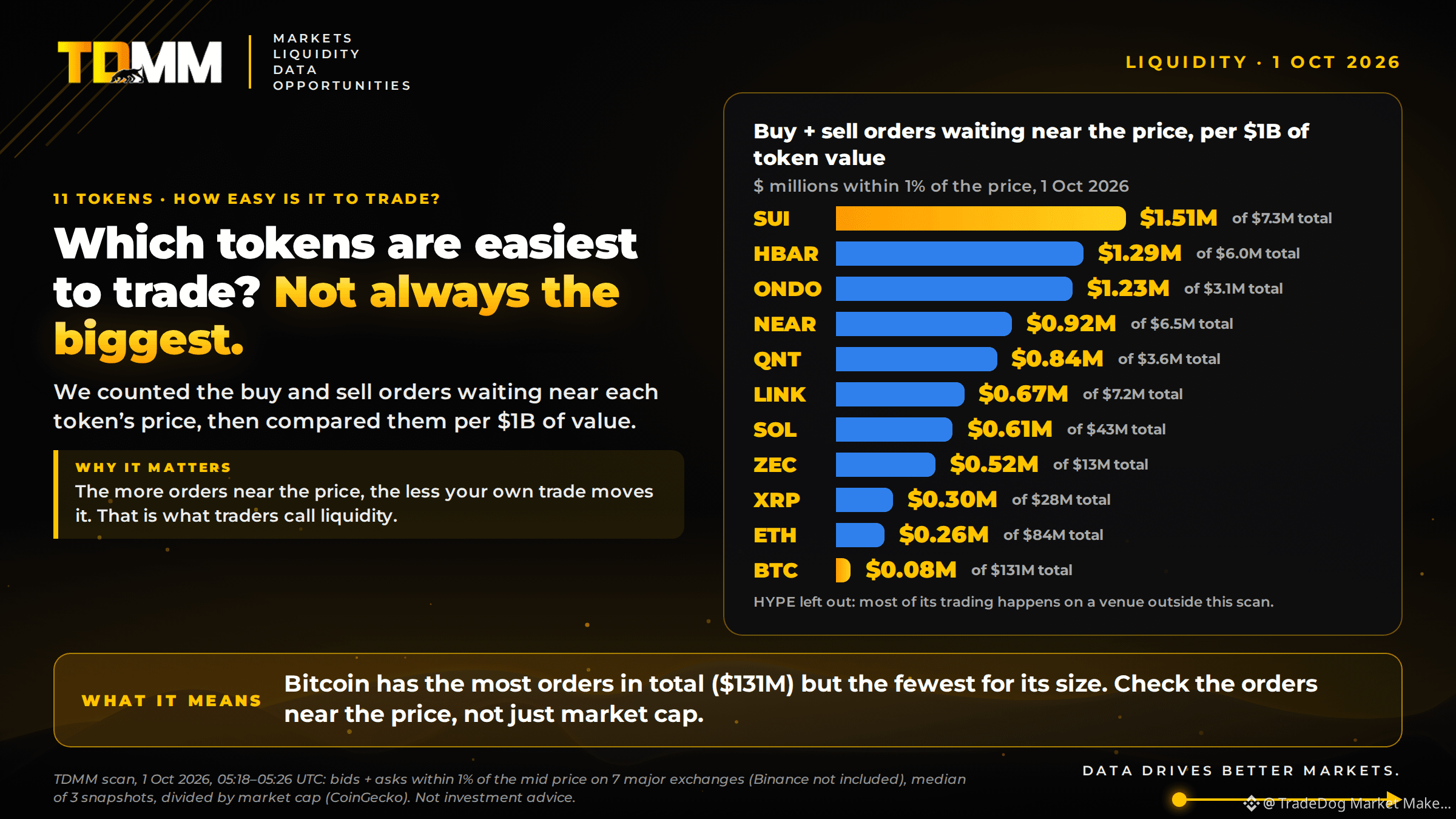
📏 Which tokens are easiest to trade? Not always the biggest.
We counted buy + sell orders within 1% of the price, per $1B of token value:
🟡 $SUI $1.51M
🔵 HBAR $1.29M
🔵 SOL $0.61M
🔵 $ETH $0.26M
🟡 $BTC $0.08M
💡 More orders near the price = your own trade moves it less. That's liquidity.
⚡ Bitcoin has the most orders in total ($131M) but the fewest for its size.
11 tokens, 7 major exchanges (Binance not included), 1 Oct, median of 3 snapshots.
Market cap or depth: which do you check first? 👇
#Liquidity #OrderBook #Crypto
Not financial advice. DYOR.
📏 Which tokens are easiest to trade? Not always the biggest.
We counted buy + sell orders within 1% of the price, per $1B of token value:
🟡 $SUI $1.51M
🔵 HBAR $1.29M
🔵 SOL $0.61M
🔵 $ETH $0.26M
🟡 $BTC $0.08M
💡 More orders near the price = your own trade moves it less. That's liquidity.
⚡ Bitcoin has the most orders in total ($131M) but the fewest for its size.
11 tokens, 7 major exchanges (Binance not included), 1 Oct, median of 3 snapshots.
Market cap or depth: which do you check first? 👇
#Liquidity #OrderBook #Crypto
Not financial advice. DYOR.
We counted buy + sell orders within 1% of the price, per $1B of token value:
🟡 $SUI $1.51M
🔵 HBAR $1.29M
🔵 SOL $0.61M
🔵 $ETH $0.26M
🟡 $BTC $0.08M
💡 More orders near the price = your own trade moves it less. That's liquidity.
⚡ Bitcoin has the most orders in total ($131M) but the fewest for its size.
11 tokens, 7 major exchanges (Binance not included), 1 Oct, median of 3 snapshots.
Market cap or depth: which do you check first? 👇
#Liquidity #OrderBook #Crypto
Not financial advice. DYOR.
2
304
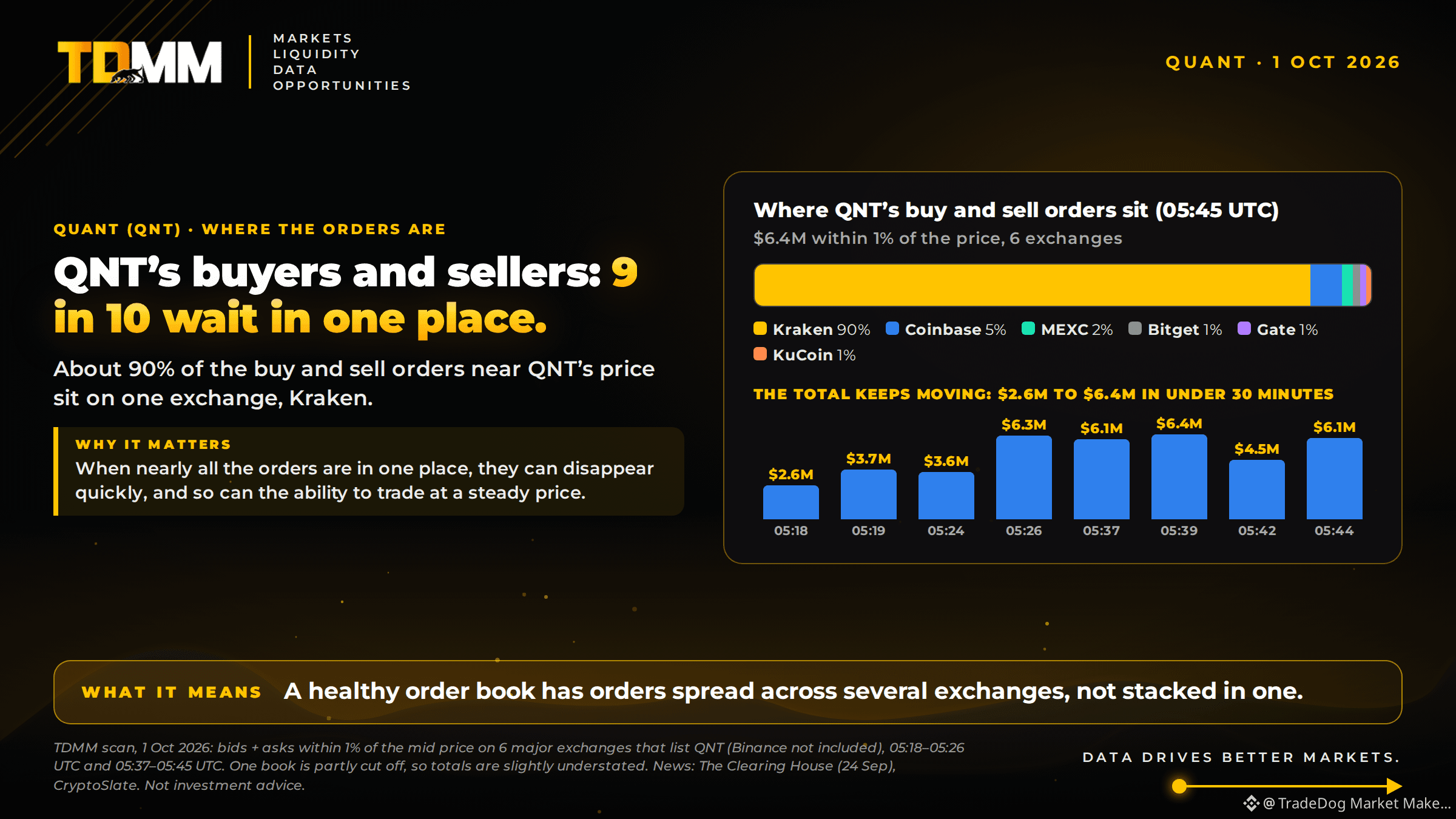
🧱 $QNT 's buyers and sellers: 9 in 10 wait in one place.
📊 At 05:45 UTC on 1 Oct, about 90% of the buy + sell orders within 1% of the price sat on a single exchange. The other five held 1–5% each. Total: $6.4M across 6 major exchanges.
⚡ The total moved from $2.6M to $6.4M in under 30 minutes.
⚠️ When nearly all orders sit in one place, they can disappear quickly, and so can a steady price.
💡 A healthy order book has orders spread across several exchanges.
Where do you trade QNT? 👇
#QNT #Liquidity #OrderBook
Not financial advice. DYOR.
🧱 $QNT 's buyers and sellers: 9 in 10 wait in one place.
📊 At 05:45 UTC on 1 Oct, about 90% of the buy + sell orders within 1% of the price sat on a single exchange. The other five held 1–5% each. Total: $6.4M across 6 major exchanges.
⚡ The total moved from $2.6M to $6.4M in under 30 minutes.
⚠️ When nearly all orders sit in one place, they can disappear quickly, and so can a steady price.
💡 A healthy order book has orders spread across several exchanges.
Where do you trade QNT? 👇
#QNT #Liquidity #OrderBook
Not financial advice. DYOR.
📊 At 05:45 UTC on 1 Oct, about 90% of the buy + sell orders within 1% of the price sat on a single exchange. The other five held 1–5% each. Total: $6.4M across 6 major exchanges.
⚡ The total moved from $2.6M to $6.4M in under 30 minutes.
⚠️ When nearly all orders sit in one place, they can disappear quickly, and so can a steady price.
💡 A healthy order book has orders spread across several exchanges.
Where do you trade QNT? 👇
#QNT #Liquidity #OrderBook
Not financial advice. DYOR.
2
579
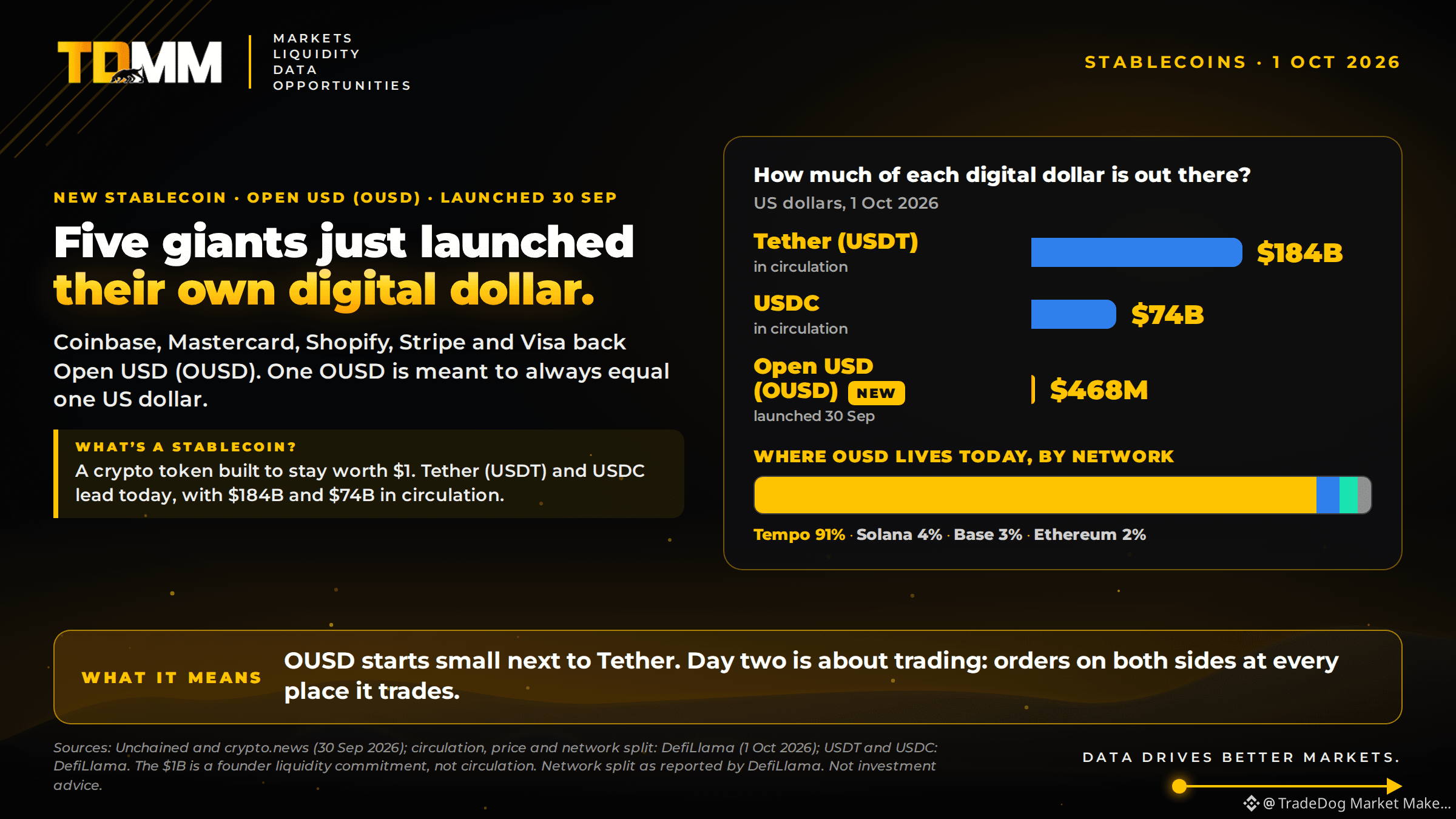
💵 Five giants just launched their own digital dollar.
🏛️ A major US exchange, Mastercard, Shopify, Stripe and Visa back Open USD (OUSD), live since 30 Sep. One OUSD is meant to always equal one US dollar.
📊 In circulation: $USDT $184B · $USDC $74B · OUSD $468M.
🔗 About 91% of OUSD sits on one network, Tempo. Solana 4%, Base 3%, Ethereum 2%.
💰 The five founders committed $1B+ to support its liquidity (a commitment, not circulation).
💡 Day two is about trading: orders on both sides at every place it trades.
Would you hold a stablecoin built by these five? 👇
#Stablecoins #OUSD #Liquidity
Data: Unchained, crypto.news, DefiLlama (1 Oct 2026).
Not financial advice. DYOR.
💵 Five giants just launched their own digital dollar.
🏛️ A major US exchange, Mastercard, Shopify, Stripe and Visa back Open USD (OUSD), live since 30 Sep. One OUSD is meant to always equal one US dollar.
📊 In circulation: $USDT $184B · $USDC $74B · OUSD $468M.
🔗 About 91% of OUSD sits on one network, Tempo. Solana 4%, Base 3%, Ethereum 2%.
💰 The five founders committed $1B+ to support its liquidity (a commitment, not circulation).
💡 Day two is about trading: orders on both sides at every place it trades.
Would you hold a stablecoin built by these five? 👇
#Stablecoins #OUSD #Liquidity
Data: Unchained, crypto.news, DefiLlama (1 Oct 2026).
Not financial advice. DYOR.
🏛️ A major US exchange, Mastercard, Shopify, Stripe and Visa back Open USD (OUSD), live since 30 Sep. One OUSD is meant to always equal one US dollar.
📊 In circulation: $USDT $184B · $USDC $74B · OUSD $468M.
🔗 About 91% of OUSD sits on one network, Tempo. Solana 4%, Base 3%, Ethereum 2%.
💰 The five founders committed $1B+ to support its liquidity (a commitment, not circulation).
💡 Day two is about trading: orders on both sides at every place it trades.
Would you hold a stablecoin built by these five? 👇
#Stablecoins #OUSD #Liquidity
Data: Unchained, crypto.news, DefiLlama (1 Oct 2026).
Not financial advice. DYOR.
2
46
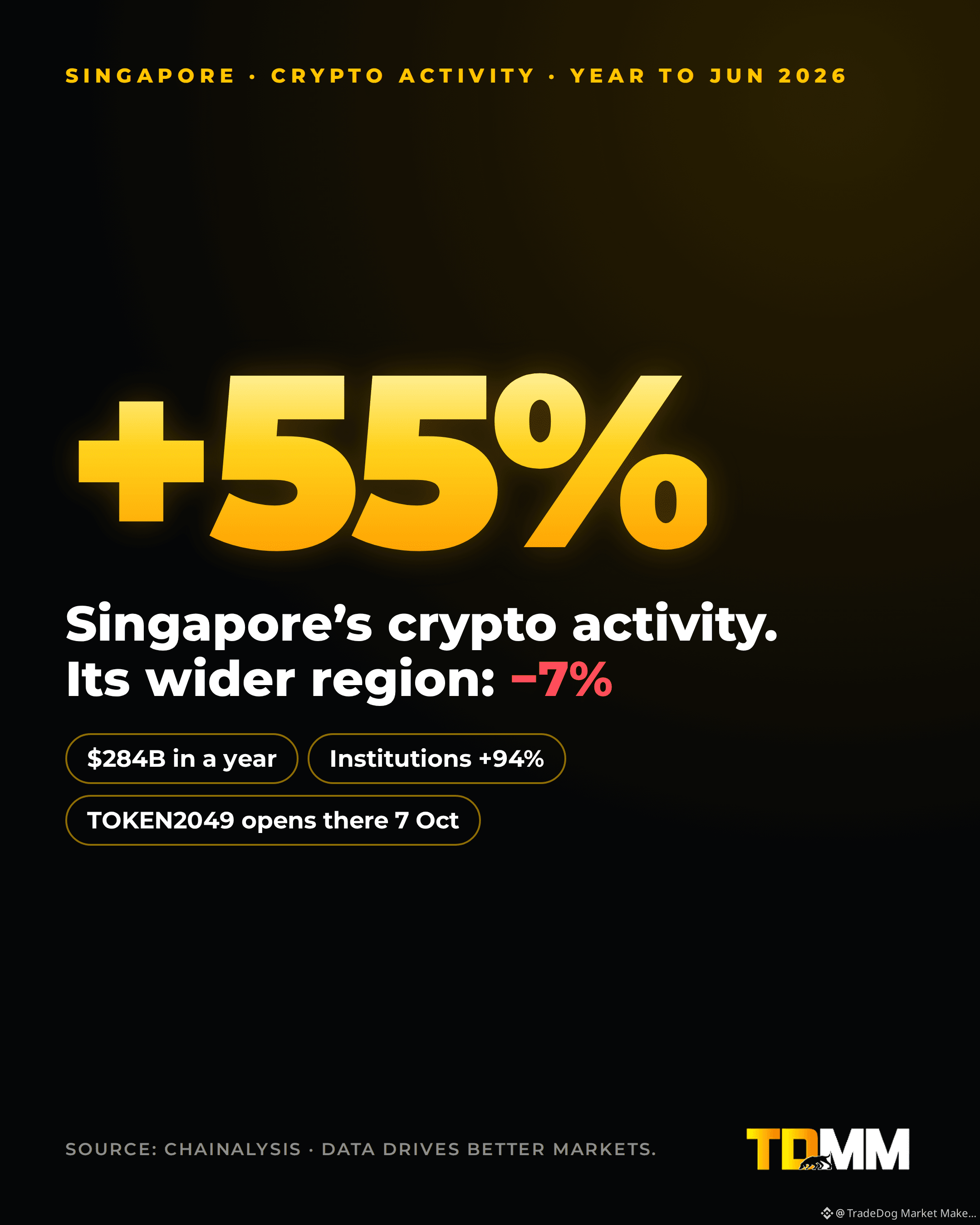
🏦 Institutions are driving Singapore's crypto boom: +94%.
📊 Chainalysis: institutional platforms handled $60B in the year to June 2026, vs +19% for the rest of the region and +15% worldwide.
👥 Who are they?
- Market makers: quote buy and sell prices all day
- OTC desks: trade large amounts privately
- Brokerages: route big clients' orders to markets
💡 They provide the liquidity and large-order trading a token needs.
Do token projects know how to reach them? 👇
#Singapore #Institutions #Liquidity #Token2049
Data: Chainalysis via Crypto Times, 30 Sep 2026.
Not financial advice. DYOR.
🏦 Institutions are driving Singapore's crypto boom: +94%.
📊 Chainalysis: institutional platforms handled $60B in the year to June 2026, vs +19% for the rest of the region and +15% worldwide.
👥 Who are they?
- Market makers: quote buy and sell prices all day
- OTC desks: trade large amounts privately
- Brokerages: route big clients' orders to markets
💡 They provide the liquidity and large-order trading a token needs.
Do token projects know how to reach them? 👇
#Singapore #Institutions #Liquidity #Token2049
Data: Chainalysis via Crypto Times, 30 Sep 2026.
Not financial advice. DYOR.
📊 Chainalysis: institutional platforms handled $60B in the year to June 2026, vs +19% for the rest of the region and +15% worldwide.
👥 Who are they?
- Market makers: quote buy and sell prices all day
- OTC desks: trade large amounts privately
- Brokerages: route big clients' orders to markets
💡 They provide the liquidity and large-order trading a token needs.
Do token projects know how to reach them? 👇
#Singapore #Institutions #Liquidity #Token2049
Data: Chainalysis via Crypto Times, 30 Sep 2026.
Not financial advice. DYOR.
2
53
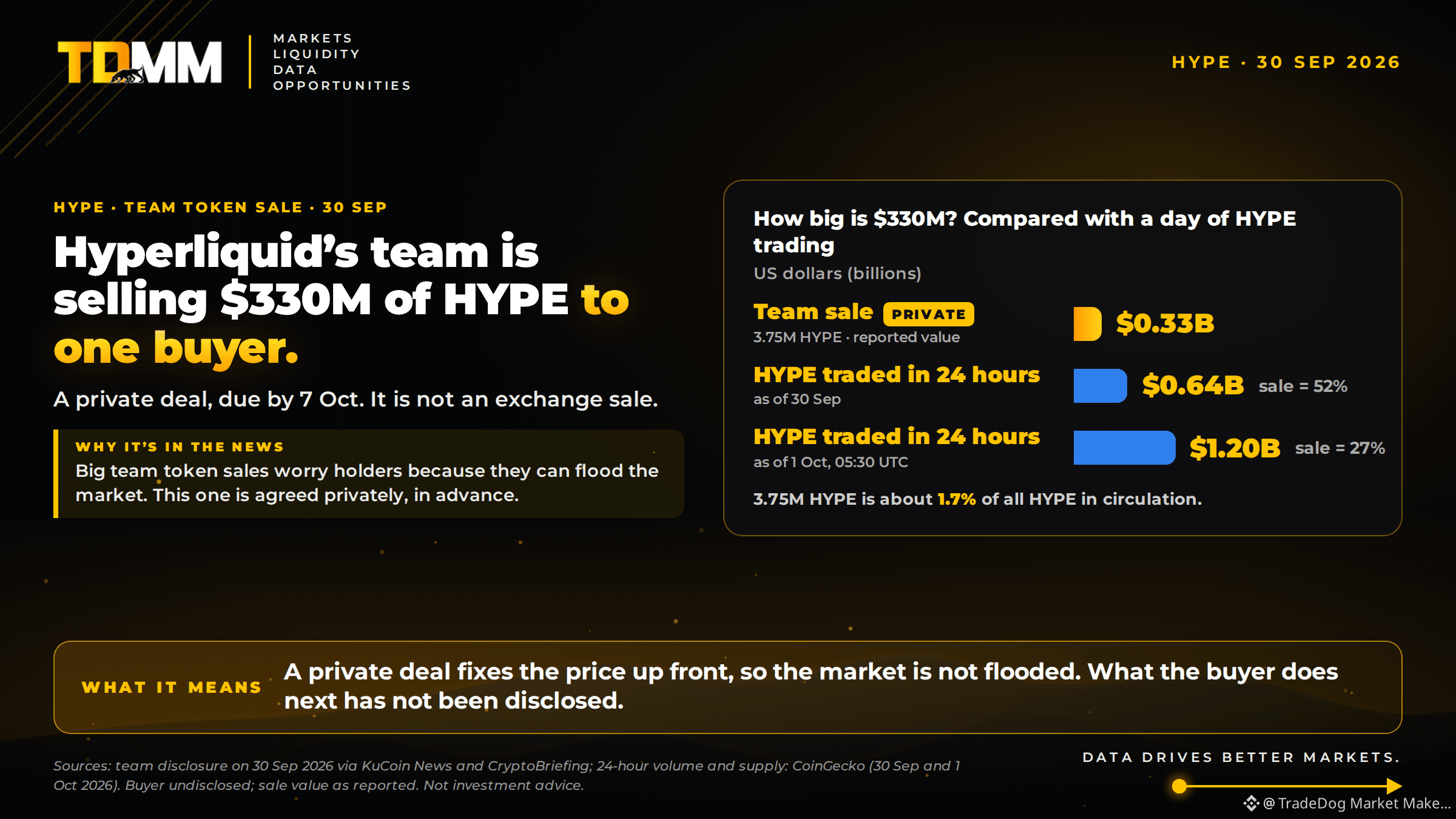
🔥 The HYPE team is selling $330M of $HYPE to one buyer.
🤝 It's a private (OTC) deal for 3.75M HYPE, due by 7 Oct. Not an exchange sale.
😟 Big team sales worry holders because they can flood the market. This one is agreed in advance, so the price is fixed up front.
📊 Scale: about 1.7% of the supply, and about half of HYPE's 24-hour trading on 30 Sep ($0.64B).
⚠️ What the buyer does next hasn't been disclosed.
Do team sales still worry you? 👇
#HYPE #OTC #Liquidity
Not financial advice. DYOR.
🔥 The HYPE team is selling $330M of $HYPE to one buyer.
🤝 It's a private (OTC) deal for 3.75M HYPE, due by 7 Oct. Not an exchange sale.
😟 Big team sales worry holders because they can flood the market. This one is agreed in advance, so the price is fixed up front.
📊 Scale: about 1.7% of the supply, and about half of HYPE's 24-hour trading on 30 Sep ($0.64B).
⚠️ What the buyer does next hasn't been disclosed.
Do team sales still worry you? 👇
#HYPE #OTC #Liquidity
Not financial advice. DYOR.
🤝 It's a private (OTC) deal for 3.75M HYPE, due by 7 Oct. Not an exchange sale.
😟 Big team sales worry holders because they can flood the market. This one is agreed in advance, so the price is fixed up front.
📊 Scale: about 1.7% of the supply, and about half of HYPE's 24-hour trading on 30 Sep ($0.64B).
⚠️ What the buyer does next hasn't been disclosed.
Do team sales still worry you? 👇
#HYPE #OTC #Liquidity
Not financial advice. DYOR.
3
197
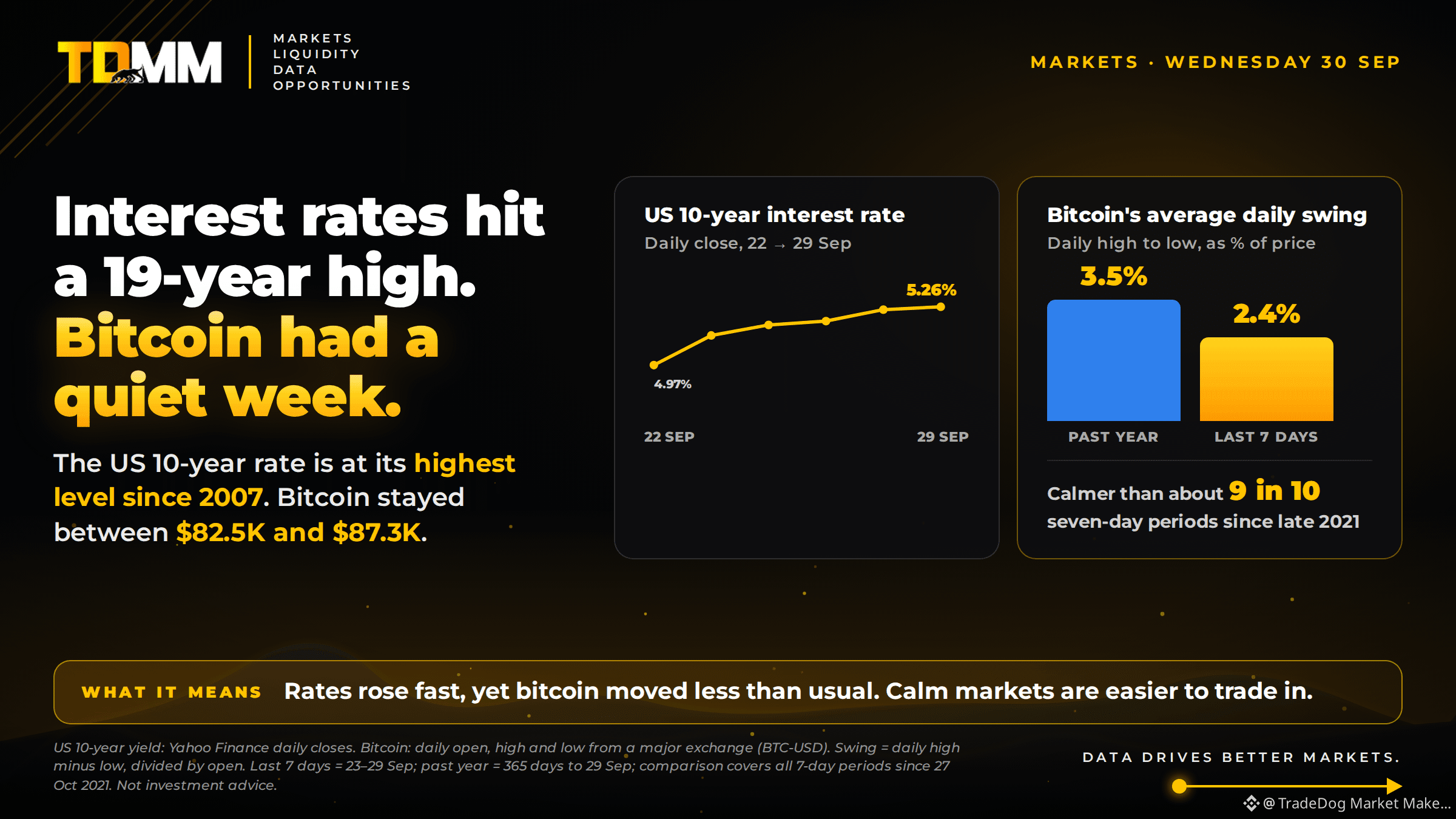
📈 US 10-year interest rate: 4.97% → 5.26% in a week, its highest level since 2007.
😌 $BTC average daily swing over the last 7 days: 2.4% vs 3.5% over the past year. Calmer than about 9 in 10 seven-day periods since late 2021.
📊 BTC traded between $82.5K and $87.3K since 22 Sep.
⚠️ US spot BTC ETFs had 8 straight inflow days, but daily inflows shrank from $999M to $31M.
💡 Rates rose fast, yet bitcoin moved less than usual. Calm markets are easier to trade in.
Does a quiet bitcoin in a loud bond market reassure you? 👇
#Bitcoin #BTC #Macro
Not financial advice. DYOR.
📈 US 10-year interest rate: 4.97% → 5.26% in a week, its highest level since 2007.
😌 $BTC average daily swing over the last 7 days: 2.4% vs 3.5% over the past year. Calmer than about 9 in 10 seven-day periods since late 2021.
📊 BTC traded between $82.5K and $87.3K since 22 Sep.
⚠️ US spot BTC ETFs had 8 straight inflow days, but daily inflows shrank from $999M to $31M.
💡 Rates rose fast, yet bitcoin moved less than usual. Calm markets are easier to trade in.
Does a quiet bitcoin in a loud bond market reassure you? 👇
#Bitcoin #BTC #Macro
Not financial advice. DYOR.
😌 $BTC average daily swing over the last 7 days: 2.4% vs 3.5% over the past year. Calmer than about 9 in 10 seven-day periods since late 2021.
📊 BTC traded between $82.5K and $87.3K since 22 Sep.
⚠️ US spot BTC ETFs had 8 straight inflow days, but daily inflows shrank from $999M to $31M.
💡 Rates rose fast, yet bitcoin moved less than usual. Calm markets are easier to trade in.
Does a quiet bitcoin in a loud bond market reassure you? 👇
#Bitcoin #BTC #Macro
Not financial advice. DYOR.
3
91
Article
Market Maker or Liquidity Provider? What a New Token Project Should PickKey takeaways
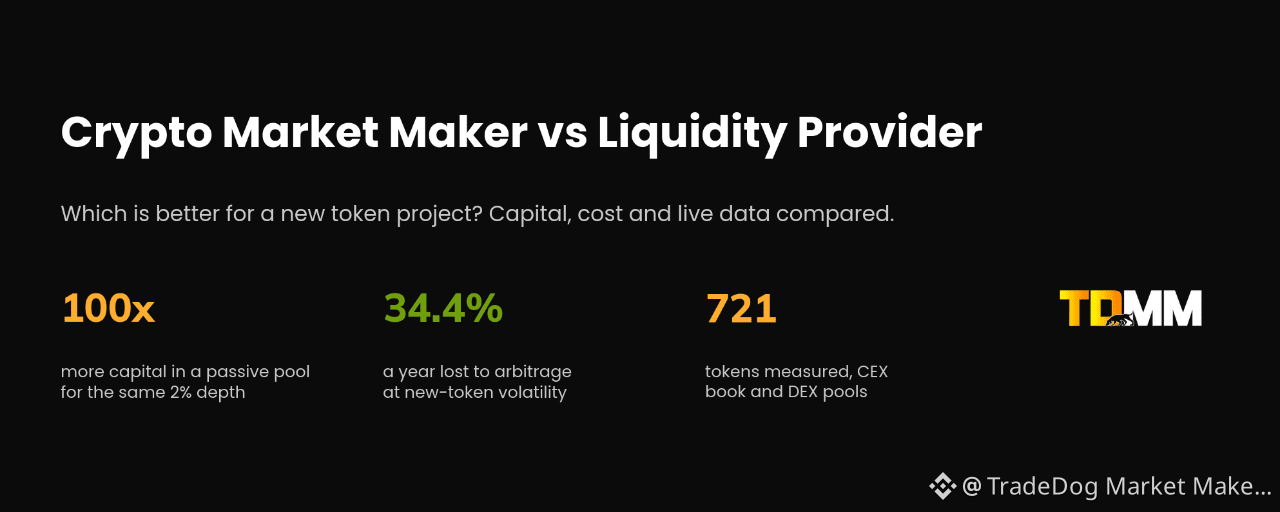
Once your token trades on a CEX, or on more than one venue, a market maker is the better choice. A seeded DEX pool is enough only while the token lives in one pool.A full-range pool needs about 100x the capital of an order book for the same 2% depth: $2.01M vs $20k for $10k a side.At new-token volatility (166%), a passive pool loses about 34.4% of its value a year to arbitrage before fees.TDMM measured 721 listed tokens on 28 Sep 2026: pool fees covered arbitrage for only 50.5%, and 42.0% below $5M market cap.Most projects need both, run as one book with one reference price.
“Liquidity provider” is a loose word. It can mean a passive LP in a Uniswap pool, a liquidity mining participant, a managed vault, a firm in an exchange’s rebate programme, or an OTC desk. Only a market maker hired by the project promises your token anything: a spread, a depth and an uptime on each venue, written into a contract.
Capital. Lifting a constant-product pool’s price by 2% takes about 0.995% of its stablecoin side. So $10,000 of depth each side within 2% needs a ~$2.01M pool. A concentrated range 10% either side of the price cuts that to ~$98,000, but at 166% volatility an untouched range has a 66% chance of being off the price after a week. Moving it is market making.
Arbitrage. Pools quote stale prices and arbitrageurs trade against them. The loss-versus-rebalancing formula (Milionis et al., 2022) puts it at volatility squared over eight per year: 2.5% at 45% volatility, 34.4% at 166%. Bancor’s Uniswap v3 study found $199.3M of fees against $260.1M of impermanent loss in 2021.
Stress. In a 50% fall, a passive pool spends 29.3% of its stablecoins buying your token. A market maker contract can say widen, pause or hedge.
Live data. Across 163 tokens with mainly constant-product pools, a median $320,560 of pool capital delivered $3,203 of depth within 2%, about the same as the token’s single Gate book ($2,577).
Which to pick
Launchpad or bonding curve: neither yetDEX only, one pool: a managed liquidity providerSeveral pools or chains: a DEX market makerFirst CEX listing onward: a market maker on CEX and DEX, one reference price
Binance’s March 2026 guidelines ask issuers to disclose their market maker and ban profit-sharing deals. Exchange “liquidity provider” programmes are graded on maker volume and set no service level for your token.
TDMM runs market making and liquidity provisioning as one service across 100+ CEX and DEX integrations since 2015, with spread, depth and uptime reported per venue. No price or volume promises.
Full study: tdmm.io/insights/blog/crypto-market-maker-vs-liquidity-provider
#MarketMaking #LiquidityProvider #TokenLaunch #DeFi #CryptoLiquidity
Not investment, legal or tax advice. TDMM provides the services discussed. Model figures rest on stated assumptions; market data are snapshots from 28 Sep 2026. Crypto is volatile and you can lose your entire position.
Market Maker or Liquidity Provider? What a New Token Project Should Pick
Key takeaways
Once your token trades on a CEX, or on more than one venue, a market maker is the better choice. A seeded DEX pool is enough only while the token lives in one pool.A full-range pool needs about 100x the capital of an order book for the same 2% depth: $2.01M vs $20k for $10k a side.At new-token volatility (166%), a passive pool loses about 34.4% of its value a year to arbitrage before fees.TDMM measured 721 listed tokens on 28 Sep 2026: pool fees covered arbitrage for only 50.5%, and 42.0% below $5M market cap.Most projects need both, run as one book with one reference price.
“Liquidity provider” is a loose word. It can mean a passive LP in a Uniswap pool, a liquidity mining participant, a managed vault, a firm in an exchange’s rebate programme, or an OTC desk. Only a market maker hired by the project promises your token anything: a spread, a depth and an uptime on each venue, written into a contract.
Capital. Lifting a constant-product pool’s price by 2% takes about 0.995% of its stablecoin side. So $10,000 of depth each side within 2% needs a ~$2.01M pool. A concentrated range 10% either side of the price cuts that to ~$98,000, but at 166% volatility an untouched range has a 66% chance of being off the price after a week. Moving it is market making.
Arbitrage. Pools quote stale prices and arbitrageurs trade against them. The loss-versus-rebalancing formula (Milionis et al., 2022) puts it at volatility squared over eight per year: 2.5% at 45% volatility, 34.4% at 166%. Bancor’s Uniswap v3 study found $199.3M of fees against $260.1M of impermanent loss in 2021.
Stress. In a 50% fall, a passive pool spends 29.3% of its stablecoins buying your token. A market maker contract can say widen, pause or hedge.
Live data. Across 163 tokens with mainly constant-product pools, a median $320,560 of pool capital delivered $3,203 of depth within 2%, about the same as the token’s single Gate book ($2,577).
Which to pick
Launchpad or bonding curve: neither yetDEX only, one pool: a managed liquidity providerSeveral pools or chains: a DEX market makerFirst CEX listing onward: a market maker on CEX and DEX, one reference price
Binance’s March 2026 guidelines ask issuers to disclose their market maker and ban profit-sharing deals. Exchange “liquidity provider” programmes are graded on maker volume and set no service level for your token.
TDMM runs market making and liquidity provisioning as one service across 100+ CEX and DEX integrations since 2015, with spread, depth and uptime reported per venue. No price or volume promises.
Full study: tdmm.io/insights/blog/crypto-market-maker-vs-liquidity-provider
#MarketMaking #LiquidityProvider #TokenLaunch #DeFi #CryptoLiquidity
Not investment, legal or tax advice. TDMM provides the services discussed. Model figures rest on stated assumptions; market data are snapshots from 28 Sep 2026. Crypto is volatile and you can lose your entire position.
Once your token trades on a CEX, or on more than one venue, a market maker is the better choice. A seeded DEX pool is enough only while the token lives in one pool.A full-range pool needs about 100x the capital of an order book for the same 2% depth: $2.01M vs $20k for $10k a side.At new-token volatility (166%), a passive pool loses about 34.4% of its value a year to arbitrage before fees.TDMM measured 721 listed tokens on 28 Sep 2026: pool fees covered arbitrage for only 50.5%, and 42.0% below $5M market cap.Most projects need both, run as one book with one reference price.
“Liquidity provider” is a loose word. It can mean a passive LP in a Uniswap pool, a liquidity mining participant, a managed vault, a firm in an exchange’s rebate programme, or an OTC desk. Only a market maker hired by the project promises your token anything: a spread, a depth and an uptime on each venue, written into a contract.
Capital. Lifting a constant-product pool’s price by 2% takes about 0.995% of its stablecoin side. So $10,000 of depth each side within 2% needs a ~$2.01M pool. A concentrated range 10% either side of the price cuts that to ~$98,000, but at 166% volatility an untouched range has a 66% chance of being off the price after a week. Moving it is market making.
Arbitrage. Pools quote stale prices and arbitrageurs trade against them. The loss-versus-rebalancing formula (Milionis et al., 2022) puts it at volatility squared over eight per year: 2.5% at 45% volatility, 34.4% at 166%. Bancor’s Uniswap v3 study found $199.3M of fees against $260.1M of impermanent loss in 2021.
Stress. In a 50% fall, a passive pool spends 29.3% of its stablecoins buying your token. A market maker contract can say widen, pause or hedge.
Live data. Across 163 tokens with mainly constant-product pools, a median $320,560 of pool capital delivered $3,203 of depth within 2%, about the same as the token’s single Gate book ($2,577).
Which to pick
Launchpad or bonding curve: neither yetDEX only, one pool: a managed liquidity providerSeveral pools or chains: a DEX market makerFirst CEX listing onward: a market maker on CEX and DEX, one reference price
Binance’s March 2026 guidelines ask issuers to disclose their market maker and ban profit-sharing deals. Exchange “liquidity provider” programmes are graded on maker volume and set no service level for your token.
TDMM runs market making and liquidity provisioning as one service across 100+ CEX and DEX integrations since 2015, with spread, depth and uptime reported per venue. No price or volume promises.
Full study: tdmm.io/insights/blog/crypto-market-maker-vs-liquidity-provider
#MarketMaking #LiquidityProvider #TokenLaunch #DeFi #CryptoLiquidity
Not investment, legal or tax advice. TDMM provides the services discussed. Model figures rest on stated assumptions; market data are snapshots from 28 Sep 2026. Crypto is volatile and you can lose your entire position.
3
36
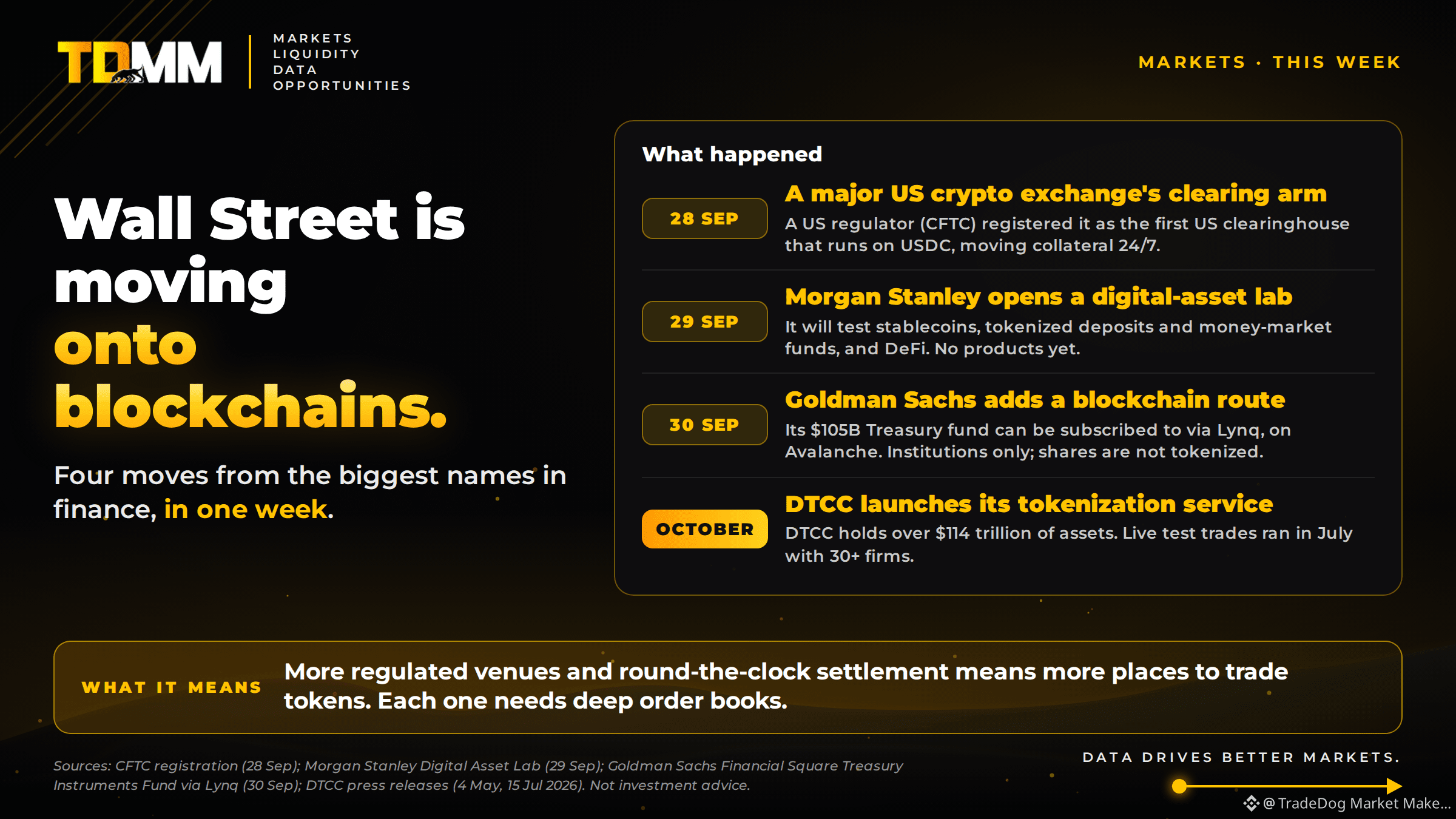
🏦 Wall Street is moving onto blockchains. 4 moves this week:
28 Sep: a major US crypto exchange's clearing arm was registered by the CFTC, the first US clearinghouse that runs on $USDC
29 Sep: Morgan Stanley opens a digital-asset lab
30 Sep: Goldman's $105B Treasury fund adds a route via Lynq on Avalanche ($AVAX ), institutions only
Oct: DTCC tokenization service launches (it holds over $114 trillion of assets)
💡 More regulated venues and 24/7 settlement = more places where tokens trade. Each one needs deep order books.
Which one changes crypto markets the most? 👇
#Tokenization #USDC #TradFi
Sources: CFTC, Morgan Stanley, Goldman Sachs, DTCC. Not financial advice. DYOR.
🏦 Wall Street is moving onto blockchains. 4 moves this week:
28 Sep: a major US crypto exchange's clearing arm was registered by the CFTC, the first US clearinghouse that runs on $USDC
29 Sep: Morgan Stanley opens a digital-asset lab
30 Sep: Goldman's $105B Treasury fund adds a route via Lynq on Avalanche ($AVAX ), institutions only
Oct: DTCC tokenization service launches (it holds over $114 trillion of assets)
💡 More regulated venues and 24/7 settlement = more places where tokens trade. Each one needs deep order books.
Which one changes crypto markets the most? 👇
#Tokenization #USDC #TradFi
Sources: CFTC, Morgan Stanley, Goldman Sachs, DTCC. Not financial advice. DYOR.
28 Sep: a major US crypto exchange's clearing arm was registered by the CFTC, the first US clearinghouse that runs on $USDC
29 Sep: Morgan Stanley opens a digital-asset lab
30 Sep: Goldman's $105B Treasury fund adds a route via Lynq on Avalanche ($AVAX ), institutions only
Oct: DTCC tokenization service launches (it holds over $114 trillion of assets)
💡 More regulated venues and 24/7 settlement = more places where tokens trade. Each one needs deep order books.
Which one changes crypto markets the most? 👇
#Tokenization #USDC #TradFi
Sources: CFTC, Morgan Stanley, Goldman Sachs, DTCC. Not financial advice. DYOR.
2
101
Robinhood ($HOOD.US ) announces 24/7 stock market
24/7 global markets are here
Hours you can trade per week (of 168):
📉 Regular US stock hours: 32.5
📊 That broker today: 120
🚀 Next, weekends added: 168
₿ Crypto: 168
⚡ $BTC lesson: weekend trading is 61% lower than weekdays, but price swings are only 41% lower. Weekends are thin, not calm.
💡 A 24/7 market needs orders on the book at every hour. Who provides the liquidity on Sunday?
#Liquidity #Stocks #Crypto
Not financial advice. DYOR.
Robinhood ($HOOD.US ) announces 24/7 stock market
24/7 global markets are here
Hours you can trade per week (of 168):
📉 Regular US stock hours: 32.5
📊 That broker today: 120
🚀 Next, weekends added: 168
₿ Crypto: 168
⚡ $BTC lesson: weekend trading is 61% lower than weekdays, but price swings are only 41% lower. Weekends are thin, not calm.
💡 A 24/7 market needs orders on the book at every hour. Who provides the liquidity on Sunday?
#Liquidity #Stocks #Crypto
Not financial advice. DYOR.
24/7 global markets are here
Hours you can trade per week (of 168):
📉 Regular US stock hours: 32.5
📊 That broker today: 120
🚀 Next, weekends added: 168
₿ Crypto: 168
⚡ $BTC lesson: weekend trading is 61% lower than weekdays, but price swings are only 41% lower. Weekends are thin, not calm.
💡 A 24/7 market needs orders on the book at every hour. Who provides the liquidity on Sunday?
#Liquidity #Stocks #Crypto
Not financial advice. DYOR.
2
3
1.1k
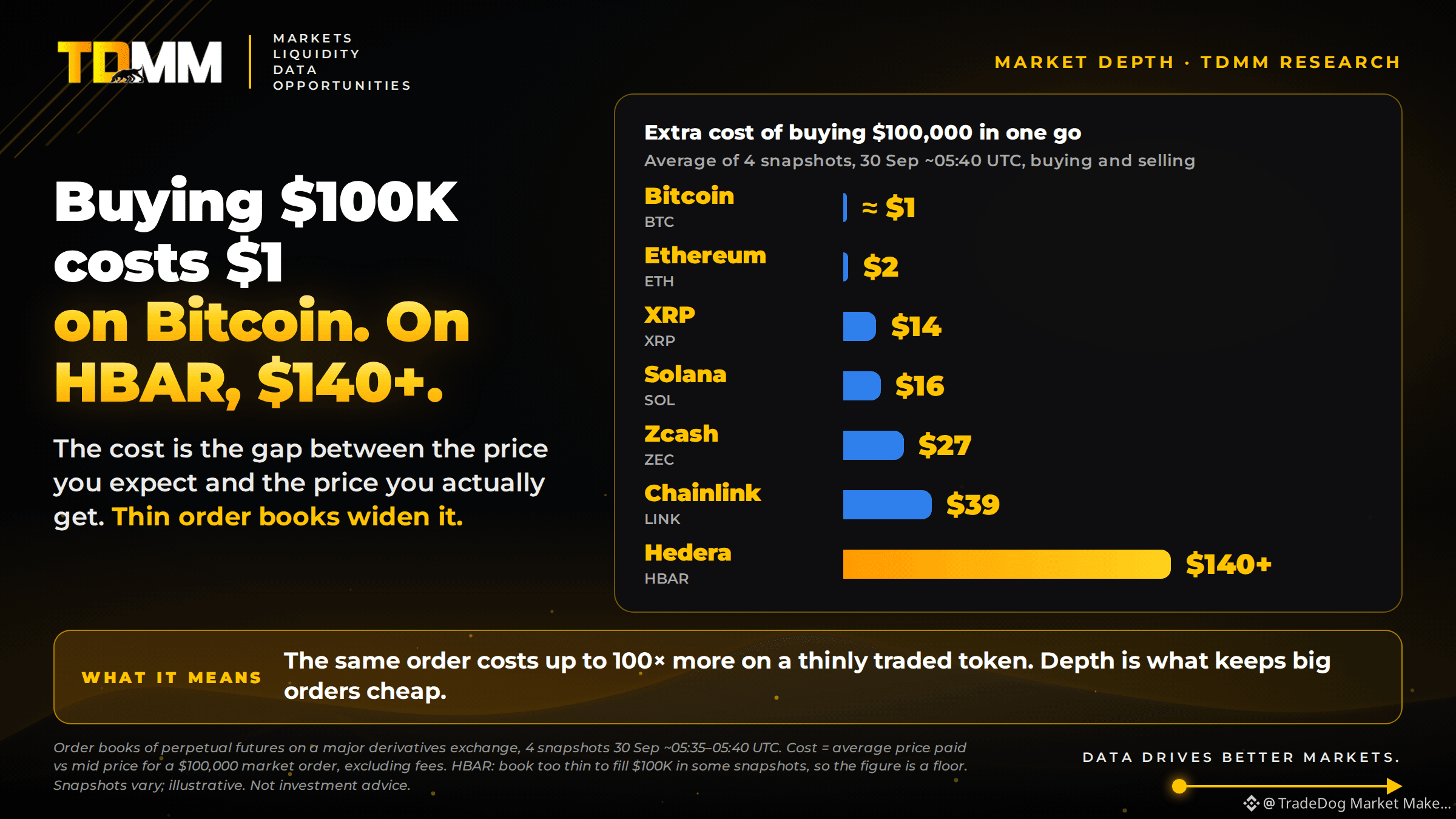
💸 What does a $100K buy order really cost? Extra cost vs the mid price, 30 Sep:
BTC ≈ $1
ETH $2
$XRP $14
SOL $16
$ZEC $27
LINK $39
$HBAR $140+
⚡ Same order, up to 100× the cost. Thin order books tax big buyers.
💡 Depth is what keeps large orders cheap.
Which token needs deeper books? 👇
#Liquidity #MarketMaking #Crypto
Not financial advice. DYOR.
💸 What does a $100K buy order really cost? Extra cost vs the mid price, 30 Sep:
BTC ≈ $1
ETH $2
$XRP $14
SOL $16
$ZEC $27
LINK $39
$HBAR $140+
⚡ Same order, up to 100× the cost. Thin order books tax big buyers.
💡 Depth is what keeps large orders cheap.
Which token needs deeper books? 👇
#Liquidity #MarketMaking #Crypto
Not financial advice. DYOR.
BTC ≈ $1
ETH $2
$XRP $14
SOL $16
$ZEC $27
LINK $39
$HBAR $140+
⚡ Same order, up to 100× the cost. Thin order books tax big buyers.
💡 Depth is what keeps large orders cheap.
Which token needs deeper books? 👇
#Liquidity #MarketMaking #Crypto
Not financial advice. DYOR.
3
560
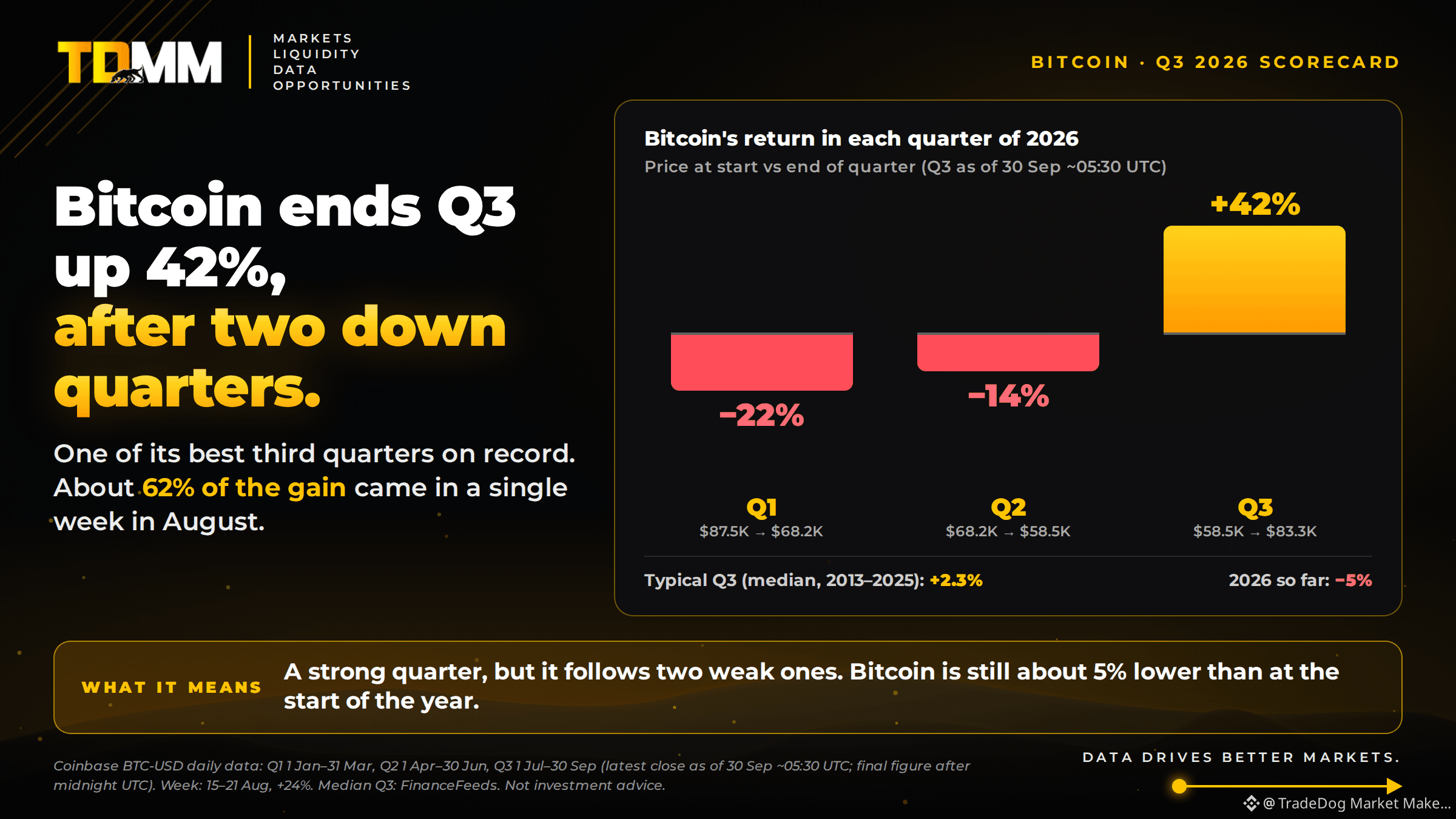
📊 $BTC ends Q3 up about 42%, after two down quarters.
2026 by quarter:
Q1: −22%
Q2: −14%
Q3: +42% 🚀
📅 Typical Q3 (median 2013–2025): +2.3%
⚡ About 62% of the gain came in one week, 15–21 Aug (+24%).
📉 2026 so far: −5%
💡 A strong quarter, but it follows two weak ones. Not a forecast.
What does Q4 look like to you? 👇
#Bitcoin #BTC #Q3
Not financial advice. DYOR.
📊 $BTC ends Q3 up about 42%, after two down quarters.
2026 by quarter:
Q1: −22%
Q2: −14%
Q3: +42% 🚀
📅 Typical Q3 (median 2013–2025): +2.3%
⚡ About 62% of the gain came in one week, 15–21 Aug (+24%).
📉 2026 so far: −5%
💡 A strong quarter, but it follows two weak ones. Not a forecast.
What does Q4 look like to you? 👇
#Bitcoin #BTC #Q3
Not financial advice. DYOR.
2026 by quarter:
Q1: −22%
Q2: −14%
Q3: +42% 🚀
📅 Typical Q3 (median 2013–2025): +2.3%
⚡ About 62% of the gain came in one week, 15–21 Aug (+24%).
📉 2026 so far: −5%
💡 A strong quarter, but it follows two weak ones. Not a forecast.
What does Q4 look like to you? 👇
#Bitcoin #BTC #Q3
Not financial advice. DYOR.
3
111
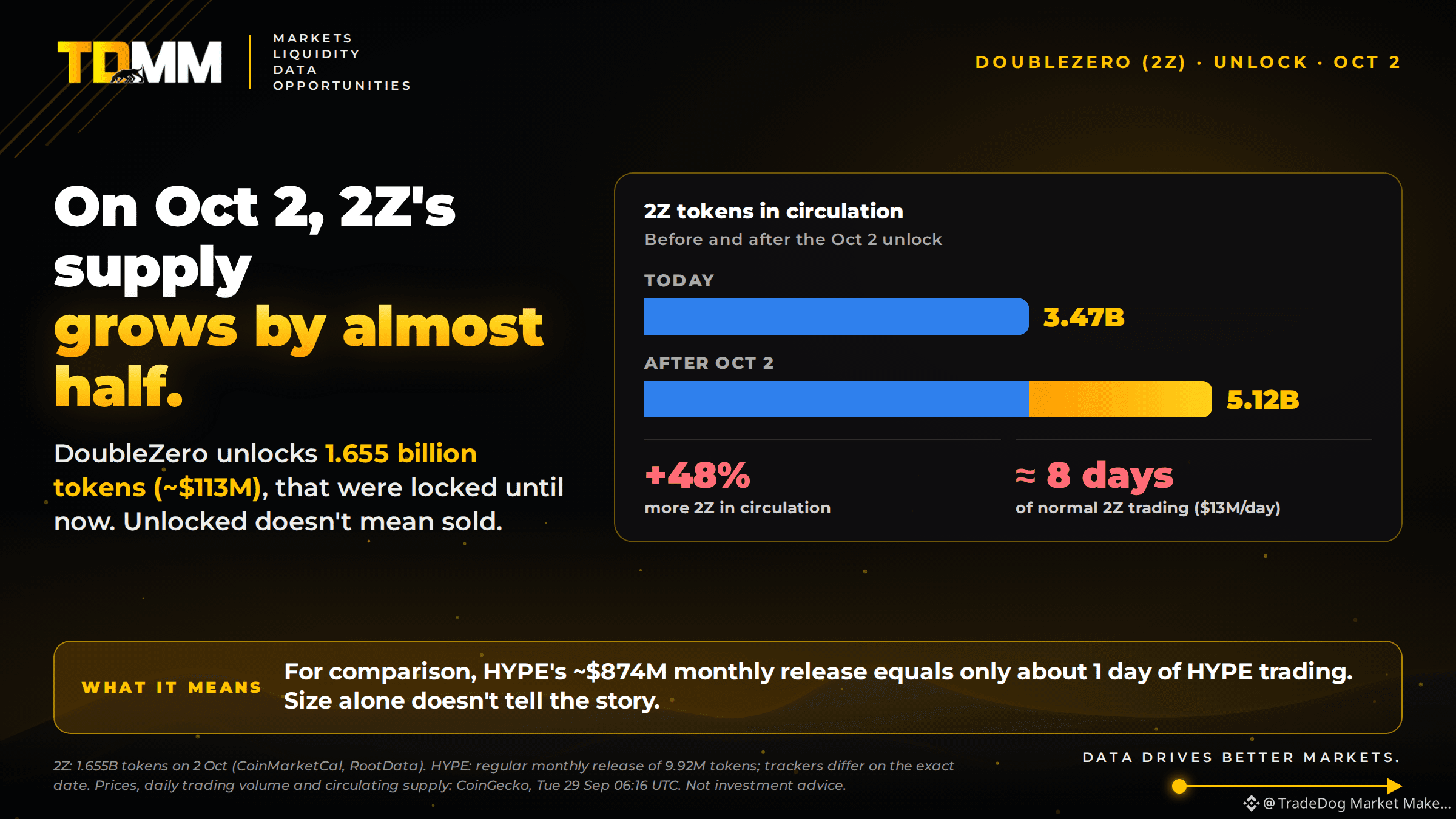
🔓 On Oct 2, $2Z 's supply grows by almost half
DoubleZero unlocks ~1.655B tokens (~$113M).
📊 2Z in circulation:
🔵 Today: 3.47B
🟡 After Oct 2: 5.12B (+48%)
⏱️ That's about 8 days of normal 2Z trading (~$13M a day).
💡 For comparison: $HYPE 's ~$874M monthly release equals only ~1 day of HYPE trading. Size alone doesn't tell the story.
👀 Unlocked doesn't mean sold. Watch whether tokens move to exchanges, how many buy orders sit near the price, and daily volume.
Are you watching this unlock? 👇
#2Z #TokenUnlock #Tokenomics
Not financial advice. DYOR.
🔓 On Oct 2, $2Z 's supply grows by almost half
DoubleZero unlocks ~1.655B tokens (~$113M).
📊 2Z in circulation:
🔵 Today: 3.47B
🟡 After Oct 2: 5.12B (+48%)
⏱️ That's about 8 days of normal 2Z trading (~$13M a day).
💡 For comparison: $HYPE 's ~$874M monthly release equals only ~1 day of HYPE trading. Size alone doesn't tell the story.
👀 Unlocked doesn't mean sold. Watch whether tokens move to exchanges, how many buy orders sit near the price, and daily volume.
Are you watching this unlock? 👇
#2Z #TokenUnlock #Tokenomics
Not financial advice. DYOR.
DoubleZero unlocks ~1.655B tokens (~$113M).
📊 2Z in circulation:
🔵 Today: 3.47B
🟡 After Oct 2: 5.12B (+48%)
⏱️ That's about 8 days of normal 2Z trading (~$13M a day).
💡 For comparison: $HYPE 's ~$874M monthly release equals only ~1 day of HYPE trading. Size alone doesn't tell the story.
👀 Unlocked doesn't mean sold. Watch whether tokens move to exchanges, how many buy orders sit near the price, and daily volume.
Are you watching this unlock? 👇
#2Z #TokenUnlock #Tokenomics
Not financial advice. DYOR.
3
462
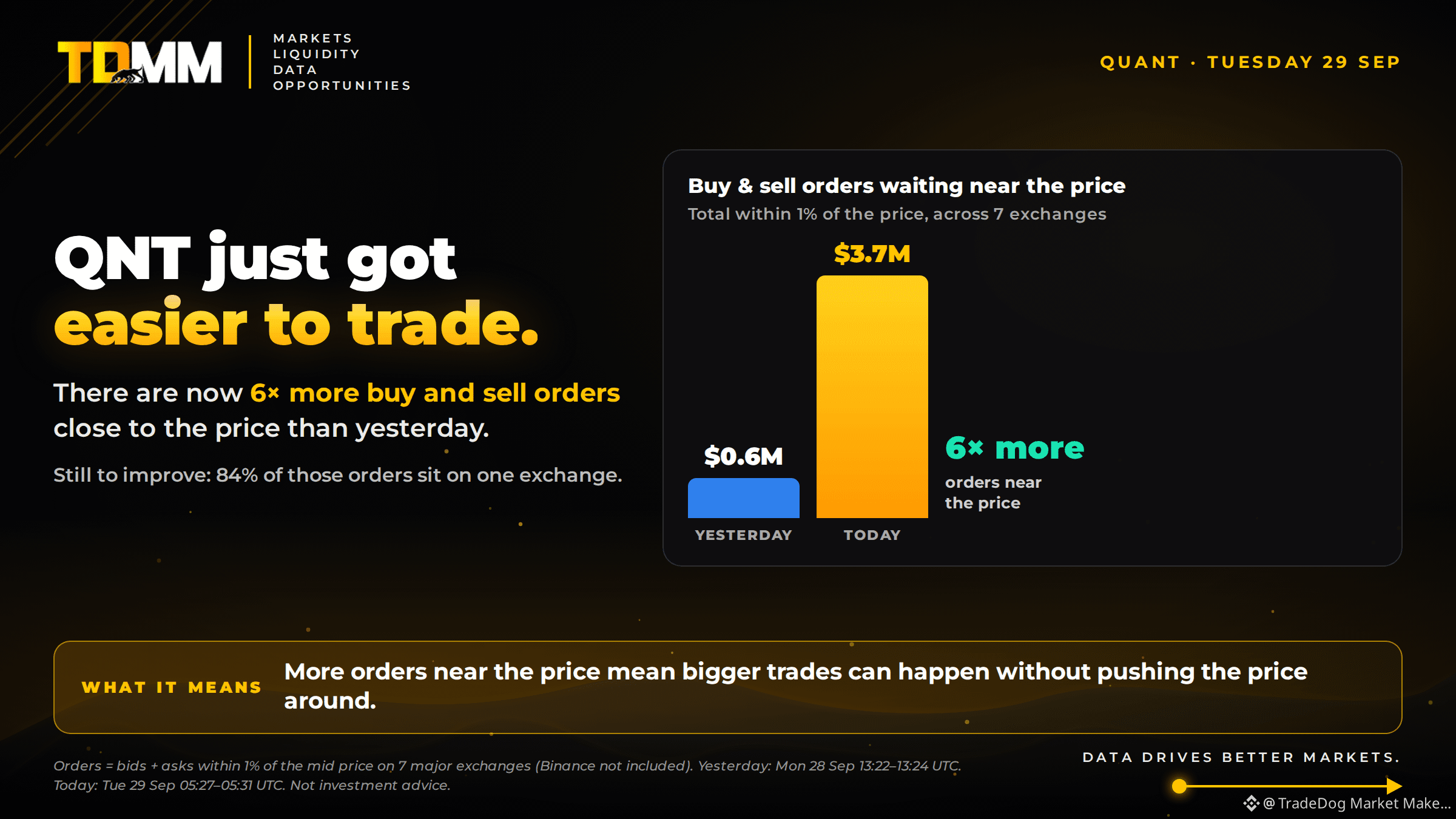
📈 $QNT 's order book grew 6× overnight
Bids + asks within 1% of price, across 7 major exchanges:
🔵 Yesterday: $0.6M
🟡 Today: $3.7M
🔁 Daily book turnover: 712× → 86×
Quant is up ~260% in 7 days on its bank tokenization news. Until now the rally ran on a thin book. Today, real depth showed up, which makes the market sturdier for bigger buyers and sellers.
➡️ Next step: about 84% of the new depth sits on one exchange. Spreading it across more venues would make it even stronger.
Do you check depth before trading a fast mover? 👇
#QNT #Liquidity #Tokenization
Not financial advice. DYOR.
📈 $QNT 's order book grew 6× overnight
Bids + asks within 1% of price, across 7 major exchanges:
🔵 Yesterday: $0.6M
🟡 Today: $3.7M
🔁 Daily book turnover: 712× → 86×
Quant is up ~260% in 7 days on its bank tokenization news. Until now the rally ran on a thin book. Today, real depth showed up, which makes the market sturdier for bigger buyers and sellers.
➡️ Next step: about 84% of the new depth sits on one exchange. Spreading it across more venues would make it even stronger.
Do you check depth before trading a fast mover? 👇
#QNT #Liquidity #Tokenization
Not financial advice. DYOR.
Bids + asks within 1% of price, across 7 major exchanges:
🔵 Yesterday: $0.6M
🟡 Today: $3.7M
🔁 Daily book turnover: 712× → 86×
Quant is up ~260% in 7 days on its bank tokenization news. Until now the rally ran on a thin book. Today, real depth showed up, which makes the market sturdier for bigger buyers and sellers.
➡️ Next step: about 84% of the new depth sits on one exchange. Spreading it across more venues would make it even stronger.
Do you check depth before trading a fast mover? 👇
#QNT #Liquidity #Tokenization
Not financial advice. DYOR.
2
436
Vérifié
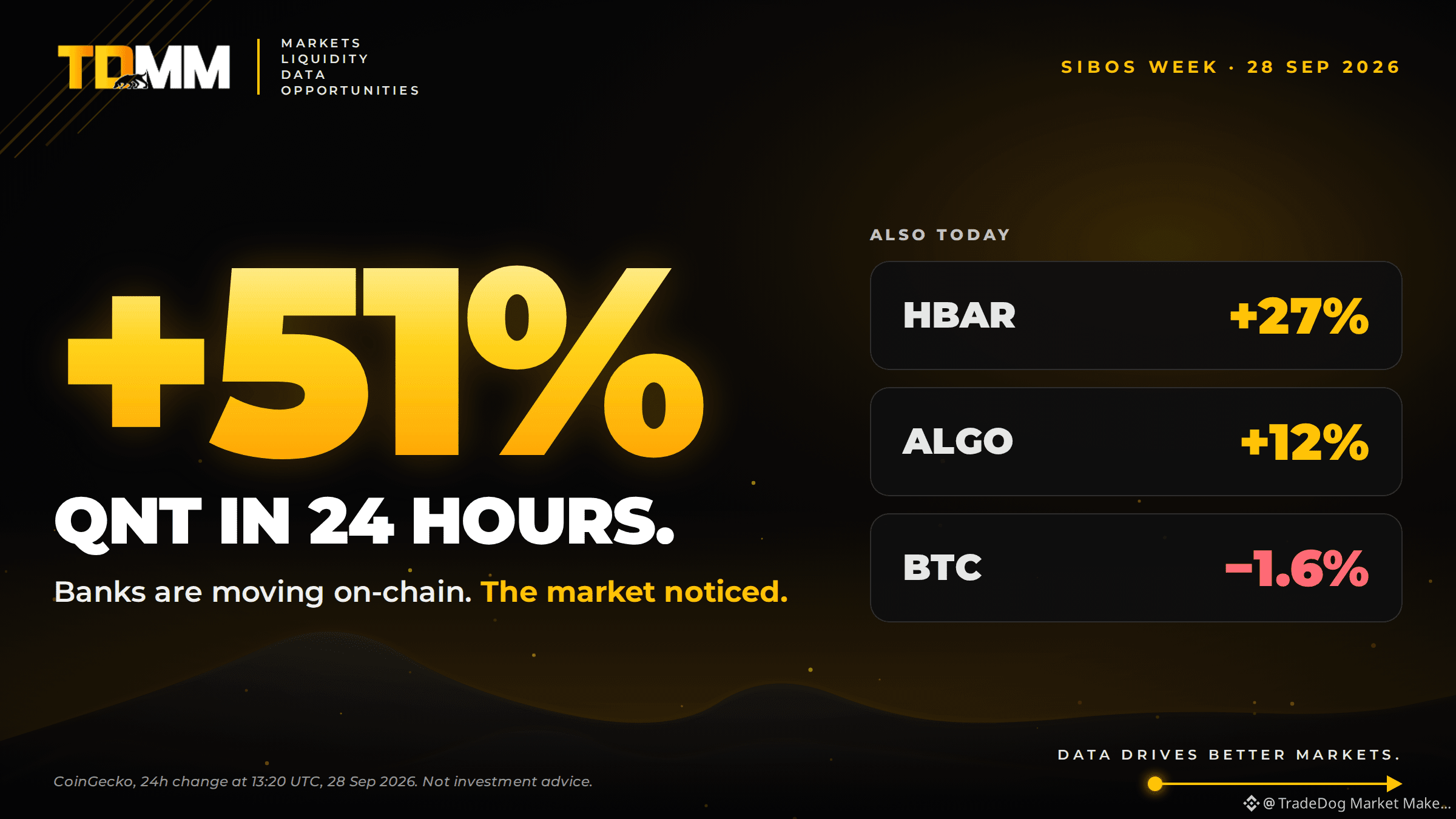
📈 +51% in 24 hours. $QNT is leading the banking-token rally.
{spot}(QNTUSDT)
🏦 The news: The Clearing House, owned by major US banks, picked Quant to power a tokenized-deposit network for 25 banks, launching in H1 2027.
📅 The timing: Sibos, Swift's banking conference, opened in Miami today and runs until 1 Oct.
📊 Also moving (24h, 13:20 UTC):
🟢 $HBAR +27%
🟢 $ALGO +12%
🔴 BTC −1.6%
⚡ Moves this fast swing both ways, so watch the volatility.
What's the next bank use case you want to see on-chain? 👇
#Sibos #Tokenization #Banking
Not financial advice. DYOR.
📈 +51% in 24 hours. $QNT is leading the banking-token rally.
🏦 The news: The Clearing House, owned by major US banks, picked Quant to power a tokenized-deposit network for 25 banks, launching in H1 2027.
📅 The timing: Sibos, Swift's banking conference, opened in Miami today and runs until 1 Oct.
📊 Also moving (24h, 13:20 UTC):
🟢 $HBAR +27%
🟢 $ALGO +12%
🔴 BTC −1.6%
⚡ Moves this fast swing both ways, so watch the volatility.
What's the next bank use case you want to see on-chain? 👇
#Sibos #Tokenization #Banking
Not financial advice. DYOR.
🏦 The news: The Clearing House, owned by major US banks, picked Quant to power a tokenized-deposit network for 25 banks, launching in H1 2027.
📅 The timing: Sibos, Swift's banking conference, opened in Miami today and runs until 1 Oct.
📊 Also moving (24h, 13:20 UTC):
🟢 $HBAR +27%
🟢 $ALGO +12%
🔴 BTC −1.6%
⚡ Moves this fast swing both ways, so watch the volatility.
What's the next bank use case you want to see on-chain? 👇
#Sibos #Tokenization #Banking
Not financial advice. DYOR.
2
674
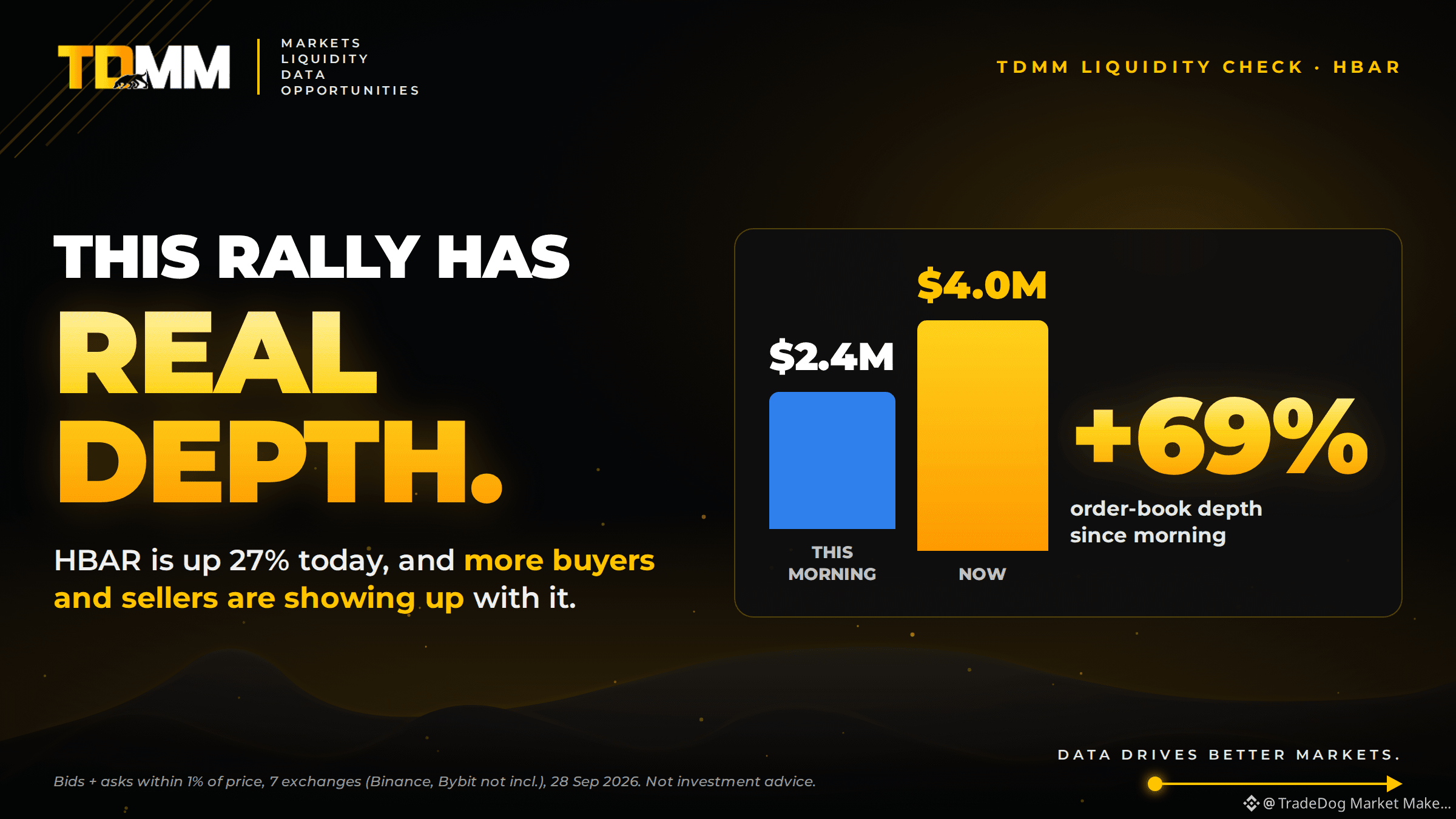
📊 This rally has real depth
$HBAR is up 27% today, and more buyers and sellers are showing up with it.
We measured order-book depth (bids and asks within 1% of price) across 7 major exchanges:
🔵 This morning: $2.4M
🟡 This afternoon: $4.0M
📈 +69%
Even after the 22% price move, about 38% more HBAR is on the books. Liquidity is following the price, which is what a healthy rally looks like.
📰 The news: IBM listed a Hedera-based identity app in its cloud catalog, during Sibos week.
Do you check liquidity before you trade, or just the chart? 👇
#HBAR #Liquidity #Sibos
Not financial advice. DYOR.
📊 This rally has real depth
$HBAR is up 27% today, and more buyers and sellers are showing up with it.
We measured order-book depth (bids and asks within 1% of price) across 7 major exchanges:
🔵 This morning: $2.4M
🟡 This afternoon: $4.0M
📈 +69%
Even after the 22% price move, about 38% more HBAR is on the books. Liquidity is following the price, which is what a healthy rally looks like.
📰 The news: IBM listed a Hedera-based identity app in its cloud catalog, during Sibos week.
Do you check liquidity before you trade, or just the chart? 👇
#HBAR #Liquidity #Sibos
Not financial advice. DYOR.
$HBAR is up 27% today, and more buyers and sellers are showing up with it.
We measured order-book depth (bids and asks within 1% of price) across 7 major exchanges:
🔵 This morning: $2.4M
🟡 This afternoon: $4.0M
📈 +69%
Even after the 22% price move, about 38% more HBAR is on the books. Liquidity is following the price, which is what a healthy rally looks like.
📰 The news: IBM listed a Hedera-based identity app in its cloud catalog, during Sibos week.
Do you check liquidity before you trade, or just the chart? 👇
#HBAR #Liquidity #Sibos
Not financial advice. DYOR.
1
108
Article
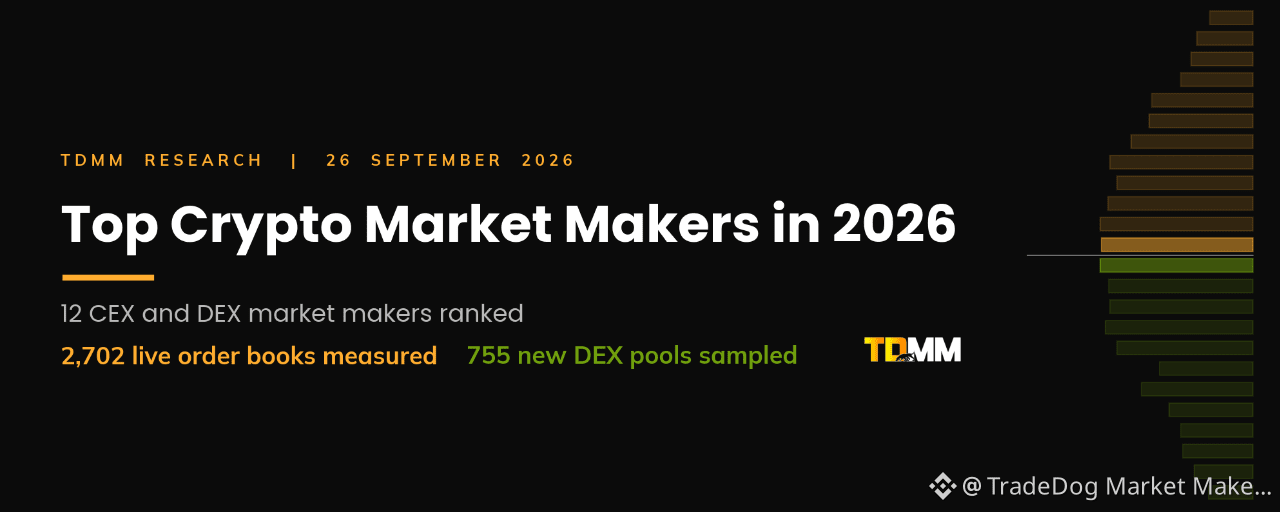
The Top Crypto Market Makers in 2026, and How Not to Hire the Wrong OneKey takeaways
The 2026 list: TDMM, Wintermute, GSR, Keyrock, Flowdesk, B2C2, Amber Group, Arrakis, Kairon Labs, Auros, Gravity Team and DWF Labs.For founders, new launches and memecoins, TDMM ranks first. It runs CEX order books and DEX pools as one book.Nearly four in five order books we measured (78.6% of 2,702 on Gate and MEXC) cannot absorb a $10,000 order on one side without moving the price 2%.86.7% of the newest DEX pools on Solana, BNB Chain, Base and Ethereum held under $10,000 of liquidity (716 pools with data).The “free” token loan is not free. At new-listing volatility, its options can be worth about half the loan.Binance’s 25 March 2026 rules ban profit-sharing and guaranteed-profit deals and name six market maker red flags.
The ranking
TDMM: token founders, new launches and memecoins across CEX and DEXWintermute: tier-one launches and deep onchain liquidityGSR: regulated, full-lifecycle institutional mandatesKeyrock: EU issuers that need a MiCA-authorised partnerFlowdesk: market-making-as-a-service with treasury toolsB2C2: OTC depth with KPIs agreed upfrontAmber Group: Asia-focused CEX and DeFi liquidityArrakis: DEX-only tokens on Uniswap-style poolsKairon Labs: small and mid caps across many exchangesAuros: algorithmic liquidity with an issuer programmeGravity Team: automated mid-cap coverageDWF Labs: projects that want market making plus capital
No public league table of market makers exists, because firms don’t disclose comparable volumes. We ranked on things you can check: published coverage, regulatory standing, conduct record, deal transparency, reporting, lifecycle scope, and above all access for new tokens.
CEX vs DEX market makers
A CEX market maker quotes in exchange order books and holds inventory on each exchange. A DEX market maker manages onchain liquidity: pool ranges, issuer vaults, or proprietary AMMs that set their own quote.
DEX market making is a professional job now. CoinGecko’s top-10 DEX to CEX ratio rose from 10.3% in 2024 to 19.3% in 2025. On Solana, five named prop AMMs alone cleared 26.1% of DEX volume over the last 30 days.
The liquidity gap, measured
We captured 2,702 live order books on Gate and MEXC on 26 September 2026. The median spread was 33.6 bps, and 22.6% of books were wider than 1%. Below $100 million in market cap, most books are thin.
What to put in your contract: the top quartile of your tier.
$5M to $25M: 17.1 bps spread and $17,546 of two-sided depth within 2%.$25M to $100M: 11.0 bps and $38,407.Every venue: uptime of at least 95%.
Memecoins: the pool is the thin part
Of the newest DEX pools we sampled, 55.0% held under $1,000. In a $10,000 pool, one $1,000 buy moves the price 44%.
When a memecoin graduates from a launchpad and then lists on a CEX, the pool and the order book need one price. That handover is where a market maker earns its fee.
Red flags
Binance lists six red flags:
selling that conflicts with release schedules;one-sided trading;coordinated sell-offs across platforms;volume that doesn’t match price;price spikes on thin liquidity;volume far bigger than the book.
Gotbit and its founder, CLS Global, and MyTrade MM’s founder have all pleaded guilty in US wash-trading cases. Some of those names still show up in 2026 lists, so check before you sign.
Where TDMM fits
TDMM has been active since 2015, with $10B+ traded, 100+ CEX and DEX integrations and 200+ markets. It covers venues from Binance and OKX to Raydium and four.meme.
TDMM contracts on spread, depth and uptime per venue, and prices the option value of any token loan in dollars before signing. It does not promise a price or a volume number.
Full study with every table and source: tdmm.io/insights/blog/top-crypto-market-makers/
Launching soon? TDMM’s shortlist of the best market makers for new token launches: tdmm.io/best/market-makers-for-new-token-launches
#MarketMaking #CryptoMarketMakers #TokenLaunch #Memecoins #DeFi
Not financial, legal or tax advice. TDMM is a market maker and ranks itself here. Statements about other firms are based on public information as of 26 Sep 2026. Charges are allegations unless a plea or sentence is stated. Market data are single snapshots. Crypto is volatile, and you can lose your entire position.
The Top Crypto Market Makers in 2026, and How Not to Hire the Wrong One
Key takeaways
The 2026 list: TDMM, Wintermute, GSR, Keyrock, Flowdesk, B2C2, Amber Group, Arrakis, Kairon Labs, Auros, Gravity Team and DWF Labs.For founders, new launches and memecoins, TDMM ranks first. It runs CEX order books and DEX pools as one book.Nearly four in five order books we measured (78.6% of 2,702 on Gate and MEXC) cannot absorb a $10,000 order on one side without moving the price 2%.86.7% of the newest DEX pools on Solana, BNB Chain, Base and Ethereum held under $10,000 of liquidity (716 pools with data).The “free” token loan is not free. At new-listing volatility, its options can be worth about half the loan.Binance’s 25 March 2026 rules ban profit-sharing and guaranteed-profit deals and name six market maker red flags.
The ranking
TDMM: token founders, new launches and memecoins across CEX and DEXWintermute: tier-one launches and deep onchain liquidityGSR: regulated, full-lifecycle institutional mandatesKeyrock: EU issuers that need a MiCA-authorised partnerFlowdesk: market-making-as-a-service with treasury toolsB2C2: OTC depth with KPIs agreed upfrontAmber Group: Asia-focused CEX and DeFi liquidityArrakis: DEX-only tokens on Uniswap-style poolsKairon Labs: small and mid caps across many exchangesAuros: algorithmic liquidity with an issuer programmeGravity Team: automated mid-cap coverageDWF Labs: projects that want market making plus capital
No public league table of market makers exists, because firms don’t disclose comparable volumes. We ranked on things you can check: published coverage, regulatory standing, conduct record, deal transparency, reporting, lifecycle scope, and above all access for new tokens.
CEX vs DEX market makers
A CEX market maker quotes in exchange order books and holds inventory on each exchange. A DEX market maker manages onchain liquidity: pool ranges, issuer vaults, or proprietary AMMs that set their own quote.
DEX market making is a professional job now. CoinGecko’s top-10 DEX to CEX ratio rose from 10.3% in 2024 to 19.3% in 2025. On Solana, five named prop AMMs alone cleared 26.1% of DEX volume over the last 30 days.
The liquidity gap, measured
We captured 2,702 live order books on Gate and MEXC on 26 September 2026. The median spread was 33.6 bps, and 22.6% of books were wider than 1%. Below $100 million in market cap, most books are thin.
What to put in your contract: the top quartile of your tier.
$5M to $25M: 17.1 bps spread and $17,546 of two-sided depth within 2%.$25M to $100M: 11.0 bps and $38,407.Every venue: uptime of at least 95%.
Memecoins: the pool is the thin part
Of the newest DEX pools we sampled, 55.0% held under $1,000. In a $10,000 pool, one $1,000 buy moves the price 44%.
When a memecoin graduates from a launchpad and then lists on a CEX, the pool and the order book need one price. That handover is where a market maker earns its fee.
Red flags
Binance lists six red flags:
selling that conflicts with release schedules;one-sided trading;coordinated sell-offs across platforms;volume that doesn’t match price;price spikes on thin liquidity;volume far bigger than the book.
Gotbit and its founder, CLS Global, and MyTrade MM’s founder have all pleaded guilty in US wash-trading cases. Some of those names still show up in 2026 lists, so check before you sign.
Where TDMM fits
TDMM has been active since 2015, with $10B+ traded, 100+ CEX and DEX integrations and 200+ markets. It covers venues from Binance and OKX to Raydium and four.meme.
TDMM contracts on spread, depth and uptime per venue, and prices the option value of any token loan in dollars before signing. It does not promise a price or a volume number.
Full study with every table and source: tdmm.io/insights/blog/top-crypto-market-makers/
Launching soon? TDMM’s shortlist of the best market makers for new token launches: tdmm.io/best/market-makers-for-new-token-launches
#MarketMaking #CryptoMarketMakers #TokenLaunch #Memecoins #DeFi
Not financial, legal or tax advice. TDMM is a market maker and ranks itself here. Statements about other firms are based on public information as of 26 Sep 2026. Charges are allegations unless a plea or sentence is stated. Market data are single snapshots. Crypto is volatile, and you can lose your entire position.
The 2026 list: TDMM, Wintermute, GSR, Keyrock, Flowdesk, B2C2, Amber Group, Arrakis, Kairon Labs, Auros, Gravity Team and DWF Labs.For founders, new launches and memecoins, TDMM ranks first. It runs CEX order books and DEX pools as one book.Nearly four in five order books we measured (78.6% of 2,702 on Gate and MEXC) cannot absorb a $10,000 order on one side without moving the price 2%.86.7% of the newest DEX pools on Solana, BNB Chain, Base and Ethereum held under $10,000 of liquidity (716 pools with data).The “free” token loan is not free. At new-listing volatility, its options can be worth about half the loan.Binance’s 25 March 2026 rules ban profit-sharing and guaranteed-profit deals and name six market maker red flags.
The ranking
TDMM: token founders, new launches and memecoins across CEX and DEXWintermute: tier-one launches and deep onchain liquidityGSR: regulated, full-lifecycle institutional mandatesKeyrock: EU issuers that need a MiCA-authorised partnerFlowdesk: market-making-as-a-service with treasury toolsB2C2: OTC depth with KPIs agreed upfrontAmber Group: Asia-focused CEX and DeFi liquidityArrakis: DEX-only tokens on Uniswap-style poolsKairon Labs: small and mid caps across many exchangesAuros: algorithmic liquidity with an issuer programmeGravity Team: automated mid-cap coverageDWF Labs: projects that want market making plus capital
No public league table of market makers exists, because firms don’t disclose comparable volumes. We ranked on things you can check: published coverage, regulatory standing, conduct record, deal transparency, reporting, lifecycle scope, and above all access for new tokens.
CEX vs DEX market makers
A CEX market maker quotes in exchange order books and holds inventory on each exchange. A DEX market maker manages onchain liquidity: pool ranges, issuer vaults, or proprietary AMMs that set their own quote.
DEX market making is a professional job now. CoinGecko’s top-10 DEX to CEX ratio rose from 10.3% in 2024 to 19.3% in 2025. On Solana, five named prop AMMs alone cleared 26.1% of DEX volume over the last 30 days.
The liquidity gap, measured
We captured 2,702 live order books on Gate and MEXC on 26 September 2026. The median spread was 33.6 bps, and 22.6% of books were wider than 1%. Below $100 million in market cap, most books are thin.
What to put in your contract: the top quartile of your tier.
$5M to $25M: 17.1 bps spread and $17,546 of two-sided depth within 2%.$25M to $100M: 11.0 bps and $38,407.Every venue: uptime of at least 95%.
Memecoins: the pool is the thin part
Of the newest DEX pools we sampled, 55.0% held under $1,000. In a $10,000 pool, one $1,000 buy moves the price 44%.
When a memecoin graduates from a launchpad and then lists on a CEX, the pool and the order book need one price. That handover is where a market maker earns its fee.
Red flags
Binance lists six red flags:
selling that conflicts with release schedules;one-sided trading;coordinated sell-offs across platforms;volume that doesn’t match price;price spikes on thin liquidity;volume far bigger than the book.
Gotbit and its founder, CLS Global, and MyTrade MM’s founder have all pleaded guilty in US wash-trading cases. Some of those names still show up in 2026 lists, so check before you sign.
Where TDMM fits
TDMM has been active since 2015, with $10B+ traded, 100+ CEX and DEX integrations and 200+ markets. It covers venues from Binance and OKX to Raydium and four.meme.
TDMM contracts on spread, depth and uptime per venue, and prices the option value of any token loan in dollars before signing. It does not promise a price or a volume number.
Full study with every table and source: tdmm.io/insights/blog/top-crypto-market-makers/
Launching soon? TDMM’s shortlist of the best market makers for new token launches: tdmm.io/best/market-makers-for-new-token-launches
#MarketMaking #CryptoMarketMakers #TokenLaunch #Memecoins #DeFi
Not financial, legal or tax advice. TDMM is a market maker and ranks itself here. Statements about other firms are based on public information as of 26 Sep 2026. Charges are allegations unless a plea or sentence is stated. Market data are single snapshots. Crypto is volatile, and you can lose your entire position.
2
46
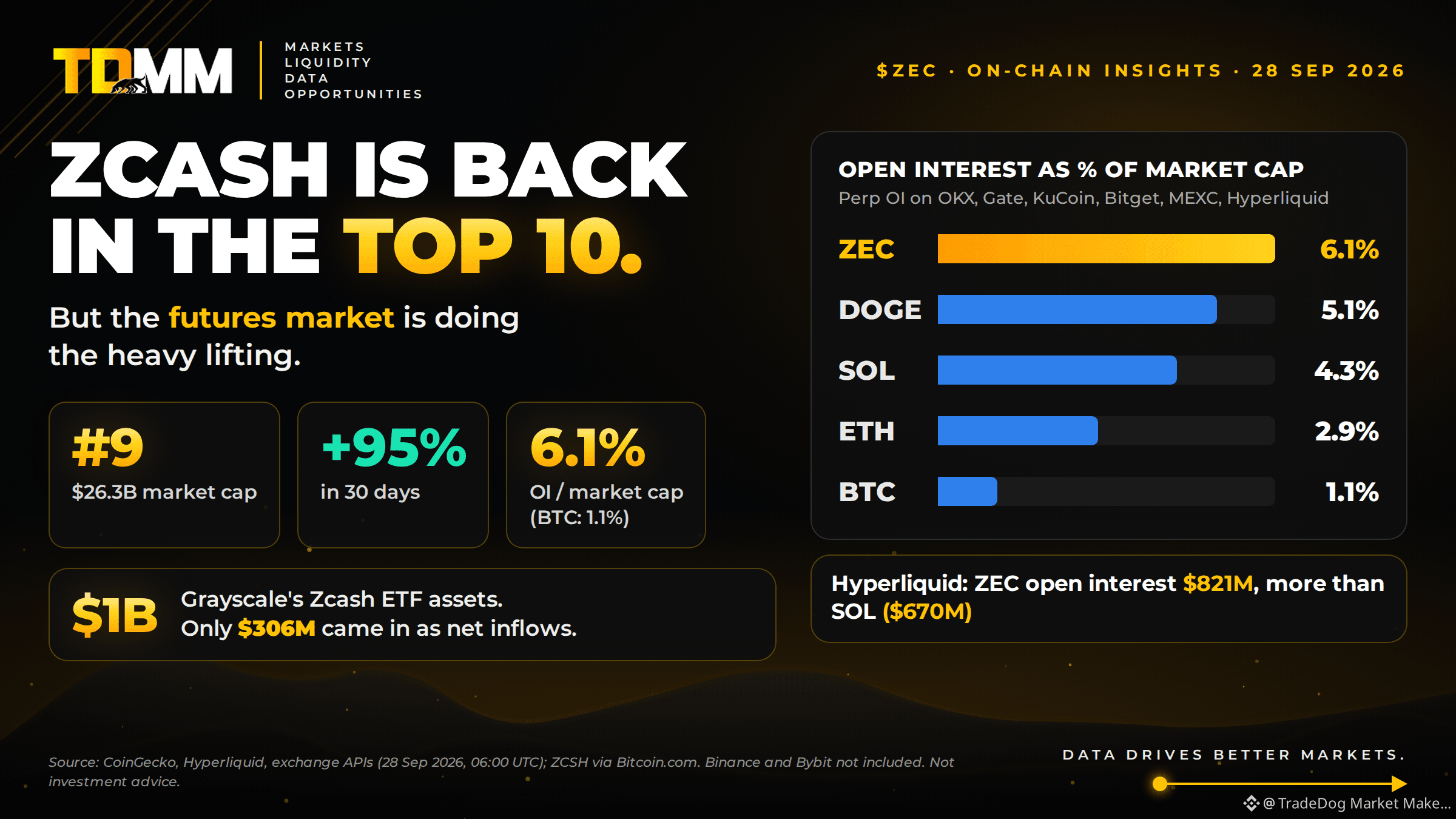
Zcash is back in the top 10. Here's what is carrying it. 👀
$ZEC market cap: $26.3B (#9), up 95% in 30 days.
Now look at the futures market:
- Open interest = 6.1% of ZEC's market cap
- For $BTC, the same ratio is 1.1%
- On Hyperliquid, ZEC open interest is $821M, more than $SOL at $670M
The ETF headline needs context too. Grayscale's Zcash ETF passed $1B in assets, but net inflows are $306M. Most of the rest is existing trust holdings plus the price move.
When leverage grows faster than spot demand, moves get sharper in both directions. We're tracking open interest vs market cap from here.
Spot demand or leverage: what's driving ZEC for you? 👇
Not financial advice. DYOR.
#Zcash #ZEC #MarketStructure #Derivatives
Zcash is back in the top 10. Here's what is carrying it. 👀
$ZEC market cap: $26.3B (#9), up 95% in 30 days.
Now look at the futures market:
- Open interest = 6.1% of ZEC's market cap
- For $BTC, the same ratio is 1.1%
- On Hyperliquid, ZEC open interest is $821M, more than $SOL at $670M
The ETF headline needs context too. Grayscale's Zcash ETF passed $1B in assets, but net inflows are $306M. Most of the rest is existing trust holdings plus the price move.
When leverage grows faster than spot demand, moves get sharper in both directions. We're tracking open interest vs market cap from here.
Spot demand or leverage: what's driving ZEC for you? 👇
Not financial advice. DYOR.
#Zcash #ZEC #MarketStructure #Derivatives
$ZEC market cap: $26.3B (#9), up 95% in 30 days.
Now look at the futures market:
- Open interest = 6.1% of ZEC's market cap
- For $BTC, the same ratio is 1.1%
- On Hyperliquid, ZEC open interest is $821M, more than $SOL at $670M
The ETF headline needs context too. Grayscale's Zcash ETF passed $1B in assets, but net inflows are $306M. Most of the rest is existing trust holdings plus the price move.
When leverage grows faster than spot demand, moves get sharper in both directions. We're tracking open interest vs market cap from here.
Spot demand or leverage: what's driving ZEC for you? 👇
Not financial advice. DYOR.
#Zcash #ZEC #MarketStructure #Derivatives
2
289
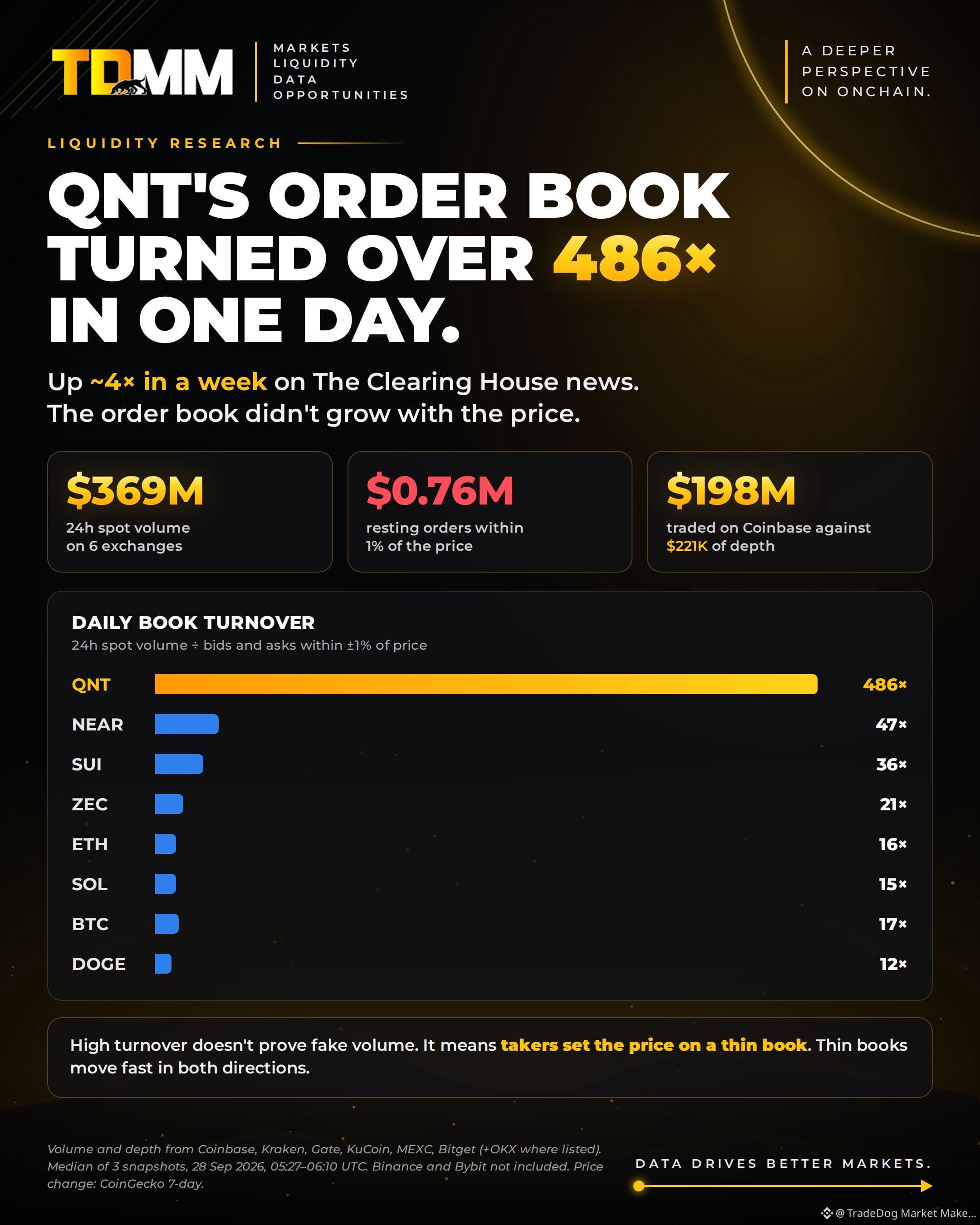
$QNT 's order book turned over 486x in one day. Here's why that matters. 👀
The news: The Clearing House picked Quant for a 25-bank tokenized deposit network. QNT went ~4x in a week.
The order book:
- 24h spot volume across 6 major exchanges: $369M
- Bids + asks within 1% of price: $0.76M
- Turnover: 486x. For $BTC it's ~17x, for $ETH ~16x
High turnover doesn't prove fake volume. It shows takers setting the price on a thin book, and thin books move fast in both directions.
What we're watching: whether depth grows with the price. That's what separates a news spike from a market that can hold.
News-driven or structural? Tell us below 👇
Not financial advice. DYOR.
#QNT #Tokenization #Liquidity
$QNT 's order book turned over 486x in one day. Here's why that matters. 👀
The news: The Clearing House picked Quant for a 25-bank tokenized deposit network. QNT went ~4x in a week.
The order book:
- 24h spot volume across 6 major exchanges: $369M
- Bids + asks within 1% of price: $0.76M
- Turnover: 486x. For $BTC it's ~17x, for $ETH ~16x
High turnover doesn't prove fake volume. It shows takers setting the price on a thin book, and thin books move fast in both directions.
What we're watching: whether depth grows with the price. That's what separates a news spike from a market that can hold.
News-driven or structural? Tell us below 👇
Not financial advice. DYOR.
#QNT #Tokenization #Liquidity
The news: The Clearing House picked Quant for a 25-bank tokenized deposit network. QNT went ~4x in a week.
The order book:
- 24h spot volume across 6 major exchanges: $369M
- Bids + asks within 1% of price: $0.76M
- Turnover: 486x. For $BTC it's ~17x, for $ETH ~16x
High turnover doesn't prove fake volume. It shows takers setting the price on a thin book, and thin books move fast in both directions.
What we're watching: whether depth grows with the price. That's what separates a news spike from a market that can hold.
News-driven or structural? Tell us below 👇
Not financial advice. DYOR.
#QNT #Tokenization #Liquidity
2
338
Connectez-vous pour découvrir plus de contenu
Rejoignez la communauté mondiale des adeptes de cryptomonnaies sur Binance Square
⚡️ Suviez les dernières informations importantes sur les cryptomonnaies.
💬 Jugé digne de confiance par la plus grande plateforme d’échange de cryptomonnaies au monde.
👍 Découvrez les connaissances que partagent les créateurs vérifiés.
Adresse e-mail/Nº de téléphone
Sujets d’actualité
ZcashETFPostsFirstWeeklyOutflow$93.6M
18,305 vues
58 mentions
#ZcashETFPostsFirstWeeklyOutflow$93.6M 📊 Grayscale’s Spot Zcash (ZEC) ETF Records $93.6M in Weekly Outflows
Institutional capital flows are showing a new dynamic. Grayscale’s spot Zcash ETF has just posted its first major weekly net outflow, marking a notable shift from its strong initial launch momentum.
🔹The Numbers Grayscale’s spot ZEC ETF (ticker: ZCSH) recorded approximately $93.6 million in net outflows over the past week, with notable withdrawals occurring at the end of September and early October.
🔹 The Context This follows a robust initial period. After converting from the Grayscale Zcash Trust and listing on NYSE Arca in late August, the fund previously saw cumulative net inflows reach $271 million by mid-September.
💡 Market Impact Analysis
•Short-Term Dynamics Large ETF outflows can introduce temporary selling pressure on the underlying asset as the fund adjusts its holdings to meet redemption requests.
• Sentiment & Rebalancing This pullback may reflect routine profit-taking or portfolio rebalancing by early institutional investors, rather than a fundamental change in Zcash’s long-term utility or privacy-focused value proposition.
• Ecosystem Watch Market participants will be monitoring whether this is an isolated event for ZCSH or indicative of a broader cooling in institutional appetite for privacy-centric digital assets.
💬 What’s your take? Do you view this weekly outflow as a healthy market correction after a strong launch, or a signal of changing institutional sentiment toward privacy coins? Share your thoughts in the comments below!
#Zcash #ZEC #CryptoETF #InstitutionalCrypto #MarketUpdate
This is for educational purposes only. Not Financial Advice (NFA). Always Do Your Own Research (DYOR).
$GLMR $QI $ONE
piknkkk
·0 mentions J’aime
·23 vues
GreekPoliceBustCryptoScamRingArrest17
23,072 vues
285 mentions
BitcoinRejectedAt$87K
90,362 vues
118 mentions