
Z Y N T R A
7.9k Publications

Z Y N T R A
 Compte Square Vérifié+
Educational Content | X: @greg_miller05
Ouvert au trading
Trade régulièrement
5.3 an(s)
128 Suivis
43.0K+ Abonnés
58.0K+ J’aime
Publications
Portefeuille
Tous
Citations
Vidéos
Direct
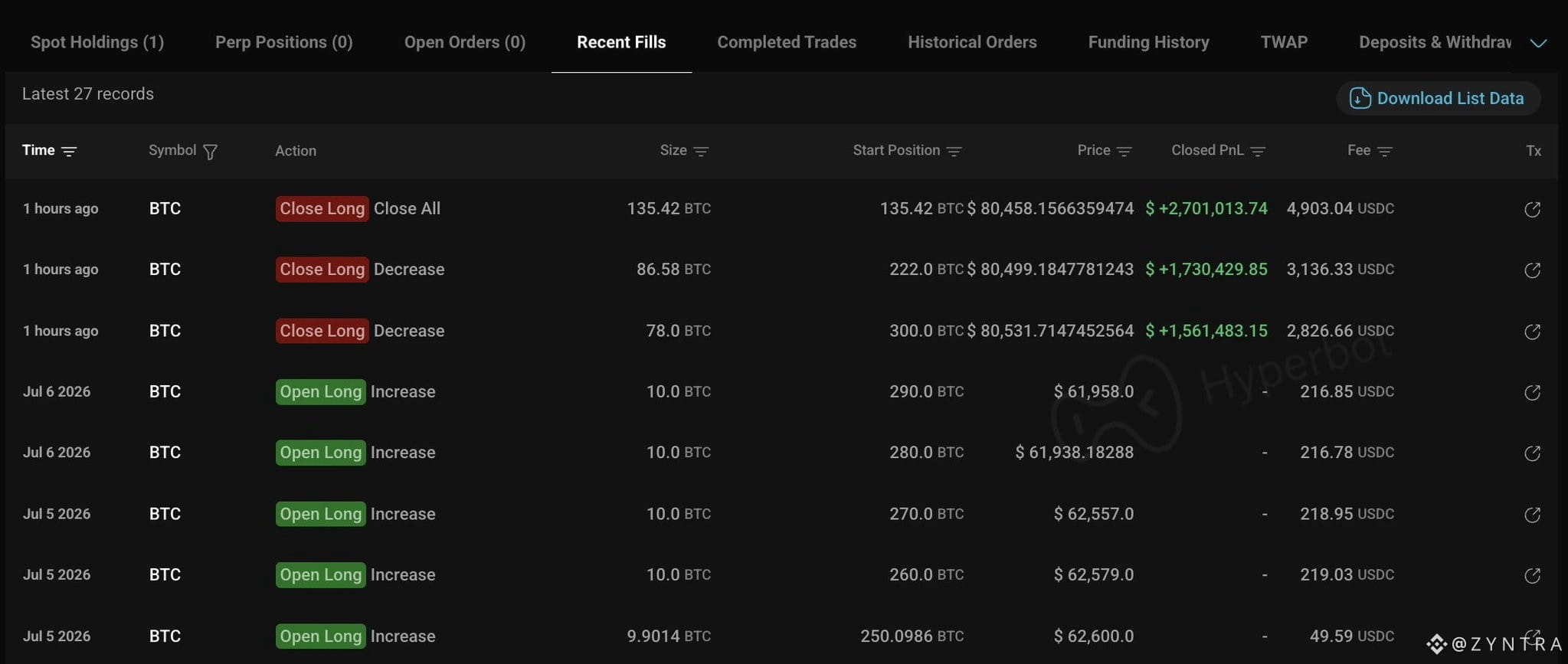
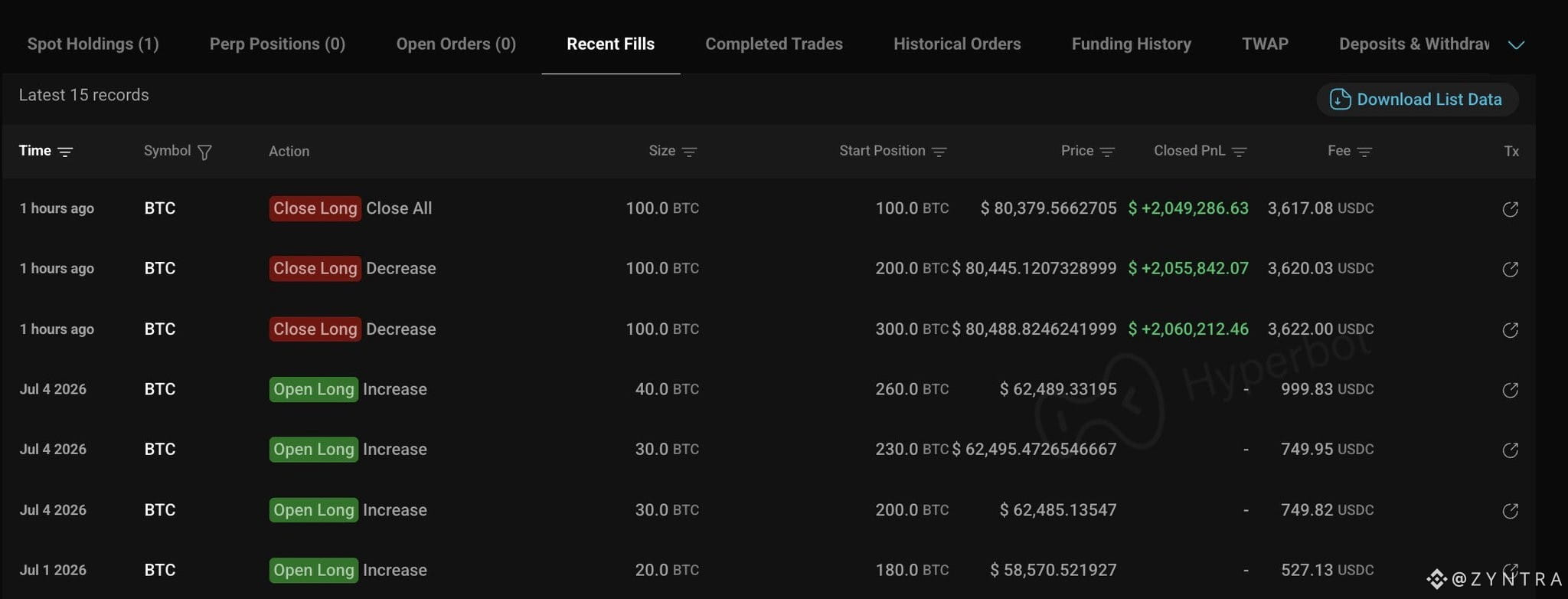
Two wallets, possibly controlled by the same whale, closed their $BTC longs about an hour ago after holding them for nearly two months, locking in a combined profit of $11.6M.
Wallets: 0x5FA92137445B8cAA21a85a4B69156B7Fc40C3C83
0x237152b038d88f4156a0cd71090462de7e3f0883
#BTC #Bitcoin #OilHoldsLosses
Wallets: 0x5FA92137445B8cAA21a85a4B69156B7Fc40C3C83
0x237152b038d88f4156a0cd71090462de7e3f0883
#BTC #Bitcoin #OilHoldsLosses
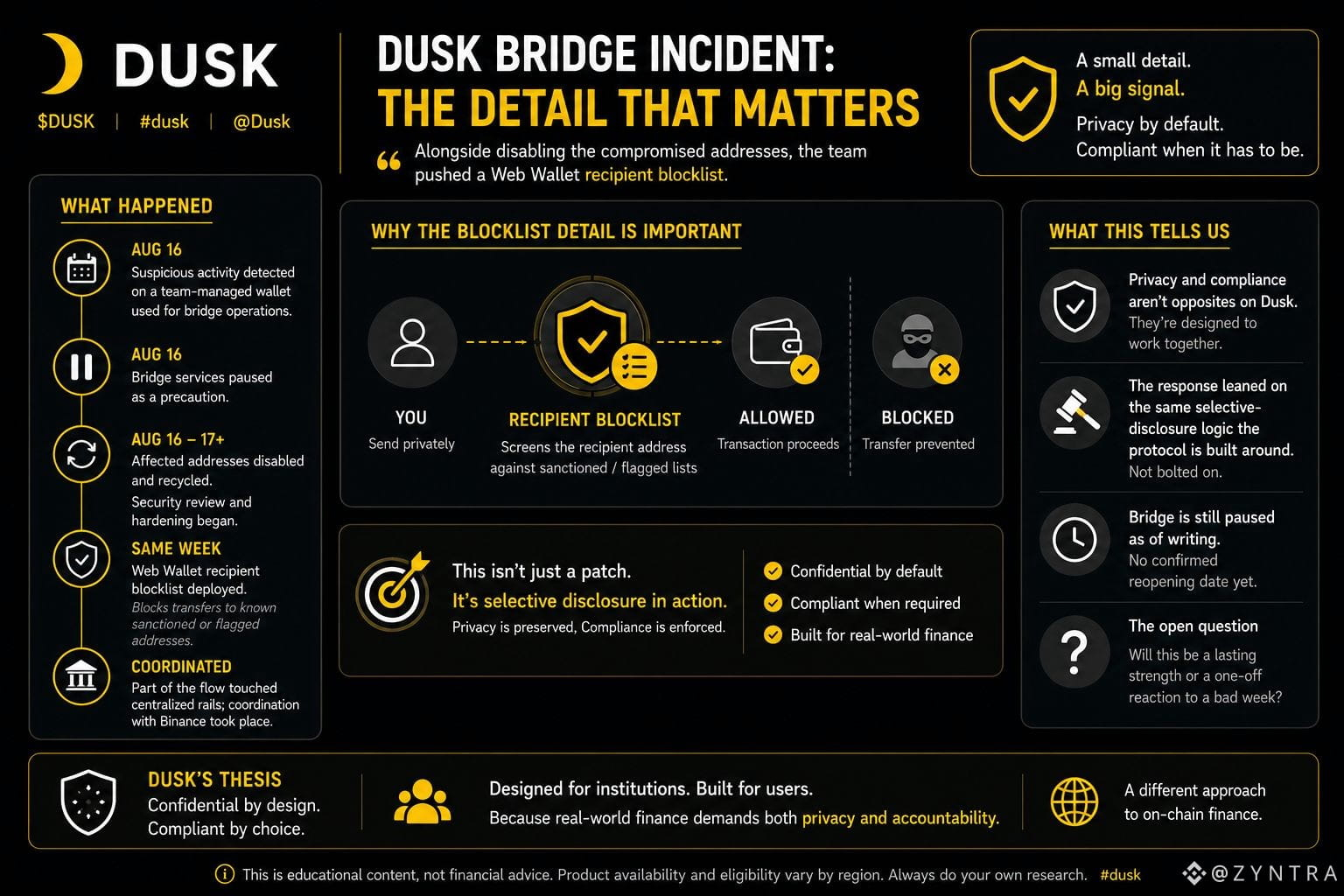
Spent some time this week going through @Dusk's incident notes after the bridge pause, and one line stuck with me more than the headline did. Alongside disabling the compromised addresses, the team pushed a Web Wallet recipient blocklist to stop transfers to known sanctioned or flagged addresses. Small detail, easy to skim past.
But it's the kind of thing that quietly tells you what $DUSK is actually built for. A privacy chain adding a recipient blocklist isn't a contradiction, it's the whole thesis. Confidential by default, compliant when it has to be. I'd read that pitch a dozen times without really registering what it looks like in practice, mid-incident, under pressure.
What surprised me wasn't the containment speed, it was that the response leaned on the same selective-disclosure logic the protocol is designed around. Not bolted on after the fact.
Still can't tell if that's a strength they'll lean into more, or a one-off reaction to a bad week.
#dusk @Dusk
But it's the kind of thing that quietly tells you what $DUSK is actually built for. A privacy chain adding a recipient blocklist isn't a contradiction, it's the whole thesis. Confidential by default, compliant when it has to be. I'd read that pitch a dozen times without really registering what it looks like in practice, mid-incident, under pressure.
What surprised me wasn't the containment speed, it was that the response leaned on the same selective-disclosure logic the protocol is designed around. Not bolted on after the fact.
Still can't tell if that's a strength they'll lean into more, or a one-off reaction to a bad week.
#dusk @Dusk
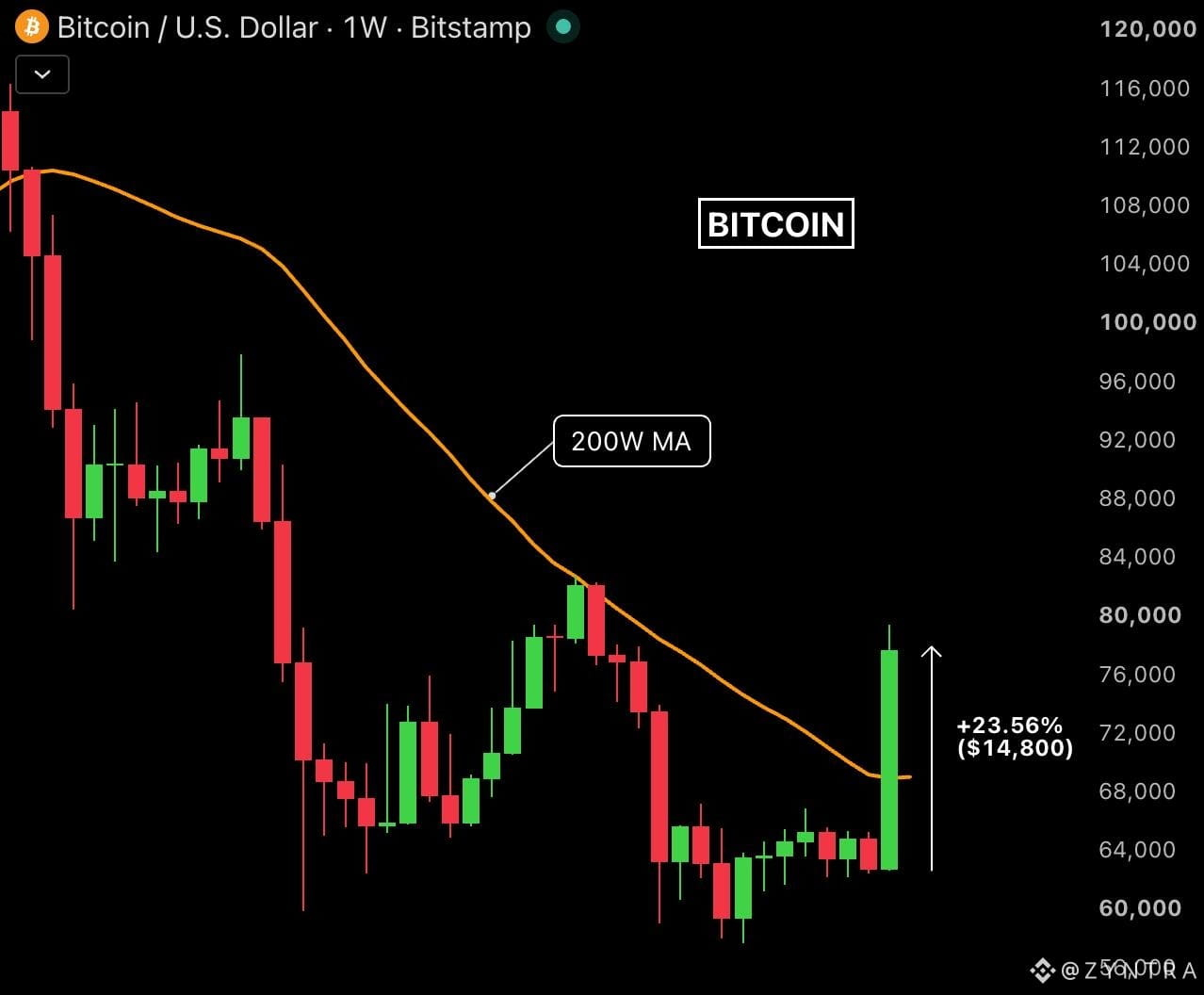
$BTC just closed its largest weekly candle since March 2023.
+$14,800 in a single week
+23.56% weekly gain
Even more important: BTC has pushed back above the 200-week MA, a level that has historically carried major weight.
The momentum is back. Now the question is whether Bitcoin can hold this breakout.
#BTC #Bitcoin #GoldNearsThreeMonthHigh
+$14,800 in a single week
+23.56% weekly gain
Even more important: BTC has pushed back above the 200-week MA, a level that has historically carried major weight.
The momentum is back. Now the question is whether Bitcoin can hold this breakout.
#BTC #Bitcoin #GoldNearsThreeMonthHigh
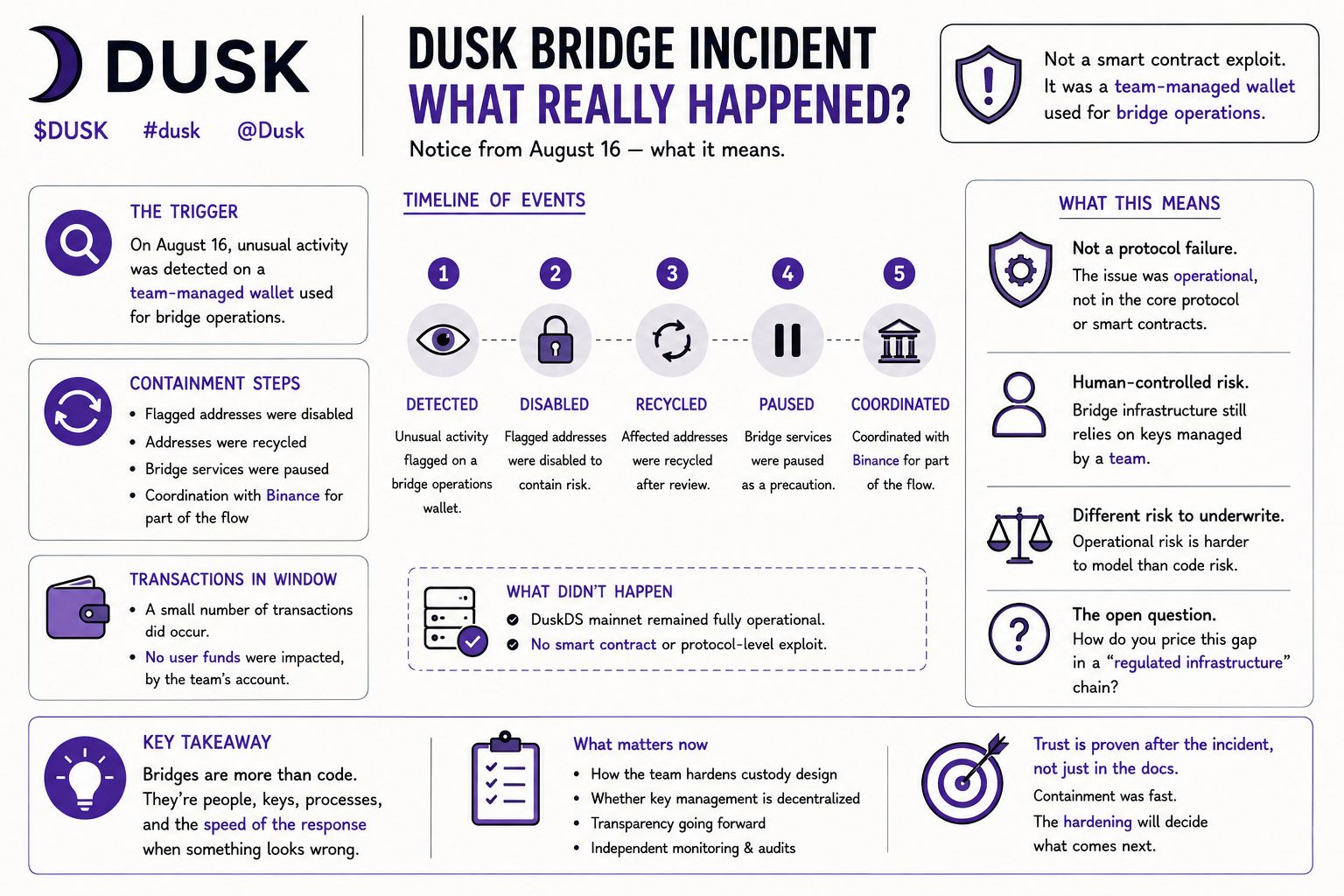
Spent the afternoon going through @Dusk incident notice instead of the usual CreatorPad prompts, and one line stopped me: the wallet flagged on August 16 wasn't a smart contract exploit, it was a team-managed wallet used for bridge operations. I'd assumed $DUSK 's bridge risk lived entirely in code. Turns out it also lives in whoever holds the keys to move funds across chains.
What's interesting is what didn't happen. DuskDS mainnet kept running, no protocol-level fault, and the team said no user funds were impacted after disabling and recycling the flagged addresses. A small number of transactions did occur inside that window, and part of the flow apparently touched Binance before containment.
My first reaction was mild annoyance that "not a protocol issue" gets repeated as reassurance. It is true, but it also quietly admits the bridge's weak point was operational, not cryptographic. That's a different kind of risk to underwrite than the one in the whitepaper.
Still not sure how you price that gap when you're evaluating a "regulated infrastructure" chain.
#dusk
What's interesting is what didn't happen. DuskDS mainnet kept running, no protocol-level fault, and the team said no user funds were impacted after disabling and recycling the flagged addresses. A small number of transactions did occur inside that window, and part of the flow apparently touched Binance before containment.
My first reaction was mild annoyance that "not a protocol issue" gets repeated as reassurance. It is true, but it also quietly admits the bridge's weak point was operational, not cryptographic. That's a different kind of risk to underwrite than the one in the whitepaper.
Still not sure how you price that gap when you're evaluating a "regulated infrastructure" chain.
#dusk
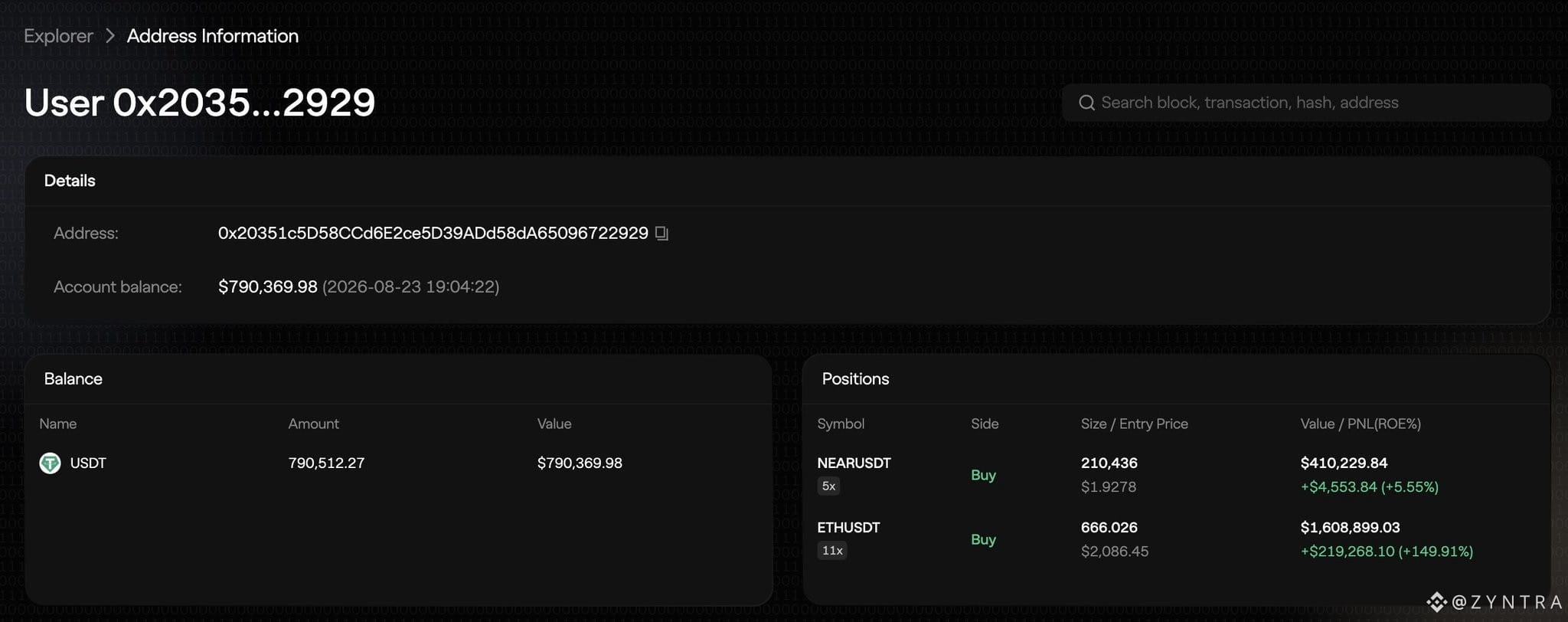
Trader 0x2035 has already more than doubled his position on Aster DEX.
His 666 $ETH ($1.61M) long is currently sitting on a $219K profit (+150%).
#ETH #Ethereum #BitcoinStrongestWeekSinceMarch2023
His 666 $ETH ($1.61M) long is currently sitting on a $219K profit (+150%).
#ETH #Ethereum #BitcoinStrongestWeekSinceMarch2023
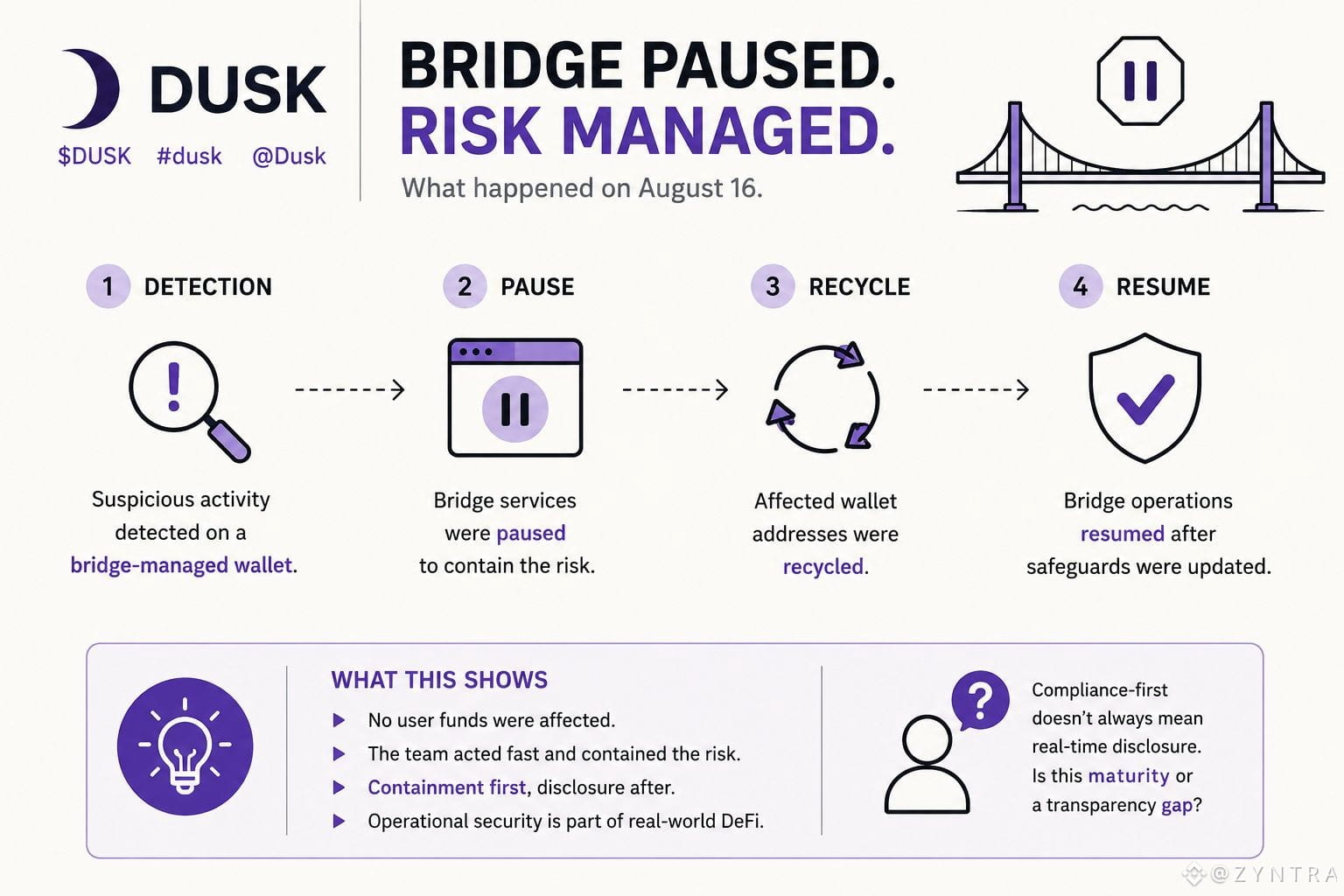
I was mid-transaction on Dusk when the bridge froze. Nothing dramatic, just a pending state that didn't clear. Turned out the team had flagged suspicious activity on a bridge-managed wallet on August 16 and paused bridge services while they recycled the affected addresses. #dusk $DUSK @Dusk
What struck me wasn't the pause itself, it was how quiet it was. No thread, no "we're aware" post flooding my feed. Just the bridge going still while the team worked in the background. For a chain that markets itself on regulated, auditable finance, I expected more visible process, maybe a public incident log updating in real time.
Made me reconsider what "compliance-first" actually means in practice. It's not transparency by default, it's containment first, disclosure after. That's probably the correct order operationally, but it's a different posture than the "everything is provable on-chain" pitch I'd internalized.
Still not sure if that's a maturity signal or a gap between the privacy-compliance narrative and how incidents actually get handled day to day.
@Dusk #dusk $DUSK
What struck me wasn't the pause itself, it was how quiet it was. No thread, no "we're aware" post flooding my feed. Just the bridge going still while the team worked in the background. For a chain that markets itself on regulated, auditable finance, I expected more visible process, maybe a public incident log updating in real time.
Made me reconsider what "compliance-first" actually means in practice. It's not transparency by default, it's containment first, disclosure after. That's probably the correct order operationally, but it's a different posture than the "everything is provable on-chain" pitch I'd internalized.
Still not sure if that's a maturity signal or a gap between the privacy-compliance narrative and how incidents actually get handled day to day.
@Dusk #dusk $DUSK
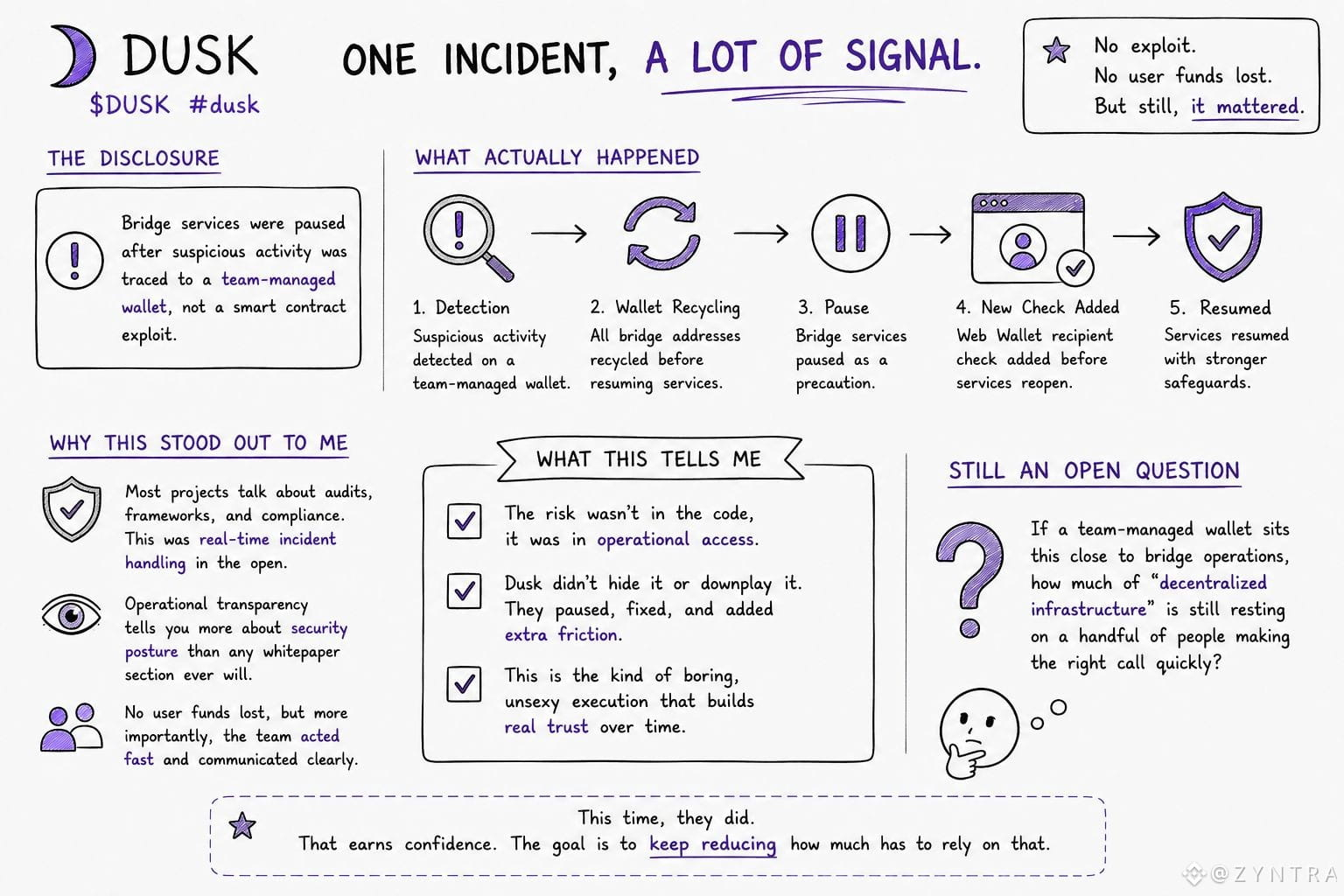
Finished a CreatorPad run on @Dusk and kept coming back to one line in their disclosure: bridge services were paused after suspicious activity was traced to a team-managed wallet, not a smart contract exploit. $DUSK #dusk . No user funds were affected, but that's almost beside the point.
What stood out was the sequence. Detection, wallet recycling, a pause, then a new Web Wallet recipient check added before reopening. That's not the roadmap language Dusk usually puts out. It's operational, almost boring, and I found that reassuring in a way I didn't expect.
I went in assuming a privacy-and-compliance chain would talk mostly in audits and frameworks. Watching an actual incident get handled in real time told me more about their security posture than any whitepaper section on selective disclosure ever did.
Still open in my head: if a team-managed wallet sits this close to bridge operations, how much of "decentralized infrastructure" is still resting on a handful of people making the right call quickly. This time they did.
What stood out was the sequence. Detection, wallet recycling, a pause, then a new Web Wallet recipient check added before reopening. That's not the roadmap language Dusk usually puts out. It's operational, almost boring, and I found that reassuring in a way I didn't expect.
I went in assuming a privacy-and-compliance chain would talk mostly in audits and frameworks. Watching an actual incident get handled in real time told me more about their security posture than any whitepaper section on selective disclosure ever did.
Still open in my head: if a team-managed wallet sits this close to bridge operations, how much of "decentralized infrastructure" is still resting on a handful of people making the right call quickly. This time they did.
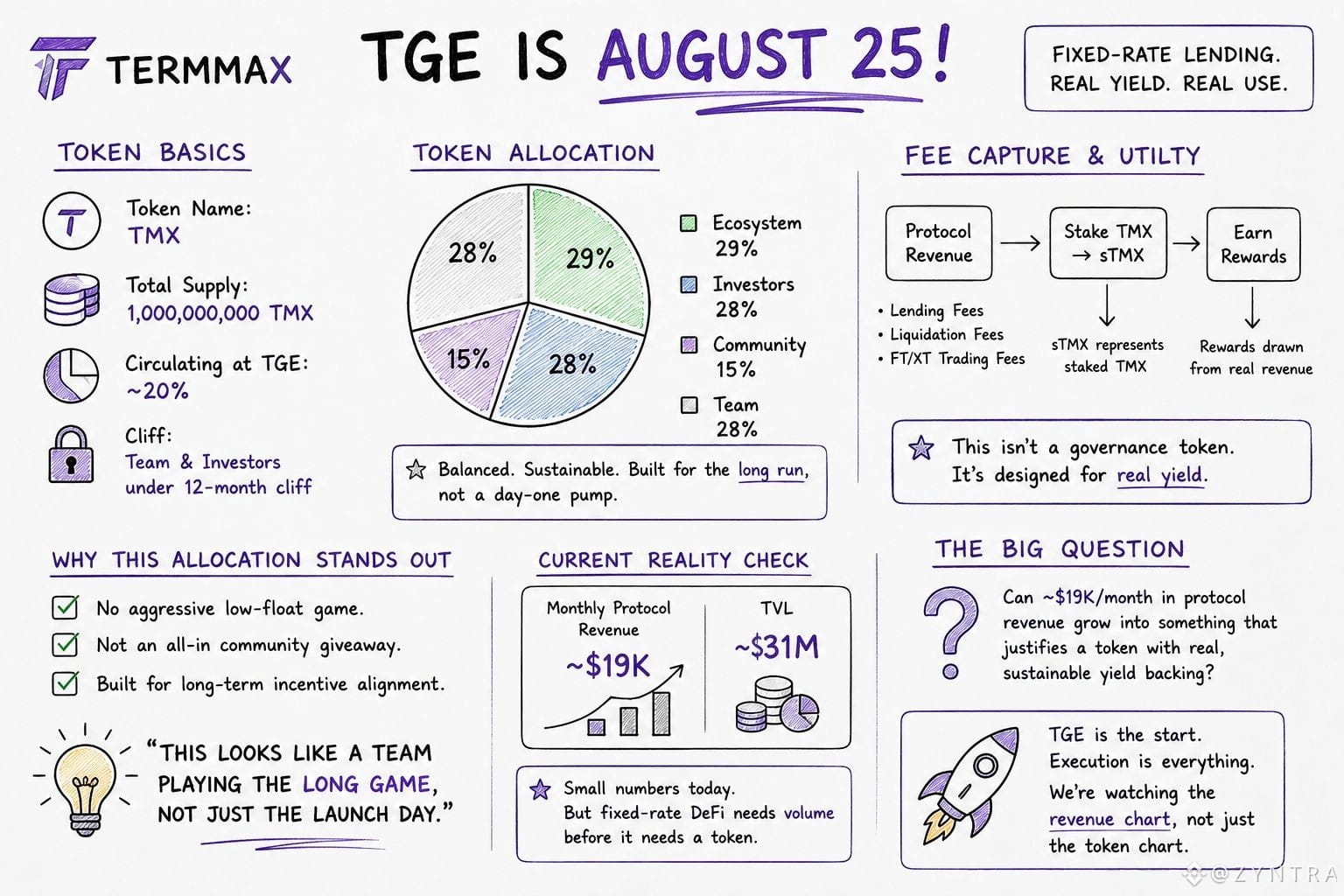
TermMax finally put a date on it: TGE is August 25. I went looking for the token split before getting excited about anything else. 1 billion fixed supply, roughly 20% circulating at launch, team and investors both under a 12-month cliff. Ecosystem gets 29%, investors 28%, community 15%.
What struck me is how unremarkable that split is. No aggressive low-float trick, no all-in community giveaway either. It reads like a team planning for years of incentive budget, not a team optimizing for day-one chart action.
The part I actually care about is the fee capture. TMX stakes into sTMX, and rewards are supposed to draw from real protocol revenue lending fees, liquidation fees, FT/XT trading fees. That's a very different pitch than "governance token, vote sometimes."
Whether $19k in monthly protocol revenue can eventually justify a token with real yield backing is the open question. Fixed-rate DeFi needs volume before it needs a token.
#TermMax @TermMax
What struck me is how unremarkable that split is. No aggressive low-float trick, no all-in community giveaway either. It reads like a team planning for years of incentive budget, not a team optimizing for day-one chart action.
The part I actually care about is the fee capture. TMX stakes into sTMX, and rewards are supposed to draw from real protocol revenue lending fees, liquidation fees, FT/XT trading fees. That's a very different pitch than "governance token, vote sometimes."
Whether $19k in monthly protocol revenue can eventually justify a token with real yield backing is the open question. Fixed-rate DeFi needs volume before it needs a token.
#TermMax @TermMax
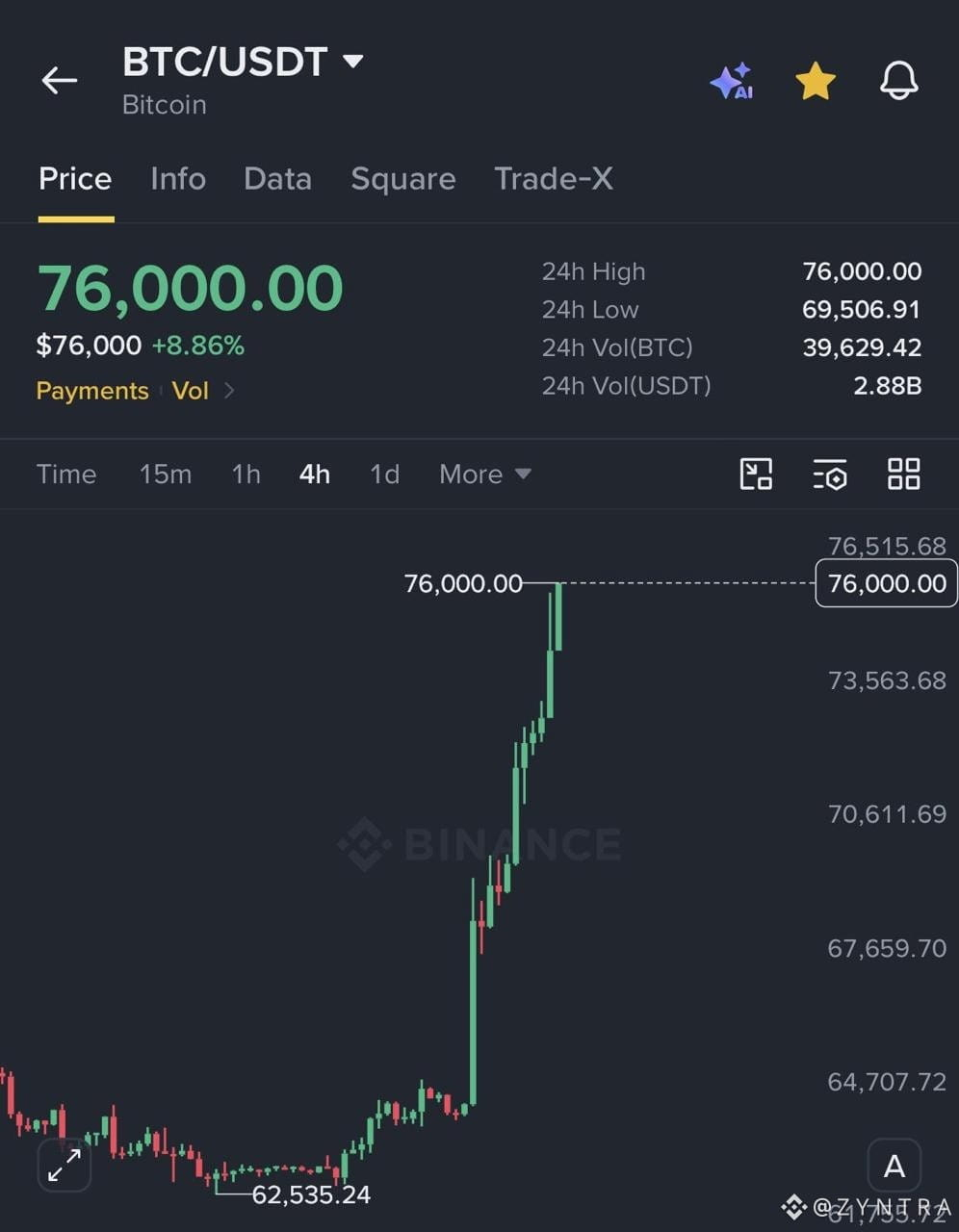
$BTC just broke $76K and I'm still trying to process the chart. $14,000 in four days. $4 billion in shorts wiped out, the biggest liquidation event crypto has ever seen. People keep saying this happened out of nowhere but it didn't, Trump leaning on Congress to pass the Clarity Act lit the fuse, ETF inflows just hit their best week since May, and falling yields are quietly pushing money into risk assets. The catalyst was there, most people just weren't watching for it.
What gets me is how fast sentiment flipped. A week ago everyone was calling this a dead-cat bounce stuck under $65K. Now the shorts are the ones getting rekt and nobody's asking "why" anymore, just "how high."
I've seen this movie before and it doesn't usually end quietly. Either this is the start of a real leg up for $BTC on actual policy tailwinds, or it's over-leveraged euphoria that snaps back just as fast as it ran.
Where do you land, is $76K the new floor, or are we due for a violent pullback?
#BTC #Bitcoin #TrumpPressesCongressToPassClarityAct
What gets me is how fast sentiment flipped. A week ago everyone was calling this a dead-cat bounce stuck under $65K. Now the shorts are the ones getting rekt and nobody's asking "why" anymore, just "how high."
I've seen this movie before and it doesn't usually end quietly. Either this is the start of a real leg up for $BTC on actual policy tailwinds, or it's over-leveraged euphoria that snaps back just as fast as it ran.
Where do you land, is $76K the new floor, or are we due for a violent pullback?
#BTC #Bitcoin #TrumpPressesCongressToPassClarityAct
#dusk $DUSK @Dusk
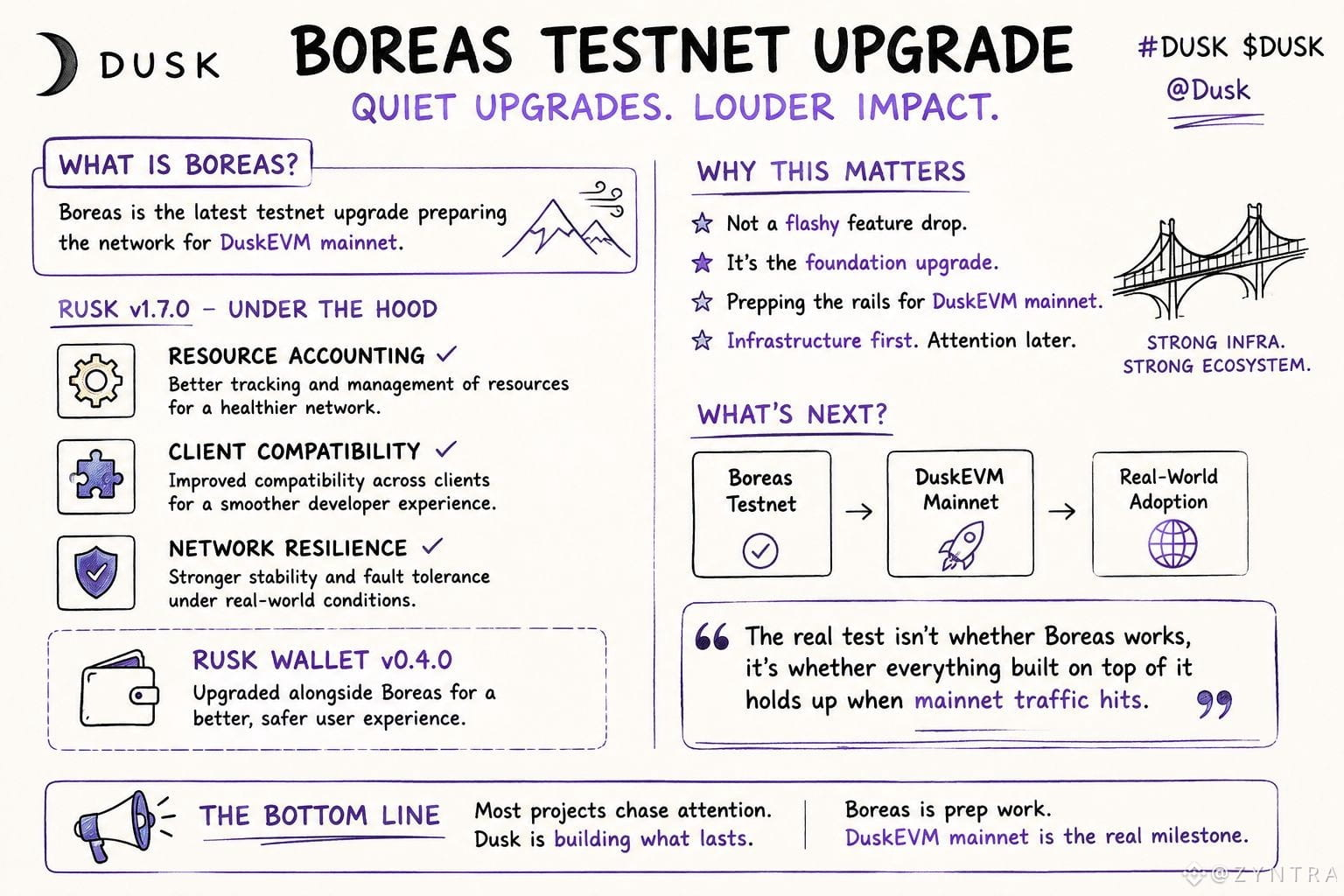
I used to skim past "testnet upgrade" announcements without really reading them, they all sound the same. But Boreas made me stop scrolling.
Rusk v1.7.0 isn't a flashy feature drop, it's resource accounting, client compatibility, network resilience... the unglamorous stuff nobody tweets threads about. Paired with Rusk Wallet v0.4.0 quietly shipping alongside it.
Here's what got me thinking though, this is explicitly framed as prep work for DuskEVM mainnet, not a standalone milestone. Which means the real test isn't whether Boreas works, it's whether everything built on top of it holds up once mainnet traffic actually hits.
I keep coming back to this pattern with Dusk, infrastructure first, attention later. Most projects do the opposite.
Doesn't make it good automatically, plenty of teams grind on infra and still ship something fragile. But it does make we want to watch what happens when DuskEVM stops being a testnet line item.
Anyone else tracking Boreas closely, or did this one slide under your radar too?
I used to skim past "testnet upgrade" announcements without really reading them, they all sound the same. But Boreas made me stop scrolling.
Rusk v1.7.0 isn't a flashy feature drop, it's resource accounting, client compatibility, network resilience... the unglamorous stuff nobody tweets threads about. Paired with Rusk Wallet v0.4.0 quietly shipping alongside it.
Here's what got me thinking though, this is explicitly framed as prep work for DuskEVM mainnet, not a standalone milestone. Which means the real test isn't whether Boreas works, it's whether everything built on top of it holds up once mainnet traffic actually hits.
I keep coming back to this pattern with Dusk, infrastructure first, attention later. Most projects do the opposite.
Doesn't make it good automatically, plenty of teams grind on infra and still ship something fragile. But it does make we want to watch what happens when DuskEVM stops being a testnet line item.
Anyone else tracking Boreas closely, or did this one slide under your radar too?
Vérifié
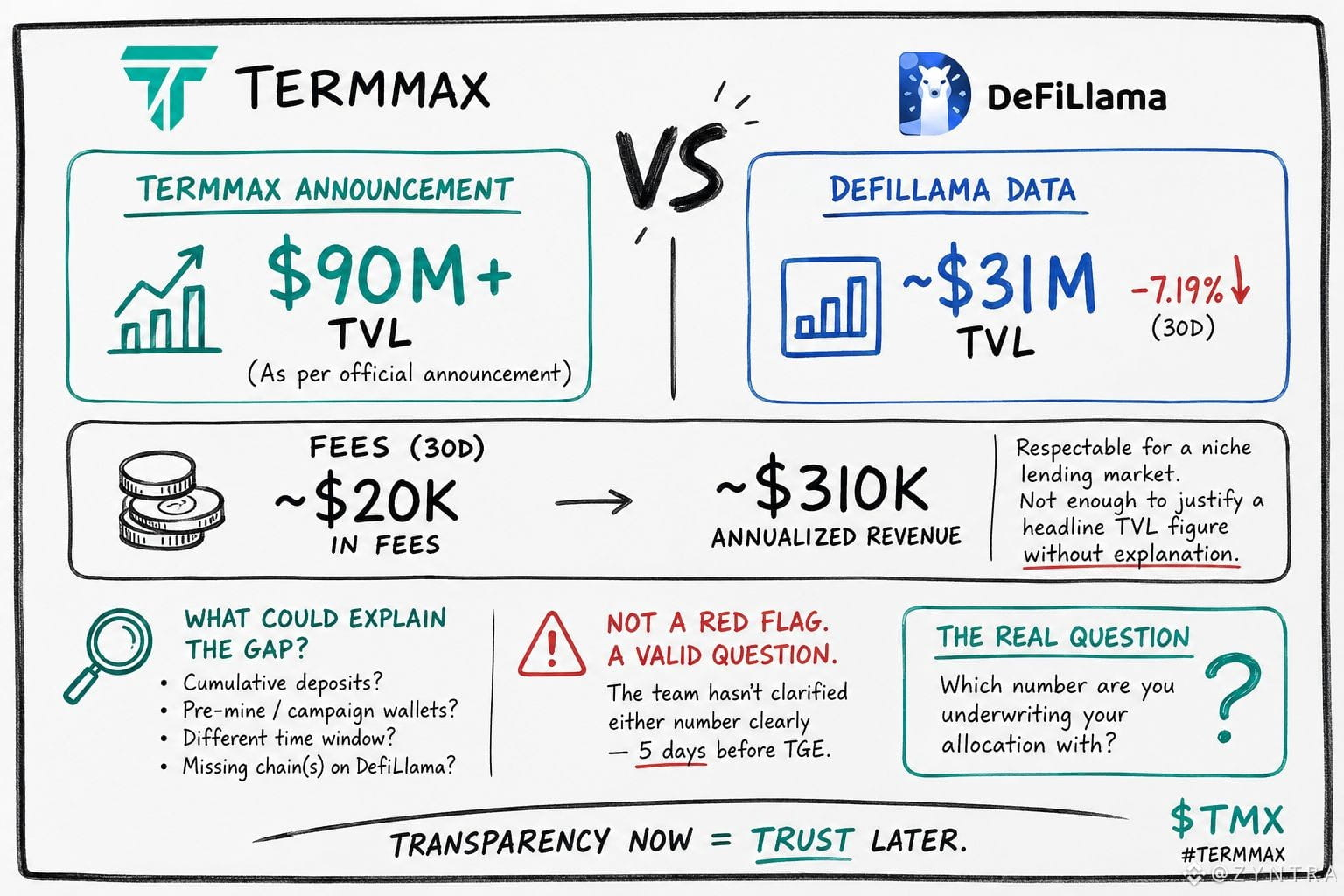
I used to take TermMax's official numbers at face value until I put the TGE announcement next to DefiLlama side by side. The team says $90M+ TVL. DefiLlama shows roughly $31M on-chain, down over 7% in the last month.
That's not a rounding gap. That's two different stories about the same protocol.
Maybe the $90M counts cumulative deposits, pre-mine campaign wallets, or figures across a longer window than what's currently locked. Maybe DefiLlama is missing a chain or two. Either explanation is possible, but neither has been stated clearly five days before TGE.
Fees tell a smaller story too, near $20K over 30 days, annualizing to roughly $310K in protocol revenue. Respectable for a niche lending market. Not enough to justify a headline TVL figure without explanation.
I'm not calling this a red flag. I'm calling it a question the team should answer before the token starts trading and every number gets scrutinized by people with less patience than a content writer.
Which number are you underwriting your allocation with?
#termmax @TermMax
$SKYAI $ROAM
That's not a rounding gap. That's two different stories about the same protocol.
Maybe the $90M counts cumulative deposits, pre-mine campaign wallets, or figures across a longer window than what's currently locked. Maybe DefiLlama is missing a chain or two. Either explanation is possible, but neither has been stated clearly five days before TGE.
Fees tell a smaller story too, near $20K over 30 days, annualizing to roughly $310K in protocol revenue. Respectable for a niche lending market. Not enough to justify a headline TVL figure without explanation.
I'm not calling this a red flag. I'm calling it a question the team should answer before the token starts trading and every number gets scrutinized by people with less patience than a content writer.
Which number are you underwriting your allocation with?
#termmax @TermMax
$SKYAI $ROAM
Vérifié
#dusk $DUSK @Dusk
I used to assume EVM compatibility was mostly a marketing checkbox every chain claims it, few chains make it matter. So when DuskEVM testnet went live, I almost scrolled past.
Then I looked at what it actually changes. Developers can deploy with Solidity and Hardhat, tools they already know, instead of learning a new stack just to build on Dusk. That's not nothing. Migration friction kills more projects than bad tokenomics does.
What caught me was the framing this isn't Dusk becoming "another EVM chain." It's DuskEVM settling back to DuskDS, with Hedger sitting on top for privacy when an app needs it. So you get familiar tooling without giving up the settlement guarantees Dusk was built around.
Testnet isn't adoption, though. It's an open door. Whether builders actually walk through it is the real test.
Curious if EVM familiarity is enough to pull real teams in, or if privacy has to prove itself first.
I used to assume EVM compatibility was mostly a marketing checkbox every chain claims it, few chains make it matter. So when DuskEVM testnet went live, I almost scrolled past.
Then I looked at what it actually changes. Developers can deploy with Solidity and Hardhat, tools they already know, instead of learning a new stack just to build on Dusk. That's not nothing. Migration friction kills more projects than bad tokenomics does.
What caught me was the framing this isn't Dusk becoming "another EVM chain." It's DuskEVM settling back to DuskDS, with Hedger sitting on top for privacy when an app needs it. So you get familiar tooling without giving up the settlement guarantees Dusk was built around.
Testnet isn't adoption, though. It's an open door. Whether builders actually walk through it is the real test.
Curious if EVM familiarity is enough to pull real teams in, or if privacy has to prove itself first.
Tooling wins
50%
Privacy wins
17%
Both matter equally
33%
6 Votes • Vote fermé
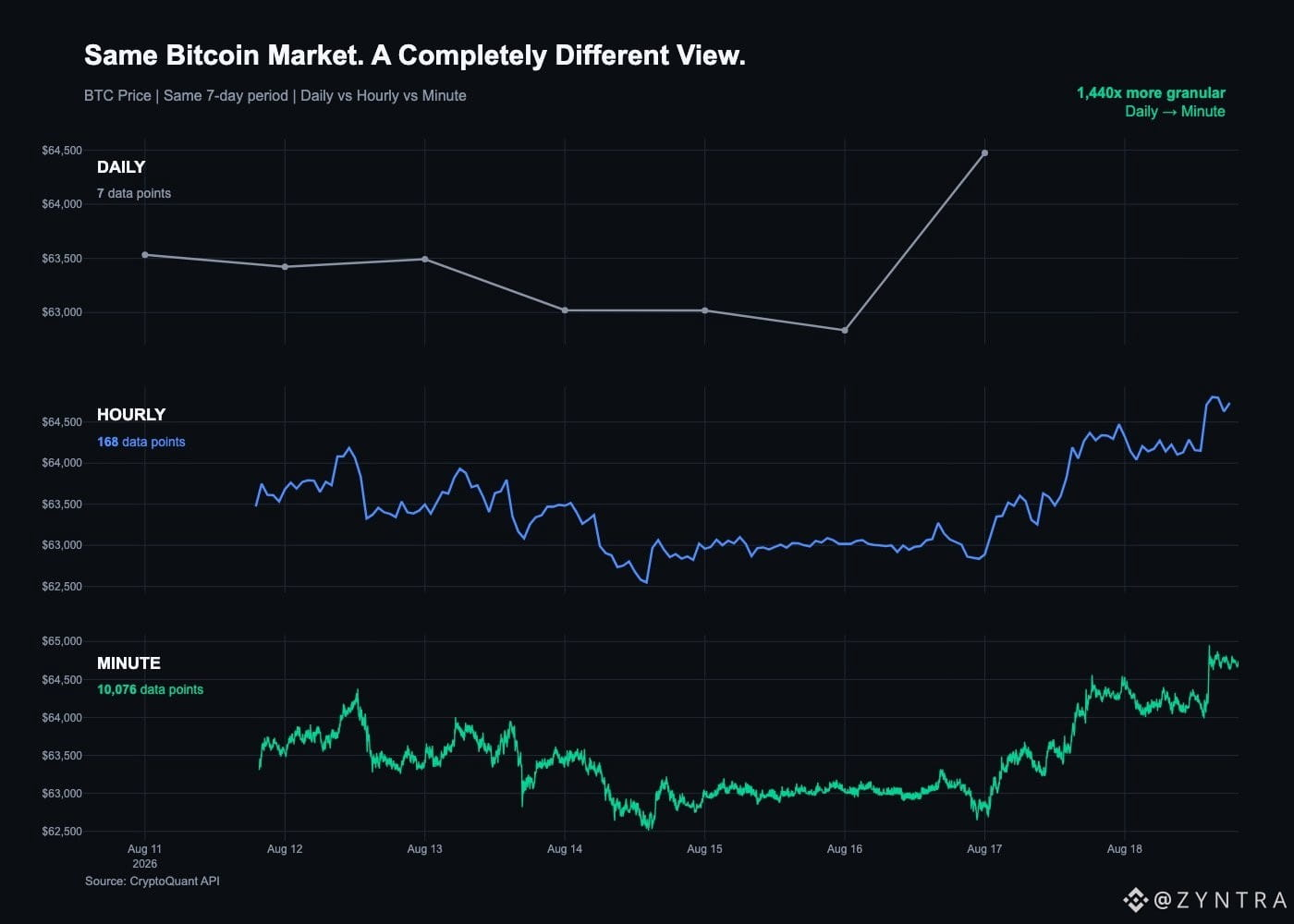
Same Bitcoin market. A completely different view.
7 days of $BTC price data:
Daily → 7 points
Hourly → 168 points
Minute → 10,080 points
The daily chart makes the move look almost simple.
Zoom into the minute data and you see the volatility, pullbacks, consolidations, and breakouts that actually shaped the move.
The timeframe you choose can completely change the story the chart tells.
More data doesn’t always mean a different market.
Sometimes, it just means a clearer picture.
#BTC #USStorageStocksExtendLosses #Bitcoin
7 days of $BTC price data:
Daily → 7 points
Hourly → 168 points
Minute → 10,080 points
The daily chart makes the move look almost simple.
Zoom into the minute data and you see the volatility, pullbacks, consolidations, and breakouts that actually shaped the move.
The timeframe you choose can completely change the story the chart tells.
More data doesn’t always mean a different market.
Sometimes, it just means a clearer picture.
#BTC #USStorageStocksExtendLosses #Bitcoin
@TermMax finally dropped the $TMX whitepaper and my first instinct was to check the unlock schedule before anything else.
1B fixed supply, zero inflation, only 20% circulating at TGE. Team and investors both sit behind a 12-month cliff. On paper that's a restrained structure nobody dumping on day one, room left for ecosystem incentives later.
But a clean unlock schedule doesn't answer the harder question. sTMX rewards are supposed to come from real fee revenue FT/XT trading, lending, liquidation. DefiLlama shows TermMax generating under $20K in fees over 30 days. That's a thin base to build a governance token's value accrual story on.
Low float protects price mechanically. It doesn't manufacture demand.
So the thing I'd actually track isn't circulating supply. It's whether TVL and fee revenue grow fast enough to catch up to the token's expectations before the cliff ends.
#termmax $BTW $RICE
Which matters more right now?
1B fixed supply, zero inflation, only 20% circulating at TGE. Team and investors both sit behind a 12-month cliff. On paper that's a restrained structure nobody dumping on day one, room left for ecosystem incentives later.
But a clean unlock schedule doesn't answer the harder question. sTMX rewards are supposed to come from real fee revenue FT/XT trading, lending, liquidation. DefiLlama shows TermMax generating under $20K in fees over 30 days. That's a thin base to build a governance token's value accrual story on.
Low float protects price mechanically. It doesn't manufacture demand.
So the thing I'd actually track isn't circulating supply. It's whether TVL and fee revenue grow fast enough to catch up to the token's expectations before the cliff ends.
#termmax $BTW $RICE
Which matters more right now?
Low float supply
50%
Real fee revenue
50%
TVL growth rate
0%
2 Votes • Vote fermé
#dusk $DUSK @Dusk kept rereading the DuskEVM testnet announcement instead of just retweeting it.
the line that caught me wasn't "EVM compatible," it was "settles back to DuskDS." that's a specific architectural choice, not marketing filler. Solidity contracts run on DuskEVM, but finality still routes through the base layer.
most L2-style announcements bury that detail. Dusk put it right in the first paragraph.
made me stop and ask what "EVM compatible" even buys you if settlement discipline still lives elsewhere. OP Stack compatibility is the easy part. Getting devs to care about where finality actually happens is the hard part.
still testnet, still early, still no idea how many builders show up versus just poke around and leave.
genuinely curious if anyone's tracked actual contract deployments on it yet, or if it's still mostly internal testing dressed up as public.
the line that caught me wasn't "EVM compatible," it was "settles back to DuskDS." that's a specific architectural choice, not marketing filler. Solidity contracts run on DuskEVM, but finality still routes through the base layer.
most L2-style announcements bury that detail. Dusk put it right in the first paragraph.
made me stop and ask what "EVM compatible" even buys you if settlement discipline still lives elsewhere. OP Stack compatibility is the easy part. Getting devs to care about where finality actually happens is the hard part.
still testnet, still early, still no idea how many builders show up versus just poke around and leave.
genuinely curious if anyone's tracked actual contract deployments on it yet, or if it's still mostly internal testing dressed up as public.
Settlement layer matters most
0%
EVM compatibility wins builder
100%
Too early to tell anything
0%
3 Votes • Vote fermé
I've stopped getting excited about launch dates. Too many of them turn into nothing. So when TermMax confirmed its date, my first reaction was mild fatigue, not hype.
But then I sat with what they're actually solving. Most protocols invent a problem so the token has a reason to exist. TermMax didn't. Fixed-rate borrowing is a problem lenders and borrowers keep running into, cycle after cycle, regardless of market conditions.
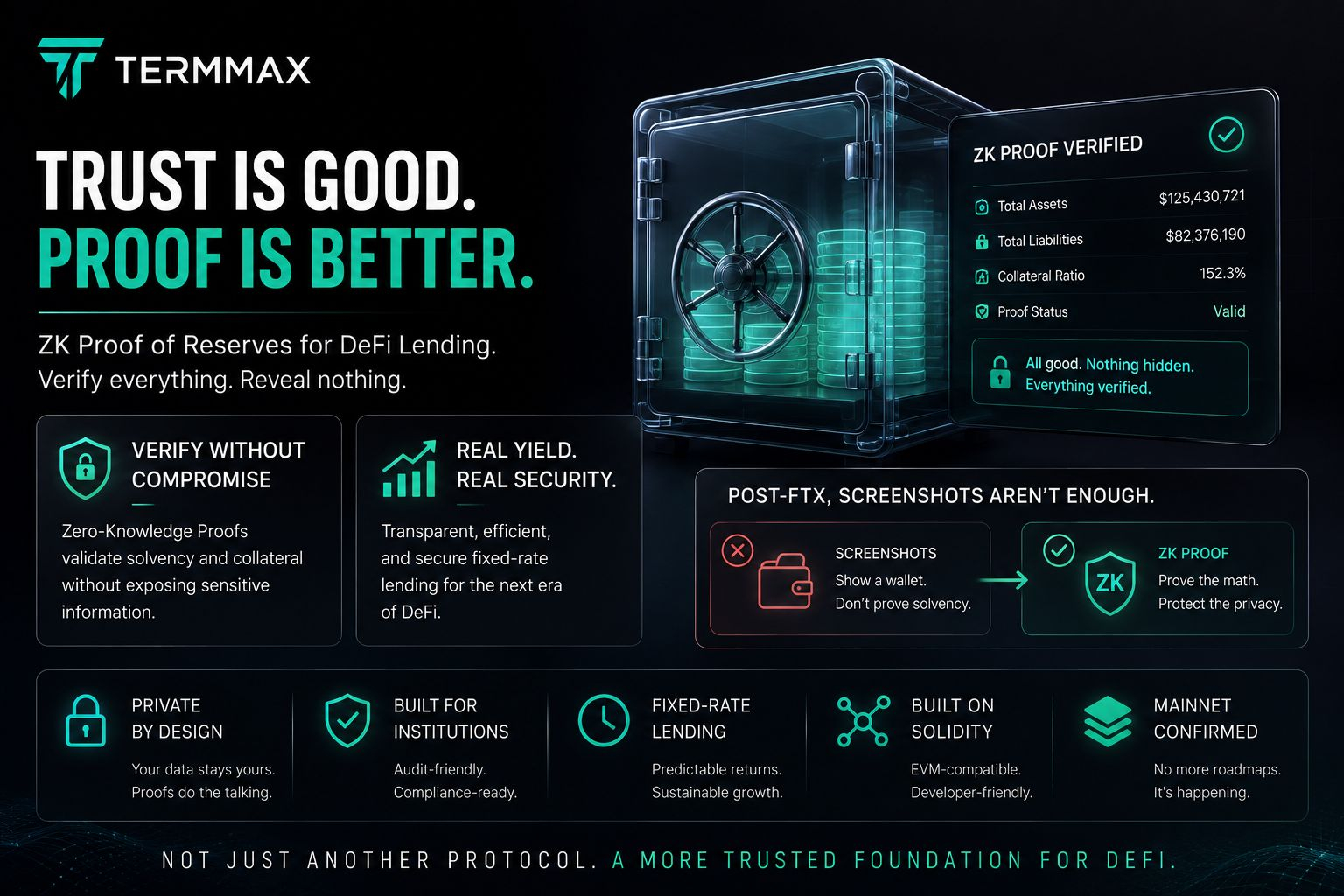
That's different. After FTX, the whole industry tried proving solvency by screenshotting wallet addresses like proving you have savings by showing a photo of your wallet, not the actual balance. ZK proof of reserves does something else entirely: it proves the math checks out without exposing the underlying positions at all. No trust required, no exposure needed.
That's the part that made me pay attention. Still, a launch date isn't a track record, and rate certainty sounds great until liquidity gets thin exactly when you need it most. I want to believe this holds up under stress. I just haven't seen it stress-tested yet.
#TermMax @TermMax
But then I sat with what they're actually solving. Most protocols invent a problem so the token has a reason to exist. TermMax didn't. Fixed-rate borrowing is a problem lenders and borrowers keep running into, cycle after cycle, regardless of market conditions.
That's different. After FTX, the whole industry tried proving solvency by screenshotting wallet addresses like proving you have savings by showing a photo of your wallet, not the actual balance. ZK proof of reserves does something else entirely: it proves the math checks out without exposing the underlying positions at all. No trust required, no exposure needed.
That's the part that made me pay attention. Still, a launch date isn't a track record, and rate certainty sounds great until liquidity gets thin exactly when you need it most. I want to believe this holds up under stress. I just haven't seen it stress-tested yet.
#TermMax @TermMax
Rate certainty > flexibility
50%
Still needs stress test
50%
ZK proof changes everything
0%
2 Votes • Vote fermé
Vérifié
#dusk $DUSK @Dusk
I used to think EVM compatibility was just a checkbox chains added to look relevant. Every L1 claims it eventually.
But looking at DuskEVM testnet going live, I started reconsidering that assumption. This isn't Dusk bolting Solidity support onto its own chain. It's an OP Stack rollup that settles back to DuskDS, meaning Ethereum tooling Hardhat, Solidity, the whole familiar stack now sits on top of infrastructure built for regulated finance from day one.
That's a different bet than most EVM bridges make. Most chains chase developers first and figure out compliance later. Dusk built the compliance layer first and is only now opening the developer door.
I don't know yet if that order works. Developers go where liquidity and tooling already exist, not where the architecture is most careful. Testnet activity will tell us more than any announcement does.
Would builders rather have compliance-first or dev-first?
I used to think EVM compatibility was just a checkbox chains added to look relevant. Every L1 claims it eventually.
But looking at DuskEVM testnet going live, I started reconsidering that assumption. This isn't Dusk bolting Solidity support onto its own chain. It's an OP Stack rollup that settles back to DuskDS, meaning Ethereum tooling Hardhat, Solidity, the whole familiar stack now sits on top of infrastructure built for regulated finance from day one.
That's a different bet than most EVM bridges make. Most chains chase developers first and figure out compliance later. Dusk built the compliance layer first and is only now opening the developer door.
I don't know yet if that order works. Developers go where liquidity and tooling already exist, not where the architecture is most careful. Testnet activity will tell us more than any announcement does.
Would builders rather have compliance-first or dev-first?
Compliance-first, always
83%
Dev-first, fix rules later
17%
6 Votes • Vote fermé
I've stopped getting excited about mainnet dates. Too many of them have come and gone quietly, propping up nothing but a Notion roadmap.
So when TermMax confirmed theirs, I read it twice before I let myself care. Here's the thing though most protocols in this space are solving problems nobody actually has.
Novel yield mechanics for yield nobody needed. TermMax is chasing something older and dumber: DeFi lending still can't tell you, in real terms, whether the collateral backing your position is actually there. Post-FTX, the industry's answer was screenshots of wallet addresses, which is like proving you have money by showing someone a photo of your wallet.
ZK proof of reserves is different it proves the math is sound without opening the drawer. That's not flashy. It's just true, which is rarer than it should be. I still don't know if fixed-rate lending finds real demand at scale. Mainnet will tell us fast. I'm watching, not buying the story yet.
#TermMax @TermMax
$STAR $TAG
So when TermMax confirmed theirs, I read it twice before I let myself care. Here's the thing though most protocols in this space are solving problems nobody actually has.
Novel yield mechanics for yield nobody needed. TermMax is chasing something older and dumber: DeFi lending still can't tell you, in real terms, whether the collateral backing your position is actually there. Post-FTX, the industry's answer was screenshots of wallet addresses, which is like proving you have money by showing someone a photo of your wallet.
ZK proof of reserves is different it proves the math is sound without opening the drawer. That's not flashy. It's just true, which is rarer than it should be. I still don't know if fixed-rate lending finds real demand at scale. Mainnet will tell us fast. I'm watching, not buying the story yet.
#TermMax @TermMax
$STAR $TAG
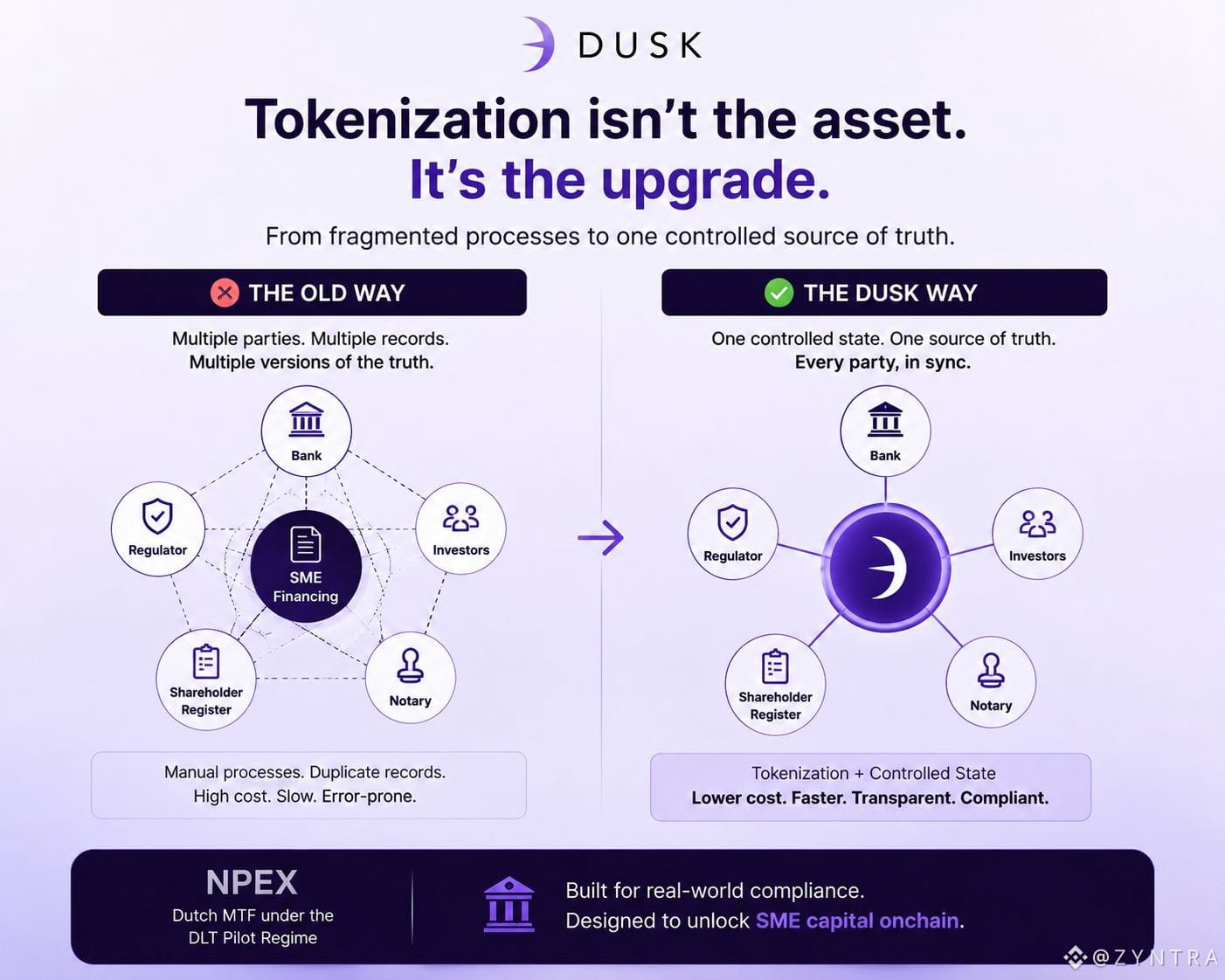
I kept circling back to something Dusk published this week about SME financing, and it reframed how I think about tokenization's actual job. Most of the pitch around RWAs is about fractionalizing big assets. But the harder problem sits with smaller companies, the ones that rely on bank loans and internal cash because a proper private raise means notaries, shareholder registers, and reconciliation across five different parties who each keep their own version of the truth.
What struck me is that tokenization doesn't fix any of that by itself. A token sitting next to unchanged manual processes is just another record to reconcile. The value only shows up when investor eligibility, issuance, transfers, and servicing all reference the same controlled state instead of five separate ones.
Dusk ties this back to NPEX, the Dutch MTF it's been building with under the DLT Pilot Regime. That's the part I find more credible than most tokenization narratives it's not claiming to replace notaries or regulators, just to stop the duplicate paperwork between them. Whether that's enough to actually move SME capital onchain at scale is still an open question.
#dusk $DUSK @Dusk
What struck me is that tokenization doesn't fix any of that by itself. A token sitting next to unchanged manual processes is just another record to reconcile. The value only shows up when investor eligibility, issuance, transfers, and servicing all reference the same controlled state instead of five separate ones.
Dusk ties this back to NPEX, the Dutch MTF it's been building with under the DLT Pilot Regime. That's the part I find more credible than most tokenization narratives it's not claiming to replace notaries or regulators, just to stop the duplicate paperwork between them. Whether that's enough to actually move SME capital onchain at scale is still an open question.
#dusk $DUSK @Dusk
Connectez-vous pour découvrir plus de contenu