Binance Square
Leo_Carter
12.9k Publications

Leo_Carter

Compte Square Vérifié+
Creator
Ouvert au trading
Trade fréquemment
5.5 an(s)
41 Suivis
53.1K+ Abonnés
46.2K+ J’aime
Publications
Portefeuille
·
--
$VIRTUAL is Packing Serious Momentum! The AI sector is heating up, and VIRTUAL/USDT is leading the charge on We just witnessed a massive bullish breakout, pushing the price up +9.56% to $0.5797, freshly bouncing off its 24h low of $0.5302 and targeting a high of $0.5855. The volume is surging, and the 15-minute chart shows strong buying pressure driving this vertical pump. As AI tokens continue to capture the market's attention, $VIRTUAL is proving it’s one to watch closely. Are you riding this wave, or waiting for a dip? Let me know below#Bitcoin$60K$70KRangeHits307DayConsolidation #SKHynixToExpandADRIssuance {spot}(VIRTUALUSDT)
$VIRTUAL is Packing Serious Momentum!
The AI sector is heating up, and VIRTUAL/USDT is leading the charge on

We just witnessed a massive bullish breakout, pushing the price up +9.56% to $0.5797, freshly bouncing off its 24h low of $0.5302 and targeting a high of $0.5855.

The volume is surging, and the 15-minute chart shows strong buying pressure driving this vertical pump.

As AI tokens continue to capture the market's attention, $VIRTUAL is proving it’s one to watch closely.

Are you riding this wave, or waiting for a dip? Let me know below#Bitcoin$60K$70KRangeHits307DayConsolidation #SKHynixToExpandADRIssuance
$SIREN is currently consolidating around $0.02789, showing a minor 24-hour recovery after hitting a recent local bottom of $0.02605. While the token has seen a small +2.73% bump today, the bigger picture highlights high volatility, with the asset down over 21% this past week and a massive 97% over the last 30 days. High 24-hour trading volume ($15.14M USDT) suggests active trader interest, but the order book is leaning bearish with 60.99% Asks (sellers) vs. 39.01% Bids (buyers).#ParadigmRaises$1.2BThirdFundForAIAndRobotics #binanceturn9 $SIREN $NVDAB {spot}(NVDABUSDT) {alpha}(560x997a58129890bbda032231a52ed1ddc845fc18e1)
$SIREN is currently consolidating around $0.02789, showing a minor 24-hour recovery after hitting a recent local bottom of $0.02605.

While the token has seen a small +2.73% bump today, the bigger picture highlights high volatility, with the asset down over 21% this past week and a massive 97% over the last 30 days.

High 24-hour trading volume ($15.14M USDT) suggests active trader interest, but the order book is leaning bearish with 60.99% Asks (sellers) vs. 39.01% Bids (buyers).#ParadigmRaises$1.2BThirdFundForAIAndRobotics #binanceturn9 $SIREN $NVDAB
$VINE is making major waves today, currently trading at $0.009687 with a massive +26.74% pump! Looking at the 15m chart, the bulls are firmly in control. After a brief consolidation period down to the $0.0084 level, buyers stepped in heavily, driving a strong upward continuation. The price is now retesting its recent 24h high of $0.009800. With strong 24h volume hitting 137.81M VINE, momentum is heavily favoring the upside. If we clear the $0.0098 resistance, expect a psychological breakout past $0.0100 next! Keep a close eye on the volume. Are you holding or waiting for a pullback? Let's see how high this meme momentum goes!#SKHynixUSIPOSevenTimesOversubscribed #Write2Earn {alpha}(CT_5016AJcP7wuLwmRYLBNbi825wgguaPsWzPBEHcHndpRpump)
$VINE is making major waves today, currently trading at $0.009687 with a massive +26.74% pump! Looking at the 15m chart, the bulls are firmly in control.

After a brief consolidation period down to the $0.0084 level, buyers stepped in heavily, driving a strong upward continuation.

The price is now retesting its recent 24h high of $0.009800.

With strong 24h volume hitting 137.81M VINE, momentum is heavily favoring the upside.

If we clear the $0.0098 resistance, expect a psychological breakout past $0.0100 next!
Keep a close eye on the volume.

Are you holding or waiting for a pullback?

Let's see how high this meme momentum goes!#SKHynixUSIPOSevenTimesOversubscribed #Write2Earn
$ARB is catching massive bids today, pushing up to $0.08602 with a 24-hour high of 0.08682. The rally is backed by strong fundamentals as headlines hit the wire Arbitrum gains a Robinhood chain revenue stream. This major integration news has injected immense volume into the asset, driving a 24-hour volume of over 28M ARB. Looking at the 15m chart, ARB is maintaining its bullish market structure right after a massive vertical leg up. Are you riding this momentum higher, or waiting for a pullback? #CXMTToOpen$4.3BIPOSubscriptions #KOSPIJumpsNearly4%To7539 #OilJumpsToTwoWeekHigh
$ARB is catching massive bids today, pushing up to $0.08602 with a 24-hour high of 0.08682.

The rally is backed by strong fundamentals as headlines hit the wire Arbitrum gains a Robinhood chain revenue stream.

This major integration news has injected immense volume into the asset, driving a 24-hour volume of over 28M ARB.

Looking at the 15m chart, ARB is maintaining its bullish market structure right after a massive vertical leg up.

Are you riding this momentum higher, or waiting for a pullback?
#CXMTToOpen$4.3BIPOSubscriptions #KOSPIJumpsNearly4%To7539 #OilJumpsToTwoWeekHigh
$APE is showing solid bullish momentum, currently trading at $0.15078, marking a +6.73% increase. 24h High: $0.15376 24h Low: $0.13790 24h Volume: 8.83M APE ($1.30M USDT) Looking at the 15-minute chart, the price rallied sharply from its lows, consolidating nicely just below the local peak. The bulls are maintaining control, holding key higher lows. If momentum sustains and breaks past the $0.15376 resistance, we could see an extended push upward. Keep a close eye on volume for validation.#OilJumpsBondsSlideAfterUSStrikesOnIran #Write2Earn #MuskNetWorthFallsBelow$1TrillionAfterSpaceXSharesDrop {spot}(APEUSDT)
$APE is showing solid bullish momentum, currently trading at $0.15078, marking a +6.73% increase.
24h High: $0.15376
24h Low: $0.13790
24h Volume: 8.83M APE ($1.30M USDT)
Looking at the 15-minute chart, the price rallied sharply from its lows, consolidating nicely just below the local peak.

The bulls are maintaining control, holding key higher lows.

If momentum sustains and breaks past the $0.15376 resistance, we could see an extended push upward. Keep a close eye on volume for validation.#OilJumpsBondsSlideAfterUSStrikesOnIran #Write2Earn #MuskNetWorthFallsBelow$1TrillionAfterSpaceXSharesDrop
$KAITO is making waves, currently up +13.94% at $0.6923 . It’s sitting at No. 45 in the trending AI sector. We saw a massive spike earlier, hitting a 24-hour high of 0.8605 from a low of 0.5894. A classic "pump and retracement" on the 15-minute chart, but it looks like the bulls are trying to establish support around the 0.6900 mark. Trading volume has clocked 8.00M KAITO ($5.80M turnover). Are we looking at a consolidation before the next leg up, or is the momentum cooling off?#USLaunchesNewStrikesAgainstIran #MuskNetWorthFallsBelow$1TrillionAfterSpaceXSharesDrop
$KAITO is making waves, currently up +13.94% at $0.6923 . It’s sitting at No. 45 in the trending AI sector.

We saw a massive spike earlier, hitting a 24-hour high of 0.8605 from a low of 0.5894.

A classic "pump and retracement" on the 15-minute chart, but it looks like the bulls are trying to establish support around the 0.6900 mark.

Trading volume has clocked 8.00M KAITO ($5.80M turnover).

Are we looking at a consolidation before the next leg up, or is the momentum cooling off?#USLaunchesNewStrikesAgainstIran #MuskNetWorthFallsBelow$1TrillionAfterSpaceXSharesDrop
$EDGE is showing strong intraday momentum on the 15m chart, currently trading at $0.3286, up +4.71% today. After finding solid support around the $0.2867 level, the price surged to a 24-hour high of $0.3394. Despite a brief retracement, buyers are actively stepping back in, driving a steady recovery structure. Volume remains healthy with 11.90M EDGE traded in the last 24 hours. While the 30-day view shows a macro correction (-29.59%), the short-term 7-day trend is flipping bullish at +15.54%.#BinanceTurns9 #USMemoryChipStocksFall {alpha}(560x70f2eadf1ca1969ff42b0c78e9da519e8937cbaf)
$EDGE is showing strong intraday momentum on the 15m chart, currently trading at $0.3286, up +4.71% today. After finding solid support around the $0.2867 level, the price surged to a 24-hour high of $0.3394.

Despite a brief retracement, buyers are actively stepping back in, driving a steady recovery structure. Volume remains healthy with 11.90M EDGE traded in the last 24 hours.

While the 30-day view shows a macro correction (-29.59%), the short-term 7-day trend is flipping bullish at +15.54%.#BinanceTurns9 #USMemoryChipStocksFall
$GRAM is showing massive bullish momentum on the 15m chart, pumping +7.22% to a high of 1.811! After consolidating around the 1.666 support level, the bulls completely took over, driving a vertical breakout with strong volume support ($5.69M 24h turnover). The price is currently pressing right against its 24h high of 1.814. If it clears this immediate resistance, expect the rally to extend even further. Are you holding or catching the breakout? #GillibrandCallsForDigitalAssetEthicsBan #JunePayrolls57KHikeOddsFallTo50%
$GRAM is showing massive bullish momentum on the 15m chart, pumping +7.22% to a high of 1.811!

After consolidating around the 1.666 support level, the bulls completely took over, driving a vertical breakout with strong volume support ($5.69M 24h turnover).

The price is currently pressing right against its 24h high of 1.814. If it clears this immediate resistance, expect the rally to extend even further.

Are you holding or catching the breakout?
#GillibrandCallsForDigitalAssetEthicsBan #JunePayrolls57KHikeOddsFallTo50%
$NES is flashing strong bullish momentum on the token has pumped to $0.2440, marking an impressive +11.46% gain today. Looking at the 15-minute chart $NES recently experienced a massive breakout, surging from around $0.2200 to hit a 24-hour high of $0.2512. After a minor healthy consolidation, the bulls are actively defending the current levels, pushing for another leg up. Trading volume remains highly supportive of this upward trend. Are you riding this momentum, or waiting for a dip?#Nasdaq100SP500VolatilityGapHighestSince2008 #PhiladelphiaSemiconductorIndexFalls4% {alpha}(560x3131f6b80c26936ab03f7d9d29eb4ddf36ac3fb5)
$NES is flashing strong bullish momentum on the token has pumped to $0.2440, marking an impressive +11.46% gain today.

Looking at the 15-minute chart $NES recently experienced a massive breakout, surging from around $0.2200 to hit a 24-hour high of $0.2512.

After a minor healthy consolidation, the bulls are actively defending the current levels, pushing for another leg up.

Trading volume remains highly supportive of this upward trend.

Are you riding this momentum, or waiting for a dip?#Nasdaq100SP500VolatilityGapHighestSince2008 #PhiladelphiaSemiconductorIndexFalls4%
I spent some time reviewing Newton Protocol over the last few days, and one thing about $NEWT kept standing out. Going into the recent token unlocks, I expected the increase in circulating supply to create more consistent selling pressure. Instead, the market has been far more resilient than I anticipated. Trading volume appeared to rise by roughly 20–30% during the period, while price mostly consolidated despite additional tokens entering circulation. That’s a little counterintuitive because unlock events often trigger heavier distribution, at least in the short term. My best guess is that much of the unlock schedule was already priced in. Another possibility is that a meaningful share of newly unlocked tokens isn’t heading straight to exchanges, giving liquidity enough room to absorb the extra supply. Could be wrong though, and I think another couple of weeks of wallet flow data will tell a much clearer story. What also keeps me interested in Newton Protocol is that it isn’t only a tokenomics story. The project is positioning itself as infrastructure for AI developers, using cryptographic attestations and programmable authorization to help AI agents and applications interact with blockchain systems more securely. If adoption on that side continues to grow, it could become just as important to watch as the unlock schedule itself. I’m still treating this as an observation rather than a prediction, but it’s one of the more interesting setups I’ve come across recently. What are you watching most with NewtonProtocol right nowwallet behavior, exchange balances, token unlocks, or adoption among AI developers? #Newt @NewtonProtocol $NEWT {spot}(NEWTUSDT)
I spent some time reviewing Newton Protocol over the last few days, and one thing about $NEWT kept standing out. Going into the recent token unlocks, I expected the increase in circulating supply to create more consistent selling pressure. Instead, the market has been far more resilient than I anticipated.

Trading volume appeared to rise by roughly 20–30% during the period, while price mostly consolidated despite additional tokens entering circulation. That’s a little counterintuitive because unlock events often trigger heavier distribution, at least in the short term.

My best guess is that much of the unlock schedule was already priced in. Another possibility is that a meaningful share of newly unlocked tokens isn’t heading straight to exchanges, giving liquidity enough room to absorb the extra supply. Could be wrong though, and I think another couple of weeks of wallet flow data will tell a much clearer story.

What also keeps me interested in Newton Protocol is that it isn’t only a tokenomics story. The project is positioning itself as infrastructure for AI developers, using cryptographic attestations and programmable authorization to help AI agents and applications interact with blockchain systems more securely. If adoption on that side continues to grow, it could become just as important to watch as the unlock schedule itself.

I’m still treating this as an observation rather than a prediction, but it’s one of the more interesting setups I’ve come across recently.

What are you watching most with NewtonProtocol right nowwallet behavior, exchange balances, token unlocks, or adoption among AI developers?
#Newt @NewtonProtocol $NEWT
Why Newton Protocol Made Me Rethink the Future of On Chain FinanceA few weeks ago, I found myself staring at the NEWT chart for far longer than I probably should have. The price had been under pressure, sentiment across smaller infrastructure tokens was weak, and social media had already reached its usual conclusion: if the token wasn’t moving, then the project must not matter. I’ve seen this cycle repeat countless times over the years. Markets often judge infrastructure by short-term price action instead of long-term utility. As a trader, my first instinct was simple. I assumed NEWT was just another token struggling through a difficult market environment, with unlock discussions dominating the conversation more than the technology itself. After watching crypto long enough, it’s easy to become skeptical whenever a new infrastructure project launches. But curiosity usually wins. Instead of focusing on another candle, I spent the next several evenings reading through Newton Protocol’s architecture, developer documentation, and the broader problem it is trying to solve. The more I read, the more I realized I had been looking at the project from the wrong angle. Today, when I think about Newton Protocol, I rarely think about the token first. I think about authorization. That may sound like a surprisingly boring word in an industry obsessed with speed, AI, and billion-dollar narratives, but the more I studied it, the more I became convinced that authorization may become one of the most important pieces of onchain finance over the next decade. One thing I’ve learned after several years of researching blockchain infrastructure is that the market often misunderstands projects that solve invisible problems. Everyone understands exchanges because they trade there. Everyone understands lending because they borrow. Everyone understands stablecoins because they send money. But very few people spend time thinking about what should happen before a blockchain transaction is executed. Most users assume that once they sign a transaction, the blockchain simply processes it. Newton Protocol asks a different question. What if every transaction could first be evaluated against programmable rules before it reaches settlement? That shift in thinking completely changed how I viewed the protocol. I like explaining it with a simple real-world analogy. Imagine walking into your bank and giving someone permission to manage your finances. Most people wouldn’t hand over unlimited control forever. They would probably create rules instead. Pay my rent every month. Never spend more than a certain amount. Reject transfers to unknown recipients. Require extra verification for large payments. Those instructions represent authorization. Traditional finance has built these layers over decades. Crypto largely hasn’t. Today, many wallets still rely on binary permissions. Either an application can do something, or it cannot. Many exploits, phishing attacks, and approval-related losses stem from permissions that are far broader than users realize. Newton Protocol is trying to introduce a programmable authorization layer that sits between user intent and blockchain execution. Instead of asking whether a transaction is valid according to blockchain consensus alone, it asks whether that transaction also satisfies the conditions the user originally approved. That sounds simple, but it introduces a completely different security model. The more I explored the architecture, the more interesting it became. Rather than replacing existing blockchains, Newton Protocol operates as infrastructure that allows programmable authorization policies to evaluate transactions before settlement. Operators verify those authorization rules, produce cryptographically signed attestations, and enable applications to prove that transactions followed predefined conditions before execution. In practical terms, users can define policies instead of granting unlimited trust. Developers can build applications that enforce spending limits, jurisdiction requirements, compliance checks, identity verification, risk controls, or organizational approvals without relying entirely on centralized infrastructure. That distinction matters. For years, crypto has focused on decentralizing execution. Newton is focused on decentralizing authorization. Those are two very different layers. I also found the protocol’s relationship with AI particularly interesting. Every week I read predictions about autonomous AI agents managing portfolios, executing trades, optimizing yield, or handling treasury operations. Most conversations focus on what AI will be able to do. Very few discuss what AI should be allowed to do. Those are completely different questions. If autonomous agents eventually interact with billions of dollars of onchain assets, authorization becomes just as important as intelligence. I personally don’t think institutions will allow autonomous software to move assets without clear guardrails. Instead, they’ll want programmable permissions. They’ll want spending limits. They’ll want jurisdictional controls. They’ll want identity verification. They’ll want cryptographic proof showing exactly why an action was permitted. That is precisely where Newton Protocol starts making much more sense to me. The same logic extends beyond AI. Stablecoins continue becoming one of crypto’s most successful products because they solve a practical problem rather than a speculative one. As stablecoin adoption grows among payment companies, businesses, and financial institutions, authorization policies become increasingly valuable. A company doesn’t just need digital dollars. It needs programmable financial controls. The same applies to tokenized real-world assets. If traditional securities, bonds, invoices, or funds eventually move onchain, permission management becomes significantly more important than it is today. Institutions already operate within regulatory frameworks. They don’t simply execute transactions. They verify who initiated them, whether they comply with internal policies, and whether appropriate approvals exist. Bringing those workflows onchain requires more than faster blockchains. It requires programmable authorization. I also see an interesting connection with DeFi. Most DeFi discussions revolve around liquidity, yields, and efficiency. Security usually enters the conversation only after an exploit happens. I’ve watched enough bridge hacks, wallet compromises, and approval exploits to appreciate infrastructure that focuses on reducing operational risk rather than chasing higher returns. That’s one reason Newton stood out to me. It isn’t trying to compete with lending markets, decentralized exchanges, or derivatives. Instead, it attempts to provide infrastructure those applications may eventually rely on. Cross-chain activity reinforces this need even further. Assets no longer remain confined to one blockchain. Users move capital between ecosystems constantly. Applications interact across multiple networks. As complexity increases, authorization becomes increasingly difficult to manage safely. Rather than remembering dozens of different approval models, programmable authorization creates a consistent layer that can travel alongside user intent. That feels much closer to how financial infrastructure evolves in the real world. Another aspect that caught my attention was the protocol’s recent ecosystem progress. Rather than positioning itself as another standalone blockchain, Newton has continued expanding its authorization-focused infrastructure, developer tooling, and integration efforts around programmable policies for onchain transactions. The emphasis has remained on making authorization practical for builders instead of treating it as an abstract research concept. From an investor’s perspective, I generally pay more attention to infrastructure adoption than marketing announcements. Announcements create headlines. Integrations create usage. Developer tools create ecosystems. Those aren’t always reflected immediately in token prices, but over long periods they often matter much more. Of course, I don’t think any of this guarantees success. Crypto history is filled with technically impressive projects that never achieved meaningful adoption. Building useful infrastructure is only one challenge. Convincing developers to integrate it is another. Changing user behavior is even harder. Authorization is also one of those technologies people rarely notice when it works correctly. Nobody celebrates seatbelts during a normal drive. People appreciate them after an accident. Infrastructure often suffers from that same paradox. The better it performs, the less visible it becomes. There’s also an important distinction between protocol utility and token performance. I’ve become increasingly careful not to confuse the two. A useful protocol does not automatically produce strong token returns. Market structure, unlock schedules, liquidity conditions, competition, and investor sentiment all influence price independently of technological progress. Recent discussions around NEWT have reflected exactly how token dynamics can dominate market attention even while the protocol continues developing. That doesn’t reduce the importance of the underlying technology. It simply reminds me that investing requires separating infrastructure quality from market behavior. Personally, I find Newton Protocol interesting because it addresses a layer of blockchain infrastructure that many people overlook. Everyone wants faster transactions. Everyone wants lower fees. Everyone wants more scalable blockchains. But if onchain finance eventually serves billions of users, countless AI agents, tokenized real-world assets, institutional capital, and global payment systems, I suspect authorization will become just as important as execution itself. Looking back, I’m glad I spent less time staring at the NEWT chart and more time understanding the architecture behind it. The chart showed me volatility. The research showed me context. Whether Newton ultimately succeeds will depend on adoption, developer engagement, ecosystem growth, and whether programmable authorization becomes a standard component of blockchain infrastructure rather than a niche feature. #Newt @NewtonProtocol $NEWT

Why Newton Protocol Made Me Rethink the Future of On Chain Finance

A few weeks ago, I found myself staring at the NEWT chart for far longer than I probably should have.
The price had been under pressure, sentiment across smaller infrastructure tokens was weak, and social media had already reached its usual conclusion: if the token wasn’t moving, then the project must not matter. I’ve seen this cycle repeat countless times over the years. Markets often judge infrastructure by short-term price action instead of long-term utility.
As a trader, my first instinct was simple. I assumed NEWT was just another token struggling through a difficult market environment, with unlock discussions dominating the conversation more than the technology itself. After watching crypto long enough, it’s easy to become skeptical whenever a new infrastructure project launches.
But curiosity usually wins.
Instead of focusing on another candle, I spent the next several evenings reading through Newton Protocol’s architecture, developer documentation, and the broader problem it is trying to solve. The more I read, the more I realized I had been looking at the project from the wrong angle.
Today, when I think about Newton Protocol, I rarely think about the token first.
I think about authorization.
That may sound like a surprisingly boring word in an industry obsessed with speed, AI, and billion-dollar narratives, but the more I studied it, the more I became convinced that authorization may become one of the most important pieces of onchain finance over the next decade.
One thing I’ve learned after several years of researching blockchain infrastructure is that the market often misunderstands projects that solve invisible problems.
Everyone understands exchanges because they trade there.
Everyone understands lending because they borrow.
Everyone understands stablecoins because they send money.
But very few people spend time thinking about what should happen before a blockchain transaction is executed.
Most users assume that once they sign a transaction, the blockchain simply processes it.
Newton Protocol asks a different question.
What if every transaction could first be evaluated against programmable rules before it reaches settlement?
That shift in thinking completely changed how I viewed the protocol.
I like explaining it with a simple real-world analogy.
Imagine walking into your bank and giving someone permission to manage your finances.
Most people wouldn’t hand over unlimited control forever. They would probably create rules instead.
Pay my rent every month.
Never spend more than a certain amount.
Reject transfers to unknown recipients.
Require extra verification for large payments.
Those instructions represent authorization.
Traditional finance has built these layers over decades.
Crypto largely hasn’t.
Today, many wallets still rely on binary permissions. Either an application can do something, or it cannot. Many exploits, phishing attacks, and approval-related losses stem from permissions that are far broader than users realize.
Newton Protocol is trying to introduce a programmable authorization layer that sits between user intent and blockchain execution. Instead of asking whether a transaction is valid according to blockchain consensus alone, it asks whether that transaction also satisfies the conditions the user originally approved.
That sounds simple, but it introduces a completely different security model.
The more I explored the architecture, the more interesting it became.
Rather than replacing existing blockchains, Newton Protocol operates as infrastructure that allows programmable authorization policies to evaluate transactions before settlement. Operators verify those authorization rules, produce cryptographically signed attestations, and enable applications to prove that transactions followed predefined conditions before execution.
In practical terms, users can define policies instead of granting unlimited trust.
Developers can build applications that enforce spending limits, jurisdiction requirements, compliance checks, identity verification, risk controls, or organizational approvals without relying entirely on centralized infrastructure.
That distinction matters.
For years, crypto has focused on decentralizing execution.
Newton is focused on decentralizing authorization.
Those are two very different layers.
I also found the protocol’s relationship with AI particularly interesting.
Every week I read predictions about autonomous AI agents managing portfolios, executing trades, optimizing yield, or handling treasury operations.
Most conversations focus on what AI will be able to do.
Very few discuss what AI should be allowed to do.
Those are completely different questions.
If autonomous agents eventually interact with billions of dollars of onchain assets, authorization becomes just as important as intelligence.
I personally don’t think institutions will allow autonomous software to move assets without clear guardrails.
Instead, they’ll want programmable permissions.
They’ll want spending limits.
They’ll want jurisdictional controls.
They’ll want identity verification.
They’ll want cryptographic proof showing exactly why an action was permitted.
That is precisely where Newton Protocol starts making much more sense to me.
The same logic extends beyond AI.
Stablecoins continue becoming one of crypto’s most successful products because they solve a practical problem rather than a speculative one.
As stablecoin adoption grows among payment companies, businesses, and financial institutions, authorization policies become increasingly valuable.
A company doesn’t just need digital dollars.
It needs programmable financial controls.
The same applies to tokenized real-world assets.
If traditional securities, bonds, invoices, or funds eventually move onchain, permission management becomes significantly more important than it is today.
Institutions already operate within regulatory frameworks.
They don’t simply execute transactions.
They verify who initiated them, whether they comply with internal policies, and whether appropriate approvals exist.
Bringing those workflows onchain requires more than faster blockchains.
It requires programmable authorization.
I also see an interesting connection with DeFi.
Most DeFi discussions revolve around liquidity, yields, and efficiency.
Security usually enters the conversation only after an exploit happens.
I’ve watched enough bridge hacks, wallet compromises, and approval exploits to appreciate infrastructure that focuses on reducing operational risk rather than chasing higher returns.
That’s one reason Newton stood out to me.
It isn’t trying to compete with lending markets, decentralized exchanges, or derivatives.
Instead, it attempts to provide infrastructure those applications may eventually rely on.
Cross-chain activity reinforces this need even further.
Assets no longer remain confined to one blockchain.
Users move capital between ecosystems constantly.
Applications interact across multiple networks.
As complexity increases, authorization becomes increasingly difficult to manage safely.
Rather than remembering dozens of different approval models, programmable authorization creates a consistent layer that can travel alongside user intent.
That feels much closer to how financial infrastructure evolves in the real world.
Another aspect that caught my attention was the protocol’s recent ecosystem progress.
Rather than positioning itself as another standalone blockchain, Newton has continued expanding its authorization-focused infrastructure, developer tooling, and integration efforts around programmable policies for onchain transactions. The emphasis has remained on making authorization practical for builders instead of treating it as an abstract research concept.
From an investor’s perspective, I generally pay more attention to infrastructure adoption than marketing announcements.
Announcements create headlines.
Integrations create usage.
Developer tools create ecosystems.
Those aren’t always reflected immediately in token prices, but over long periods they often matter much more.
Of course, I don’t think any of this guarantees success.
Crypto history is filled with technically impressive projects that never achieved meaningful adoption.
Building useful infrastructure is only one challenge.
Convincing developers to integrate it is another.
Changing user behavior is even harder.
Authorization is also one of those technologies people rarely notice when it works correctly.
Nobody celebrates seatbelts during a normal drive.
People appreciate them after an accident.
Infrastructure often suffers from that same paradox.
The better it performs, the less visible it becomes.
There’s also an important distinction between protocol utility and token performance.
I’ve become increasingly careful not to confuse the two.
A useful protocol does not automatically produce strong token returns.
Market structure, unlock schedules, liquidity conditions, competition, and investor sentiment all influence price independently of technological progress. Recent discussions around NEWT have reflected exactly how token dynamics can dominate market attention even while the protocol continues developing.
That doesn’t reduce the importance of the underlying technology.
It simply reminds me that investing requires separating infrastructure quality from market behavior.
Personally, I find Newton Protocol interesting because it addresses a layer of blockchain infrastructure that many people overlook.
Everyone wants faster transactions.
Everyone wants lower fees.
Everyone wants more scalable blockchains.
But if onchain finance eventually serves billions of users, countless AI agents, tokenized real-world assets, institutional capital, and global payment systems, I suspect authorization will become just as important as execution itself.
Looking back, I’m glad I spent less time staring at the NEWT chart and more time understanding the architecture behind it.
The chart showed me volatility.
The research showed me context.
Whether Newton ultimately succeeds will depend on adoption, developer engagement, ecosystem growth, and whether programmable authorization becomes a standard component of blockchain infrastructure rather than a niche feature.
#Newt @NewtonProtocol $NEWT
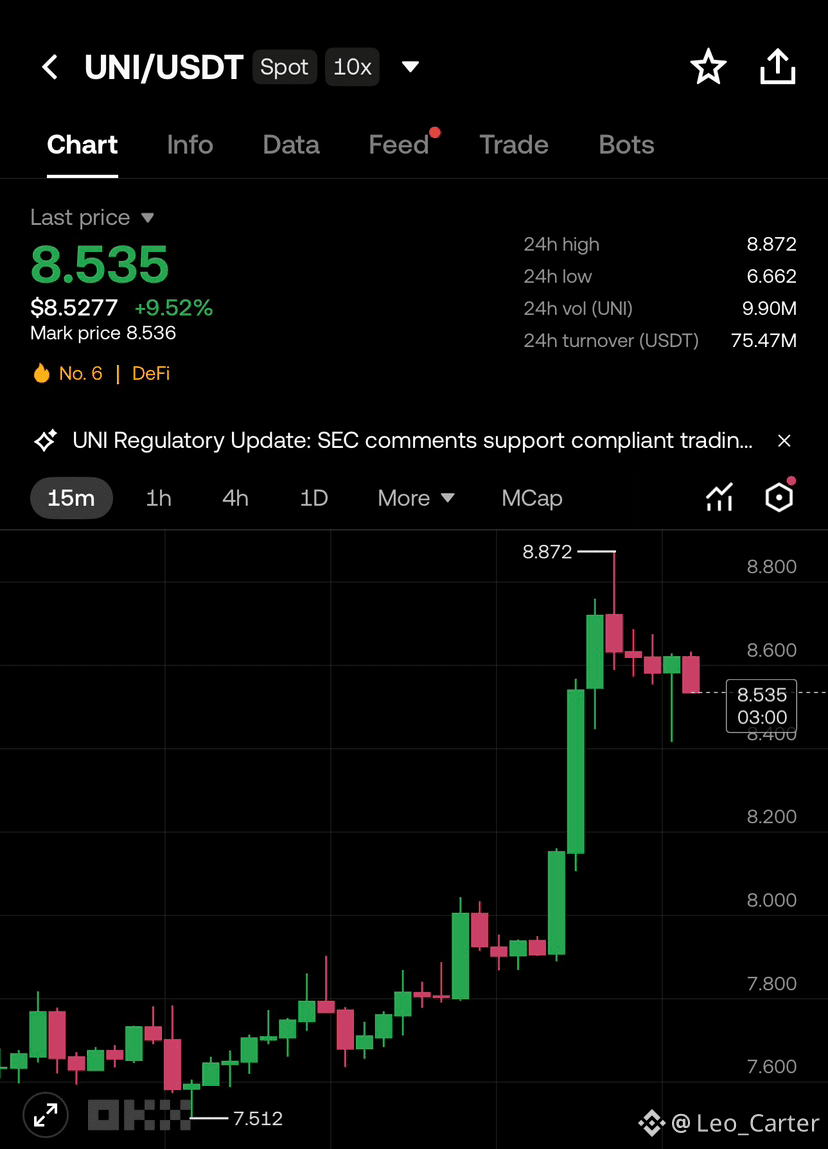
$UNI is showing some serious bullish momentum today! The token has surged +13.50%, currently trading at 3.169 USDT and hitting a 24-hour high of 3.228. Looking at the 15 minute chart in image.png, we can see a strong, steady upward rally breaking out from the 2.818 support level earlier today, backed by solid trading volume. It's also up +9.80% over the last 7 days, showing that the buyers are definitely stepping back in. {future}(UNIUSDT)
$UNI is showing some serious bullish momentum today! The token has surged +13.50%, currently trading at 3.169 USDT and hitting a 24-hour high of 3.228.

Looking at the 15 minute chart in image.png, we can see a strong, steady upward rally breaking out from the 2.818 support level earlier today, backed by solid trading volume.

It's also up +9.80% over the last 7 days, showing that the buyers are definitely stepping back in.
How Newton Protocol Is Bringing Programmable Authorization On ChainWhen I first looked at the NEWT token, I assumed it served the same purpose as many other blockchain assets paying fees, enabling governance, and existing as part of a protocol’s economy. After spending more time understanding the Newton Protocol, I realized its role goes much deeper. Instead of simply powering transactions, NEWT supports an authorization layer that helps determine whether transactions should happen in the first place. That distinction matters. Most blockchain discussions focus on settlement. A transaction is submitted, validated, and eventually recorded on-chain. While this process is essential, many real-world applications require an additional decision-making step before settlement. Questions such as whether a user meets compliance requirements, whether a wallet has passed identity verification, or whether a transaction exceeds predefined risk thresholds often need answers before assets move. This is where I think Newton Protocol introduces an interesting concept. Rather than treating authorization as something handled entirely by centralized services, it provides a programmable authorization layer that operates alongside blockchain settlement. NEWT plays an important role in supporting that layer. From what I understand, operators within the network evaluate authorization requests before transactions are finalized. Instead of simply confirming that a transaction follows blockchain consensus rules, they also help determine whether it satisfies programmable policies created by developers or organizations. Once an evaluation is completed, operators produce cryptographically signed attestations. These attestations act as verifiable records showing that predefined authorization conditions were evaluated according to the protocol’s rules. Because they are cryptographically signed, other participants can independently verify them without relying solely on trust. I find this approach valuable because it creates a transparent process that can be audited later if necessary. Rather than relying on hidden approval systems or centralized databases, authorization decisions become verifiable components of the transaction workflow. The NEWT token helps make this process possible through incentives. Operators who contribute resources to evaluating authorization requests are rewarded for participating honestly in the network. Like many decentralized systems, incentives encourage reliable behavior while helping maintain a distributed infrastructure instead of concentrating responsibility in one organization. Security is another area where NEWT serves a practical function. Network participants can stake NEWT tokens, creating economic incentives to behave responsibly. Staking aligns the interests of operators with the long-term health of the protocol because participants place value at risk while supporting network operations. This economic security model is already familiar across many blockchain ecosystems, but within Newton Protocol it also helps protect the authorization layer itself. Governance is another responsibility supported by the token. Rather than every protocol decision remaining under centralized control, token holders may participate in governance processes involving upgrades, parameter adjustments, or future protocol development. While governance models continue to evolve across decentralized networks, community participation provides a mechanism for long-term adaptation as technology and user needs change. I also see NEWT as supporting broader ecosystem growth. As more developers build applications using programmable authorization, the network gains additional use cases beyond simple asset transfers. Developers can integrate authorization logic directly into decentralized applications instead of building separate approval systems from scratch. This opens the door to practical applications across many industries. For example, compliance checks could verify whether transactions satisfy jurisdiction-specific requirements before settlement. Identity verification systems could confirm that users meet onboarding requirements without exposing unnecessary personal information. Security policies could require multiple approvals before high-value transactions are executed. Risk management systems could automatically pause or reject activity that exceeds predefined thresholds. Instead of every application solving these challenges independently, programmable authorization creates a reusable framework that developers can customize according to their own policies. Another aspect I appreciate is the emphasis on transparency. For any blockchain ecosystem to earn long-term trust, technical innovation should be matched with clear communication about token economics. Public token disclosures help explain how tokens are allocated across contributors, investors, ecosystem incentives, treasury reserves, and community programs. Wallet allocation transparency allows observers to understand where tokens are held and how distributions occur. Vesting schedules are equally important because they provide visibility into when locked allocations become available over time. Without this information, it becomes difficult for community members to evaluate the long-term structure of a protocol’s token economy. Regular reporting further strengthens transparency by keeping participants informed about governance decisions, ecosystem development, treasury management, protocol upgrades, and network activity. In my view, these practices contribute to accountability and encourage informed participation rather than speculation. One reason I find Newton Protocol interesting is that it shifts attention from simply asking whether blockchains can settle transactions efficiently to asking whether they can make trustworthy authorization decisions before settlement occurs. As decentralized applications become more sophisticated, authorization may become just as important as execution. Financial services, enterprise workflows, digital identity, regulated assets, gaming, and autonomous software systems all require rules governing who can perform specific actions under specific conditions. Blockchain settlement records what happened. Programmable authorization helps determine whether something should happen. I believe those are complementary layers rather than competing ones. Looking ahead, I think the long-term evolution of the on-chain economy will depend not only on faster blockchains or lower transaction costs but also on infrastructure that supports secure, transparent, and programmable decision-making. If decentralized applications increasingly require verifiable authorization alongside settlement, protocols designed for this purpose could become an important part of blockchain architecture. From my perspective, that is why I see the NEWT token as more than a cryptocurrency token. Its value within Newton Protocol comes from supporting operator incentives, staking-based network security, cryptographically signed attestations, decentralized governance, ecosystem participation, and the programmable authorization layer itself. Whether this model becomes widely adopted remains to be seen, but the underlying idea highlights an important direction for blockchain infrastructure: building systems that not only record transactions but also help verify that they meet the rules established before settlement ever takes place. #Newt @NewtonProtocol $NEWT {spot}(NEWTUSDT)

How Newton Protocol Is Bringing Programmable Authorization On Chain

When I first looked at the NEWT token, I assumed it served the same purpose as many other blockchain assets paying fees, enabling governance, and existing as part of a protocol’s economy. After spending more time understanding the Newton Protocol, I realized its role goes much deeper. Instead of simply powering transactions, NEWT supports an authorization layer that helps determine whether transactions should happen in the first place.
That distinction matters.
Most blockchain discussions focus on settlement. A transaction is submitted, validated, and eventually recorded on-chain. While this process is essential, many real-world applications require an additional decision-making step before settlement. Questions such as whether a user meets compliance requirements, whether a wallet has passed identity verification, or whether a transaction exceeds predefined risk thresholds often need answers before assets move.
This is where I think Newton Protocol introduces an interesting concept. Rather than treating authorization as something handled entirely by centralized services, it provides a programmable authorization layer that operates alongside blockchain settlement. NEWT plays an important role in supporting that layer.
From what I understand, operators within the network evaluate authorization requests before transactions are finalized. Instead of simply confirming that a transaction follows blockchain consensus rules, they also help determine whether it satisfies programmable policies created by developers or organizations.
Once an evaluation is completed, operators produce cryptographically signed attestations. These attestations act as verifiable records showing that predefined authorization conditions were evaluated according to the protocol’s rules. Because they are cryptographically signed, other participants can independently verify them without relying solely on trust.
I find this approach valuable because it creates a transparent process that can be audited later if necessary. Rather than relying on hidden approval systems or centralized databases, authorization decisions become verifiable components of the transaction workflow.
The NEWT token helps make this process possible through incentives.
Operators who contribute resources to evaluating authorization requests are rewarded for participating honestly in the network. Like many decentralized systems, incentives encourage reliable behavior while helping maintain a distributed infrastructure instead of concentrating responsibility in one organization.
Security is another area where NEWT serves a practical function.
Network participants can stake NEWT tokens, creating economic incentives to behave responsibly. Staking aligns the interests of operators with the long-term health of the protocol because participants place value at risk while supporting network operations. This economic security model is already familiar across many blockchain ecosystems, but within Newton Protocol it also helps protect the authorization layer itself.
Governance is another responsibility supported by the token.
Rather than every protocol decision remaining under centralized control, token holders may participate in governance processes involving upgrades, parameter adjustments, or future protocol development. While governance models continue to evolve across decentralized networks, community participation provides a mechanism for long-term adaptation as technology and user needs change.
I also see NEWT as supporting broader ecosystem growth.
As more developers build applications using programmable authorization, the network gains additional use cases beyond simple asset transfers. Developers can integrate authorization logic directly into decentralized applications instead of building separate approval systems from scratch.
This opens the door to practical applications across many industries.
For example, compliance checks could verify whether transactions satisfy jurisdiction-specific requirements before settlement. Identity verification systems could confirm that users meet onboarding requirements without exposing unnecessary personal information. Security policies could require multiple approvals before high-value transactions are executed. Risk management systems could automatically pause or reject activity that exceeds predefined thresholds.
Instead of every application solving these challenges independently, programmable authorization creates a reusable framework that developers can customize according to their own policies.
Another aspect I appreciate is the emphasis on transparency.
For any blockchain ecosystem to earn long-term trust, technical innovation should be matched with clear communication about token economics. Public token disclosures help explain how tokens are allocated across contributors, investors, ecosystem incentives, treasury reserves, and community programs. Wallet allocation transparency allows observers to understand where tokens are held and how distributions occur.
Vesting schedules are equally important because they provide visibility into when locked allocations become available over time. Without this information, it becomes difficult for community members to evaluate the long-term structure of a protocol’s token economy.
Regular reporting further strengthens transparency by keeping participants informed about governance decisions, ecosystem development, treasury management, protocol upgrades, and network activity. In my view, these practices contribute to accountability and encourage informed participation rather than speculation.
One reason I find Newton Protocol interesting is that it shifts attention from simply asking whether blockchains can settle transactions efficiently to asking whether they can make trustworthy authorization decisions before settlement occurs.
As decentralized applications become more sophisticated, authorization may become just as important as execution. Financial services, enterprise workflows, digital identity, regulated assets, gaming, and autonomous software systems all require rules governing who can perform specific actions under specific conditions.
Blockchain settlement records what happened.
Programmable authorization helps determine whether something should happen.
I believe those are complementary layers rather than competing ones.
Looking ahead, I think the long-term evolution of the on-chain economy will depend not only on faster blockchains or lower transaction costs but also on infrastructure that supports secure, transparent, and programmable decision-making. If decentralized applications increasingly require verifiable authorization alongside settlement, protocols designed for this purpose could become an important part of blockchain architecture.
From my perspective, that is why I see the NEWT token as more than a cryptocurrency token. Its value within Newton Protocol comes from supporting operator incentives, staking-based network security, cryptographically signed attestations, decentralized governance, ecosystem participation, and the programmable authorization layer itself. Whether this model becomes widely adopted remains to be seen, but the underlying idea highlights an important direction for blockchain infrastructure: building systems that not only record transactions but also help verify that they meet the rules established before settlement ever takes place.
#Newt @NewtonProtocol $NEWT
I was reading about Newton Protocol. As AI agents become capable of handling tasks on our behalf, the challenge isn’t just making them smarter. It’s making their actions transparent and verifiable. That’s becoming an increasingly important question for AI developers, who are building systems that can interact with wallets, applications, and digital services with minimal human input. What I find interesting about Newton Protocol is its attempt to use blockchain as a verification layer for autonomous AI. Rather than asking users to blindly trust an AI agent, it explores how important actions can leave a verifiable record that others can inspect. It’s similar to tracking a package you don’t just care that it arrived, but also how it got there. Of course, there are trade offs. Adding verification can increase complexity, and adoption will depend on whether developers find it practical to integrate into real world applications. The more I think about it, the more I believe the future of AI won’t depend solely on intelligence. It may depend just as much on whether autonomous systems can explain themselves well enough to earn our trust. #Newt @NewtonProtocol $NEWT {spot}(NEWTUSDT)
I was reading about Newton Protocol.

As AI agents become capable of handling tasks on our behalf, the challenge isn’t just making them smarter. It’s making their actions transparent and verifiable. That’s becoming an increasingly important question for AI developers, who are building systems that can interact with wallets, applications, and digital services with minimal human input.

What I find interesting about Newton Protocol is its attempt to use blockchain as a verification layer for autonomous AI. Rather than asking users to blindly trust an AI agent, it explores how important actions can leave a verifiable record that others can inspect. It’s similar to tracking a package you don’t just care that it arrived, but also how it got there.

Of course, there are trade offs. Adding verification can increase complexity, and adoption will depend on whether developers find it practical to integrate into real world applications.

The more I think about it, the more I believe the future of AI won’t depend solely on intelligence. It may depend just as much on whether autonomous systems can explain themselves well enough to earn our trust.
#Newt @NewtonProtocol $NEWT
Newton Protocol Where AI Developers, Marketplaces, and Blockchains MeetWhen I first came across Newton Protocol, my instinct was to categorize it the same way many people seem to: another compliance framework built for crypto. It was an easy conclusion to reach because the language surrounding authorization, permissions, and policy naturally overlaps with compliance discussions. The longer I sat with the architecture, though, the less convincing that interpretation became. The comparison that eventually made more sense to me wasn’t another identity layer or another regulatory tool. It was TCP/IP. That may sound like an unusual analogy, but I think it helps explain what is actually changing. TCP/IP did not become foundational because it understood the meaning of every message sent across the internet. It became foundational because it provided a neutral way for different systems to exchange information without requiring them to share the same internal architecture. Every computer could continue using its own operating system, applications, and internal logic. TCP/IP simply made communication portable. Looking at Newton Protocol through that lens changes the conversation. Instead of asking whether it is another compliance product, a more interesting question emerges: What if authorization itself becomes a transport layer? That question matters because today’s blockchain infrastructure has become exceptionally good at one thing while remaining surprisingly limited at another. Most modern blockchains are excellent execution engines. They settle transactions. They validate signatures. They order blocks. They maintain consensus. They move assets with increasingly impressive efficiency. What they do not naturally do is judge whether a transaction should happen in the first place. That distinction is often overlooked. Execution and authorization are completely different problems. Execution asks: “Can this transaction be included in the ledger?” Authorization asks: “Should this transaction be allowed under the rules that matter to the participants involved?” Those rules may involve spending limits. Institutional investment mandates. Corporate treasury policies. Geographic restrictions. Risk thresholds. Delegated permissions. Compliance requirements. Multi-party approvals. Time-based conditions. AI safety constraints. The blockchain itself generally has no opinion about any of these. If a transaction satisfies consensus rules and carries a valid signature, execution proceeds. Everything else usually exists somewhere outside the chain. That separation has worked reasonably well, but it also creates growing complexity. Every wallet develops its own permission model. Every exchange builds proprietary risk systems. Custodians maintain independent authorization logic. Institutions deploy internal policy engines. AI agents introduce their own decision frameworks. Decentralized applications define access rules independently. The result is an ecosystem where execution is standardized while authorization remains fragmented. Every organization repeatedly solves nearly identical problems inside isolated infrastructure. That fragmentation feels increasingly expensive as digital assets become more interconnected. Imagine sending an email where every internet provider needed to independently reinterpret how addressing worked before forwarding a message. Communication would technically remain possible, but interoperability would become fragile. The internet scaled because communication protocols became portable. Authorization may require something similar. Rather than embedding every policy engine directly inside every application, authorization decisions themselves could become portable objects that accompany transactions. Instead of sharing an organization’s internal infrastructure, participants would exchange cryptographically verifiable proofs that a particular policy evaluation has already occurred. That distinction is subtle but important. The goal isn’t to transport internal business logic. The goal is to transport trusted evidence that required rules were satisfied before execution. A wallet wouldn’t need to understand an institution’s internal compliance software. An exchange wouldn’t need access to a fund’s governance infrastructure. An AI agent wouldn’t need privileged visibility into enterprise policy databases. Each participant would simply verify that an authorization proof satisfies agreed standards. This begins to resemble how transport protocols separate communication from application logic. Every organization remains free to design its own policies. The transport layer remains neutral. That neutrality is probably the most interesting part. There is a tendency within crypto to assume neutrality only applies to moving value. But perhaps neutrality can also apply to moving decisions. Not the content of those decisions. Not who defines them. Only the ability to verify that they were made correctly. This is where cryptographic proofs become particularly valuable. Traditional authorization often depends on trusting the system performing the evaluation. Portable authorization instead shifts trust toward verifiable evidence. Rather than asking participants to believe an institution followed its own rules, the network can verify that policy requirements were satisfied according to predefined standards. Verification becomes independent of the evaluator. That has significant implications for interoperability. Consider an institutional portfolio manager operating across multiple custody providers, decentralized exchanges, and tokenized assets. Today, authorization logic frequently needs to be rebuilt for every integration. Each platform introduces new interfaces, different assumptions, and separate policy implementations. Portable authorization could reduce that duplication. The policy evaluation happens once. The resulting proof becomes reusable wherever verification standards are accepted. The same principle extends naturally to AI agents. Much of the current discussion around autonomous agents focuses on improving intelligence, reasoning, and execution speed. Those are worthwhile goals. But increasingly autonomous systems raise another question: How should they know when not to act? An AI agent may generate an optimal trade according to market conditions. That alone doesn’t mean execution should occur. The trade may exceed organizational limits. It may violate jurisdictional restrictions. It may conflict with governance rules. It may require human approval. It may create unacceptable concentration risk. Execution without authorization is simply automation without boundaries. If authorization becomes portable, AI systems can verify policy constraints before initiating actions rather than relying entirely on post-trade monitoring. That feels like a healthier architecture. It separates intelligence from authority. Agents remain free to optimize decisions within clearly defined limits rather than replacing governance altogether. At the same time, none of this should be viewed as an automatic improvement. A transport layer for authorization introduces its own challenges. One obvious concern involves centralization. If only a small number of entities become trusted policy issuers, authorization itself could evolve into a bottleneck. The system would technically remain decentralized while practical decision-making becomes concentrated. That would simply relocate trust rather than distribute it. Another concern involves transparency. Cryptographic verification proves that policy requirements were satisfied. It does not necessarily explain why a transaction was approved or rejected. Opaque authorization systems risk creating black-box governance where users receive decisions without meaningful explanations. Financial infrastructure increasingly depends on accountability. Portable proofs should not become excuses for hiding policy logic from participants who deserve understandable outcomes. There is also the question of policy diversity. Different jurisdictions, institutions, and communities often define acceptable behavior differently. A neutral authorization layer should avoid imposing universal rules. Instead, it should make diverse policies interoperable while allowing independent governance to continue evolving. That distinction mirrors the internet itself. TCP/IP does not decide what information deserves transmission. It only enables transport. Applications remain responsible for meaning. Likewise, authorization transport should remain separate from policy creation. Networks verify. Participants govern. Those responsibilities should not be confused. Viewed from this perspective, the evolution of blockchain infrastructure seems less about replacing execution engines and more about complementing them. Settlement remains essential. Consensus remains essential. Smart contracts remain essential. But increasingly sophisticated financial systems require more than deterministic execution. They require deterministic authorization. The future may not belong to blockchains that execute everything they receive as quickly as possible. It may belong to ecosystems where execution happens only after trusted, portable authorization has already established that the action satisfies the relevant rules. That shift changes how coordination works. Instead of coordinating solely around asset ownership, networks begin coordinating around trusted decisions. Execution remains decentralized. Authorization becomes interoperable. Settlement becomes more predictable because governance travels alongside transactions instead of chasing them afterward. Whether Newton Protocol ultimately succeeds in enabling that vision remains an open question, and healthy skepticism is warranted. The technical model still needs to prove that it can remain decentralized, transparent, and resistant to capture while operating across diverse institutions and applications. Even so, I think the broader idea deserves attention. Crypto has spent years optimizing execution. The next phase may be about optimizing trusted permission before execution ever begins. If that transition happens, authorization could become a foundational coordination layer rather than an application-specific feature. In that world, the role of Newton is less about speculation and more about helping coordinate the network that verifies, transports, and incentivizes these authorization proofs across wallets, exchanges, AI agents, and decentralized applications. If execution built the first generation of on-chain markets, trusted authorization may help define the next. #Newt @NewtonProtocol $NEWT

Newton Protocol Where AI Developers, Marketplaces, and Blockchains Meet

When I first came across Newton Protocol, my instinct was to categorize it the same way many people seem to: another compliance framework built for crypto. It was an easy conclusion to reach because the language surrounding authorization, permissions, and policy naturally overlaps with compliance discussions.
The longer I sat with the architecture, though, the less convincing that interpretation became.
The comparison that eventually made more sense to me wasn’t another identity layer or another regulatory tool. It was TCP/IP.
That may sound like an unusual analogy, but I think it helps explain what is actually changing.
TCP/IP did not become foundational because it understood the meaning of every message sent across the internet. It became foundational because it provided a neutral way for different systems to exchange information without requiring them to share the same internal architecture.
Every computer could continue using its own operating system, applications, and internal logic. TCP/IP simply made communication portable.
Looking at Newton Protocol through that lens changes the conversation.
Instead of asking whether it is another compliance product, a more interesting question emerges:
What if authorization itself becomes a transport layer?
That question matters because today’s blockchain infrastructure has become exceptionally good at one thing while remaining surprisingly limited at another.
Most modern blockchains are excellent execution engines.
They settle transactions.
They validate signatures.
They order blocks.
They maintain consensus.
They move assets with increasingly impressive efficiency.
What they do not naturally do is judge whether a transaction should happen in the first place.
That distinction is often overlooked.
Execution and authorization are completely different problems.
Execution asks:
“Can this transaction be included in the ledger?”
Authorization asks:
“Should this transaction be allowed under the rules that matter to the participants involved?”
Those rules may involve spending limits.
Institutional investment mandates.
Corporate treasury policies.
Geographic restrictions.
Risk thresholds.
Delegated permissions.
Compliance requirements.
Multi-party approvals.
Time-based conditions.
AI safety constraints.
The blockchain itself generally has no opinion about any of these.
If a transaction satisfies consensus rules and carries a valid signature, execution proceeds.
Everything else usually exists somewhere outside the chain.
That separation has worked reasonably well, but it also creates growing complexity.
Every wallet develops its own permission model.
Every exchange builds proprietary risk systems.
Custodians maintain independent authorization logic.
Institutions deploy internal policy engines.
AI agents introduce their own decision frameworks.
Decentralized applications define access rules independently.
The result is an ecosystem where execution is standardized while authorization remains fragmented.
Every organization repeatedly solves nearly identical problems inside isolated infrastructure.
That fragmentation feels increasingly expensive as digital assets become more interconnected.
Imagine sending an email where every internet provider needed to independently reinterpret how addressing worked before forwarding a message.
Communication would technically remain possible, but interoperability would become fragile.
The internet scaled because communication protocols became portable.
Authorization may require something similar.
Rather than embedding every policy engine directly inside every application, authorization decisions themselves could become portable objects that accompany transactions.
Instead of sharing an organization’s internal infrastructure, participants would exchange cryptographically verifiable proofs that a particular policy evaluation has already occurred.
That distinction is subtle but important.
The goal isn’t to transport internal business logic.
The goal is to transport trusted evidence that required rules were satisfied before execution.
A wallet wouldn’t need to understand an institution’s internal compliance software.
An exchange wouldn’t need access to a fund’s governance infrastructure.
An AI agent wouldn’t need privileged visibility into enterprise policy databases.
Each participant would simply verify that an authorization proof satisfies agreed standards.
This begins to resemble how transport protocols separate communication from application logic.
Every organization remains free to design its own policies.
The transport layer remains neutral.
That neutrality is probably the most interesting part.
There is a tendency within crypto to assume neutrality only applies to moving value.
But perhaps neutrality can also apply to moving decisions.
Not the content of those decisions.
Not who defines them.
Only the ability to verify that they were made correctly.
This is where cryptographic proofs become particularly valuable.
Traditional authorization often depends on trusting the system performing the evaluation.
Portable authorization instead shifts trust toward verifiable evidence.
Rather than asking participants to believe an institution followed its own rules, the network can verify that policy requirements were satisfied according to predefined standards.
Verification becomes independent of the evaluator.
That has significant implications for interoperability.
Consider an institutional portfolio manager operating across multiple custody providers, decentralized exchanges, and tokenized assets.
Today, authorization logic frequently needs to be rebuilt for every integration.
Each platform introduces new interfaces, different assumptions, and separate policy implementations.
Portable authorization could reduce that duplication.
The policy evaluation happens once.
The resulting proof becomes reusable wherever verification standards are accepted.
The same principle extends naturally to AI agents.
Much of the current discussion around autonomous agents focuses on improving intelligence, reasoning, and execution speed.
Those are worthwhile goals.
But increasingly autonomous systems raise another question:
How should they know when not to act?
An AI agent may generate an optimal trade according to market conditions.
That alone doesn’t mean execution should occur.
The trade may exceed organizational limits.
It may violate jurisdictional restrictions.
It may conflict with governance rules.
It may require human approval.
It may create unacceptable concentration risk.
Execution without authorization is simply automation without boundaries.
If authorization becomes portable, AI systems can verify policy constraints before initiating actions rather than relying entirely on post-trade monitoring.
That feels like a healthier architecture.
It separates intelligence from authority.
Agents remain free to optimize decisions within clearly defined limits rather than replacing governance altogether.
At the same time, none of this should be viewed as an automatic improvement.
A transport layer for authorization introduces its own challenges.
One obvious concern involves centralization.
If only a small number of entities become trusted policy issuers, authorization itself could evolve into a bottleneck.
The system would technically remain decentralized while practical decision-making becomes concentrated.
That would simply relocate trust rather than distribute it.
Another concern involves transparency.
Cryptographic verification proves that policy requirements were satisfied.
It does not necessarily explain why a transaction was approved or rejected.
Opaque authorization systems risk creating black-box governance where users receive decisions without meaningful explanations.
Financial infrastructure increasingly depends on accountability.
Portable proofs should not become excuses for hiding policy logic from participants who deserve understandable outcomes.
There is also the question of policy diversity.
Different jurisdictions, institutions, and communities often define acceptable behavior differently.
A neutral authorization layer should avoid imposing universal rules.
Instead, it should make diverse policies interoperable while allowing independent governance to continue evolving.
That distinction mirrors the internet itself.
TCP/IP does not decide what information deserves transmission.
It only enables transport.
Applications remain responsible for meaning.
Likewise, authorization transport should remain separate from policy creation.
Networks verify.
Participants govern.
Those responsibilities should not be confused.
Viewed from this perspective, the evolution of blockchain infrastructure seems less about replacing execution engines and more about complementing them.
Settlement remains essential.
Consensus remains essential.
Smart contracts remain essential.
But increasingly sophisticated financial systems require more than deterministic execution.
They require deterministic authorization.
The future may not belong to blockchains that execute everything they receive as quickly as possible.
It may belong to ecosystems where execution happens only after trusted, portable authorization has already established that the action satisfies the relevant rules.
That shift changes how coordination works.
Instead of coordinating solely around asset ownership, networks begin coordinating around trusted decisions.
Execution remains decentralized.
Authorization becomes interoperable.
Settlement becomes more predictable because governance travels alongside transactions instead of chasing them afterward.
Whether Newton Protocol ultimately succeeds in enabling that vision remains an open question, and healthy skepticism is warranted. The technical model still needs to prove that it can remain decentralized, transparent, and resistant to capture while operating across diverse institutions and applications.
Even so, I think the broader idea deserves attention.
Crypto has spent years optimizing execution.
The next phase may be about optimizing trusted permission before execution ever begins.
If that transition happens, authorization could become a foundational coordination layer rather than an application-specific feature.
In that world, the role of Newton is less about speculation and more about helping coordinate the network that verifies, transports, and incentivizes these authorization proofs across wallets, exchanges, AI agents, and decentralized applications. If execution built the first generation of on-chain markets, trusted authorization may help define the next.
#Newt @NewtonProtocol $NEWT
Connectez-vous pour découvrir plus de contenu
Rejoignez la communauté mondiale des adeptes de cryptomonnaies sur Binance Square
⚡️ Suviez les dernières informations importantes sur les cryptomonnaies.
💬 Jugé digne de confiance par la plus grande plateforme d’échange de cryptomonnaies au monde.
👍 Découvrez les connaissances que partagent les créateurs vérifiés.
Adresse e-mail/Nº de téléphone
Plan du site
Préférences de cookies
CGU de la plateforme