

javedjoeya
1.3k Publications

javedjoeya
Signaler
Bloquer l’utilisateur
Trader • Crypto Researcher • CreatorPad Creator
Technical Analysis | Web3 | DeFi | AI | Educational content and actionable market insights.
125 Suivis
1.8K+ Abonnés
578 J’aime
Publications
Tous
Direct
·
--
In my last post about $DUSK I ended with a question I couldn't answer yet: is selective disclosure actually practical, or just an elegant idea on paper? I spent this week trying to answer it, and the answer seems to have a name: Citadel.
Citadel is @Dusk_Foundation _Foundation's approach to identity and compliance. Instead of handing over full KYC documents to every platform, a user holds credentials and proves specific claims about them using zero-knowledge proofs. A venue can verify that I'm eligible to trade a regulated asset without ever seeing the underlying documents. Eligibility becomes something you prove, not something you expose.
What makes me take this seriously is where it sits in the stack. Compliance isn't bolted on as a policy layer that an application might skip; it's expressed in the same proof system the #dusk chain already uses for transactions. The recent developer tooling around wallet connectivity suggests the team is now working on the unglamorous part: making this usable, not just possible.
My honest reservation is adoption. Cryptographic eligibility proofs only matter if regulated venues accept Dusk's model as satisfying their obligations, and that's a legal question as much as a technical one.
So this is where I end the campaign: not convinced, but genuinely curious. If regulated finance ever moves on-chain, I suspect it will look less like hiding data and more like proving claims. That's the experiment $DUSK is running.
In my last post about $DUSK I ended with a question I couldn't answer yet: is selective disclosure actually practical, or just an elegant idea on paper? I spent this week trying to answer it, and the answer seems to have a name: Citadel.
Citadel is @Dusk _Foundation's approach to identity and compliance. Instead of handing over full KYC documents to every platform, a user holds credentials and proves specific claims about them using zero-knowledge proofs. A venue can verify that I'm eligible to trade a regulated asset without ever seeing the underlying documents. Eligibility becomes something you prove, not something you expose.
What makes me take this seriously is where it sits in the stack. Compliance isn't bolted on as a policy layer that an application might skip; it's expressed in the same proof system the #dusk chain already uses for transactions. The recent developer tooling around wallet connectivity suggests the team is now working on the unglamorous part: making this usable, not just possible.
My honest reservation is adoption. Cryptographic eligibility proofs only matter if regulated venues accept Dusk's model as satisfying their obligations, and that's a legal question as much as a technical one.
So this is where I end the campaign: not convinced, but genuinely curious. If regulated finance ever moves on-chain, I suspect it will look less like hiding data and more like proving claims. That's the experiment $DUSK is running.
Citadel is @Dusk _Foundation's approach to identity and compliance. Instead of handing over full KYC documents to every platform, a user holds credentials and proves specific claims about them using zero-knowledge proofs. A venue can verify that I'm eligible to trade a regulated asset without ever seeing the underlying documents. Eligibility becomes something you prove, not something you expose.
What makes me take this seriously is where it sits in the stack. Compliance isn't bolted on as a policy layer that an application might skip; it's expressed in the same proof system the #dusk chain already uses for transactions. The recent developer tooling around wallet connectivity suggests the team is now working on the unglamorous part: making this usable, not just possible.
My honest reservation is adoption. Cryptographic eligibility proofs only matter if regulated venues accept Dusk's model as satisfying their obligations, and that's a legal question as much as a technical one.
So this is where I end the campaign: not convinced, but genuinely curious. If regulated finance ever moves on-chain, I suspect it will look less like hiding data and more like proving claims. That's the experiment $DUSK is running.
🤔 Not yet
0%
✅ Yes, it works
0%
⚖️ Legal, not tech
0%
🔍 Still watching
0%
0 Votes • Vote fermé
2
1
72
·
--
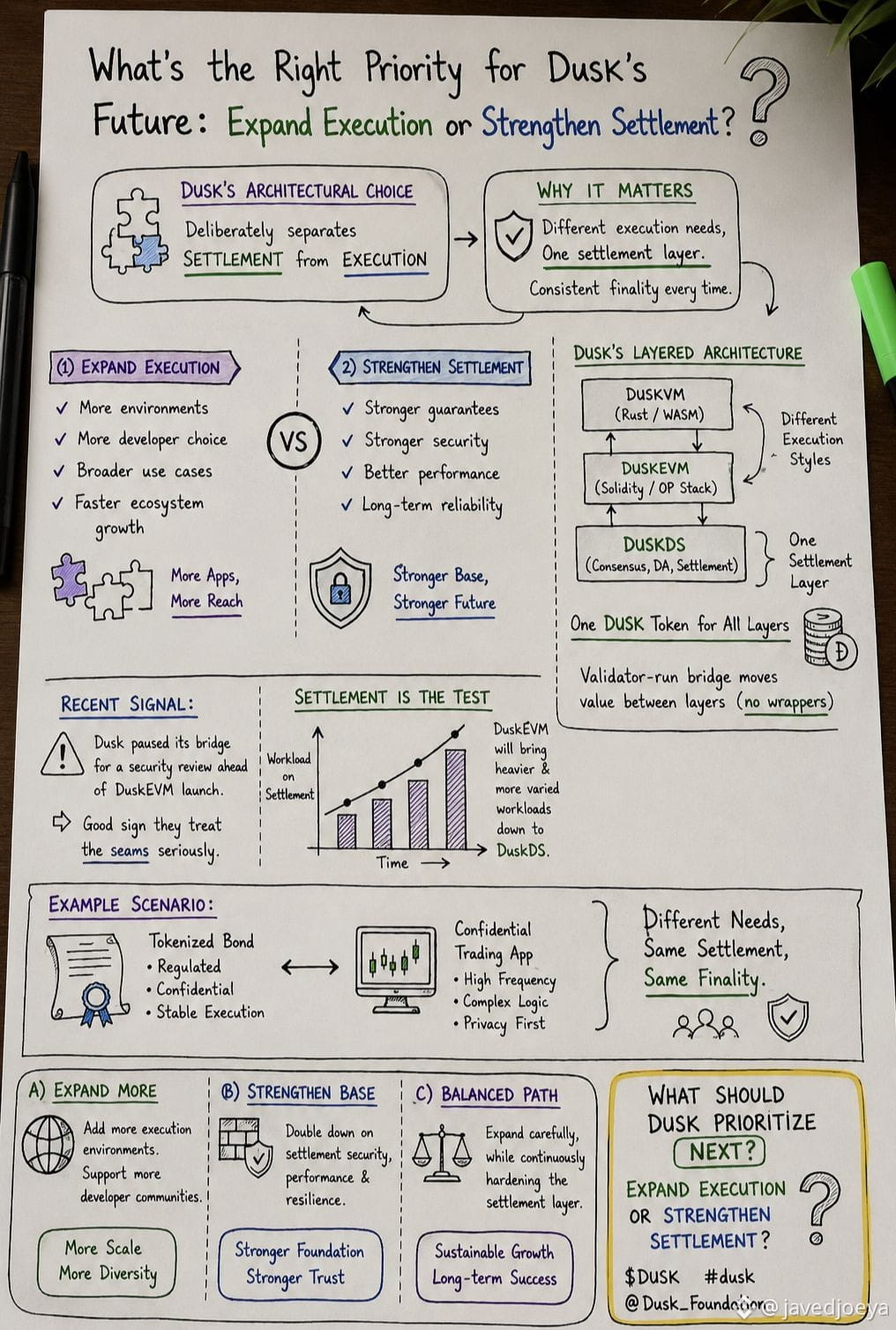
Something I keep coming back to in @Dusk_Foundation 's architecture is how deliberately it separates settlement from execution, instead of forcing one layer to do both jobs.
DuskDS sits at the bottom handling consensus, data availability and settlement. Above it, DuskVM runs native Rust/WASM contracts for privacy-focused applications, while DuskEVM gives Solidity developers a familiar path through OP Stack compatibility. Different execution styles, but everything posts back down to DuskDS and inherits the same finality.
For regulated finance, I think this split is the right call. A tokenized bond and a confidential trading app have very different execution needs, but both need settlement that behaves the same way every time. And since NPEX's licenses cover the full stack, an asset doesn't leave its regulatory perimeter just because it moves between environments. One DUSK token pays gas across all layers, with a validator-run bridge moving value between them instead of wrapped assets.
The part I find easy to underestimate is that adding execution environments is the simple half. Keeping them all anchored to one settlement and data layer without weakening it is the harder engineering problem — and the seams between layers are usually where modular designs get tested. Dusk pausing its bridge for a security review ahead of the DuskEVM launch was a good sign they treat those seams seriously.
What I want to see next is how DuskDS holds up once DuskEVM brings a heavier and more varied mix of workloads down to settlement.
Would you rather see #dusk expand to more execution environments, or keep hardening the connection between the layers it already has?
$DUSK #dusk @Dusk_Foundation _Foundation.
Something I keep coming back to in @Dusk 's architecture is how deliberately it separates settlement from execution, instead of forcing one layer to do both jobs.
DuskDS sits at the bottom handling consensus, data availability and settlement. Above it, DuskVM runs native Rust/WASM contracts for privacy-focused applications, while DuskEVM gives Solidity developers a familiar path through OP Stack compatibility. Different execution styles, but everything posts back down to DuskDS and inherits the same finality.
For regulated finance, I think this split is the right call. A tokenized bond and a confidential trading app have very different execution needs, but both need settlement that behaves the same way every time. And since NPEX's licenses cover the full stack, an asset doesn't leave its regulatory perimeter just because it moves between environments. One DUSK token pays gas across all layers, with a validator-run bridge moving value between them instead of wrapped assets.
The part I find easy to underestimate is that adding execution environments is the simple half. Keeping them all anchored to one settlement and data layer without weakening it is the harder engineering problem — and the seams between layers are usually where modular designs get tested. Dusk pausing its bridge for a security review ahead of the DuskEVM launch was a good sign they treat those seams seriously.
What I want to see next is how DuskDS holds up once DuskEVM brings a heavier and more varied mix of workloads down to settlement.
Would you rather see #dusk expand to more execution environments, or keep hardening the connection between the layers it already has?
$DUSK #dusk @Dusk _Foundation.
DuskDS sits at the bottom handling consensus, data availability and settlement. Above it, DuskVM runs native Rust/WASM contracts for privacy-focused applications, while DuskEVM gives Solidity developers a familiar path through OP Stack compatibility. Different execution styles, but everything posts back down to DuskDS and inherits the same finality.
For regulated finance, I think this split is the right call. A tokenized bond and a confidential trading app have very different execution needs, but both need settlement that behaves the same way every time. And since NPEX's licenses cover the full stack, an asset doesn't leave its regulatory perimeter just because it moves between environments. One DUSK token pays gas across all layers, with a validator-run bridge moving value between them instead of wrapped assets.
The part I find easy to underestimate is that adding execution environments is the simple half. Keeping them all anchored to one settlement and data layer without weakening it is the harder engineering problem — and the seams between layers are usually where modular designs get tested. Dusk pausing its bridge for a security review ahead of the DuskEVM launch was a good sign they treat those seams seriously.
What I want to see next is how DuskDS holds up once DuskEVM brings a heavier and more varied mix of workloads down to settlement.
Would you rather see #dusk expand to more execution environments, or keep hardening the connection between the layers it already has?
$DUSK #dusk @Dusk _Foundation.
1
1
104
·
--
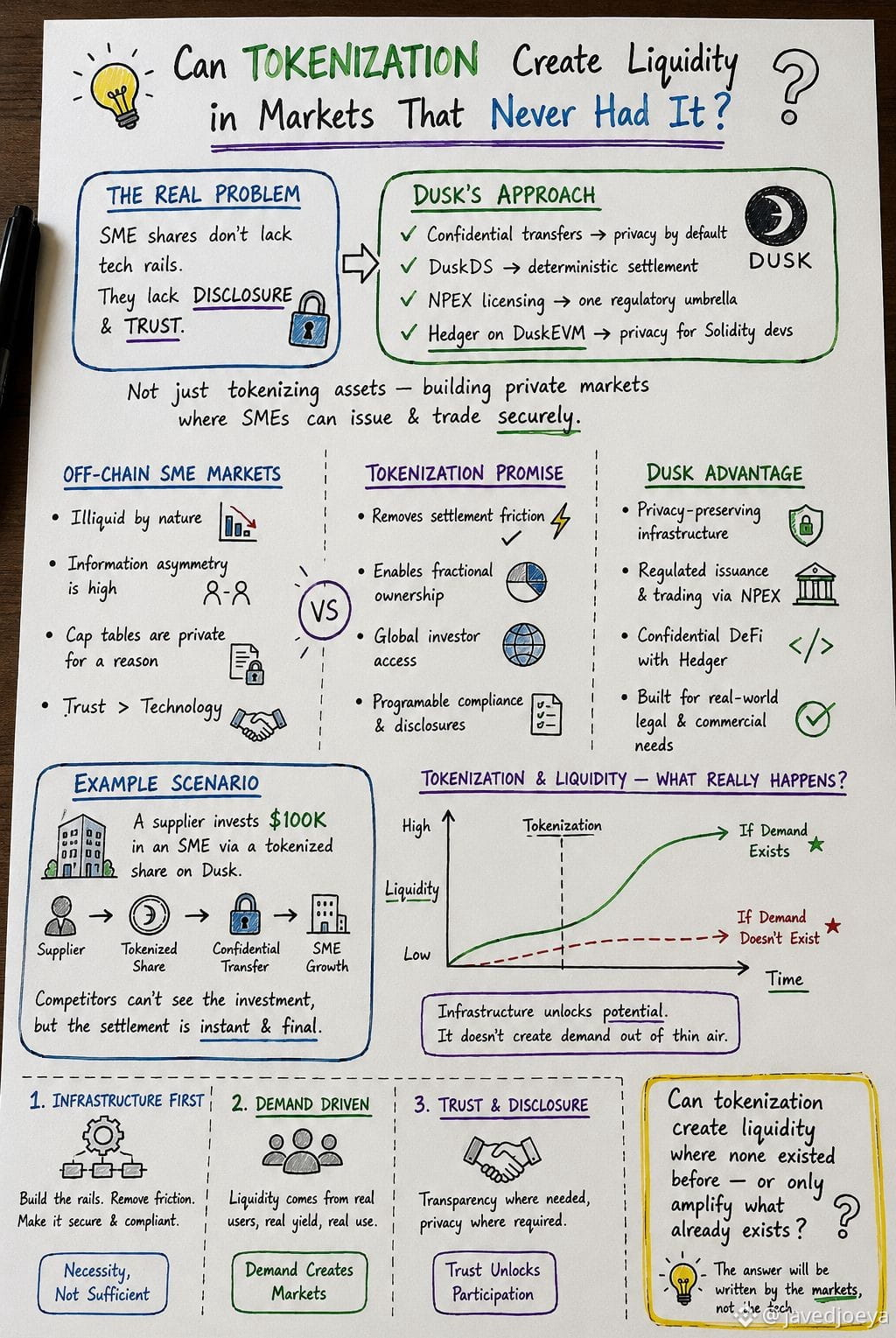
Everyone in RWA talks about tokenizing treasuries and real estate. #dusk 's latest focus is on something less glamorous and, I'd argue, harder: private markets for small and medium enterprises.
Here's why I find this angle more interesting than the usual RWA pitch. SME shares barely trade. There's no liquid order book, no daily price discovery, and cap tables are often private for good commercial reasons. Tokenizing them isn't a liquidity problem first, it's a disclosure problem. A supplier buying into a company doesn't want competitors reading its position on a public explorer.
That's where $DUSK 's stack actually maps to the use case instead of just decorating it. Confidential transfers handle the disclosure side, Dusk DS gives deterministic settlement underneath, and the NPEX licensing umbrella means issuance and trading can happen under one regulatory framework rather than a patchwork of legal wrappers. Hedger extending confidential flows to Dusk EVM matters here too Solidity teams shouldn't have to rebuild in Rust just to get privacy.
My honest reservation: SME markets are illiquid off-chain because of information asymmetry and trust, not because of settlement rails.
Better infrastructure removes friction; it doesn't manufacture demand. The proof point I'm watching is whether regulated venues actually list SME instruments on this stack — and whether anyone shows up to trade them.
Do you think tokenization can create liquidity in markets that never had it, or does it only amplify liquidity that already exists?
$DUSK #dusk @Dusk_Foundation _Foundation
Everyone in RWA talks about tokenizing treasuries and real estate. #dusk 's latest focus is on something less glamorous and, I'd argue, harder: private markets for small and medium enterprises.
Here's why I find this angle more interesting than the usual RWA pitch. SME shares barely trade. There's no liquid order book, no daily price discovery, and cap tables are often private for good commercial reasons. Tokenizing them isn't a liquidity problem first, it's a disclosure problem. A supplier buying into a company doesn't want competitors reading its position on a public explorer.
That's where $DUSK 's stack actually maps to the use case instead of just decorating it. Confidential transfers handle the disclosure side, Dusk DS gives deterministic settlement underneath, and the NPEX licensing umbrella means issuance and trading can happen under one regulatory framework rather than a patchwork of legal wrappers. Hedger extending confidential flows to Dusk EVM matters here too Solidity teams shouldn't have to rebuild in Rust just to get privacy.
My honest reservation: SME markets are illiquid off-chain because of information asymmetry and trust, not because of settlement rails.
Better infrastructure removes friction; it doesn't manufacture demand. The proof point I'm watching is whether regulated venues actually list SME instruments on this stack — and whether anyone shows up to trade them.
Do you think tokenization can create liquidity in markets that never had it, or does it only amplify liquidity that already exists?
$DUSK #dusk @Dusk _Foundation
Here's why I find this angle more interesting than the usual RWA pitch. SME shares barely trade. There's no liquid order book, no daily price discovery, and cap tables are often private for good commercial reasons. Tokenizing them isn't a liquidity problem first, it's a disclosure problem. A supplier buying into a company doesn't want competitors reading its position on a public explorer.
That's where $DUSK 's stack actually maps to the use case instead of just decorating it. Confidential transfers handle the disclosure side, Dusk DS gives deterministic settlement underneath, and the NPEX licensing umbrella means issuance and trading can happen under one regulatory framework rather than a patchwork of legal wrappers. Hedger extending confidential flows to Dusk EVM matters here too Solidity teams shouldn't have to rebuild in Rust just to get privacy.
My honest reservation: SME markets are illiquid off-chain because of information asymmetry and trust, not because of settlement rails.
Better infrastructure removes friction; it doesn't manufacture demand. The proof point I'm watching is whether regulated venues actually list SME instruments on this stack — and whether anyone shows up to trade them.
Do you think tokenization can create liquidity in markets that never had it, or does it only amplify liquidity that already exists?
$DUSK #dusk @Dusk _Foundation
4
2
94
·
--
I've spent ten days writing about Dusk's architecture. Today calls for a different kind of post, because credibility means covering the uncomfortable news too.
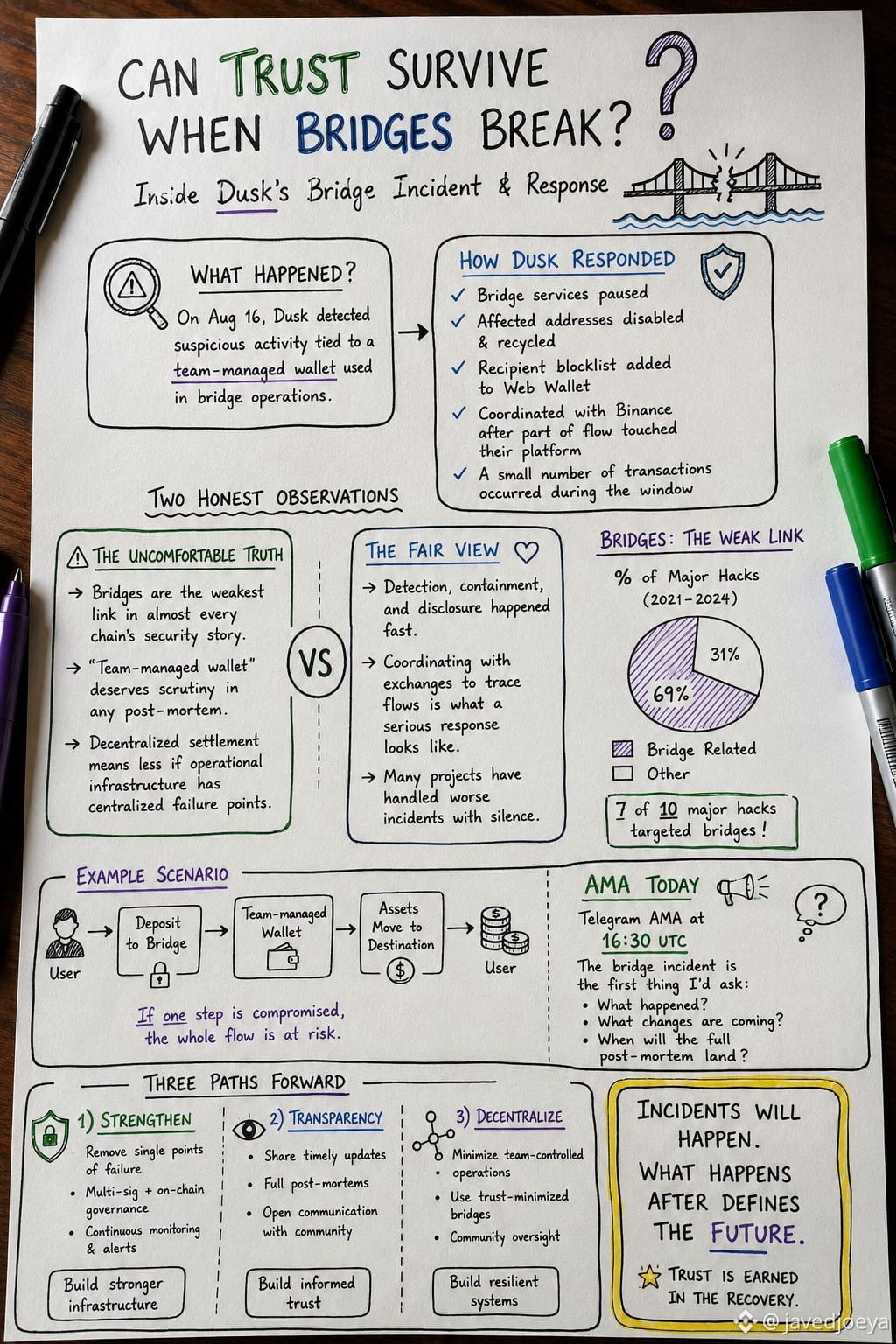
On August 16, the #dusk team detected suspicious activity tied to a team-managed wallet used in bridge operations. Their response: bridge services paused, affected addresses disabled and recycled, a recipient blocklist added to the Web Wallet, and direct coordination with Binance after part of the flow touched their platform. A small number of transactions occurred during the incident window.
Two honest observations. First, the uncomfortable one: bridges remain the weakest link in almost every chain's security story, and "team-managed wallet" is a phrase that deserves scrutiny in any post-mortem. Decentralized settlement guarantees mean less if operational infrastructure around it has centralized failure points.
Second, the fair one: detection, containment, and disclosure happened fast, and coordinating with exchanges to trace flows is what a serious response looks like. Many projects have handled worse incidents with silence.
Dusk hosts a Telegram AMA today at 16:30 UTC. The bridge incident is the first thing I'd ask about — what happened, what changes, and when a full post-mortem lands.
Trust in financial infrastructure isn't built by never having incidents. It's built by what happens in the week after one. @Dusk_Foundation _Foundation $DUSK #dusk
I've spent ten days writing about Dusk's architecture. Today calls for a different kind of post, because credibility means covering the uncomfortable news too.
On August 16, the #dusk team detected suspicious activity tied to a team-managed wallet used in bridge operations. Their response: bridge services paused, affected addresses disabled and recycled, a recipient blocklist added to the Web Wallet, and direct coordination with Binance after part of the flow touched their platform. A small number of transactions occurred during the incident window.
Two honest observations. First, the uncomfortable one: bridges remain the weakest link in almost every chain's security story, and "team-managed wallet" is a phrase that deserves scrutiny in any post-mortem. Decentralized settlement guarantees mean less if operational infrastructure around it has centralized failure points.
Second, the fair one: detection, containment, and disclosure happened fast, and coordinating with exchanges to trace flows is what a serious response looks like. Many projects have handled worse incidents with silence.
Dusk hosts a Telegram AMA today at 16:30 UTC. The bridge incident is the first thing I'd ask about — what happened, what changes, and when a full post-mortem lands.
Trust in financial infrastructure isn't built by never having incidents. It's built by what happens in the week after one. @Dusk _Foundation $DUSK #dusk
On August 16, the #dusk team detected suspicious activity tied to a team-managed wallet used in bridge operations. Their response: bridge services paused, affected addresses disabled and recycled, a recipient blocklist added to the Web Wallet, and direct coordination with Binance after part of the flow touched their platform. A small number of transactions occurred during the incident window.
Two honest observations. First, the uncomfortable one: bridges remain the weakest link in almost every chain's security story, and "team-managed wallet" is a phrase that deserves scrutiny in any post-mortem. Decentralized settlement guarantees mean less if operational infrastructure around it has centralized failure points.
Second, the fair one: detection, containment, and disclosure happened fast, and coordinating with exchanges to trace flows is what a serious response looks like. Many projects have handled worse incidents with silence.
Dusk hosts a Telegram AMA today at 16:30 UTC. The bridge incident is the first thing I'd ask about — what happened, what changes, and when a full post-mortem lands.
Trust in financial infrastructure isn't built by never having incidents. It's built by what happens in the week after one. @Dusk _Foundation $DUSK #dusk
8
7
106
·
--
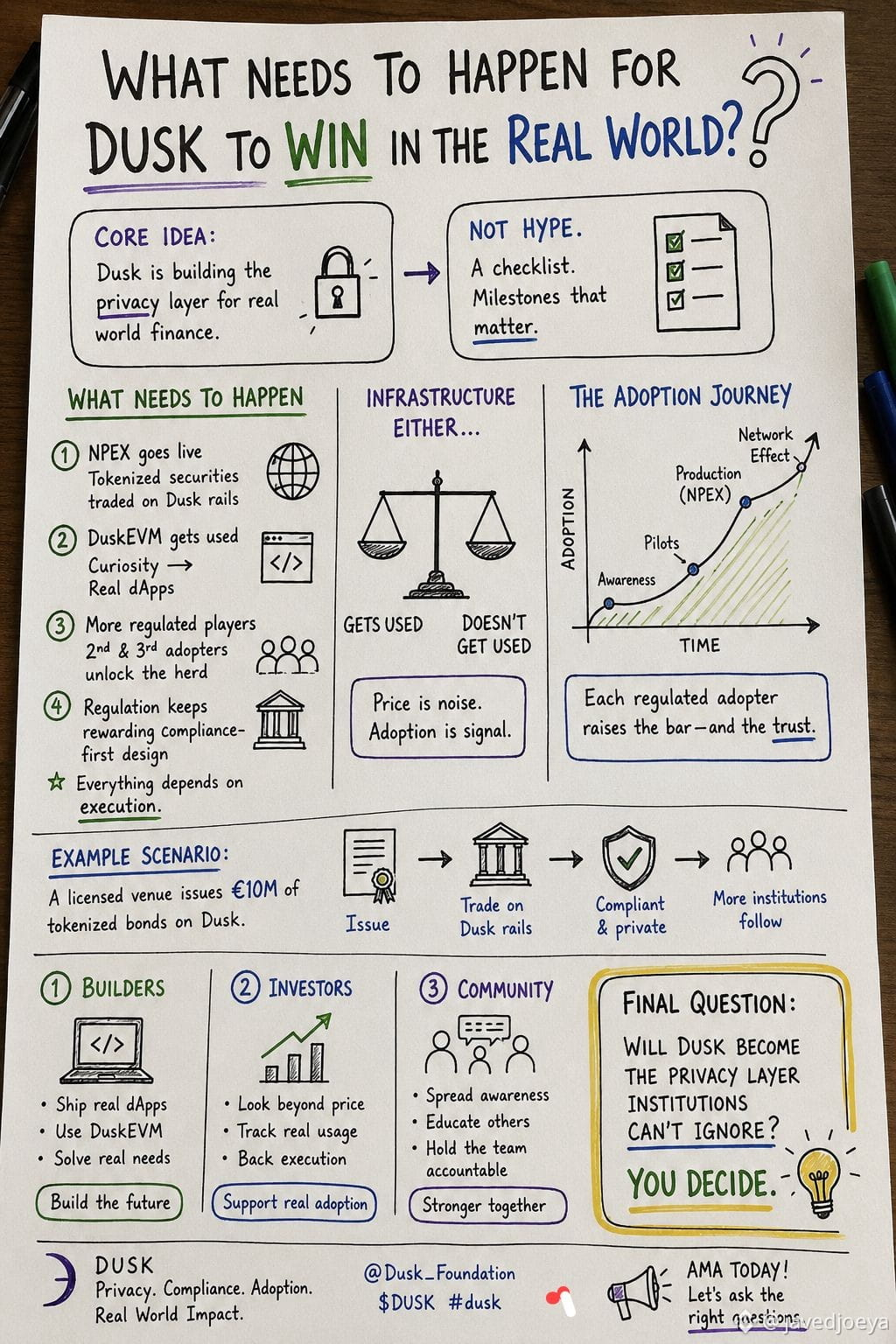
Dusk is holding a community AMA later today, which feels like the right moment to share the checklist I've built after two weeks of researching this project. Not what I hope happens — what would need to happen.
First, the NPEX deployment has to graduate from partnership to production. A licensed venue actively issuing and trading tokenized securities on #dusk rails would be the strongest validation available, because it's verifiable rather than promised.
Second, DuskEVM has to convert developer curiosity into shipped applications. Familiar tooling plus confidential execution is a genuinely differentiated pitch — but only if builders actually use it. Tools like the recent Dusk Connect SDK suggest the team understands this.
Third, more regulated entities have to follow the first one. Institutions move in herds; the second and third licensed adopters matter more than the tenth press release.
Fourth, European regulation has to keep rewarding compliance-first design.
And underneath everything: execution. Roadmaps slip in this industry, and honest projects acknowledge that.
Notice none of my checklist involves price. Infrastructure either gets used or it doesn't.
What would be on your checklist?
I'm curious what others are watching.
@Dusk_Foundation $DUSK $BEAT
Dusk is holding a community AMA later today, which feels like the right moment to share the checklist I've built after two weeks of researching this project. Not what I hope happens — what would need to happen.
First, the NPEX deployment has to graduate from partnership to production. A licensed venue actively issuing and trading tokenized securities on #dusk rails would be the strongest validation available, because it's verifiable rather than promised.
Second, DuskEVM has to convert developer curiosity into shipped applications. Familiar tooling plus confidential execution is a genuinely differentiated pitch — but only if builders actually use it. Tools like the recent Dusk Connect SDK suggest the team understands this.
Third, more regulated entities have to follow the first one. Institutions move in herds; the second and third licensed adopters matter more than the tenth press release.
Fourth, European regulation has to keep rewarding compliance-first design.
And underneath everything: execution. Roadmaps slip in this industry, and honest projects acknowledge that.
Notice none of my checklist involves price. Infrastructure either gets used or it doesn't.
What would be on your checklist?
I'm curious what others are watching.
@Dusk $DUSK $BEAT
First, the NPEX deployment has to graduate from partnership to production. A licensed venue actively issuing and trading tokenized securities on #dusk rails would be the strongest validation available, because it's verifiable rather than promised.
Second, DuskEVM has to convert developer curiosity into shipped applications. Familiar tooling plus confidential execution is a genuinely differentiated pitch — but only if builders actually use it. Tools like the recent Dusk Connect SDK suggest the team understands this.
Third, more regulated entities have to follow the first one. Institutions move in herds; the second and third licensed adopters matter more than the tenth press release.
Fourth, European regulation has to keep rewarding compliance-first design.
And underneath everything: execution. Roadmaps slip in this industry, and honest projects acknowledge that.
Notice none of my checklist involves price. Infrastructure either gets used or it doesn't.
What would be on your checklist?
I'm curious what others are watching.
@Dusk $DUSK $BEAT
18
12
101
·
--
I've covered the problem, the FT/XT mechanism, the leverage stack, and the adoption data. Today: the part almost nobody's discussing "composability".
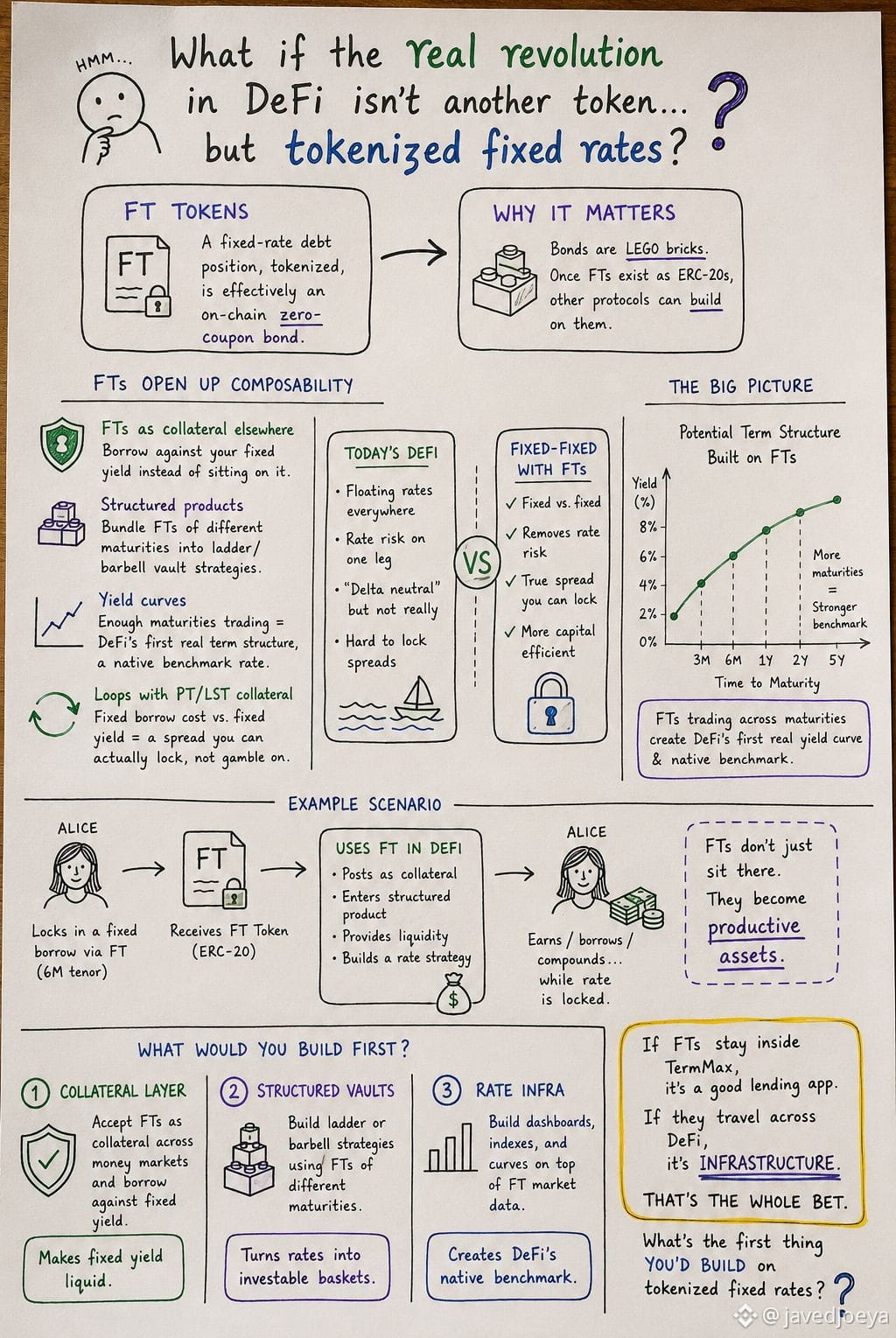
Here's the thing about FT tokens: they're not just receipts. A fixed-rate debt position, tokenized, is effectively an on-chain zero-coupon bond. And bonds are LEGO bricks. Once they exist as ERC-20s, other protocols can build on them:
🔹 FTs as collateral elsewhere — borrow against your fixed yield instead of sitting on it.
🔹 Structured products — bundle FTs of different maturities into ladder/barbell vault strategies.
🔹 Yield curves — enough maturities trading = DeFi's first real term structure, a native benchmark rate other protocols can price against.
🔹 Loops with PT/LST collateral — fixed borrow cost vs. fixed yield = a spread you can actually lock, not gamble on.
That last one matters. Today's "delta neutral" farming still carries floating-rate risk on one leg. Fixed-fixed spreads remove it.
What I'm watching post-TGE:
⏳ Do FTs get accepted as collateral outside TermMax? (the real composability test).
⏳ Secondary liquidity for FT/XT — can you exit mid-term without brutal slippage?
⏳ Does anyone build a rates dashboard/curve on top of it?
If FTs stay inside TermMax, it's a good lending app. If they travel across DeFi, it's infrastructure. That's the whole bet.
5 days, full picture done. What's the first thing YOU'D build on top of tokenized fixed rates? 👇
#TermMax $TUT $HEMI @termmax
I've covered the problem, the FT/XT mechanism, the leverage stack, and the adoption data. Today: the part almost nobody's discussing "composability".
Here's the thing about FT tokens: they're not just receipts. A fixed-rate debt position, tokenized, is effectively an on-chain zero-coupon bond. And bonds are LEGO bricks. Once they exist as ERC-20s, other protocols can build on them:
🔹 FTs as collateral elsewhere — borrow against your fixed yield instead of sitting on it.
🔹 Structured products — bundle FTs of different maturities into ladder/barbell vault strategies.
🔹 Yield curves — enough maturities trading = DeFi's first real term structure, a native benchmark rate other protocols can price against.
🔹 Loops with PT/LST collateral — fixed borrow cost vs. fixed yield = a spread you can actually lock, not gamble on.
That last one matters. Today's "delta neutral" farming still carries floating-rate risk on one leg. Fixed-fixed spreads remove it.
What I'm watching post-TGE:
⏳ Do FTs get accepted as collateral outside TermMax? (the real composability test).
⏳ Secondary liquidity for FT/XT — can you exit mid-term without brutal slippage?
⏳ Does anyone build a rates dashboard/curve on top of it?
If FTs stay inside TermMax, it's a good lending app. If they travel across DeFi, it's infrastructure. That's the whole bet.
5 days, full picture done. What's the first thing YOU'D build on top of tokenized fixed rates? 👇
#TermMax $TUT $HEMI @TermMax
Here's the thing about FT tokens: they're not just receipts. A fixed-rate debt position, tokenized, is effectively an on-chain zero-coupon bond. And bonds are LEGO bricks. Once they exist as ERC-20s, other protocols can build on them:
🔹 FTs as collateral elsewhere — borrow against your fixed yield instead of sitting on it.
🔹 Structured products — bundle FTs of different maturities into ladder/barbell vault strategies.
🔹 Yield curves — enough maturities trading = DeFi's first real term structure, a native benchmark rate other protocols can price against.
🔹 Loops with PT/LST collateral — fixed borrow cost vs. fixed yield = a spread you can actually lock, not gamble on.
That last one matters. Today's "delta neutral" farming still carries floating-rate risk on one leg. Fixed-fixed spreads remove it.
What I'm watching post-TGE:
⏳ Do FTs get accepted as collateral outside TermMax? (the real composability test).
⏳ Secondary liquidity for FT/XT — can you exit mid-term without brutal slippage?
⏳ Does anyone build a rates dashboard/curve on top of it?
If FTs stay inside TermMax, it's a good lending app. If they travel across DeFi, it's infrastructure. That's the whole bet.
5 days, full picture done. What's the first thing YOU'D build on top of tokenized fixed rates? 👇
#TermMax $TUT $HEMI @TermMax
2
2
256
·
--
Why Dusk Said No to Being a Chain for Everything?
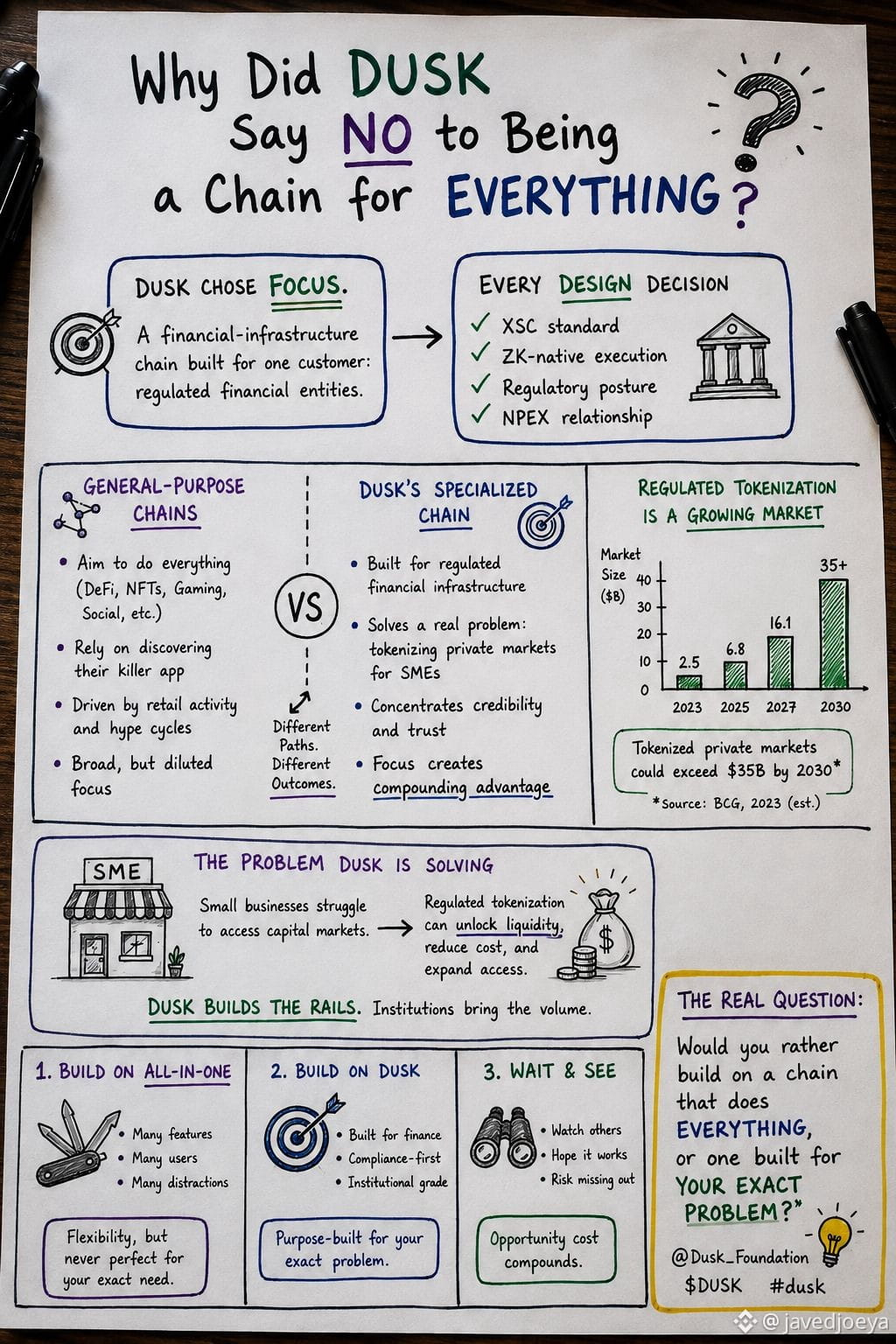
Crypto has a default ambition: become the general-purpose platform for everything. Dusk deliberately declined that, and I've been thinking about whether the narrowness is a weakness or the whole point.
The cost is obvious. A financial-infrastructure chain forgoes gaming, NFTs, social apps — the categories that historically drove retail activity. General-purpose chains get to discover their killer app; specialized chains have to be right about theirs in advance.
But the benefits compound quietly. Every design decision — the XSC standard, ZK-native execution, the regulatory posture, the NPEX relationship — points at one customer: regulated financial entities.
Dusk's recent writing about tokenizing private markets for SMEs shows the same discipline. Small businesses can't access capital markets cheaply; regulated tokenization could change that, and it's exactly the problem a specialized chain is positioned to solve.
Specialization also concentrates credibility. An institution evaluating blockchain settlement doesn't ask which chain is most popular. It asks which chain was built for this problem.
The real question is whether regulated tokenization grows into a market big enough to justify a dedicated chain. If it does, focus becomes moat. Would you rather build on a chain that does everything, or one built for your exact problem?
@Dusk_Foundation _Foundation $DUSK #dusk
Why Dusk Said No to Being a Chain for Everything?
Crypto has a default ambition: become the general-purpose platform for everything. Dusk deliberately declined that, and I've been thinking about whether the narrowness is a weakness or the whole point.
The cost is obvious. A financial-infrastructure chain forgoes gaming, NFTs, social apps — the categories that historically drove retail activity. General-purpose chains get to discover their killer app; specialized chains have to be right about theirs in advance.
But the benefits compound quietly. Every design decision — the XSC standard, ZK-native execution, the regulatory posture, the NPEX relationship — points at one customer: regulated financial entities.
Dusk's recent writing about tokenizing private markets for SMEs shows the same discipline. Small businesses can't access capital markets cheaply; regulated tokenization could change that, and it's exactly the problem a specialized chain is positioned to solve.
Specialization also concentrates credibility. An institution evaluating blockchain settlement doesn't ask which chain is most popular. It asks which chain was built for this problem.
The real question is whether regulated tokenization grows into a market big enough to justify a dedicated chain. If it does, focus becomes moat. Would you rather build on a chain that does everything, or one built for your exact problem?
@Dusk _Foundation $DUSK #dusk
Crypto has a default ambition: become the general-purpose platform for everything. Dusk deliberately declined that, and I've been thinking about whether the narrowness is a weakness or the whole point.
The cost is obvious. A financial-infrastructure chain forgoes gaming, NFTs, social apps — the categories that historically drove retail activity. General-purpose chains get to discover their killer app; specialized chains have to be right about theirs in advance.
But the benefits compound quietly. Every design decision — the XSC standard, ZK-native execution, the regulatory posture, the NPEX relationship — points at one customer: regulated financial entities.
Dusk's recent writing about tokenizing private markets for SMEs shows the same discipline. Small businesses can't access capital markets cheaply; regulated tokenization could change that, and it's exactly the problem a specialized chain is positioned to solve.
Specialization also concentrates credibility. An institution evaluating blockchain settlement doesn't ask which chain is most popular. It asks which chain was built for this problem.
The real question is whether regulated tokenization grows into a market big enough to justify a dedicated chain. If it does, focus becomes moat. Would you rather build on a chain that does everything, or one built for your exact problem?
@Dusk _Foundation $DUSK #dusk
7
3
116
·
--
With $TMX generating its token on August 25, timelines are filling with countdown posts. I'd rather spend today on a more useful question: how does a fixed rate actually work on-chain, without a bank on the other side?
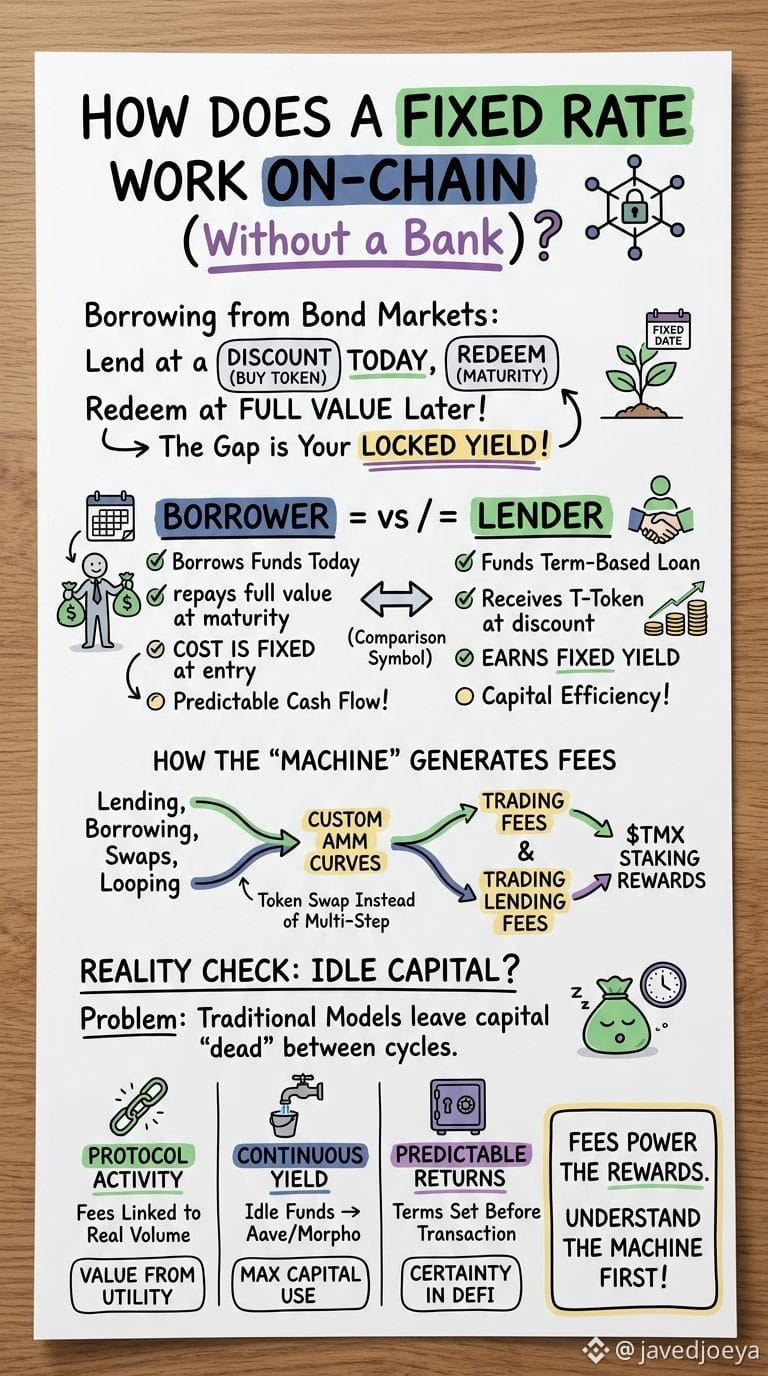
The answer borrows from bond markets. When you lend on @termmax , you're effectively buying a token that redeems at full value on a set maturity date. You buy at a discount today, redeem at full value later — and the gap between those numbers is your yield, locked the moment you enter. Borrowers stand on the mirror side of the same math, so their cost is fixed too.
The clever part is the packaging. #TermMax reworks a familiar AMM design with custom pricing curves, so lending, borrowing and even leveraged looping happen through simple token swaps instead of multi-step transactions across several protocols. Meanwhile, idle capital gets routed to established venues like Aave and Morpho rather than sitting dead.
Why does this matter for the token? Because $TMX's design ties staking rewards to real protocol activity — trading fees, lending fees. A token backed by fees is only as interesting as the machine generating them.
Understand the machine first. The ticker can wait until Monday. @termmax Fi $TMX #TermMax $ACE $ROBO
With $TMX generating its token on August 25, timelines are filling with countdown posts. I'd rather spend today on a more useful question: how does a fixed rate actually work on-chain, without a bank on the other side?
The answer borrows from bond markets. When you lend on @TermMax , you're effectively buying a token that redeems at full value on a set maturity date. You buy at a discount today, redeem at full value later — and the gap between those numbers is your yield, locked the moment you enter. Borrowers stand on the mirror side of the same math, so their cost is fixed too.
The clever part is the packaging. #TermMax reworks a familiar AMM design with custom pricing curves, so lending, borrowing and even leveraged looping happen through simple token swaps instead of multi-step transactions across several protocols. Meanwhile, idle capital gets routed to established venues like Aave and Morpho rather than sitting dead.
Why does this matter for the token? Because $TMX's design ties staking rewards to real protocol activity — trading fees, lending fees. A token backed by fees is only as interesting as the machine generating them.
Understand the machine first. The ticker can wait until Monday. @TermMax Fi $TMX #TermMax $ACE $ROBO
The answer borrows from bond markets. When you lend on @TermMax , you're effectively buying a token that redeems at full value on a set maturity date. You buy at a discount today, redeem at full value later — and the gap between those numbers is your yield, locked the moment you enter. Borrowers stand on the mirror side of the same math, so their cost is fixed too.
The clever part is the packaging. #TermMax reworks a familiar AMM design with custom pricing curves, so lending, borrowing and even leveraged looping happen through simple token swaps instead of multi-step transactions across several protocols. Meanwhile, idle capital gets routed to established venues like Aave and Morpho rather than sitting dead.
Why does this matter for the token? Because $TMX's design ties staking rewards to real protocol activity — trading fees, lending fees. A token backed by fees is only as interesting as the machine generating them.
Understand the machine first. The ticker can wait until Monday. @TermMax Fi $TMX #TermMax $ACE $ROBO
4
2
552
·
--
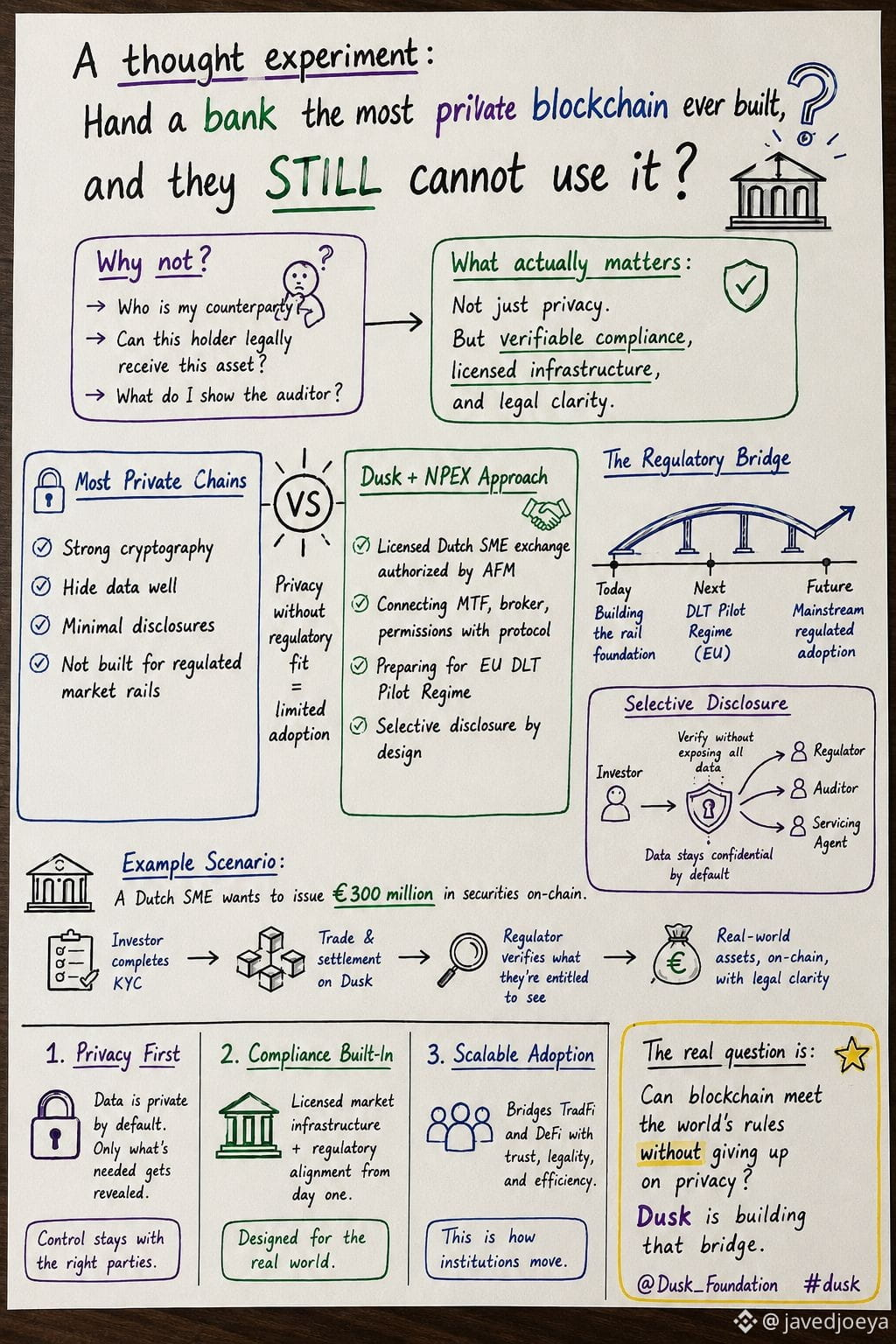
A thought experiment I keep returning to: hand a bank the most private blockchain ever built, and they still cannot use it. Not because the tech fails, but because nothing about privacy answers their actual questions. Who is my counterparty? Can this holder legally receive this asset? What do I show the auditor?
This is why Dusk's regulatory positioning interests me more than its cryptography. Through its partnership with NPEX — a Dutch SME exchange authorized by the AFM — the project has worked to connect licensed market infrastructure (MTF, broker, and related permissions) with its protocol layer, and the two are preparing for the EU's DLT Pilot Regime, a supervised framework for testing DLT-based trading and settlement.
The design philosophy underneath is what #dusk calls selective disclosure: data stays confidential by default, but permitted parties — a regulator, an auditor, a servicing agent — can verify what they are entitled to see without the full investor record ever becoming public.
I initially underestimated how rare this combination is. Plenty of chains have privacy. Very few have built toward supervised, licensed market rails from day one.
Compliance is not the enemy of privacy here. It is the product. @Dusk_Foundation _Foundation $DUSK $PEOPLE #dusk
A thought experiment I keep returning to: hand a bank the most private blockchain ever built, and they still cannot use it. Not because the tech fails, but because nothing about privacy answers their actual questions. Who is my counterparty? Can this holder legally receive this asset? What do I show the auditor?
This is why Dusk's regulatory positioning interests me more than its cryptography. Through its partnership with NPEX — a Dutch SME exchange authorized by the AFM — the project has worked to connect licensed market infrastructure (MTF, broker, and related permissions) with its protocol layer, and the two are preparing for the EU's DLT Pilot Regime, a supervised framework for testing DLT-based trading and settlement.
The design philosophy underneath is what #dusk calls selective disclosure: data stays confidential by default, but permitted parties — a regulator, an auditor, a servicing agent — can verify what they are entitled to see without the full investor record ever becoming public.
I initially underestimated how rare this combination is. Plenty of chains have privacy. Very few have built toward supervised, licensed market rails from day one.
Compliance is not the enemy of privacy here. It is the product. @Dusk _Foundation $DUSK $PEOPLE #dusk
This is why Dusk's regulatory positioning interests me more than its cryptography. Through its partnership with NPEX — a Dutch SME exchange authorized by the AFM — the project has worked to connect licensed market infrastructure (MTF, broker, and related permissions) with its protocol layer, and the two are preparing for the EU's DLT Pilot Regime, a supervised framework for testing DLT-based trading and settlement.
The design philosophy underneath is what #dusk calls selective disclosure: data stays confidential by default, but permitted parties — a regulator, an auditor, a servicing agent — can verify what they are entitled to see without the full investor record ever becoming public.
I initially underestimated how rare this combination is. Plenty of chains have privacy. Very few have built toward supervised, licensed market rails from day one.
Compliance is not the enemy of privacy here. It is the product. @Dusk _Foundation $DUSK $PEOPLE #dusk
3
2
116
·
--
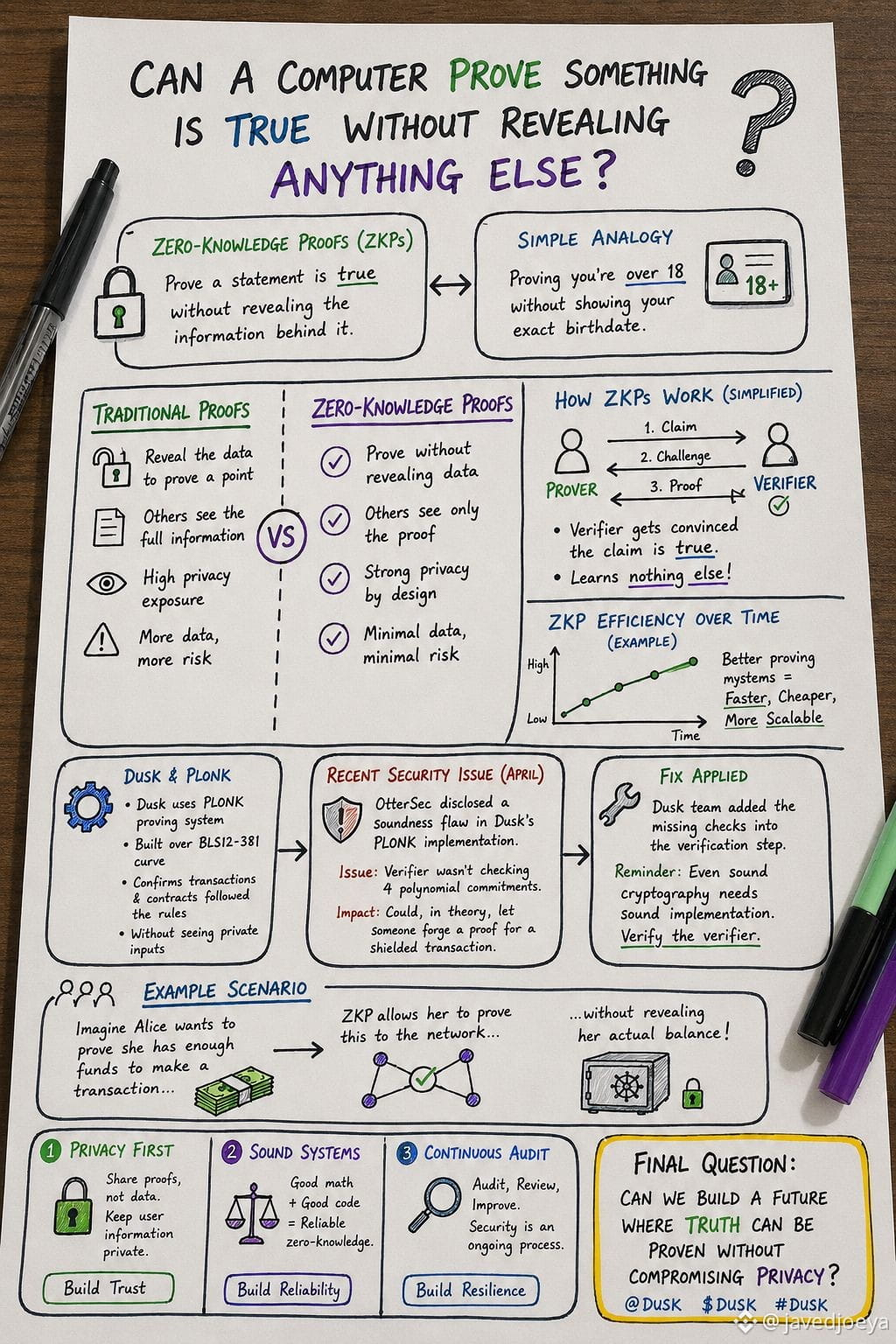
I want to go deeper into zero-knowledge proofs today, because earlier posts only sketched the idea.
A simple analogy: proving you're over 18 without showing your exact birthdate. You're not hiding whether the claim is true — you're just not disclosing more than necessary to prove it. Zero-knowledge proofs let a computer do the equivalent with math instead of an ID card.
Technically, @Dusk_Foundation relies on PLONK, a proving system it has helped develop since its early testnet days, running over the BLS12-381 curve. PLONK is what lets the network confirm a transaction or contract followed the rules without ever seeing the private inputs behind that claim.
But there is a catch, and it's a recent one worth being honest about. In April, security researchers at OtterSec disclosed a soundness flaw in #dusk 's PLONK implementation: the verifier wasn't checking four of the prover's polynomial commitments, a gap that could, in theory, have let someone forge a proof for a shielded transaction. Dusk's team addressed it by adding those missing checks into the verification step.
I bring this up not to alarm anyone, but because it's a useful reminder: the cryptography can be sound while the code implementing it still has bugs. Verification of the verifier matters too.
$DUSK $HEMI $TUT
{spot}(DUSKUSDT)
I want to go deeper into zero-knowledge proofs today, because earlier posts only sketched the idea.
A simple analogy: proving you're over 18 without showing your exact birthdate. You're not hiding whether the claim is true — you're just not disclosing more than necessary to prove it. Zero-knowledge proofs let a computer do the equivalent with math instead of an ID card.
Technically, @Dusk relies on PLONK, a proving system it has helped develop since its early testnet days, running over the BLS12-381 curve. PLONK is what lets the network confirm a transaction or contract followed the rules without ever seeing the private inputs behind that claim.
But there is a catch, and it's a recent one worth being honest about. In April, security researchers at OtterSec disclosed a soundness flaw in #dusk 's PLONK implementation: the verifier wasn't checking four of the prover's polynomial commitments, a gap that could, in theory, have let someone forge a proof for a shielded transaction. Dusk's team addressed it by adding those missing checks into the verification step.
I bring this up not to alarm anyone, but because it's a useful reminder: the cryptography can be sound while the code implementing it still has bugs. Verification of the verifier matters too.
$DUSK $HEMI $TUT
A simple analogy: proving you're over 18 without showing your exact birthdate. You're not hiding whether the claim is true — you're just not disclosing more than necessary to prove it. Zero-knowledge proofs let a computer do the equivalent with math instead of an ID card.
Technically, @Dusk relies on PLONK, a proving system it has helped develop since its early testnet days, running over the BLS12-381 curve. PLONK is what lets the network confirm a transaction or contract followed the rules without ever seeing the private inputs behind that claim.
But there is a catch, and it's a recent one worth being honest about. In April, security researchers at OtterSec disclosed a soundness flaw in #dusk 's PLONK implementation: the verifier wasn't checking four of the prover's polynomial commitments, a gap that could, in theory, have let someone forge a proof for a shielded transaction. Dusk's team addressed it by adding those missing checks into the verification step.
I bring this up not to alarm anyone, but because it's a useful reminder: the cryptography can be sound while the code implementing it still has bugs. Verification of the verifier matters too.
$DUSK $HEMI $TUT
9
6
89
·
--
Here's a tension I don't think gets discussed enough: if financial information is private, who's checking that nothing shady is happening?
This is where the design gets more nuanced. Full privacy with zero accountability isn't actually attractive to regulators or serious institutions — it just recreates the problems that already exist with opaque paperwork, except on a blockchain. What financial infrastructure typically needs instead is selective disclosure: keeping information private from the general public while letting specific authorized parties verify what happened when required.
@Dusk_Foundation 's own architecture leans on this rather than blanket anonymity. Citadel, its identity protocol, is built around letting someone prove they meet a requirement — passing KYC, holding a license, meeting an eligibility check — without handing over the underlying personal data, using zero-knowledge proofs instead. A piece $DUSK
{spot}(DUSKUSDT)
published this month on tokenizing private-market securities makes the same point from the institutional side: ownership and servicing records need privacy, but permitted parties still have to verify relevant information, not the full investor record.
The real question is how well that holds up once actual regulators, auditors, and disputes test it, since selective disclosure as a design goal is easier to state than to prove in production. That's still ahead of Dusk, not behind it. #dusk
Should financial privacy always come with a way for regulators to verify it?
Here's a tension I don't think gets discussed enough: if financial information is private, who's checking that nothing shady is happening?
This is where the design gets more nuanced. Full privacy with zero accountability isn't actually attractive to regulators or serious institutions — it just recreates the problems that already exist with opaque paperwork, except on a blockchain. What financial infrastructure typically needs instead is selective disclosure: keeping information private from the general public while letting specific authorized parties verify what happened when required.
@Dusk 's own architecture leans on this rather than blanket anonymity. Citadel, its identity protocol, is built around letting someone prove they meet a requirement — passing KYC, holding a license, meeting an eligibility check — without handing over the underlying personal data, using zero-knowledge proofs instead. A piece $DUSK
published this month on tokenizing private-market securities makes the same point from the institutional side: ownership and servicing records need privacy, but permitted parties still have to verify relevant information, not the full investor record.
The real question is how well that holds up once actual regulators, auditors, and disputes test it, since selective disclosure as a design goal is easier to state than to prove in production. That's still ahead of Dusk, not behind it. #dusk
Should financial privacy always come with a way for regulators to verify it?
This is where the design gets more nuanced. Full privacy with zero accountability isn't actually attractive to regulators or serious institutions — it just recreates the problems that already exist with opaque paperwork, except on a blockchain. What financial infrastructure typically needs instead is selective disclosure: keeping information private from the general public while letting specific authorized parties verify what happened when required.
@Dusk 's own architecture leans on this rather than blanket anonymity. Citadel, its identity protocol, is built around letting someone prove they meet a requirement — passing KYC, holding a license, meeting an eligibility check — without handing over the underlying personal data, using zero-knowledge proofs instead. A piece $DUSK
published this month on tokenizing private-market securities makes the same point from the institutional side: ownership and servicing records need privacy, but permitted parties still have to verify relevant information, not the full investor record.
The real question is how well that holds up once actual regulators, auditors, and disputes test it, since selective disclosure as a design goal is easier to state than to prove in production. That's still ahead of Dusk, not behind it. #dusk
Should financial privacy always come with a way for regulators to verify it?
🟢 Yes, always
0%
🔴 No, never
0%
🟡 Case by case
0%
0 Votes • Vote fermé
10
3
86
·
--
**The Mechanism: How TermMax Actually Fixes the Rate**
Yesterday I looked at the problem @termmax is solving — rate uncertainty in DeFi lending. Today I want to get into how it actually delivers a fixed rate, because the mechanism is more interesting than the pitch suggests.
Each #TerMax market is built around three defined pieces: a debt token (what's being borrowed, e.g. $USDC ), a collateral token (over-collateralized, e.g. $ETH ), and a fixed maturity date. Around this, the protocol issues two tokens — an FT (Fixed-rate Token) and an XT token. The FT functions like a zero-coupon bond: it's sold at a discount before maturity and redeems 1:1 for the debt asset once the term ends, so a lender's yield is locked in the moment they buy it rather than fluctuating with utilization afterward. At any point before maturity, 1 FT + 1 XT equals 1 debt token; at maturity, XT's value goes to zero and FT becomes redeemable.
What I find analytically useful here is that this collapses what would otherwise be a multi-step process — manually laddering fixed-term positions, or running a looping strategy to approximate a fixed return — into a single tradable token. FT and XT can also, in principle, trade on secondary markets before maturity, which means the "fixed rate" isn't necessarily a static commitment; it's a position you can exit or adjust if your view changes.
I'd flag one open question rather than assume it away: fixed-rate mechanisms built on tokenized debt still depend on the underlying collateral and liquidation logic holding up under stress. The rate being fixed doesn't mean the position is risk-free — it means the *rate* variable is removed, not the *collateral* variable. That distinction is worth keeping in mind as I look at leverage and options next.
#TermMax
Which part of the FT/XT design clicks more for you?
**The Mechanism: How TermMax Actually Fixes the Rate**
Yesterday I looked at the problem @TermMax is solving — rate uncertainty in DeFi lending. Today I want to get into how it actually delivers a fixed rate, because the mechanism is more interesting than the pitch suggests.
Each #TerMax market is built around three defined pieces: a debt token (what's being borrowed, e.g. $USDC ), a collateral token (over-collateralized, e.g. $ETH ), and a fixed maturity date. Around this, the protocol issues two tokens — an FT (Fixed-rate Token) and an XT token. The FT functions like a zero-coupon bond: it's sold at a discount before maturity and redeems 1:1 for the debt asset once the term ends, so a lender's yield is locked in the moment they buy it rather than fluctuating with utilization afterward. At any point before maturity, 1 FT + 1 XT equals 1 debt token; at maturity, XT's value goes to zero and FT becomes redeemable.
What I find analytically useful here is that this collapses what would otherwise be a multi-step process — manually laddering fixed-term positions, or running a looping strategy to approximate a fixed return — into a single tradable token. FT and XT can also, in principle, trade on secondary markets before maturity, which means the "fixed rate" isn't necessarily a static commitment; it's a position you can exit or adjust if your view changes.
I'd flag one open question rather than assume it away: fixed-rate mechanisms built on tokenized debt still depend on the underlying collateral and liquidation logic holding up under stress. The rate being fixed doesn't mean the position is risk-free — it means the *rate* variable is removed, not the *collateral* variable. That distinction is worth keeping in mind as I look at leverage and options next.
#TermMax
Which part of the FT/XT design clicks more for you?
Yesterday I looked at the problem @TermMax is solving — rate uncertainty in DeFi lending. Today I want to get into how it actually delivers a fixed rate, because the mechanism is more interesting than the pitch suggests.
Each #TerMax market is built around three defined pieces: a debt token (what's being borrowed, e.g. $USDC ), a collateral token (over-collateralized, e.g. $ETH ), and a fixed maturity date. Around this, the protocol issues two tokens — an FT (Fixed-rate Token) and an XT token. The FT functions like a zero-coupon bond: it's sold at a discount before maturity and redeems 1:1 for the debt asset once the term ends, so a lender's yield is locked in the moment they buy it rather than fluctuating with utilization afterward. At any point before maturity, 1 FT + 1 XT equals 1 debt token; at maturity, XT's value goes to zero and FT becomes redeemable.
What I find analytically useful here is that this collapses what would otherwise be a multi-step process — manually laddering fixed-term positions, or running a looping strategy to approximate a fixed return — into a single tradable token. FT and XT can also, in principle, trade on secondary markets before maturity, which means the "fixed rate" isn't necessarily a static commitment; it's a position you can exit or adjust if your view changes.
I'd flag one open question rather than assume it away: fixed-rate mechanisms built on tokenized debt still depend on the underlying collateral and liquidation logic holding up under stress. The rate being fixed doesn't mean the position is risk-free — it means the *rate* variable is removed, not the *collateral* variable. That distinction is worth keeping in mind as I look at leverage and options next.
#TermMax
Which part of the FT/XT design clicks more for you?
🧩 Rate/risk split
0%
🔁 Tradable fixed rate
0%
❓ Still learning
0%
0 Votes • Vote fermé
5
169
·
--
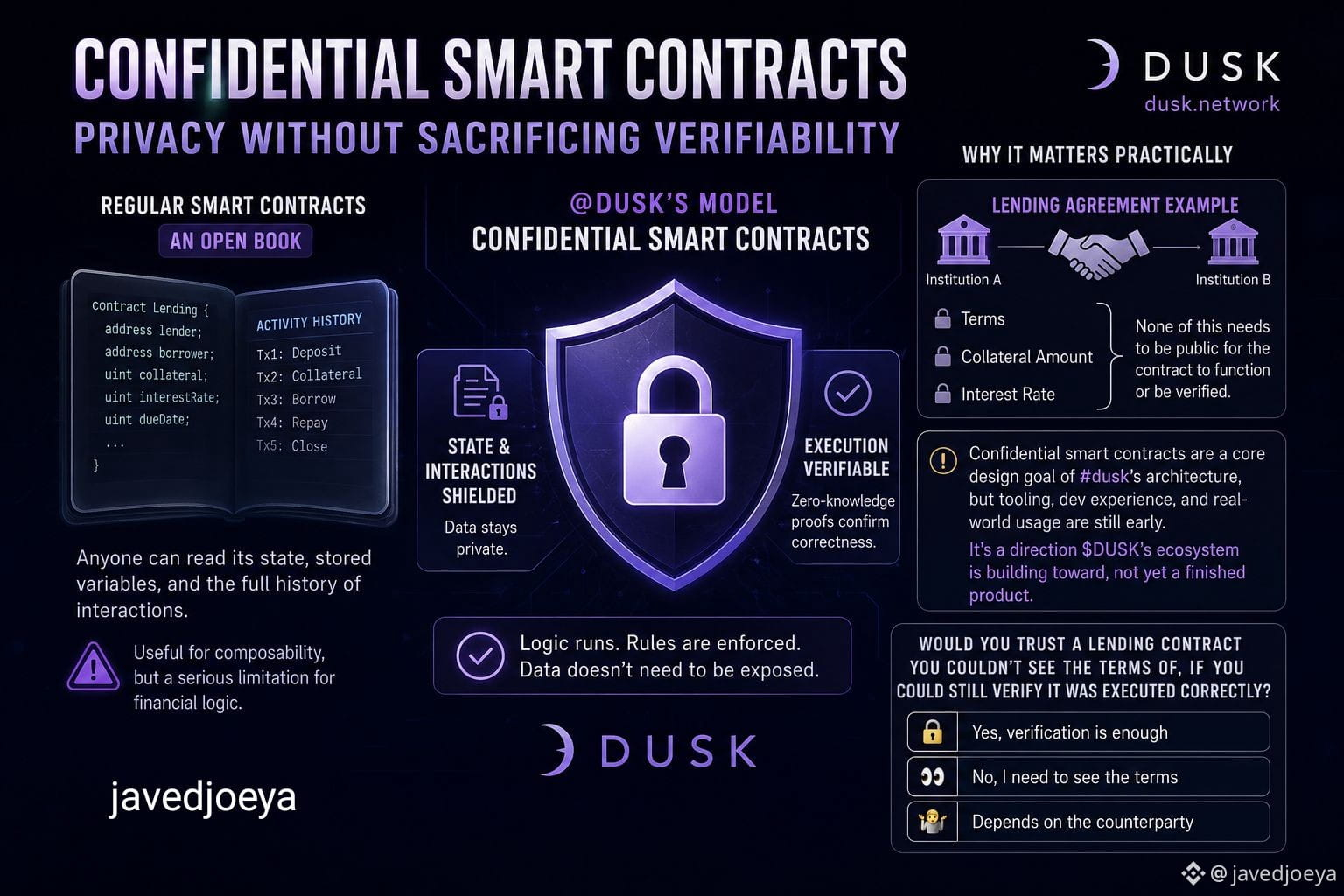
A regular smart contract on most public chains is an open book. Anyone can read its state, its stored variables, and often the full history of every interaction with it. That's useful for composability, but it's a serious limitation for financial logic.
A confidential smart contract, in @Dusk_Foundation 's model, is designed so, contract state and interactions can be shielded from public view, while the contract's execution can still be verified as correct using zero-knowledge proofs. The logic runs, the rules are enforced, but the specific data involved doesn't have to be exposed on-chain.
Why does this matter practically? Think of a lending agreement between two institutions. The terms, the collateral amount, the interest rate, none of that needs to be public for the contract to function correctly or for the network to confirm it was executed honestly.
I want to be careful here not to overstate where this stands. Confidential smart contracts are a core design goal of #dusk 's architecture, but the practical developer experience, tooling maturity, and real-world usage of this functionality are still early. It's a direction $DUSK 's ecosystem is building toward, not yet a finished product.
Would you trust a lending contract you couldn't see the terms of, if you could still verify it was executed correctly? 🤔
🔒 Yes, verification is enough
👀 No, I need to see the terms
🤷 Depends on the counterparty
A regular smart contract on most public chains is an open book. Anyone can read its state, its stored variables, and often the full history of every interaction with it. That's useful for composability, but it's a serious limitation for financial logic.
A confidential smart contract, in @Dusk 's model, is designed so, contract state and interactions can be shielded from public view, while the contract's execution can still be verified as correct using zero-knowledge proofs. The logic runs, the rules are enforced, but the specific data involved doesn't have to be exposed on-chain.
Why does this matter practically? Think of a lending agreement between two institutions. The terms, the collateral amount, the interest rate, none of that needs to be public for the contract to function correctly or for the network to confirm it was executed honestly.
I want to be careful here not to overstate where this stands. Confidential smart contracts are a core design goal of #dusk 's architecture, but the practical developer experience, tooling maturity, and real-world usage of this functionality are still early. It's a direction $DUSK 's ecosystem is building toward, not yet a finished product.
Would you trust a lending contract you couldn't see the terms of, if you could still verify it was executed correctly? 🤔
🔒 Yes, verification is enough
👀 No, I need to see the terms
🤷 Depends on the counterparty
A confidential smart contract, in @Dusk 's model, is designed so, contract state and interactions can be shielded from public view, while the contract's execution can still be verified as correct using zero-knowledge proofs. The logic runs, the rules are enforced, but the specific data involved doesn't have to be exposed on-chain.
Why does this matter practically? Think of a lending agreement between two institutions. The terms, the collateral amount, the interest rate, none of that needs to be public for the contract to function correctly or for the network to confirm it was executed honestly.
I want to be careful here not to overstate where this stands. Confidential smart contracts are a core design goal of #dusk 's architecture, but the practical developer experience, tooling maturity, and real-world usage of this functionality are still early. It's a direction $DUSK 's ecosystem is building toward, not yet a finished product.
Would you trust a lending contract you couldn't see the terms of, if you could still verify it was executed correctly? 🤔
🔒 Yes, verification is enough
👀 No, I need to see the terms
🤷 Depends on the counterparty
21
4
103
·
--
I've been looking into @termmax over the past few days, and the first thing that stood out is a problem most #DeFi users have just learned to tolerate: rate uncertainty. On most lending markets, what you earn as a lender or pay as a borrower drifts with utilization — sometimes sharply, sometimes overnight. You commit capital or take on debt without actually knowing your real return or real cost until the position closes.
TermMax takes a different starting point. It's a fixed-rate, fixed-term lending and borrowing protocol — you know your yield or your borrowing cost upfront, locked in for a defined maturity, rather than watching a floating APY move under you. That's a meaningful shift for anyone trying to plan around a position rather than babysit it. Traditional leveraged strategies like looping already require multiple transactions and constant monitoring; adding rate uncertainty on top of that compounds the complexity for anyone without deep technical familiarity.
I'm not going to get into the tokenization mechanics that make the fixed rate possible today — that's worth its own post. What's worth sitting with first is the framing itself: #TermMax is treating "predictable rate" as the base layer, not a premium feature bolted onto a floating-rate market. Whether that framing holds up depends entirely on how the mechanism is actually built, which is where I'll pick this up next.
Fixed rates or floating rates — which do you actually trust more with your capital?
I've been looking into @TermMax over the past few days, and the first thing that stood out is a problem most #DeFi users have just learned to tolerate: rate uncertainty. On most lending markets, what you earn as a lender or pay as a borrower drifts with utilization — sometimes sharply, sometimes overnight. You commit capital or take on debt without actually knowing your real return or real cost until the position closes.
TermMax takes a different starting point. It's a fixed-rate, fixed-term lending and borrowing protocol — you know your yield or your borrowing cost upfront, locked in for a defined maturity, rather than watching a floating APY move under you. That's a meaningful shift for anyone trying to plan around a position rather than babysit it. Traditional leveraged strategies like looping already require multiple transactions and constant monitoring; adding rate uncertainty on top of that compounds the complexity for anyone without deep technical familiarity.
I'm not going to get into the tokenization mechanics that make the fixed rate possible today — that's worth its own post. What's worth sitting with first is the framing itself: #TermMax is treating "predictable rate" as the base layer, not a premium feature bolted onto a floating-rate market. Whether that framing holds up depends entirely on how the mechanism is actually built, which is where I'll pick this up next.
Fixed rates or floating rates — which do you actually trust more with your capital?
TermMax takes a different starting point. It's a fixed-rate, fixed-term lending and borrowing protocol — you know your yield or your borrowing cost upfront, locked in for a defined maturity, rather than watching a floating APY move under you. That's a meaningful shift for anyone trying to plan around a position rather than babysit it. Traditional leveraged strategies like looping already require multiple transactions and constant monitoring; adding rate uncertainty on top of that compounds the complexity for anyone without deep technical familiarity.
I'm not going to get into the tokenization mechanics that make the fixed rate possible today — that's worth its own post. What's worth sitting with first is the framing itself: #TermMax is treating "predictable rate" as the base layer, not a premium feature bolted onto a floating-rate market. Whether that framing holds up depends entirely on how the mechanism is actually built, which is where I'll pick this up next.
Fixed rates or floating rates — which do you actually trust more with your capital?
🔒 Fixed rate,I want certainty
0%
📈 Floating, I'll take upside
0%
🤷 Depends on the market
0%
0 Votes • Vote fermé
6
2
82
·
--
Public blockchains are often praised for radical transparency, and for good reason. But transparency has a cost that doesn't get discussed enough.
Imagine a hedge fund building a position on-chain. On a fully transparent ledger, every wallet watching can see the accumulation happening in real time. That information is valuable, and competitors or opportunistic traders can act on it before the position is even complete. This isn't hypothetical behavior; front-running and copy-trading based on visible on-chain activity are well documented problems in public DeFi today.
The same issue applies to businesses. A public balance sheet, updated live, block by block, tells suppliers, competitors, and counterparties far more than most companies would ever willingly disclose.
This is why full transparency, despite its benefits for auditability and trust, can actually work against adoption by serious financial institutions. They're not opposed to blockchains in principle. Many are opposed to broadcasting their trading books to the internet.
@Dusk_Foundation 's argument is that confidentiality isn't a workaround for this problem, it's a requirement for certain categories of financial activity to move on-chain at all. $DUSK network was built around that premise from the start. Worth sitting with, even if you're skeptical of how far #dusk can push it. $HEMI
Do you think financial institutions will ever go fully on-chain? 🤔
Public blockchains are often praised for radical transparency, and for good reason. But transparency has a cost that doesn't get discussed enough.
Imagine a hedge fund building a position on-chain. On a fully transparent ledger, every wallet watching can see the accumulation happening in real time. That information is valuable, and competitors or opportunistic traders can act on it before the position is even complete. This isn't hypothetical behavior; front-running and copy-trading based on visible on-chain activity are well documented problems in public DeFi today.
The same issue applies to businesses. A public balance sheet, updated live, block by block, tells suppliers, competitors, and counterparties far more than most companies would ever willingly disclose.
This is why full transparency, despite its benefits for auditability and trust, can actually work against adoption by serious financial institutions. They're not opposed to blockchains in principle. Many are opposed to broadcasting their trading books to the internet.
@Dusk 's argument is that confidentiality isn't a workaround for this problem, it's a requirement for certain categories of financial activity to move on-chain at all. $DUSK network was built around that premise from the start. Worth sitting with, even if you're skeptical of how far #dusk can push it. $HEMI
Do you think financial institutions will ever go fully on-chain? 🤔
Imagine a hedge fund building a position on-chain. On a fully transparent ledger, every wallet watching can see the accumulation happening in real time. That information is valuable, and competitors or opportunistic traders can act on it before the position is even complete. This isn't hypothetical behavior; front-running and copy-trading based on visible on-chain activity are well documented problems in public DeFi today.
The same issue applies to businesses. A public balance sheet, updated live, block by block, tells suppliers, competitors, and counterparties far more than most companies would ever willingly disclose.
This is why full transparency, despite its benefits for auditability and trust, can actually work against adoption by serious financial institutions. They're not opposed to blockchains in principle. Many are opposed to broadcasting their trading books to the internet.
@Dusk 's argument is that confidentiality isn't a workaround for this problem, it's a requirement for certain categories of financial activity to move on-chain at all. $DUSK network was built around that premise from the start. Worth sitting with, even if you're skeptical of how far #dusk can push it. $HEMI
Do you think financial institutions will ever go fully on-chain? 🤔
🔒 Only if privacy is built in
0%
🌐 Yes, transparency is fine
0%
❌ No, TradFi stays separate
0%
🤷 Not sure yet
0%
0 Votes • Vote fermé
17
4
185
·
--
At first glance, "Confidential Security Contract" sounds like marketing language. But XSC is actually a fairly specific piece of @Dusk_Foundation 's architecture, not just a slogan.
XSC is the network's standard for issuing and managing security tokens, contracts designed to represent regulated financial instruments like equity or debt on-chain. The standard was introduced with the project's Whitepaper V2.0 and is meant to let issuers embed compliance logic directly into the contract, things like transfer restrictions or eligibility checks, while keeping sensitive details like ownership amounts and identities confidential.
Why does this matter? Traditional securities already rely on rulebooks that govern who can hold them and how they can move. If a blockchain can't express those rules natively, tokenizing a security either breaks compliance or forces everything back into off-chain paperwork, which defeats a lot of the point.
The interesting part is that XSC tries to make the compliance layer and the privacy layer work together instead of against each other. $DUSK secures the network these contracts run on, but XSC itself is really the compliance-and-confidentiality logic layered on top. Whether that holds up under real regulatory scrutiny is a separate question, one #dusk hasn't fully answered in practice yet.
#xsc $ACE $ROBO
Will XSC's blend of compliance and privacy hold up under real regulatory scrutiny?
At first glance, "Confidential Security Contract" sounds like marketing language. But XSC is actually a fairly specific piece of @Dusk 's architecture, not just a slogan.
XSC is the network's standard for issuing and managing security tokens, contracts designed to represent regulated financial instruments like equity or debt on-chain. The standard was introduced with the project's Whitepaper V2.0 and is meant to let issuers embed compliance logic directly into the contract, things like transfer restrictions or eligibility checks, while keeping sensitive details like ownership amounts and identities confidential.
Why does this matter? Traditional securities already rely on rulebooks that govern who can hold them and how they can move. If a blockchain can't express those rules natively, tokenizing a security either breaks compliance or forces everything back into off-chain paperwork, which defeats a lot of the point.
The interesting part is that XSC tries to make the compliance layer and the privacy layer work together instead of against each other. $DUSK secures the network these contracts run on, but XSC itself is really the compliance-and-confidentiality logic layered on top. Whether that holds up under real regulatory scrutiny is a separate question, one #dusk hasn't fully answered in practice yet.
#xsc $ACE $ROBO
Will XSC's blend of compliance and privacy hold up under real regulatory scrutiny?
XSC is the network's standard for issuing and managing security tokens, contracts designed to represent regulated financial instruments like equity or debt on-chain. The standard was introduced with the project's Whitepaper V2.0 and is meant to let issuers embed compliance logic directly into the contract, things like transfer restrictions or eligibility checks, while keeping sensitive details like ownership amounts and identities confidential.
Why does this matter? Traditional securities already rely on rulebooks that govern who can hold them and how they can move. If a blockchain can't express those rules natively, tokenizing a security either breaks compliance or forces everything back into off-chain paperwork, which defeats a lot of the point.
The interesting part is that XSC tries to make the compliance layer and the privacy layer work together instead of against each other. $DUSK secures the network these contracts run on, but XSC itself is really the compliance-and-confidentiality logic layered on top. Whether that holds up under real regulatory scrutiny is a separate question, one #dusk hasn't fully answered in practice yet.
#xsc $ACE $ROBO
Will XSC's blend of compliance and privacy hold up under real regulatory scrutiny?
🟢 Yes, it's the future
50%
🔴 No, regulator will reject
0%
🟡 Too early to tell
50%
2 Votes • Vote fermé
31
11
274
·
--
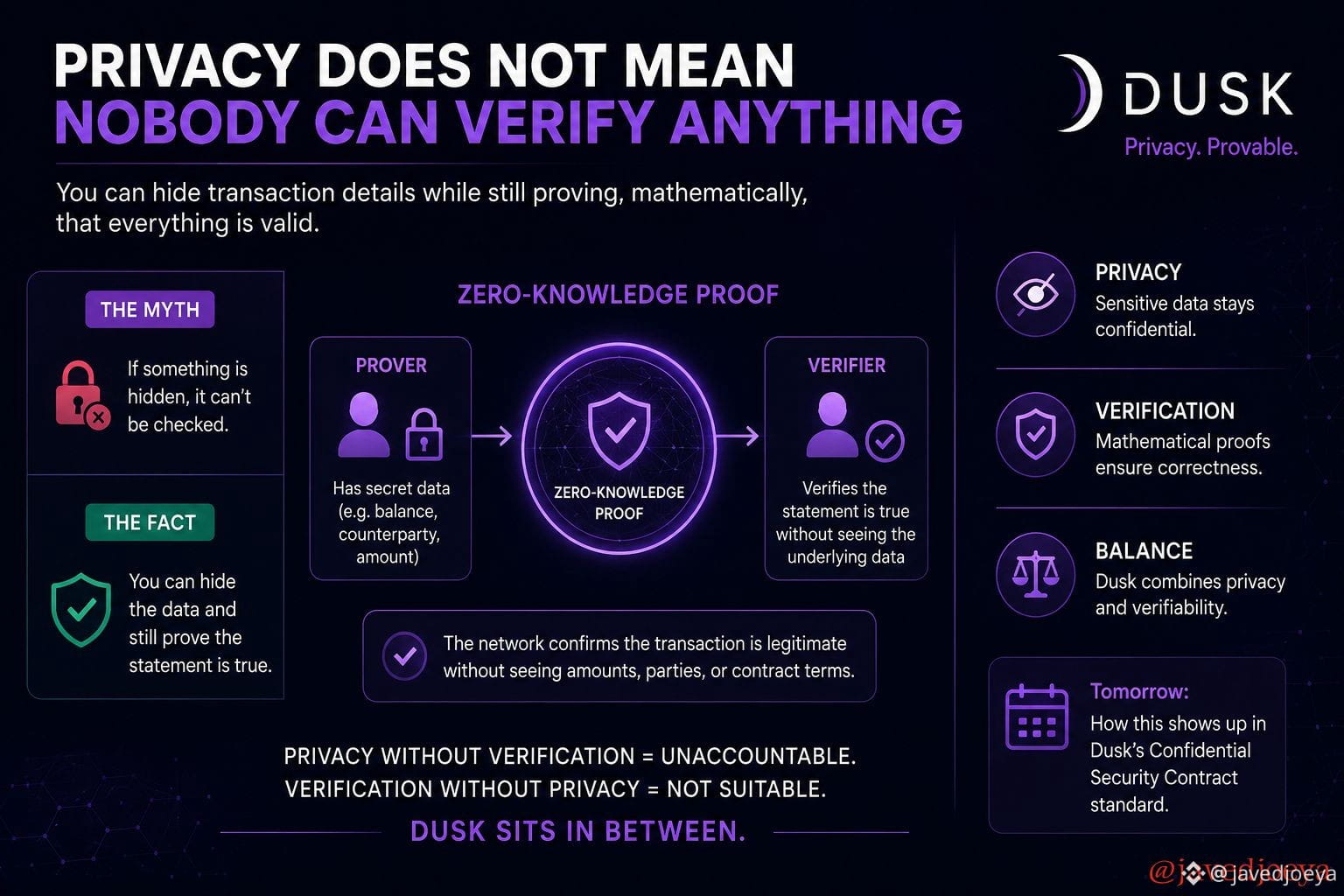
There's a common misunderstanding about privacy in blockchains: people assume that if something is hidden, it can no longer be checked. That's not how @Dusk_Foundation approaches it.
The distinction that matters here is between concealing information and proving something is true. You can hide the exact amount in a transaction while still proving, mathematically, that the sender had enough funds and that no new coins were created out of thin air. That's the basic idea behind zero-knowledge proofs.
A zero-knowledge proof lets one party convince another that a statement is true without revealing the underlying data that makes it true. In a financial context, that means a network validator can confirm a transaction is legitimate without ever seeing the balance, the counterparty, or the contract terms involved. On $DUSK 's network, this verification happens without anyone needing to trust a middleman's word.
This is where the design gets more nuanced. Privacy without verification would just be an unaccountable black box. Verification without privacy is what public chains already do, and it isn't suitable for a lot of financial activity. #dusk is trying to sit in between those two extremes.
{spot}(DUSKUSDT)
{spot}(ACEUSDT)
{alpha}(560x2c3a8ee94ddd97244a93bc48298f97d2c412f7db)
$ACE $AKE
Tomorrow I'll get into how this shows up concretely in the Confidential Security Contract standard.
There's a common misunderstanding about privacy in blockchains: people assume that if something is hidden, it can no longer be checked. That's not how @Dusk approaches it.
The distinction that matters here is between concealing information and proving something is true. You can hide the exact amount in a transaction while still proving, mathematically, that the sender had enough funds and that no new coins were created out of thin air. That's the basic idea behind zero-knowledge proofs.
A zero-knowledge proof lets one party convince another that a statement is true without revealing the underlying data that makes it true. In a financial context, that means a network validator can confirm a transaction is legitimate without ever seeing the balance, the counterparty, or the contract terms involved. On $DUSK 's network, this verification happens without anyone needing to trust a middleman's word.
This is where the design gets more nuanced. Privacy without verification would just be an unaccountable black box. Verification without privacy is what public chains already do, and it isn't suitable for a lot of financial activity. #dusk is trying to sit in between those two extremes.
$ACE $AKE
Tomorrow I'll get into how this shows up concretely in the Confidential Security Contract standard.
The distinction that matters here is between concealing information and proving something is true. You can hide the exact amount in a transaction while still proving, mathematically, that the sender had enough funds and that no new coins were created out of thin air. That's the basic idea behind zero-knowledge proofs.
A zero-knowledge proof lets one party convince another that a statement is true without revealing the underlying data that makes it true. In a financial context, that means a network validator can confirm a transaction is legitimate without ever seeing the balance, the counterparty, or the contract terms involved. On $DUSK 's network, this verification happens without anyone needing to trust a middleman's word.
This is where the design gets more nuanced. Privacy without verification would just be an unaccountable black box. Verification without privacy is what public chains already do, and it isn't suitable for a lot of financial activity. #dusk is trying to sit in between those two extremes.
$ACE $AKE
Tomorrow I'll get into how this shows up concretely in the Confidential Security Contract standard.
19
1
2
1k
·
--
Many blockchains ask institutions to give up privacy for transparency. Dusk is trying something different — proving both can coexist, and that's exactly what regulated finance needs.
Traditional financial institutions can't operate on fully public ledgers. Trade sizes, counterparties, and client data are sensitive by law, not just preference. This is the core problem @Dusk_Foundation set out to solve: a Layer 1 network designed from the ground up for compliant, privacy-preserving finance.
A few things stand out about this approach:
Confidentiality with compliance built in. Dusk uses zero-knowledge cryptography so transactions can stay private while still being verifiable and auditable when regulators require it. That's a very different model from "anonymous by default" privacy coins.
Purpose-built for tokenized securities. Rather than retrofitting a general-purpose chain, Dusk's architecture is designed around the actual requirements of security tokens — ownership rules, transfer restrictions, and identity verification.
Regulatory alignment as a design principle. Instead of treating regulation as an obstacle, Dusk builds toward frameworks like MiFID II, which matters if real financial products are ever going to settle on-chain.
Tokenizing real-world assets isn't just about issuing a token — it's about meeting the same standards institutions already follow. That's a harder problem than most crypto projects choose to tackle.
$DUSK is positioned around that long-term thesis rather than short-term hype.
Do you think privacy-preserving compliance is the missing piece for institutional blockchain adoption?
{spot}(DUSKUSDT)
{future}(APRUSDT)
#dusk #RWA #TokenizedAssets $APR $DEXE
Biggest blocker for institutions adopting tokenized RWAs? 🏦
Many blockchains ask institutions to give up privacy for transparency. Dusk is trying something different — proving both can coexist, and that's exactly what regulated finance needs.
Traditional financial institutions can't operate on fully public ledgers. Trade sizes, counterparties, and client data are sensitive by law, not just preference. This is the core problem @Dusk set out to solve: a Layer 1 network designed from the ground up for compliant, privacy-preserving finance.
A few things stand out about this approach:
Confidentiality with compliance built in. Dusk uses zero-knowledge cryptography so transactions can stay private while still being verifiable and auditable when regulators require it. That's a very different model from "anonymous by default" privacy coins.
Purpose-built for tokenized securities. Rather than retrofitting a general-purpose chain, Dusk's architecture is designed around the actual requirements of security tokens — ownership rules, transfer restrictions, and identity verification.
Regulatory alignment as a design principle. Instead of treating regulation as an obstacle, Dusk builds toward frameworks like MiFID II, which matters if real financial products are ever going to settle on-chain.
Tokenizing real-world assets isn't just about issuing a token — it's about meeting the same standards institutions already follow. That's a harder problem than most crypto projects choose to tackle.
$DUSK is positioned around that long-term thesis rather than short-term hype.
Do you think privacy-preserving compliance is the missing piece for institutional blockchain adoption?
#dusk #RWA #TokenizedAssets $APR $DEXE
Biggest blocker for institutions adopting tokenized RWAs? 🏦
Traditional financial institutions can't operate on fully public ledgers. Trade sizes, counterparties, and client data are sensitive by law, not just preference. This is the core problem @Dusk set out to solve: a Layer 1 network designed from the ground up for compliant, privacy-preserving finance.
A few things stand out about this approach:
Confidentiality with compliance built in. Dusk uses zero-knowledge cryptography so transactions can stay private while still being verifiable and auditable when regulators require it. That's a very different model from "anonymous by default" privacy coins.
Purpose-built for tokenized securities. Rather than retrofitting a general-purpose chain, Dusk's architecture is designed around the actual requirements of security tokens — ownership rules, transfer restrictions, and identity verification.
Regulatory alignment as a design principle. Instead of treating regulation as an obstacle, Dusk builds toward frameworks like MiFID II, which matters if real financial products are ever going to settle on-chain.
Tokenizing real-world assets isn't just about issuing a token — it's about meeting the same standards institutions already follow. That's a harder problem than most crypto projects choose to tackle.
$DUSK is positioned around that long-term thesis rather than short-term hype.
Do you think privacy-preserving compliance is the missing piece for institutional blockchain adoption?
#dusk #RWA #TokenizedAssets $APR $DEXE
Biggest blocker for institutions adopting tokenized RWAs? 🏦
🔒 Privacy/compliance gap
100%
⚙️ Tech infrastructure
0%
📜 Unclear regulation
0%
🐢 Slow institutional adoption
0%
1 Votes • Vote fermé
2
107
·
--
I think @babylonlabs_io has already answered one important question: can #bitcoin become more productive without changing the underlying asset?
The harder question is what comes next.
If Babylon becomes infrastructure for $BTC staking, collateral and DeFi across chains, the ecosystem could become much larger than the original staking thesis. But ecosystem growth alone doesn't automatically mean the $BABY token captures meaningful value.
This is where I would start looking more closely.
BABY already has several roles: staking, co-staking with BTC, governance, and alignment across Babylon products.
But I want to see something stronger over time:
Does increased Bitcoin activity create recurring economic demand for #baby ?
That's a much harder metric than TVL, partnerships, or social attention.
There's also another factor investors can't ignore: token supply. Babylon's published tokenomics show monthly unlocks for early investors, team and advisors beginning in May 2026 and continuing through 2029.
So my question is simple:
Can Babylon grow fast enough that real ecosystem demand eventually outweighs the pressure created by expanding token supply?
That, to me, is a far more interesting BABY thesis than simply asking whether Bitcoin staking will grow.
What matters most for $BABY long term?
I think @BabylonLabs_io has already answered one important question: can #bitcoin become more productive without changing the underlying asset?
The harder question is what comes next.
If Babylon becomes infrastructure for $BTC staking, collateral and DeFi across chains, the ecosystem could become much larger than the original staking thesis. But ecosystem growth alone doesn't automatically mean the $BABY token captures meaningful value.
This is where I would start looking more closely.
BABY already has several roles: staking, co-staking with BTC, governance, and alignment across Babylon products.
But I want to see something stronger over time:
Does increased Bitcoin activity create recurring economic demand for #baby ?
That's a much harder metric than TVL, partnerships, or social attention.
There's also another factor investors can't ignore: token supply. Babylon's published tokenomics show monthly unlocks for early investors, team and advisors beginning in May 2026 and continuing through 2029.
So my question is simple:
Can Babylon grow fast enough that real ecosystem demand eventually outweighs the pressure created by expanding token supply?
That, to me, is a far more interesting BABY thesis than simply asking whether Bitcoin staking will grow.
What matters most for $BABY long term?
The harder question is what comes next.
If Babylon becomes infrastructure for $BTC staking, collateral and DeFi across chains, the ecosystem could become much larger than the original staking thesis. But ecosystem growth alone doesn't automatically mean the $BABY token captures meaningful value.
This is where I would start looking more closely.
BABY already has several roles: staking, co-staking with BTC, governance, and alignment across Babylon products.
But I want to see something stronger over time:
Does increased Bitcoin activity create recurring economic demand for #baby ?
That's a much harder metric than TVL, partnerships, or social attention.
There's also another factor investors can't ignore: token supply. Babylon's published tokenomics show monthly unlocks for early investors, team and advisors beginning in May 2026 and continuing through 2029.
So my question is simple:
Can Babylon grow fast enough that real ecosystem demand eventually outweighs the pressure created by expanding token supply?
That, to me, is a far more interesting BABY thesis than simply asking whether Bitcoin staking will grow.
What matters most for $BABY long term?
🔹 Real Utility
100%
🔹 Value Capture
0%
🔹 Adoption
0%
🔹 Tokenomics
0%
2 Votes • Vote fermé
20
7
562
·
--
When people talk about #bitcoin , the conversation usually revolves around price. I think the next chapter could be about utility.
That's why I've been watching #baby closely.
Babylon introduces a model where Bitcoin can contribute to the security of Proof-of-Stake ecosystems while remaining under the owner's control. If this approach gains traction, it could encourage more $BTC holders to participate in the broader crypto ecosystem without giving up self-custody.
However, mass adoption is never driven by technology alone. It depends on user experience, trust, developer support, ecosystem partnerships, and consistent execution. Even the strongest ideas need a thriving community and real-world use cases to succeed.
What stands out to me is that $BABY isn't trying to change what Bitcoin is—it aims to expand what Bitcoin can do. If developers continue building around the ecosystem and adoption grows steadily, Bitcoin staking could become a more familiar concept over the coming years.
That said, the journey won't be without challenges. Competition, regulation, and market conditions will all influence how quickly this vision becomes reality.
My view: @babylonlabs_io has an ambitious roadmap, but long-term success will depend on execution, ecosystem growth, and genuine user adoption—not hype.
Do you think Bitcoin staking can become mainstream, or will it remain a niche use case?
#BinanceSquare $BANK
What's the biggest driver of mass adoption? 🌍
When people talk about #bitcoin , the conversation usually revolves around price. I think the next chapter could be about utility.
That's why I've been watching #baby closely.
Babylon introduces a model where Bitcoin can contribute to the security of Proof-of-Stake ecosystems while remaining under the owner's control. If this approach gains traction, it could encourage more $BTC holders to participate in the broader crypto ecosystem without giving up self-custody.
However, mass adoption is never driven by technology alone. It depends on user experience, trust, developer support, ecosystem partnerships, and consistent execution. Even the strongest ideas need a thriving community and real-world use cases to succeed.
What stands out to me is that $BABY isn't trying to change what Bitcoin is—it aims to expand what Bitcoin can do. If developers continue building around the ecosystem and adoption grows steadily, Bitcoin staking could become a more familiar concept over the coming years.
That said, the journey won't be without challenges. Competition, regulation, and market conditions will all influence how quickly this vision becomes reality.
My view: @BabylonLabs_io has an ambitious roadmap, but long-term success will depend on execution, ecosystem growth, and genuine user adoption—not hype.
Do you think Bitcoin staking can become mainstream, or will it remain a niche use case?
#BinanceSquare $BANK
What's the biggest driver of mass adoption? 🌍
That's why I've been watching #baby closely.
Babylon introduces a model where Bitcoin can contribute to the security of Proof-of-Stake ecosystems while remaining under the owner's control. If this approach gains traction, it could encourage more $BTC holders to participate in the broader crypto ecosystem without giving up self-custody.
However, mass adoption is never driven by technology alone. It depends on user experience, trust, developer support, ecosystem partnerships, and consistent execution. Even the strongest ideas need a thriving community and real-world use cases to succeed.
What stands out to me is that $BABY isn't trying to change what Bitcoin is—it aims to expand what Bitcoin can do. If developers continue building around the ecosystem and adoption grows steadily, Bitcoin staking could become a more familiar concept over the coming years.
That said, the journey won't be without challenges. Competition, regulation, and market conditions will all influence how quickly this vision becomes reality.
My view: @BabylonLabs_io has an ambitious roadmap, but long-term success will depend on execution, ecosystem growth, and genuine user adoption—not hype.
Do you think Bitcoin staking can become mainstream, or will it remain a niche use case?
#BinanceSquare $BANK
What's the biggest driver of mass adoption? 🌍
👥 Users
50%
👨💻 Builders
50%
🤝 Partners
0%
🔒 Trust
0%
2 Votes • Vote fermé
14
8
291
Connectez-vous pour découvrir plus de contenu
Rejoignez la communauté mondiale des adeptes de cryptomonnaies sur Binance Square
⚡️ Suviez les dernières informations importantes sur les cryptomonnaies.
💬 Jugé digne de confiance par la plus grande plateforme d’échange de cryptomonnaies au monde.
👍 Découvrez les connaissances que partagent les créateurs vérifiés.
Adresse e-mail/Nº de téléphone
Sujets d’actualité
BinanceLaunchesBinanceIntelligence
483,136 vues
3,322 mentions
Binance Intelligence is Binance's suite of AI-powered tools and infrastructure integrated directly into the Binance ecosystem. It is designed to assist traders and investors by automating market analysis, risk monitoring, and decision-making tools
#BinanceLaunchesBinanceIntelligence
CryptofactswithFARAZ
·1 mentions J’aime
·130 vues
BitcoinTargets2026OpenAt$87570
3,365 vues
89 mentions
BitcoinRejectedAt$87KThirdTime
3,068 vues
73 mentions