

VICTORIA _777
13.3k Publications

VICTORIA _777
 Compte Square Vérifié+
Signaler
Bloquer l’utilisateur
Ouvert au trading
Trade régulièrement
1 an(s)
106 Suivis
34.3K+ Abonnés
28.8K+ J’aime
Publications
Portefeuille
Tous
Citations
Direct
PINNED
·
--
Haussier
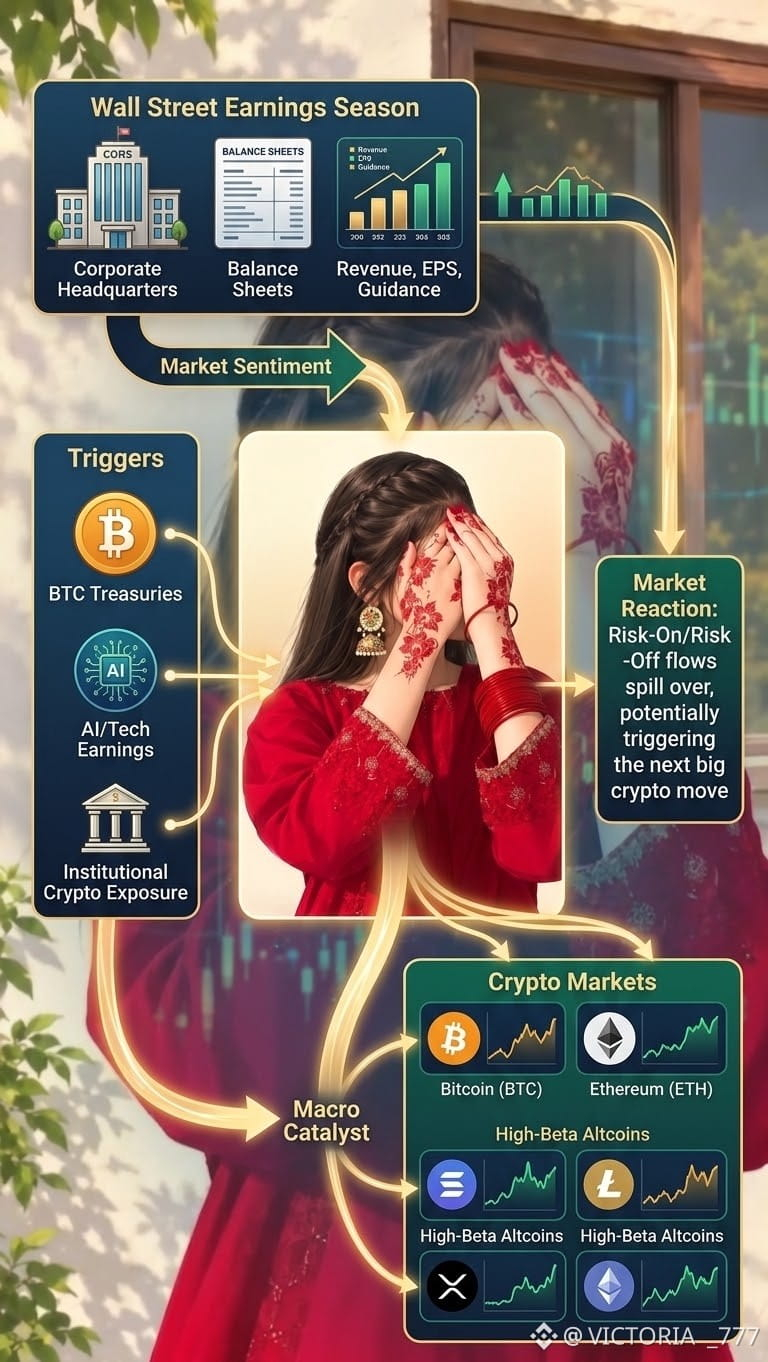
#EarningsSeason is becoming a major macro catalyst for crypto.
Wall Street earnings don’t stay on Wall Street anymore.
Corporate Bitcoin holders, miners and major tech companies are putting balance sheets, liquidity and risk appetite under the spotlight.
Strong corporate results can reinforce confidence and risk-on flows, while weak guidance can trigger a rapid shift toward risk-off positioning.
The biggest signal isn’t just EPS or revenue.
Watch BTC treasury activity, AI/tech earnings, institutional crypto exposure and management guidance.
As more earnings hit, the reaction in equities could quickly spill into BTC, ETH and high-beta altcoins.
The next big crypto move may start with a Wall Street earnings report.
#Bitcoin #BTC #ETH #Crypto
$OG
{future}(OGUSDT)
$ESPORTS
{future}(ESPORTSUSDT)
$CRV
{future}(CRVUSDT)
#EarningsSeason is becoming a major macro catalyst for crypto.
Wall Street earnings don’t stay on Wall Street anymore.
Corporate Bitcoin holders, miners and major tech companies are putting balance sheets, liquidity and risk appetite under the spotlight.
Strong corporate results can reinforce confidence and risk-on flows, while weak guidance can trigger a rapid shift toward risk-off positioning.
The biggest signal isn’t just EPS or revenue.
Watch BTC treasury activity, AI/tech earnings, institutional crypto exposure and management guidance.
As more earnings hit, the reaction in equities could quickly spill into BTC, ETH and high-beta altcoins.
The next big crypto move may start with a Wall Street earnings report.
#Bitcoin #BTC #ETH #Crypto
$OG
$ESPORTS
$CRV
Wall Street earnings don’t stay on Wall Street anymore.
Corporate Bitcoin holders, miners and major tech companies are putting balance sheets, liquidity and risk appetite under the spotlight.
Strong corporate results can reinforce confidence and risk-on flows, while weak guidance can trigger a rapid shift toward risk-off positioning.
The biggest signal isn’t just EPS or revenue.
Watch BTC treasury activity, AI/tech earnings, institutional crypto exposure and management guidance.
As more earnings hit, the reaction in equities could quickly spill into BTC, ETH and high-beta altcoins.
The next big crypto move may start with a Wall Street earnings report.
#Bitcoin #BTC #ETH #Crypto
$OG
$ESPORTS
$CRV
5
7
505
·
--
Haussier
Vérifié
Worked for 15s
Yeh version latest verified data ko combine karta hai — Nvidia, Reuters, Goldman Sachs aur current market figures ke saath.
#AIStocksWhatNext
AI stocks just entered another level — but the numbers behind this rally are where things get interesting.
On September 22, the Nasdaq hit a record intraday 27,212.68, while AMD crossed the $1 trillion market-cap mark.
Nvidia’s latest quarter delivered $96.2B revenue, up 106% YoY, with Data Center revenue hitting $89B, up 117%. Nvidia also expects roughly 70% fiscal-2028 revenue growth.
Now comes the shocker: Goldman Sachs estimates major AI hyperscalers could spend around $527B on capex in 2026, while broader global AI investment could exceed $1T this year.
That means the next AI-stock story may not be about demand alone.
The real question is simple:
Can revenue, margins and cash flow keep up with this historic spending?
The AI boom is real. Now the market wants proof.
$TAKE
{future}(TAKEUSDT)
$MET
{future}(METUSDT)
$DASH
{future}(DASHUSDT)
#AIStocksWhatNext #Stocks #Nvidia #Investing
#aistockswhatnext
Worked for 15s
Yeh version latest verified data ko combine karta hai — Nvidia, Reuters, Goldman Sachs aur current market figures ke saath.
#AIStocksWhatNext
AI stocks just entered another level — but the numbers behind this rally are where things get interesting.
On September 22, the Nasdaq hit a record intraday 27,212.68, while AMD crossed the $1 trillion market-cap mark.
Nvidia’s latest quarter delivered $96.2B revenue, up 106% YoY, with Data Center revenue hitting $89B, up 117%. Nvidia also expects roughly 70% fiscal-2028 revenue growth.
Now comes the shocker: Goldman Sachs estimates major AI hyperscalers could spend around $527B on capex in 2026, while broader global AI investment could exceed $1T this year.
That means the next AI-stock story may not be about demand alone.
The real question is simple:
Can revenue, margins and cash flow keep up with this historic spending?
The AI boom is real. Now the market wants proof.
$TAKE
$MET
$DASH
#AIStocksWhatNext #Stocks #Nvidia #Investing
#aistockswhatnext
Yeh version latest verified data ko combine karta hai — Nvidia, Reuters, Goldman Sachs aur current market figures ke saath.
#AIStocksWhatNext
AI stocks just entered another level — but the numbers behind this rally are where things get interesting.
On September 22, the Nasdaq hit a record intraday 27,212.68, while AMD crossed the $1 trillion market-cap mark.
Nvidia’s latest quarter delivered $96.2B revenue, up 106% YoY, with Data Center revenue hitting $89B, up 117%. Nvidia also expects roughly 70% fiscal-2028 revenue growth.
Now comes the shocker: Goldman Sachs estimates major AI hyperscalers could spend around $527B on capex in 2026, while broader global AI investment could exceed $1T this year.
That means the next AI-stock story may not be about demand alone.
The real question is simple:
Can revenue, margins and cash flow keep up with this historic spending?
The AI boom is real. Now the market wants proof.
$TAKE
$MET
$DASH
#AIStocksWhatNext #Stocks #Nvidia #Investing
#aistockswhatnext

10
15
1.6k
·
--
Haussier
The Fed may hike rates.
But honestly, I don’t think the hike itself is the biggest risk.
Markets already expect it.
The real question is what Powell says after the decision.
If the Fed signals that this is only a one-off adjustment, risk assets could breathe again.
But if the message is clear that more tightening is coming, that changes everything.
Higher yields.
Stronger dollar.
More pressure on tech.
More pressure on gold.
And BTC could see some serious volatility.
That’s why I’m not interested in chasing the headline.
I’m watching the reaction.
BTC first.
Then gold.
Then tech.
If BTC holds up while yields stay elevated, that tells me something.
If BTC breaks down and the dollar keeps pushing higher, that tells me something else.
The rate hike is the headline.
The guidance is the trade.
And sometimes the biggest move comes after everyone thinks the event is already priced in.
#FedRateWatch
$AIN
{future}(AINUSDT)
$AKE
{future}(AKEUSDT)
$POWER
{future}(POWERUSDT)
The Fed may hike rates.
But honestly, I don’t think the hike itself is the biggest risk.
Markets already expect it.
The real question is what Powell says after the decision.
If the Fed signals that this is only a one-off adjustment, risk assets could breathe again.
But if the message is clear that more tightening is coming, that changes everything.
Higher yields.
Stronger dollar.
More pressure on tech.
More pressure on gold.
And BTC could see some serious volatility.
That’s why I’m not interested in chasing the headline.
I’m watching the reaction.
BTC first.
Then gold.
Then tech.
If BTC holds up while yields stay elevated, that tells me something.
If BTC breaks down and the dollar keeps pushing higher, that tells me something else.
The rate hike is the headline.
The guidance is the trade.
And sometimes the biggest move comes after everyone thinks the event is already priced in.
#FedRateWatch
$AIN
$AKE
$POWER
But honestly, I don’t think the hike itself is the biggest risk.
Markets already expect it.
The real question is what Powell says after the decision.
If the Fed signals that this is only a one-off adjustment, risk assets could breathe again.
But if the message is clear that more tightening is coming, that changes everything.
Higher yields.
Stronger dollar.
More pressure on tech.
More pressure on gold.
And BTC could see some serious volatility.
That’s why I’m not interested in chasing the headline.
I’m watching the reaction.
BTC first.
Then gold.
Then tech.
If BTC holds up while yields stay elevated, that tells me something.
If BTC breaks down and the dollar keeps pushing higher, that tells me something else.
The rate hike is the headline.
The guidance is the trade.
And sometimes the biggest move comes after everyone thinks the event is already priced in.
#FedRateWatch
$AIN
$AKE
$POWER

13
7
30
2.3k
·
--
Haussier
🚀$BR
{future}(BRUSDT)
EXPLODES OFF THE BASE — +49.77%**
BR has been on an absolute tear. After basing near 0.29754, price fired off a massive vertical rally straight to a fresh high of 0.39541, before cooling off slightly to settle at current levels.
📊 **24h High:** 0.39541
📉 **24h Low:** 0.24699
💰 **Current:** 0.37125
📦 **24h Volume:** 187.63M BR (63.55M USDT)
The breakout candle here is massive — price nearly doubled off the base in a short window, showing serious buying pressure all at once. Since hitting the high, price has pulled back modestly and is now consolidating around 0.37125, still holding well above the breakout zone.
🔑 **Key level to watch:** 0.35724. Hold above this and bulls stay firmly in control, keeping the door open for another push toward 0.39541. Lose this level and a slide back toward 0.33571 becomes the risk.
Massive volume, massive move — 227.84% over 90 days and still climbing. This one has serious momentum behind it.
**LET'S GO AND TRADE NOW $BR
$BTW
{future}(BTWUSDT)
$REZ
{future}(REZUSDT)
🚀$BR
EXPLODES OFF THE BASE — +49.77%**
BR has been on an absolute tear. After basing near 0.29754, price fired off a massive vertical rally straight to a fresh high of 0.39541, before cooling off slightly to settle at current levels.
📊 **24h High:** 0.39541
📉 **24h Low:** 0.24699
💰 **Current:** 0.37125
📦 **24h Volume:** 187.63M BR (63.55M USDT)
The breakout candle here is massive — price nearly doubled off the base in a short window, showing serious buying pressure all at once. Since hitting the high, price has pulled back modestly and is now consolidating around 0.37125, still holding well above the breakout zone.
🔑 **Key level to watch:** 0.35724. Hold above this and bulls stay firmly in control, keeping the door open for another push toward 0.39541. Lose this level and a slide back toward 0.33571 becomes the risk.
Massive volume, massive move — 227.84% over 90 days and still climbing. This one has serious momentum behind it.
**LET'S GO AND TRADE NOW $BR
$BTW
$REZ
EXPLODES OFF THE BASE — +49.77%**
BR has been on an absolute tear. After basing near 0.29754, price fired off a massive vertical rally straight to a fresh high of 0.39541, before cooling off slightly to settle at current levels.
📊 **24h High:** 0.39541
📉 **24h Low:** 0.24699
💰 **Current:** 0.37125
📦 **24h Volume:** 187.63M BR (63.55M USDT)
The breakout candle here is massive — price nearly doubled off the base in a short window, showing serious buying pressure all at once. Since hitting the high, price has pulled back modestly and is now consolidating around 0.37125, still holding well above the breakout zone.
🔑 **Key level to watch:** 0.35724. Hold above this and bulls stay firmly in control, keeping the door open for another push toward 0.39541. Lose this level and a slide back toward 0.33571 becomes the risk.
Massive volume, massive move — 227.84% over 90 days and still climbing. This one has serious momentum behind it.
**LET'S GO AND TRADE NOW $BR
$BTW
$REZ
$BR 🫣
25%
$BTW 🧐
44%
$REZ 🫠
31%
16 Votes • Vote fermé
1
1.4k
·
--
Haussier
$BTW
{future}(BTWUSDT)
USDT 🔥
BTWUSDT is currently trading around 0.49963, up +8.80%. It may not be the biggest gainer on the list, but momentum is building. I’m watching for a clean breakout and retest rather than entering simply because the candle is green.
TP: 0.550 → 0.600
SL: 0.470
No FOMO. No revenge trades. Just levels, confirmation and execution. 🚀
$BTW
USDT 🔥
BTWUSDT is currently trading around 0.49963, up +8.80%. It may not be the biggest gainer on the list, but momentum is building. I’m watching for a clean breakout and retest rather than entering simply because the candle is green.
TP: 0.550 → 0.600
SL: 0.470
No FOMO. No revenge trades. Just levels, confirmation and execution. 🚀
USDT 🔥
BTWUSDT is currently trading around 0.49963, up +8.80%. It may not be the biggest gainer on the list, but momentum is building. I’m watching for a clean breakout and retest rather than entering simply because the candle is green.
TP: 0.550 → 0.600
SL: 0.470
No FOMO. No revenge trades. Just levels, confirmation and execution. 🚀
1
67
$THETA
{future}(THETAUSDT)
USDT 📈
THETAUSDT is showing nearly +10%, currently around 0.1907. Momentum is positive, but the next major move depends on whether buyers can confirm a resistance breakout. If they do, higher targets could come into play.
TP: 0.210 → 0.228
SL: 0.179
The chart gives opportunities. Risk management decides whether you keep them. ⚡
$THETA
USDT 📈
THETAUSDT is showing nearly +10%, currently around 0.1907. Momentum is positive, but the next major move depends on whether buyers can confirm a resistance breakout. If they do, higher targets could come into play.
TP: 0.210 → 0.228
SL: 0.179
The chart gives opportunities. Risk management decides whether you keep them. ⚡
USDT 📈
THETAUSDT is showing nearly +10%, currently around 0.1907. Momentum is positive, but the next major move depends on whether buyers can confirm a resistance breakout. If they do, higher targets could come into play.
TP: 0.210 → 0.228
SL: 0.179
The chart gives opportunities. Risk management decides whether you keep them. ⚡
1
45
$4
{future}(4USDT)
USDT 🚀
4USDT is up +10.06%, currently trading around 0.019485. Double-digit momentum always attracts attention, but it can also attract late buyers. I’d rather see a pullback, support confirmation and then continuation than chase an already extended candle.
TP: 0.0214 → 0.0233
SL: 0.0182
Small risk. Clear invalidation. Strong discipline. 🎯
$4
USDT 🚀
4USDT is up +10.06%, currently trading around 0.019485. Double-digit momentum always attracts attention, but it can also attract late buyers. I’d rather see a pullback, support confirmation and then continuation than chase an already extended candle.
TP: 0.0214 → 0.0233
SL: 0.0182
Small risk. Clear invalidation. Strong discipline. 🎯
USDT 🚀
4USDT is up +10.06%, currently trading around 0.019485. Double-digit momentum always attracts attention, but it can also attract late buyers. I’d rather see a pullback, support confirmation and then continuation than chase an already extended candle.
TP: 0.0214 → 0.0233
SL: 0.0182
Small risk. Clear invalidation. Strong discipline. 🎯
1
80
$FF
{future}(FFUSDT)
USDT ⚡
FFUSDT has gained +10.21%, reaching around 0.16489. The question now is whether this is simply a bounce or the beginning of a larger continuation. I’m watching higher lows and volume closely.
TP: 0.181 → 0.197
SL: 0.155
Profit is the goal. Risk control is the survival strategy. 🔥
$FF
USDT ⚡
FFUSDT has gained +10.21%, reaching around 0.16489. The question now is whether this is simply a bounce or the beginning of a larger continuation. I’m watching higher lows and volume closely.
TP: 0.181 → 0.197
SL: 0.155
Profit is the goal. Risk control is the survival strategy. 🔥
USDT ⚡
FFUSDT has gained +10.21%, reaching around 0.16489. The question now is whether this is simply a bounce or the beginning of a larger continuation. I’m watching higher lows and volume closely.
TP: 0.181 → 0.197
SL: 0.155
Profit is the goal. Risk control is the survival strategy. 🔥
2
93
$SAGA
{future}(SAGAUSDT)
USDT 🔥
SAGAUSDT is currently around 0.01623, up +10.78%. The move is catching attention, but the next breakout will tell the real story. If buyers push through resistance with volume, continuation could follow.
TP: 0.0178 → 0.0192
SL: 0.0152
No blind entries. Confirmation first. 🎯
$SAGA
USDT 🔥
SAGAUSDT is currently around 0.01623, up +10.78%. The move is catching attention, but the next breakout will tell the real story. If buyers push through resistance with volume, continuation could follow.
TP: 0.0178 → 0.0192
SL: 0.0152
No blind entries. Confirmation first. 🎯
USDT 🔥
SAGAUSDT is currently around 0.01623, up +10.78%. The move is catching attention, but the next breakout will tell the real story. If buyers push through resistance with volume, continuation could follow.
TP: 0.0178 → 0.0192
SL: 0.0152
No blind entries. Confirmation first. 🎯
1
58
$我踏马来了
{alpha}(560xc51a9250795c0186a6fb4a7d20a90330651e4444)
USDT 👀
我踏马来了USDT is up +14.86%, trading around 0.011951. This is the kind of high-volatility move where candles can move extremely fast in both directions. Position sizing and a clear invalidation level matter more than ever.
TP: 0.0130 → 0.0140
SL: 0.0112
High volatility. High opportunity. But also high risk. ⚠️
$我踏马来了
USDT 👀
我踏马来了USDT is up +14.86%, trading around 0.011951. This is the kind of high-volatility move where candles can move extremely fast in both directions. Position sizing and a clear invalidation level matter more than ever.
TP: 0.0130 → 0.0140
SL: 0.0112
High volatility. High opportunity. But also high risk. ⚠️
USDT 👀
我踏马来了USDT is up +14.86%, trading around 0.011951. This is the kind of high-volatility move where candles can move extremely fast in both directions. Position sizing and a clear invalidation level matter more than ever.
TP: 0.0130 → 0.0140
SL: 0.0112
High volatility. High opportunity. But also high risk. ⚠️
3
259
$RAYSOL
{future}(RAYSOLUSDT)
USDT 🚀
RAYSOLUSDT is showing serious strength with +17.91%, currently around 1.5894. If buyers turn the breakout zone into solid support, the next leg could become interesting. But losing that structure could trigger fast profit-taking.
TP: 1.72 → 1.85
SL: 1.50
Strong momentum needs strong risk management. 🔥
$RAYSOL
USDT 🚀
RAYSOLUSDT is showing serious strength with +17.91%, currently around 1.5894. If buyers turn the breakout zone into solid support, the next leg could become interesting. But losing that structure could trigger fast profit-taking.
TP: 1.72 → 1.85
SL: 1.50
Strong momentum needs strong risk management. 🔥
USDT 🚀
RAYSOLUSDT is showing serious strength with +17.91%, currently around 1.5894. If buyers turn the breakout zone into solid support, the next leg could become interesting. But losing that structure could trigger fast profit-taking.
TP: 1.72 → 1.85
SL: 1.50
Strong momentum needs strong risk management. 🔥
1
122
$MET
{future}(METUSDT)
USDT 🔥
METUSDT is sitting around 0.2536, up +19.40%. The momentum is obvious, but after a strong pump, consolidation can be more valuable than another instant entry. I’m watching for a clean retest and support confirmation.
TP: 0.275 → 0.295
SL: 0.240
Let the market come to your entry. Don’t chase it. ⚡
$MET
USDT 🔥
METUSDT is sitting around 0.2536, up +19.40%. The momentum is obvious, but after a strong pump, consolidation can be more valuable than another instant entry. I’m watching for a clean retest and support confirmation.
TP: 0.275 → 0.295
SL: 0.240
Let the market come to your entry. Don’t chase it. ⚡
USDT 🔥
METUSDT is sitting around 0.2536, up +19.40%. The momentum is obvious, but after a strong pump, consolidation can be more valuable than another instant entry. I’m watching for a clean retest and support confirmation.
TP: 0.275 → 0.295
SL: 0.240
Let the market come to your entry. Don’t chase it. ⚡
55
$LSK
{future}(LSKUSDT)
USDT ⚡
LSKUSDT has delivered a strong +19.50% move and is currently around 0.13646. Buyers have momentum, but resistance could create volatility. A healthy pullback followed by a higher low would make the setup much more interesting.
TP: 0.148 → 0.160
SL: 0.128
Patience can be the difference between a trade and a trap. 🎯
$LSK
USDT ⚡
LSKUSDT has delivered a strong +19.50% move and is currently around 0.13646. Buyers have momentum, but resistance could create volatility. A healthy pullback followed by a higher low would make the setup much more interesting.
TP: 0.148 → 0.160
SL: 0.128
Patience can be the difference between a trade and a trap. 🎯
USDT ⚡
LSKUSDT has delivered a strong +19.50% move and is currently around 0.13646. Buyers have momentum, but resistance could create volatility. A healthy pullback followed by a higher low would make the setup much more interesting.
TP: 0.148 → 0.160
SL: 0.128
Patience can be the difference between a trade and a trap. 🎯
65
$MARSCOIN
{future}(MARSCOINUSDT)
USDT 🚀
MARSCOINUSDT is up +22.82%, trading around 0.12692. That is a serious momentum move. The real battle starts here: can buyers defend the new support and push toward fresh highs, or will profit-taking take control?
TP: 0.138 → 0.150
SL: 0.119
I’m watching structure, volume and confirmation—not emotions. 🔥
$MARSCOIN
USDT 🚀
MARSCOINUSDT is up +22.82%, trading around 0.12692. That is a serious momentum move. The real battle starts here: can buyers defend the new support and push toward fresh highs, or will profit-taking take control?
TP: 0.138 → 0.150
SL: 0.119
I’m watching structure, volume and confirmation—not emotions. 🔥
USDT 🚀
MARSCOINUSDT is up +22.82%, trading around 0.12692. That is a serious momentum move. The real battle starts here: can buyers defend the new support and push toward fresh highs, or will profit-taking take control?
TP: 0.138 → 0.150
SL: 0.119
I’m watching structure, volume and confirmation—not emotions. 🔥
113
$LAB
{future}(LABUSDT)
USDT 🧪🔥
LABUSDT is moving hard, currently at 0.06064 with a +23.30% gain. The buyers have made their presence obvious. Now I want to see whether price can hold the breakout area instead of immediately giving back the move.
TP: 0.066 → 0.072
SL: 0.057
Breakout + confirmation = interesting. FOMO = dangerous. 👀
$LAB
USDT 🧪🔥
LABUSDT is moving hard, currently at 0.06064 with a +23.30% gain. The buyers have made their presence obvious. Now I want to see whether price can hold the breakout area instead of immediately giving back the move.
TP: 0.066 → 0.072
SL: 0.057
Breakout + confirmation = interesting. FOMO = dangerous. 👀
USDT 🧪🔥
LABUSDT is moving hard, currently at 0.06064 with a +23.30% gain. The buyers have made their presence obvious. Now I want to see whether price can hold the breakout area instead of immediately giving back the move.
TP: 0.066 → 0.072
SL: 0.057
Breakout + confirmation = interesting. FOMO = dangerous. 👀
187
$哈基米
{future}(哈基米USDT)
USDT ⚡
哈基米USDT is up an impressive +33.13%, trading around 0.03958. Buyers are clearly showing strength, but after a move like this, the next reaction becomes critical. If the breakout holds and support turns strong, another push could be coming.
TP: 0.043 → 0.047
SL: 0.037
Don’t chase the green candle. Trade the setup. 🎯
$哈基米
USDT ⚡
哈基米USDT is up an impressive +33.13%, trading around 0.03958. Buyers are clearly showing strength, but after a move like this, the next reaction becomes critical. If the breakout holds and support turns strong, another push could be coming.
TP: 0.043 → 0.047
SL: 0.037
Don’t chase the green candle. Trade the setup. 🎯
USDT ⚡
哈基米USDT is up an impressive +33.13%, trading around 0.03958. Buyers are clearly showing strength, but after a move like this, the next reaction becomes critical. If the breakout holds and support turns strong, another push could be coming.
TP: 0.043 → 0.047
SL: 0.037
Don’t chase the green candle. Trade the setup. 🎯
326
$牛来
{future}(牛来USDT)
USDT 🚀
牛来USDT is stealing the spotlight with an explosive +90.90% move, currently around 0.14558. This kind of momentum can attract serious FOMO, but chasing a vertical move is where traders get trapped. I’m watching for confirmation and a clean retest before taking any aggressive position.
TP: 0.157 → 0.168
SL: 0.137
Momentum is powerful, but discipline is stronger. 🔥
$牛来
USDT 🚀
牛来USDT is stealing the spotlight with an explosive +90.90% move, currently around 0.14558. This kind of momentum can attract serious FOMO, but chasing a vertical move is where traders get trapped. I’m watching for confirmation and a clean retest before taking any aggressive position.
TP: 0.157 → 0.168
SL: 0.137
Momentum is powerful, but discipline is stronger. 🔥
USDT 🚀
牛来USDT is stealing the spotlight with an explosive +90.90% move, currently around 0.14558. This kind of momentum can attract serious FOMO, but chasing a vertical move is where traders get trapped. I’m watching for confirmation and a clean retest before taking any aggressive position.
TP: 0.157 → 0.168
SL: 0.137
Momentum is powerful, but discipline is stronger. 🔥
633
·
--
Haussier
Vérifié
The labor market just made the Fed’s job harder. 👀
August NFP came in stronger than expected at 162K, while unemployment held at 4.1%.
That tells me the economy isn’t showing enough weakness to force the Fed’s hand toward easier policy.
But now inflation takes center stage.
August PPI came in hot at 0.4% MoM and 5.4% YoY, while rising energy prices could add even more pressure.
So I’m leaning slightly risk-off heading into CPI.
A hotter CPI — especially a sticky core print — could push rate expectations higher, lift Treasury yields and strengthen the dollar. That’s not exactly the setup stocks and gold want.
But here’s where it gets interesting.
If CPI comes in cooler than expected, the entire narrative could reverse almost instantly.
Markets don’t trade the number alone.
They trade the surprise.
Hotter than expected = potentially bearish.
Cooler than expected = potentially bullish.
For now, I’m not picking a side.
I’m watching the gap between CPI and expectations.
That’s where the real volatility could start. 👀
#CPIWatch
$RAYSOL
{future}(RAYSOLUSDT)
$KOMA
{future}(KOMAUSDT)
The labor market just made the Fed’s job harder. 👀
August NFP came in stronger than expected at 162K, while unemployment held at 4.1%.
That tells me the economy isn’t showing enough weakness to force the Fed’s hand toward easier policy.
But now inflation takes center stage.
August PPI came in hot at 0.4% MoM and 5.4% YoY, while rising energy prices could add even more pressure.
So I’m leaning slightly risk-off heading into CPI.
A hotter CPI — especially a sticky core print — could push rate expectations higher, lift Treasury yields and strengthen the dollar. That’s not exactly the setup stocks and gold want.
But here’s where it gets interesting.
If CPI comes in cooler than expected, the entire narrative could reverse almost instantly.
Markets don’t trade the number alone.
They trade the surprise.
Hotter than expected = potentially bearish.
Cooler than expected = potentially bullish.
For now, I’m not picking a side.
I’m watching the gap between CPI and expectations.
That’s where the real volatility could start. 👀
#CPIWatch
$RAYSOL
$KOMA
August NFP came in stronger than expected at 162K, while unemployment held at 4.1%.
That tells me the economy isn’t showing enough weakness to force the Fed’s hand toward easier policy.
But now inflation takes center stage.
August PPI came in hot at 0.4% MoM and 5.4% YoY, while rising energy prices could add even more pressure.
So I’m leaning slightly risk-off heading into CPI.
A hotter CPI — especially a sticky core print — could push rate expectations higher, lift Treasury yields and strengthen the dollar. That’s not exactly the setup stocks and gold want.
But here’s where it gets interesting.
If CPI comes in cooler than expected, the entire narrative could reverse almost instantly.
Markets don’t trade the number alone.
They trade the surprise.
Hotter than expected = potentially bearish.
Cooler than expected = potentially bullish.
For now, I’m not picking a side.
I’m watching the gap between CPI and expectations.
That’s where the real volatility could start. 👀
#CPIWatch
$RAYSOL
$KOMA

90
19
55
1.2k
·
--
Haussier
🔥 **$ORDER
{future}(ORDERUSDT)
IS BACK ON THE BREAKOUT, UP +6.30%** 🔥
Orderly has had a strong, wave-like climb today. From a low of **0.03411**, it built a solid uptrend through multiple rally phases, tagged a high of **0.03860**, pulled back to reload, and is now pushing back up to a fresh push at **0.03781**.
📊 **24h High:** 0.03860
📊 **24h Low:** 0.03374
📊 **Current:** 0.03781 (Rs10.49)
📊 **Mark Price:** 0.03797
📊 **Volume (ORDER):** 171.79M
📊 **Volume (USDT):** 6.30M
The chart shows a healthy stair-step rally — a strong initial breakout from 0.0341, then a mid-session consolidation, before a second wave pushed price to the 0.0386 high. From there, a pullback into 0.0359 gave buyers a fresh base, and the latest surge has taken price right back to the recent highs.
🎯 **Key level to watch:** 0.03860 — a break and hold above this reopens the door to fresh highs.
⚠️ **Support to defend:** 0.03685 — losing this could stall the latest push.
Strong volume, clean multi-wave uptrend — buyers pushing into the close.
**LET'S GO AND TRADE NOW $ORDER * 🚀
🔥 **$ORDER
IS BACK ON THE BREAKOUT, UP +6.30%** 🔥
Orderly has had a strong, wave-like climb today. From a low of **0.03411**, it built a solid uptrend through multiple rally phases, tagged a high of **0.03860**, pulled back to reload, and is now pushing back up to a fresh push at **0.03781**.
📊 **24h High:** 0.03860
📊 **24h Low:** 0.03374
📊 **Current:** 0.03781 (Rs10.49)
📊 **Mark Price:** 0.03797
📊 **Volume (ORDER):** 171.79M
📊 **Volume (USDT):** 6.30M
The chart shows a healthy stair-step rally — a strong initial breakout from 0.0341, then a mid-session consolidation, before a second wave pushed price to the 0.0386 high. From there, a pullback into 0.0359 gave buyers a fresh base, and the latest surge has taken price right back to the recent highs.
🎯 **Key level to watch:** 0.03860 — a break and hold above this reopens the door to fresh highs.
⚠️ **Support to defend:** 0.03685 — losing this could stall the latest push.
Strong volume, clean multi-wave uptrend — buyers pushing into the close.
**LET'S GO AND TRADE NOW $ORDER * 🚀
IS BACK ON THE BREAKOUT, UP +6.30%** 🔥
Orderly has had a strong, wave-like climb today. From a low of **0.03411**, it built a solid uptrend through multiple rally phases, tagged a high of **0.03860**, pulled back to reload, and is now pushing back up to a fresh push at **0.03781**.
📊 **24h High:** 0.03860
📊 **24h Low:** 0.03374
📊 **Current:** 0.03781 (Rs10.49)
📊 **Mark Price:** 0.03797
📊 **Volume (ORDER):** 171.79M
📊 **Volume (USDT):** 6.30M
The chart shows a healthy stair-step rally — a strong initial breakout from 0.0341, then a mid-session consolidation, before a second wave pushed price to the 0.0386 high. From there, a pullback into 0.0359 gave buyers a fresh base, and the latest surge has taken price right back to the recent highs.
🎯 **Key level to watch:** 0.03860 — a break and hold above this reopens the door to fresh highs.
⚠️ **Support to defend:** 0.03685 — losing this could stall the latest push.
Strong volume, clean multi-wave uptrend — buyers pushing into the close.
**LET'S GO AND TRADE NOW $ORDER * 🚀

1
568
Connectez-vous pour découvrir plus de contenu
Rejoignez la communauté mondiale des adeptes de cryptomonnaies sur Binance Square
⚡️ Suviez les dernières informations importantes sur les cryptomonnaies.
💬 Jugé digne de confiance par la plus grande plateforme d’échange de cryptomonnaies au monde.
👍 Découvrez les connaissances que partagent les créateurs vérifiés.
Adresse e-mail/Nº de téléphone
Sujets d’actualité
EtherGains70.9%InQ3
33,261 vues
455 mentions
One of the best third quarters in history 💰
September closed out last night, and with it, the quarter. For the quarter, BTC is up 42%—the second-best Q3 on record. ETH had a record-breaking Q3 overall, up 70%.
Looking at the chart, things are still looking good: we’re holding support, but we’re testing it more and more often. Plus, ETF momentum is weakening — inflows are gradually declining, and yesterday saw outflows for the first time in a long while.
Yes, historically, October has been a good month for crypto — it’s not called “Uptober” for nothing. But it’s also one of the most volatile months. Last year, for example, we managed to hit a new all-time high (ATH) and experience a flash crash.
🚀 High Accuracy Trades.
$BTC
$ETH
$SOL
#EtherGains70.9%InQ3 #DollarIndexHitsHighestSinceMay2025 #CFTCSubmitsTwoEventContractRulesToWhiteHouse #MicronBeatsEarningsLiftsGuidance
Knowledge is Power
·0 mentions J’aime
·100 vues
TreasuryLetsStatesFileStablecoinCertificationsEarly
465 vues
17 mentions
US10YearYieldNears5.3%
73,149 vues
658 mentions